
On a cold, snowy Friday at the end of the semester,The Preservation Lab hosted a 3D imaging workshop where two professors from UC’s College of Design, Architecture, Art & Planning (DAAP) taught 3D imaging techniques to a small group of imaging colleagues from Ohio and Michigan labs.
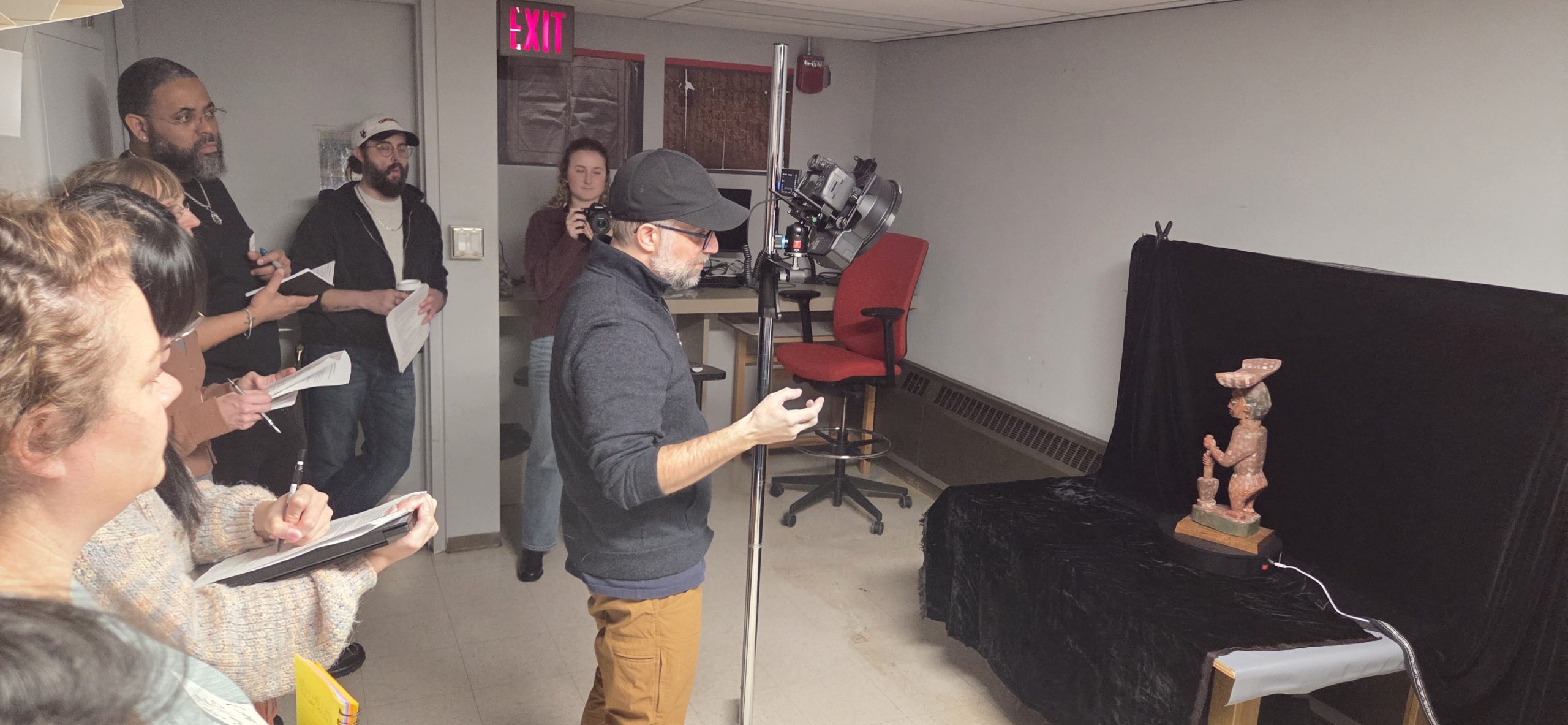
The instructors, Jordan Tate and John-David Richardson, both teach photography in DAAP. Previously, Jordan cross-collaborated with Jessica Ebert from the Preservation Lab on imaging the Assyrian Cornerstone, found in the collection of the Archives and Rare Books Library. Jordan demonstrated 3D imaging techniques and Jessica demonstrated how to do Reflectance Transformation Imaging (RTI).
Participants in the Friday, Dec.12th workshop were:
- Jessica Ebert – UC Libraries, Preservation Lab
- Catarina Figueirinhas – UC Libraries, Preservation Lab
- Erin Wilson – Ohio University Libraries, Preservation & Digital Initiatives
- Matt Carissimi – The Ohio State University Libraries, Digitization
- Sidney Gao – UC Libraries, Digital Initiatives Team
- Biz Gallo – Library of Michigan, Digitization Initiatives
- Dustin Wood – New South Associates/Veterans Affairs History Office (Dayton), Digital Archives & Museum Imaging Specialist
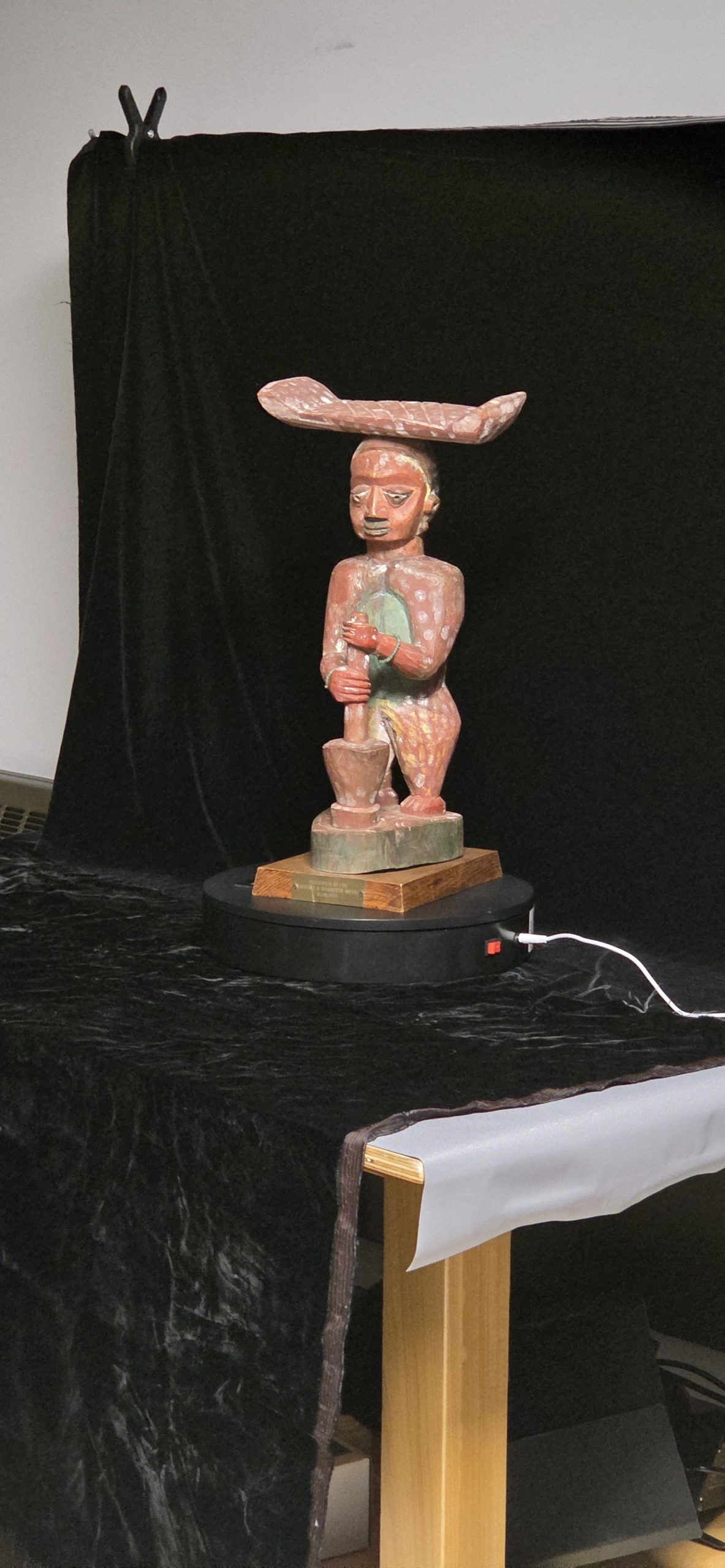
The object photographed came from the Henry R. Winkler Center for the History of the Health Professions.
The Yoruba, Luba or Luluwa/Lulua Statue (circa 1800—1900) was presented by “the Interns & Residents Wives Club, 1974” to the University of Cincinnati Hospital. The statue’s distinct shapes and facial features match most closely to the sculpture style of the Yoruba, Luba or Luluwa/Lulua. The figure appears to be working with a mortar and pestle, and was made for sale, rather than ceremonial or cultural use.
The Preservation Lab provides the full suite of preservation services to the University of Cincinnati Libraries. The Lab’s expertise is in book and paper conservation, with services available in general circulating materials repair, single-item conservation treatment, housing, exhibition prep and preservation consulting.
The use of 3D imaging in preservation is crucial as it creates an accurate visual record of an object before and after treatment. It allows conservators to examine often fragile objects in close detail without touching, and possibly damaging, the structure. In addition, 3D imaging provides a visual record for students and researchers to view and study.