
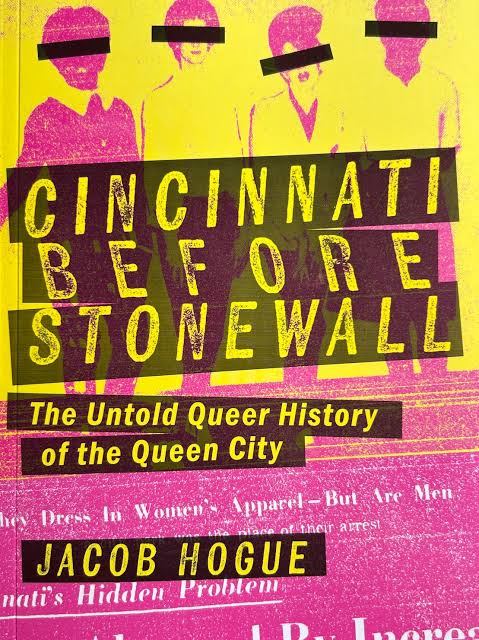
Jacob Hogue, author of Cincinnati Before Stonewall: The Untold Queer History of the Queen City, shares his experience with libraries and archives and his research process as a public historian with Nimisha Bhat, research & instruction librarian.
Congratulations on the publication of your new book! How has your research practice in and around libraries and archives evolved since you were a student? Were there particular classes or opportunities during your time at NKU that prepared you for undertaking the research for this book?
Since writing my debut book, I have actually taken a position as a Programmer in the Local History and Genealogy Department at the Kenton County Public Library. That experience has significantly expanded both the resources available to me and my understanding of how to use them. I now have access to historical maps, city directories, county histories, and other reference materials that have helped me uncover stories that might otherwise have remained hidden. Through the library’s resources, including Ancestry, I have also improved my ability to locate vital records and trace individuals through historical documents.
My degree is in Public History, and of all the courses I took at NKU, I would say my archives class prepared me the most for researching and writing this book. It taught me how to navigate archival collections, evaluate primary sources, and piece together fragmented stories from incomplete records. Those skills proved invaluable when researching LGBTQ+ history, where sources are often scattered, hidden, or difficult to identify. More broadly, NKU taught me how historians think—how to ask questions, follow evidence, and remain comfortable with ambiguity when the historical record is incomplete.
Referring to your subtitle, I assume you’ve found the process of researching queer history in Cincinnati to be challenging, given that much of it has heretofore been untold and marginalized, especially related to queer and trans people of color – have you found unconventional or surprising venues for finding the information you’ve needed to tell these stories?
One of the most surprising sources I encountered was Cincinnati’s medical literature. Textbooks, journal articles, and physician reports produced in the city helped me trace the emergence of sexology and changing attitudes toward sexuality and gender. Through these sources, I found early discussions of homosexuality, hermaphroditism (the historical term used at the time), and other forms of gender and sexual variance that increasingly came to be viewed as conditions that science and medicine were expected to explain—or even correct.
Newspapers were equally invaluable. Although journalists often lacked the language we would use today to describe LGBTQ+ identities, they nevertheless documented queer lives with surprising regularity. In fact, some of the earliest references I found to same-sex relationships and gender nonconformity predate Cincinnati’s incorporation as a city. One particularly memorable example involved the True Blue and Castigator, an early newspaper whose printing press was reportedly thrown into the river after it published speculation about local residents’ sexuality.
Another source that I found especially useful—and one that remains underutilized by many researchers—is the Lavender Listings. These directories documented LGBTQ+ bars, organizations, and businesses across the region. Because they can be mapped geographically, they provide an extraordinary tool for reconstructing queer spaces and community networks that might otherwise have been lost to history.
I imagine you’ve had to think creatively to come up with how to search for this history (and most likely you’ve had to work with a lot of outdated, homophobic, and transphobic language in order to find it.) What has helped to inform you of how to pivot how you research when you’re coming up without results?
Understanding the context of the time period you’re researching is the single most important skill. Historical actors did not use the language we use today, and if you search exclusively for modern terms, you’re going to miss most of the story.
For example, I learned that newspapers frequently reported on people “masquerading” in the clothing of the opposite sex. Once I began searching terms like “masquerade,” “masquerader,” and related phrases, I uncovered stories that would never have appeared in a search for words like transgender or cross-dressing. The same principle applies more broadly. Queer people were often described through the prejudices of the era, with newspapers referring to them as “singular discoveries,” “degraded creatures,” “moral perverts,” or “lewd and lascivious persons.” When a search comes up empty, I often step back and ask: What words would a nineteenth-century journalist, police officer, doctor, or minister have used to describe this person or behavior? Then I begin searching variations and synonyms of those terms.
One of the most useful lessons I’ve learned is that sometimes you are not searching for sexuality or gender directly at all. Victorian society placed enormous importance on clothing as a marker of respectability and gender conformity. As a result, searches for phrases like “women’s clothes,” “men’s clothes,” “attired as a woman,” or “dressed in male attire” can reveal stories about gender nonconformity that would otherwise remain hidden. The key is learning to think like the people who created the records rather than the people who are studying them today.
Researching queer history often means sifting through vast amounts of material and confronting language that is outdated, offensive, and sometimes painful to read. But hidden among those sources are remarkable stories that would be lost if we limited ourselves to modern terminology. Some of the most important discoveries in my book came from following those unexpected linguistic trails.
What do you think it is about Cincinnati in particular that has cultivated the rich queer history you’ve documented in your book?
I think Cincinnati’s rich queer history is inseparable from its history as a major American city. During the mid-to-late nineteenth century, Cincinnati was often called the “Paris of America.” It was one of the largest cities in the country, a center of commerce, immigration, theater, publishing, and culture. Wherever large numbers of people gather, queer communities tend to emerge—and Cincinnati was no exception.
What surprised me most was not that a vibrant queer subculture existed here, but that so little had been written about it. In many ways, that absence reflects Cincinnati’s later reputation as a socially conservative city. For much of the twentieth century, Cincinnatians told themselves a particular story about their past: who lived here, what values defined the city, and what kinds of lives were acceptable. But when you begin reading diaries, arrest records, court documents, medical reports, and newspaper accounts, a much more complicated picture emerges.
The historical record makes one thing abundantly clear: queer people have always been here. They were our neighbors, coworkers, entertainers, soldiers, ministers, and family members. They lived in every era of Cincinnati’s history, even when society lacked the language to describe them or tried to push them into the shadows.
Ironically, some of the same forces that sought to suppress queer life also helped preserve evidence of its existence. Arrest records, moral reform campaigns, newspaper exposés, and court cases all generated paper trails. Those documents were often created by people who disapproved of queer lives, but they left behind breadcrumbs that allow historians to reconstruct communities and stories that might otherwise have been lost. In that sense, Cincinnati’s conservatism did not erase queer history—it inadvertently documented it.
Do you have any advice for history students in the Cincinnati area who love to research but aren’t quite sure what to do with their degree after graduation?
My biggest piece of advice is to find your niche and never assume that the research is “finished.” There are still countless stories waiting to be told, particularly when it comes to the histories of marginalized communities. Women’s history, LGBTQ+ history, Indigenous history, immigrant history, and the histories of people of color have all received more attention in recent years, but there is still so much left to uncover—especially at the local level.
I would also encourage students to immerse themselves in the broader context of the era they are studying. Understanding the political, social, economic, and cultural realities of a particular time period will not only make you a better writer, but also a better researcher. It opens up new avenues of inquiry and helps you recognize sources that others might overlook. For example, if I were researching Japanese immigrants in Cincinnati after World War II, I would begin by learning about the city’s social and political climate during that period. From there, I might turn to census records, city directories, newspapers, and other sources to identify people born in Japan who were living in Cincinnati and begin reconstructing their stories.
Perhaps most importantly, don’t be afraid to pursue a project that seems too ambitious. When I began researching Cincinnati’s LGBTQ+ history, I had no intention of writing a book. In fact, I assumed someone else had already done it. When I discovered that no one had, I decided to try. If I can write a book, you can too.
You can buy Jacob’s new book and check out upcoming events from Queens of Queen City.