
Registrations, Registered Reports, and Preprints: additional research outputs in the open research approach.
The Open Access Week blog posts from 10/19 and 10/21 focused on Open Access publishing for the article which is part of a bigger research approach known as open research or open science. Per the UNESCO Open Science effort1, the goal is to make scientific knowledge accessible and reusable. If done completely through the research lifecycle, then every step of the process and all the research output is openly available by project’s end. Not all projects can make the process completely open and share all the outputs e.g. a data set containing personal identifiable information, and the best efforts are to try for “as open as possible, as closed as necessary” 2. Prior to the publication of the accepted article version of record, there are other options to promote research projects. These are known as Registrations and Preprints. Registered Reports are derived from registrations and are fully peer-reviewed like other articles. So how do researchers get the most from these practices and additional outputs?
Registrations3 make the study plan available early in a project and allow peer review of the protocol before data is collected. It also provides a time stamp for this stage of the project. This can help optimize a research project to ensure that the necessary data is collected to address the intended research question. Also, this practice promotes impartiality, quality, reproducibility, and transparency. Certain journals4 will commit to publishing a registered report from the registration. This means there will be a scholarly publication regardless of the outcome even if this includes negative results. Publishing a registered report demonstrates that negative results have value and to let other researchers in the discipline know this research was attempted already and under what conditions. The registration and the registered report get a digital object identifier and metadata, and the identifiers for project related output can be compiled to track the project through its lifecycle.
The last type of pre-approval publications is the preprint5. This is the preliminary version of the article prior to peer review, acceptance, and copy-editing for publication. Like registrations, preprints also promote transparency and provide additional crucial details about the research process. But most importantly, they provide a publicly accessible version of the research in a timelier manner than the final peer-reviewed article. Though preprints do not meet the public access mandate requirements from US federal funders, they give access to the details of the research far in advance of the version of publication.
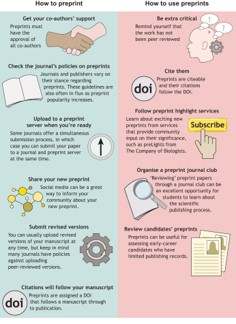
Image credit: see reference #6 – https://doi-org.uc.idm.oclc.org/10.1242/jeb.250590
Publishing a preprint can present challenges6. Errors can be found early which is a benefit and could also be an embarrassment. If there are inaccuracies, these can be promoted before corrections are made, and there is the fear to be scooped. But with the content of the preprint having a DOI for attribution, publishing the article would have the same concern. It adds time to the project to publish a preprint, and this also usually means an additional platform as many preprints go into preprint archives and not into the same journal as the article. Also not all journals will accept an article if there is a preprint. To check journal policies, you can search the JISC Open Policy Finder7 to see if your journal of choice has a preprint policy established. Ask the publisher or your subject librarian8 if you need assistance.
AI has been a paradigm shifting change agent, even in the preprint arena. Recently Arxiv9 announced that it is changing its process to accept preprints. New authors will need to be endorsed by existing authors prior to publishing their preprint. This extra step is intended to minimize the number of AI generated submissions.
Despite the challenges, the many benefits of preprints mirror those for registrations. Publishing a preprint also promotes impartiality, quality, reproducibility, and transparency. In addition to these benefits, a preprint can increase the impact of the research, provides a path of rapid dissemination especially for students and early career researchers, and supports the bigger goals of open research. For researchers, there is evidence10 that articles that have a preprint have higher altmetrics and are published in higher ranked journals.
If you are interested in learning more about these practices, we encourage you to talk with your subject librarian or our Scholarly communications librarian, Melissa Moreau.
Resources
- Open science | UNESCO https://www.unesco.org/en/open-science