Making history visible: Chemistry displays help transform Old Chem
By Mark Chalmers, Science and Engineering Librarian and Curator of the Oesper Collections
The scavenger hunt clue was discovered by accident, tucked inside the sliding glass doors to one of the Old Chemistry building’s new display cases. The typed note read: “They don’t speak, but they’ve seen it all — Minds that sparked the rise and fall. Pasteur, Franklin, Cannizzaro too — Their faces cast in quiet view. Find the wall where legends stare, and history lingers in the air.”
Someone had incorporated the busts of famous scientists —Pasteur, Franklin, Cannizzaro—into their puzzle, working the display’s content into the clue itself. The clue was confirmation that the year-long installation project was achieving exactly what was hoped: students weren’t just walking past 100 linear feet of chemistry history; they were engaging with it.
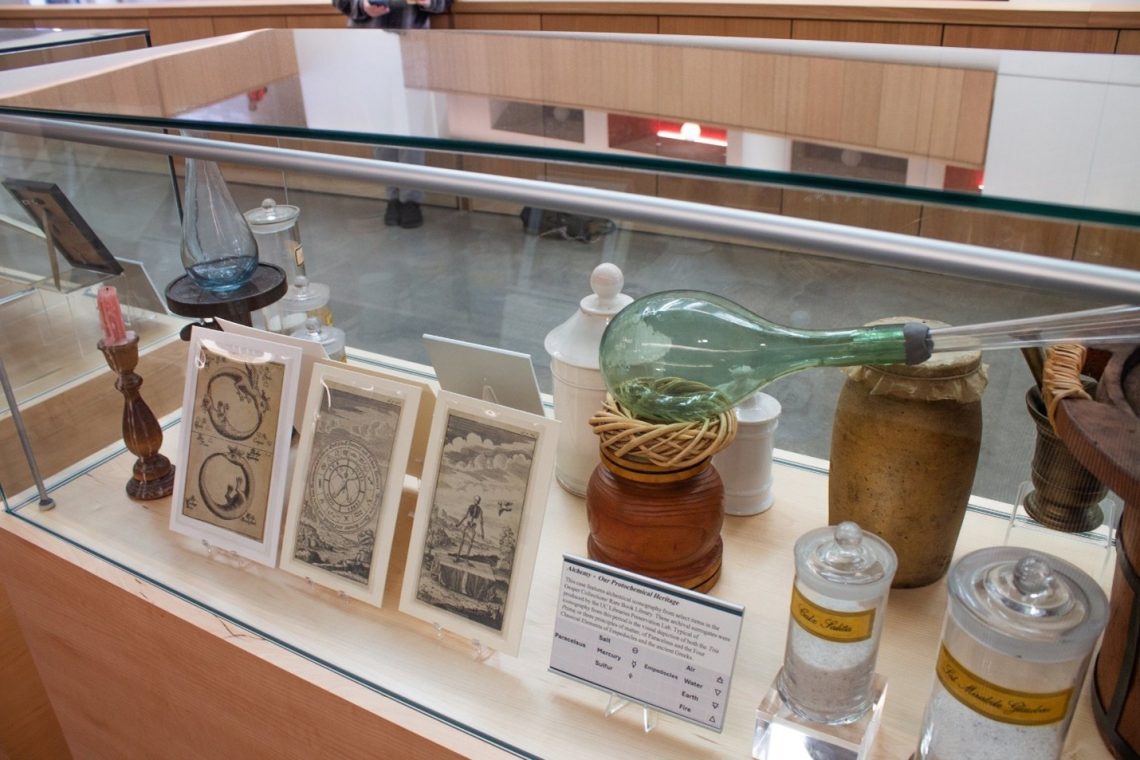
From September 2024 through August 2025, I led a collaborative effort to transform Old Chem’s renovation into an opportunity to make the Oesper Collections—one of the world’s largest curated collections of chemistry artifacts and historical materials—visible to the numerous students, staff and faculty who now pass through the building daily. The project coincided with UC Chemistry’s 150th anniversary, making it a fitting moment to showcase the department and the discipline’s rich history.
A Rare Opportunity
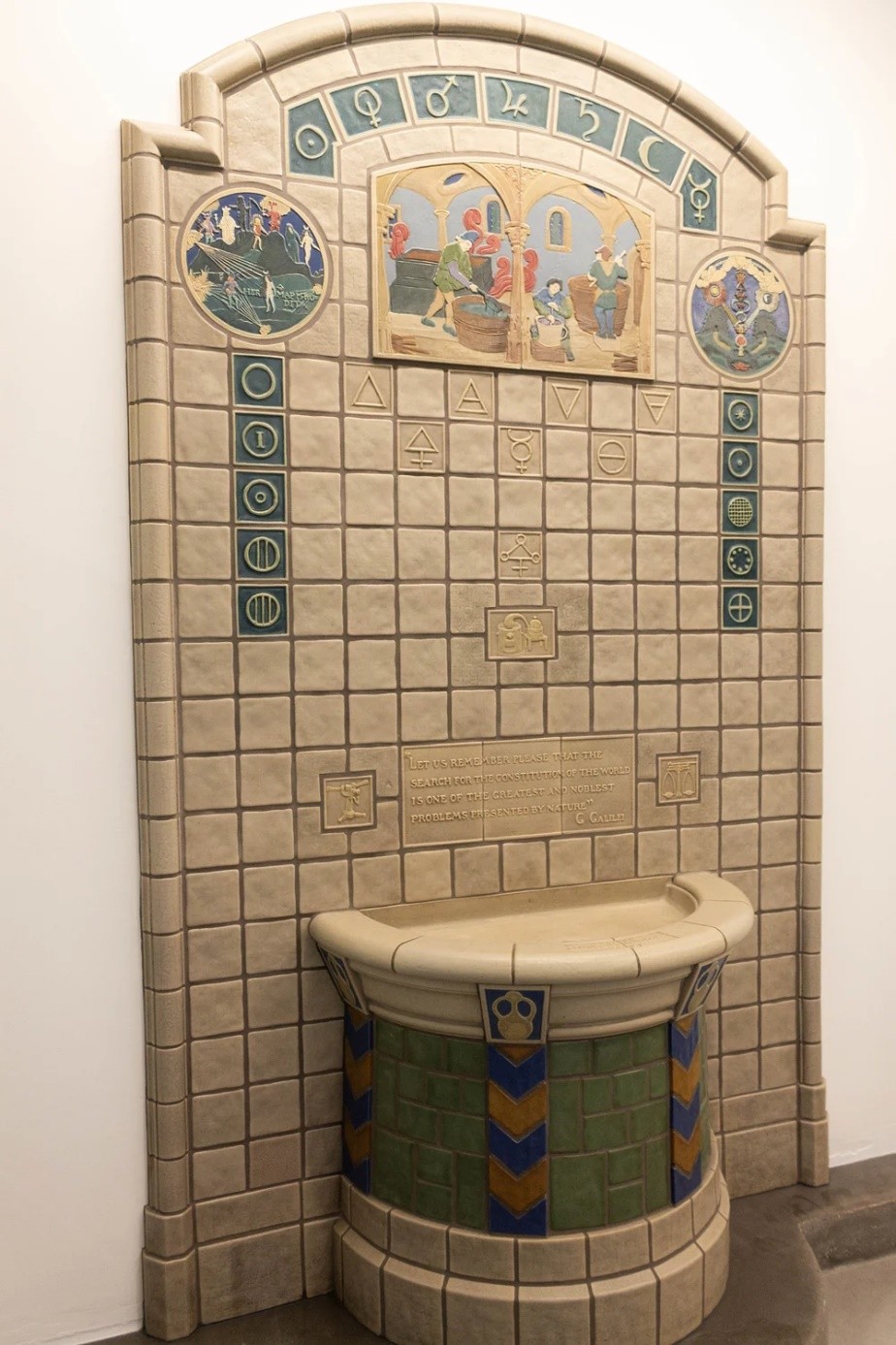
The $190 million renovation of the 108-year-old building presented a unique opportunity. While Old Chem now houses cutting-edge laboratories for chemistry, engineering and biology, it also preserves history in every detail. The building’s architects drew inspiration from the restored Rookwood fountain, echoing its chevron patterns and tile designs in frosted windows throughout the building’s conference rooms and study spaces. This philosophy—bridging past and future—laid the groundwork for the displays.
This was a unique opportunity to be given so many display cases to showcase our historical collections in a state-of-the-art renovation combining teaching labs, research labs and unique historical objects and narratives.
The Oesper Collections is one of the world’s largest curated collections of scientific artifacts, books, journals, photos and prints related to the history of chemistry—a collection recognized as a National Historic Chemical Landmark by the American Chemical Society. Housed in the Oesper Museum in Rieveschl Hall with limited public access, these treasures remained largely unknown to the students, faculty and visitors who now move through Old Chem daily.
Two Generations, One Passion
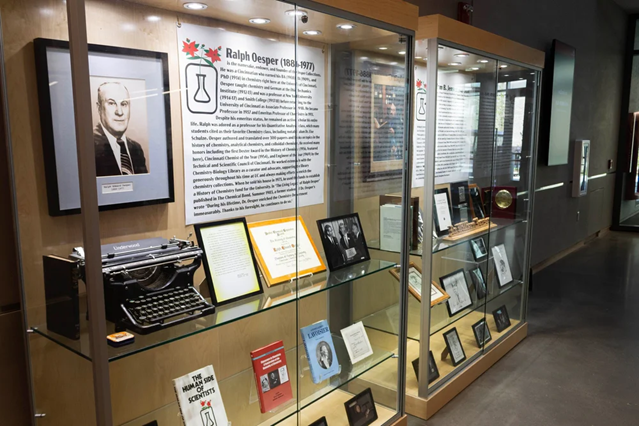
The story of the collections that populate the displays begins with two remarkable collectors whose passion for chemistry’s history shaped UC’s collections over nearly a century.
Ralph Oesper (1886-1977) was a Cincinnatian who earned his BA, MA, and PhD in chemistry at UC before becoming a beloved professor. Over his career, he authored and translated more than 300 papers and books on chemistry and its history, receiving the first-ever Dexter Award for Outstanding Achievement in the History of Chemistry in 1956. When he sold his house in 1973, he used the proceeds to establish what would become an endowment for the collections that now bear his name.
Oesper’s approach was deeply humanistic. His 1975 book The Human Side of Scientists collected anecdotes showing famous chemists as quirky, relatable people, not just names in textbooks attached to equations, reactions and instruments. Oesper’s impact continues to enrich the Chemistry Department even almost 50 years after his passing.
William Jensen (1948-2024) carried that vision forward. Appointed Oesper Professor in 1986, Jensen founded the museum and expanded the collections dramatically, acquiring volumes for the library, prints and photos from chemistry’s history, and rescuing antique apparatus from universities and labs across the country. His hand-drawn caricatures of famous chemists, sketched as a graduate student in the 1970s, became beloved teaching tools that now appear throughout the Old Chem displays.
“The Collectors” cases on the 400 level feature two Dexter Awards, the outstanding career achievement award given out by the American Chemical Society’s (ACS) History Division: Oesper’s original plaque from 1956—the first ever given—and Jensen’s from 2005. Between them, there is five decades of dedication to chemistry history. Both men served the ACS’s History Division extensively during their careers, stewarding the same scholarly community across generations.
A Collaborative Vision Realized
Creating 100-plus linear feet of displays required expertise from across the Libraries and Chemistry Department. Lily Bambalas, PhD student in chemistry and the Oesper graduate assistant, took on more than 30 linear feet, curating the entire “Discovery of Elements and Periodic Table” section on the 400 level of the building across from “The Collectors.” From spiral galaxy designs to pyramid steps, the display features multiple table formats alongside stories of element discoveries: Mendeleev’s prediction of gallium, spectroscope discoveries like cesium and dramatic tales like the Marsh test for arsenic.
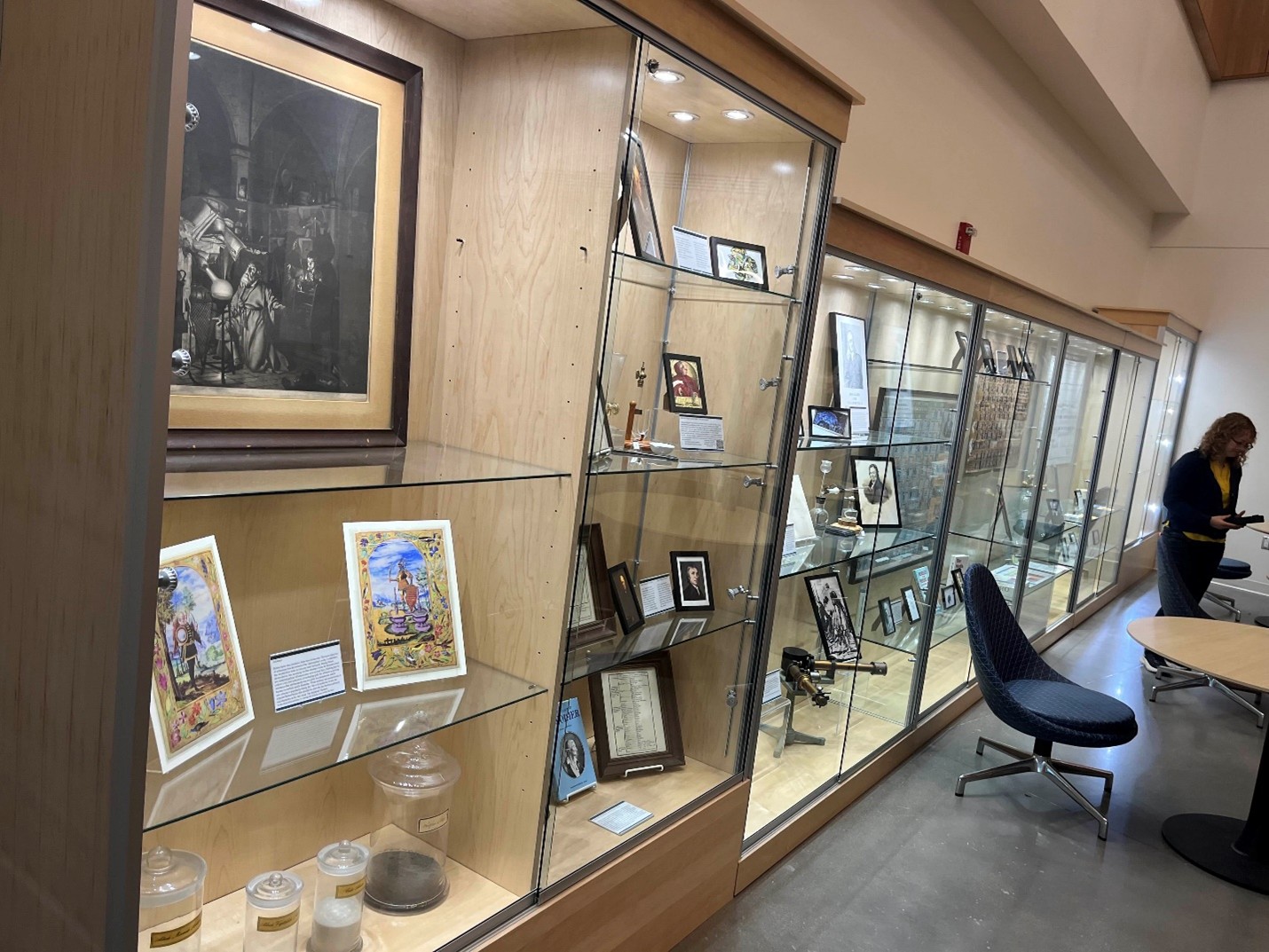
Design, Architecture, Art and Planning (DAAP) coop-student Kiera Yeck brought crucial graphic design skills and a fresh perspective to the project. She created signage incorporating imagery from Oesper’s Human Side of Scientists book cover, designed display label templates and wrote labels for art objects in the women in chemistry section. On her portfolio website, Yeck reflected on the challenge of learning chemistry history as a non-chemistry student: “I had to stretch those barriers into the creative side.”
The project required coordination with UC’s Digitization Team, which scaled down oversized periodic tables so they could fit in the cases, and the Preservation Lab, which created archival surrogates of pages, woodcuts and lithographs from the rare book collection, making fragile 17th-century materials display-safe. The label colors echo the Rookwood fountain’s palette, while alchemical imagery from those centuries-old books mirrors symbols visible in the fountain itself.
I could not have done this entire project without the support of the partners in Planning, Design & Construction, the student workers and my colleagues in the libraries. Lily took on a significant section of the displays, which helped me focus on the other cases and how they fit into the spaces in the building, and Kiera brought important student and art installation perspectives as well as graphic design skills that were invaluable.
The installation happened the weekend before classes started in August 2025—a fitting culmination of a year’s work drawing on Jensen’s scholarship while creating entirely new displays.
Stories That Make Scientists Human
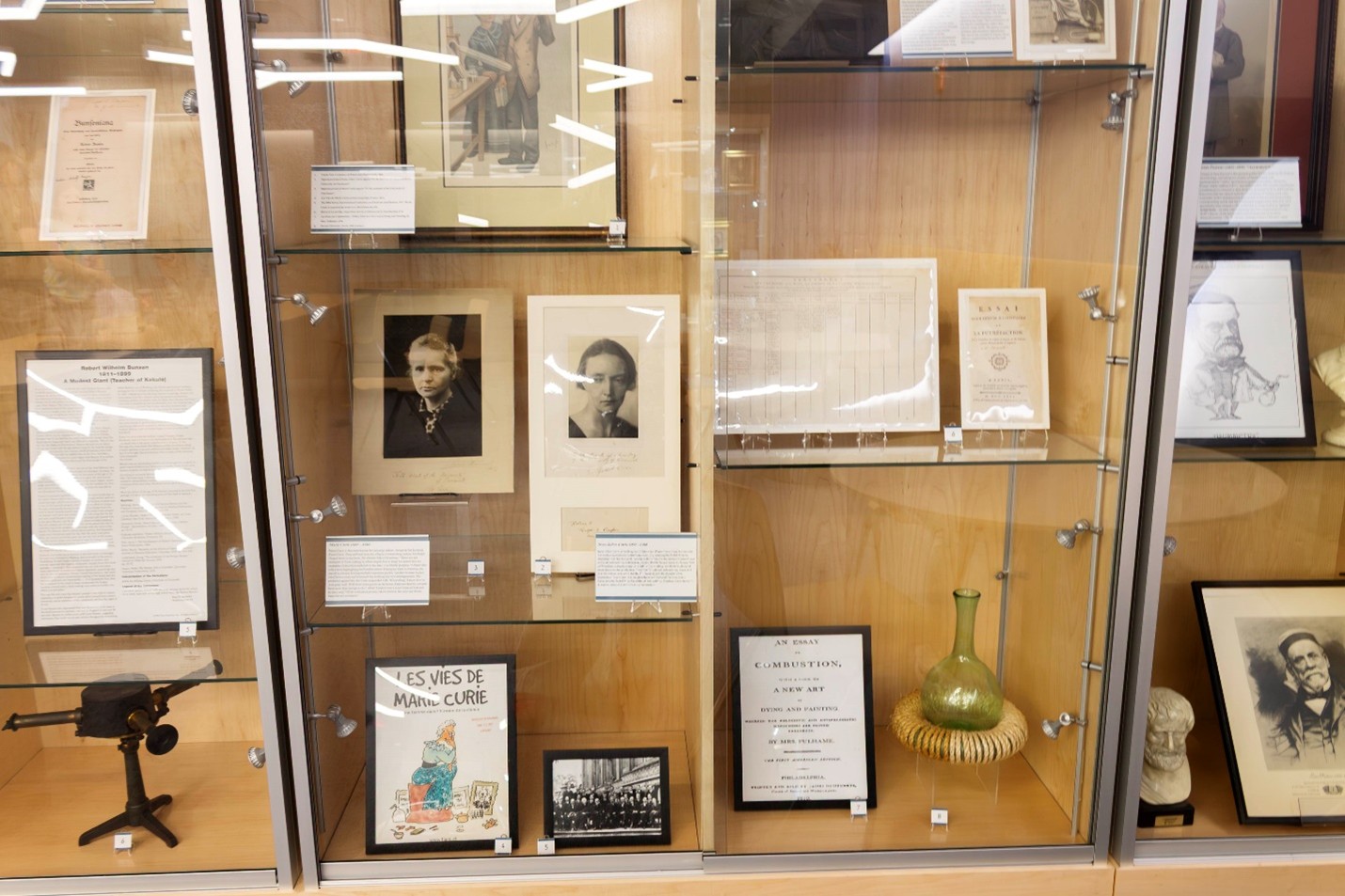
Walk through Old Chem’s 500 level today and you’ll encounter chemistry history that reads like literature. The “Human Side of Scientists” cases bring Oesper’s biographical approach to life with unexpected anecdotes and human imagery:
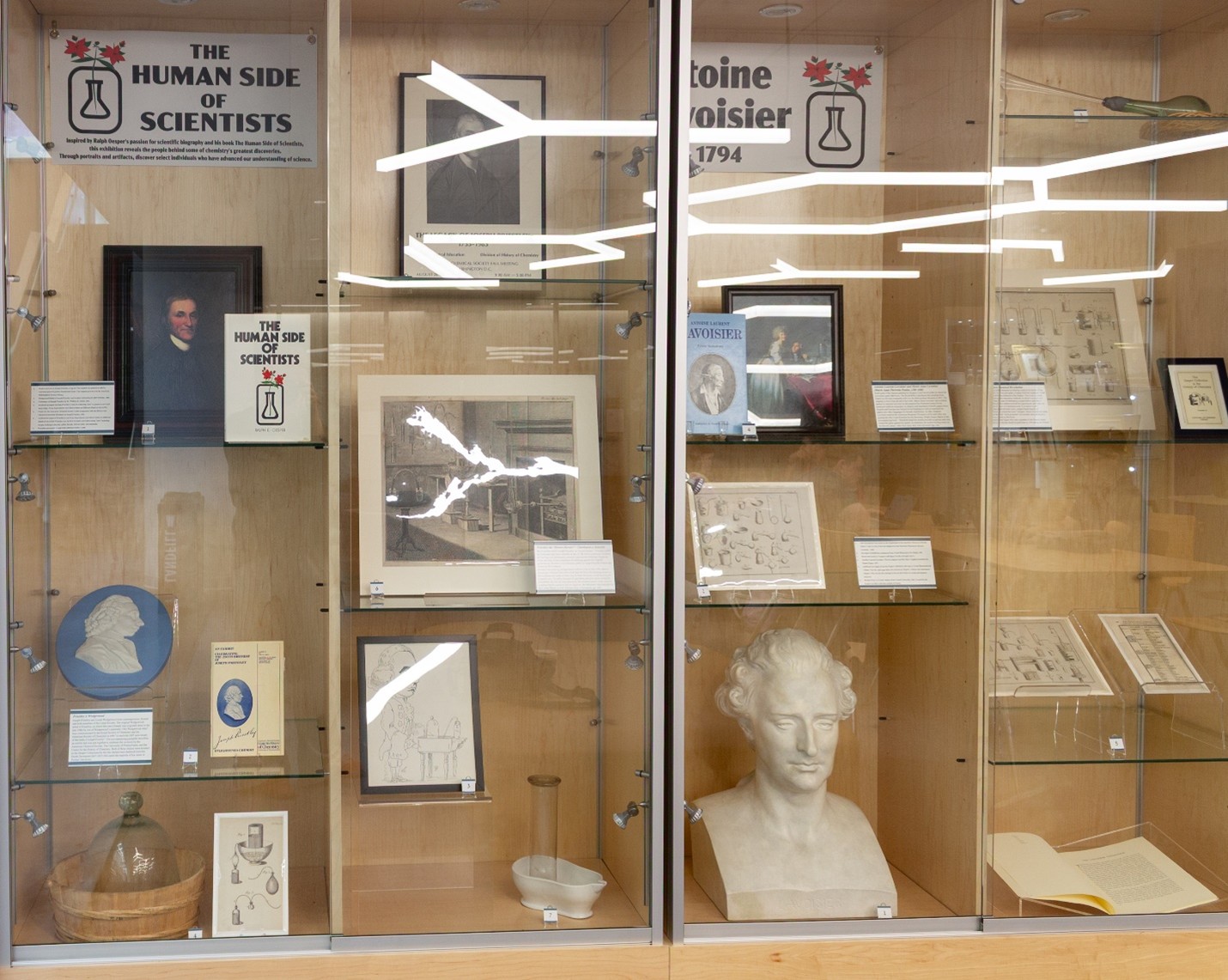
Marie Curie, hosting important guests in America, was found by another woman washing her own undergarments. When protested, Curie responded simply: “It is nothing; I know how to do it quite well. With these extra guests in the house, I am sure that the servants have more than enough to do.” Einstein later said of her, “Of all celebrated persons, Marie Curie is the only one whom fame has not corrupted.”
Robert Bunsen, whose burner appears in a neighboring case. refused to patent his invention, believing firmly that “working is beautiful and rewarding, but acquisition of wealth for its own sake is disgusting.” He told students about a former pupil who had amassed a fortune: “I cannot understand the man; he certainly has outstanding scientific talents and yet he thinks of nothing except accumulating money.”
There’s irony, too. When a student told Marie Curie about his doctoral thesis on artificially induced radioactivity, she dismissed it as impractical and outside her interests. Years later, her daughter Irene Joliot-Curie won the Nobel Prize for exactly that work. Marie’s reflection: “It is easy to criticize in retrospect a monomania.” Portraits of both Marie Curie and Irene Joliot-Curie signed to the students at the University of Cincinnati are proudly displayed in these cases alongside the anecdotes.
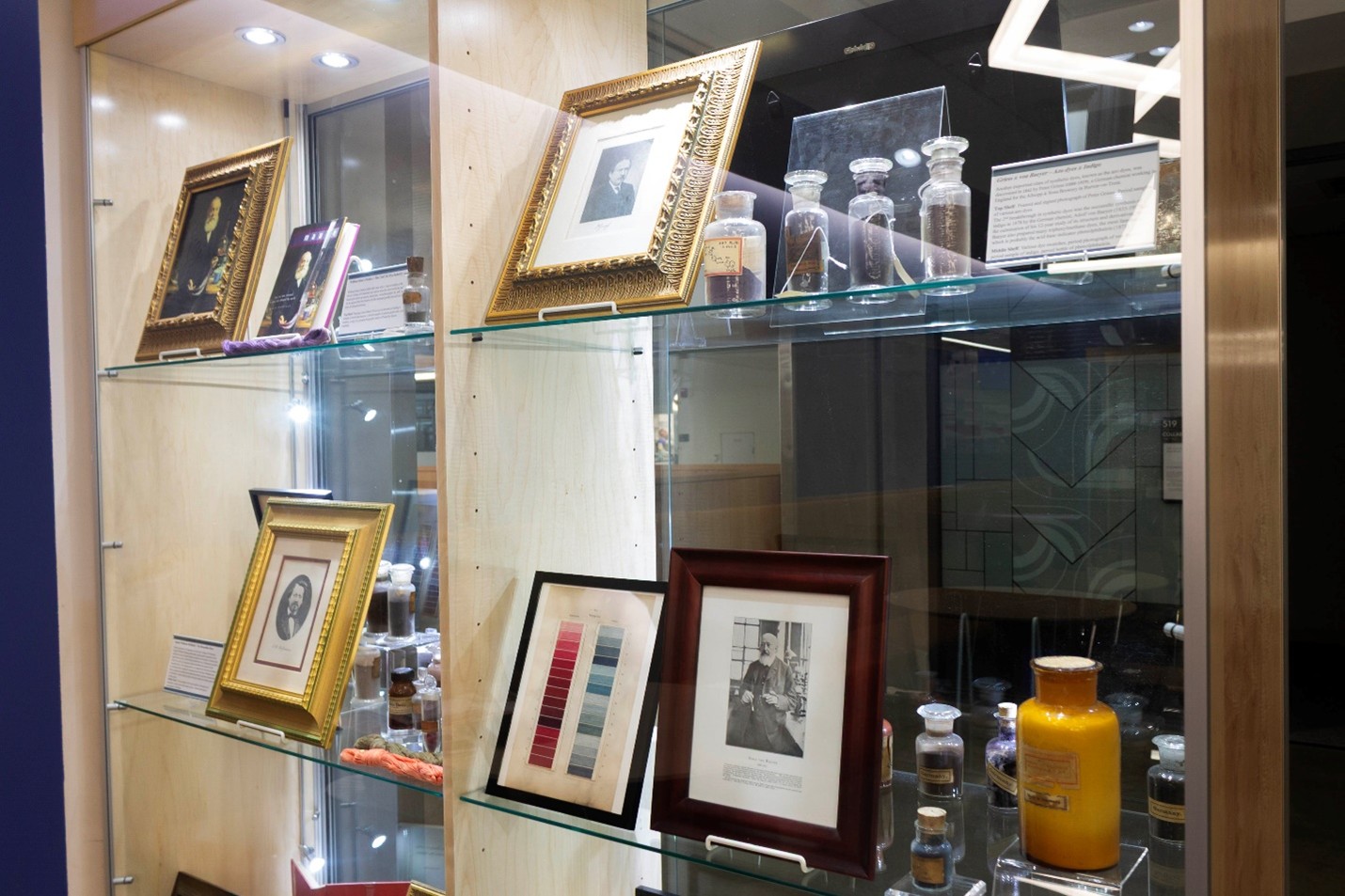
Other displays explore Cincinnati’s chemical heritage through Thomas Norton, who chaired UC’s Chemistry Department in the 1890s after studying under Robert Bunsen at Heidelberg. His artifacts from Germany connect UC directly to European chemistry’s golden age. The Coal-Tar Dye Industry case tells how 17-year-old William Henry Perkin’s accidental discovery of mauve dye in 1856 launched a global industry.
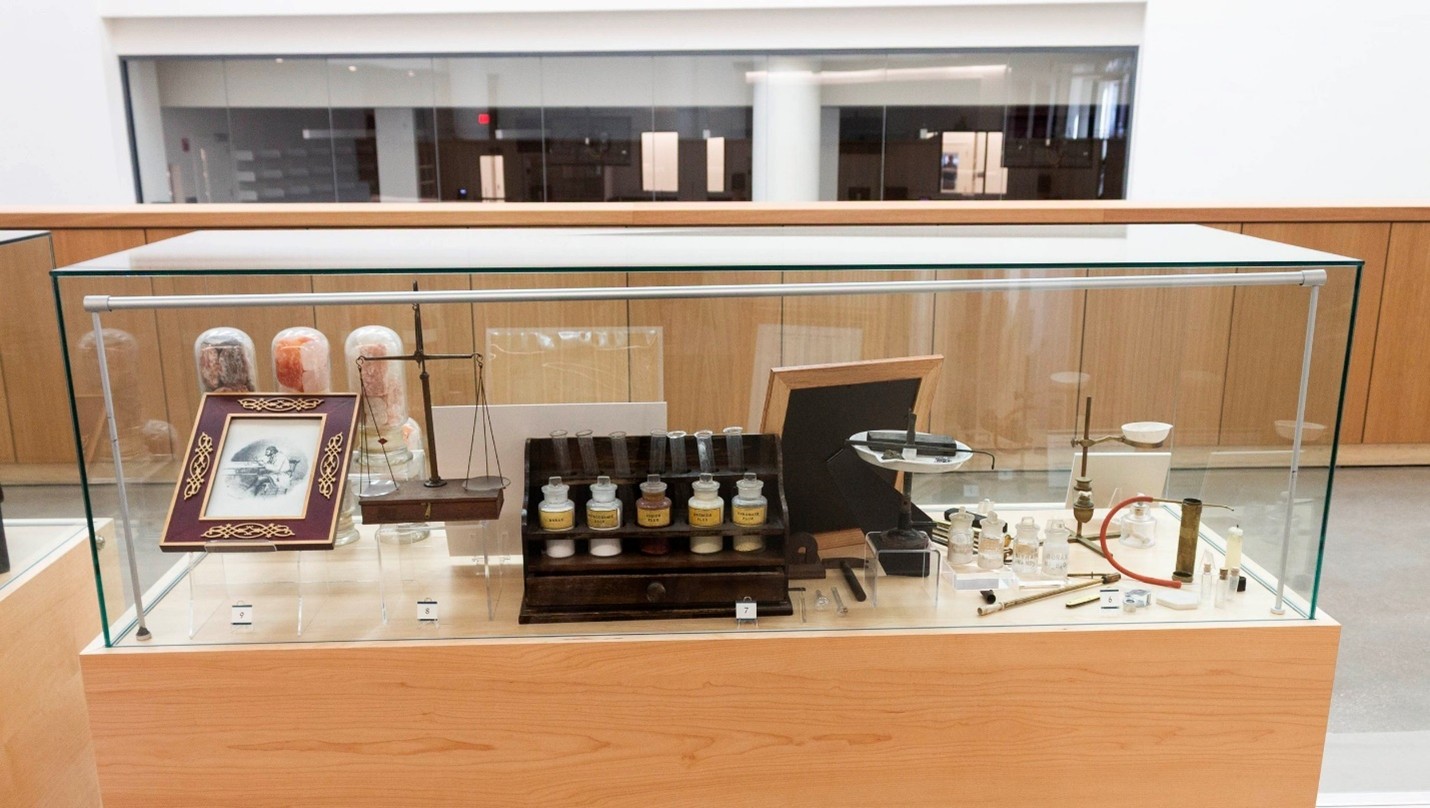
The cases feature a rare bronze plaque depicting an educated woman conducting experiments, alongside Marie Meurdrac’s 1687 “La Chymie Charitable et Facile, en Faveur des Dames”—evidence of women’s often-overlooked contributions to chemistry’s prehistory. Historic cells from Edison and Daniell, blowpipe analysis equipment, and antique mineral samples round out the display cases.
Making History Matter
The response has exceeded expectations. Photos of the displays were unexpectedly featured in the Cincinnati Business Courier’s coverage of the building renovation. Students encounter the cases constantly, and that scavenger hunt clue wasn’t an isolated incident.
More significantly, faculty are integrating the displays into coursework. A History of Exhibitions & Displays class uses them as case studies for the class to critique and analyze. Cosmetic Sciences students engage with the Coal-Tar Dye Industry case, connecting 19th-century dye chemistry to modern formulations. Mineralogy students study the blowpipe analysis equipment and period mineral samples and have recently incorporated flame tests into their lab section, using blowpipes from the collection.
I hope students gain a deeper appreciation for chemistry’s rich history and the human side of science. Ralph Oesper was a big proponent of scientific biography and I want to carry that forward, helping students to appreciate that great scientists who made contributions that changed the world are also human and sometimes even humorous.
The project exemplifies UC Libraries’ strategic directions to Enrich Our Collections and Expand Our Impact. By moving materials from a by-appointment museum into a building where hundreds pass daily, the displays make scholarship accessible in new ways. They honor the vision of two generations of collectors while inviting a new generation to discover the human stories behind the science and the Oesper Collections’ incredible library and apparatus collection.
The scavenger hunt clue now lives in the Oesper Collections and remains a reminder that when history becomes visible, students find their own ways to engage with it. The displays are open during Old Chemistry’s regular building hours. More information about the Oesper Collections is available online.