
By Tiffany J. Grant, PhD
Traditionally, research findings were published in journal articles, but much of the data gathered in the process was seldom made available. Now funders, publishers, and institutions demand that both publications and supporting data be openly available. Open research does not stop at publications; it also includes all research outputs, such as data, code, and even open peer review. Open access can help increase the impact of research and potentially speed up new discoveries.
Federal policies require researchers to deposit federally funded research in open data repositories. While open-access publishing makes research findings freely available to readers, open data repositories enhance transparency by providing access to the datasets underlying those findings. Open access publishing and open data repositories advance the principles of open science by promoting greater openness, reusability, and reproducibility in research. While open access publishing gives readers access to the story, open data repositories give readers access to the evidence behind the story, allowing others to examine and reuse it.
Open data repositories are places where researchers can share data to make it easier to find. Many open data repositories provide DOIs (digital object identifiers), or digital tags, to help researchers cite their data, support long-term storage, and meet funder and publisher requirements to share data. Sharing research data in a trustworthy open data repository can make your data more accessible, reusable, and compliant with FAIR (Findable, Accessible, Interoperable, and Reusable) principles.
Considerations for Selecting a Data Repository
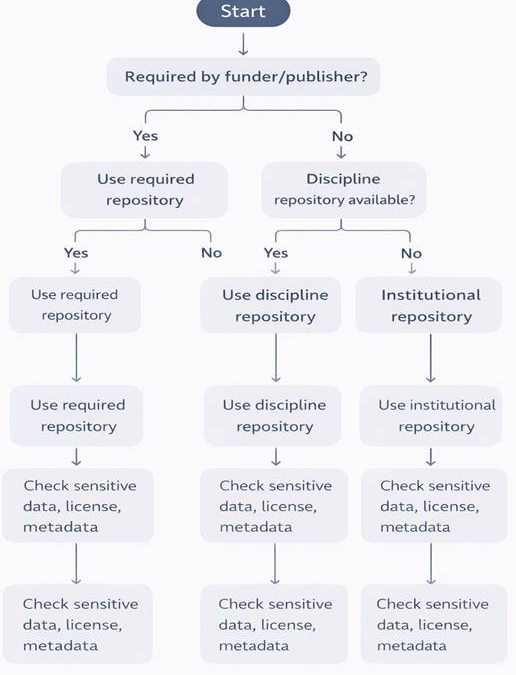
Simplified flowchart for choosing a research data repository. Created with BearChatGPT based on author specifications, October 14, 2026.
Selected Repository Options
Generalist Repositories
General repositories accept research data, code, and scholarly outputs regardless of subject matter, data format, or academic discipline. These are good options when no disciplinary repository exists.
- Figshare: Supports datasets, code, figures, posters, presentations, and other research outputs. Provides DOIs, versioning, and sharing controls, making it popular among universities and research institutions. UCFigshare is the data repository available for federally funded University of Cincinnati researchers to promote the sharing of scientific data in compliance with. UCFigshare provides a data sharing platform consistent with the FAIR (Findability, Accessibility, Interoperability, and Reusability) data principles and is provided via a partnership between the Office of Research, UC Libraries, and DTS.
- Zenodo: A free multidisciplinary repository that allows researchers to share datasets, software, publications, and other research products while receiving a DOI.
- Dryad: A curated repository commonly used for datasets associated with scholarly publications, particularly in the life and environmental sciences.
Domain Specific Repositories
Domain-specific repositories are specialized repositories that collect, preserve, and share data, code, or research outputs tailored to a particular academic field, scientific discipline, or data type.
Social Sciences and Education
- ICPSR (Inter-university Consortium for Political and Social Research): One of the largest social science data archives, housing datasets related to sociology, political science, education, public health, and economics.
- UK Data Service: Provides access to social, economic, and population data for research and teaching. The principal repository for economic, population, and social research data in the UK
- Qualitative Data Repository (QDR): Supports the sharing and preservation of qualitative and mixed-methods research data.
Health and Biomedical Sciences Repositories
- GenBank: Genetic and DNA sequence data.
- Protein Data Bank (PDB): Three-dimensional protein and biomolecular structures.
- Gene Expression Omnibus (GEO): Functional genomics and gene expression data.
- Sequence Read Archive (SRA): High-throughput sequencing data.
- dbGaP: Genotype and phenotype datasets with controlled access mechanisms for sensitive human-subjects data.
Environmental and Earth Sciences Repositories
- Environmental Data Initiative (EDI): Ecological and environmental datasets.
- PANGAEA: Earth system, oceanographic, climate, and environmental science data.
- NOAA National Centers for Environmental Information (NCEI): Weather, climate, and oceanographic data.
- EarthChem: Geochemical and earth science research data.
Engineering, Physical Sciences, and Computing
- Zenodo: Widely used for software, code, and engineering datasets.
- Materials Data Facility (MDF): Materials science data.
- IEEE DataPort: Engineering and technology datasets.