
Open Access Week 2026 – a graduate student’s experience

by Collin Brice, Ph.D., CCC-SLP

Collin Brice, Ph.D., CCC-SLP graduated from the University of Cincinnati in August of this year. He is a speech-language pathologist and an assistant professor at the University of Scranton in Scranton, Pennsylvania in the Occupational Therapy and Communication Sciences and Disorders department. 

After five years of practicing as a speech-language pathologist, I applied to a PhD program out of frustration with what I still didn’t know about my field. While I am grateful for the experience and the career I chose, it wasn’t until I heard about open science that I realized what I didn’t know may have simply been hiding behind a paywall. Part of open science involves open access, a practice that makes research available without a subscription to a database or journal. 

Open access appealed to me from both sides of my career. As a citizen of the United States and a practicing clinician, I found it compelling that the science my tax dollars fund can (and should!) be freely accessible to me. As a budding researcher, I found it equally compelling that whoever wants to read or interact with my hard work should be free to do so. 

It wasn’t until diving in a bit more that I realized open science doesn’t just make research accessible; it also holds researchers accountable. Practices like preregistration, for example, ask you to commit to your plan publicly before collecting any data. To come up with a research idea as a PhD student is one thing; to commit to and describe every detail of my study before it begins is another. That commitment felt daunting at first, but I wasn’t starting from scratch. Because others had shared their work openly, I was able to find similar experimental designs, templates to plan and justify every step of my data organization and analysis, and even open educational resources so that I did not have to reinvent the wheel for every course I teach. As a new student and now a new professor, I still find these resources invaluable, and they’ve shaped how I see my role in the field. 

The world of science and education is changing, and the demands on those of us in these roles keep growing. Open science reminds me that we are a community who can share the burdens of academia together, build on the foundations others have laid, and make our commitment to science more than a single ripple. 
Open Access Week 2026 – Open Data Repositories: Choosing the Right Home for Your Research Data

By Tiffany J. Grant, PhD

Traditionally, research findings were published in journal articles, but much of the data gathered in the process was seldom made available. Now funders, publishers, and institutions demand that both publications and supporting data be openly available. Open research does not stop at publications; it also includes all research outputs, such as data, code, and even open peer review. Open access can help increase the impact of research and potentially speed up new discoveries.

Federal policies require researchers to deposit federally funded research in open data repositories. While open-access publishing makes research findings freely available to readers, open data repositories enhance transparency by providing access to the datasets underlying those findings.  Open access publishing and open data repositories advance the principles of open science by promoting greater openness, reusability, and reproducibility in research. While open access publishing gives readers access to the story, open data repositories give readers access to the evidence behind the story, allowing others to examine and reuse it.

Open data repositories are places where researchers can share data to make it easier to find. Many open data repositories provide DOIs (digital object identifiers), or digital tags, to help researchers cite their data, support long-term storage, and meet funder and publisher requirements to share data. Sharing research data in a trustworthy open data repository can make your data more accessible, reusable, and compliant with FAIR (Findable, Accessible, Interoperable, and Reusable) principles.

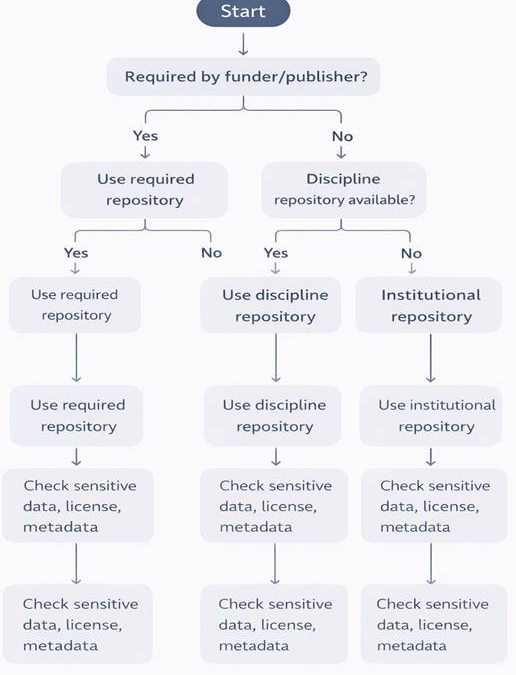
Considerations for Selecting a Data Repository

Open Access Week 2026 – Open Data Repositories: Choosing the Right Home for Your Research Data

Simplified flowchart for choosing a research data repository. Created with BearChatGPT based on author specifications, October 14, 2026.

Selected Repository Options

Generalist Repositories

General repositories accept research data, code, and scholarly outputs regardless of subject matter, data format, or academic discipline. These are good options when no disciplinary repository exists.

  • Figshare: Supports datasets, code, figures, posters, presentations, and other research outputs. Provides DOIs, versioning, and sharing controls, making it popular among universities and research institutions. UCFigshare is the data repository available for federally funded University of Cincinnati researchers to promote the sharing of scientific data in compliance with. UCFigshare provides a data sharing platform consistent with the FAIR (Findability, Accessibility, Interoperability, and Reusability) data principles and is provided via a partnership between the Office of Research, UC Libraries, and DTS.
  • Zenodo: A free multidisciplinary repository that allows researchers to share datasets, software, publications, and other research products while receiving a DOI.
  • Dryad: A curated repository commonly used for datasets associated with scholarly publications, particularly in the life and environmental sciences.

Domain Specific Repositories

Domain-specific repositories are specialized repositories that collect, preserve, and share data, code, or research outputs tailored to a particular academic field, scientific discipline, or data type.

Social Sciences and Education

Health and Biomedical Sciences Repositories

Environmental and Earth Sciences Repositories

Engineering, Physical Sciences, and Computing

Join the open conversation

Join UC Libraries in celebrating International Open Access Week 2026.

Research is a conversation. We build upon the insights and findings of those who’ve preceded us, and those we work in parallel with, to move our areas of study forward. Ideally, those conversations also push beyond the boundaries of the academy, informing work done by practitioners, industry, activists and government. But, not everyone is having the same conversation.

Paywalls and the considerable cost of journal subscriptions make research inaccessible to most people outside of research institutions, and access even within those institutions can be variable, particularly for our colleagues in the Global South. The goal of open access is to remove the barriers between research and those who can build upon it and employ it.

It’s hard to argue with that goal, but reaching it can be complicated and confusing for authors. UC Libraries can help. If you’re new to open access, or if you’ve struggled with navigating the open world in the past, this post unpacks a few open access basics and the supports open to UC scholars.

Continue reading →