Open Scholarship includes all open practices such as open data, open educational resources, and all other forms of open tools used in scholarly and research environments. This practice doesn’t solely focus on the end product of journal articles or textbooks, but the sharing and collaboration of its practitioners.
Learn more about open scholarship from authors George Veletsianos and Royce Kimmons from the University of Texas at Austin in the article “Assumptions and challenges of open scholarship.”
Traditionally, research findings were published in journal articles, but much of the data gathered in the process was seldom made available. Now funders, publishers, and institutions demand that both publications and supporting data be openly available. Open research does not stop at publications; it also includes all research outputs, such as data, code, and even open peer review. Open access can help increase the impact of research and potentially speed up new discoveries.
Federal policies require researchers to deposit federally funded research in open data repositories. While open-access publishing makes research findings freely available to readers, open data repositories enhance transparency by providing access to the datasets underlying those findings. Open access publishing and open data repositories advance the principles of open science by promoting greater openness, reusability, and reproducibility in research. While open access publishing gives readers access to the story, open data repositories give readers access to the evidence behind the story, allowing others to examine and reuse it.
Open data repositories are places where researchers can share data to make it easier to find. Many open data repositories provide DOIs (digital object identifiers), or digital tags, to help researchers cite their data, support long-term storage, and meet funder and publisher requirements to share data. Sharing research data in a trustworthy open data repository can make your data more accessible, reusable, and compliant with FAIR (Findable, Accessible, Interoperable, and Reusable) principles.
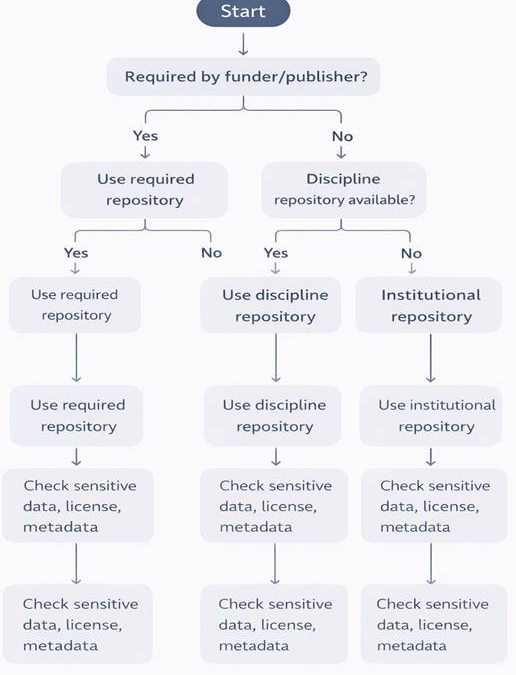
Considerations for Selecting a Data Repository
Simplified flowchart for choosing a research data repository. Created with BearChatGPT based on author specifications, October 14, 2026.
Selected Repository Options
Generalist Repositories
General repositories accept research data, code, and scholarly outputs regardless of subject matter, data format, or academic discipline. These are good options when no disciplinary repository exists.
Figshare: Supports datasets, code, figures, posters, presentations, and other research outputs. Provides DOIs, versioning, and sharing controls, making it popular among universities and research institutions. UCFigshare is the data repository available for federally funded University of Cincinnati researchers to promote the sharing of scientific data in compliance with. UCFigshare provides a data sharing platform consistent with the FAIR (Findability, Accessibility, Interoperability, and Reusability) data principles and is provided via a partnership between the Office of Research, UC Libraries, and DTS.
Zenodo: A free multidisciplinary repository that allows researchers to share datasets, software, publications, and other research products while receiving a DOI.
Dryad: A curated repository commonly used for datasets associated with scholarly publications, particularly in the life and environmental sciences.
Domain Specific Repositories
Domain-specific repositories are specialized repositories that collect, preserve, and share data, code, or research outputs tailored to a particular academic field, scientific discipline, or data type.
UK Data Service: Provides access to social, economic, and population data for research and teaching. The principal repository for economic, population, and social research data in the UK
UC Libraries provides access to a wide range of Research Data and GIS services and resources for the campus community. Informationists and librarians assist researchers in managing and preserving research data, finding and acquiring external data and in utilizing GIS techniques and software. Research and Data Services (RDS) announces two programs this summer to engage with research experts — UC Open Research Day on May 27 and the Undergraduate Research Summer Learning Community running June 3 through July 22.