Not all books fit neatly on a shelf. Recently the Lab was asked to create enclosures to safely house a number of pop-ups by book artist Paul Johnson . The one I had the privilege of finding a storage solution for was the one-of-a-kind “Old Mother Hubbard in Cincinnati.”
To me this looks more like a castle than a book!
Continue reading
Category Archives: Uncategorized
Preservation Week 2014
Far be it from us to let Preservation Week pass unmarked! We invited everyone from the UC and PLCH communities to come down and celebrate with us.
Continue reading
Bring out the fools!
We have a no eating rule in the joint preservation lab.
We also have a “no using the board sheer alone” rule.
In celebration of Edible Books and April Fools’ Day we are breaking all the rules… and one of us is suffering the consequences!
Continue reading
We aren't fooling – it is Spring Cleaning Time!
Are you the type of person who when Spring rolls around you get this sudden urge to organize and clean? No? Well, I am. Though I will admit it only comes in short bursts. Maybe there is just something about the change of seasons that makes me want to sort through things; this Spring I decided to tackle our stockpile of matboard. Does my sudden urge to clean and organize really have anything to do with the vernal eqinox? No, probably not. It is more likely due to the fact that we recently order a bunch of new Rising board and it has been sitting around for a couple weeks with no place to go. Enter, Jessica and her fit of cleaning.
Continue reading
1st Fridays @ 4 – Bookbinding workshop!
Several times a semester UCL’s Reference and Instructional Services department hosts 1st Fridays @4, a fun activity (with food!) that engages and educates students/patrons. When Pam Bach, the lead coordinator of 1st Fridays, asked the Preservation Lab if we would be interested instructing a simple, fun bookbinding workshop we jumped on the opportunity. Being in the basement of the library can be a bit isolating, so any chance we get to interact with the students and patrons is very appealing to us. We decided to show the participants how to make an adhesive-bound miniature book with a paper case. We chose this because it would be easy for people new to bookbinding to construct, we had all the supplies we needed to prep for the workshop, and we already had a little experience prepping and teaching the structure since we made these cute little books during our student and volunteer fun day in November.
Continue reading
How to set up a Digital Photography Documentation Studio
First of all, you might be wondering. Why do conservation labs conduct photography?
A picture is worth a thousand words:
Photographs are the most descriptive way for conservators to accurately document physical changes made to an object during treatment.
In conservation, producing photographic documentation is a conservation professional’s ethical obligation. In conjunction with written documentation, the photographs help to more accurately and efficiently document the examination, scientific investigation, and treatment of special collection materials.
Afterwards, the photography becomes an important part of the treatment record for a rare object and it is permanently archived with the treatment report. This information is saved with the object in hopes of aiding future scholars and conservators in understanding an object’s aesthetic, conceptual, or physical historical characteristics. For more information on conservation treatment documentation, visit the Preservation Lab’s digital collection located here: http://digital.libraries.uc.edu/collections/preservation/.
Continue reading
A conservator in Cincinnati
Moving from sunny California to the “most northern southern city, and the most eastern Midwest city,” A.K.A. Cincinnati, I’ve found that I love living in a climate with the change of seasons. In particular, one of my favorite sightings on the University of Cincinnati campus made me feel as though I was living in an page of an Andy Goldsworthy book! Just before this yellow ginkgo tree began to lose its leaves, the ground received a light autumn dusting of snow that whimsically highlighted the presence of the tree’s newly fallen leaves.
Continue reading
Adhesive Man! #2
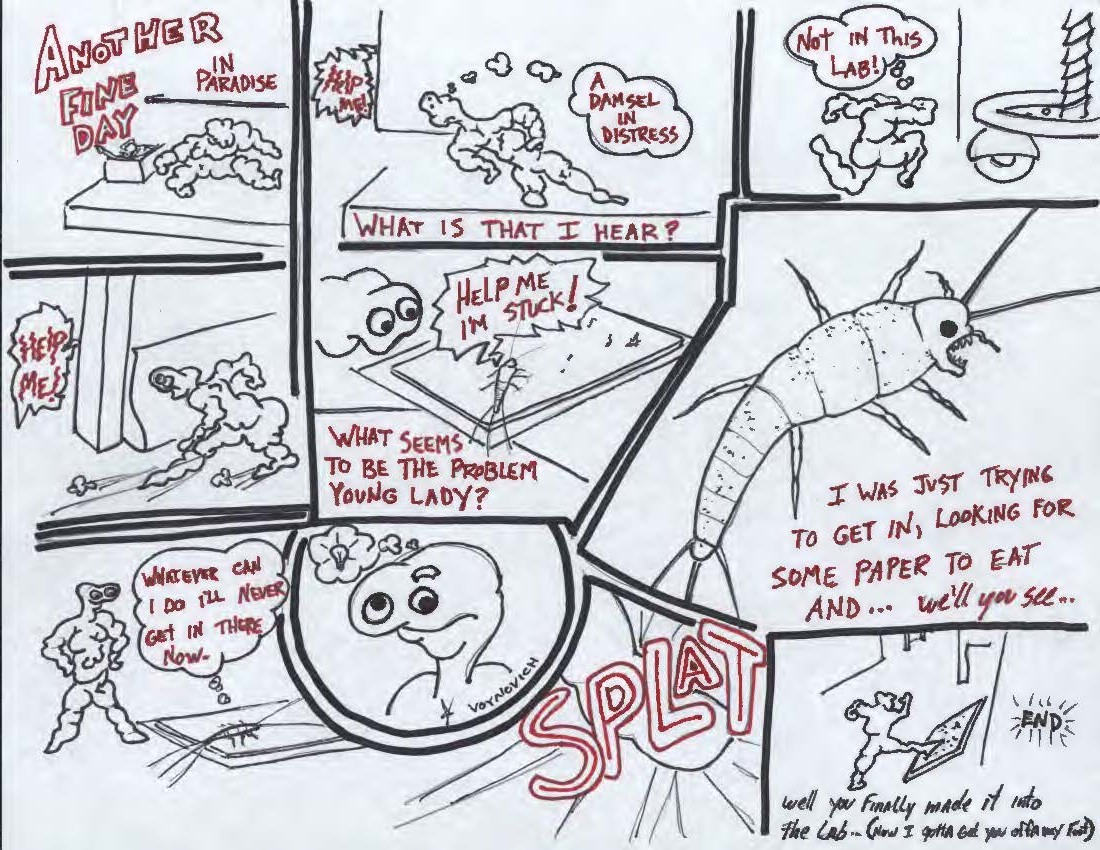
Check out installment #1 – https://libapps.libraries.uc.edu/thepreservationlab/2013/10/adhesive-man/
Chris Voynovich (PLCH) — Conservation technician
And now, for something really amazing…students and volunteers!
Our Preservation Lab has, for many years had the help of some unsung heroes in the form of our student assistants and volunteers. Although we appreciate them very much, they rarely get the attention that they deserve. As the student supervisor for Preservation Services it has been my job to interview, hire, and train our student assistants. When I interview prospective candidates, I usually look for two basic things, one being on time, and the other being appropriately dressed. The rest is just instinct and gut feeling. Our department has been extremely fortunate in the high caliber of student assistants who have worked for us but sometimes it’s obvious that the applicant would not be a good fit. A few years ago we had a candidate who arrived wearing a barbed wire belt and who asked if it was okay if he sometimes came to work bruised and bleeding, since his hobby was ultimate fighting. Even though the applicant seemed like a nice guy, it was not okay.
Meet the collaborative lab's new conservator!

There’s a new face in the Lab these days. Ashleigh Schieszer (pronounced She-zer), our new Conservator and Lab Manager, arrived last week. She hit the ground running just a few days after moving to Cincinnati from Los Angeles, California where she was completing her internship at the Huntington Library. Somehow, though, in the midst of the orientation sessions, getting to know her way around the Lab and meetings with managers and colleagues she found time to sit down for an interview with me.
Continue reading