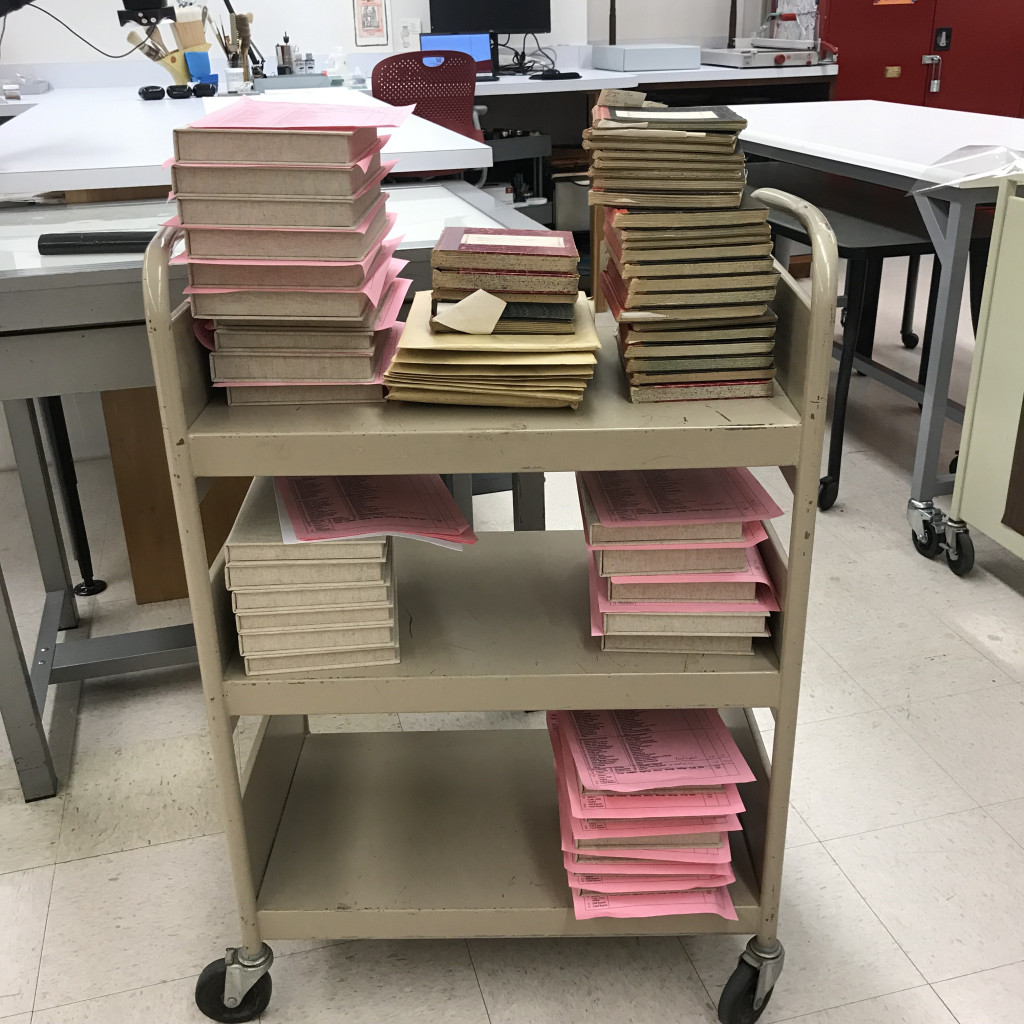
For the past few years, I have been working on the conservation treatment of the Lawrence Notebooks, a remarkable collection of 99 handwritten volumes created by William J. Lawrence that document his extensive research on the Irish stage from 1630 to 1911. Over many years, Lawrence filled these small, lined notebooks with careful handwriting, news clippings, photographs of actors, typed play transcriptions, and detailed notes on theaters, performances, ticket prices, and even personal anecdotes. Together, the notebooks offer a rich and vivid window into the history of Irish theater and the cultural life of Dublin from the seventeenth through the early twentieth centuries.
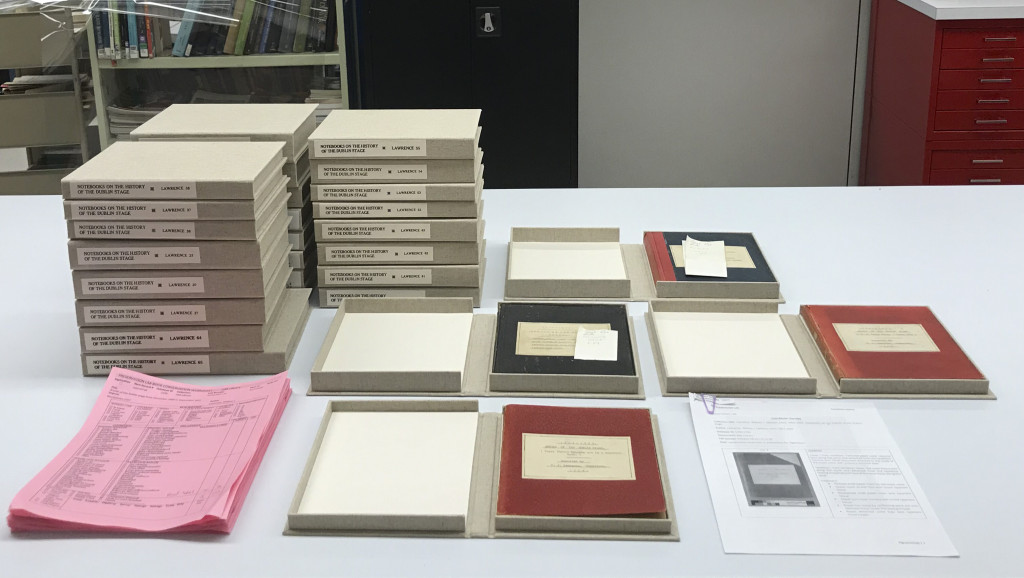
In 2021, we had already completed 37 of the 99 volumes, and we still have 62 volumes in the Lab.
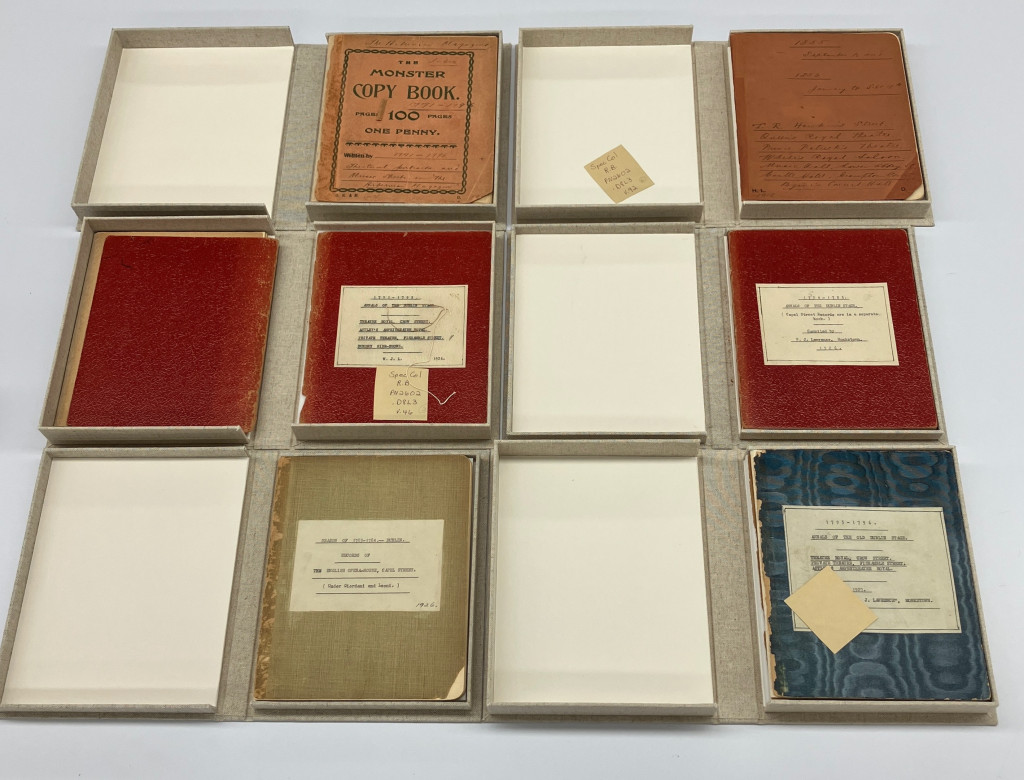
This project was a collaborative effort and was completed gradually over several years, with individual volumes treated alongside other conservation projects rather than all at once. Our former colleague Chris Voynovich created custom cloth-covered clamshell enclosures for all 99 volumes, while I was responsible for the evaluation and conservation treatment of the notebooks themselves.
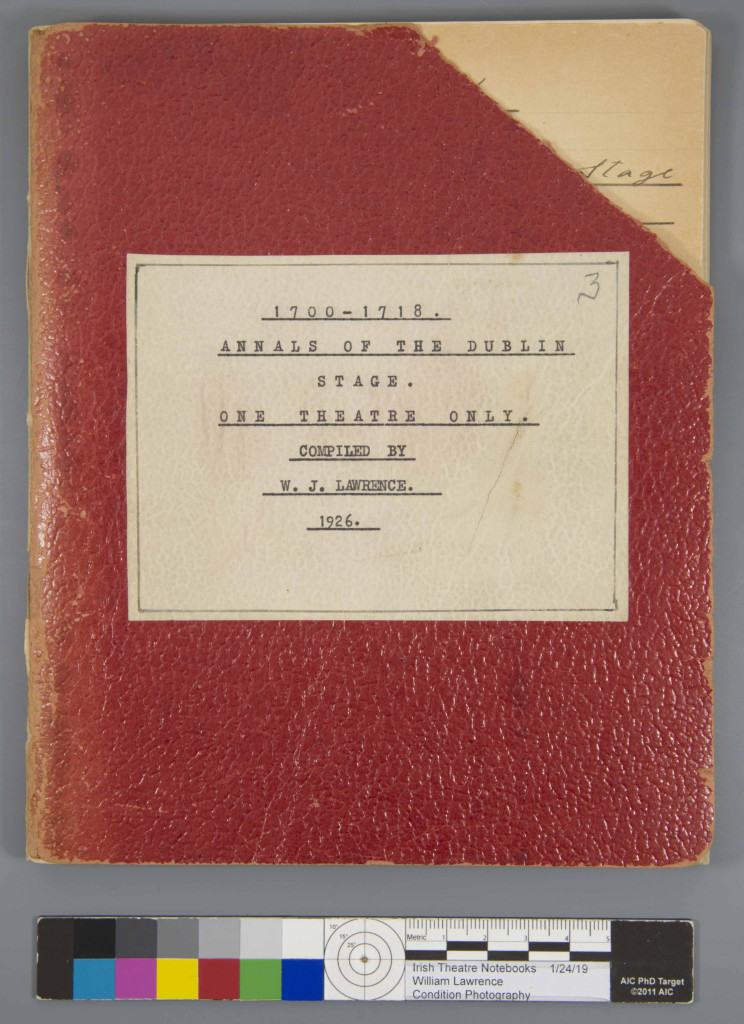
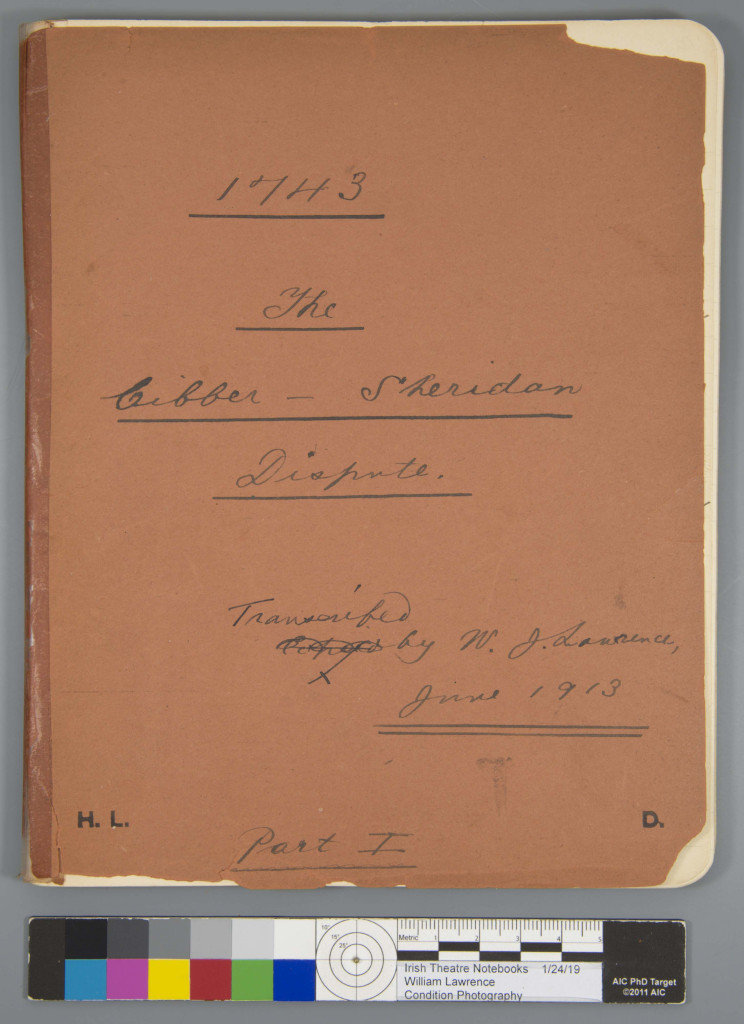
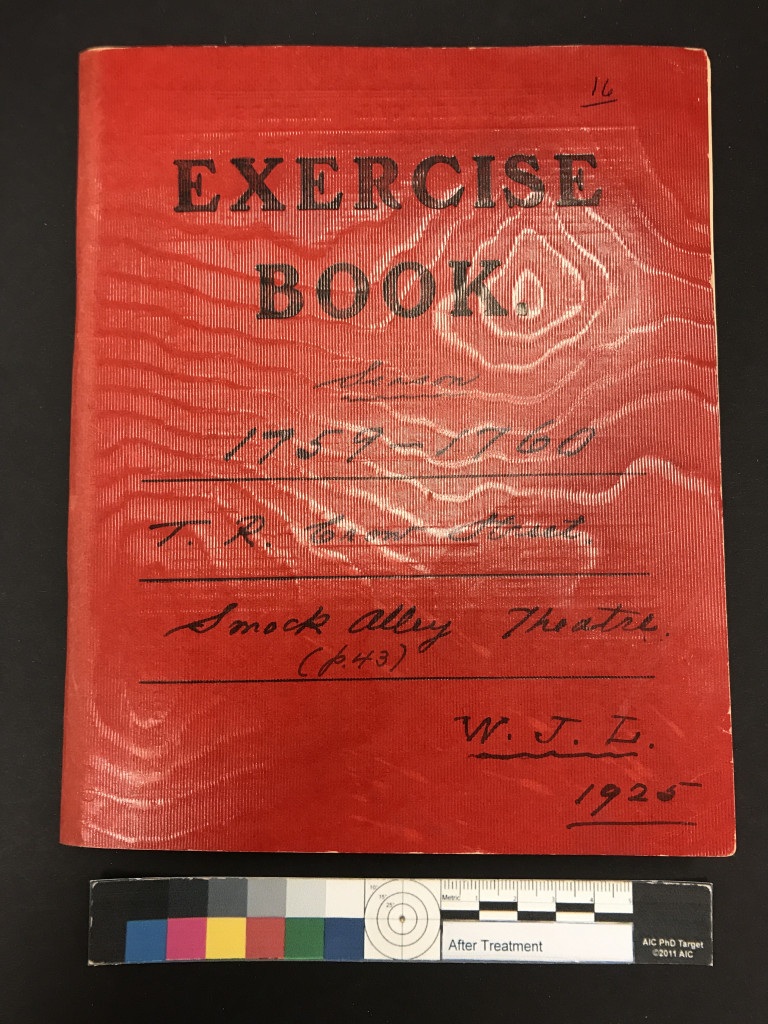
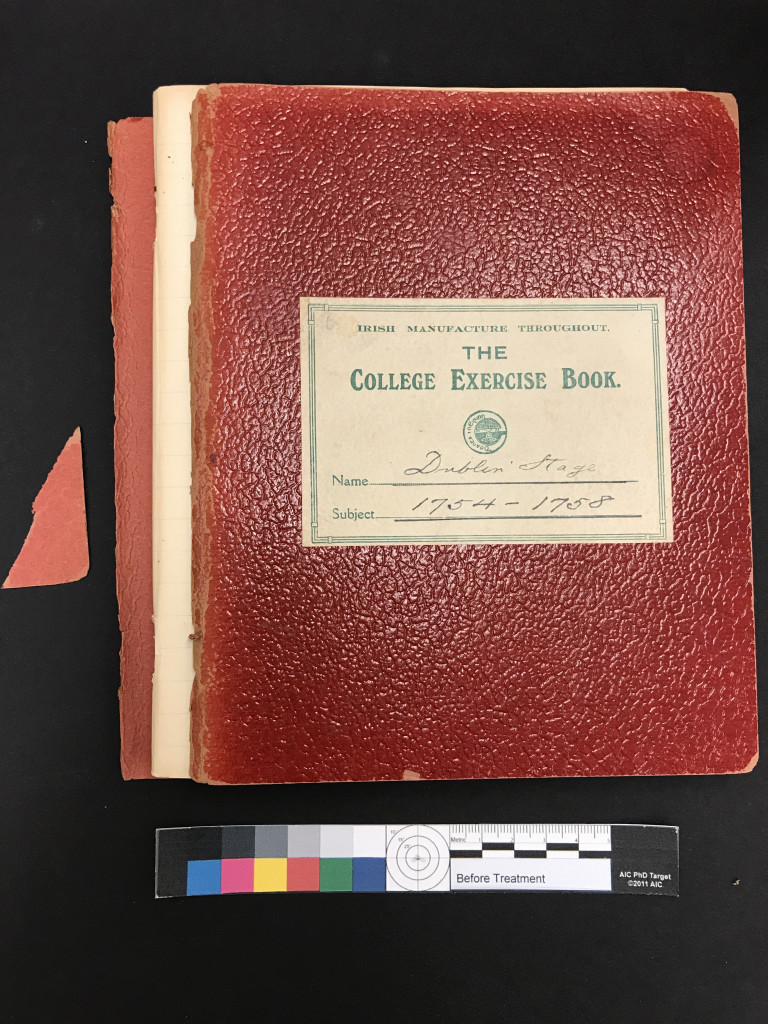
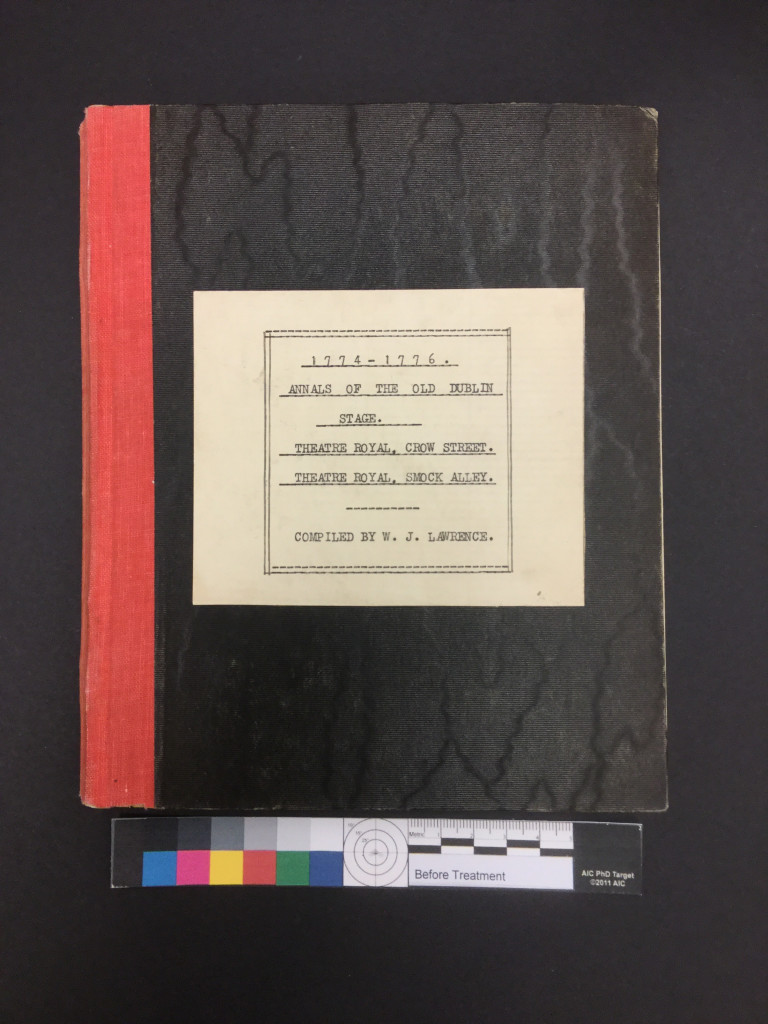
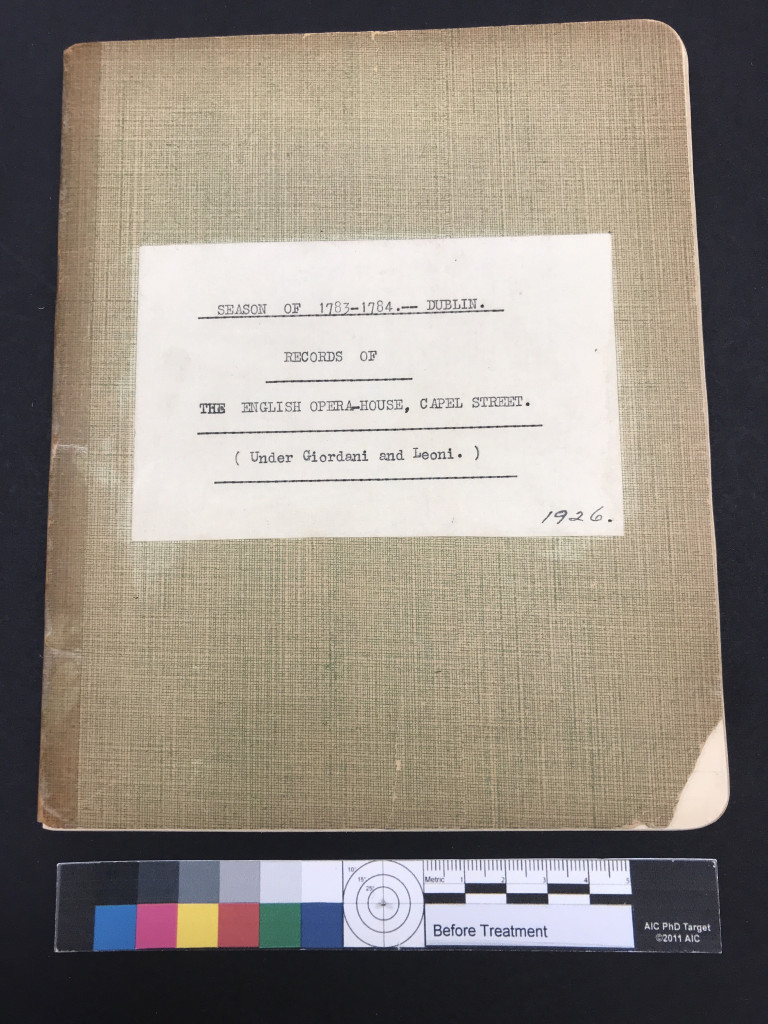
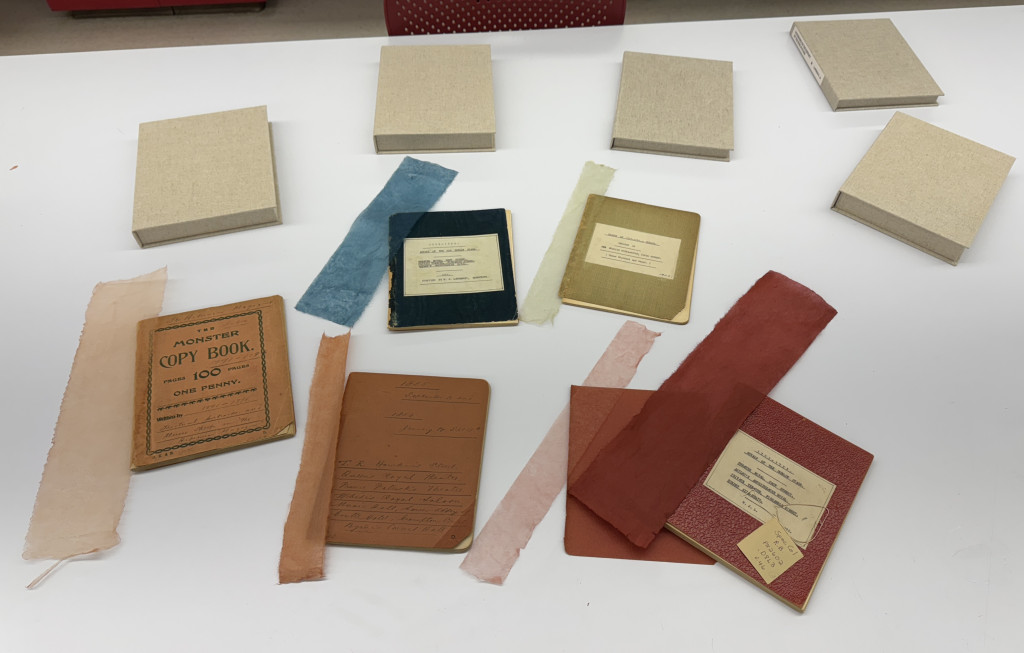
Although the Lawrence Notebooks shared a broadly similar format, closer examination revealed subtle but meaningful variations in both their covers and text blocks. Most volumes were small, square notebooks with thin boards covered in cloth or paper covers, in a range of muted colors including red, orange, green, blue, and black. The text blocks were generally composed of one or several gatherings sewn through the fold, with the primary support most often being lined paper.
Variations in cover materials and colors across the Lawrence Notebooks.
Once all the volumes were received in the lab, each notebook was evaluated for its condition and assigned to one of three categories: good (no treatment required), fair (requiring stabilization), or poor (requiring more extensive treatment). The notebooks showed clear signs of long-term handling and use. Many volumes had weakened or detached covers, some of which had been previously repaired with pressure-sensitive tape. Other common condition issues included broken sewing, tears along the spine folds of the text block pages, and brittle newspaper clippings that had also been repaired with pressure-sensitive tape.
Condition evaluation of the Lawrence Notebooks prior to treatment.
When determining the most appropriate conservation treatment for each volume, it was also important to consider their future digitization. Treatments were selected to stabilize the notebooks while ensuring they could be safely opened, handled, and imaged without placing additional stress on the original materials.
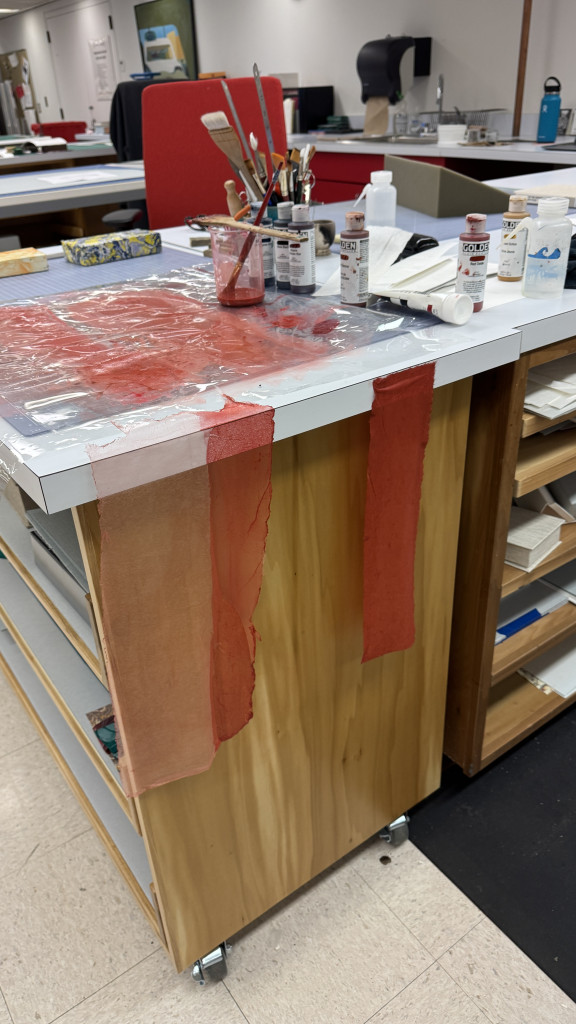
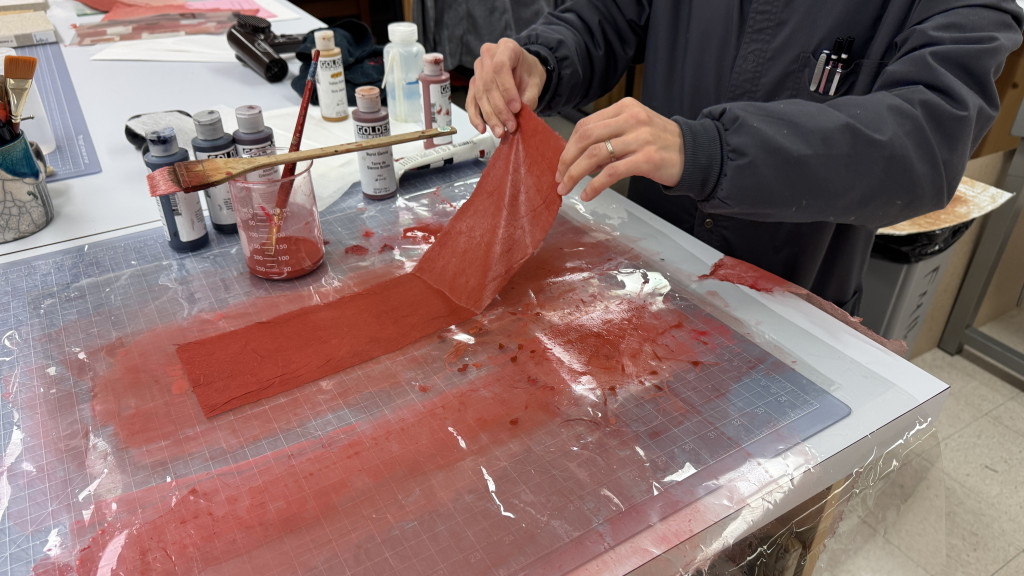
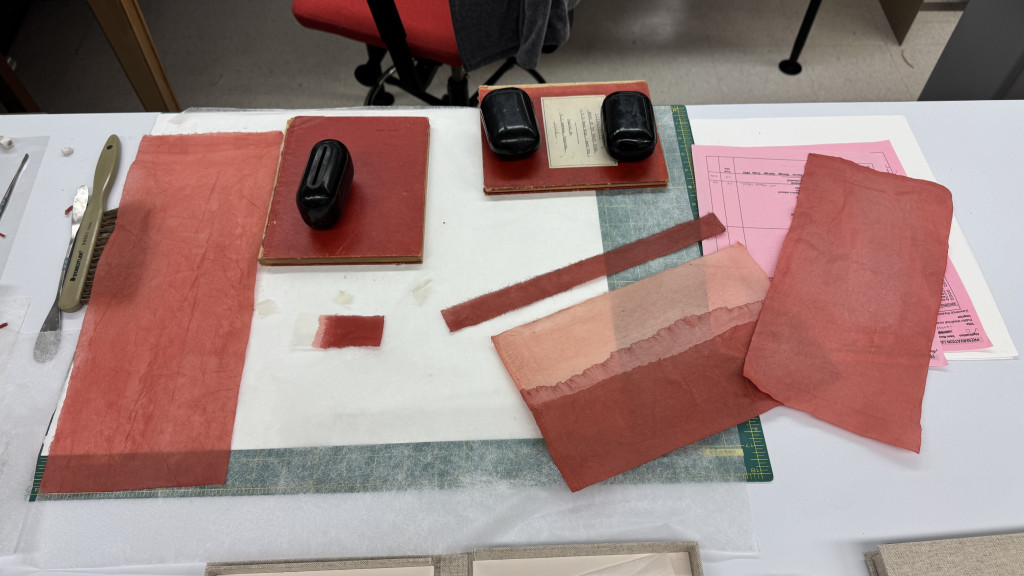
Most of my conservation treatment ended up being hours spent removing pressure-sensitive tape, many more hours toning Japanese paper with acrylics for the repair and stabilization of paper covers, along with surface cleaning and a lot of time dedicated to tear repair.
Toning Japanese paper with acrylics.Toning Japanese paper with acrylics.Toned Japanese paper for repair and stabilization next to the respective notebooks.
Completing the conservation treatment of all 99 Lawrence Notebooks marked the end of a project that unfolded slowly over several years. Because the work was done alongside many other conservation projects, progress often happened one volume at a time, making the moment when the final notebook was finished feel especially satisfying.
With treatment complete and each volume now housed in a custom clamshell enclosure, the Lawrence Notebooks are stabilized and better supported for future handling, digitization, and research. While the notebooks still show the signs of long use that make them such compelling working documents, they are now structurally sound and prepared for the next phase of their life in the collection.
Projects like this reveal how conservation work happens slowly and methodically, often behind the scenes. Completing treatment on all 99 notebooks and seeing them reunited as a stabilized collection reinforces the importance of long-term care in preserving these records of Irish theatrical history for future research and access.
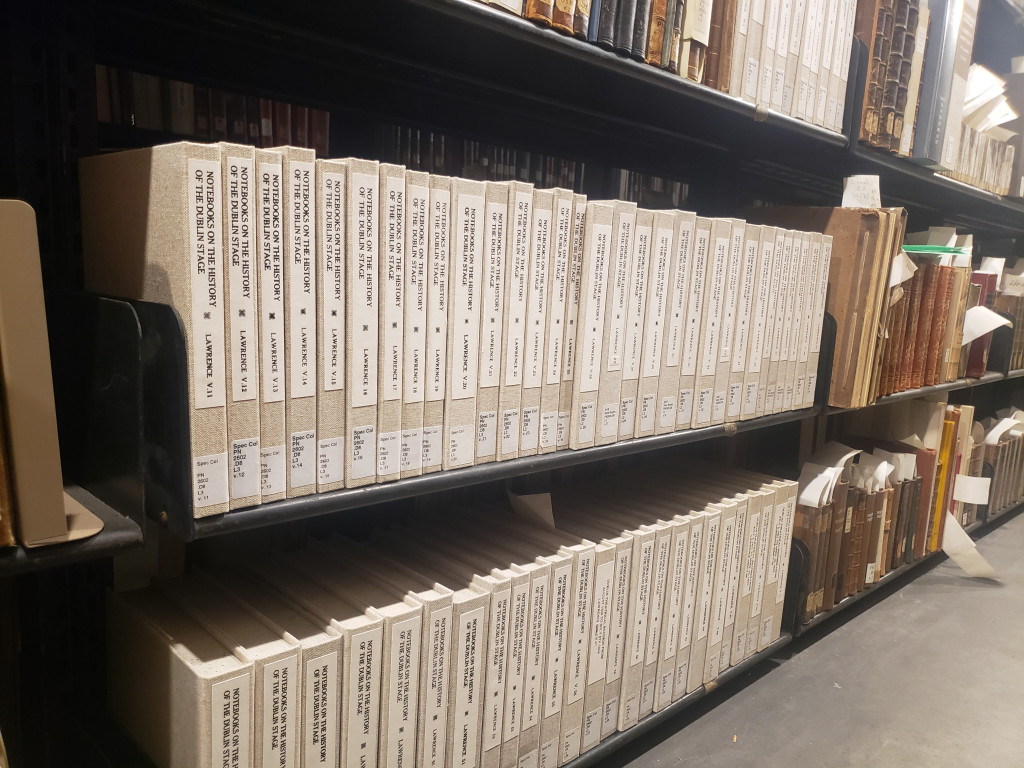
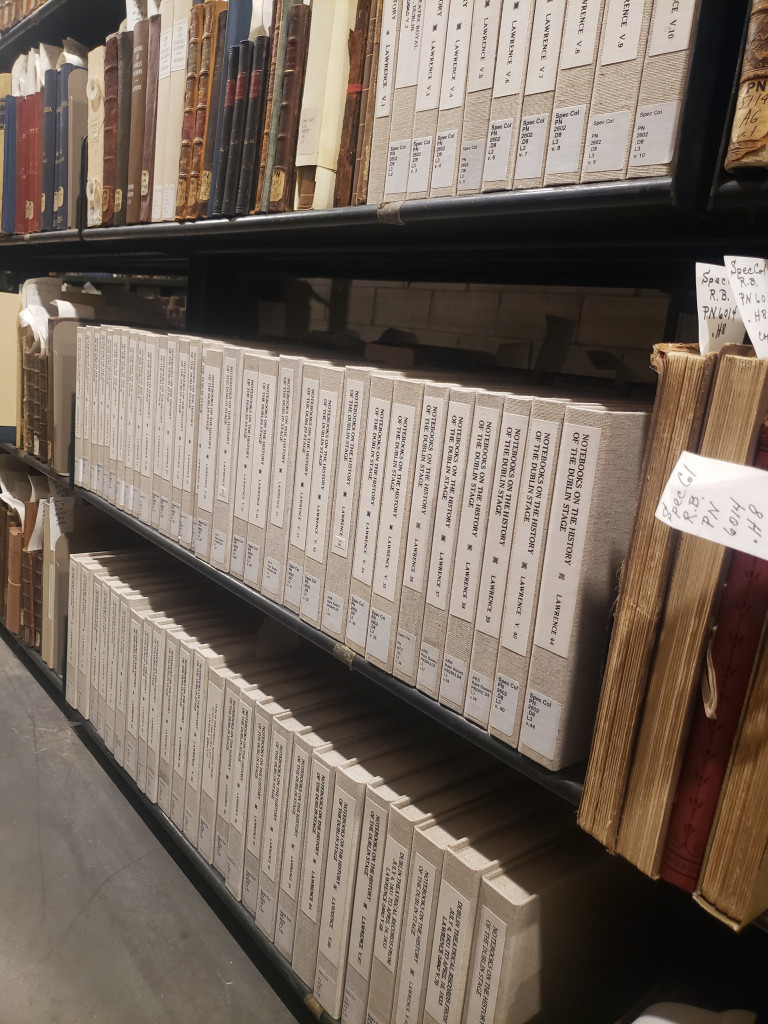
The Lawrence Notebooks shelves in the Archives and Rare Books Library stacks.
How often do we pay attention to the framed portraits of important people and historical figures that hang on the walls of our institutions? Perhaps we glance their way every now and again, perhaps we even contemplate these forgotten ghosts briefly; but how often does a piece with its own provenance, characters, and stories simply become part of the everyday background, and how do we approach preserving these items, so they are not lost to history?
Frame By Frame
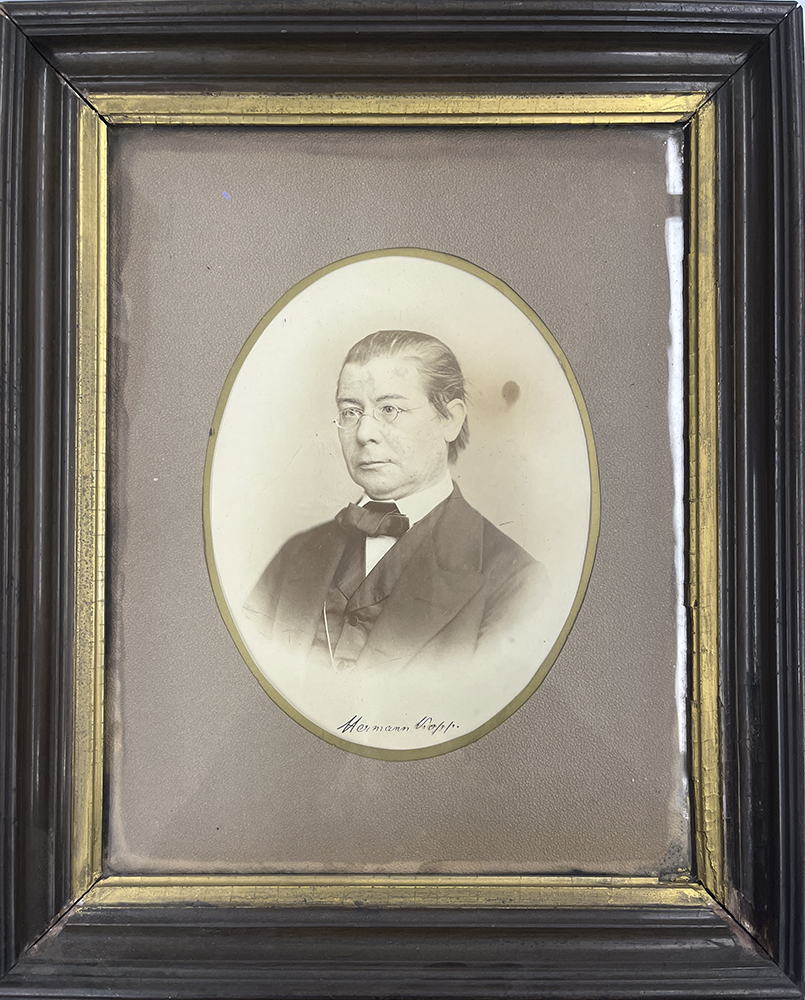
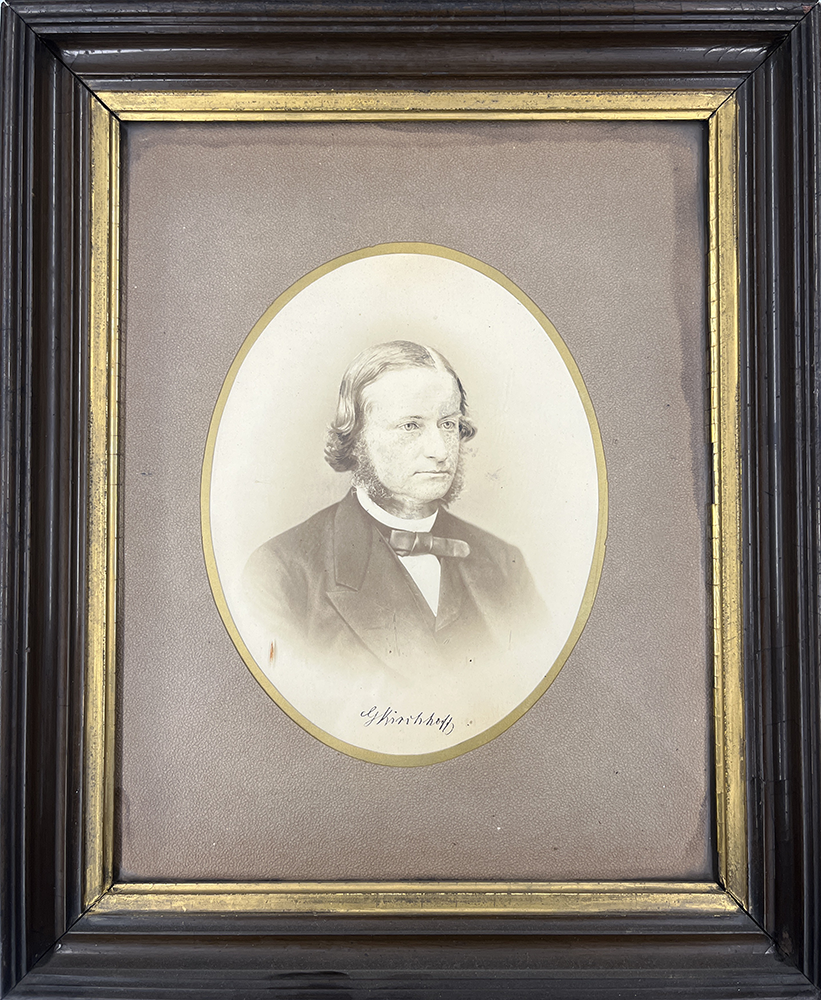
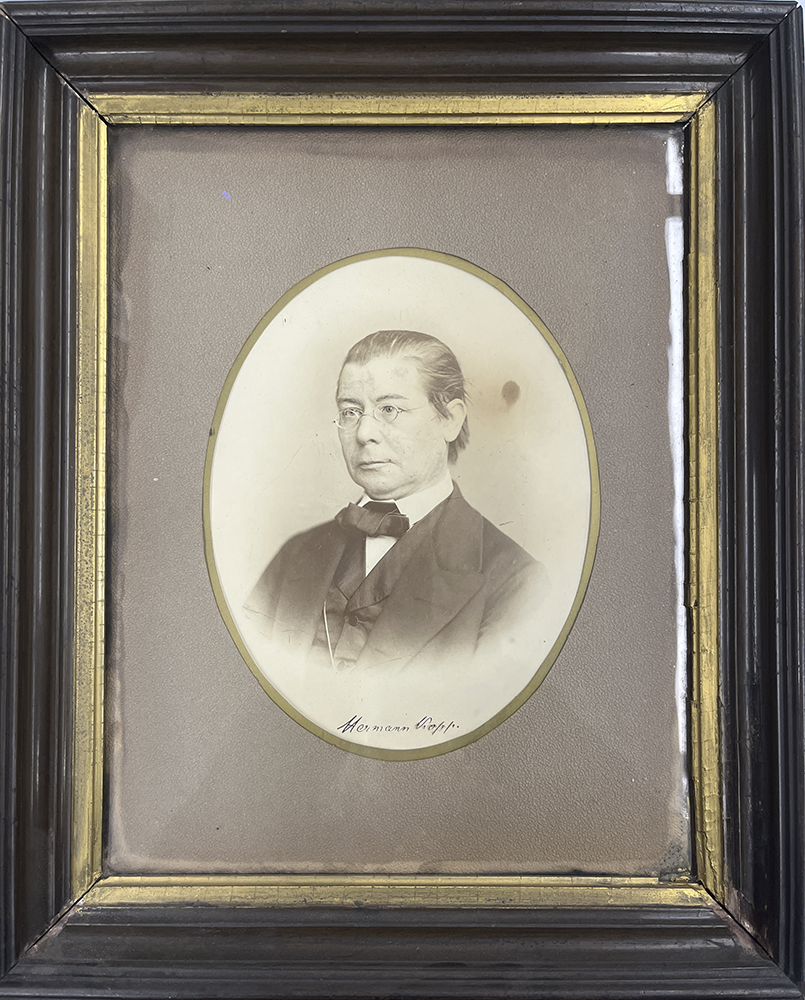
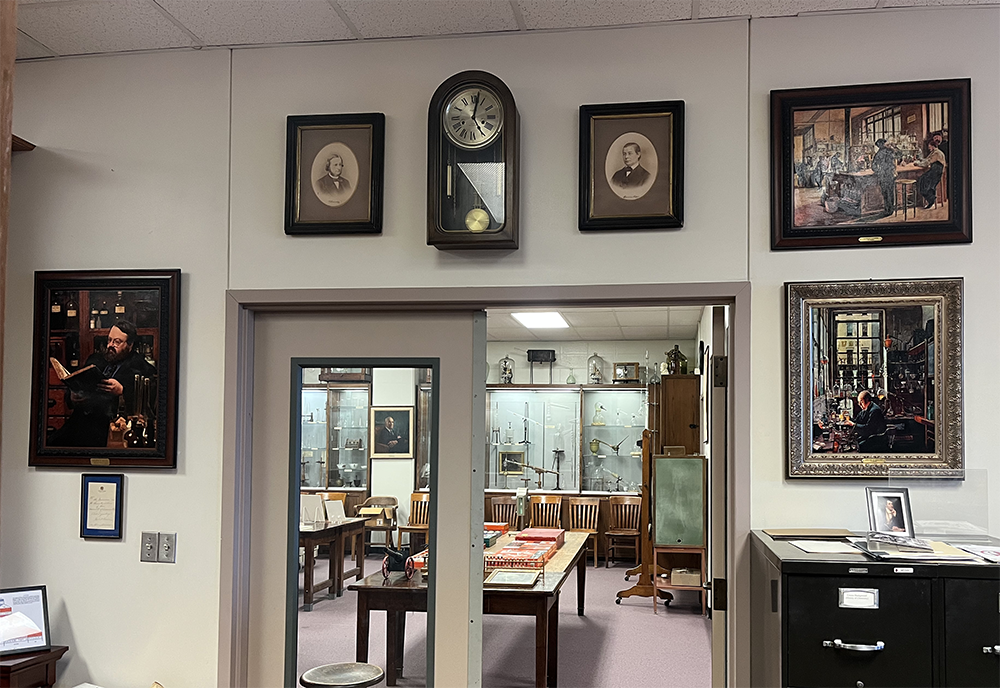
Recently I was assigned a framed portrait of German chemist and historian Hermann Kopp from the Oesper Collections in the History of Chemistry at the University of Cincinnati Libraries. It arrived with a similarly framed portrait of German physicist/mathematician Gustav Kirchhoff, both of which were gifted to early UC chemistry department chair Thomas Norton in 1875 upon completion of his PhD at the University of Heidelberg. They would later become part of the Oesper Collections, and have been, for some time now, hanging on the wall of the library section since the collection was moved there in 1998, according to librarian Mark Chalmers.
The framed portrait of chemist and historian Hermann Kopp, before treatmentThe framed portrait of physicist and mathematician Gustav Kirchhoff, before treatment
The Preservation Lab has received quite a few framed items from this collection as of late and the treatment/housing requested by the selectors has become a common one that we practice. It involves scanning the original and printing a high-quality surrogate image of the photograph or print which can then replace it inside the original frame. The original photograph/print can then be moved to a more archival storage option where it will be less susceptible to damage and degradation. A framed portrait of Marie Curie’s daughter, Irene Joliot-Curie with an inscription from Ralph Oesper received this treatment and storage solution.
The Kopp portrait however, proved to require more creativity than prior framed items, and gave me an opportunity to try out a more unique storage solution.
Kopp’s Portrait
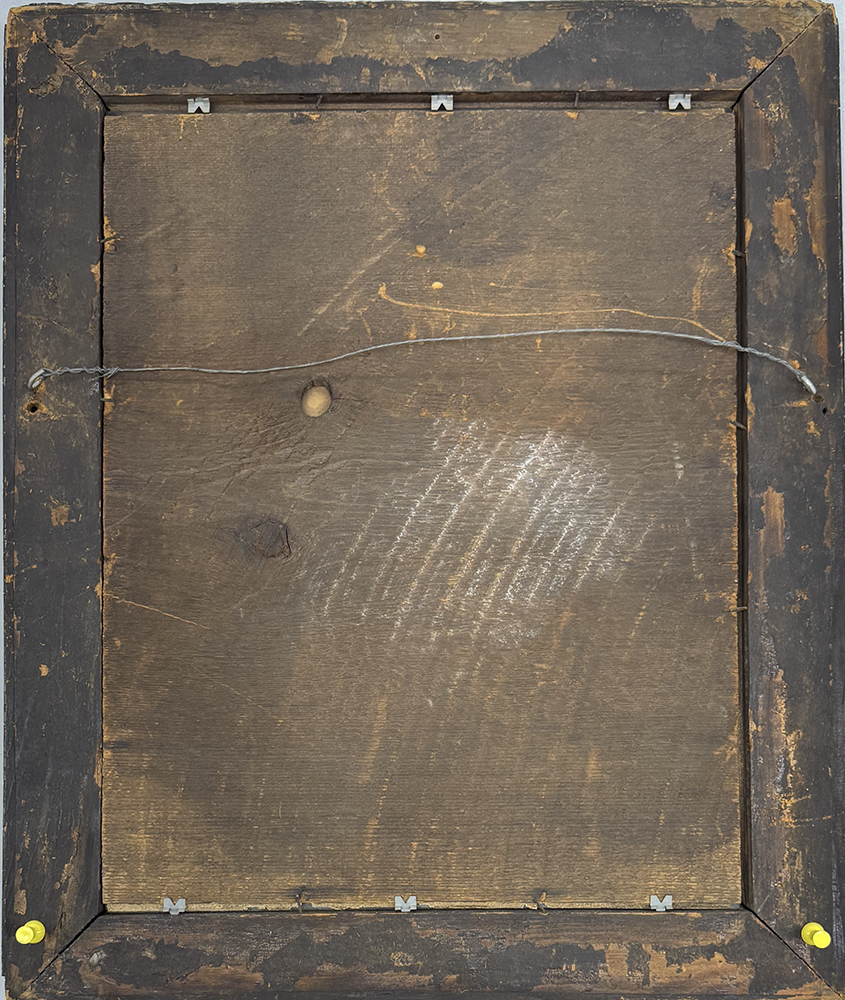
The portrait was framed under several layers. From the bottom up, they included: a beige backing mat which the (likely) albumen print photo of Kopp was attached to, a thin piece of paper featuring an oval-shaped window with a golden border, and a thick brown textured paper, also with an oval-shaped window. These had been secured into a brown varnished wooden frame with painted gold inlays and a solid wood backing board held in place with rusty nails and metal brackets.
Kopp’s portrait seen inside its original frame before treatmentThe verso of the original frame before treatment
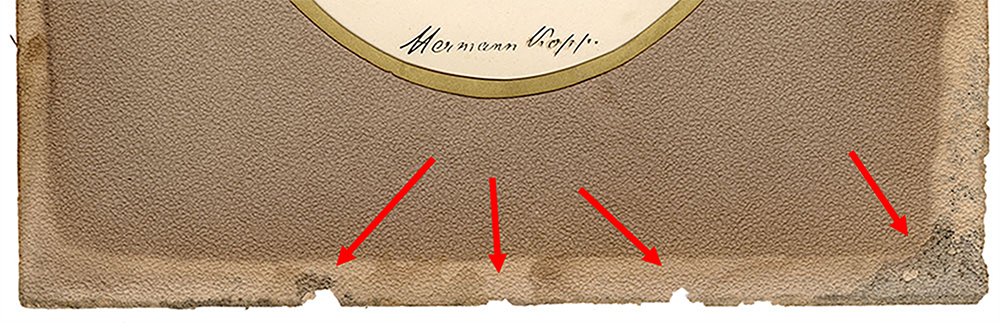
Unfortunately, just about everything outside of the photograph itself is in poor condition. The entire matting system is extremely acidic and brittle with pieces of the brown paper window flaking off around the edges. There is also evidence that it has suffered water damage in the past.
The portrait’s matting system is extremely acidic and brittle; areas where bits have flaked off can be seen. Evidence of water damage can also be seen in the lower right corner.
The Original Frame
Although the wooden frame the portrait was housed in for years is original and part of the object’s history, it is far from archival. With its varnished finish, rough wooden edges, and surface grime, it was likely doing more harm than good as far as the long-term preservation of Kopp’s portrait; it could not remain in this frame. The frame is, however, every bit as storied as the actual photograph.
Conditions such as those presented by this frame are a good example of why we often replace original items inside frames with surrogate images. This way, any potential damage or degradation caused by poor storage conditions will happen to a reproduction image opposed to the actual object.
The Surrogates
For this treatment, it was determined that two surrogates would be printed to be displayed in the Oesper Collection: one to take the place of Kopp’s original portrait inside the frame which could then be re-hung on the wall of the library, and the other to be added to a display in the museum section.
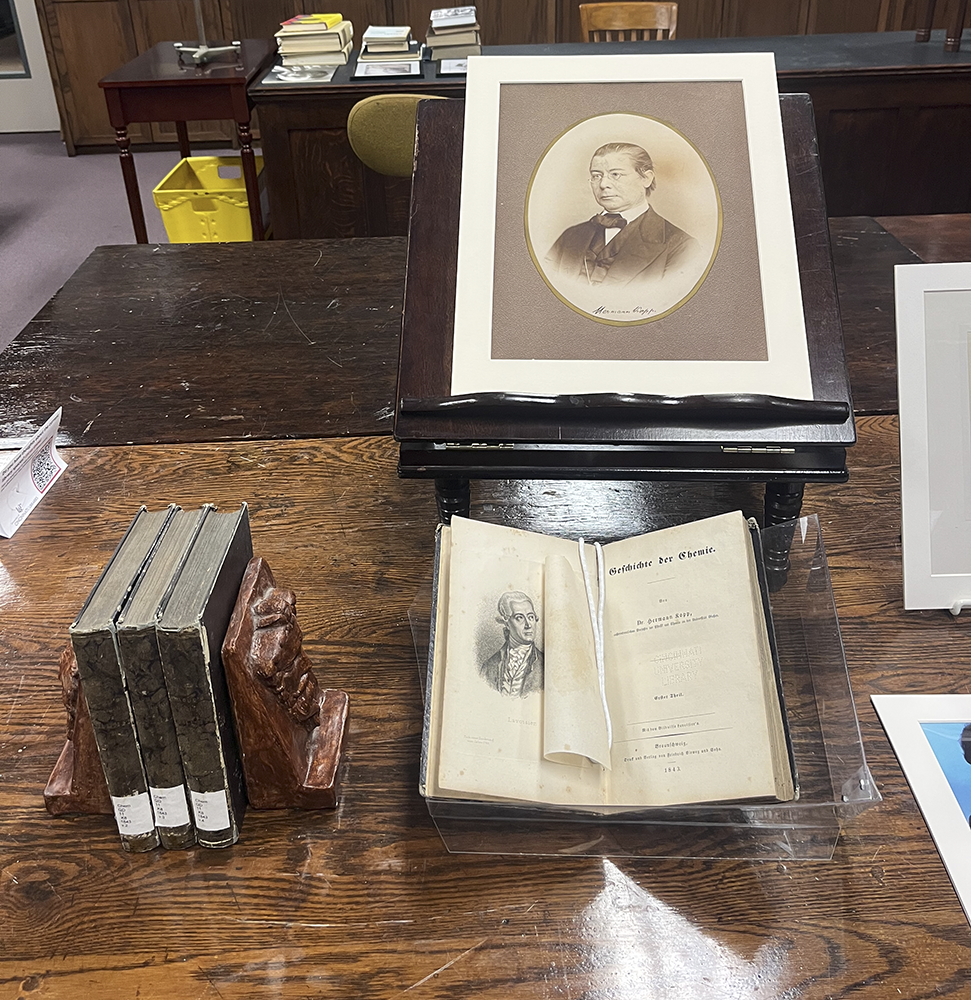
One of the surrogates of Kopp’s portrait on display in the museum section of the Oesper Collections alongside Kopp’s four-volume series Geschichte der Chemi (1843-1847), courtesy of Mark Chalmers.The other surrogate back in its original frame re-hung on the wall of the Oesper Collections library, Courtesy of Mark Chalmers.
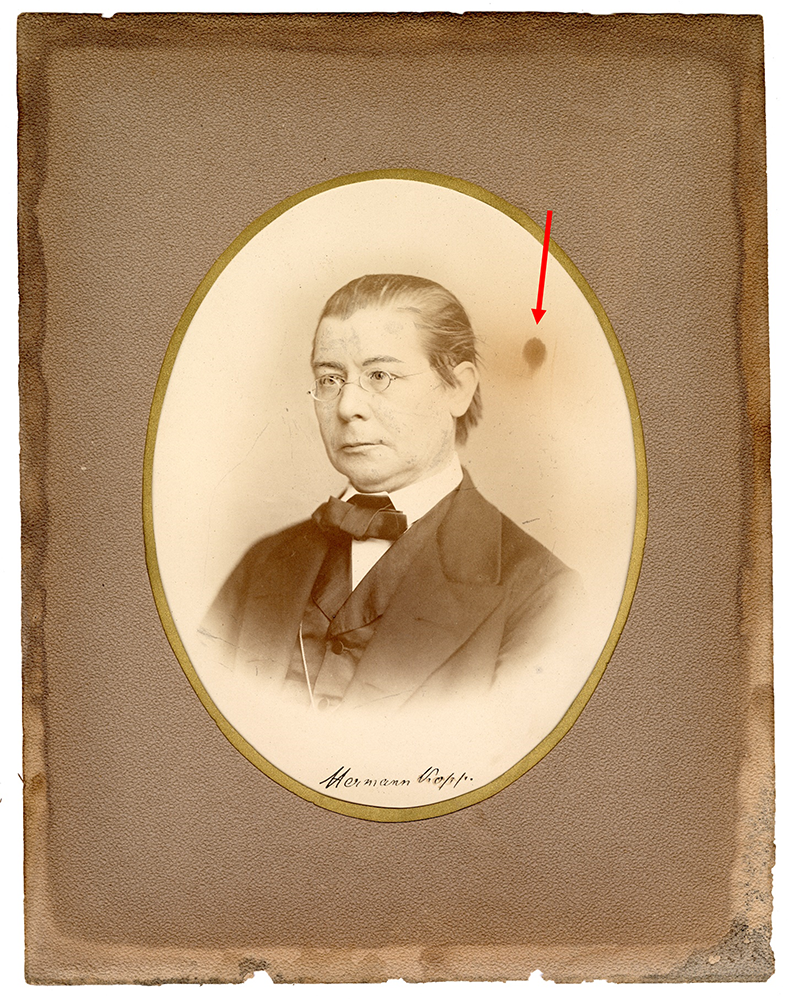
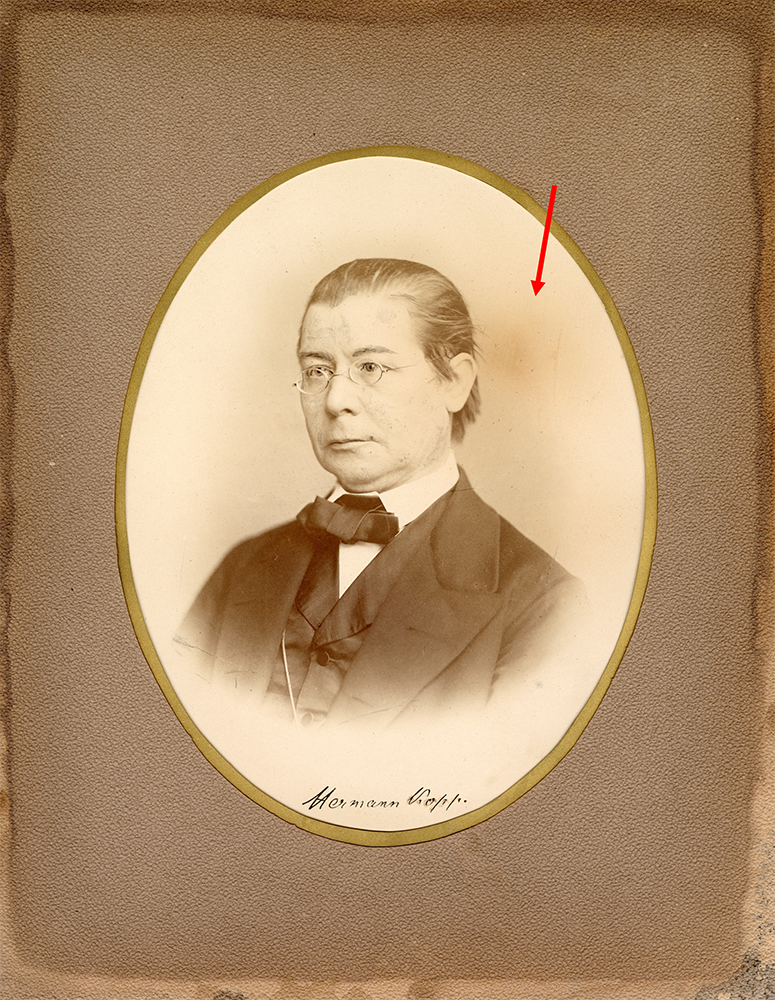
Jessica Ebert, Assistant Conservator at the Preservation Lab, and our go-to personnel for digital imaging, gently digitally retouched the image of Kopp, after consultation with the curator.
The scanned image before digital retouching.The scanned image after digital retouching; notice the absence of the spot to the right of his head.
Storage Considerations
As with earlier framed items we have received from The Oesper Collections, it was decided a matting system was appropriate for safe storage of the unframed portrait and its included parts. However, the brittleness of the items and some uncertainty about how the photograph would react to environmental factors presented some unique challenges.
Although the mounting technique of placing them inside a polyester L-sleeve and mounting this with photo corners/strips would be easy and fast, there was some concern that humidity could enter the sleeve and cause damage to the photograph’s emulsion layer. Also, items mounted this way often need to flex and bend to a degree that these fragile materials likely could not afford.
The Paper Cradle with Z-folds
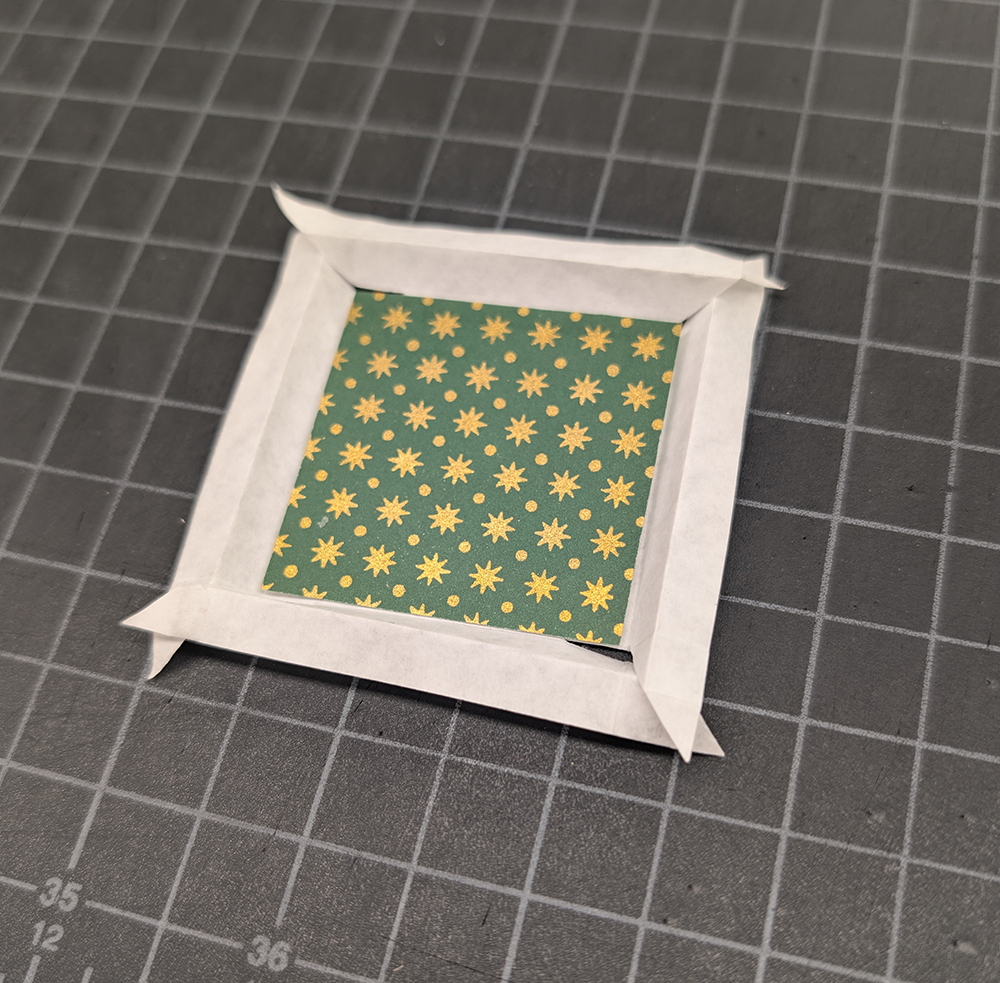
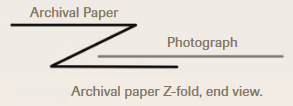
After considering these factors, Assistant Conservator Jessica Ebert suggested a paper cradle with z-folds. This mounting technique utilizes archival paper that is partially cut diagonally at each corner. Each edge of the paper is then folded over itself twice in opposite directions, creating a pocket for the edges of an object to rest gently inside.
A small model of a paper cradle after the cuts and folds have been made.
Profile view of the pocket created when making the above folds; image from 2010 Art Conservator Tech Notes by Jennifer McGlinchy.
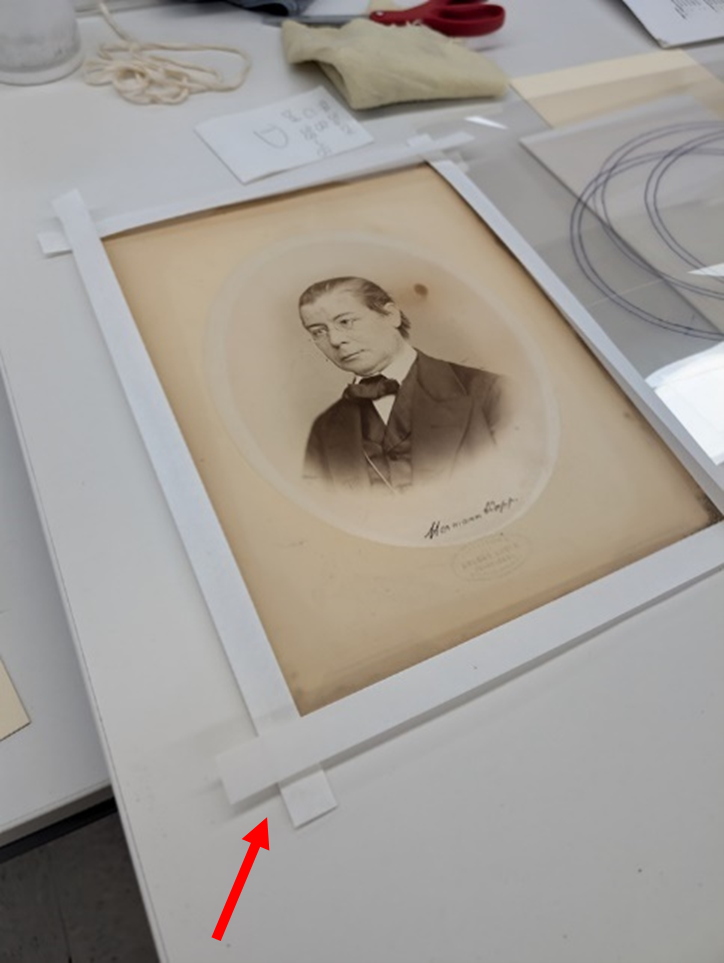
Once the cuts and folds have been made and the object is safely inside the cradle, the paper tabs extending off the corners of the cradle can then be mounted to a back mat using archival tape.
Once cuts and folds are made, the cradle features two tabs at each corner; these are used to mount the cradle using archival tape.
The Package
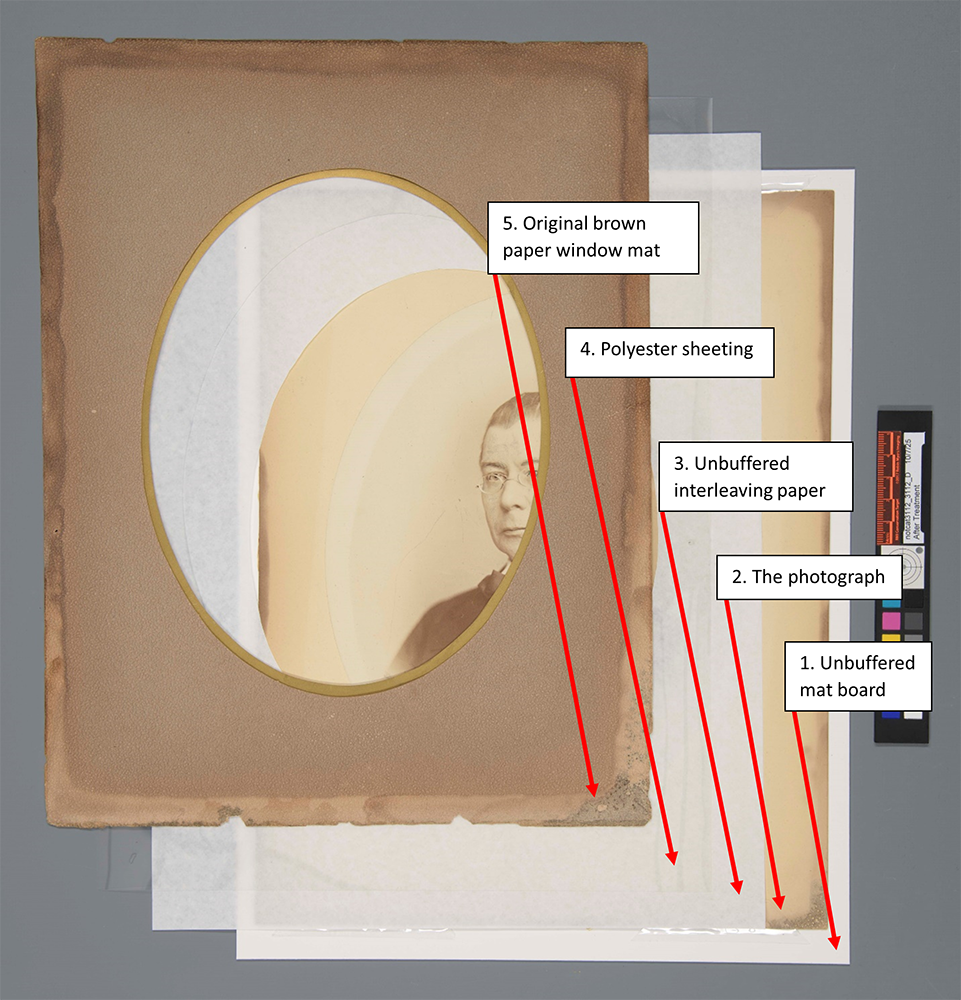
We wanted to store both the photograph and its original brown paper window mat together inside of the paper cradle, but the acidity of the brown paper was still a concern. We determined that several protective layers should be included to prevent any acid migration from the brown paper to the photograph. All the layers inside of the paper cradle, affectionately referred to as “the package”, are as follows, starting from the bottom up:
A piece of mat board to provide rigidity to the package.
This will prevent any potential bending of the extremely brittle materials which could easily lead to damage. It was cut to be slightly larger than the rest of the package, allowing for small micro movements of the brown paper window mat, hopefully preventing its brittle edges from becoming damaged inside the creases of the cradle.
The photograph itself.
The photograph and its original back mat were mounted to the unbuffered mat board piece described in the previous layer using edge strips.
A piece of unbuffered interleaving paper with an oval-shaped window, allowing the portrait to still be viewed.
This layer was added because the polyester sheeting mentioned in the next layer has a sharp edge around its window. The interleaving paper protects the emulsion layer of the photograph from scratches and other abrasions.
A piece of polyester sheeting, also with an oval-shaped window, allowing the portrait to still be viewed.
This layer adds a bit of rigidity to the original brown paper window mat. This will further help prevent the acidic brown paper from bending and breaking.
The original brown paper window mat
The individual layers of the “package” to be stored inside the paper cradle.
The Sink Mat
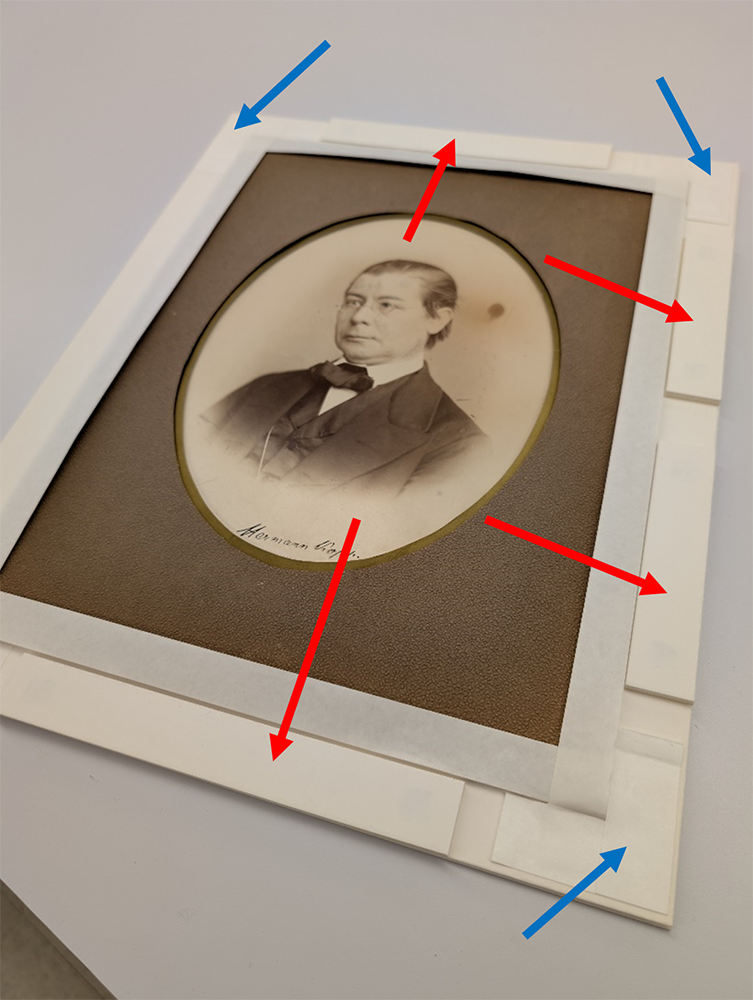
Now that the portrait/package was safely inside its paper cradle, I could begin working on the matting system. As is typically the case with any item with a significant amount of thickness, I planned on building a sink mat. However, when constructing this sink mat, I had to allocate space around the perimeter of the object when attaching the mat board spacers so that the paper cradle’s tabs had space to be taped down; this contrasts with a typical sink mat in which the spacers are typically placed around the entire perimeter.
Although the perimeter is still built up around the object with mat board (indicated with the red arrows), space had to be allocated to allow the tabs of the paper cradle to be attached using archival tape (indicated with the blue arrows).
Cutting Ovals
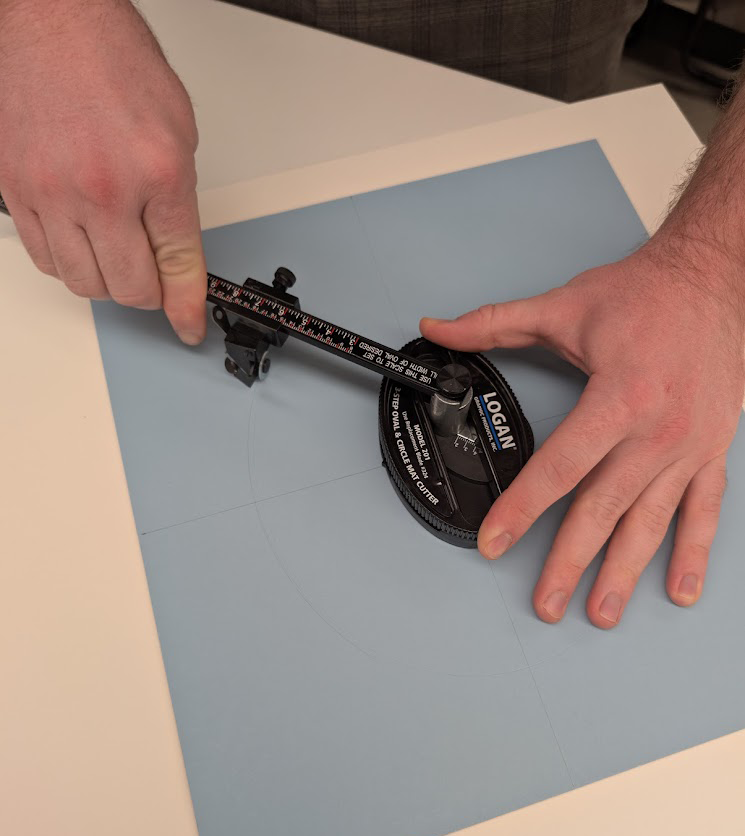
For the new window of the matting system, Assistant Conservator Catarina Figueirinhas suggested that cutting the window in the shape of an oval would be appropriate as the original brown paper window mat had an oval window, and the photograph itself was oval-shaped. After a bit of research, we discovered a moderately-priced (around $65 on Amazon) adjustable mat board cutter that could cut ovals at a beveled angle: The Model 201 Oval & Circle Mat Cutter from Logan.
The Logan Model 201 in action; one hand holds the base steady while the other guides the arm with an attached blade around the center point.
After watching a very helpful YouTube video I felt ready to give the Logan Cutter a try. I found it easy to use after a little practice and was satisfied with the results.
The Completed Matting System
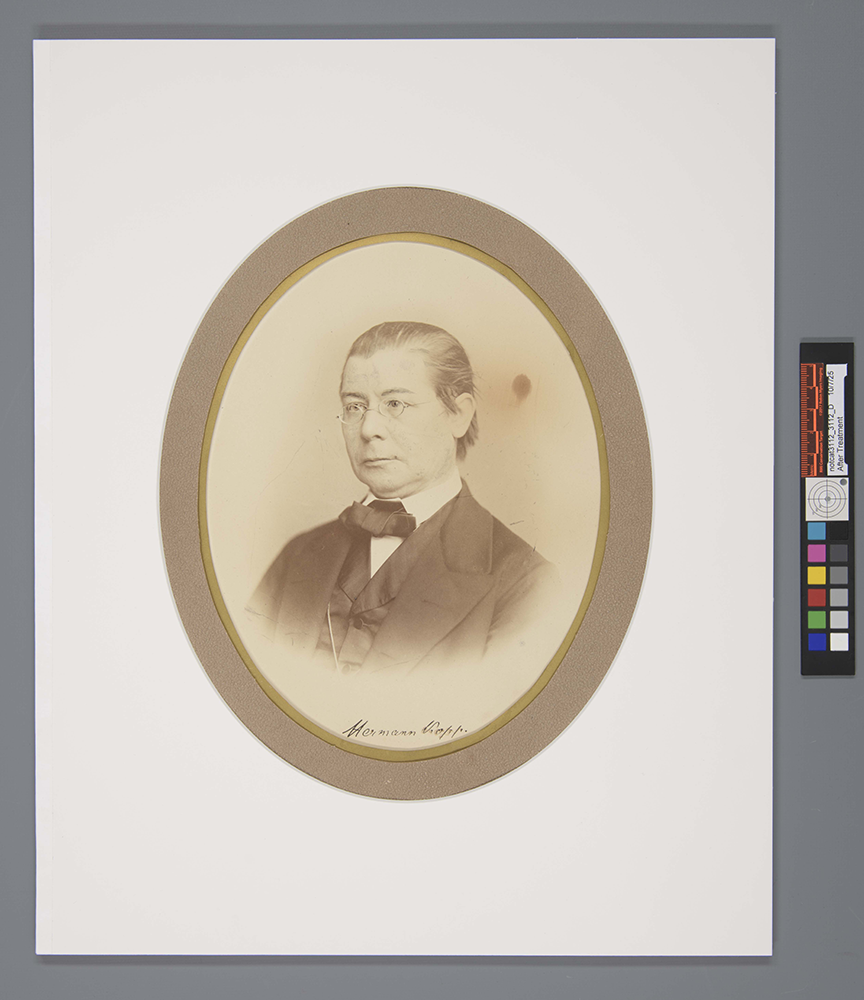
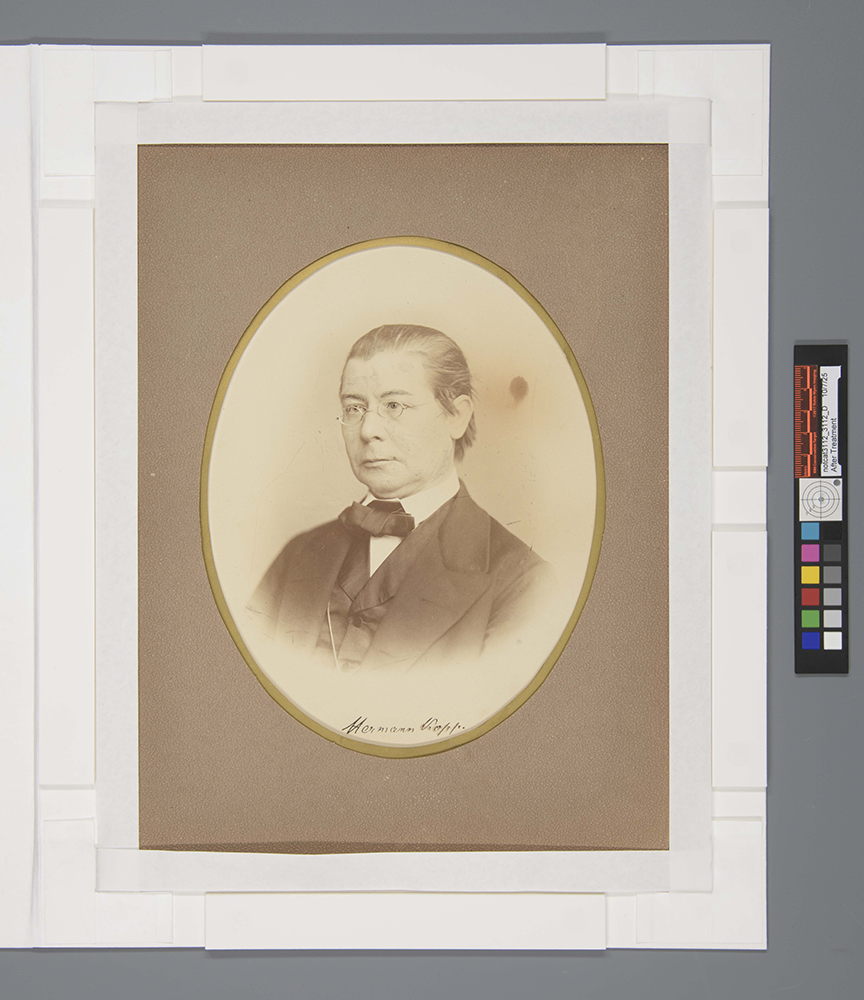
Once the sink mat spacers were added, the paper cradle was taped down, and the oval window mat was attached, the matting system was complete.
Kopp’s portrait inside its matting system with an oval window.The inside of the matting system; Kopp’s portrait can be seen inside its mounted paper cradle.
As Kopp’s actual portrait inside its new matting system is not going to be displayed any time soon, I also constructed a tuxedo box for long-term storage. This will help further protect it, especially from any light damage.
Final Thoughts
The display surrogates, however, can currently be viewed and contemplated by anyone who tours the Oesper Collection. Sometimes I like to think about how the work that we do at the Preservation Lab is becoming part of the items we treat’s history. Just as this portrait has crossed an ocean, passed through the hands of Thomas Norton, Ralph Oesper and multiple UC Chemistry department heads, hung on that cold wall of the chemistry library in 521 Rieveschl Hall for countless aspiring chemists to contemplate, and finally ended up under the stewardship of current UC librarian Mark Chalmers, it was briefly in my possession. As stewards of cultural heritage, we can only hope that the time these objects spend in our care can extend these histories indefinitely.
Historical References Provided by Mark Chalmers:
Cincinnati Chemists: Assorted Papers on the History of the Cincinnati Chemical Community by William B. Jensen
Robert Bunsen’s Sweet Tooth: Bunseniana in the Oesper Collections by William B. Jensen
Image and Other Supplemental References:
2010 Art Conservator Tech Notes by Jennifer McGlinchy