Category Archives: Treatment

When you THINK you know the difference between handmade and machine-made paper!

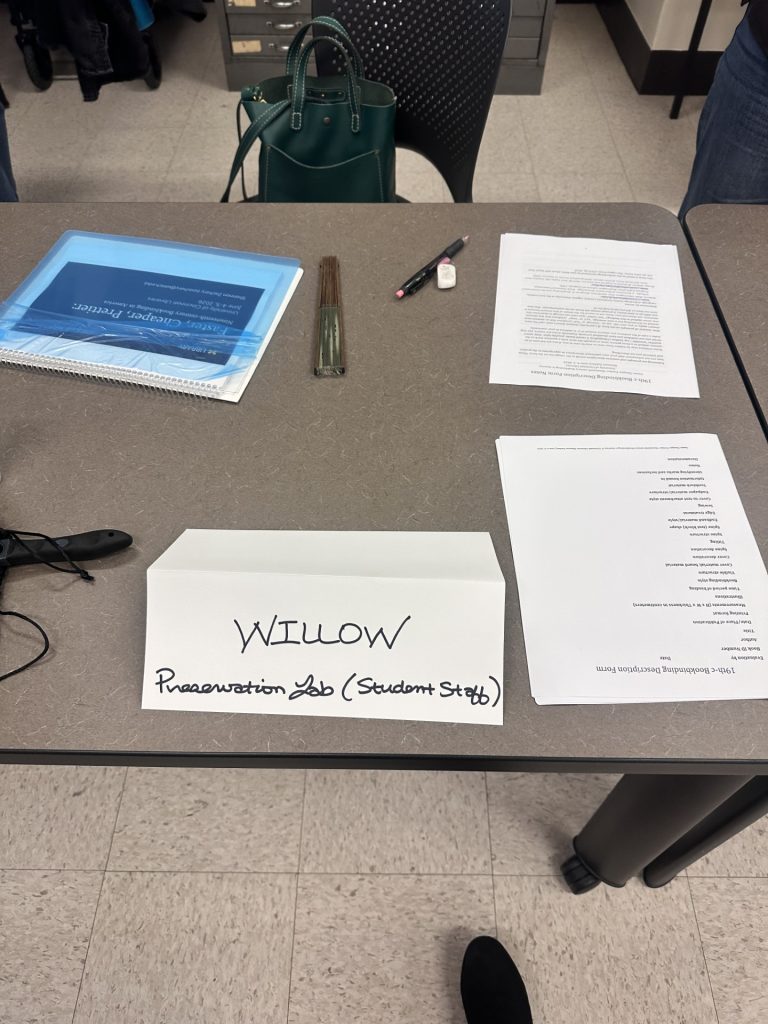
We were delighted to have Dr. Cathleen Baker come to UC for 4 days to teach us all about paper, paper making and printing in a collaborative programming and outreach workshop entitled Identification of Western Hand- & Machine-Made Paper, 1750-1900. The workshop included Preservation Lab staff, staff from UC Libraries Archives and Rare Books Library and the Content Services department, and Kathy Lechuga from Signature Conservation.

With Cathy’s teaching and guidance, we soon discovered some of the key characteristics is in handmade paper and how the introduction of machine-made paper just made everything more complicated. Oof, that dandy roller… But it was so exciting to make discoveries in the paper and learn new tips for paper identification. This will be particularly helpful for Preservation Lab staff when we do our examination of items for treatment proposals.

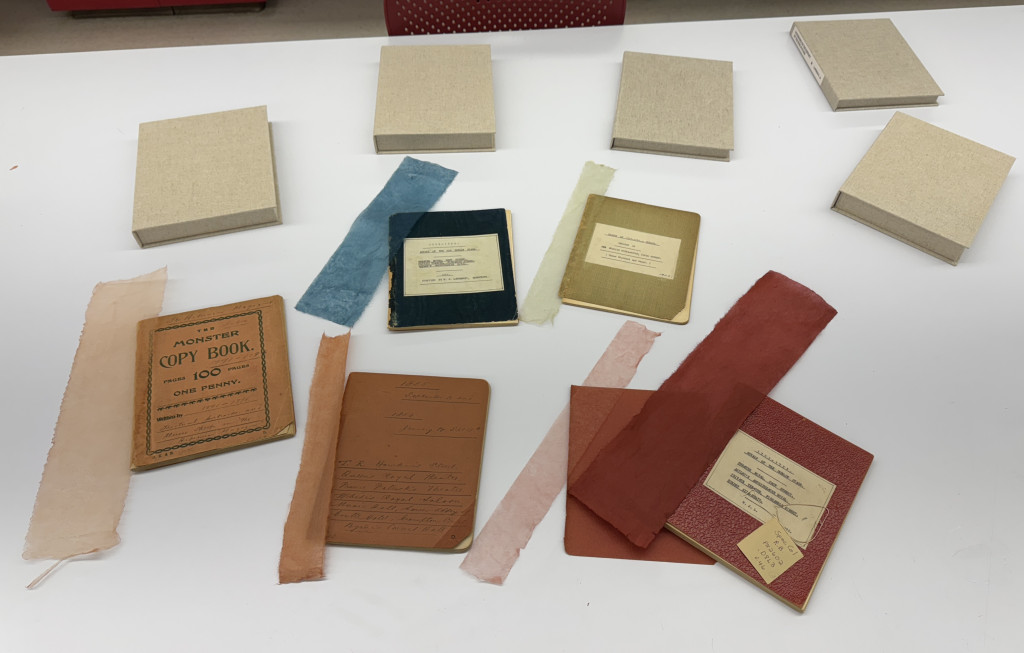
We are all beyond grateful to Cathy for sharing her immense knowledge and expertise with us. We all learned so much about handmade and machine-made paper and printing. Here’s just a taste of the workshop and us examining special collections items from the ARB Library and the Science Library collections:

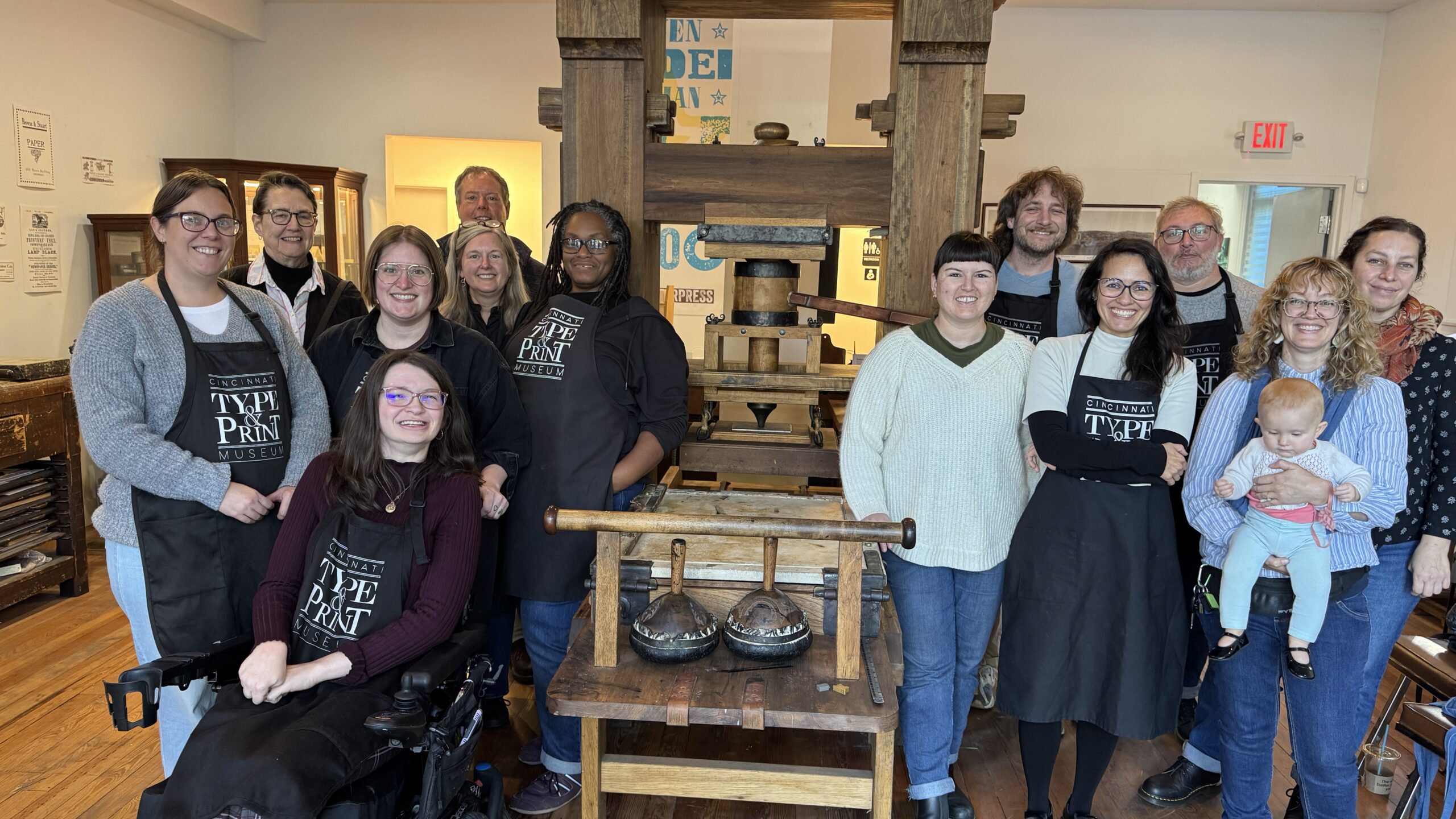
We also took a field trip to the Cincinnati Type & Print Museum to get a paper understanding of printing. It was a fantastic experience! A big thank you to Gary and his staff for a wonderful time printing and a great tour.

13 people and a baby posing in front of a large wooden printing press.
All participants of the workshop and Cathy posing in front of the Cincinnati Type & Print Museum’s wooden hand press.

Jessica Ebert – Assistant Conservator

A Timeless Tale – How Inscriptions Tell Stories

It’s amazing the different ways books can tell us stories. There’s the obvious: the words that are written on the page and create the story the author wanted to tell. But there’s also what lies beneath the surface — the wear and tear of the book, how it was bound, what materials were used to make it. There’s the outright story a book was meant to share, but there are also context clues, and deeper ways we can dive into the history of a book.

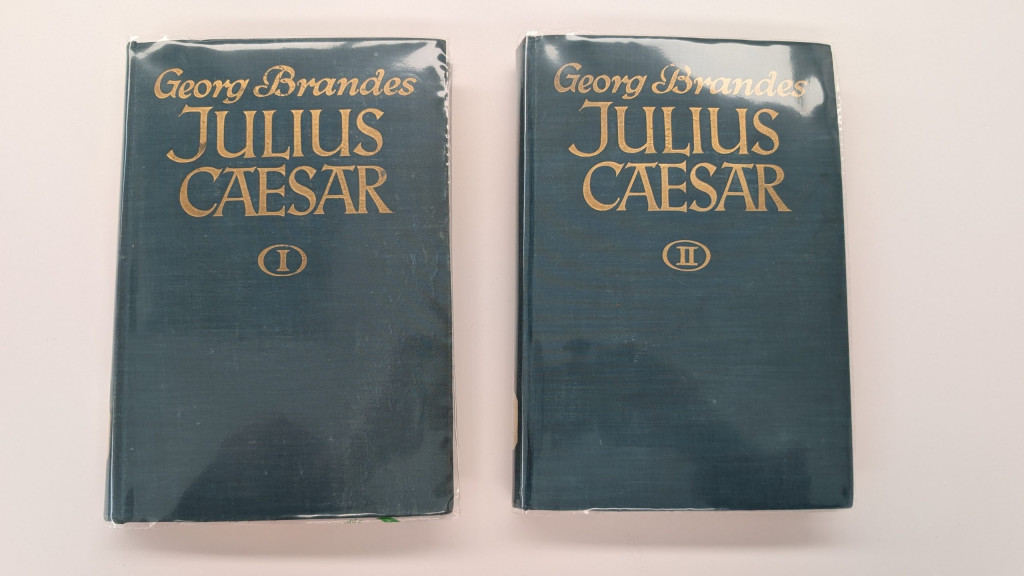
Sometimes, a book just outrightly tells its story through notes left by previous owners. A handwritten message about where it was bought, a book plate of whose library it came from, or an inscription with notable information about damage to the tome are all ways prior owners can document what the book has been through. This latter suggestion is the case for a two-volume set of Cajus Julius Caesar by Georg Brandes.

Pictured: volumes I and II of Cajus Julius Caesar.

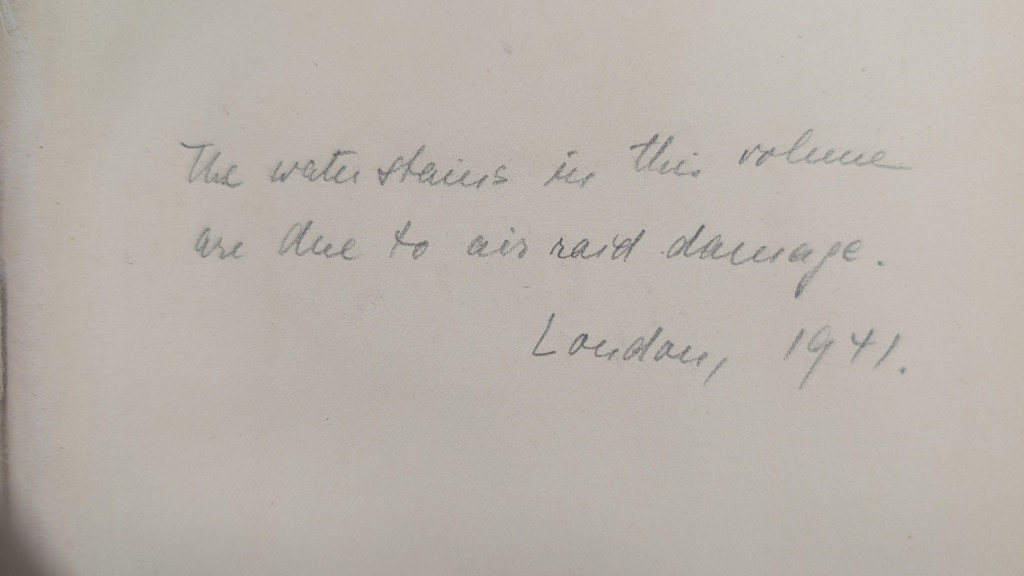
These books were published in 1925 by the Erich Reiss Verlag publishing house. On the fly leaf of both of these volumes is a handwritten inscription which reads “The water stains in this volume are due to air raid damage. London, 1941.” In graphite. What a big journey for two books, from Berlin, Germany, to London, England, and then to Cincinnati, Ohio!

Pictured: inscription in Julius Caesar Volume I.
Inside of both volumes, open to the first blank page, where the inscription is visible on both books.
Pictured: inscriptions in Julius Caesar Vol. I and II
Two volumes stacked on top of each other with the bottom of the text block visible. The text block is stained brown on the lower right corners of both volumes due to water damage.
Pictured above: signs of water damage on the book.

The water damage to the books is there but it isn’t too drastic. There is some obvious staining and cockling to the pages, as well as some warping of the covers. These books were treated with v hinges on the front and back fly leaves to prevent further separation of the cover from the text block and were also put in Colibri covers to help keep them protected on the shelves and during use.

One of the books with the front cover open and the text block under weights while being repaired.
Pictured: both volumes of Julius Caeser being treated with v hinges.

These books needed minimal treatment, and then will return to their home at the Classics library. With some care from the preservation lab, these two volumes can continue to tell their story for years to come.

Nicole Browning — Conservation Technician

Allegheny River / Capt. J.W. McLaughlin

How to store a 15ft paper scroll?

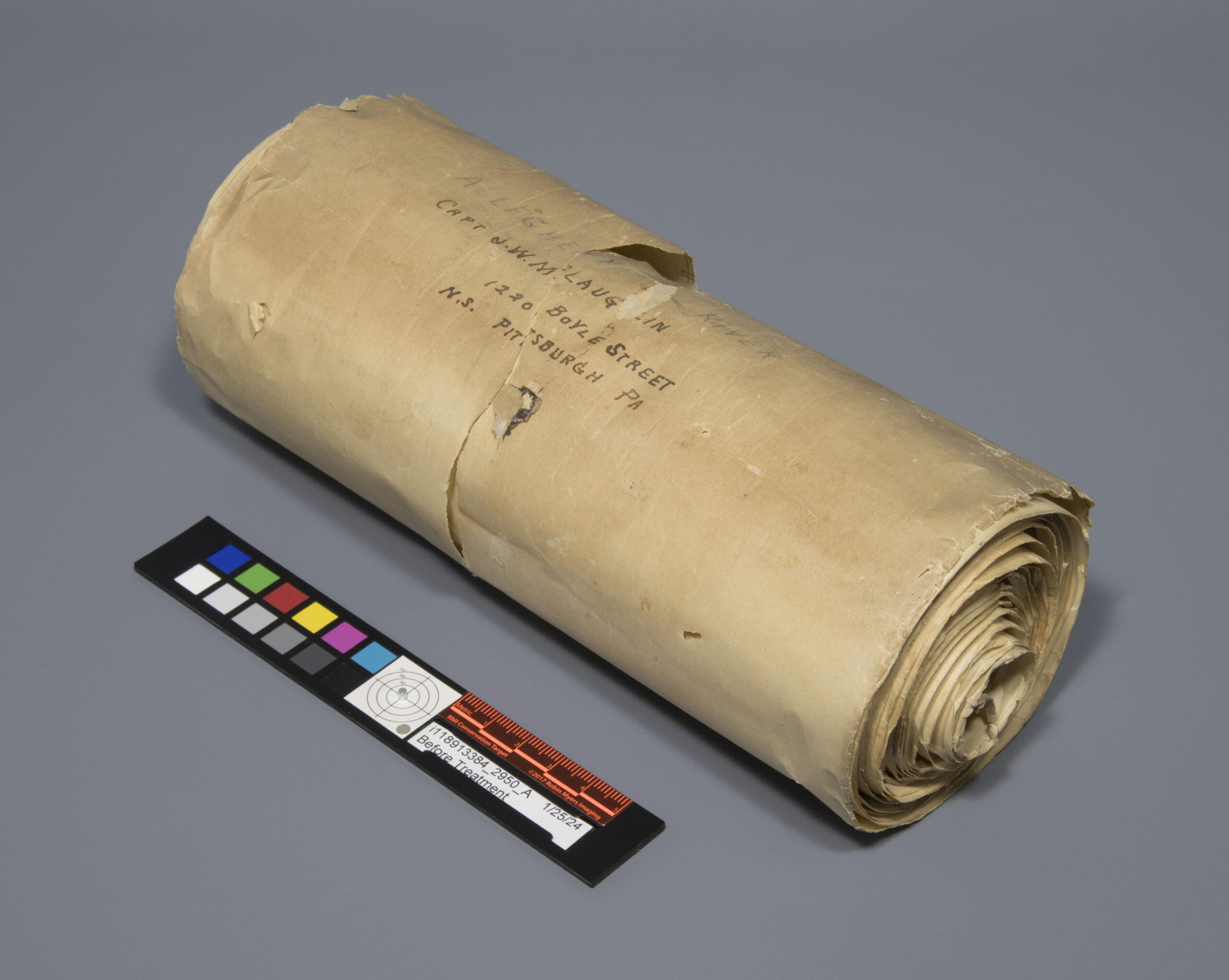
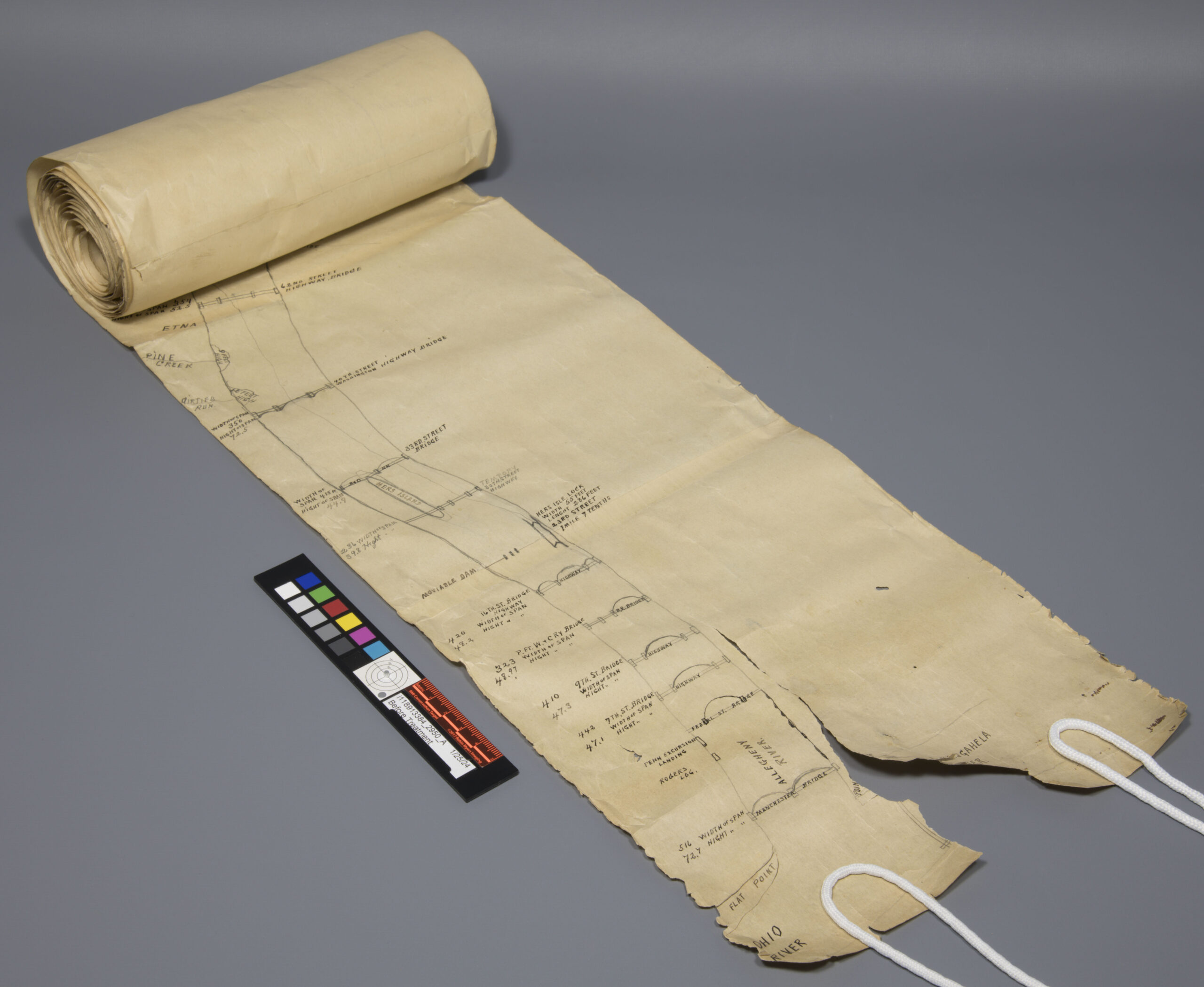
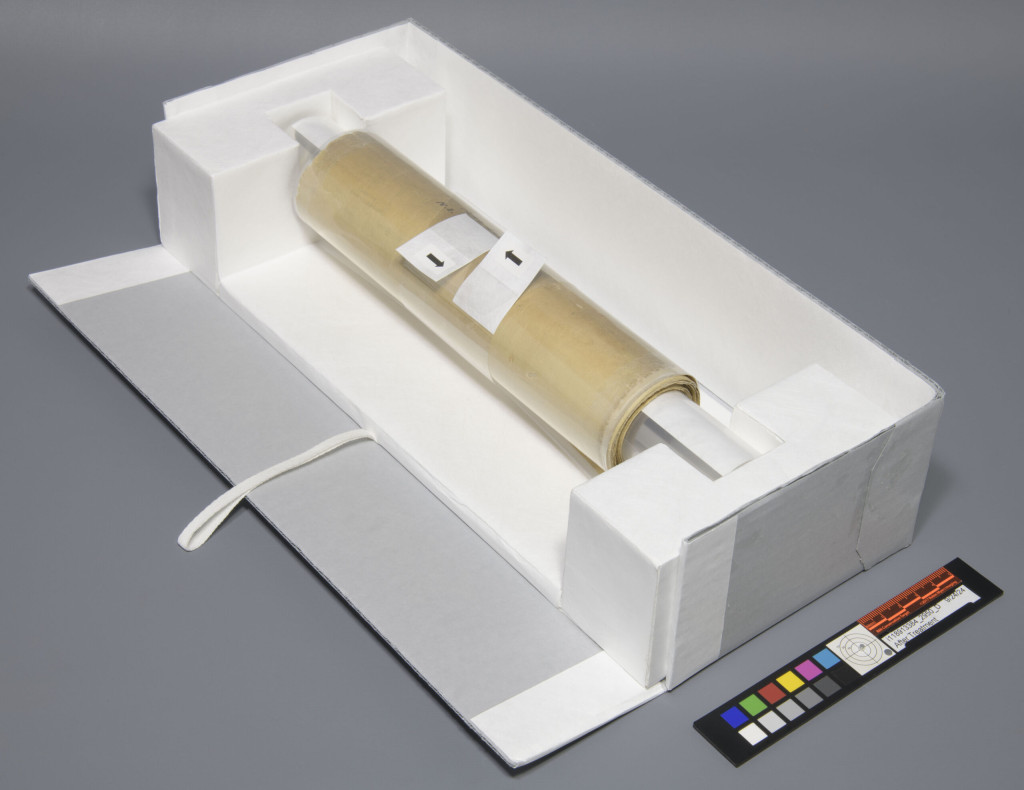
Back in October of 2024, we received something slightly more unusual from the Cincinnati and Hamilton County Public Library, a 15-foot-long, hand-drawn rolled map of the Allegheny River. Yes, fifteen feet.  This map was created by joining smaller sheets edge-to-edge, forming one continuous scroll that looked more like a treasure map than your typical library item.

Scroll with photography target in front of it

A dilemma quickly followed, how do I create a housing solution that’s safe and functional, but won’t turn future handling into a logistical nightmare? Like many libraries, they didn’t have a 15-foot shelf just waiting for this (because who does?), so storing it flat was out. Storing it rolled became our only real option. The enclosure needed to be secure and protective for the map, and ideally, easy and elegant to display when needed.

First things first, some stabilization treatment. Before tackling the housing design, the scroll underwent conservation treatment to mend small tears and fill losses, particularly at the “beginning” and “end” (depending on which direction you follow the river). Once stabilized, it was ready for some housing trials.

scroll partially unrolled
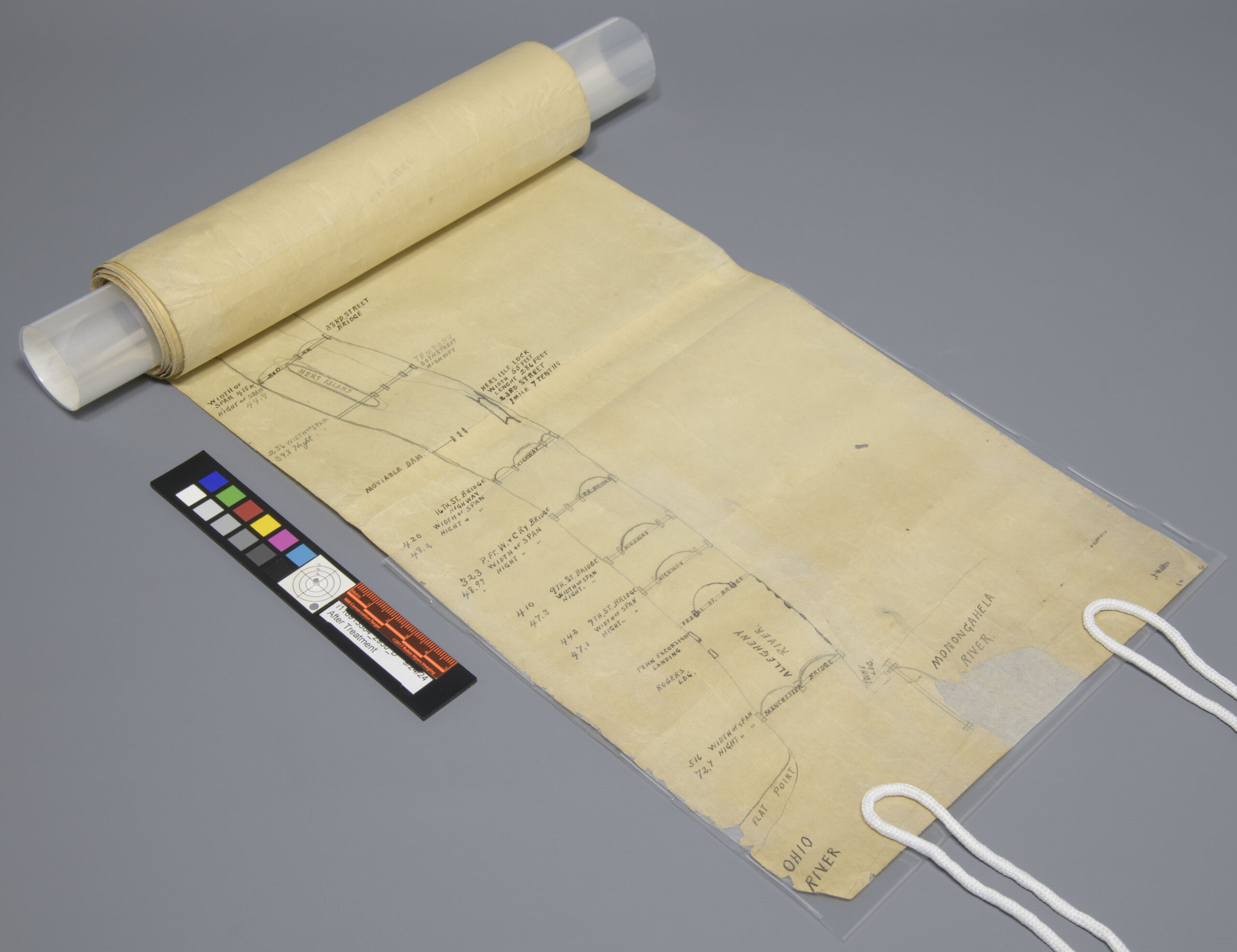
Before Treatment – Large loss and tear at one end.
scroll partially unrolled
After Treatment – Large loss repaired and map rolled around the polyester cylinder core.

While researching solutions online, I stumbled upon a fantastic blog post by J.M. Iacchei from the Cornell University Library Conservation Lab (link here). Their approach to scroll housing was clever, practical and elegant, and it just gave me the spark I needed to create our own version.

Here is how we rolled:

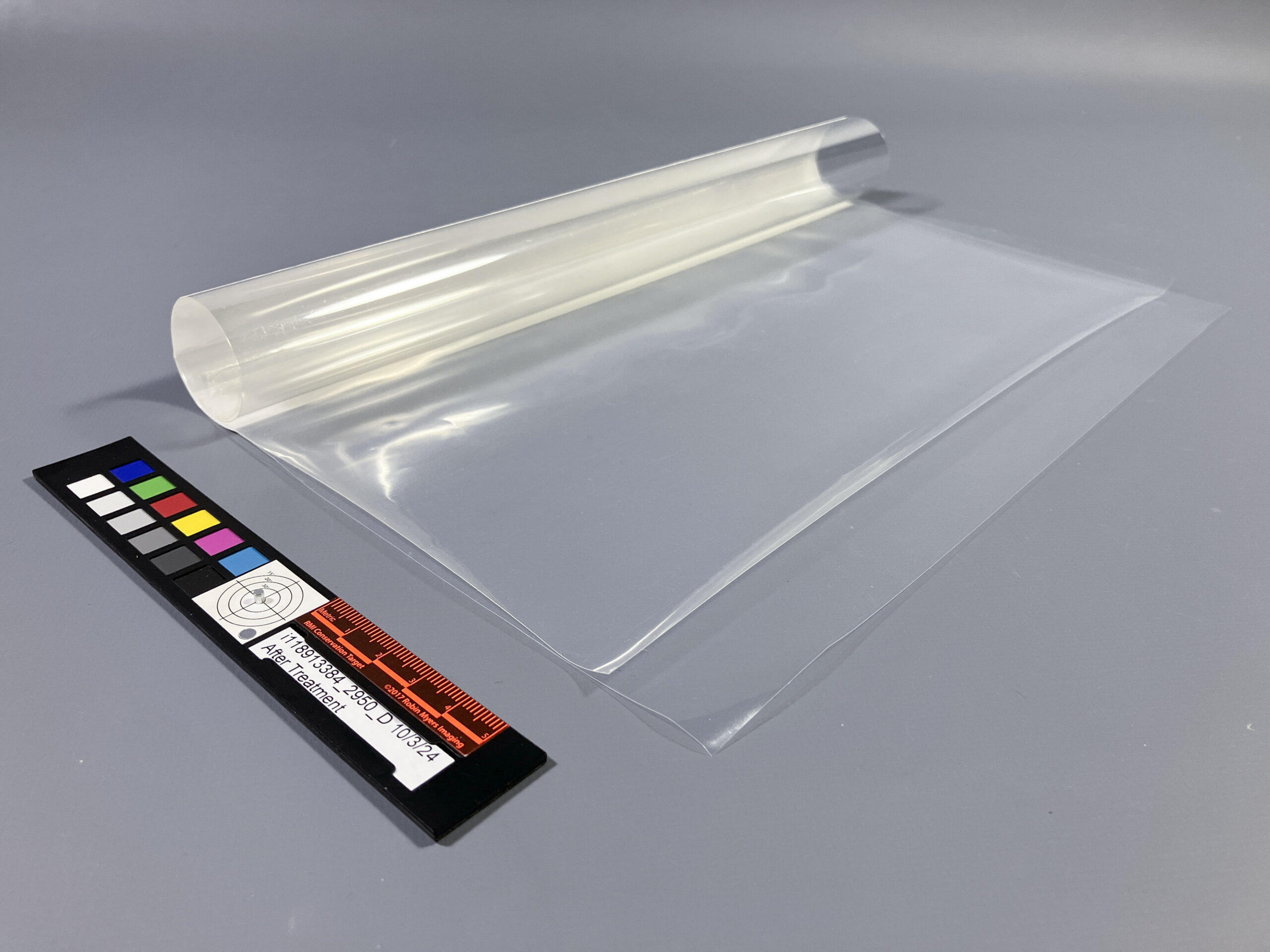
  • A support core – To give the scroll structure while rolling, I created a polyester cylinder core with a polyethylene sling. The sling supports one end of the scroll as it begins to wrap around the core, providing gentle guidance and protection as you start to roll the map. The map can be easily inserted into the sling to begin rolling.
Polyester cylinder core with a polyethylene sling to secure one end of the map.
The end can be easily inserted into the sling and supported as the map is rolled around the polyester core.
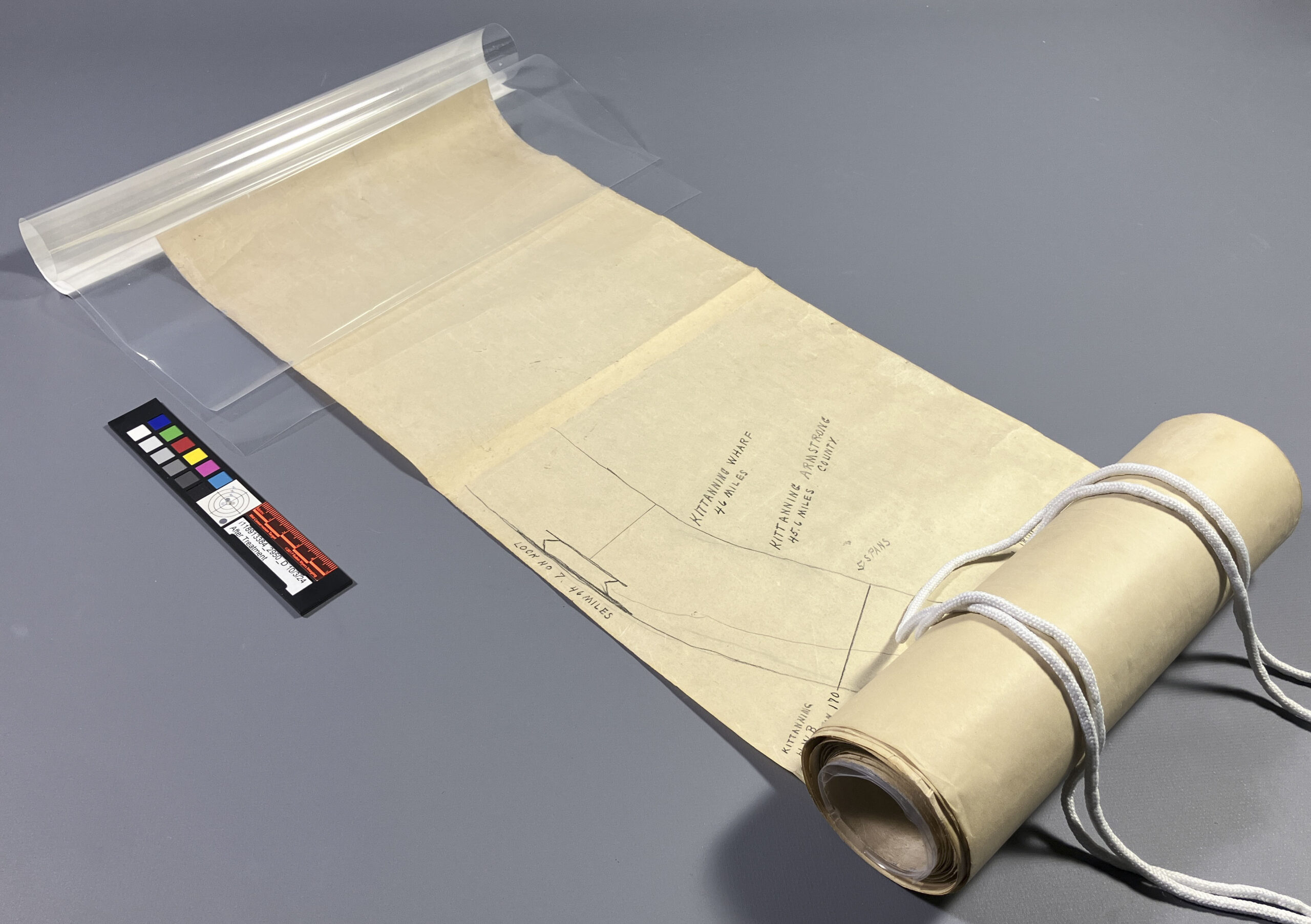
  • Protection of the ends – The opposite end of the scroll was placed into a soft, transparent polyethylene pocket. It’s flexible, unobtrusive, and doesn’t need to be removed, even during after treatment photography.
Scroll partially unrolled
The other end of the map is protected with a polyethylene pocket that is flexible and offers support to the fragile end of the map.
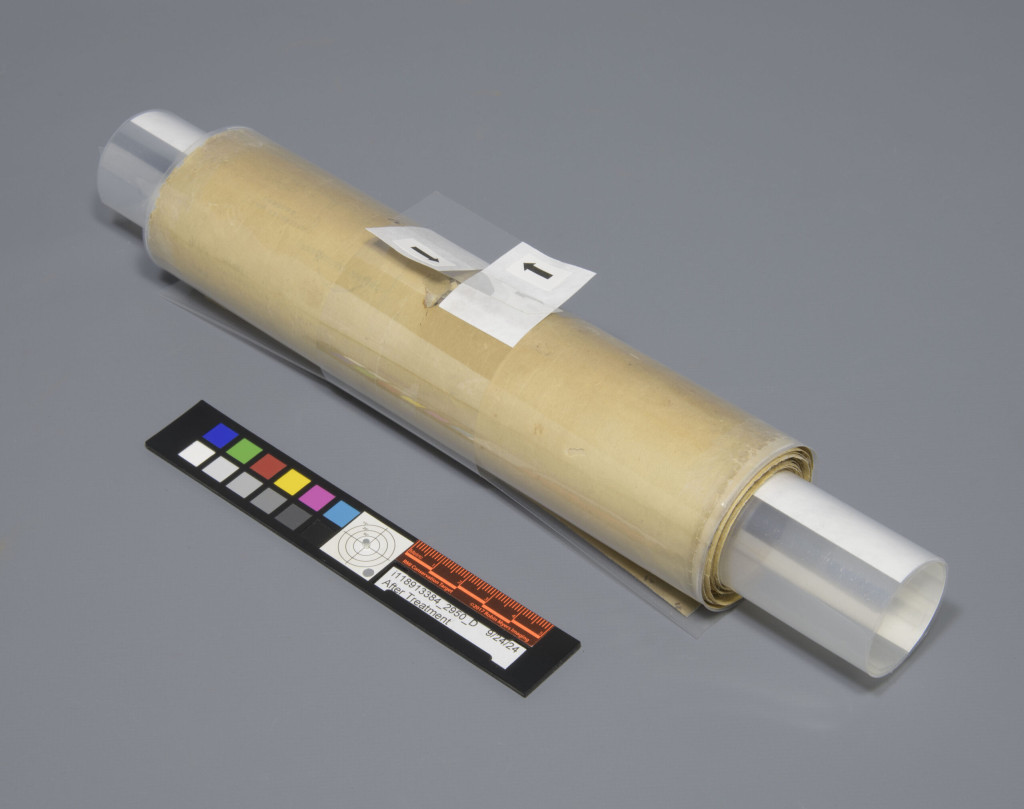
  • Keep it rolled – Once fully rolled, the scroll was secured with a polyester belly band. The polyethylene pocket helped protect the scroll surface from any abrasion caused by the belly band.
rolled scroll with belly band to hold it in place
The rolled map is secured with a polyester belly band.
  • Display ready? – For display,I built a removable tray that cradles the rolled scroll without letting it rest directly on a surface. This tray doubles as a mini display platform, so the scroll can be partially unrolled and supported during handling and exhibit. Functional and elegant.
Rolled scroll secured within an enclosure tray
Display tray that offers support to the rolled map for long term storage.

I also tested a few other methods along the way, like supporting the entire scroll in a single 15-foot polyester sheet or sandwiching it between two. But the seams where the map’s original sheets were joined caused additional creases with those solutions.  In the end, supporting the scroll in its entirety just wasn’t viable, so I pivoted to protecting the ends and letting the core do the heavy lifting.

Also: cutting two 15-foot-long sheets of Mylar by hand? Let’s just say I don’t recommend it… and I definitely don’t miss it.

Here is what a 15ft paper map looks like:

Catarina Figueirinhas – Assistant Conservator

Fun with PhotoDoc – X-rays and CT scans, Oh My!

An alternate title to this blog could be, “That time we X-rayed medieval choir book at the UC Medical Center, and then the pandemic happened I forgot to write a blog post about it”. Oops!

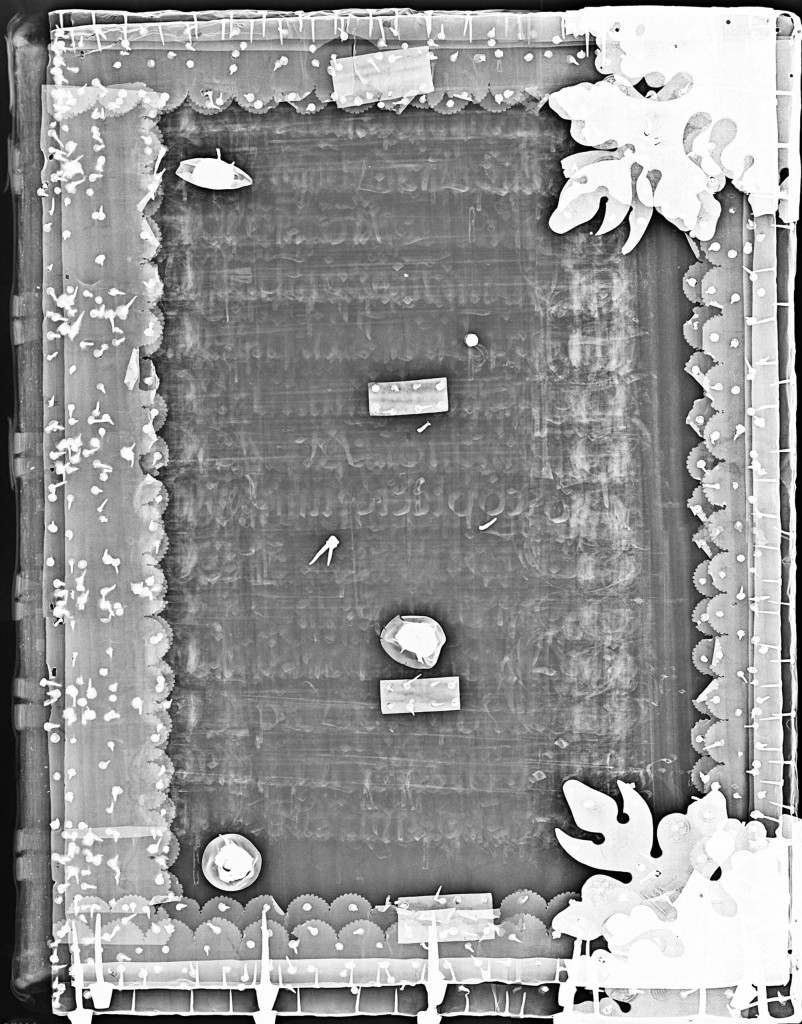
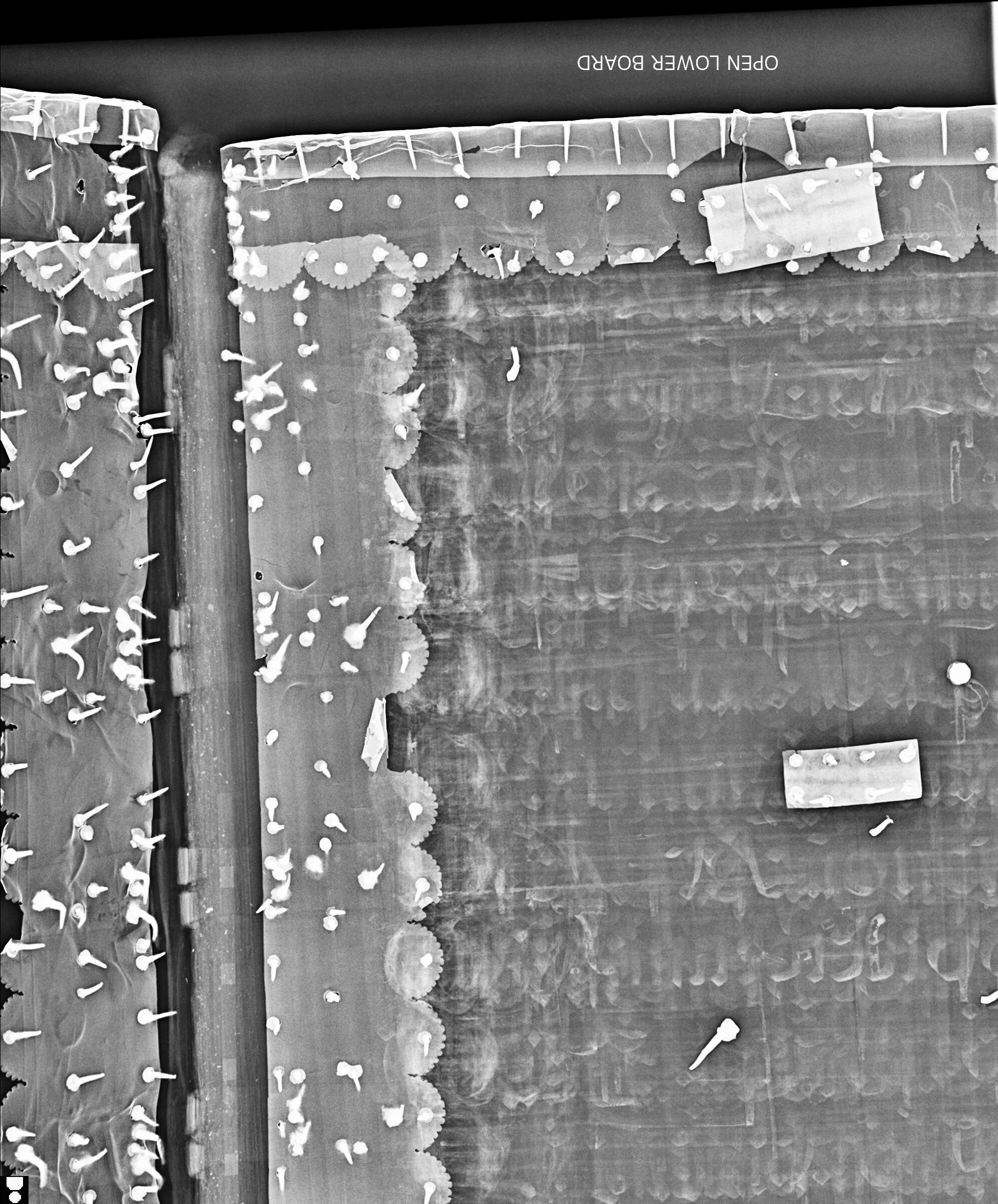
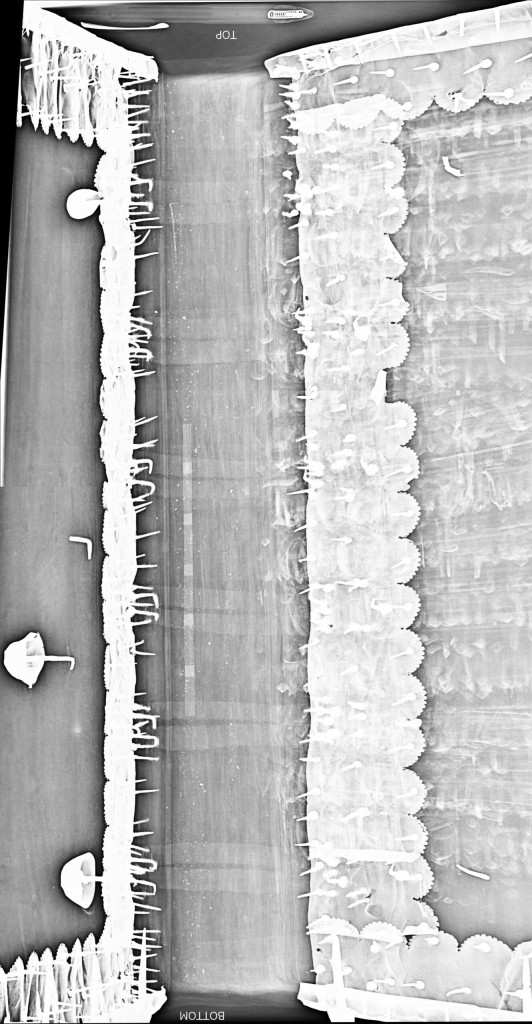
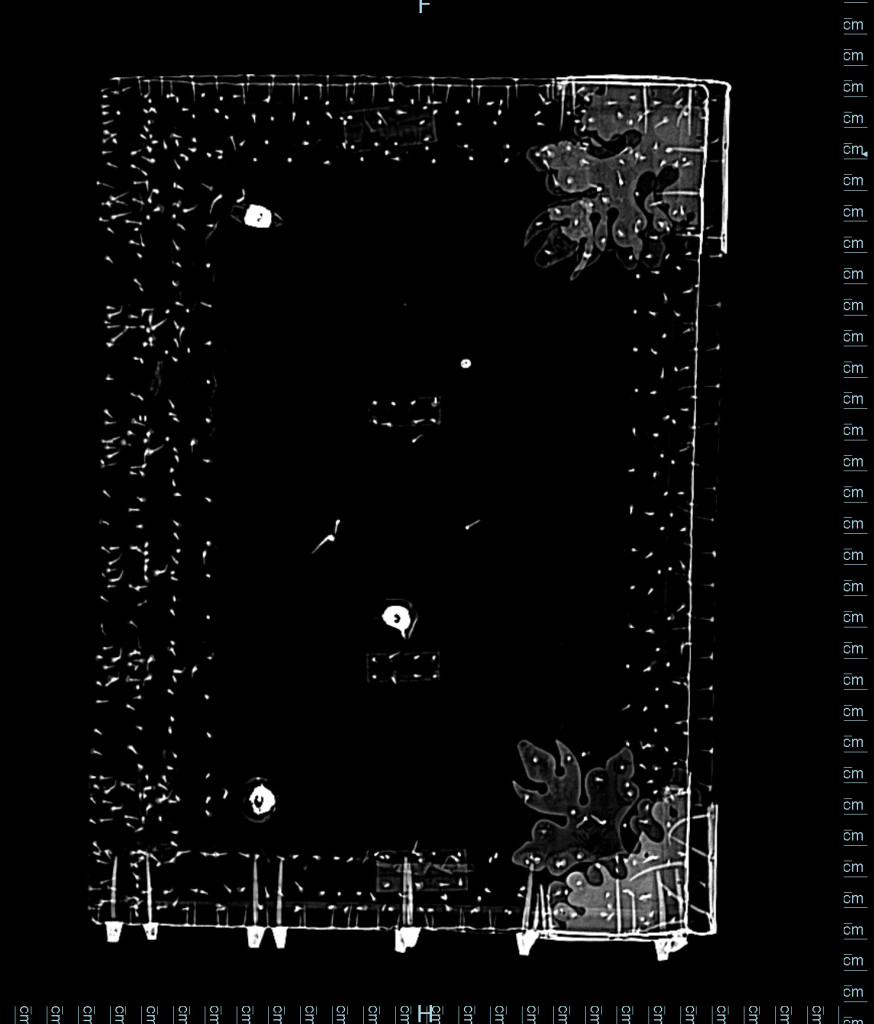
X-ray image of an oversized medieval book

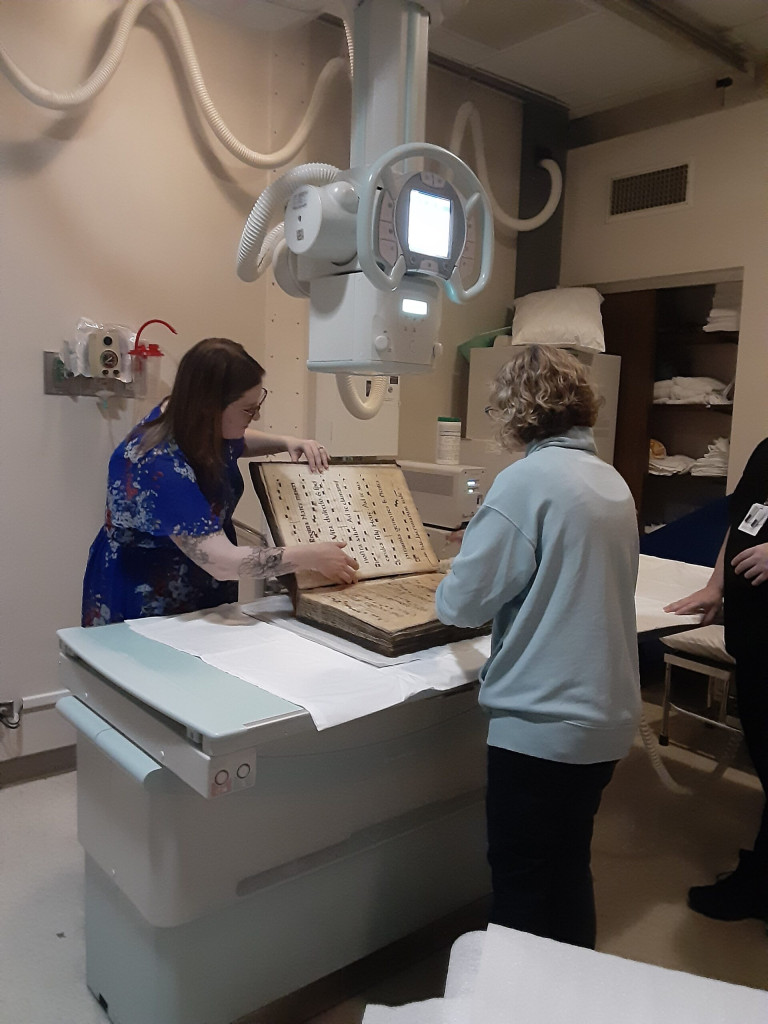
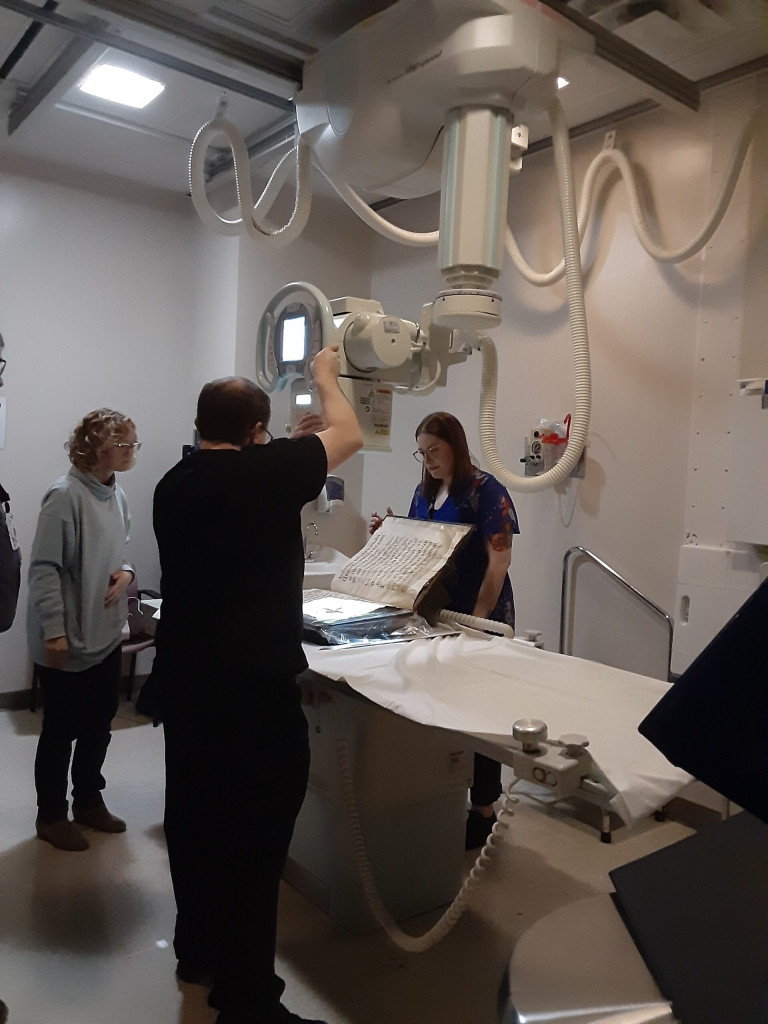
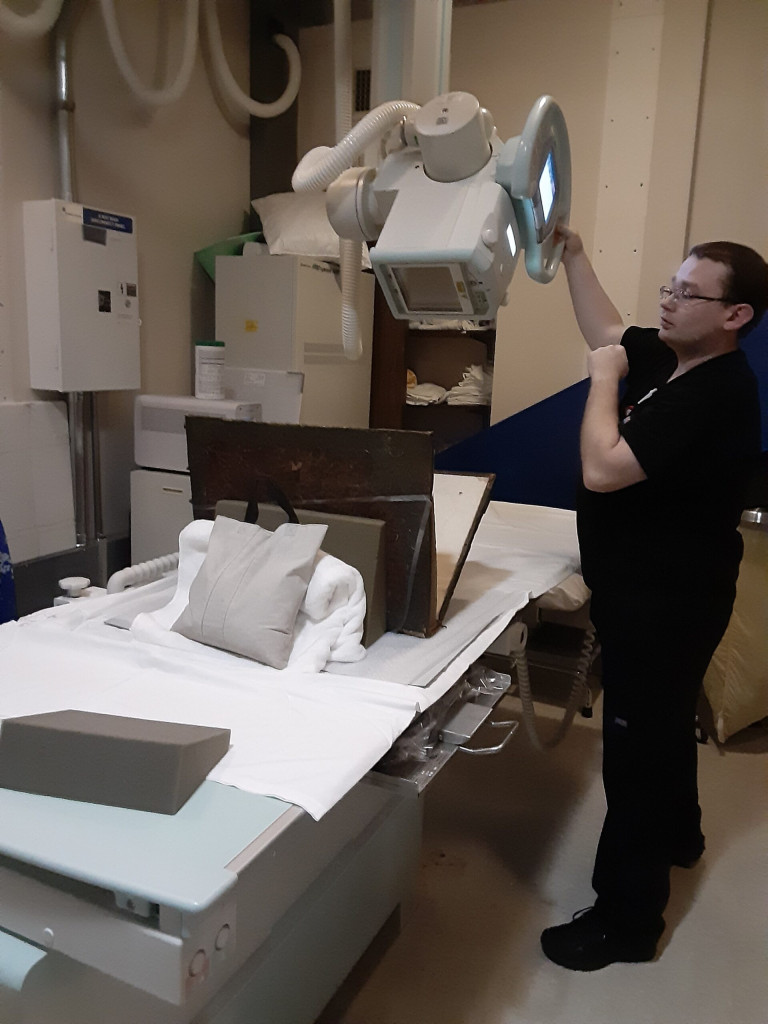
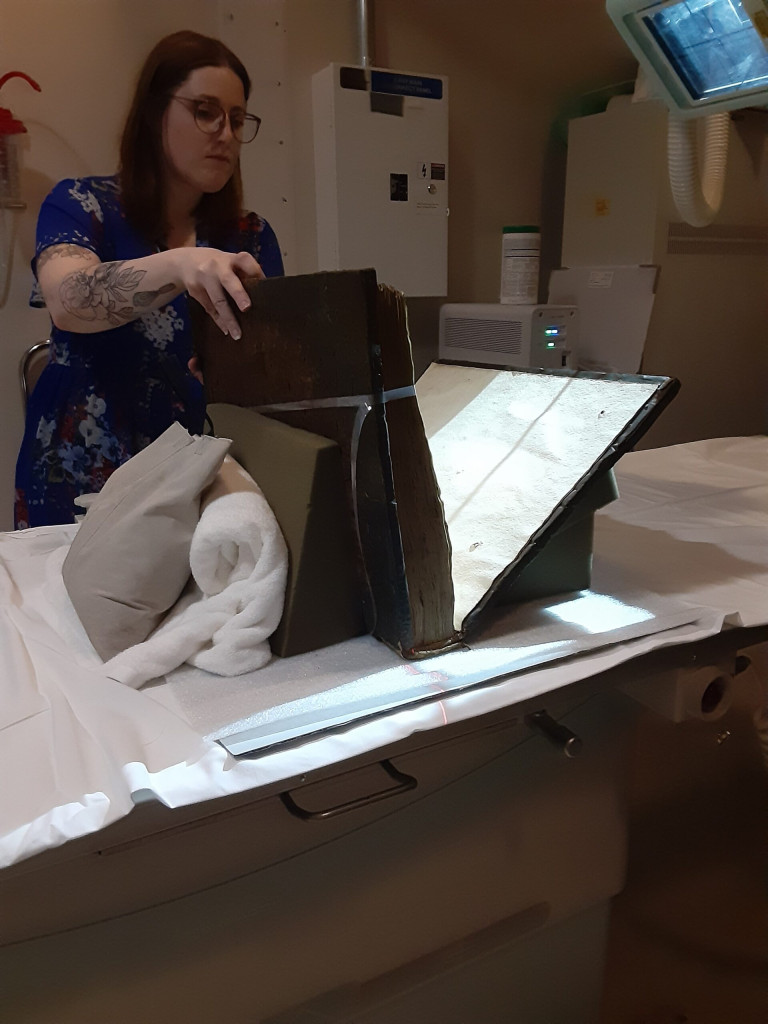
Let’s rewind the story back to mid-2019, when our Associate Conservator, Ashleigh, expressed interest in radiography on a beautiful, oversized choir book from the Classics Library. I, at the time, was the Photographic Documentation Specialist and had never carried out or assisted with any radiography projects, so I was very keen to start reaching out to anyone I could think of on West and East campus who might have access to such equipment. The most logical answer, UC Health, proved to be the winning one when finally the Director of Diagnostic Radiology put me in contact with the Enterprise Director of Imaging, who said yes to my request, and ultimately put me in contact with my main contact for the project, the Radiology Manager at UC Medical Center.

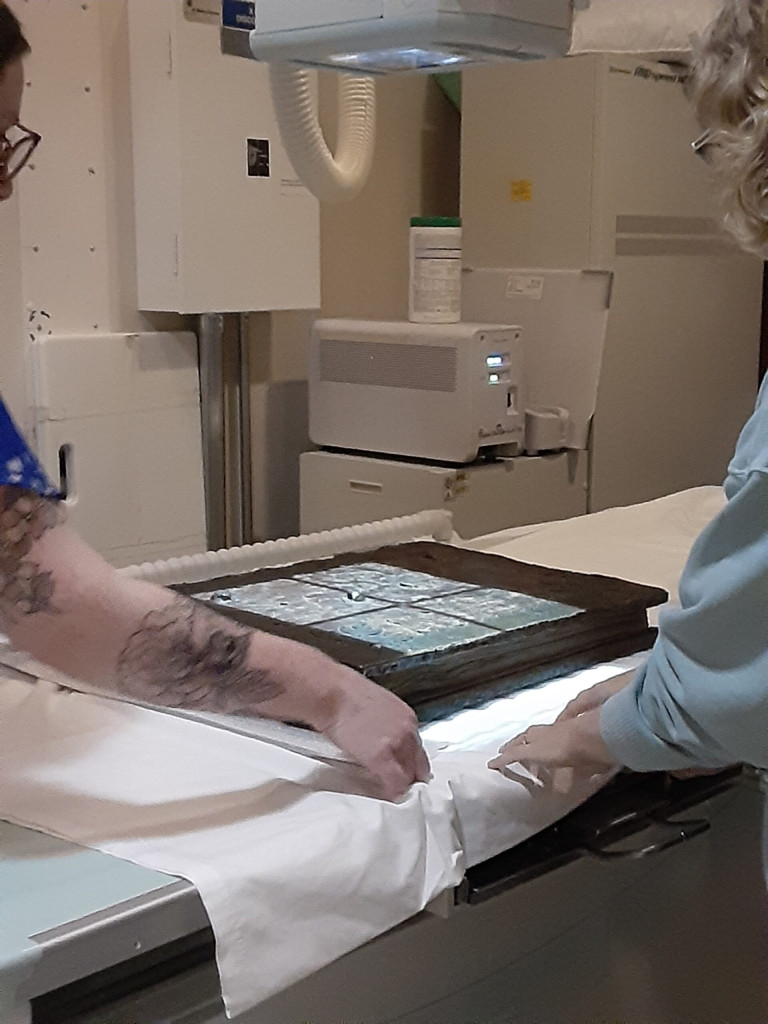
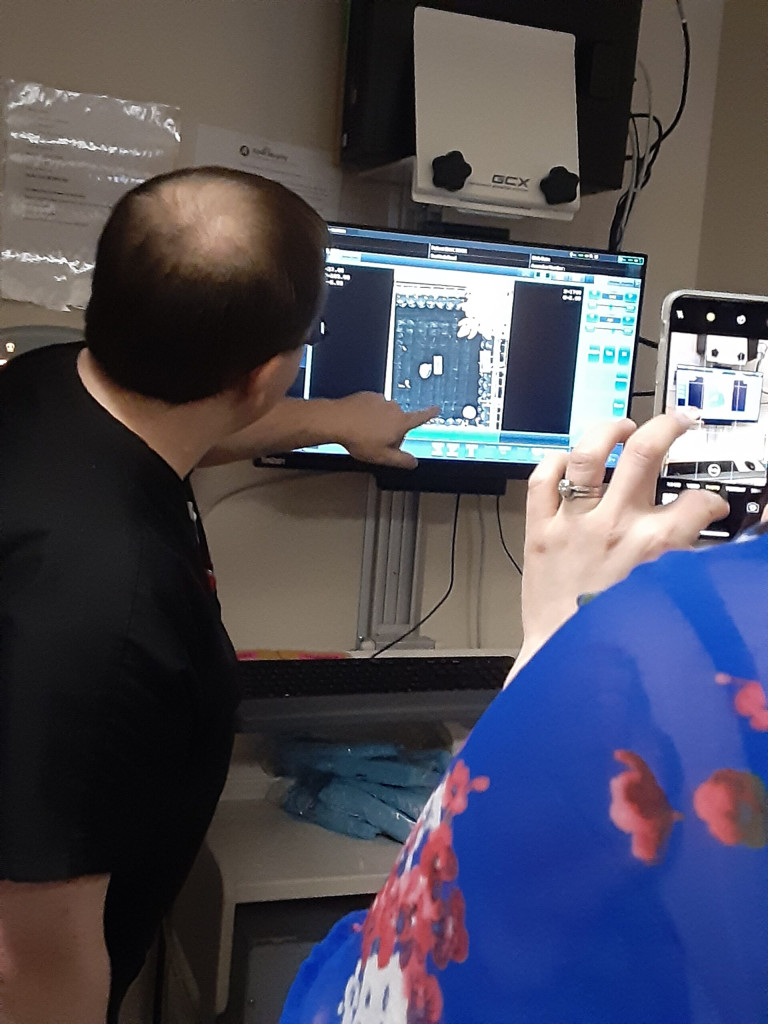
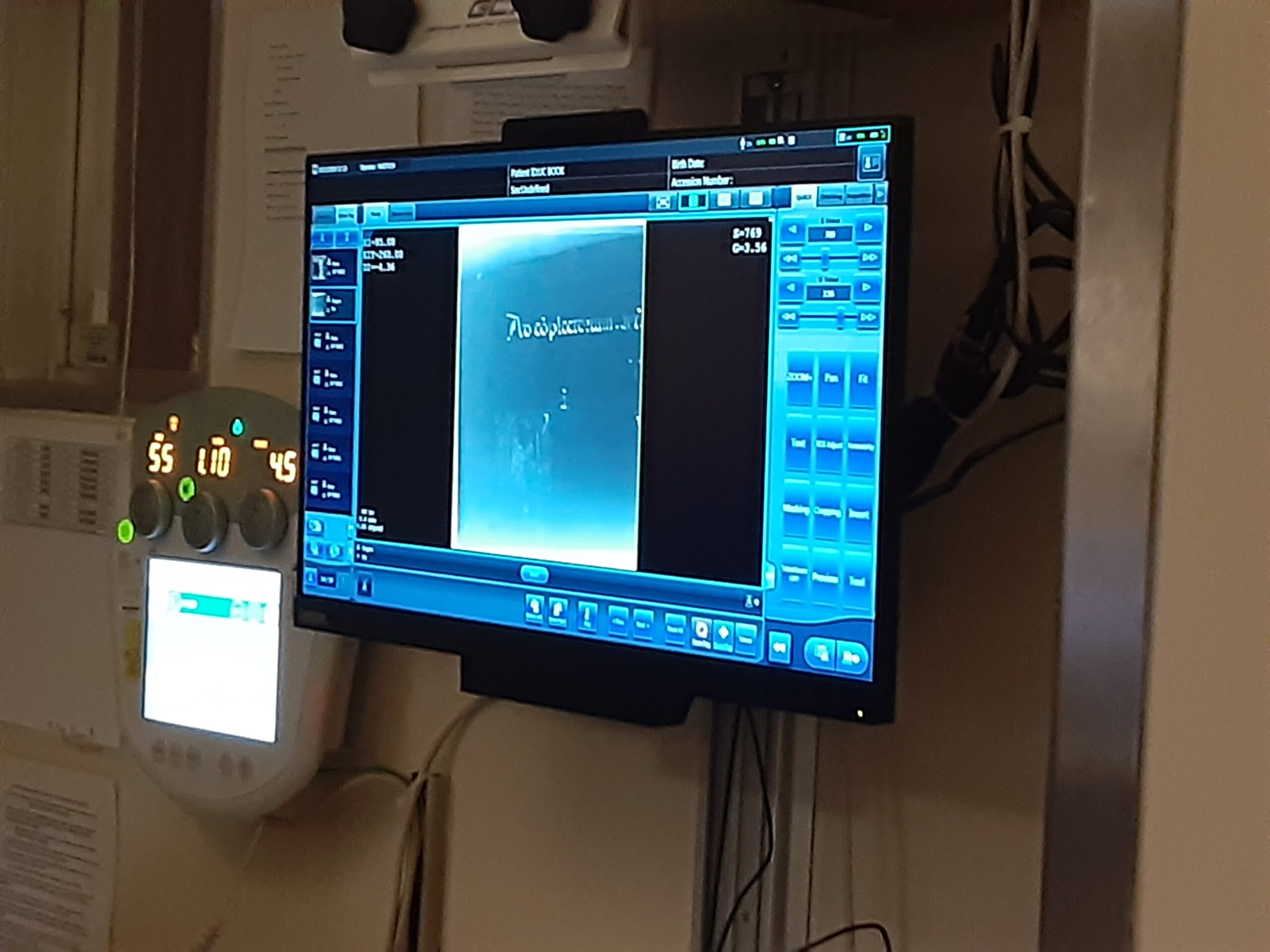
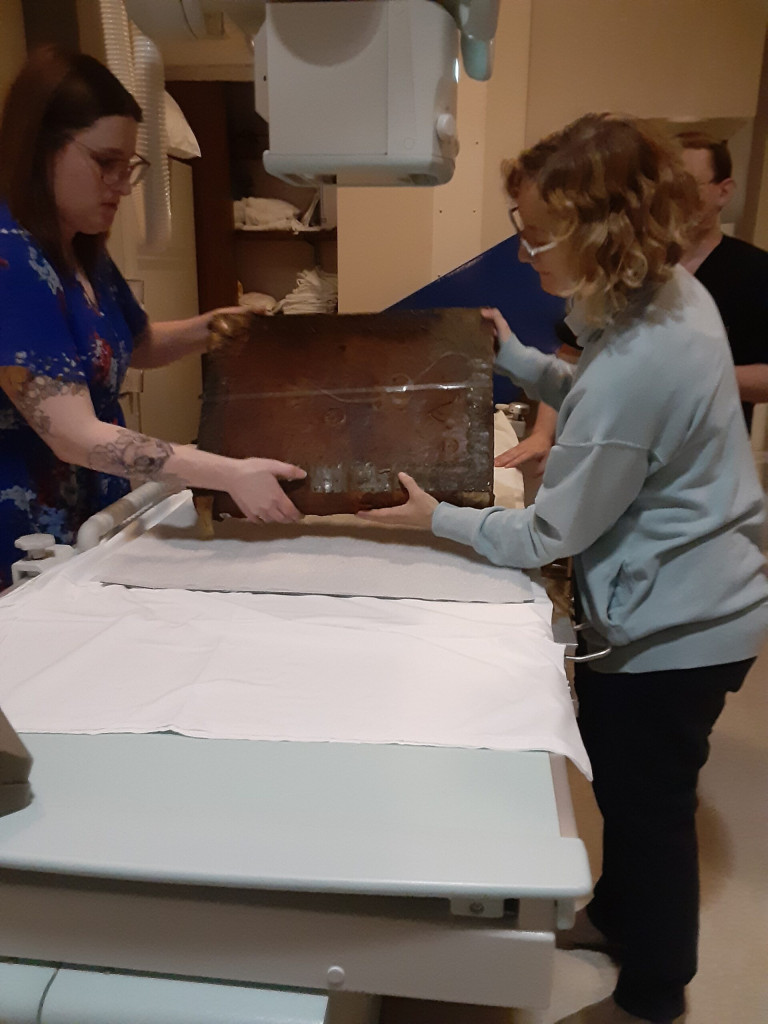
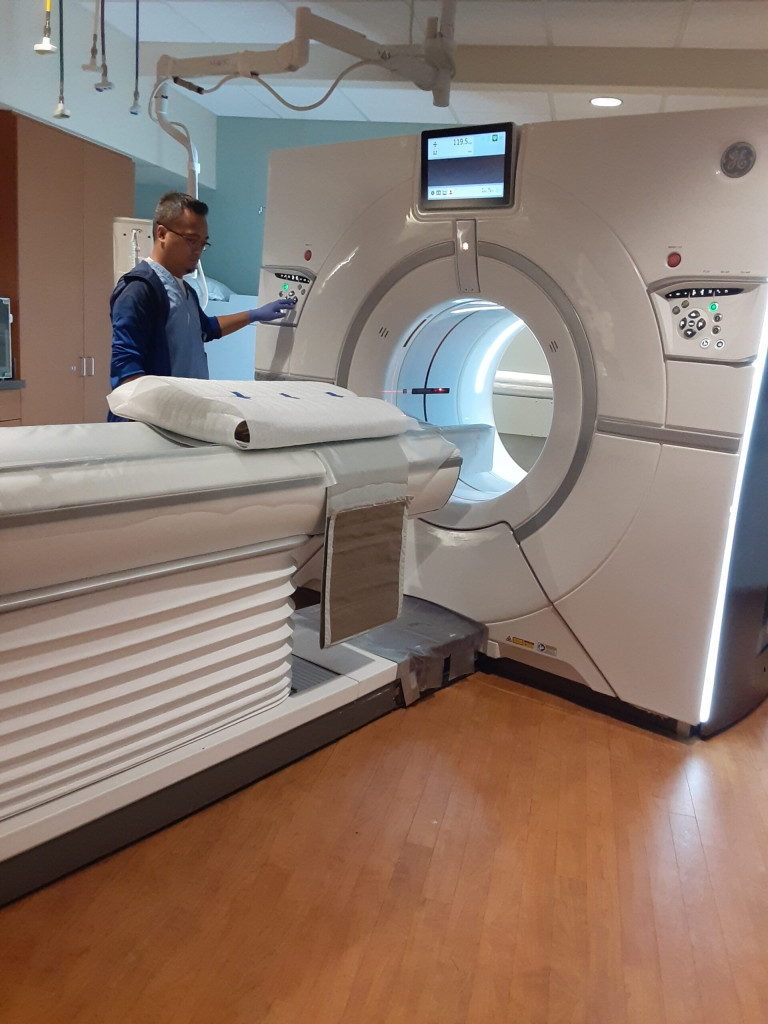
The date was set, October 22, 2019. Ashleigh, Holly and I packed up the heavy, choir book and carefully transported it from West campus to East campus to be imaged. The UC Health staff were beyond friendly, and I think they got a kick out of imaging the oversized leather volume. The technician really worked with us to adjust the intensity of the radiography depending on what we were trying to capture, whether it was the cover, the sewing and the supports, or the illuminated text (which was a little harder to capture with their equipment).

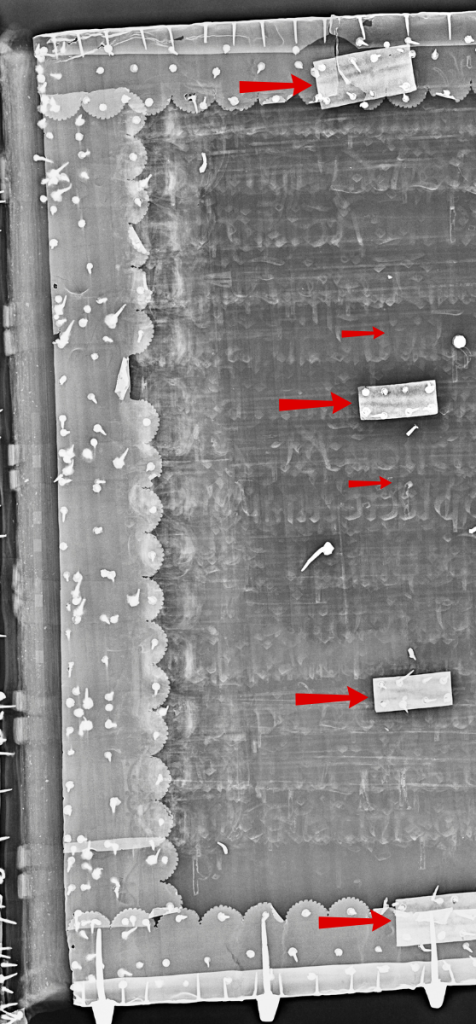
Overall, we discovered…a lot of nails, split thong supports, and on the lower board, four mends to the wooden board that appear to be bracing a split in the wood that is running vertically.

Red arrows indicate metal braces adhered to the wooden boards
The larger red arrows indicate metal braces while the smaller red arrows indicate the crack in the wooden board.
X-ray image of the spine
Image of the spine which allows you to see the split thong supports and you can even see the tattle-tape security strip!

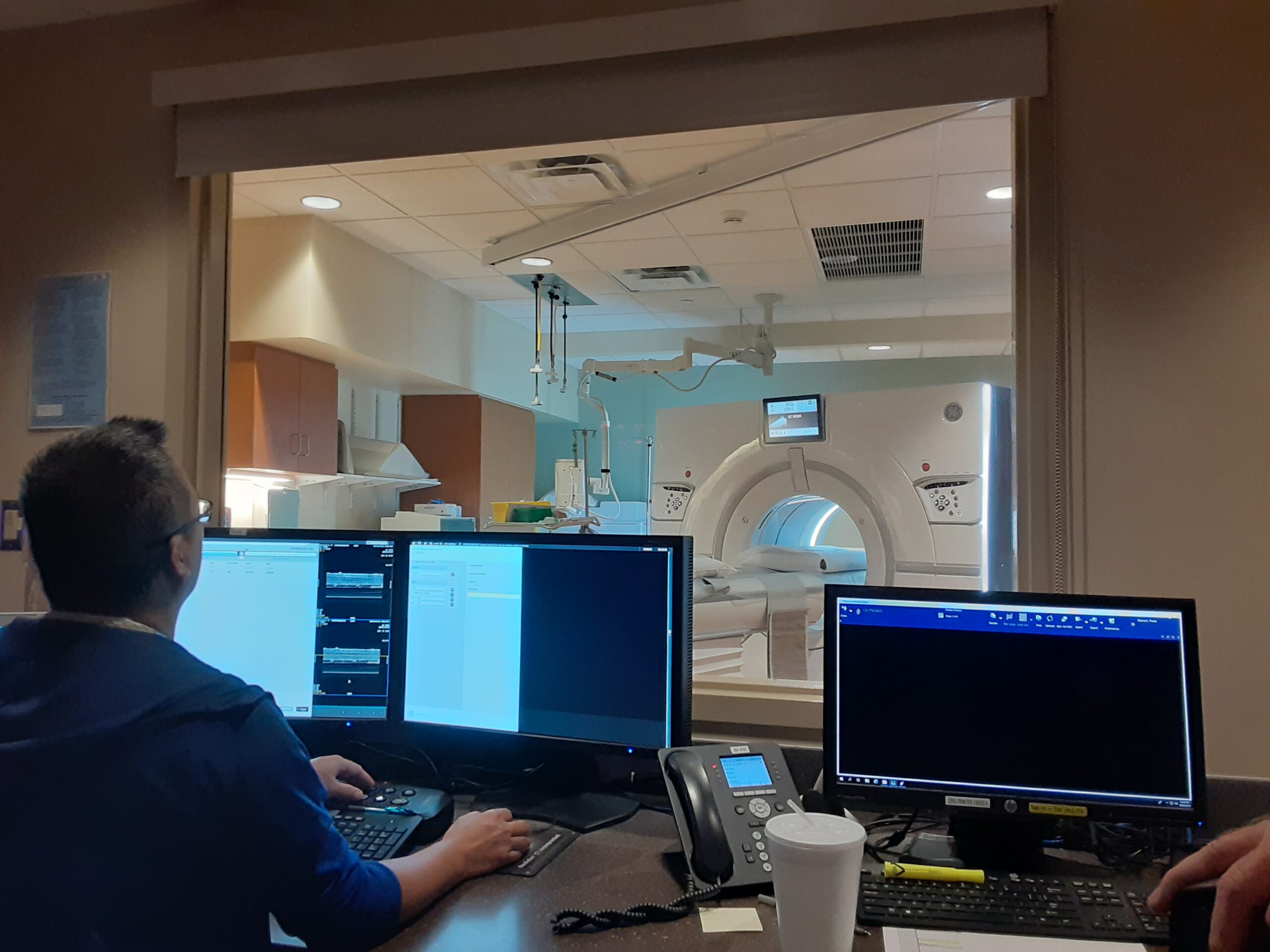
Then following the radiography session, they were kind enough to ask if we would also like to place the volume in the CT scanner. Since the scanner could easily and safely accommodate the volume while keeping it wrapped in foam, we jumped at the chance!

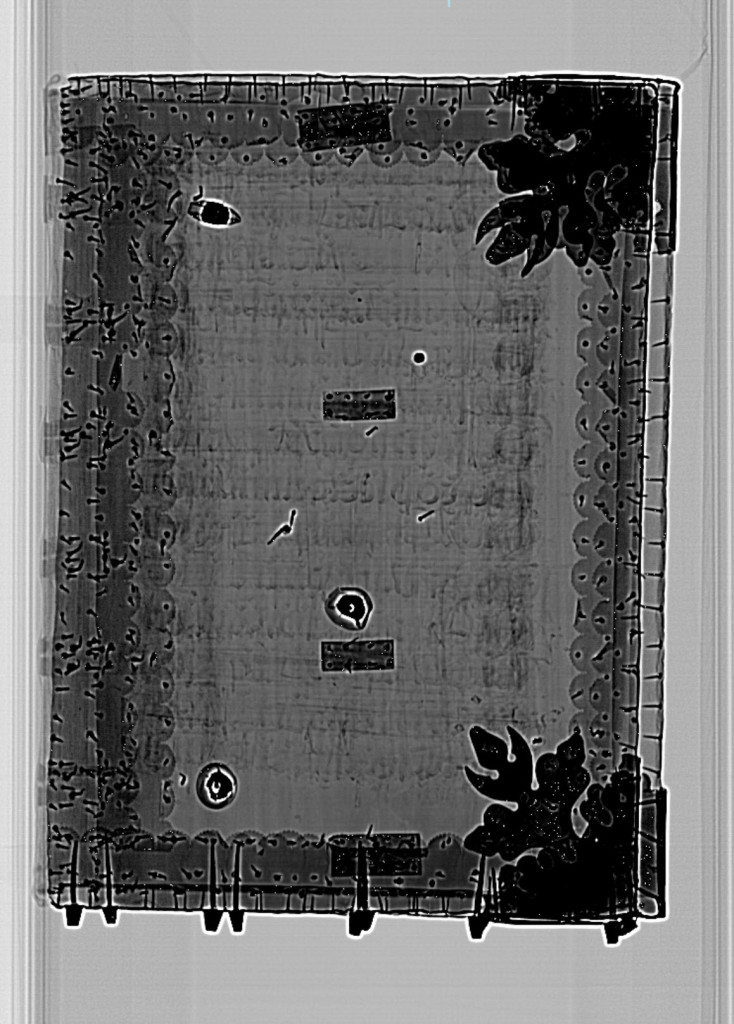
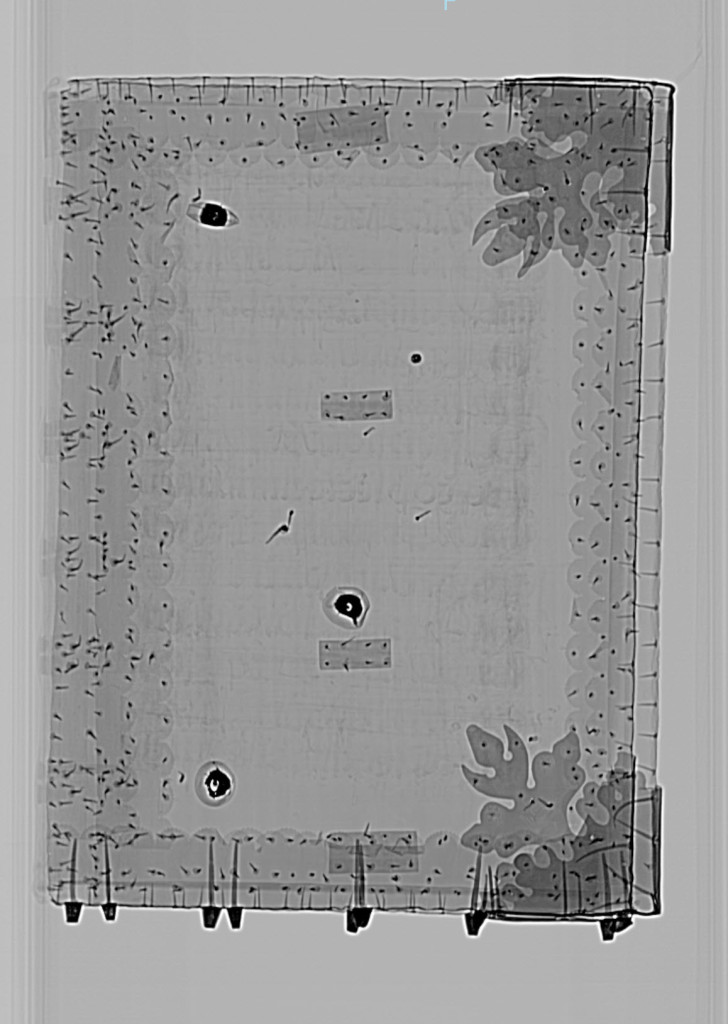
We received all the imaging files on two CDs from UC Health, and then I went about making heads and tails of it. The radiography images were fairly straightforward. For the most impactful imaging, namely of the spine, upper and lower boards, I created composite images using the panorama feature in Photoshop to merge the images. For example, each cover consisted of four separate images.

With the CT imaging, the CD came with a reviewer software (Sorna) to view the files. Frankly, the CT scans were a little bit harder to comprehend, but nonetheless interesting. Ultimately the CT scanner allows you to view the various materials within the object. Whereas normally for the equipment that was used that would mean bones, organs and tissues, for the choir book that meant metal material like brass, leather, ink and pigment. Within the viewer function there was also an interactive component to the CT data as well, which allowed you to manipulate various levels to see various intensities, but even after a lot of trail and error and experimentation I found it very confusing, though I did get some interesting, and some less impactful, results. Let’s just say, I do not have a future as a CT technician!  I’ll stick to my day job.

  • Still image from CT scan
  • Still image from CT scan
  • Still image from CT scan

Jessica Ebert – Assistant Conservator

Archeological Textile Discovery in the Stacks: Storage Solutions

This is the final post of a four-part series.

When a collection of Egyptian mummy bandage fragments at the Cincinnati and Hamilton County Public Library was found in an area used to store uncatalogued flat materials, the lab was asked to play a role in providing better stewardship.  

Click the links below to jump to the following posts:

  • Research and Examination – Examining the material composition of the objects
  • History – Historical information provided about the Egyptian inscriptions
  • Treatment – How the materials were treated after learning about their content
  • Storage Solutions – Individual solutions for separated fragments as well as storage as a collection

Storage Solutions

Inspired by JAIC and AIC articles such as Storage Containerization: Archaeological Textile Collections by Dennis Piechota and Storage System for Archeological Textile Fragments by Lisa Anderson, Dominiue Cocuzza, Susan Heald and Melinda McPeek a custom matting system was created with the following goals in mind:

  • The textiles will remain in the enclosure for both storage and potential display
  • The matting system will support the fragments for handling and viewing
  • The fragments will not move or slide in the enclosure, yet be stored non-adhesively

Portfolio Matting System

Before constructing the final portfolio, models were created to test functionality. The first prototype was a helpful learning experience that lead to improvements in the final product.

First Portfolio Model

I used the basic construction outlined in Storage System for Archeological Textile Fragments with a few tweaks. Below is the original article’s construction I used as a jumping off point:

Fig 3. from Storage System for Archeological Textile Fragments by Lisa Anderson, Dominiue Cocuzza, Susan Heald and Melinda McPeek

In particular, I made one big change: rather than constructing the sink mat portfolio out of corrugated board, I used museum rag mat board. I also added a hinged window mat on top of the pillow. Below the window mat, notes or labels could be discretely added below so the object would be exhibit ready with no handling required.

A few other alterations included using 4-ply mat board for the inset board rather than 2-ply (I used the cut out from the window mat trimmed a bit smaller), and instead of using polyester webbing adhesive, I used Jade 403 PVA along areas where the construction materials did not come into contact with the textile.

Completed first prototype: a sink mat portfolio made out of museum rag board with an added window mat

The first model had many successful features; however, there were two main failures in its construction. These related to the cloth tie closures and Tyvek lining. Pros and cons in the construction were determined using a mock-up Egyptian textile fragment (made out of linen book cloth colored with acrylic paint and inscribed with Sharpie).

Pros:

  • The cover folds behind the backing board which is useful for saving space when on display.
  • The cotton/polyester pillow holds the textile in place non-adhesively with Velcro-like surface tension.
  • The cover’s inset board applies gentle compression that safely holds the textile in place when closed. The 4-ply board was the appropriate thickness for our thin textile.
  • Both the front and back of the fragment can be viewed without excess handling: If the portfolio is opened while laying face-down, the back of the fragment can be safely viewed while resting on the inside of the cover. Then the portfolio can be closed while still laying face down. Once closed, it can be flipped and reopened to the front. (See handling video below.)

Cons:

  • The cloth edge ties are cumbersome during handling. Ties showed potential to drape over and catch on textiles, becoming a potential for damage.
  • The soft Tyvek lining created such a strong static cling charge that the textile often became stuck to the cover lid when opened, posing a hazard of falling unexpectedly!
Nicole tests the portfolio finding the textile stuck to the inside of the cover upon opening due to static cling!

Improved Portfolio Model

Improvements to the second model included replacing the cloth ties with rare earth magnets and eliminating the soft Tyvek. A smooth, stiffer Tyvek was used instead. These changes proved highly successful and also felt more elegant!

It was a bit more time consuming to use rare earth magnets because the magnets were inlaid both to the cover and the hinged window. While creating the model, I learned to strategically use a stronger magnetic pull for the window so that when the portfolio was opened, the cover released preferentially. If you’d like to read step by step instructions about its construction, please check out my notes here.

Additional lesson learned: Be sure to double check how the magnets are oriented so they attract each other rather than repel!

Revealing rare earth magnets below the Tyvek lining and Tyvek tape to reorient them so they attract the opposing magnets rather than repel

Final Portfolio

This versatile portfolio facilitates storage, handling, and display as the cover can be folded behind the window and backing board.

Cloth Covered Clamshell with Trays and Chemise

Each fragment received a custom matted portfolio that then needed to be grouped appropriately and stored as a collection.

Overall, the collection of six fragments were stored together in a cloth covered clamshell, constructed by Conservation Specialist, Matt McCoy. We designed the enclosure as follows:

  • Each matted fragment sits on a custom support tray within the box because many portfolios varied in size and needed to be easily stacked.
  • To retain the context of the three fragments that belonged to a priest named Wennofer, these trays were grouped within the box inside a cloth-covered chemise.
  • Labels were added to the portfolios and trays for easy replacement into the custom trays.

This GIF shows the different layers within the enclosure system.

Curious on how these storage enclosures facilitate handling? Check out the video below for instructions on use.

If you missed the earlier installments, you can jump to the previous posts below:

  • Research and Examination – Examining the material composition of the objects
  • History – Historical information provided about the Egyptian inscriptions
  • Treatment – How the materials were treated after learning about their content
  • Storage Solutions – Individual solutions for separated fragments as well as storage as a collection

Acknowledgements

  • Katherine Davis, Lecturer in Egyptology in the Department of Middle East Studies at the University of Michigan
  • Suzanne Davis, the Associate Curator and Head of Conservation at the Kelsey Museum of Archaeology at the University of Michigan
  • Dr. Ann-Katril Gill at the University of Leipzig
  • Marieka Kaye, Harry A. and Margaret D. Towsley Foundation, Head, Conservation & Book Repair, University of Michigan Library
  • Obie Linn, Textile Conservator at the Cincinnati Art Museum
  • Ann Wuertemberger, Catalog Librarian at the Cincinnati and Hamilton County Public Library
  • Meredith Montague, Textile Conservator at the Museum of Fine Arts Boston

Ashleigh Ferguson Schieszer – Special Collections Conservator and Co-Lab Manager [CHPL]

Archeological Textile Discovery in the Stacks: The Treatment

This is the third post of a four-part series.

When a collection of Egyptian mummy bandage fragments at the Cincinnati and Hamilton County Public Library was found in an area used to store uncatalogued flat materials, the lab was asked to play a role in providing better stewardship.  

Click the links below to jump to the following posts:

  • Research and Examination – Examining the material composition of the objects
  • History – Historical information provided about the Egyptian inscriptions
  • Treatment – How the materials were treated after learning about their content
  • Storage Solutions – Individual solutions for separated fragments as well as storage as a collection

Conservation Treatment Consultations

Being a primarily book, paper, and photograph conservator, working on textiles comes up only intermittently as minor stabilization or housing.  When these projects do arise, I tend to consult immediately with a textile conservator. This project was no different. Generously, Obie from the Cincinnati Art Museum kindly visited the lab to look at the fragments with me in person.

Initial Treatment Idea

Before consulting with Obie, my initial plan was to cut the overall board and separate the individual fragments.  Once separated, I thought I might hinge the fragments to a backboard inside a sink matting system.  I had briefly corresponded with a textile conservator at the MFA Boston who is familiar with ancient textiles and she confirmed this would be a sufficient option. 

Testing

However, with Obie present, together we tested the solubility of the adhesives and likelihood of removing the fragments from the acidic board for better storage. Surprisingly, we determined removal was possible with the smallest amount of moisture!

Being familiar with backing removals and conserving degraded cloth covers (and now encouraged after having Obie’s support) I next went beyond spot testing and decided to perform a test treatment on one of the fragments to remove the backing board… with the caveat that I would stop at any point if I felt uncomfortable.  Should I ever feel out of my element at any step, or have concerns that removing the textiles from the backing would not keep them intact, I knew I could always pivot to my initial solution of storing the mounted parts in mats.

Treatment

My new plan was now to first reduce the acidic backing board layer by layer.  Once the backing was removed, I would assess if it was appropriate to remove the brown paper lining.  (While my test treatment was performed on only one of the smaller fragments, images below are pulled from the actual treatment for better illustration).

Low and behold on my first fragment, treatment proceeded without a hitch.

The board was removed slowly, layer by layer. The fragment was kept planar to prevent mechanical damage to the textile.

Before I knew it, it felt as though I was performing a regular backing removal on a photograph or document and soon found myself down to the final brown paper layer. 

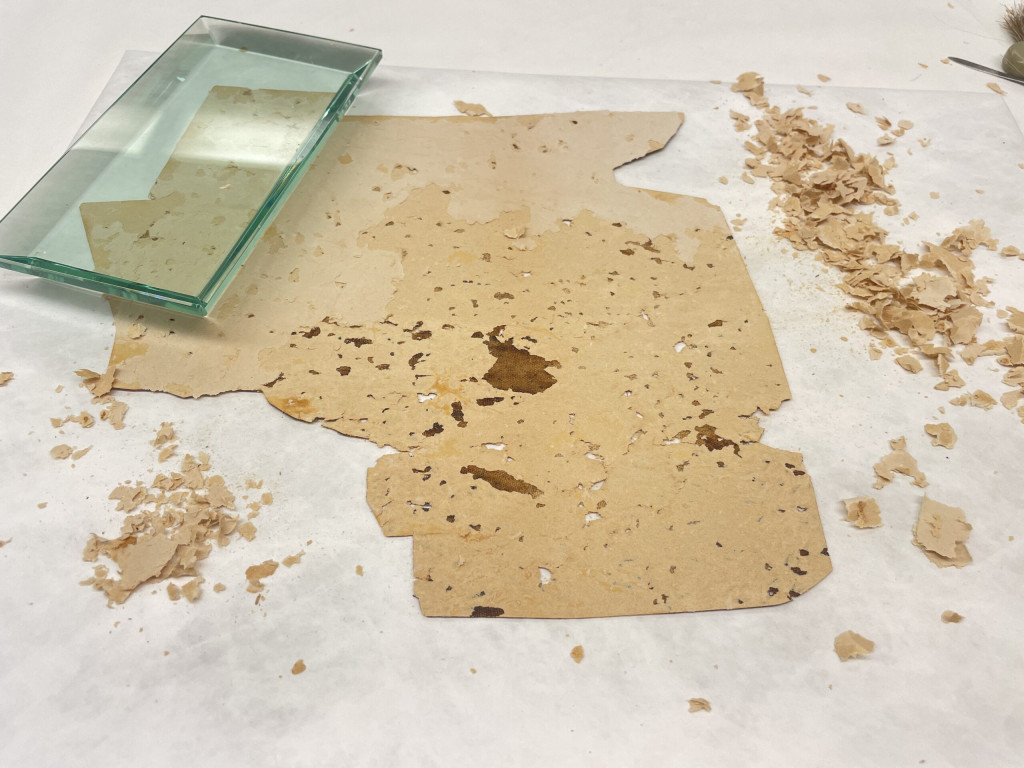
After removing multiple layers of board, the brown paper lining was revealed. Some areas of the brown paper were no longer adhered to the textile and readily released during mechanical removal while other areas remained more firmly attached.

At this point, with the backing and lining parts removed as much as possible, I decided to test a corner of the paper backing with light moisture. To my surprise, the paper backing adhesive quickly reactivated, the lining lifted with little effort, and the humidification strengthened the fibers of the linen fragment. All of this eased fears the fragments might fracture during final treatment steps. Proceeding with treatment felt obtainable.

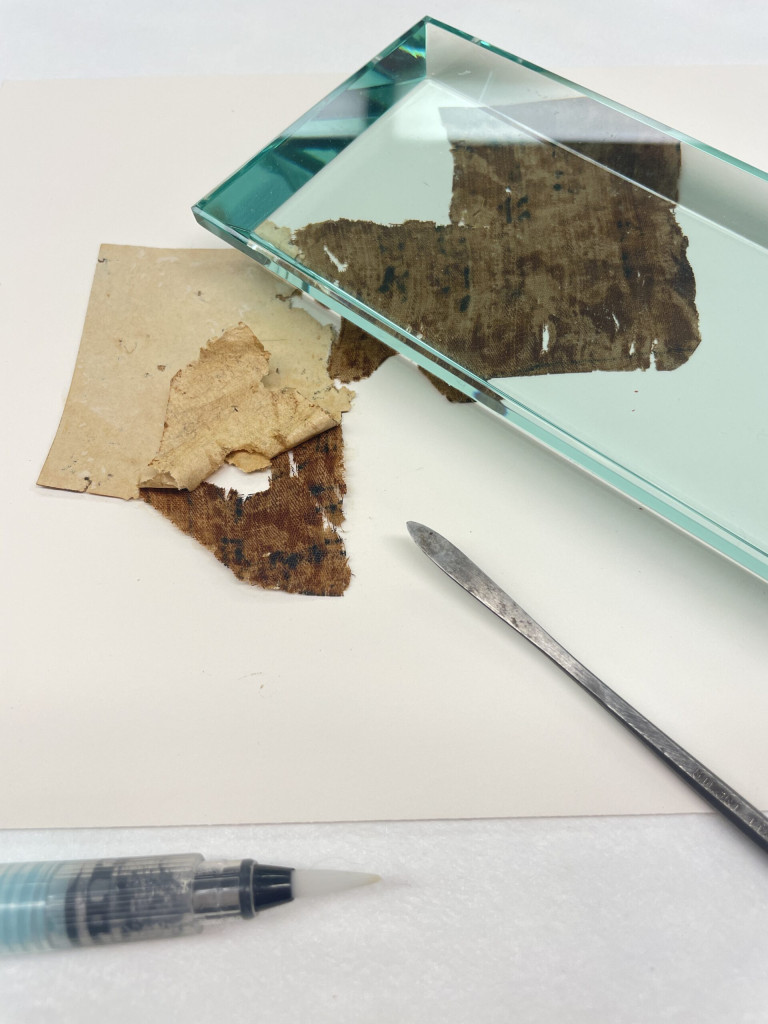
The final step was releasing the brown paper lining with moisture from a water pen and lifting the lining with spatulas.

With this new turn of events, I realized, if I ventured so far as to remove both the mounted board AND the paper backing, I’d need a new storage solution.

I halted treatment and went back to the drawing board to research storage enclosures (click here to jump to my post on storage solutions). Once I felt confident in selecting a method of storage for the loose textiles, I resumed treatment to remove the brown lining paper and proceeded with treatment on the rest of the fragments.

This is a time-lapse video showing how the brown paper lining was removed in stages. Localized humidification was applied from the back while mechanically separating the paper from the textile with spatulas.

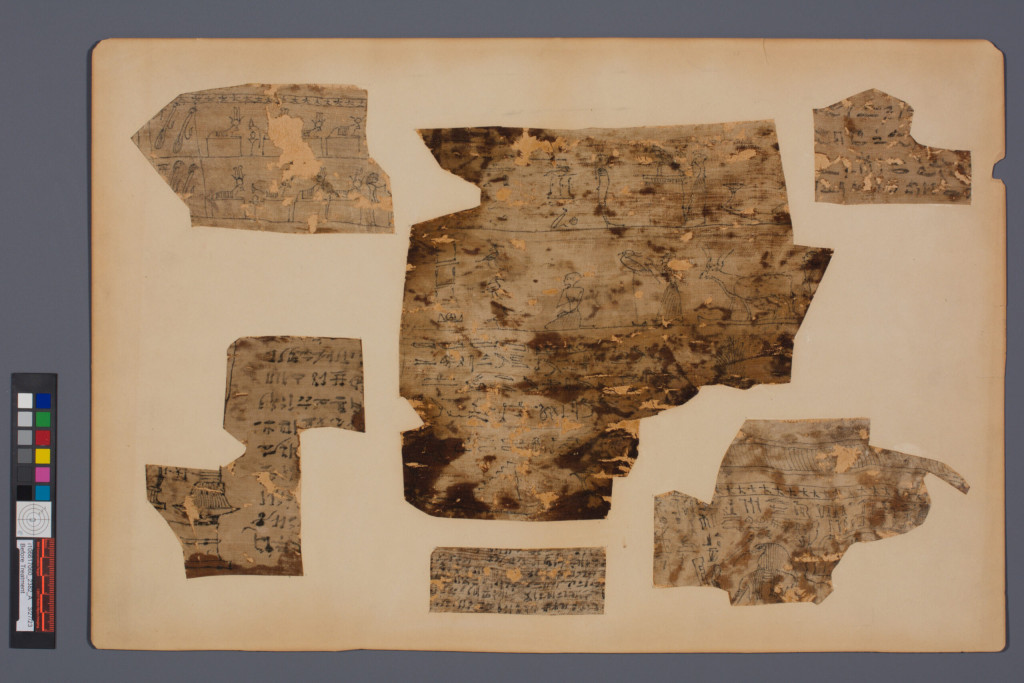
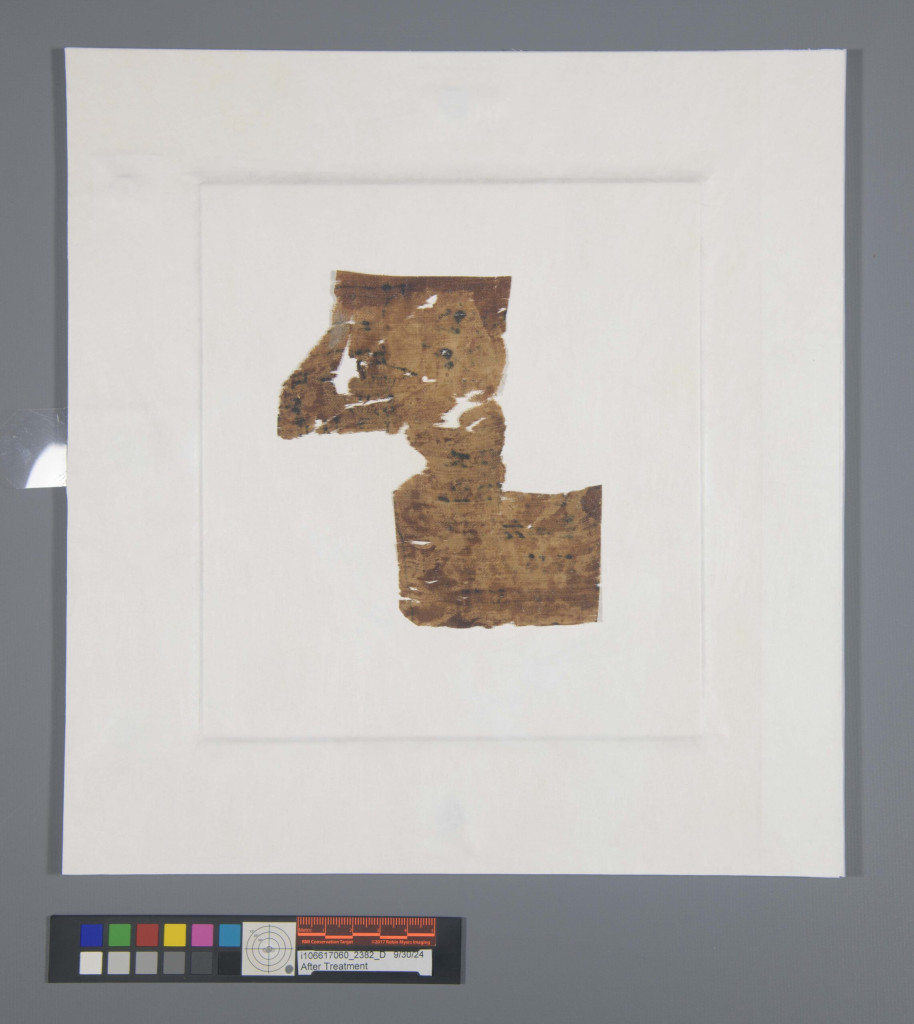
Before Treatment

Collection is mounted to an acidic board with two of the fragments oriented upside down.

Normal Illumination, Before Treatment

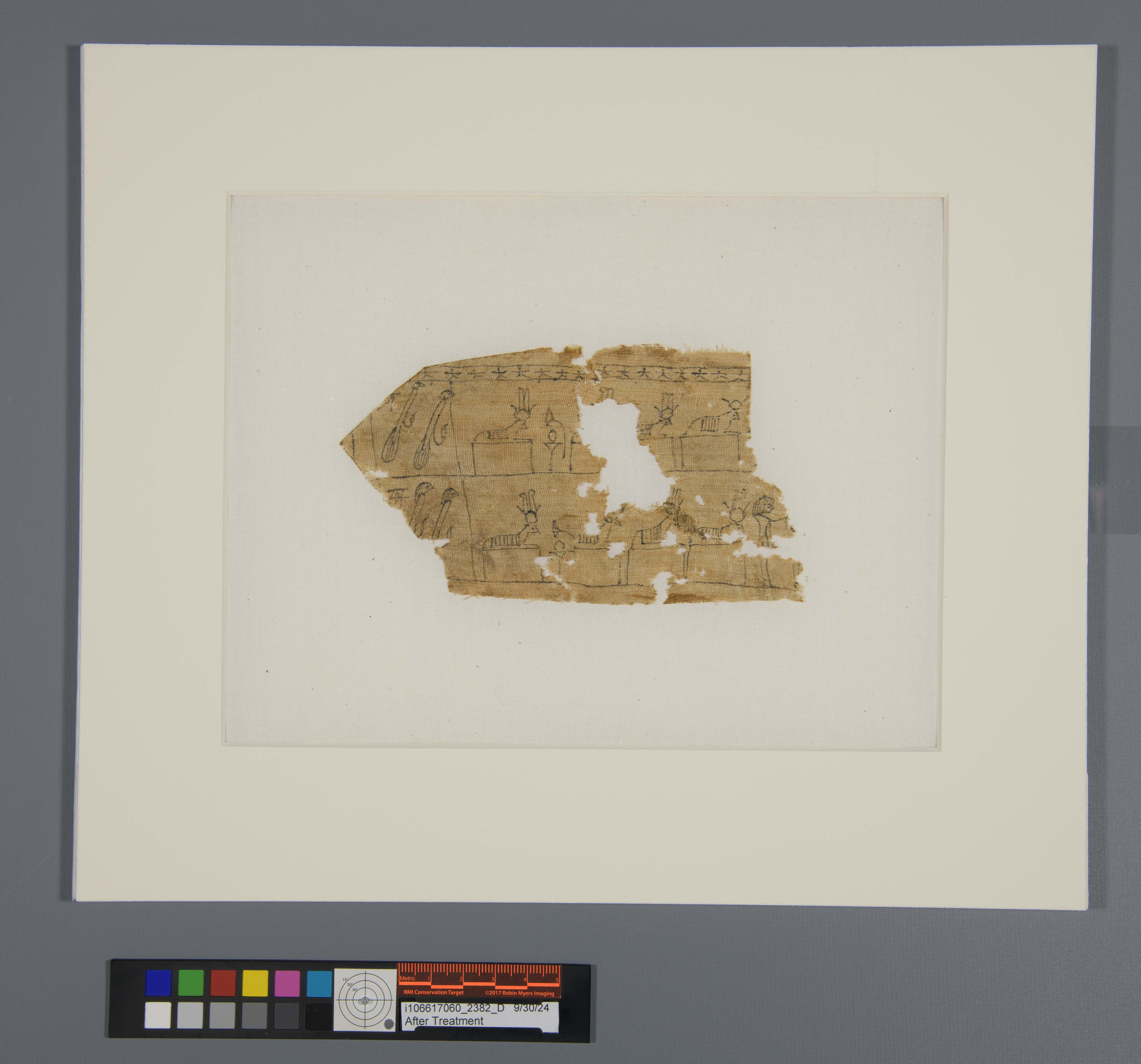
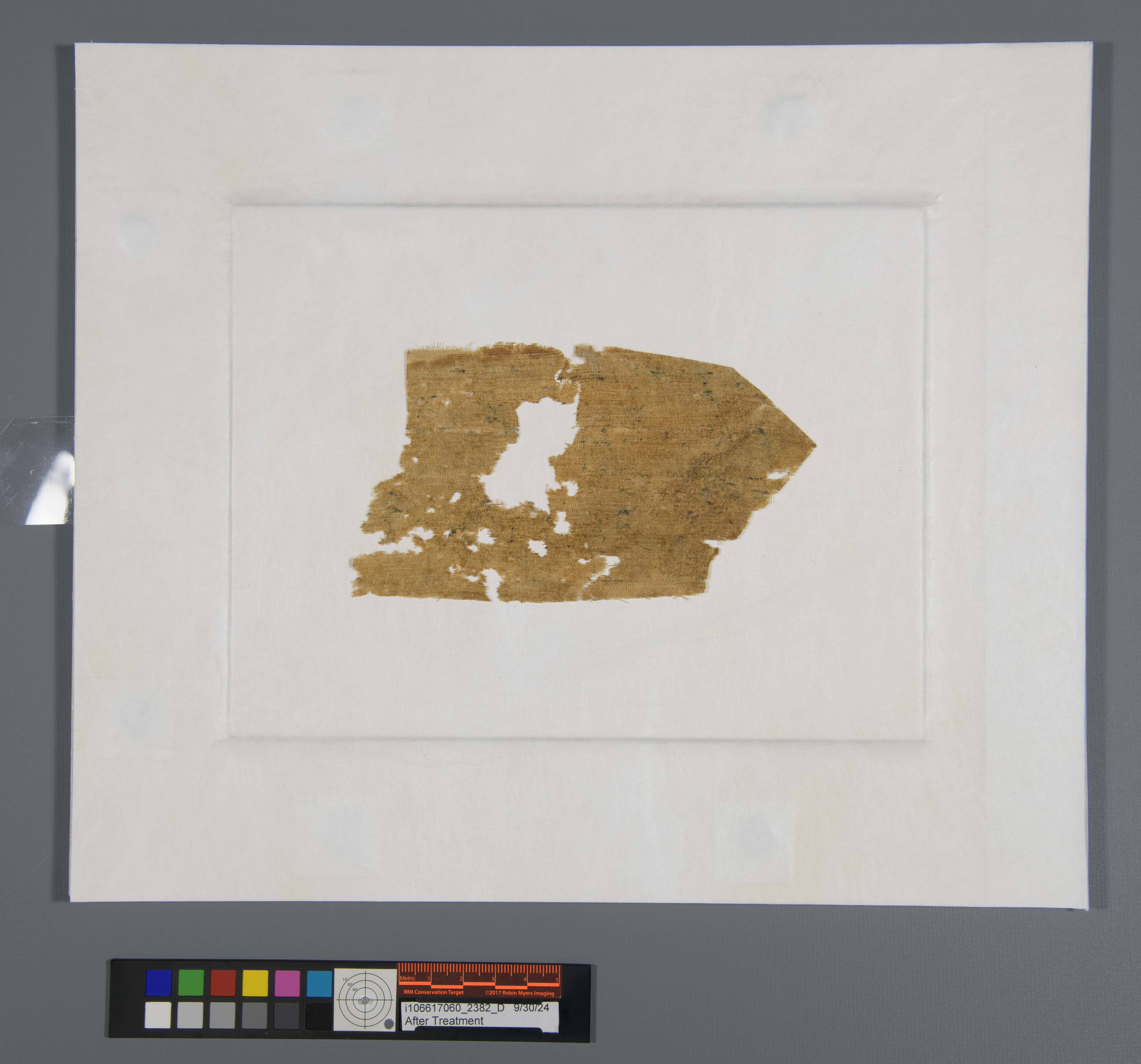
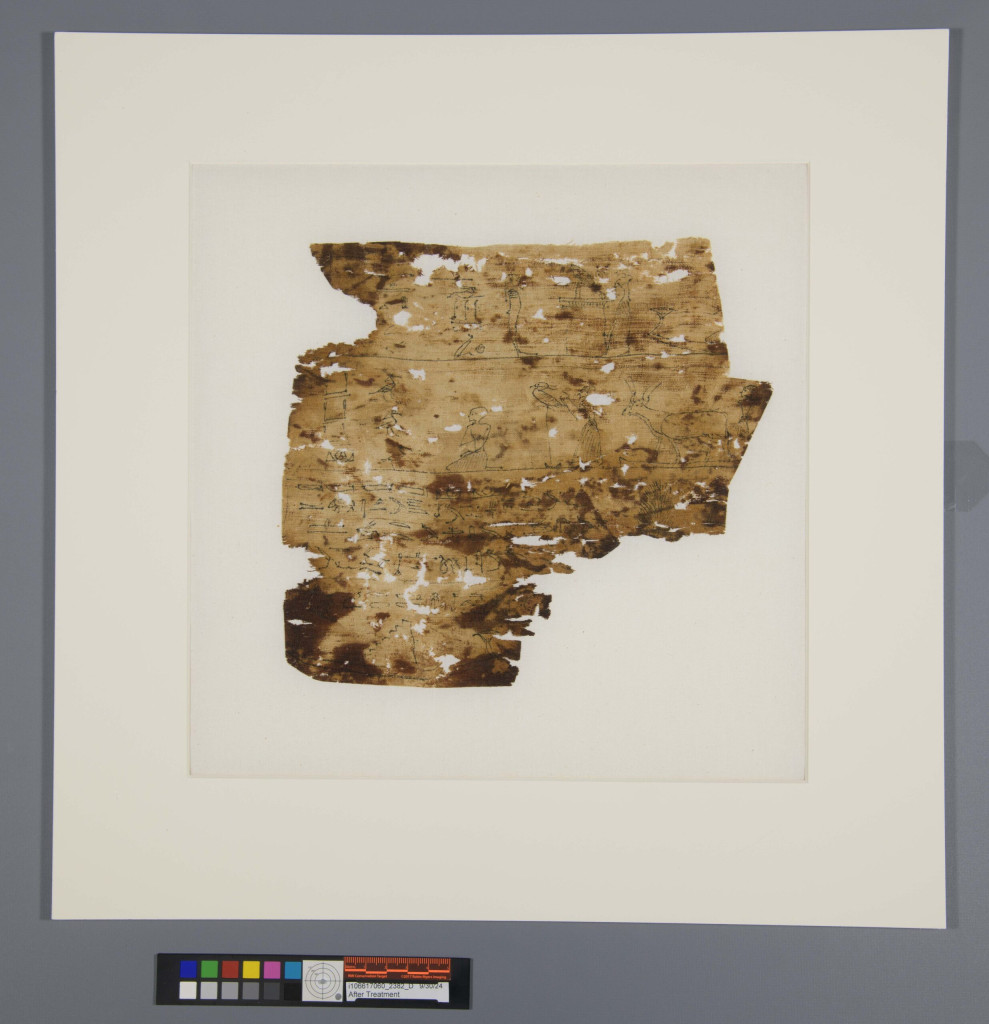
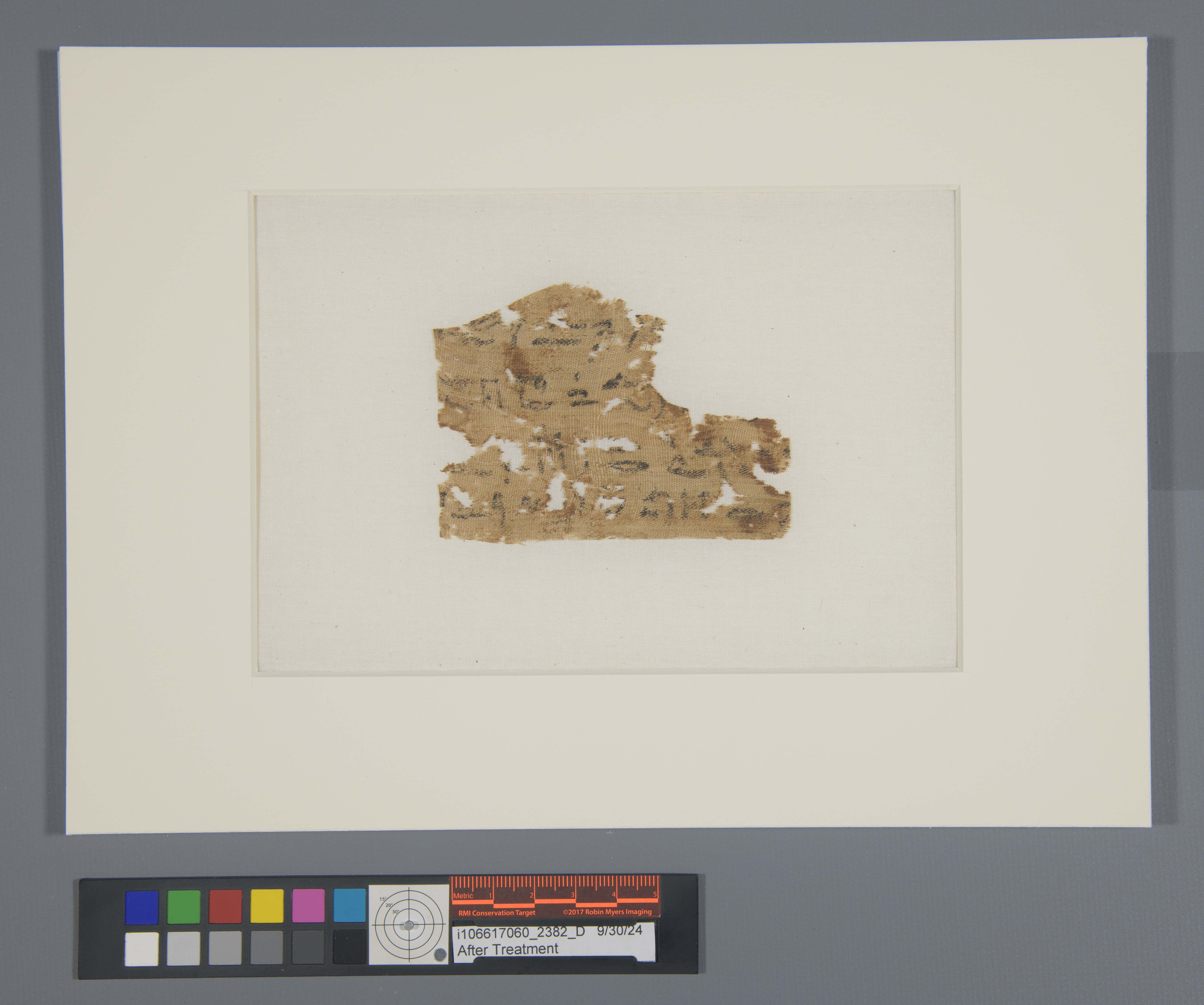
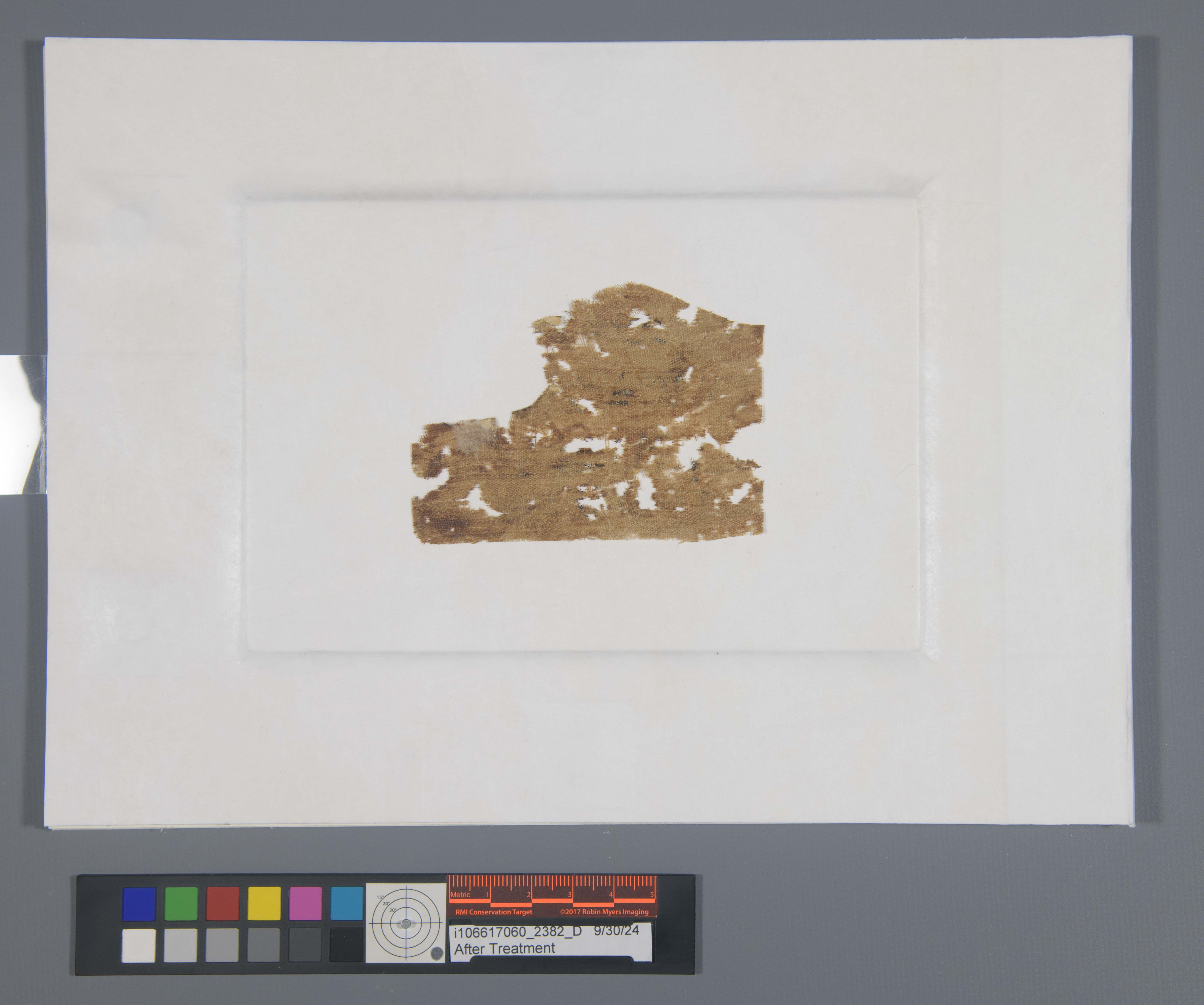
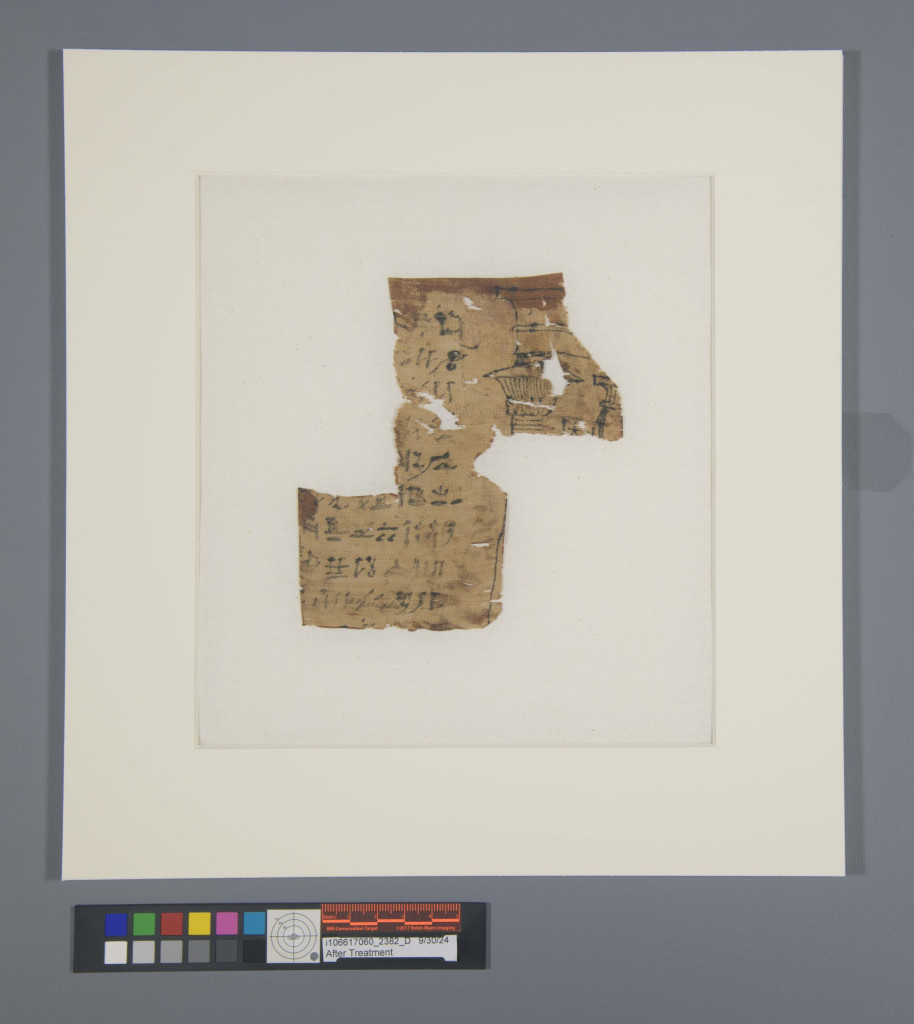
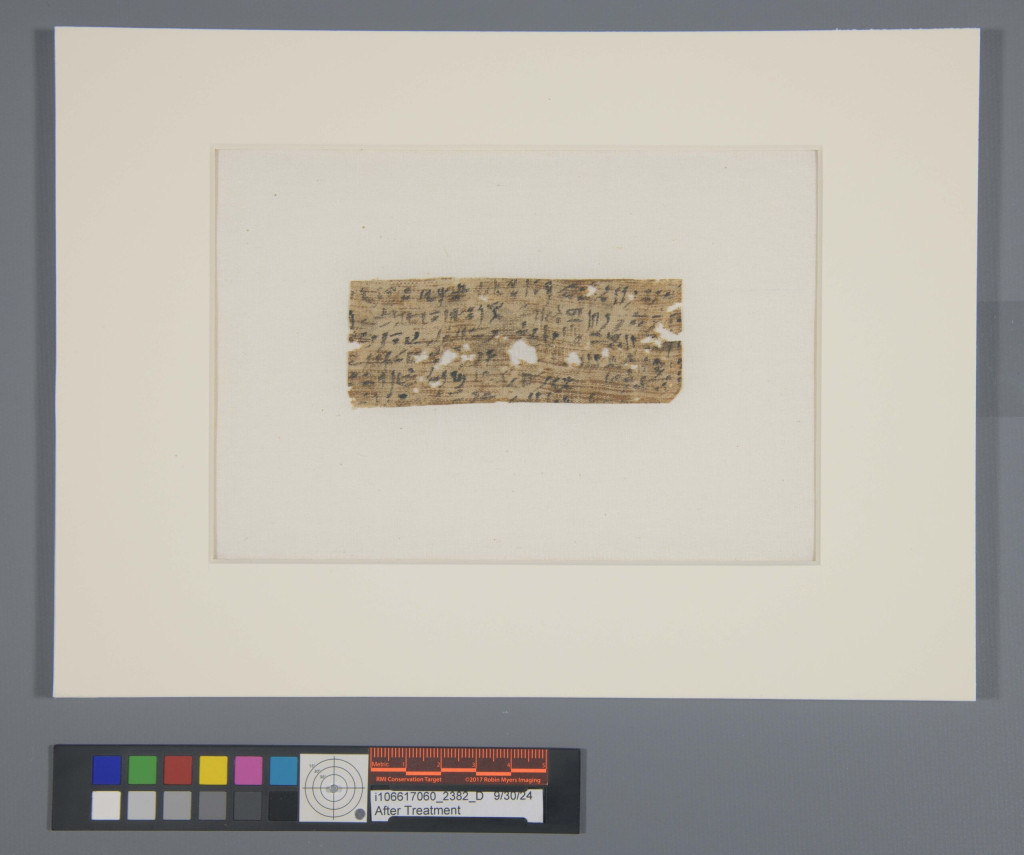
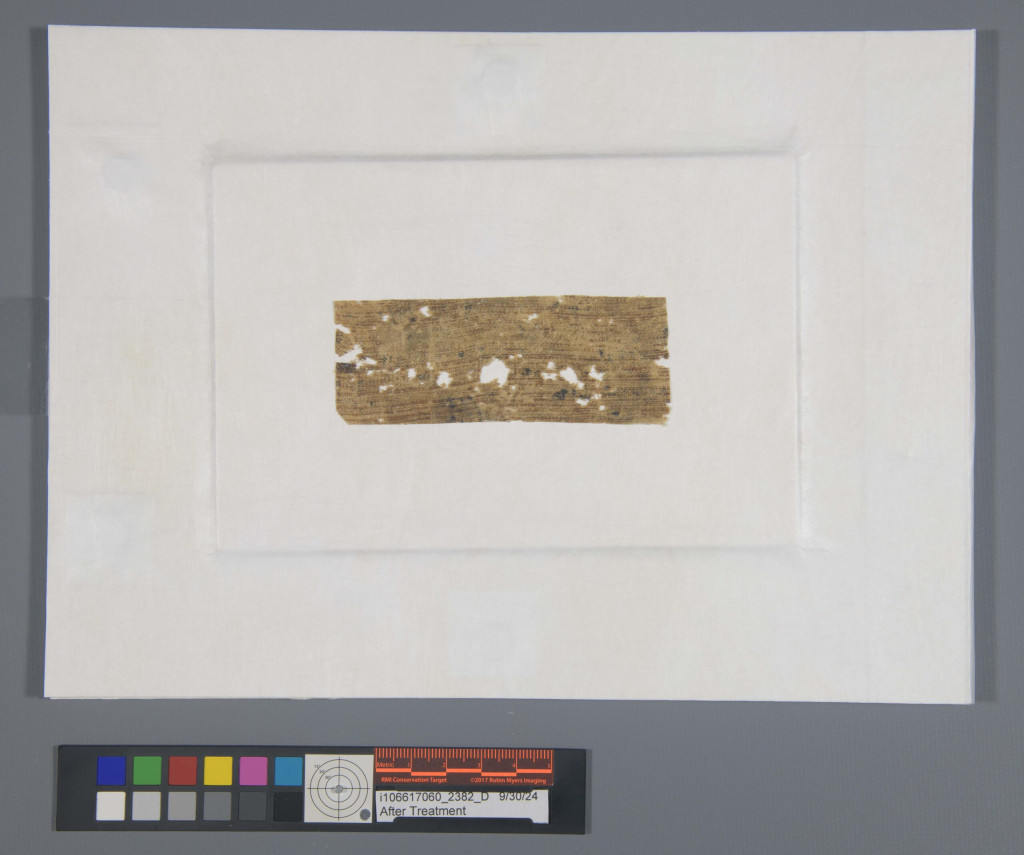
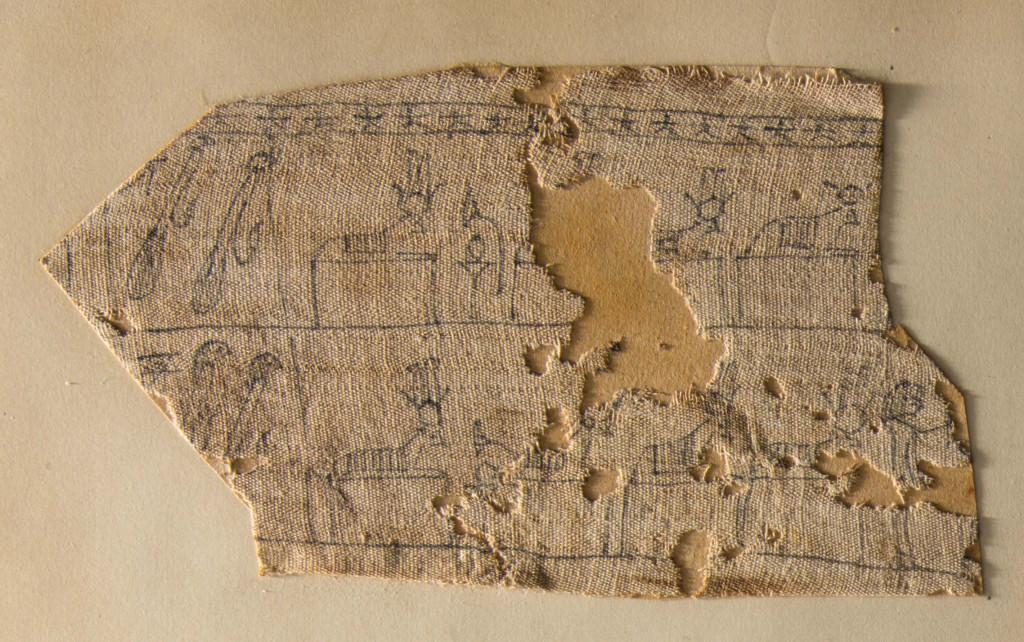
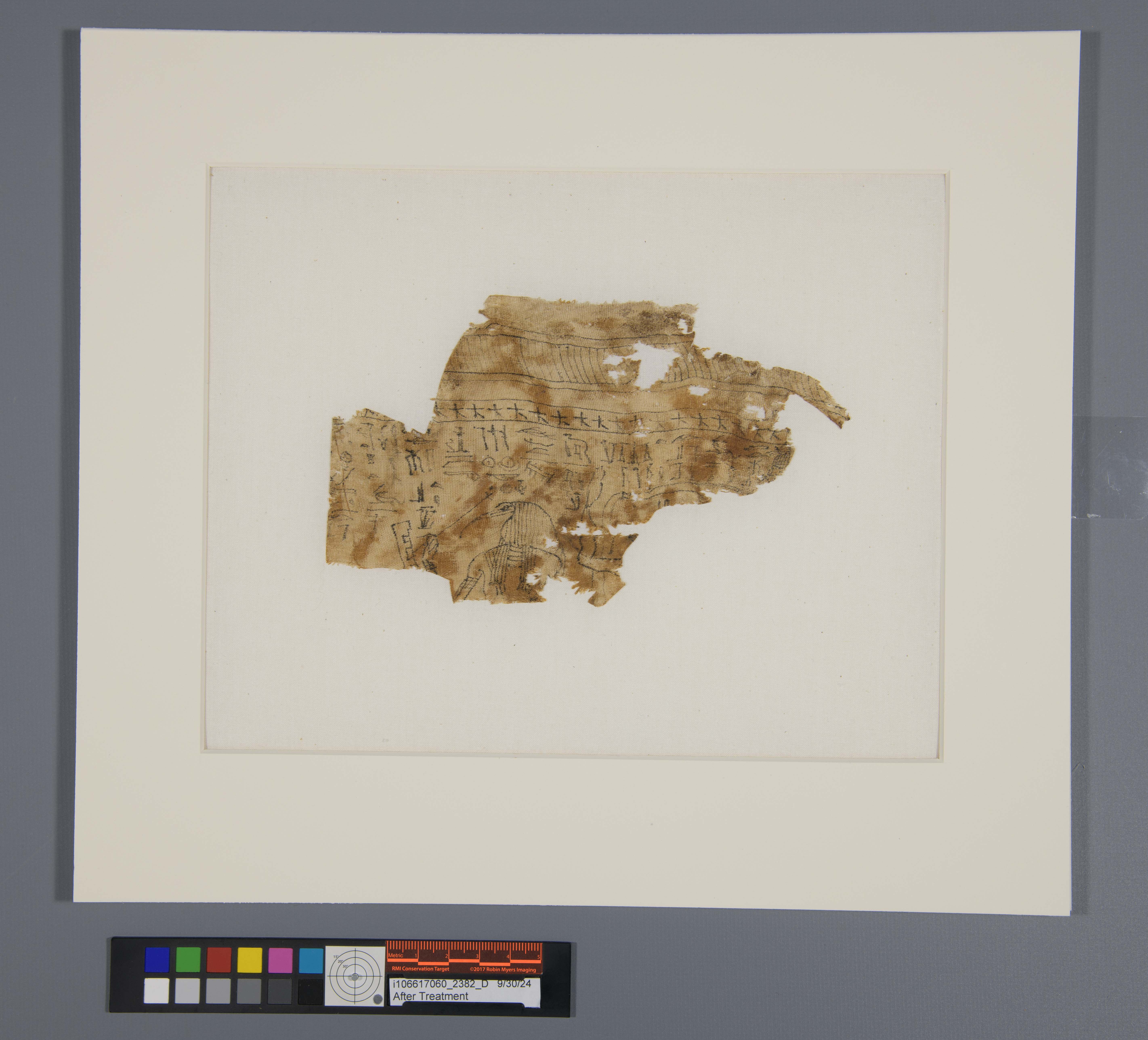
After Treatment

Fragments are stored individually in storage solutions that double as long-term housing. The enclosures facilitate handling as well as display. Being stored individually, the fragments are able to be grouped as necessary by their context.

To learn more about the storage, check out the final post of the four-part series: Storage Solutions!

If you missed the earlier installments, you can jump to previous posts using the links below:

  • Research and Examination – Examining the material composition of the objects
  • History – Historical information provided about the Egyptian inscriptions
  • Treatment – How the materials were treated after learning about their content
  • Storage Solutions – Individual solutions for separated fragments as well as storage as a collection

Acknowledgements

  • Katherine Davis, Lecturer in Egyptology in the Department of Middle East Studies at the University of Michigan
  • Suzanne Davis, the Associate Curator and Head of Conservation at the Kelsey Museum of Archaeology at the University of Michigan
  • Dr. Ann-Katril Gill at the University of Leipzig
  • Marieka Kaye, Harry A. and Margaret D. Towsley Foundation, Head, Conservation & Book Repair, University of Michigan Library
  • Obie Linn, Textile Conservator at the Cincinnati Art Museum
  • Ann Wuertemberger, Catalog Librarian at the Cincinnati and Hamilton County Public Library
  • Meredith Montague, Textile Conservator at the Museum of Fine Arts Boston

Ashleigh Ferguson Schieszer – Special Collections Conservator and Co-Lab Manager [CHPL]

Archeological Textile Discovery in the Stacks: The History

This is the second post of a four part series.

When a collection of Egyptian mummy bandage fragments at the Cincinnati and Hamilton County Public Library was found in an area used to store uncatalogued flat materials, the lab was asked to play a role in providing better stewardship.  

Click the links below to jump to the following posts:

  • Research and Examination – Examining the material composition of the objects
  • History – Historical information provided about the Egyptian inscriptions
  • Treatment – How the materials were treated after learning about their content
  • Storage Solutions – Individual solutions for separated fragments as well as storage as a collection

Learning About the Collection

Before coming to the lab, the library knew little about the fragments. So first and foremost, I reached out to a handful of scholars to see if I could glean any information.  I soon found myself engulfed in a journey of discovery with each colleague leading me to a new reference, sharing a collective wealth of knowledge.

History

With generous information provided by colleagues, the library learned the following about the fragments (fragment measurements below are with height and width at the widest points):

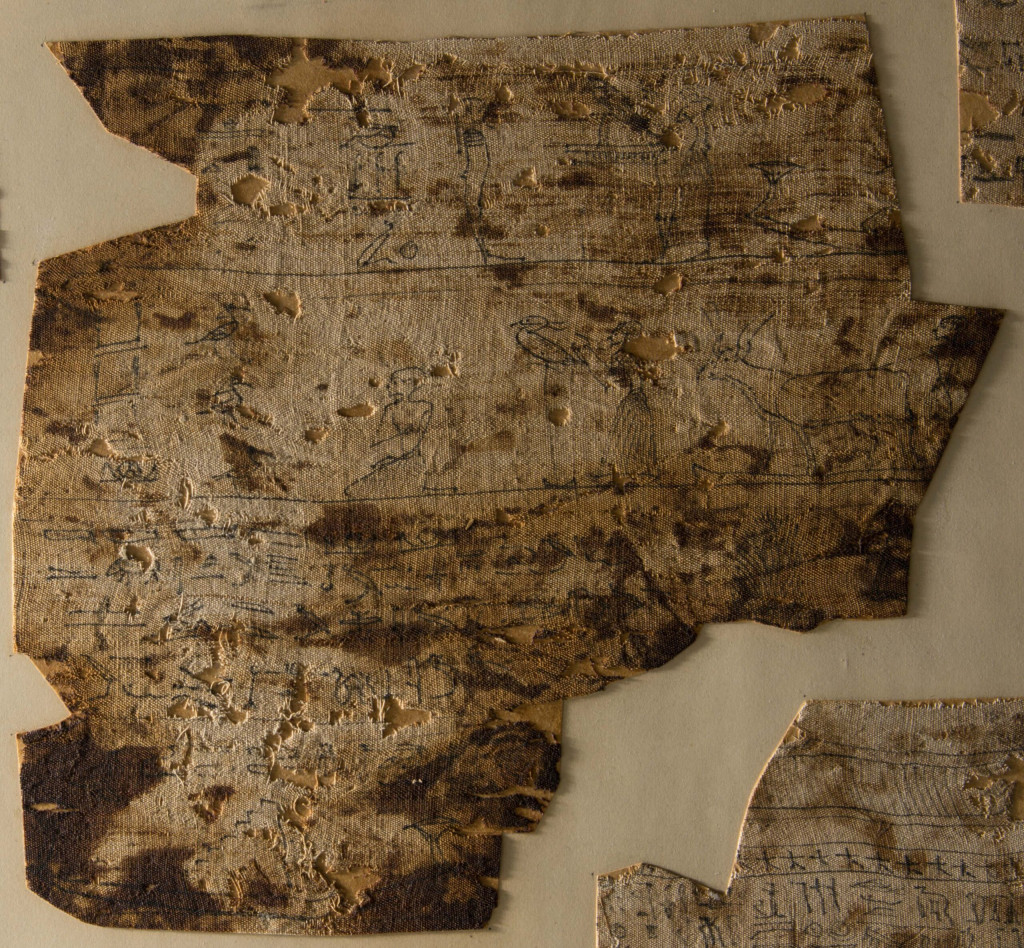
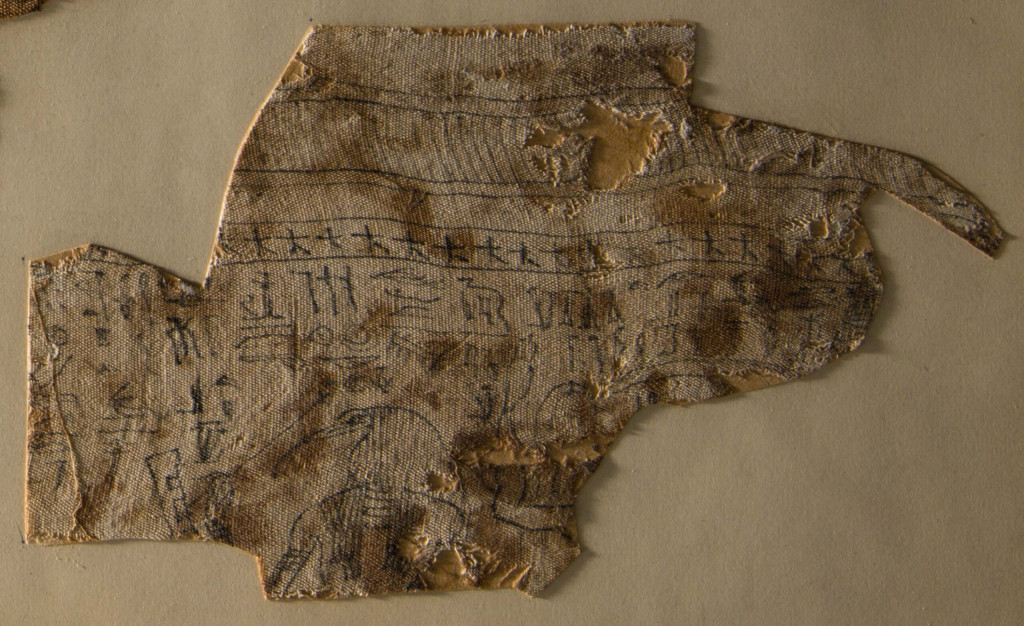
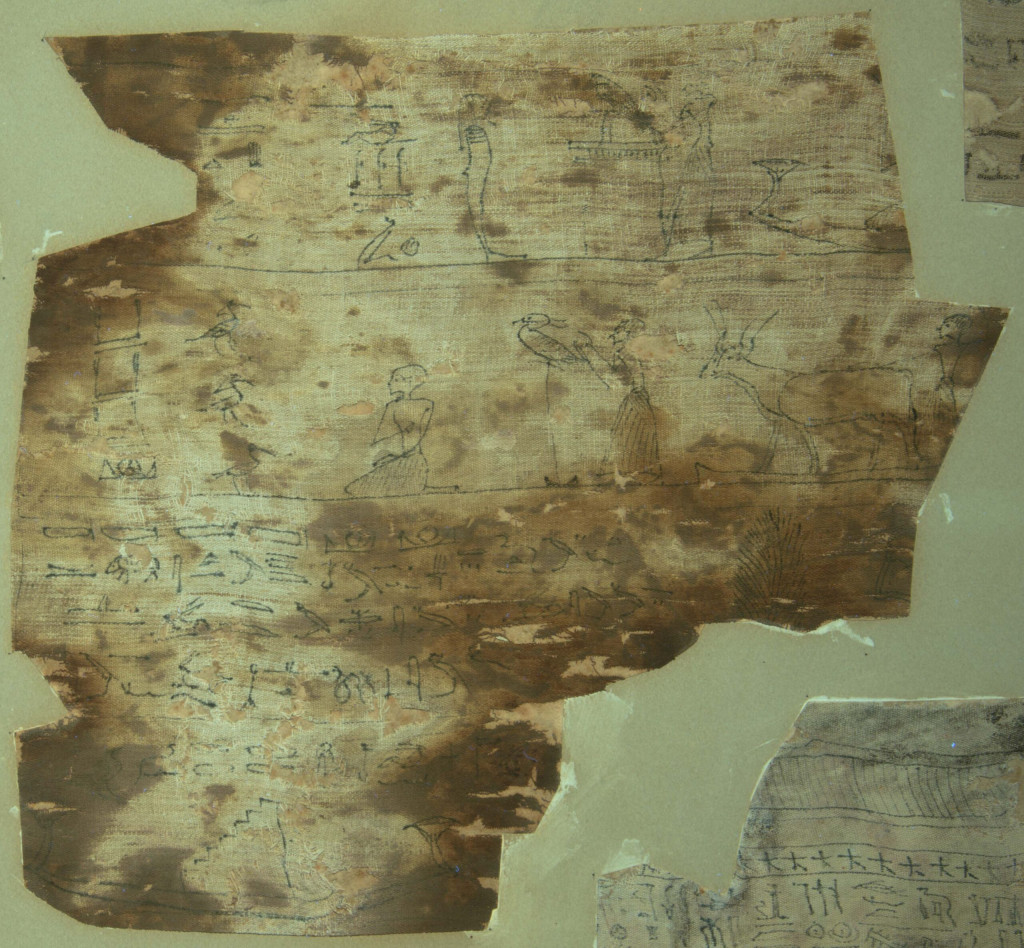
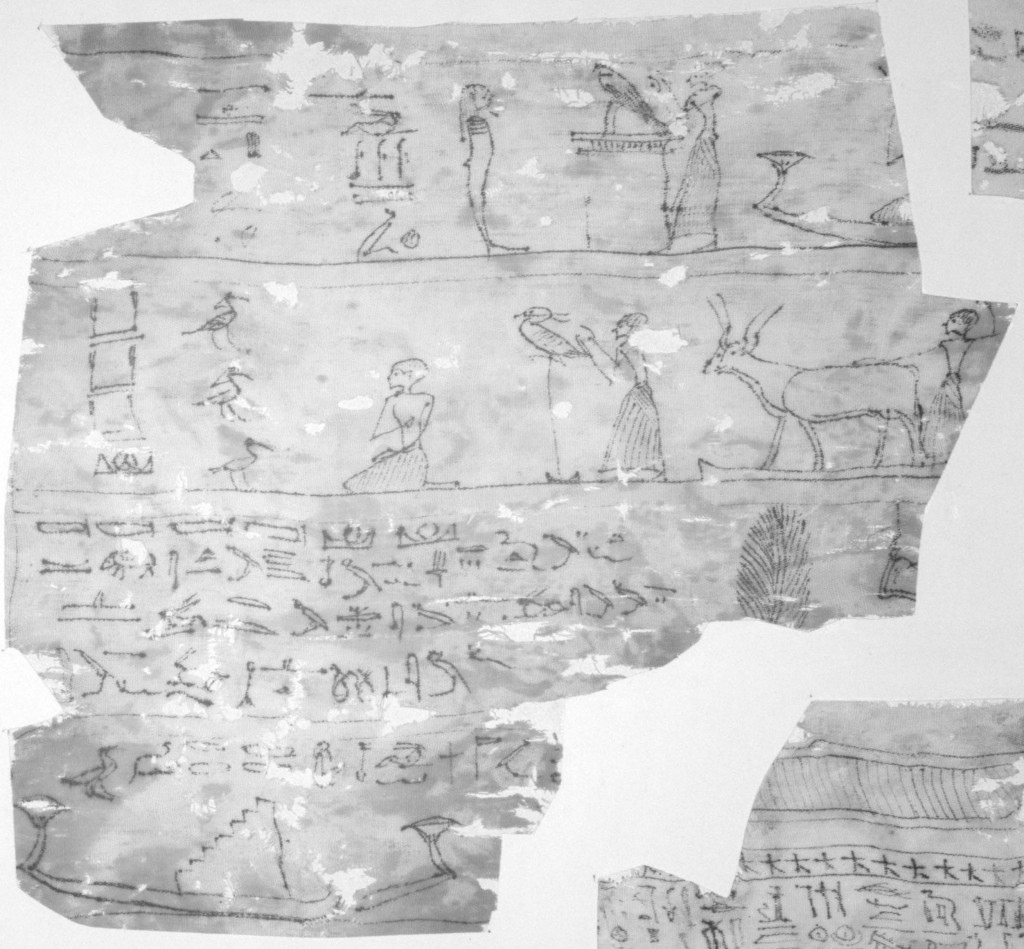
This is the center fragment.  It contains Hieroglyphic script, measuring 21 x 23 cm.  It’s part of a 3-piece set that belonged to a priest called Wennofer.  The large scene in the middle belongs to Book of the Dead Spell 110 showing the deceased doing various things in the netherworld.

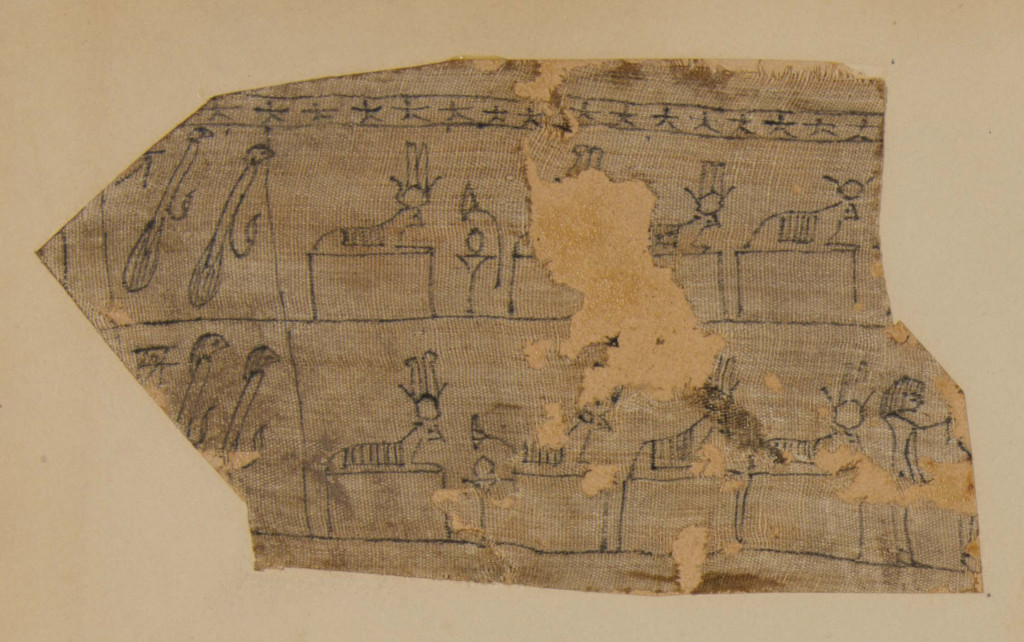
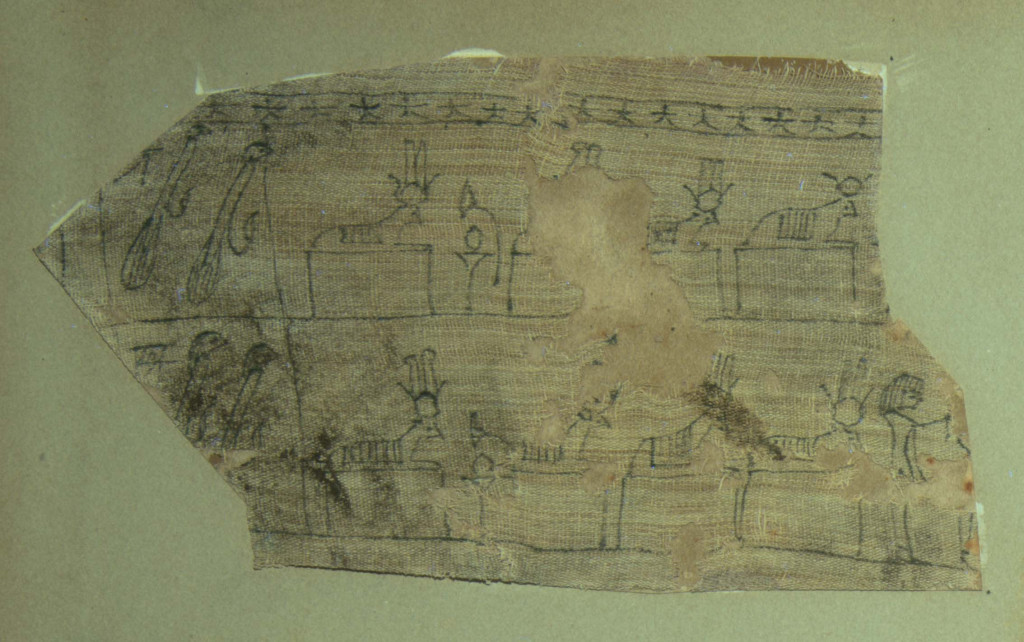
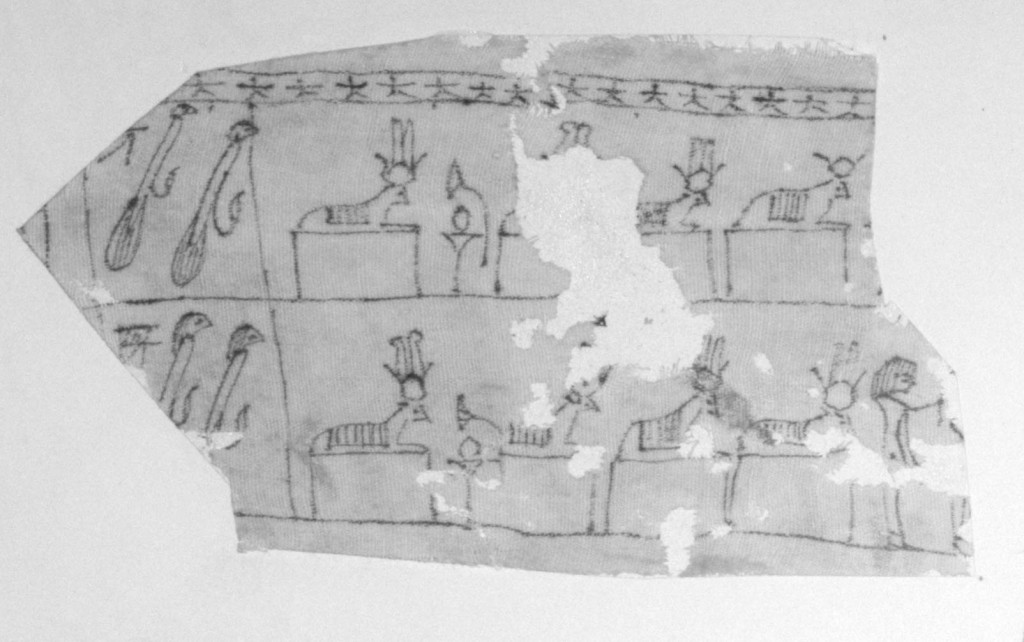
This is the upper left fragment.  It measures 8 x 14 cm. Script contains images and no preserved text. This is part of the 3-piece set that also belonged to a priest called Wennofer. Images belong to the vignette of Book of the Dead Spell 148. “For making provision for a spirit in the realm of the dead” this spell provides the names of the Bull of Heaven and his seven cows, providing an eternal supply of food and beer.

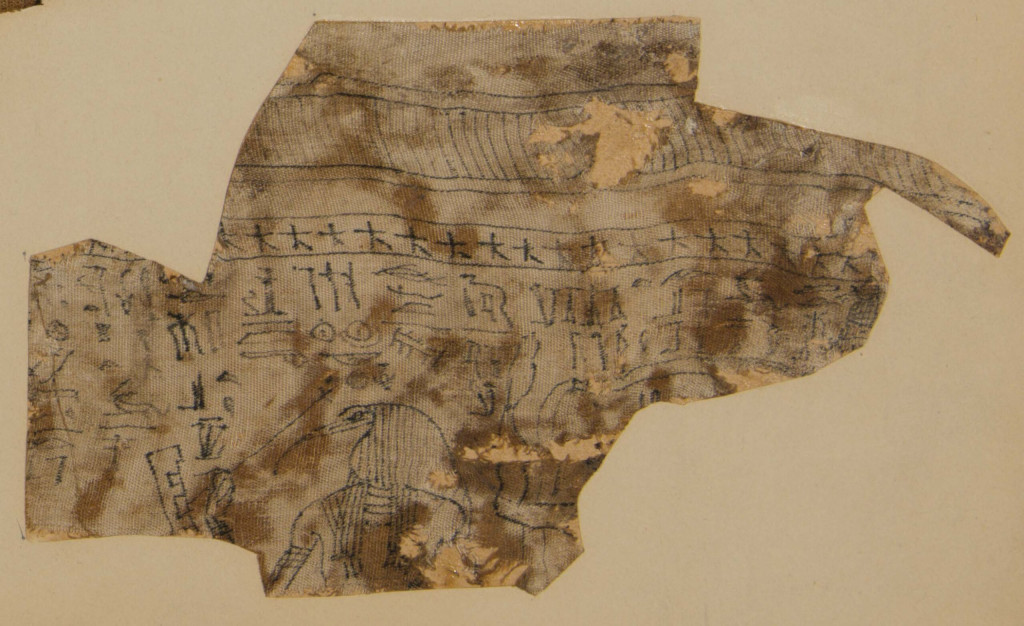
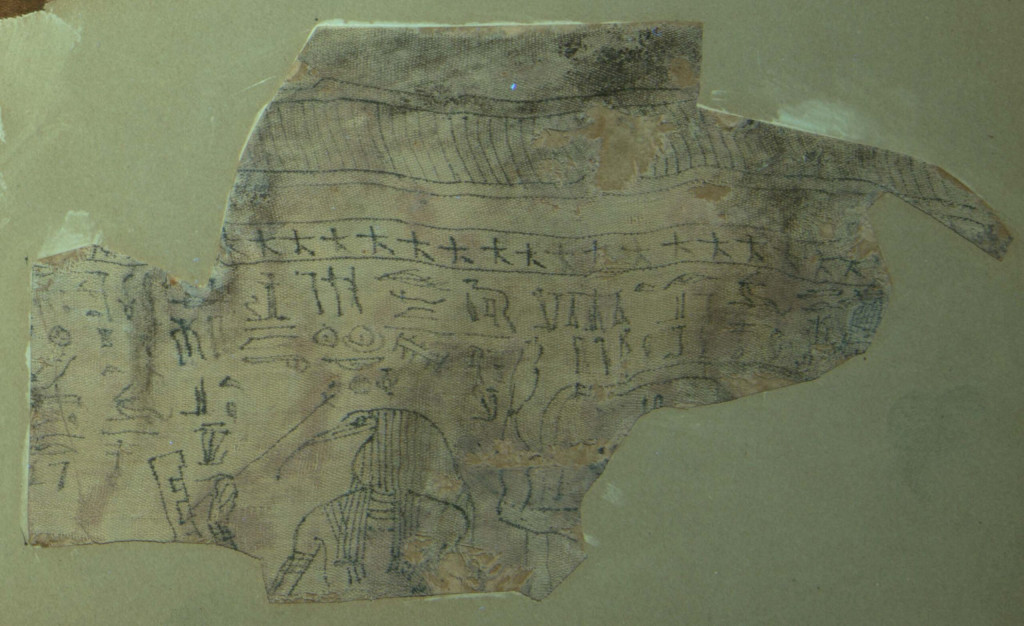
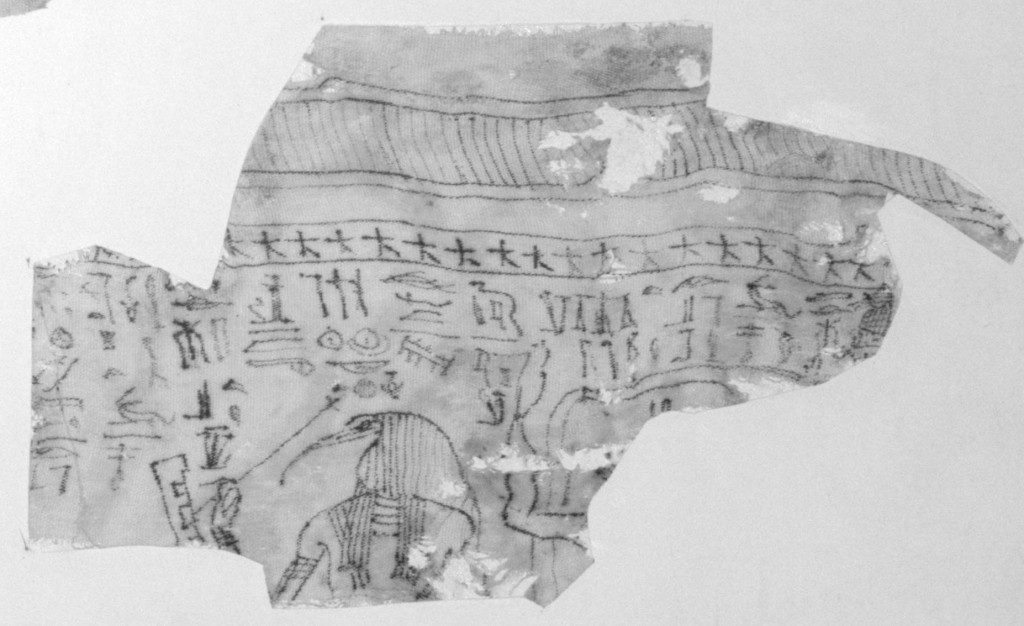
This is the bottom right fragment.  It contains Hieroglyphic writing and measures approximately 10 x 17 cm, containing a Thoth god image. It’s the final part of the 3-piece set that belonged to a priest called Wennofer. Preserved images are part of the vignette of Book of the Dead Spell 125, the so-called judgement scene.

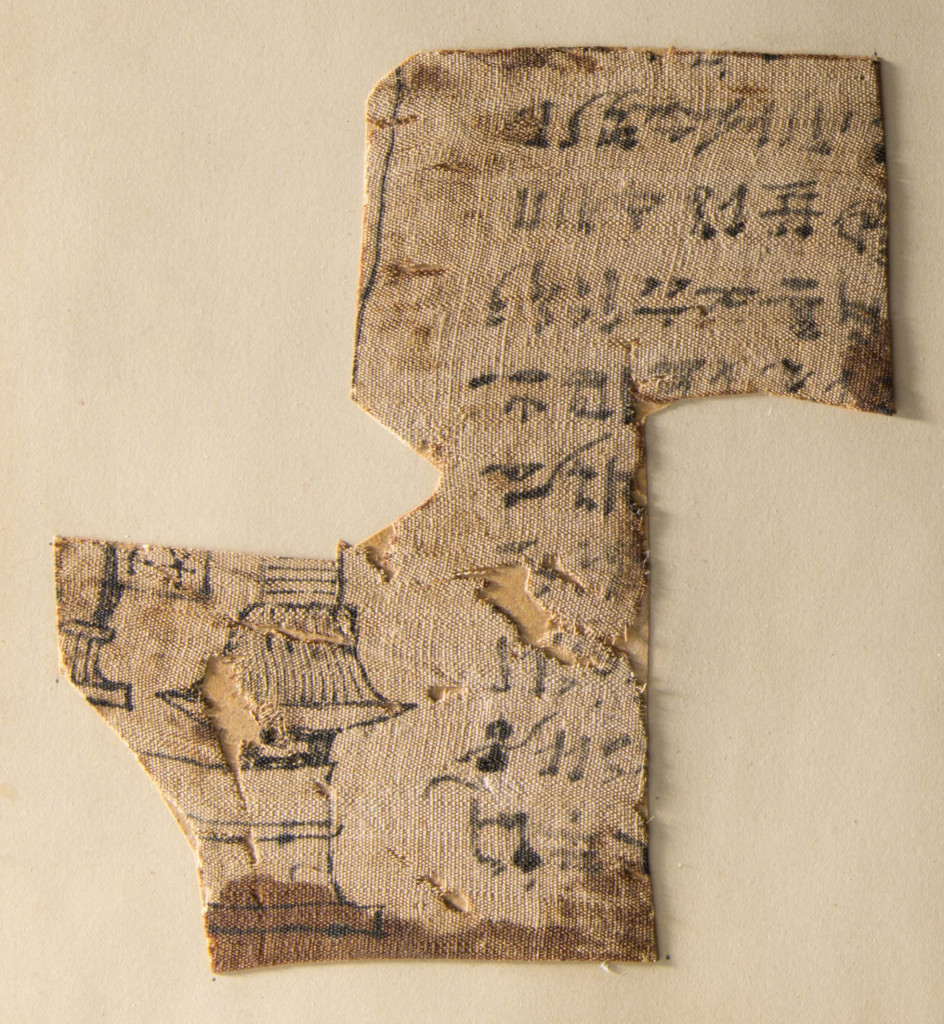
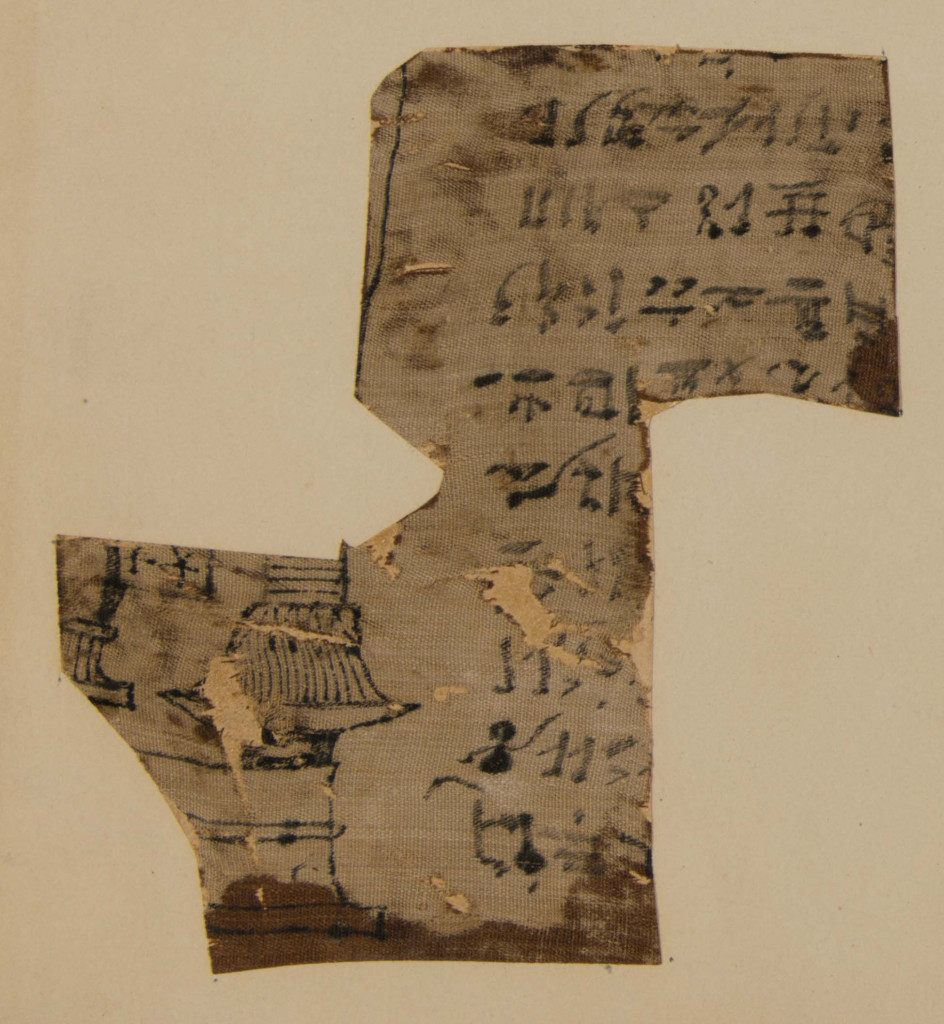
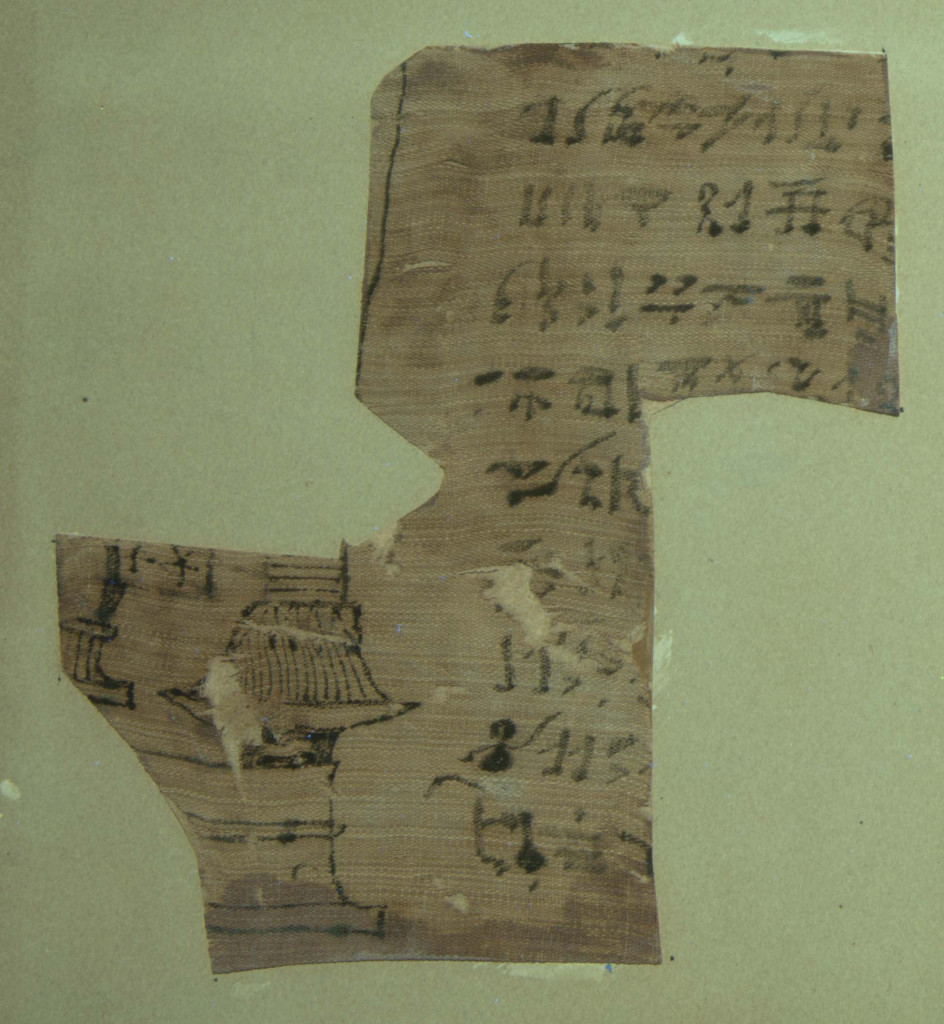
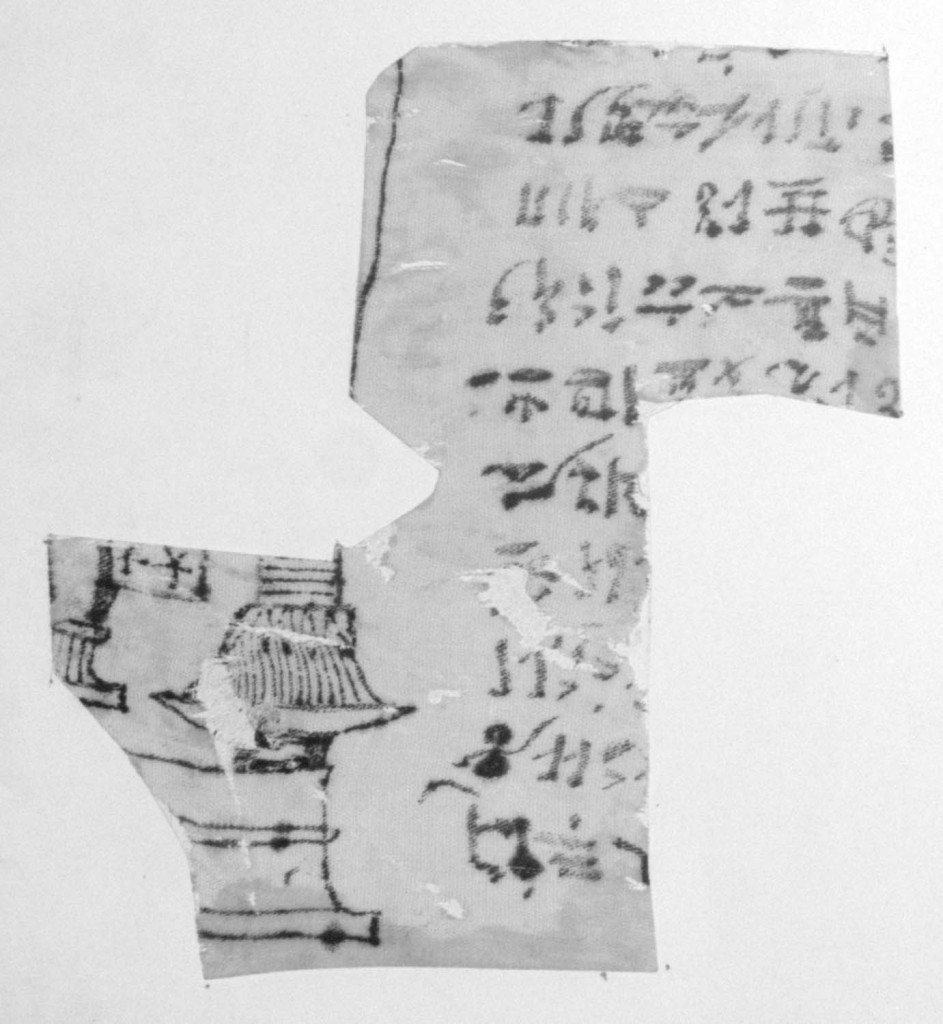
This is the bottom left fragment containing Hieratic script, however it is oriented upside down. It measures approximately 13 x 12 cm.  There isn’t an owner’s name preserved so we’re unsure if it belongs with any other fragments in this collection. Images contain a shrine column, sections of Book of the Dead Spells 125 and 126, as well as traces of the vignette belonging to Book of the Dead Spell 125.

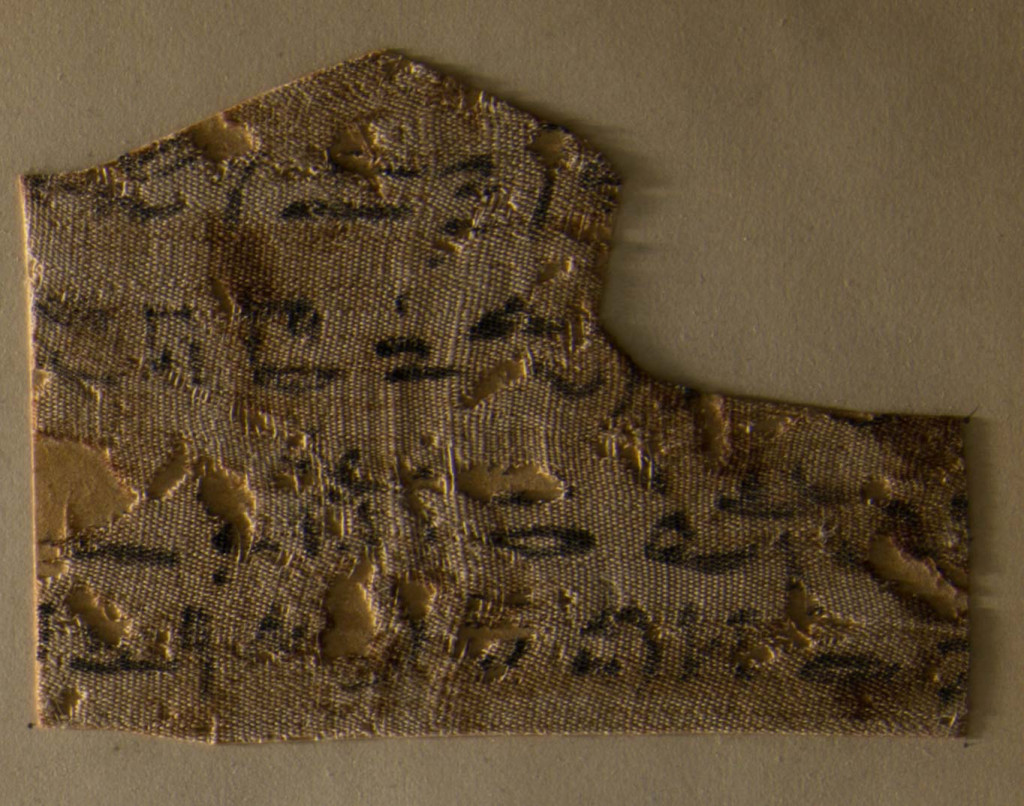
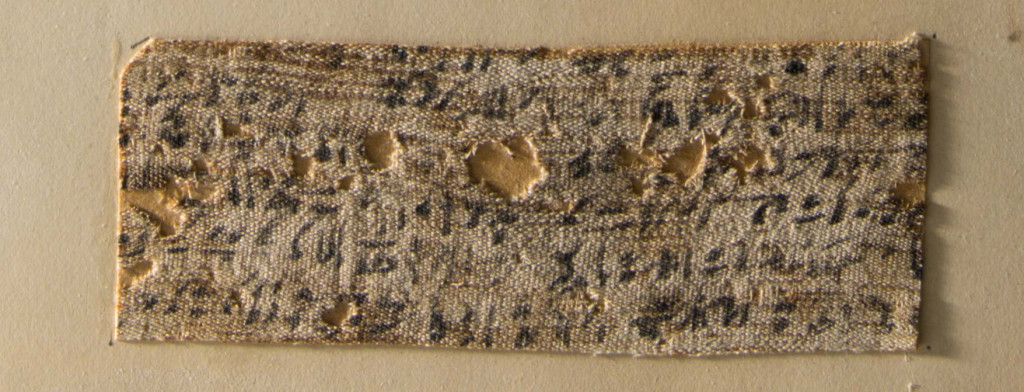
This is the upper right hieratic fragment with Hieratic script. It measures approximately 9 x 7 cm. There is no owner’s name preserved.

This is the bottom center hieratic fragment measuring 4 x 10 cm, also with no owner’s name preserved and oriented upside down.

Further Reading

Check out this essay for Glencairn Museum News by Dr. Jennifer Houser Wegner to learn more about burial practices and in particular, funerary texts, such as the Book of the Dead.

To learn about how the fragments were treated in preparation for long-term storage, check out the third post of the four-part series: The Treatment

If you missed the earlier installment, you can jump to previous post using the links below (or even skip to the final post on storage):

  • Research and Examination – Examining the material composition of the objects
  • History – Historical information provided about the Egyptian inscriptions
  • Treatment – How the materials were treated after learning about their content
  • Storage Solutions – Individual solutions for separated fragments as well as storage as a collection

Acknowledgements

  • Katherine Davis, Lecturer in Egyptology in the Department of Middle East Studies at the University of Michigan
  • Suzanne Davis, the Associate Curator and Head of Conservation at the Kelsey Museum of Archaeology at the University of Michigan
  • Dr. Ann-Katril Gill at the University of Leipzig
  • Marieka Kaye, Harry A. and Margaret D. Towsley Foundation, Head, Conservation & Book Repair, University of Michigan Library
  • Obie Linn, Textile Conservator at the Cincinnati Art Museum
  • Ann Wuertemberger, Catalog Librarian at the Cincinnati and Hamilton County Public Library
  • Meredith Montague, Textile Conservator at the Museum of Fine Arts Boston

Ashleigh Ferguson Schieszer – Special Collections Conservator and Co-Lab Manager [CHPL]

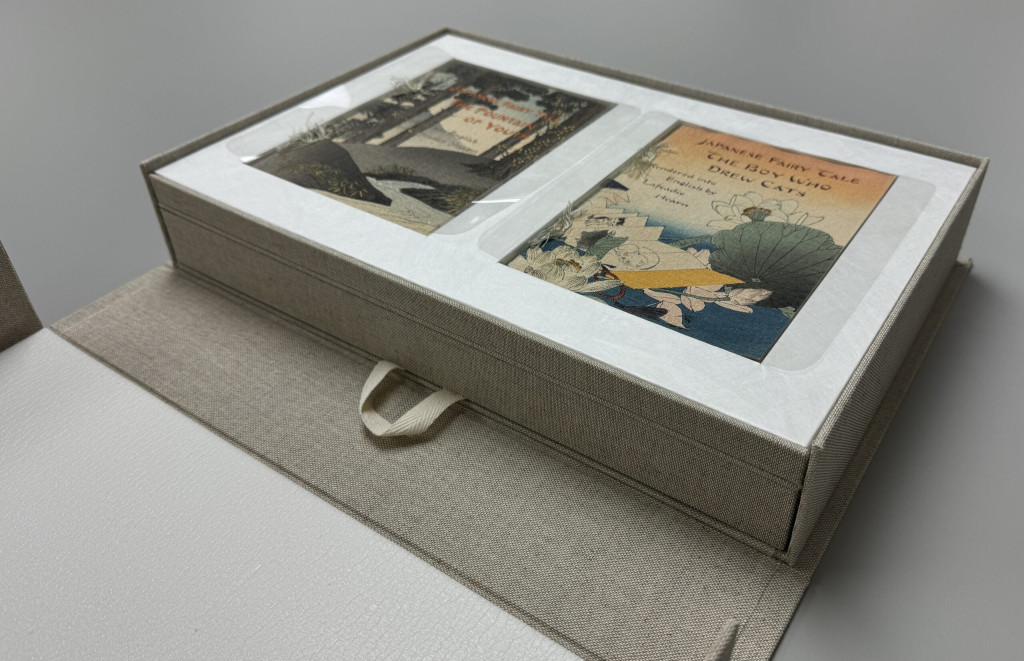
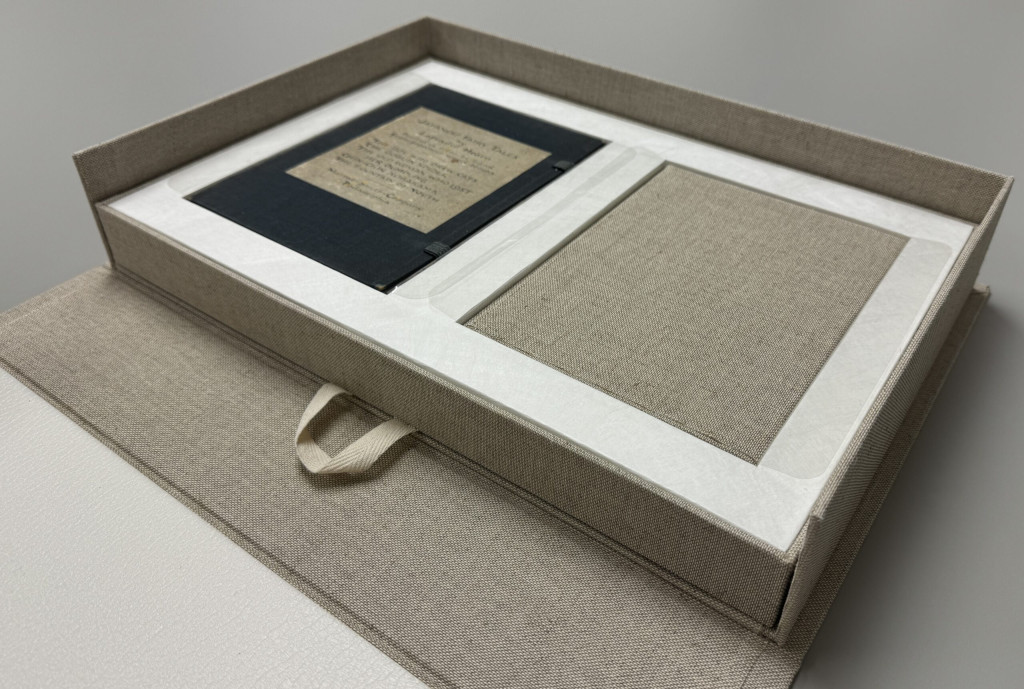
Problem Solving: An Exhibition-Style Enclosure for a Collection of Lafcadio Hearn Japanese Bindings

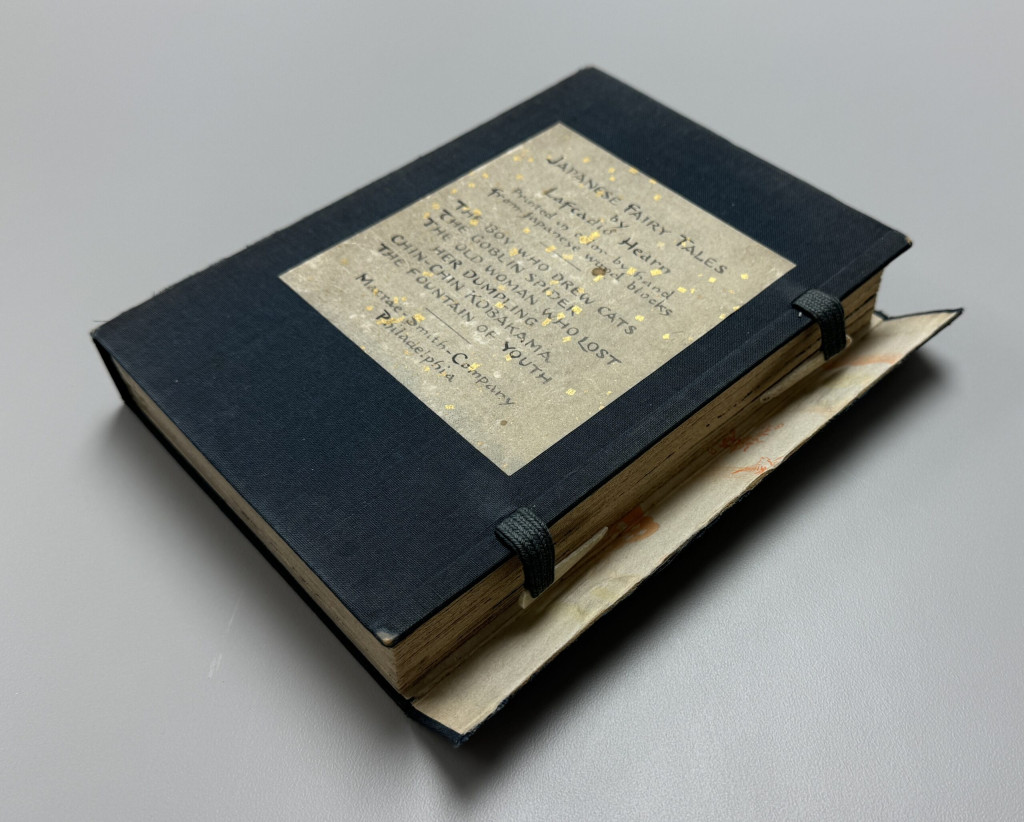
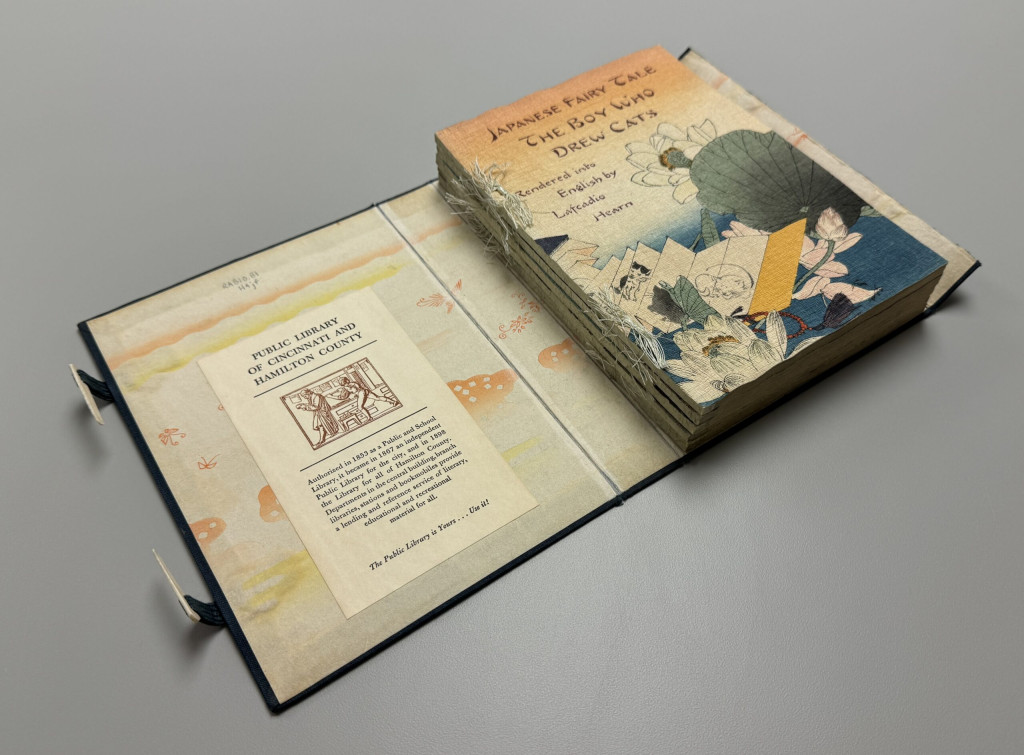
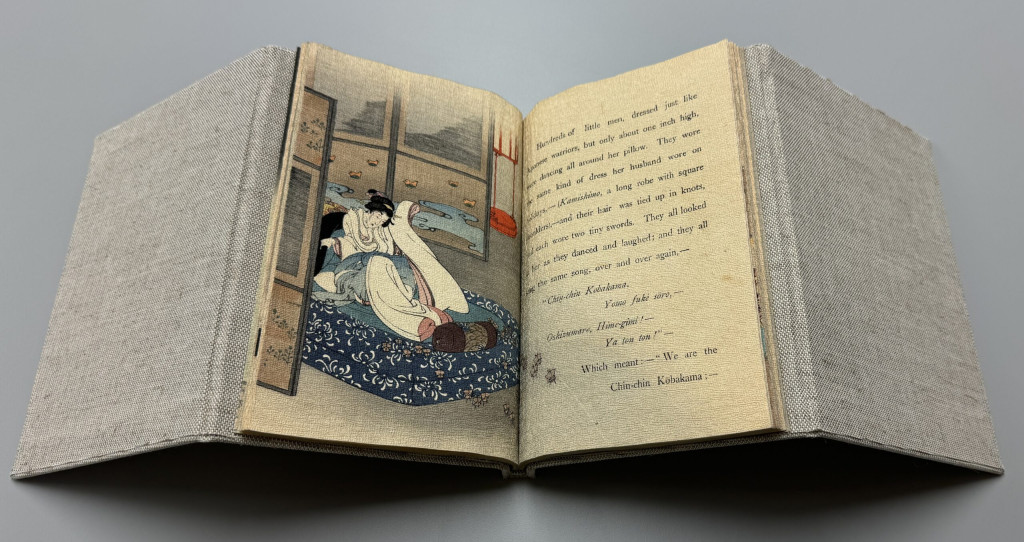
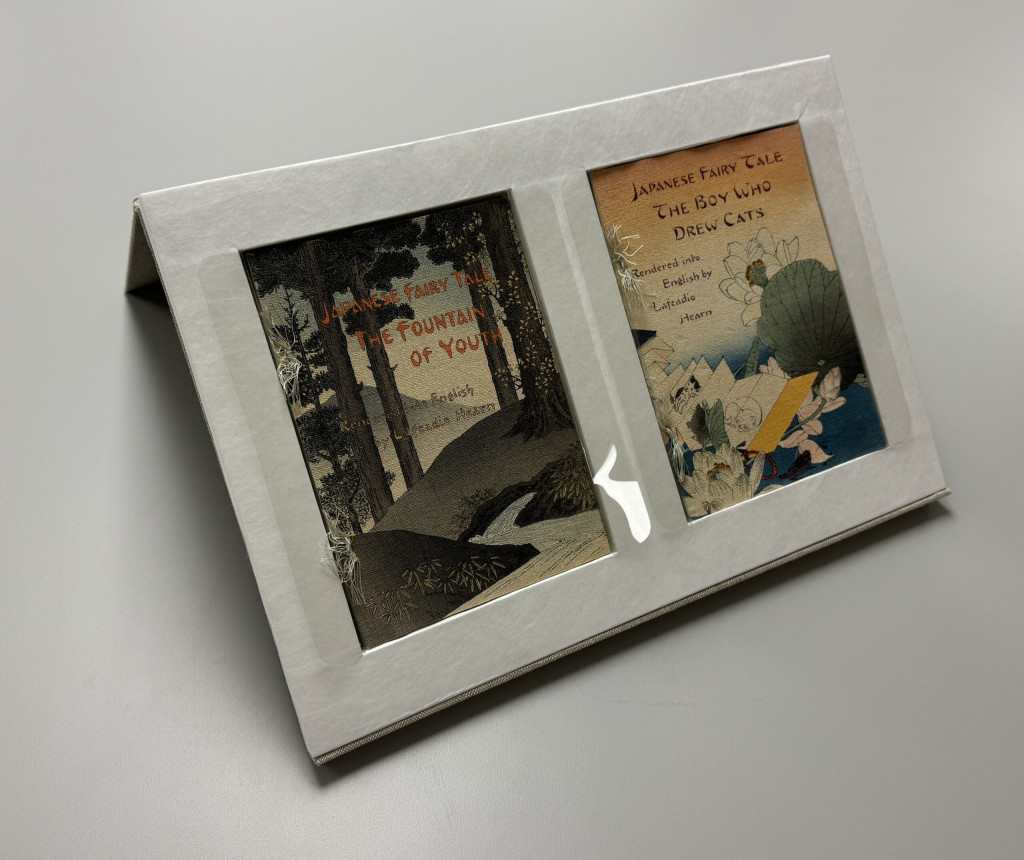
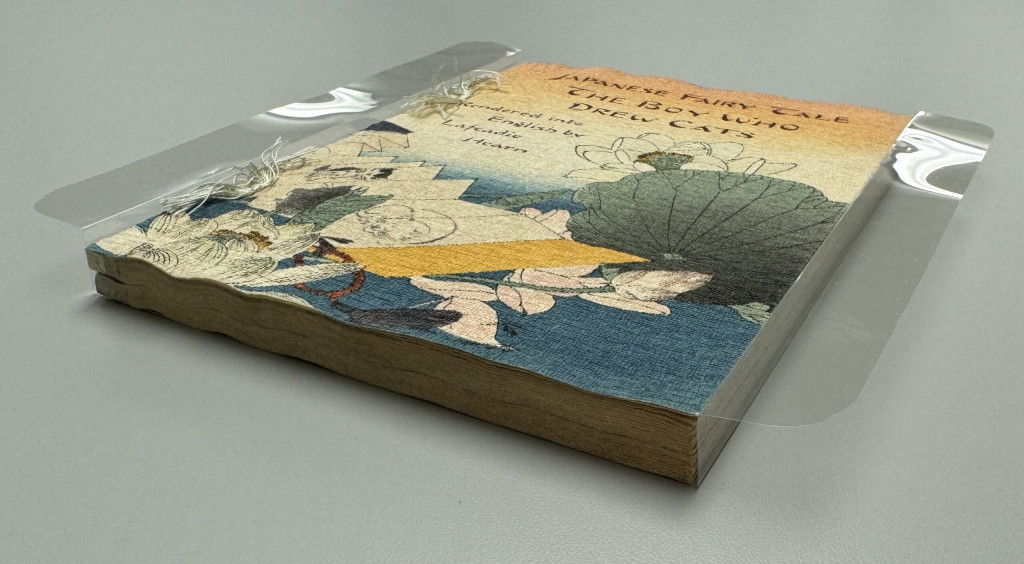
This set of Japanese side-sewn, crepe paper bindings, or Chirimen-bon, came to the Preservation Lab housed in their damaged traditional Japanese wraparound case, known as a maru chitsu. The set belongs to the Cincinnati and Hamilton County Public Library, which has an extensive Lafcadio Hearn collection. This collection of volumes was printed by Hasegawa Takejirō, a Japanese publisher who specialized in books written in European languages on Japanese subjects. The Japanese Fairy Tale Series was one of the more popular series, beginning with six volumes in 1885; though this later collection only has five volumes of fairy tales. Lacadio Hearn was one of the foreign translators employed by T. Hasegawa.

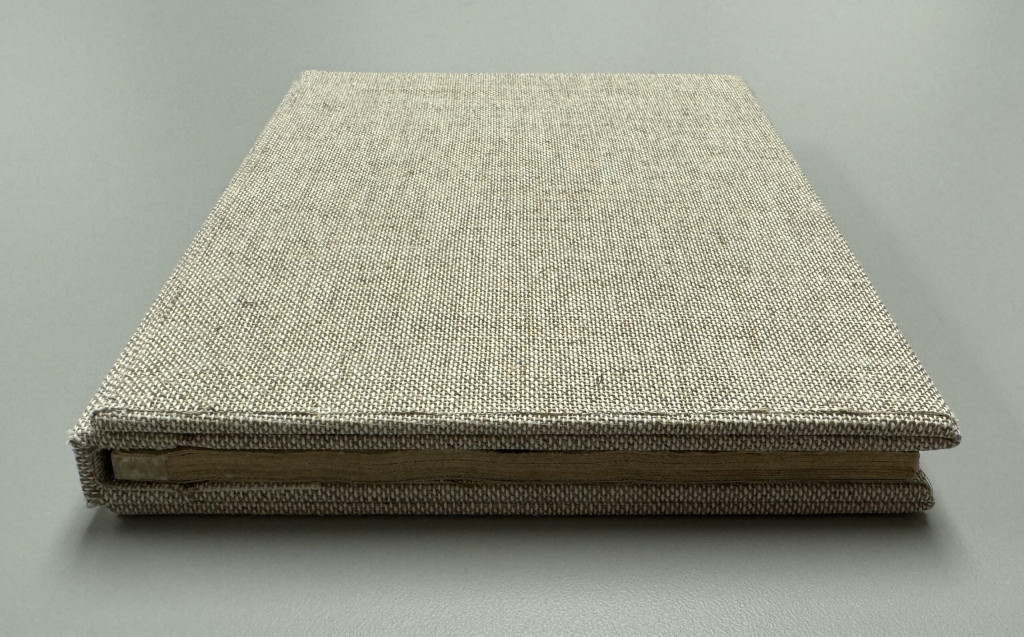
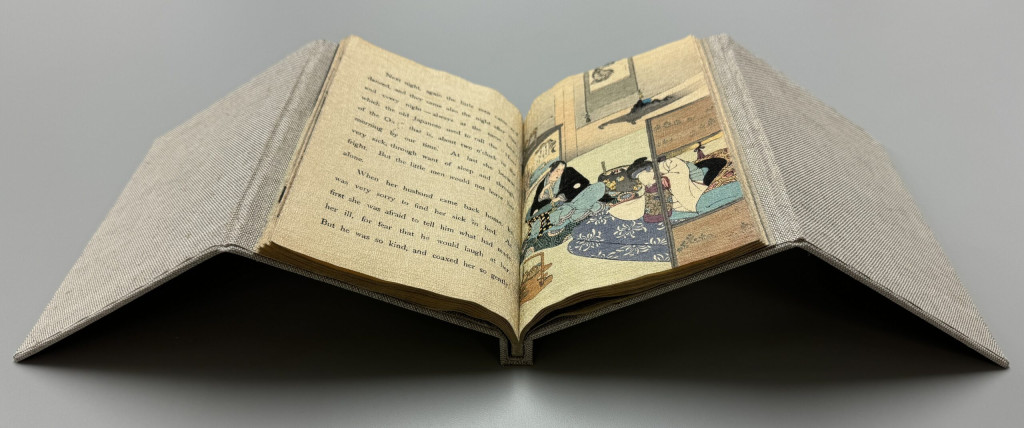
Due to the high profile nature of Lafcadio Hearn for the library and the beauty of the bindings, the collection is often shown during tours and used for display, however, the crepe paper volumes, while in excellent condition, are extremely floppy, and they are also side-sewn, both factors make them difficult to handle and display. The original enclosure is also very fragile and damaged, and susceptible to further damage if used as an enclosure moving forward. For all these reasons, the curators wanted an enclosure that would not only store the collection long-term, but could also be used for display.

This proved to be a challenge, but a fun one. I started by making a couple of sketches and then a couple of models…

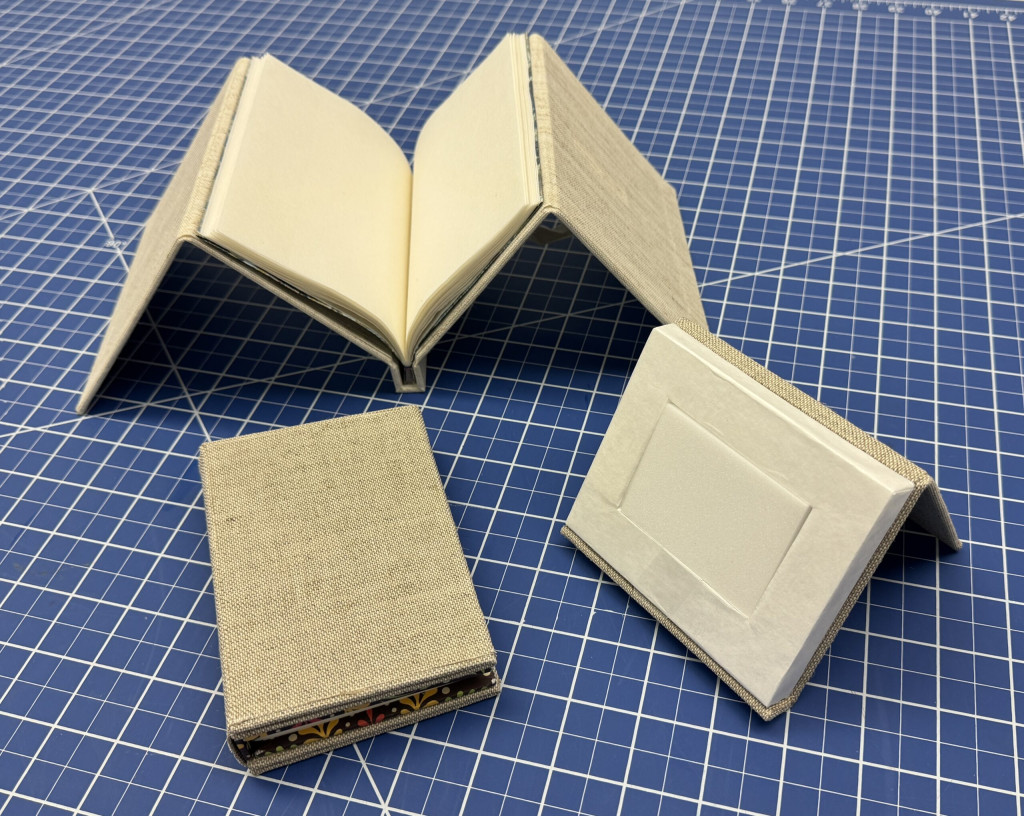
Three models pictured, two are collapsible cradles and one display stand with foam insert
Models – two types of collapsible cradles and one model of the display tray/stand

For the models, I had two main focuses: 1) a collapsible cradle that would house and display one of the volumes, and 2) a display component that would act as a tray or level within the enclosure and house the remaining four volumes, in two stacks of two, side by side.

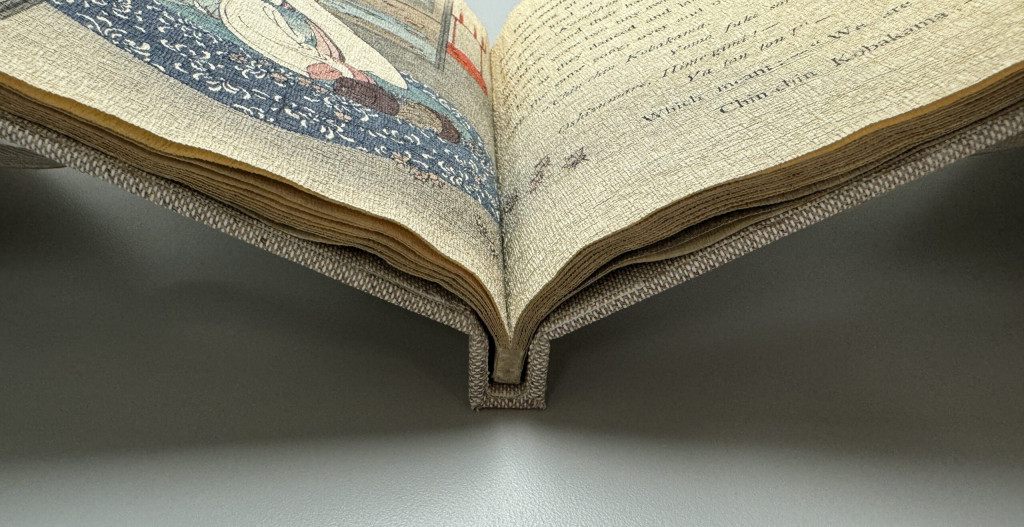
I will always advocate for making a model if you are trying to work through a new enclosure or adjust an existing enclosure or display piece, like a cradle. For example, I knew that a normal collapsible cradle wasn’t going to fit the bill for these volumes. Instead, I was going to need a stiff, squared off spine piece built into the cradle to help support the bindings’ spines.

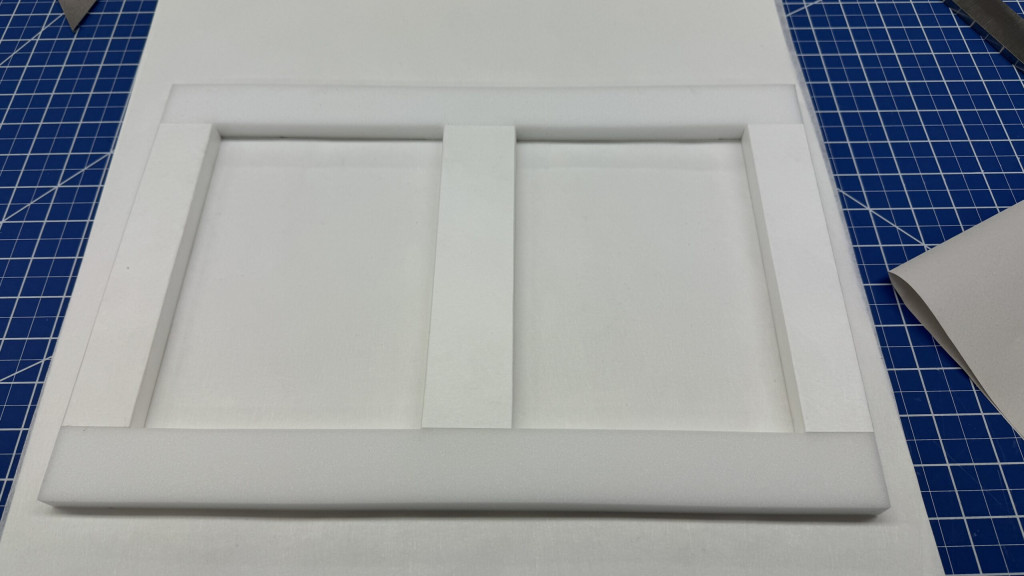
One of the main areas I had to troubleshoot was the display tray, which would house the four remaining volumes. I knew I wanted to create a stand that would basically replicate one side of a collapsible cradle and have a 1/2 inch Plastazote foam insert, which happened to nestle the thickness of two volumes perfectly, that was covered in Tyvek. But I had concerns about gravity and reliability of PVA to hold the foam insert in place overtime. And I wasn’t happy with my initial ideas of how to remove the volumes (and also the original enclosure and collapsible cradle) from the insert(s), which consisted of a tab underneath the volume. It created friction that would ultimately cause damage to the actual volumes.

Ultimately, I am extremely happy with what I came up with. I think it functions very well, and checks all the boxes it needed to check. Safe, secure storage. Elegant display. User-friendly.

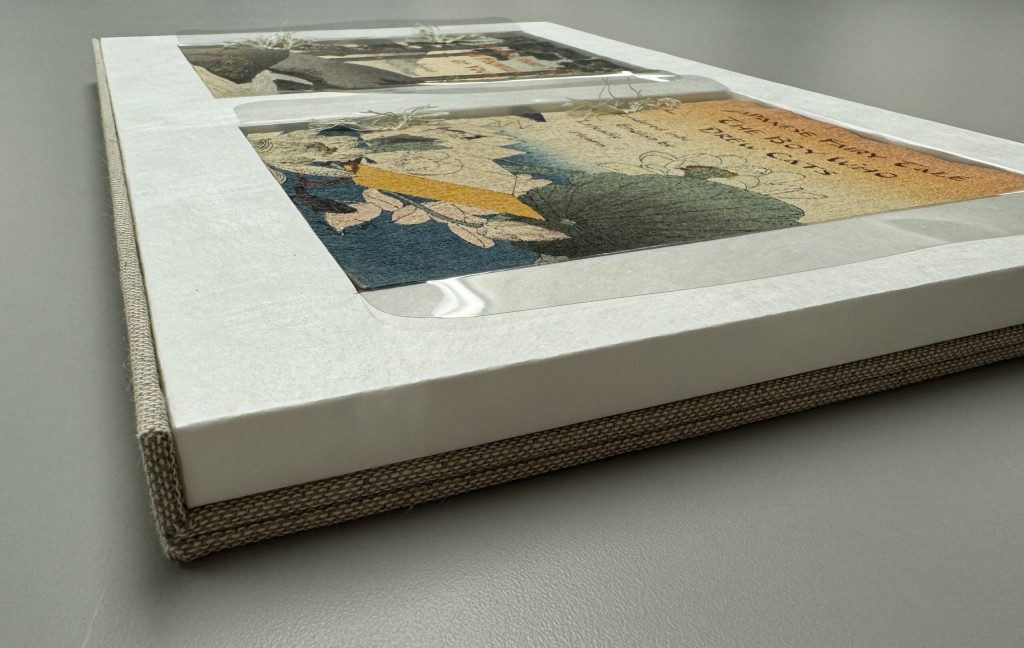
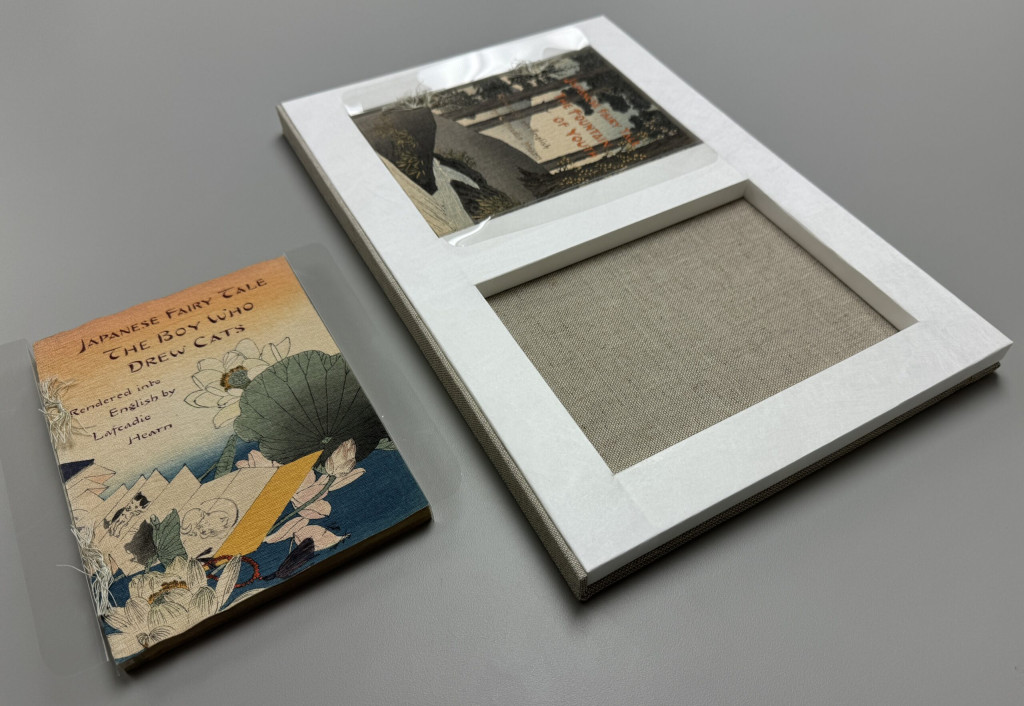
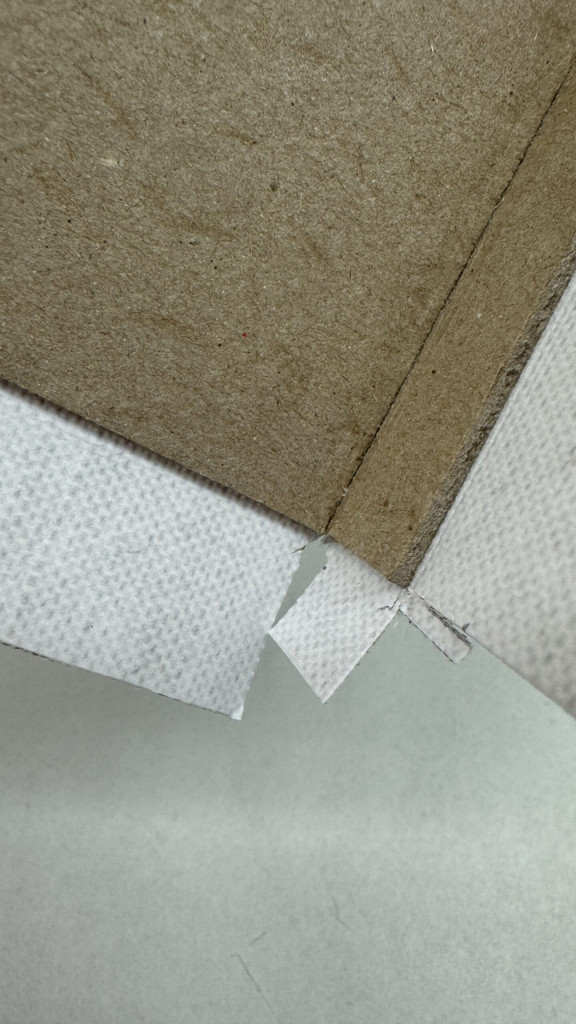
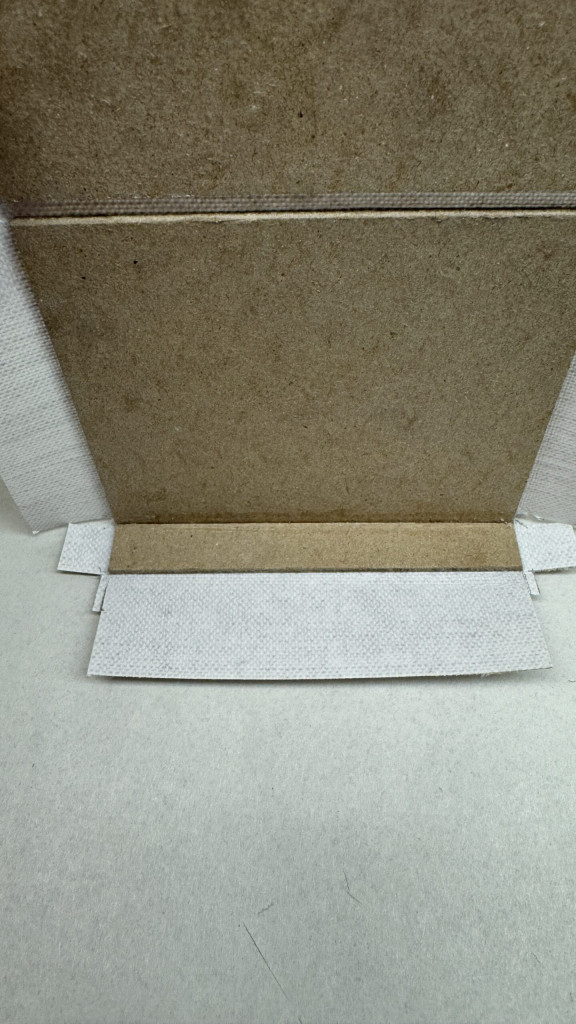
The display stand includes a cloth tape inserted into the boards to keep it from opening too far, a foam insert covered in Tyvek, a lip to support the foam insert overtime, and two polyester film slings to aid in removing the volumes from the foam insert. The polyester slings proved to be an excellent solution for removing all the elements from the enclosure safely and easily.

For those interested in how some of the components were constructed, here are some in-progress images…

Because of the way the trays/components of the enclosure are constructed, they are actually interchangeable. So if the “lower tray” with the original enclosure and collapsible cradle ends up on top of the display tray/stand, that’s not an issue at all. And there is a 1/4 inch Volara foam piece adhered to the outer tray of the clamshell enclosure, so whatever items are on top will be cushioned by soft foam in the enclosure.

Get a full tour of the enclosure by watching our reel on Instagram:
Jessica Ebert [UCL] – Assistant Conservator

Archeological Textile Discovery in the Stacks: The Research
This is the first post of a four part series. Click the links below to jump to the following posts:
  • Research and Examination – Examining the material composition of the objects
  • History – Historical information provided about the Egyptian inscriptions
  • Treatment – How the materials were treated after learning about their content
  • Storage Solutions – Individual solutions for separated fragments as well as storage as a collection

Discovery in the Stacks

When a collection of Egyptian mummy bandage fragments at the Cincinnati and Hamilton County Public Library was found in an area used to store uncatalogued flat materials, the lab was asked to play a role in providing better stewardship.  

Discovered in the stacks: A mounted collection of six Egyptian textile fragments that date to the Ptolemaic Period (around 300-30 BCE), recto

Mummy bandage wrappings are rare finds in public libraries, and discovering that the materials where uncatalogued was not terribly surprising; having the specialized knowledge to catalog such a unique object may not have been available at the Public Library at the time of the acquisition.  With no identifying marks, and mounted to an aged board, the provenance of these objects are unfortunately unknown.

Collection suffered from a lack of storage housing without identifying information, found by staff performing a collections inventory, verso

Concerned about their overall safety of the fragments, as they were attached to a brittle board that could potentially chip and break if mishandled, it was clear that a solution for long-storage was needed.  Therefore, the items were brought to the lab for a comprehensive examination.

As a book and paper conservator with little knowledge of archeological textiles, the first step towards selecting a preservation solution was to better understand the fragments and conduct research on how to care for them. Because of the age and fragility of the items, my goal became to find a storage solution that could facilitate access while limiting handling of the actual objects themselves.

Examination

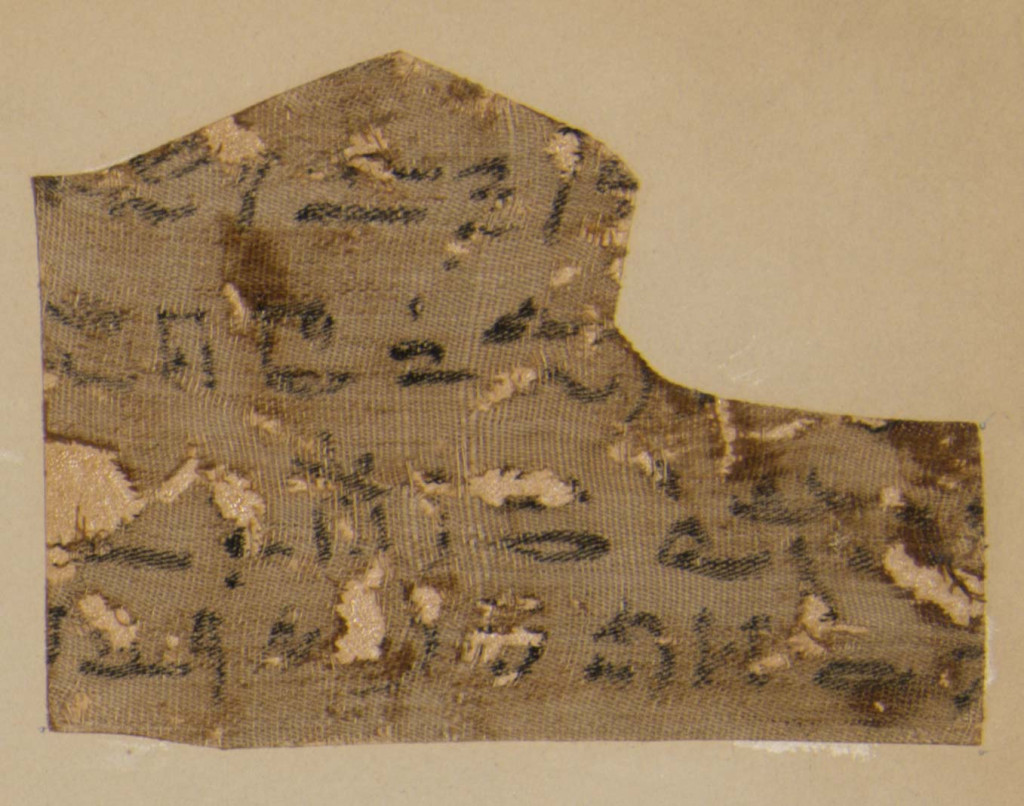
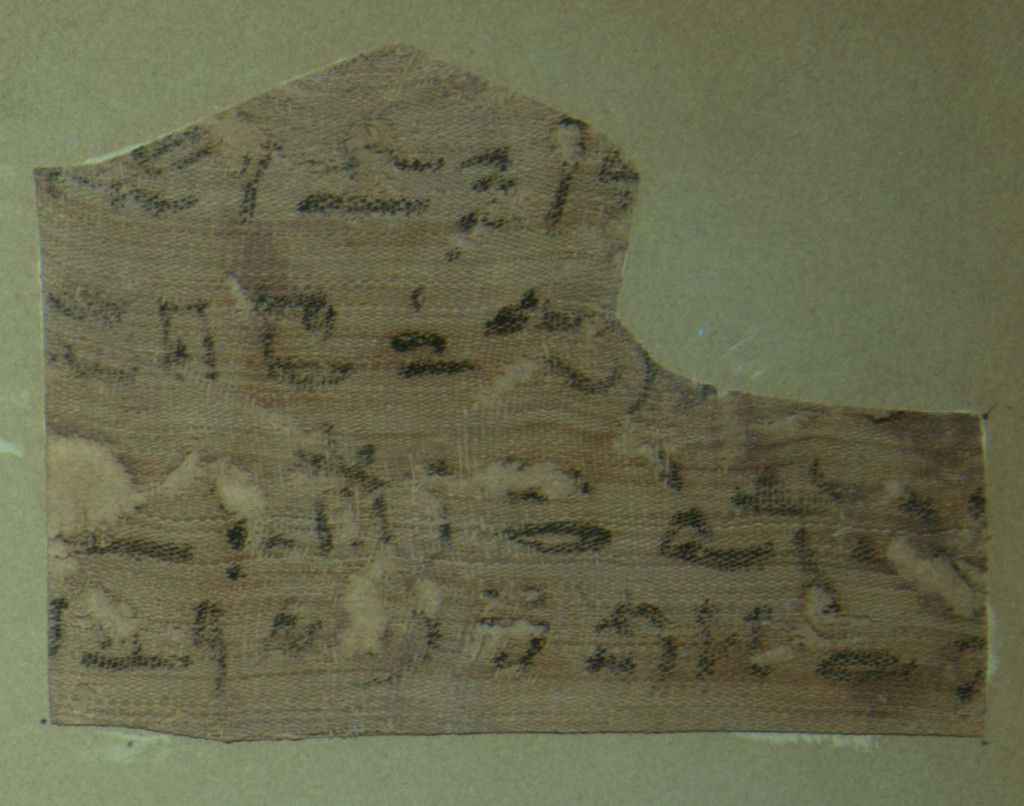
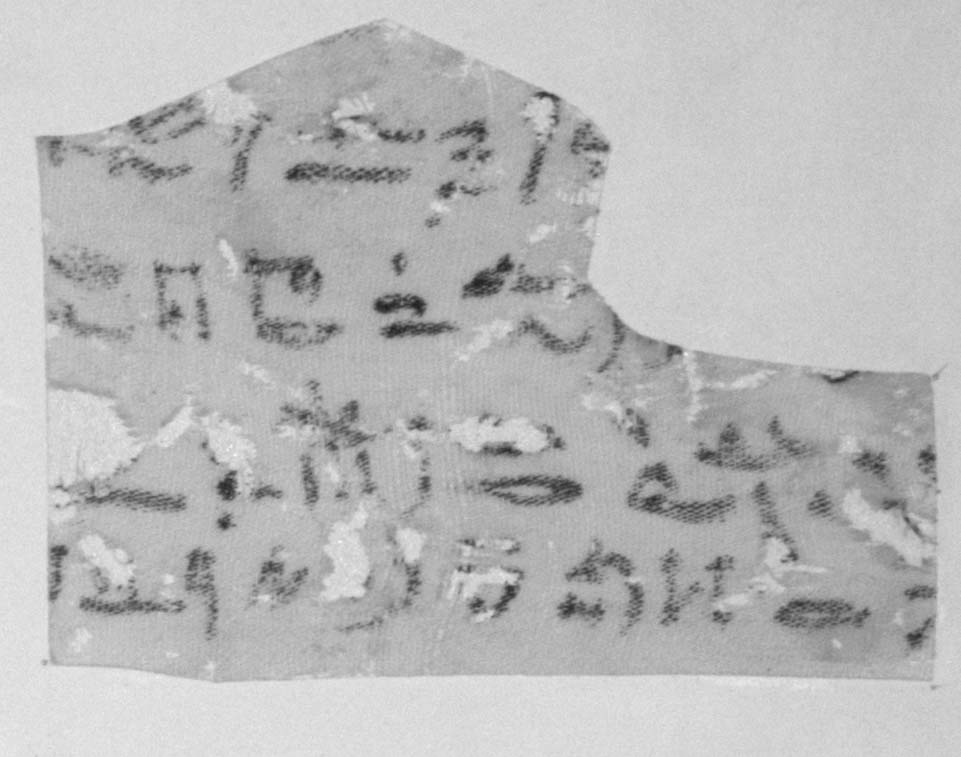
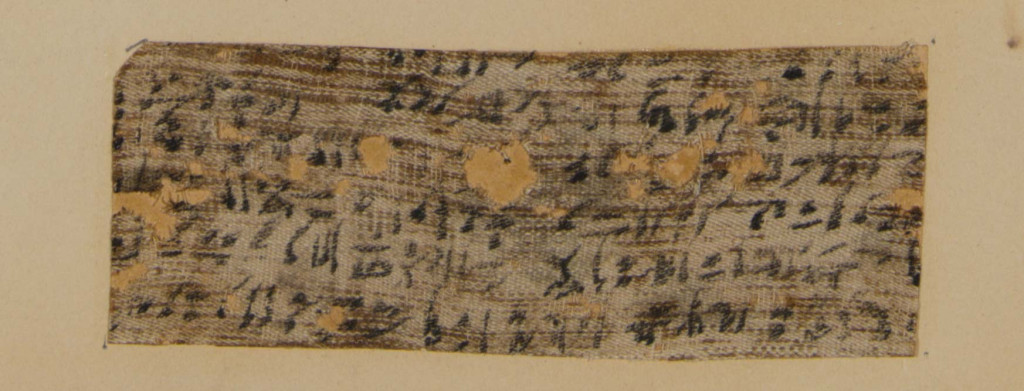
In order to conduct research, the condition of the individual fragments were fully examined with a variety of illumination techniques to better understand their composition. The collection was photographed with a DSLR camera in normal illumination, raking light, infrared, and ultraviolet fluorescence. The images revealed valuable information such as the possible types of adhesives used in mounting, the degree of linen loss, as well as the type of pigment applied to the linen. 

Creating the photographic documentation also allowed me to reach out to other scholars, to inquire about their history, while providing high quality images.

Types of Photography Performed During Examination

  • Normal Illumination – Overall images were taken of both the front and back of the mounting board. Normal illumination images serve as general reference photographs, representing how we perceive the object in normal room lighting.
  • Raking Illumination – Reveals the surface topography, showing breaks, tears, and losses in both the linen fragments and the mounting board.
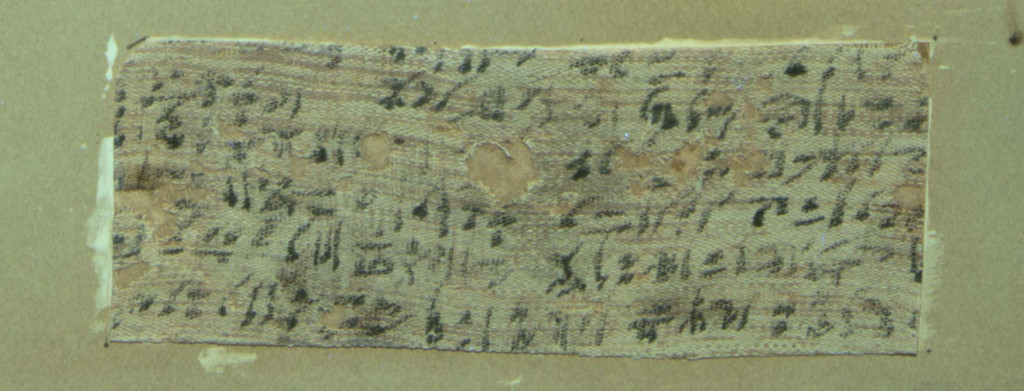
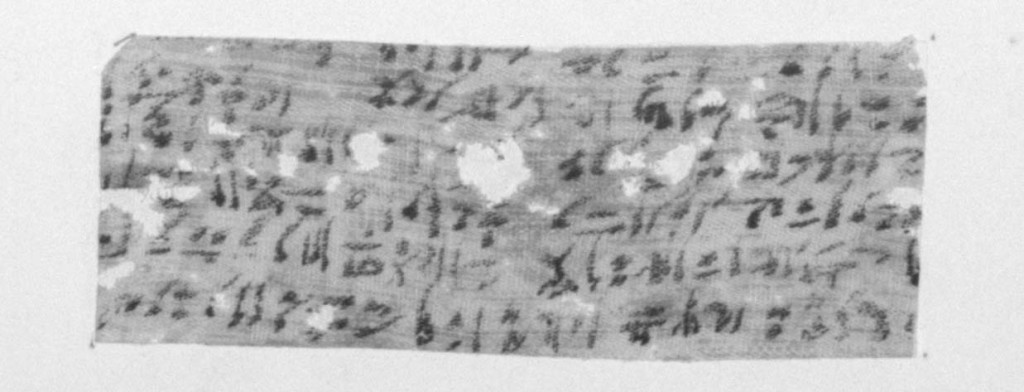
  • Infrared Imaging – A modified DSLR camera and specialized filters remove visible light and capture longer wavelengths than the human eye can see, revealing the carbon-based writing while allowing the stains to disappear, making the writing more legible.
  • Ultraviolet RadiationUltraviolet radiation produces a fluorescence that readily shows the two differing types of adhesives used to adhere the fragments onto the backings. The first adhesive used to adhere the fragments to a brown paper backing does not fluoresce, while an adhesive that is smeared onto the face of the backing board does fluoresce.  This indicates that the fragments were adhered at different times to the two different substrates, first being adhered overall to a paper backing, then later mounted onto the board.

Research

Using the high-quality images described above, I reached out to experts in Egyptology and papyrology at the University of Cincinnati Classics Library and the University of Michigan to learn about the history of the objects. Right away, I was given extremely detailed information by generous colleagues.

One of the first surprising things I learned is that two of the fragments were oriented upside down.  So in their mounted format, they were not properly represented. Perhaps even more exciting was the discovery that three fragments were able to be attributed to a priest named Wennofer! (There will be more about the history of the pieces in the second part of the series, stay tuned.)

Of Parts and Pieces

It was serendipitous that during my research one of the contacts I was put in touch with was Dr. Ann-Katrin Gill from the University of Leipzig.  Dr. Gill happened to be in the midst of a larger project titled: Of parts and pieces: unearthing, reassembling, and documenting papyri and linen objects in US libraries.  As you can imagine, she was thrilled to receive the treatment documentation of the Public Library’s fragments to add to the collection.  We have hopes that should any other fragments belonging to these be discovered, perhaps they could become reunited.

Materiality

The Egyptian mummy bandage fragments, or cloth shrouds, are also referred to as archaeological linen textile fragments. I learned the following about the materiality of the fragments.

Inscriptions

Fragments contain either formal hieroglyphs (using pictorial characters) or cursive hieratic script (which is a later Egyptian shorthand writing system used by scribes). It was determined that the fragments likely date to the Ptolemaic Period (around 300-30 BCE) based on the writing style used during that time period. 

Inscriptions are written in black ink with a reed or rush pen, referred to as rush ink.  The ink appears to be typical of the time period, most likely carbon-based with a gum binder. The fragments when viewed though infrared imaging (see slide show above) shows the carbon in the ink absorbing infrared radiation, making the ink appear dark black in infrared images, while the organic staining drops out of the image.

20th Century Alterations

Lined with Brown Paper

At some point in the fragments’ history, the textiles were lined on the back in an acidic machine-made brown paper (reminiscent of brown craft paper tape).  If you look carefully in the raking light image (see slide show above), you might notice the brown lining paper poking through losses in the textiles as a slightly darker shade of brown than the board support.  Under UV fluorescence (see slide show above), the adhesive used in conjunction with the brown paper lining does not fluoresce. This adhesive was found to be readily water soluble and possibly a gum-based adhesive.

Trimmed Edges

You might notice the fragments are cut into odd shapes. Likely, they were trimmed to remove frayed ends and damaged parts.  There’s no way to know if the fragments were trimmed before or after they were lined with the brown paper lining, however the edges are fairly consistent with one another. One could make the case they were trimmed at the same time.

Mounted to a Board

After lining, these fragments would have then been mounted to a board, with two identified as upside down (oops)! Faint patterns on the back of the paper board resemble off-setting from wood, likely caused by a wooden backing board in a frame. If these assumptions are correct, it’s my guess that the fragments were mounted then framed for the tourist trade, with the frame now lost. 

Condition

Being mounted on an aged, unsupported, brittle board put the fragments at risk of breaking along with the board. Since the board already contained cracks and breaks along the edges, this concern felt urgent.

Despite the precarious storage and concerns surrounding the fragments being exposed to the elements, the textiles themselves appeared in fairly good condition for being over 2,000 years old! Viewing the fragments in raking light (see slide show above) reveals a considerable amount of linen loss throughout the textiles. However, it doesn’t appear that these losses were a recent incident in the past half century.  The losses were likely present when the fragments were lined with brown paper backing.

Next Steps

Next steps were to prepare the objects for safe keeping in long-term storage. To do so, required research on possible treatment options to safely store the items in their proper orientations. Also, knowing that not all fragments belonged in context with each other was further justification to split the collection into separate parts. Read on for more discoveries in this preservation journey!

To learn more, check out the other three posts in the series:

  • History – Historical information provided about the Egyptian inscriptions
  • Treatment – How the materials were treated after learning about their content
  • Storage Solutions – Individual solutions for separated fragments as well as storage as a collection

Acknowledgements

  • Katherine Davis, Lecturer in Egyptology in the Department of Middle East Studies at the University of Michigan
  • Suzanne Davis, the Associate Curator and Head of Conservation at the Kelsey Museum of Archaeology at the University of Michigan
  • Dr. Ann-Katril Gill at the University of Leipzig
  • Marieka Kaye, Harry A. and Margaret D. Towsley Foundation, Head, Conservation & Book Repair, University of Michigan Library
  • Obie Linn, Textile Conservator at the Cincinnati Art Museum
  • Ann Wuertemberger, Catalog Librarian at the Cincinnati and Hamilton County Public Library
  • Meredith Montague, Textile Conservator at the Museum of Fine Arts Boston

Ashleigh Ferguson Schieszer – Special Collections Conservator and Co-Lab Manager [CHPL]

Just Peachey: Jeff’s Conservation Hand Tools Workshop

For one week in July, 2024, the Preservation Lab busted out belt sanders and opened the elbow grease to host a workshop taught by Jeff Peachey, learning all about making, modifying and maintaining our own hand tools. Jeff, a book conservator and master tool maker, brought all kinds of fun machinery and exciting tools for us to learn from and use. From hacksaws to pencil sharpeners, Jeff’s tool collection is inspiring, and we all left the week with some amazing new additions to our bench.

A set of raw materials each participant received at the beginning of the week to shape into their own personal new tool set! Credit: Jeff Peachey
Extra scraps of horse butt, cherry, pear and box wood, Delrin, and bamboo: materials we used and experimented with during our workshop. Credit: Jessica Ebert

Delrin

We started the week off working with Delrin. Delrin, an acetal homopolymer plastic that appears similar to Teflon, was easy to shape with saws, files, scrapers and silicon carbide sandpapers. We burnished with sanding pads and polishing paper.

We started off with Delrin rods that we shaped into delicate heras. Heras are thin tools with spatula-like ends that Jeff says are great for delicate prying, inserting small amounts of adhesive, and lifting tape to name a few of the uses for this handy little tool.

We made a rough cut of the shape we wanted with the bandsaw, then smoothed everything out by going through a sandpaper grit progression. Once we’d crafted these, many of us tried our hand at making versatile Delrin folders. With lots of filing and sanding, this malleable Delrin was easy to manipulate into a variety of tool shapes, and no two tools were exactly alike.

A Delrin hera created by Holly. Credit: Holly Prochaska
Ashleigh uses a saw to shape her Delrin. Credit: Ashleigh Ferguson Schieszer
Jeff demonstrates how to work with Delrin. Credit: Ashleigh Ferguson Schieszer

Knives

Our second and third days with Jeff were all about M2 steel knifes, both sharpening them and making them. We learned all about using Jeff’s sharpening system and honed down our own Peachey paring knife. We also made two lifting knives out of Starrett 32T hacksaw blades by grinding the blades down on a belt sander and then taking them through the sharpening system with microfinishing films to achieve a sharp edge.

A progression of 3M Microfinishing Films adhered to a glass plate for sharpening. Credit: Ashleigh Ferguson Schieszer
A Peachey knife next to a sharpening system on marble. Credit: Holly Prochaska

Sharpening knives turned out to be a complex process – a burr must be formed at each grit gradient before moving on to the finer grind, and if your hand position is off this could take some time. Furthermore, the wrong hand position could yield a bevel angle too big or too small on the plane of the knife. We aimed for an ideal bevel angle between 11 and 13 degrees.

Specular light shows a raw bevel angle during sharpening, before it has been ground smooth on the first grit progression. Credit: Ashleigh Ferguson Schieszer

Additional Knife Features

Some people chose to add grooves into the sides of their paring knives for a more comfortable grip; some of us chose to wrap our knife handles in leather and make horse butt sheaths for them. Matt was the bravest of all and mounted a custom carved wooden handle to his left-handed paring knife.

Grained Book Cloth

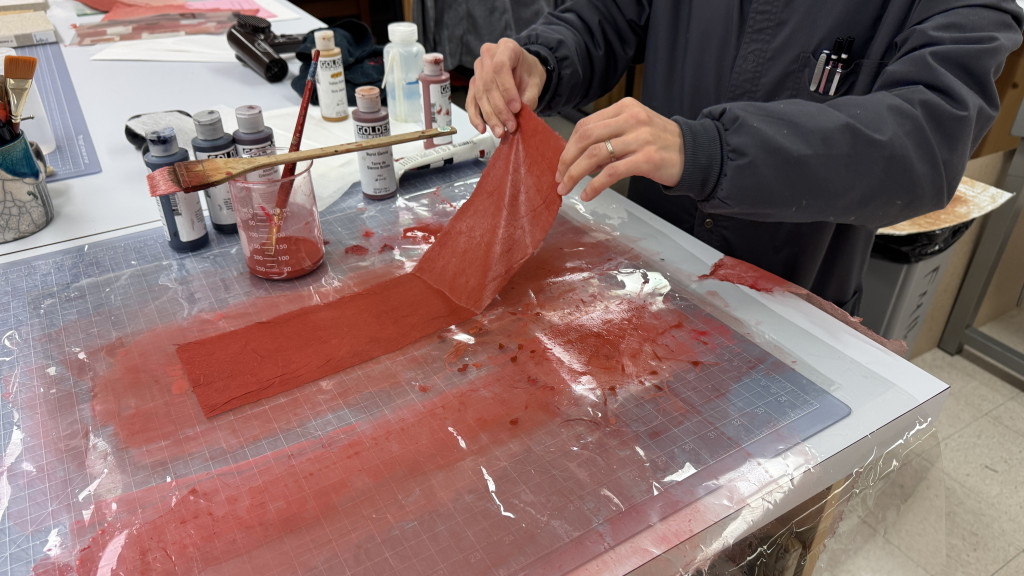
We also went over creating 19th century grained book cloth on our third day. Through toning, glazing, then pressing with a die that has your desired pattern, it’s possible to create book cloth that mimics the textures of 19th century book cloth. After going through the time-consuming process, the idea of making up large batches at one time became appealing.

Jeff demos coating a cotton muslin with acrylics and paste, pressing the coated cloth with screens to add a grain, then finishing with an egg glare. Credit: Ashleigh Ferguson Schieszer
Jeff’s samples he made ahead of the workshop

Wood and Bamboo

On our fourth day we learned all about wood and bamboo carving. Using a chisel, wood plane or hatchet, we created the crude shape we wanted our wooden tools to take. Then we got to work sanding until the wood was smooth, and created a more precise shape. A final finish with nose grease or wax was optional.

Jeff’s workbench after his wood carving demo. Credit: Jessica Ebert

Bamboo is great for creating thin, flexible tools. With our pieces of wood most of us created folders, but a few decided to make wooden handles for their knives or straight edges. Personally, my favorite tool I created the whole week was my wooden folder I made, though it was probably the hardest to create. I had to shape it using a small hatchet, then sand it for quite some time before it took on the shape that I wanted.

Jeff demonstrating how to carve our piece of wood using his proprietary bench hook. Credit: Jessica Ebert
Holly chiseling a piece of bamboo using a generic bench hook. Credit: Jessica Ebert
My new wood folder. Credit: Nicole Browning

Stainless Steel

Our final day with Jeff was spent shaping stainless steel tools, which to me was the hardest material we worked with, as it took a lot of patience with the belt sander, and the metal was prone to heating up quickly and potentially burning our fingers. We created straight edges or 45 degree triangles, and even learned how to drill holes and attach small handles to these tools. We also had a thicker piece of stainless steel for creating a folder, which I found the most challenging of all. The stainless steel was harder to manipulate, understandably, and much less forgiving than the wood or Delrin.

Holly drilling holes in the stainless steel handle of her straight edge. Credit: Ashleigh Ferguson Schieszer
Two stainless steel folders made and engraved by Jessica. Credit: Jessica Ebert

We ended the week by testing the sharpness of our blades and doing a little show and tell of our favorite tools that we made. It was so amazing to see all the different tool shapes people were inspired to make based upon what they most used in their work.

My assortment of tools I made at the workshop. From left to right: bamboo lifters, two Delrin Heras, two lifting knifes, a Delrin folder, a paring knife and its sheath, and a wooden folder. Credit: Nicole Browning

Learning from Jeff was such an amazing opportunity, and it was so eye-opening and world-expanding to learn that so many of these tools we use every day can be created from our own hands.

Jeff did a fabulous job tailoring his tool-making workshop to the the availability of machinery and other logistics of our facility. As a result, the actual tools made in our version of this workshop vary from other workshops Jeff has taught, empowering us to keep making tools with our space in the future. If you ever have the chance to take this workshop, we highly recommend it!

Be sure to check out this Instagram post by Jeff featuring all of us showing off our favorite hand tools we created!

Nicole Browning [CHPL] – Conservation Assistant