
Category Archives: Enclosures

I Got 99 Problems, but the Lawrence Notebooks Ain’t One: Finishing the Conservation Treatment of 99 Volumes

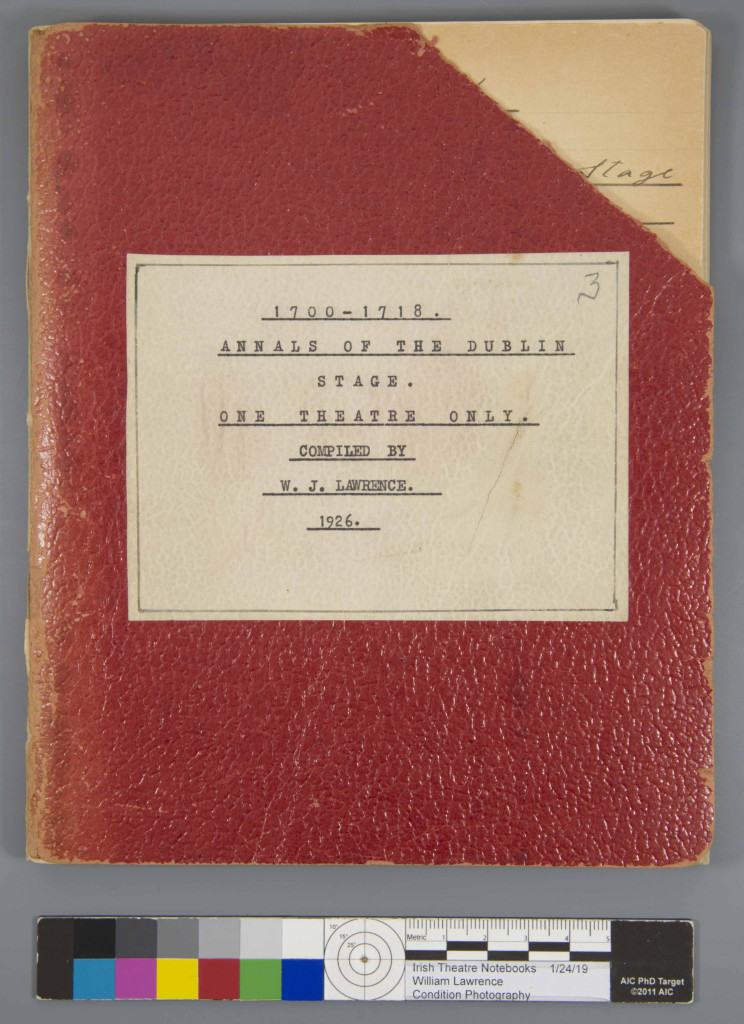
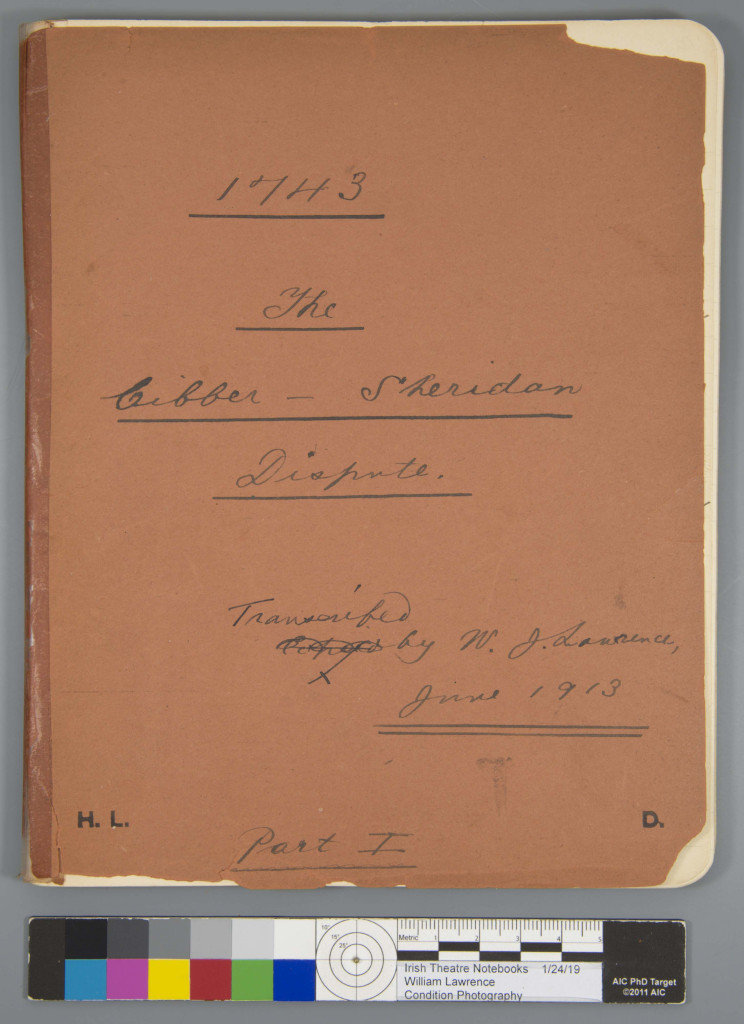
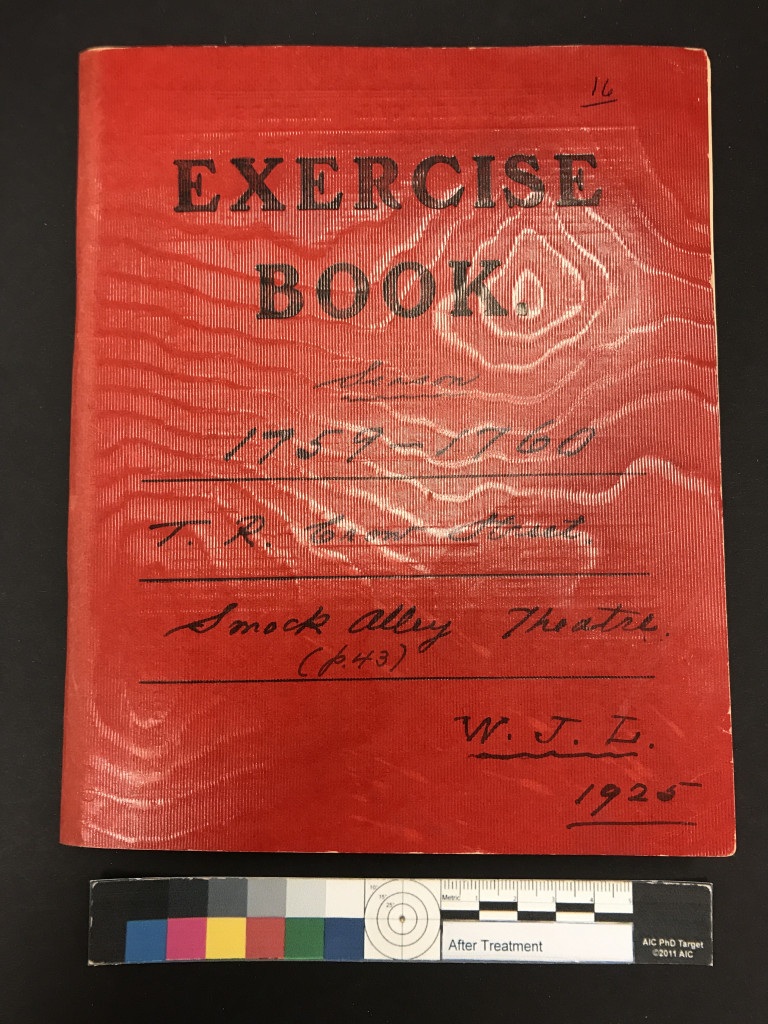
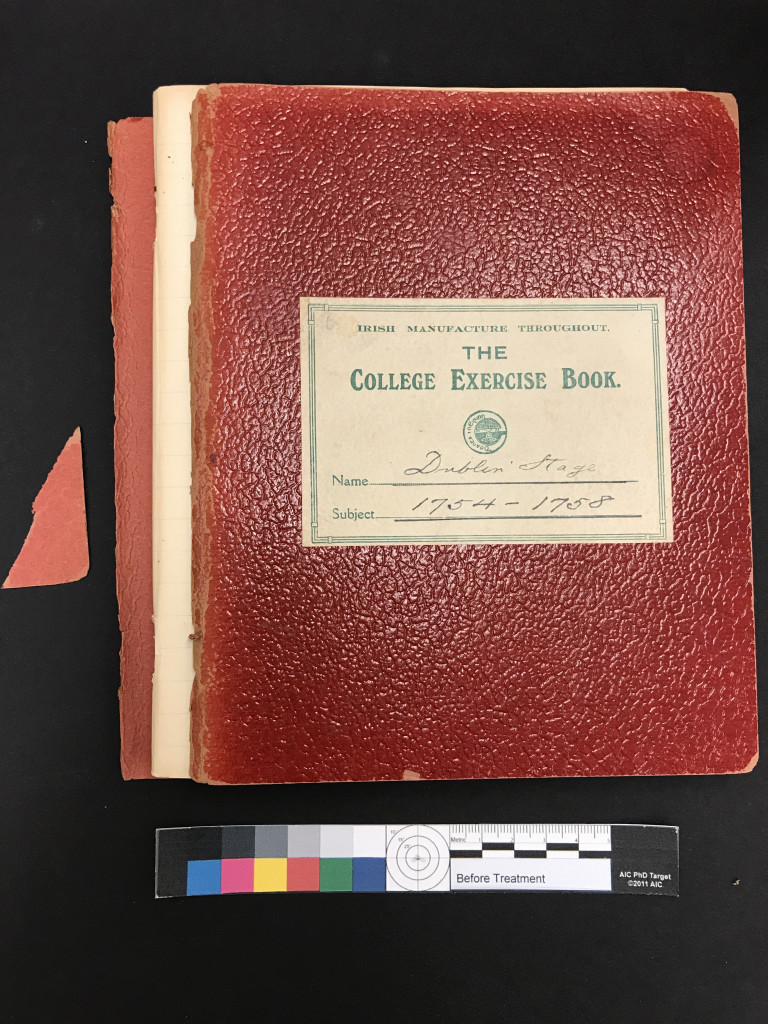
For the past few years, I have been working on the conservation treatment of the Lawrence Notebooks, a remarkable collection of 99 handwritten volumes created by William J. Lawrence that document his extensive research on the Irish stage from 1630 to 1911. Over many years, Lawrence filled these small, lined notebooks with careful handwriting, news clippings, photographs of actors, typed play transcriptions, and detailed notes on theaters, performances, ticket prices, and even personal anecdotes. Together, the notebooks offer a rich and vivid window into the history of Irish theater and the cultural life of Dublin from the seventeenth through the early twentieth centuries.

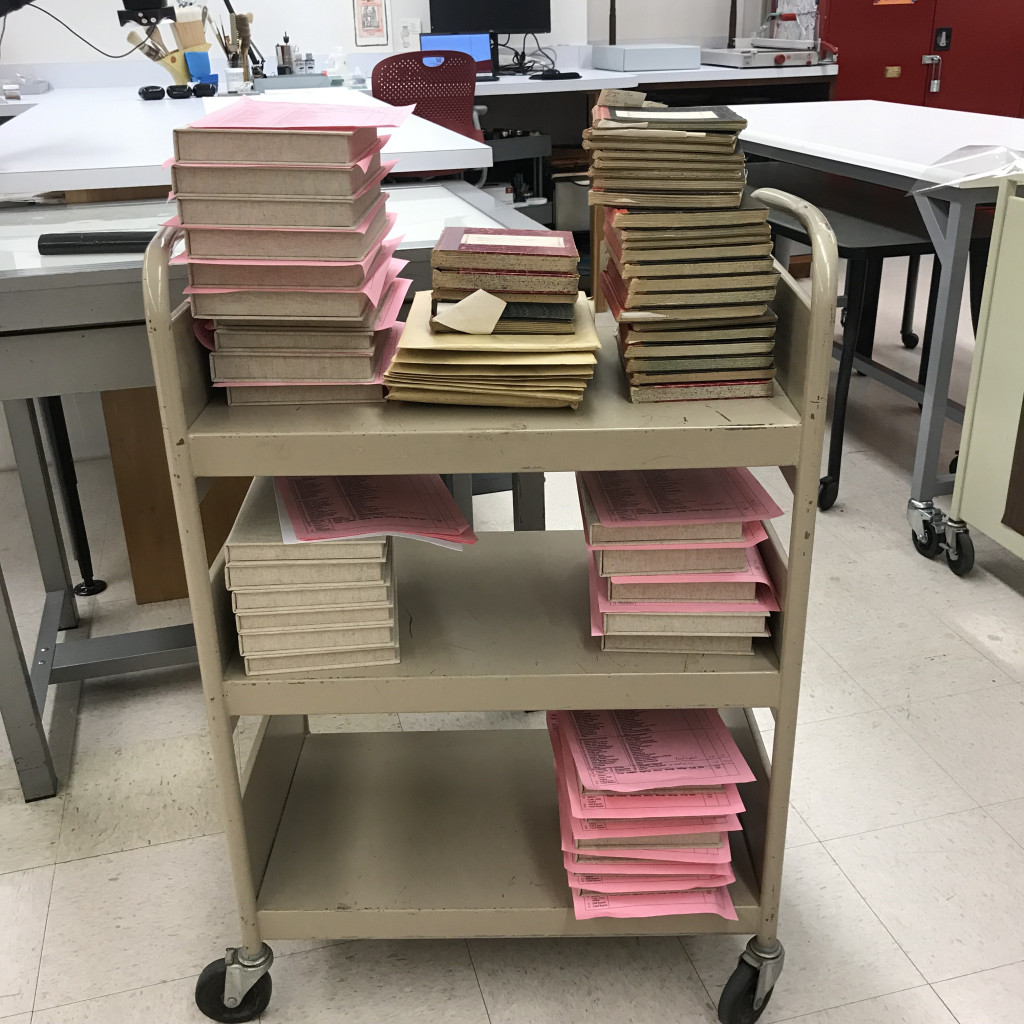
A library book truck filled with various small notebooks and conservation boxes.
In 2021, we had already completed 37 of the 99 volumes, and we still have 62 volumes in the Lab.
This project was a collaborative effort and was completed gradually over several years, with individual volumes treated alongside other conservation projects rather than all at once. Our former colleague Chris Voynovich created custom cloth-covered clamshell enclosures for all 99 volumes, while I was responsible for the evaluation and conservation treatment of the notebooks themselves.

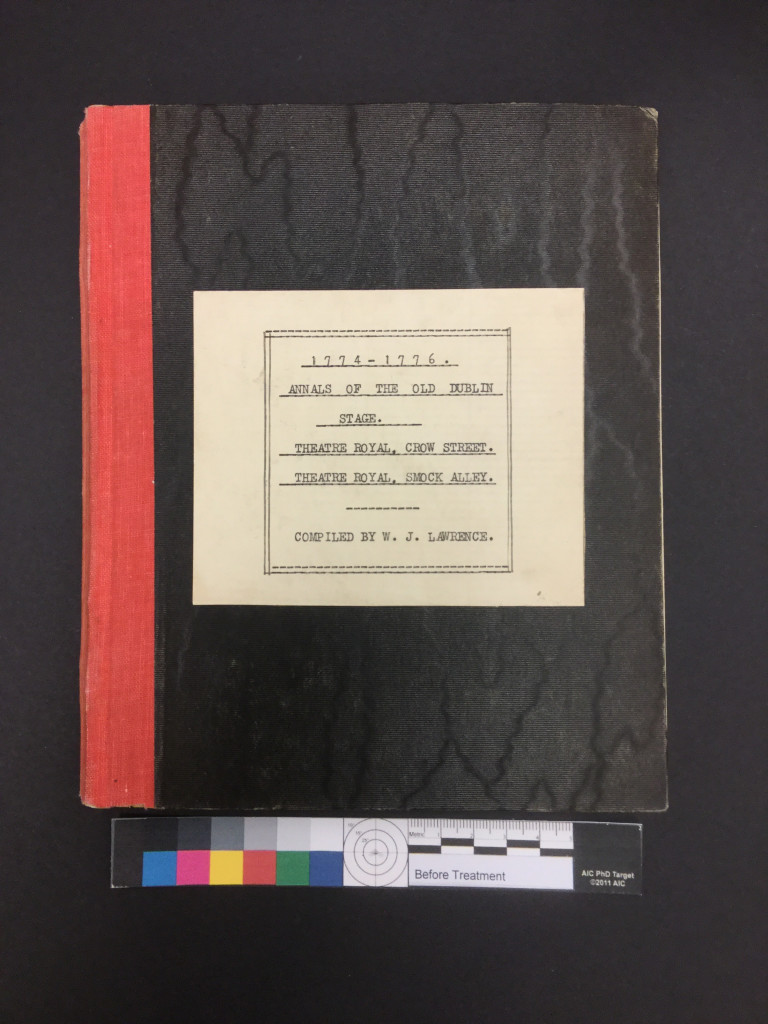
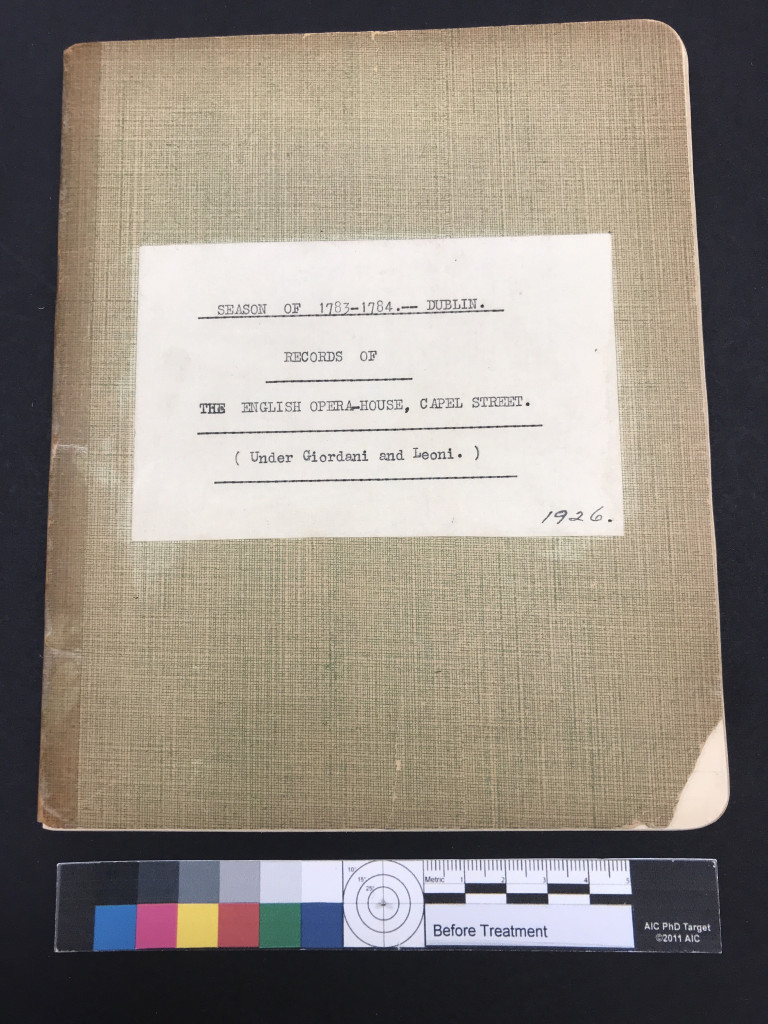
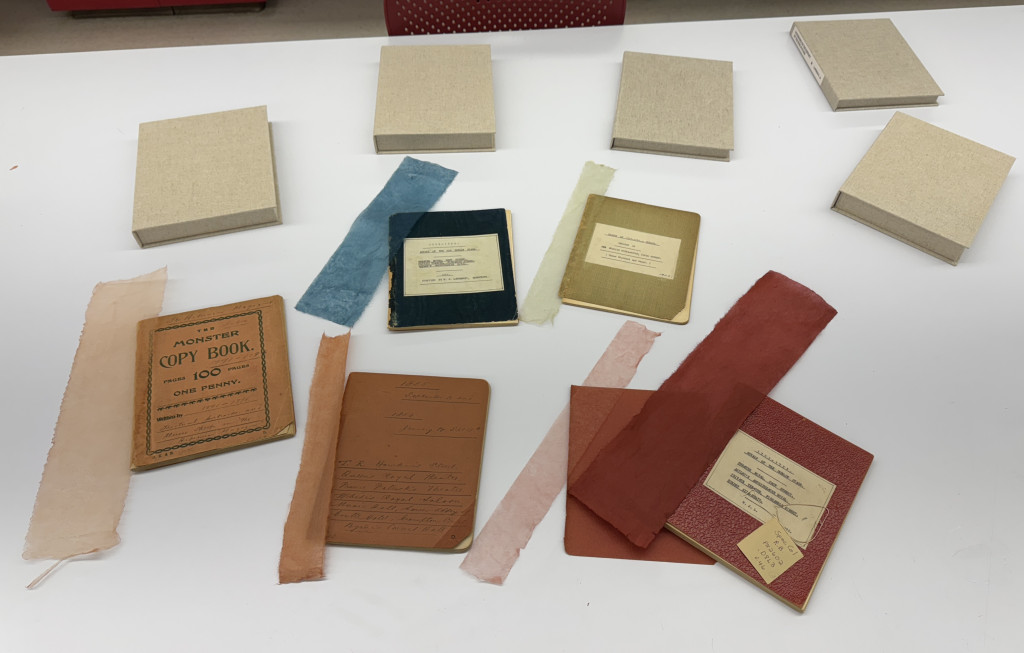
Although the Lawrence Notebooks shared a broadly similar format, closer examination revealed subtle but meaningful variations in both their covers and text blocks. Most volumes were small, square notebooks with thin boards covered in cloth or paper covers, in a range of muted colors including red, orange, green, blue, and black. The text blocks were generally composed of one or several gatherings sewn through the fold, with the primary support most often being lined paper.

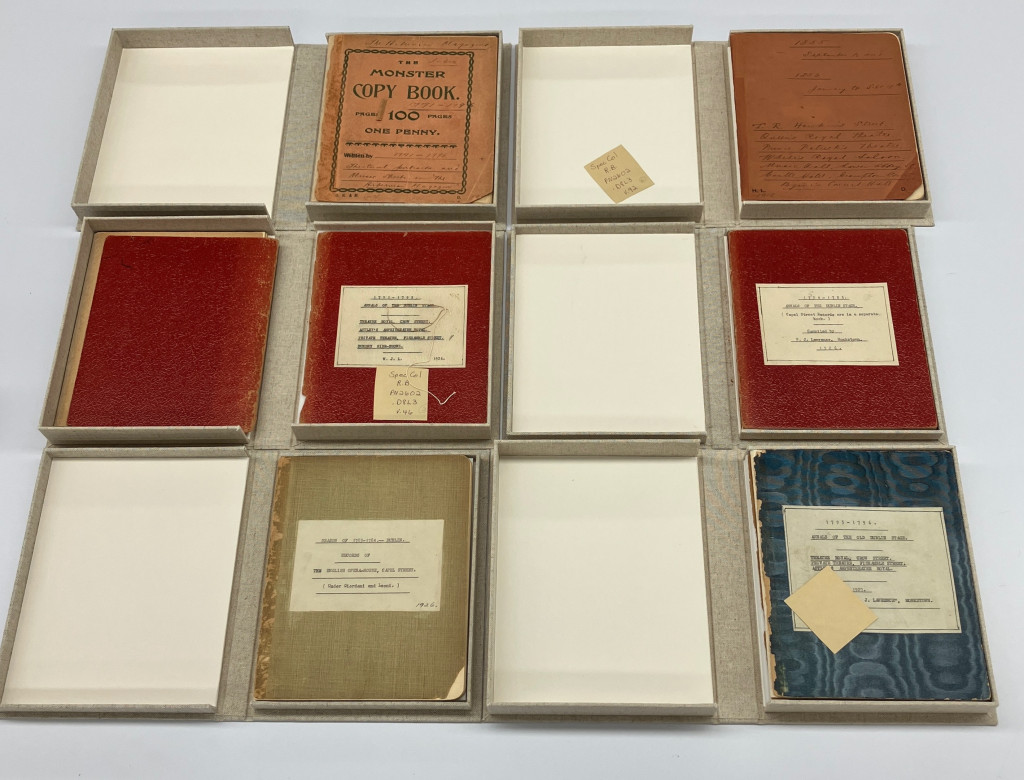
Overhead view of six notebooks with different covers in their enclosures, with the boxes opened.
Variations in cover materials and colors across the Lawrence Notebooks.

Once all the volumes were received in the lab, each notebook was evaluated for its condition and assigned to one of three categories: good (no treatment required), fair (requiring stabilization), or poor (requiring more extensive treatment). The notebooks showed clear signs of long-term handling and use. Many volumes had weakened or detached covers, some of which had been previously repaired with pressure-sensitive tape. Other common condition issues included broken sewing, tears along the spine folds of the text block pages, and brittle newspaper clippings that had also been repaired with pressure-sensitive tape.

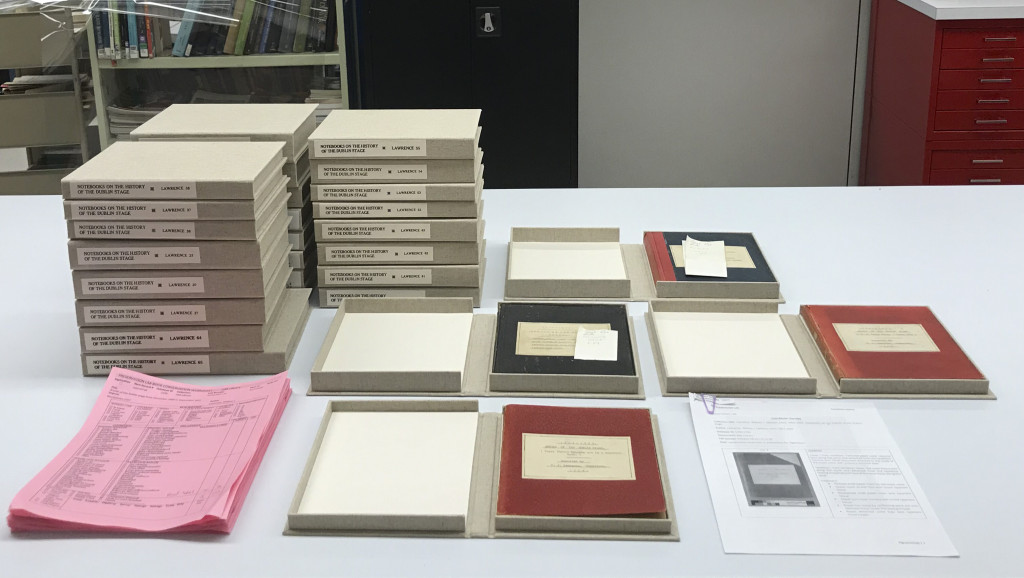
View of a stack of cloth clamshell enclosures, with several opened to show notebooks inside.
Condition evaluation of the Lawrence Notebooks prior to treatment.

When determining the most appropriate conservation treatment for each volume, it was also important to consider their future digitization. Treatments were selected to stabilize the notebooks while ensuring they could be safely opened, handled, and imaged without placing additional stress on the original materials.

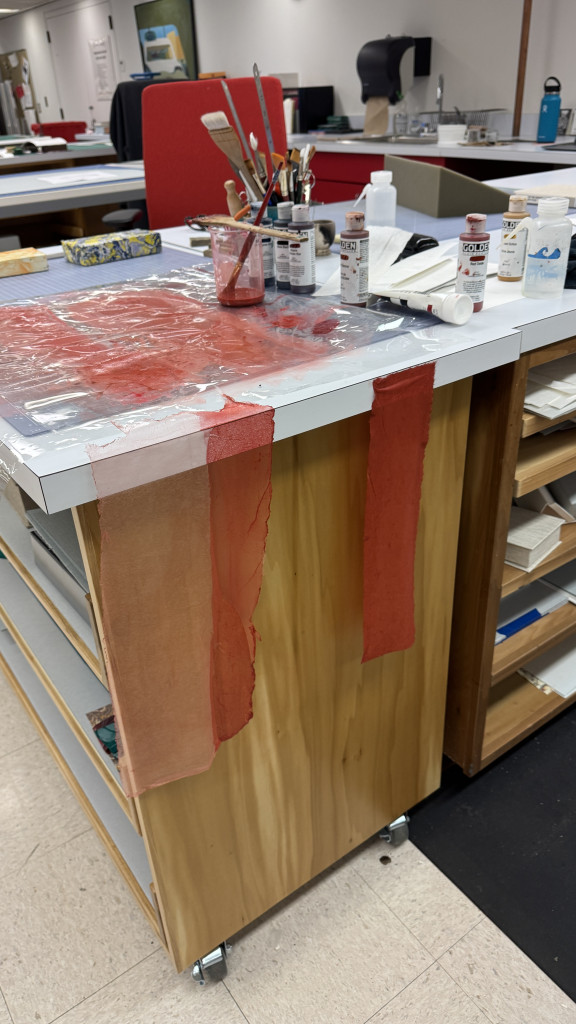
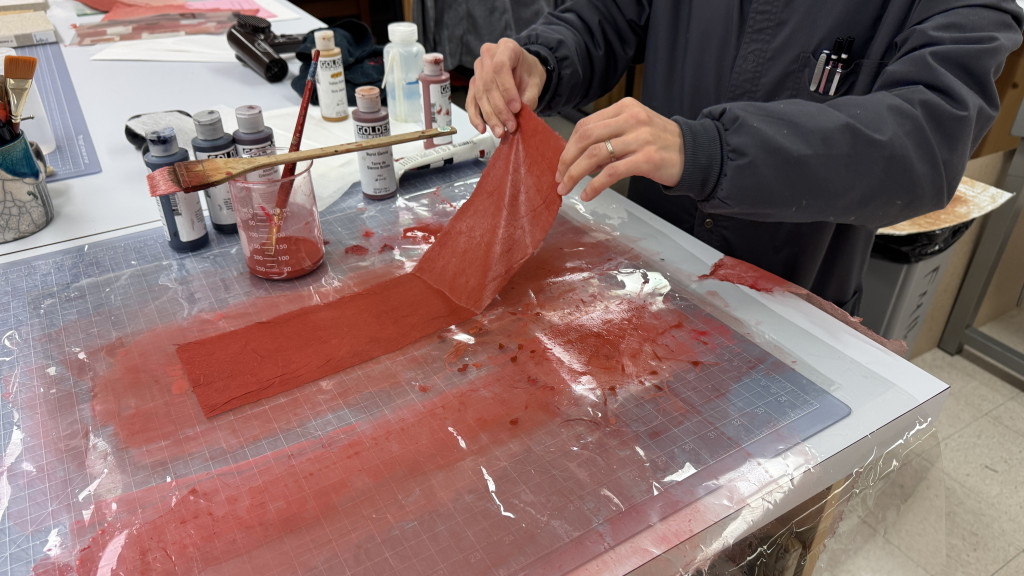
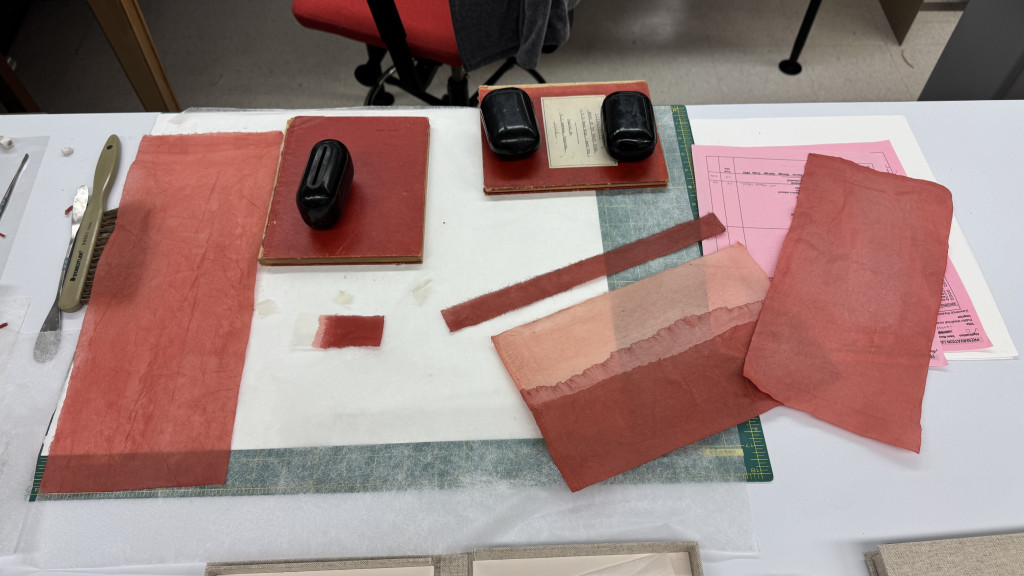
Most of my conservation treatment ended up being hours spent removing pressure-sensitive tape, many more hours toning Japanese paper with acrylics for the repair and stabilization of paper covers, along with surface cleaning and a lot of time dedicated to tear repair. 

Completing the conservation treatment of all 99 Lawrence Notebooks marked the end of a project that unfolded slowly over several years. Because the work was done alongside many other conservation projects, progress often happened one volume at a time, making the moment when the final notebook was finished feel especially satisfying.

With treatment complete and each volume now housed in a custom clamshell enclosure, the Lawrence Notebooks are stabilized and better supported for future handling, digitization, and research. While the notebooks still show the signs of long use that make them such compelling working documents, they are now structurally sound and prepared for the next phase of their life in the collection. 

Projects like this reveal how conservation work happens slowly and methodically, often behind the scenes. Completing treatment on all 99 notebooks and seeing them reunited as a stabilized collection reinforces the importance of long-term care in preserving these records of Irish theatrical history for future research and access. 

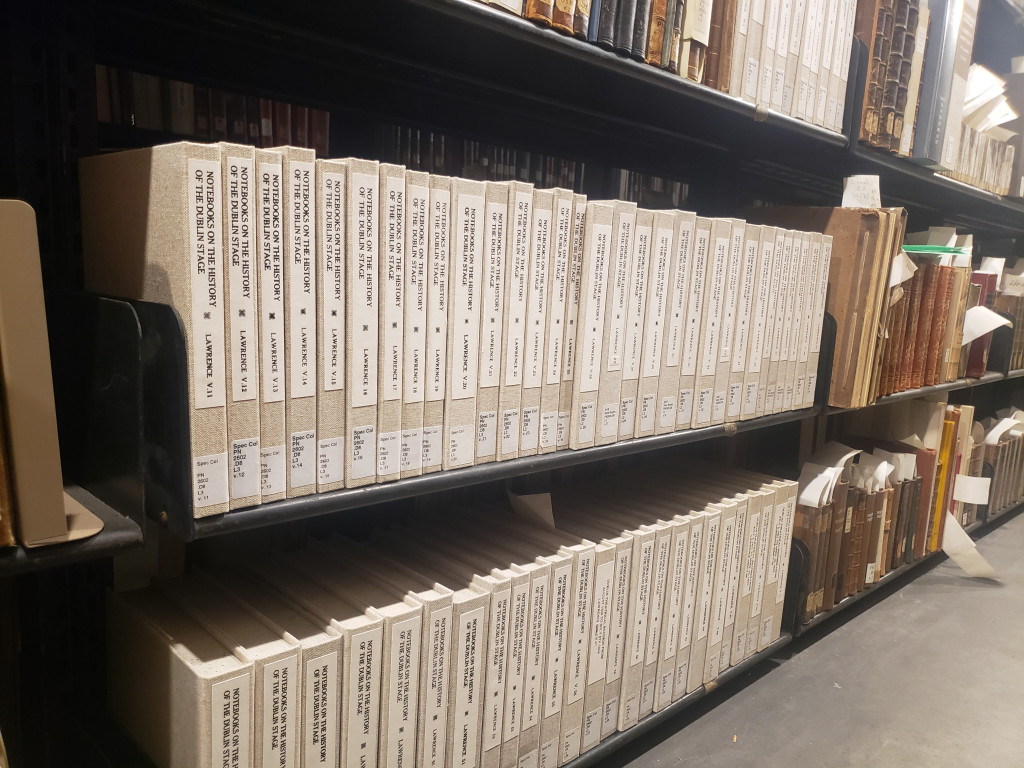
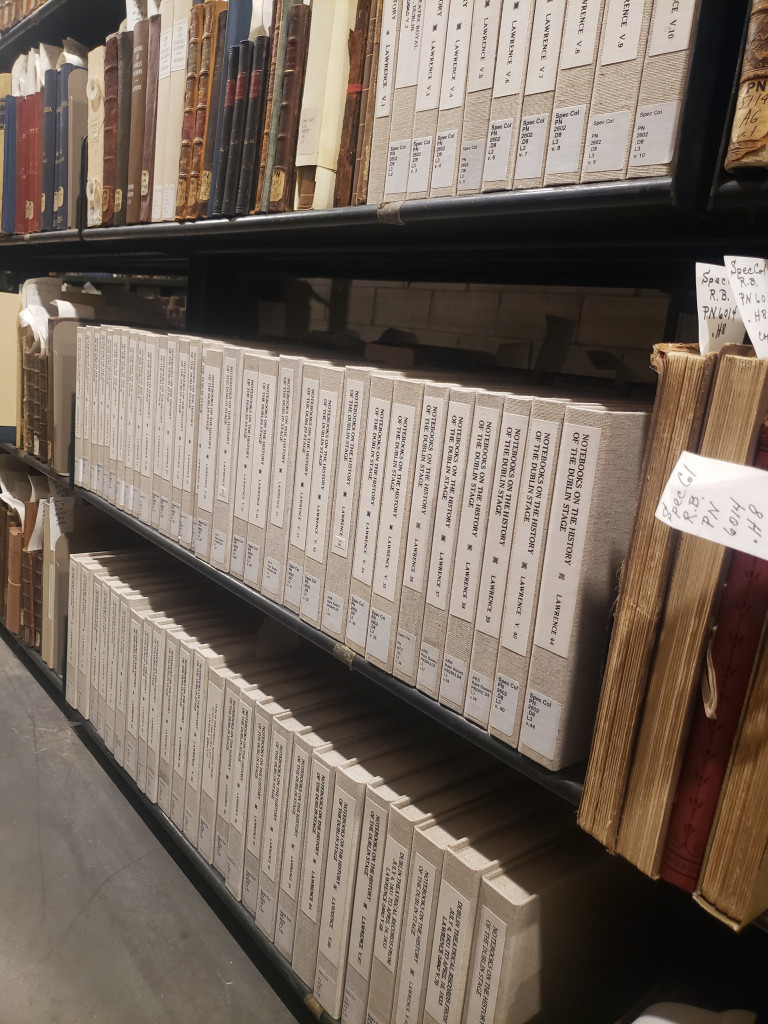
The Lawrence Notebooks shelves in the Archives and Rare Books Library stacks.

Catarina Figueirinhas – Assistant Conservator

A Wedge for a Wedge

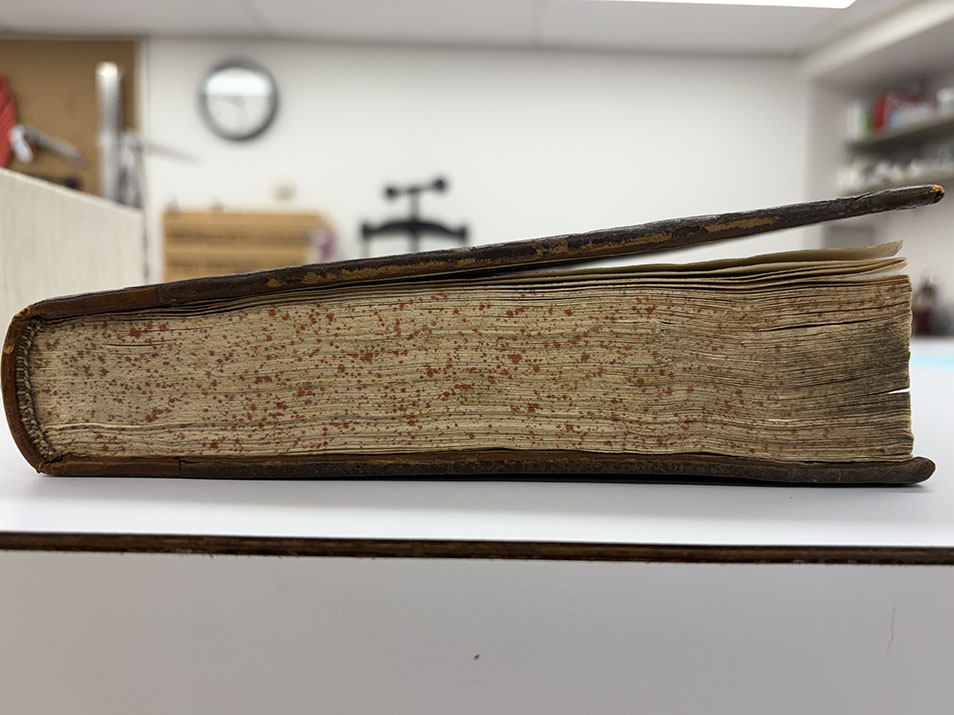
This is a lovely leather-bound volume that came to us in need of a cloth-covered clamshell with some gentle compression. Unfortunately, it has a bit of an odd shape, meaning we had to solve the problem of the open space in the enclosure.

Image of a leather bound book that has deformed into a wedge shape.
Figure 1. The problem: a wedge-shaped volume

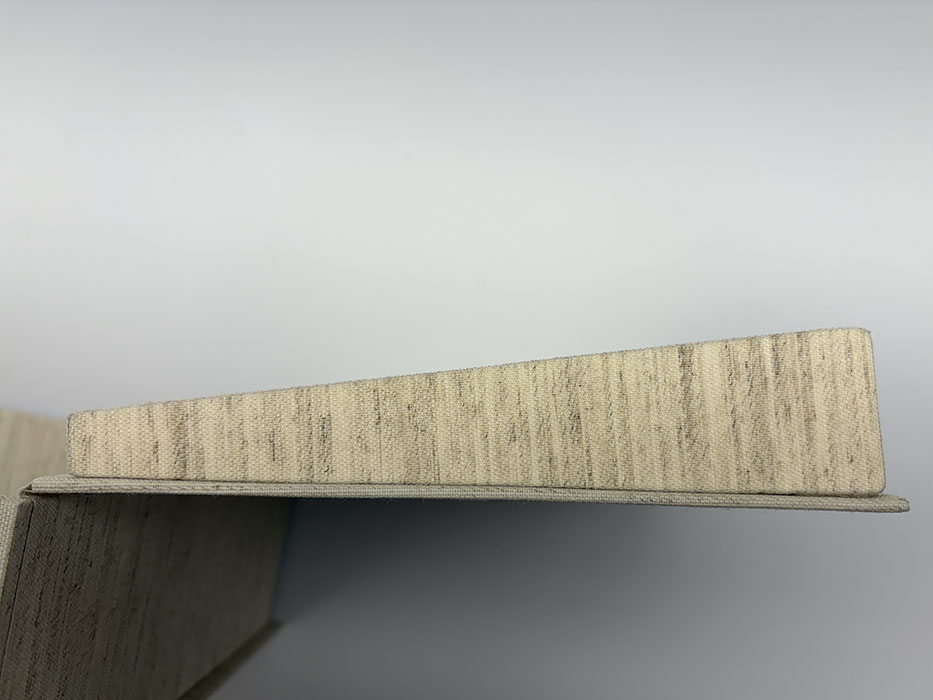
Our solution: a wedge to secure the volume and spread the pressure of the compression. We opted for mat board as opposed to book board, both to keep the enclosure from getting to heavy and to give the wedge a little bit of flex.

Thanks to a little math and a little mat board, this volume will be safe and secure and protected from temperature and humidity changes in its home on the shelf!

Image of wedge shape constructed of board and book cloth to support the deformed leather book.
Figure 2. The solution: a cloth-covered wedge to spread the compression and fill the empty space.
Cloth covered clamshell enclosure with leather book inside.
Figure 3. The completed wedge. A perfect fit!

Hyacinth Tucker – Conservation Technician and Bindery Processor

Faux Jacket-Sling Hybrid?

I recently created a cloth covered clamshell enclosure for this small leather volume from the Cincinnati & Hamilton County Public Library. The volume has eight full color miniatures which received surrogate photography. The surrogates were printed to roughly 5×7 inches, making them substantially larger than the text, so an insert was created within the cloth clamshell to house the smaller volume.

Cloth clamshell with insert and small book inside
Interior tray of the cloth clamshell enclosure with the surrogates placed on top of the small leather volume housed within the custom insert.
Small book in insert inside of custom box
To build up the enclosure to the size of the surrogates, an insert was created using archival corrugated board covered in Cotlin bookcloth. I lined the portion of the insert where the volume would rest with thin Ethafoam sheeting, so the fragile leather edges wouldn’t be abraded.
Small book in insert inside of custom box. Book is wrapped in a custom polyester wrapper.
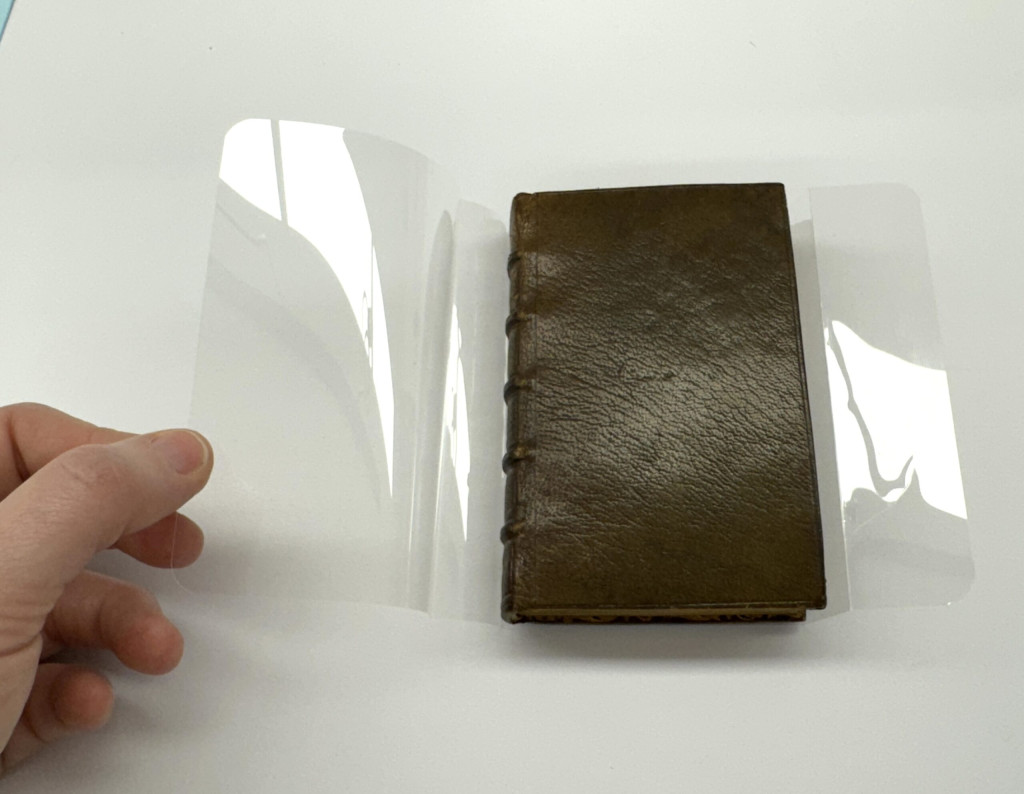
To aid in lifting the volume from the enclosure I created a partial polyester wrapper of sorts. Part jacket, part sling. A faux jacket-sling hybrid, if you will?
Book is wrapped in a custom polyester wrapper.
A closer look at the polyester creation, with rounded corners.

Overall, I think it’s a quick and easy solution that could be beneficial in future situations where a simple modification of an existing enclosure is needed, but space within the enclosure is at a premium.

Jessica Ebert – Assistant Conservator

Allegheny River / Capt. J.W. McLaughlin

How to store a 15ft paper scroll?

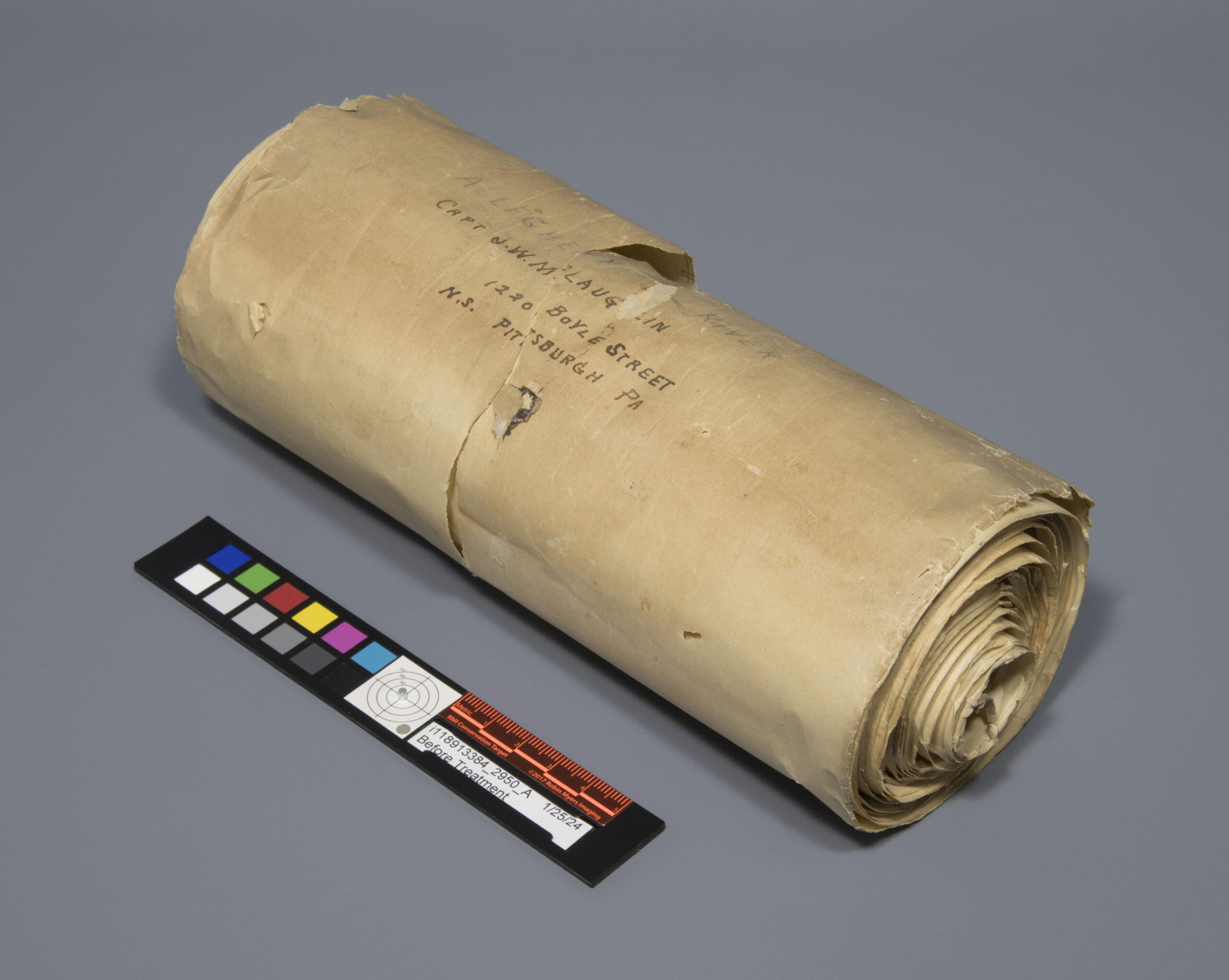
Back in October of 2024, we received something slightly more unusual from the Cincinnati and Hamilton County Public Library, a 15-foot-long, hand-drawn rolled map of the Allegheny River. Yes, fifteen feet.  This map was created by joining smaller sheets edge-to-edge, forming one continuous scroll that looked more like a treasure map than your typical library item.

Scroll with photography target in front of it

A dilemma quickly followed, how do I create a housing solution that’s safe and functional, but won’t turn future handling into a logistical nightmare? Like many libraries, they didn’t have a 15-foot shelf just waiting for this (because who does?), so storing it flat was out. Storing it rolled became our only real option. The enclosure needed to be secure and protective for the map, and ideally, easy and elegant to display when needed.

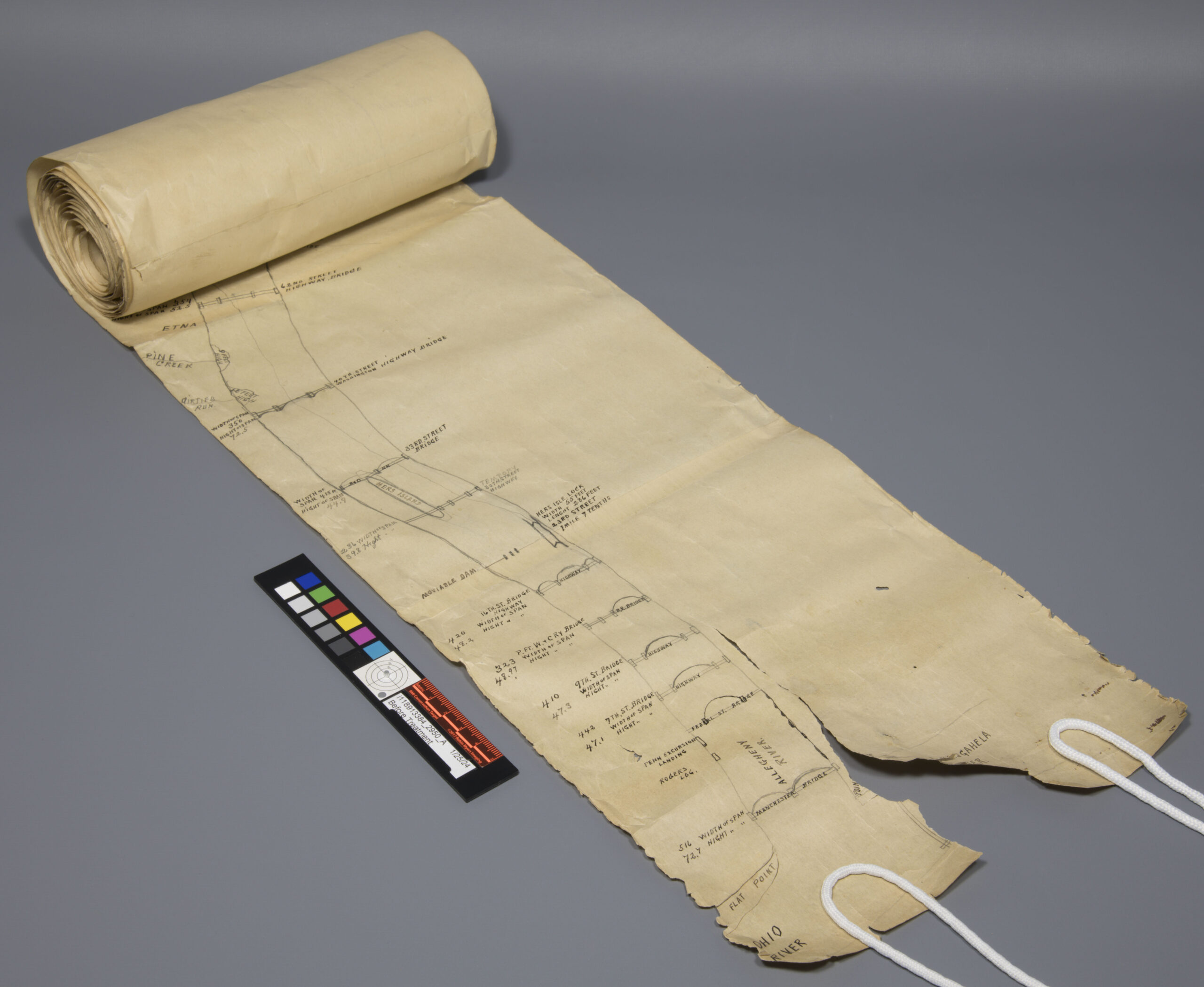
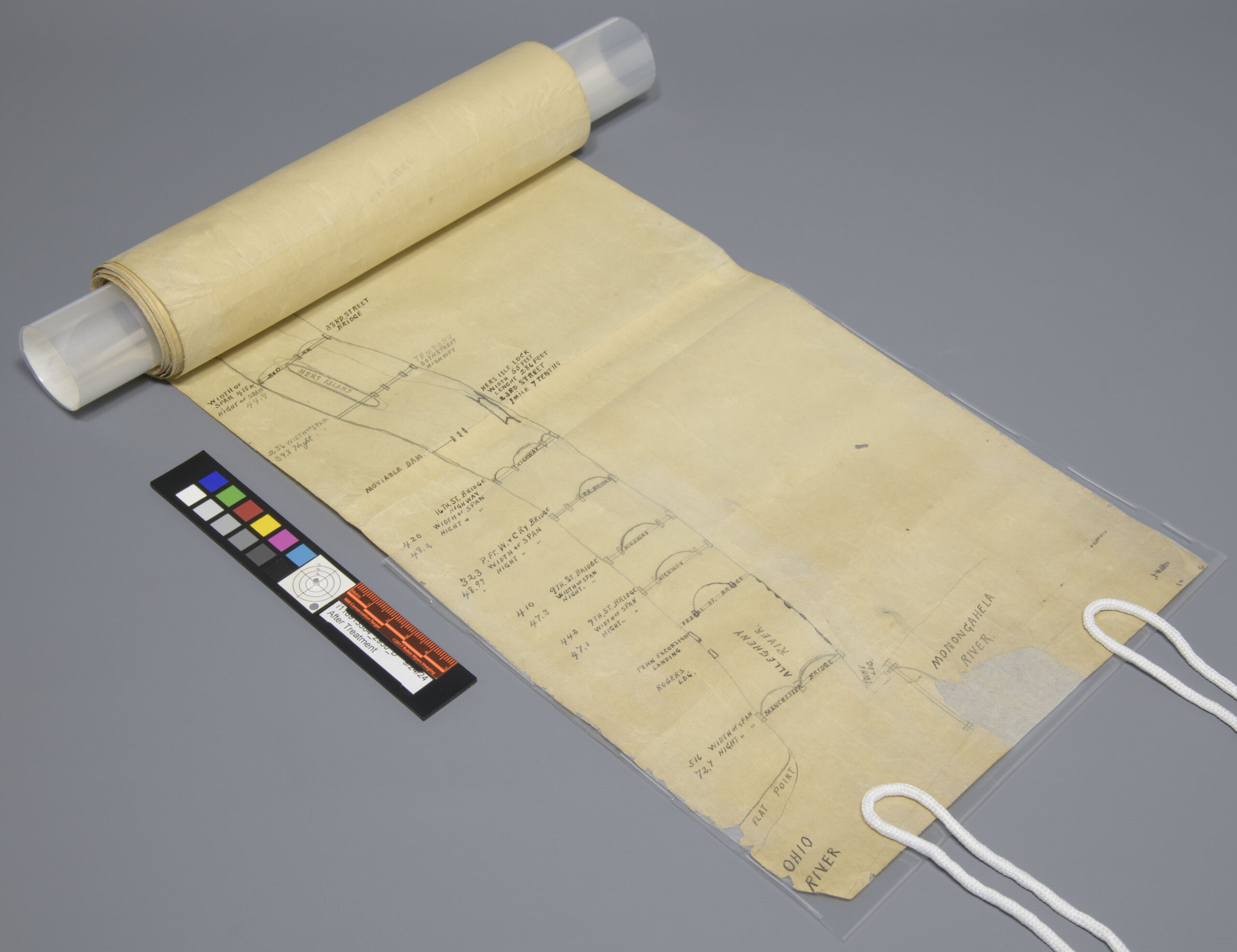
First things first, some stabilization treatment. Before tackling the housing design, the scroll underwent conservation treatment to mend small tears and fill losses, particularly at the “beginning” and “end” (depending on which direction you follow the river). Once stabilized, it was ready for some housing trials.

scroll partially unrolled
Before Treatment – Large loss and tear at one end.
scroll partially unrolled
After Treatment – Large loss repaired and map rolled around the polyester cylinder core.

While researching solutions online, I stumbled upon a fantastic blog post by J.M. Iacchei from the Cornell University Library Conservation Lab (link here). Their approach to scroll housing was clever, practical and elegant, and it just gave me the spark I needed to create our own version.

Here is how we rolled:

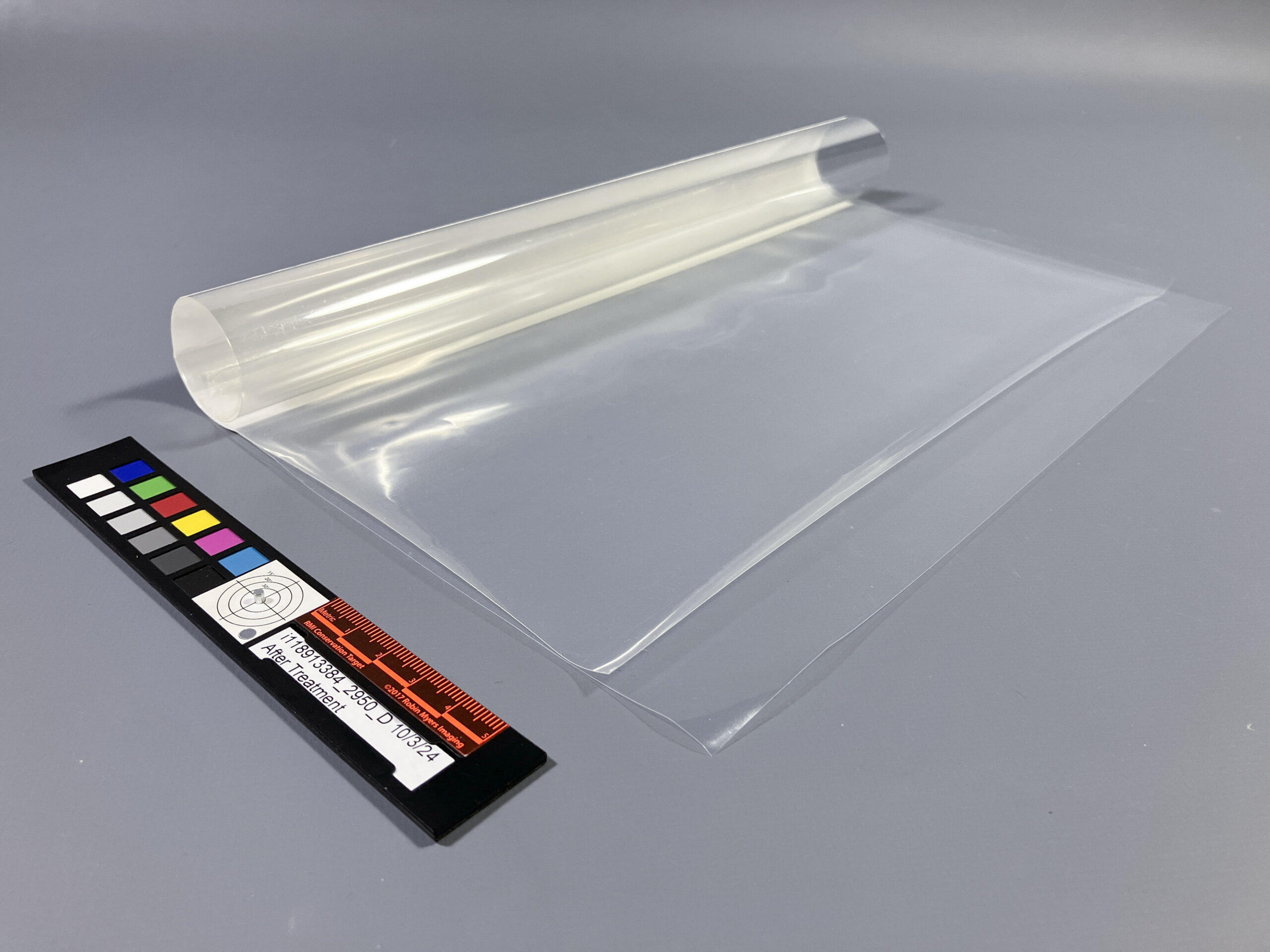
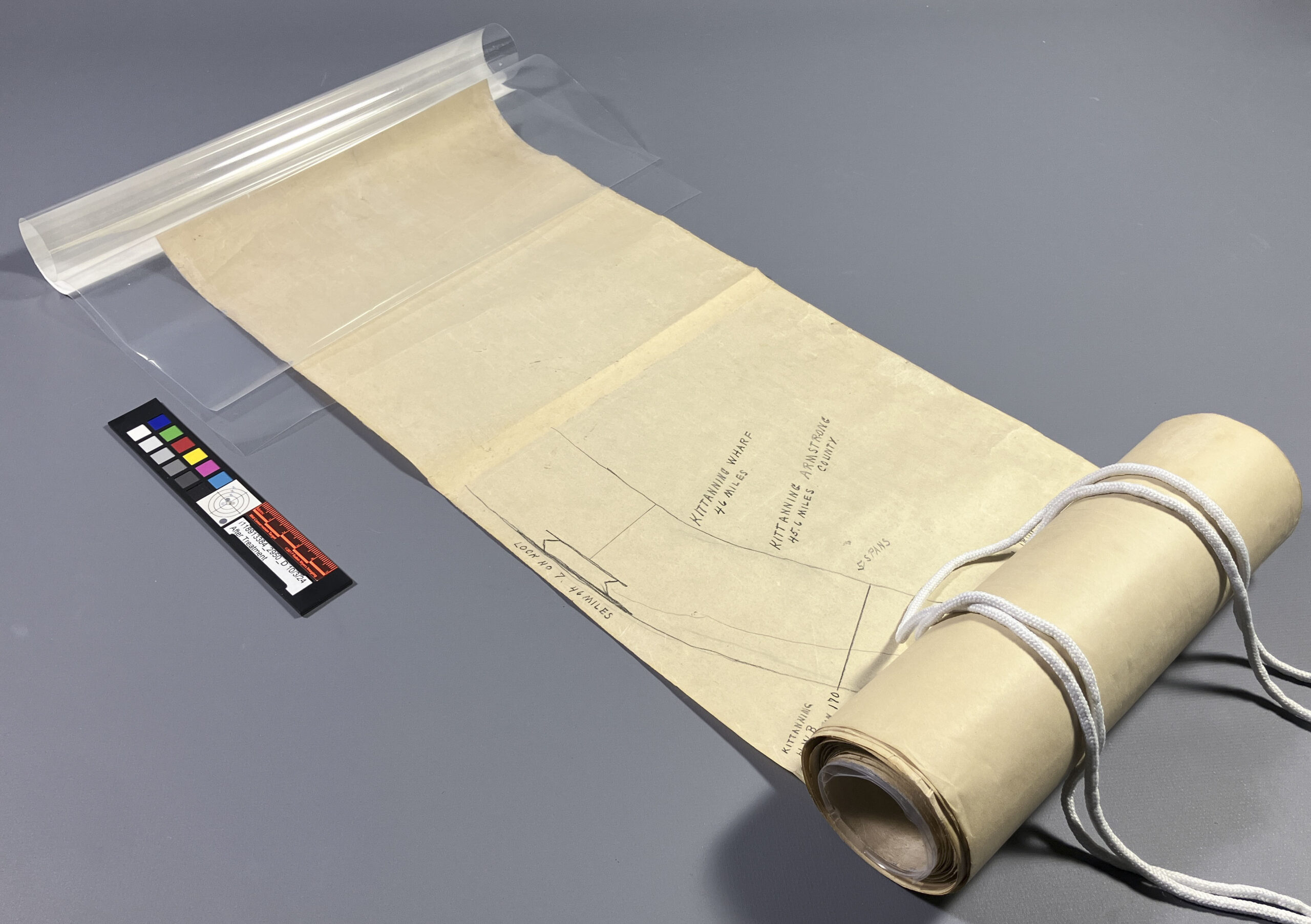
  • A support core – To give the scroll structure while rolling, I created a polyester cylinder core with a polyethylene sling. The sling supports one end of the scroll as it begins to wrap around the core, providing gentle guidance and protection as you start to roll the map. The map can be easily inserted into the sling to begin rolling.
Allegheny River / Capt. J.W. McLaughlin
Polyester cylinder core with a polyethylene sling to secure one end of the map.
Allegheny River / Capt. J.W. McLaughlin
The end can be easily inserted into the sling and supported as the map is rolled around the polyester core.
  • Protection of the ends – The opposite end of the scroll was placed into a soft, transparent polyethylene pocket. It’s flexible, unobtrusive, and doesn’t need to be removed, even during after treatment photography.
Scroll partially unrolled
The other end of the map is protected with a polyethylene pocket that is flexible and offers support to the fragile end of the map.
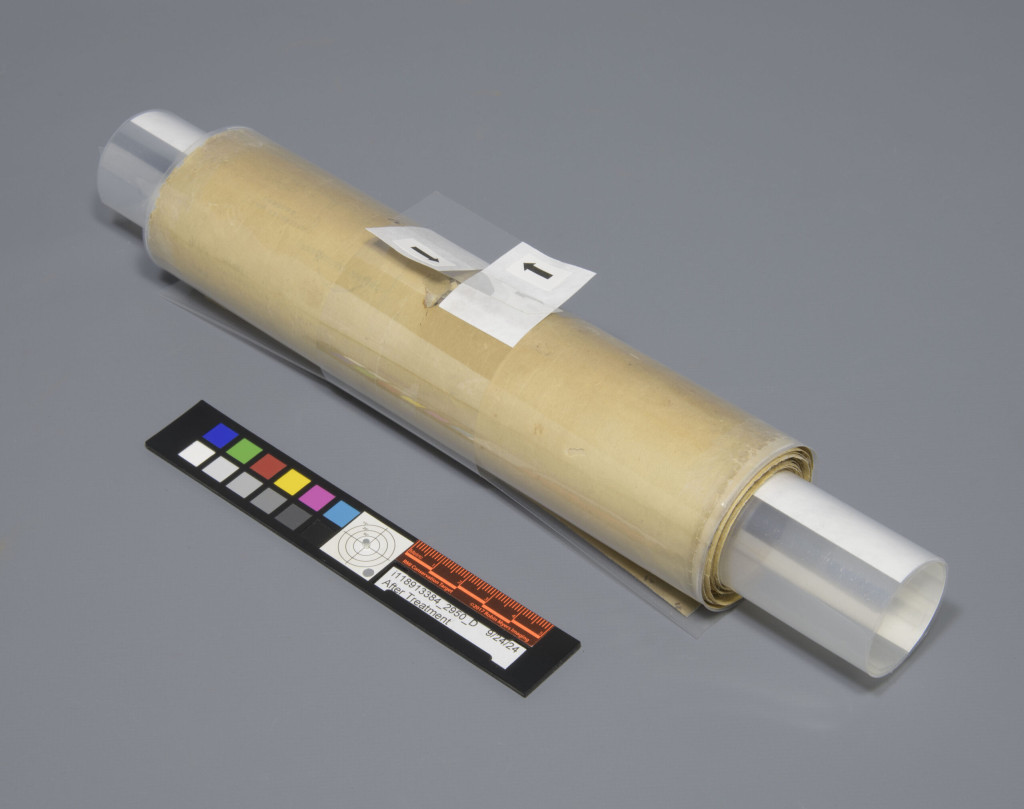
  • Keep it rolled – Once fully rolled, the scroll was secured with a polyester belly band. The polyethylene pocket helped protect the scroll surface from any abrasion caused by the belly band.
rolled scroll with belly band to hold it in place
The rolled map is secured with a polyester belly band.
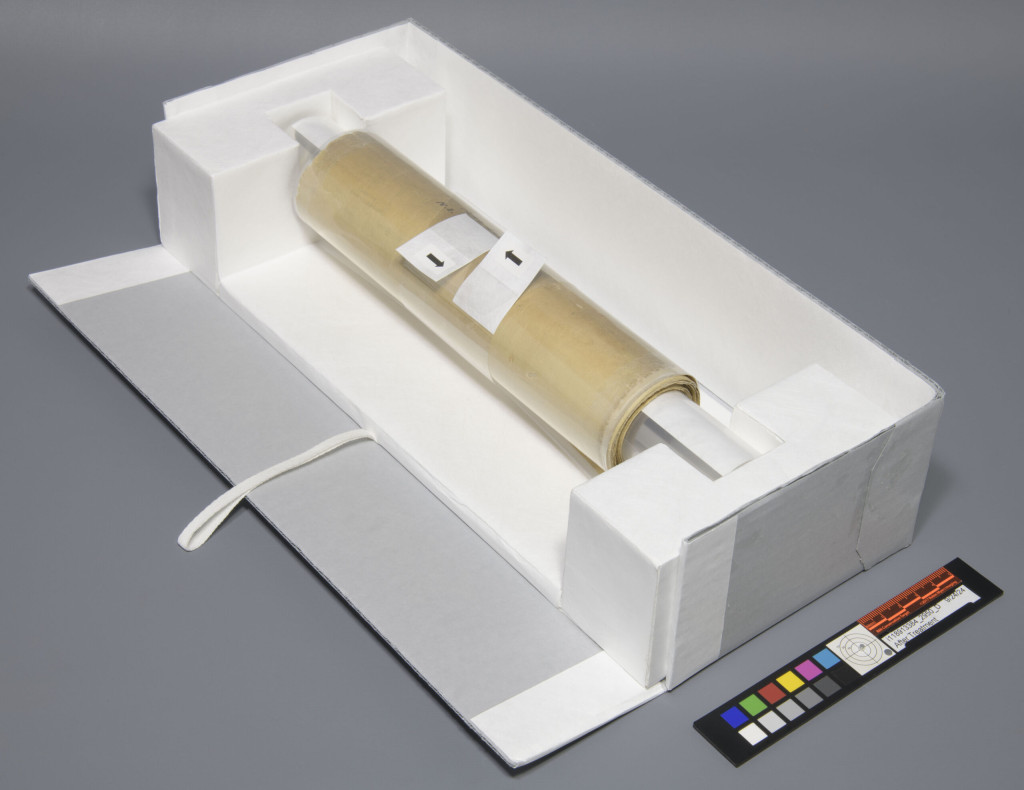
  • Display ready? – For display,I built a removable tray that cradles the rolled scroll without letting it rest directly on a surface. This tray doubles as a mini display platform, so the scroll can be partially unrolled and supported during handling and exhibit. Functional and elegant.
Rolled scroll secured within an enclosure tray
Display tray that offers support to the rolled map for long term storage.

I also tested a few other methods along the way, like supporting the entire scroll in a single 15-foot polyester sheet or sandwiching it between two. But the seams where the map’s original sheets were joined caused additional creases with those solutions.  In the end, supporting the scroll in its entirety just wasn’t viable, so I pivoted to protecting the ends and letting the core do the heavy lifting.

Also: cutting two 15-foot-long sheets of Mylar by hand? Let’s just say I don’t recommend it… and I definitely don’t miss it.

Here is what a 15ft paper map looks like:

Catarina Figueirinhas – Assistant Conservator

The Problem with Foam: Thoughts on our new foam cutter

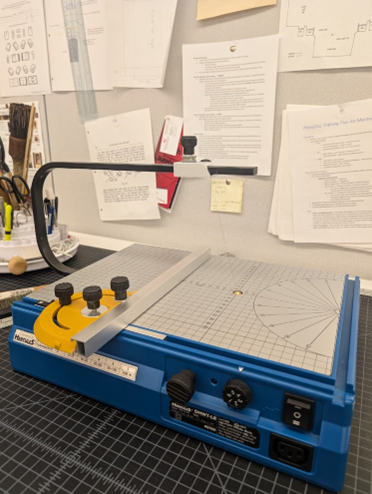
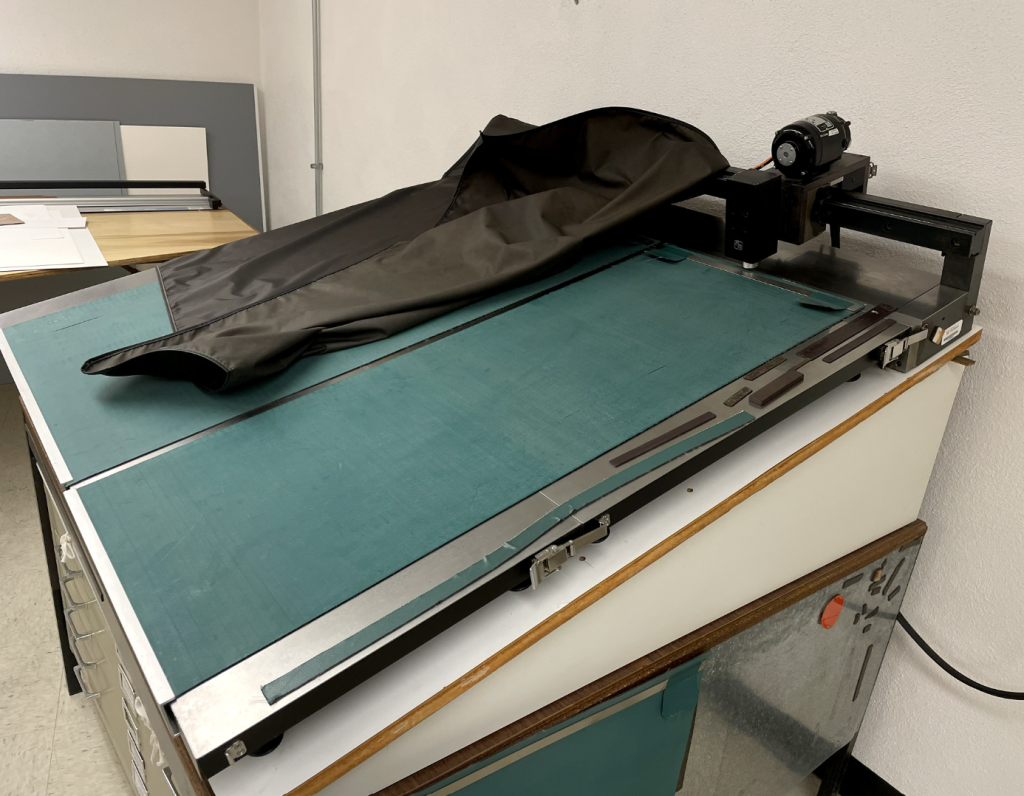
A housing treatment that I have recently taken on led me to getting some hands-on experience with one of the newer tools to arrive at the lab: The Hercules Cordless-Battery Operated Hot Wire Table from Hercules Cutters.

Image of Hercules Cordless battery operated foam cutter
Figure 1: The Hercules Cordless-Battery Operated Hot Wire Table

The Difficulties of Cutting Foam

We have typically performed foam cutting at the lab using either a hand-held blade like an Olfa or scalpel, a board shear, or in some cases a hand-held saw. While these methods can be somewhat satisfactory, they are none without their limitations. Cuts with a hand-held blade often look sloppy, especially if the foam needs to be stacked; the compressible nature of foam makes it very difficult to make accurately measured cuts this way, and the inaccuracies become glaringly obvious when trying to stack multiple seemingly same sized pieces for thick fills inside an enclosure (something I often need to achieve!).

Stack of foam sheets with emphasis on their imperfect cut edges.
Figure 2: The minor inaccuracies of hand-cut foam become obvious when the pieces are stacked. Notice the unevenness along the edge of this stack of Plastazote foam. Plastazote, as well as a thinner foam called Volara, are among the most commonly used foams we utilize at The Preservation Lab.

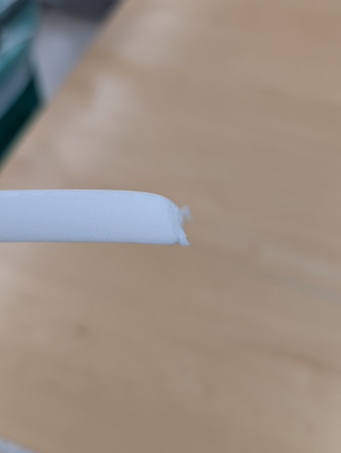
A board shear is quick and offers a measuring guide to provide accurately measured cuts, but the edges where the blade slices through the foam often end up rounded or otherwise distorted.

Image of foam with rough edge from being cut on a board shear.
Figure 3: The downward cutting motion of a board shear can often leave the edge of foam looking rounded or otherwise distorted, as can be seen on this piece of Plastazote.

Finally, cuts with a saw can leave a mess and the teeth can leave a sloppy looking edge on the foam.

Stack of foam roughly cut with a saw.
Figure 4: This stack of Plastazote was cut with a saw. A saw’s teeth can leave a very messy edge when cutting through foam.

The Hercules Foam Cutter: Basic Features and Operation

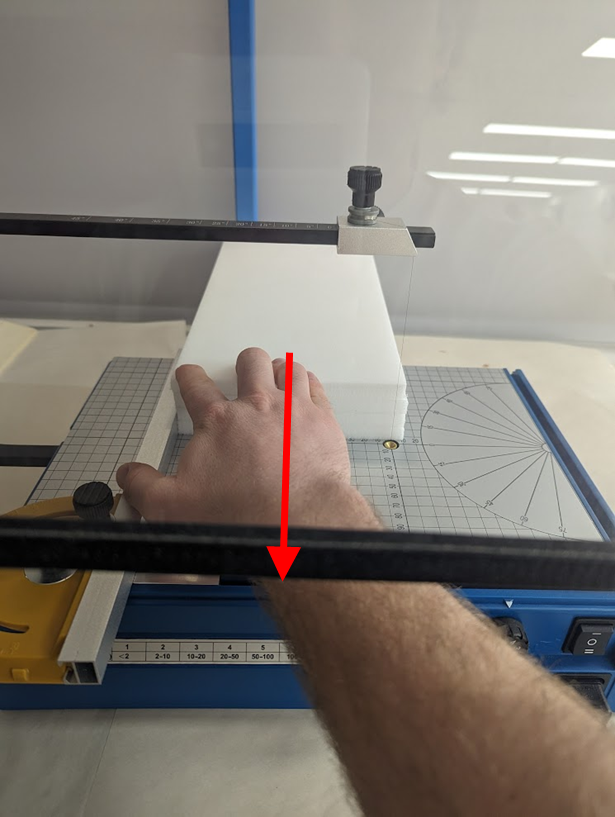
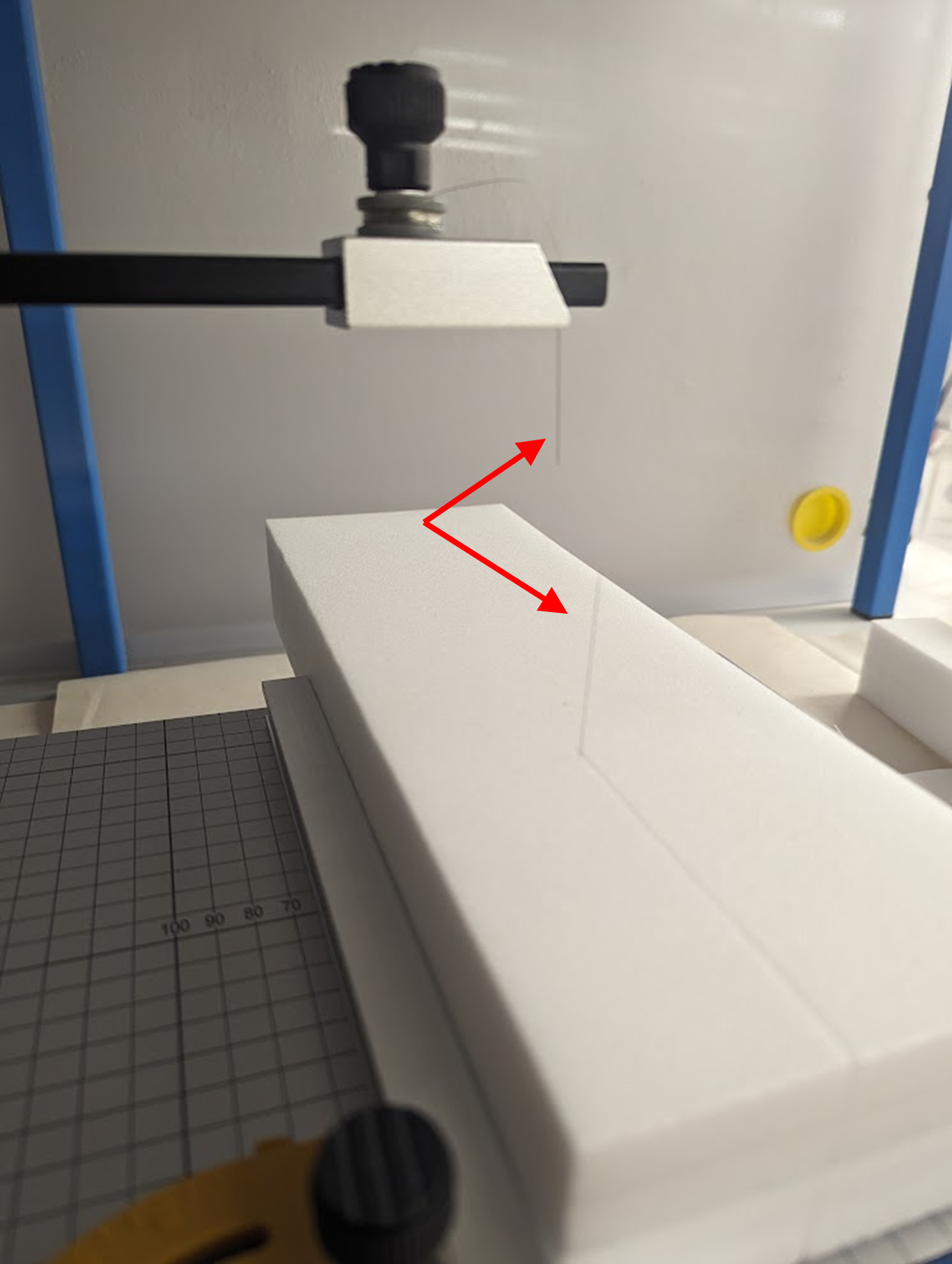
                The Hercules foam cutter uses a different approach. It heats up a filament wire that is pulled taught vertically through the device. While the wire it hot, foam is drawn through the wire to accurately and cleanly (with a little practice) slice through it.

Image of foam plank being cut by a the hot filament of the Hercules foam cutter.
Figure 5: A stack of Plastazote is pulled through the hot filament wire to make a clean cut.

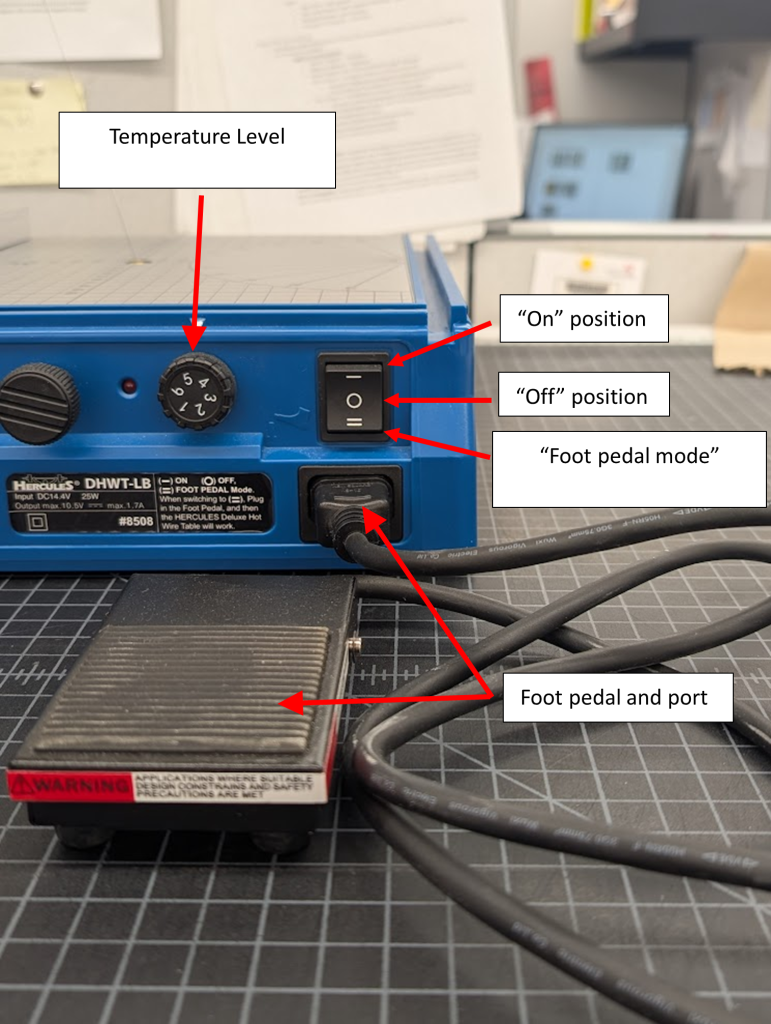
The heat can be engaged in one of two ways: with the power switch turned to “On” mode, the wire stays hot until it is turned off; when the switch is set to “Foot pedal mode”, the wire only heats up while the included foot pedal is pressed. There is an adjustment knob allowing the user to control the temperature of the wire. In general, after experimenting a bit it seems that the thicker the foam, the hotter the wire needs to be.

Image highlighting controls of the Hercules foam cutter.
Figure 6: The Hercules Cutter’s heat controls.

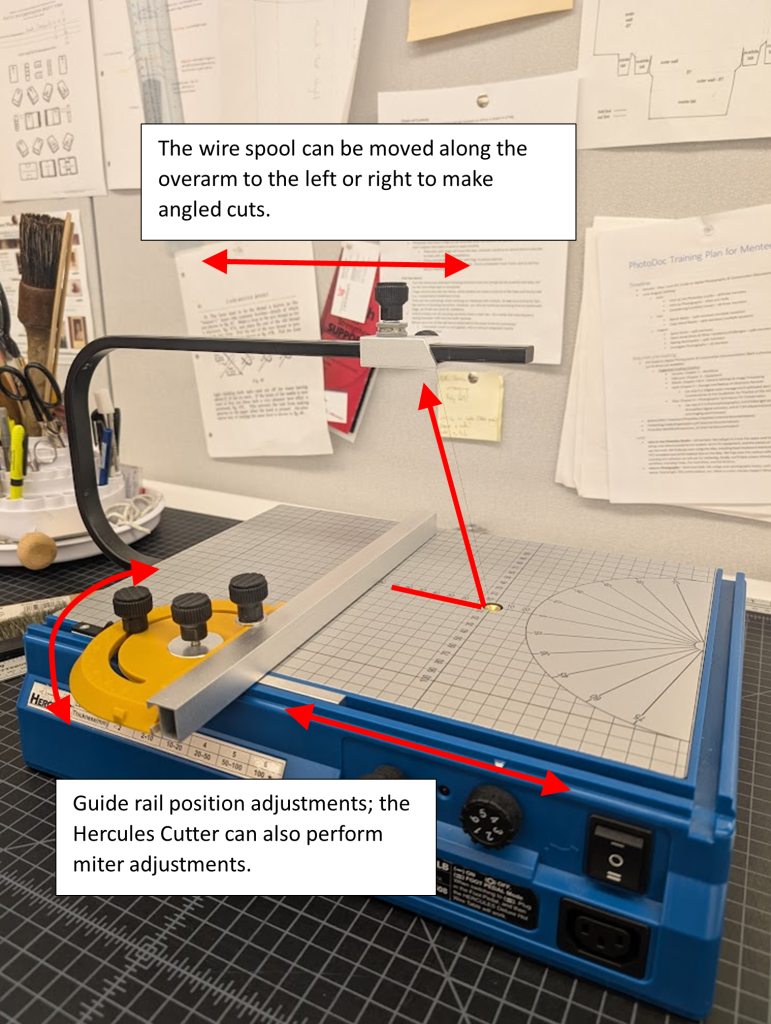
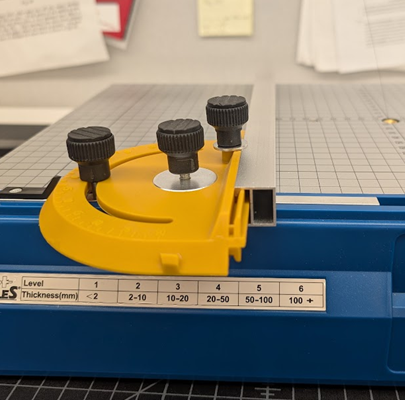
The cutter includes an adjustable guide rail to aid in accurate cutting. The position of the spool that holds the wire is also adjustable, allowing for angled cuts to be made.

Image of Hercules foam cutter with adjustments labeled.
Figure 7: Cutting position adjustments of the Hercules Cutter.

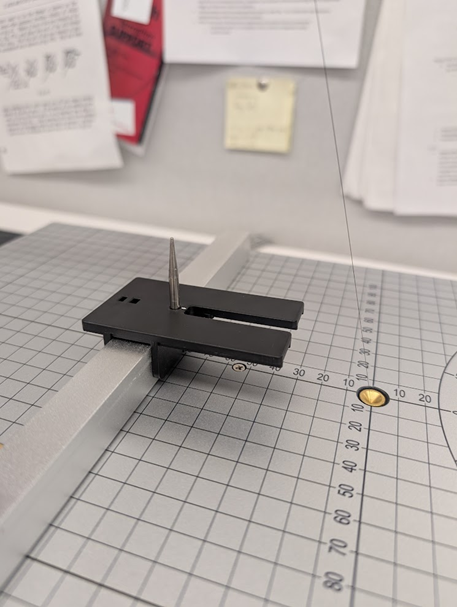
Finally, there is an attachment that can be placed onto the guide rail allowing for circular cuts to be made.

Image of circle cutting attachment on the Hercules foam cutter.
Figure 8: The circle cutting attachment: the foam piece is impaled by the point of the attachment at the center point of the desired circle. The distance from the point to the wire will be the circles radius. Once the attachment is in position for the desired size of circle, the foam piece is rotated as the wire cuts through the foam until a complete circle is made.

Advantages

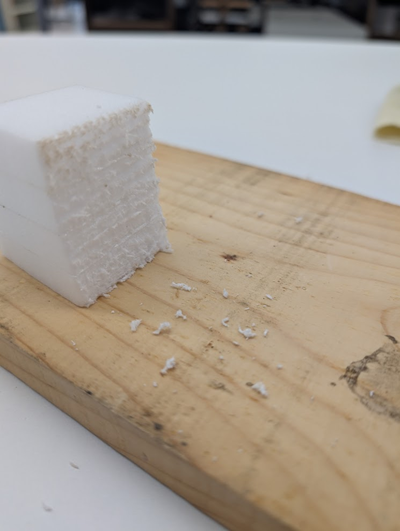
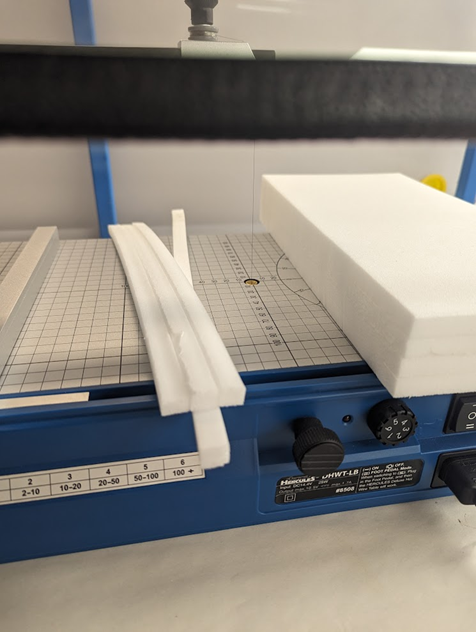
                The Hercules Foam Cutter’s ability to cut stacked pieces of foam is by far my favorite and the most practical of its uses in my opinion. As previously mentioned, cutting inaccuracies become very noticeable when trying to stack multiple same sized pre-cut pieces of foam. With the Hercules Cutter, the foam pieces can be stacked/attached to each other before hand, and then cut to a uniform size. I was pleased to discover that the heated wire doesn’t seem to have any trouble cutting through multiple layers of foam that have been adhered together using double-sided tape and/or PVA. With a bit of practice, I was able to achieve neat, uniform chunks of foam that were several layers thick. I have found, however, that when cutting foam adhered together using double sided tape it is important to be mindful of where your points of adhesion are inside the stack of foam. It is possible to end up with a stack of foam that doesn’t have any tape holding it together after cutting.

Image of a cleanly cut block of Plastazote using the Hercules foam cutter.
Figure 9: A cleanly cut chunk of Plastazote 4 layers thick. Notice that the section that was cut off has fallen apart due to not having any double-sided tape in this section. Fortunately, this is not the piece I needed from this cut!

Also remember that the thicker the foam, the hotter the wire needs to be. There is a decal attached to the cutter with heat setting recommendations based on how thick the foam is, but the instructions (and also myself) recommend doing a few test cuts with scrap foam first to see what works, as different types of foam will respond differently to various heat settings. It shouldn’t require much pressure from the user to push the foam piece through the wire, and too much pressure will cause the wire to bend or even break; if this happens, the wire isn’t hot enough!

Image of a snapped cutting wire caused by applying to much pressure, and not enough heat, while cutting a foam block.
Figure 10: It is difficult to see as the wire is so thin, but it has snapped. The wire wasn’t hot enough and I had to apply too much pressure to pass this stack of Plastazote through it. Fortunately, there was plenty of wire remaining on the spool, and it was easily threaded back into its port.

I found the foot pedal to be a beneficial feature as well. Some types of cuts require the user to adjust their hand position mid-cut, and it is helpful to have the option to stop the flow of heat into the wire if such an adjustment needs to be made. The wire both heats and cools down almost instantaneously, which is also a nice touch.

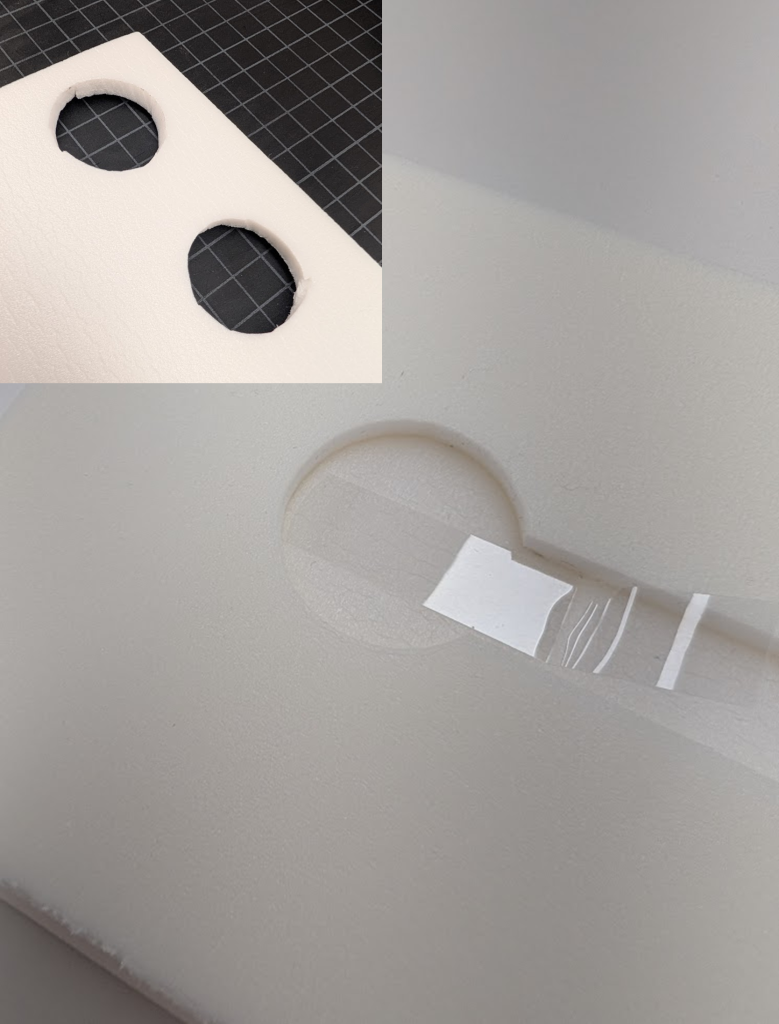
Finally, the circle cutting attachment proved to be useful during a recent housing treatment. I needed to create a compartment in a piece of foam to store a commemorative medallion, and my attempts to cut a circle using a hand-held blade did not look good. I was very pleased with the results I achieved using the attachment, although it took several attempts to get my circle to have the correct diameter.

Two images - a hand cut circle into foam and a circle cut with the Hercules foam cutter.
Figure 11: A circle cut into Volara foam using the circle cutting attachment with my previous attempts to make the cut by hand using a scalpal in the corner of the image.

Drawbacks

                It should be noted that many components of the Hercules Cutter are made of plastic. While this makes it lightweight and portable, it causes some problems. The guide rail feels rather cheap, and even with all the screws secured tightly, the rail still has the potential to wiggle around a bit. This can make getting accurate cuts difficult. I did find that cuts still look better using the rail than doing them free hand, though.

Image of adjustable guides on the Hercules foam cutter.
Figure 12: Most of the components of the adjustable guide rail are made of plastic, giving them the potential to move slightly during use, even when tightly screwed down.

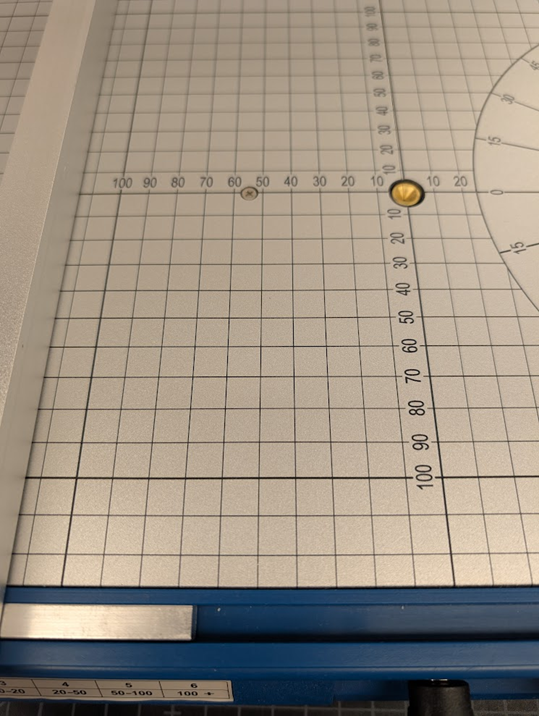
Another issue I had with the cutter lies in its cutting platform. There is centimeter grid on it for measuring/setting the guide rail which is a nice idea; however, I feel it would have been much more helpful to have millimeters indicated somewhere like board shears often do, as precision cuts rarely fall exactly on nice round centimeter measurements. The user is forced into one of three solutions: 1) measuring the foam and adding a tick mark to it, which is not as easy and one would think as foam isn’t very easy to make discreet marks in; 2) using a ruler or other measuring device to set the guide rail, which defeats the purpose of the cutting surface containing a measuring grid to begin with; 3) eyeballing the correct measurement between the grid marks. This parred with the already wobbly nature of the guide rail makes it somewhat challenging to make precision cuts.

Image of the measurement grid in millimeters on the base of the Hercules foam cutter.
Figure 13: Although the numbers represent millimeters, the grid lines on the cutting platform appear only every centimeter.

Finally, as the Hercules Cutter operates through a wire essentially melting foam, it can produce a somewhat unpleasant burnt-plastic smell while in use. It is recommended to use under a fume hood, outside, or in another well-ventilated area if possible.

Final Thoughts

As with all other methods of cutting foam, the Hercules Foam Cutter is not perfect. For making simple cuts in a single layer of foam, I still find using a board shear to be my preferred method; it is quick, easy, and the rounded edges left by the blade don’t bother me much if it is only a single layer of foam.  However, the Hercules Cutter has become the default tool I use to cut stacked foam and to make circular cuts. It has been a fun tool to test out, and it is always possible that more practical uses for it will arise as I continue to make more custom and specialized enclosures.

Matt McCoy — Senior Library Conservation Specialist

Archeological Textile Discovery in the Stacks: The Treatment

This is the third post of a four-part series.

When a collection of Egyptian mummy bandage fragments at the Cincinnati and Hamilton County Public Library was found in an area used to store uncatalogued flat materials, the lab was asked to play a role in providing better stewardship.  

Click the links below to jump to the following posts:

  • Research and Examination – Examining the material composition of the objects
  • History – Historical information provided about the Egyptian inscriptions
  • Treatment – How the materials were treated after learning about their content
  • Storage Solutions – Individual solutions for separated fragments as well as storage as a collection

Conservation Treatment Consultations

Being a primarily book, paper, and photograph conservator, working on textiles comes up only intermittently as minor stabilization or housing.  When these projects do arise, I tend to consult immediately with a textile conservator. This project was no different. Generously, Obie from the Cincinnati Art Museum kindly visited the lab to look at the fragments with me in person.

Initial Treatment Idea

Before consulting with Obie, my initial plan was to cut the overall board and separate the individual fragments.  Once separated, I thought I might hinge the fragments to a backboard inside a sink matting system.  I had briefly corresponded with a textile conservator at the MFA Boston who is familiar with ancient textiles and she confirmed this would be a sufficient option. 

Testing

However, with Obie present, together we tested the solubility of the adhesives and likelihood of removing the fragments from the acidic board for better storage. Surprisingly, we determined removal was possible with the smallest amount of moisture!

Being familiar with backing removals and conserving degraded cloth covers (and now encouraged after having Obie’s support) I next went beyond spot testing and decided to perform a test treatment on one of the fragments to remove the backing board… with the caveat that I would stop at any point if I felt uncomfortable.  Should I ever feel out of my element at any step, or have concerns that removing the textiles from the backing would not keep them intact, I knew I could always pivot to my initial solution of storing the mounted parts in mats.

Treatment

My new plan was now to first reduce the acidic backing board layer by layer.  Once the backing was removed, I would assess if it was appropriate to remove the brown paper lining.  (While my test treatment was performed on only one of the smaller fragments, images below are pulled from the actual treatment for better illustration).

Low and behold on my first fragment, treatment proceeded without a hitch.

Archeological Textile Discovery in the Stacks: The Treatment

The board was removed slowly, layer by layer. The fragment was kept planar to prevent mechanical damage to the textile.

Before I knew it, it felt as though I was performing a regular backing removal on a photograph or document and soon found myself down to the final brown paper layer. 

Archeological Textile Discovery in the Stacks: The Treatment

After removing multiple layers of board, the brown paper lining was revealed. Some areas of the brown paper were no longer adhered to the textile and readily released during mechanical removal while other areas remained more firmly attached.

At this point, with the backing and lining parts removed as much as possible, I decided to test a corner of the paper backing with light moisture. To my surprise, the paper backing adhesive quickly reactivated, the lining lifted with little effort, and the humidification strengthened the fibers of the linen fragment. All of this eased fears the fragments might fracture during final treatment steps. Proceeding with treatment felt obtainable.

Archeological Textile Discovery in the Stacks: The Treatment

The final step was releasing the brown paper lining with moisture from a water pen and lifting the lining with spatulas.

With this new turn of events, I realized, if I ventured so far as to remove both the mounted board AND the paper backing, I’d need a new storage solution.

I halted treatment and went back to the drawing board to research storage enclosures (click here to jump to my post on storage solutions). Once I felt confident in selecting a method of storage for the loose textiles, I resumed treatment to remove the brown lining paper and proceeded with treatment on the rest of the fragments.

This is a time-lapse video showing how the brown paper lining was removed in stages. Localized humidification was applied from the back while mechanically separating the paper from the textile with spatulas.

Before Treatment

Collection is mounted to an acidic board with two of the fragments oriented upside down.

Archeological Textile Discovery in the Stacks: The Treatment
Normal Illumination, Before Treatment

After Treatment

Fragments are stored individually in storage solutions that double as long-term housing. The enclosures facilitate handling as well as display. Being stored individually, the fragments are able to be grouped as necessary by their context.

  • Archeological Textile Discovery in the Stacks: The Treatment
  • Archeological Textile Discovery in the Stacks: The Treatment
  • Archeological Textile Discovery in the Stacks: The Treatment
  • Archeological Textile Discovery in the Stacks: The Treatment
  • Archeological Textile Discovery in the Stacks: The Treatment
  • Archeological Textile Discovery in the Stacks: The Treatment
  • Archeological Textile Discovery in the Stacks: The Treatment
  • Archeological Textile Discovery in the Stacks: The Treatment
  • Archeological Textile Discovery in the Stacks: The Treatment
  • Archeological Textile Discovery in the Stacks: The Treatment
<div class="wp-block-jetpack-slideshow aligncenter" data-effect="slide"><div class="wp-block-jetpack-slideshow_container swiper-container"><ul class="wp-block-jetpack-slideshow_swiper-wrapper swiper-wrapper"><li class="wp-block-jetpack-slideshow_slide swiper-slide"><figure><img alt="" class="wp-block-jetpack-slideshow_image wp-image-5079" data-id="5079" src="https://libapps.libraries.uc.edu/thepreservationlab/wp-content/uploads/2024/10/i106617060_2382_D05N.jpg"/><figcaption class="wp-block-jetpack-slideshow_caption gallery-caption">Recto, Normal Illumination</figcaption></figure></li><li class="wp-block-jetpack-slideshow_slide swiper-slide"><figure><img alt="" class="wp-block-jetpack-slideshow_image wp-image-5082" data-id="5082" src="https://libapps.libraries.uc.edu/thepreservationlab/wp-content/uploads/2024/10/i106617060_2382_D06N.jpg"/><figcaption class="wp-block-jetpack-slideshow_caption gallery-caption">Verso, Normal Illumination</figcaption></figure></li></ul><a class="wp-block-jetpack-slideshow_button-prev swiper-button-prev swiper-button-white" role="button"></a><a class="wp-block-jetpack-slideshow_button-next swiper-button-next swiper-button-white" role="button"></a><a aria-label="Pause Slideshow" class="wp-block-jetpack-slideshow_button-pause" role="button"></a><div class="wp-block-jetpack-slideshow_pagination swiper-pagination swiper-pagination-white"></div></div></div>
  • Archeological Textile Discovery in the Stacks: The Treatment
  • Archeological Textile Discovery in the Stacks: The Treatment
  • Archeological Textile Discovery in the Stacks: The Treatment
  • Archeological Textile Discovery in the Stacks: The Treatment
  • Archeological Textile Discovery in the Stacks: The Treatment
  • Archeological Textile Discovery in the Stacks: The Treatment
  • Archeological Textile Discovery in the Stacks: The Treatment
  • Archeological Textile Discovery in the Stacks: The Treatment
  • Archeological Textile Discovery in the Stacks: The Treatment
  • Archeological Textile Discovery in the Stacks: The Treatment
  • Archeological Textile Discovery in the Stacks: The Treatment
  • Archeological Textile Discovery in the Stacks: The Treatment

To learn more about the storage, check out the final post of the four-part series: Storage Solutions!

If you missed the earlier installments, you can jump to previous posts using the links below:

  • Research and Examination – Examining the material composition of the objects
  • History – Historical information provided about the Egyptian inscriptions
  • Treatment – How the materials were treated after learning about their content
  • Storage Solutions – Individual solutions for separated fragments as well as storage as a collection

Acknowledgements

  • Katherine Davis, Lecturer in Egyptology in the Department of Middle East Studies at the University of Michigan
  • Suzanne Davis, the Associate Curator and Head of Conservation at the Kelsey Museum of Archaeology at the University of Michigan
  • Dr. Ann-Katril Gill at the University of Leipzig
  • Marieka Kaye, Harry A. and Margaret D. Towsley Foundation, Head, Conservation & Book Repair, University of Michigan Library
  • Obie Linn, Textile Conservator at the Cincinnati Art Museum
  • Ann Wuertemberger, Catalog Librarian at the Cincinnati and Hamilton County Public Library
  • Meredith Montague, Textile Conservator at the Museum of Fine Arts Boston

Ashleigh Ferguson Schieszer – Special Collections Conservator and Co-Lab Manager [CHPL]

Archeological Textile Discovery in the Stacks: The History

This is the second post of a four part series.

When a collection of Egyptian mummy bandage fragments at the Cincinnati and Hamilton County Public Library was found in an area used to store uncatalogued flat materials, the lab was asked to play a role in providing better stewardship.  

Click the links below to jump to the following posts:

  • Research and Examination – Examining the material composition of the objects
  • History – Historical information provided about the Egyptian inscriptions
  • Treatment – How the materials were treated after learning about their content
  • Storage Solutions – Individual solutions for separated fragments as well as storage as a collection

Learning About the Collection

Before coming to the lab, the library knew little about the fragments. So first and foremost, I reached out to a handful of scholars to see if I could glean any information.  I soon found myself engulfed in a journey of discovery with each colleague leading me to a new reference, sharing a collective wealth of knowledge.

History

With generous information provided by colleagues, the library learned the following about the fragments (fragment measurements below are with height and width at the widest points):

  • Archeological Textile Discovery in the Stacks: The History
  • Archeological Textile Discovery in the Stacks: The History
  • Archeological Textile Discovery in the Stacks: The History
  • Archeological Textile Discovery in the Stacks: The History

This is the center fragment.  It contains Hieroglyphic script, measuring 21 x 23 cm.  It’s part of a 3-piece set that belonged to a priest called Wennofer.  The large scene in the middle belongs to Book of the Dead Spell 110 showing the deceased doing various things in the netherworld.

  • Archeological Textile Discovery in the Stacks: The History
  • Archeological Textile Discovery in the Stacks: The History
  • Archeological Textile Discovery in the Stacks: The History
  • Archeological Textile Discovery in the Stacks: The History

This is the upper left fragment.  It measures 8 x 14 cm. Script contains images and no preserved text. This is part of the 3-piece set that also belonged to a priest called Wennofer. Images belong to the vignette of Book of the Dead Spell 148. “For making provision for a spirit in the realm of the dead” this spell provides the names of the Bull of Heaven and his seven cows, providing an eternal supply of food and beer.

  • Archeological Textile Discovery in the Stacks: The History
  • Archeological Textile Discovery in the Stacks: The History
  • Archeological Textile Discovery in the Stacks: The History
  • Archeological Textile Discovery in the Stacks: The History

This is the bottom right fragment.  It contains Hieroglyphic writing and measures approximately 10 x 17 cm, containing a Thoth god image. It’s the final part of the 3-piece set that belonged to a priest called Wennofer. Preserved images are part of the vignette of Book of the Dead Spell 125, the so-called judgement scene.

  • Archeological Textile Discovery in the Stacks: The History
  • Archeological Textile Discovery in the Stacks: The History
  • Archeological Textile Discovery in the Stacks: The History
  • Archeological Textile Discovery in the Stacks: The History

This is the bottom left fragment containing Hieratic script, however it is oriented upside down. It measures approximately 13 x 12 cm.  There isn’t an owner’s name preserved so we’re unsure if it belongs with any other fragments in this collection. Images contain a shrine column, sections of Book of the Dead Spells 125 and 126, as well as traces of the vignette belonging to Book of the Dead Spell 125.

  • Archeological Textile Discovery in the Stacks: The History
  • Archeological Textile Discovery in the Stacks: The History
  • Archeological Textile Discovery in the Stacks: The History
  • Archeological Textile Discovery in the Stacks: The History

This is the upper right hieratic fragment with Hieratic script. It measures approximately 9 x 7 cm. There is no owner’s name preserved.

  • Archeological Textile Discovery in the Stacks: The History
  • Archeological Textile Discovery in the Stacks: The History
  • Archeological Textile Discovery in the Stacks: The History
  • Archeological Textile Discovery in the Stacks: The History

This is the bottom center hieratic fragment measuring 4 x 10 cm, also with no owner’s name preserved and oriented upside down.

Further Reading

Check out this essay for Glencairn Museum News by Dr. Jennifer Houser Wegner to learn more about burial practices and in particular, funerary texts, such as the Book of the Dead.

To learn about how the fragments were treated in preparation for long-term storage, check out the third post of the four-part series: The Treatment

If you missed the earlier installment, you can jump to previous post using the links below (or even skip to the final post on storage):

  • Research and Examination – Examining the material composition of the objects
  • History – Historical information provided about the Egyptian inscriptions
  • Treatment – How the materials were treated after learning about their content
  • Storage Solutions – Individual solutions for separated fragments as well as storage as a collection

Acknowledgements

  • Katherine Davis, Lecturer in Egyptology in the Department of Middle East Studies at the University of Michigan
  • Suzanne Davis, the Associate Curator and Head of Conservation at the Kelsey Museum of Archaeology at the University of Michigan
  • Dr. Ann-Katril Gill at the University of Leipzig
  • Marieka Kaye, Harry A. and Margaret D. Towsley Foundation, Head, Conservation & Book Repair, University of Michigan Library
  • Obie Linn, Textile Conservator at the Cincinnati Art Museum
  • Ann Wuertemberger, Catalog Librarian at the Cincinnati and Hamilton County Public Library
  • Meredith Montague, Textile Conservator at the Museum of Fine Arts Boston

Ashleigh Ferguson Schieszer – Special Collections Conservator and Co-Lab Manager [CHPL]

Problem Solving: An Exhibition-Style Enclosure for a Collection of Lafcadio Hearn Japanese Bindings

This set of Japanese side-sewn, crepe paper bindings, or Chirimen-bon, came to the Preservation Lab housed in their damaged traditional Japanese wraparound case, known as a maru chitsu. The set belongs to the Cincinnati and Hamilton County Public Library, which has an extensive Lafcadio Hearn collection. This collection of volumes was printed by Hasegawa Takejirō, a Japanese publisher who specialized in books written in European languages on Japanese subjects. The Japanese Fairy Tale Series was one of the more popular series, beginning with six volumes in 1885; though this later collection only has five volumes of fairy tales. Lacadio Hearn was one of the foreign translators employed by T. Hasegawa.

Due to the high profile nature of Lafcadio Hearn for the library and the beauty of the bindings, the collection is often shown during tours and used for display, however, the crepe paper volumes, while in excellent condition, are extremely floppy, and they are also side-sewn, both factors make them difficult to handle and display. The original enclosure is also very fragile and damaged, and susceptible to further damage if used as an enclosure moving forward. For all these reasons, the curators wanted an enclosure that would not only store the collection long-term, but could also be used for display.

This proved to be a challenge, but a fun one. I started by making a couple of sketches and then a couple of models…

Three models pictured, two are collapsible cradles and one display stand with foam insert
Models – two types of collapsible cradles and one model of the display tray/stand

For the models, I had two main focuses: 1) a collapsible cradle that would house and display one of the volumes, and 2) a display component that would act as a tray or level within the enclosure and house the remaining four volumes, in two stacks of two, side by side.

I will always advocate for making a model if you are trying to work through a new enclosure or adjust an existing enclosure or display piece, like a cradle. For example, I knew that a normal collapsible cradle wasn’t going to fit the bill for these volumes. Instead, I was going to need a stiff, squared off spine piece built into the cradle to help support the bindings’ spines.

One of the main areas I had to troubleshoot was the display tray, which would house the four remaining volumes. I knew I wanted to create a stand that would basically replicate one side of a collapsible cradle and have a 1/2 inch Plastazote foam insert, which happened to nestle the thickness of two volumes perfectly, that was covered in Tyvek. But I had concerns about gravity and reliability of PVA to hold the foam insert in place overtime. And I wasn’t happy with my initial ideas of how to remove the volumes (and also the original enclosure and collapsible cradle) from the insert(s), which consisted of a tab underneath the volume. It created friction that would ultimately cause damage to the actual volumes.

Ultimately, I am extremely happy with what I came up with. I think it functions very well, and checks all the boxes it needed to check. Safe, secure storage. Elegant display. User-friendly.

The display stand includes a cloth tape inserted into the boards to keep it from opening too far, a foam insert covered in Tyvek, a lip to support the foam insert overtime, and two polyester film slings to aid in removing the volumes from the foam insert. The polyester slings proved to be an excellent solution for removing all the elements from the enclosure safely and easily.

For those interested in how some of the components were constructed, here are some in-progress images…

Because of the way the trays/components of the enclosure are constructed, they are actually interchangeable. So if the “lower tray” with the original enclosure and collapsible cradle ends up on top of the display tray/stand, that’s not an issue at all. And there is a 1/4 inch Volara foam piece adhered to the outer tray of the clamshell enclosure, so whatever items are on top will be cushioned by soft foam in the enclosure.

Get a full tour of the enclosure by watching our reel on Instagram:

Jessica Ebert [UCL] – Assistant Conservator

Otto Ege: Villain or Hero?

Introduction

Otto Ege (1888-1951) was a real-life figure known for his involvement in the dispersal of medieval manuscripts. Whether he is considered a villain or a hero depends on the perspective and context in which his actions are viewed.

Ege was a book dealer and collector who gained notoriety for breaking apart medieval manuscripts and selling individual leaves or pages to collectors and institutions. He would disassemble bound illuminated manuscripts and sell them as separate pieces or as a collection of works, thereby dispersing the original works.

Otto Ege: Villain or Hero?
Original portfolio case
Otto Ege: Villain or Hero?
Leaf from 12th century manuscript bible
Otto Ege: Villain or Hero?
Leaf from 12th century Armenian bible

This is one of four Otto F. Ege collections owned by the Cincinnati and Hamilton County Public Library before treatment.  It is titled Original Leaves from Famous Bibles, Nine Centuries 1121-1935 AD (call number R090 ffB582).  It came to the lab for better long term storage.

Villain

From the perspective of some scholars and conservators, Ege’s actions are viewed as unethical today. By breaking up unique historic manuscripts, he caused irreparable damage to the cultural, historical, and scholarly heritage they represented. The dispersal of these manuscripts makes it challenging for researchers to study them as cohesive and complete works, leading to a loss of valuable historical information and artistic context.

Hero

On the other hand, some might argue that Ege’s actions had positive effects. By selling individual leaves, he made rare and exquisite artworks more accessible to a broader audience, including institutions and collectors who might not have been able to afford an entire manuscript. This enabled more people to appreciate the beauty and artistry of these ancient texts.

Conclusion

Otto Ege’s legacy is a complex one, and opinions about him vary widely. However, it is essential to note that Ege’s actions occurred in a different time when the appreciation for medieval manuscripts as complete works of art was not as prevalent as it is today. Modern views on preservation and the importance of maintaining cultural heritage have evolved significantly. Ultimately, his actions highlight the ethical and moral dilemmas surrounding cultural heritage and the need for responsible stewardship of historically significant artifacts.

Treatment and Storage of the Public Library’s Collections

The Public Library owns four collections by Ege. Each have been receiving treatment to better improve their long-term storage. After the smaller collections received successful treatment, this larger collection followed suite.

Treatment

In their original format, the manuscript leaves were hinged to floppy paper folders with windows cut out for viewing. The original hinges were thick cloth, and in many cases, no longer functioning as the hinges became stuck in place. This prevented viewing the backs of the materials. The flexible folders overtime became U-shaped and were in need of supports to keep materials planar, especially during handling.

Individual leaves were unmounted from the original paper folders and re-hinged with kozo tissue and wheat starch paste onto archival 2 ply mat board supports. The mat board supports were then placed within the paper folders. Unbuffered interleaving tissue was then added between the manuscript and the folder window for long term storage to prevent the edges of the window from catching or rubbing onto the objects.

Otto Ege: Villain or Hero?
Armenian manuscript hinged to 2ply mat board support, stored within the original paper folder
Otto Ege: Villain or Hero?
The backs are now viewable!
Otto Ege: Villain or Hero?
Interleaving tissue protects the face of the manuscripts from rubbing along the edges of the windows

Storage

While other collections were retained within their original enclosures with a protective chemise, this portfolio was acidic and deformed with broken ties, so two new corrugated banker’s boxes were created to retain the original enclosure and store the manuscripts separately.

Otto Ege: Villain or Hero?

Additional Resources

The Public Library also owns Ege collections titled Fifty Original Leaves from Medieval Manuscript Western Europe: XII‐XVI century (call number R096.1 ffF469), Fifteen original oriental manuscript leaves of six centuries (call number 096.1 ffF469f), and Original Leaves from Famous Books, Eight Centuries 1240 A.D. – 1923 A.D. (call number R094 ff069).

The collection Fifty Original Leaves from Medieval Manuscripts is digitized and is available online in the digital library.

There are also multiple copies of the printed pamphlet by Otto Ege titled Pre‐Alphabet days. Interestingly, Genealogy and Local History own two copies in different formats. One copy is a cased‐in hardback with a single sewn gathering while the other copy is a single gathering pamphlet sewn into a paper case. Both pamphlets are original formats that would have been offered to buyers at different price points!

If you’re interested in further treatment details, check out our treatment reports on the Digital Resource Commons by searching for Otto Ege.

Ashleigh Ferguson Schieszer [CHPL] – Special Collections Conservator, Lab Manager

Learning the Basics

Hi! I’m Nicole, and I’m the newest member of the Preservation Lab.

Portrait of Nicole Browning
Nicole Browning makes a corrugated clamshell enclosures

When I was interviewing for the position of Conservation Assistant, I did a deep dive into what preservation and conservation really mean. I read through blog posts and perused the Lab’s Instagram, trying to get a grasp on what exactly the lab did. Little did I know, these snapshots into lab life hardly even scratched the surface.

Materials and Tools

My first week as a Conservation Assistant was full of learning, from what types of boards and paper supplies are available, to how to create a pamphlet binder and sew music scores. I had no idea there were so many types of paper out there, and I was ignorant about how many tools there exist simply to cut these pieces of paper. My hand skills were immediately put to the test with learning the stitches used to attach pamphlets to protective premade binders, which create a hard cover for these otherwise soft materials. I was also instructed in which methods of cutting are best for which practices and types of paper, such as board shears for larger pieces of Bristol or corrugated board, scalpels and Olfas for small, precision cutting, and even a corner cutter to clean up the corners of your pamphlet binders!

A music score lays on a bench with a needle and thread used for conservation sewing.
Sewing parts of a music score with a needle and thread.

Enclosures

Over the next few weeks, I was thrust into a whole new world of enclosures after learning about pamphlet binders and music scores. Enclosures are typically boxes that are used to keep a book or object safe from light, dust, and other environmental factors that can harm the item over time.

Tuxedo boxes

Creating tuxedo boxes was an exciting and fun challenge, as getting all the measurements right and being precise is so important. These boxes take a lot of focus to make, and attaching the two pieces of board can be daunting, as you must make sure not to overlap the folds and ruin the whole box.

Front view of a tuxedo box
View of a tuxedo box opened next to the book it will house.

A finished tuxedo box on the left, and the two pieces of an unfinished tuxedo box opened to show the full spread of the box on the right.

Corrugated Clamshells

Corrugated clamshell boxes came next, with their in depth measuring and precision crimping and cutting. Like a tuxedo box, these boxes offer better storage from light and dust, and are a more structured enclosure. Where they differ, though, is they are made from corrugated board rather than Bristol board, and this offers more support to items that need a little boost of structural help. These boxes are made from one piece of board that is cut and folded into a clam-like box that opens on one end and is attached at the spine.

A flat corrugated blue board that has been cut and pre-folded, ready to form into a box.
A corrugated clamshell during the construction process. This clamshell still needs it’s ends glued in to create it’s box shape.

General Collections Treatment

My final big learning project was cloth tape removal, which was something completely different, making it very enjoyable to learn. Cloth tape removal is taking off old adhesive tape that has been applied to materials that is now falling apart. To remove cloth tape, a poultice of methyl cellulose is applied in thirds to the tape. Introducing moisture to the adhesive allows you to slowly and carefully use a Casselli microspatula to loosen and remove the tape, leaving behind only the original materials.

General collections treatment removing a cloth spine hinge with a methyl cellulose poultice.

An old pamphlet that’s been bound together with cloth tape in the middle of the removal process. Weights hold down pieces of Mylar to keep the pamphlet cover from absorbing any of the poultice. The cloth tape is the grey strip on the right of the pamphlet, and you can see where some of the tape has been removed and what still needs to be done.

Final Impressions

I’ve learned so much over my first month at the lab, but so far corrugated clamshells have been my favorite. It’s been so fun to grow my hand skills and to see how much of a difference one month can make, and I’m so excited to expand my horizons and learn more about the lab in the upcoming months!

Nicole Browning, Conservation Assistant [CHPL]