Category Archives: Book

Creating a Cradle for Frankenstein

When a copy of Frankenstein: the Man and the Monster came into the lab from CHPL, Catarina asked me to make an enclosure for it – easy enough. What I didn’t imagine was how tricky a book this little can be. This book measured around 6 inches tall by 4 inches wide and maybe a quarter of an inch thick – small, thin, and not very heavy at all. 

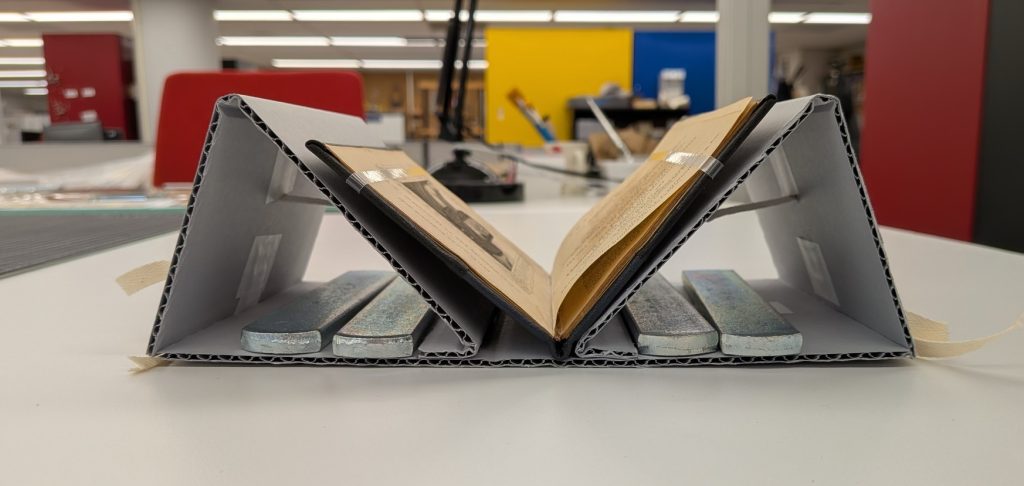
The problem wasn’t the box, but the integrated cradle, which is essentially a few pieces of corrugated board adhered together to create a rest so the book can open with less stress on the spine. With a book as small and lightweight as this one, the pages and cover weren’t heavy enough to weigh down the arms of the cradle, therefore I needed to figure out a way to keep the arms of the cradle down so the book could open fully.

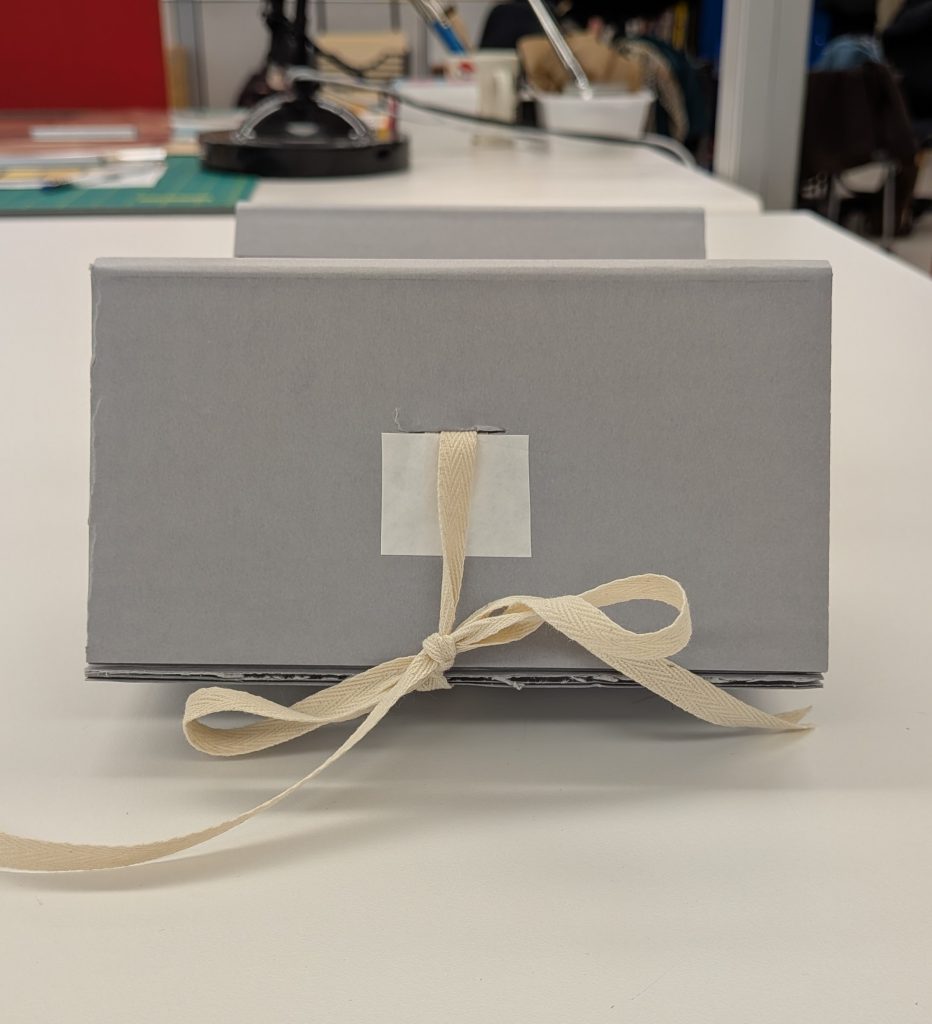
To achieve this, I used linen tapes to hold the two halves of the arms together so they stayed firmly down without needing the book to weigh them. The tape on the outer part of the arm is tied into a bow with another piece of tape that is attached to the base of the cradle. 

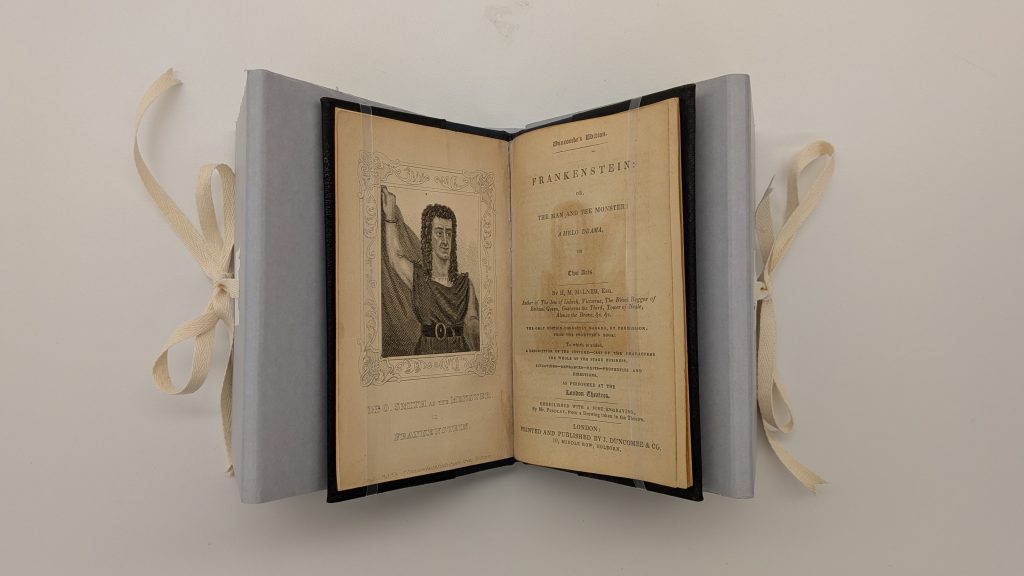
Aerial view of a small book strapped in a corrugated cradle.

Furthermore, to keep the cradle from opening too far, I used more linen tapes on the interior of the arms to hold the arms at the exact width I wanted them from the spine of the book. This helped the cradle keep it’s shape, and created tension for the ties.

View of a small book strapped in a corrugated cradle with weights in along the base to hold the cradle in place.

Nicole Browning – Conservation Specialist

A CoLibri Jacket with an Encapsulated Spine

UC Libraries are faced with many books in need repair. Often, books must be thoughtfully housed while they wait their turn for treatment priority.

For books with a detached spine, this option can be challenging to find a solution to prevent the spine from becoming lost or crushed (especially if fragile leather!).

As an alternative to storing a loose spine in a baggy or envelope, or holding the spine in place with a cloth tie, behold a satisfying and easy solution

…to encapsulate the loose spine in a SCRAP of a polyethylene CoLibri jacket, then attach it to the jacket itself!

This option gives the look and feel of a repaired binding, with none of the work!

To Encapsulate:

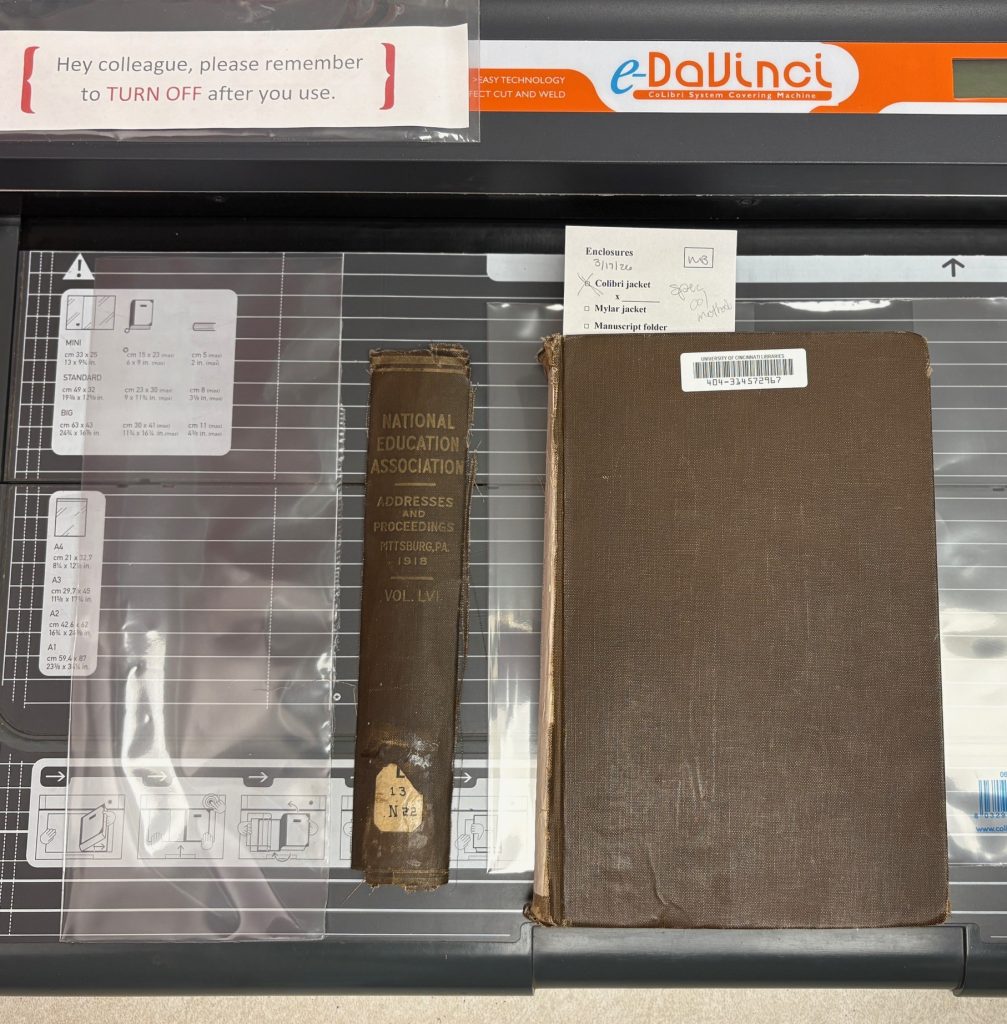
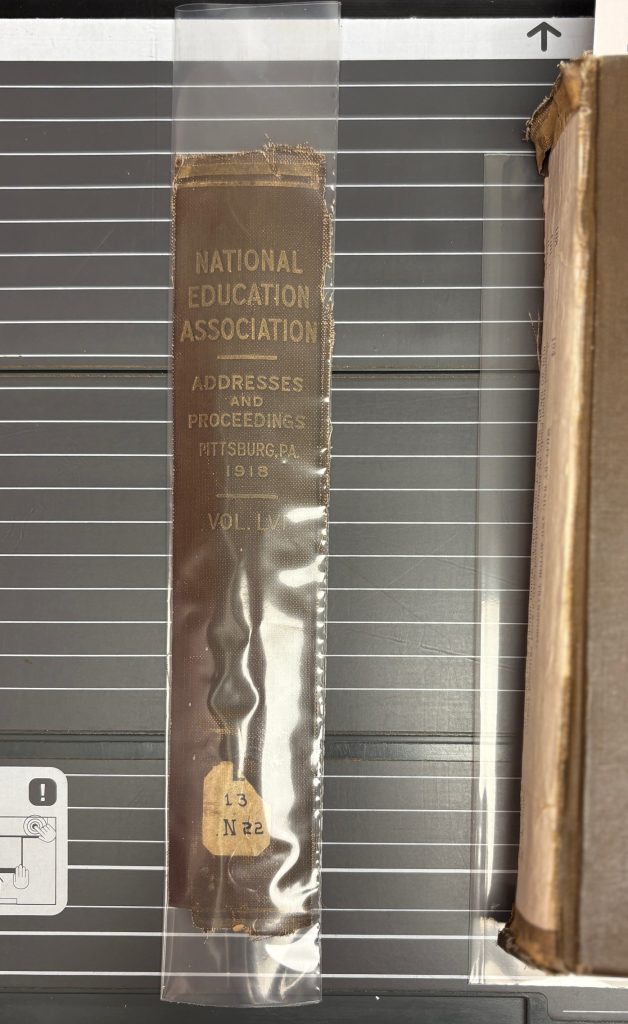
1. First make a polyethylene pocket with the spine inside. Create a pocket taller than the book height. Weld the pocket only on the long sides at this time. Continue to leave the length taller than the book at both the top and bottom. You will weld the head and tail later and will need this length for both welds!

The spine is encapsulated in the polyethylene clear plastic on the long edges.  There is excess plastic material at the top and bottom edge where it is not welded.

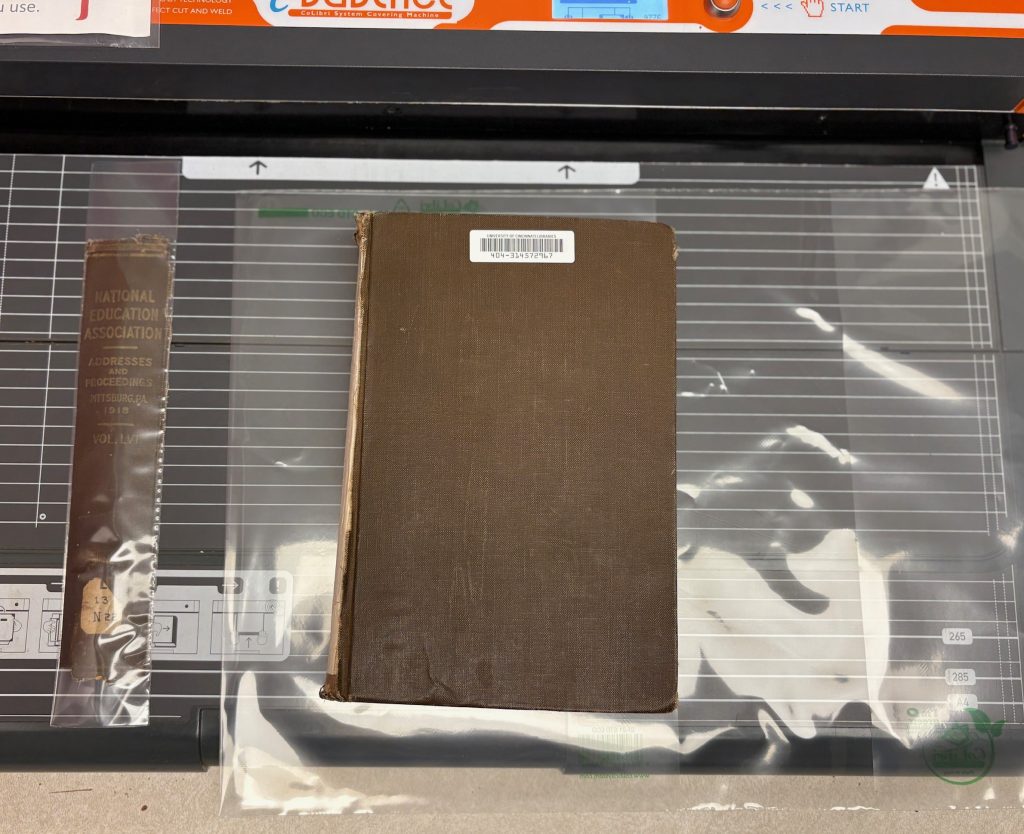
2. Grab a CoLibri jacket that is larger than the height of the book. Wrap the CoLibri jacket around the book. Take care to make the book squared and centered in the jacket.

The encapsulated spine pocket sits next to the closed book.  The book is sitting on top of an un-used CoLibri jacket that is taller than the book.

3. Position the encapsulated spine under the jacket against the spine of the book. Center it and align as close as possible to where it would have once sat.

Book is closed with the jacket wrapped around the book.  The encapsulated spine pocket is loosely in place at the spine.

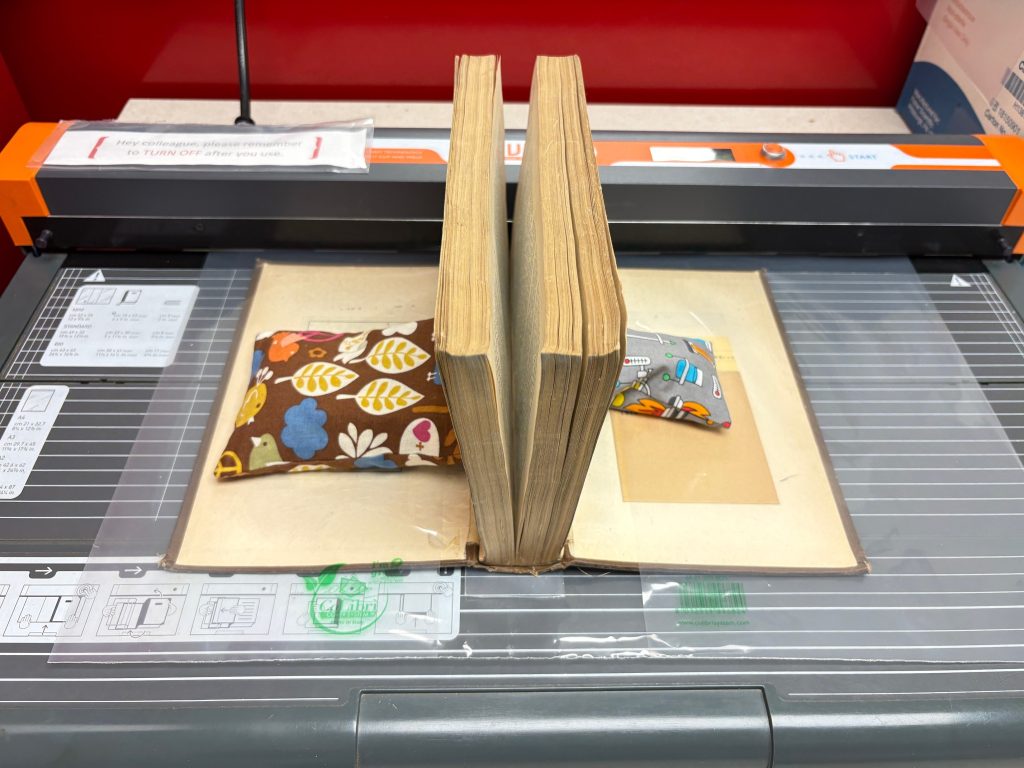
4. Place light weights on the opened covers to help hold the pages upright and prevent the jacket from sliding. Make any last minute spine adjustments at this time.

The book is laid cover side down with the covers opened on each side with bags of weights to hold it in place. The pages are closed, sticking upright with the help of the weights.

5. Weld the jacket at the head to secure the pocket in place.

Book with jacket and spine pocket welded at the top edge.  The un-welded bottom of the jacket and pocket protrudes out from below the book in excess.

6. Next, weld the jacket at the fore edges. At this time you can close the book and wiggle the book side to side to also help re-position the spine into place.

7. Weld the CoLibri jacket at the tail. The pocket will now be attached to the top and bottom welds on the jacket!

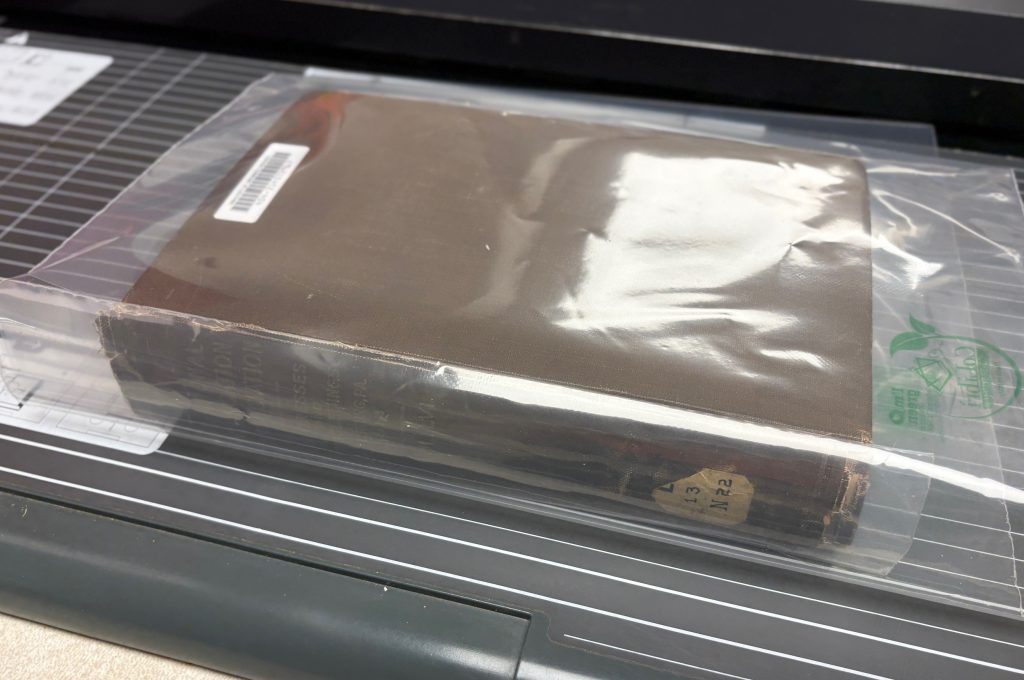
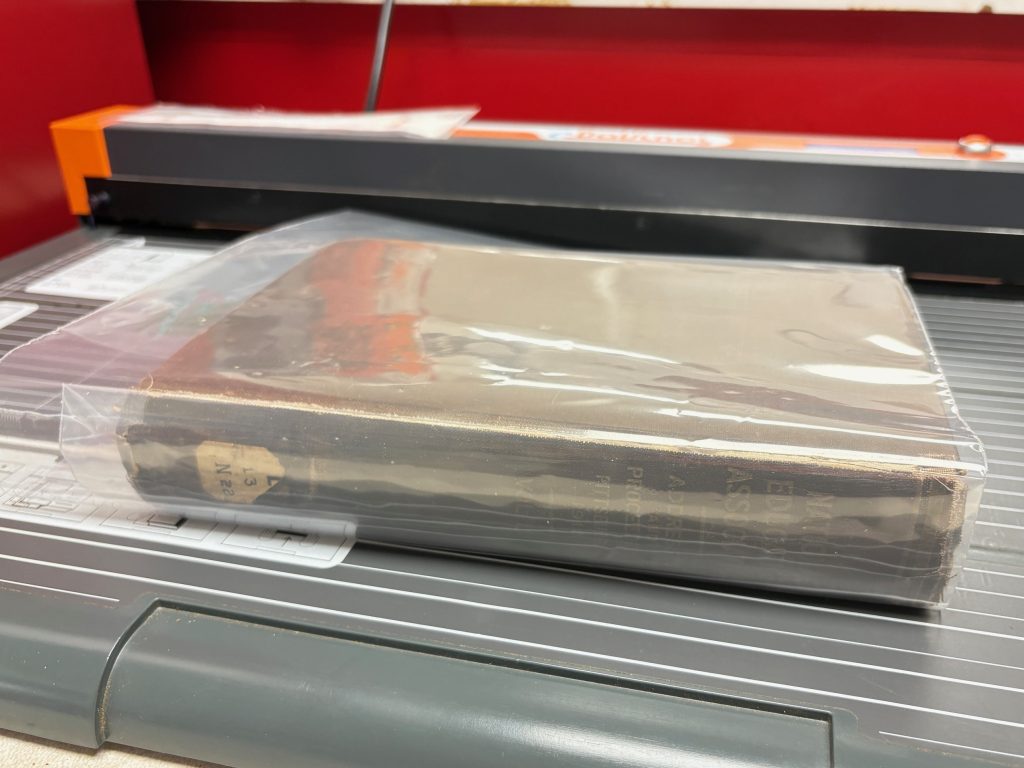
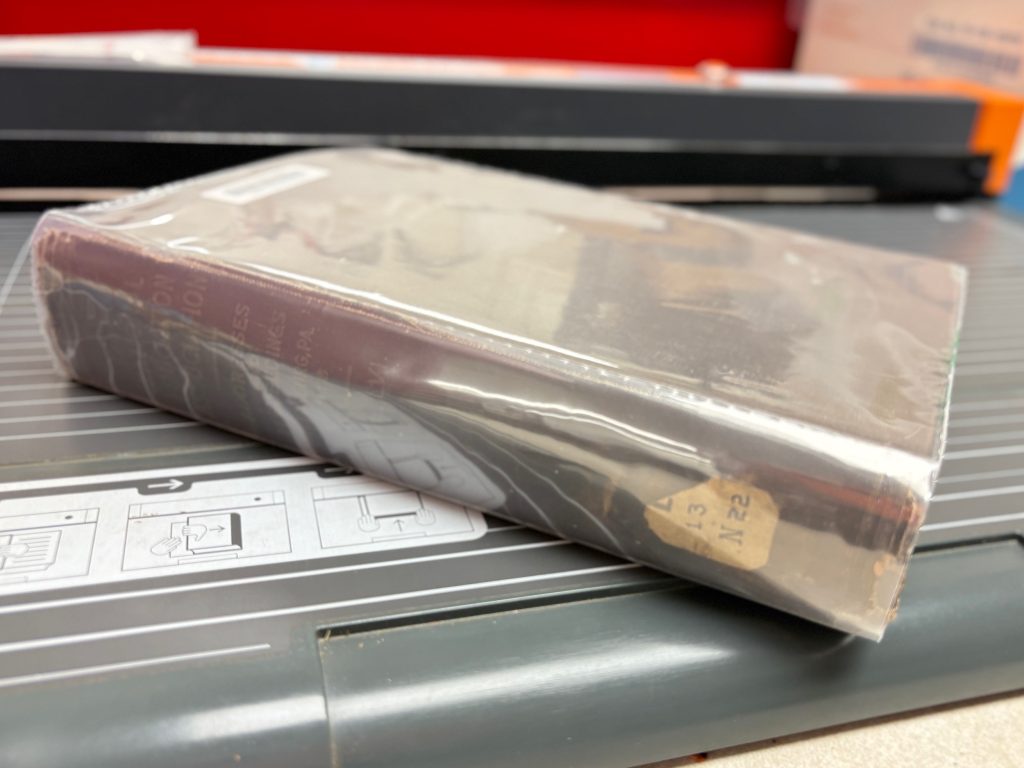
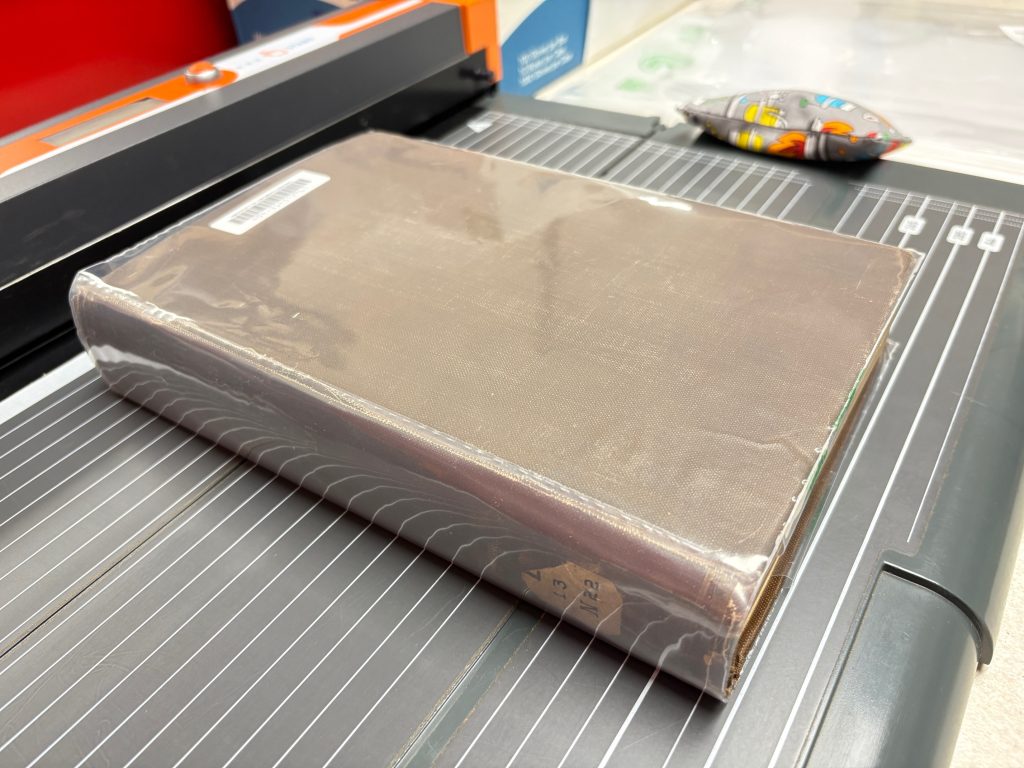
Book with completed jacket. Book is sitting on the CoLibri welder bed with view of spine.

This solution results in a spine that is safely held to the book during storage without a concern of it becoming lost.  The only way it can become lost is if the jacket is removed from the covers!

Overall view of book with finished CoLibri jacket with encapsulated spine.
Encapsulated spine is securely attached with CoLibri jacket.
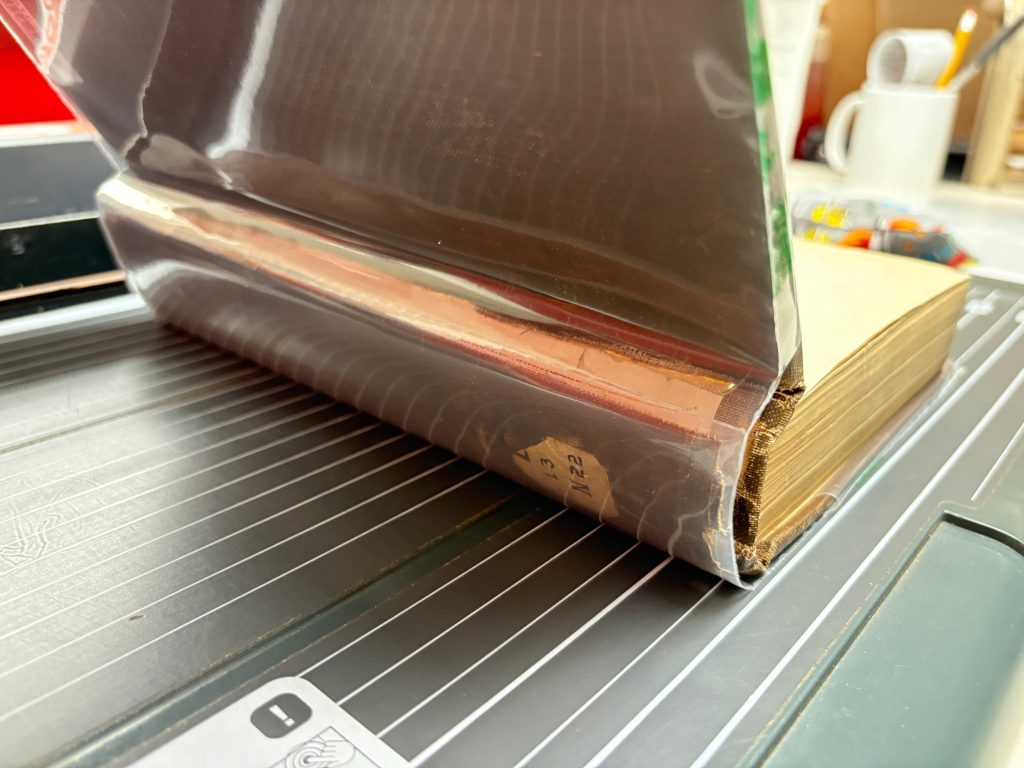
Book with front cover opened with view of the spine.
When book is opened, the encapsulated spine pops away from book.

Below are two preventive-conservation treatment reports where this option was successfully utilized for two leather bound books. Click the links to view the reports on the University of Cincinnati’s Digital Resource Commons:

Ashleigh Ferguson Schieszer – Conservator

I Got 99 Problems, but the Lawrence Notebooks Ain’t One: Finishing the Conservation Treatment of 99 Volumes

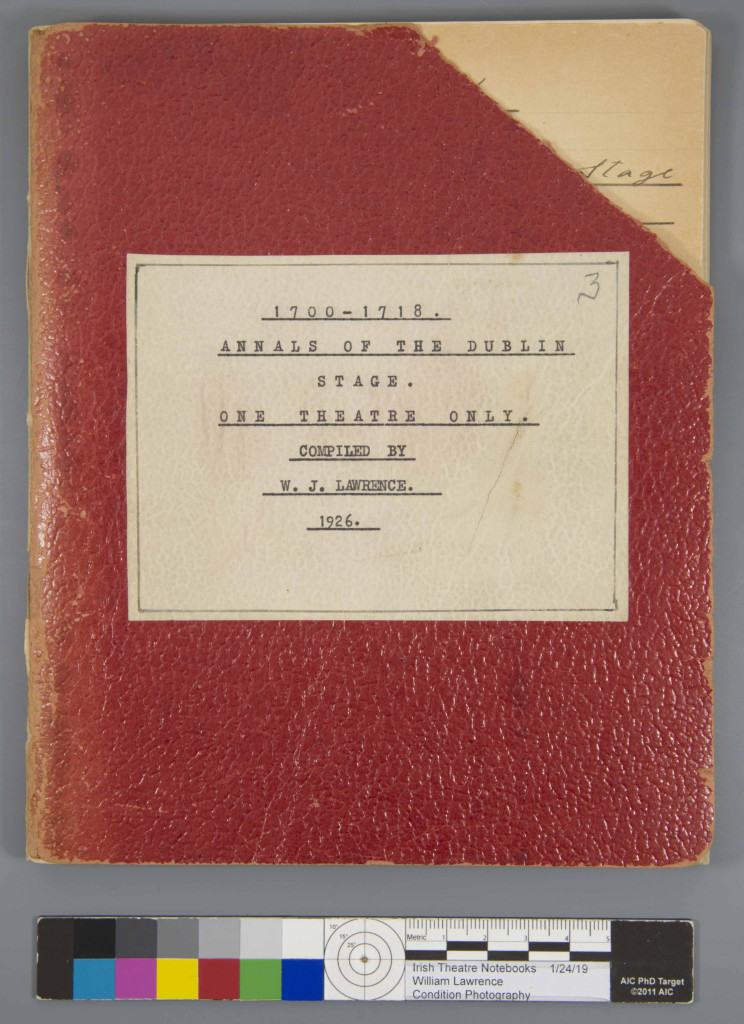
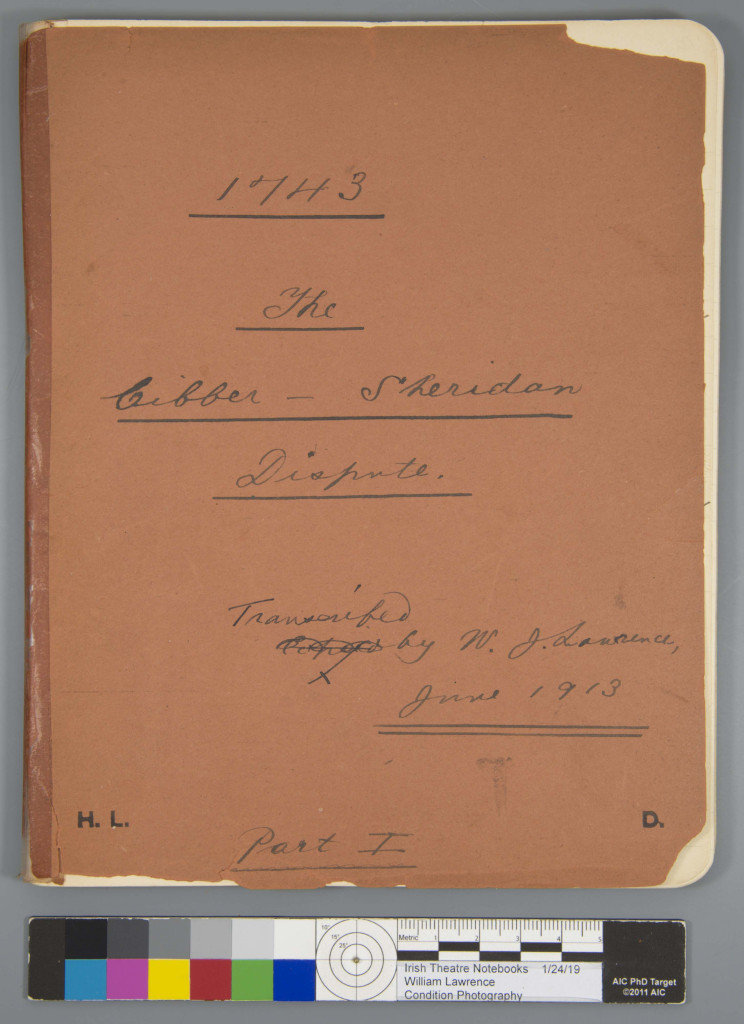
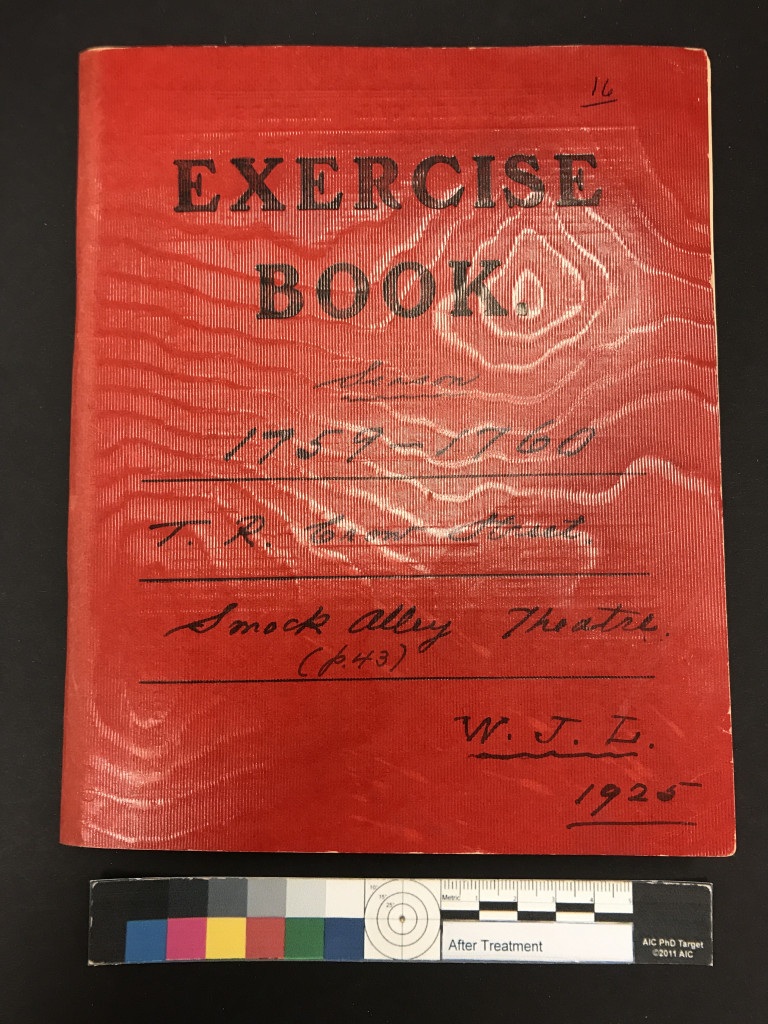
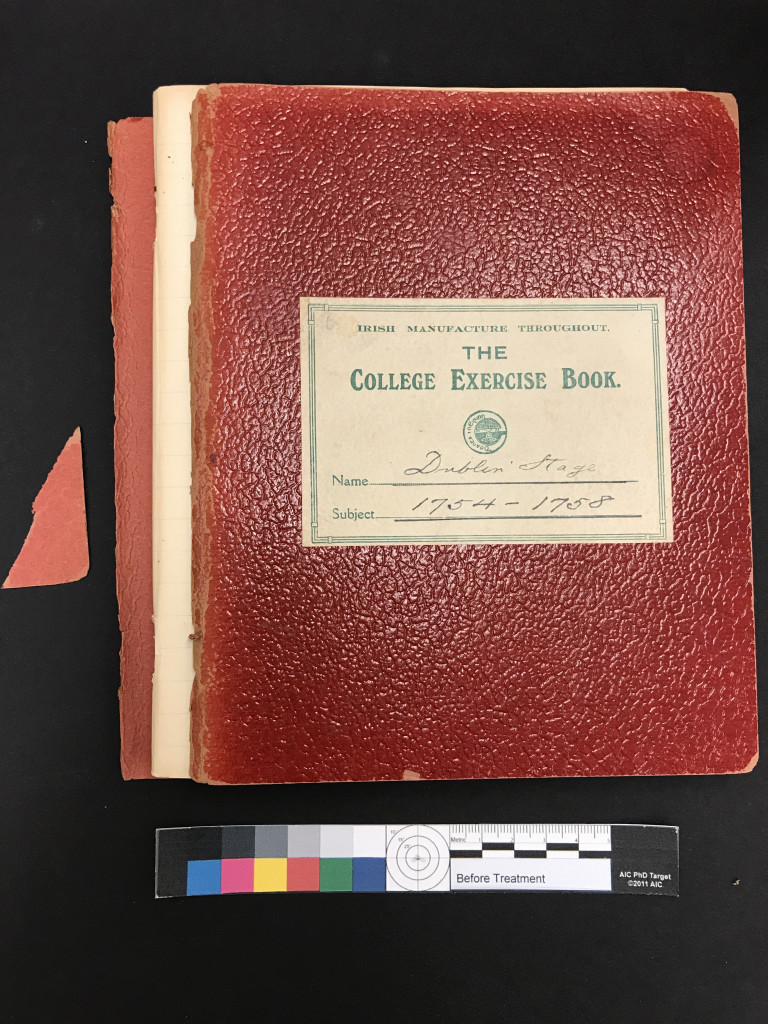
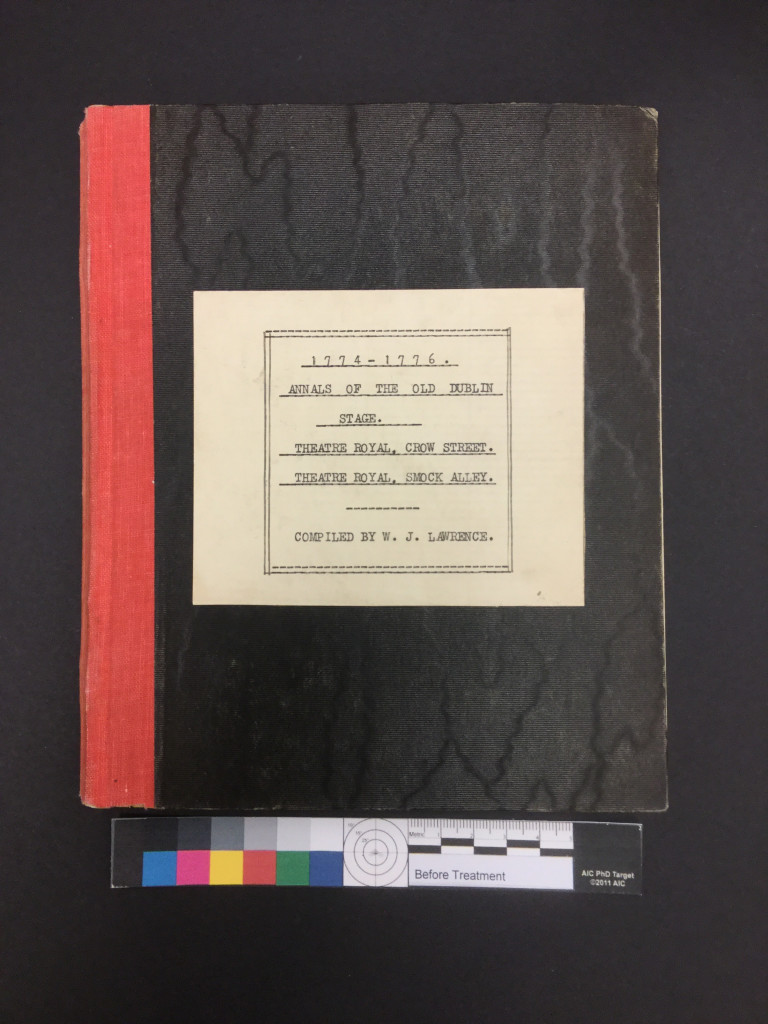
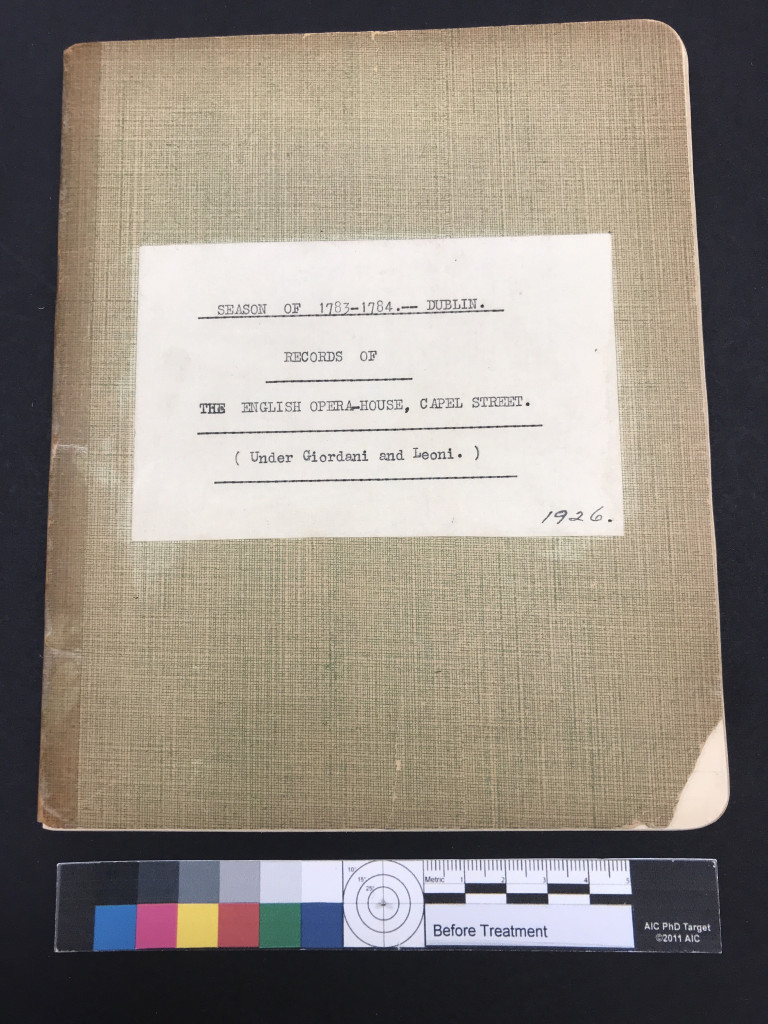
For the past few years, I have been working on the conservation treatment of the Lawrence Notebooks, a remarkable collection of 99 handwritten volumes created by William J. Lawrence that document his extensive research on the Irish stage from 1630 to 1911. Over many years, Lawrence filled these small, lined notebooks with careful handwriting, news clippings, photographs of actors, typed play transcriptions, and detailed notes on theaters, performances, ticket prices, and even personal anecdotes. Together, the notebooks offer a rich and vivid window into the history of Irish theater and the cultural life of Dublin from the seventeenth through the early twentieth centuries.

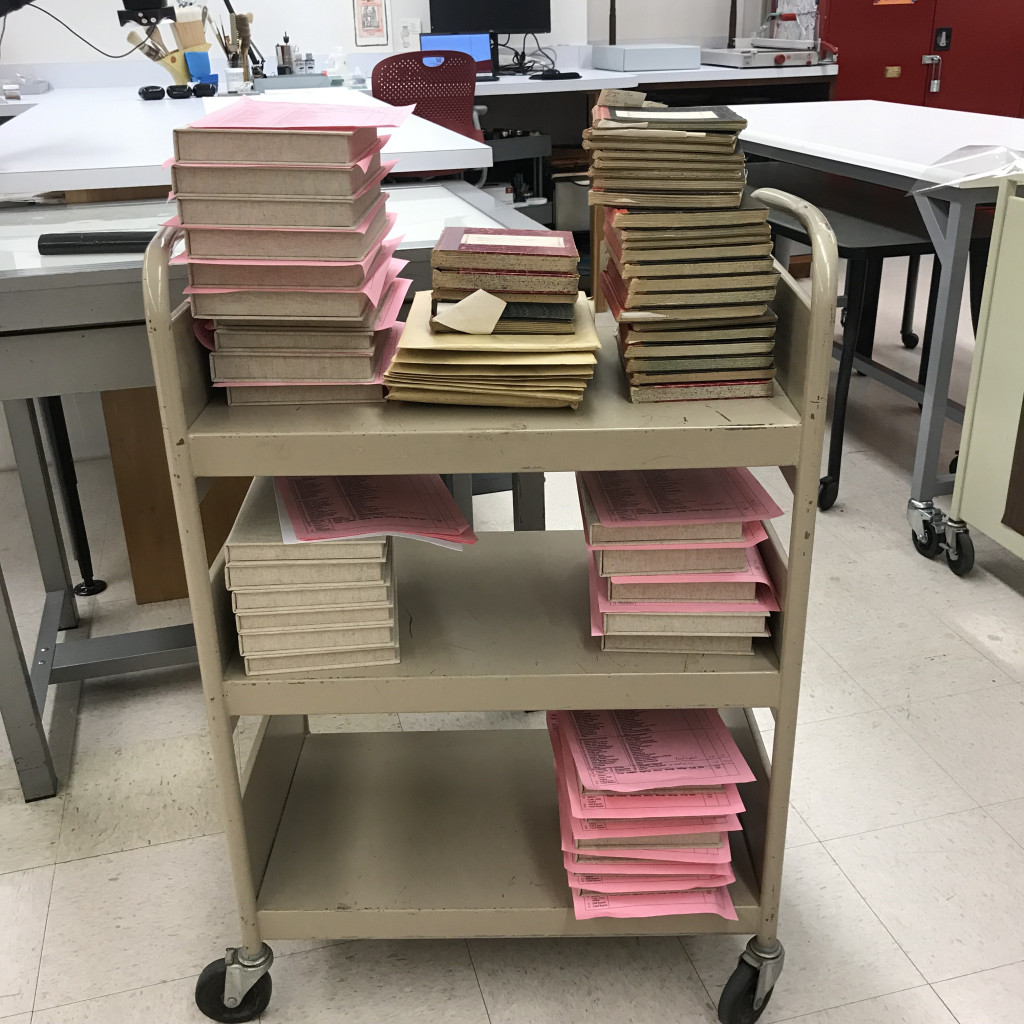
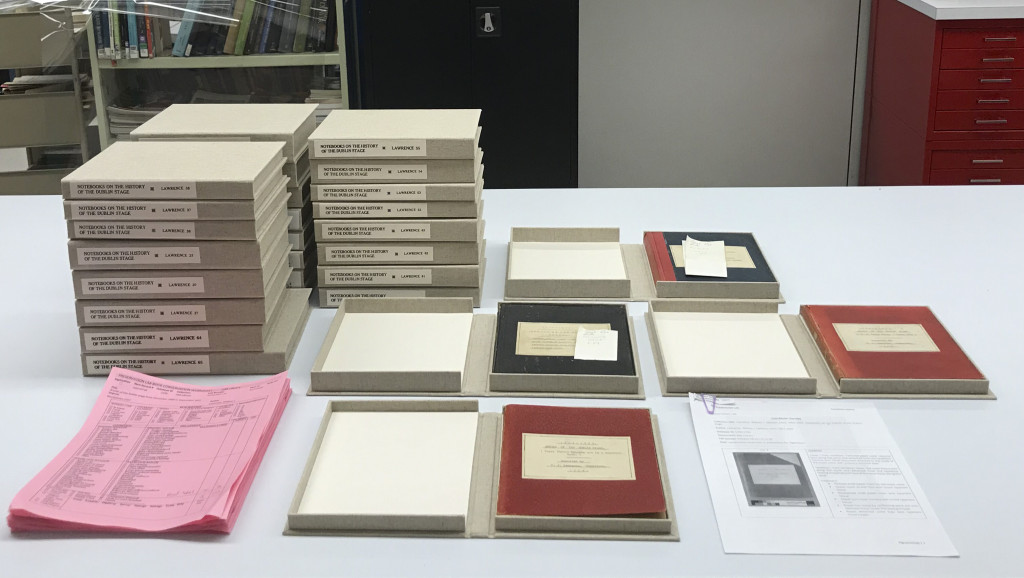
A library book truck filled with various small notebooks and conservation boxes.
In 2021, we had already completed 37 of the 99 volumes, and we still have 62 volumes in the Lab.

This project was a collaborative effort and was completed gradually over several years, with individual volumes treated alongside other conservation projects rather than all at once. Our former colleague Chris Voynovich created custom cloth-covered clamshell enclosures for all 99 volumes, while I was responsible for the evaluation and conservation treatment of the notebooks themselves.

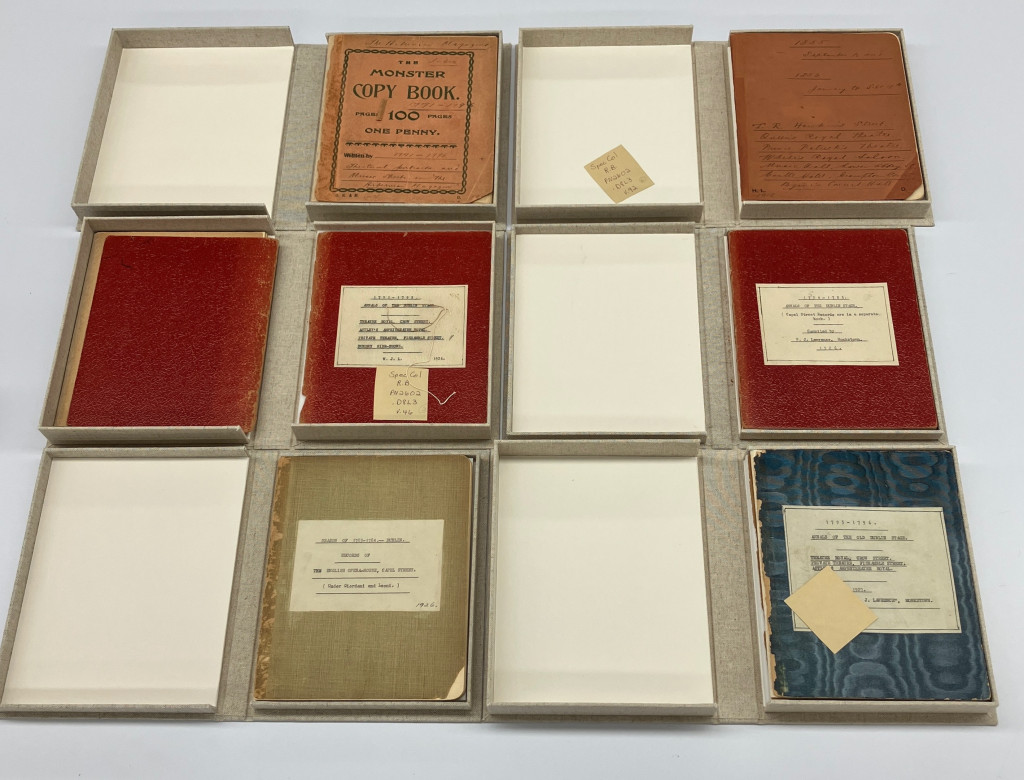
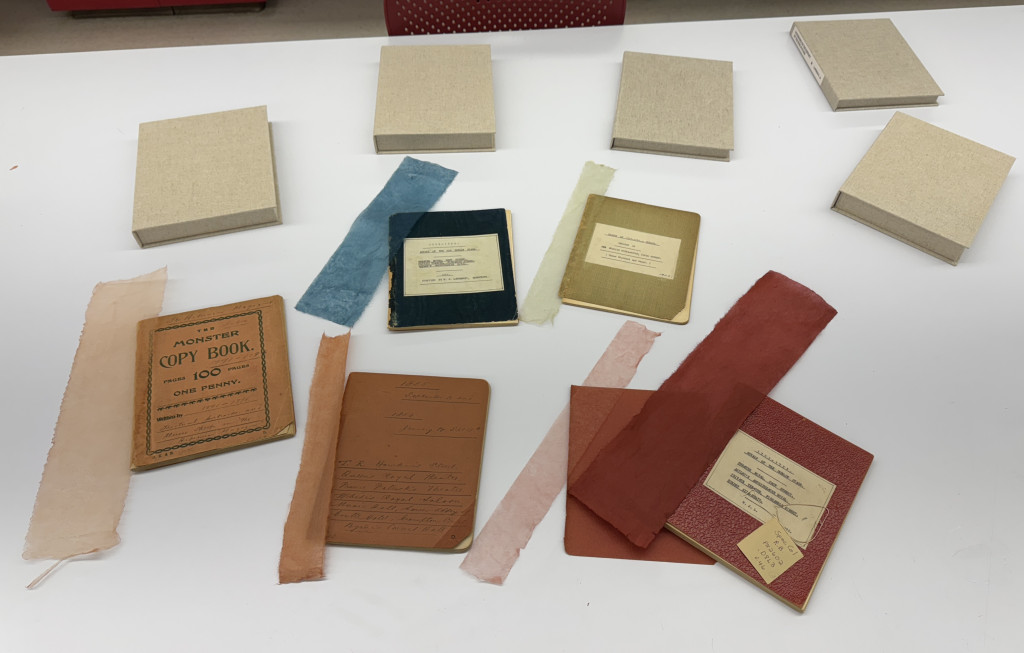
Although the Lawrence Notebooks shared a broadly similar format, closer examination revealed subtle but meaningful variations in both their covers and text blocks. Most volumes were small, square notebooks with thin boards covered in cloth or paper covers, in a range of muted colors including red, orange, green, blue, and black. The text blocks were generally composed of one or several gatherings sewn through the fold, with the primary support most often being lined paper.

Overhead view of six notebooks with different covers in their enclosures, with the boxes opened.
Variations in cover materials and colors across the Lawrence Notebooks.

Once all the volumes were received in the lab, each notebook was evaluated for its condition and assigned to one of three categories: good (no treatment required), fair (requiring stabilization), or poor (requiring more extensive treatment). The notebooks showed clear signs of long-term handling and use. Many volumes had weakened or detached covers, some of which had been previously repaired with pressure-sensitive tape. Other common condition issues included broken sewing, tears along the spine folds of the text block pages, and brittle newspaper clippings that had also been repaired with pressure-sensitive tape.

View of a stack of cloth clamshell enclosures, with several opened to show notebooks inside.
Condition evaluation of the Lawrence Notebooks prior to treatment.

When determining the most appropriate conservation treatment for each volume, it was also important to consider their future digitization. Treatments were selected to stabilize the notebooks while ensuring they could be safely opened, handled, and imaged without placing additional stress on the original materials.

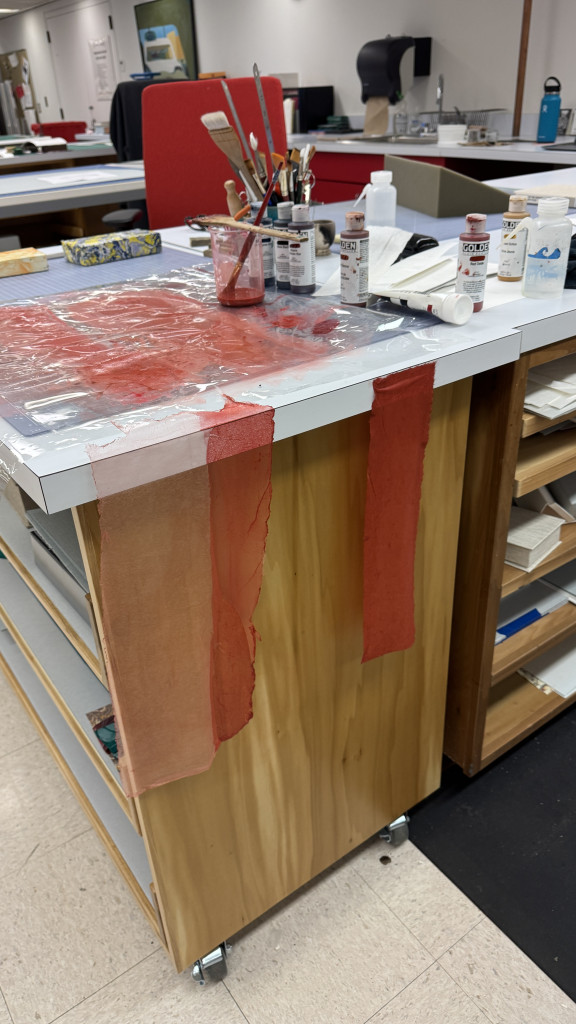
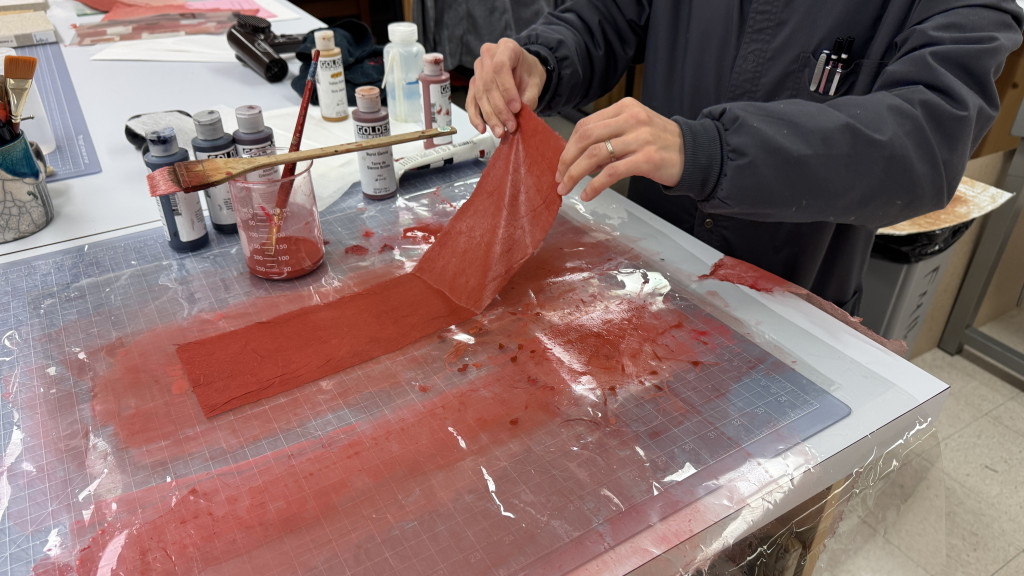
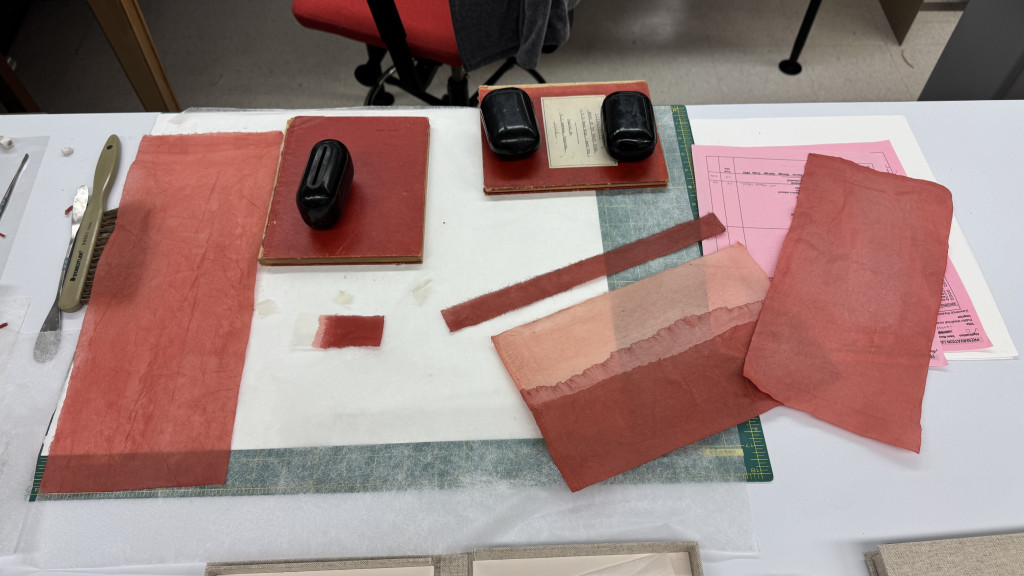
Most of my conservation treatment ended up being hours spent removing pressure-sensitive tape, many more hours toning Japanese paper with acrylics for the repair and stabilization of paper covers, along with surface cleaning and a lot of time dedicated to tear repair. 

Completing the conservation treatment of all 99 Lawrence Notebooks marked the end of a project that unfolded slowly over several years. Because the work was done alongside many other conservation projects, progress often happened one volume at a time, making the moment when the final notebook was finished feel especially satisfying.

With treatment complete and each volume now housed in a custom clamshell enclosure, the Lawrence Notebooks are stabilized and better supported for future handling, digitization, and research. While the notebooks still show the signs of long use that make them such compelling working documents, they are now structurally sound and prepared for the next phase of their life in the collection. 

Projects like this reveal how conservation work happens slowly and methodically, often behind the scenes. Completing treatment on all 99 notebooks and seeing them reunited as a stabilized collection reinforces the importance of long-term care in preserving these records of Irish theatrical history for future research and access. 

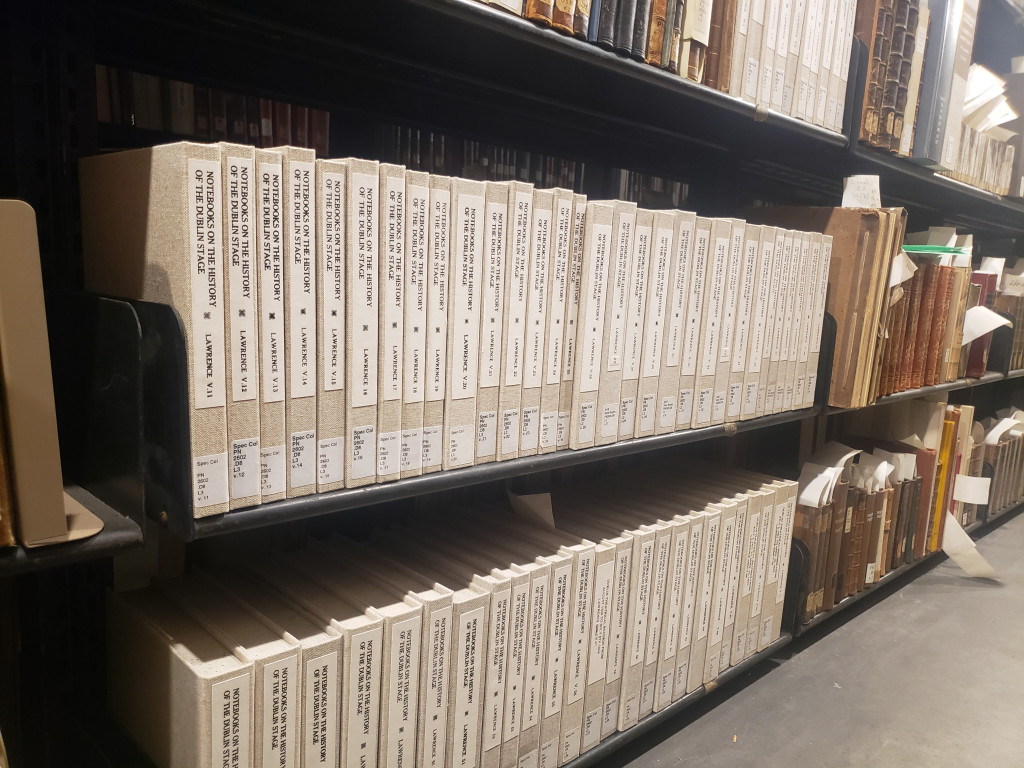
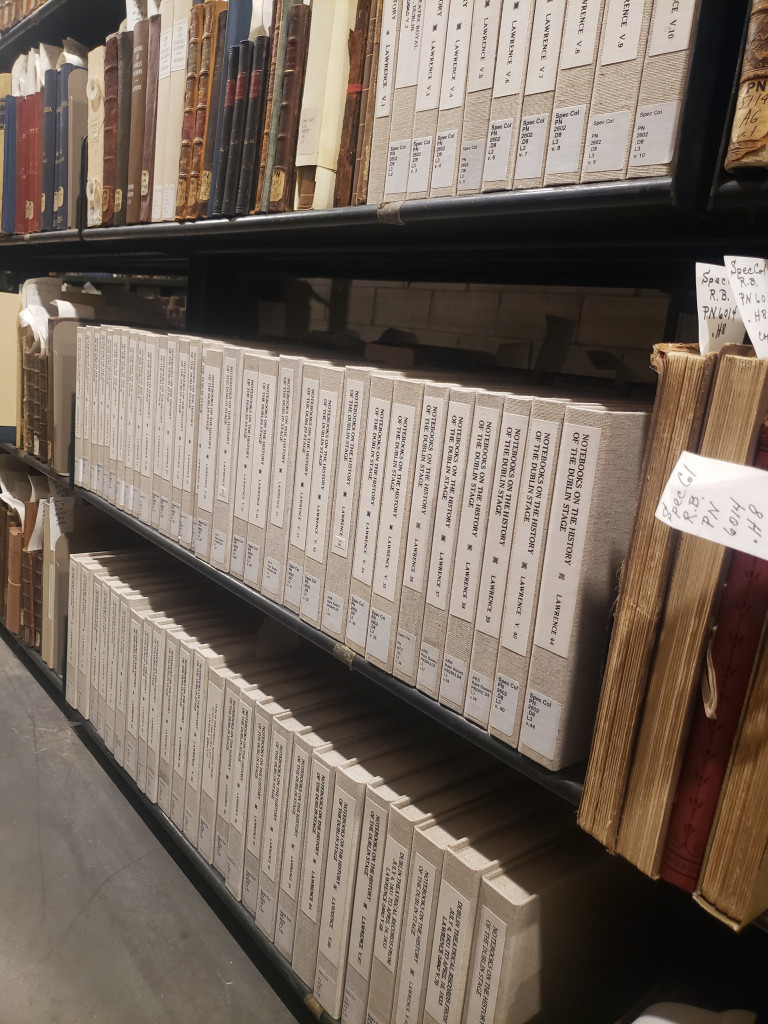
The Lawrence Notebooks shelves in the Archives and Rare Books Library stacks.

Catarina Figueirinhas – Assistant Conservator

When you THINK you know the difference between handmade and machine-made paper!

We were delighted to have Dr. Cathleen Baker come to UC for 4 days to teach us all about paper, paper making and printing in a collaborative programming and outreach workshop entitled Identification of Western Hand- & Machine-Made Paper, 1750-1900. The workshop included Preservation Lab staff, staff from UC Libraries Archives and Rare Books Library and the Content Services department, and Kathy Lechuga from Signature Conservation.

With Cathy’s teaching and guidance, we soon discovered some of the key characteristics is in handmade paper and how the introduction of machine-made paper just made everything more complicated. Oof, that dandy roller… But it was so exciting to make discoveries in the paper and learn new tips for paper identification. This will be particularly helpful for Preservation Lab staff when we do our examination of items for treatment proposals.

We are all beyond grateful to Cathy for sharing her immense knowledge and expertise with us. We all learned so much about handmade and machine-made paper and printing. Here’s just a taste of the workshop and us examining special collections items from the ARB Library and the Science Library collections:

We also took a field trip to the Cincinnati Type & Print Museum to get a paper understanding of printing. It was a fantastic experience! A big thank you to Gary and his staff for a wonderful time printing and a great tour.

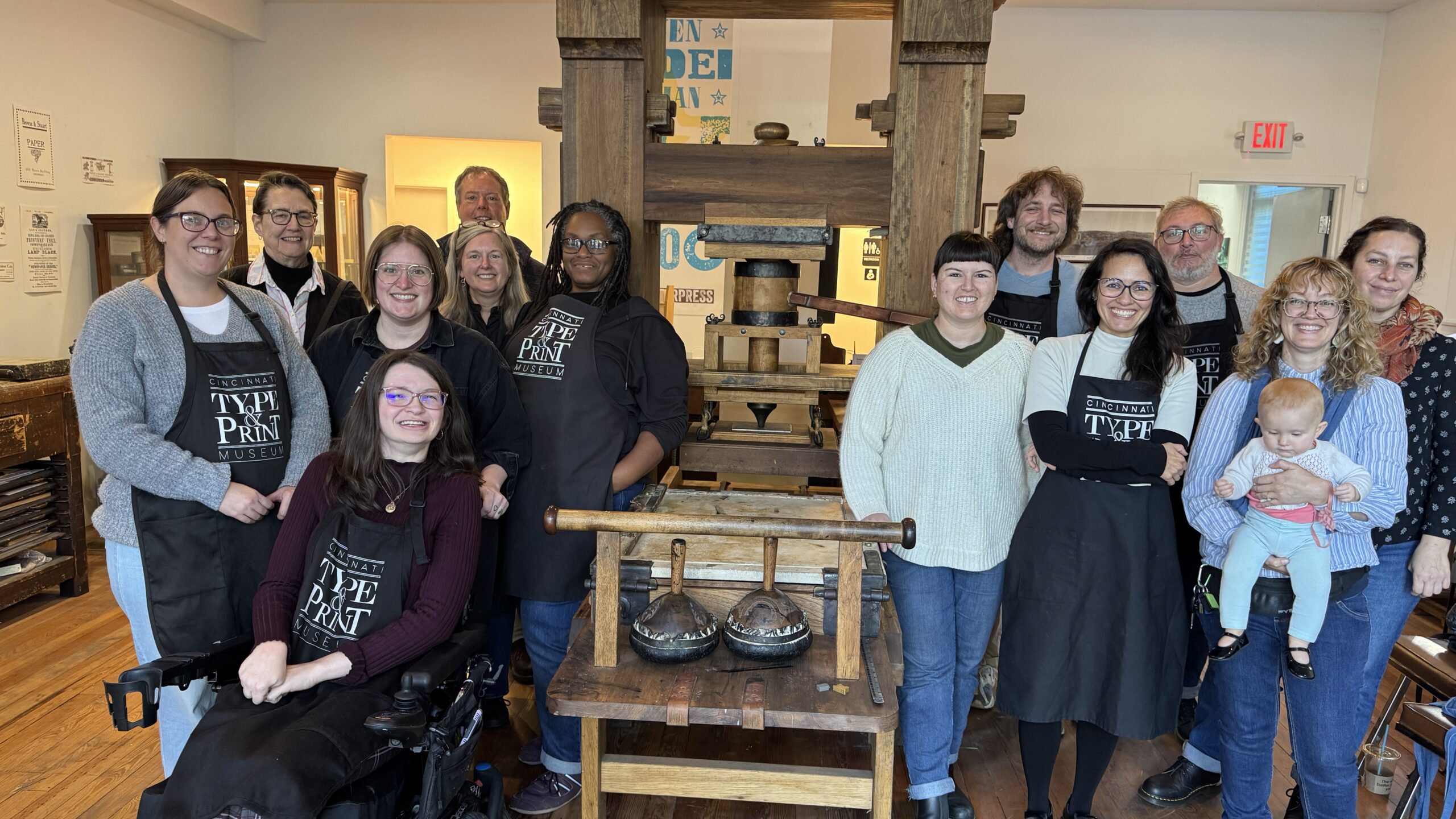
13 people and a baby posing in front of a large wooden printing press.
All participants of the workshop and Cathy posing in front of the Cincinnati Type & Print Museum’s wooden hand press.

Jessica Ebert – Assistant Conservator

A Timeless Tale – How Inscriptions Tell Stories

It’s amazing the different ways books can tell us stories. There’s the obvious: the words that are written on the page and create the story the author wanted to tell. But there’s also what lies beneath the surface — the wear and tear of the book, how it was bound, what materials were used to make it. There’s the outright story a book was meant to share, but there are also context clues, and deeper ways we can dive into the history of a book.

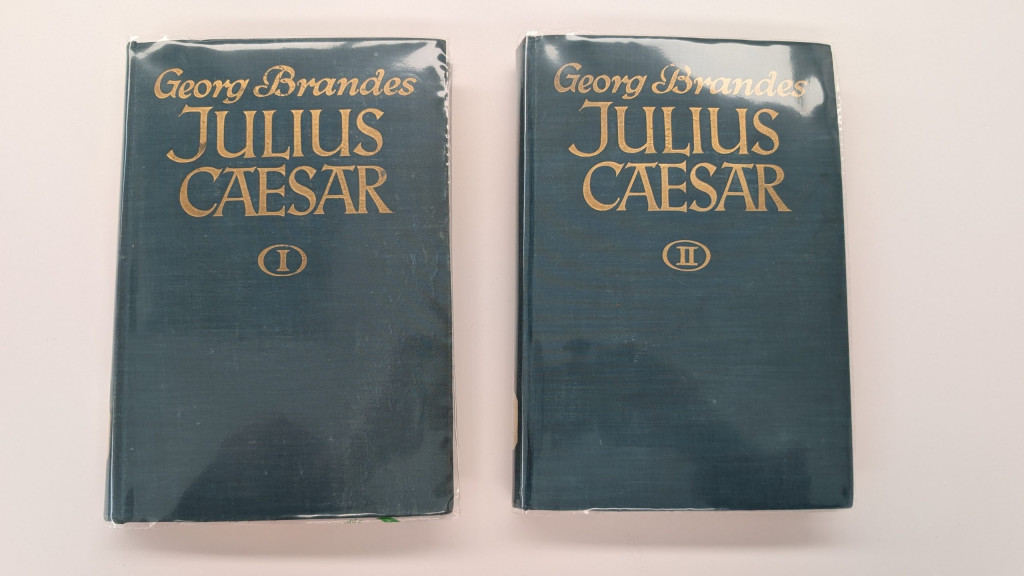
Sometimes, a book just outrightly tells its story through notes left by previous owners. A handwritten message about where it was bought, a book plate of whose library it came from, or an inscription with notable information about damage to the tome are all ways prior owners can document what the book has been through. This latter suggestion is the case for a two-volume set of Cajus Julius Caesar by Georg Brandes.

A Timeless Tale – How Inscriptions Tell Stories
Pictured: volumes I and II of Cajus Julius Caesar.

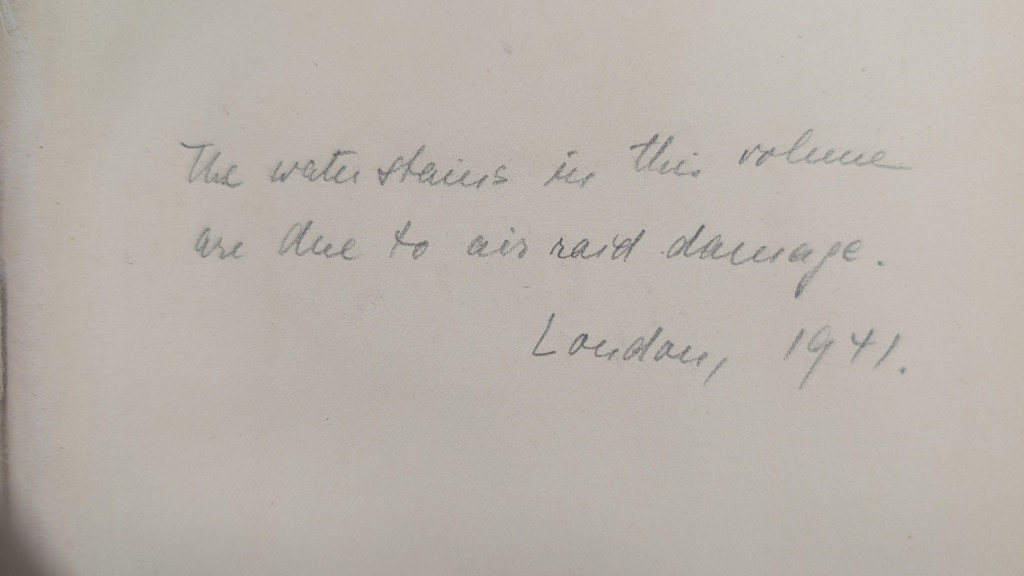
These books were published in 1925 by the Erich Reiss Verlag publishing house. On the fly leaf of both of these volumes is a handwritten inscription which reads “The water stains in this volume are due to air raid damage. London, 1941.” In graphite. What a big journey for two books, from Berlin, Germany, to London, England, and then to Cincinnati, Ohio!

A Timeless Tale – How Inscriptions Tell Stories
Pictured: inscription in Julius Caesar Volume I.
Inside of both volumes, open to the first blank page, where the inscription is visible on both books.
Pictured: inscriptions in Julius Caesar Vol. I and II
Two volumes stacked on top of each other with the bottom of the text block visible. The text block is stained brown on the lower right corners of both volumes due to water damage.
Pictured above: signs of water damage on the book.

The water damage to the books is there but it isn’t too drastic. There is some obvious staining and cockling to the pages, as well as some warping of the covers. These books were treated with v hinges on the front and back fly leaves to prevent further separation of the cover from the text block and were also put in Colibri covers to help keep them protected on the shelves and during use.

One of the books with the front cover open and the text block under weights while being repaired.
Pictured: both volumes of Julius Caeser being treated with v hinges.

These books needed minimal treatment, and then will return to their home at the Classics library. With some care from the preservation lab, these two volumes can continue to tell their story for years to come.

Nicole Browning — Conservation Technician

Faux Jacket-Sling Hybrid?

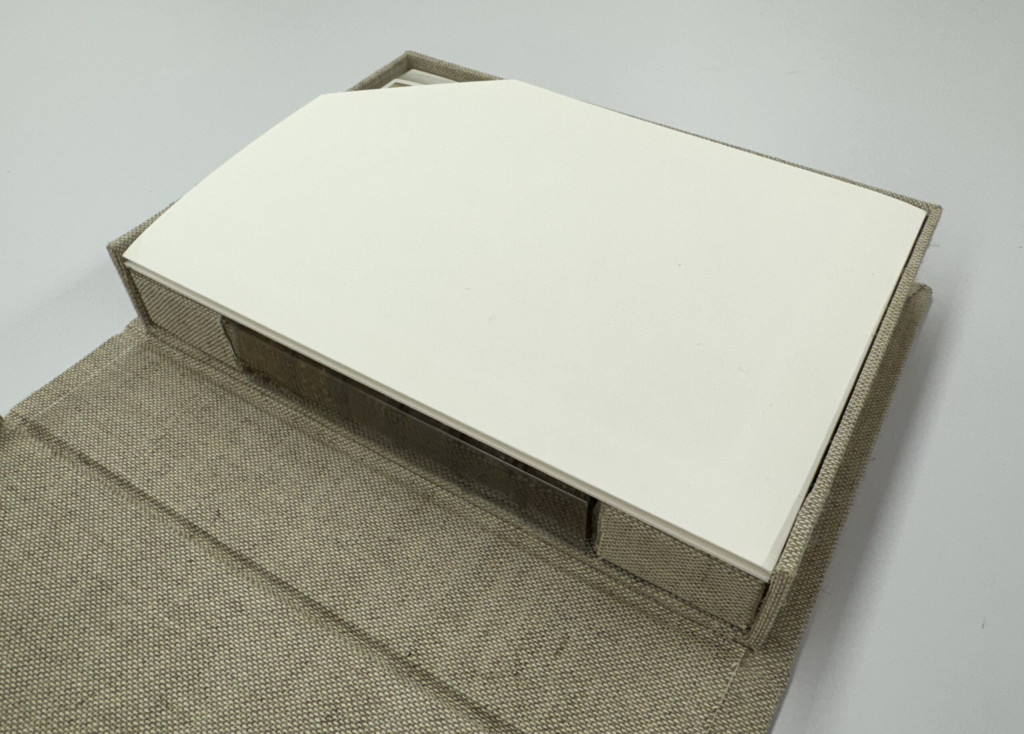
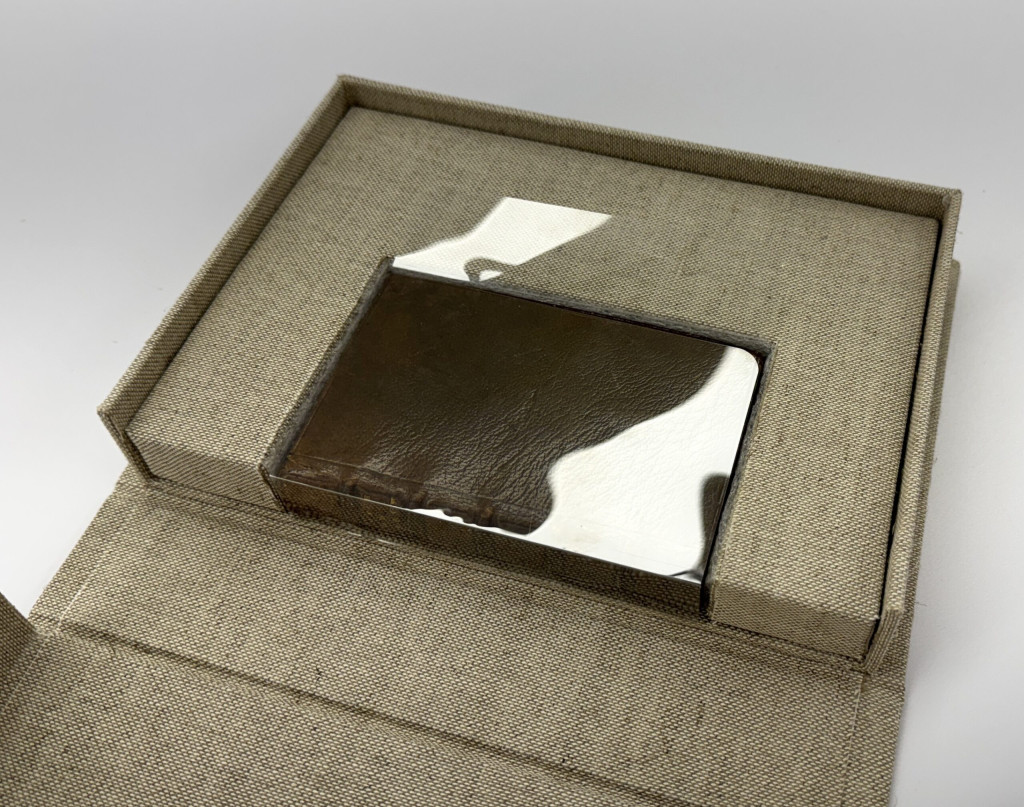
I recently created a cloth covered clamshell enclosure for this small leather volume from the Cincinnati & Hamilton County Public Library. The volume has eight full color miniatures which received surrogate photography. The surrogates were printed to roughly 5×7 inches, making them substantially larger than the text, so an insert was created within the cloth clamshell to house the smaller volume.

Cloth clamshell with insert and small book inside
Interior tray of the cloth clamshell enclosure with the surrogates placed on top of the small leather volume housed within the custom insert.
Small book in insert inside of custom box
To build up the enclosure to the size of the surrogates, an insert was created using archival corrugated board covered in Cotlin bookcloth. I lined the portion of the insert where the volume would rest with thin Ethafoam sheeting, so the fragile leather edges wouldn’t be abraded.
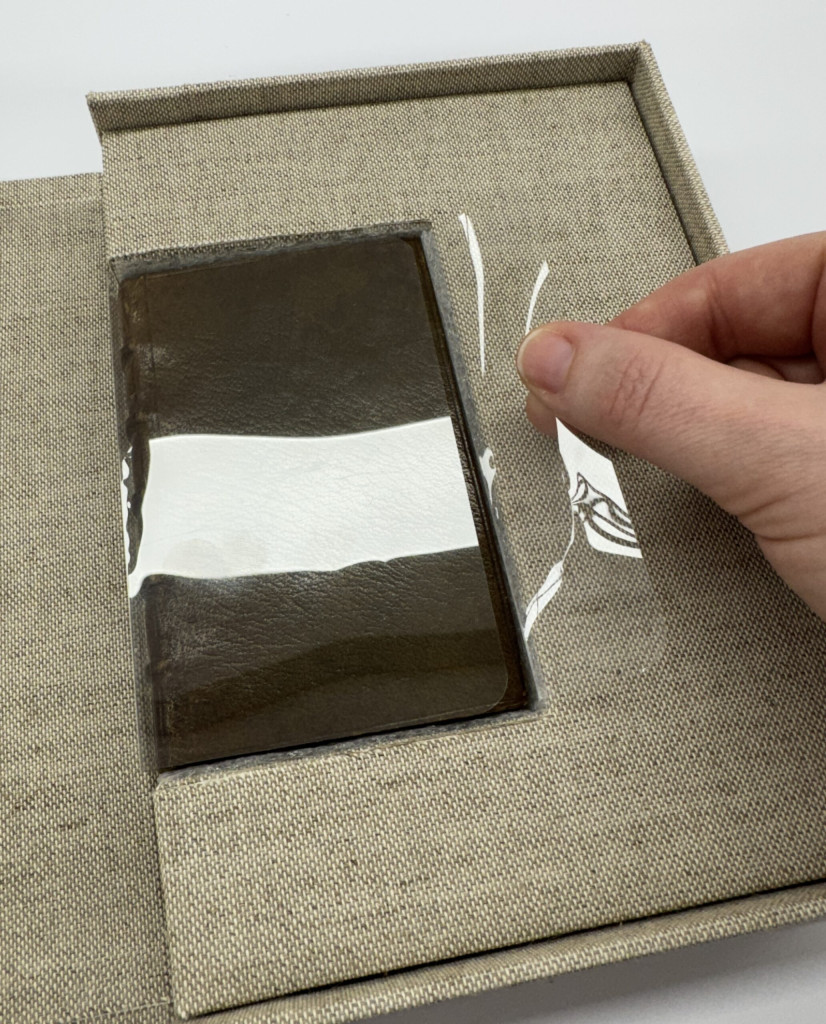
Small book in insert inside of custom box. Book is wrapped in a custom polyester wrapper.
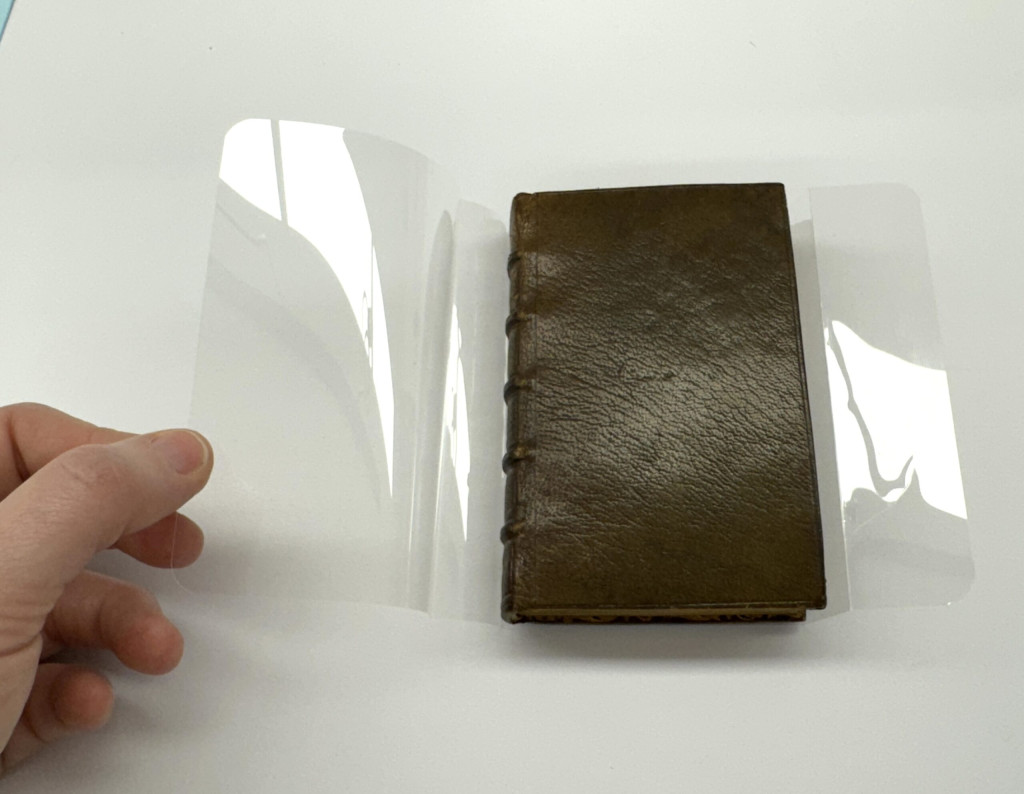
To aid in lifting the volume from the enclosure I created a partial polyester wrapper of sorts. Part jacket, part sling. A faux jacket-sling hybrid, if you will?
Book is wrapped in a custom polyester wrapper.
A closer look at the polyester creation, with rounded corners.

Overall, I think it’s a quick and easy solution that could be beneficial in future situations where a simple modification of an existing enclosure is needed, but space within the enclosure is at a premium.

Jessica Ebert – Assistant Conservator

Fun with PhotoDoc – X-rays and CT scans, Oh My!

An alternate title to this blog could be, “That time we X-rayed medieval choir book at the UC Medical Center, and then the pandemic happened I forgot to write a blog post about it”. Oops!

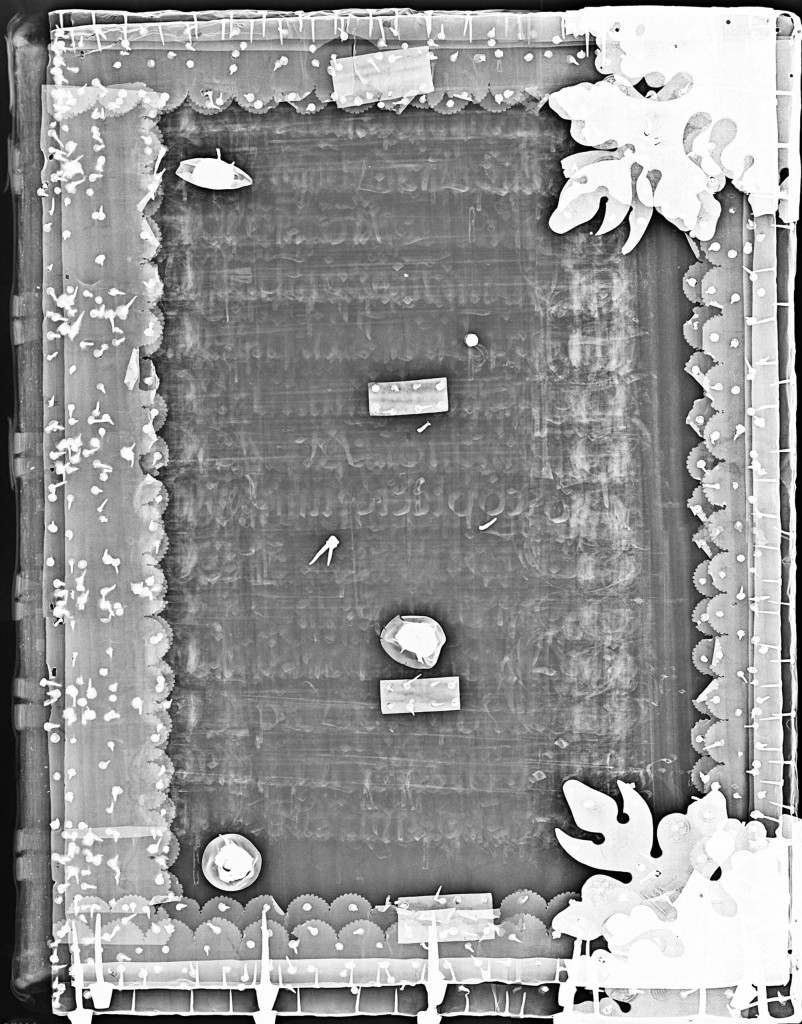
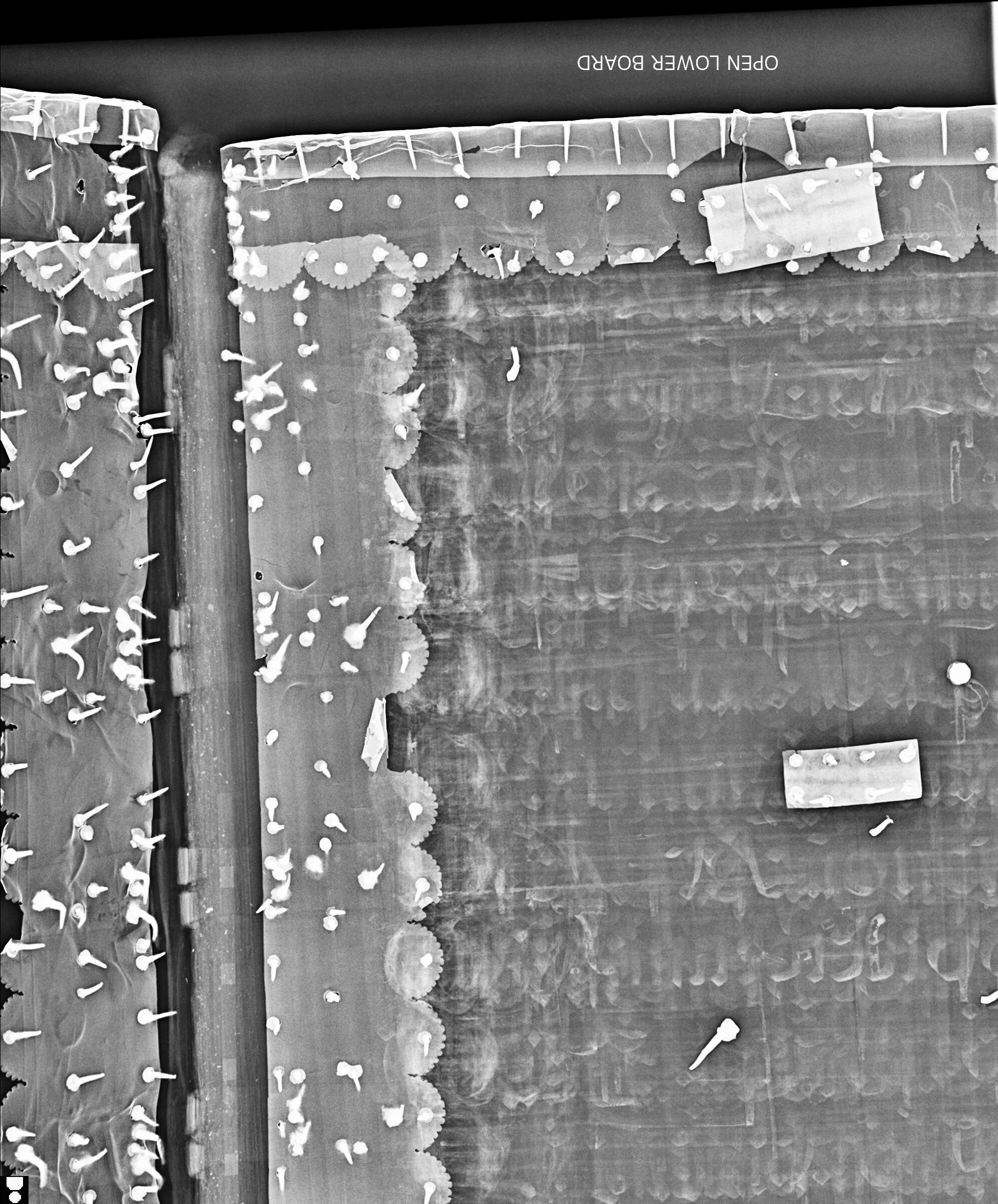
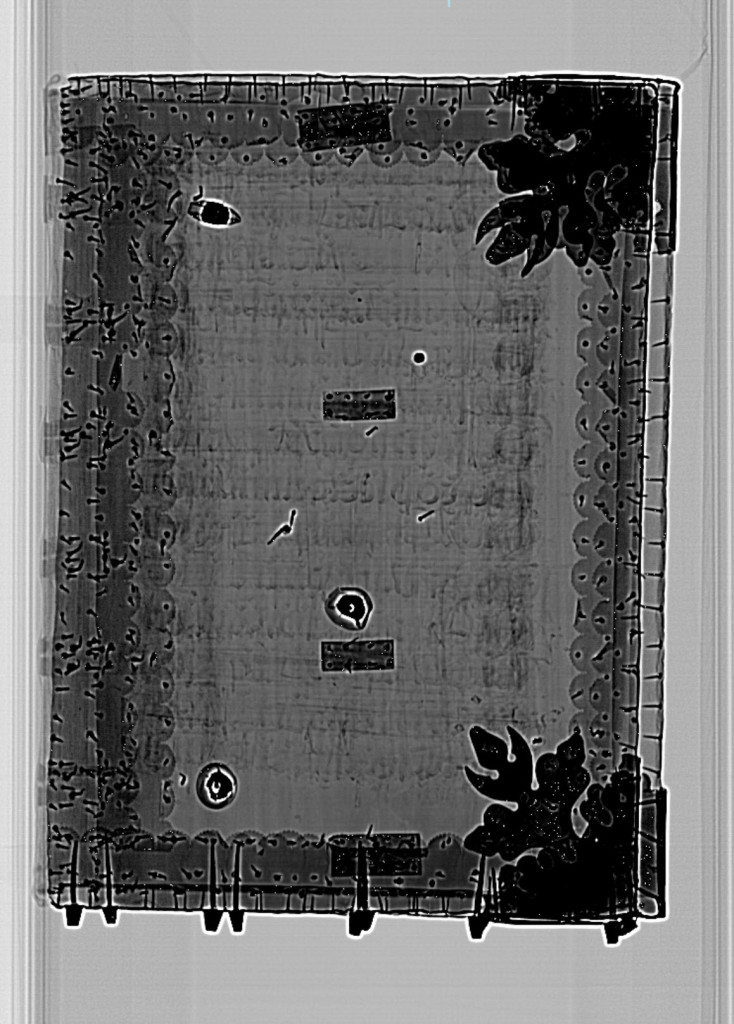
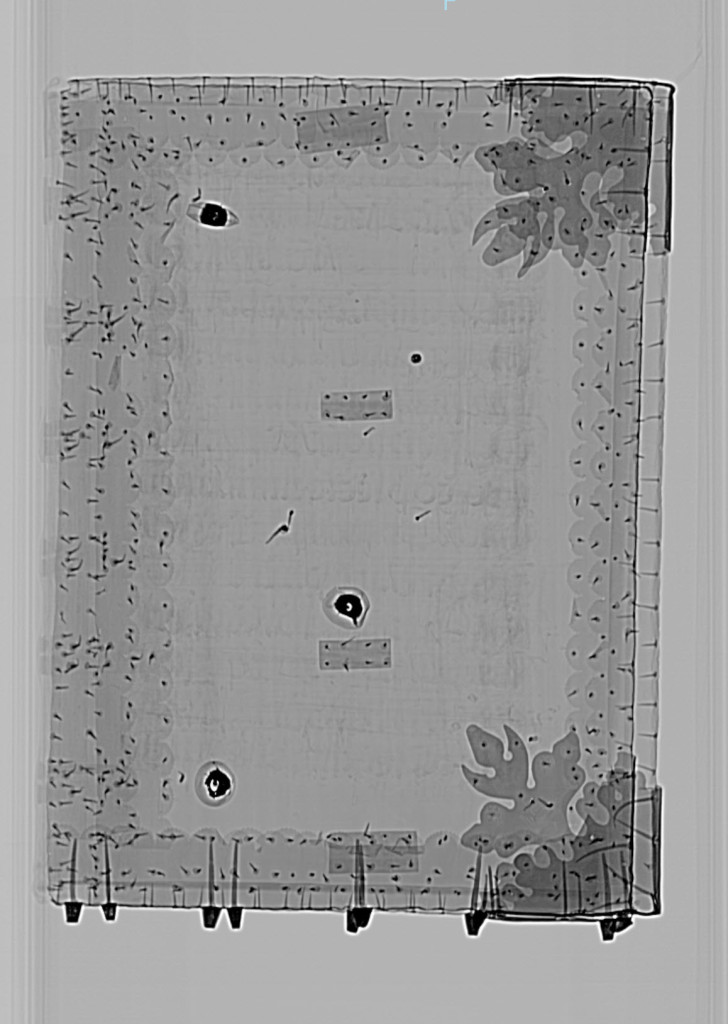
X-ray image of an oversized medieval book

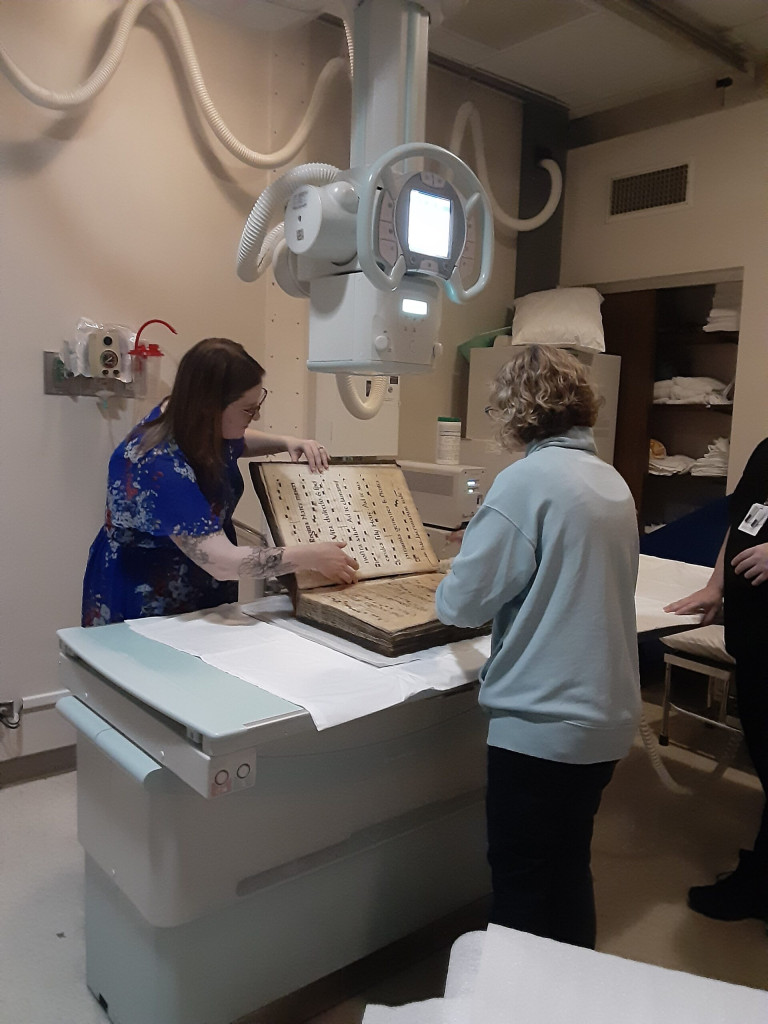
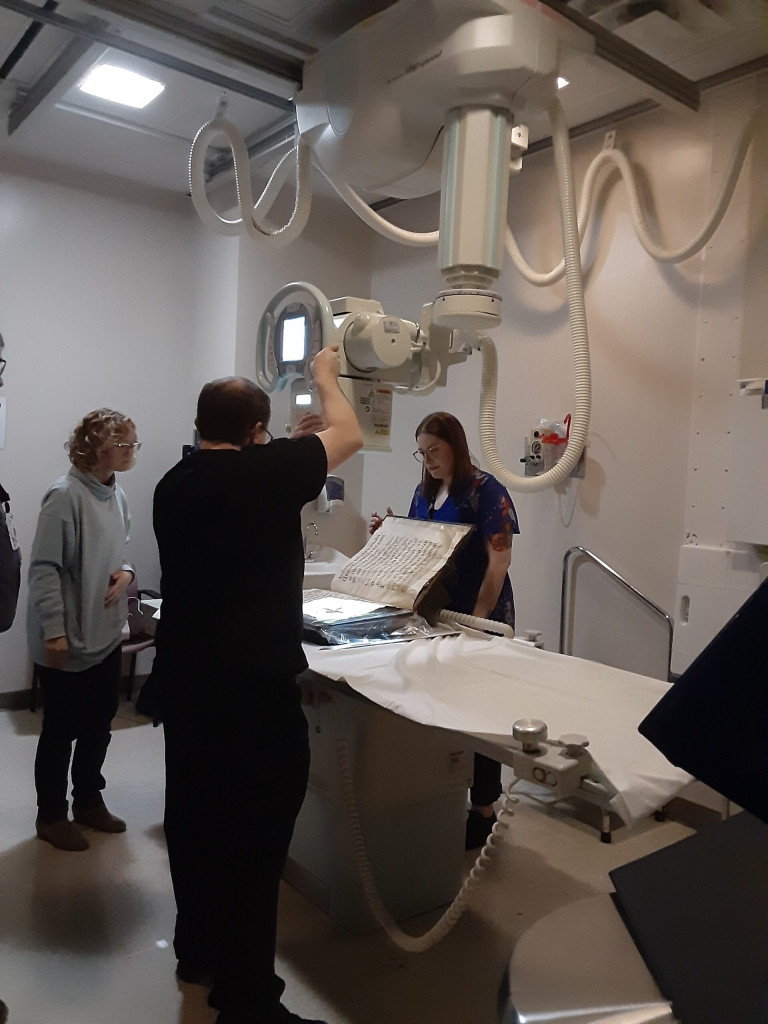
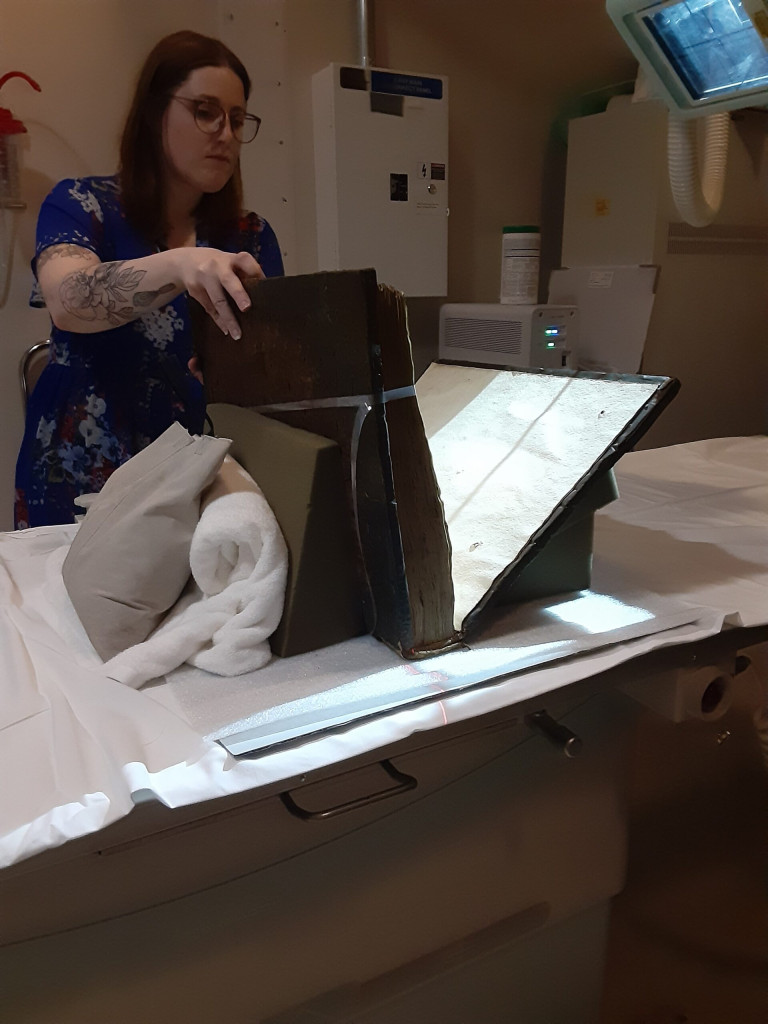
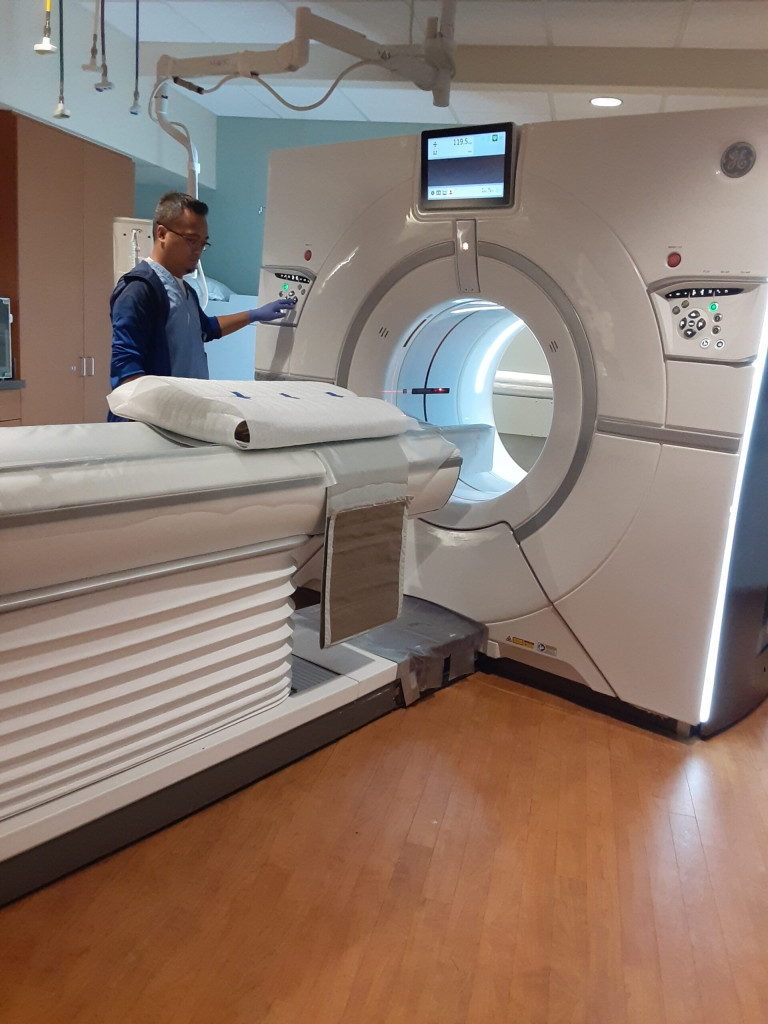
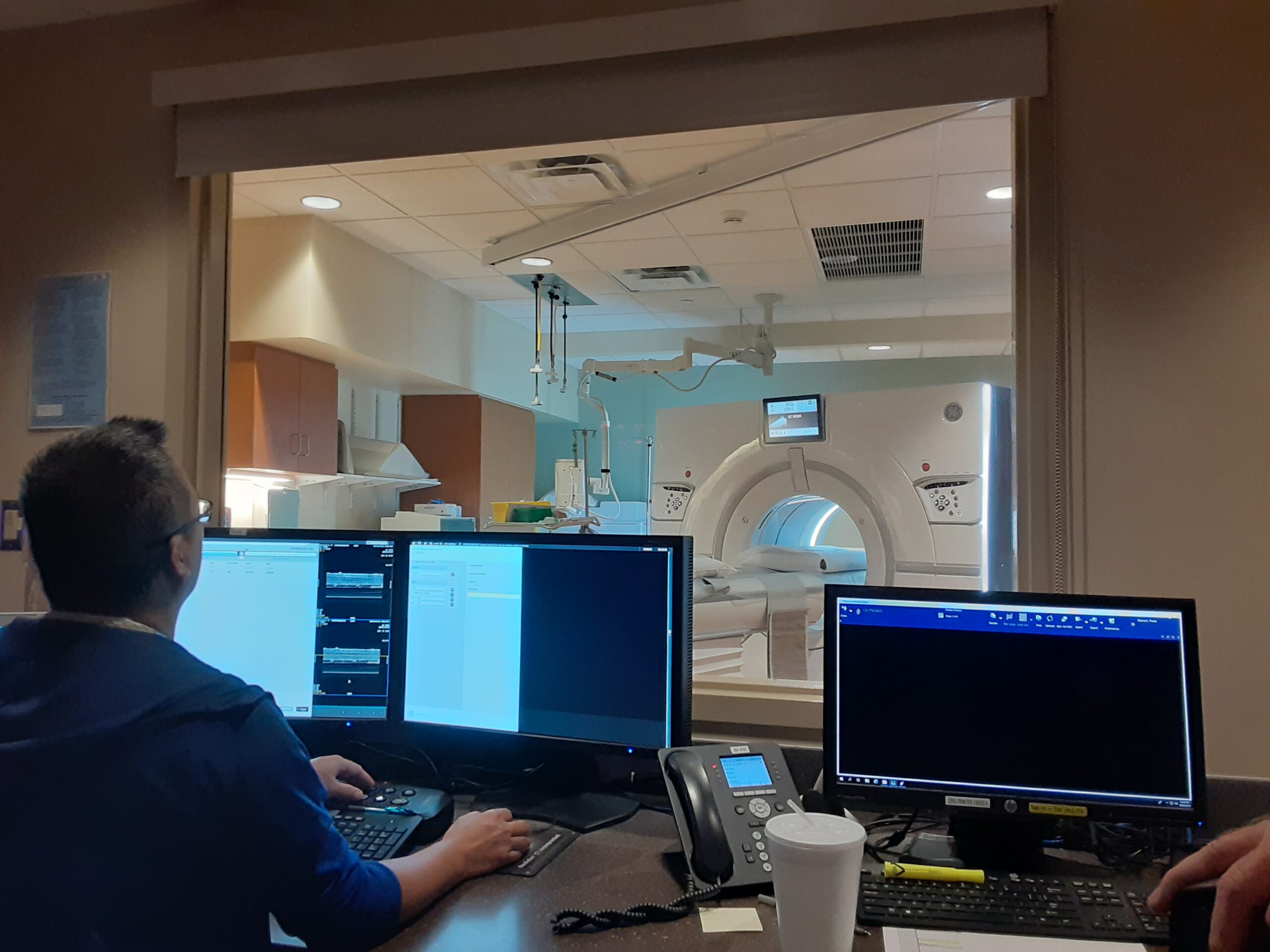
Let’s rewind the story back to mid-2019, when our Associate Conservator, Ashleigh, expressed interest in radiography on a beautiful, oversized choir book from the Classics Library. I, at the time, was the Photographic Documentation Specialist and had never carried out or assisted with any radiography projects, so I was very keen to start reaching out to anyone I could think of on West and East campus who might have access to such equipment. The most logical answer, UC Health, proved to be the winning one when finally the Director of Diagnostic Radiology put me in contact with the Enterprise Director of Imaging, who said yes to my request, and ultimately put me in contact with my main contact for the project, the Radiology Manager at UC Medical Center.

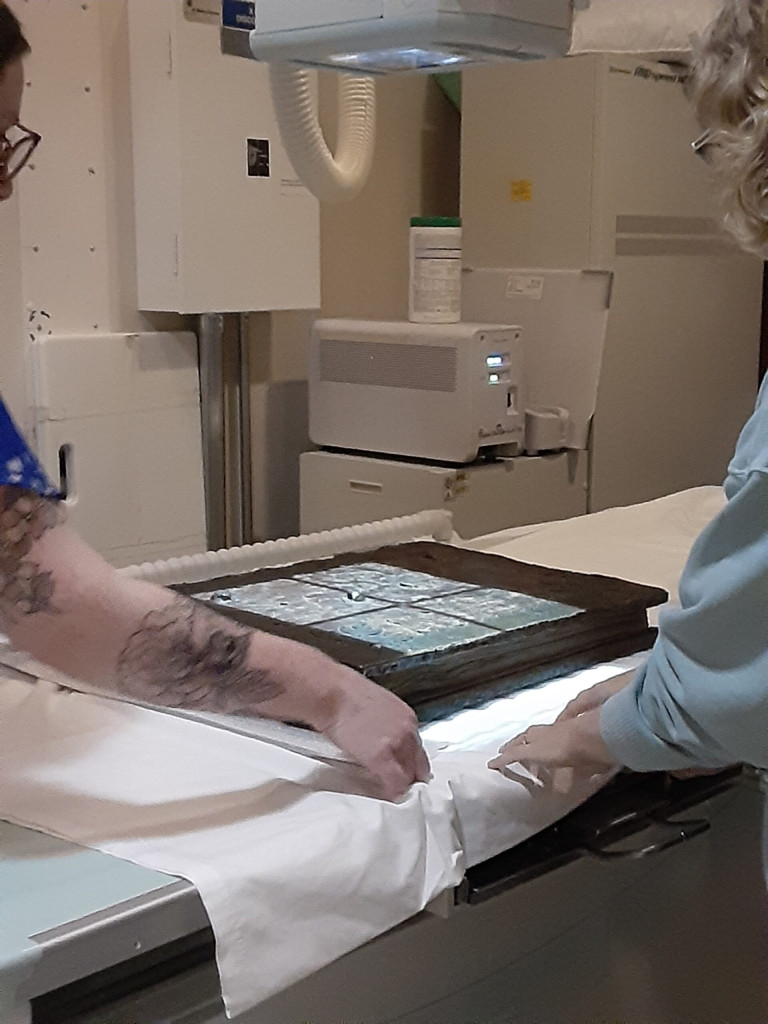
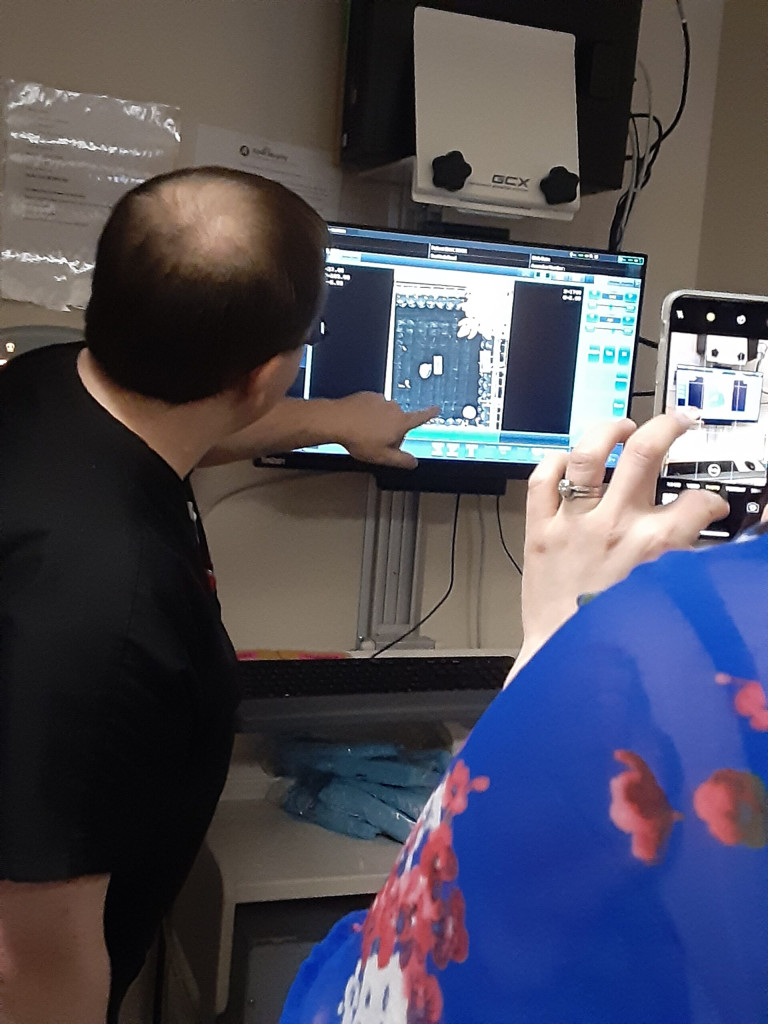
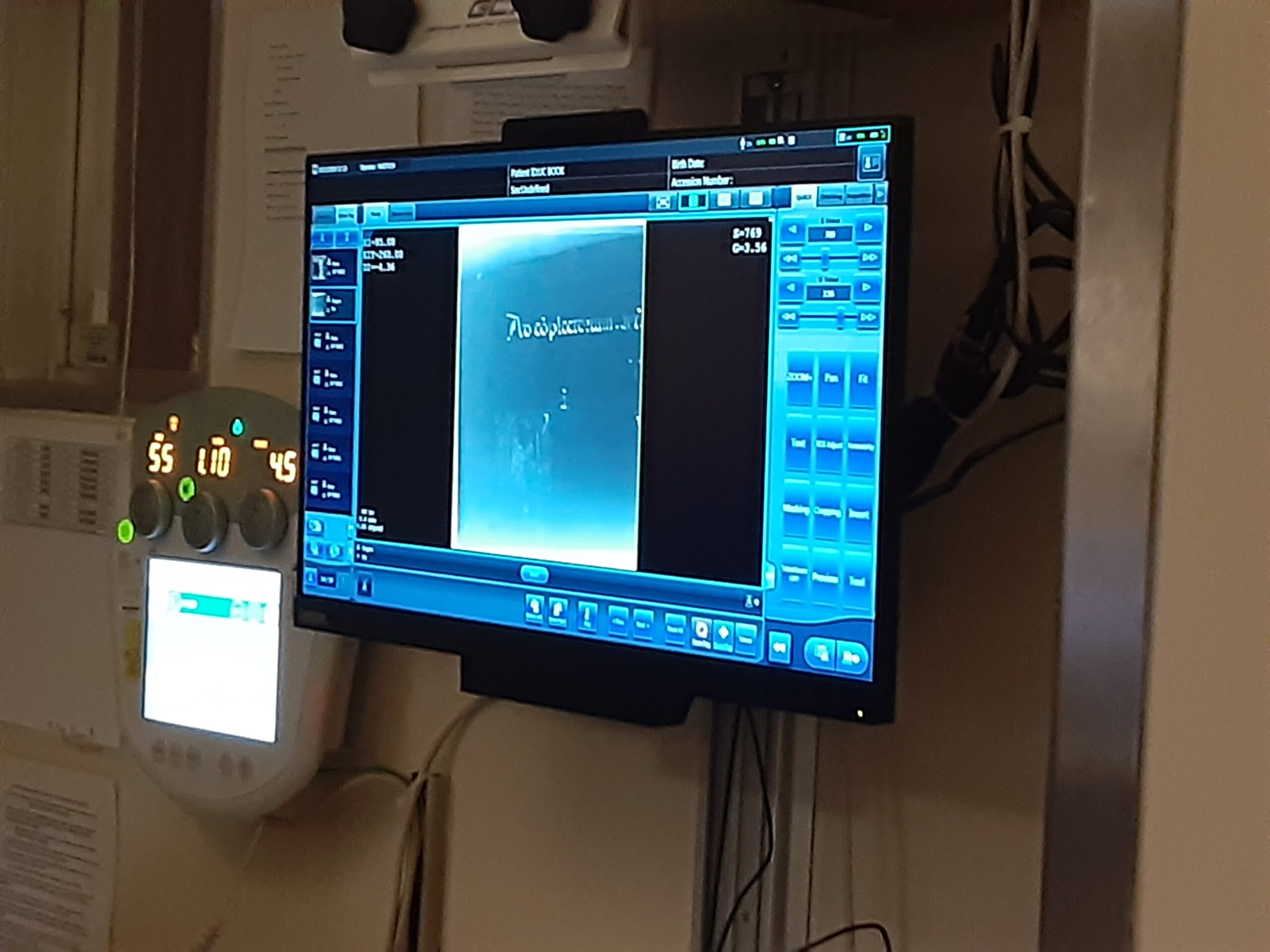
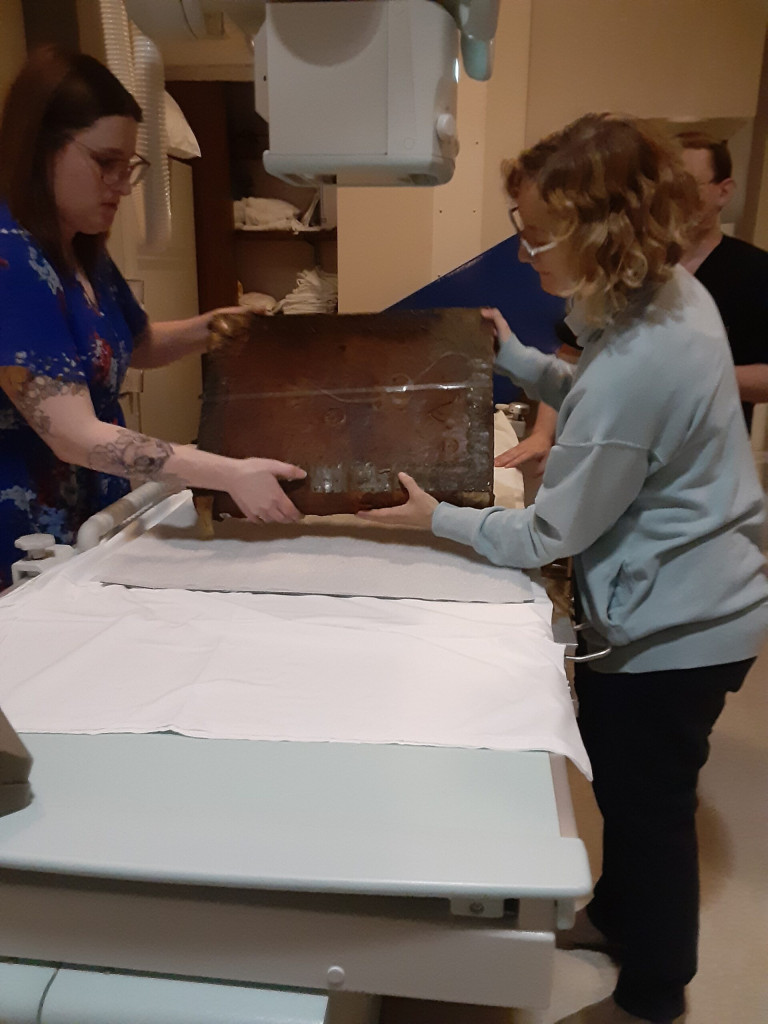
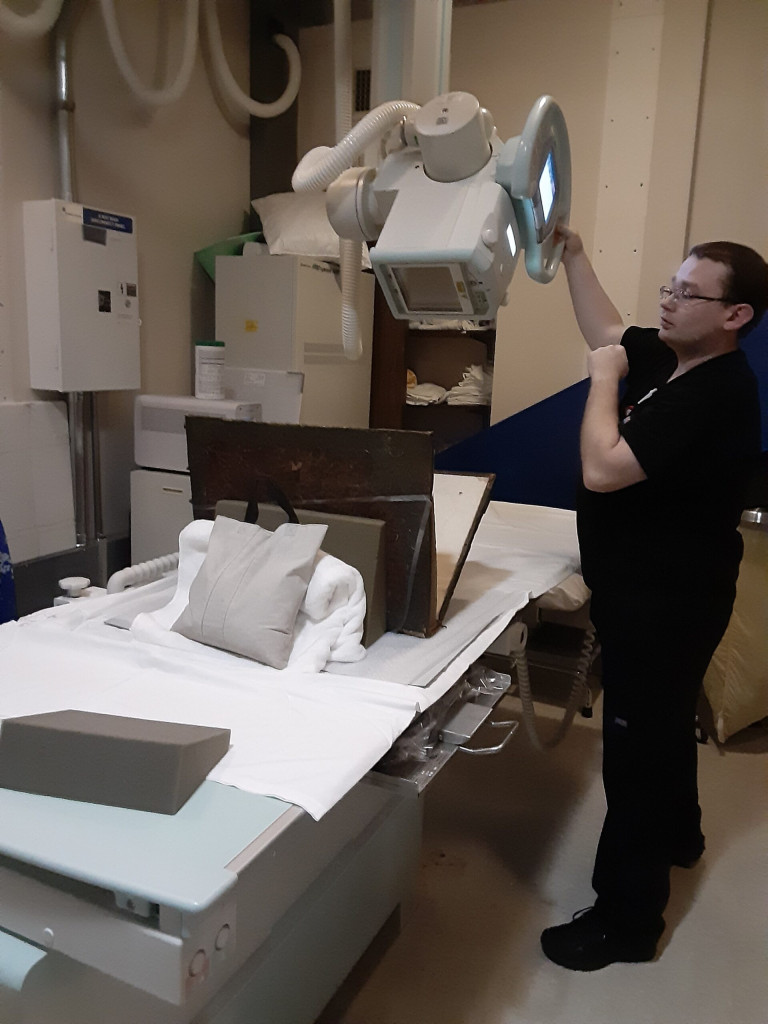
The date was set, October 22, 2019. Ashleigh, Holly and I packed up the heavy, choir book and carefully transported it from West campus to East campus to be imaged. The UC Health staff were beyond friendly, and I think they got a kick out of imaging the oversized leather volume. The technician really worked with us to adjust the intensity of the radiography depending on what we were trying to capture, whether it was the cover, the sewing and the supports, or the illuminated text (which was a little harder to capture with their equipment).

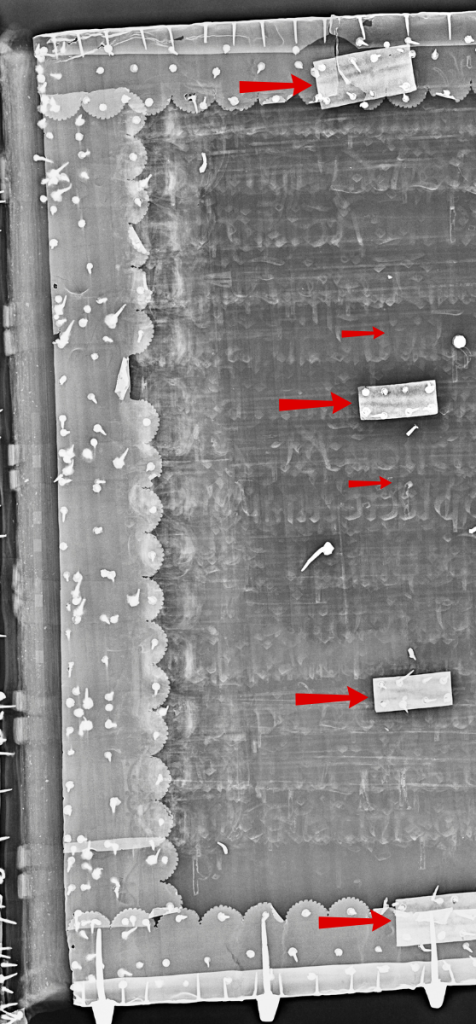
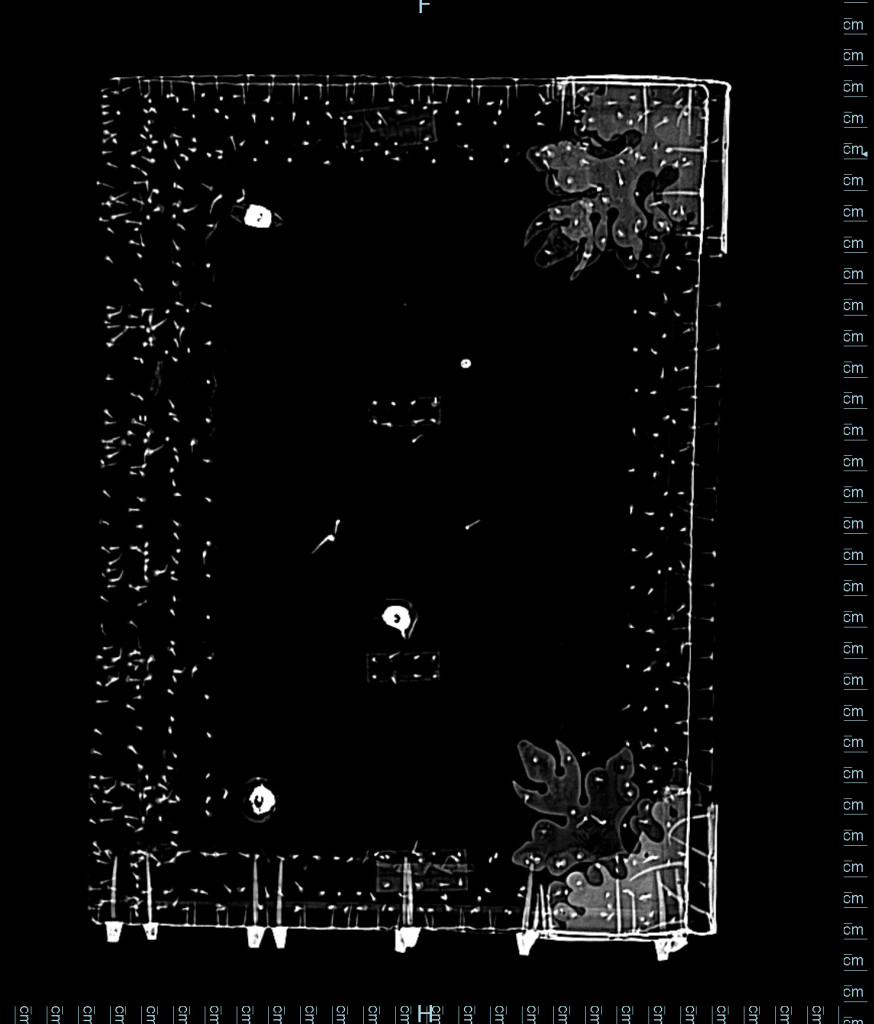
Overall, we discovered…a lot of nails, split thong supports, and on the lower board, four mends to the wooden board that appear to be bracing a split in the wood that is running vertically.

Red arrows indicate metal braces adhered to the wooden boards
The larger red arrows indicate metal braces while the smaller red arrows indicate the crack in the wooden board.
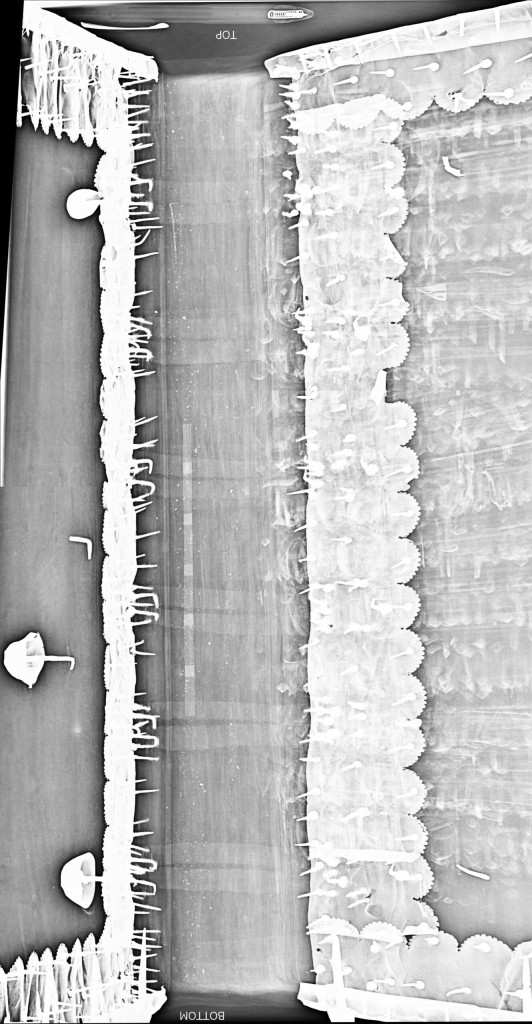
X-ray image of the spine
Image of the spine which allows you to see the split thong supports and you can even see the tattle-tape security strip!

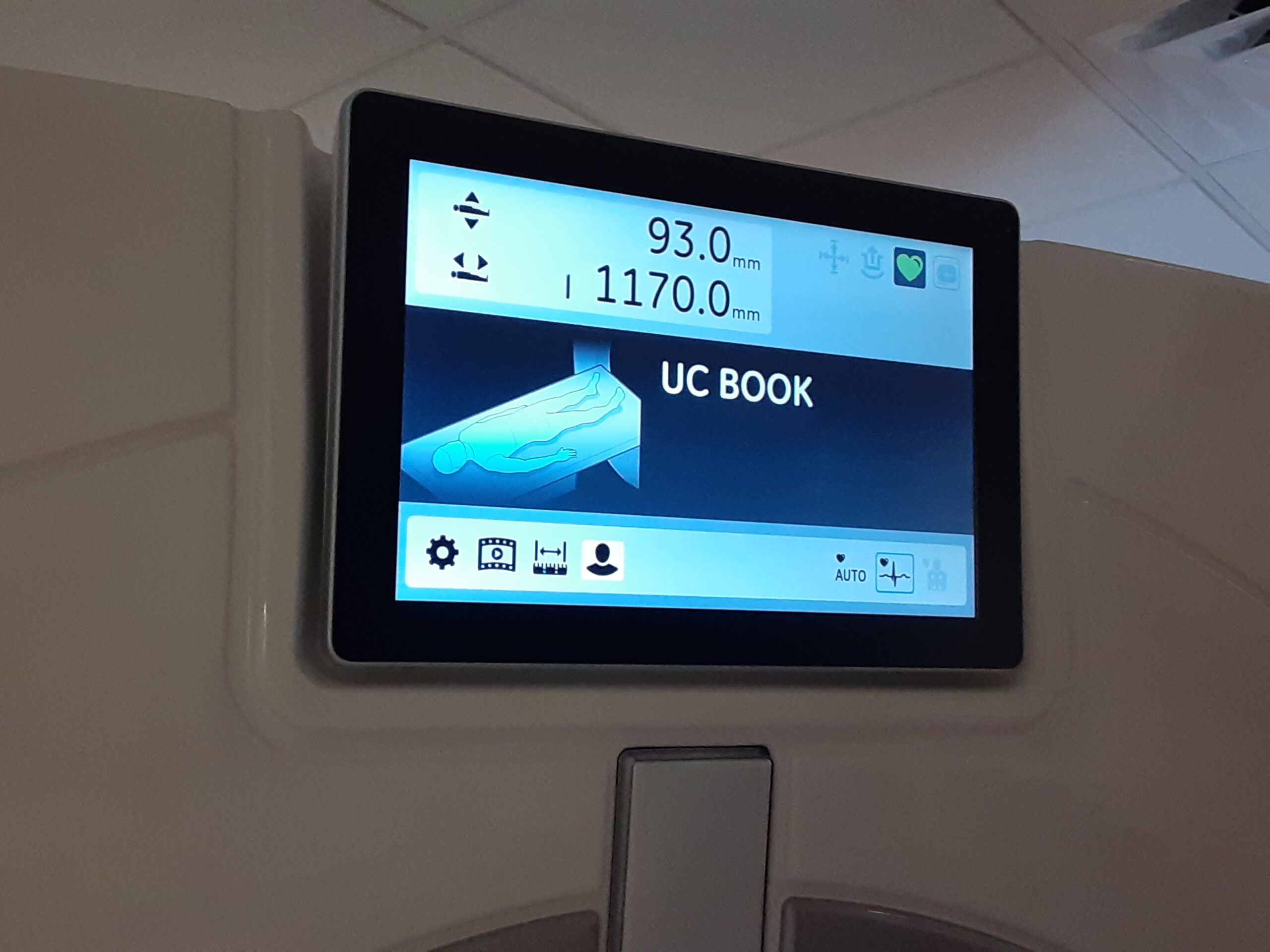
Then following the radiography session, they were kind enough to ask if we would also like to place the volume in the CT scanner. Since the scanner could easily and safely accommodate the volume while keeping it wrapped in foam, we jumped at the chance!

We received all the imaging files on two CDs from UC Health, and then I went about making heads and tails of it. The radiography images were fairly straightforward. For the most impactful imaging, namely of the spine, upper and lower boards, I created composite images using the panorama feature in Photoshop to merge the images. For example, each cover consisted of four separate images.

With the CT imaging, the CD came with a reviewer software (Sorna) to view the files. Frankly, the CT scans were a little bit harder to comprehend, but nonetheless interesting. Ultimately the CT scanner allows you to view the various materials within the object. Whereas normally for the equipment that was used that would mean bones, organs and tissues, for the choir book that meant metal material like brass, leather, ink and pigment. Within the viewer function there was also an interactive component to the CT data as well, which allowed you to manipulate various levels to see various intensities, but even after a lot of trail and error and experimentation I found it very confusing, though I did get some interesting, and some less impactful, results. Let’s just say, I do not have a future as a CT technician!  I’ll stick to my day job.

  • Still image from CT scan
  • Still image from CT scan
  • Still image from CT scan

Jessica Ebert – Assistant Conservator

Historical Binding Structures with Julia Miller

This week the Preservation Lab and the Archives and Rare Books Library hosted a 2-day workshop with the conservator and book historian Julia Miller. The workshop, Identifying and Describing Historical Binding Structure: A Stacks Appraisal Workshop, provided the Preservation Lab staff, University of Cincinnati Libraries’ (UCL) special collections catalogers, and UCL special collections stewards an opportunity to strengthen their skills of historical binding identification and description. We honed our descriptive skills by examining collections from the Archives and Rare Books Library and models/exemplars from Julia’s personal teaching collection.

Julia Miller is in the fore ground holding a highly decorated book that is read with gold stamping and tooling.
Julia Miller presenting to the Historical Binding Structures class.

Thanks to Julia Miller, one of the most knowledgeable and giving people that we have had the privilege to learn from.

Thanks to Chris Harter for providing access to so many Archives and Rare Book treasures and a wonderful space to learn and collaborate.

Thanks to Catarina Figueirinhas for suggesting the course and being the on-site coordinator and organizer.

Lastly, thanks to University of Cincinnati Libraries for their continued support of staff professional development!

Holly Prochaska [UCL] — Preservation Librarian

Problem Solving: An Exhibition-Style Enclosure for a Collection of Lafcadio Hearn Japanese Bindings

This set of Japanese side-sewn, crepe paper bindings, or Chirimen-bon, came to the Preservation Lab housed in their damaged traditional Japanese wraparound case, known as a maru chitsu. The set belongs to the Cincinnati and Hamilton County Public Library, which has an extensive Lafcadio Hearn collection. This collection of volumes was printed by Hasegawa Takejirō, a Japanese publisher who specialized in books written in European languages on Japanese subjects. The Japanese Fairy Tale Series was one of the more popular series, beginning with six volumes in 1885; though this later collection only has five volumes of fairy tales. Lacadio Hearn was one of the foreign translators employed by T. Hasegawa.

Due to the high profile nature of Lafcadio Hearn for the library and the beauty of the bindings, the collection is often shown during tours and used for display, however, the crepe paper volumes, while in excellent condition, are extremely floppy, and they are also side-sewn, both factors make them difficult to handle and display. The original enclosure is also very fragile and damaged, and susceptible to further damage if used as an enclosure moving forward. For all these reasons, the curators wanted an enclosure that would not only store the collection long-term, but could also be used for display.

This proved to be a challenge, but a fun one. I started by making a couple of sketches and then a couple of models…

Three models pictured, two are collapsible cradles and one display stand with foam insert
Models – two types of collapsible cradles and one model of the display tray/stand

For the models, I had two main focuses: 1) a collapsible cradle that would house and display one of the volumes, and 2) a display component that would act as a tray or level within the enclosure and house the remaining four volumes, in two stacks of two, side by side.

I will always advocate for making a model if you are trying to work through a new enclosure or adjust an existing enclosure or display piece, like a cradle. For example, I knew that a normal collapsible cradle wasn’t going to fit the bill for these volumes. Instead, I was going to need a stiff, squared off spine piece built into the cradle to help support the bindings’ spines.

One of the main areas I had to troubleshoot was the display tray, which would house the four remaining volumes. I knew I wanted to create a stand that would basically replicate one side of a collapsible cradle and have a 1/2 inch Plastazote foam insert, which happened to nestle the thickness of two volumes perfectly, that was covered in Tyvek. But I had concerns about gravity and reliability of PVA to hold the foam insert in place overtime. And I wasn’t happy with my initial ideas of how to remove the volumes (and also the original enclosure and collapsible cradle) from the insert(s), which consisted of a tab underneath the volume. It created friction that would ultimately cause damage to the actual volumes.

Ultimately, I am extremely happy with what I came up with. I think it functions very well, and checks all the boxes it needed to check. Safe, secure storage. Elegant display. User-friendly.

The display stand includes a cloth tape inserted into the boards to keep it from opening too far, a foam insert covered in Tyvek, a lip to support the foam insert overtime, and two polyester film slings to aid in removing the volumes from the foam insert. The polyester slings proved to be an excellent solution for removing all the elements from the enclosure safely and easily.

For those interested in how some of the components were constructed, here are some in-progress images…

Because of the way the trays/components of the enclosure are constructed, they are actually interchangeable. So if the “lower tray” with the original enclosure and collapsible cradle ends up on top of the display tray/stand, that’s not an issue at all. And there is a 1/4 inch Volara foam piece adhered to the outer tray of the clamshell enclosure, so whatever items are on top will be cushioned by soft foam in the enclosure.

Get a full tour of the enclosure by watching our reel on Instagram:
Jessica Ebert [UCL] – Assistant Conservator

Nests and Eggs on Display at the Cincinnati Symphony Orchestra

Illustrations of the Nests and Eggs of Birds of Ohio are on display at the Cincinnati Symphony Orchestra March 1st and 2nd as part of a musical program honoring Oliver Messiaen who was both a major composer of the 20th century and an ornithologist.

Synesthesia

Oliver Messiaen is well known for studying bird songs and interpreting their notes into musical transcriptions. His works are also unique in that Messiaen experienced synesthesia which greatly influenced his creations. Synesthesia is when a person perceives more than one sense at a time, such as Messiaen who experienced colors when listening to music and was able to see sounds. 

Cincinnati Symphony Orchestra Program

The program at the CSO honors Messiaen by incorporating both music, color, and bird visuals to invite the audience to experience a unique multi-sensory experience. Messiaen’s Des canyons aux étoiles (“From the Canyons to the Stars”) will be performed  by the conductor, Matthias Pintscher, and pianist Pierre-Laurent Aimard.

Nests and Eggs on Display at the Cincinnati Symphony Orchestra
Click the image for a link to the digital program for the CSO Proof: From the Canyons to the Stars

“Inspired by his visits to Utah’s Bryce Canyon and Zion National Park, Messiaen’s Des canyons aux étoiles (“From the Canyons to the Stars”) depicts the birdsong and red rock hues he experienced during his time in the desert… Accompanied by immersive video-art, Springer Auditorium will be transformed, allowing listeners to escape into the southwestern landscape and experience a synesthesia of their own.” – As described by the CSO website

Nests and Eggs

Complementing the musical performances, on display will be a page from Cincinnati and Hamilton County’s Illustrations of the nests and eggs.  The page showcases a local Ohio native, the Wood Thrush, who lays bright blue colored eggs within a nest made of old leaves, dried grasses and moss (rarely sticks).  The nest of the Wood Thrush also contains “rootlets” placed intentionally inside of the nest, resulting in a pinkish brown or black lining. The nest is “plastered” with a thin mud that is easily missed as it’s thoroughly worked in and covered.

Nests and Eggs, while lesser known than Audubon’s Birds of America, is quite extraordinary in how it highlights the uniqueness of the construction of nests made by different bird species. Take for instance, the Baltimore Oriole’s nest, which primarily consists of strings and flax fibers to create a soft and long pocket.  Compare that to the more traditional nest of the Wood Thrush whose home is bowl-shaped with a wide opening.

Nests and Eggs on Display at the Cincinnati Symphony Orchestra
Baltimore Oriole – Plate 1
Nests and Eggs on Display at the Cincinnati Symphony Orchestra
Wood Thrush – Plate II

It’s also extraordinary that the illustrations are detailed lithographic portraits created by Gabrielle Estelle Jones and her family, despite not having been formally trained.  Their work was intended to be used as a companion volume to John James Audubon’s Birds of America.  While not as large as the Birds of America double elephant folios, Eggs and Nests is still an impressively large-sized volume. 

Gabrielle “Gennie” Estelle Jones

The following excerpt was written by Sara Williams, Arts & Special Collections Reference Librarian:

Illustrations of the Nests and Eggs of Birds of Ohio was a project begun by Genevieve Estelle Jones, a native of Circleville, Ohio. Born May 13, 1847, Genevieve, or Gennie, spent much time as a young girl birdwatching in the woods and wetlands with her father, an amateur ornithologist. Just before the age of 30, Jones’ father forbade her from marrying the man she loved, and in 1876, she visited the Centennial World’s Fair in Philadelphia to take her mind off her broken heart. While there, she viewed hand-colored engravings from John James Audubon’s vibrant The Birds of America. Inspired by Audubon’s example, Jones set out to illustrate the nests and eggs of birds, an aspect often missing from his work. Jones completed only five illustrations for her book before she died of typhoid at the age of 32. The work was eventually completed by Genevieve Jones’ family. Only 90 copies of the book were published, of which only 34 are currently known to exist.  

Preservation

As part of the Preservation Lab’s role in displaying the object, a condition report book was created to accompany the item to ensure the object’s condition is preserved. This helps those who are installing anticipate any possible challenges in supporting fragile pages or bindings. In this case, the upper endsheets are extremely brittle and have been previously repaired, but could break again if not carefully draped and held with polyester strapping in a safe manner.

After determining a proper exhibit case to fit and secure the binding, a custom cradle was made. To protect weak points of the binding on display, a support was constructed out of 8 ply museum mat board to support the heavy and oversized pages from stress along the joint.  

Nests and Eggs on Display at the Cincinnati Symphony Orchestra
Solutions were tested to fit within an 18 inch deep case, however, the book was just too large!
Nests and Eggs on Display at the Cincinnati Symphony Orchestra
A custom 8 ply mat board cradle was created to fit within a more appropriate 4 ft case. Pages are strapped with polyester strapping

Before an object travels, it’s often reviewed to make sure it can handle transport and treated if necessary.  Luckily, in this case, the binding was treated in 2016 and is still in great condition for its age.  When it received treatment, at that time it received a lightweight yet strong enclosure that will also work well to safely protect the item for travel to the CSO.

Nests and Eggs on Display at the Cincinnati Symphony Orchestra
Corrugated banker’s box with a drop spine houses the Nests and Eggs book. Binding and exhibit labels are ready for packing.
Nests and Eggs on Display at the Cincinnati Symphony Orchestra
A 4-foot case was kindly loaned to the CSO from the Behringer-Crawford Museum and is ready for use! (Image credit: Amber Ostaszewski)
  • Nests and Eggs on Display at the Cincinnati Symphony Orchestra
  • Nests and Eggs on Display at the Cincinnati Symphony Orchestra
  • Nests and Eggs on Display at the Cincinnati Symphony Orchestra
  • Nests and Eggs on Display at the Cincinnati Symphony Orchestra
  • Nests and Eggs on Display at the Cincinnati Symphony Orchestra
  • Nests and Eggs on Display at the Cincinnati Symphony Orchestra
  • Nests and Eggs on Display at the Cincinnati Symphony Orchestra
  • Nests and Eggs on Display at the Cincinnati Symphony Orchestra

Additional Resources

Interested in seeing more Nests and Eggs?  The entire binding is conserved and digitized where it is made publicly available online. More information about Gennie’s fascinating and tragic history can be read at the Linda Hall website.

CSO Program Dates

There are two programs where you can view the item on display, Friday, March 1st and Saturday, March 2nd, both at 8pm at the Music Hall. Interested? Click here for the digital program.

We hope to see you there!

Ashleigh Ferguson Schieszer [CHPL] – Book and Paper Conservator, Co-Lab Manager