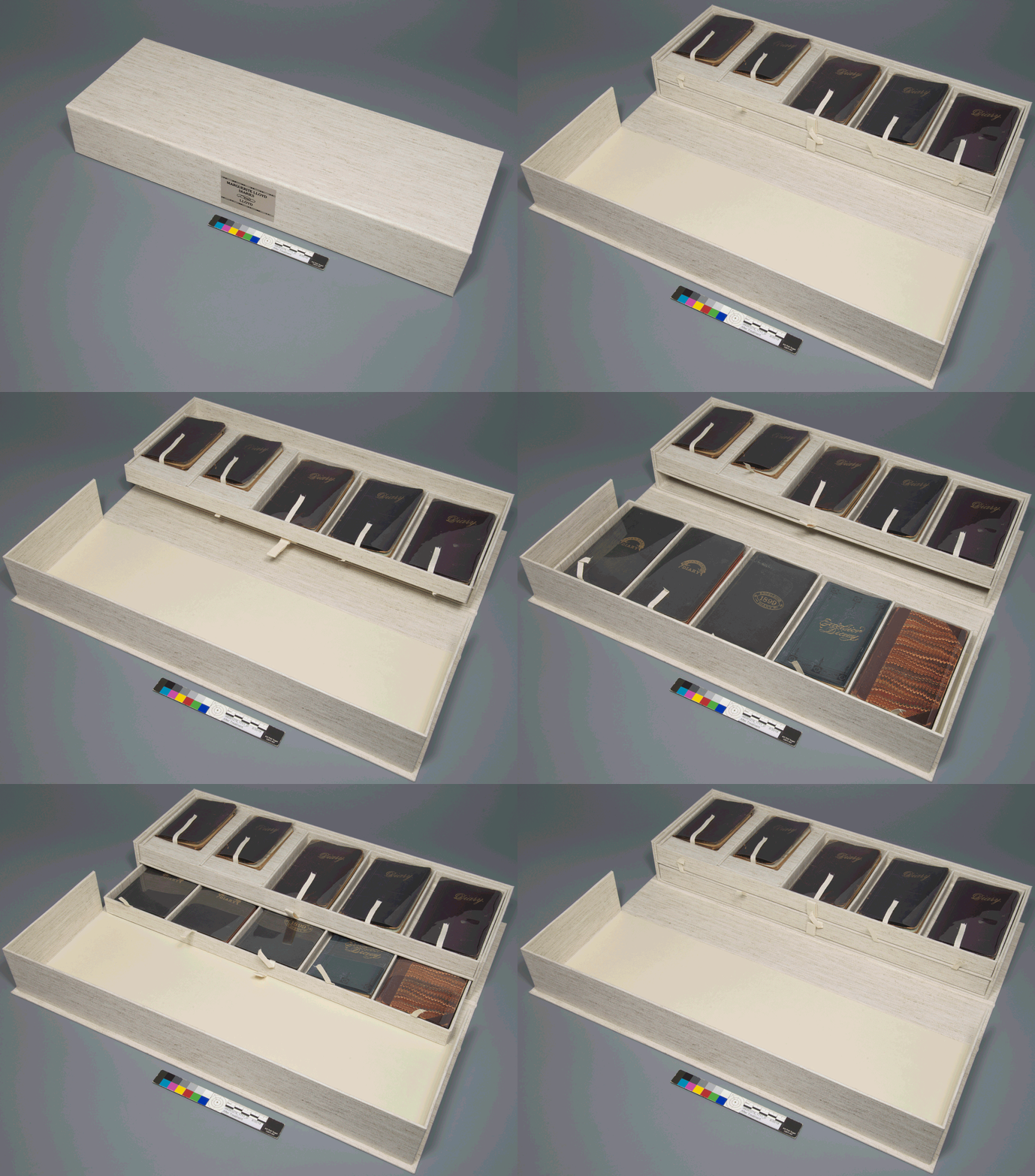
I just had to share this beauty of a box that was made by conservation technician, Chris Voynovich, to house the Public Library’s collection of Marguerite Lloyd’s diaries. These ten diaries are part of the library’s Genealogy & Local History Department. Marguerite Lloyd was the daughter of Major Harlan Page Lloyd, the former law partner of Alphonso Taft, the father of President William Howard Taft.

Chris created this lovely cloth covered clamshell box with two removable trays that each house 5 diaries. The compartments for the two smaller diaries have a custom fill to accommodate for their smaller size. All the diaries have received a polyester jacket and the linen tabs under each volume make them easy to remove and handle.
Jessica Ebert (UCL) – Conservation Technician, Lead Photographic Documentation Tech
Tag Archives: Jessica Ebert
Fun with PhotoDoc: Infrared Again (Edition 8)
It’s been a while since my last Fun with PhotoDoc post, so I wanted to share some progress I’ve been making with Reflected IR. You might remember from my last PhotoDoc post, we purchased a modified UV-Vis-IR camera from MaxMax at the end of 2017. Our first two objects we (Ashleigh and I) examined and documented with the camera were a great learning experience, but didn’t exactly leave me with goosebumps. Still it was a good experience and we worked out the use of the various filters and the general IR workflow.
Fast forward to April when the lab received not one but two books from UC in need of IR photography. The first was the Masters thesis of Ralph E Oesper from the Oesper History of Chemistry collection. The curator wished to exhibit several of the pages from the volume, but upon inspection Ashleigh (our conservator) was concerned that the purple text ink might be dye based, which is very light sensitive.
- Normal illumination image
- Near infrared image
The ink disappearing under near IR is a clear indicator that the ink is most likely dye based, and while that made Ashleigh very happy and validated her choice to create printed surrogates of the pages for exhibition, I still felt a little less than wow’d. I was still waiting for a really compelling and dramatic IR example.
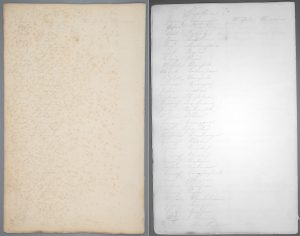
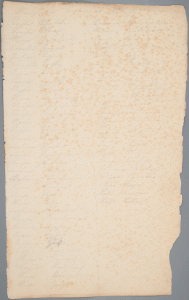
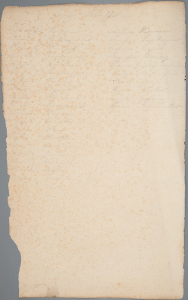
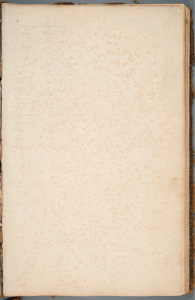
Enter volume 1 from the Third German Protestant Church of Cincinnati collection, an 18 volume collection of early Cincinnati baptismal, marriage, and funeral records from the Archives and Rare Books Library that pre-dates the city records. In this case, Ashleigh wanted me to examine and document 4 pages within the volume with faint graphite inscriptions on paper with heavy foxing.

Side by side comparison of one page under normal illumination and near infrared
Finally! A satisfying IR session with helpful results. Documenting all four pages using reflected IR allows for the foxing to disappear from the page, thus making the faint graphite inscription easier to read. After converting the IR image to grayscale I also upped the contrast significantly, allowing for better readability of the handwriting. In the end, we now have four pages of legible inscriptions and I’m very happy with the results.
Click on an individual image to see the gif in action for that page…
I definitely still have a lot to learn when it comes to near infrared photography, but I would call this, not only a satisfying experience, but progress that will hopefully lead to a better workflow. This round of IR photography definitely was not seamless, but I did learn more, as I do every time I shoot, and it is my hope that the more I do the more I will streamline and improve our IR workflow.
Jessica Ebert (UCL) – Conservation Technician, Lead Photographic Documentation Tech
2018 Preservation Week Open House Video
Were you unable to attend our annual preservation week open house at the end of April? OR maybe you did attend but didn’t get to see everything you wanted? Well, have no fear! I’ve created a quirky little video to encapsulate (fyi, that’s a scrapbook conservation joke) all the excitement, activity, and overall bombardment of information and cool stuff to your senses that our open houses generally entail.
A big thank you again to everyone who was able to make it and celebrate Preservation Week with us. This was definitely our biggest, most jammed packed year yet and it was so much fun! If you missed the event, definitely mark your calendars for next years’ preservation week, April 21-27, 2019 and stay tuned at the beginning of 2019 for an exact open house date. Until next time…

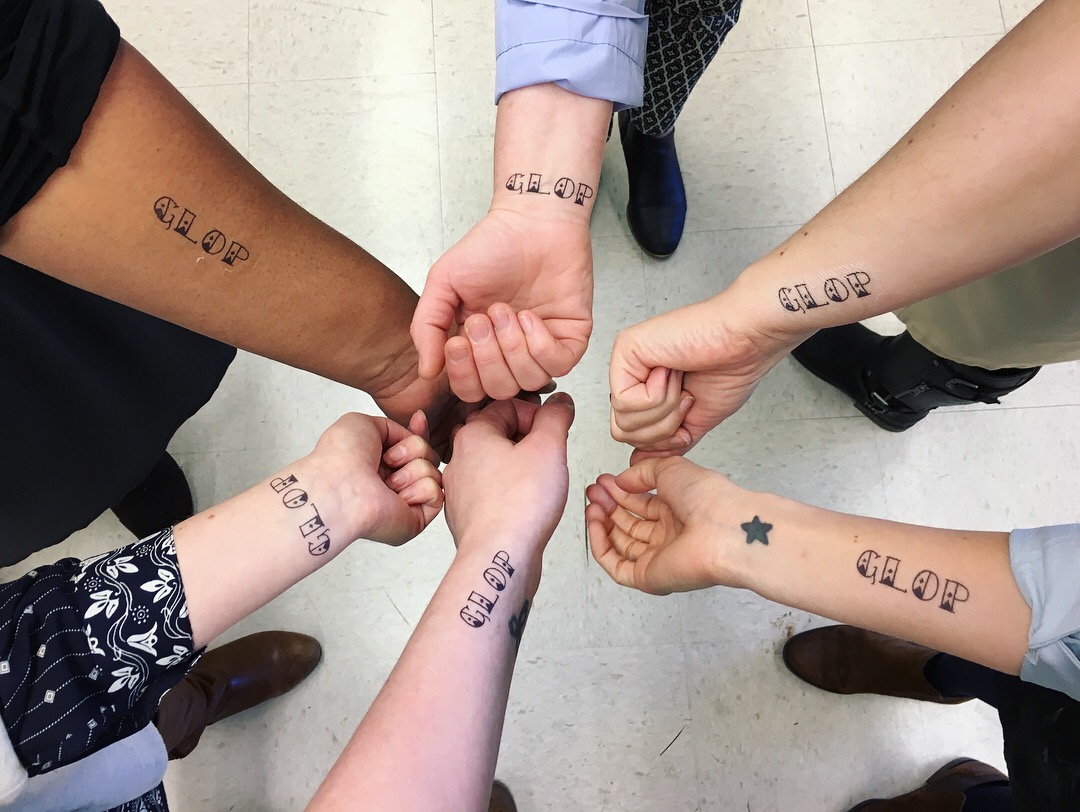
Our conservator, Ashleigh, ordered these GLOP custom temporary tattoos for all the staff members and we all couldn’t wait to sport them during the event! GLOP is our little nickname for our team and our preservation friends and it stands for Gorgeous Ladies/Lads of Preservation.
Jessica Ebert (UCL) – Conservation Technician (and maker of quirky Lab videos)
Open House Success
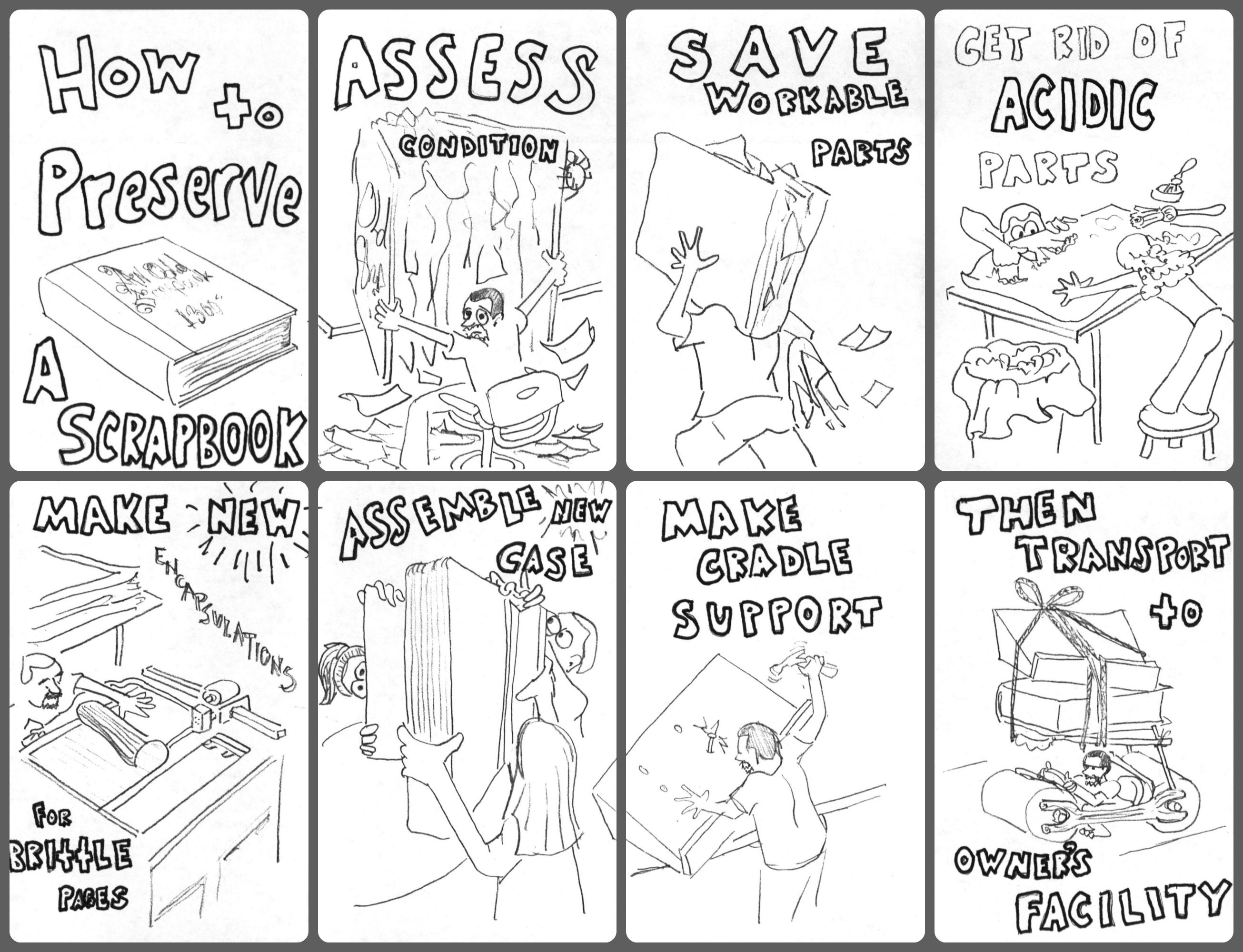
A big thank you to everyone who was able to attend our Preservation Week Open House last Thursday! It was a great success and we all had so much fun sharing what we do with everyone. If you were not able to attend, we wanted to share the awesome comic that our very own Chris Voynovich (conservation technician) created just for the event.
ScrapbookOnePgWonder_CV_withInterior
Attendees were able to create their own one-page wonder featuring this comic and then had a chance to flip through the Madisonville Branch Library’s scrapbook that inspired the comic. Those who attended were also able to explore various artist book structures by viewing and handling (and in some cases, just admiring from a far) collection items from the DAAP Library’s artist book collection. The evolution of the book was a central theme with attendees learning about pre-codex structures (like cuneiform tablets and scrolls), early codex structures (with a foray into medieval bindings and parchment), and modern structures like the ever complex scrapbook. Attendees were able to stamp their own book mark, featuring a quote by P.J. O’Rourke, and learn about RTI, how the lab has improved their capture process, and view the results from a recent RTI project featuring cuneiform tablets. And of course, attendees were able to grab a Busken cookie featuring our Preservation Lab logo. It was a great event!
Make sure to mark your calendar for 2019 Preservation Week (April 21–27) so you can come down, visit the lab, and see the cool stuff we’re working on. I’m also working on a little video of the event, so stayed tuned and check out our MediaSpace channel for updates in the near future.
Jessica Ebert (UCL) – Conservation Technician & Lead Photographic Documentation Tech
The Preservation Lab…in the news
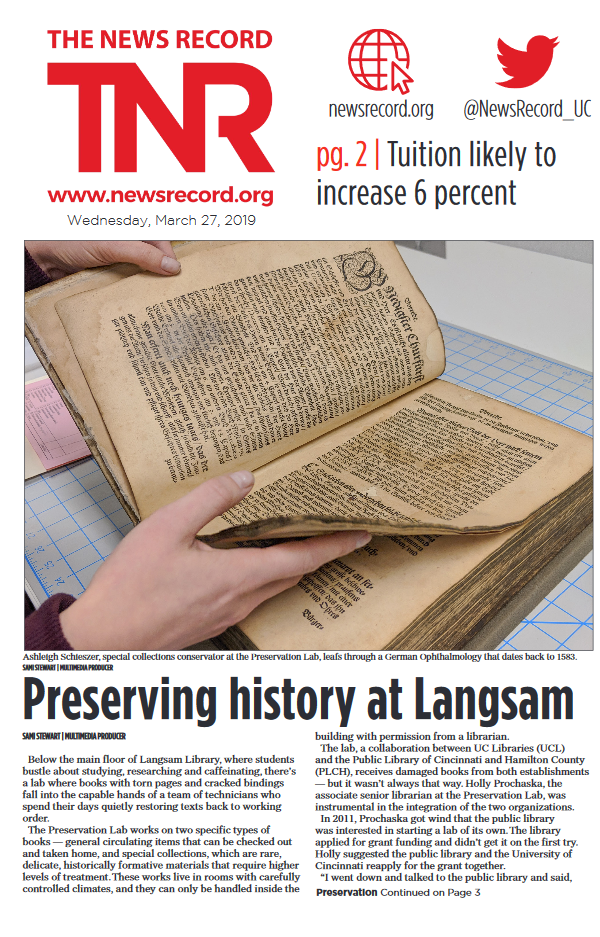
Check out this new article about the work of the Preservation Lab by our collaborator Melissa Norris, with assistance from Ashleigh Schieszer, Jessica Ebert, and Kevin Grace at https://libapps.libraries.uc.edu/source/preserving-taft/.
Isn’t Preservation just so cool!
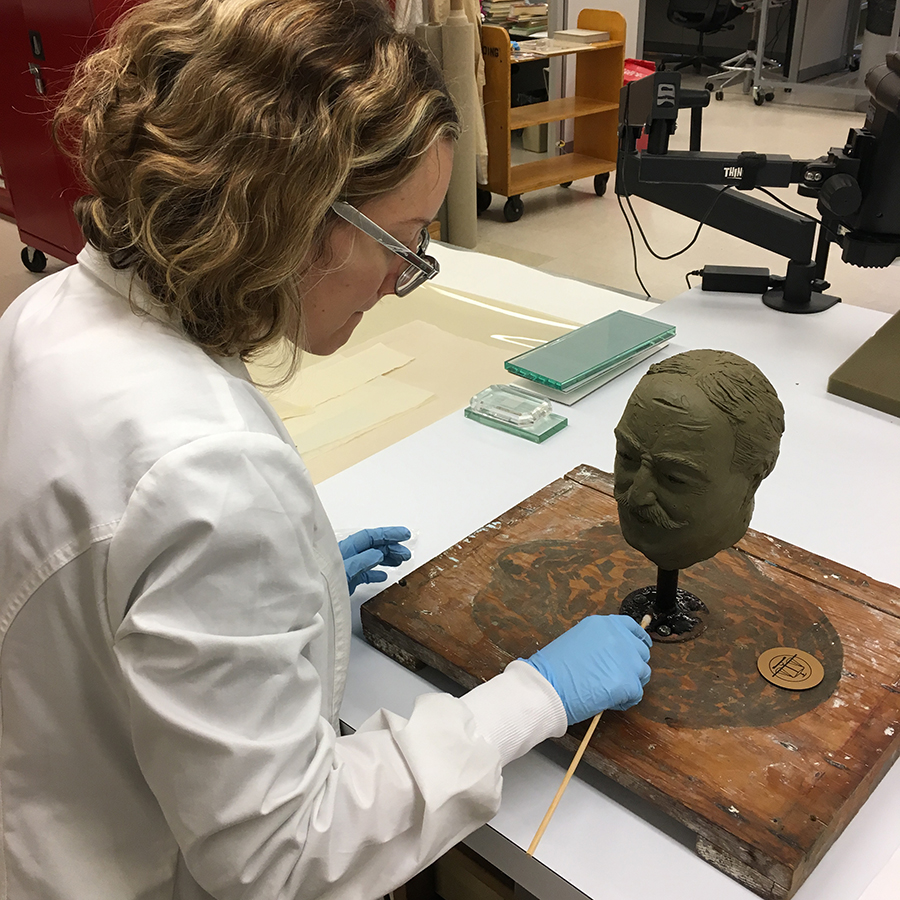
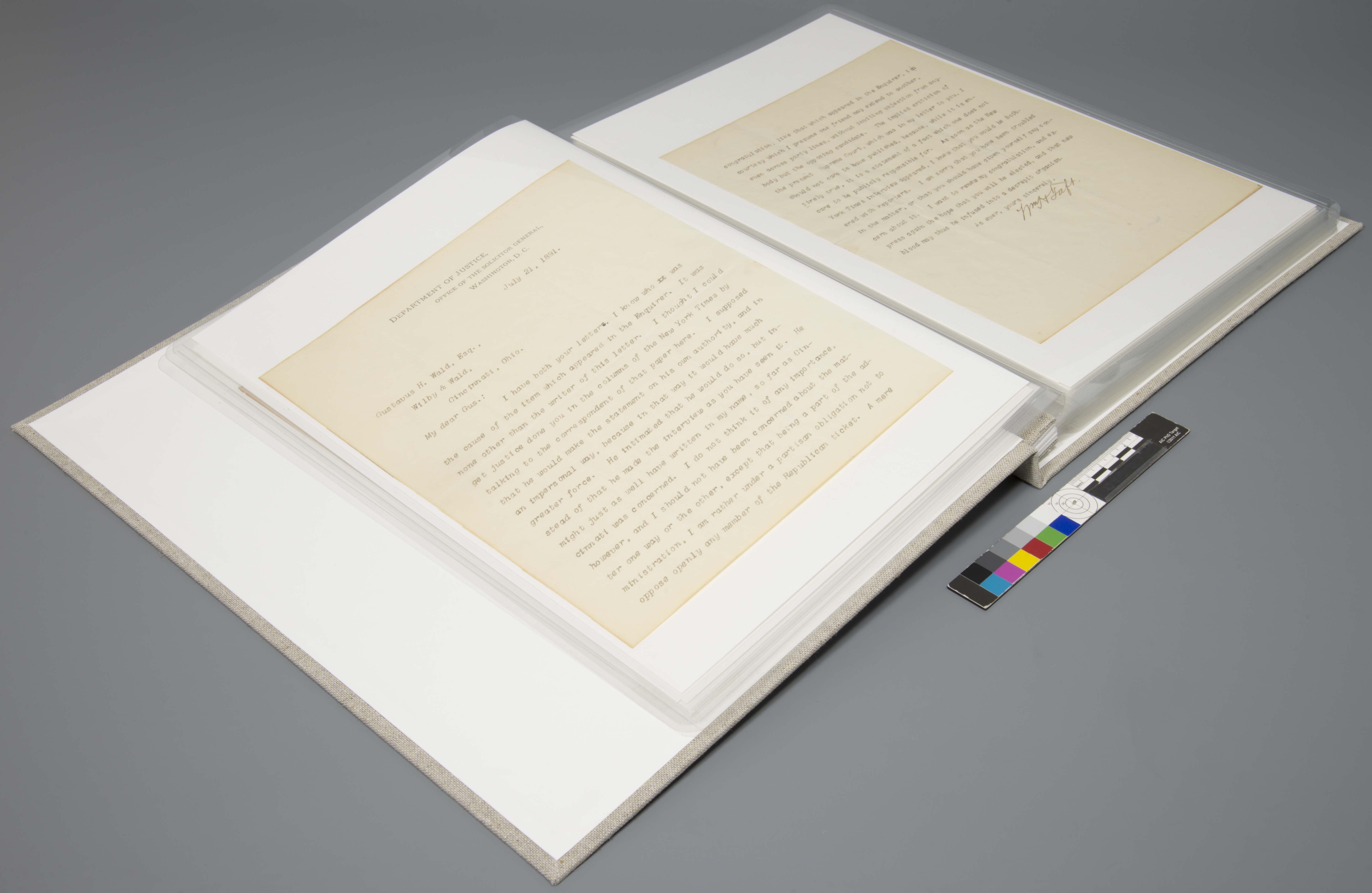
And for our loyal followers a bonus image of the housing of the William Howard Taft letters…
Fun with PhotoDoc: Infrared (Edition 7)
At the end of last year the lab purchased a modified UV-Vis-IR Nikon through MaxMax so that we can start to play around with infrared photography. Infrared photography (IR) is commonly used in fine art conservation as an examination tool. Reflected IR can be helpful when trying to identify pigments, inks, coatings, etc. and transmitted IR can helpful for viewing watermarks, underdrawings, and linings. We’ve only just started dabbling with IR photography, but I wanted to share some photos from my most recent session with reflected IR.
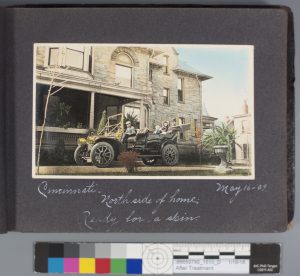
This is a full leather photo album from the Public Library of Cincinnati & Hamilton County’s collection. This early 1900s photo album contains hand-colored silver gelatin photographs taken by A. Nielen. The photographs appear to depict his travels through the US and Canada, and various landmarks and neighborhoods of Cincinnati are represented.
- Before treatment
- After treatment
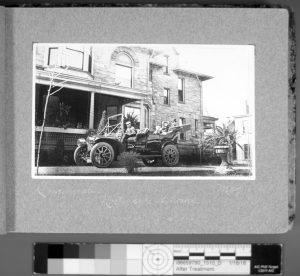
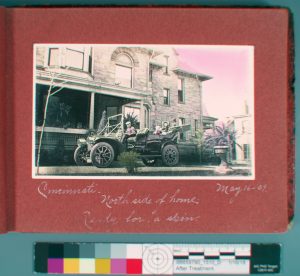
This seemed like a good object for reflected IR because of the hand-coloring on the photographs and the white ink inscription below each photograph. I began by taking a representative visible light image (first image below) using our modified UV-Vis-IR camera, incandescent lighting, and the X-Nite CC1 filter on our 50mm lens. Then, being careful not to move the position of the camera or the object, I switched to the X-Nite 830 filter (830nm) and converted that image to grayscale in Photoshop (second image below). Then I took my visible light image and my reflected IR image into Photoshop to create the false-color image (third image below). The digital false-color image is a combined representation of the visible and infrared images, and it’s actually quite simple to make. You basically copy and paste the various channels for the VIS and IR image as follows, green to blue, red to green, and IR to red. The false-color image allows you to better differentiate and characterize the various materials (pigments, inks, etc.) and potentially even identify them if you have sufficient known samples to use as references.
- Normal illumination
- Near infrared with wavelength at roughly 830nm
- False color
Like I said, we’ve only just started using IR and we’ve got a long way to go, but I’m looking forward to experimenting and learning more about it as time goes on.
Jessica Ebert (UCL) – Conservation Technician & Photographic Documentation Tech
Making the Perfect Wheat Starch Paste
As I’m sure anyone in a book & paper lab will attest, good wheat starch paste is key to most, if not all conservation treatments. And achieving that perfectly smooth and lump-free paste is often easier said than done. So when the Preservation Lab crew returned from UC’s winter seasonal days off, the first thing on the docket for our resident paste maker, Veronica Sorcher, was to make a brand new batch of wheat starch paste to start the new year off right! My purpose in documenting her through this process was two fold: first, it’s been ages since I’ve made paste myself (because Veronica almost always does it – she loves it and we love her for always making it!) and I could use a refresher, and secondly, I thought it would be interesting to show the making of (or behind-the-scenes, BTS, if you will) of something so core to the day-to-day conservation in the lab. To give those who might not understand how much attention is put into the quality of every aspect of what we do here in the lab. Plus, I thought it might be fun! I hope you enjoy…
A huge thank you to Veronica for being the paste making master she is and allowing me to film her and to Catarina for allowing me to film her while she strained and used the lovely paste that had just been made.
Jessica Ebert (UCL) – Conservation Technician
Our Students
As the end of the year is drawing to a close (this is our last day before UC’s winter seasonal break when the university is closed until the New Year!!) I find myself looking back at the past year in the lab and thinking of all the things we’ve accomplished, individually and as a team. I know all of us in the lab consider ourselves very fortunate, our work is fulfilling and interesting and we are continuously surrounded by a great group of dynamic and talented people. And as the student supervisor for the lab, I have to say, our students have made this year even more stellar. They’re just the best! Ask any staff member in the lab and I’m sure they’ll say the same exact thing, we are so lucky to have the group of passionate, energetic, and skilled students that we have working with us.
Each year, instead of the usual departmental pizza party for students, the lab sets aside some time to thank our students and volunteers for everything they do for us by having two days of fun activities for our students and volunteers. These “fun days” are generally around finals, when the students are reaching the end of the semester and their holiday break, and usually involve activities that tie back into bookbinding/book arts/conservation/etc. somehow. This year we enjoyed papermaking, pulp painting, explosion books/ornaments and origami boxes. Our annual “fun days” are just that…fun, not only because we get to watch the students relax and unwind and thank them for all they do, but we always get to learn more about them and connect with them even more. One of my favorite parts is seeing which students get really into which activities; sometimes it’s fascinating and unexpected, and sometimes it just makes total sense. But that moment when a student gets to relax and enjoy, after a semester of rigorous schoolwork and general collections repairs, well that’s just the cherry on top!
This year has been extra fulfilling not only because our students are amazing and it is because of them that the bulk of our general collections repairs happen, but also because those warm fuzzy feelings all our staff feel for the students…well, apparently they’re mutual. For four years now the UC Libraries has been offering an annual UCL Student Worker Scholarship, thanks to generous donations from the faculty and staff at UCL. This year, we are happy to say, a Preservation Lab student was awarded the scholarship for the second time in four years! Two years ago it was our student, DJ Davis (who recently graduated earning his MBA….go DJ!), who received the scholarship, and this year it was our student, Stefan Apostoluk! Stefan is a senior Computer Engineering major who is also working his MBA through the ACCEND program. I am beyond proud of Stefan!
We actually had two students apply for the scholarship this year, Stefan and our DAAP fine arts student, Alex Phillips. This isn’t surprising, because in my eyes, all of our students are award worthy. In fact, our binding student and business major, Drew Eaton, was awarded the Student Quality Service Award in April of this year! So, our students have been killing it this year; again, that’s no surprise to the staff down here. They crush it on a daily basis in the lab, but it’s great that they are getting some public attention for it. What has been immensely fulfilling in writing the scholarship recommendation letters for Alex and Stefan was getting to read their essays on how working in the libraries has inspired them. They’ve both given me permission to share their sweet words about the lab and our team…
Alex wrote:
“Working for the University’s Preservation Lab has been a dream-come-true. Ever since I learned that such a job existed, I wanted to be involved…There is a sense of satisfaction with each book that passes through my hands in need of care, and my work feels purposeful. Not only do I enjoy my work, but my co-workers and mentors have been a great model of what a productive and positive work environment can be. It is a relief to work in a space where there aren’t constant negative and harmful conversations such as gossip. The Lab has proven that a positive work environment is not a myth, and I am so grateful.”
Stefan wrote:
“Working at UC Libraries has inspired me to find a job where I fit in and matter. I have the great pleasure of working in the Preservation Lab at Langsam, a place that I’ve come to love dearly in my four years there as a student worker. While the lab is small and has a full-time staff of less than 10, my coworkers are all heartfelt, funny, and interesting people. They are truly what makes my job so special and enjoyable. A few hours at the lab can be enough to turn a miserable day into a good one. Even though doing spine repairs on books and making enclosures is a far cry from software development and project management, I’ve learned some very important things working at UC Libraries. The lab has taught me about the importance of work culture, of loving where you work, and of loving who you work with. Wherever I end up working in the next year after I graduate from UC, I know it’ll need to be some place I love.”
It doesn’t get much better than that, right? If that doesn’t make you feel like you are doing something right and are one of the lucky ones, I don’t know what would. And darn it, if it doesn’t make me appreciate those students, volunteers, and staff that I get to call team members even more! A big thank you to our entire team, for all the amazing work you have done this year and for your enthusiasm, personality, and dedication!
OUR TEAM:
Students –
- Stefan Apostoluk
- DJ Davis
- Drew Eaton
- Evelyn Mendoza
- Brad Miller
- Alex Phillips
Volunteers –
- Joan Konecny
- Lucy Schultz
- Jeanne Taylor
- Alex Temple
Staff –
- Jessica Ebert, Conservation Tech
- Catarina Figueirinhas, Sr. Conservation Tech
- Holly Prochaska, Preservation Librarian & Co-Manager
- Ashleigh Schieszer, Conservator & Co-Manager
- Veronica Sorcher, Conservation Tech
- Hyacinth Tucker, Binding Processor
- Chris Voynovich, Conservation Tech
Here are some more pictures from the papermaking portion of our student/volunteer appreciation days…
You can also watch a brief video on the beating process of papermaking on our UCL MediaSpace channel, here.
Happy Holidays from the Preservation Lab!
Jessica Ebert (UCL) – Conservation Technician [and the very fortunate student supervisor]
NEW! Preservation Lab Channel on UCL MediaSpace
The Preservation Lab now has its own channel on the UC Libraries MediaSpace, a YouTube-like media platform powered by Kaltura! You can find the Lab’s channel, here.

We currently have 8 videos on the MediaSpace, most of which relate to RTI. But I recently created this fun little time-lapse video of sewing conservation endbands on a Classics collection item. (If you enjoy twangy bluegrass music, then make sure to turn your volume up!)
Stay tuned for future videos from the Lab!
Jessica Ebert (UCL) – Conservation Technician
The Codex Symposium
On August 4th, the Ohio Preservation Council hosted a full day symposium in celebration of the book, The Codex: History, Art, and Practice. The lab shut down for the day so that staff could attend this great event.

Panelists James Reid-Cunningham, Macy Chadwick, and Bonnie Mak discuss the idea of a post-codex at the Jessing Center in Columbus.

Panelists James Reid-Cunningham, Macy Chadwick, and Bonnie Mak discuss the idea of a post-codex, with moderator Ed Vermue.

Kyle Holland from the Morgan Art of Papermaking Conservatory and Educational Foundation discusses his project that’s been years in the making.

Carrie Phillips, archives and special collections librarian from Bluffton University, shares one of the most significant codices to be produced in pre-revolutionary America.

Conservators Jayme Jamison and Ashleigh Ferguson Schieszer discuss two Ohio Public Library conservation treatments performed on scrapbooks significant to the collection/the community.
Many thanks to all the wonderful guest speakers, exhibitors, and fellow Ohio Preservation Council members for a wonderful day dedicated to celebrating the history of the book!
Ashleigh Schieszer (PLCH) – Book & Paper Conservator
Jessica Ebert (UCL) – Conservation Technician