Tag Archives: Catarina Figueirinhas

3D Imaging Workshop in the Lab

This past December, the Lab hosted a small 3D Imaging workshop for a group of digital imaging colleagues. The workshop was led by UC School of Art professors, Jordan Tate and John-David Richardson. Colleagues from Ohio University Libraries, the Ohio State University Libraries, Library of Michigan, Veterans Affairs History Office in Dayton and UC Libraries were able to join us for this amazing opportunity to learn practical, high-resolution 3D imaging techniques using a simple setup.

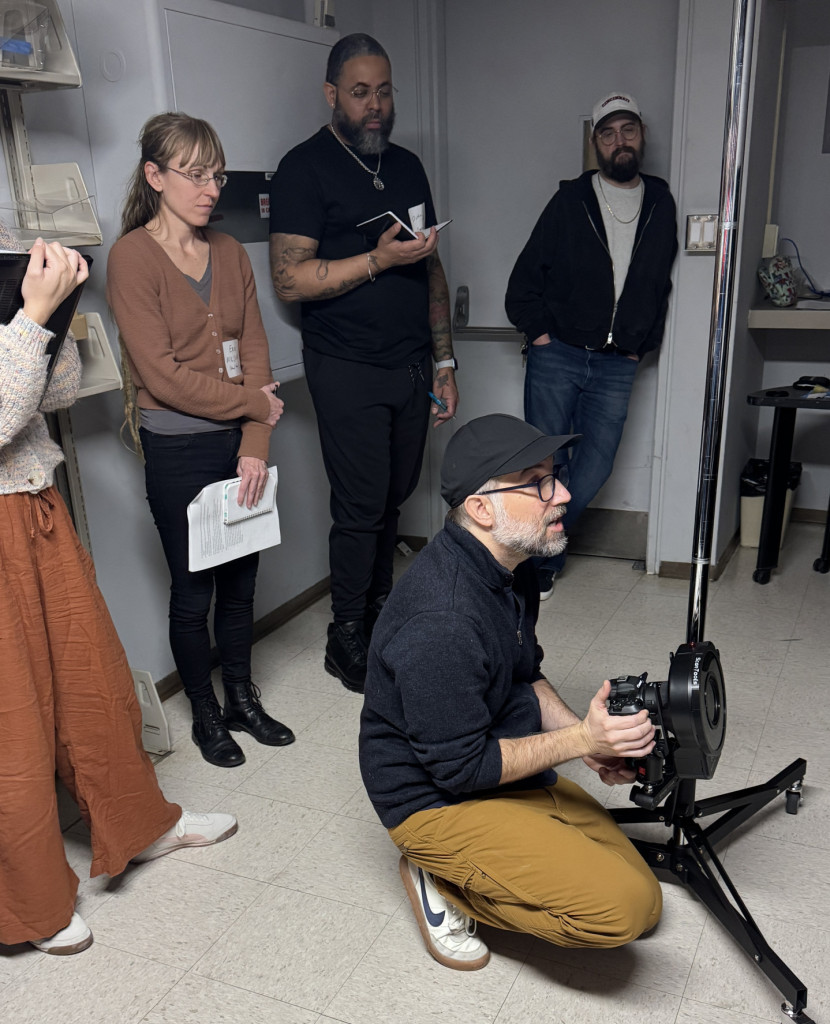
Person kneeling behind a camera with four other people standing behind him.
Jordan demonstrating to the group how to set up a low-angle shot.

Prior to the workshop, I had worked with UC Libraries special collections curators to attain a selection of various objects for imaging ranging from cuneiform tablets to plaster busts. For the workshop, we began with a painted wooden Nigerian statue from the Winkler Center. We walked through the imaging process first, using a fairly standard DSLR manual setup and a ring flash with a polarized filter. The object was placed on a motorized turn-table which allows you to determine how many rotations or shots you want per angle.

Yoruba statue, from the Winkler Center, being photographed on the motorized turntable.

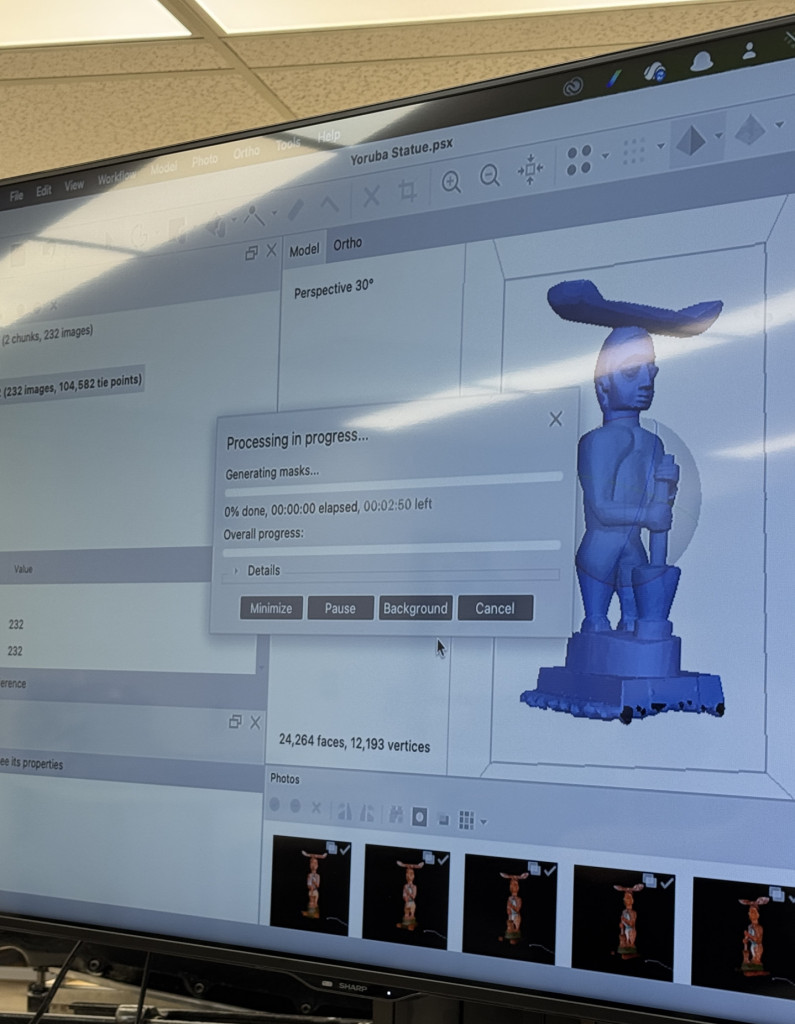
Once all the images were captured, we moved onto the processing portion, using Agisoft Metashape Professional Educational edition.

Screen with 3D imaging software showing a model of an African statue being processed.
The model of the Yoruba statue being processed in Agisoft Metashape software.

After lunch we ran through another imaging and processing session, to reinforce what we had learned in the morning. Overall the day was incredibly successful and I am beyond grateful to Jordan and John-David for sharing their time, knowledge and passion for 3D imaging with the group. They truly made the imaging capture and processing experience fun and attainable!

Following the workshop, fellow Assistant Conservator, Catarina, and I were able to get some 3D imaging practice in; using what we had learned in the workshop and putting it into action. This was made possible by two very important factors: first, Jordan had graciously loaned us his equipment to use before the ’26 Spring semester began, including his polarized flash ring, and second, we had a couple of slower days, following our special collections returns and prior to winter break, which afforded both Catarina and I this time to learn and hone this new technique.

The combat medic statue from the Winkler Center being photographed.

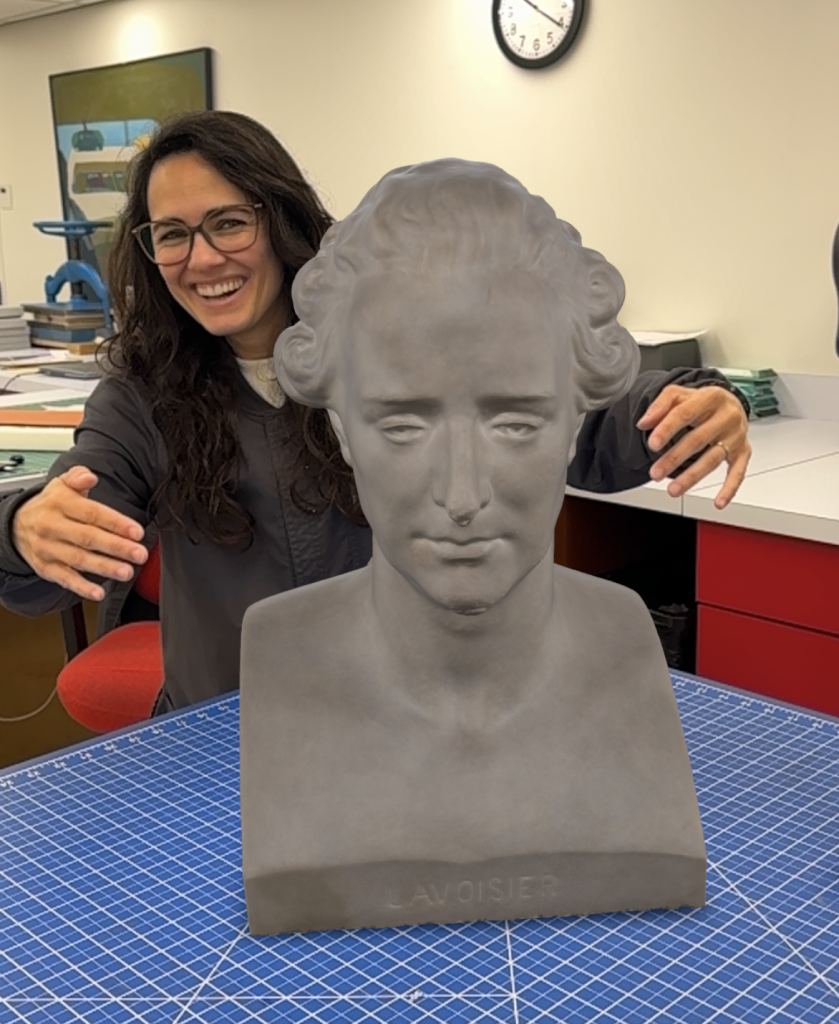
In the end, Catarina and I ended up imaging three additional objects, including a Gothic manuscript from the Archives and Rare Books Library, a plaster bust of Antoine Lavoisier from the Oesper Collection, and a combat medic statue from the Winker Center.

Again, thanks to Jordan’s immense generosity, he has hosted the 3D models of the objects we captured on his site, so that they can be shared more broadly with a wider audience. If you can click on the links below (whether with computer, phone or tablet) you can view and manipulate the 3D models of each object, as well as read more about the object:

Again, a huge thank you to Jordan and John-David for their eagerness to share their knowledge during the workshop, and to Jordan for his ongoing generosity and collegiality. And, as always, thank you to our curators for supplying us with an array of objects for the workshop, and to our department head, Holly Prochaska, for her perennial support and advocacy.

Woman attempting to hug a 3D model of Antoine Lavoisier (bust).
Catarina attempting to hug the Lavoisier bust model. This model is being projected from an iPhone, allowing it to be “placed” on the table.

Jessica Ebert – Assistant Conservator

I Got 99 Problems, but the Lawrence Notebooks Ain’t One: Finishing the Conservation Treatment of 99 Volumes

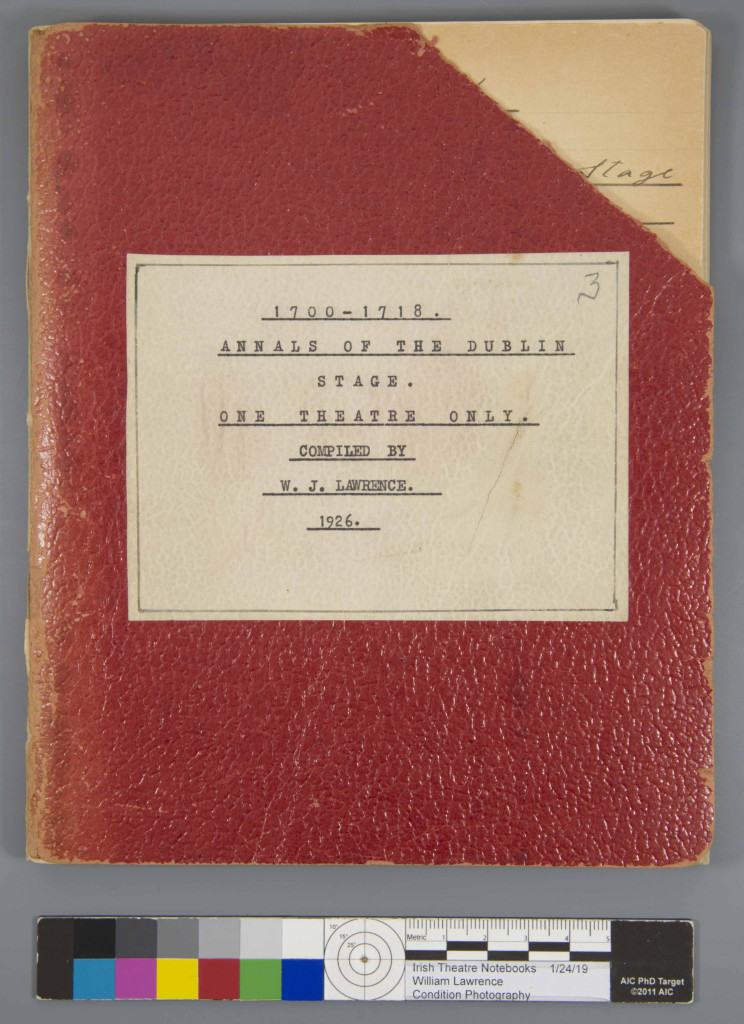
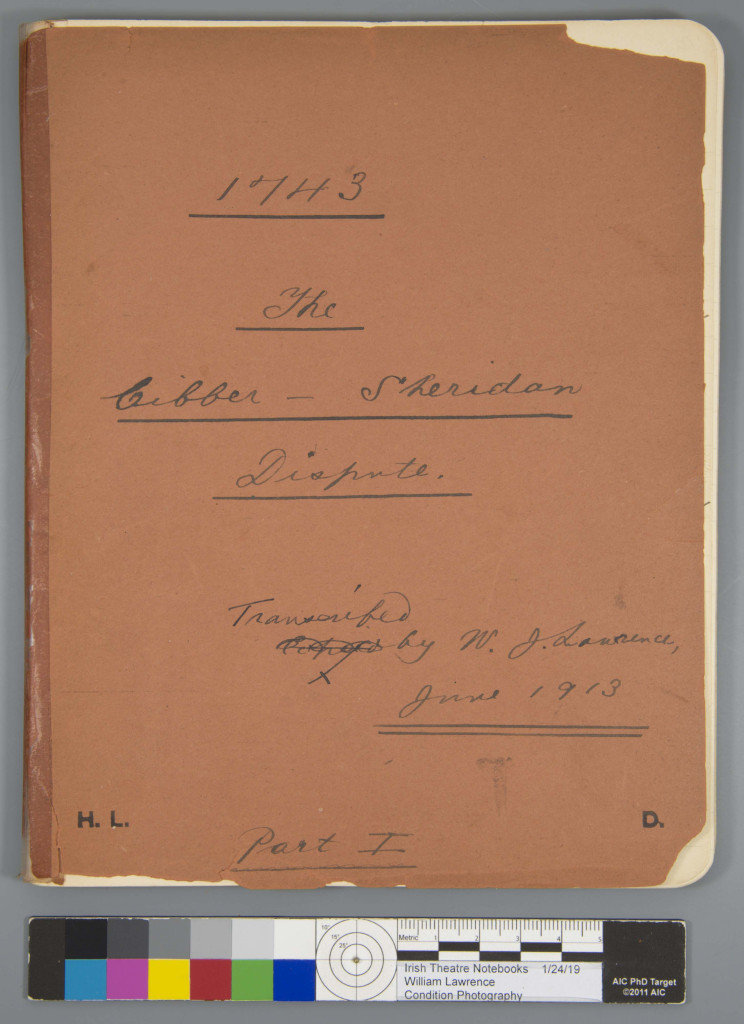
For the past few years, I have been working on the conservation treatment of the Lawrence Notebooks, a remarkable collection of 99 handwritten volumes created by William J. Lawrence that document his extensive research on the Irish stage from 1630 to 1911. Over many years, Lawrence filled these small, lined notebooks with careful handwriting, news clippings, photographs of actors, typed play transcriptions, and detailed notes on theaters, performances, ticket prices, and even personal anecdotes. Together, the notebooks offer a rich and vivid window into the history of Irish theater and the cultural life of Dublin from the seventeenth through the early twentieth centuries.

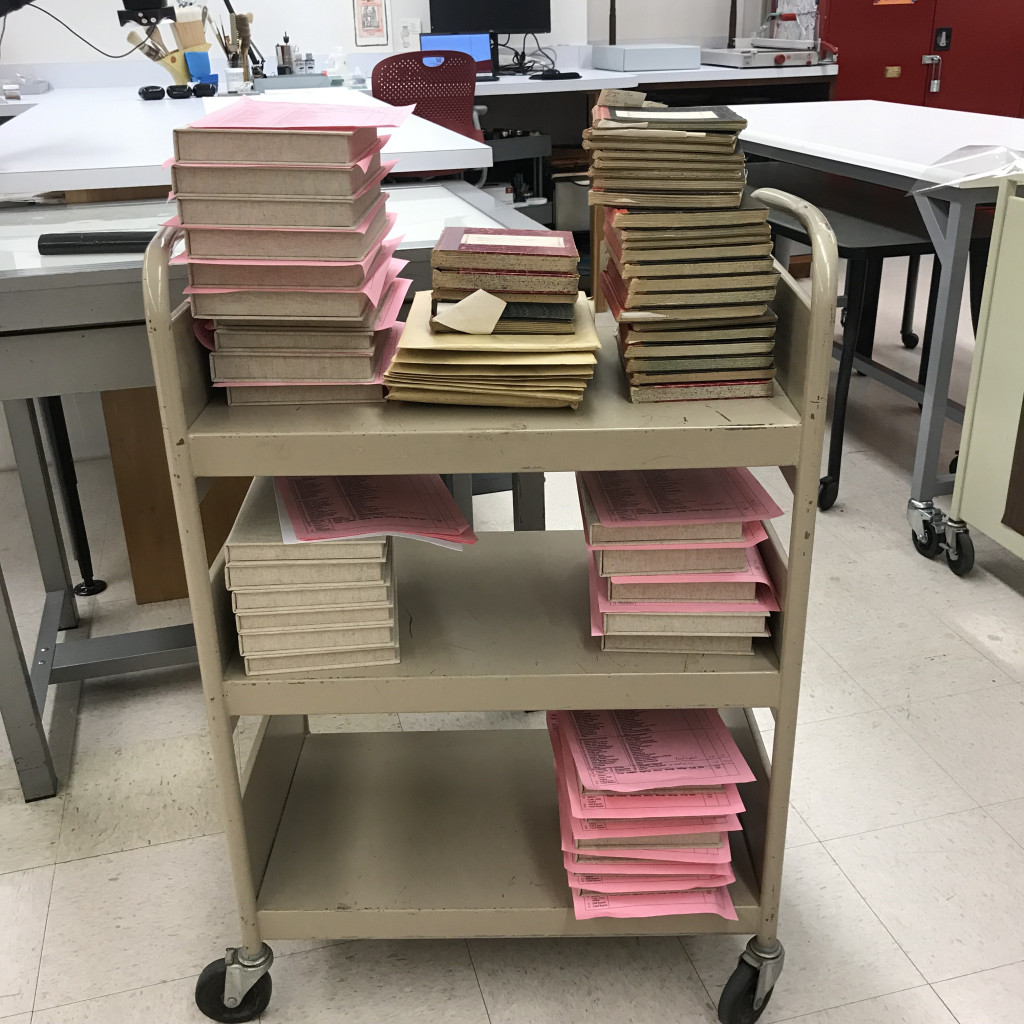
A library book truck filled with various small notebooks and conservation boxes.
In 2021, we had already completed 37 of the 99 volumes, and we still have 62 volumes in the Lab.

This project was a collaborative effort and was completed gradually over several years, with individual volumes treated alongside other conservation projects rather than all at once. Our former colleague Chris Voynovich created custom cloth-covered clamshell enclosures for all 99 volumes, while I was responsible for the evaluation and conservation treatment of the notebooks themselves.

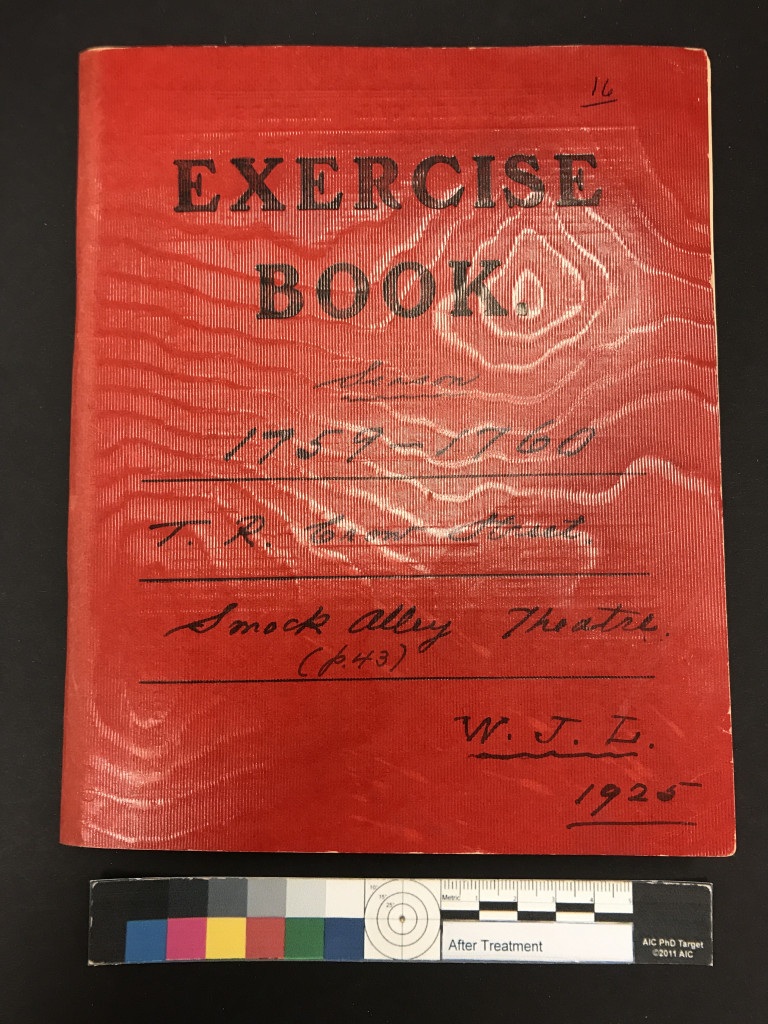
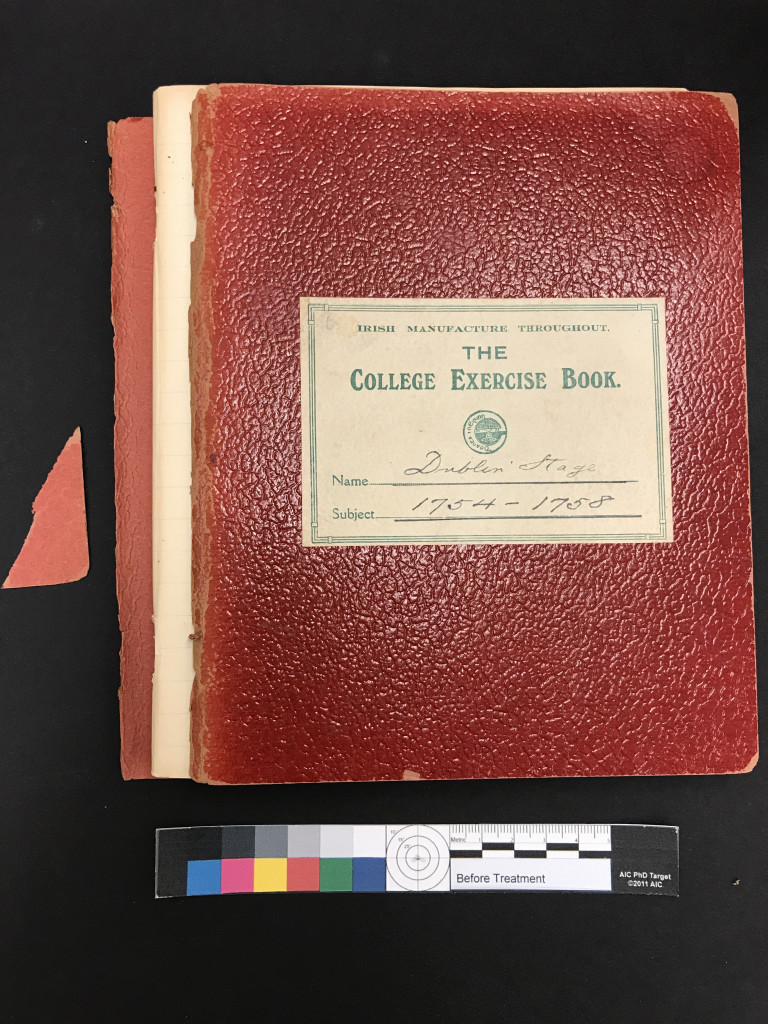
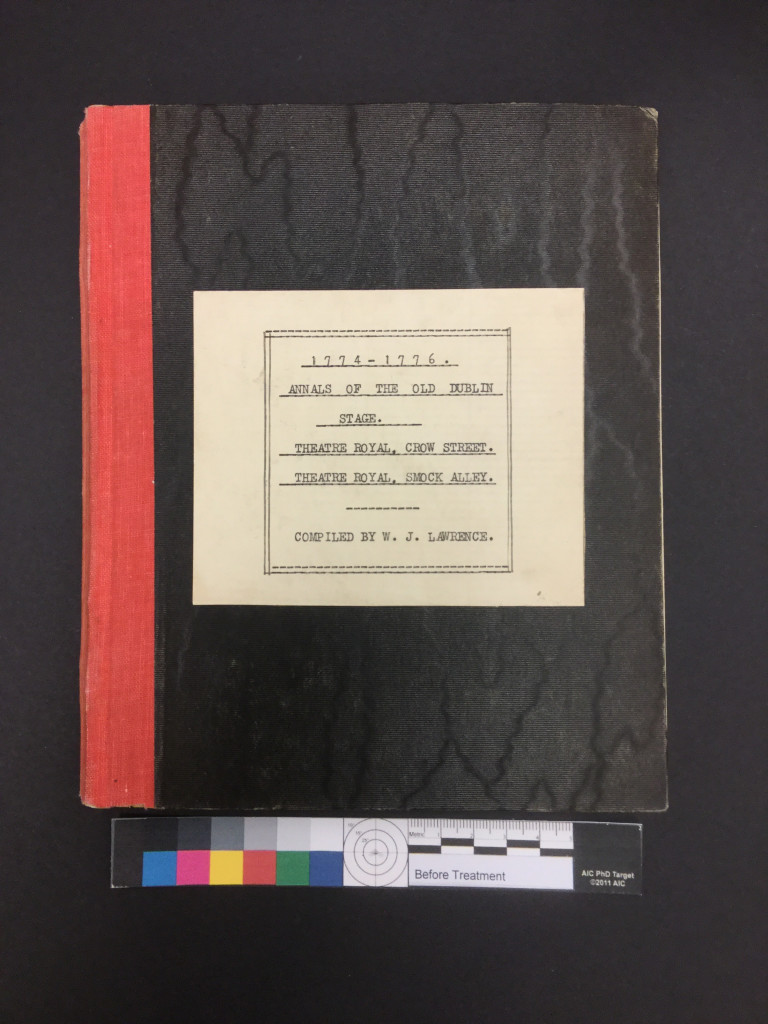
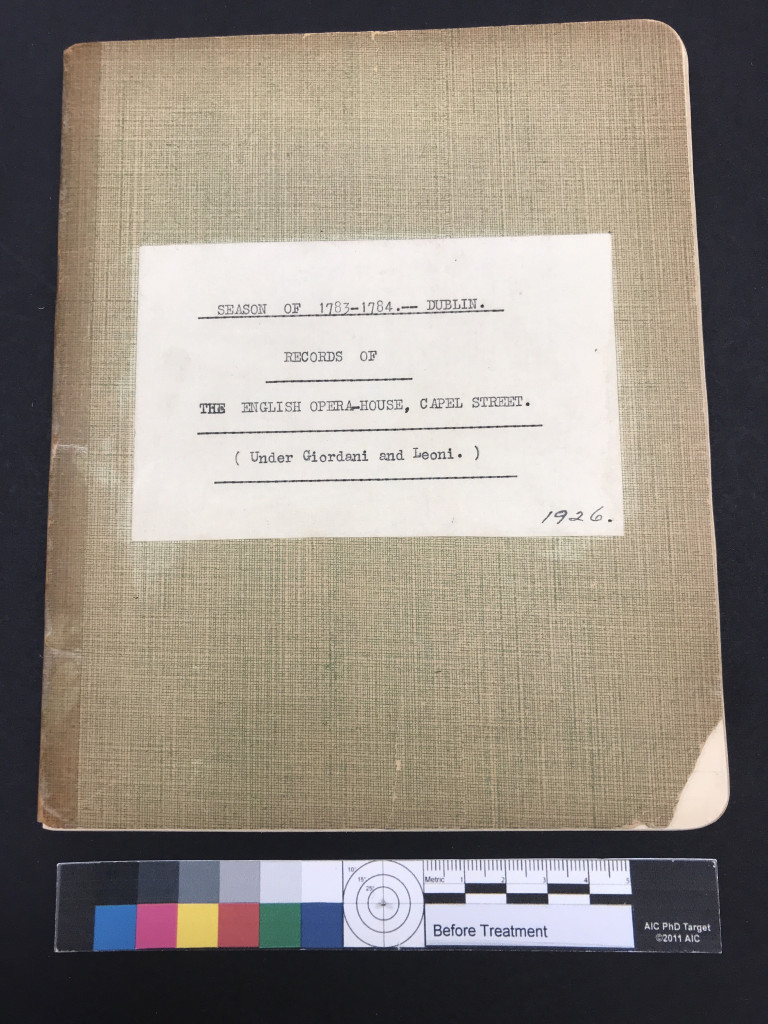
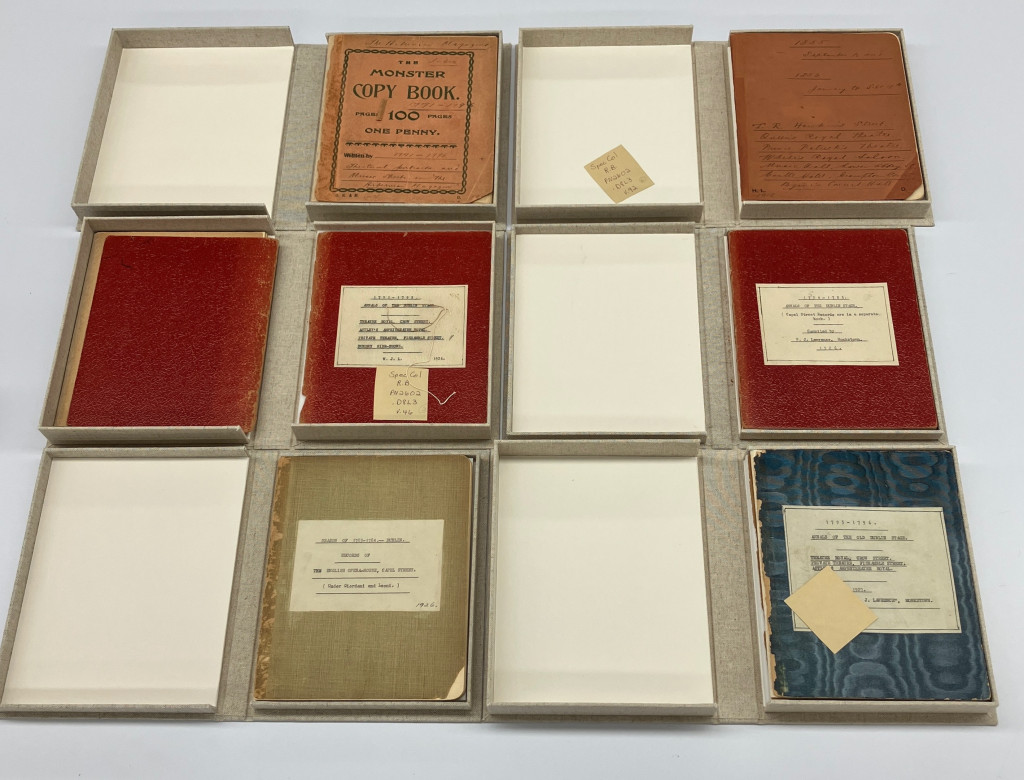
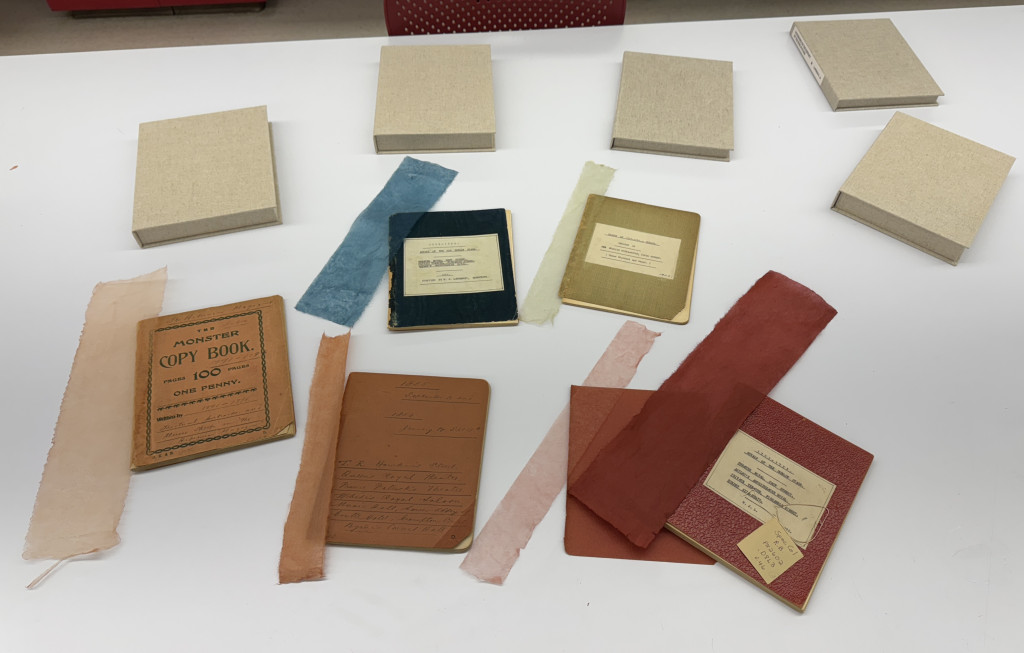
Although the Lawrence Notebooks shared a broadly similar format, closer examination revealed subtle but meaningful variations in both their covers and text blocks. Most volumes were small, square notebooks with thin boards covered in cloth or paper covers, in a range of muted colors including red, orange, green, blue, and black. The text blocks were generally composed of one or several gatherings sewn through the fold, with the primary support most often being lined paper.

Overhead view of six notebooks with different covers in their enclosures, with the boxes opened.
Variations in cover materials and colors across the Lawrence Notebooks.

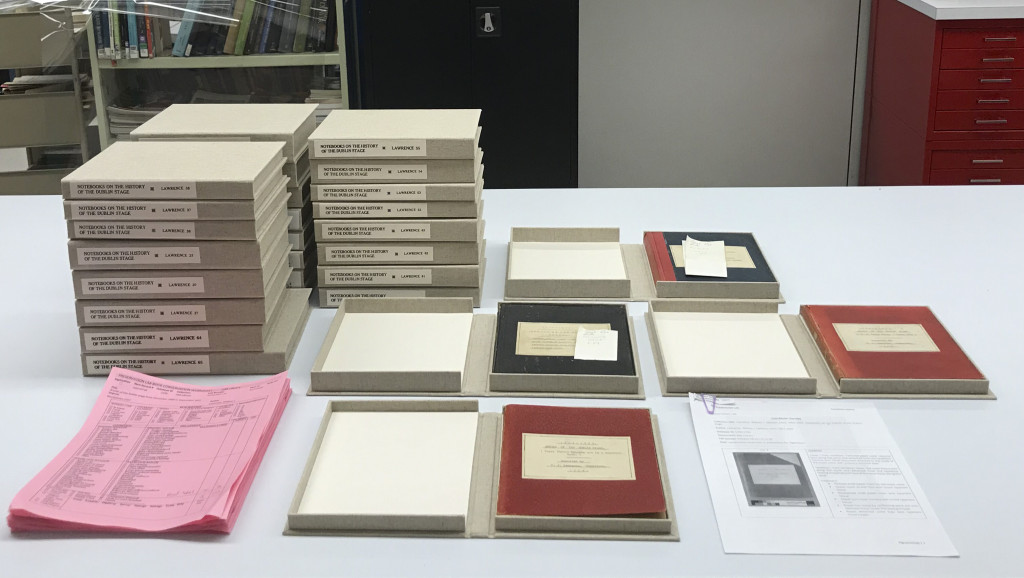
Once all the volumes were received in the lab, each notebook was evaluated for its condition and assigned to one of three categories: good (no treatment required), fair (requiring stabilization), or poor (requiring more extensive treatment). The notebooks showed clear signs of long-term handling and use. Many volumes had weakened or detached covers, some of which had been previously repaired with pressure-sensitive tape. Other common condition issues included broken sewing, tears along the spine folds of the text block pages, and brittle newspaper clippings that had also been repaired with pressure-sensitive tape.

View of a stack of cloth clamshell enclosures, with several opened to show notebooks inside.
Condition evaluation of the Lawrence Notebooks prior to treatment.

When determining the most appropriate conservation treatment for each volume, it was also important to consider their future digitization. Treatments were selected to stabilize the notebooks while ensuring they could be safely opened, handled, and imaged without placing additional stress on the original materials.

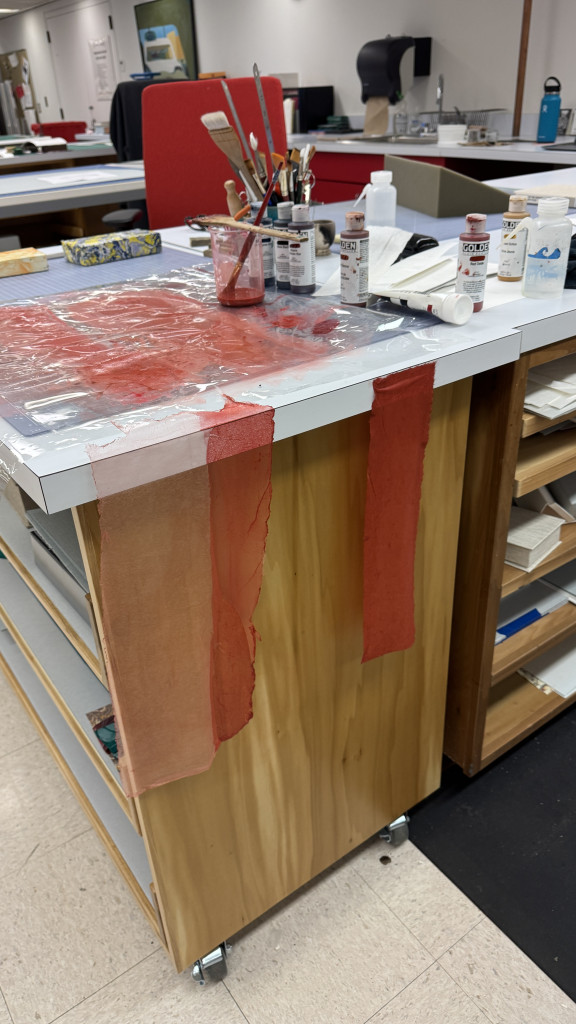
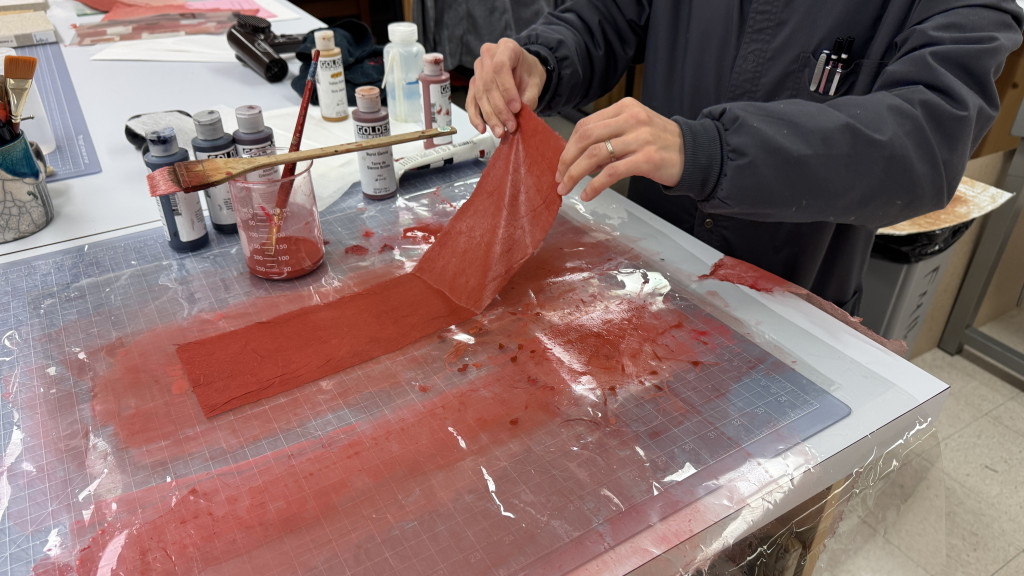
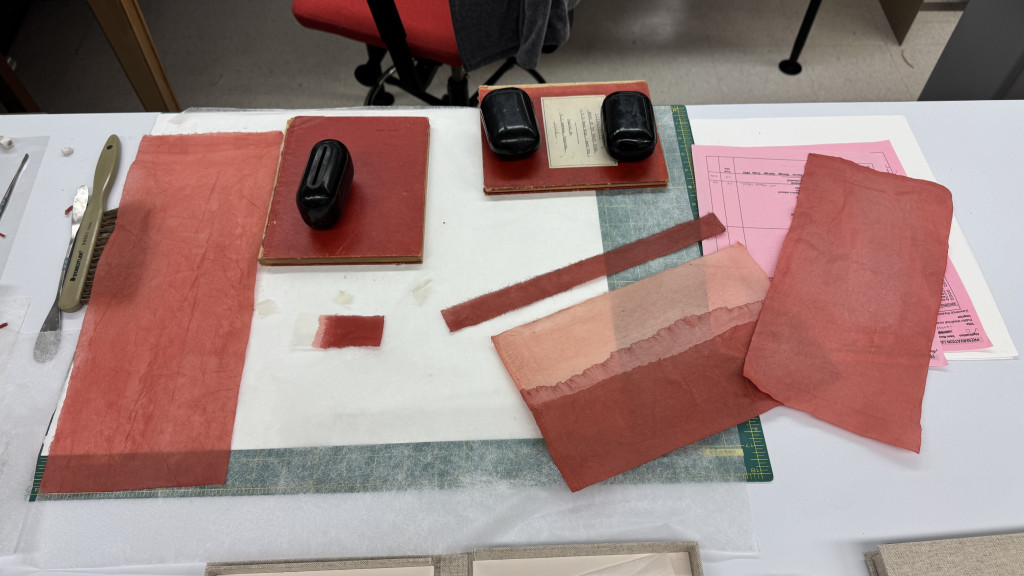
Most of my conservation treatment ended up being hours spent removing pressure-sensitive tape, many more hours toning Japanese paper with acrylics for the repair and stabilization of paper covers, along with surface cleaning and a lot of time dedicated to tear repair. 

Completing the conservation treatment of all 99 Lawrence Notebooks marked the end of a project that unfolded slowly over several years. Because the work was done alongside many other conservation projects, progress often happened one volume at a time, making the moment when the final notebook was finished feel especially satisfying.

With treatment complete and each volume now housed in a custom clamshell enclosure, the Lawrence Notebooks are stabilized and better supported for future handling, digitization, and research. While the notebooks still show the signs of long use that make them such compelling working documents, they are now structurally sound and prepared for the next phase of their life in the collection. 

Projects like this reveal how conservation work happens slowly and methodically, often behind the scenes. Completing treatment on all 99 notebooks and seeing them reunited as a stabilized collection reinforces the importance of long-term care in preserving these records of Irish theatrical history for future research and access. 

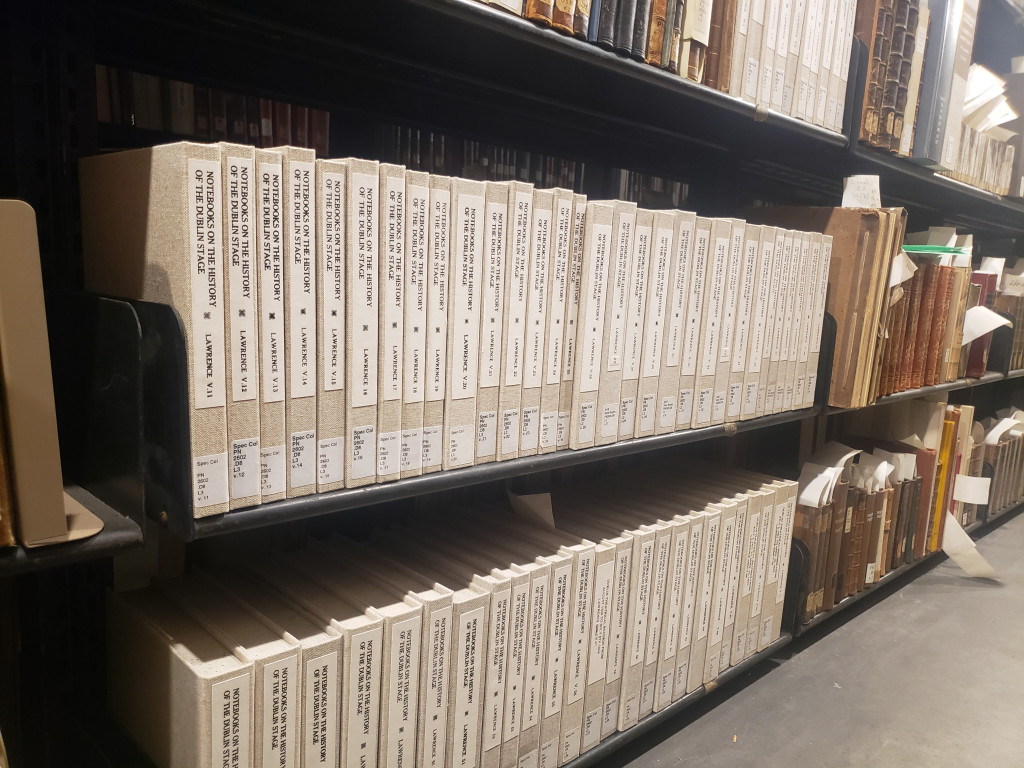
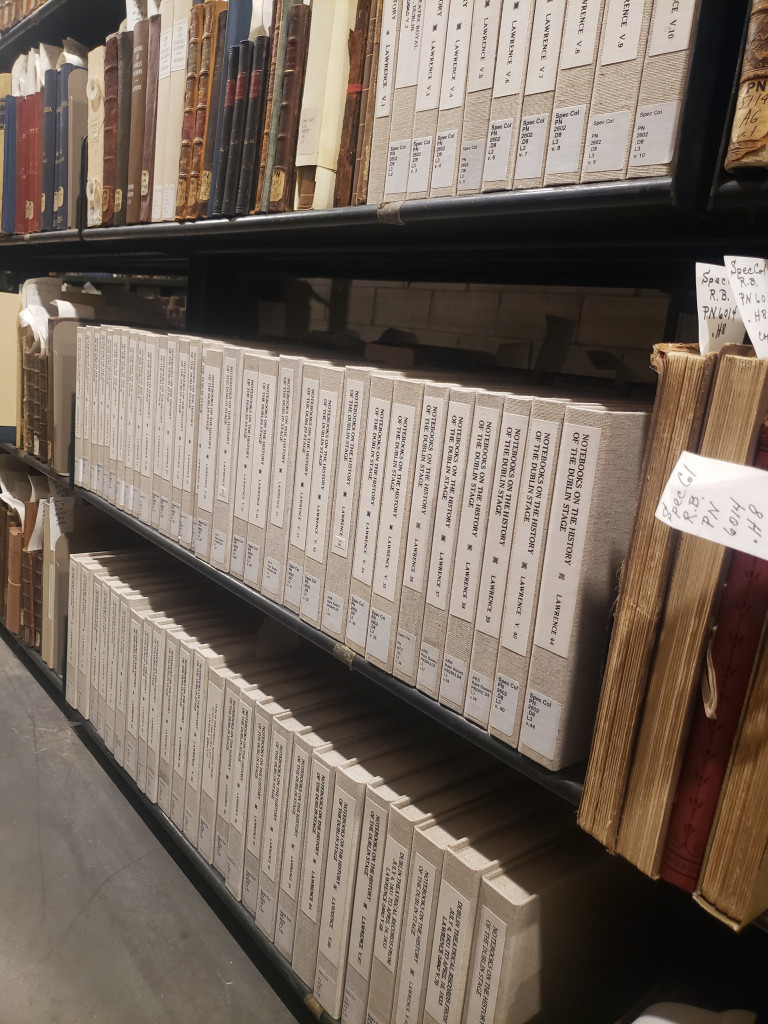
The Lawrence Notebooks shelves in the Archives and Rare Books Library stacks.

Catarina Figueirinhas – Assistant Conservator
Allegheny River / Capt. J.W. McLaughlin

How to store a 15ft paper scroll?

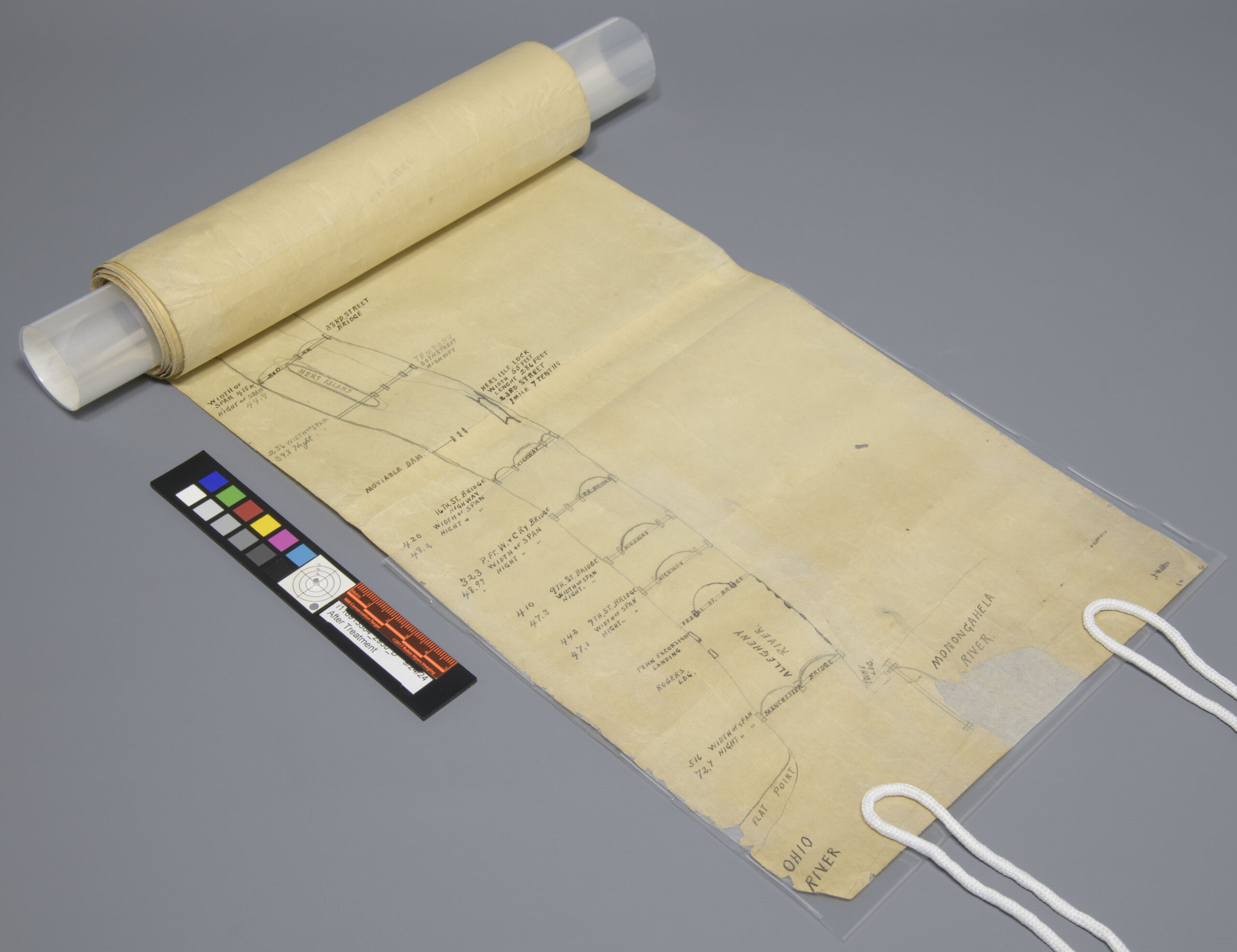
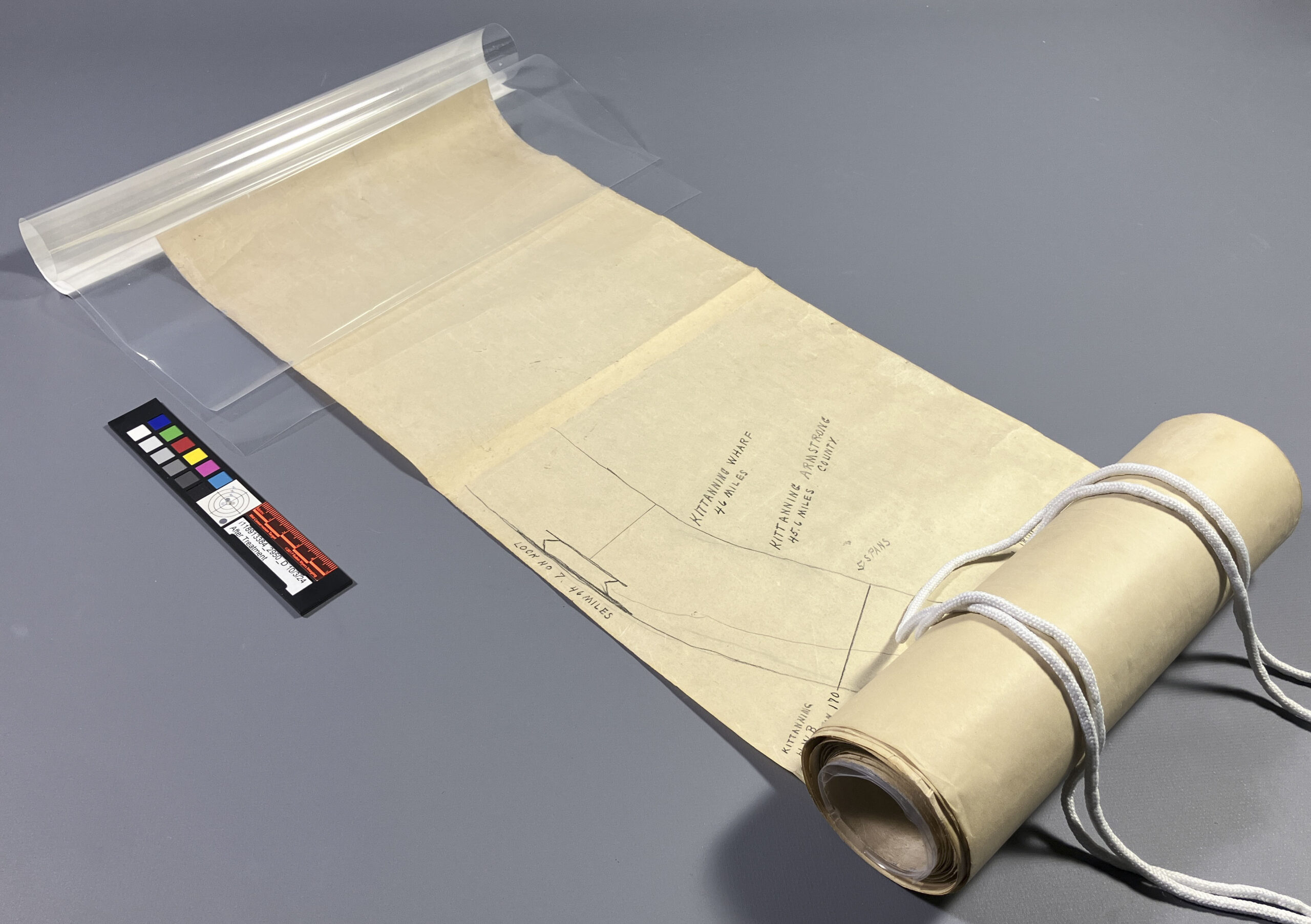
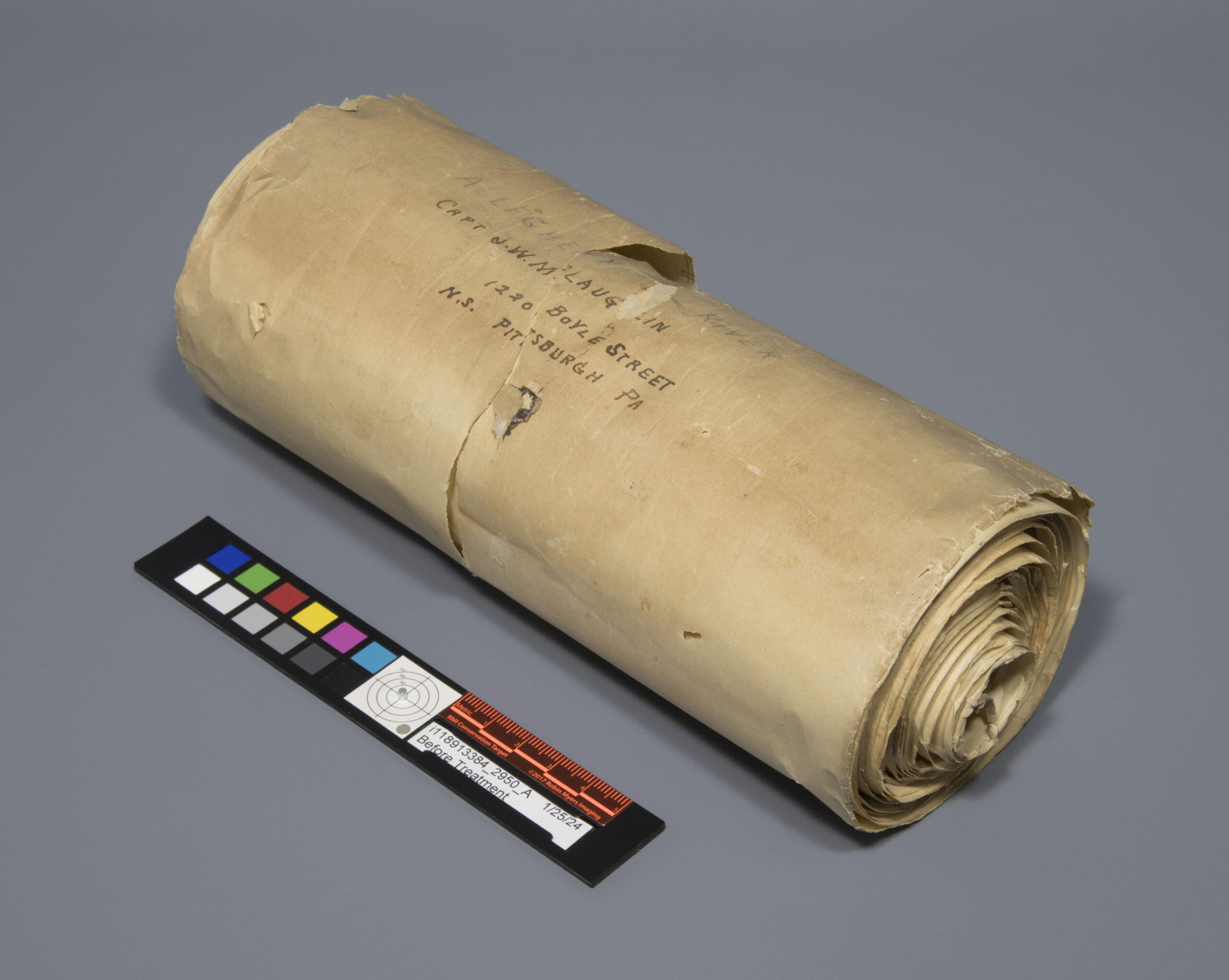
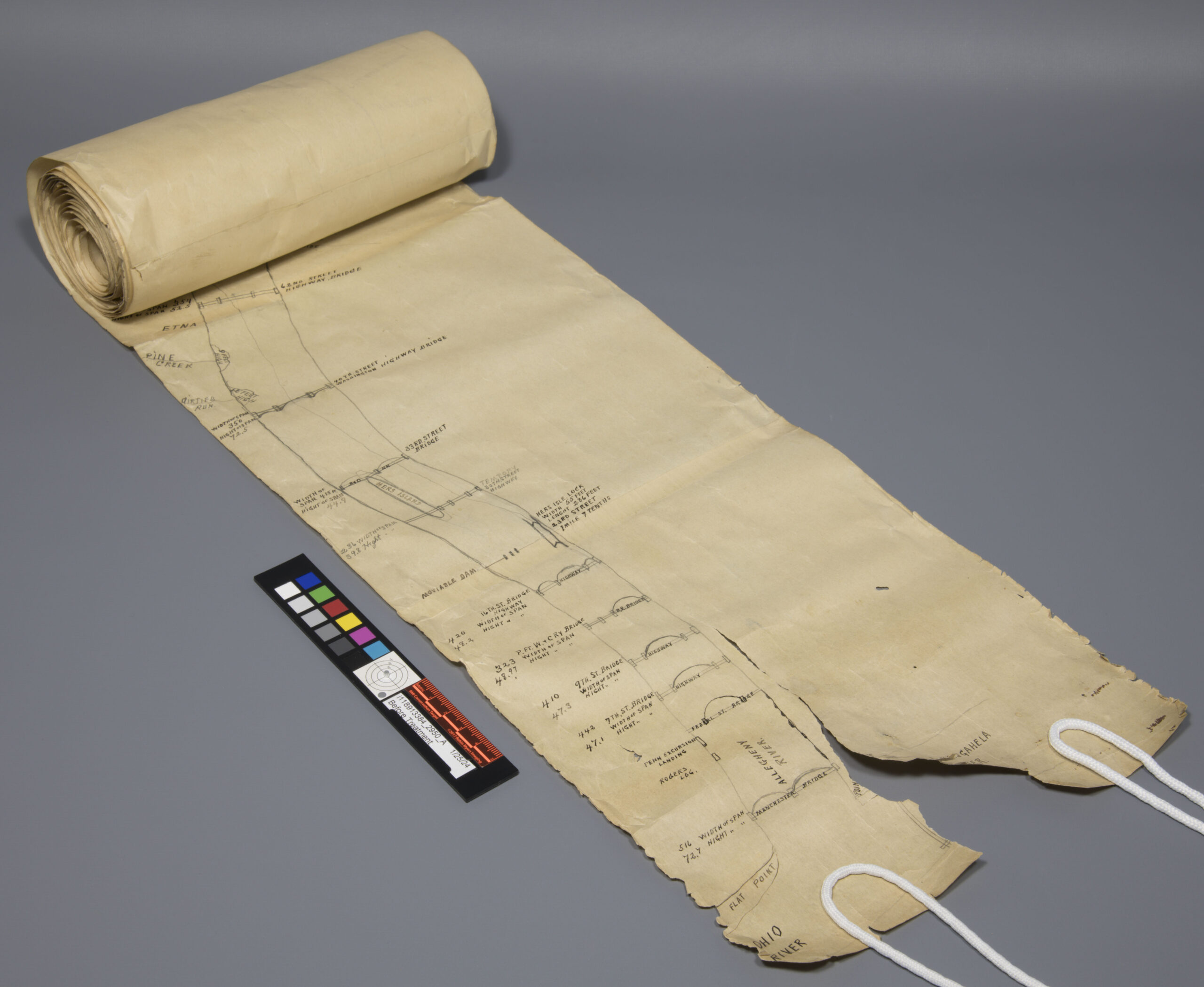
Back in October of 2024, we received something slightly more unusual from the Cincinnati and Hamilton County Public Library, a 15-foot-long, hand-drawn rolled map of the Allegheny River. Yes, fifteen feet.  This map was created by joining smaller sheets edge-to-edge, forming one continuous scroll that looked more like a treasure map than your typical library item.

Scroll with photography target in front of it

A dilemma quickly followed, how do I create a housing solution that’s safe and functional, but won’t turn future handling into a logistical nightmare? Like many libraries, they didn’t have a 15-foot shelf just waiting for this (because who does?), so storing it flat was out. Storing it rolled became our only real option. The enclosure needed to be secure and protective for the map, and ideally, easy and elegant to display when needed.

First things first, some stabilization treatment. Before tackling the housing design, the scroll underwent conservation treatment to mend small tears and fill losses, particularly at the “beginning” and “end” (depending on which direction you follow the river). Once stabilized, it was ready for some housing trials.

scroll partially unrolled
Before Treatment – Large loss and tear at one end.
scroll partially unrolled
After Treatment – Large loss repaired and map rolled around the polyester cylinder core.

While researching solutions online, I stumbled upon a fantastic blog post by J.M. Iacchei from the Cornell University Library Conservation Lab (link here). Their approach to scroll housing was clever, practical and elegant, and it just gave me the spark I needed to create our own version.

Here is how we rolled:

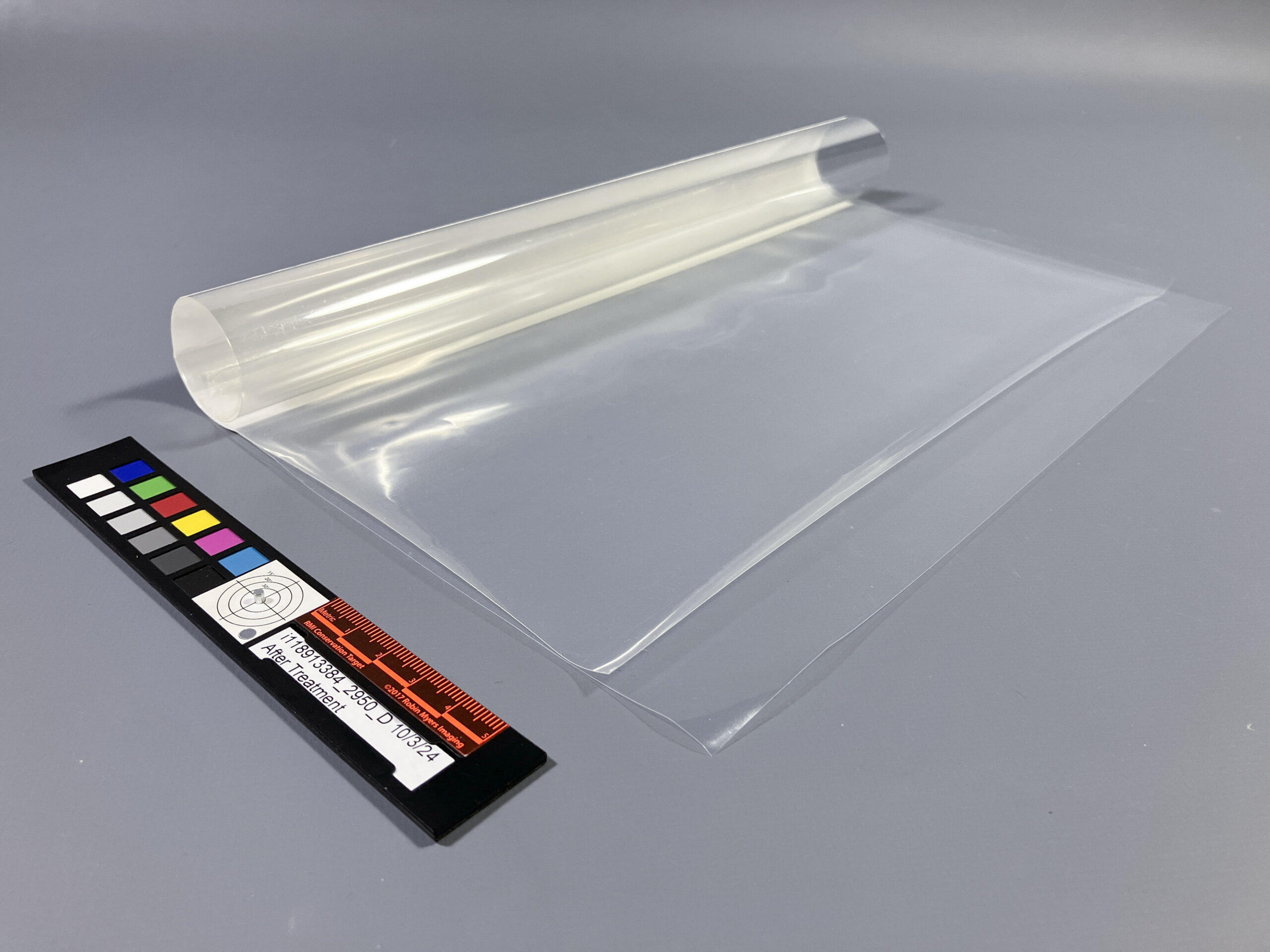
  • A support core – To give the scroll structure while rolling, I created a polyester cylinder core with a polyethylene sling. The sling supports one end of the scroll as it begins to wrap around the core, providing gentle guidance and protection as you start to roll the map. The map can be easily inserted into the sling to begin rolling.
Polyester cylinder core with a polyethylene sling to secure one end of the map.
The end can be easily inserted into the sling and supported as the map is rolled around the polyester core.
  • Protection of the ends – The opposite end of the scroll was placed into a soft, transparent polyethylene pocket. It’s flexible, unobtrusive, and doesn’t need to be removed, even during after treatment photography.
Scroll partially unrolled
The other end of the map is protected with a polyethylene pocket that is flexible and offers support to the fragile end of the map.
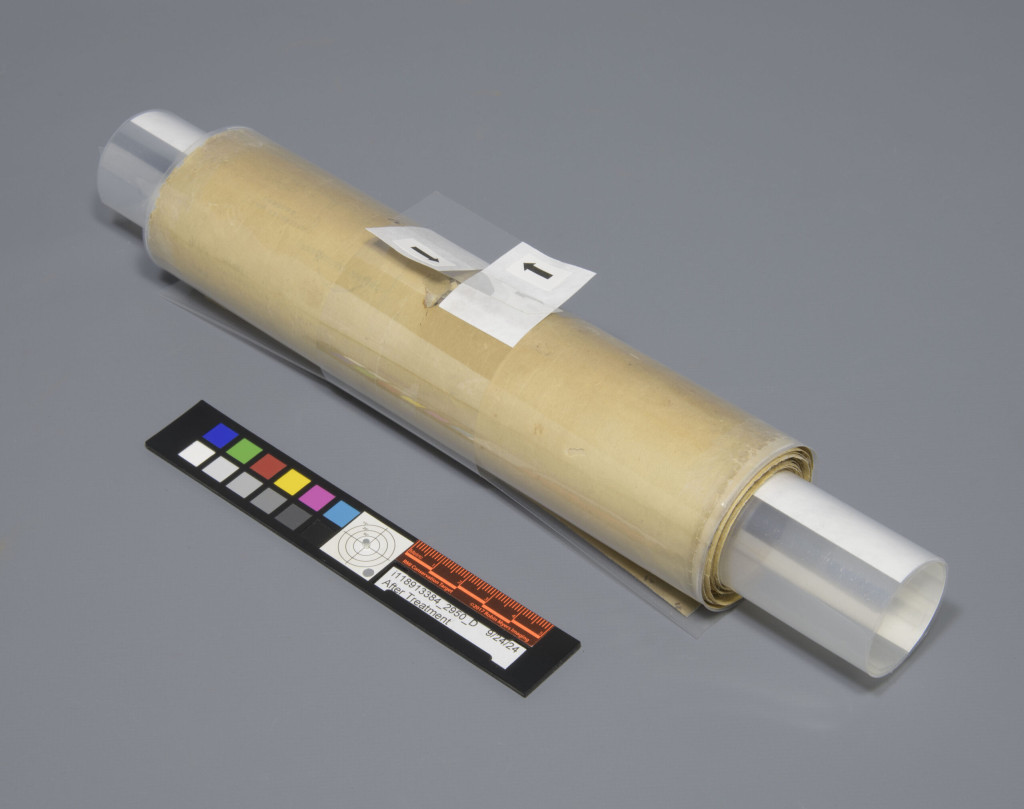
  • Keep it rolled – Once fully rolled, the scroll was secured with a polyester belly band. The polyethylene pocket helped protect the scroll surface from any abrasion caused by the belly band.
rolled scroll with belly band to hold it in place
The rolled map is secured with a polyester belly band.
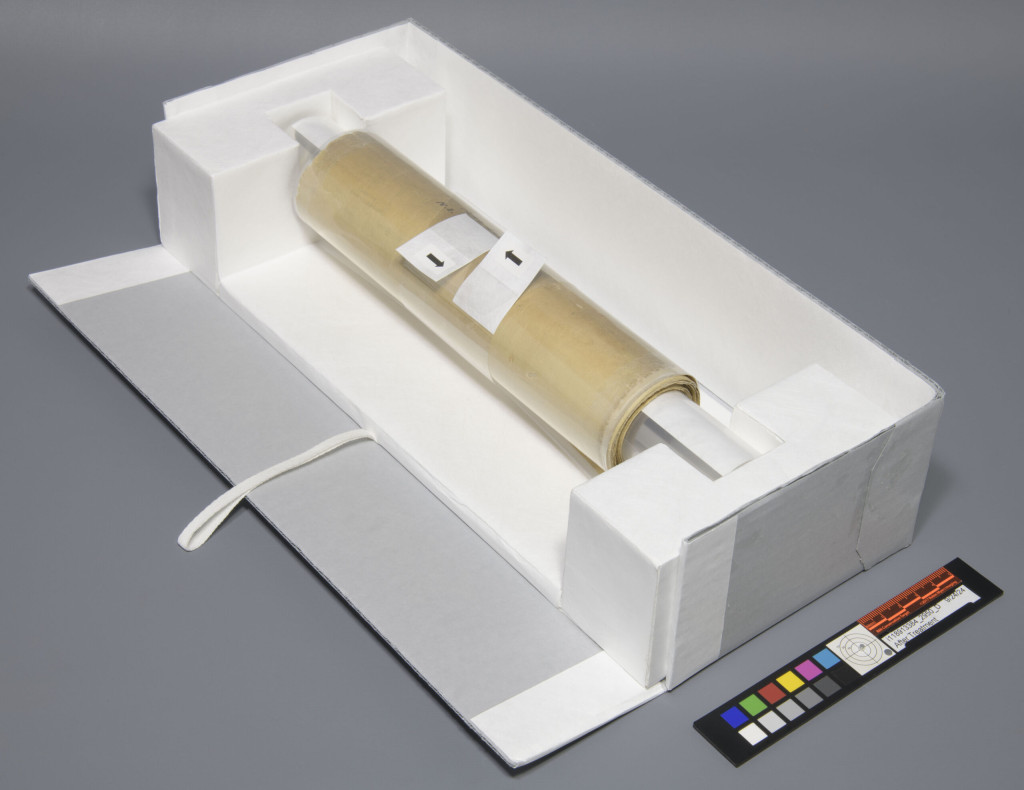
  • Display ready? – For display,I built a removable tray that cradles the rolled scroll without letting it rest directly on a surface. This tray doubles as a mini display platform, so the scroll can be partially unrolled and supported during handling and exhibit. Functional and elegant.
Rolled scroll secured within an enclosure tray
Display tray that offers support to the rolled map for long term storage.

I also tested a few other methods along the way, like supporting the entire scroll in a single 15-foot polyester sheet or sandwiching it between two. But the seams where the map’s original sheets were joined caused additional creases with those solutions.  In the end, supporting the scroll in its entirety just wasn’t viable, so I pivoted to protecting the ends and letting the core do the heavy lifting.

Also: cutting two 15-foot-long sheets of Mylar by hand? Let’s just say I don’t recommend it… and I definitely don’t miss it.

Here is what a 15ft paper map looks like:

Catarina Figueirinhas – Assistant Conservator
Are You Ready for Halloween?

With Halloween creeping up, it’s either a chance for you to unleash your spooky side or to totally panic and obsess over costumes until the last second. Ghost? Meh. Mummy? Boring. Werewolf? Too hairy. But if you work in a conservation lab, fear not. We have you covered!  

This year, we’ve scoured the lab to create costumes that mix chilling creativity with eccentric conservation tools! Each costume has a difficulty rating, so you’ll know if it takes professional skill or just a wildly spooky imagination. 

So, grab some supplies, get haunting, and remember: Conservation may be reversible, but goofy Halloween memories are forever!  

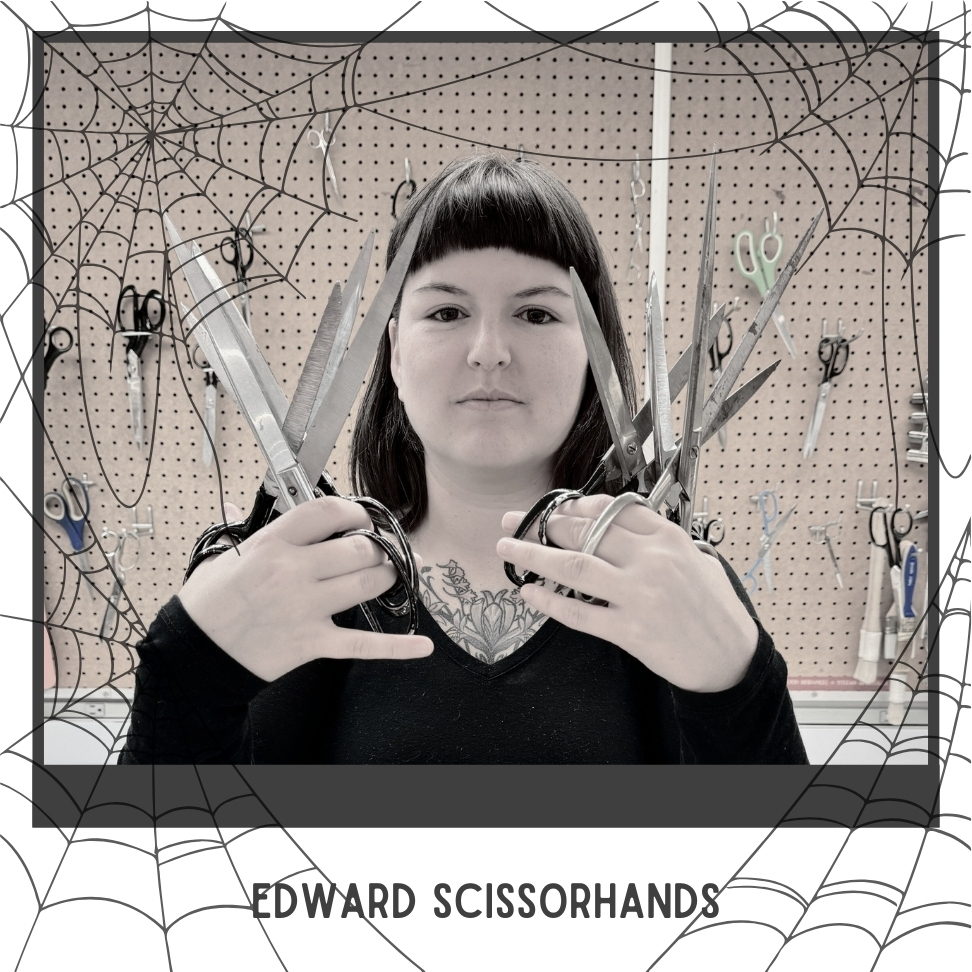
Edward Scissorhands costume, woman in black holding many scissors

Edward Scissorhands
Difficulty level – Easy
Materials and tools needed:

  • Scissors, tons of scissors
  • Black clothing
  • Strong hands (those old scissors may refuse to work properly)

Note – Not recommended for the long-haired among us…so remember, safety first! Keep a safe distance, and beware of those “accidental” snips, unless your colleagues think that you desperately need “just a little trim off the top”.

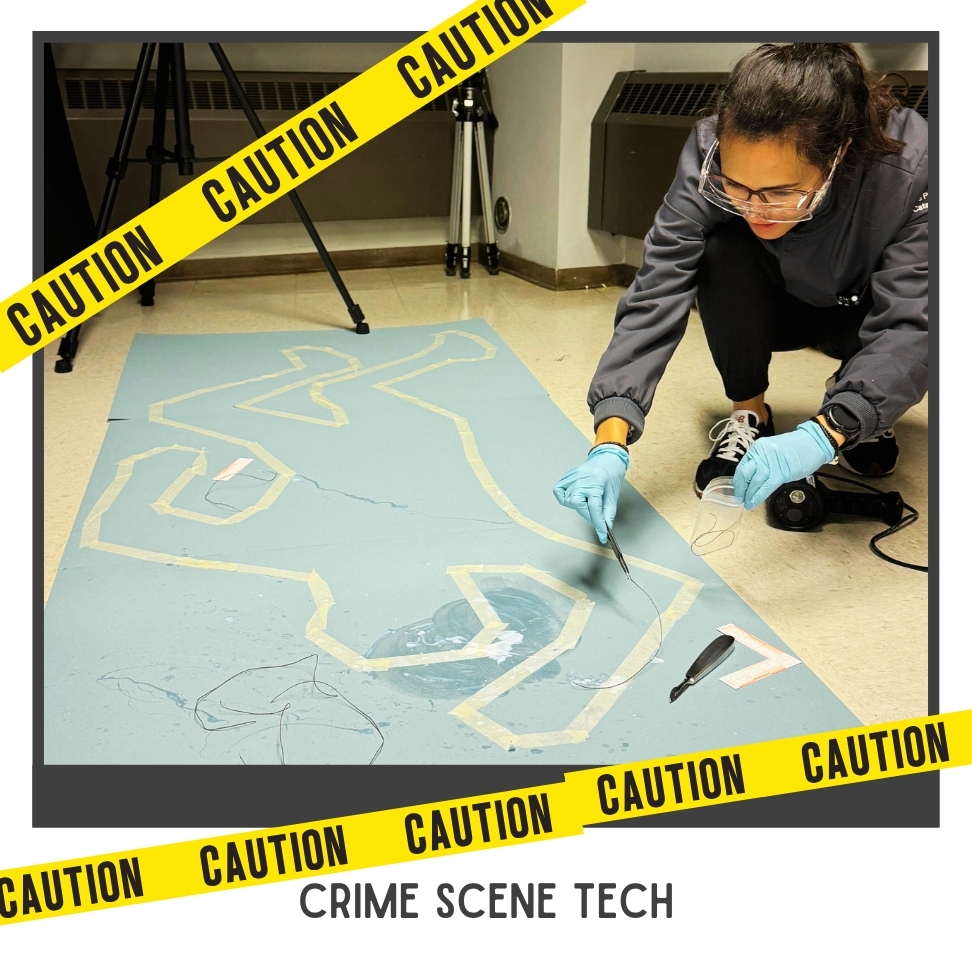
Mock crime scene with woman pretending to collect evidence by a fake chalk outline

Crime Scene Tech
Difficulty level – Medium
Materials and tools needed:

  • Masking tape
  • Caution tape
  • Gloves
  • Lab coat
  • Tweezers
  • Scalpel
  • Thread (to mimic hair samples)
  • Binder’s board to create a body/chalk outline (create a tri-fold for easy travel)
  • Golden gloss/matte media (or anything that fluoresces) to create “blood” splatters
  • Polyethylene bags (to collect evidence)
  • UV lamp
  • Protective UV goggles
  • Fluorescent scale (optional)
  • Camera (optional)
  • Tripod (optional)
  • A strong stomach, not for the faint of heart

Note – For the body outline, just kindly convince a colleague to lie on the binder’s board. Nothing says “team building” like creating a fake crime scene!

The following costumes can be done as a group effort or a solo act – dealer’s choice!

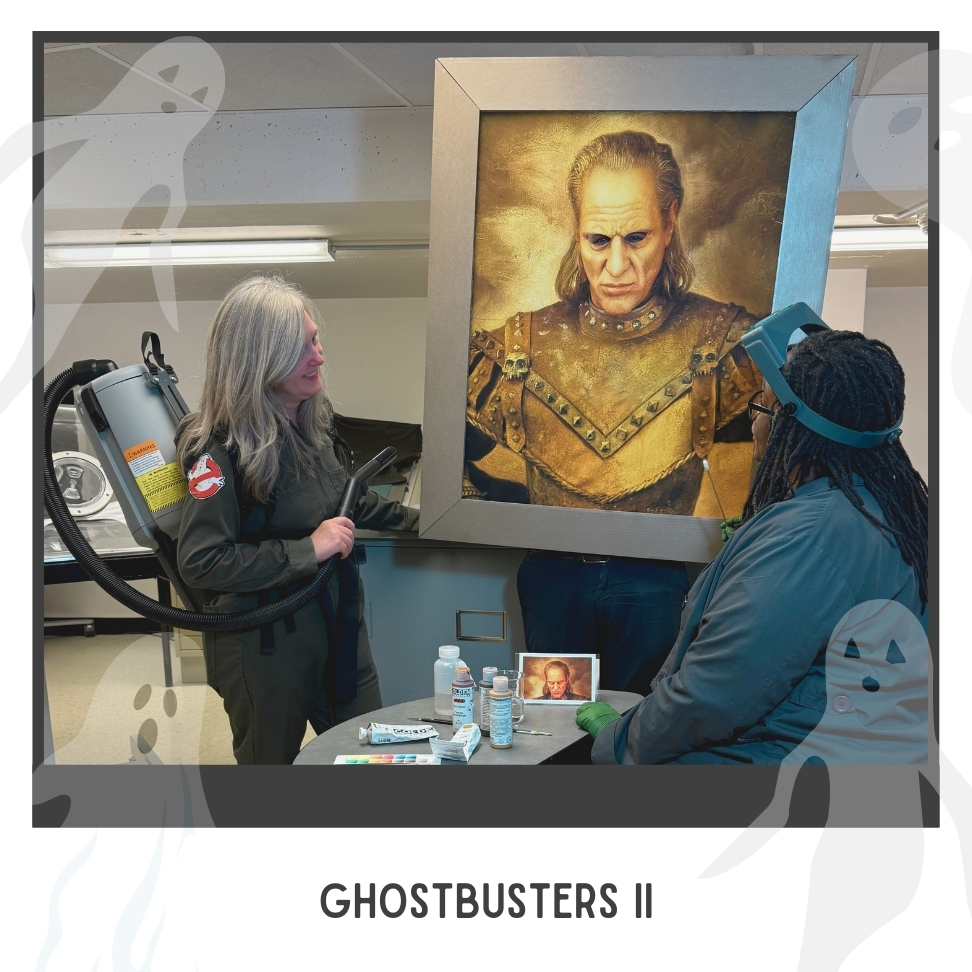
Ghostbuster on the left, painting of old man at the center, conservator seated on the right

Vigo the Carpathian (Painting)
Difficulty level – Hard
Materials and tools needed:

  • Print out of Vigo the Carpathian – our Lab recently switched to a 17″ wide Epson printer, so we are unable to print large scale items, so Jessica skillfully created the painting with two printouts pieced together.
  • Corrugated board
  • Cloth tapes (to create handles on the back of the painting)
  • Gold spray paint
  • Double-sided tape
  • Black/dark clothing
  • Strong arms and captivating eyes

Note – For that eerie stare DON’T FORGET to remove the eyes from the print out…the creepier, the better!

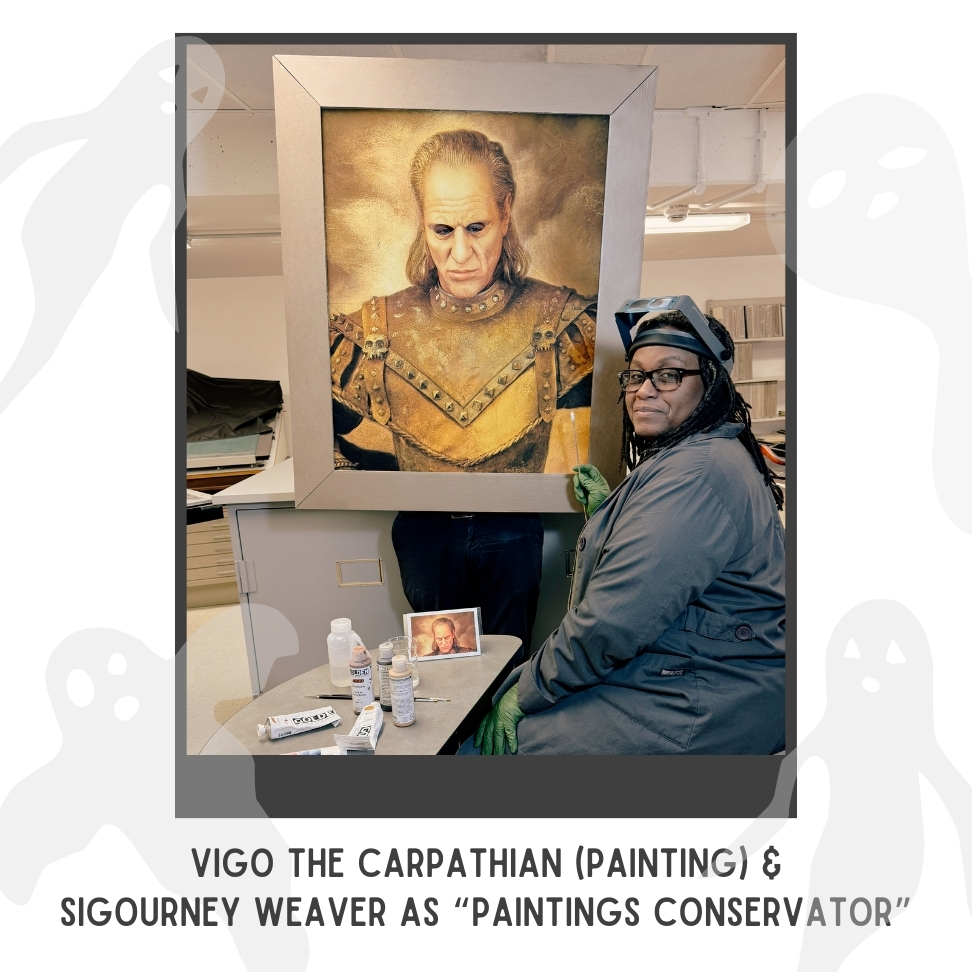
woman dressed as paintings conservator seated in front of a painting

Sigourney Weaver (as “Paintings Conservator”)
Difficulty level – Easy
Materials and tools needed:

  • Lab coat
  • OptiVisor
  • Acrylic paints
  • Gloves
  • Cotton swab
  • Beaker with filtered water
  • Paint brushes
  • Vigo printing proof, as reference (optional)
  • Must not be easily spooked by creepy eyes staring into your soul

Note – We know we aren’t a paintings conservation lab, but I think we pulled it off…or at least better than the movie, I hope!?

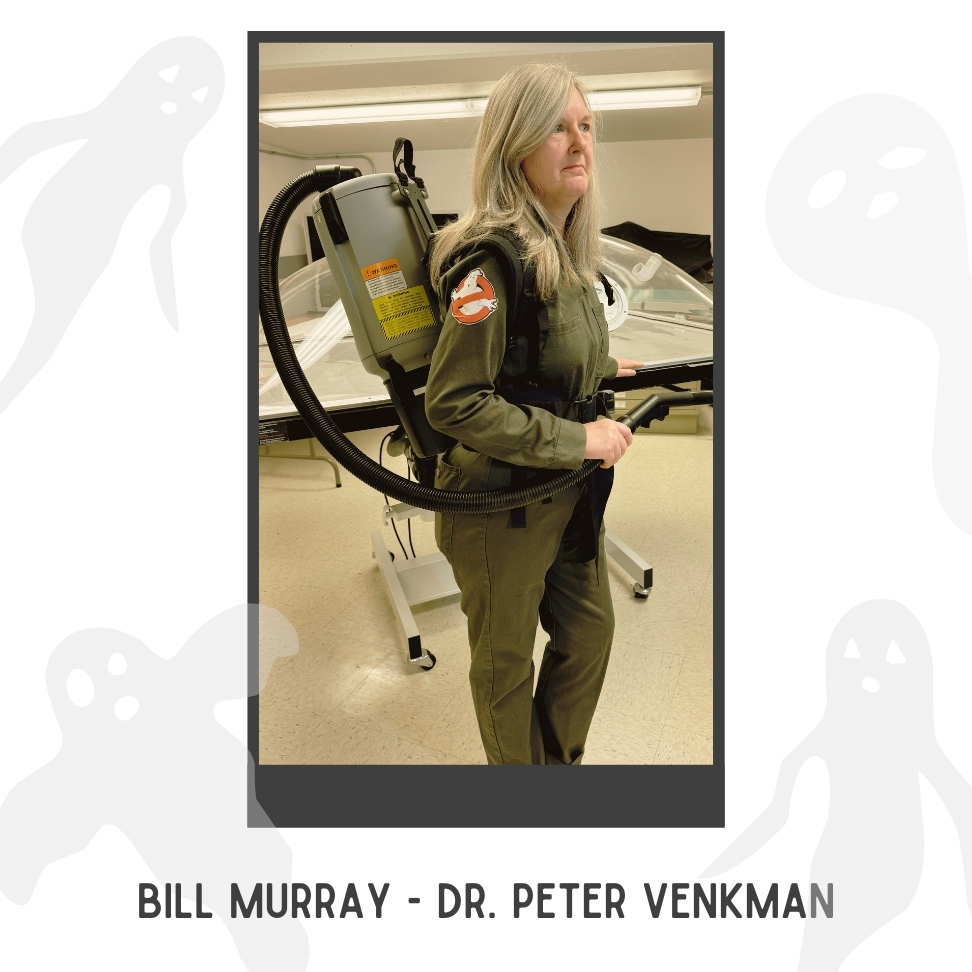
woman dressed as a ghostbuster

Ghostbuster / Bill Murray as Dr. Peter Venkman
Difficulty level – Easy
Materials and tools needed:

  • Jumpsuit from your favorite brand (Dickies, Albion Fit, etc.)
  • Nilfisk GD 10 Back HEPA Vacuum (Proton Pack)
  • Print out of Ghostbusters logo
  • Double-sided tape
  • Portable fan (for special effects)
  • Must be courageous yet capture the whimsy and humor of Bill Murray! Ready for anything!

Note – A portable fan can really elevate the special effects for this costume! Just check out our Instagram reel to see for yourself…

Happy haunting to you all! May the ghost tyrant and sorcerer Vigo (also known as Prince Vigo von Homburg Deutschendorf, Scourge of Carpathia, Sorrow of Moldavia, Vigo the Carpathian, Vigo the Cruel, Vigo the Torturer, Vigo the Despised, Vigo the Unholy1) protect you in all your spooky endeavors!

Catarina Figueirinhas [UCL] – Assistant Conservator
Images by Jessica Ebert [UCL] – Assistant Conservator & Social Media Coordinator
Preservation and Exhibition: DAAP Library’s Teaching Collection & Upcoming Gallery Talk (12/5)

For the past six months, Jessica and Catarina have been working with the DAAP Library on housing their Teaching art collection, including prior acquisition and newly acquired items.  This collection consists of different art prints on paper, print plates and manuscript parchment leaves in need of long-term housing. In addition to housing, this collection is used for teaching in a classroom setting and for exhibition.

Most of the collection only requires simple matting systems, but some require more intricate matting systems such as the copper plate along with its print, a project mentioned in a previous blog post entitled How many magnets is too many magnets!?.

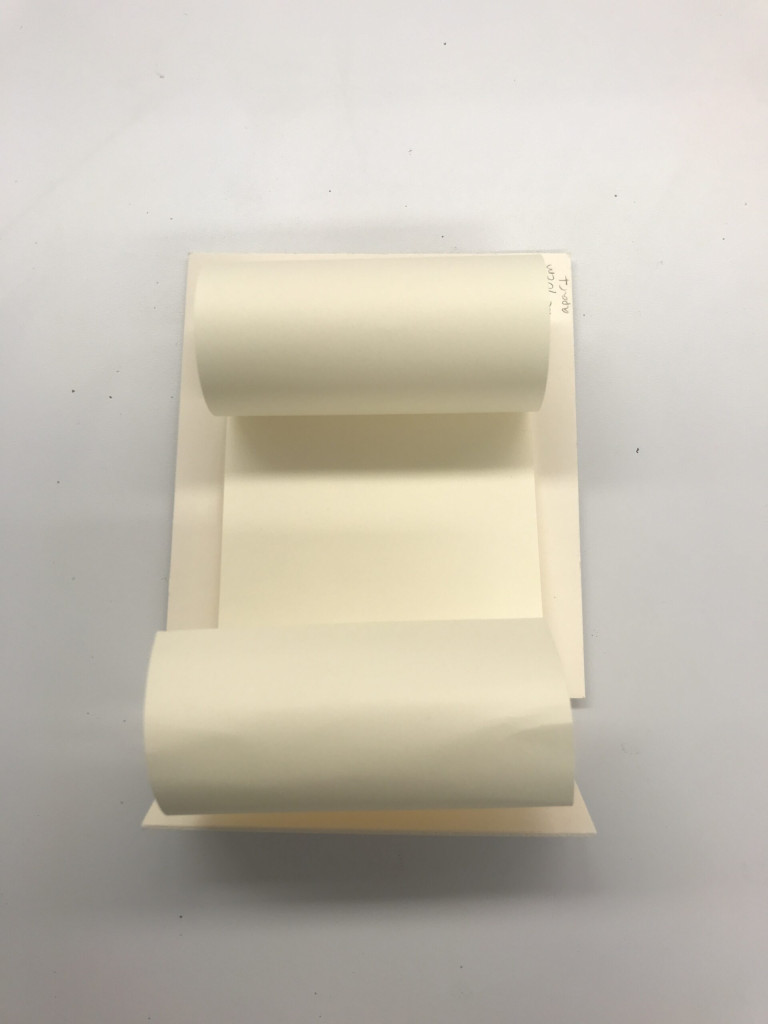
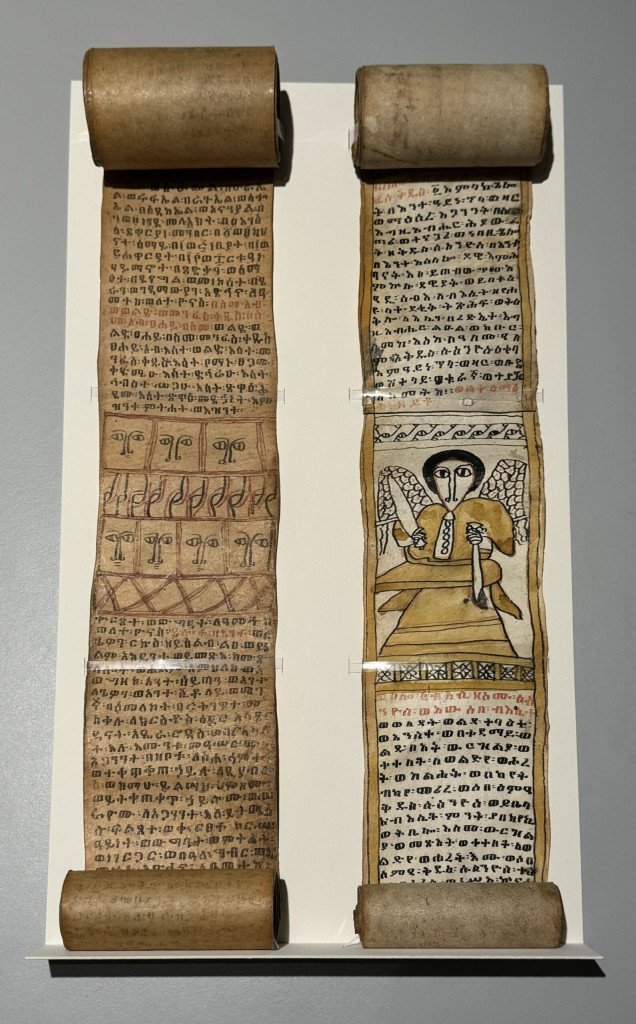
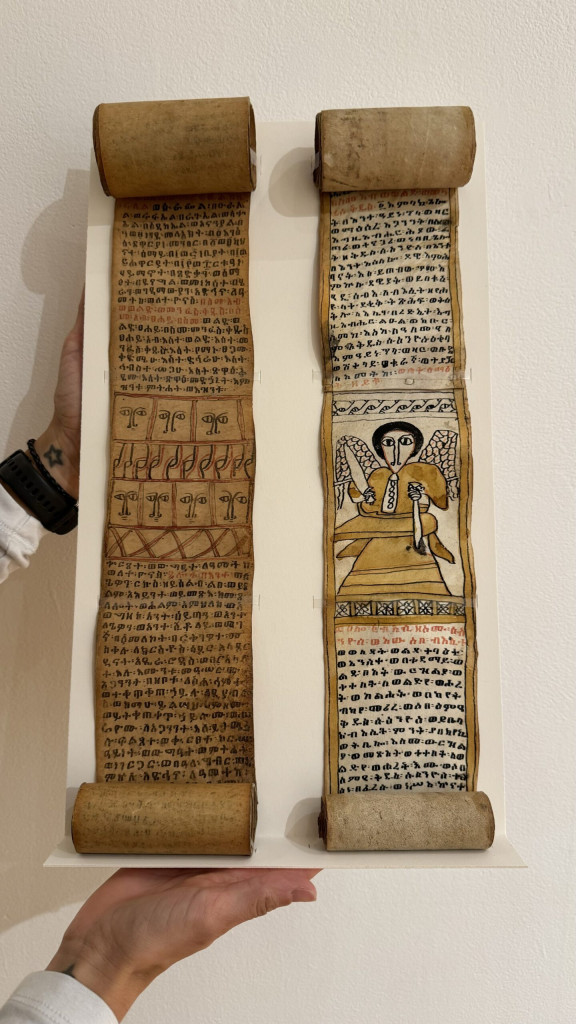
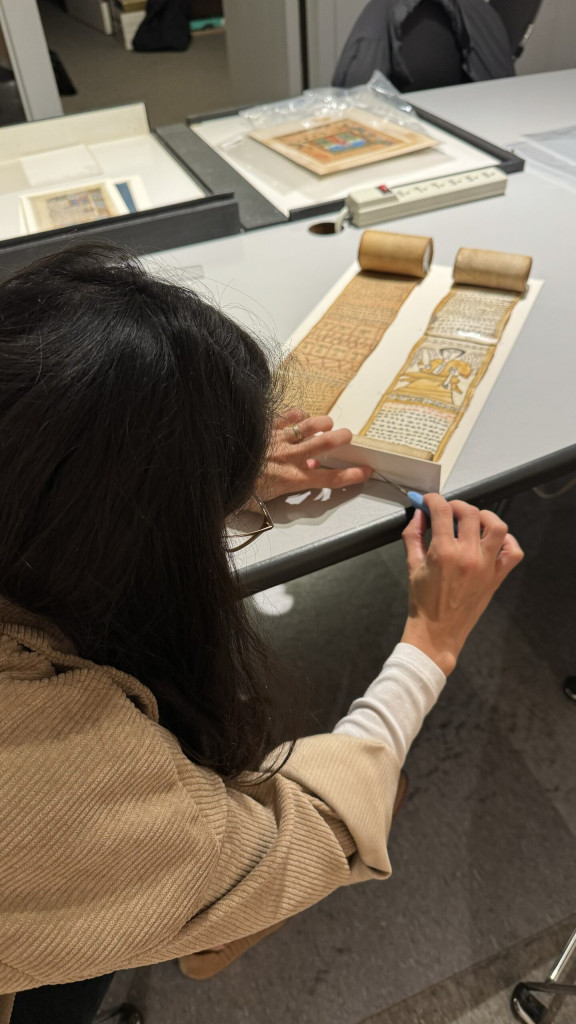
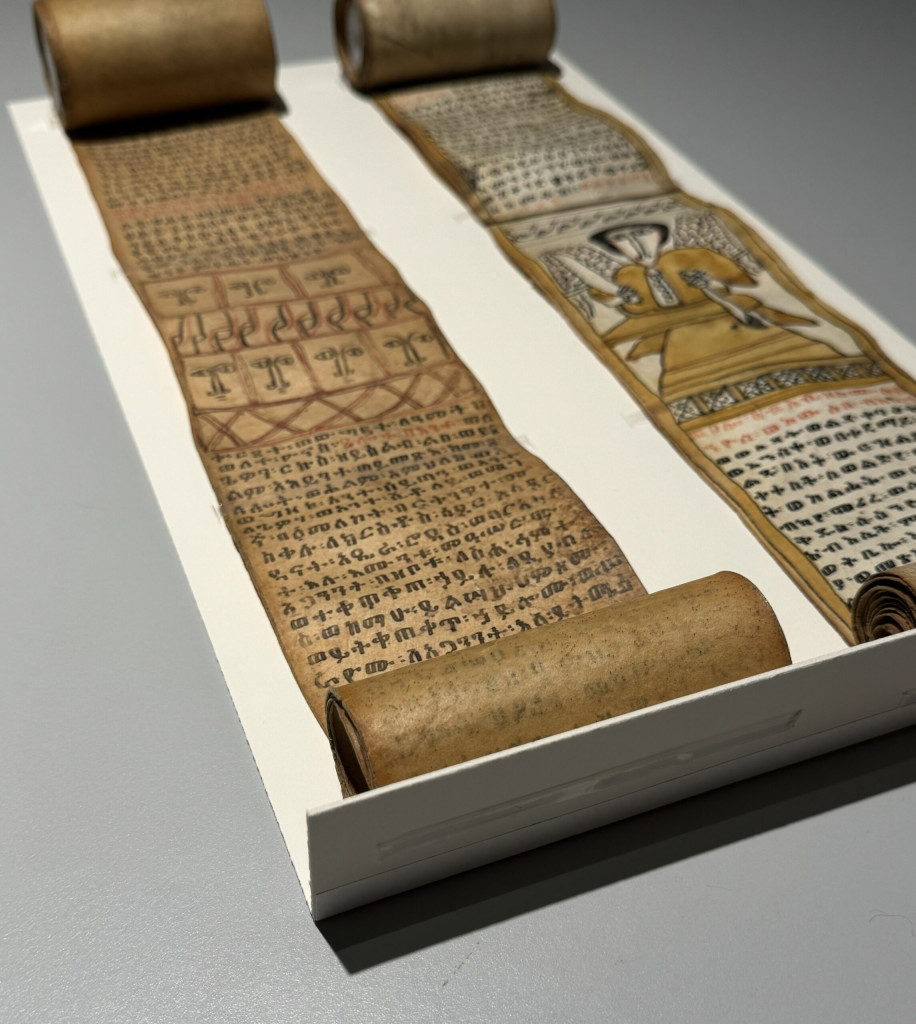
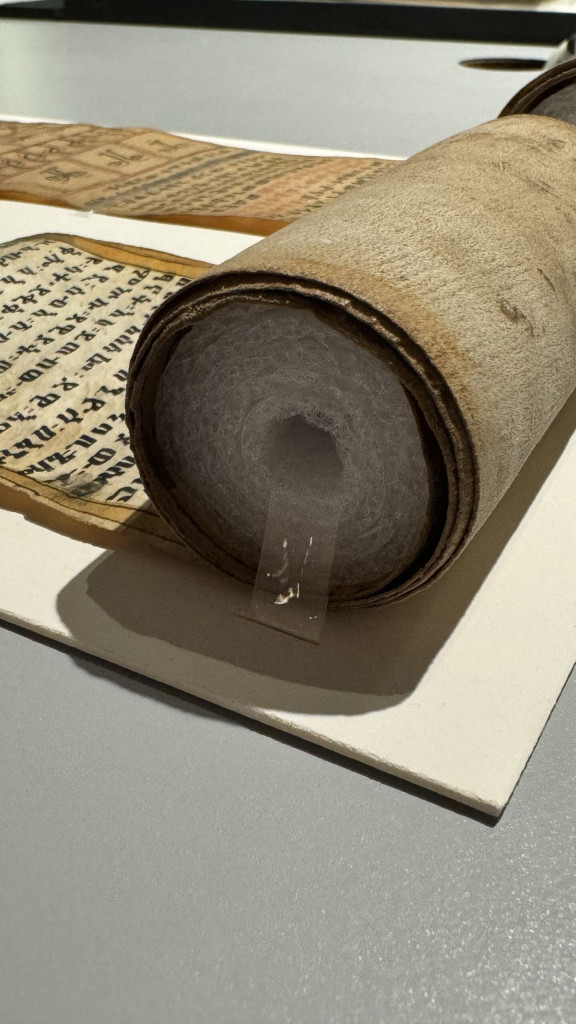
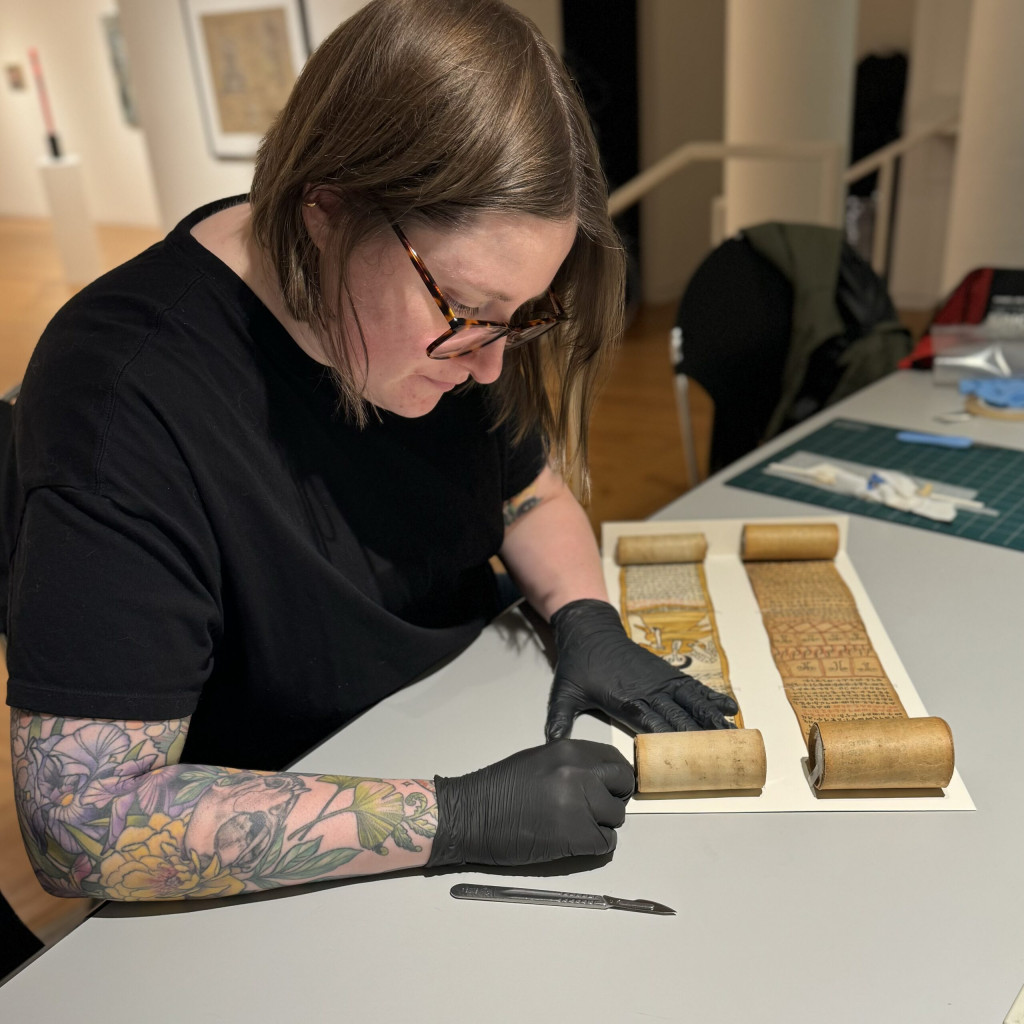
As some of the items of this collection were being prepared to go on exhibit, we had the opportunity to create mounts for other items, such as two parchment scrolls that were included in the exhibit. This was a fun project to work on, as it required us to create a support that would secure both scrolls, while providing an elegant solution for display.

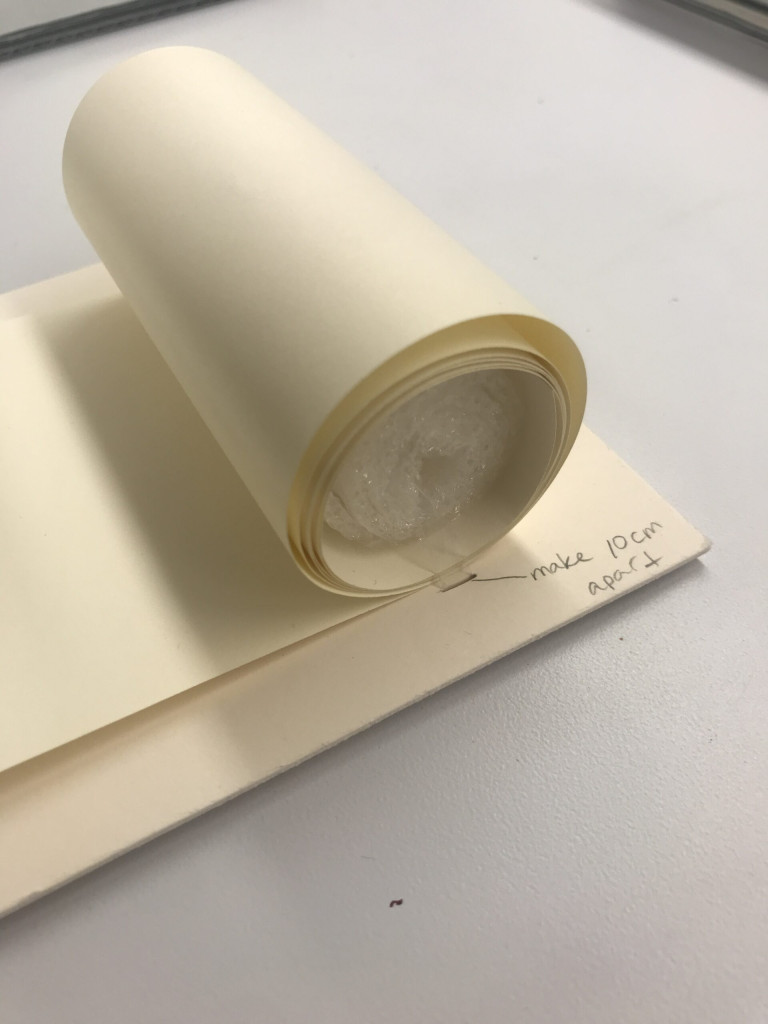
To start, Jessica created a very rough small model with mat board, polyethylene strapping, and paper (as we always do with anything new in the lab, we do love model making!!). The model provided us the visual example that we needed to create the mount for the two scrolls.

With the model in mind, we were able to engineer a good system that would provide support for the scrolls and could be used for display. The scrolls were supported with foam rolls on the inside for the rolled ends, and secured with polyethylene strapping that only touched the foam. The sections of the scrolls that were going to be displayed were also secured with polyethylene strapping that wrapped around the mat board support through slits in the board. At the bottom, the mat board extended outwards creating a small shelf to support the end of the scroll.

A small “shelf” of mat board supports the bottom of the scrolls.

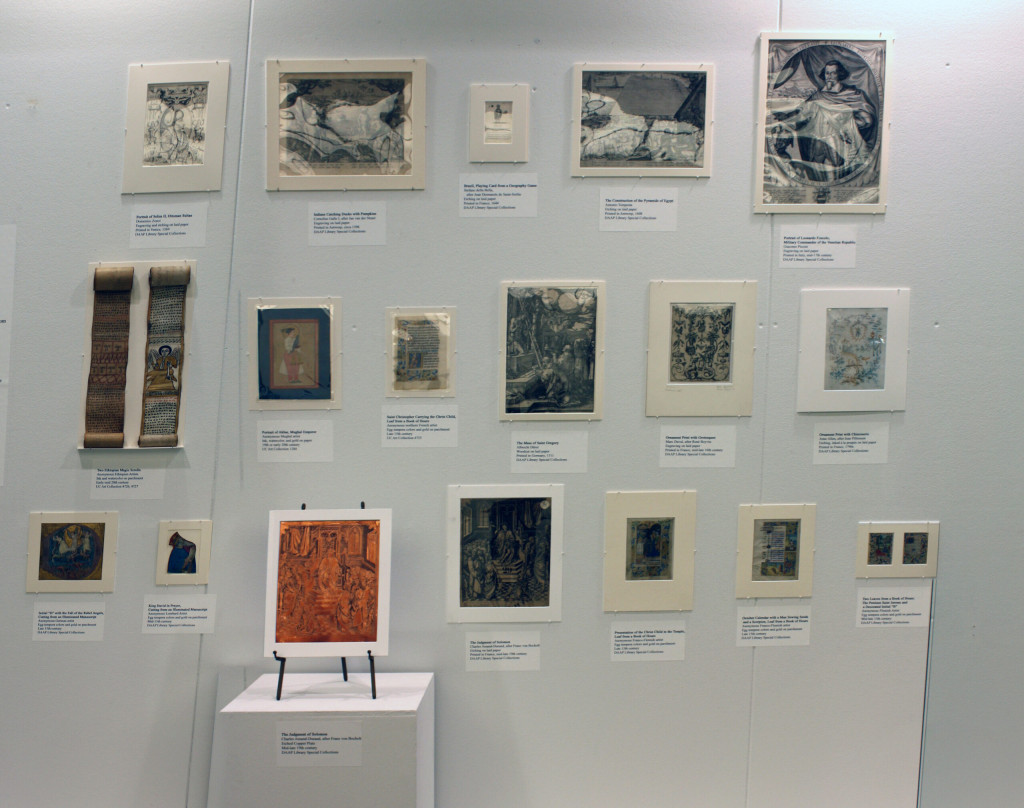
As a result of all the mounting and matting we did for the Teaching Art collection and for the scrolls, each item is currently on display at the DAAP Library entrance case:

Image of the exhibit
Current display at the DAAP Library featuring the Teaching Art Collection.
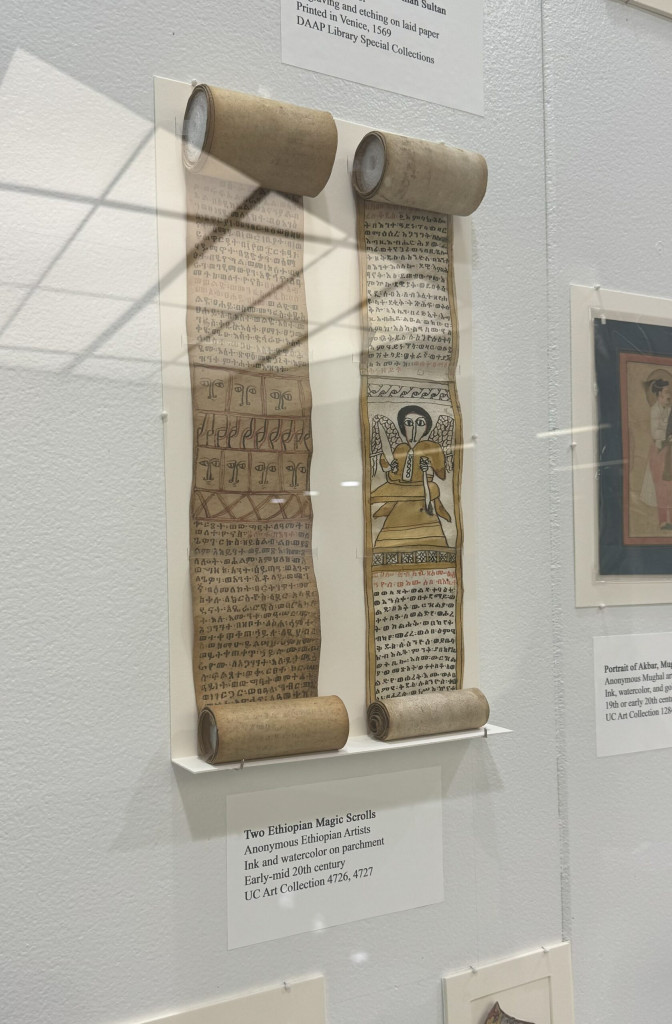
Close up of the scroll mounted on exhibit
A close-up of the scroll mounted on exhibition.

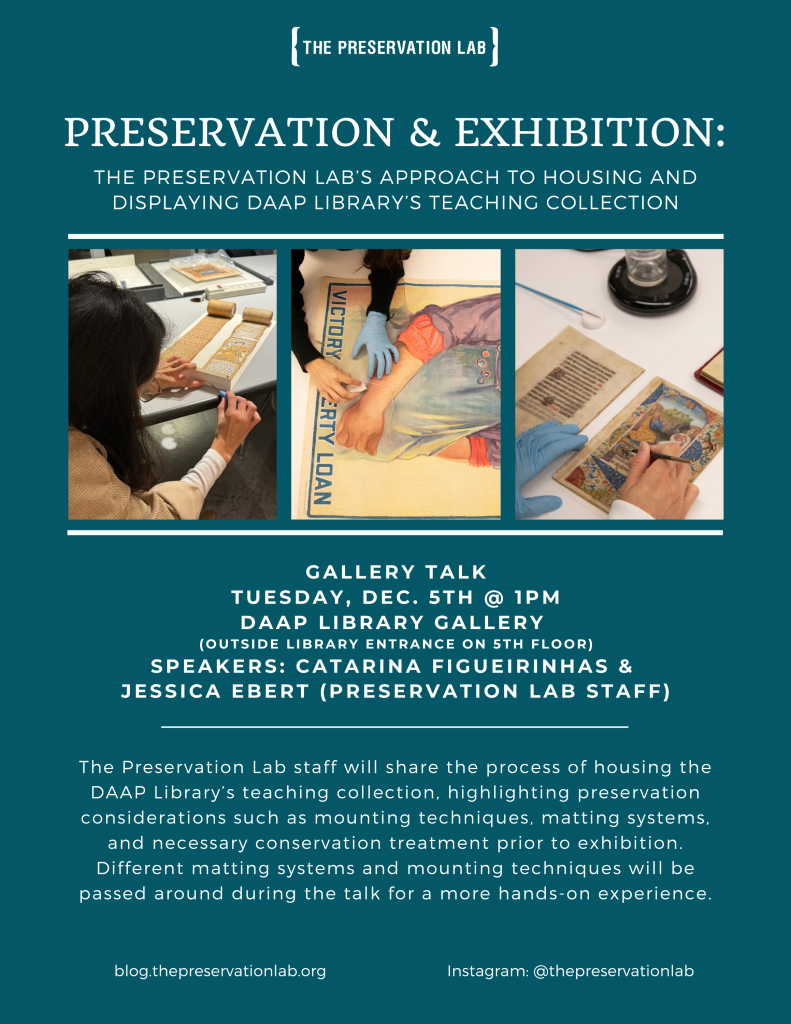
If you are interested in learning more about our preservation considerations for exhibition of this collection, Catarina and Jessica will be giving a short gallery talk on Tuesday, December 5th at 1pm, at the DAAP Library entrance on the 5th floor.

Image of the gallery talk flyer

Catarina Figueirinhas [UCL] – Assistant Conservator
Scary Stories From The Stacks

Every year the Preservation Lab celebrates Halloween with some fun, spooky and scary content, and this year is no different. However, this year we decided to reach out to our UC Libraries colleagues to hear about their encounters with the unknown, with the paranormal, and share with us any of those stories. 

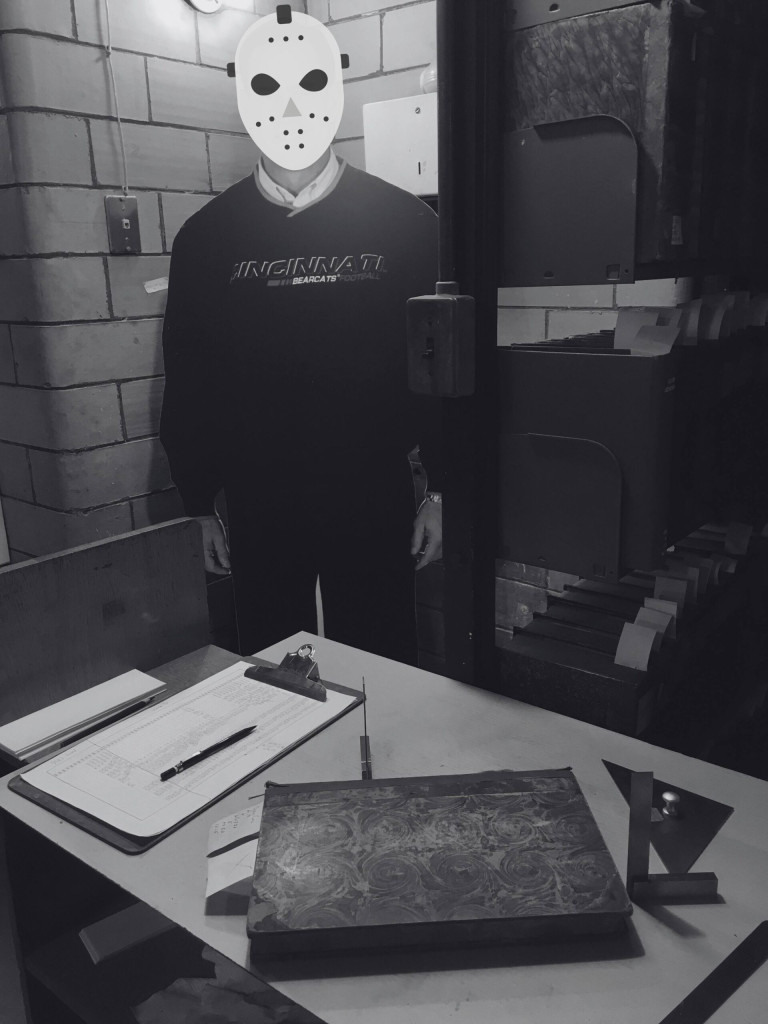
Scary figure wearing a mask in the stacks of the library

We received a few submissions that were downright spooky, creepy, and just unexplainable. So prepare yourself! Go ahead and settle in, grab yourself a hot chocolate, and cozy blanket and enjoy!! Hopefully you can sleep after this..

General spooky remarks from Mike Braunlin (Classics Library)

“Ghosts – Local lore is that the Blegen building [which is presently home to the Classics, CCM and ARB libraries] has some of them. In the Archives and Rare Books Department on the 8th floor, an apparition has been seen over the years. I read once that the Classics Department had its offices in that space years ago, and that the entity might be one of the professors of that time. I can add nothing to this story, but for years I became very uneasy whenever I had to visit our rare books in ARB and I am not usually bothered by such things. In later years, what used to invariably scare me when I retrieved a rare book was the life size photographic image of former UC president Nancy Zimpher that was placed in ARB’s stacks. They never moved it (something I would have done regularly), so I knew exactly where I would walk past it; but every time I did, it terrified me anew. But the image is now gone, and as I am also entering an age where I may soon number ghosts as my companions, I no longer fear those stacks. ”

The Ghost of Blegen Library by Kevin Miller

Published in Folkstream – volume 3, issue 3, December 1980 [courtesy of Mike Braunlin]

Cincinnati is a city steeped in tradition and folklore. Drawing upon a population of Eastern settlers, European immigrants, and Appalachian migrants, the Queen City has a varied heritage of tales and legends. Some of these, murder legends and ghost stories, have been around for the life of the city. But folklore is always being created and at least one ghost story is recent in origin: the ghost of Blegen Library.   

Located at the south end of the University of Cincinnati campus, the Blegen Library is a large, rectangular structure built in 1930. Formerly known as the Main Library and then as the Old Library, the building was rededicated last year in honor of Carl Blegen, an early Classics professor at UC In the cavernous foyer, sculptures and bronze panels depict the heritage of learning while the chandeliers exhibit proverbs in bronze silhouettes, proverbs in Egyptian hieroglyphics, Hebrew, Chinese, Latin, and Japanese which extol the virtues of education. Printers marks, the trademarks of famous publishers in the history of the printed word, decorate the high walls and stairwells. Blegen Library has a scholarly demeanor, but is at the same time a stuffy, forbidding place.   

I remember my years as a graduate student at UC, trying to negotiate the confusing stairwells, the maze of book stacks and small rooms. Some of the book stacks were located ‘underground and in the summertime, the dankness and humidity would assault me like a warm sponge. I often expected to come upon one of those career graduate students which infest every library, hiding in his carrell, his hair turned white and eyes pink from years of little sunlight, turning to me with a small, tubercular cough.   

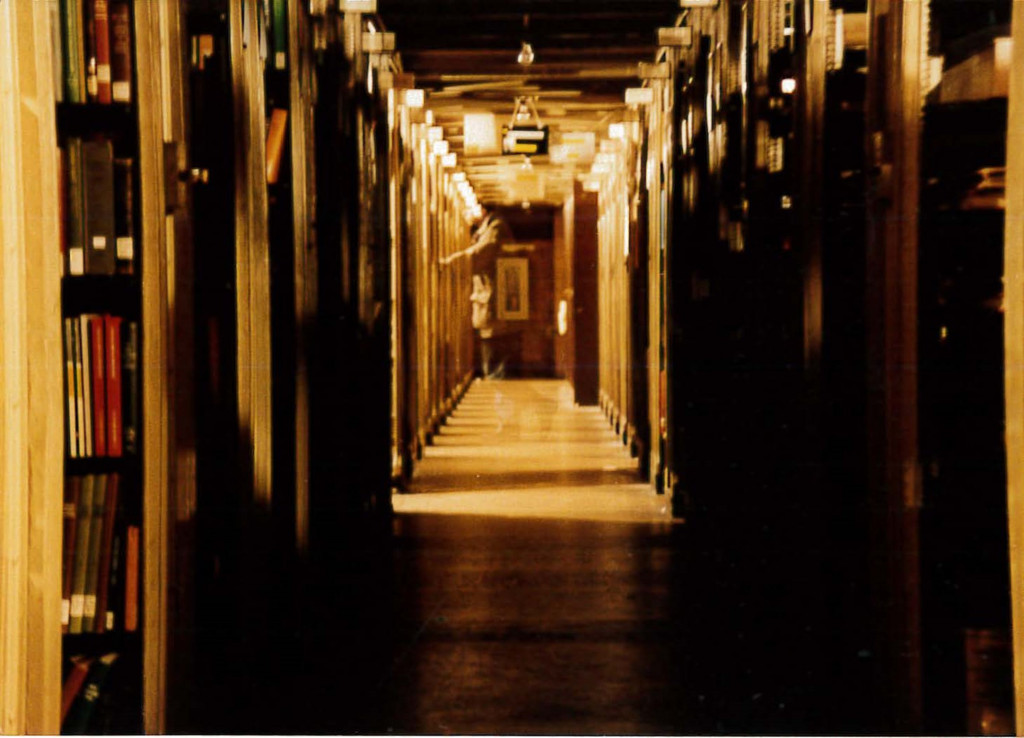
Creepy image of library stacks with a shadowy, half exposed man walking across the stacks
Image provided by Mike Braunlin

Atop the library is the Rare Book Room, a secluded area set off from offices, classrooms, and reading rooms. It is a dark room kept at a constant cool temperature and even humidity to preserve the volumes. Little drafts of air waft around theological tomes and travel accounts, in between shelves of poetry and stacks of folios. In 1976, while l was a students at UC, a student worker was shelving books in the Rare Book Room, alone in the quiet gloom, Suddenly she felt a chilling presence and turned to see a man in the stacks beside her, a rather innocuous and shadowy man who had instantly appeared.

Terrified and breathless, she rushed downstairs leaving her work unfinished. Soon her tale of a ghost quickly spread across campus and I heard about it for the first time. Since then, the story of what the student saw has circulated around Cincinnati.   

An informal ghost investigation was conducted for her by a UC professor but the spectre did not reappear. Some versions have it that the man was wearing a gray suit and glasses, others that he was short and smoked a pipe, Some folks believe it was the ghost of a former Classics professor who suffered an untimely and tragic death. His office had once been in the room where the rare books are now housed, and it happened to be near the spot where the ghost was encountered. Be that as it may, the student forever refused to return alone to the Rare Book Room for as long as she was in the library’s employ.   

Since I’ve come back to UC as an archivist in the Special Collections Department, which houses the Rare Book Room, I’m often asked by friends and acquaintances about the ghost and in turn I listen to what they have heard. Folklore is a dynamic process, always being generated and always changing. Legends are created all the time and spread by word of mouth. Whether there truly was a ghost of Blegen Library or not, its story is becoming a part of Cincinnati folklore, an example of the creative process in folklore.  

Today, there are no offices or reading rooms in Blegen Library. The building is being renovated and the sounds of welding torches and drills have for a time replaced the echoes of students’ footsteps on marble stairs. The bronze panels and chandeliers and printers marks will survive the renovation. Perhaps the ghost will too, patiently awaiting another visitor.  

Here is our reenactment of part of the story:

The Haunted Basement under the Geo-Math-Phys Library by Anonymous

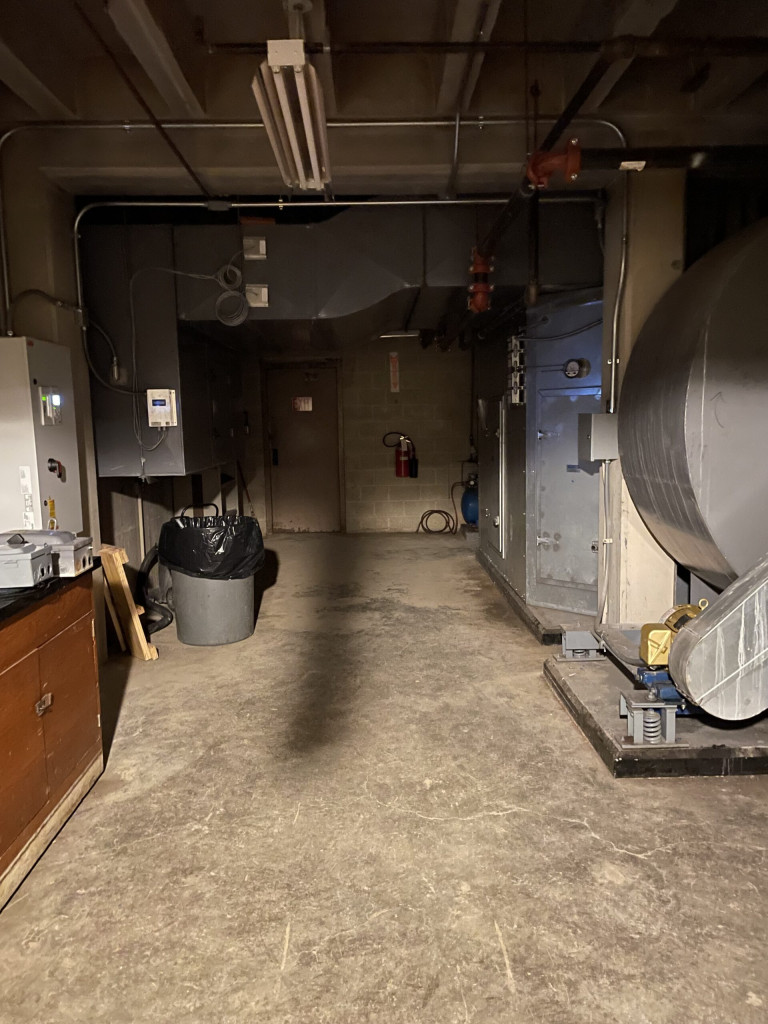
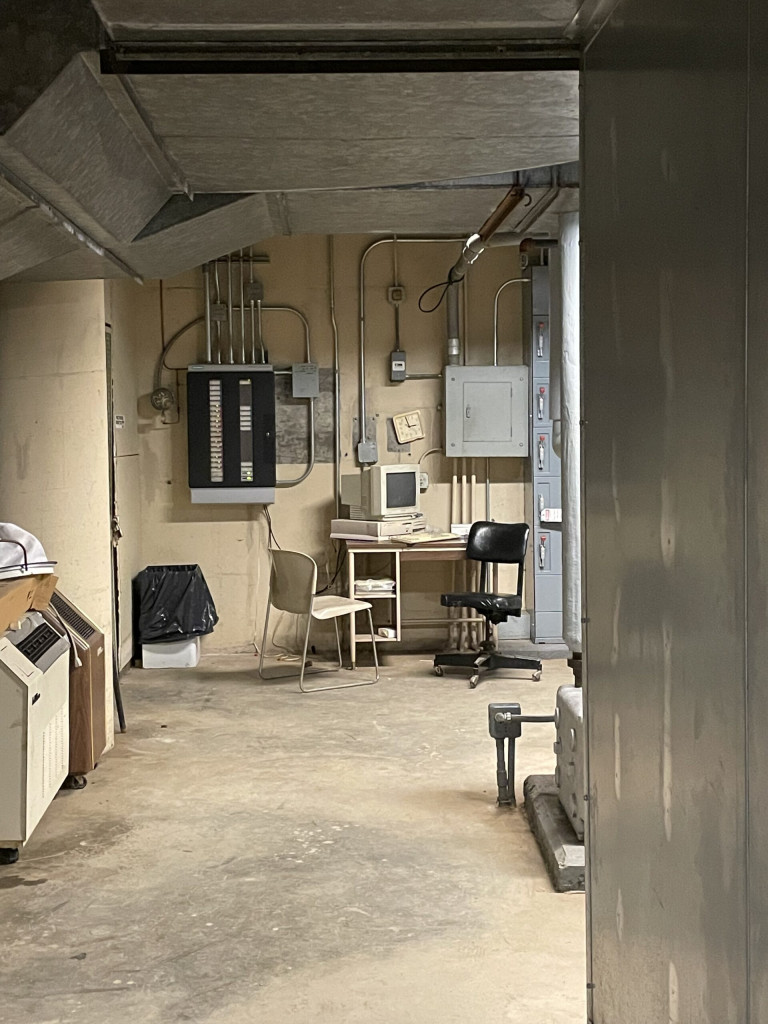
image of a creepy basement with mechanical equipment
View from the elevator

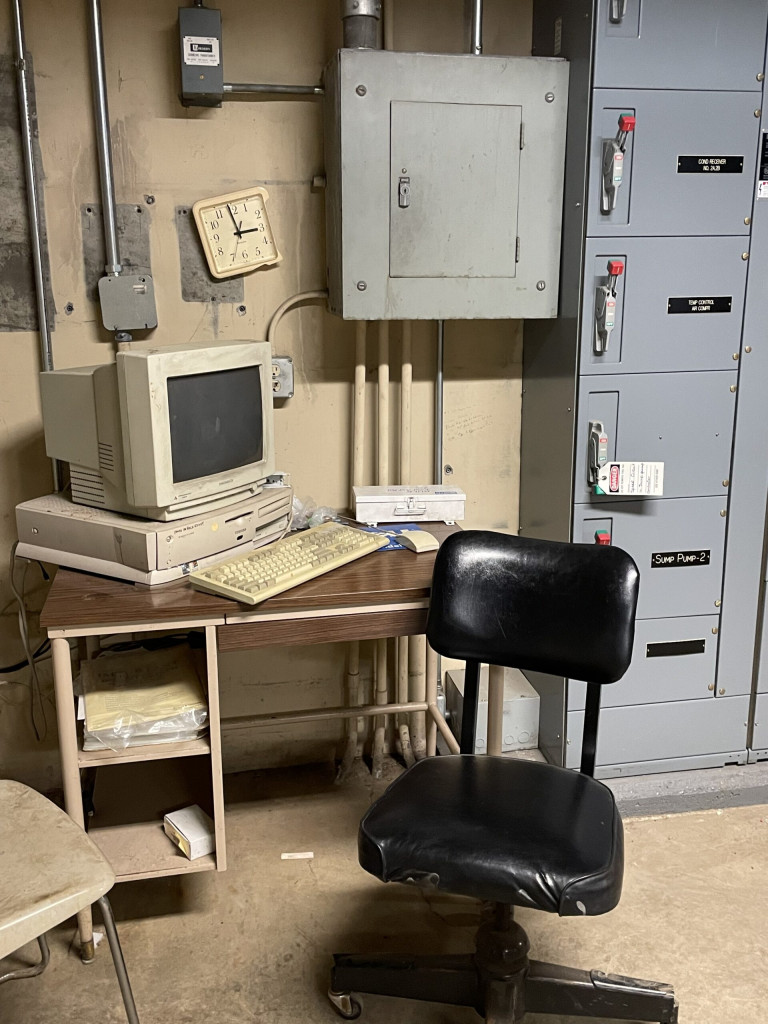
“There’s an urban legend here at GMP that long ago, a maintenance man accidentally died while trying to fix the service elevator. Now he haunts the GMP library and particularly can be spotted in the basement underneath GMP. One day I was teaching one of my coworkers how to use the service elevator and we decided to explore the basement since neither of us had been down there before. When we reached that floor, it was completely pitch black before we turned the lights on, meaning no one else was likely down there. As we walked in, we turned the corner and saw a very old work-station. At that station was an office swivel chair that was slightly turning all on its own. When it stopped, the seat pointed directly at us (almost as if someone wanted us to sit in it). We were both freaked out and decided to leave before exploring more. I have been down there a few times since then and luckily haven’t seen any more activity.”

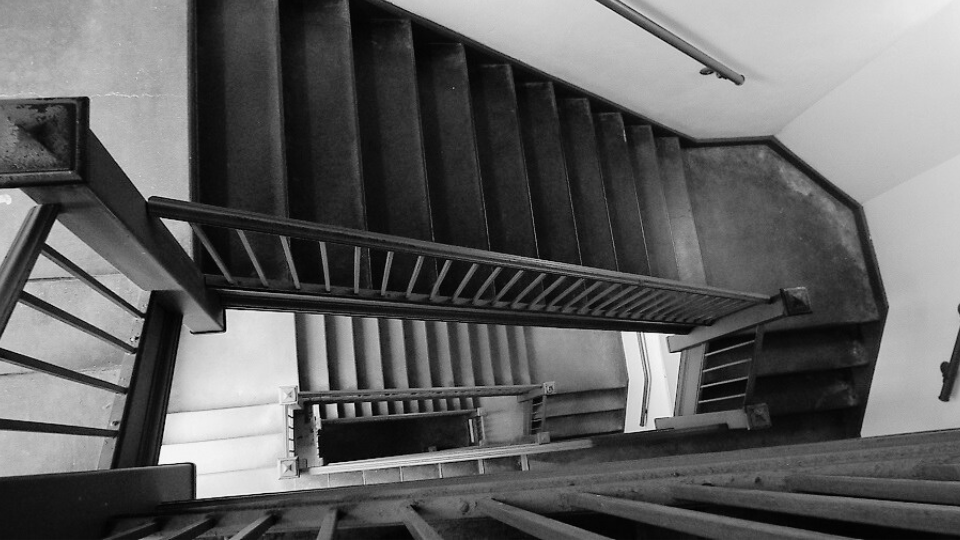
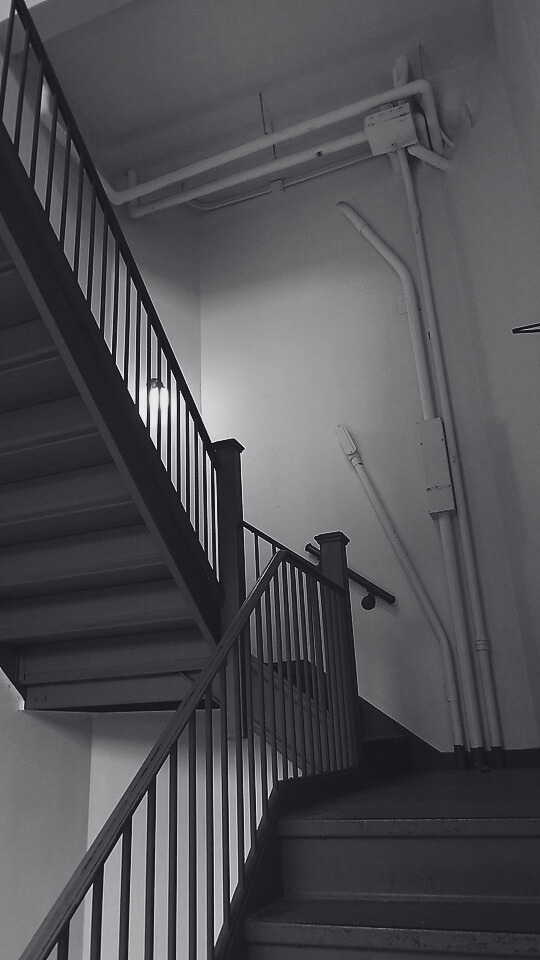
The Haunted Stairwell by Mike Braunlin

Picture of the Blegen stairs from above

“Over the years, however, student assistants have told me they are uncomfortable working on the fourth floor of our Classics stacks. No one has ever reported to me anything extraordinary, but some have told me that something there made them fearful. Some students would go to great lengths to avoid working in stacks 4 and several downright refused to go there. It is most curious that the stacks photo with the shadowy figure was taken on the fourth stack level in the area where students have reported eerie sensations.  

I only experienced one unusual incident and I offer the bare telling of it; I put forth no conclusions…

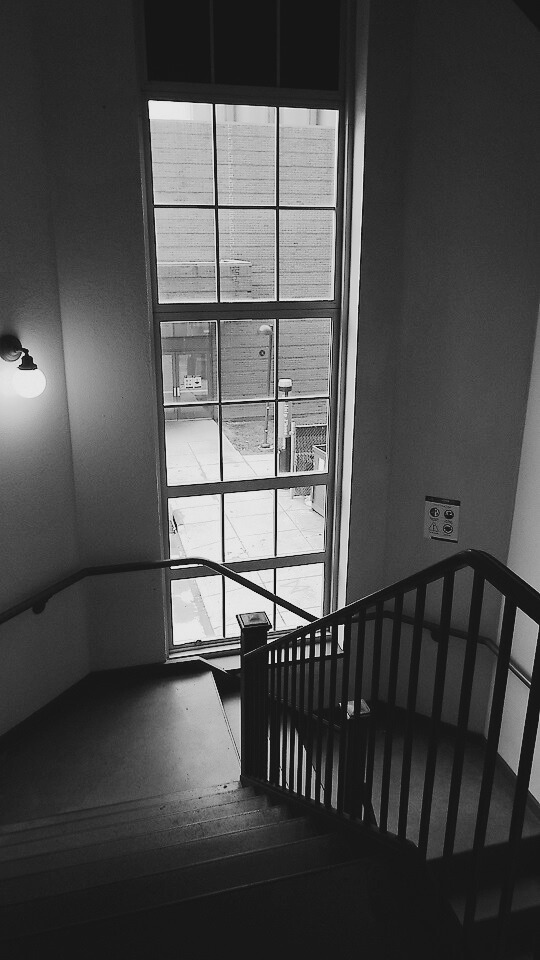
Ca. 45 years ago, when I was younger, energetic, and dedicated, an inability to stay asleep often led me to go to the office early – I often came to work in Classics around 5 AM mornings. I also didn’t have to sign in and out, as now on Flex, so I could get away with that kind of thing. One winter morning (some would call it late-middle of the night) I had entered the north stairwell of Blegen from the 4th floor to walk down to level 2, where the Classics Library was in those days. I was about halfway down the stairwell, which was in darkness, but for the moonlight shining in the windows, when the entire stairwell (all levels) erupted with the noise of dozens of people talking and laughing all together.  

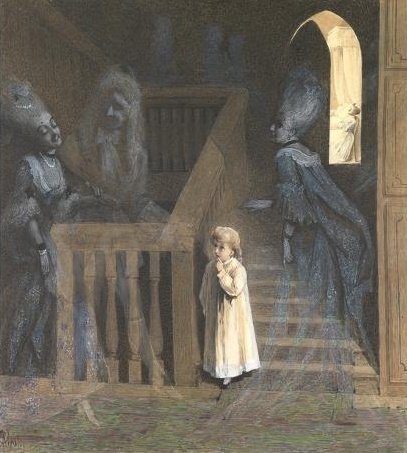
Illustration entitled “The Party on the Stairs” by British painter Adelaide Claxton from 1875

Imagine, if you will, a cocktail party going on in the stairwell, full of people, all talking and laughing at once – all around me. Except there was no one there. I stood there in the darkness, desperately tightening my sphincter muscles and taking in the unreality of this, until I bolted up the stairs, out the front door, and ran to the Majestic Apartments on McMillan, where 2 of our student assistants lived, Claire Sponsler and Susan Stites. I banged on the door and when they, full of sleep and surprise, let me in, I explained what happened, and lay on their couch until 8 AM, then I went back to work. Nearly scared the crap out of me, hence my sphincter reference several lines up, but I am glad for the experience. Also glad, because, 45 years on, Susan and I have been married for 33 years…”

Here is our reenactment of part of the story:

A huge thank you to all those who shared stories with us! We know we will definitely be checking over our shoulders the next time we’re in the stacks.

If you want more spooky content, check out our Instagram where yesterday we shared what gives conservation professionals nightmares:

Catarina Figueirinhas [UCL] – Assistant Conservator
Jessica Ebert [UCL] – Sr. Conservation Specialist

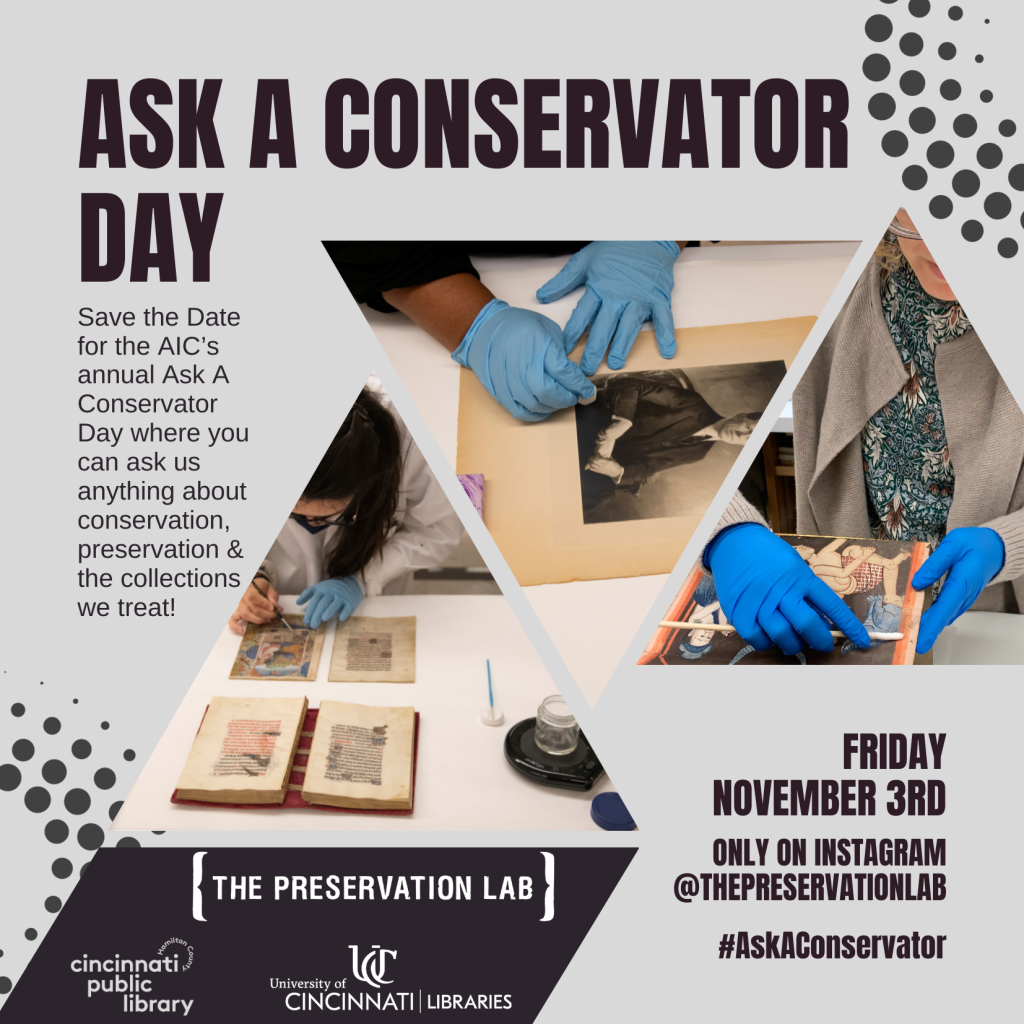
Save the Date and celebrate Ask a Conservator Day with us – Friday, Nov 3rd

Tune in Friday, November 3rd on our Instagram and ask us anything you might want to know about conservation, preservation or the Lab!

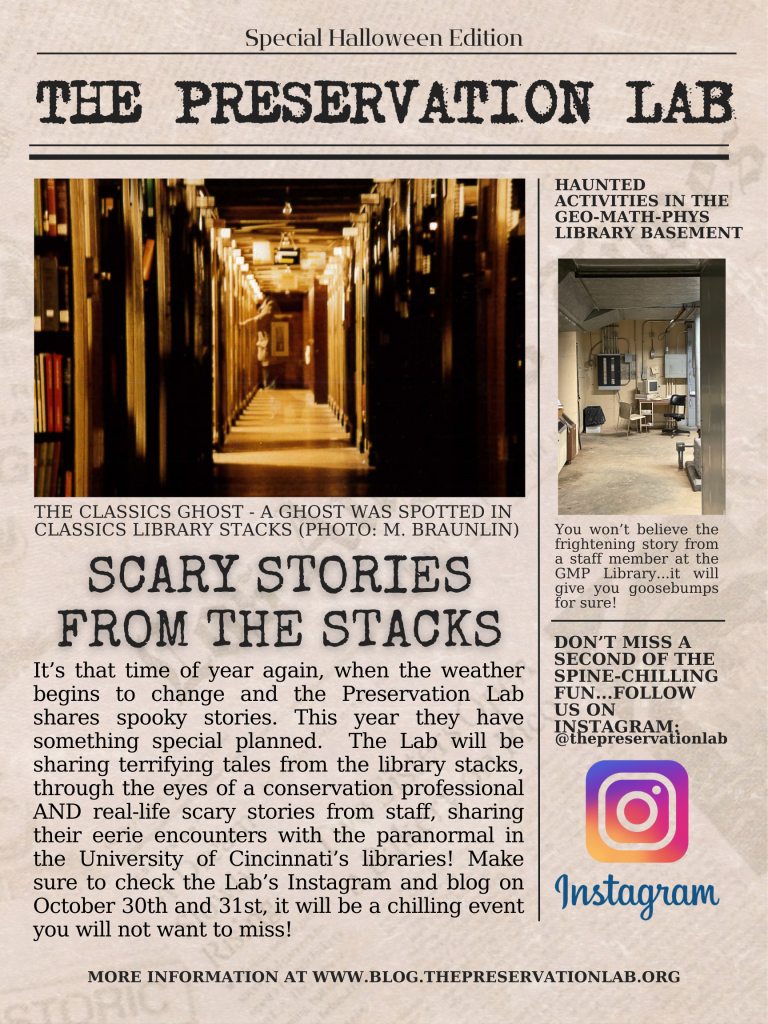
Stay Tuned for “Scary Stories From the Stacks”

Per our annual Halloween tradition, we have some spooky happenings planned next week. This year we have ventured into the stacks to bring you some spooky stories, so make sure to check the Lab’s blog and Instagram on October 30th and 31st, if you dare!

How many magnets is too many magnets?!

Recently Jessica and I started working on a series of special collection items from UC Libraries’ DAAP Library. These were recent acquisitions specifically bought to be used as a teaching collection within the DAAP Library. Most items are small prints and single manuscript leaves that need to be matted for exhibition and prepared for handling during class. We have been working on these in small batches since it is a much larger collection that keeps growing.

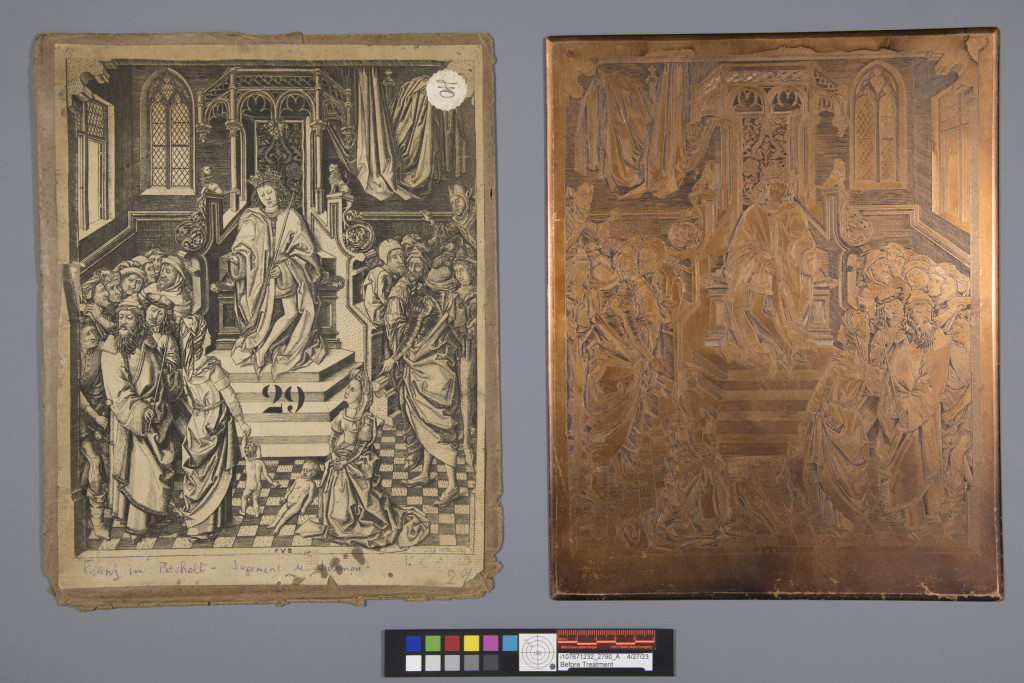
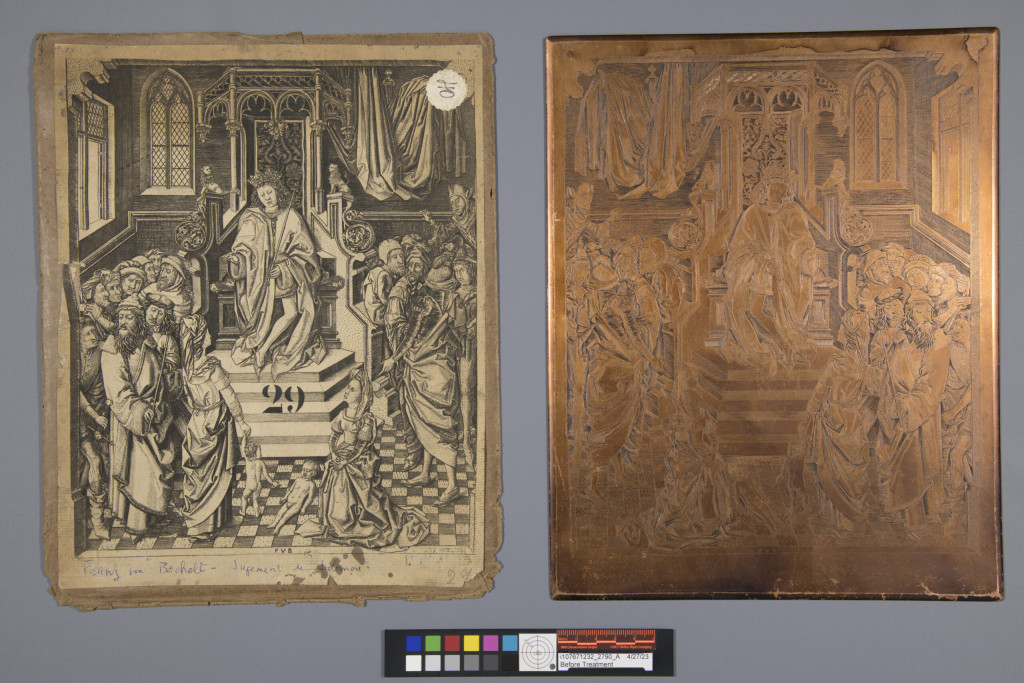
Most of the items we have received so far have been very straightforward matting projects, however we encountered one that was puzzling and fun to work on. We received this item: a proof print accompanied by its very heavy, copper engraving plate. The print was adhered to a paper brown envelope with no information and the copper plate was also unhoused.

Image of print on the left and the copper plate on the right, with a photography target below
Proof print (left) and engraving plate (right) before treatment and housing.

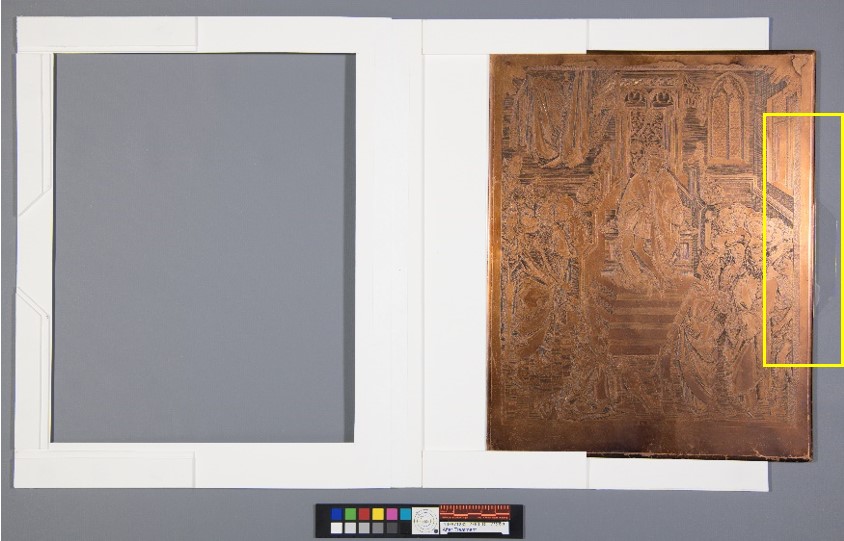
The curator of the collection wanted both items to be housed together and housed in a way that would allow students to touch the items, and also be able to use them for exhibits.  We decided that both items would be matted individually, and then housed together in a thin corrugated clamshell box. The most challenging part would be to create a matting system that was strong enough to secure the very heavy copper plate and elegant enough to be used for exhibition.

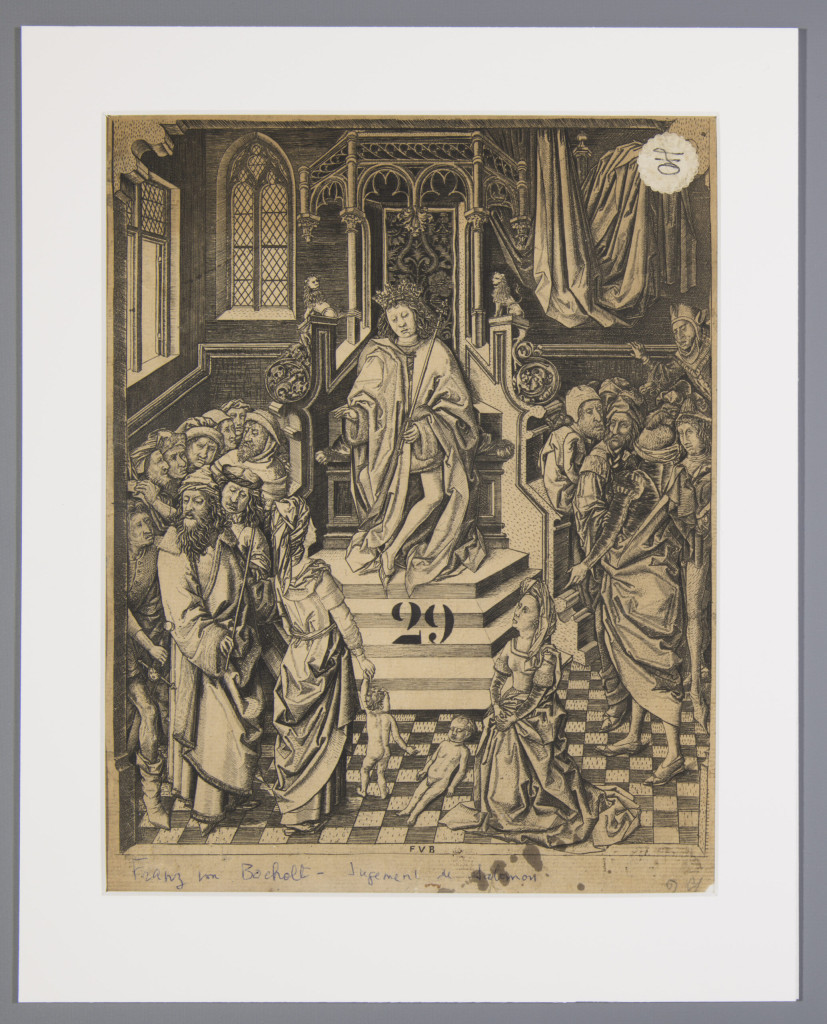
The print itself received minor treatment, with the backing envelope being removed and the print housed in a polyester L-sleeve mounted with photo corners.

An image of the matted print
Print housed in a polyester L-sleeve and matted with photo corners.

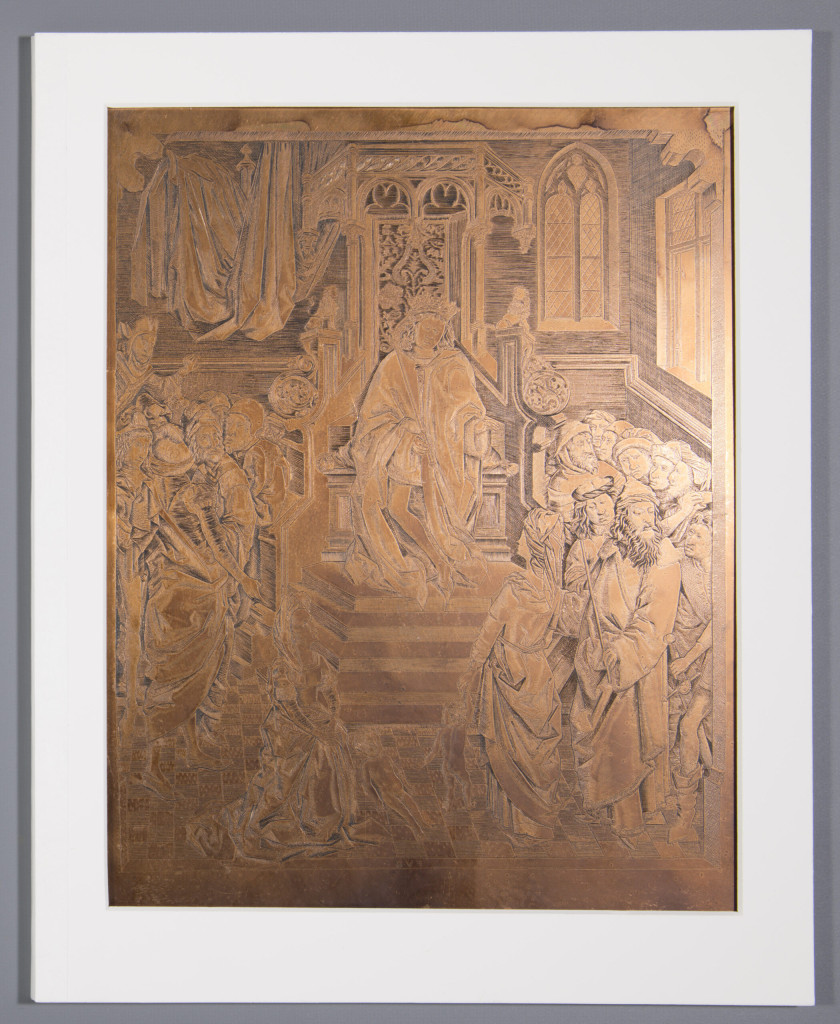
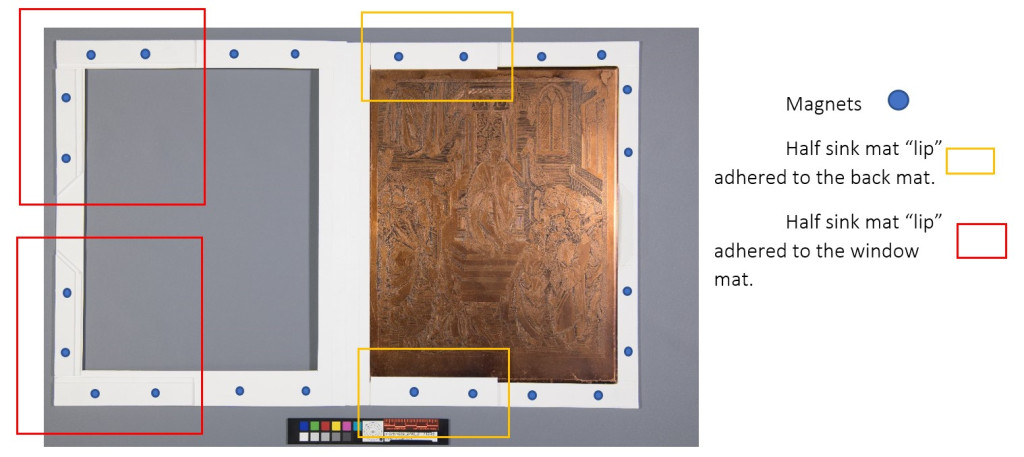
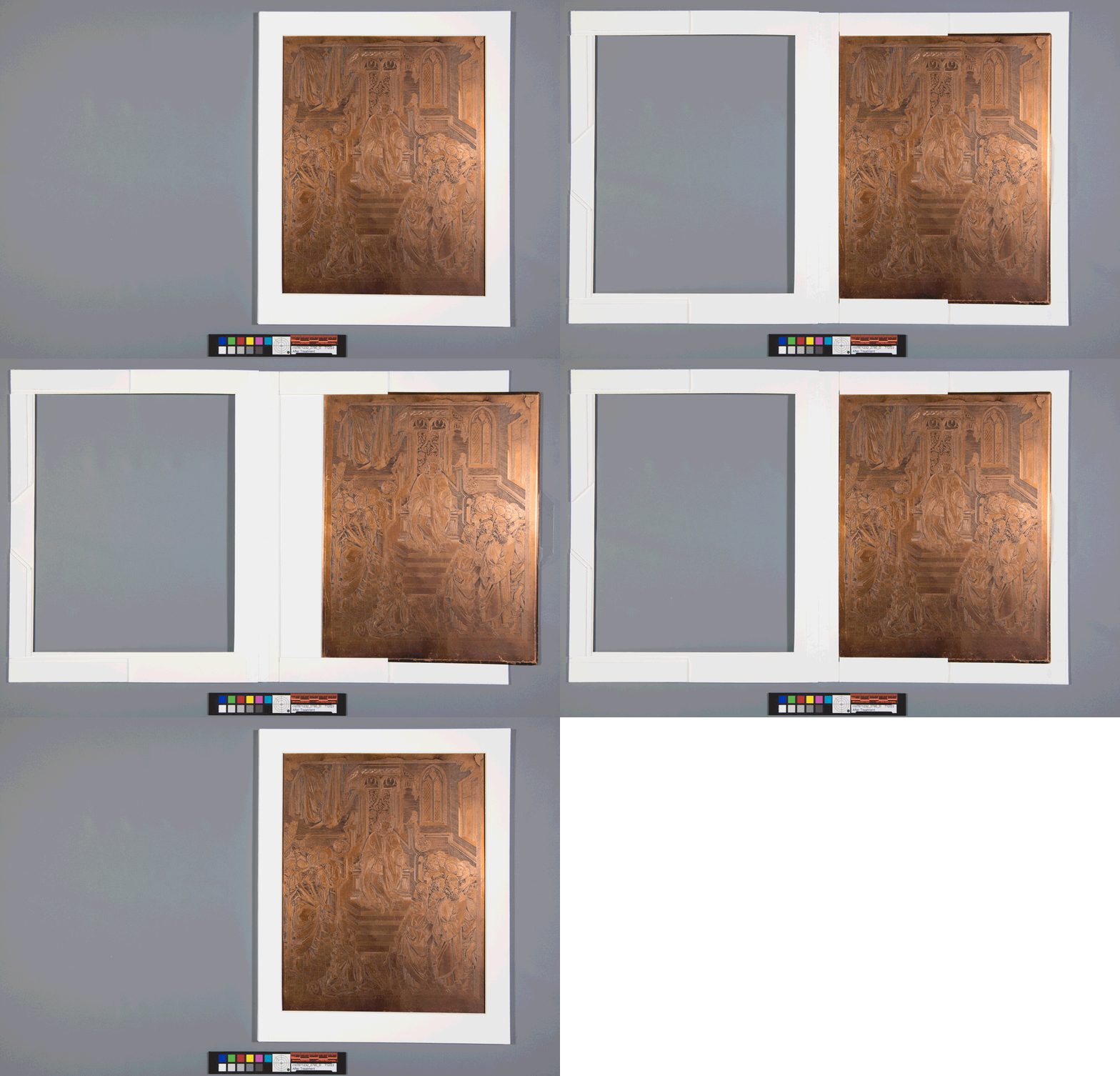
With the engraving plate, I needed to figure out how to create a matting system that was strong enough to hold the copper plate in place, especially if used for an exhibit where it may be propped at a slight angle. After considering some options, I created a sink mat that would secure the plate halfway, and then the rest of the sink mat would be adhered to the window mat so the copper plate, resting on a polyester tray, could be pulled out of the mat easily. How would I keep the matting system closed? ….with magnets, lots of magnets! For this project I used 24 rare earth magnets.

Image of the matted copper plate
Copper engraving plate housed in a specialty sink mat with magnetic closures.
Diagram of the magnet locations in the sink mat
Matting system for the copper plate – a sink mat, half attached to the back mat and half attached to the window mat, all secured closed with magnets.
Copper plate partially removed from the matting system with a box highlighting the location of the polyester film tray
Copper plate slightly removed from the matting system by the polyester film tray.

This was a fun project to work on. After using 24 magnets and breaking a few in the process, the copper plate was securely housed in the sink mat, while also able to be propped up for exhibition and handled for teaching.

The matting system in action!

Catarina Figueirinhas [UCL] – Assistant Conservator
Conservation photography by Jessica Ebert

300 photographs?! More like 4800 photographs!! 

This past March, at one of our Special collections meetings, the Lab received a photographic project from UC’s Classics Library. This was a large German collection comprised of 16 series, each series with approximately 300 photographs, a total of about 4800 photographs!! These are silver gelatin photographs that depict ancient sculptures. The photographs are important since in some cases they show sculptures that may have been destroyed during the WWII.

All the photographs were curled, some showed silver mirroring, and minor tears along the edges, or creases. Most of the conservation treatment focuses on humidification and flattening of each photograph. With such a large number of photographs, the project was divided between Chris (Senior Conservation Technician), Hyacinth (Conservation Technician), and myself (Assistant Conservator).
Before Treatment – Photographs as they were received in the Preservation Lab. Overall, curled with small tears along the edges.

We each took a series of photographs to work on. Ahead of starting the project, we conducted some tests, along with Ashleigh (Conservator), to understand how long we should humidify the photographs, we create the pressing stacks that would be used for the flattening, and some guidelines that we could all refer to throughout the projects.

We concluded that we would obtain the best results by only humidifying the photographs for a maximum of 20-30 mins and then pressing them. First, we pressed the photographs between pressing stacks of thin Hollytex, blotter, Rising Museum Photomount mat board and binders board for two days. Then we pressed them in a book press or under weights between Photomount mat board until the compression enclosure is created. Before humidification, each photograph was surface cleaned with a hydrophilic sponges.

https://www.instagram.com/reel/CrdrnkXM__3/?utm_source=ig_web_copy_link&igshid=MzRlODBiNWFlZA==

After being humidified, small cracks on the emulsion and small tears were repaired.

Chris is usually faster with any treatment, so his batch has been fully treated, and now he is in the process of making an enclosure, a cloth clamshell compression enclosure to ensure the photographs don’t start to curl again.

During Treatment – Chris working on the cloth clamshell compression enclosure.

I am still working on my batch. I currently have one-fifth of the photographs being pressed and the rest are awaiting humidification and flattening. This is a long project that requires constant monitoring and time for pressing, but it is so satisfying to see the photographs slowly relaxing and flattening. It will probably take us a few years or more to fully complete the entire 16 series, but once the project is complete each series will be safely housed and repair.

Catarina Figueirinhas [UCL] – Assistant Conservator