Tag Archives: Long-term storage

I Got 99 Problems, but the Lawrence Notebooks Ain’t One: Finishing the Conservation Treatment of 99 Volumes

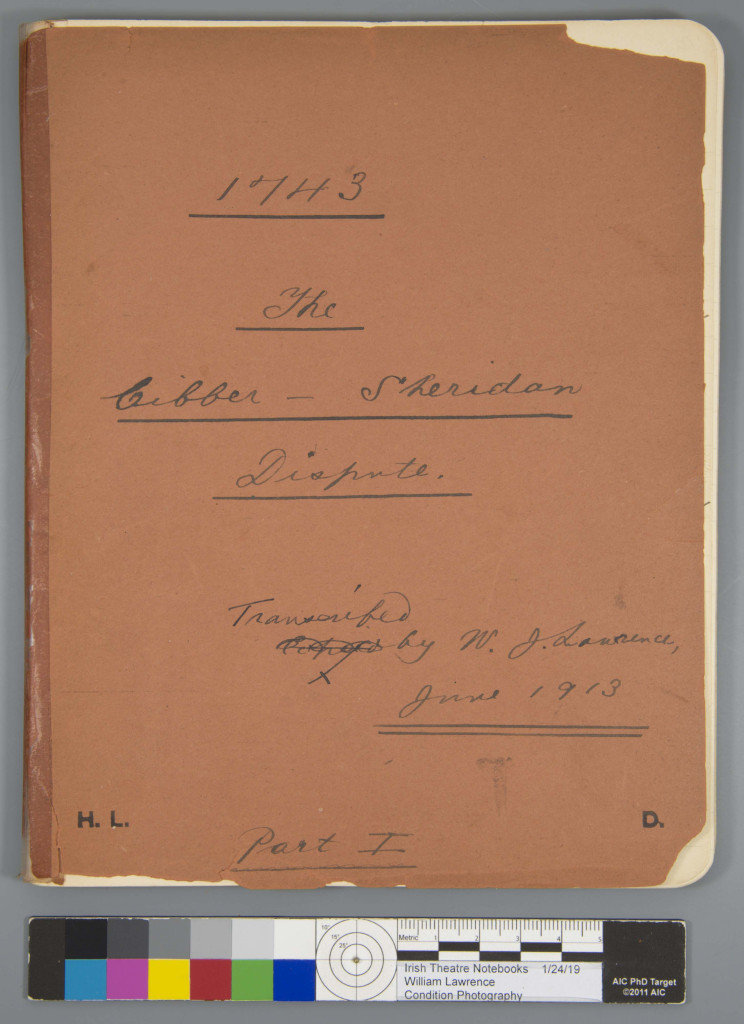
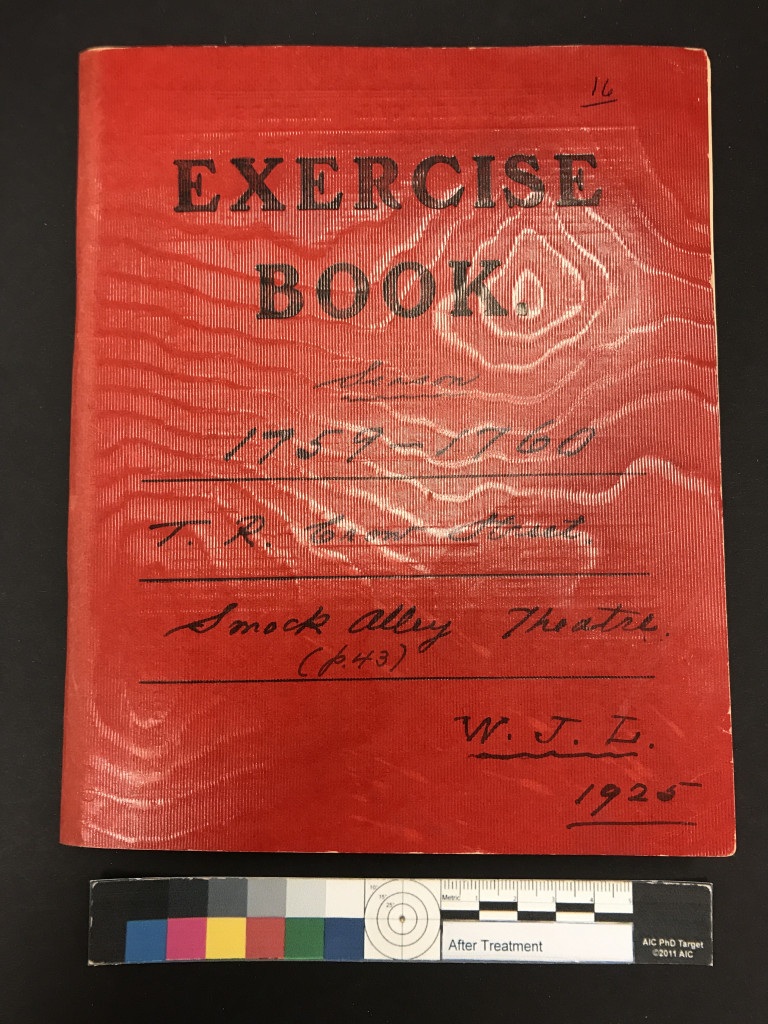
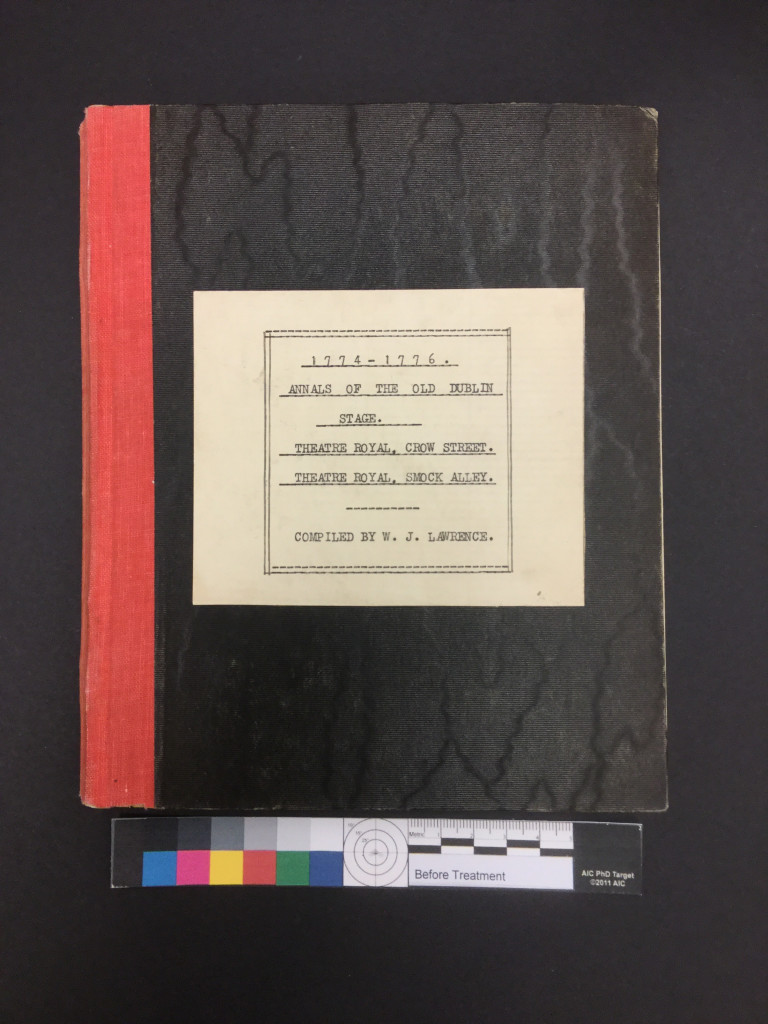
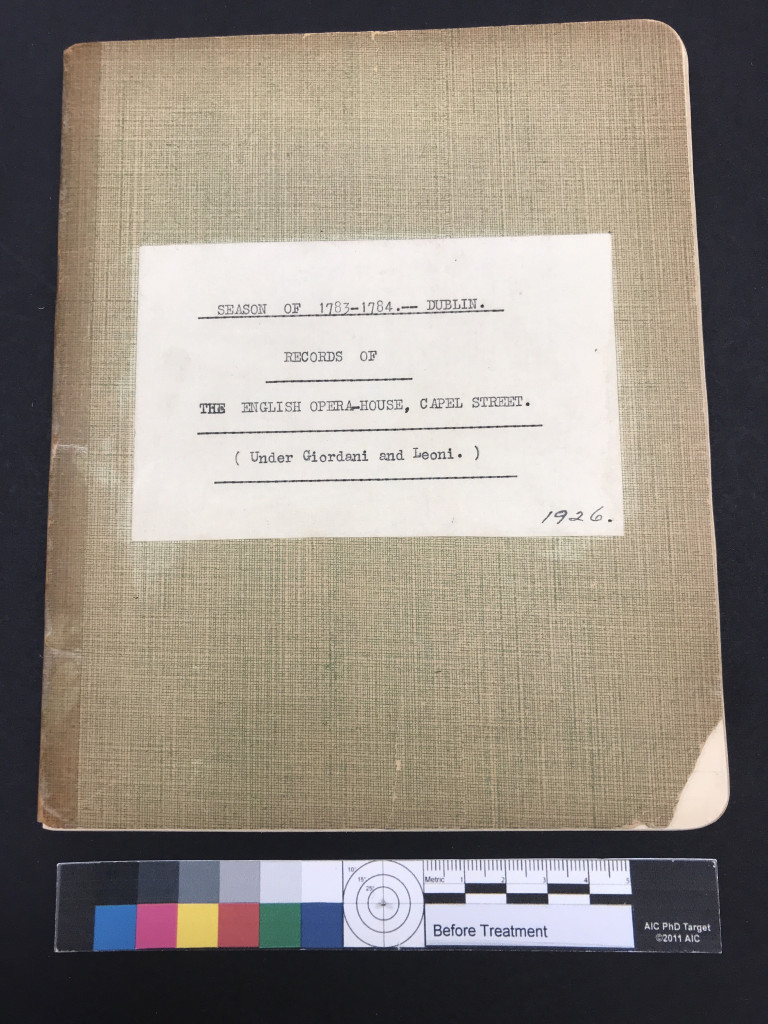
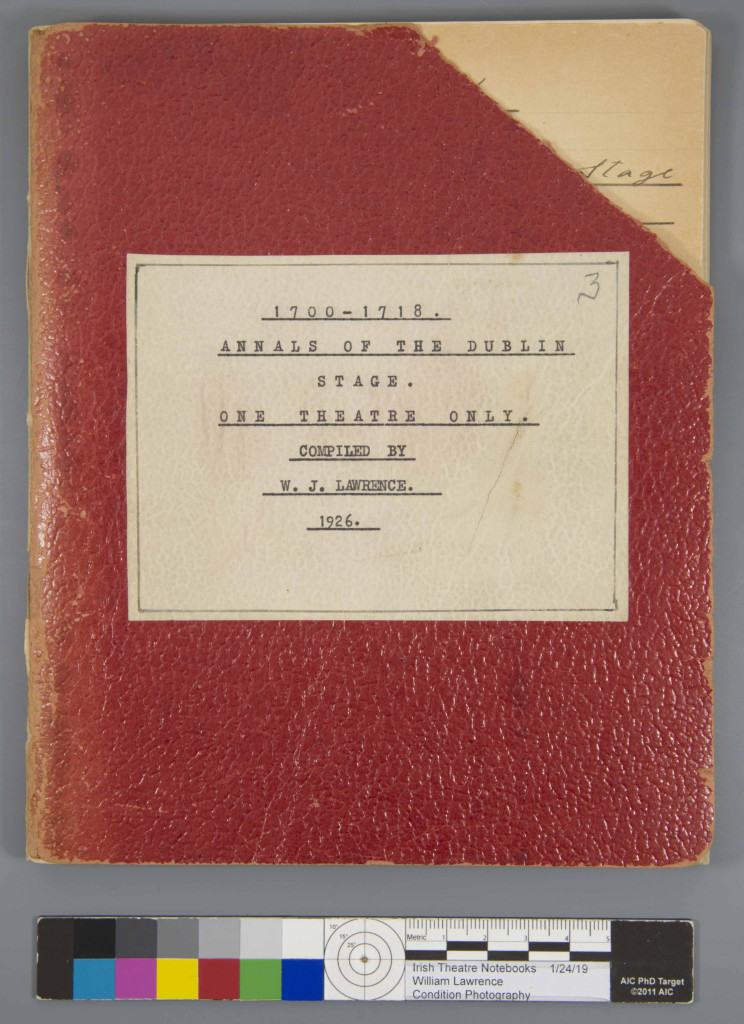
For the past few years, I have been working on the conservation treatment of the Lawrence Notebooks, a remarkable collection of 99 handwritten volumes created by William J. Lawrence that document his extensive research on the Irish stage from 1630 to 1911. Over many years, Lawrence filled these small, lined notebooks with careful handwriting, news clippings, photographs of actors, typed play transcriptions, and detailed notes on theaters, performances, ticket prices, and even personal anecdotes. Together, the notebooks offer a rich and vivid window into the history of Irish theater and the cultural life of Dublin from the seventeenth through the early twentieth centuries.
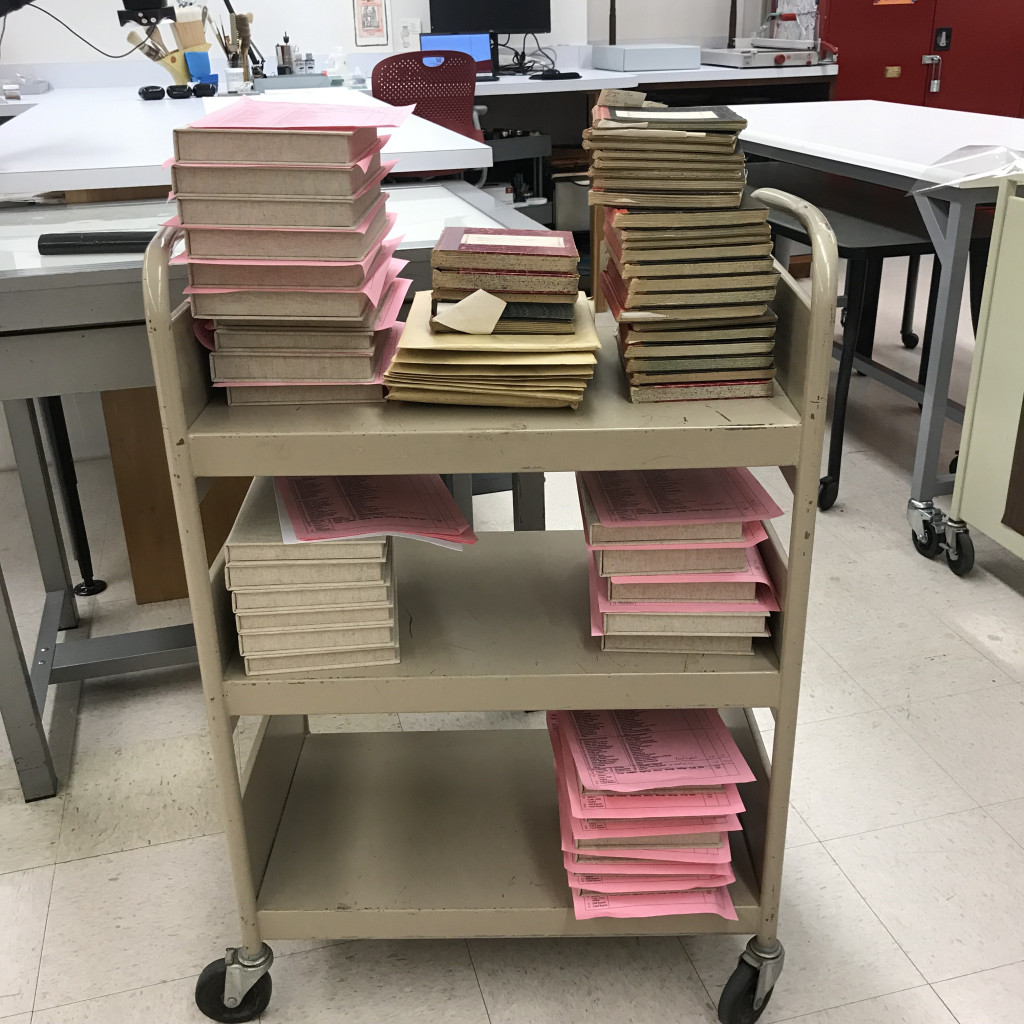
A library book truck filled with various small notebooks and conservation boxes.
In 2021, we had already completed 37 of the 99 volumes, and we still have 62 volumes in the Lab.

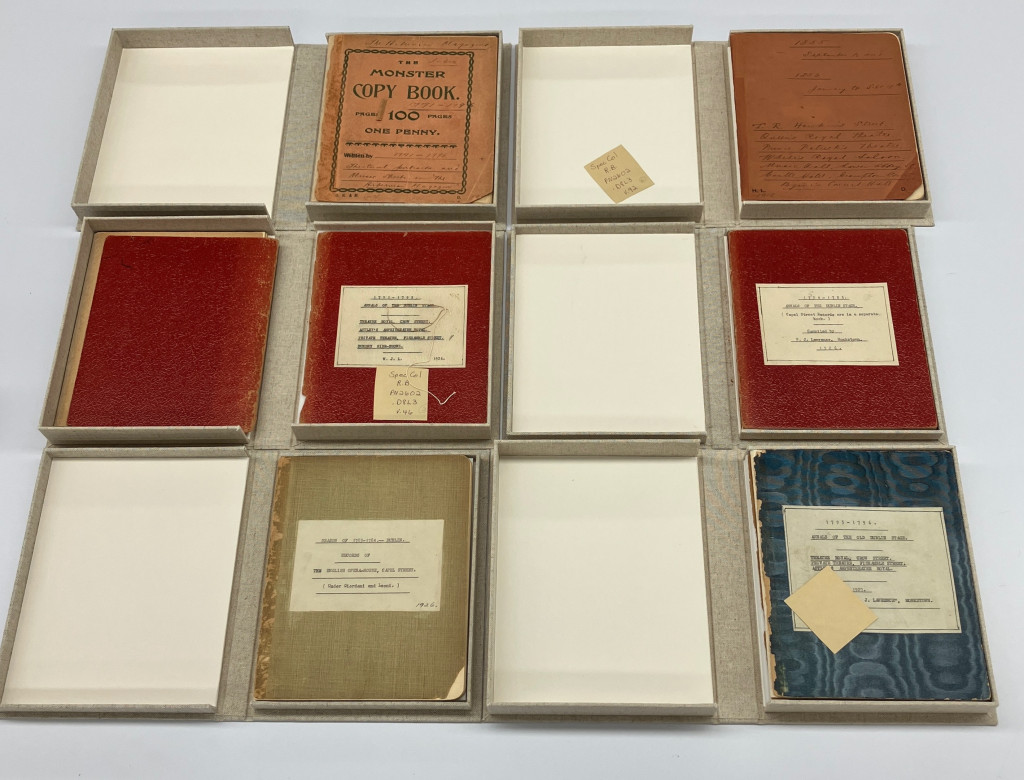
This project was a collaborative effort and was completed gradually over several years, with individual volumes treated alongside other conservation projects rather than all at once. Our former colleague Chris Voynovich created custom cloth-covered clamshell enclosures for all 99 volumes, while I was responsible for the evaluation and conservation treatment of the notebooks themselves.

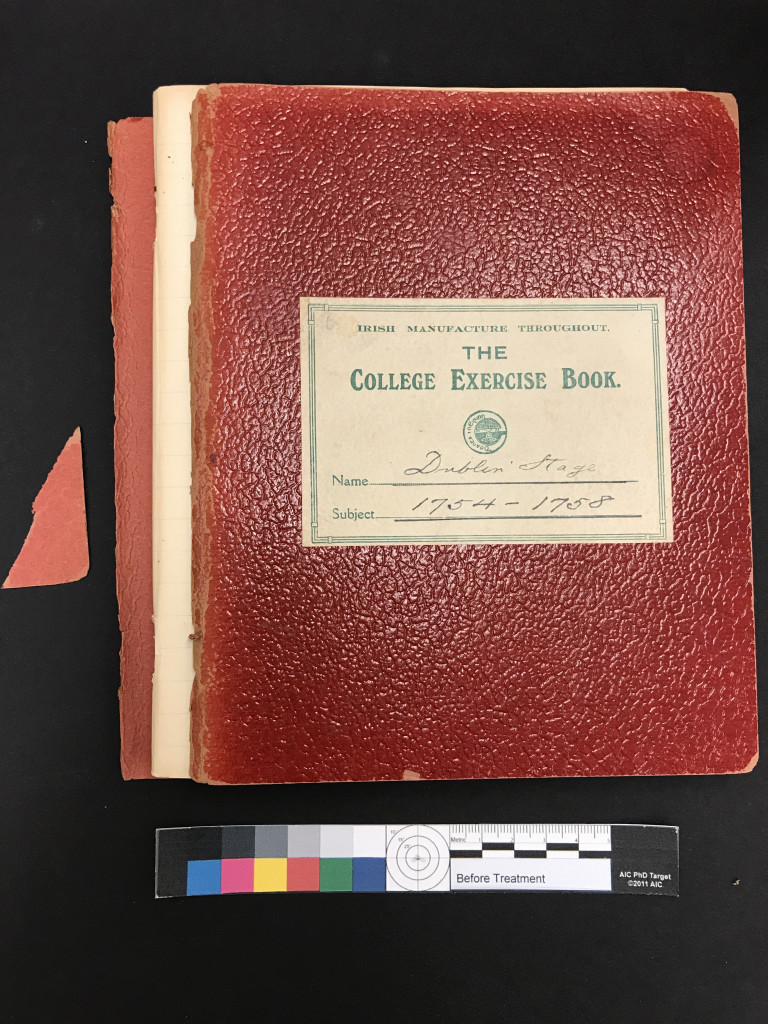
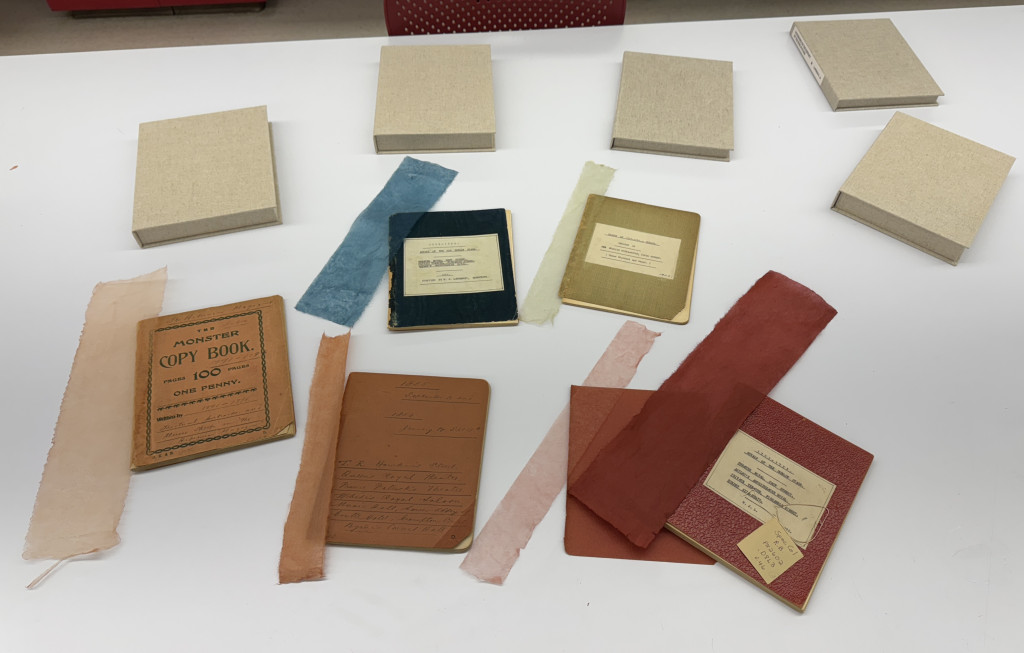
Although the Lawrence Notebooks shared a broadly similar format, closer examination revealed subtle but meaningful variations in both their covers and text blocks. Most volumes were small, square notebooks with thin boards covered in cloth or paper covers, in a range of muted colors including red, orange, green, blue, and black. The text blocks were generally composed of one or several gatherings sewn through the fold, with the primary support most often being lined paper.
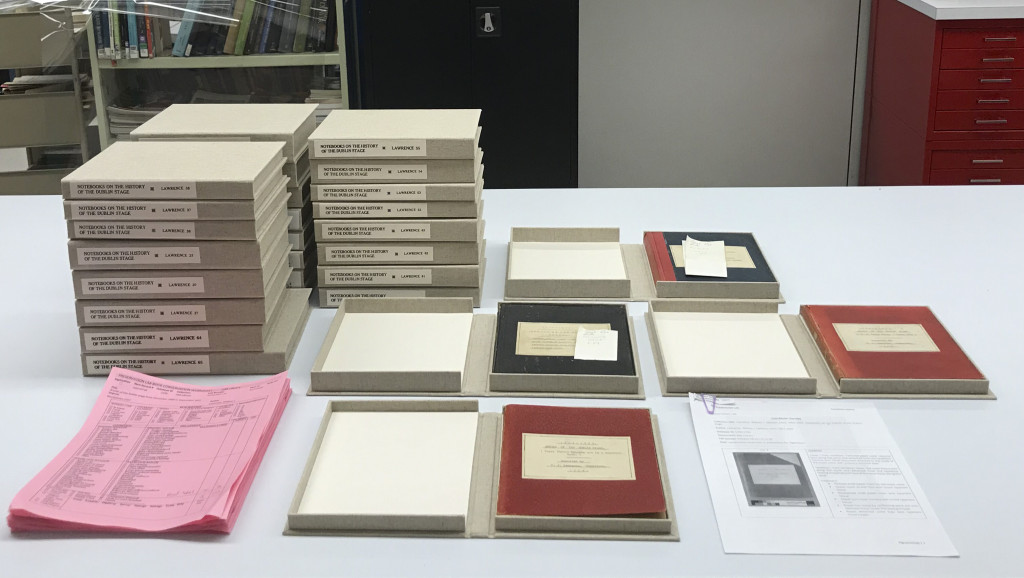
Overhead view of six notebooks with different covers in their enclosures, with the boxes opened.
Variations in cover materials and colors across the Lawrence Notebooks.

Once all the volumes were received in the lab, each notebook was evaluated for its condition and assigned to one of three categories: good (no treatment required), fair (requiring stabilization), or poor (requiring more extensive treatment). The notebooks showed clear signs of long-term handling and use. Many volumes had weakened or detached covers, some of which had been previously repaired with pressure-sensitive tape. Other common condition issues included broken sewing, tears along the spine folds of the text block pages, and brittle newspaper clippings that had also been repaired with pressure-sensitive tape.
View of a stack of cloth clamshell enclosures, with several opened to show notebooks inside.
Condition evaluation of the Lawrence Notebooks prior to treatment.

When determining the most appropriate conservation treatment for each volume, it was also important to consider their future digitization. Treatments were selected to stabilize the notebooks while ensuring they could be safely opened, handled, and imaged without placing additional stress on the original materials.

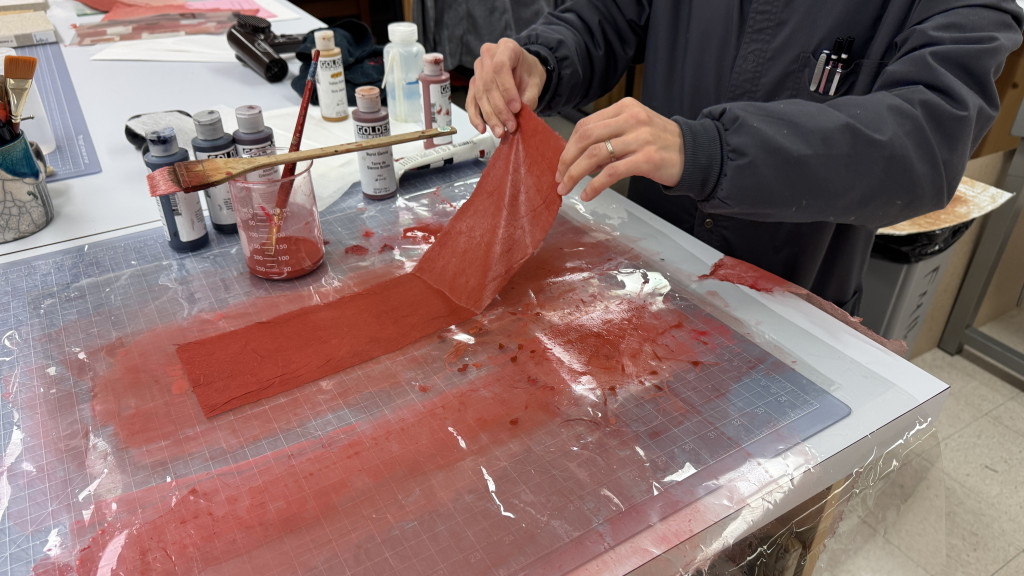
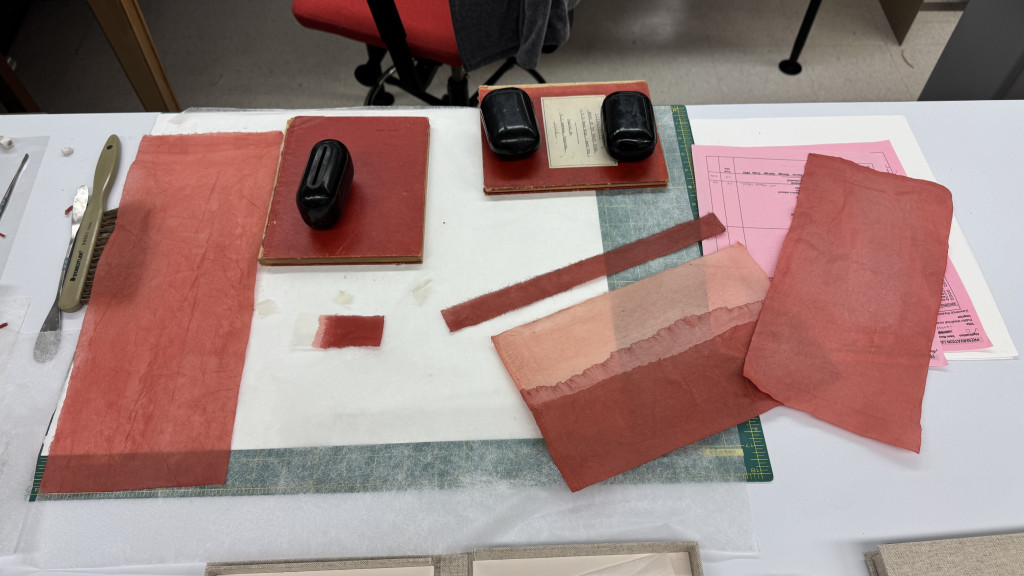
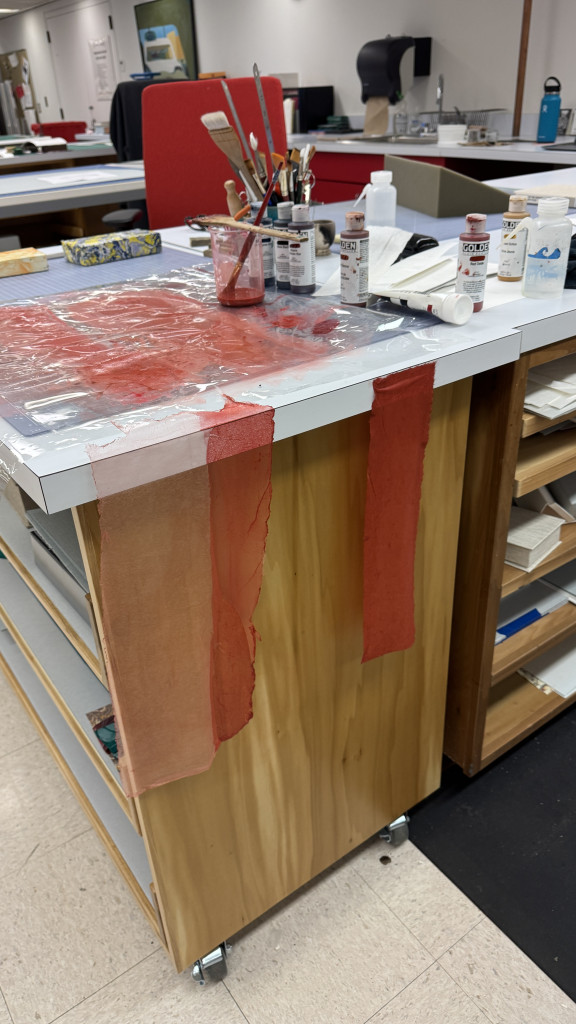
Most of my conservation treatment ended up being hours spent removing pressure-sensitive tape, many more hours toning Japanese paper with acrylics for the repair and stabilization of paper covers, along with surface cleaning and a lot of time dedicated to tear repair. 
Completing the conservation treatment of all 99 Lawrence Notebooks marked the end of a project that unfolded slowly over several years. Because the work was done alongside many other conservation projects, progress often happened one volume at a time, making the moment when the final notebook was finished feel especially satisfying.

With treatment complete and each volume now housed in a custom clamshell enclosure, the Lawrence Notebooks are stabilized and better supported for future handling, digitization, and research. While the notebooks still show the signs of long use that make them such compelling working documents, they are now structurally sound and prepared for the next phase of their life in the collection. 

Projects like this reveal how conservation work happens slowly and methodically, often behind the scenes. Completing treatment on all 99 notebooks and seeing them reunited as a stabilized collection reinforces the importance of long-term care in preserving these records of Irish theatrical history for future research and access. 
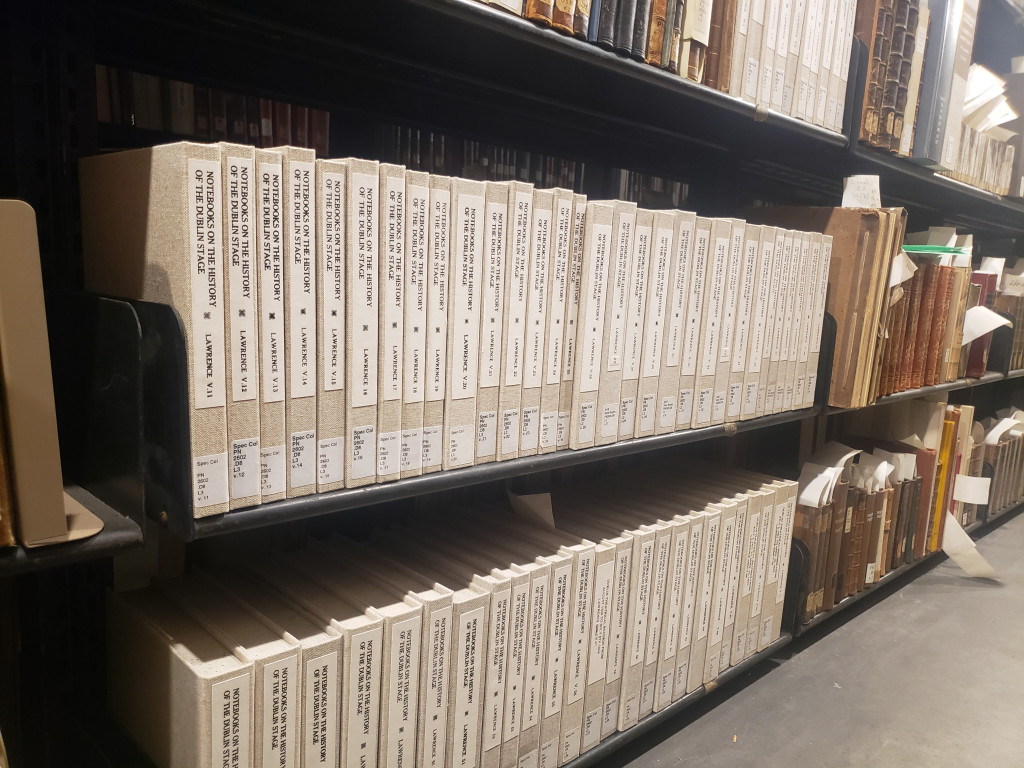
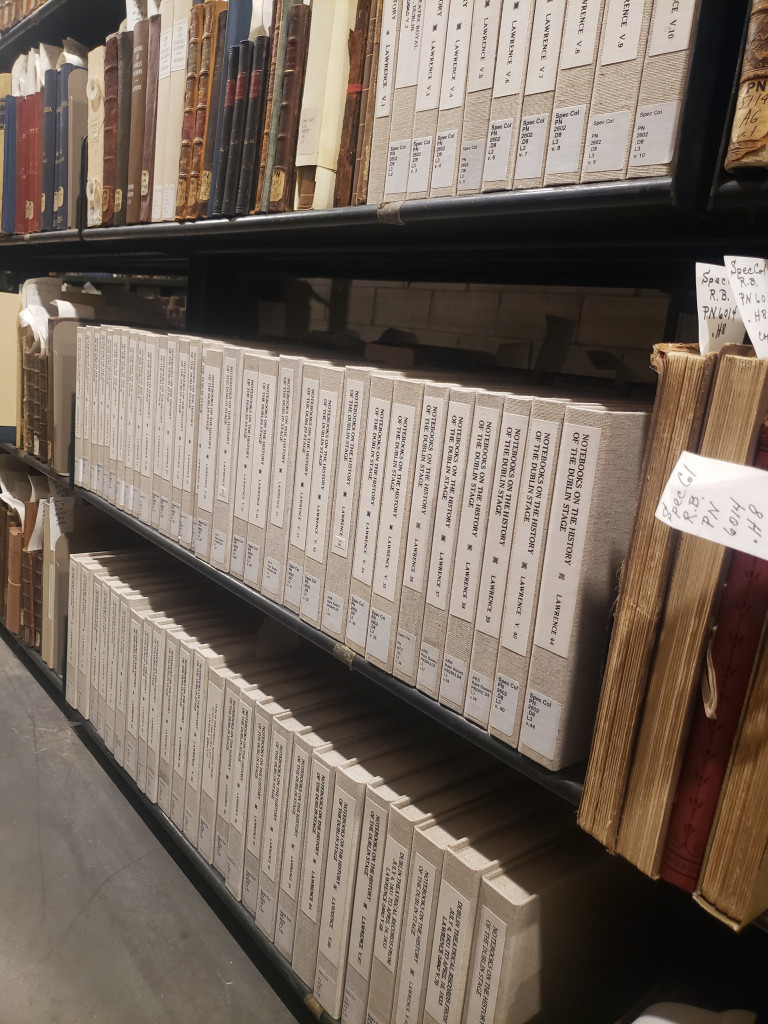
The Lawrence Notebooks shelves in the Archives and Rare Books Library stacks.

Catarina Figueirinhas – Assistant Conservator
Hidden Treasures in a 1791 English Bible

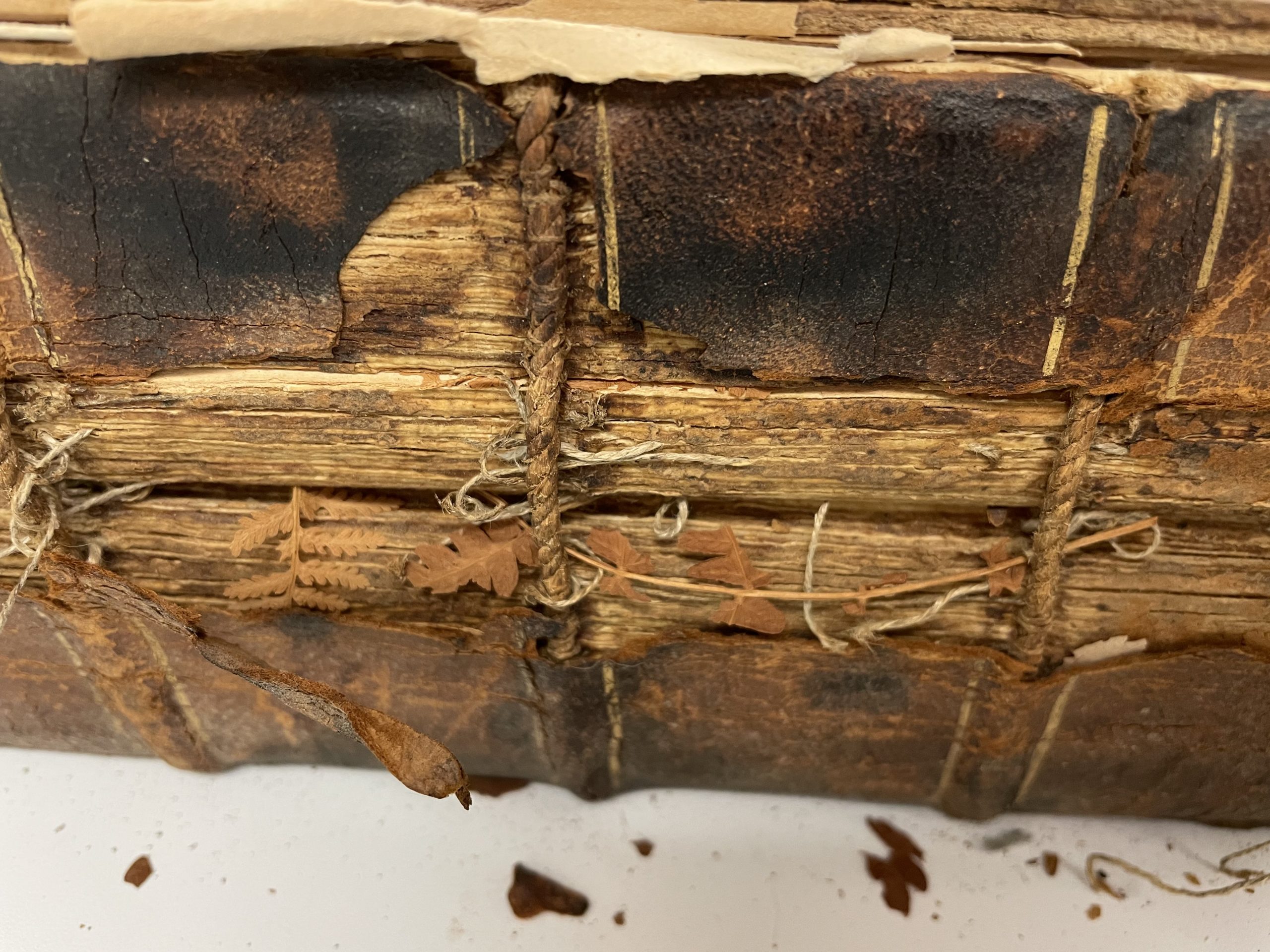
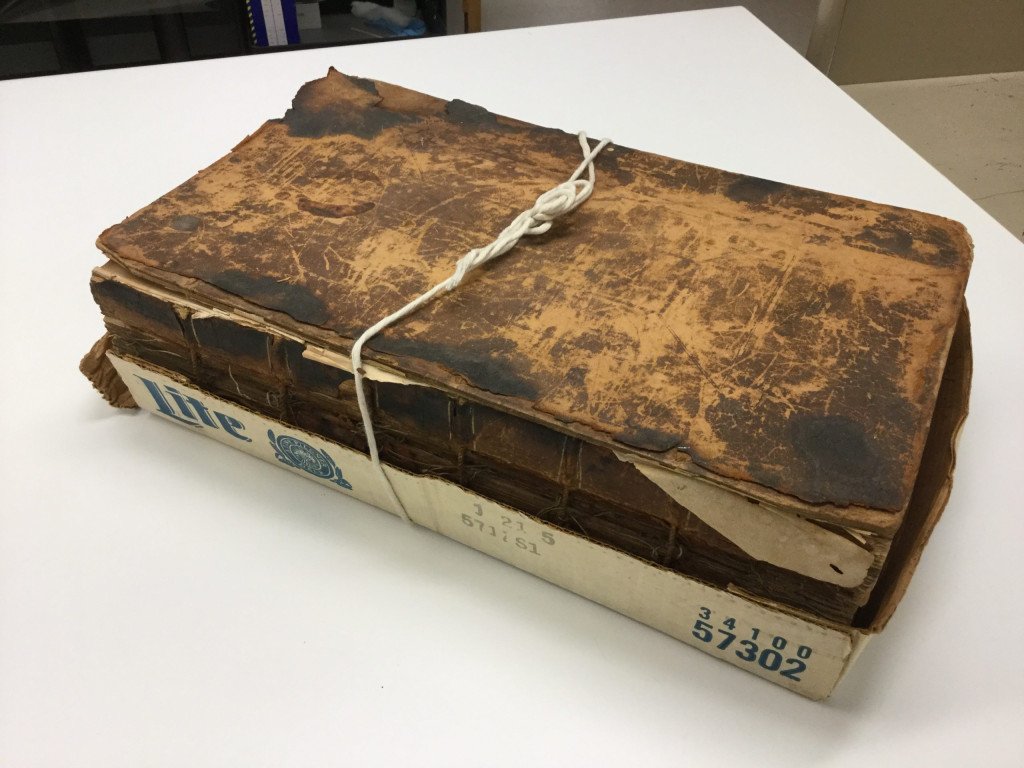
The lab received a heavy bible in exceptionally bad condition. The spine was almost nonexistent, with the leather fragments that were hanging on “by a thread.” There were many breaks in the sewing and the book block was in many pieces. The boards were also completely detached making it nearly impossible to handle. With pages that were water stained, the culmination of condition issues demonstrated how the bible had been around the block (a couple times!).

Bible as received
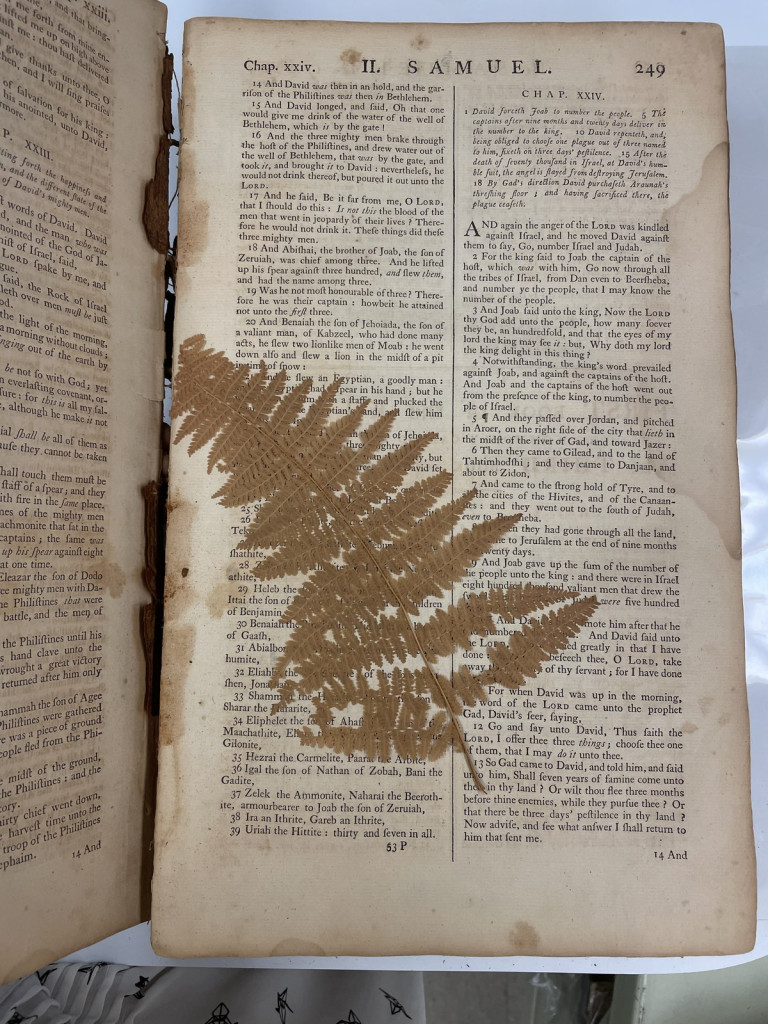
Hidden treasures discovered

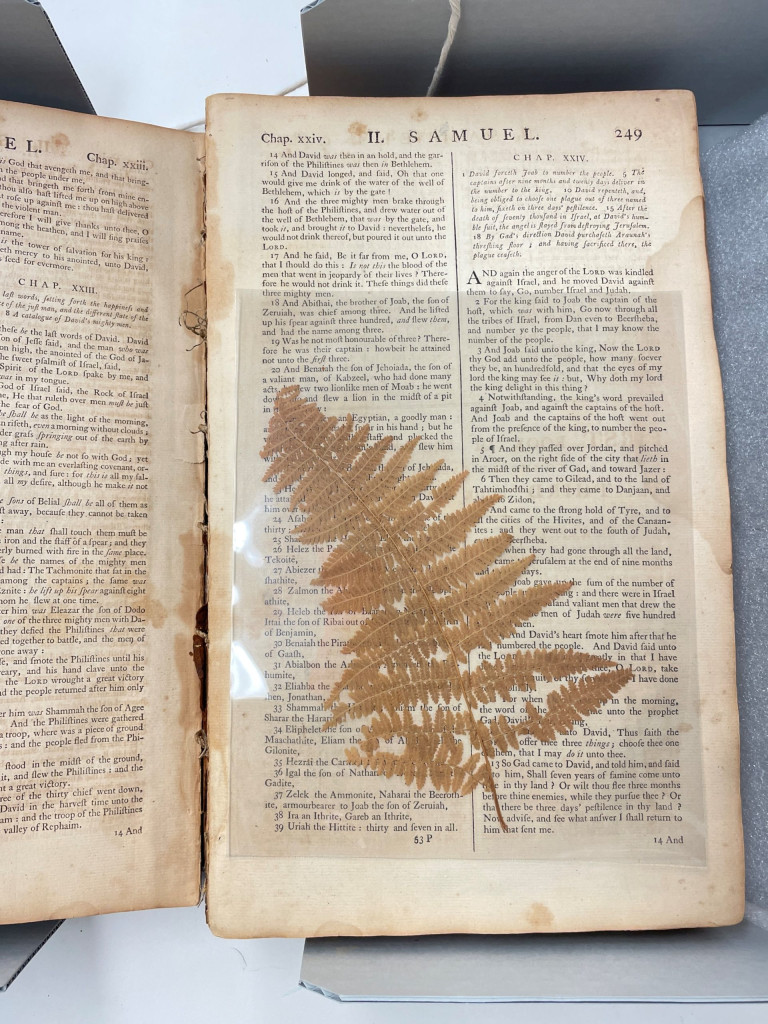
While examining the book in preparation for constructing a housing solution, there within the pages I unexpectedly discovered plant specimens! There were quite a few different types. While impossible to know for sure, it seemed to me at one point these specimens were added to mark significant passages. For example, there is a passage in the Christian bible that reads, “And the leaves of the tree are for the healing of the nations,” Revelation 22:2. When I saw the added plant specimens near this passage, my mind immediately went there.

Before preservation
After rehousing

It’s funny how things can trigger thoughts and emotions. With a religious item such as a bible, the dried plant fragments made me imagine how a reader might be moved spiritually to express something they felt deeply in the text in a material way. I was also inspired and glanced at passages beneath the plant specimens seeking out hidden connections. My quest sometimes proved rewarding while others I was left to ponder the hidden meaning.

After rehousing, book is wrapped in foam with cloth ties

The unique plant specimens were retained and stored in polyester sleeves in the same position on each page as they were discovered.   Upon the completion of sleeving, I also consolidated and performed minor leather repair and care to prevent leather fragments from falling off. For long-term storage I created an archival blue corrugated clamshell and wrapped the fragile binding in a sheet of polyester foam.   

Chris Voynovich [CHPL] – Senior Conservation Assistant

Photography by Ashleigh Ferguson Schieszer

Working with Abe

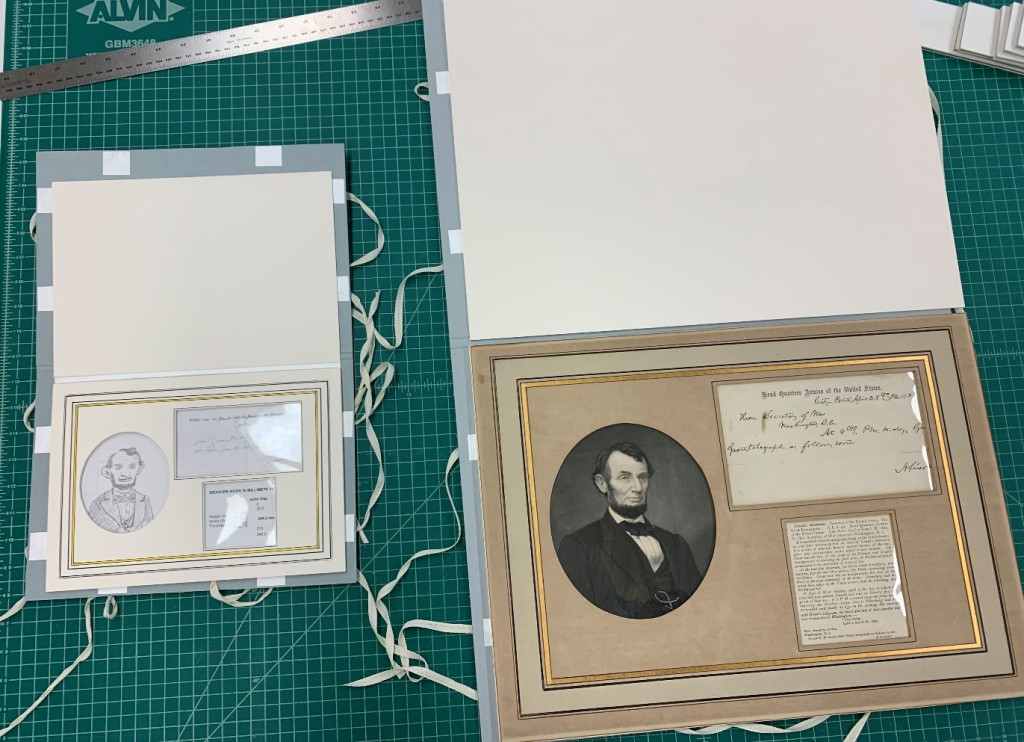
I love matting projects! Matting is an elegant way to present images and documentation for exhibition. We received a collection of letters and images from Abraham Lincoln in the lab from the Cincinnati and Hamilton County Public Library (CHPL) for preservation and conservation. After our conservator Ashleigh Schieszer completed the preliminary work of removing the artifacts from all the acidic and harmful elements they were previously in contact with, we collaborated on the matting choices. One cool thing I just love about this job is the opportunity to make tiny models of our intended work. Obviously, we can iron out some of the bugs and problem solve unforeseen obstacles with models, but making a tiny representation of my work is not only great to have as a future reference but is just really cool.

Matting model on left, original objects on right

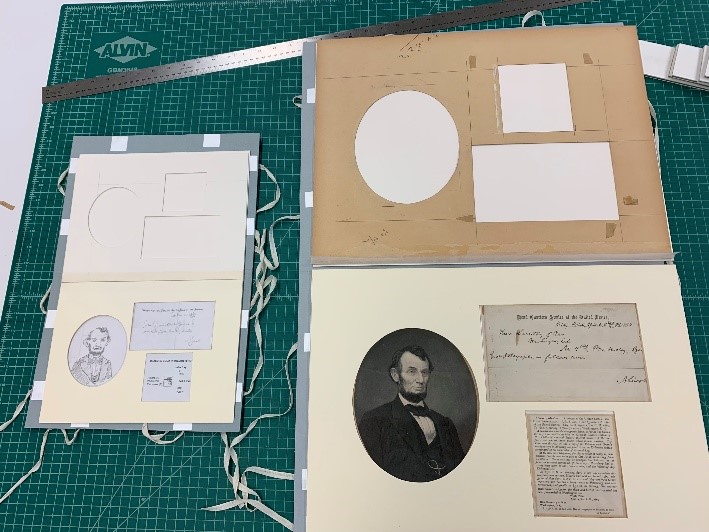
So, for one of the previously matted compilations the curator suggested retaining the beautiful custom mat for the finished system. This presented a problem because of the acidity in the original mat. The solution we came up with was to create an archival buffer mat between the original mat and the artifacts. Easy-peezy.

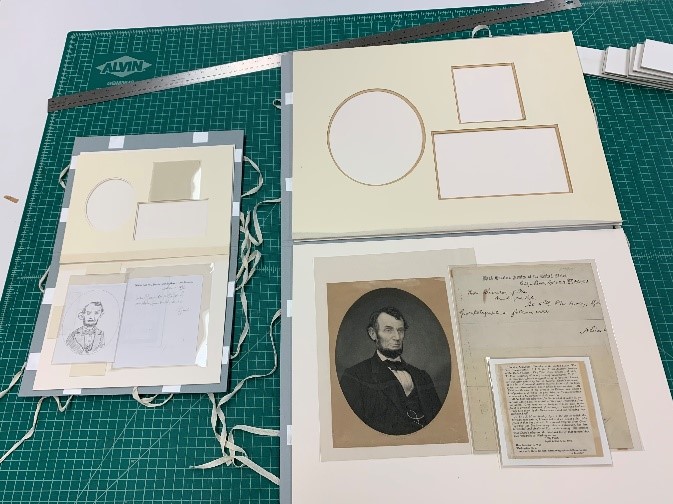
To mount overlapping objects, we decided to secure them to different mat board layers.  For example, the document on top will be attached to the back of the archival buffer with a polyester sling while the letter and portrait will be mounted to the backing board with edge strips or photo corners.

The archival buffer mat is hinged below the opened original mat.
View of the artifacts below the archival buffer mat. Parts are mounted to different layers in the model.

We also added a custom portfolio for transportation and long term housing.

Chris Voynovich (CHPL) – Conservation Assistant