If there’s one thing we really love, it’s sharing what we know with others. And one of the beauties of being in an academic setting is that opportunities to share sometimes fall right into our laps! We got a chance to play host to two classes of students from the College of Design, Architecture, Art and Planning, who came to learn creative ways to present their work when they went out to hunt for jobs.
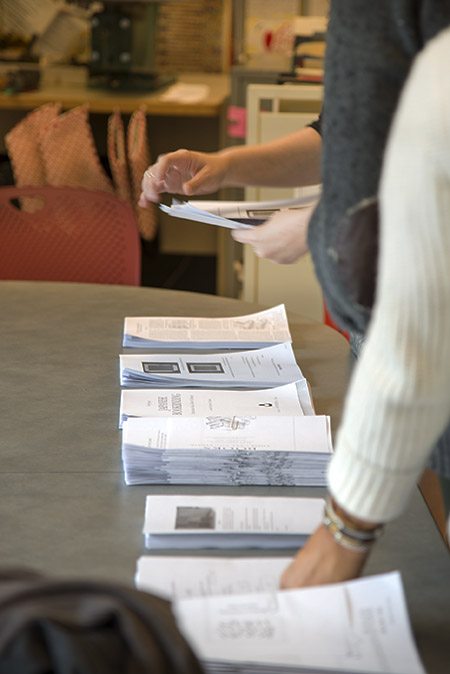
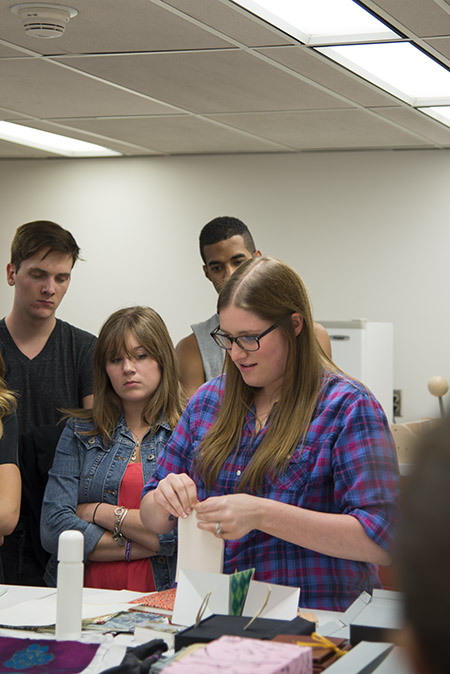
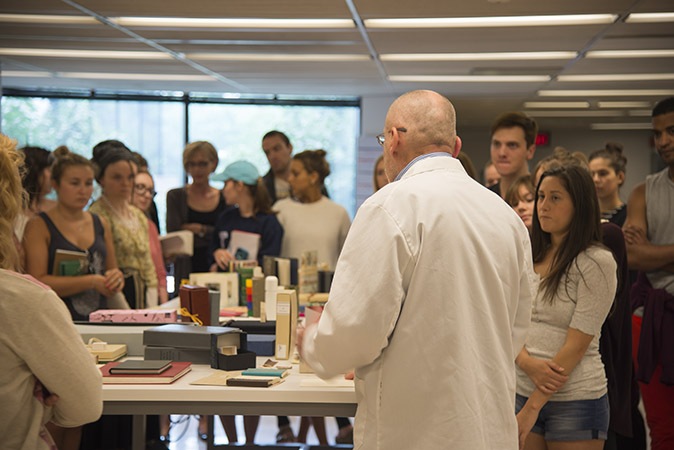
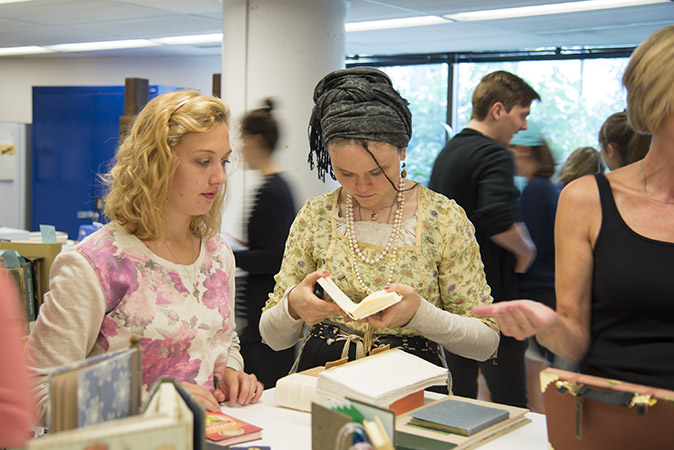
The one-hour sessions were packed with information and examples of staff work, from the simple to the sublime; in order to illustrate both what was possible at home with a few tools, and much more advanced projects to aspire to. The students were intrigued with what was presented to them, and asked thoughtful questions. They even promised to show us some of their work! (We have, as of this writing, already received our first image, and it is beautiful indeed.) We’re so glad they came; it’s always a pleasure!
Hyacinth Tucker (UCL) —- Binding Processor
Author Archives: Holly Prochaska, Head Preservation Services and Lab
Traveling Objects on Loan for Exhibition
This week we had the pleasure of assessing the condition of some unusual objects not often found in a book and paper conservation lab. The objects, owned by the Winkler Center for the History of Health Professions at UCL, consisted of a child’s leg brace, a box of polio specimen slides from the 1960’s, and a group of honorary medals.
Double Vision
Now on exhibit at the Public Library of Cincinnati and Hamilton County are a collection of stereoview photographs that were treated and rehoused in the Preservation Lab this past winter.
Continue reading
Wanted! Bench time.
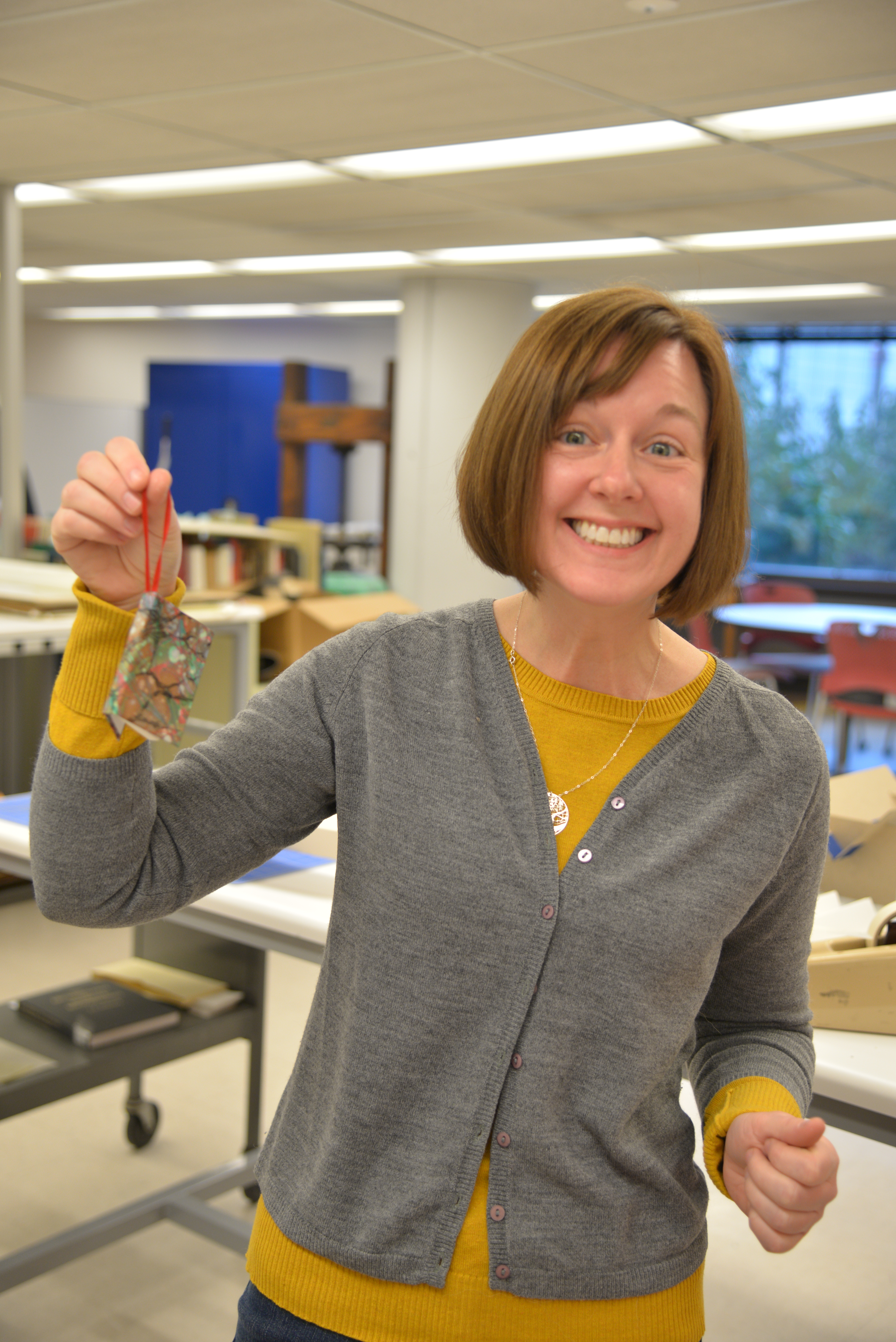 When you work for a large institution sometimes the work one does becomes very specialized and segmented. Often times preservation librarians do very little bench work, while the staff they work alongside spend the majority of their time at the bench or evaluating materials in preparation for the bench. Of course this is necessary to keep all the pieces of a lab in motion; but because one of the most important jobs of a preservation librarian is to advocate for the ongoing stewardship of the collection, and by extension the physical work done in the lab, it is important to me that I spend time at the bench.
Continue reading
Conservation – a Complex Profession
“Wh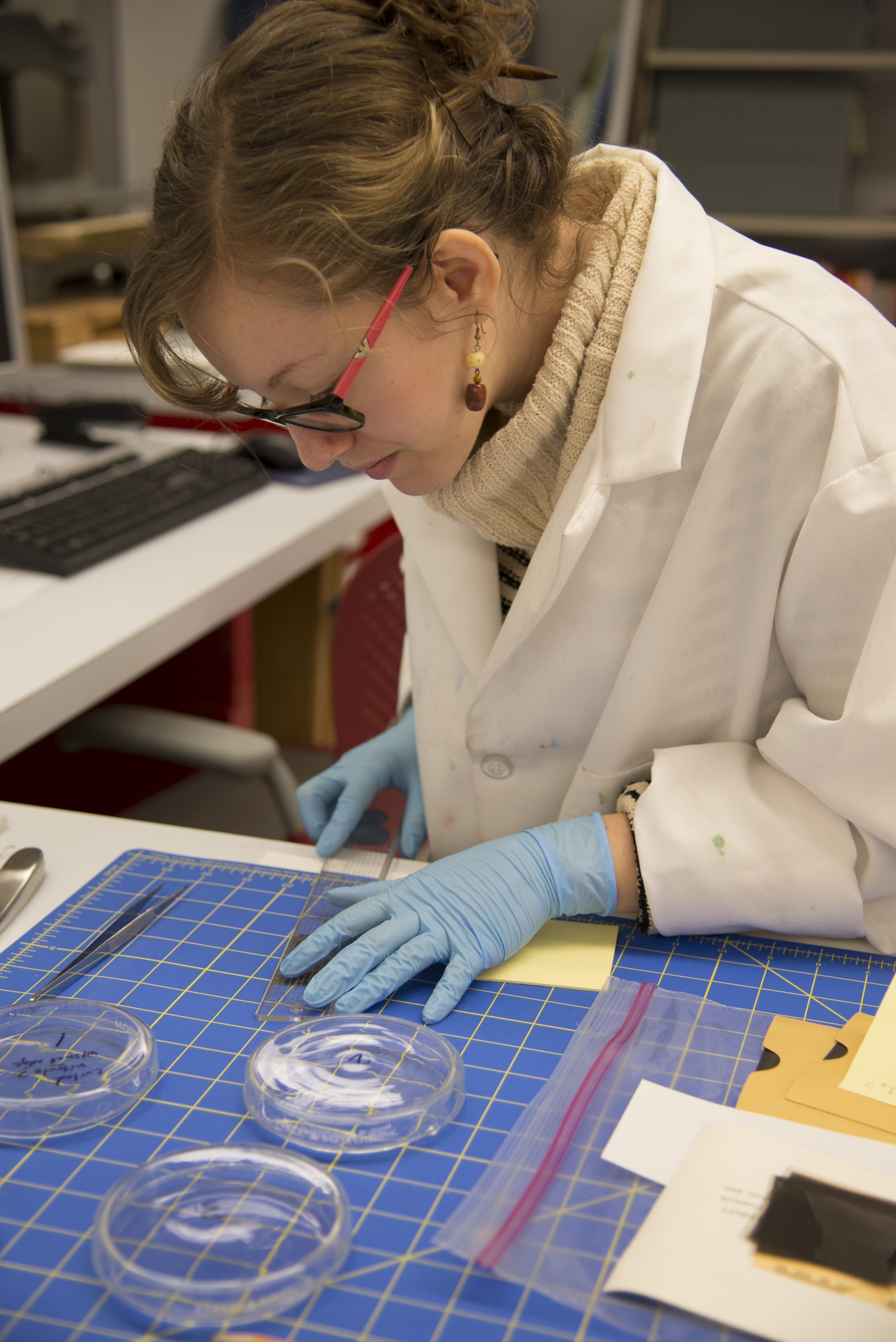 at is it that you do, exactly?” is a question conservators are often asked when met for the first time.
As an emerging conservator, sometimes it’s difficult to quickly describe the daily work I perform. When many people hear the word conservation, they immediately think of protecting wildlife.
Continue reading
Incendiary Films
The Public Library of Cincinnati and Hamilton County has a wonderful collection of materials about the use of the Ohio and Mississippi rivers known as the Inland Rivers Collection. Recently a group of photographs with accompanying film negatives from this collection came to the Lab.
What for? Well, film has been made using different chemicals over the years, some of which are very unstable. The Lab’s task was to divide and house the entire grouping according to film type. Special attention was given to identifying any cellulose nitrate negatives and isolating them in separate storage housing with the recommendation they be digitized and then disposed of in accordance with Ohio’s guidelines for discarding hazardous materials.
Cellulose nitrate film was the first widely used flexible plastic film. In the late nineteenth century it supplanted heavy, fragile glass plates. Great! Except nitrate is also a chemical component in gunpowder. As cellulose nitrate film degrades it goes through several distinct stages, beginning with silver mirroring and yellowing. Then it may become sticky and smelly (nitric acid odor). Gradually the negative changes to an amber color with the image beginning to fade. Eventually the negative can soften to a point where it may stick to adjacent pictures or its enclosure. In the final stage it turns to a brown acidic powder. As deterioration progresses it accelerates and in the last stages the film may begin to generate its own heat and ignite. A cellulose nitrate fire doesn’t need oxygen to burn so most of the usual firefighting methods won’t put it out. Any grouping of cellulose nitrate film increases the risk. Reels of motion picture film contained in metal canisters concentrate the off-gassing and accelerate the deterioration process.
Continue reading
Old Mother Hubbard Gets a Fancy New Cupboard
Not all books fit neatly on a shelf. Recently the Lab was asked to create enclosures to safely house a number of pop-ups by book artist Paul Johnson . The one I had the privilege of finding a storage solution for was the one-of-a-kind “Old Mother Hubbard in Cincinnati.”
To me this looks more like a castle than a book!
Continue reading
Preservation Week 2014
Far be it from us to let Preservation Week pass unmarked! We invited everyone from the UC and PLCH communities to come down and celebrate with us.
Continue reading
Oversized poster moves made easy!
The Preservation Lab offers a suite of services to our parent institutions, including conservation, storage and handling, pest management, and environmental monitoring. Recently we got to flex both our physical and mental muscles, assisting the Public Library with a special collections move. While there were many interesting objects that required special attention during the relocation, a collection of locally and historically significant oversized posters presented a fun and exciting challenge.
Continue reading
Bring out the fools!
We have a no eating rule in the joint preservation lab.
We also have a “no using the board sheer alone” rule.
In celebration of Edible Books and April Fools’ Day we are breaking all the rules… and one of us is suffering the consequences!
Continue reading