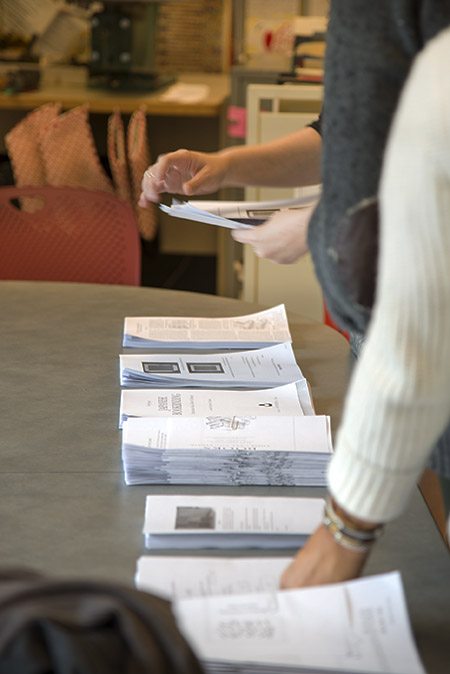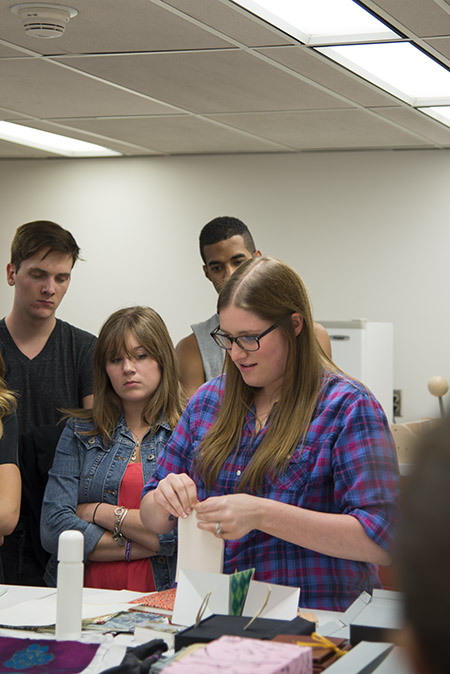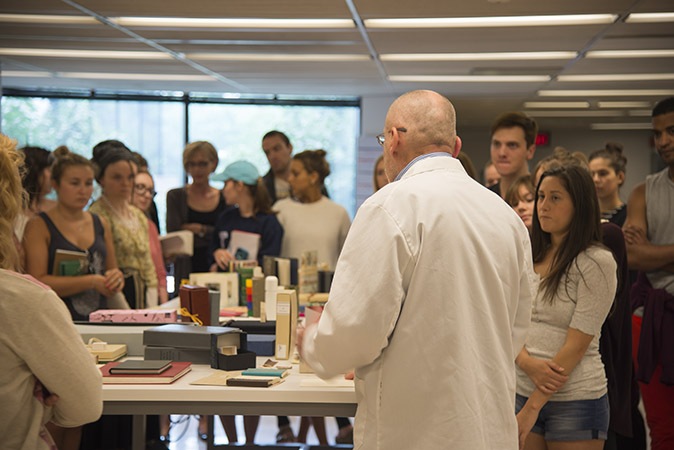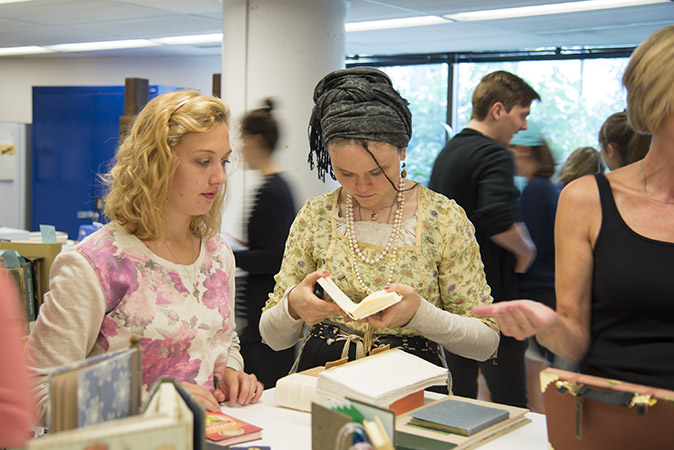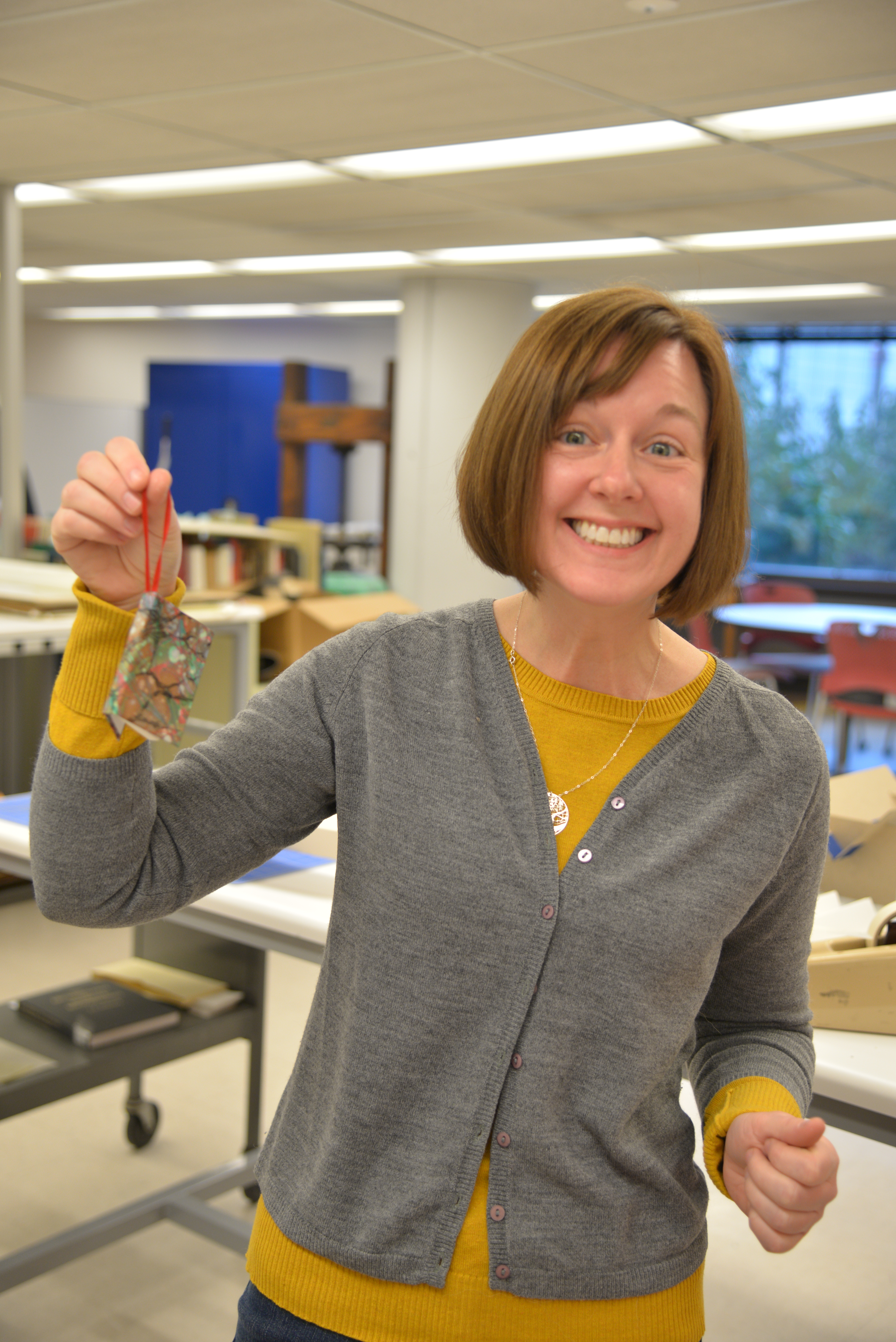
If there’s one thing we really love, it’s sharing what we know with others. And one of the beauties of being in an academic setting is that opportunities to share sometimes fall right into our laps! We got a chance to play host to two classes of students from the College of Design, Architecture, Art and Planning, who came to learn creative ways to present their work when they went out to hunt for jobs.


The one-hour sessions were packed with information and examples of staff work, from the simple to the sublime; in order to illustrate both what was possible at home with a few tools, and much more advanced projects to aspire to. The students were intrigued with what was presented to them, and asked thoughtful questions. They even promised to show us some of their work! (We have, as of this writing, already received our first image, and it is beautiful indeed.) We’re so glad they came; it’s always a pleasure!
Hyacinth Tucker (UCL) —- Binding Processor
Category Archives: Enclosures
Double Vision
Now on exhibit at the Public Library of Cincinnati and Hamilton County are a collection of stereoview photographs that were treated and rehoused in the Preservation Lab this past winter.
Continue reading
Wanted! Bench time.
When you work for a large institution sometimes the work one does becomes very specialized and segmented. Often times preservation librarians do very little bench work, while the staff they work alongside spend the majority of their time at the bench or evaluating materials in preparation for the bench. Of course this is necessary to keep all the pieces of a lab in motion; but because one of the most important jobs of a preservation librarian is to advocate for the ongoing stewardship of the collection, and by extension the physical work done in the lab, it is important to me that I spend time at the bench.
Continue reading
The Stereoscope
One of my favorite aspects of this job is learning about cool old stuff. I have just had the pleasure of becoming acquainted with stereoscopic images. In the process of surface cleaning and rehousing this project, I saw a lot of cool images and learned about the use of antique stereoscopes.
Antique stereoscopes, also known as stereopticons or stereo-viewers, were popular in the late 1800s and early 1900s. A stereoscopic viewer is a special device that helps us see 2 mounted photographs as one three dimensional image. The way it works is a stereo-view slide is inserted into the viewing device, and the person viewing looks through the device while adjusting the distance of the slide. The slide is adjusted either closer or farther from the viewer’s face until it comes into focus. The two images appear as one 3D image to us when looking through the viewer because we are seeing two perspectives merge into one – not too different from the Magic Eye books that were popular in the 90’s filled with stereograms. The two perspectives are taken with a special camera that has two lenses that mimic how we see the world through two eyes. The lenses are spaced slightly apart, roughly similar to the distance of our eyes.
Cool huh?
Continue reading
Hand painted historical renderings
Many times we receive a project and when we tackle it, it turns out to be a multifaceted endeavor. These paintings turned out to be one of those cases.

Created in the Laboratory (aka It's Alive!!!) – a new type of enclosure
A little math problem for you :

A Weighty Issue
One of the trickiest things about making a cloth-covered clamshell box happens at the very end when all the pieces finally go together. You’re applying a fair amount of adhesive to a fairly large surface area and the moisture in it inspires the boards of the case and the trays to want to curve. To suppress this natural tendency and make sure the pieces stick together properly we have to use a lot of weights.
Continue reading
Portfolios – let's jazz 'em up!
This past week the preservation lab hosted 3 classes with 3rd year fashion design majors.
The goal of the sessions were to familiarize the students with the basic parts of the book, explore different types of enclosures, and demonstrate how these simple structures can be “tweaked” to produce a wide range of compelling forms.
Continue reading
Odd shaped item? No problem!
For library items that cannot stand by themselves because of their shape or size, placing them in an enclosure is a good solution to the problem. In this case we made a custom clamshell box with filler because the item, a book on monograms, is shaped like a spade.

It's a clamshell box! with filler!
This blog explains how we construct an acid-free enclosure to protect a book that is too small to stand alone on a shelf. The dimensions of the book in question are approximately 2” X 3”. As a rule University of Cincinnati Libraries requires that all shelved items be at least 5” X 7”.

Continue reading