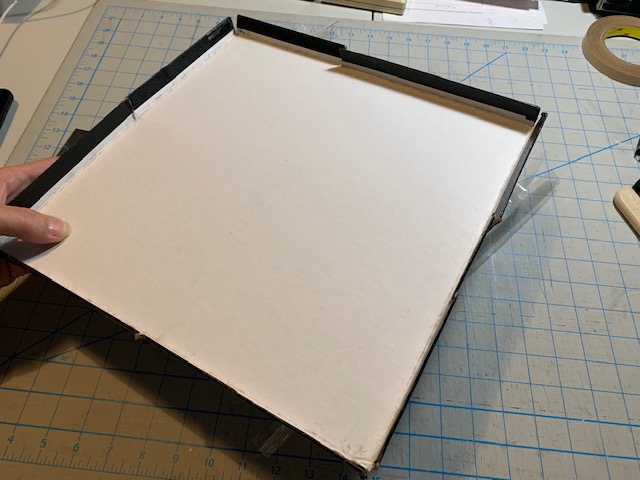
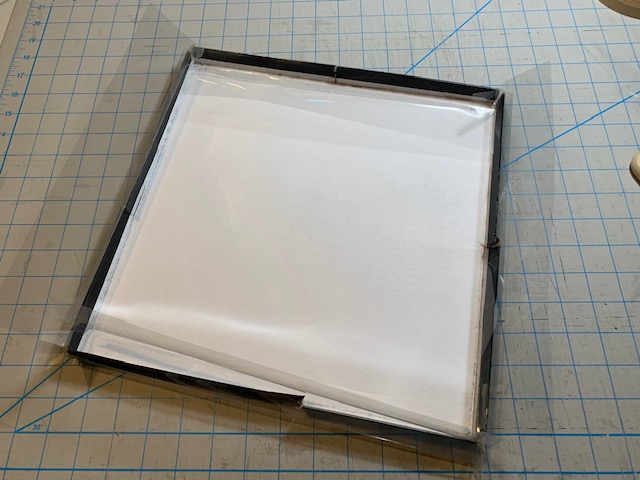
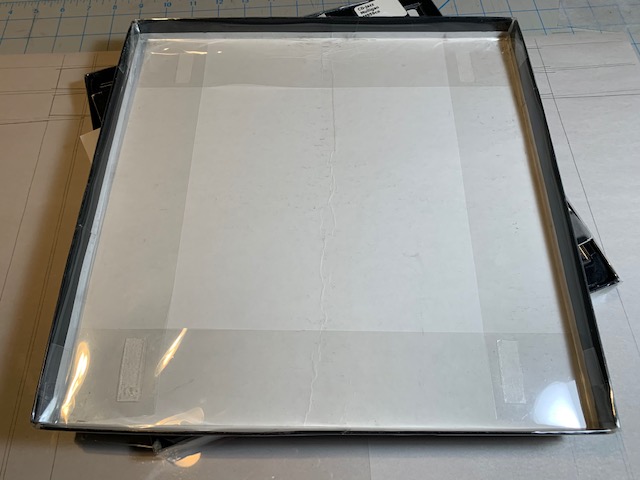
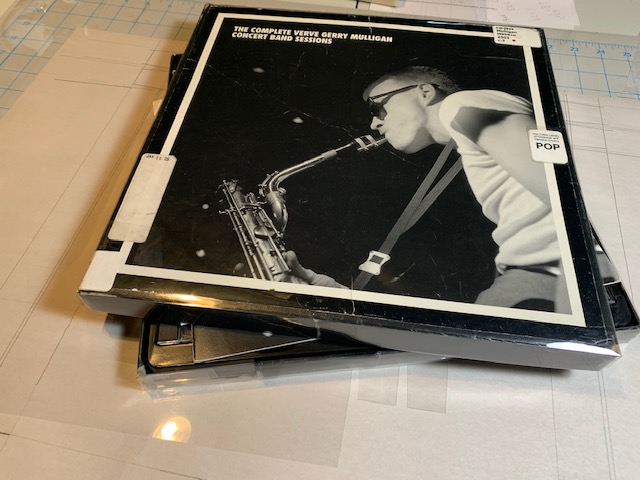
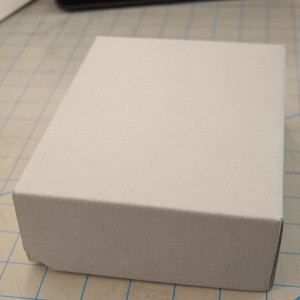
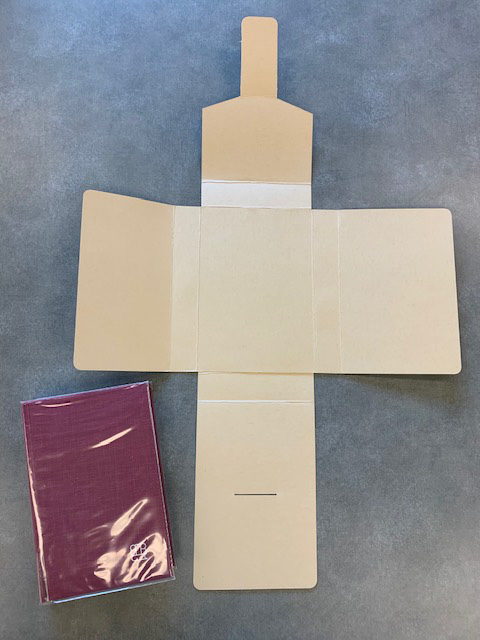
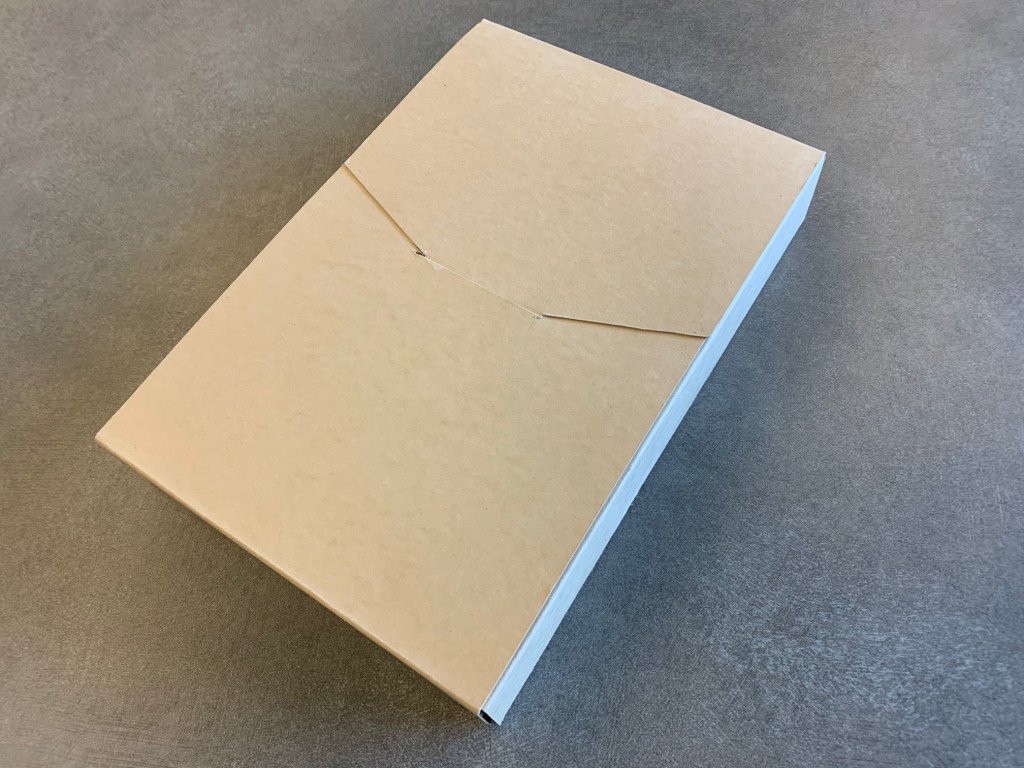
The purpose of this blog is to show a relatively easy long-term solution for strengthening and protecting the packaging for shallow banker’s box enclosures. There are two notable benefits to using this solution. The first being that in some cases little to no repairing needs to be done to damaged parts of the box and the second is at no time does any adhesive come into contact with the original piece. I have developed this system down to a science. If I make my measurements correctly, from start to finish, the lid and base jacket can be made from the custom stencils in about 180 minutes.
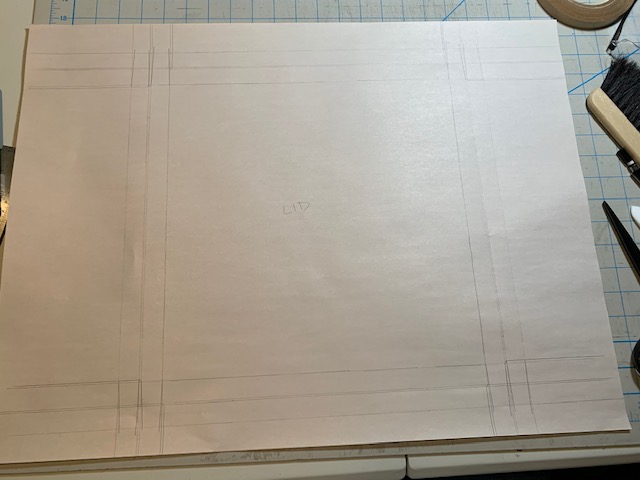
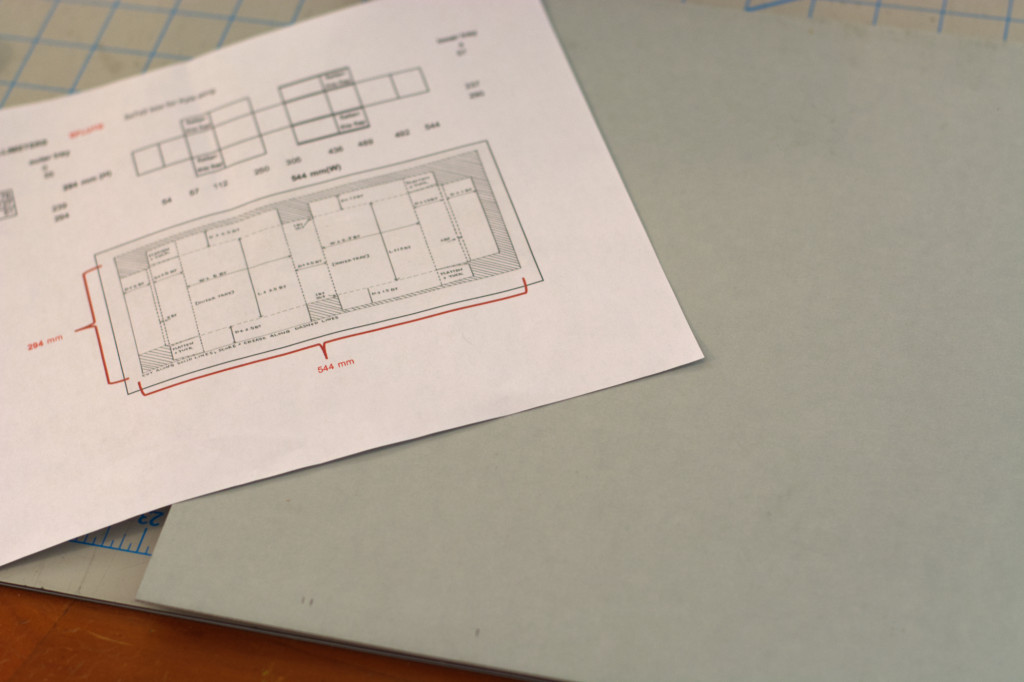
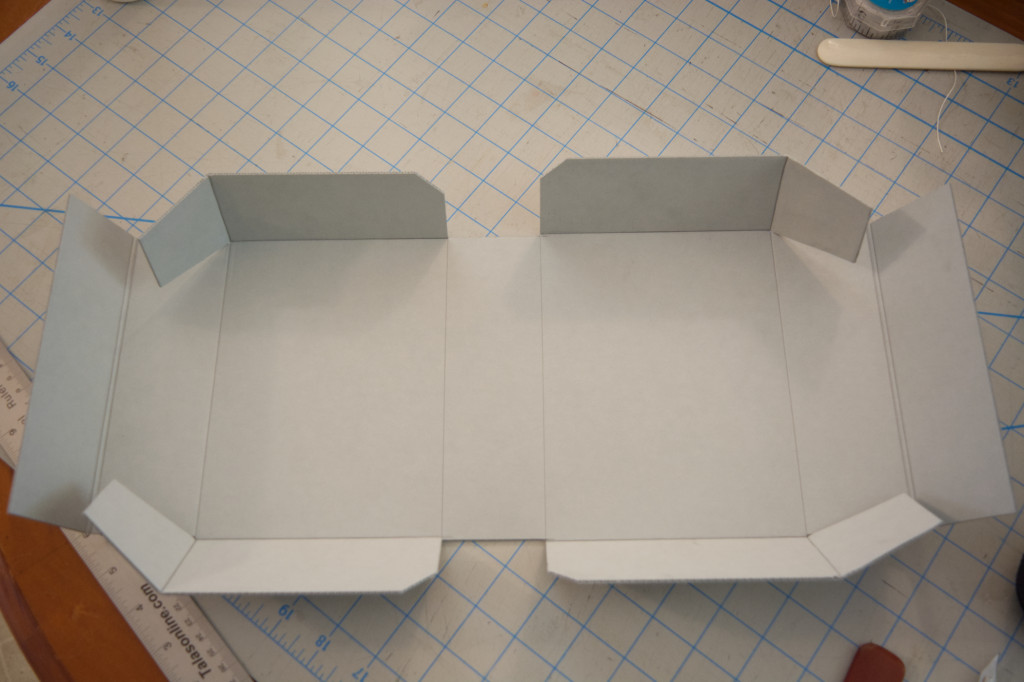
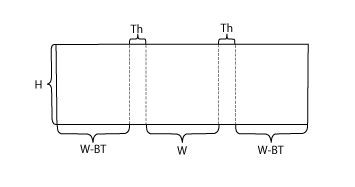
Ultimately you’ll be cutting 2 pieces of 4 mil Mylar to the following dimensions (W+thx4+4inches x H+thx4+4 inches) with the help of stencils.
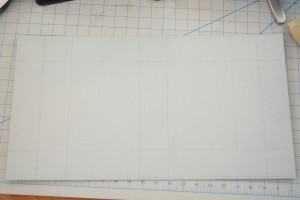
To make a stencil I just place the lid in the center of the wastepaper and adding about 1mm all around, trace the width and height. Add 1 wall thickness all around followed by 1 wall board thickness all around then another wall thickness all around. Draw each of these added lines all the way to the edge of the paper.
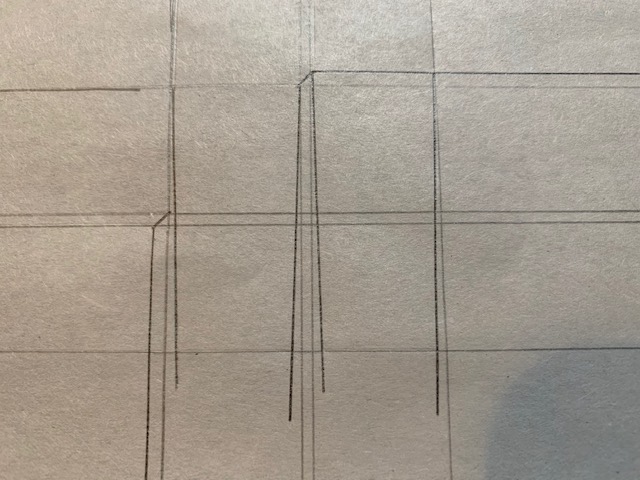
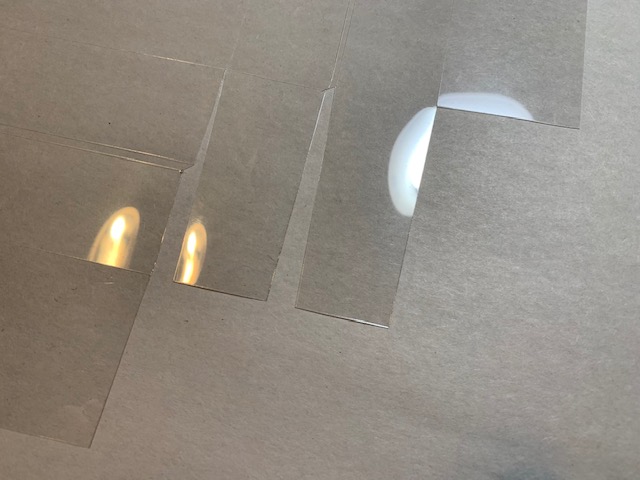
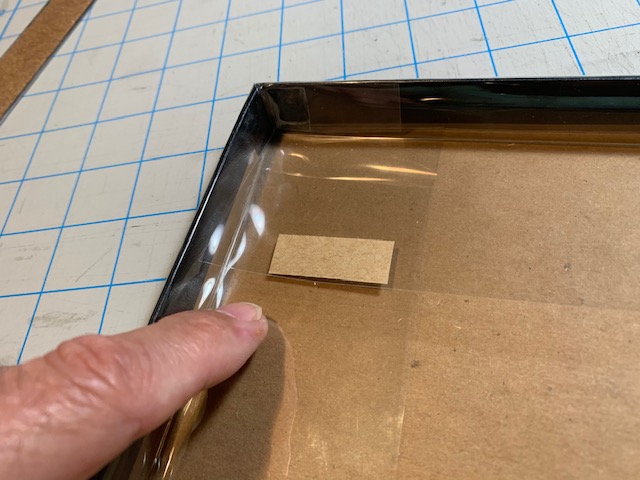
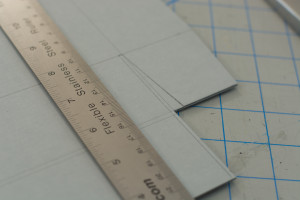
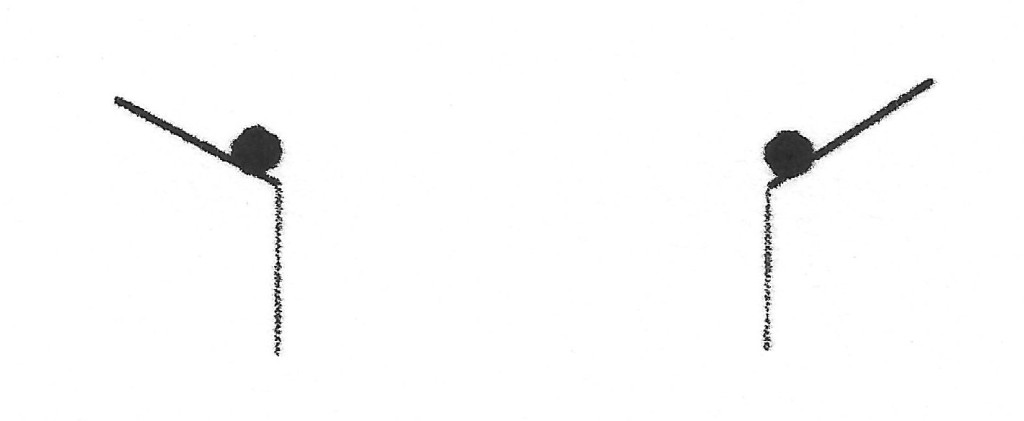
You may notice little adaptations to the tabs that will be cut out of the Mylar. I make the tabs on opposite sides to create symmetry. Here is a close-up of one.
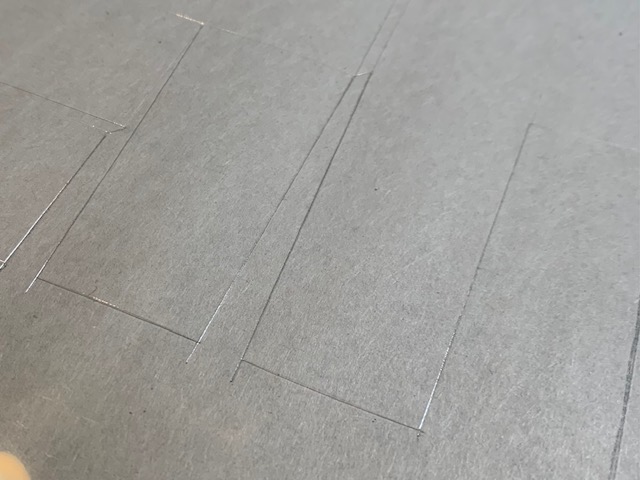
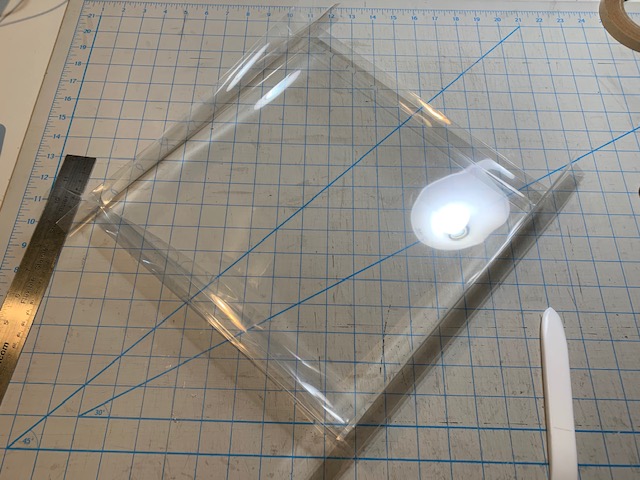
After scoring and cutting out the Mylar to match the pattern, fold on the lines using either a ruler and bone folder or your fingers.
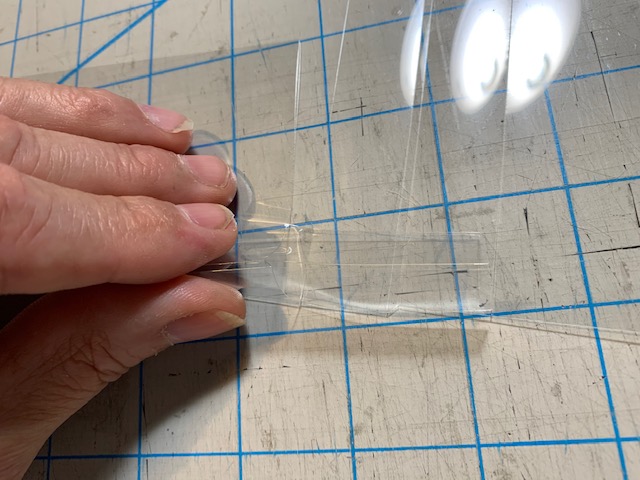
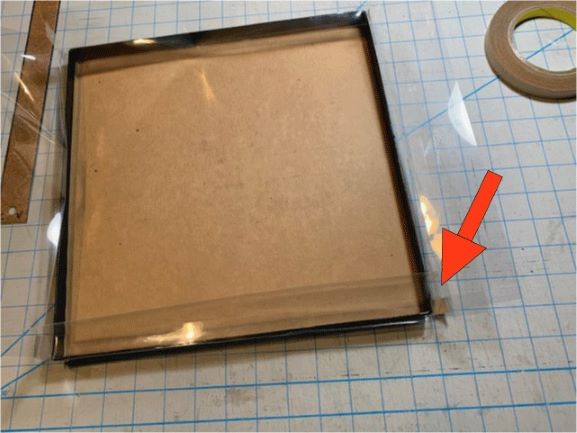
When you are all ready, place the box in the center of the Mylar sleeve and place double stick tape where the tabs will secure the corners. Start with the outside corners first.
One of the great qualities of this protective wrapper is that it can cut out repair time by the virtue of the strength of the wrapper itself.
Secure the rest of the outside, then inside corners, and we’re done!
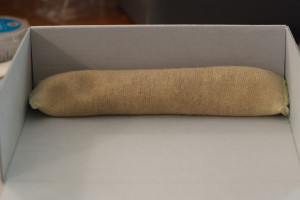
Now it’s time to enjoy the music.
Chris Voynovich (CHPL) — Senior Conservation Technician
Last month, I showed you how to make a corrugated clamshell. At that time, I mentioned some alternative strategies for special situations, such as considerations of working space, collection size, etc. Pre-made boxes may be the way to go here. They’re generally non-adhesive, and excellent if you have a large collection that needs help, but can’t be worked on right away, for pieces going to off-site storage, or if you’re in a situation where box building space is at a premium, such as many of our work from home setups (I’m currently working at my kitchen table, which is definitely a squeeze sometimes!)
There are multiple ways to obtain pre-made enclosures:
Many commercial binderies offer custom economy boxing. Our Lab uses HF Group (http://www.hfgroup.com/) when needed. Their work is excellent, and their enclosures can be created from sent measurements. This is wonderful for housing items in our collection that require storage, but we feel are too fragile to be shipped.
A pre-made enclosure can also be a great option for very small items, to keep them from becoming lost on the shelf.
Under normal circumstances, a box created in the Lab for a small piece would be lined with foam to keep it from moving around in the larger cavity, but when the pandemic hit, we thought it might be a good idea to find ways to do this that didn’t require foam, which might be expensive or difficult to source or store.
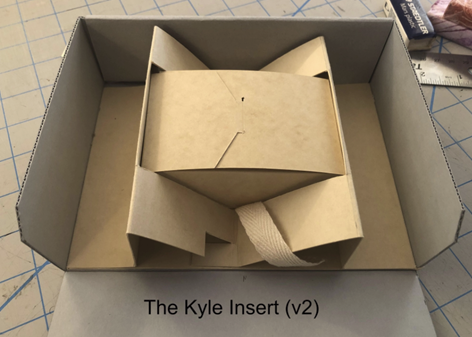
Enter the Kyle Insert. Developed by Kyle Olmon, it is an answer to the ongoing question of new ways to store smaller items that will keep them safe and prevent them from getting lost. It works well for things like artist books, which are often incredibly small. It’s also a time saver in lieu of foams. I don’t know about you, but cutting foam is not my favorite thing. An alternative is always welcome when it is appropriate, and we (and the books!) can always benefit from having multiple ways to solve problems.
Written instructions from Kyle Olmon are available on-line at https://kyleolmon.files.wordpress.com/2016/05/kyle_insert_v2_instructions.pdf . I found that the insert made more sense to me when I had a visual representation. It’s a surprisingly simple structure but may not seem that way on paper. In light of that, I did something a little different and put together a video of my assembly efforts, interspersed with instructions and diagrams from Kyle Olmon throughout. Hopefully the video combined with Mr. Olmon’s excellent instructions will help you get started with this form!
As you might imagine remote work for a preservation lab is…complicated. Not all items awaiting treatment are good candidates for repair in the home studios of staff – the repair might require specialized equipment that is only available in the lab (e.g. suction table), the item may be too valuable to transport to a private home without engaging UC risk management and CHPL administration (i.e. all our special collections!), or the object may be too large to safely be worked on in our diminutive setups (e.g. many books with the folio designation).
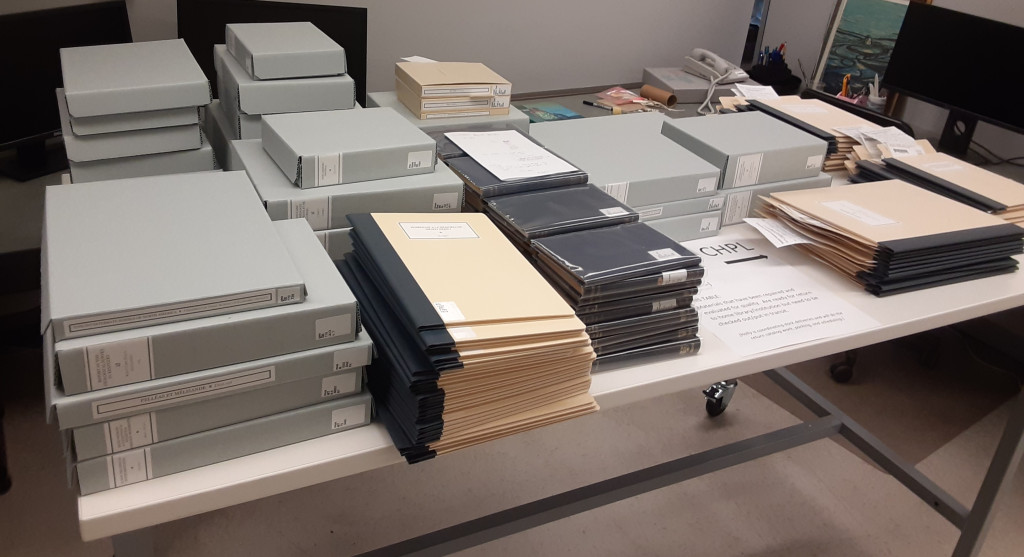
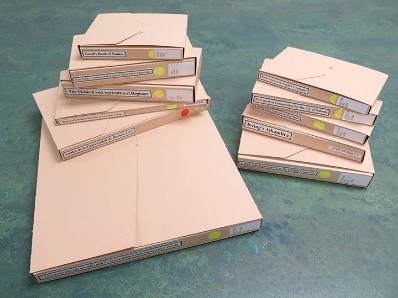
But, that doesn’t mean that work from home isn’t happening! The image below is a batch of completed treatments awaiting return to our partners. These treatments are general circulating items that have been repaired, as well as items receiving custom enclosures created without the object, using just the objects measurements. The materials have been treated from home and now, on our new abbreviated lab schedule, are being end processed and returned to their originating institutions.
Though we all deeply miss the day-to-day work in the Preservation Lab, remotely we maintain our ethos of preservation stewardship keeping us connected to the lab’s preservation mission and the missions of our parent institutions. In this, we remain unchanged.
University of Cincinnati Libraries (UCL) and Cincinnati and Hamilton County Public Library (CHPL) materials awaiting packing for delivery.
Tuxedo boxes are fantastic, accessible enclosures. Sadly, they do have their limitations, as anything does. If you’re working with a piece that is a larger or heavier (or both!), a piece that is a bit more delicate and in need of more protection, or a piece that isn’t all in one piece, you may want to look at a corrugated clamshell.
The corrugated clamshell is a slightly more complex, yet infinitely versatile addition to a good basic preservation enclosure arsenal. Developed by Andrea Krupp in 1988, it’s great for pieces that are awaiting treatment but need stabilization in the meantime. It also works beautifully for boxing sets of items that don’t quite merit the time commitment that a cloth-covered clamshell might. I have also found a corrugated clamshell to be perfect for things like experimental music scores (which may include cards, CDs, or any number of other unexpected items) that need to be shelf-ready in a hurry.
So let’s make one. The material list for this is actually surprisingly small:
A cutting implement, such as a scalpel or X-acto or Olfa knife
At least one ruler. I generally use two – a meter rule for laying down lines, and a 12-inch rule for most cuts.
A bone folder. This should have at least one end that is fully rounded. You don’t want to push through your board!
PVA; archival quality, of course. While there are a few ways to make a non-adhesive box that I won’t get into with this entry, the method we use here in the Lab does require it.
A way to secure the adhered portions of the box. In the Lab, this would be done with large bulldog or binders clips with board scraps to prevent marring, but if you’re at home without something like those, some strategically-placed weights will do nicely.
And of course, your corrugated board. Again, archival quality. For most projects, we use B flute (3mm thickness), but we do use E flute (1.6mm thickness) as well. E flute is used for my example photographs, throughout the entry.
In the Lab, planning for our corrugated boxes begins with an Excel spreadsheet. Brought to us by Ashleigh via UCLA, this greatly shortens our box making time by automating the measurements needed for each project. With just the height, width, and thickness of your piece, the sheet maps out every measurement you need for a snug, custom enclosure. As you can imagine, in a production lab like ours, this is a huge boon. I highly recommend it, and I would be happy to send it to you! (Feel free to email me any time at hyacinth.tucker@uc.edu or check out this link to past OPC workshop handouts!)
E flute spreadsheet, prepped and ready!
Corrugated board, ready for cutting and scoring.
Once we have our measurements secured, it’s time to cut our board down to size and lay down our guide-lines. Two things to remember: 1) be sure to make all your markings on the side of the board with visible corrugated lines, this way the guide-lines and the less aesthetically pleasing side of the box are on the inside of the enclosure (with the exception of fragile items that might rub against the corrugation such as red rotted leather); and 2) do your best to orient the grain in the proper direction. When the box is finished, the visible corrugated lines should run in the same direction as the spine of the book. The overall board sizing can be done with your larger ruler, rather than a board shear or oversized paper cutter, if you’re very careful. That same ruler can then be used to measure out the cutting and scoring lines.
Work in progress, a closeup of a flap cut.
Next, let’s make our box cuts. If you have one, the smaller ruler is great here. Again, the spreadsheet makes this part simple. Cut on the solid lines, score and fold on the dashed lines. One thing that the sheet doesn’t mention is that the inner corners of each box wall need to be cut. Not much; you don’t want to expose your materials to the elements. Just a little corner to keep them from catching on each other when you close your completed box.
Almost done!
Now that all of the cuts are done, we move on to the scoring and creasing. In the Lab, all of the creasing across the width of the box is done with a large crimper, and the lengthwise work is done by hand. Fortunately, if you don’t have access to a crimper, it’s pretty easy to score with one of your rulers and the rounded bone folder. Just take your time, and don’t press too hard; you don’t want to break through the board.
In the absence of bulldog clips, properly placed weights can help hold everything together while the adhesive dries.
Next, let’s pull it all together. First, fold up the sides of your box, to define your inner trays. If you are using 3mm board, this is a great time to use your bone folder to flatten the flaps, in order to prevent bulk when pasted down. Next, tuck the flaps into the fold over portions at each end. This is where the PVA comes in. Put it on the flaps and the interior of the fold-overs. Be generous, but not too generous; we don’t want it to gush out when we make the folds. Secure the fold-overs with the clips/weights, and leave it all to dry. I aim for overnight, if I can, so that the PVA can off-gas a bit before I put the piece inside. If you can leave it for longer, that’s even better.
And there you have it, a lovely custom corrugated clamshell that’s perfect for your needs. In my next post we’ll look at some non-adhesive solutions, and a great way to customize them.
Until next time!
Hyacinth Tucker (UCL) — Bindery and Conservation Technician
When in the course of an item’s history it becomes clear that the book or artifact could use extra attention, or just another element of design to aid in its care and preservation, we create enclosures.
Enclosures create a microclimate that provides a darker more consistent environment for works to be stored in. There are many types of enclosures used for many different reasons, ranging from an impermanent simple paper wrap to more long-term solutions such as cloth covered clamshells.
We use enclosures to provide a range of protection for their contents.
A microclimate providing enhanced consistency concerning heat and humidity fluctuations.
A barrier against damaging UV rays.
Dust and pest control.
A strong support for contents.
Because there is so much documentation done on customized high-end enclosures that require greater skill and experience, such as cloth covered clamshells, I will discuss easy to make, low cost enclosures. To be honest, saving time and money is at the forefront of any business. Enter the elegant tux box.
A tux box serves admirably the need for a cheap, easy first line of defense. We usually create tux boxes using 20-point Bristol board with measurements custom to the book. The tux box provides an adequate barrier against dust and light. Another virtue of the tux box is thatold books that have suffered degradation and have become brittle are provided a more stable structure for storage and handling. It should be mentioned though that because of the nature of the design, temperature, humidity and some dust and light may enter inside the tux box through the exposed corners, possibly allowing these damaging elements inside.
So, let’s make one.
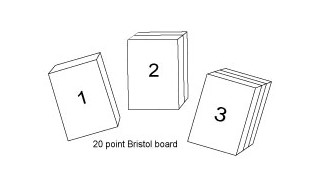
First make 3 jigs. The jigs will provide a guide to add extra board thicknesses to our book box dimensions to account for overlapping our boards during folding. We use 20-point Bristol board. Our jigs are three thicknesses – 1 thickness, 2 thicknesses and 3 thicknesses. We’ll label them 1,2 and 3.
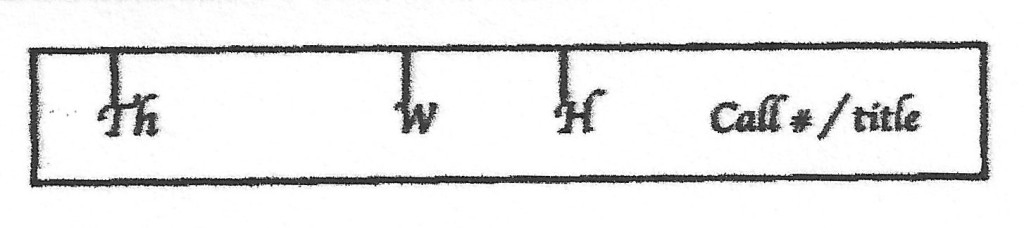
Let’s also make a handy-dandy information guide that will record all our objects measurements and identifying info on a scrap of bristol board. Record the books thickness (TH), width (W), height (H), call number and title of our book. Use tic marks to record measurements as seen below. This will be useful for quick reference as we create our tux box.
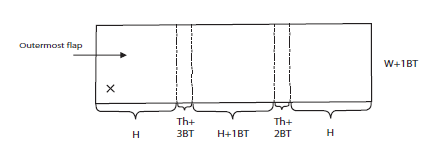
There is a grain direction in Bristol board, (the grain direction is which way the fibers are aligned) for this purpose we will cut 1 length of the Bristol board with the grain running the (H) of our book and 1 length the (W) of our book plus 1 board thickness (W+1BT).
Use our information guide and jigs to measure, score and fold the horizontal or inner height-based board as follows: (W-1BT), (TH), (W), (TH) then (W-1BT).
For the outer vertical width-based board we also score and fold starting with an x lightly placed in the corner to identify the outermost flap. With our information guide and jigs and starting from the side with our x we measure, (H), (TH+3BT), (H+1BT), (TH+2BT), (H).
Wrap the horizontal piece around the book and then fit it into the vertical part. You can either use double sided tape or PVA to adhere these two together.
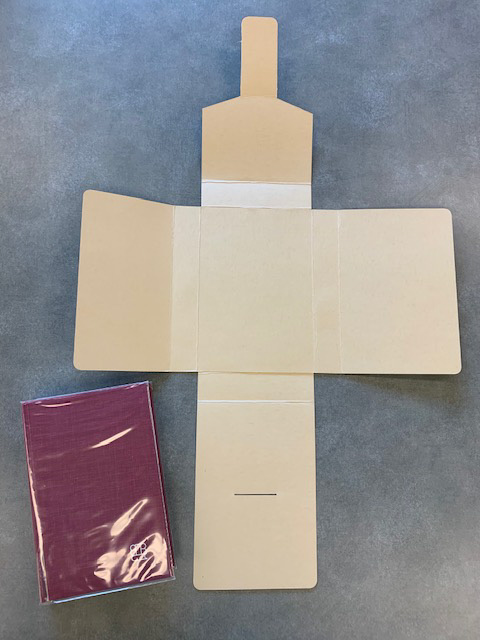
Here is the tux box in its open position. Note where the two boards are joined – only the panel where the back cover will sit.
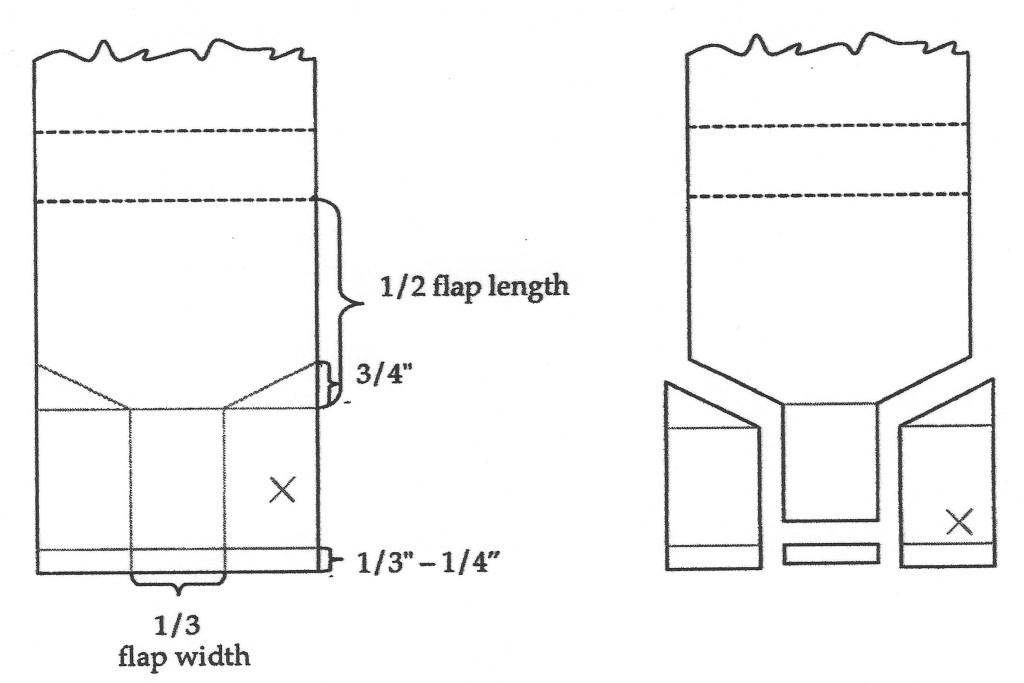
Next, the tricky part. Creating the flap to secure its closed position. Measure, mark and cut the tongue on the outermost flap, let’s use a visual for this part.
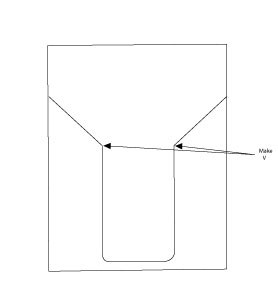
Lastly, cut a slot for the tongue to fit into which secures the tux box closed. Close the tux box as if it is finished with tongue out. With a pencil draw a light “v” in the corner where the tab lays closed. Open the tab and place 2 small holes with a Japanese hole punch or an awl. Cut 2 lines connecting the holes forming a slot. Fit tab into the slot to close. Feel free to round the corners of the tab and all flaps using a corner rounder.
Tux box in the open position.
Tux box in the closed position.
You can also customize tux boxes to accommodate a varity of book sizes. No one wants to add an enclosure to their collection that is the size of a miniature book, it would be so tiny it would get lost. We can adapt the enclosure by adding spacers to bring the overall size of the tux box to at least 5”x7”.
Here is a link to an adaptation made to a clam shell that could also be used in a tux box as well.
So, the tux box is an easy-peasy solution for an extra layer of strength and protection for its contents. Unlike the Hostess Twinkie, the tux box is not expected to endure the apocalypse. I feel given the cost of materials and time spent to make one, it’s a fine, adaptable addition our enclosure family.
Chris Voynovich (CHPL) — Senior Conservation Technician
The Ohio Preservation Council has updated grant procedures andawards to reflect the current emphasis on remote learning and virtual conferences.
In 2020, the Ohio Preservation Council will offer four awards of up to $250 each in support of continuing education for Ohio Students and Professionals with an interest in preserving our cultural heritage. Applications will be accepted on a rolling basis and awardees will be notified after the 3rd Thursday of: August, September, November, December. Full details can be found here.
The Ohio Preservation Council serves as a coalition of preservationists, conservators, librarians, archivists, curators, records managers, the institutions they represent, and other concerned citizens who recognize the serious threat to documentary heritage. The Council’s mission is to provide a network for preservation education and to support preservation activities within the state of Ohio. The Council believes in cooperative, state-wide efforts across geographic and professional lines are needed to meet preservation challenges.
The Ohio Preservation Council recognizes the value of professional meetings, conferences, and other educational opportunities to advance the field of preservation and provide a forum to voice the need for ongoing stewardship of our documentary heritage. When possible, the OPC shall provide financial support to individuals to develop skills, expand knowledge, and gain experience relevant to the mission and goals of the Ohio Preservation Council. Applications are due the first Mondays in March and September.
Individuals requesting financial support must meet the following criteria:
• Working in the state of Ohio OR pursuing an advanced degree or certificate in the state of Ohio;
• Working directly in the field of preservation (as described above) OR pursuing a degree or certificate within the field;
• Request is for professional development that clearly relates to preservation issues and/or preservation skills;
• Have not received financial support from the OPC Grant within 3 calendar years.
You might know the importance of a protective enclosure, but how often to you consider the quality of storage materials? In fact, the composition of storage materials plays a significant role in the preservation of archival collections. But how?
Since storage plays a passive role, the positive and negative interactions of storage materials may not be readily apparent. Chemical reactions that occur between library and storage materials are often a slow process, spanning over a number of months or years before a visual change occurs. Without the gratification of seeing immediate effects, many may not realize how some storage materials can be problematic, let alone the ramifications for using non-archival materials.
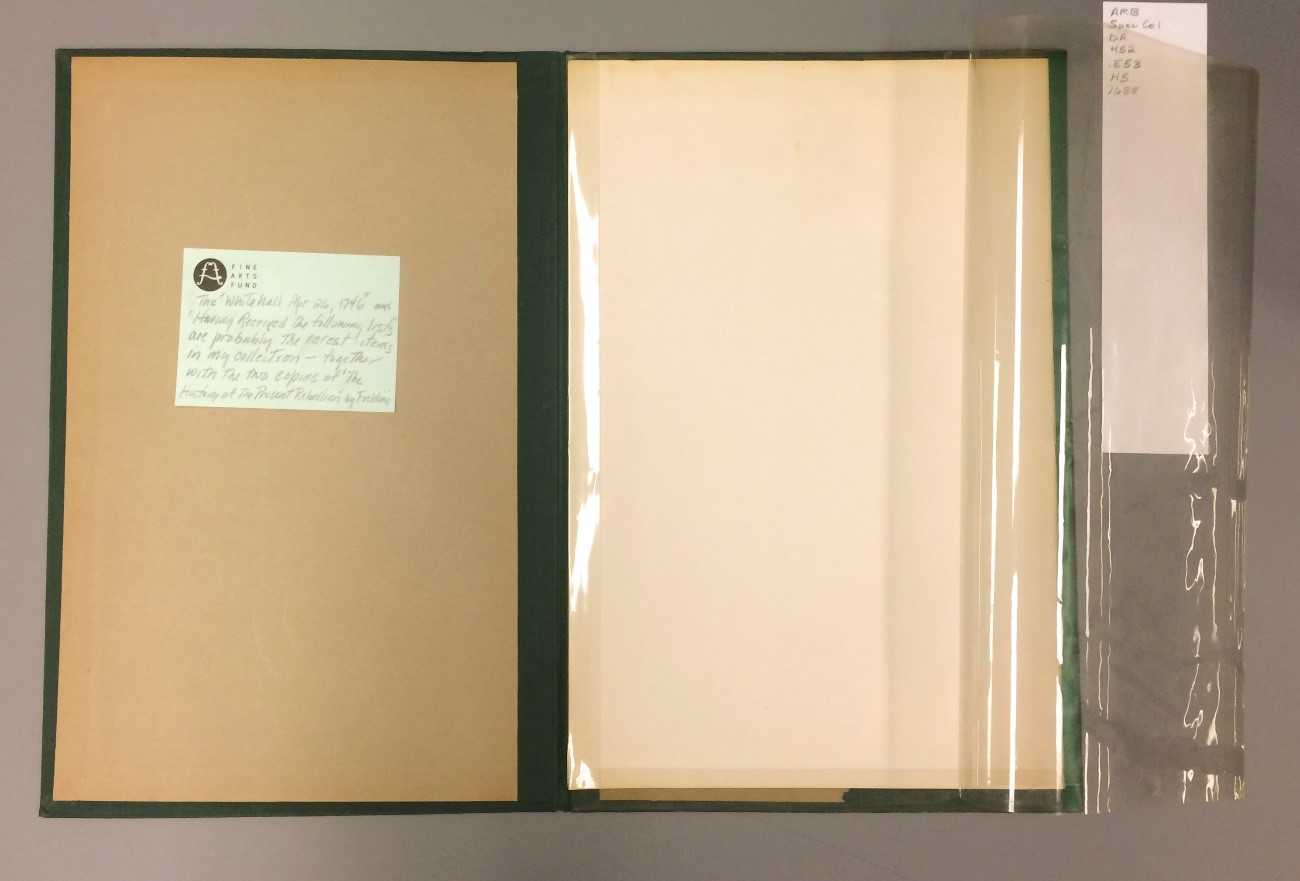
To illustrate some of the effects, I thought I’d share a vivid example of protection from acidic materials during storage. The following photograph shows the positive effects of archival buffering paper (also known as interleaving), as well as the danger of using non-archival boards and tapes – even when they are not in direct contact with the object!
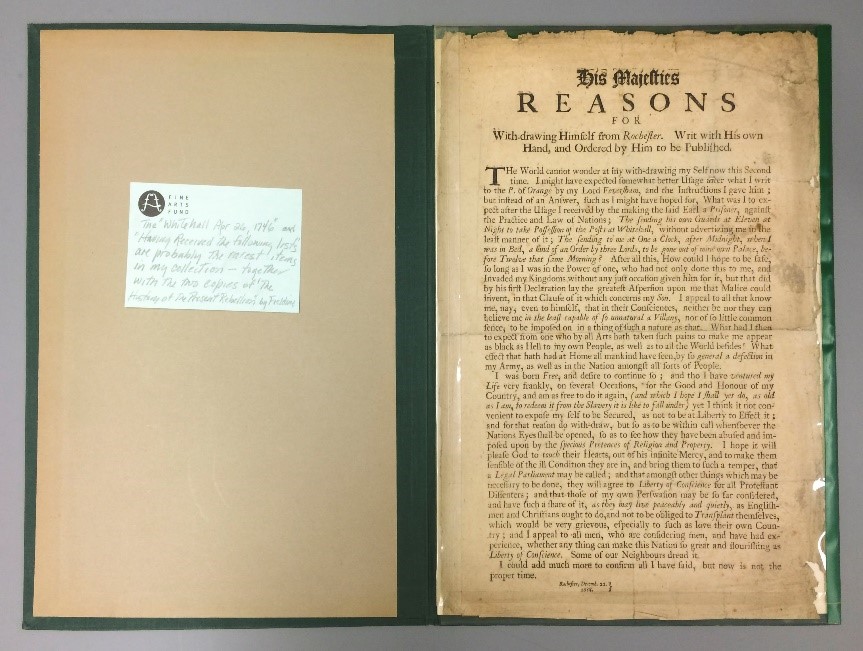
The protected object is a 17th century printed broadside. It’s a single sheet of paper with printed black text on the front. The broadside was stored for many years in a green cloth-covered portfolio.
Within the portfolio, the broadside was secured beneath with folded sheets of plastic film with a blank sheet of paper. You can see the plastic film is attached to the portfolio around the edges with green tape.
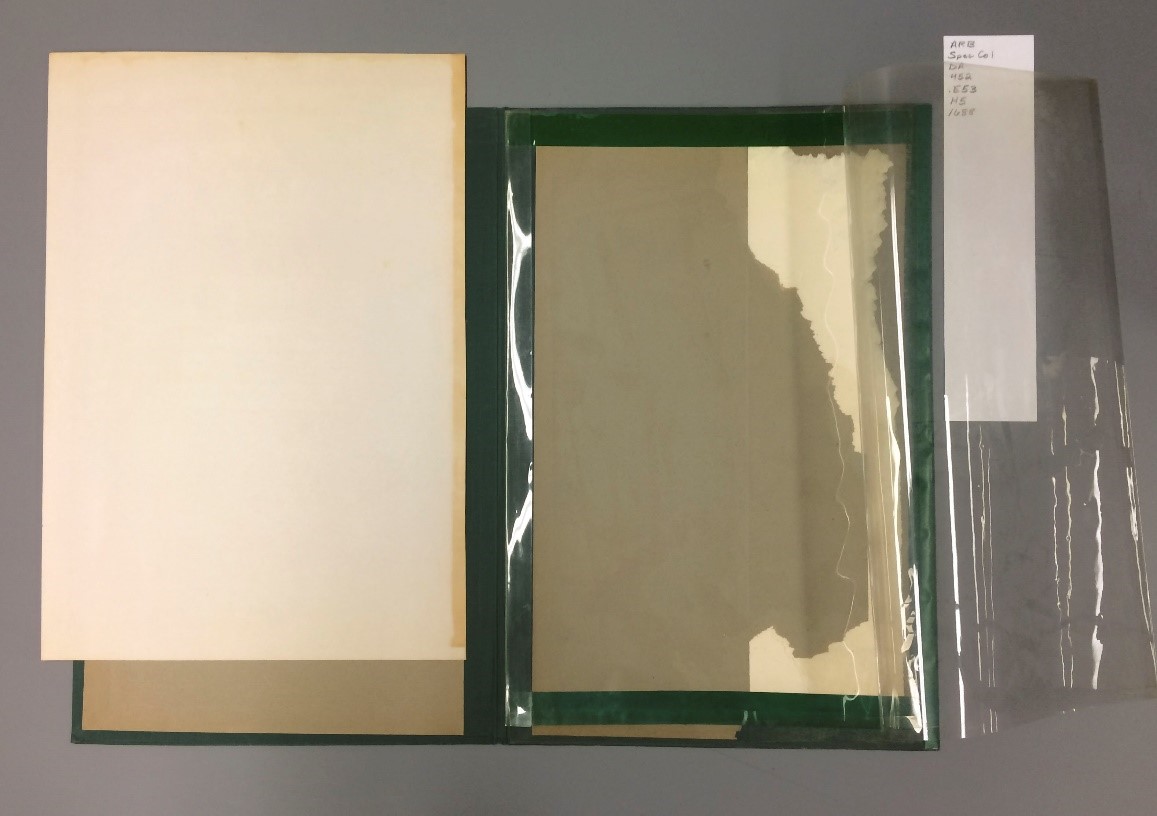
This image shows the front of the blank sheet of paper stored side the plastic film, below the broadside. The plastic has yellowed overtime.
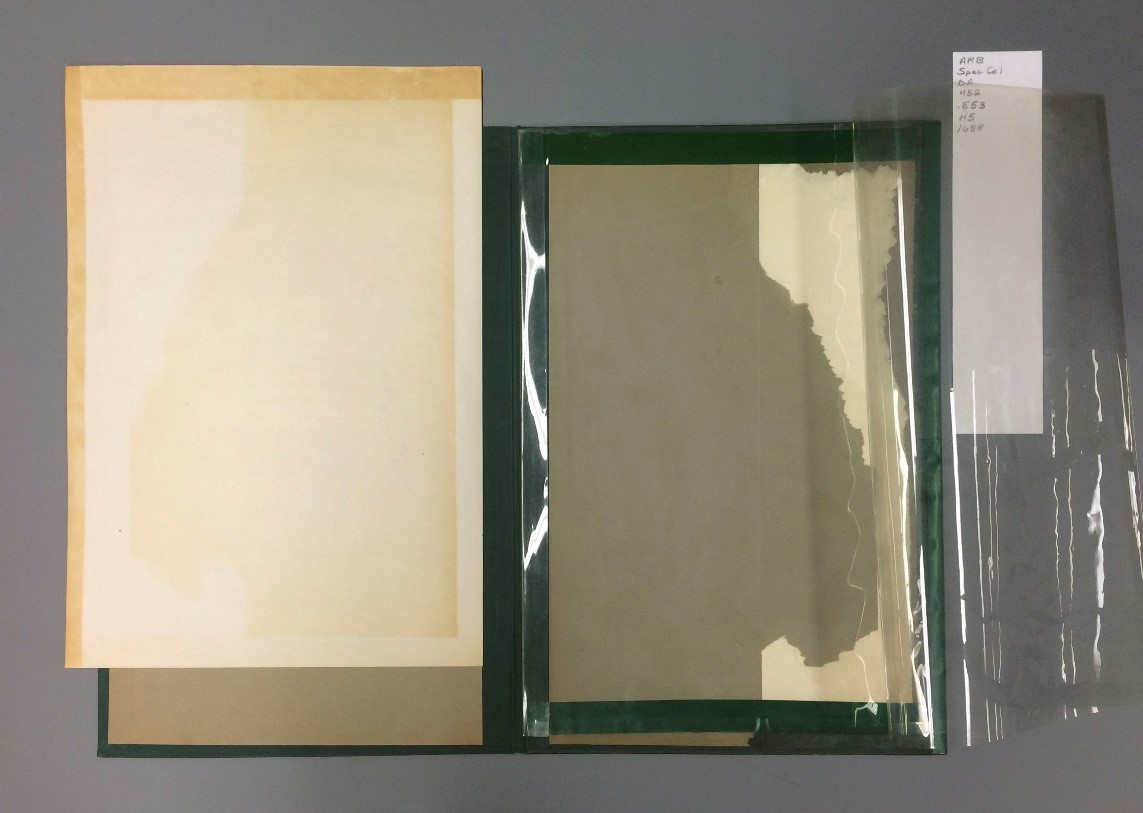
Here, the blank sheet is removed, revealing yellowish-brown discoloration around the top and right edge. This discoloration aligns perfectly with the green tape that is adhered on top of the plastic –located on the top and right side of the plastic.
When you flip the paper over, the back of the blank sheet shows even more discoloration. In fact, the discoloration is a mirror image of the materials below the plastic! This has occurred because the plastic is “breathable.” The materials below are all acidic, except for the white fragments of paper, which protected a portion of the paper from turning brown.
The interleaving paper served two purposes here:
Acts as a support for the broadside when handled.
The interleaving served as a sacrificial barrier that absorbed the bulk of acidic off-gassing from the non-archival paper and tape.
In summary, this enclosure is an excellent example of how different materials can interact with one another in nuanced ways, and how plastic is actually a permeable barrier to gasses overtime!
General storage tips:
When placing interleaving within an archival polyester L-sleeve, make sure the interleaving tissue is larger than the object so you can avoid localized discoloration
Architectural prints, blue prints and some photographs are special. Don’t store these in buffered materials (materials that are above pH 7). Store them with pH neutral materials like polyester film or unbuffered paper.
Check out these resources on selecting archival storage materials:
Our conservator Ashleigh Ferguson Schieszer will be assisting paper conservator Jamye Jamison in an upcoming Ohio Preservation Council workshop. Seats are still available! Workshop description: This course is for archivists, librarians, or anyone who is interested in caring for their family documents, print collections, or other ephemera. The class will begin with a short discussion of materials and what to look for when making archival enclosures for flat paper objects. Each participant will then make a small portfolio of reference samples of various enclosures for paper materials, including a simple four-flap, polyester sleeve, paper envelope and a “back and wrap” enclosure, which can be used for display. Each participant is asked to bring four objects no larger than 4 x 6 inches (roughly postcard size) that can be used to make the reference samples. No previous experience necessary.
Learn more and register at —- http://opc.wildapricot.org/event-3357153
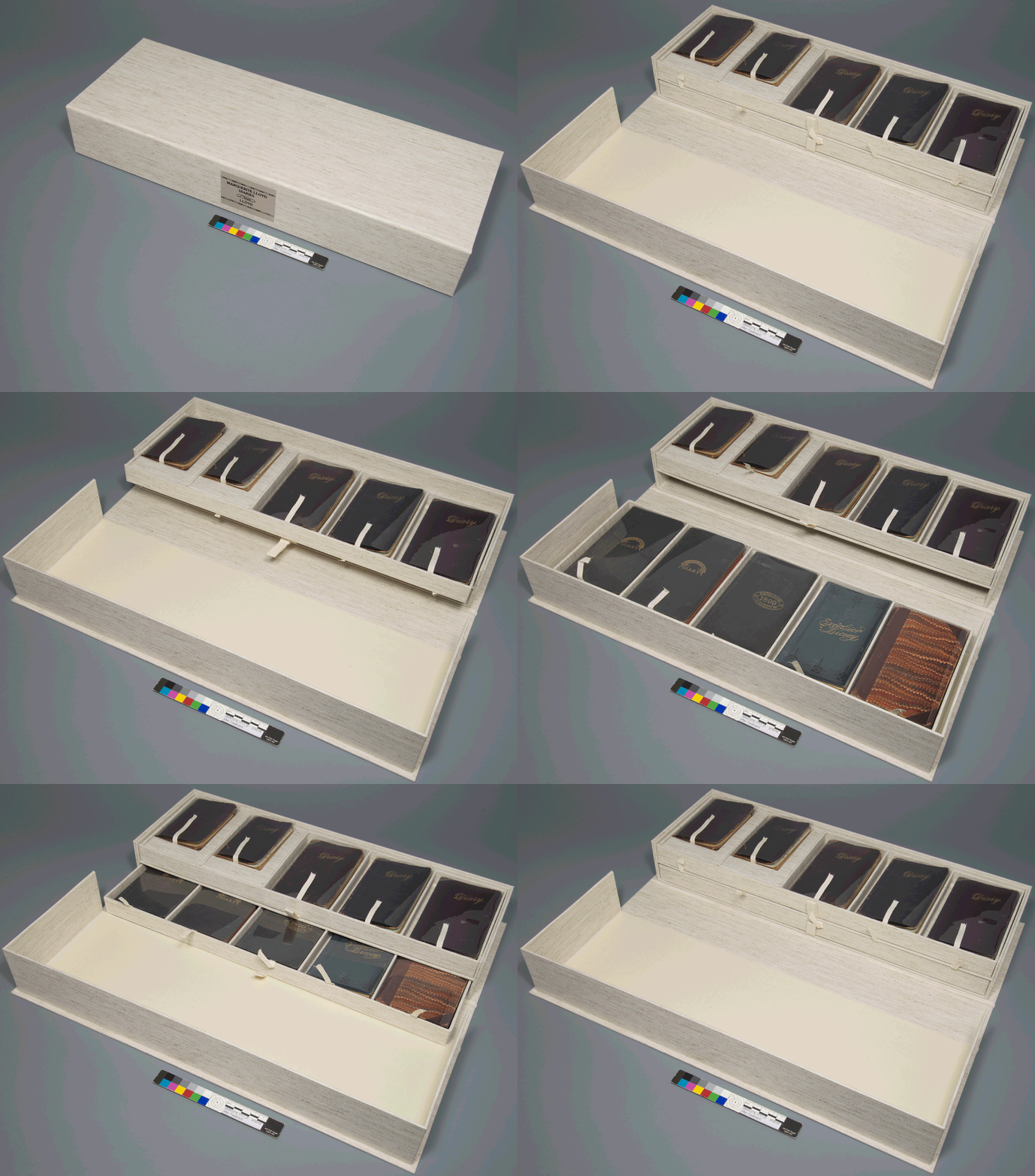
I just had to share this beauty of a box that was made by conservation technician, Chris Voynovich, to house the Public Library’s collection of Marguerite Lloyd’s diaries. These ten diaries are part of the library’s Genealogy & Local History Department. Marguerite Lloyd was the daughter of Major Harlan Page Lloyd, the former law partner of Alphonso Taft, the father of President William Howard Taft.
Chris created this lovely cloth covered clamshell box with two removable trays that each house 5 diaries. The compartments for the two smaller diaries have a custom fill to accommodate for their smaller size. All the diaries have received a polyester jacket and the linen tabs under each volume make them easy to remove and handle. Jessica Ebert (UCL) – Conservation Technician, Lead Photographic Documentation Tech
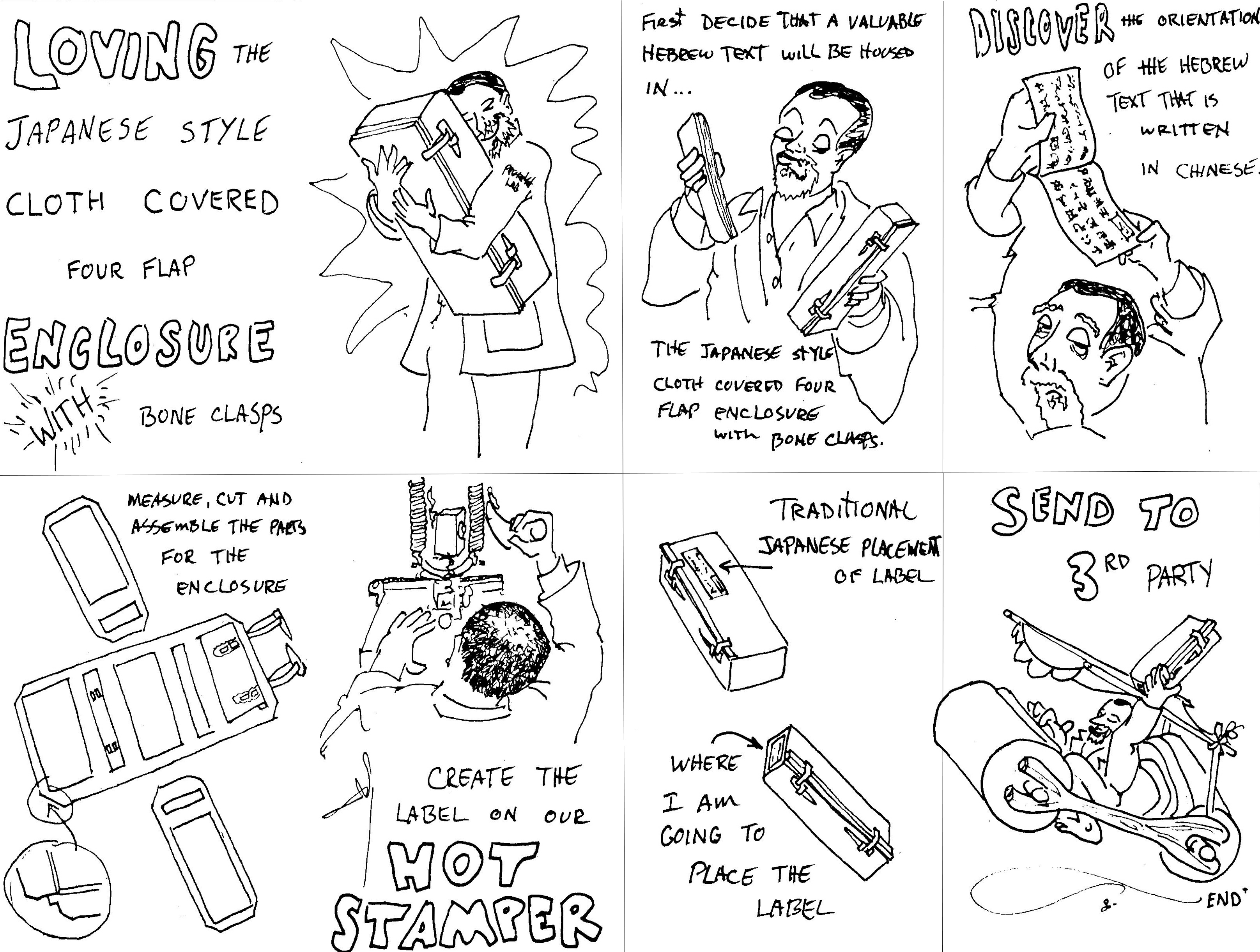
Check out the latest comic creation from our conservation technician, Chris Voynovich [PLCH], inspired by a recent enclosure project for Hebrew Union College…
“Loving the Japanese Style Cloth Covered Four Flap Enclosure with Bone Clasps” by Chris Voynovich
Want to create your own one page wonder of this fantastic comic?Go right ahead, print double sided to include The Preservation Lab information and links —OnePgWonder_JapaneseStyle4FlapWithInterior
The Preservation Lab at UC Blog uses Accessibility Checker to monitor our website's accessibility.