
Tag Archives: storage

Grooved Disc Media Storage Solutions

Record album in front of vertical sleeved albums.

Grooved Disc Media

Although The Preservation Lab is primarily a book and paper lab, we often receive items that fall outside this realm and are required to do a little research and get creative. I was recently assigned a small collection of various grooved disc media that required archival storage solutions. “Grooved disc media” is an umbrella term that encompasses any type of sound recording that features small grooves cut into its surface that a stylus then passes over to produce an audio signal. Think vinyl records, shellac discs, 45s and more. Another term I like that covers multiple varieties of grooved discs is the term “records”, which I will use interchangeably with “grooved discs” for the remainder of this post.

Considerations

Until this point, we had not received any grooved disc media requiring new housing at the Lab. In situations like this, I like to do a bit of research and figure out what is required of the housing to determine what is required for safe storage. We found several trustworthy sources that provided tips for what to do as well as what not to do. The most important ones are as follows:

  • First and foremost, any grooved disc should be stored upright. When multiple discs are placed on top of each other, their collective weight can compound quickly. This weight can then slowly compress the grooves on the discs and result in loss of media.
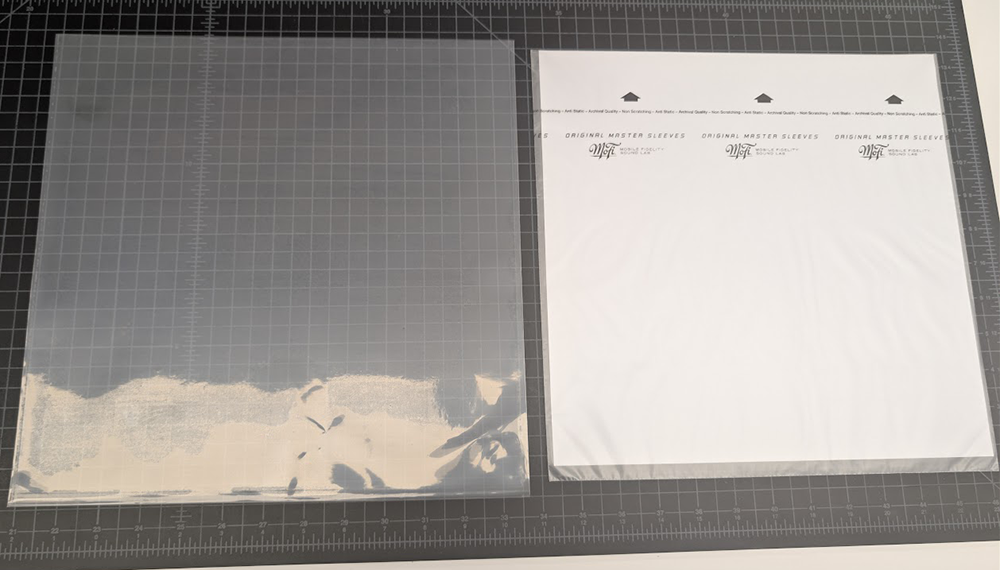
  • Grooved discs should have their old plastic sleeves, both inner and outer, replaced with archival plastic sleeves. Older records often have non-archival plastic outer sleeves that are susceptible to warping over time. This can lead to the discs themselves warping, affecting playback speeds which can lead to further degradation. We ended up purchasing these Original Master Sleeves and Archival Record Sleeves, both made by Mofi Mobile Fidelity Sound Lab.
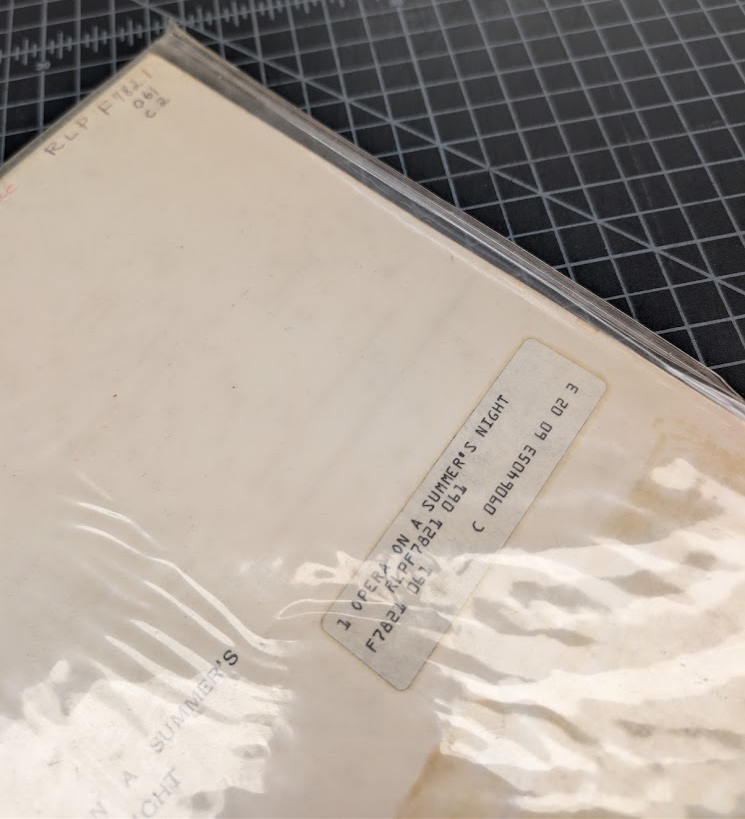
A plastic album sleeve that is curling around the edges.
A non-archival plastic outer sleeve. Notice how the plastic is starting to curl along the edge.
Two new archival sleeves, the outer sleeve is on the left and the inner sleeve is on the right.
A new archival plastic outer sleeve (left) next to a new archival plastic inner sleeve (right).
  • The original cardboard sleeves should be retained if desired and if they contain any information or artwork related to the recording. However, it is advisable to store these separate from the sleeved records, or at least with the record inside a protective archival inner sleeve before placing it inside the cardboard. These cardboard sleeves can sometimes foster mold growth in high humidity environments.
  • Ideal relative humidity for the storage environment is between 30-50% with fluctuations not exceeding +/- 5% in a 24-hour period.

Solutions

After learning all these considerations, assistant conservator Catarina Figueirinhas came up with the following solution.
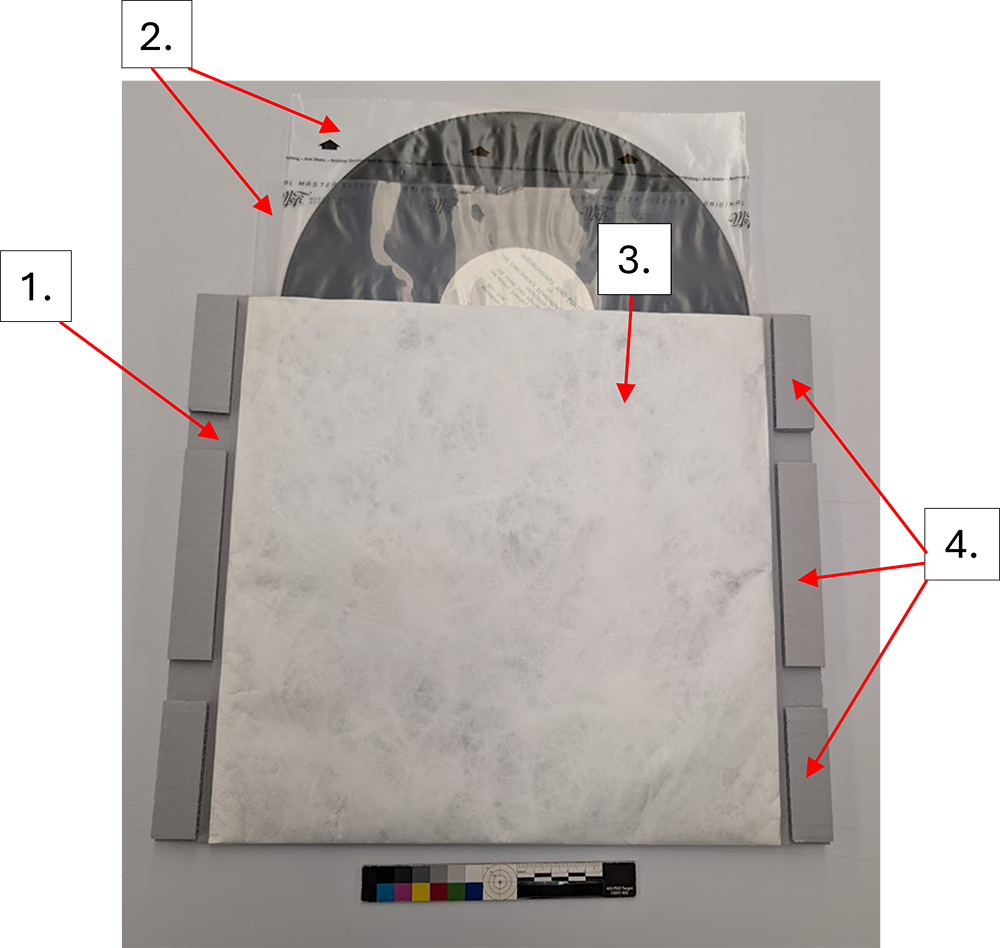
The finished sleeving system for each albums with numbers indicating to various parts of the system.
The tray and its various components that was designed to hold the records in their new archival sleeves.
  1. Individual corrugated board trays were constructed for each disc. Corrugated board was chosen because it is lightweight, inexpensive, and relatively strong. They were cut slightly oversized to provide room for protective bumpers to the left and right of where the sleeves will be attached.
  2. Each disc was placed inside its own archival inner sleeve. These are the sleeves that Mofi refers to as “Original Master Sleeves”. Each disc inside its inner sleeve was then placed inside the archival outer sleeves, which Mofi refers to as “Archival Record Sleeves”. In cases where a cardboard sleeve was present, they would also be placed inside these plastic outer sleeves. The disc’s inner sleeve should protect it from coming into contact with the non-archival cardboard, and the plastic outer sleeve will also help protect the cardboard from damage.
  3. A final pocket was constructed of Tyvek to store each disc inside its sleeves, which was then adhered to the corrugated board trays using PVA.
  4. To prevent any potential abrasion to the discs while sliding them in and out of their final enclosure, several small, corrugated board bumpers were added to the left and right of each attached Tyvek pocket that were thicker than the pocket and all its contents.
  5. A single corrugated board banker’s style box was constructed to house each disc/tray in the series.
  6. To help with removal, Tyvek tape pull tabs were added to each individual tray.
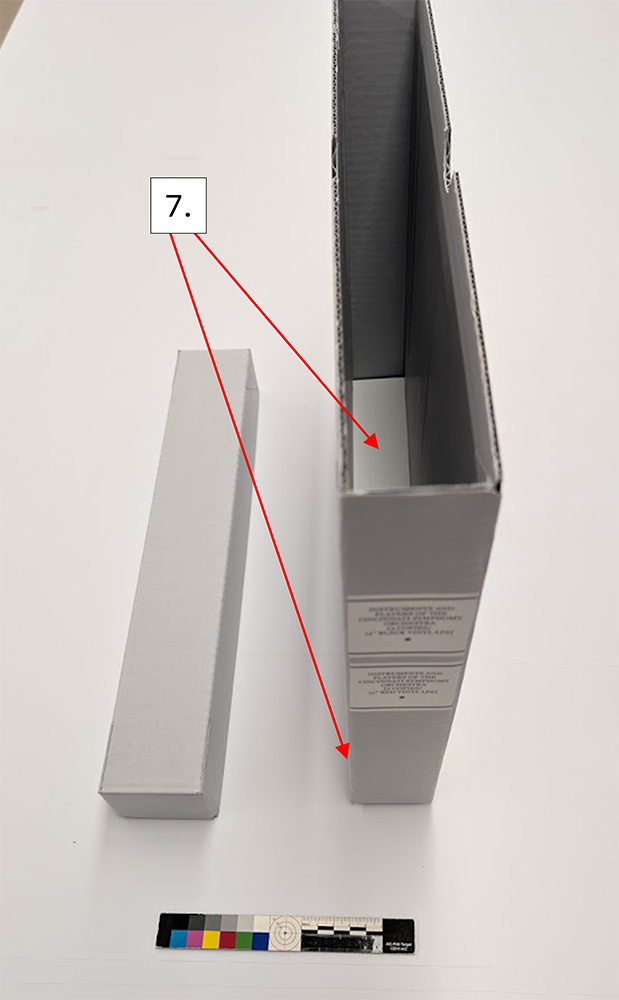
  7. After adding all the trays and their discs to the banker’s box, it was discovered that the box was quite top-heavy and prone to tipping over. To combat this, I added a strip of Dibond (a composite material consisting of a polyethylene core sandwiched between two pieces of aluminum sheeting) to both the bottom of the inside of the box and to the underside of it as well. This provided extra weight to the bottom and added some nice stability. For future enclosures of this nature, I will make the box thicker, adding fill if necessary. This make it more stable without the need to weight the bottom of the box.
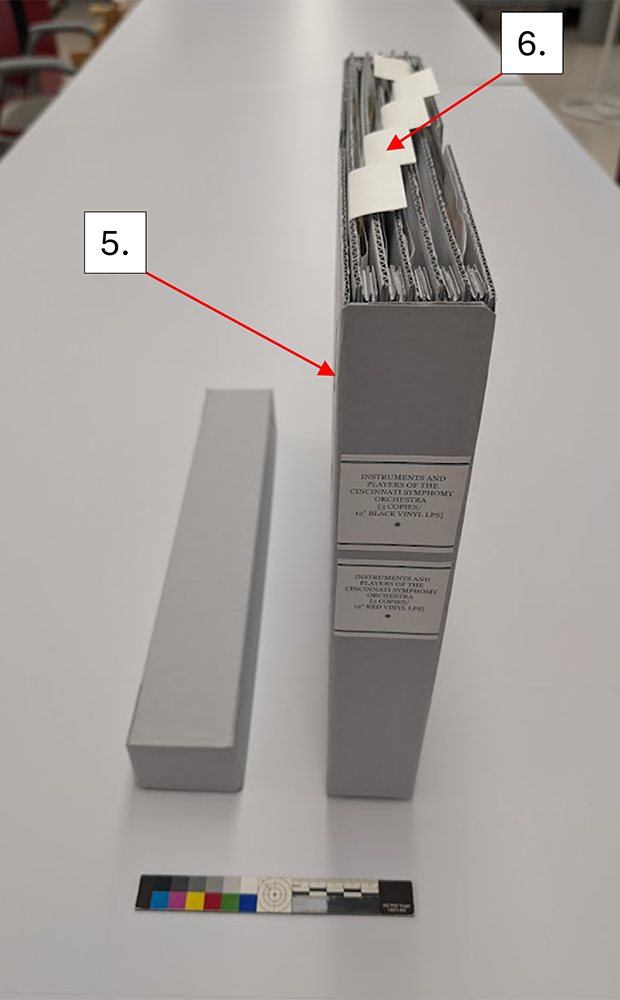
Assembly of the box with various trays with tabs which allow for easy removal from the enclosure. Components are numbered in the photo.
The banker’s box style enclosure with its lid removed to reveal the contents.
Inside of the enclosure to show the Dibond on the bottom of the enclosure, labeled 7.
The banker’s style box with its trays removed revealing a piece of Dibond lining the bottom. An additional piece of Dibond has been added to the underside of the box for added stability.

Final Thoughts

Although this storage solution will almost certainly continue to evolve as I make more of them, I was very happy with how the first batch turned out. Part of the fun of creating new storage solutions is figuring out what works and what doesn’t and adjusting accordingly.

On a side note, I realize that some readers of this post may be concerned for their record collections as they do not have a conservation lab at their disposal to construct an enclosure like this. To that I would say that any of the storage considerations mentioned that are achievable, such as storing discs upright and in new archival sleeves will go a long way in ensuring the longevity of your collections.

A huge thank you is deserved to both conservator Ashleigh Ferguson-Schieszer and assistant conservator Catarina Figueirinhas, who helped me brainstorm on this project.

Sources

Image References

Kalpa-sūtra: A Conservator’s Introduction to an Indian Religious Text

In 2017, an Indian religious text known as a Kalpa-sūtra entered the lab in desperate need for improved storage.  Being unfamiliar with this type of religious manuscript I jotted down notes in preparation for housing the item and came up with a basic housing solution.  I briefly familiarized myself with terminology, format, and condition needs.  This is a summary of those findings with links to resources.

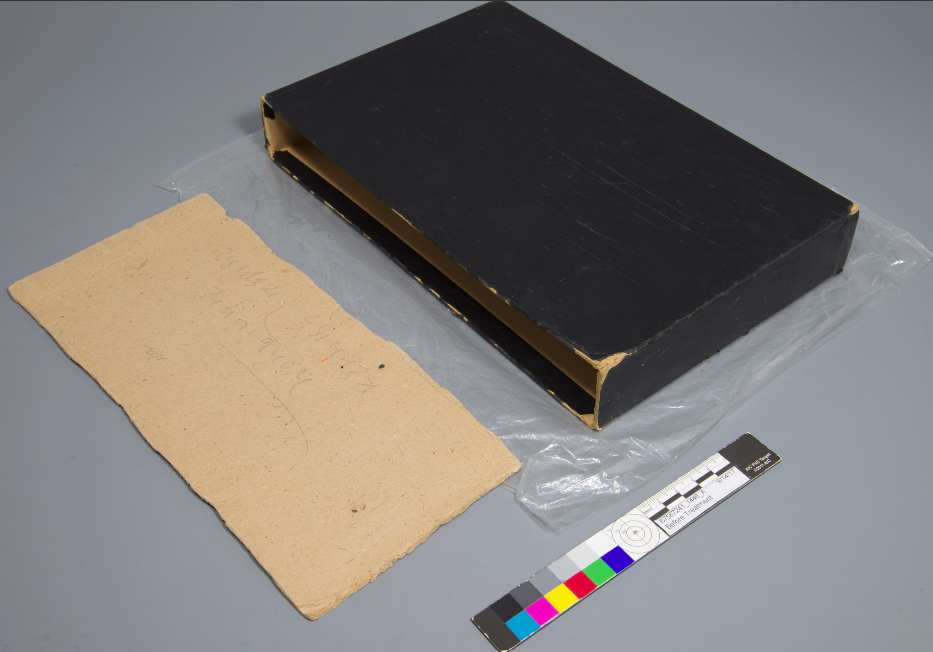
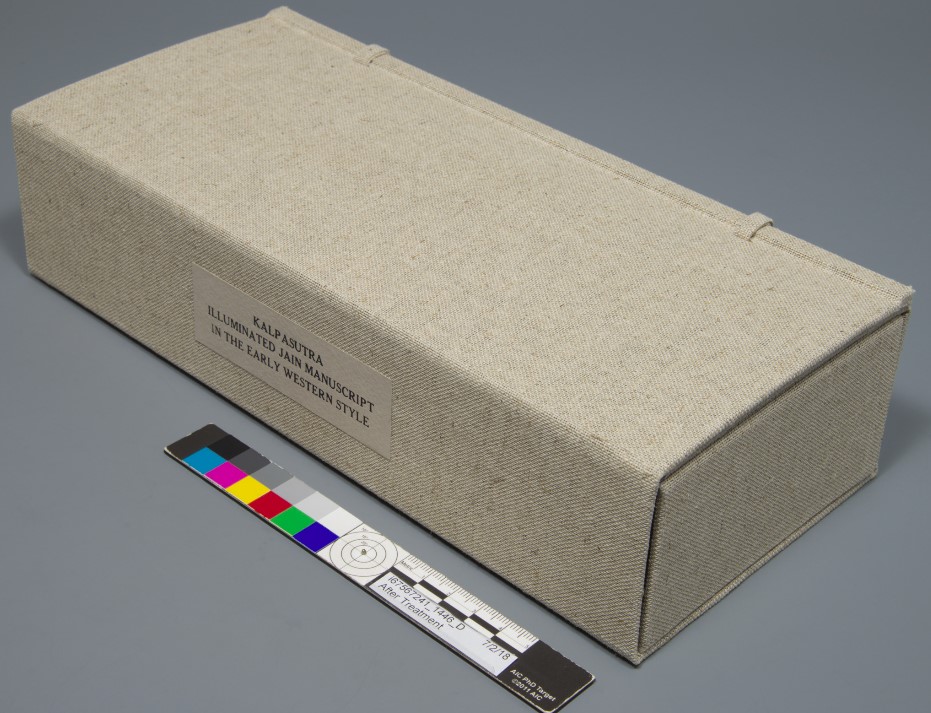
Cincinnati and Hamilton County Public Library sent their Kalpa-sūtra to the Preservation Lab to receive improved storage.  The original storage enclosure was not archival and did not properly fit the manuscript.  This left the manuscript vulnerable to damage.

Kalpa-sūtra

Kalpa-sūtra translates to “the Book of Ritual” that was meant to be read daily.  It follows a 3-part textural structure.  The first part consists of the ‘Lives of the Jinas (an enlightened human being)’ and describes the lives of well-known figures.  The second section, known as the ‘String of Elders’ celebrates early teachers of Jainism.  And the final section, referred to as the ‘Right Monastic Conduct,’ provides rules to follow during the rainy time of year.  The ‘rainy season,’ as it is often referred to, is a time of year when the festival of Paryusan is celebrated and the Kalpa-sutra is heavily used. 

Jainism

Jainism is an Indian religion that shares similarities to Buddhism and Hinduism, but is regarded as a separate religion. It’s believed to have originated in the 7th – 5th century BCE in the Ganges basin of Eastern India.  Jains believe in karma, reincarnation and practicing non-violence to all living creatures.  While learning more, I appreciated this article that described the Jain’s thoughtful practice of non-violence by explaining how Jains eat above-ground veggies but avoid eating roots of vegetables so as not to kill the plant.

Format

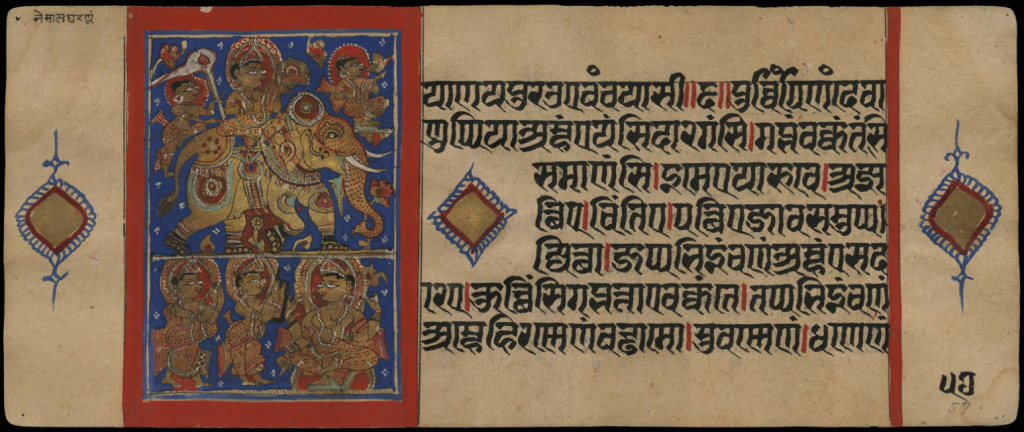
Earlier Kalpa-sūtra were written on palm leaves and stored in between decorated wooden covers.  They were bound with rope or cord through holes punched in the center of the leaves and are read by flipping the leaves up, from bottom to top.  To see an example of a palm leaf book, check out this one housed by the Preservation Lab in 2016. 

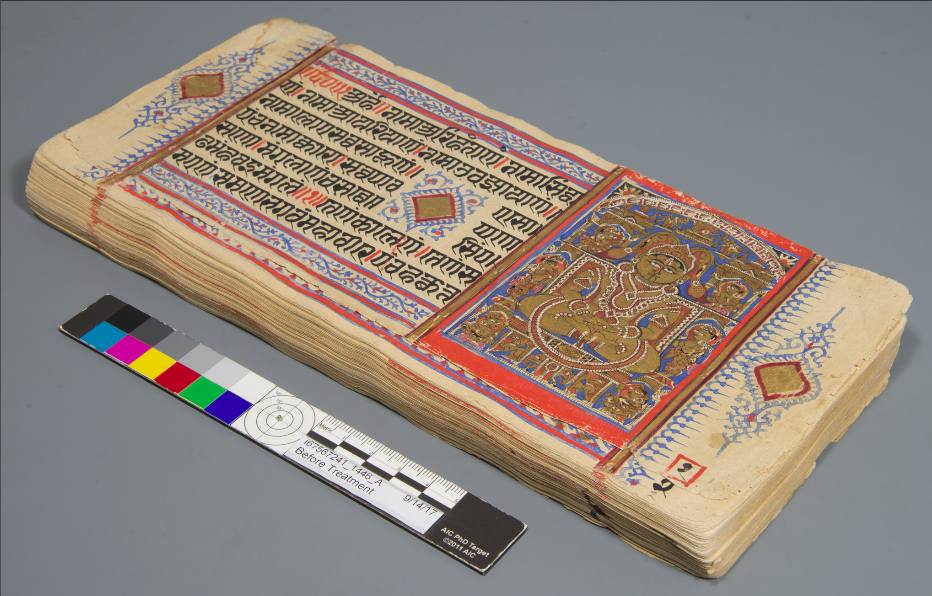
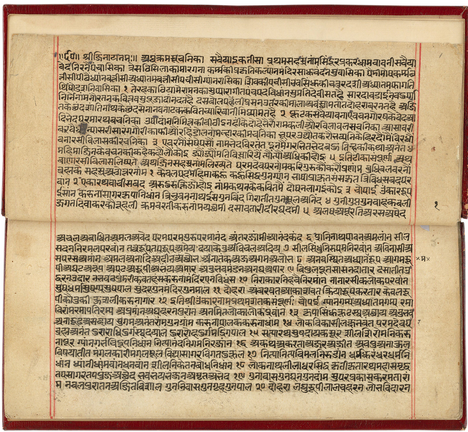
Later Kalpa-sūtra, such as this one owned and digitized by the Public Library, were written on paper beginning in the 14th century but still follow the same horizontal single-sheet format of the palm leaf.  Often they were hand colored, illuminated in gold, and written in a black ink calligraphic style on laid handmade paper.  Like many others, the Public Library’s manuscript contains 135 individual loose leaves that have never been bound.  The leaves, also referred to as folios, were traditionally written on both sides with seven lines of text. 

To learn more about formats of Jain manuscripts please refer to Jainpedia.org

Decorative Themes

The Public Library’s manuscript is a good example of a traditional paper Kalpa-sūtra manuscript.  Its decoration consists of left and right margin lines, and decorative diamond-shaped marks that interrupt the text.  The diamonds (often found as circles in other manuscripts) descend directly from the tradition of punching holes in palm leaf books for binding.  They are located in similar locations to palm leaf holes and are predetermined when the text is written.  On the recto of leaves there are three gold decorative diamonds, one located in the center and one each along the right and left margins. (The V&A refers to these decorations as “central and marginal string holes that are not pierced.”) The verso of leaves contain only one decorative diamond in the center. The religious manuscript is paginated on the recto in both calligraphy and graphite. 

Kalpa-sūtra: A Conservator’s Introduction to an Indian Religious Text
The three diamond shaped decorations descend from the tradition of punching holes in palm leaf books for binding.  Palm leaf books were bound with strands of cord.

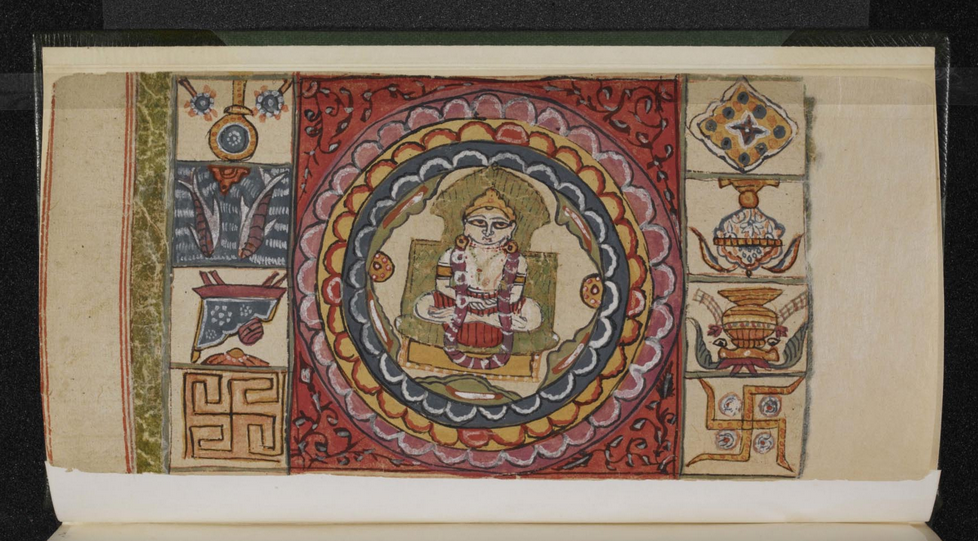
Miniature block illuminations are found sporadically throughout the text. The Public Library manuscript appears to resemble similar illumination imagery and of the 15th century Kalpa-sutra owned by the British Library, available online here where you can read about the context behind the illuminated images

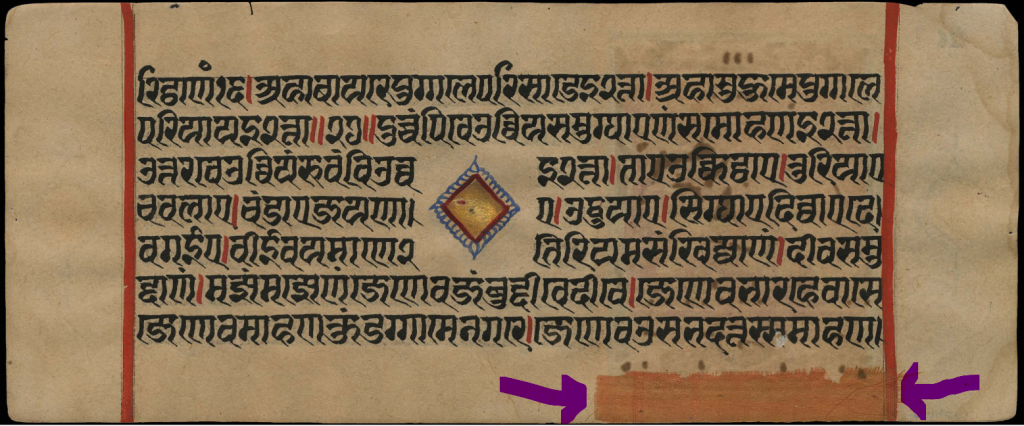
Public Library illuminations consist of red and blue opaque watercolor and gold illumination.  The very base of the paintings are a thin open weave cloth attached directly to the handmade paper.  On some leaves, you can see where this thin cloth is folded over onto the other side of the leaf.

Kalpa-sūtra: A Conservator’s Introduction to an Indian Religious Text
Purple arrows point to a cloth that is wrapped around from the front of the manuscript folio.

To learn more about how to read a Kalpa-sūtra please see https://jainpedia.org/resources/how-to-read-a-jain-manuscript/.

Manuscript Holders

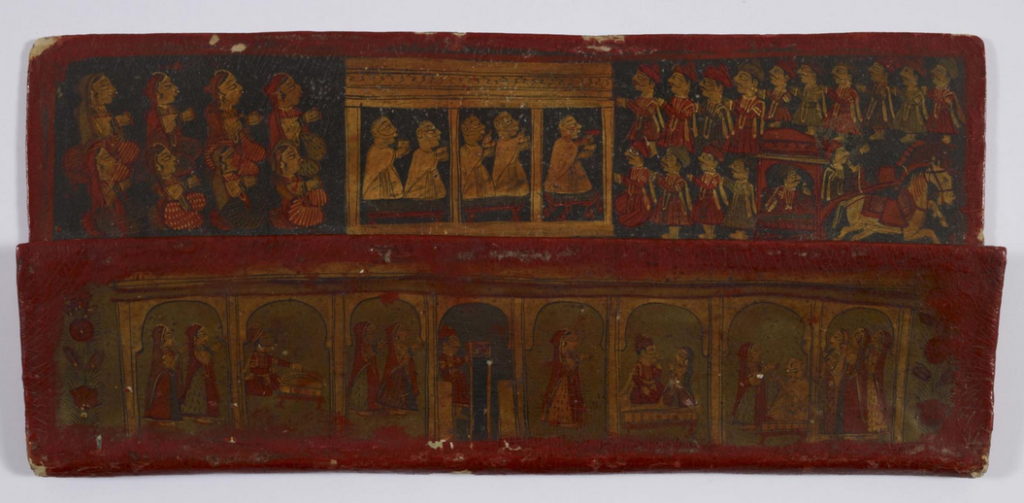
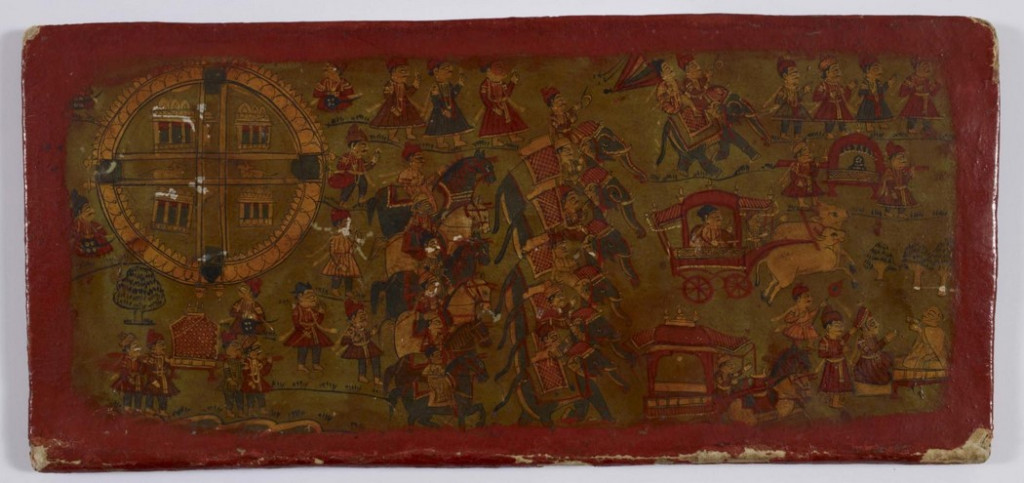
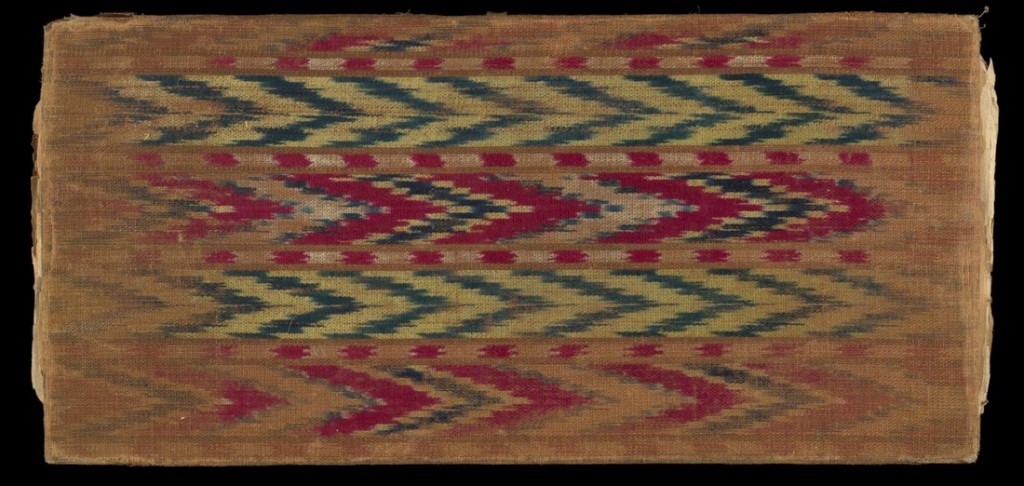
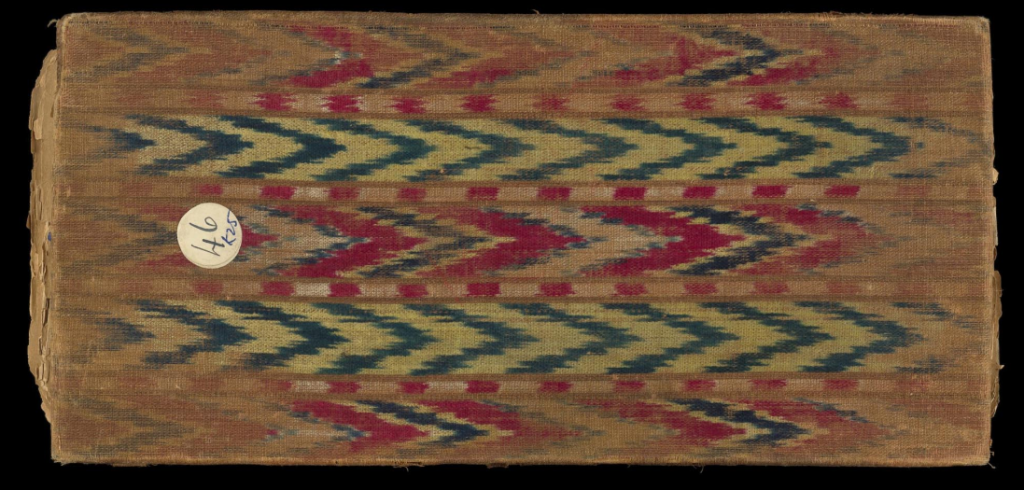
In my research, I tried to understand how paper Kalpa-sūtra were traditionally stored. It is noted on Jainpedia.org that Jain manuscripts appear to have been stored within decorated covers of paper, cloth, and wood. 

From what I can gather by surveying a collection of digitized manuscripts, loose sheets appear to have been stored within chemise-like covers, sometimes with multiple flaps, such as this one from the British Library (Or. 13950) and Gamma 453 where a loose manuscript is stored within a cloth cover:

  • Kalpa-sūtra: A Conservator’s Introduction to an Indian Religious Text
  • Kalpa-sūtra: A Conservator’s Introduction to an Indian Religious Text
  • Kalpa-sūtra: A Conservator’s Introduction to an Indian Religious Text
  • Kalpa-sūtra: A Conservator’s Introduction to an Indian Religious Text

Images courtesy of https://jainpedia.org/manuscript/cardboard-manuscript-holder-front/ and https://jainpedia.org/manuscript/cloth-manuscript-cover-front/

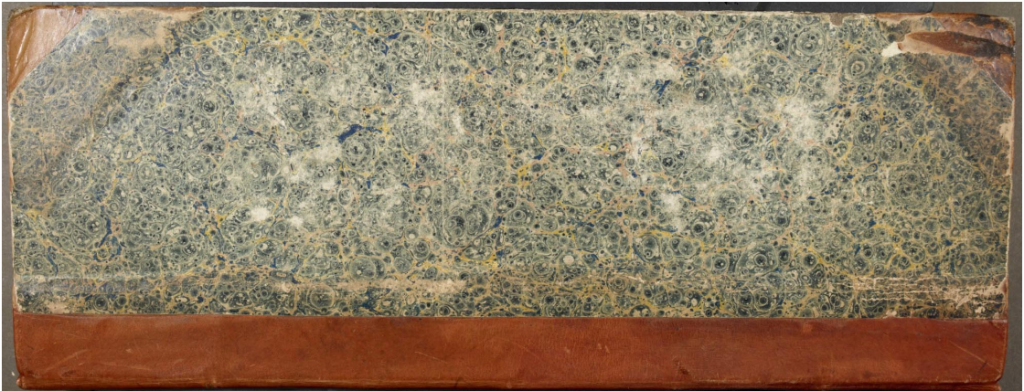
I also discovered some Kalpa-sūtra that had been treated in western traditions. Below are a few examples that include where one is tipped along the bottom edge and bound into a western style half leather binding. Another, MS 22393, appears to be bound along the top edge at the British Library. A third yet, MS 34, at the Royal Asiatic Society is bound in half leather with marbled paper:

  • Kalpa-sūtra: A Conservator’s Introduction to an Indian Religious Text
  • Kalpa-sūtra: A Conservator’s Introduction to an Indian Religious Text
  • Kalpa-sūtra: A Conservator’s Introduction to an Indian Religious Text

Images courtesy of https://jainpedia.org/manuscript/ras-tod-ms34-204/?hilite=%27cover%27, https://www.bl.uk/collection-items/banarasivilasa-jain-religious-poetry, and https://jainpedia.org/manuscript/jina-and-auspicious-symbols/

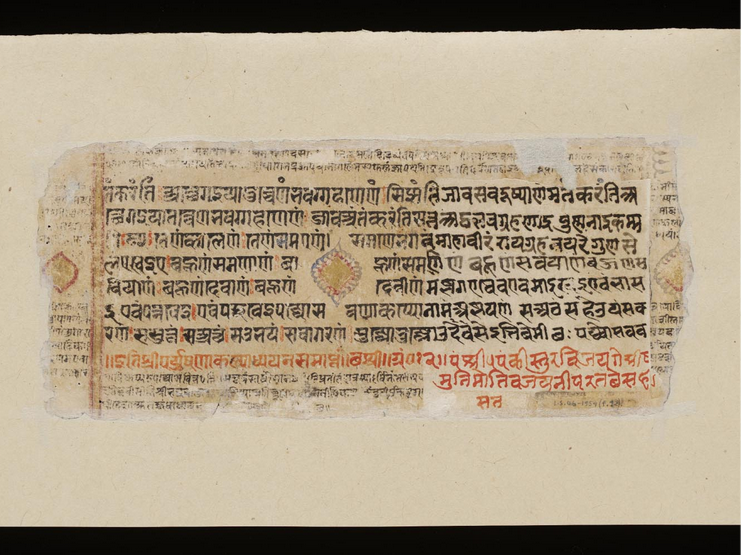
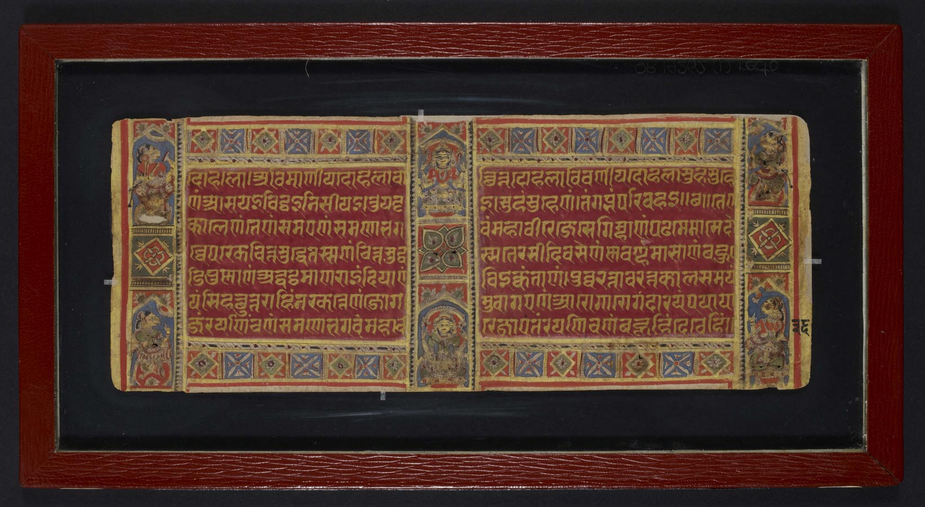
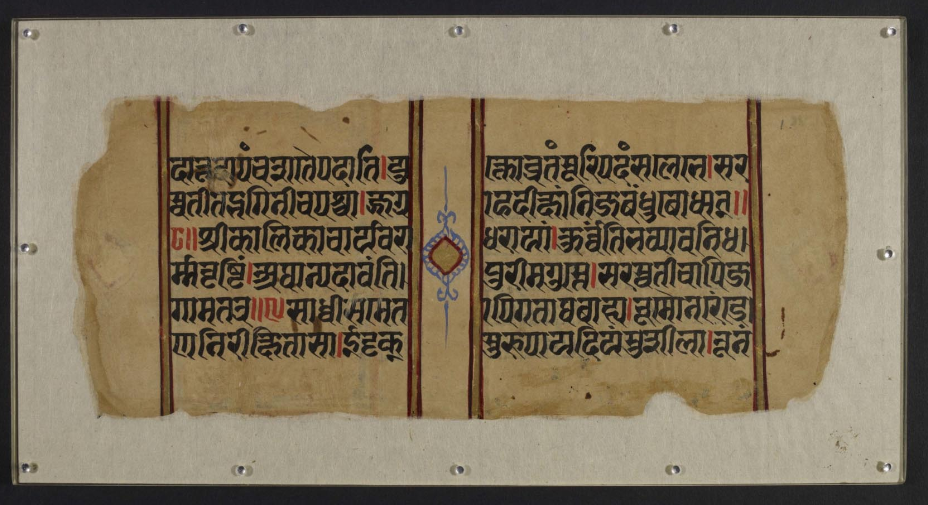
Others found online have been inlaid into larger sheets of paper, such as the one below from the Victoria and Albert Museum. Manuscripts heavily illuminated and likely suffering from pigment corrosion have been encapsulated between sheets of plastic or glass, such as these from the British Library (Or. 14262 and Or. 13950). One manuscript has been both inlaid into paper and encapsulated:

  • Kalpa-sūtra: A Conservator’s Introduction to an Indian Religious Text
  • Kalpa-sūtra: A Conservator’s Introduction to an Indian Religious Text
  • Kalpa-sūtra: A Conservator’s Introduction to an Indian Religious Text

Images courtesy of https://jainpedia.org/manuscript/stanzas-8-to-10/, https://jainpedia.org/manuscript/folio-with-decorated-borders/, and https://jainpedia.org/manuscript/end-of-text-and-scribal-remark/

Storage Observations

  • There does not appear to be a conservation standard for storing Kalpa-sūtra manuscripts.
  • Storage solutions vary widely and are specific to how they will be displayed or handled.
  • While I appreciate the western tradition of binding loose pages to prevent them from becoming lost, I knew the Public Library preferred to house the manuscript with as little reformatting as possible in order to preserve cultural traditions.
  • While I came across a few examples that appear to be stored unbound within covers, it was unclear as to the date of the covers, when they were added, and how they might have been formatted.  No images were provided of the sides of the covers.
  • Even though heavier than plastic, glass was likely used for encapsulation to protect the flaking and corroding illuminations from the static charge of plastic.

Conclusion

The housing solution selected at the lab is one of many options and provides a stop-gap until a more traditional format can be explored. 

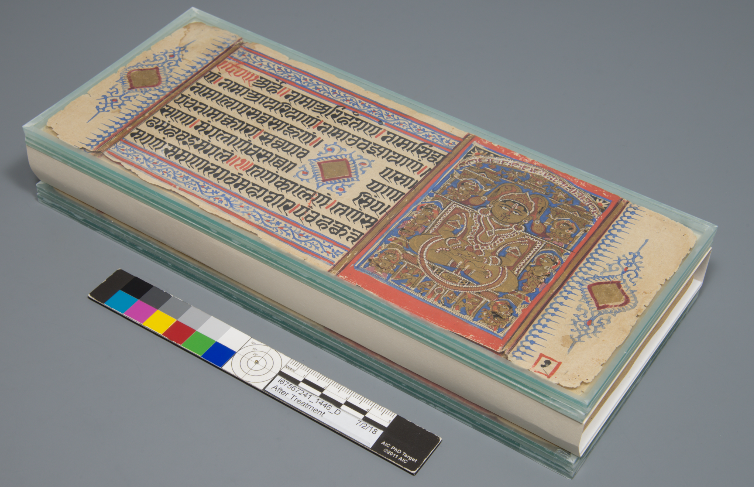
The most severely corroded leaves at the front and back of the text were encapsulated between glass while the rest of the leaves were left loose.  This allowed the most vulnerable leaves to be protected from humidity while avoiding the weight of encapsulating the entirety of the manuscript.

The encapsulated and loose manuscript leaves were then stored together (the outer encapsulated leaves helped serve as de facto covers).  An Asian four-flap enclosure with bone clasps was custom made to provide structure and stability, as well as perhaps provide a format more sympathetic in style to a Jain holder than a European style enclosure.

Further Research

There is much ripe for future study:

  • I hope to experience a historic Jain manuscript cover in person to learn the format and structure.
  • There are downsides to using glass that should be reconsidered in the future: 1. Glass is heavy and breakable.  If the glass breaks, it could cause tears in the fragile paper. 2. Glass deteriorates in humid conditions.  The alkali will eventually leach out and could cause staining in the paper. This storage solution should be considered a temporary solution until the pigments can be studied and safely consolidated.
  • Since there is a pigment contributing to corrosion and paper drop-out in the manuscript, it is likely that pigments in the Public Library manuscript contain copper. I would be interested in developing a plan to analyze the pigments to better understand their composition.
  • As a library book and paper conservator, I am less familiar with fine art painting traditions on paper, particularly Indian painting.  This was my first experience with observing an open weave cloth used as a base for illuminated manuscripts. This initial research has me captivated to learn more about the traditions of Indian miniature painting and how they are connected with early stylized Kalpa-sūtra paintings, and if their implications for inherent condition issues can be extrapolated.
  • The word ‘sutra’ is literally interpreted as “thread” in Sanskrit.  Different manuscripts contain the word “sutra” in their title, such as the Indian Kama Sutra, or Asian Buddhist sutras which are not to be confused with the Kalpa-sūtra.  Is it possible that because these manuscripts were historically bound with cords or wrapped with ties give rise to the word sutra?

Interesting Side Note

I learned that The Diamond Sutra owned by the British Library is considered the oldest block printed book in existence AND it has been analyzed to find the scroll’s yellow plant dye extract, Berberine, is toxic.  It’s possible the toxin can be absorbed through the skin (so those handling should wear gloves!) as mentioned in the Vol. 21, Number 4, Nov. 1997 Abbey Newsletter under the heading Peril in Old Paper.

Ashleigh Ferguson Schieszer (CHPL) – Conservator, Lab Co-Manager

Resource links:

https://digital.cincinnatilibrary.org/digital/collection/p16998coll24/id/3540/rec/1

https://www.smithsonianmag.com/smart-news/Five-things-to-know-about-diamond-sutra-worlds-oldest-dated-printed-book-180959052/

https://cool.culturalheritage.org/byorg/abbey/an/an21/an21-4/an21-401.html

https://www.nationalgeographic.org/encyclopedia/jainism/

The slow march towards the digital age…

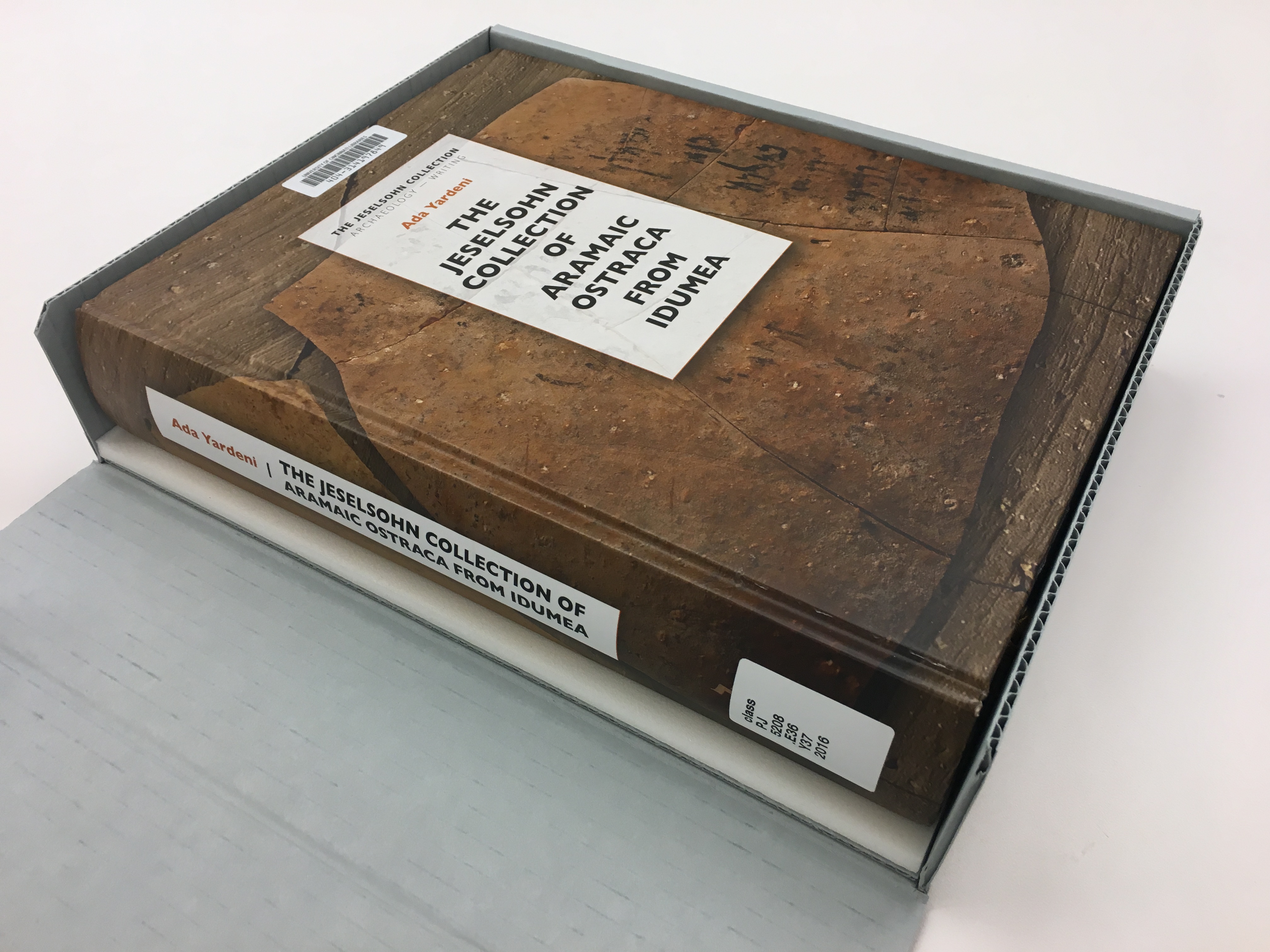
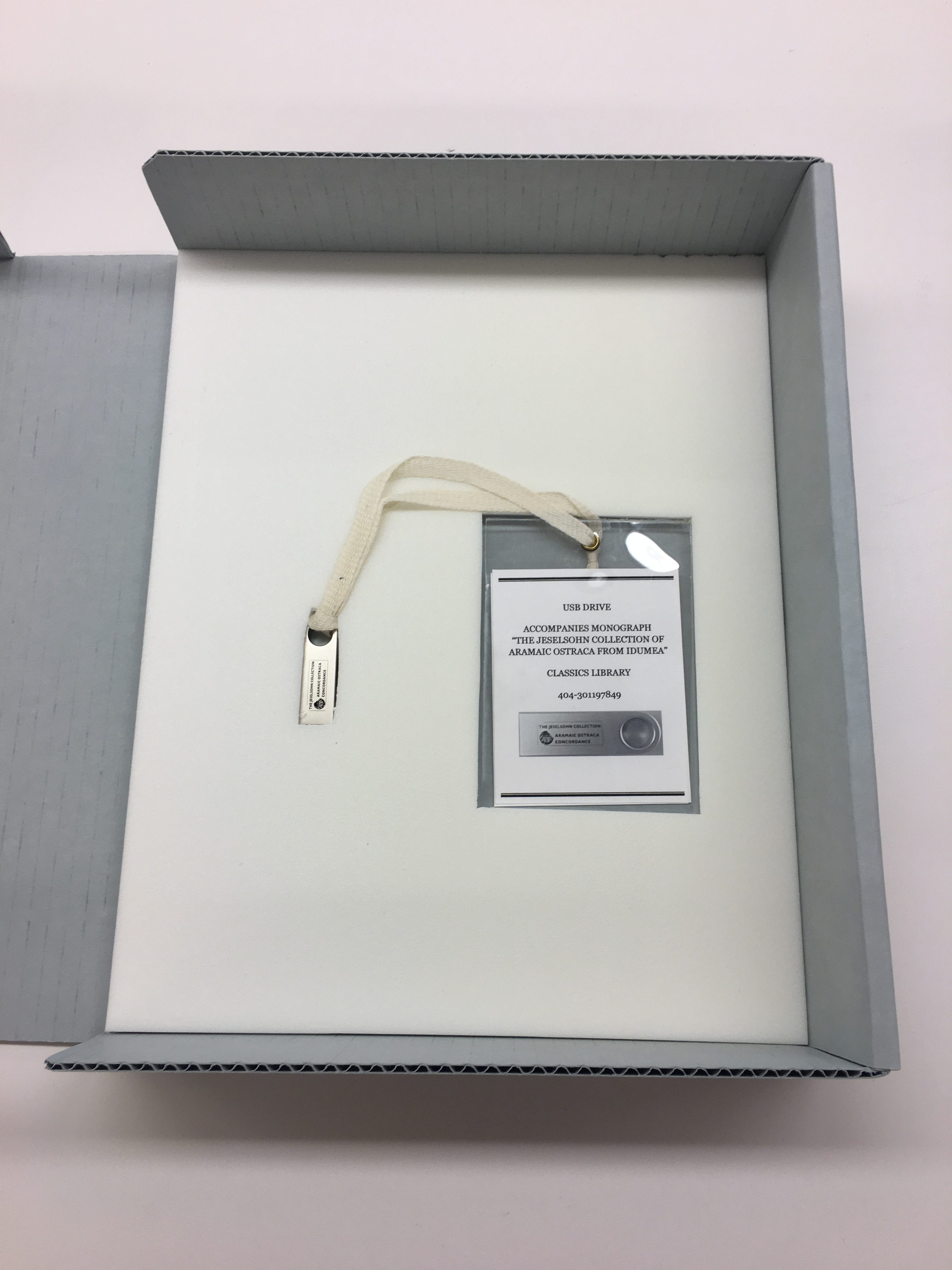
The slow march towards the digital age…Our colleagues in the Classics Library sent us an interesting housing project.  The goal, to secure and keep together a textbook and accompanying electronic content.
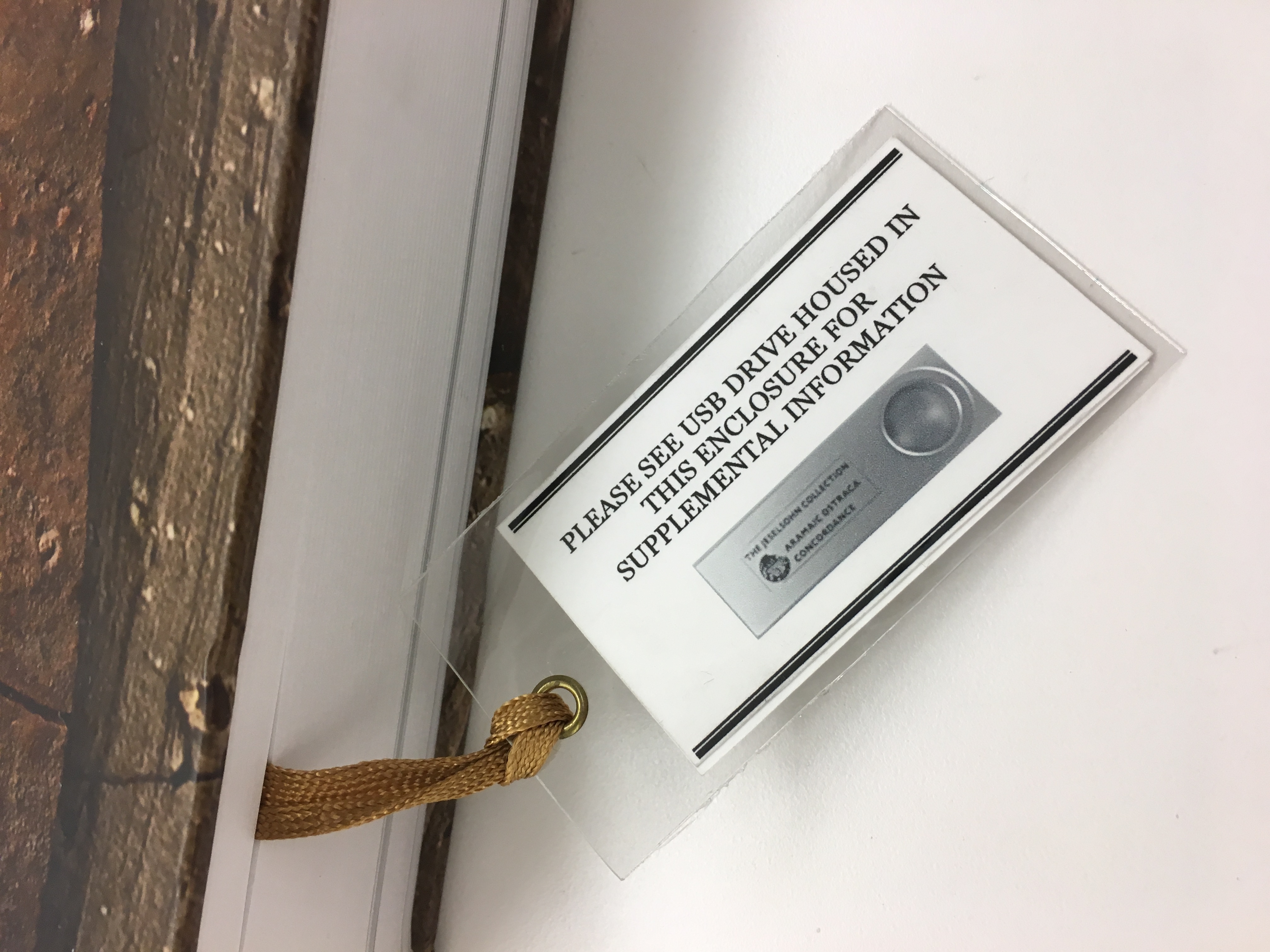
The additional electronic content was not in the form of a URL for on-line supplements, nor a DVD, but a small shiny USB drive.  The drive was originally attached it to the book at The slow march towards the digital age…the end of a long silky bookmark adhered to the text block.  A neat idea, but the drive was almost impossible to use attached to the anchor of the heavy book.
Ah, the mashup of the old and new!
Our solution was to make a simple corrugated enclosure with a volara foam compartment and a photographic surrogate on the end of the bookmark.  The surrogate directs users to the compartment holding the USB port.  Additionally, a message in the item record alerts library workers to “check for one USB device”.
To me the pleasure of this item is that it illustrates so clearly the tension between the easy functionality of the book and the limits of its fixed form. It also speaks to how slow the march towards the digital age feels – illustrating a change in technology without much of an improvement, such as the move from DVD to USB storage.
[And here is where I lament that I STILL don’t have a hovercraft or a robot maid.]
Though many of us have vowed to get out of the prediction game, let me predict in 10 years our students will marvel at this USB device the way they do now at floppy disks and zip drives.
LONG LIVE THE BOOK!

The slow march towards the digital age…

Enclosure by Jessica Ebert, conservation technician


Holly Prochaska (UCL) —- Preservation Librarian

Housing the Public Library's historic stained glass

When the original Main Library at 629 Vine Street opened to the public in 1873, three beautiful and intricate stained glass windows graced one of the reading rooms in the building. In 1955, when the building was demolished, the windows were sold at auction, later to resurface as part of the decor of the Old Spaghetti Factory on Pete Rose Way. After the restaurant closed to make room for Paul Brown Stadium, the Library purchased the windows and began making plans to return them to the Main Library for the appreciation and enjoyment of our customers and staff. Thanks to the generosity of the Friends and the Annabel Fey Trust Fund, the three windows have now been re-created and restored to their original glory and will be on permanent display in the Main Library.
Continue reading

…a massive and impressive contraption

One of the (many) great things about our collaboration, and the State Library of Ohio grant that funded our collaborative lab, was being able to purchase new equipment and supplies.  With grant funds, the lab purchased an additional board shear, a humidification/suction table, a ductless fume-hood, additional map cases to store paper and many other wonderful things.  But there were certain unique and very specific items that we couldn’t find through outside vendor s, and that’s when UC’s talented group of carpenters came to our aid.  The UC carpenters were essential when it came to renovating our existing lab, adding a second bench area for the conservator and two conservation technicians, and a second sink by the new work benches.  But one of the most massive and impressive contraptions they constructed was multi-compartment structure to hold binders board, corrugated board, foam, and other various odds and ends.  It’s mammoth, sturdy and expertly crafted.  And more importantly offers an excellent storage solution to some of the new supplies we were ordering.
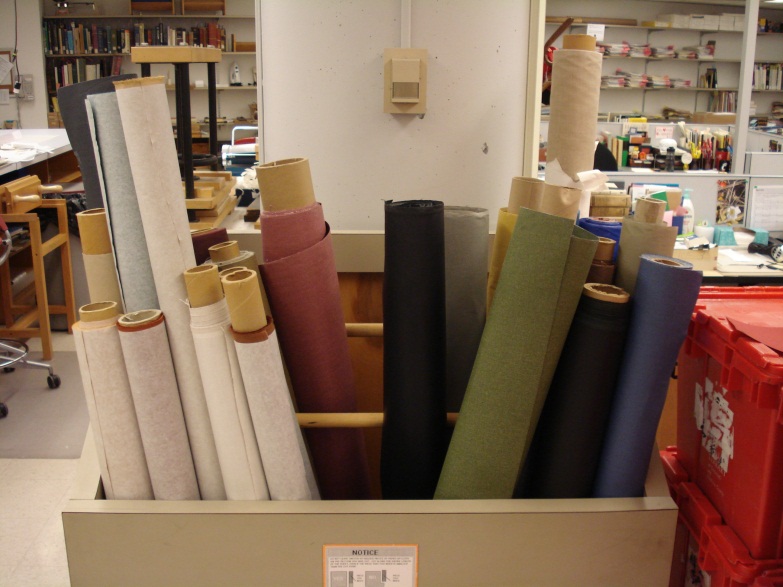
Yet, after the first year of our new created collaborative lab there was still one area where we still need some organization help…bookcloth and buckram storage.  For ages we had been storing our bookcloth and buckram in an oversized laminate bin.

Imagine this but jammed full of three times the cloth and buckram.

Imagine this but jammed full of three times the cloth and buckram.


Continue reading