Category Archives: Paper

Preservation Week Fun!

One of the things I love most about working here in the Lab is that’s like the proverbial shark: always moving. We’re constantly learning and growing and trying new things; it’s great! We do, however, reside rather off the beaten path in the library, so it often happens that unless people have to come down for a specific purpose, they never know what we’re up to now.
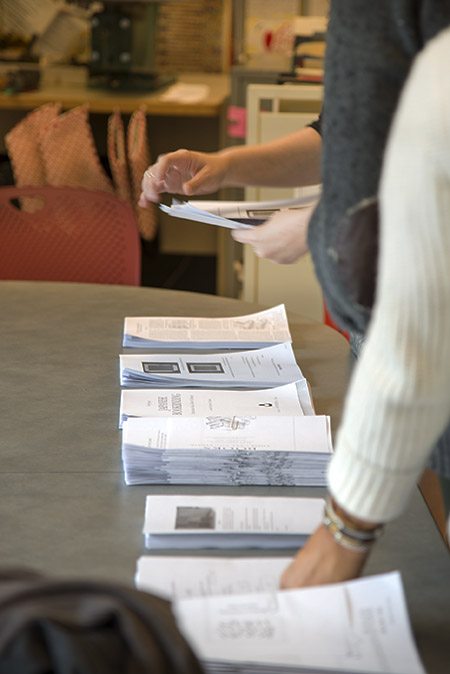
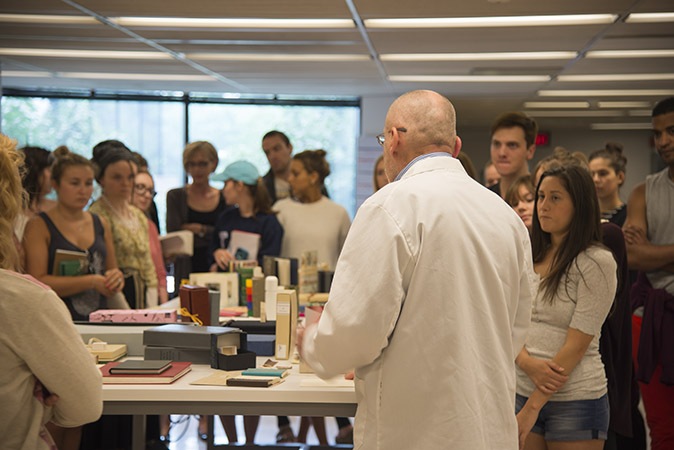
Enter the annual Open House. You would think that after so many years, it would be pretty rank and file, but we’ve managed to keep the fun. This year, in addition to learning a few new things about the lab’s treatment reports on the UC Libraries’ Digital Collections & Repositories site and the hot stamper bookmarks that everyone has come to know and love, we focused on papermaking, highlighted by the opportunity to pull a piece of their very own.  Holly and Catarina walked our guests through the process, to great (and messy) results. People love the opportunity to mix it up and put their hands in things, and I would definitely call it a success.  On top of that, our conservator, Ashleigh, displayed an array of different types of paper and plant fibers that are used to make paper, and she demonstrated and discussed the different ways in which we use paper in the lab (mends, pulps fills, etc.). It was such a good time that I’m not sure how we’ll top it next year. No doubt there’ll be something fascinating going on. Stay tuned!
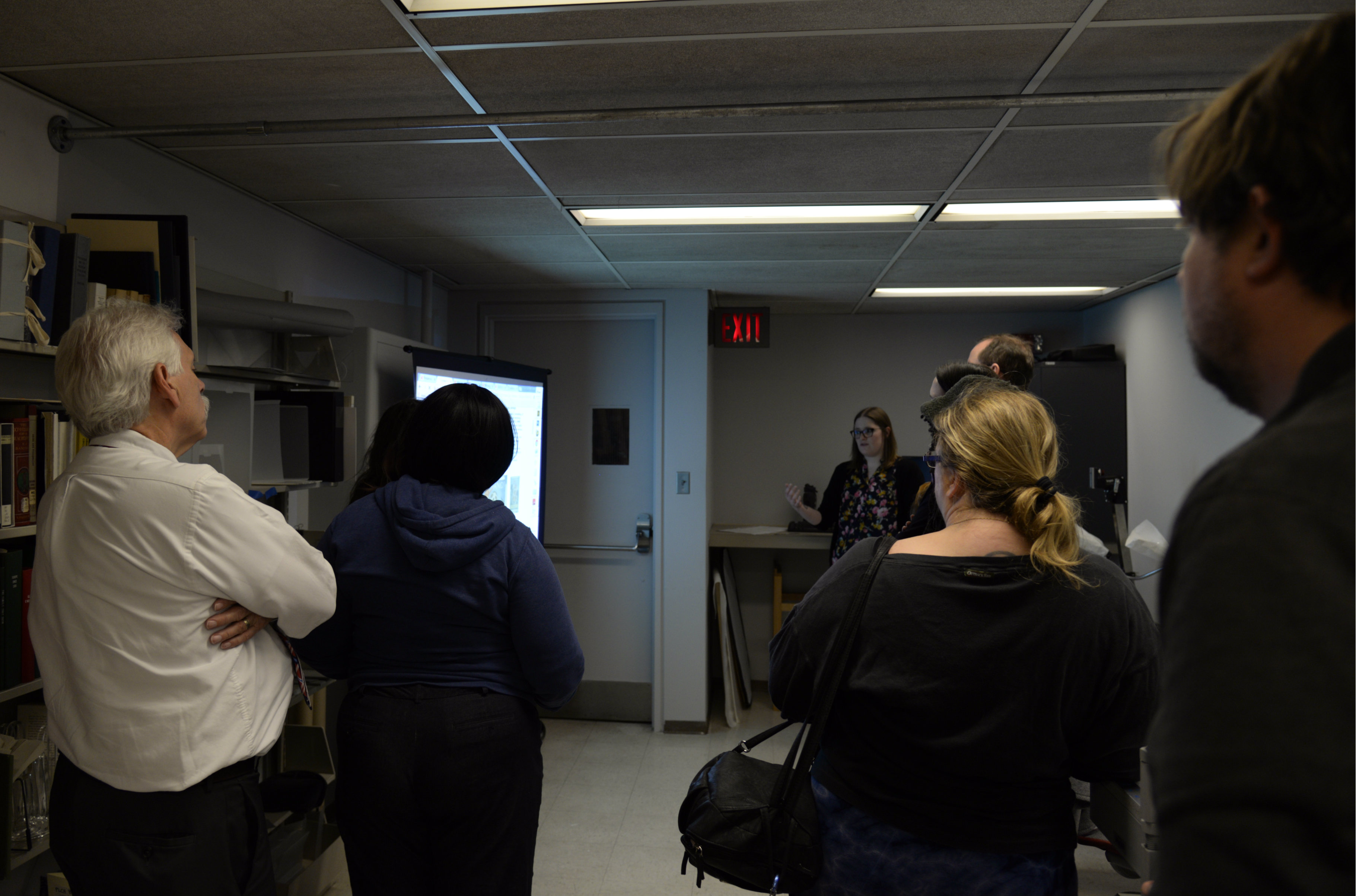
Jessica talking about the Preservation Lab's DRC and how/why we are sharing our treatment reports with researchers, patrons, and other conservation professionals.
Jessica talking about the Preservation Lab’s DRC and how/why we are sharing our treatment reports with researchers, patrons, and other conservation professionals.


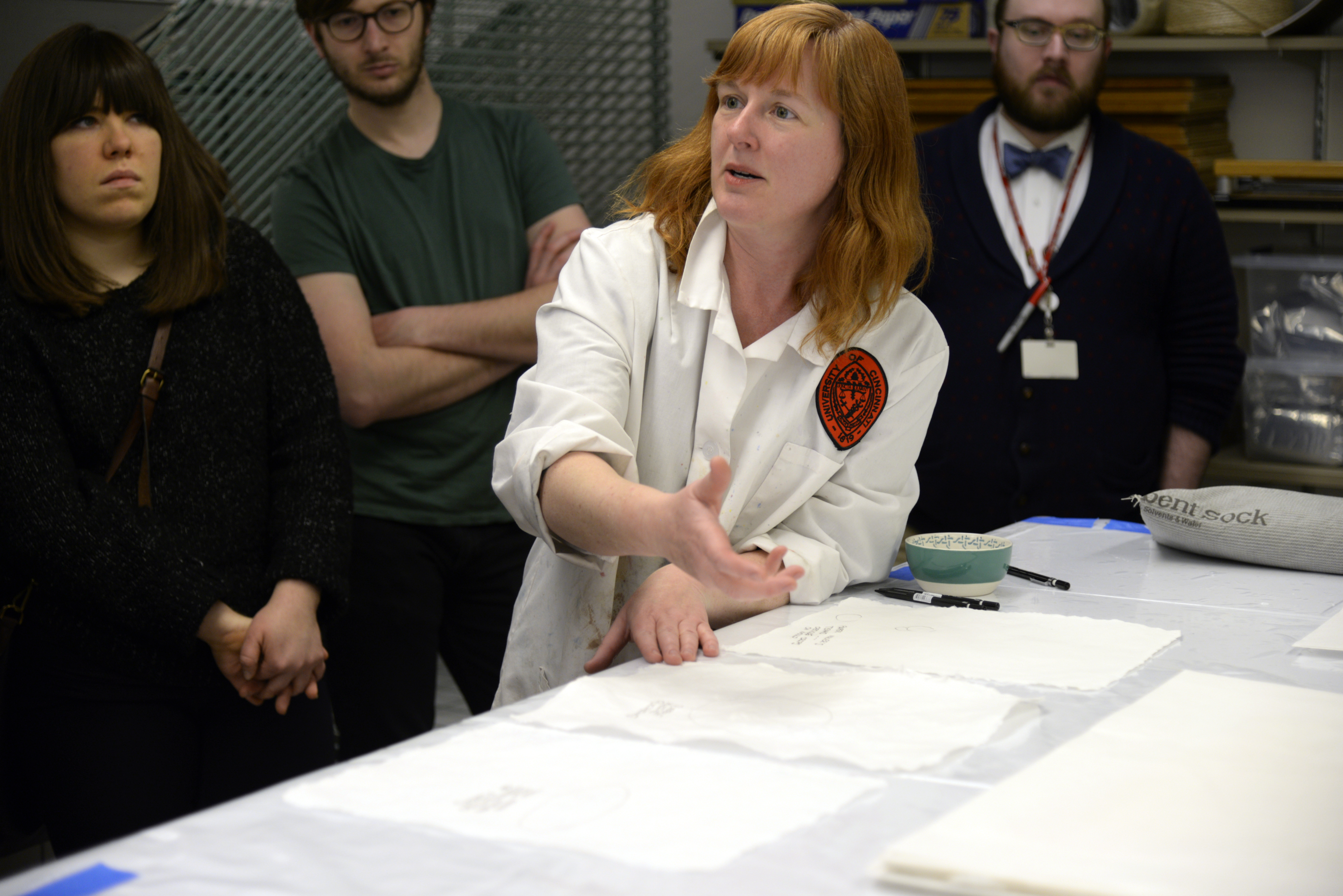
Holly discussing the papermaking process and the different problems that can occur such as "papermaker's tears" and air bubbles during couching.

Holly discussing the papermaking process and the different problems that can occur such as “papermaker’s tears” and air bubbles during couching.
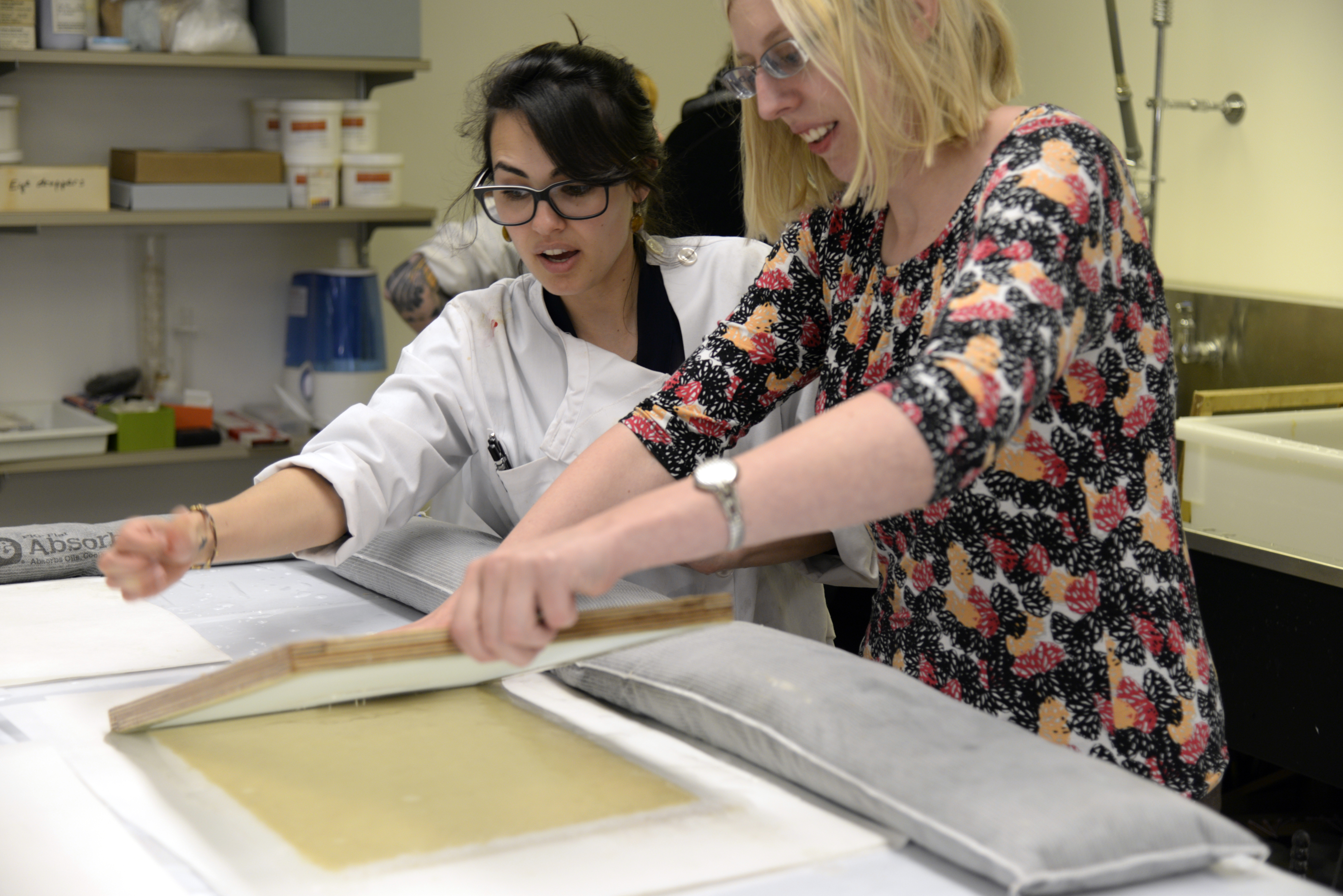

Catarina helping a visiting staff members couch her sheet of paper.
Catarina helping a visiting staff members couch her sheet of paper.


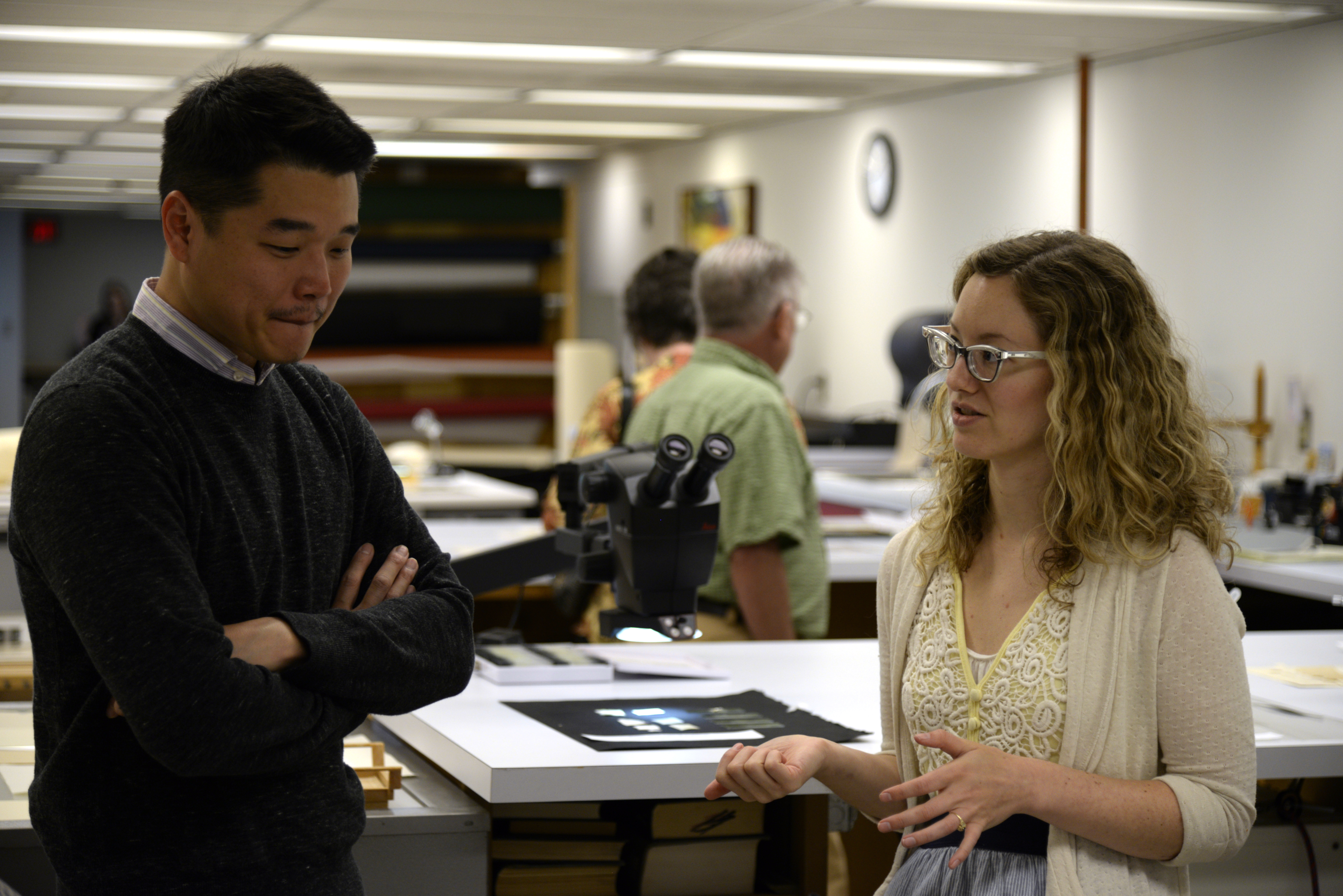
Ashleigh talking about paper sizing.

Ashleigh explaining paper sizing and why it’s done.
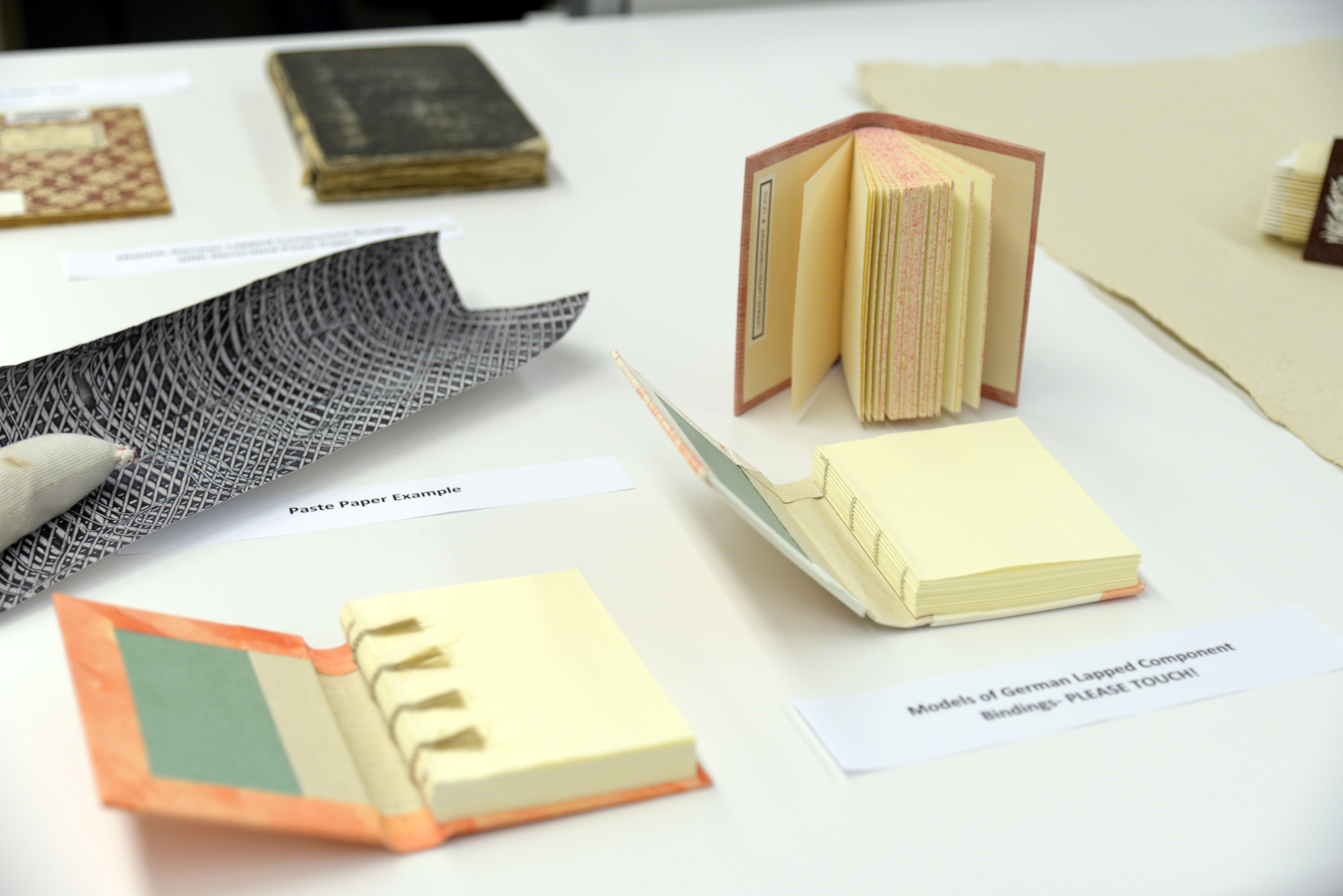

Book models and examples of paste paper.

Book models and examples of paste paper.


Hyacinth Tucker (UCL) — Binding Processor
Loopy

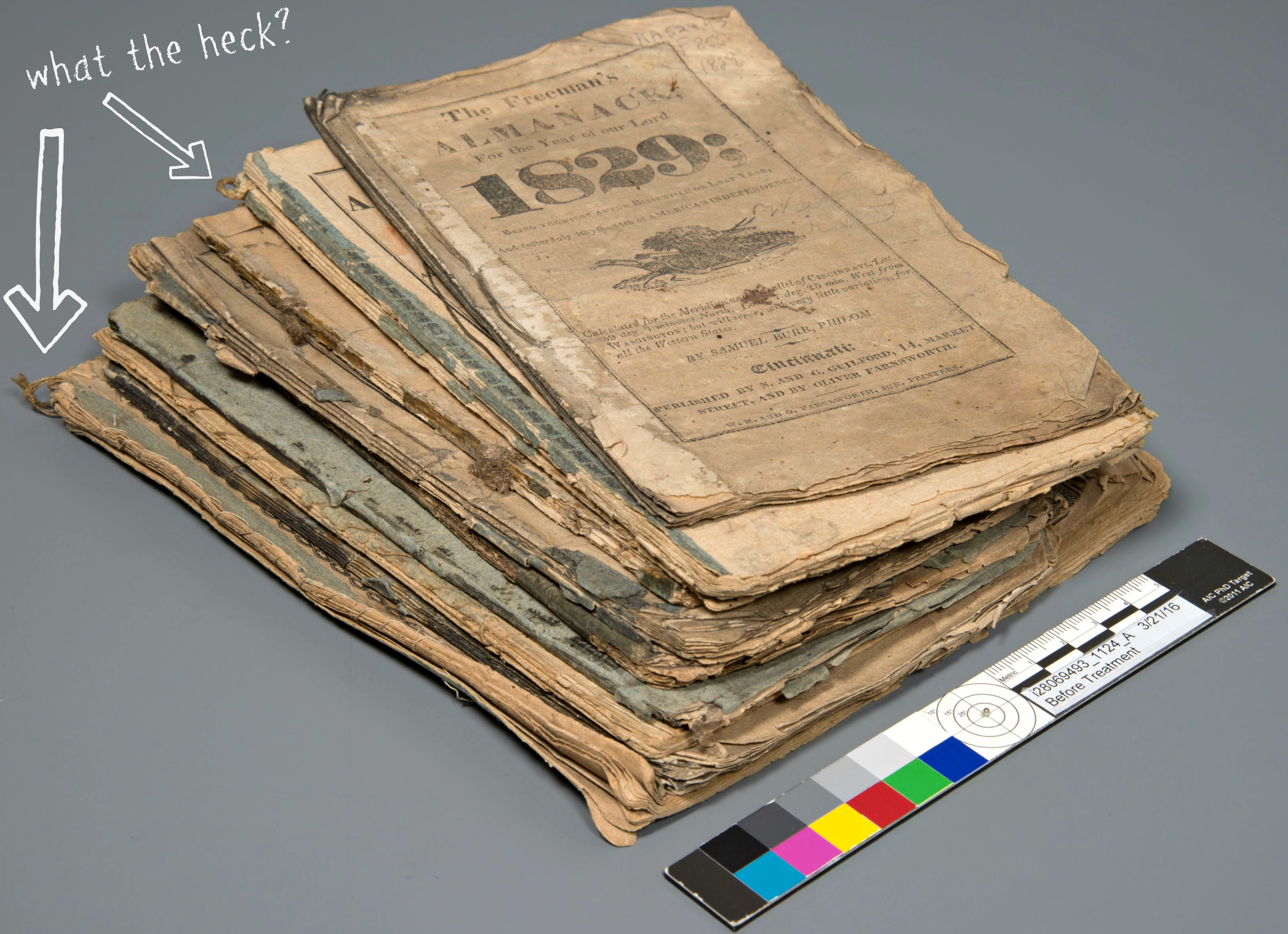
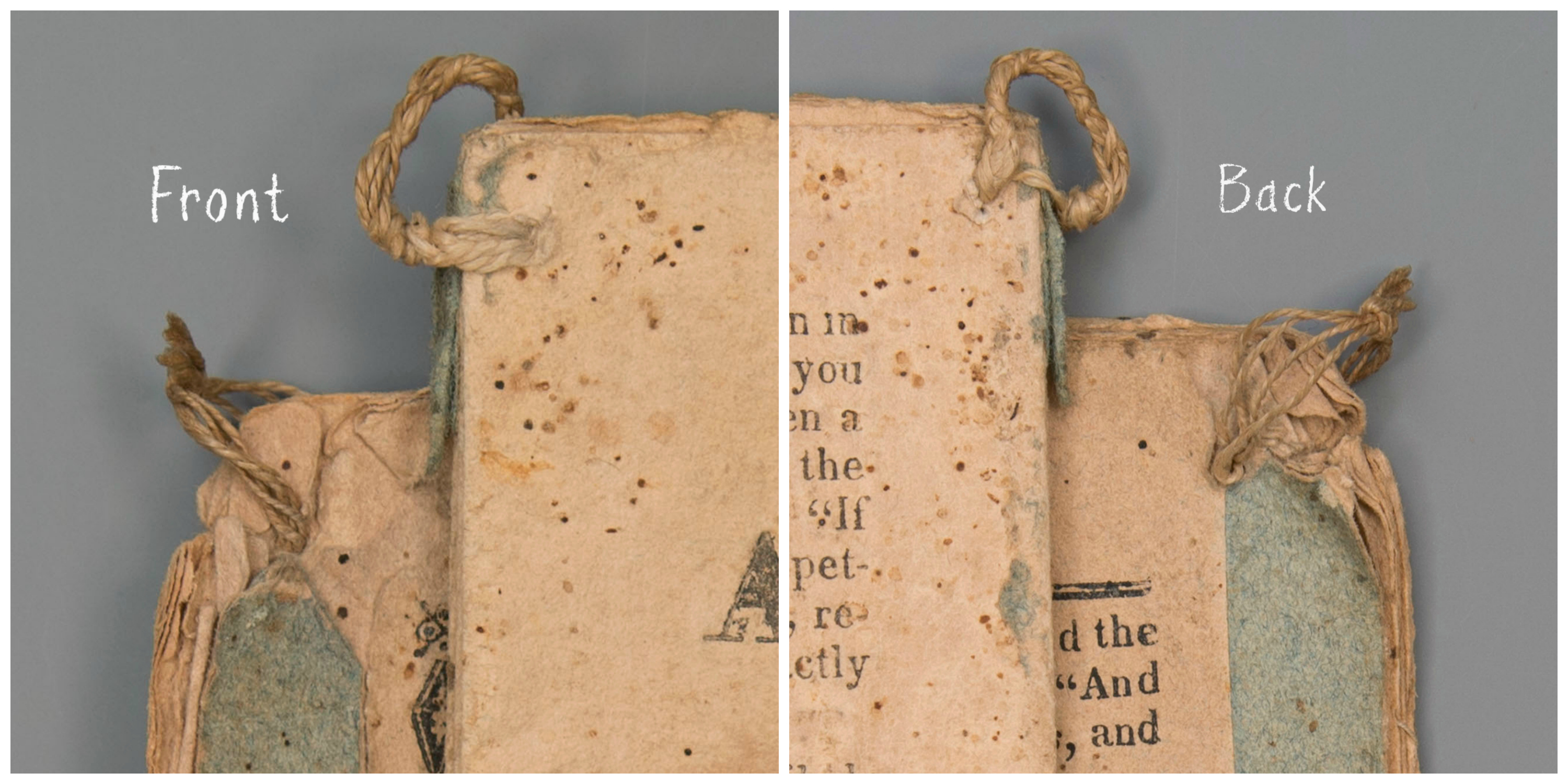
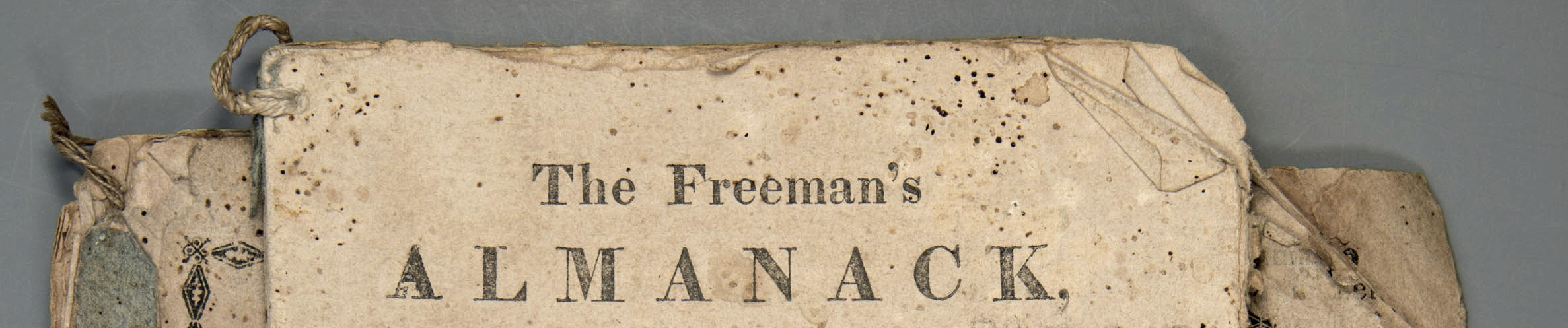
THE PRESERVATION LAB: A collaboration between the University of Cincinnati and the Public Library of Cincinnati and Hamilton County Object Institution & Library: PLCH CALL #: 529.43 F855 SUBJECT: Freeman's Almanacks from 1823-1829, all side sewn, some with threaded loops at top (to hook onto a nail in a wall), varying sizes, some missing covers, all received dirty/stained and torn edges DATABASE ID: 1124 ITEM #: i28069493 TREATMENT ID: LIGHTING: EcoSmart 27-Watt (100W) Full Spectrum Craft CFL Fluorescent with sock diffusers + reflector and foam board FILTER(s): none COMMENTS: CREATOR: Jessica Ebert WEBSITE: thepreservationlab.orgSome small booklets from the 1820s recently came to the Lab to be cleaned and prepared for digitization at the Public Library of Cincinnati and Hamilton County. Ashleigh, our Conservator, noticed a couple of them had a small loop of string attached in the upper left hand corner.
WhatTheHeck
Well, the booklets are all copies of “Freeman’s Almanack”. Before the days of smart phone calendars and weather apps, before the days of catching the weather on the radio or TV, people had almanacs. In fact some people still use them today, though these days their scope has expanded and some of them can be many hundreds of pages, depending on the information they contain. Back in the 1800s they usually looked like small magazines. Published yearly, they contained articles and snippets of wit and wisdom the publishers thought their target audience (often farmers) might enjoy. Most important though were the tables, usually organized to represent a calendar month, giving times for sunrise and sunset, astronomical highlights such as eclipses, church festivals, planting dates, and what kind of weather to expect.
So what about the loops?
Well, the almanac would be something a 19th Century family might refer to often, perhaps even daily. Where do you put such a thing in your home so everyone can grab it quickly when they need it? You hang it on a nail of course! How do you do that? You make a little hole in the top left corner of the booklet, you run some string or thread through the hole to make a loop, and you pop the loop over the nail.
LoopyFrontoBack
Problem (and mystery) solved!
Veronica Sorcher (PLCH) – Conservation Technician

Saving the 70's

Recently I’ve had the opportunity to dis-bind a bound edition of our school newspaper, send it off for digitization and then to create a clamshell box to house the single pages when they return. The process of dis-binding bound newspapers is a very delicate one. In this case, The News Record 1971-72, was no exception. Newspapers, by their very nature are meant to be read and thrown away. The paper they are printed on is not meant to last and it fades and becomes acidic and brittle very rapidly. The solution to preserving the paper’s information back in the early 70’s, before digitization was even a thought, was to bind a couple years’ worth of the News Record together in a hard cover much like a large book. This was a good method for preserving a piece of U.C.’s history, however the binding was meant to be permanent and no thought was given to reversing the process at a later date.
Continue reading

Lab outreach

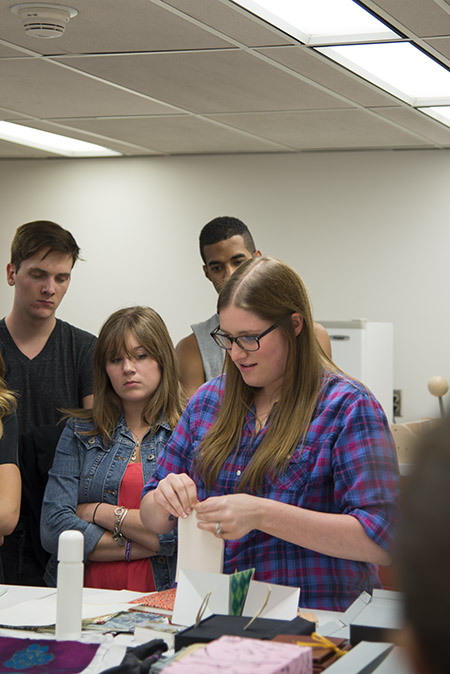
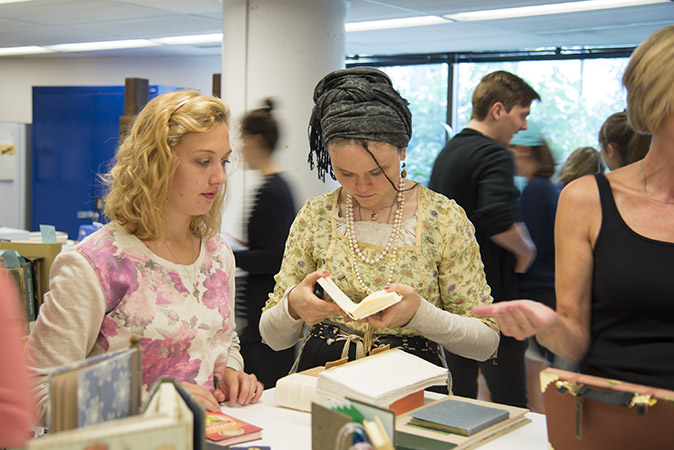
If there’s one thing we really love, it’s sharing what we know with others. And one of the beauties of being in an academic setting is that opportunities to share sometimes fall right into our laps! We got a chance to play host to two classes of students from the College of Design, Architecture, Art and Planning, who came to learn creative ways to present their work when they went out to hunt for jobs.
classvisit03classvisit02classvisit01classvisit04
The one-hour sessions were packed with information and examples of staff work, from the simple to the sublime; in order to illustrate both what was possible at home with a few tools, and much more advanced projects to aspire to. The students were intrigued with what was presented to them, and asked thoughtful questions. They even promised to show us some of their work! (We have, as of this writing, already received our first image, and it is beautiful indeed.) We’re so glad they came; it’s always a pleasure!
Hyacinth Tucker (UCL) —- Binding Processor
 

Oversized poster moves made easy!

The Preservation Lab offers a suite of services to our parent institutions, including conservation, storage and handling, pest management, and environmental monitoring. Recently we got to flex both our physical and mental muscles, assisting the Public Library with a special collections move. While there were many interesting objects that required special attention during the relocation, a collection of locally and historically significant oversized posters presented a fun and exciting challenge.
Continue reading

We aren't fooling – it is Spring Cleaning Time!

Are you the type of person who when Spring rolls around you get this sudden urge to organize and clean? No? Well, I am. Though I will admit it only comes in short bursts. Maybe there is just something about the change of seasons that makes me want to sort through things; this Spring I decided to tackle our stockpile of matboard. Does my sudden urge to clean and organize really have anything to do with the vernal eqinox? No, probably not. It is more likely due to the fact that we recently order a bunch of new Rising board and it has been sitting around for a couple weeks with no place to go. Enter, Jessica and her fit of cleaning.
Continue reading

The Stereoscope

One of my favorite aspects of this job is learning about cool old stuff. I have just had the pleasure of becoming acquainted with stereoscopic images. In the process of surface cleaning and rehousing this project, I saw a lot of cool images and learned about the use of antique stereoscopes.
Antique stereoscopes, also known as stereopticons or stereo-viewers, were popular in the late 1800s and early 1900s. A stereoscopic viewer is a special device that helps us see 2 mounted photographs as one three dimensional image. The way it works is a stereo-view slide is inserted into the viewing device, and the person viewing looks through the device while adjusting the distance of the slide. The slide is adjusted either closer or farther from the viewer’s face until it comes into focus. The two images appear as one 3D image to us when looking through the viewer because we are seeing two perspectives merge into one – not too different from the Magic Eye books that were popular in the 90’s filled with stereograms. The two perspectives are taken with a special camera that has two lenses that mimic how we see the world through two eyes. The lenses are spaced slightly apart, roughly similar to the distance of our eyes.
Cool huh?
Continue reading

The "S" Saga

S = Ship of Thesus

Every once in a while a library receives a new book that needs a little something special. Sometimes it’s a pocket to hold an enclosed map or other added material, sometimes it’s a special box or enclosure, or sometimes it’s an extra page that needs to be tipped in. Recently the Public Library of Cincinnati and Hamilton County received 20 copies of the book, “S” by J.J. Abrams and Doug Dorst. It’s unusual and highly visual, filled with things like postcards and news clippings, 22 in all, stuck in at different points as if someone had been reading it and had absent-mindedly left their impromptu bookmark between the pages. None of these ephemeral-seeming pieces are attached in any way. It’s a really neat interactive book, in fact I want a copy of my own, but having a book with numerous loose parts is definitely challenging as part of a library collection. The potential for the various pieces, all part of the book’s storyline, to be lost or misplaced is huge! In fact there was an outcry across the country as the book arrived and librarians saw the potential for chaos and disaster:
http://www.hollywoodreporter.com/news/jj-abrams-mystery-book-s-654109

Continue reading

The Rocque map of London 1749 – Transportation, Preservation, Installation and CELEBRATION!

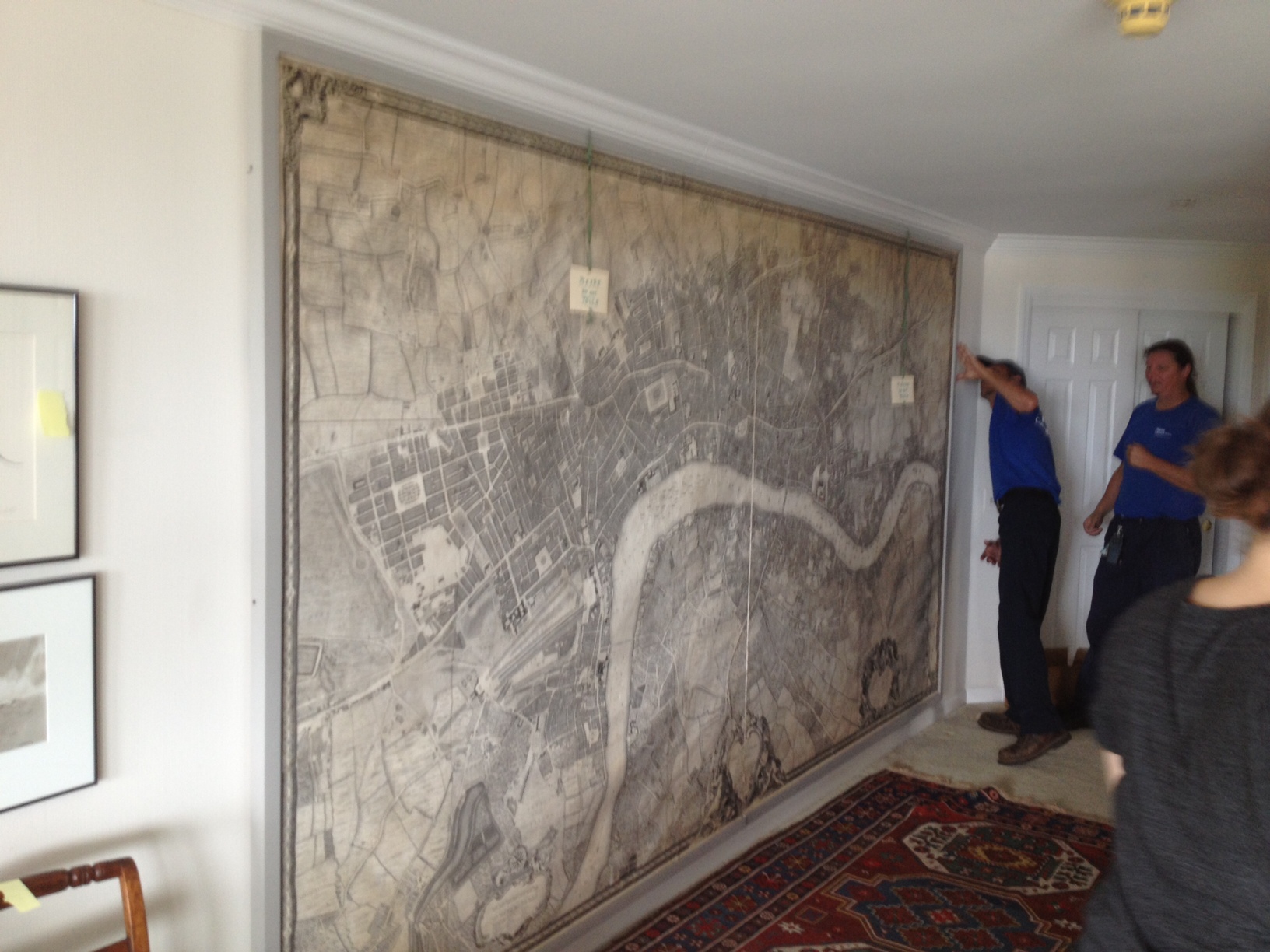
Imagine a finely engraved map of London, circa 1749.  The map is comprised of separate sheets that are mounted 8 across and 3 down.  The 24 sheets are printed on cotton rag paper and mounted on coarsely woven linen.  The map has been repaired, mounted, and framed by professional conservators.  Though the conservation work was done over 20 years ago, the work is in-line with current best practices and the map has lovingly been cared for by the owners in the intervening years.

Lovingly cared for by Keith and Betty Stewart.  Paper signs stating " PLEASE DO NOT TOUCH" did the trick since 1996.

Lovingly cared for by Keith and Betty Stewart. Paper signs stating ” PLEASE DO NOT TOUCH” did the trick since 1996.


Continue reading