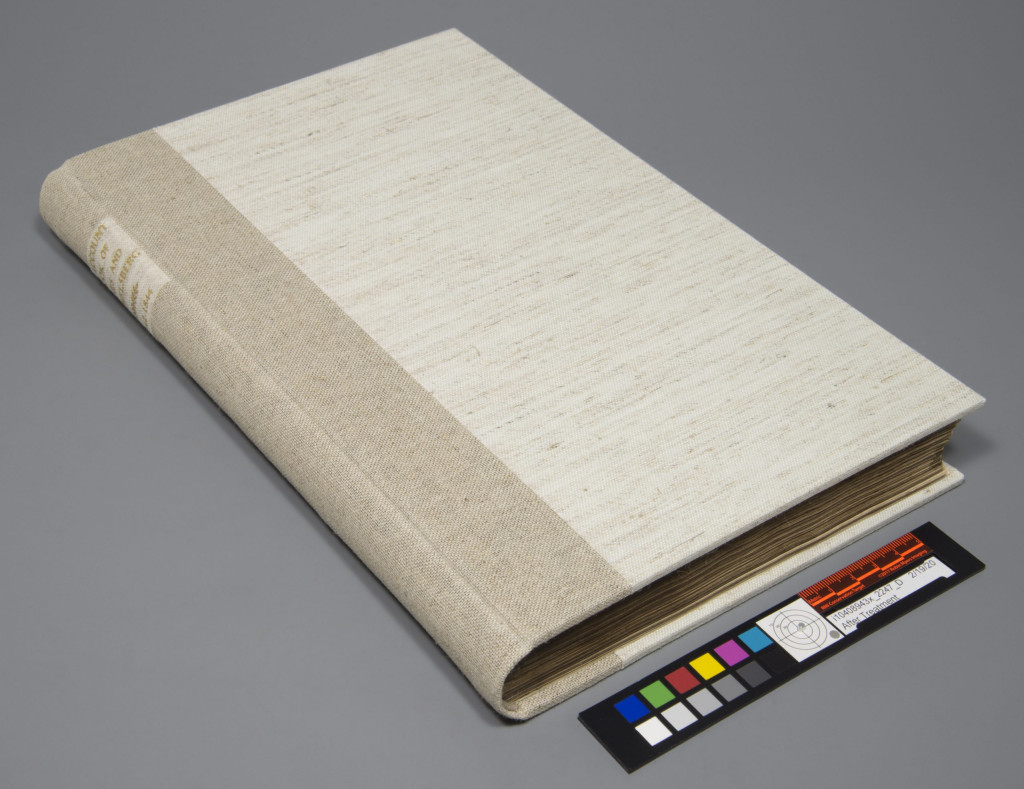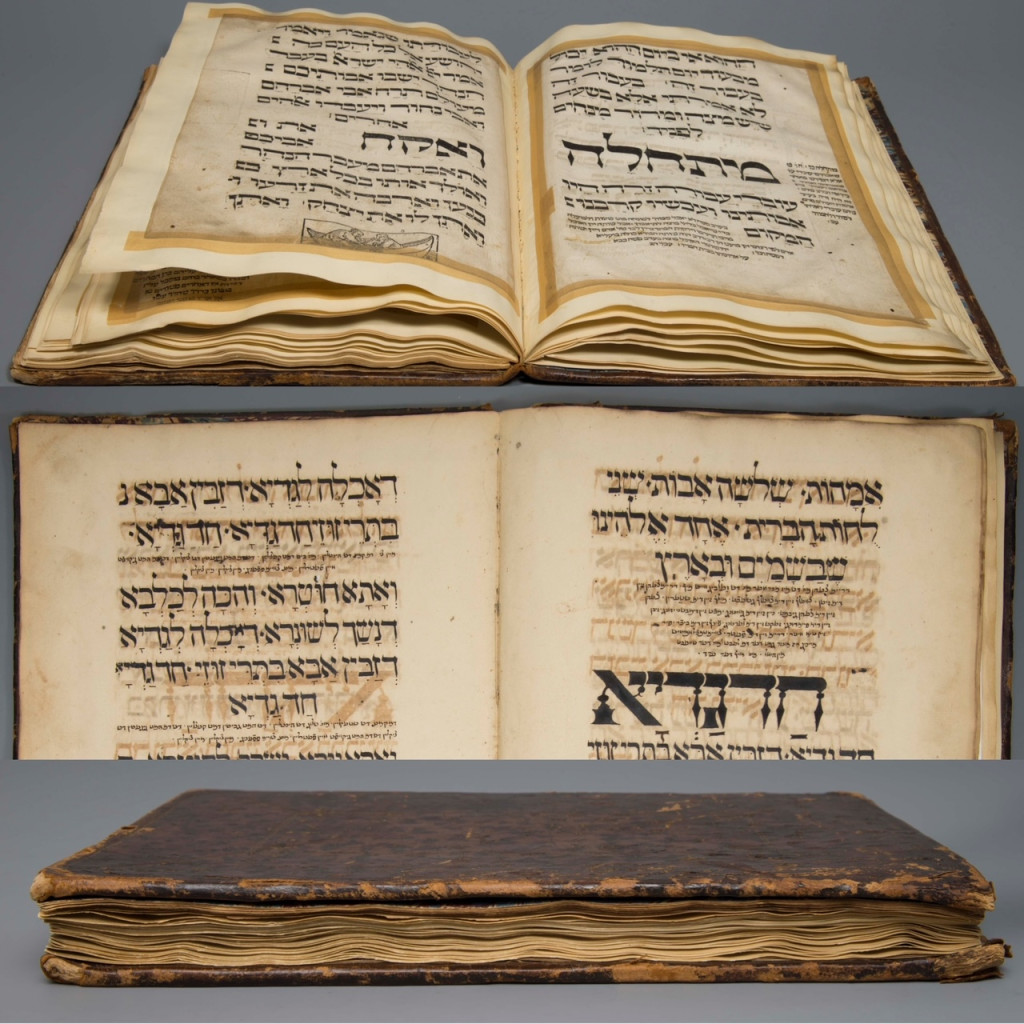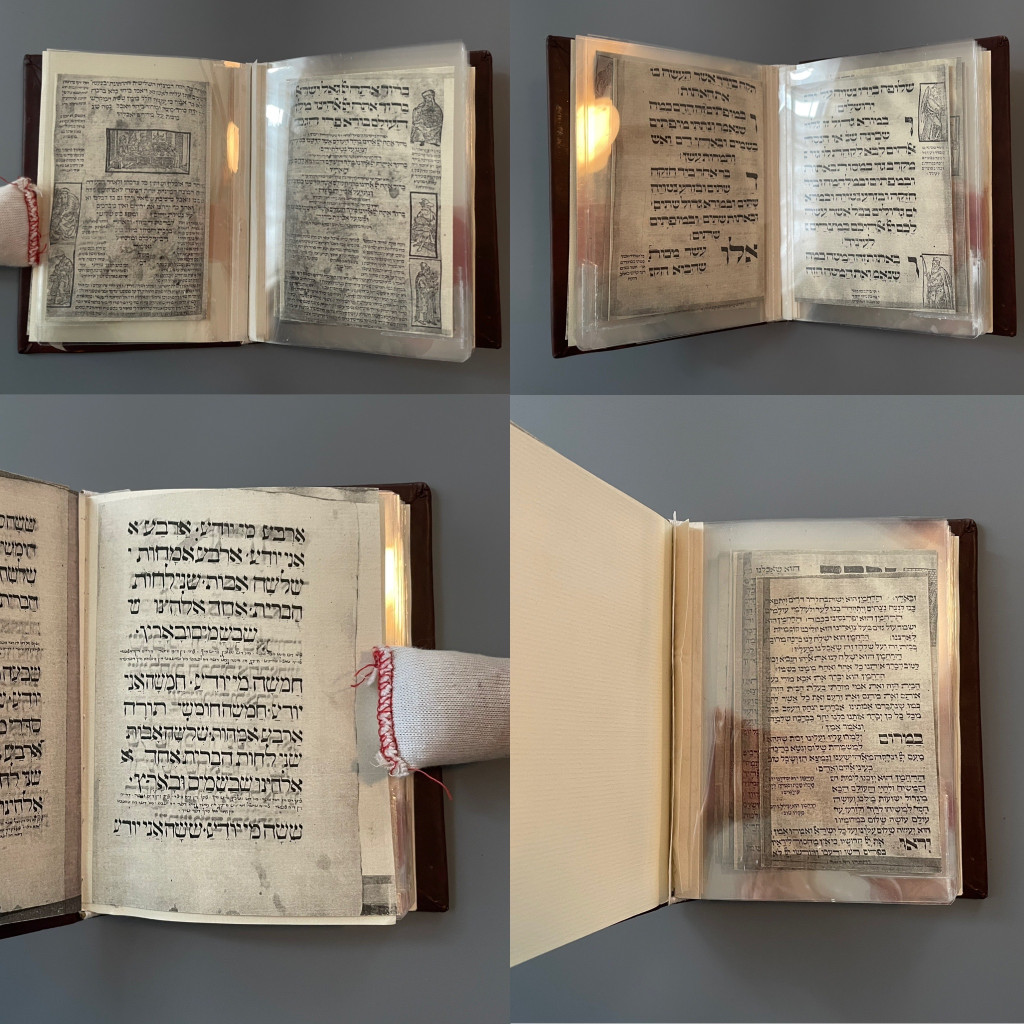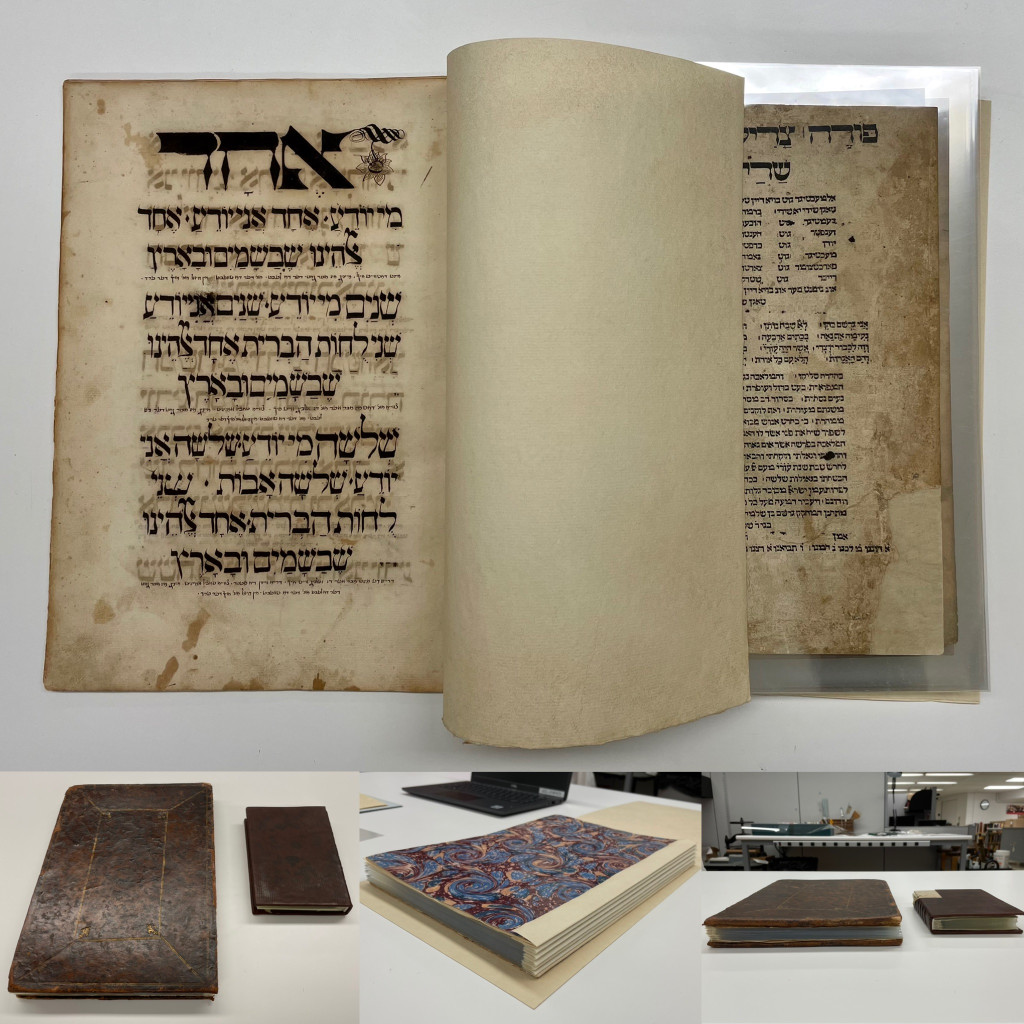
In 2017, an Indian religious text known as a Kalpa-sūtra entered the lab in desperate need for improved storage. Being unfamiliar with this type of religious manuscript I jotted down notes in preparation for housing the item and came up with a basic housing solution. I briefly familiarized myself with terminology, format, and condition needs. This is a summary of those findings with links to resources.
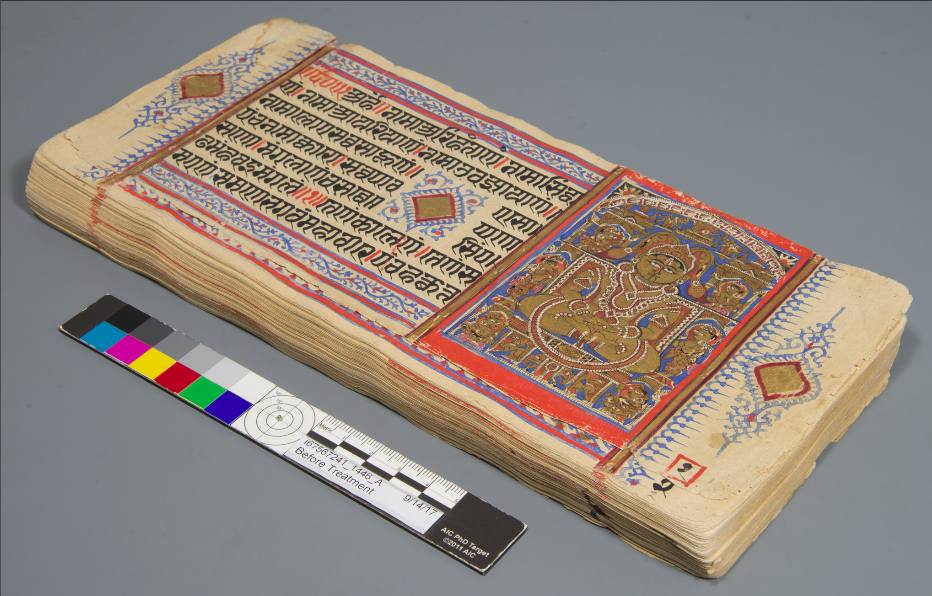
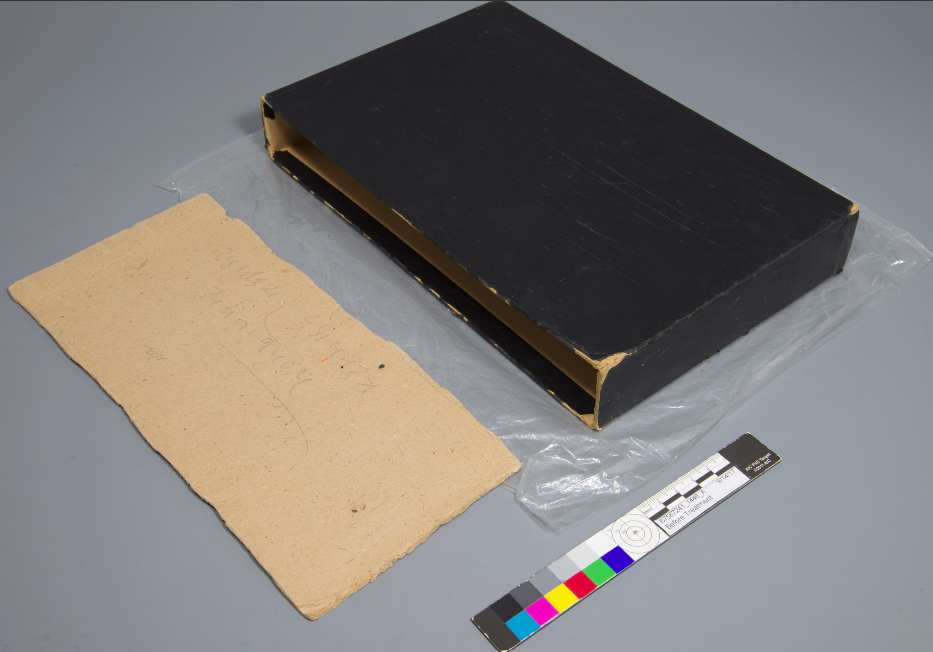
Cincinnati and Hamilton County Public Library sent their Kalpa-sūtra to the Preservation Lab to receive improved storage. The original storage enclosure was not archival and did not properly fit the manuscript. This left the manuscript vulnerable to damage.
Kalpa-sūtra
Kalpa-sūtra translates to “the Book of Ritual” that was meant to be read daily. It follows a 3-part textural structure. The first part consists of the ‘Lives of the Jinas (an enlightened human being)’ and describes the lives of well-known figures. The second section, known as the ‘String of Elders’ celebrates early teachers of Jainism. And the final section, referred to as the ‘Right Monastic Conduct,’ provides rules to follow during the rainy time of year. The ‘rainy season,’ as it is often referred to, is a time of year when the festival of Paryusan is celebrated and the Kalpa-sutra is heavily used.
Jainism
Jainism is an Indian religion that shares similarities to Buddhism and Hinduism, but is regarded as a separate religion. It’s believed to have originated in the 7th – 5th century BCE in the Ganges basin of Eastern India. Jains believe in karma, reincarnation and practicing non-violence to all living creatures. While learning more, I appreciated this article that described the Jain’s thoughtful practice of non-violence by explaining how Jains eat above-ground veggies but avoid eating roots of vegetables so as not to kill the plant.
Format
Earlier Kalpa-sūtra were written on palm leaves and stored in between decorated wooden covers. They were bound with rope or cord through holes punched in the center of the leaves and are read by flipping the leaves up, from bottom to top. To see an example of a palm leaf book, check out this one housed by the Preservation Lab in 2016.
Later Kalpa-sūtra, such as this one owned and digitized by the Public Library, were written on paper beginning in the 14th century but still follow the same horizontal single-sheet format of the palm leaf. Often they were hand colored, illuminated in gold, and written in a black ink calligraphic style on laid handmade paper. Like many others, the Public Library’s manuscript contains 135 individual loose leaves that have never been bound. The leaves, also referred to as folios, were traditionally written on both sides with seven lines of text.
To learn more about formats of Jain manuscripts please refer to Jainpedia.org.
Decorative Themes
The Public Library’s manuscript is a good example of a traditional paper Kalpa-sūtra manuscript. Its decoration consists of left and right margin lines, and decorative diamond-shaped marks that interrupt the text. The diamonds (often found as circles in other manuscripts) descend directly from the tradition of punching holes in palm leaf books for binding. They are located in similar locations to palm leaf holes and are predetermined when the text is written. On the recto of leaves there are three gold decorative diamonds, one located in the center and one each along the right and left margins. (The V&A refers to these decorations as “central and marginal string holes that are not pierced.”) The verso of leaves contain only one decorative diamond in the center. The religious manuscript is paginated on the recto in both calligraphy and graphite.
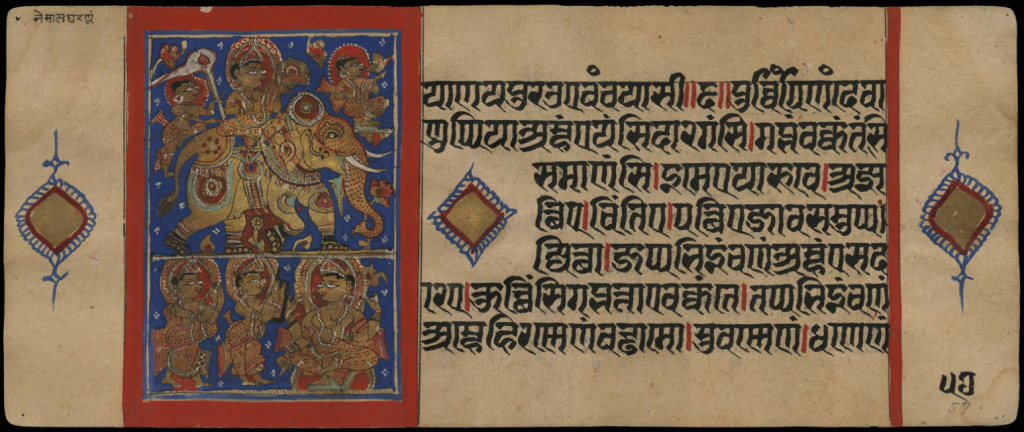
Miniature block illuminations are found sporadically throughout the text. The Public Library manuscript appears to resemble similar illumination imagery and of the 15th century Kalpa-sutra owned by the British Library, available online here where you can read about the context behind the illuminated images.
Public Library illuminations consist of red and blue opaque watercolor and gold illumination. The very base of the paintings are a thin open weave cloth attached directly to the handmade paper. On some leaves, you can see where this thin cloth is folded over onto the other side of the leaf.
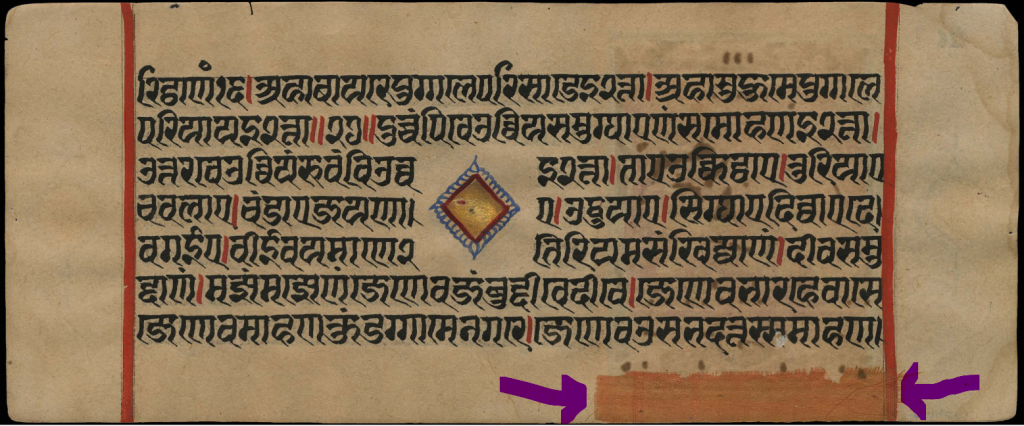
To learn more about how to read a Kalpa-sūtra please see https://jainpedia.org/resources/how-to-read-a-jain-manuscript/.
Manuscript Holders
In my research, I tried to understand how paper Kalpa-sūtra were traditionally stored. It is noted on Jainpedia.org that Jain manuscripts appear to have been stored within decorated covers of paper, cloth, and wood.
From what I can gather by surveying a collection of digitized manuscripts, loose sheets appear to have been stored within chemise-like covers, sometimes with multiple flaps, such as this one from the British Library (Or. 13950) and Gamma 453 where a loose manuscript is stored within a cloth cover:
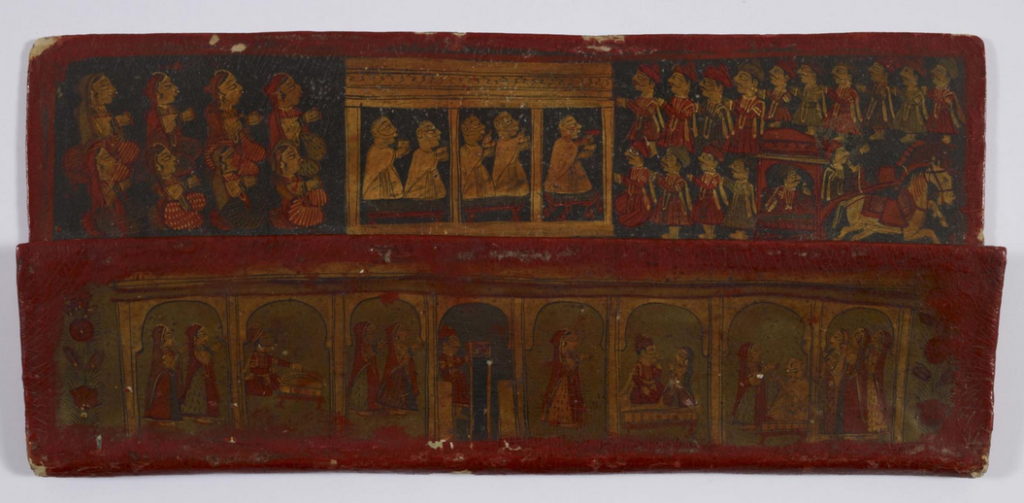
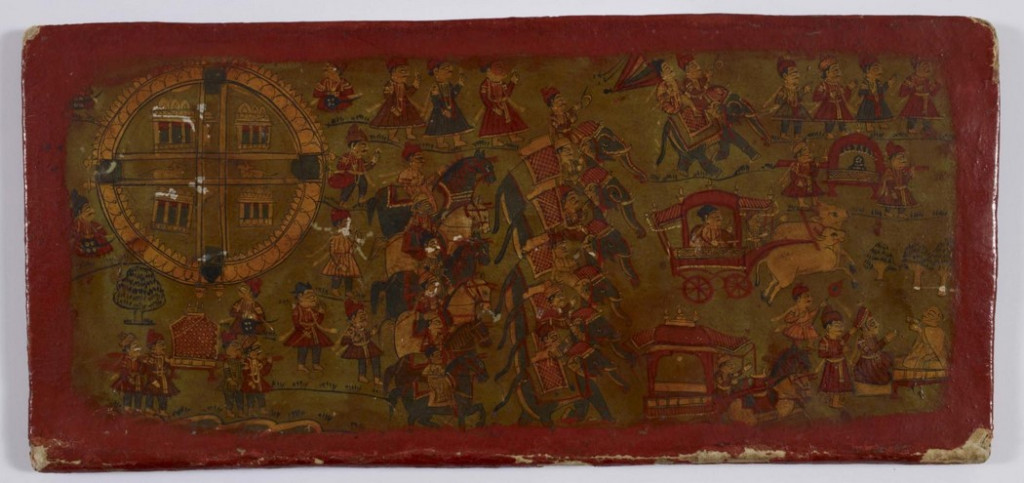
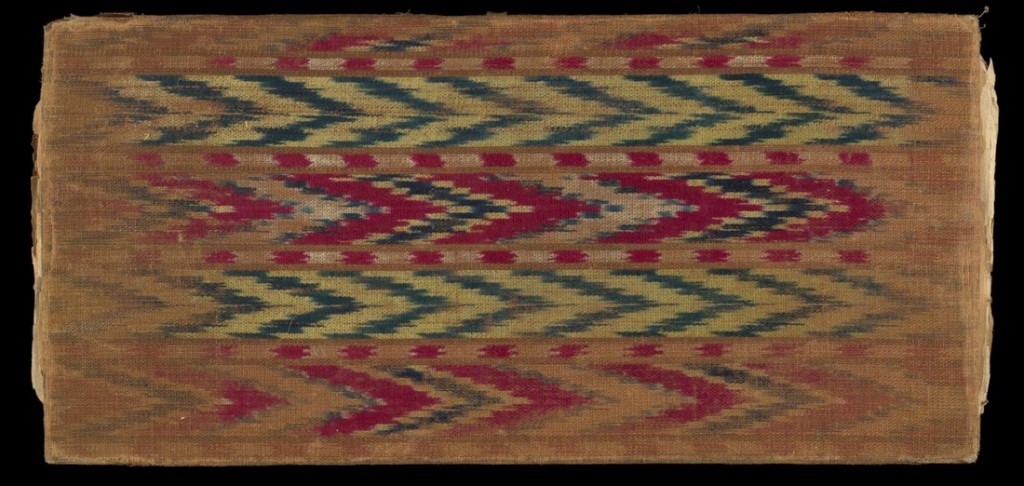
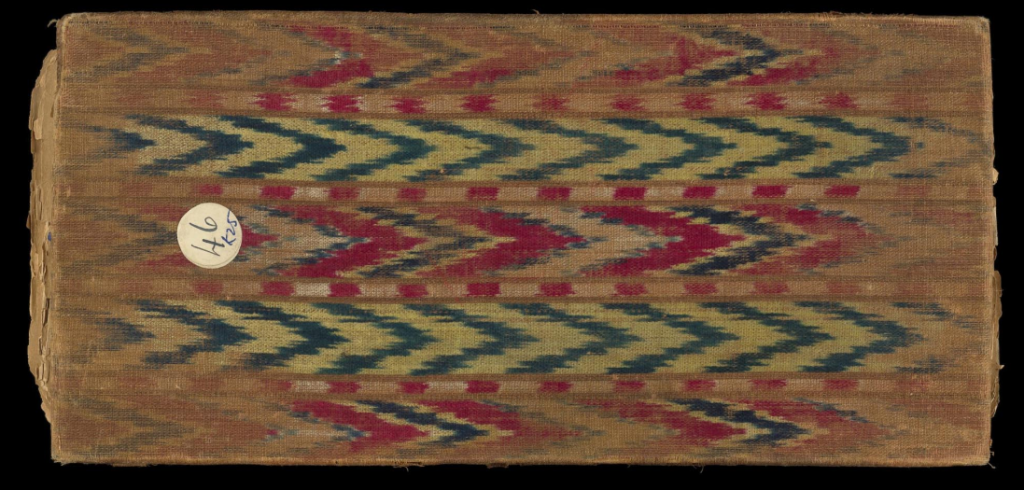
Images courtesy of https://jainpedia.org/manuscript/cardboard-manuscript-holder-front/ and https://jainpedia.org/manuscript/cloth-manuscript-cover-front/
I also discovered some Kalpa-sūtra that had been treated in western traditions. Below are a few examples that include where one is tipped along the bottom edge and bound into a western style half leather binding. Another, MS 22393, appears to be bound along the top edge at the British Library. A third yet, MS 34, at the Royal Asiatic Society is bound in half leather with marbled paper:
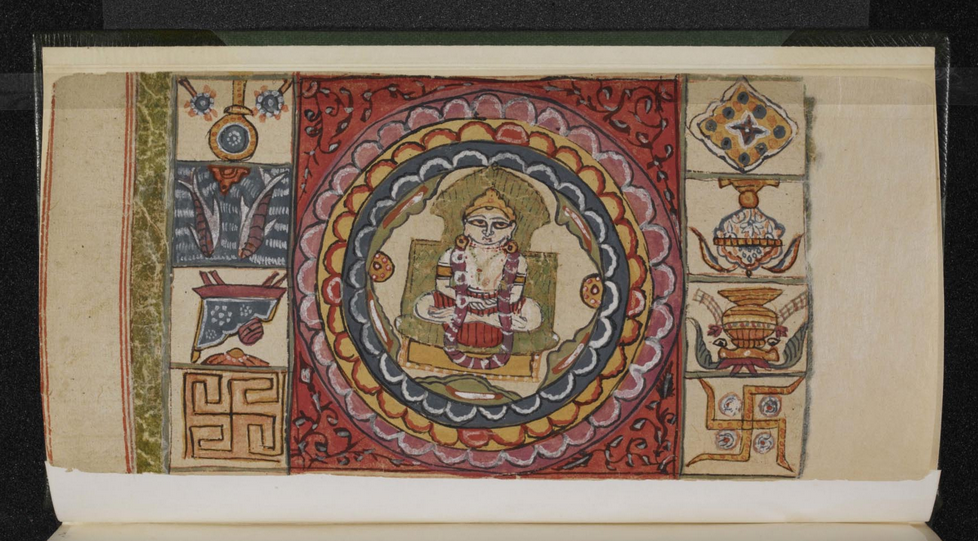
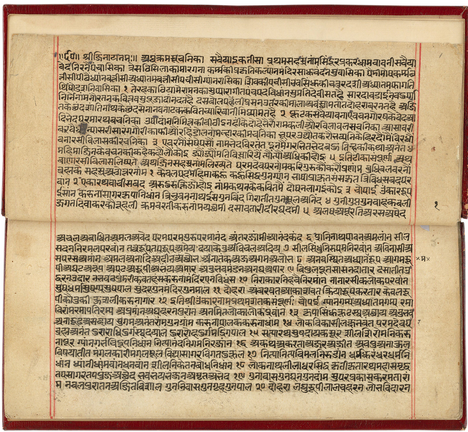
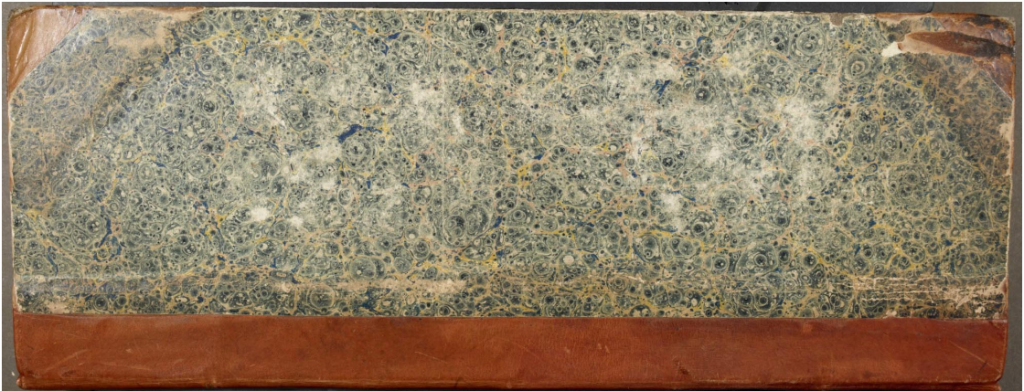
Images courtesy of https://jainpedia.org/manuscript/ras-tod-ms34-204/?hilite=%27cover%27, https://www.bl.uk/collection-items/banarasivilasa-jain-religious-poetry, and https://jainpedia.org/manuscript/jina-and-auspicious-symbols/
Others found online have been inlaid into larger sheets of paper, such as the one below from the Victoria and Albert Museum. Manuscripts heavily illuminated and likely suffering from pigment corrosion have been encapsulated between sheets of plastic or glass, such as these from the British Library (Or. 14262 and Or. 13950). One manuscript has been both inlaid into paper and encapsulated:
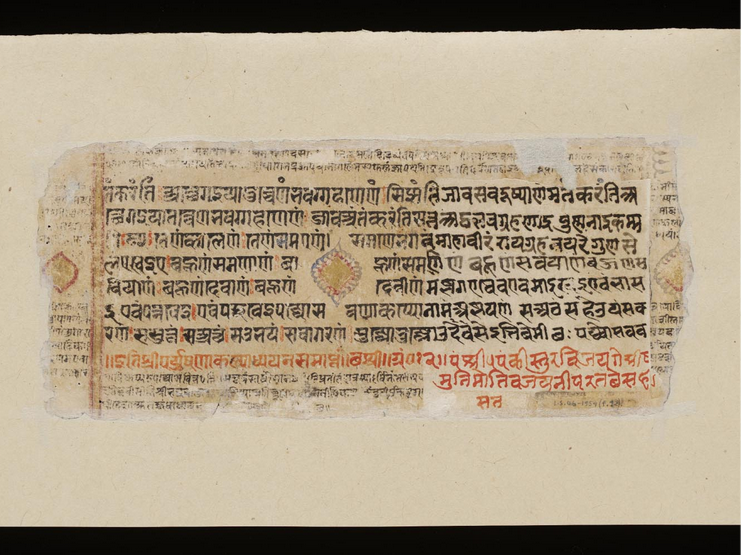
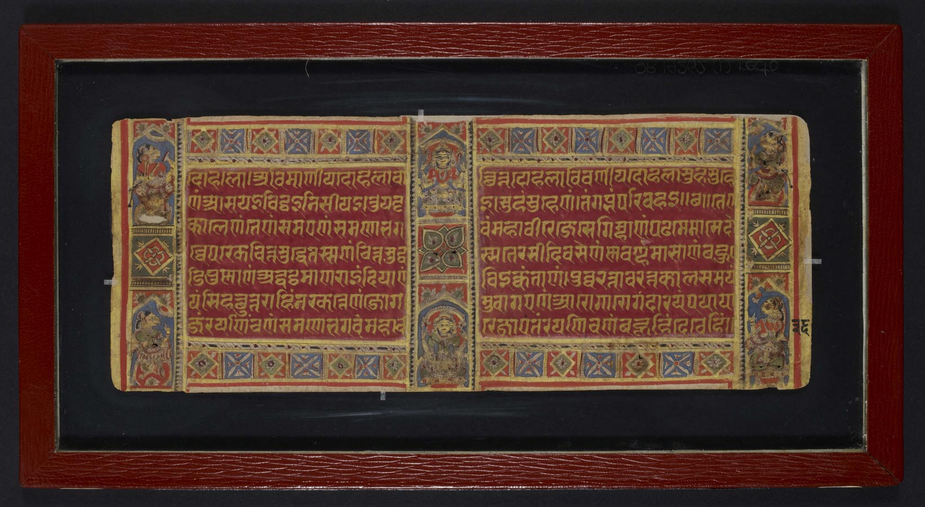
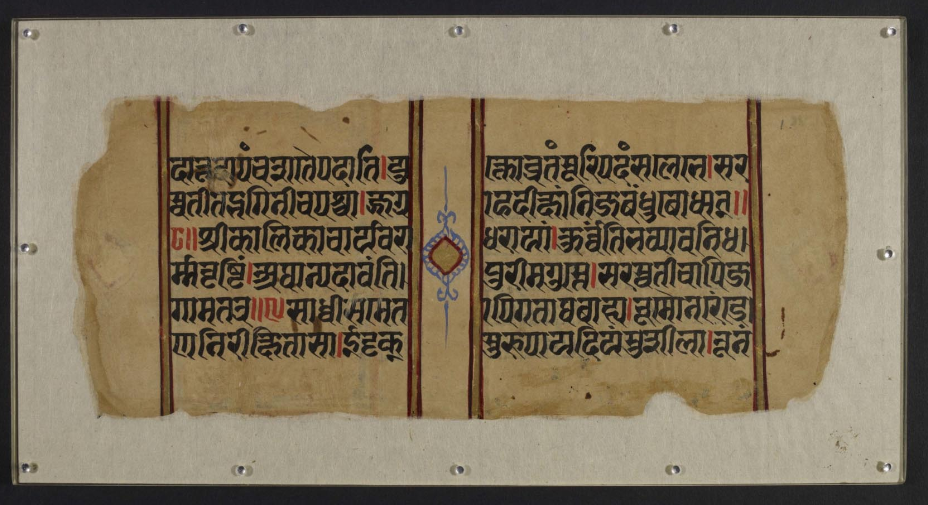
Images courtesy of https://jainpedia.org/manuscript/stanzas-8-to-10/, https://jainpedia.org/manuscript/folio-with-decorated-borders/, and https://jainpedia.org/manuscript/end-of-text-and-scribal-remark/
Storage Observations
- There does not appear to be a conservation standard for storing Kalpa-sūtra manuscripts.
- Storage solutions vary widely and are specific to how they will be displayed or handled.
- While I appreciate the western tradition of binding loose pages to prevent them from becoming lost, I knew the Public Library preferred to house the manuscript with as little reformatting as possible in order to preserve cultural traditions.
- While I came across a few examples that appear to be stored unbound within covers, it was unclear as to the date of the covers, when they were added, and how they might have been formatted. No images were provided of the sides of the covers.
- Even though heavier than plastic, glass was likely used for encapsulation to protect the flaking and corroding illuminations from the static charge of plastic.
Conclusion
The housing solution selected at the lab is one of many options and provides a stop-gap until a more traditional format can be explored.
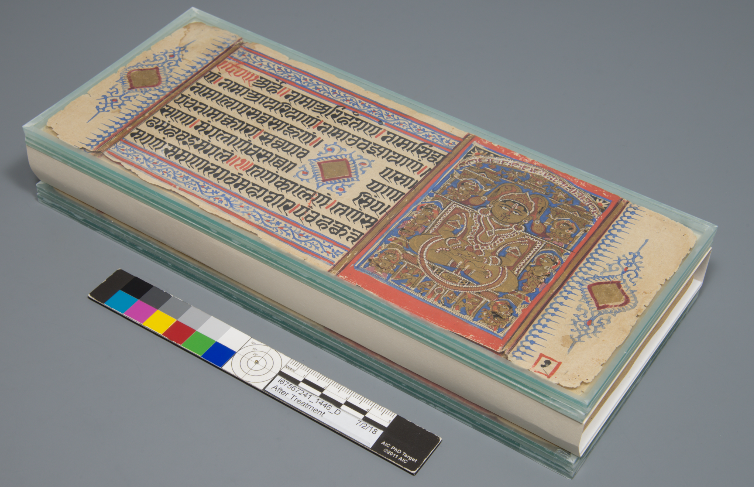
The most severely corroded leaves at the front and back of the text were encapsulated between glass while the rest of the leaves were left loose. This allowed the most vulnerable leaves to be protected from humidity while avoiding the weight of encapsulating the entirety of the manuscript.
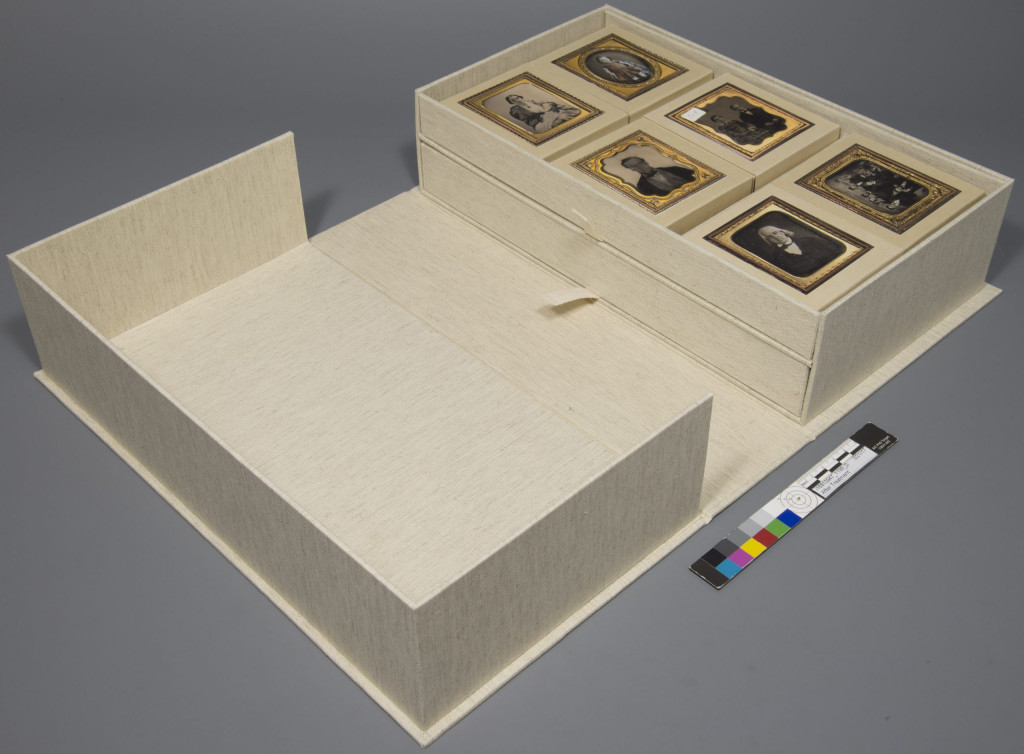
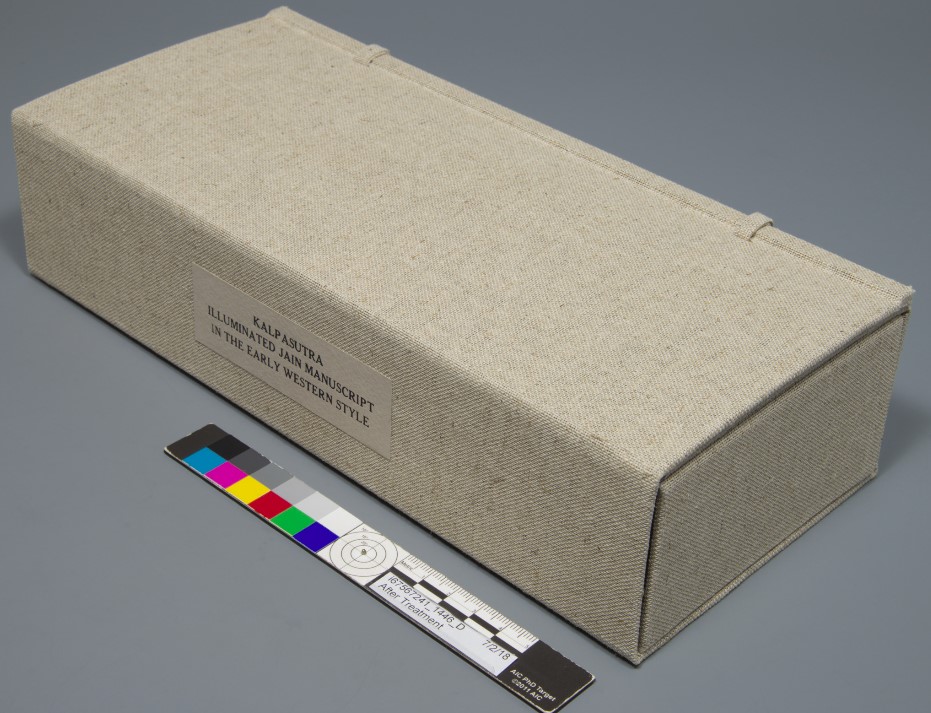
The encapsulated and loose manuscript leaves were then stored together (the outer encapsulated leaves helped serve as de facto covers). An Asian four-flap enclosure with bone clasps was custom made to provide structure and stability, as well as perhaps provide a format more sympathetic in style to a Jain holder than a European style enclosure.
Further Research
There is much ripe for future study:
- I hope to experience a historic Jain manuscript cover in person to learn the format and structure.
- There are downsides to using glass that should be reconsidered in the future: 1. Glass is heavy and breakable. If the glass breaks, it could cause tears in the fragile paper. 2. Glass deteriorates in humid conditions. The alkali will eventually leach out and could cause staining in the paper. This storage solution should be considered a temporary solution until the pigments can be studied and safely consolidated.
- Since there is a pigment contributing to corrosion and paper drop-out in the manuscript, it is likely that pigments in the Public Library manuscript contain copper. I would be interested in developing a plan to analyze the pigments to better understand their composition.
- As a library book and paper conservator, I am less familiar with fine art painting traditions on paper, particularly Indian painting. This was my first experience with observing an open weave cloth used as a base for illuminated manuscripts. This initial research has me captivated to learn more about the traditions of Indian miniature painting and how they are connected with early stylized Kalpa-sūtra paintings, and if their implications for inherent condition issues can be extrapolated.
- The word ‘sutra’ is literally interpreted as “thread” in Sanskrit. Different manuscripts contain the word “sutra” in their title, such as the Indian Kama Sutra, or Asian Buddhist sutras which are not to be confused with the Kalpa-sūtra. Is it possible that because these manuscripts were historically bound with cords or wrapped with ties give rise to the word sutra?
Interesting Side Note
I learned that The Diamond Sutra owned by the British Library is considered the oldest block printed book in existence AND it has been analyzed to find the scroll’s yellow plant dye extract, Berberine, is toxic. It’s possible the toxin can be absorbed through the skin (so those handling should wear gloves!) as mentioned in the Vol. 21, Number 4, Nov. 1997 Abbey Newsletter under the heading Peril in Old Paper.
Ashleigh Ferguson Schieszer (CHPL) – Conservator, Lab Co-Manager
Resource links:
https://digital.cincinnatilibrary.org/digital/collection/p16998coll24/id/3540/rec/1
https://cool.culturalheritage.org/byorg/abbey/an/an21/an21-4/an21-401.html
https://www.nationalgeographic.org/encyclopedia/jainism/