Author Archives: Holly Prochaska, Head Preservation Services and Lab

Hidden Treasures in a 1791 English Bible

The lab received a heavy bible in exceptionally bad condition. The spine was almost nonexistent, with the leather fragments that were hanging on “by a thread.” There were many breaks in the sewing and the book block was in many pieces. The boards were also completely detached making it nearly impossible to handle. With pages that were water stained, the culmination of condition issues demonstrated how the bible had been around the block (a couple times!).

Bible as received
Hidden treasures discovered

While examining the book in preparation for constructing a housing solution, there within the pages I unexpectedly discovered plant specimens! There were quite a few different types. While impossible to know for sure, it seemed to me at one point these specimens were added to mark significant passages. For example, there is a passage in the Christian bible that reads, “And the leaves of the tree are for the healing of the nations,” Revelation 22:2. When I saw the added plant specimens near this passage, my mind immediately went there.

Before preservation
After rehousing

It’s funny how things can trigger thoughts and emotions. With a religious item such as a bible, the dried plant fragments made me imagine how a reader might be moved spiritually to express something they felt deeply in the text in a material way. I was also inspired and glanced at passages beneath the plant specimens seeking out hidden connections. My quest sometimes proved rewarding while others I was left to ponder the hidden meaning.

After rehousing, book is wrapped in foam with cloth ties

The unique plant specimens were retained and stored in polyester sleeves in the same position on each page as they were discovered.   Upon the completion of sleeving, I also consolidated and performed minor leather repair and care to prevent leather fragments from falling off. For long-term storage I created an archival blue corrugated clamshell and wrapped the fragile binding in a sheet of polyester foam.   

Chris Voynovich [CHPL] – Senior Conservation Assistant

Photography by Ashleigh Ferguson Schieszer

Job Posting: Conservation Specialist

The Preservation Lab, a partnership to preserve and conserve the collections of the Cincinnati & Hamilton County Public Library and the University of Cincinnati Libraries, seeks applicants for a Conservation Specialist position.
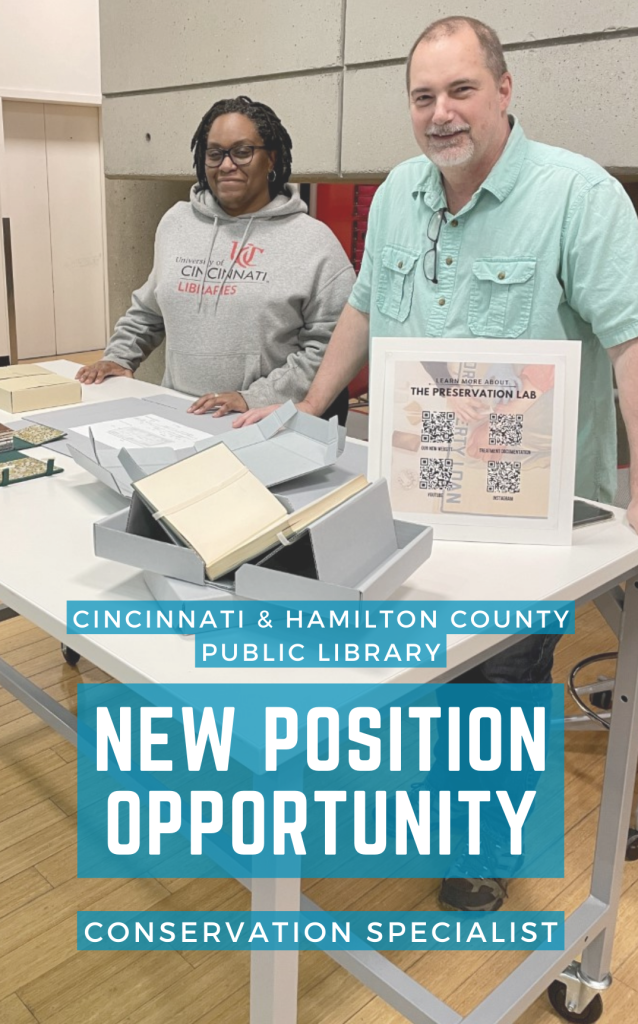
The Conservation Specialist is a technician level position with on-the-job training that may appeal to emerging conservation professionals. This position will join a collaborative team of 7 full-time staff members, including conservators, a preservation librarian, technicians, student workers and volunteers to preserve collections from both institutions. The Preservation Lab staff consists of both Cincinnati Public Library and the University Library members. This position is a Cincinnati and Hamilton County Public Library position but is stationed at the University of Cincinnati West campus.

The Public Library’s Main downtown branch will complete renovations to include a Story Center, with estimated completion fall of 2023. The Story Center will work closely with the special collections Genealogy department at the Public Library, Digital Services, and the Preservation Lab to collect, curate and preserve the experiences, histories and stories of communities, with a focus on communities of color and historically marginalized groups. Collaboration with members of Genealogy, Digital Services, and Story Center staff are an essential component of this position.  The successful candidate will also demonstrate an interest in working directly with the public.

Founded in 1853, the Cincinnati and Hamilton County Public Library today is one of the busiest and most highly acclaimed library systems in the United States, providing service to over 800,000 residents through a network of 40 branch libraries, a major downtown Main Library, and a Distribution Center.  CHPL holds one of the largest genealogical collections in the United States and many other specialized collections, most of which are housed in the Main library.

Pay rate begins at $17.85/hour.  The pay range is $37,128 – $51,979. The position will remain open until filled.

For more information about job duties and how to apply, please visit: https://recruitingbypaycor.com/career/JobIntroduction.action?clientId=8a78826755712ad4015573d869f00055&id=8a78859e84c012b10184e2b7555128d5&specialization=8a78826755712ad4015573da172e0079&lang=en

Ashleigh Ferguson Schieszer [CHPL] – Rare book and paper conservator
Our Wonderful Week with Jeff Peachey: A Recap in Instagram Reels

At the end of October we were lucky enough to have Jeff Peachey come to the Lab for a week-long workshop on Leather Conservation. We covered sewing extensions, joint tacketing, board splitting and cotton hinges, leather rebacks, and knife sharpening. In the weeks following the workshop we shared highlights from the workshop on our Instagram…

Highlights from the workshop
Sewing extensions and joint tacketing

And we couldn’t not highlight the master at work (sharpening and paring leather likes its butter) and the amazing tools Jeff makes:

Leather rebacks, including board slitting, inserting a cloth hinge, lifting the original leather, dyeing the new leather, and paring and attaching the reback.

Finally, conservation ASMR…Jeff Peachey style! Make sure the sound is on for this one…

We had the best time with Jeff. He is such a knowledgable and approachable instructor, and we learned so much from him. Thanks for coming to the Preservation Lab, Jeff!

Fun fact, did you know that Jeff was inspired by a press we have in the Lab to collaborate with Timothy Moore to create a “perfect all purpose” press that you can buy for your lab or studio?!

Jessica Ebert [UCL] – Social Media Coordinator and Sr. Conservation & Photographic Documentation Specialist

Recap of The Haunting of the Preservation Lab

In case you missed it, here is a highlight of our Halloween-inspired Instagram series this year…

“The Board Shear”:

“The Chemist”:

“The Saw”:

“The Haunting of the Preservation Lab – Part 1”:

“The Haunting of the Preservation Lab – Part 2”:

“Behind the Scenes – the Making of the Haunting of the Preservation Lab”


We hope everyone enjoyed our spooky Insta reel series…until next year!

Jessica Ebert [UCL] – Social Media Coordinator and Sr. Conservation & Photographic Documentation Specialist

Catarina Figueirinhas (UCL) – Assistant Conservator

Join Us for “The Haunting of the Preservation Lab”

Don’t miss out on our Halloween antics this year! Make sure to follow us on Instagram for some spooky but informative Halloween reels…

Fun with PhotoDoc: New Copy Stand Setup (Edition 14) 

Out with the old and in with the new!

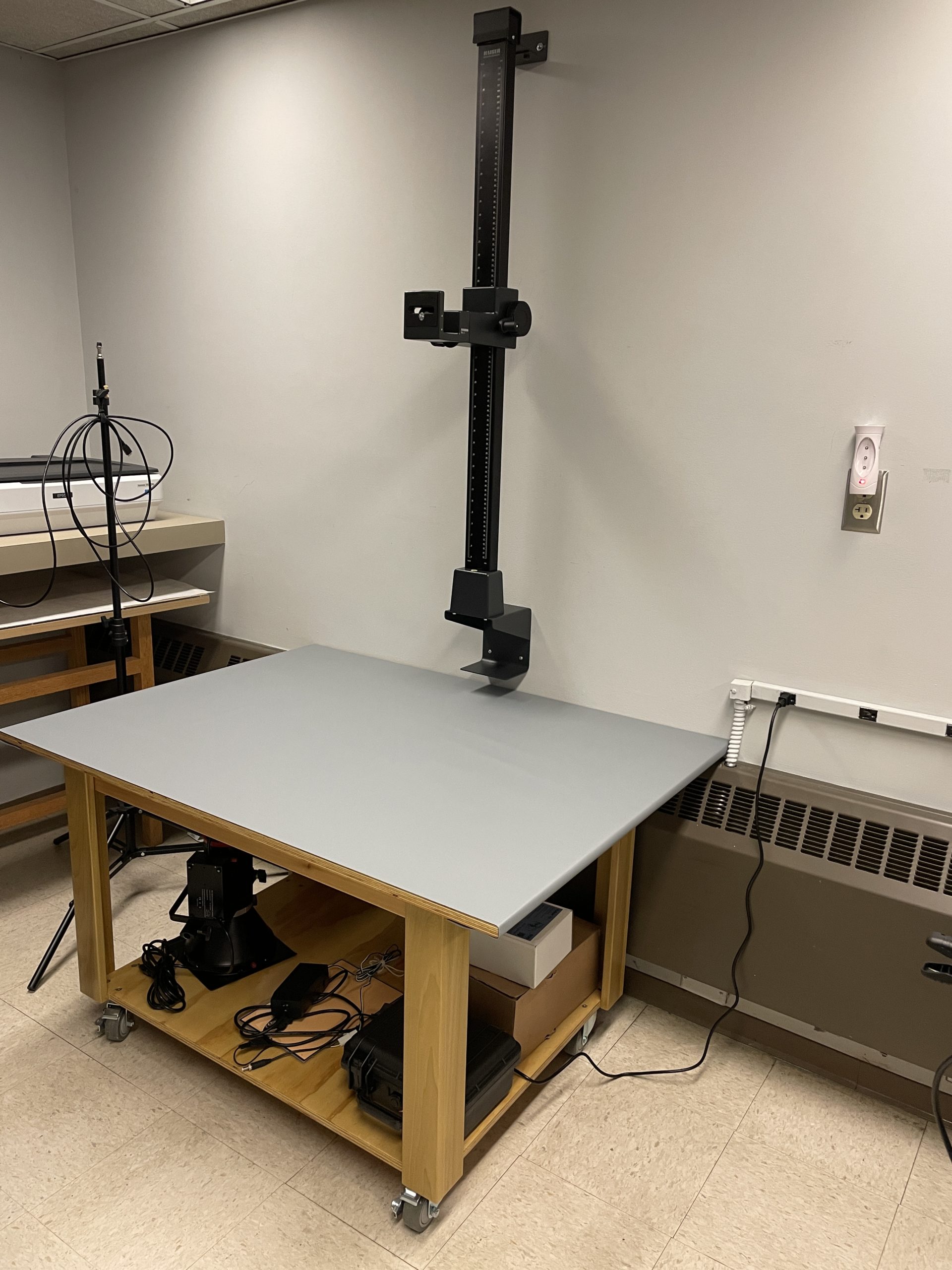
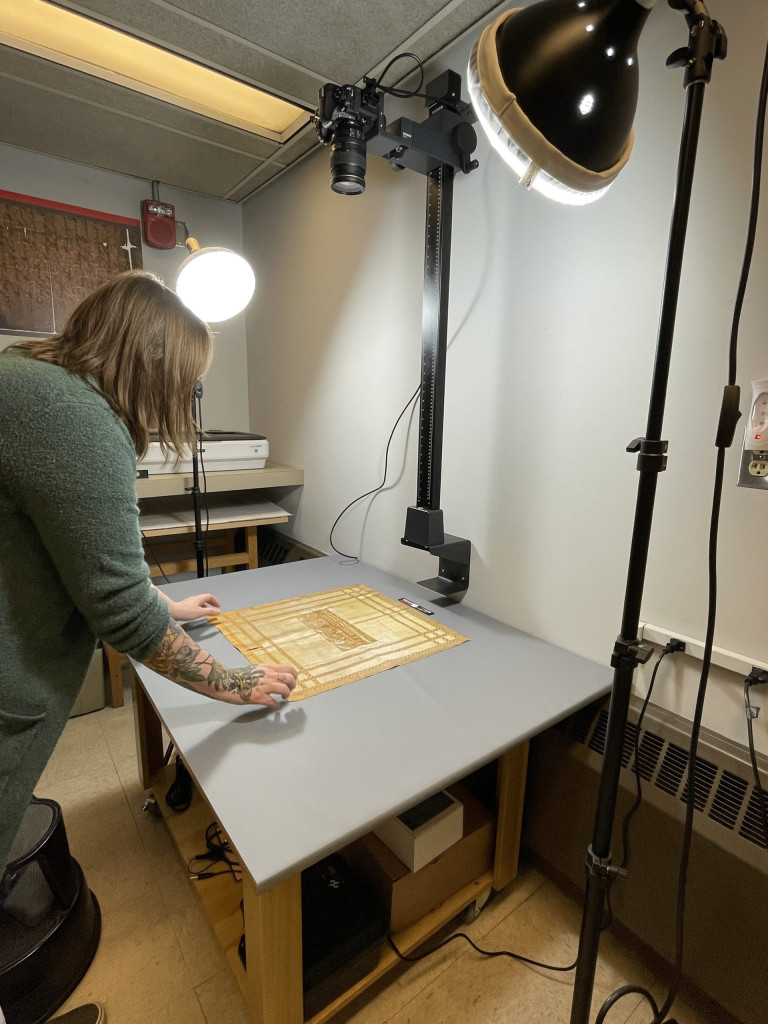
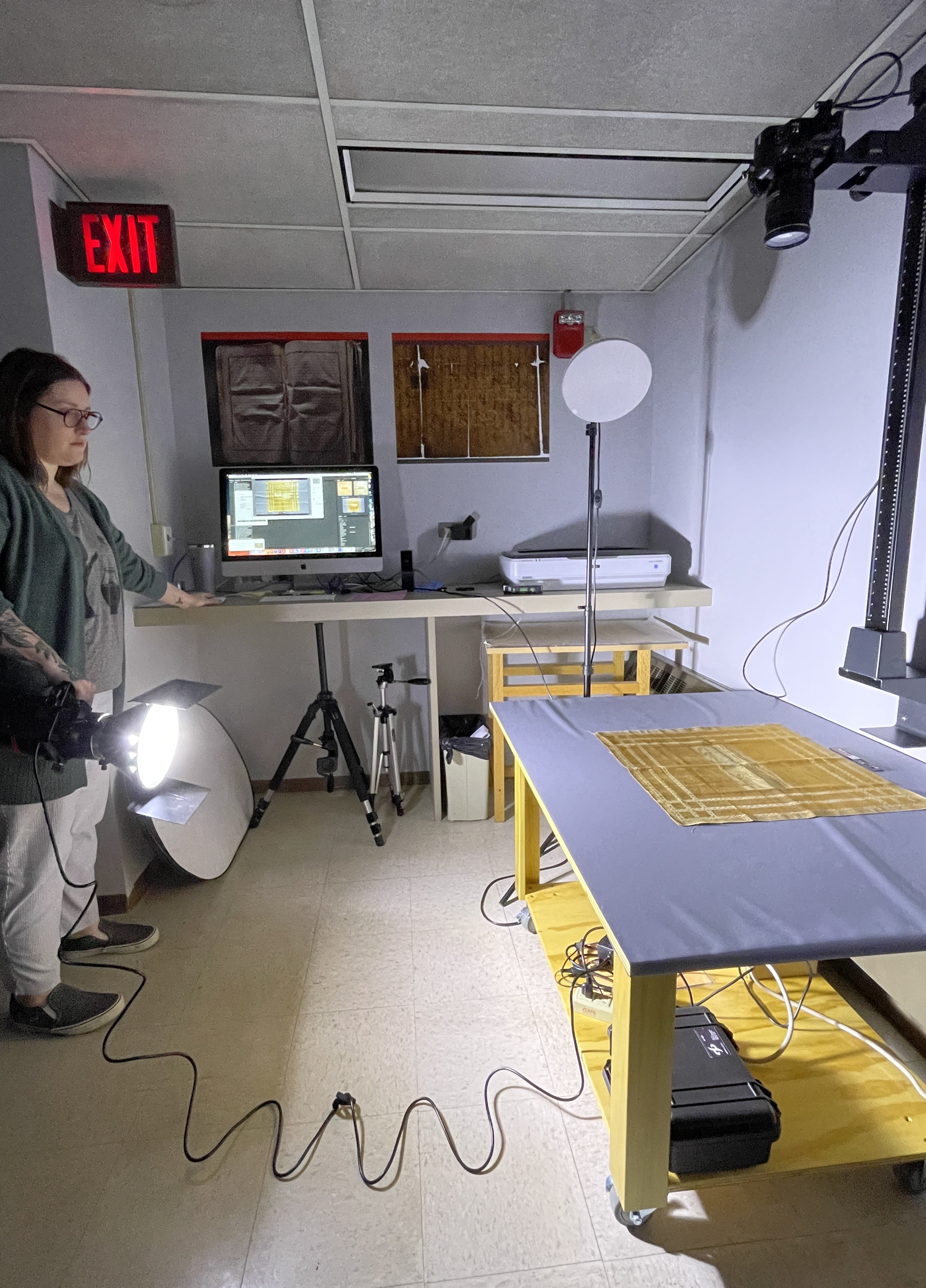
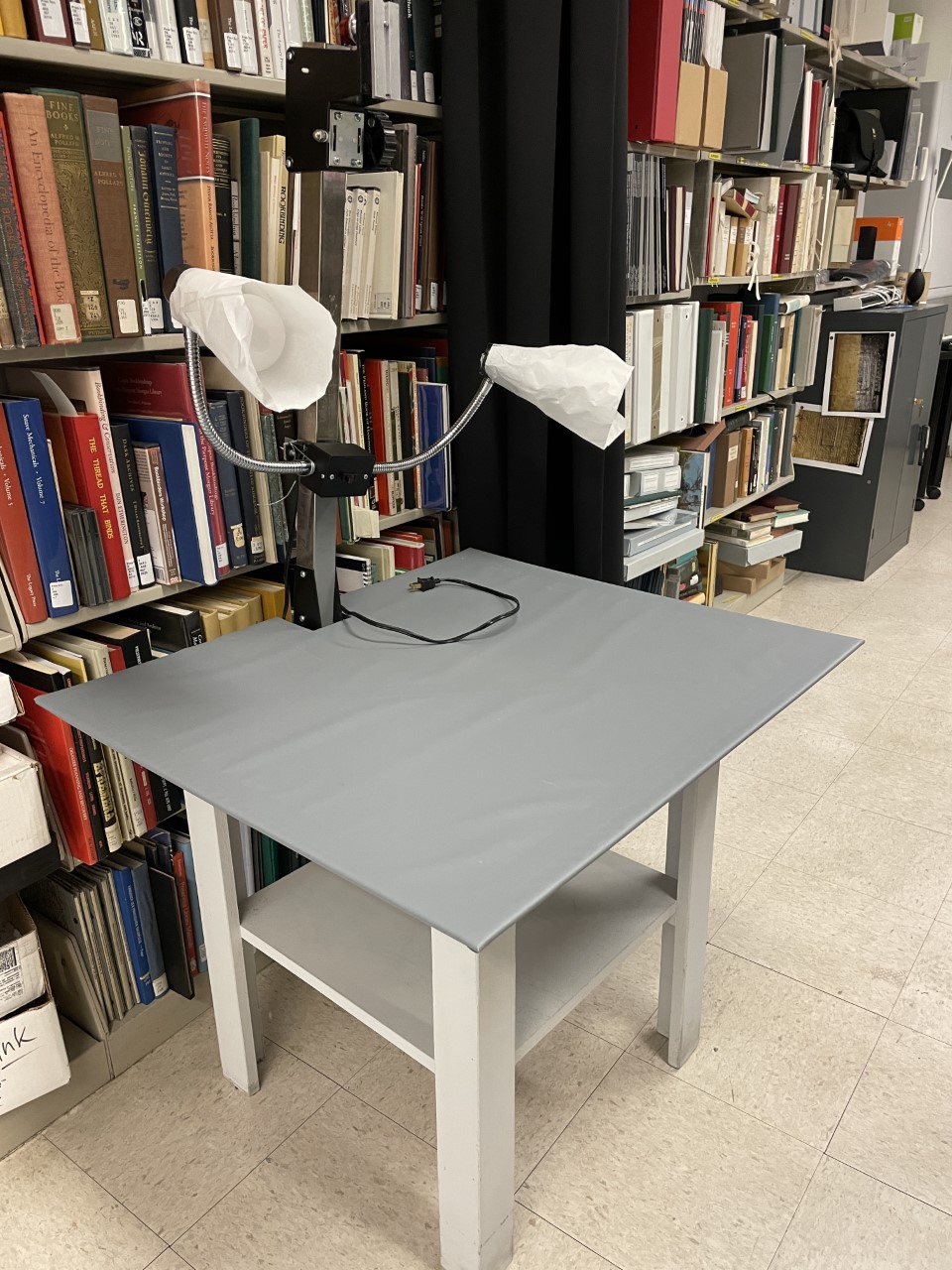
Over the Spring, I began researching relatively affordable copy stand setup options with the goal of improving our outdated and slightly MacGyver’d existing setup while also increasing the size of objects that could be photographed with the new setup. Here’s a list of the equipment we ended up purchasing:

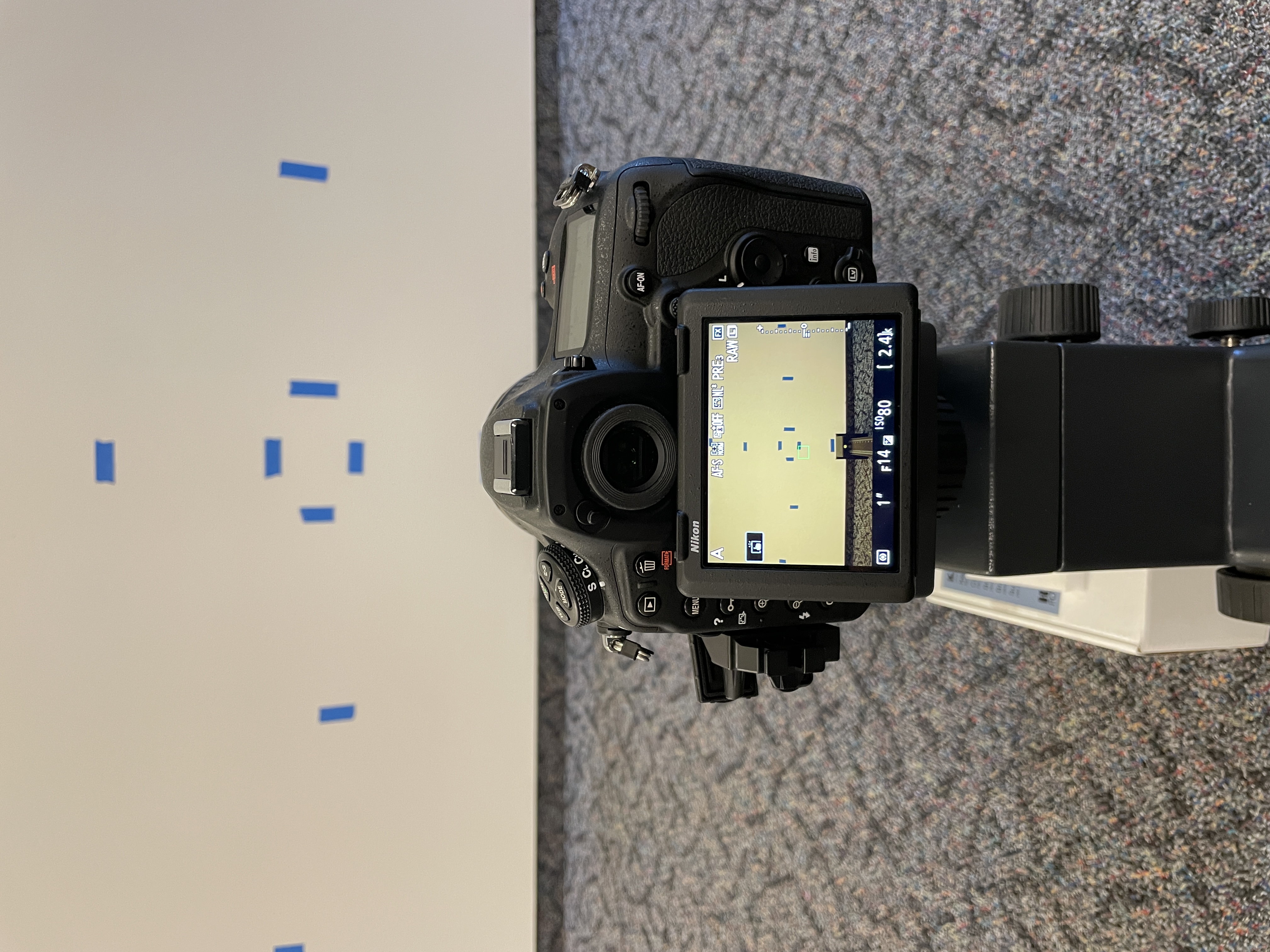
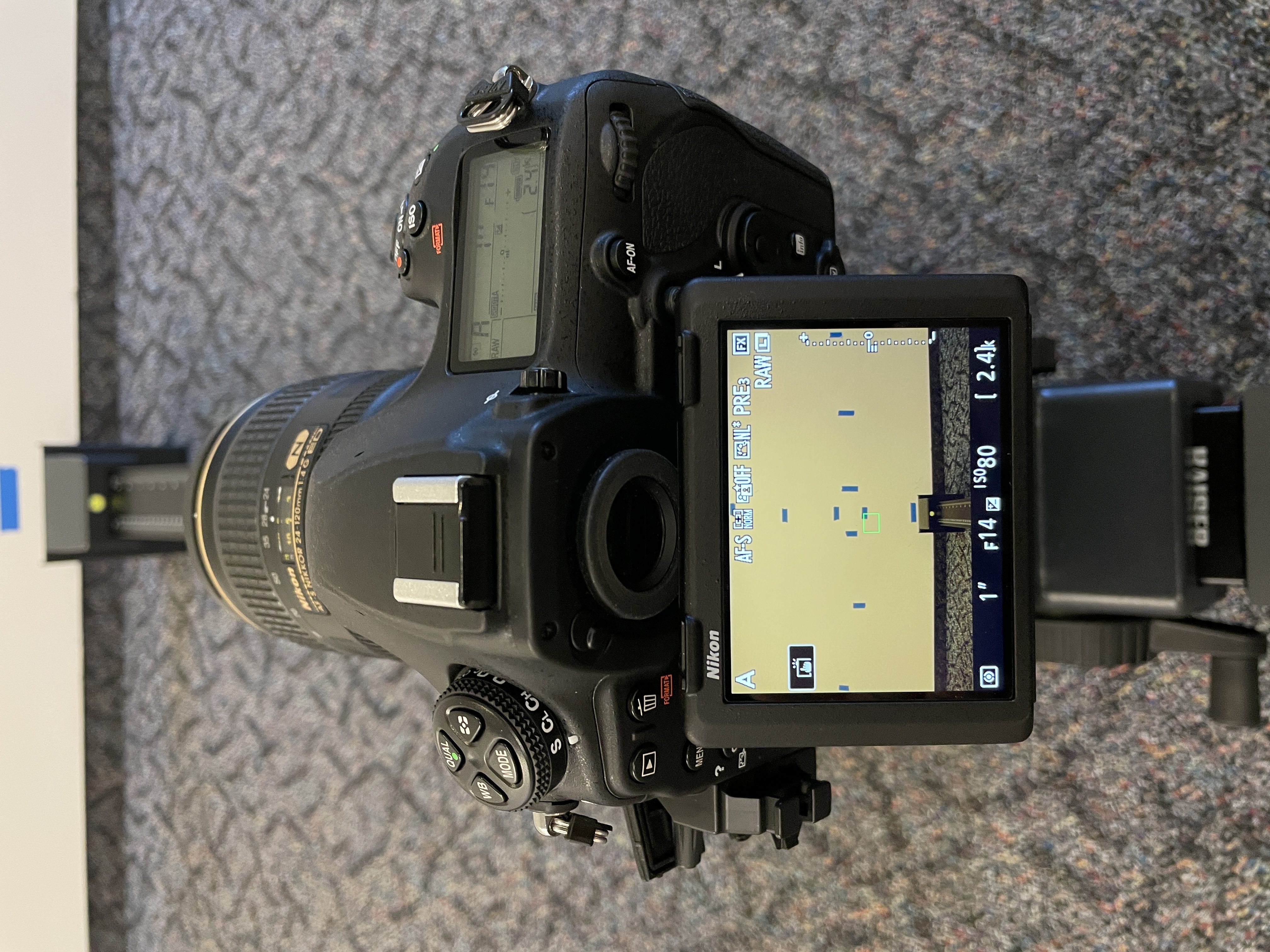
Once all of the column components arrived I set out to determine the maximum size object I could image with our current DSLR and our most used lens, in order to determine what size table I should get. Now, since I am not a math wizard, I did this the only way that made sense to my brain…I set the assembled column on against the wall, on the floor, with our camera mounted and used blue tape on the wall to create a grid of minimum and maximum size objects at various focal lengths…

This gave me pretty good idea of the general size I needed for a table. But I also wanted the table to have locking casters, sit at 27″ high (max), and have a shelf underneath for storage. Sadly, finding a table online that matched the size and other criteria was nearly impossible. Luckily for us, the UC Carpenters are the best and can make nearly anything you throw at them! And voila, after a couple months the UC Carpenters (a huge thanks to Tom!) had constructed a custom table and mounted the new copy stand column!

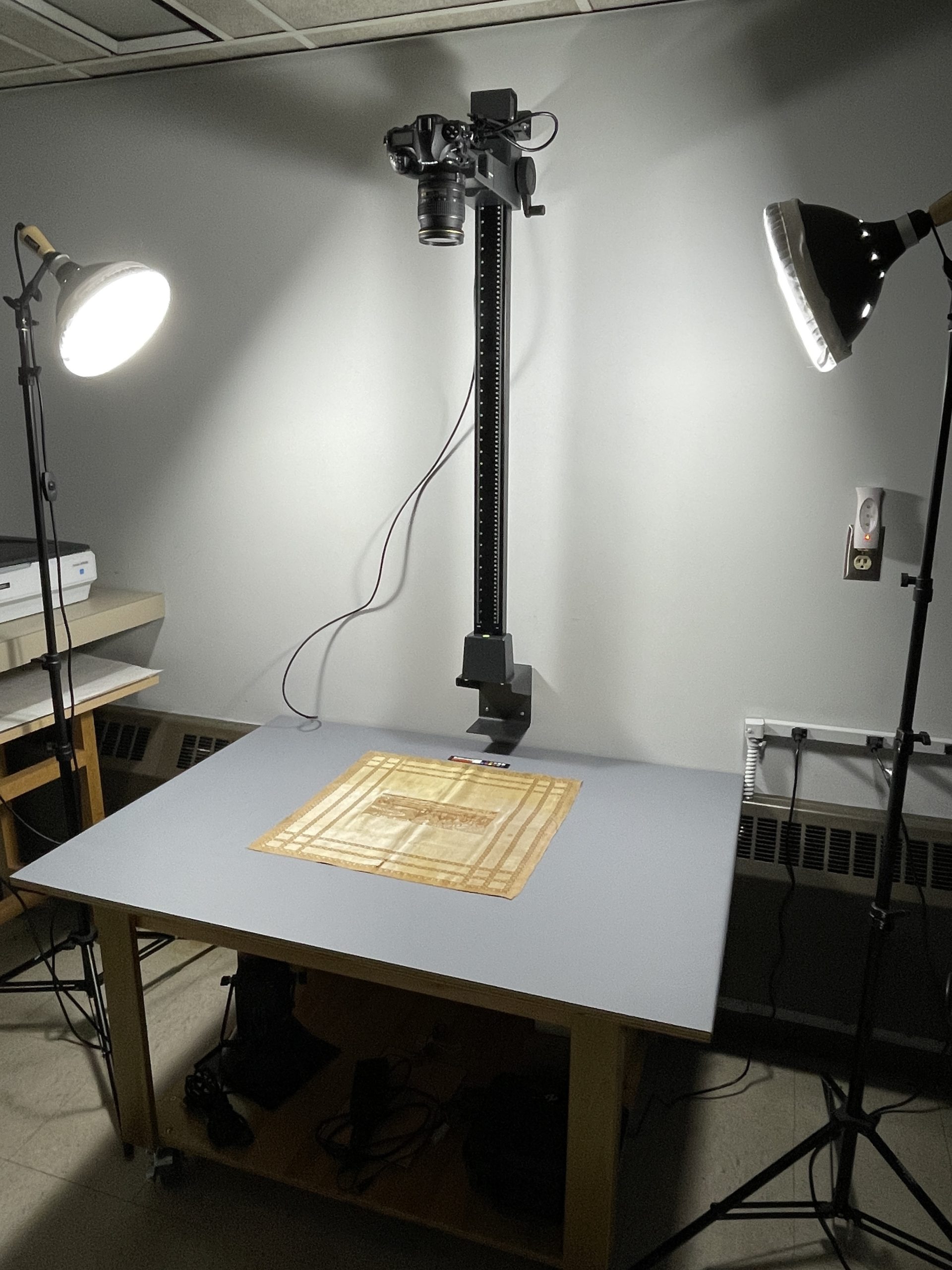
Today marked my first day using the new setup. I kicked things off by imaging a silk fabric piece from the Engineering library that would not fit on our old copy stand. Before our new setup, this would have meant shooting the delicate silk piece on the floor, using an inverted tripod. It’s a setup that I have used many times for oversized objects, and one that I strongly dislike for conservation photography, as it magnifies potential errors in handling. But luckily, I shouldn’t have to resort to the inverted tripod on the floor setup anytime soon!

Jessica Ebert [UCL] – Sr. Conservation & Photographic Documentation Specialist

Vestiges of Color in an Album of John Robinson’s Ten Big Shows

John Robinson

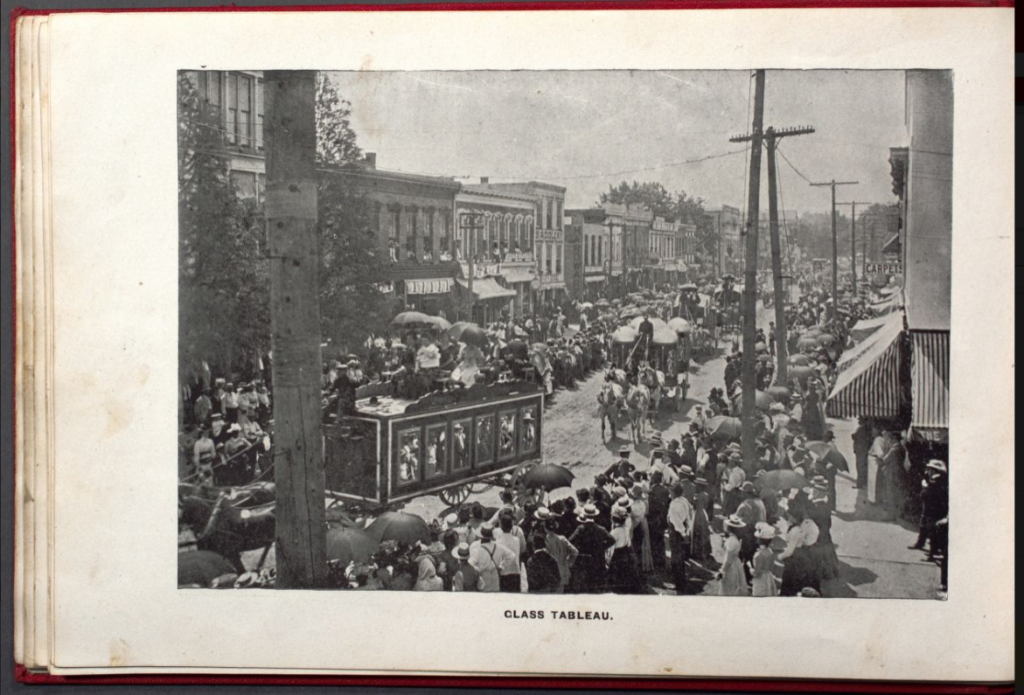
John Robinson’s circus was a famous, traveling, family-owned circus’ that toured the United States for 69 years beginning in 1842.  The family business stopped touring around 1910 and was officially sold in 1916.  It was managed by four generations, all named John Robinson.

Parade of John Robinson’s circus entering town. Image from https://digital.library.illinoisstate.edu/digital/collection/p15990coll5/id/12068
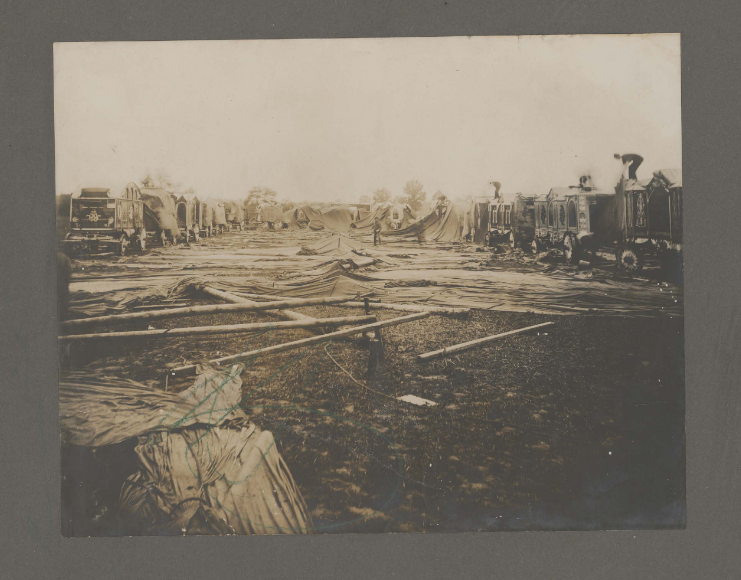
Packing up after a show. Image from the Cincinnati and Hamilton County Public Library.

Tillie

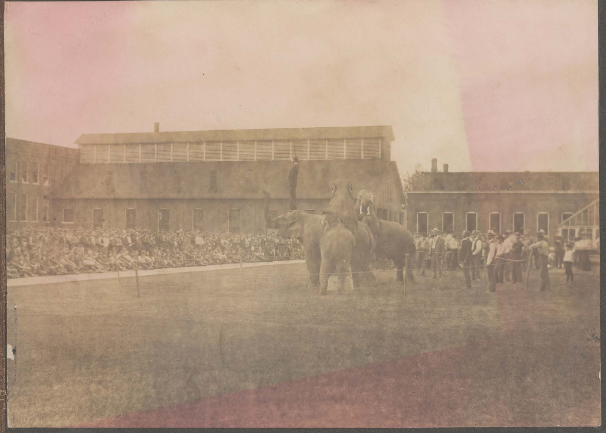
As a local tidbit to note, the circus was stationed during the winters near Cincinnati, OH, where the family owners kept Tillie, the beloved elephant.  Tillie was said to roam the neighborhood of Terrace Park and was well known in the community and beyond. Many stories were written of heroic accounts and even her ability to “talk”.  She was memorialized when she passed in 1932 and a marker can be found at Circus Place in Terrace Park today.

Elephants being forced to perform in John Robinson’s 10 Big Shows. Image from the Cincinnati and Hamilton County Public Library

Cincinnati and Hamilton County Photographic Album

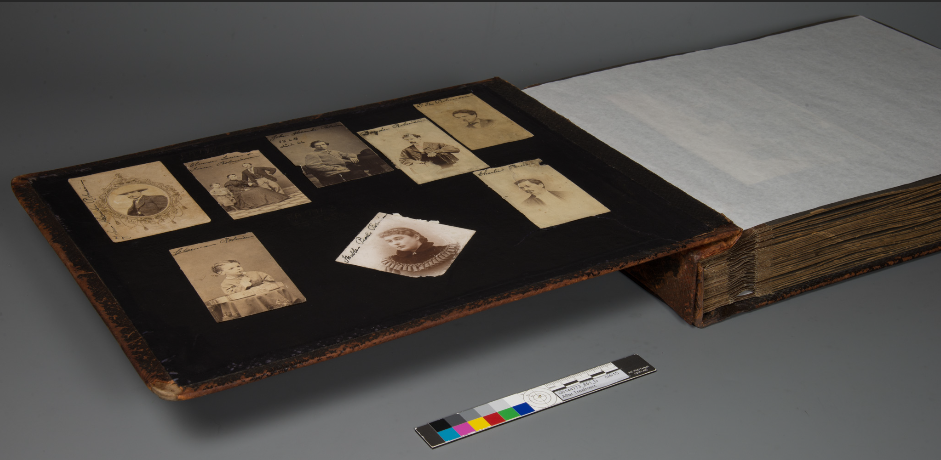
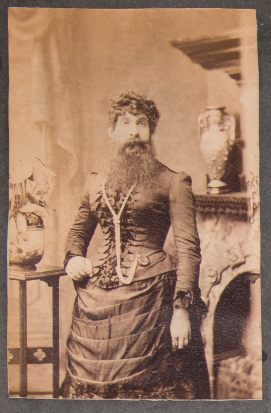
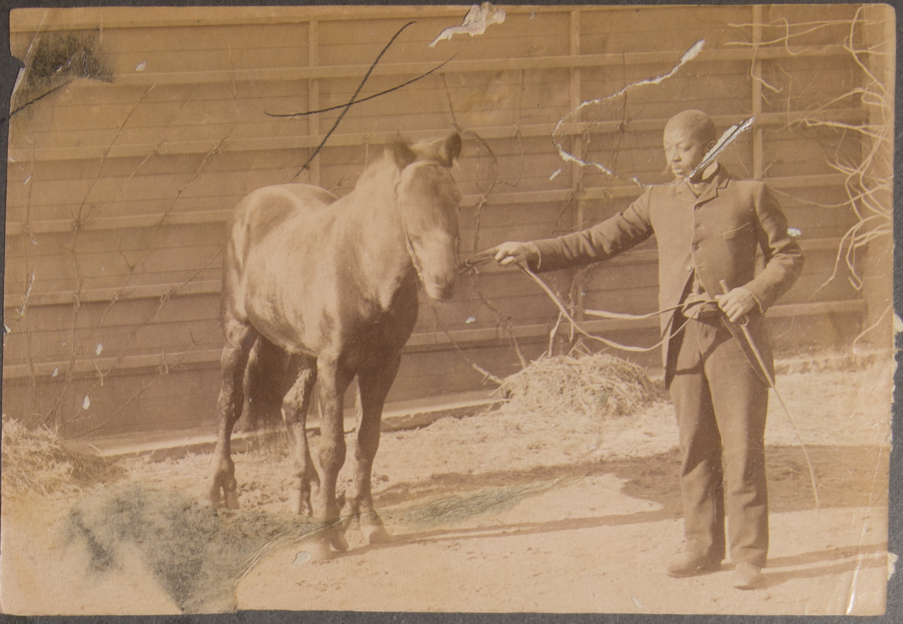
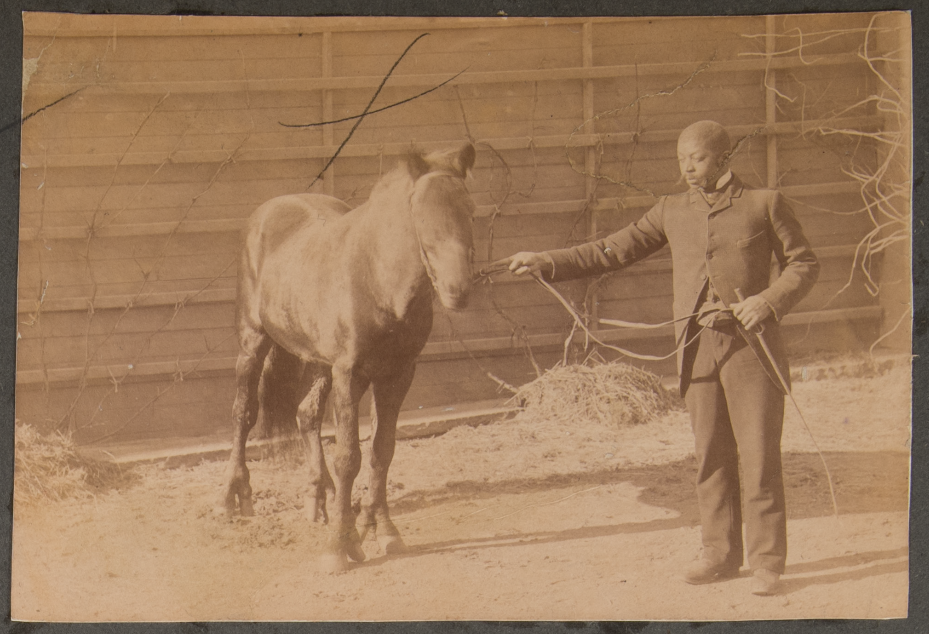
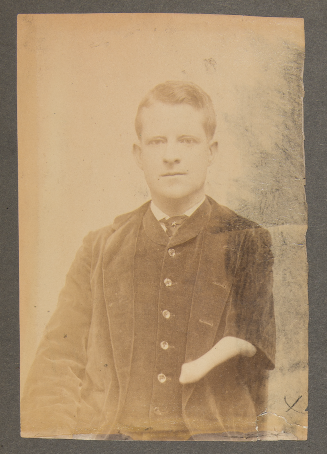
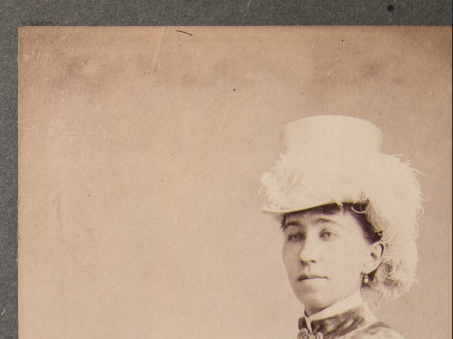
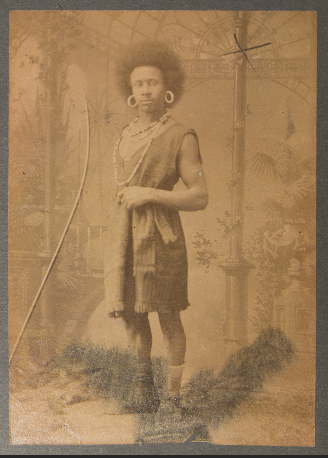
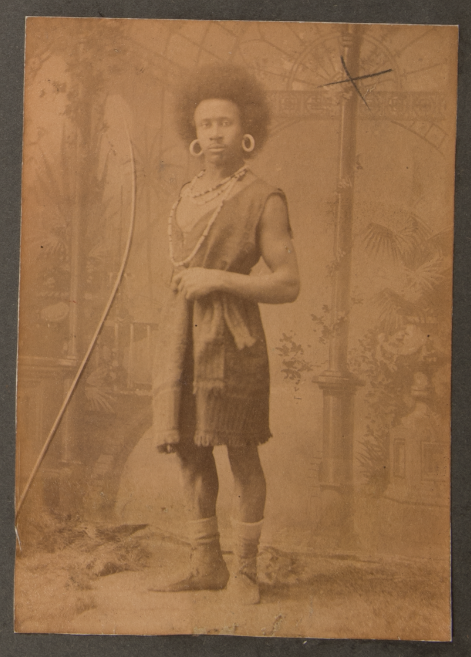
A rare photographic album owned by the Cincinnati and Hamilton County Public Library (CHPL) dates to the late 19th to early 20th century and contains albumen portraits of John Robinson’s circus performers. The images have been fully digitized after receiving treatment to improve legibility at the Preservation Lab. The CHPL Digital Library catalog describes the object as follows:

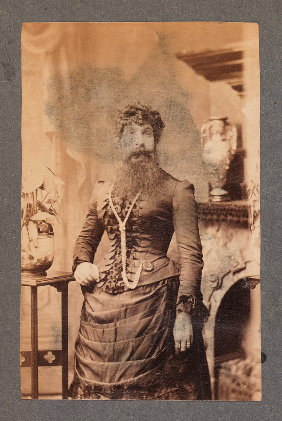
“Album of 266 photographs of varying sizes. Most are portraits of Robinson family members and of the circus staff and performers. Included are group portraits of the work crew, musicians, clowns, acrobats, novelty acts, and family acts, and circus animals. Many of the individual portraits are of side-show performers such as tattooed men, albinos, women with floor-length hair, dwarfs, etc. Some of these are studio shots that may have been sold or used as advertising. A small number have captions, and the few with dates are from 1901-1909.”

Toned Images

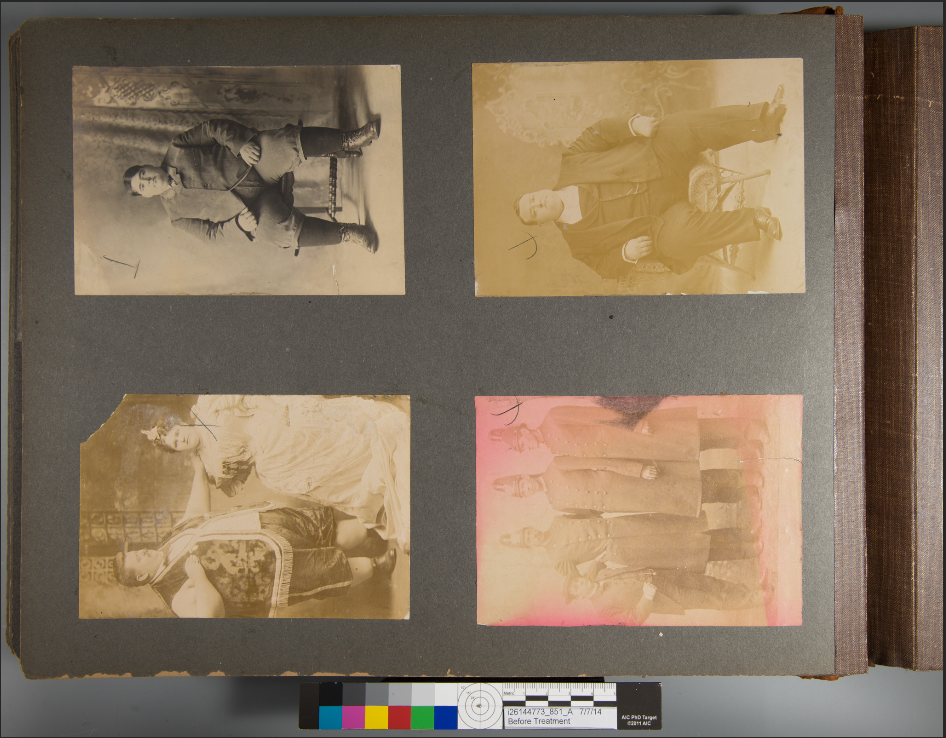
While the content of the images is spellbinding, the album is also unique as many of the photographs appear to be once toned overall with pink, yellow, or orange colors.

An online reference from the American Institute for Conservation (AIC) Preprints in 1980 refers to historic albumen photographs that were dyed and are extremely light sensitive.  In the article, James Reilly states, “A great deal of the paper sold during the 1880’s and 1890’s was “doubly albumenized”, i.e., floated twice to obtain maximum gloss. Another common practice was the addition of aniline dyes to the albumen solution. Tinted paper was mainly used for portraits, and the most popular tint appeared to be pink, but various shades of purple, blue and even green were also used. Because the dyes had such poor lightfastness–especially in such dilute solution–most of the dyed paper is difficult to recognize today.”  It’s fun to imagine that these tinted papers might have been used to capture and celebrate the lives of circus performers in John Robinson’s 10 big shows.

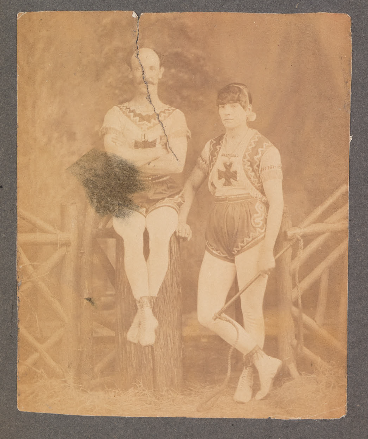
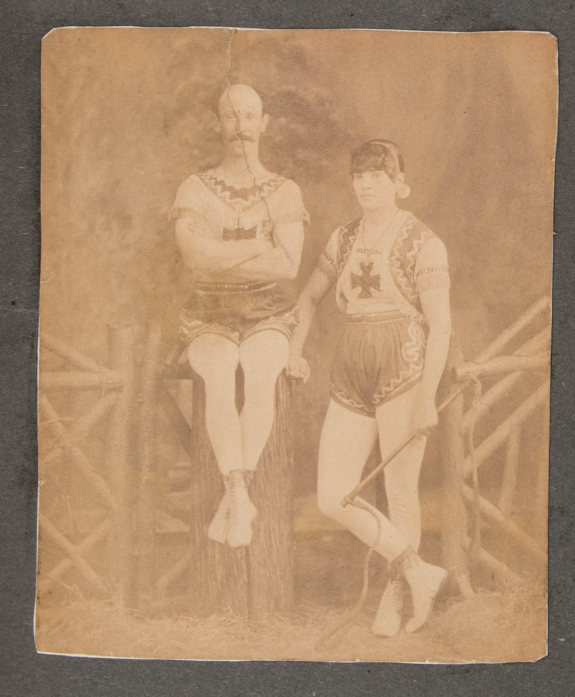
Many of the colors in the photograph album have faded irregularly, with the pink being the most prominent color remaining.  This colored photograph phenomenon does not appear to be widely documented elsewhere as the fugitive dyes were not light-fast.  They may have also been susceptible to dark fading and chemical instability.  Because these photos were preserved within pages in an album, it’s possible they’ve been protected from light and some of the more chemically stable images have not yet completely faded, allowing us a glimpse of this rare format.

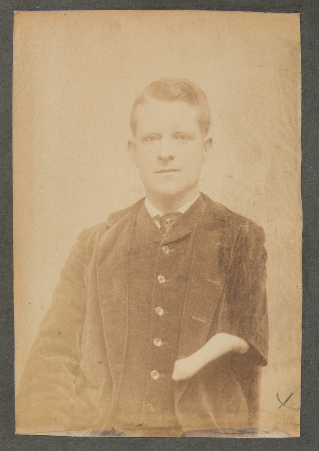
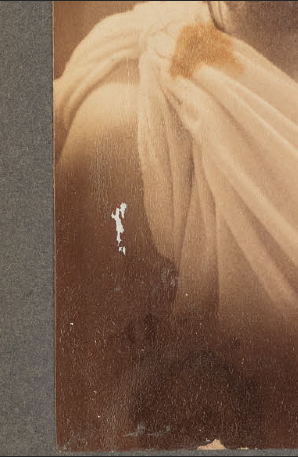
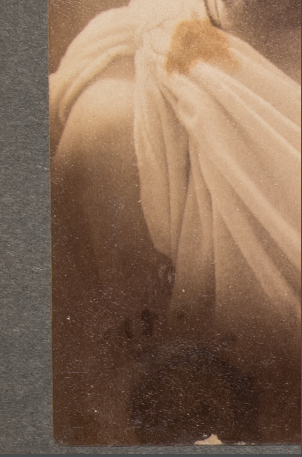
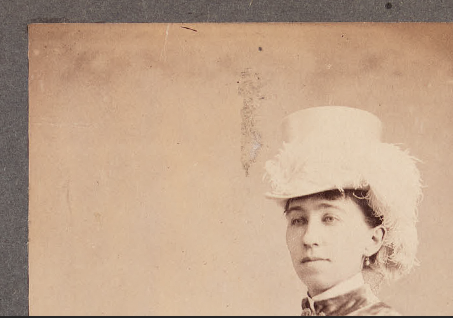
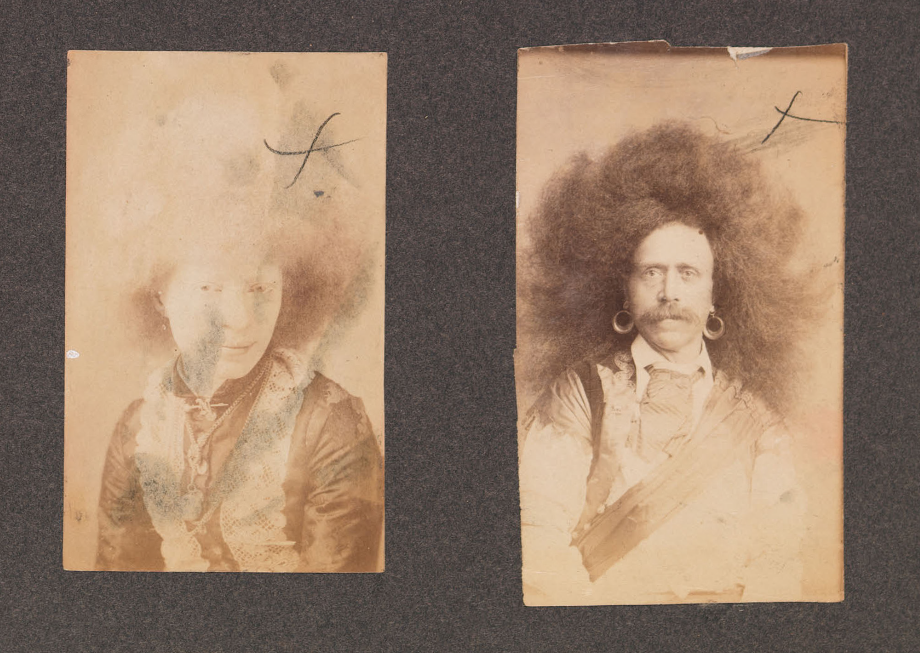
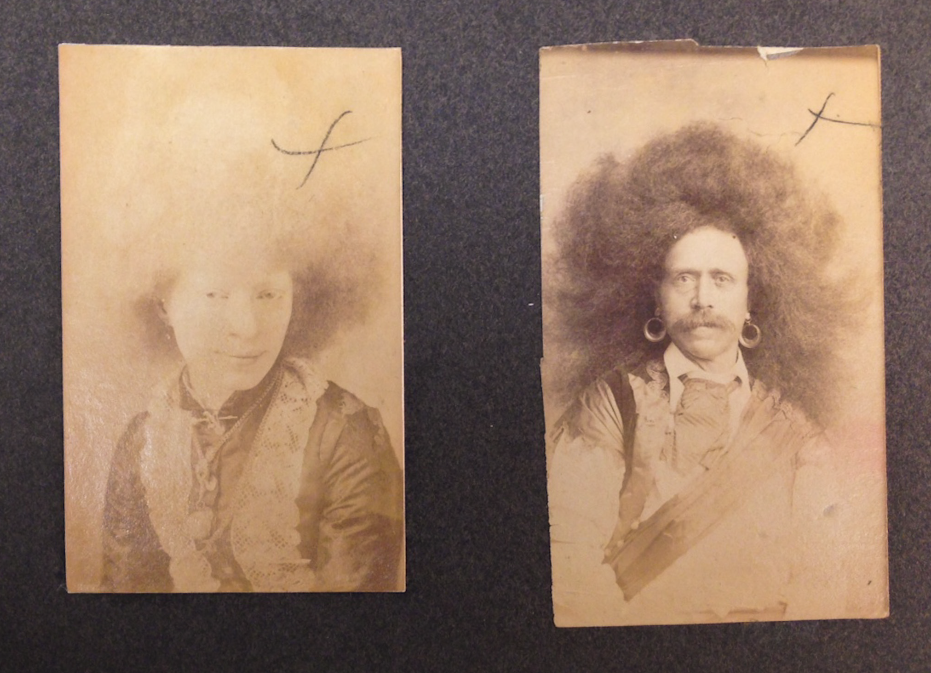
While treatment cannot be performed to recolor the images, some photographs did receive conservation treatment to improve visual legibility. There were nearly 30 images that appeared to have a dark discoloration. These photographs were identified to be missing fragments of paper backings. As a result, the dark album pages behind the photographs were obscuring the visibility of the photographic emulsion layer. Some of the more badly damaged images were carefully lifted, relined and reattached. Others received general surface cleaning. A few examples of improved readability are below.

Ashleigh Ferguson Schieszer (CHPL) – Special Collections Conservator
References and Resources:

Reilly, James. The History, Technique and Structure of Albumen Prints, AIC Preprints. May 1980. Pp.93-98. https://cool.culturalheritage.org/albumen/library/c20/reilly1980.html

Suess, Jeff. Robinson’s circus wintered in Terrace Park, The Enquirer, Cincinnati.com, published Jan 26, 2017. https://www.cincinnati.com/story/news/2017/01/26/robinsons-circus-wintered-terrace-park/97093392/

The Annual Record of the John Robinson’s 10 big Shows for 1900 is fully digitized at Illinois State where the roster of performers are listed and the program of displays are outlined. (See https://digital.library.illinoisstate.edu/digital/collection/p15990coll5/id/12035). Perhaps some cross examination of resources, such as this one, can lead to the identification of some of the portrait identities.  See also https://digital.library.illinoisstate.edu/digital/collection/p15990coll5/id/11909.

Circus posters:

Additional articles:

A librarian’s new favorite teaching tool? A historical book model!

A before image of the original Book of Hours, open to the center. The image shows that the sewing is broken and leaves are detaching.

In February 2019, the Lab received a unique item at the special collections’ meetings for the UC Libraries, a Book of Hours (ms.37) from 1475 from the Archives and Rare Books Library.  I was so excited when this book came into the Lab.

This 15th century Book of Hours was in poor condition and in need of conservation treatment. Not only was the binding structure failing and the text block broken in half, but this book was also heavily used as a teaching tool at the ARB library, and in its current condition it could not be safely handled. This was the perfect project for Ashleigh and I to collaborate.

From the beginning, it was decided that in conjunction with the conservation treatment of the Book of Hours, I would create a book model like the original Book of Hours, to be used as a teaching tool in the ARB library collection. In addition, the model would have a leather chemise, a common feature in some Book of Hours of the time.

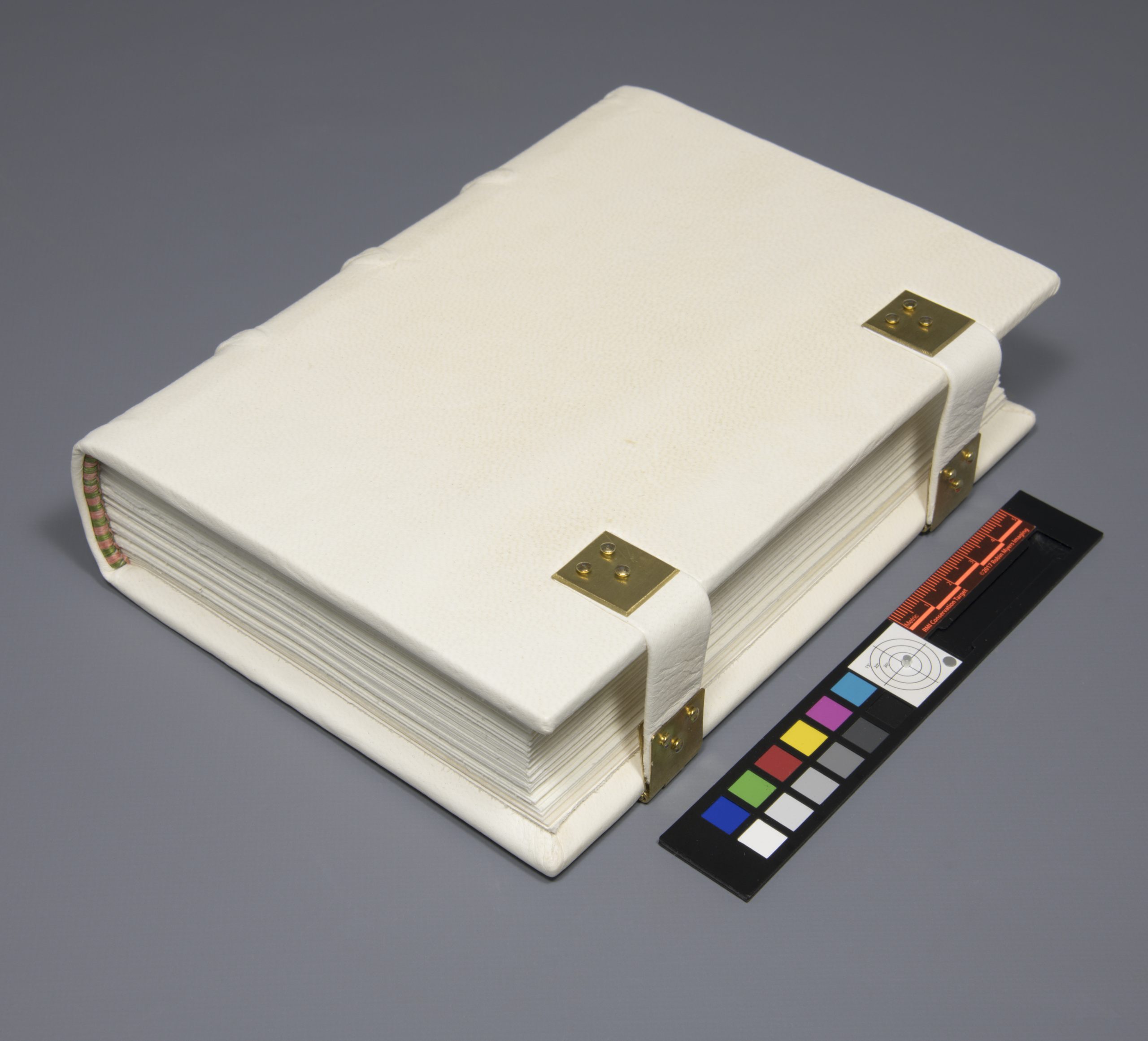
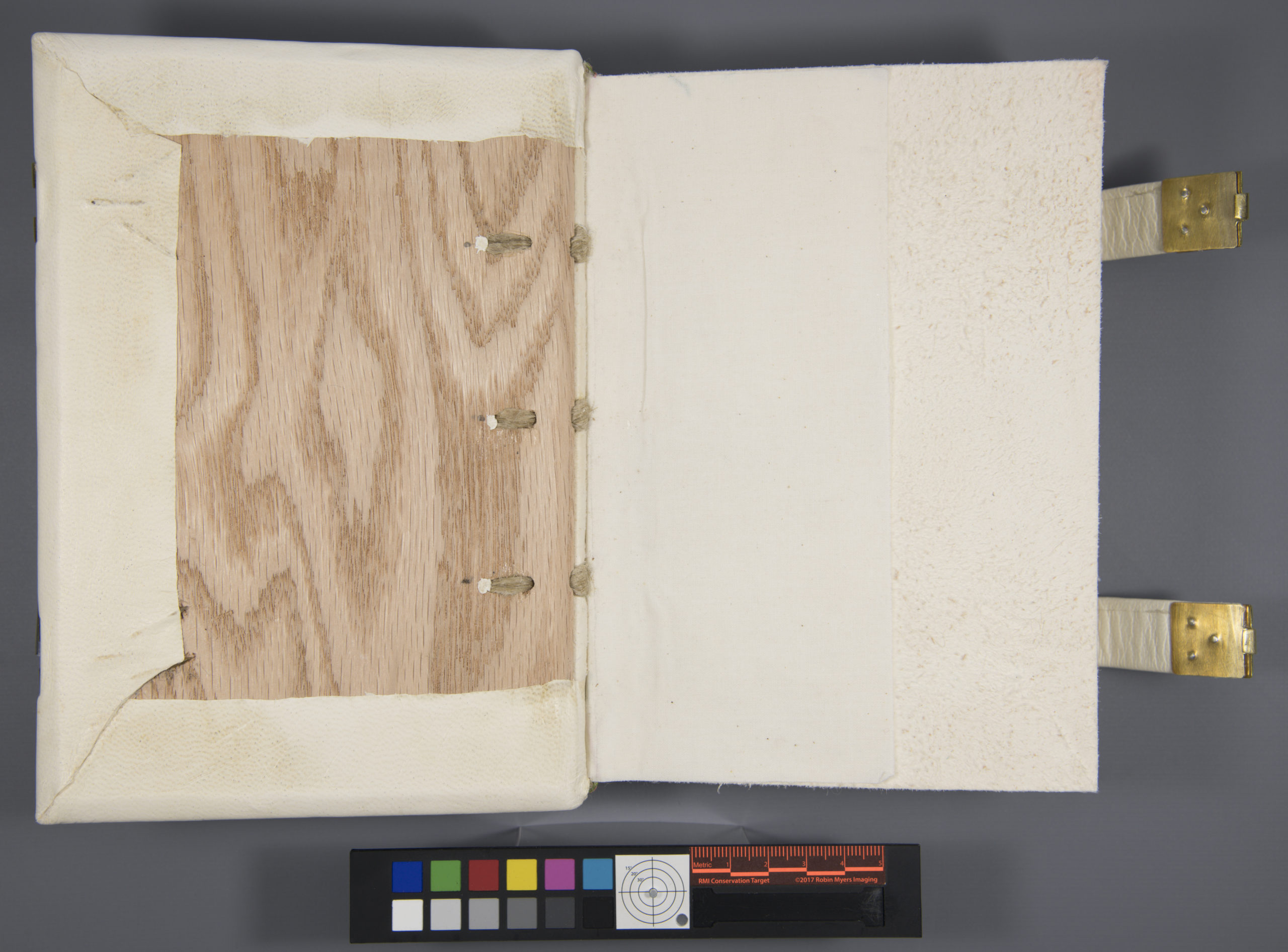
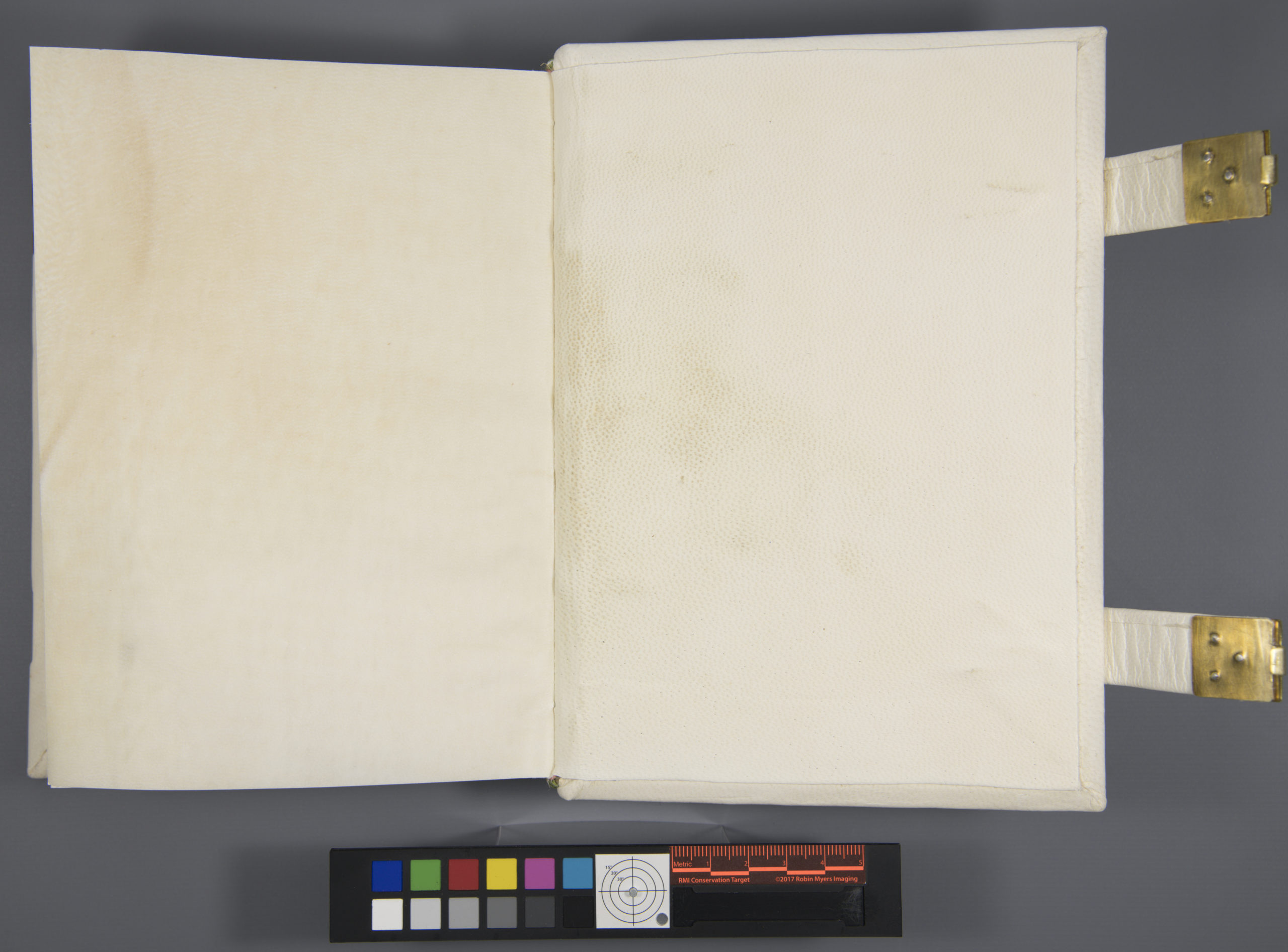
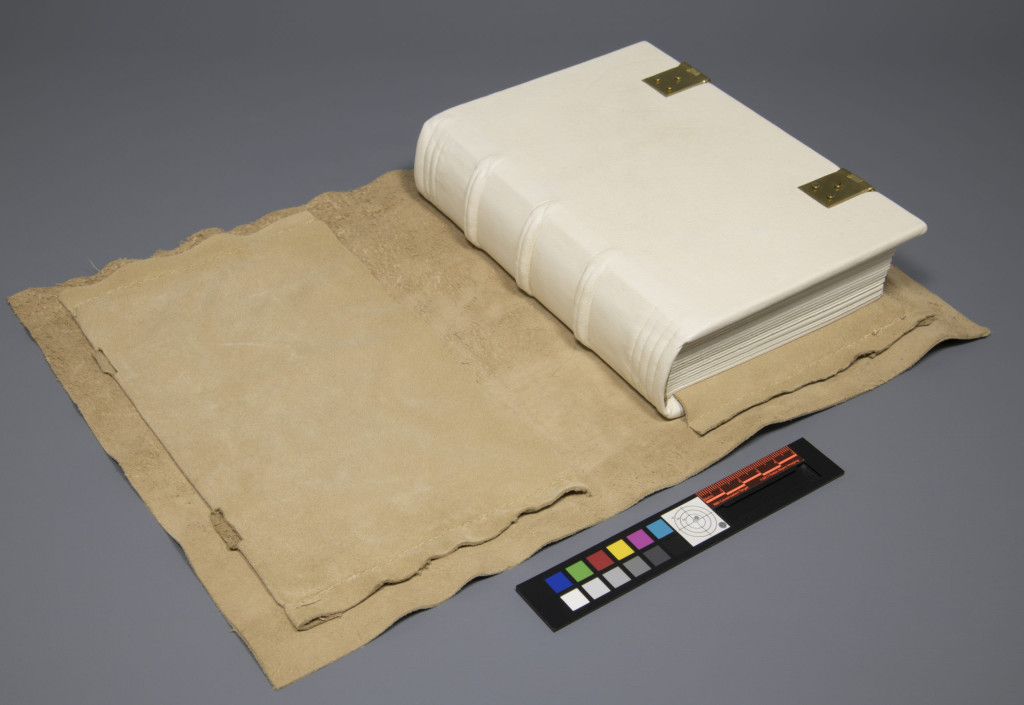
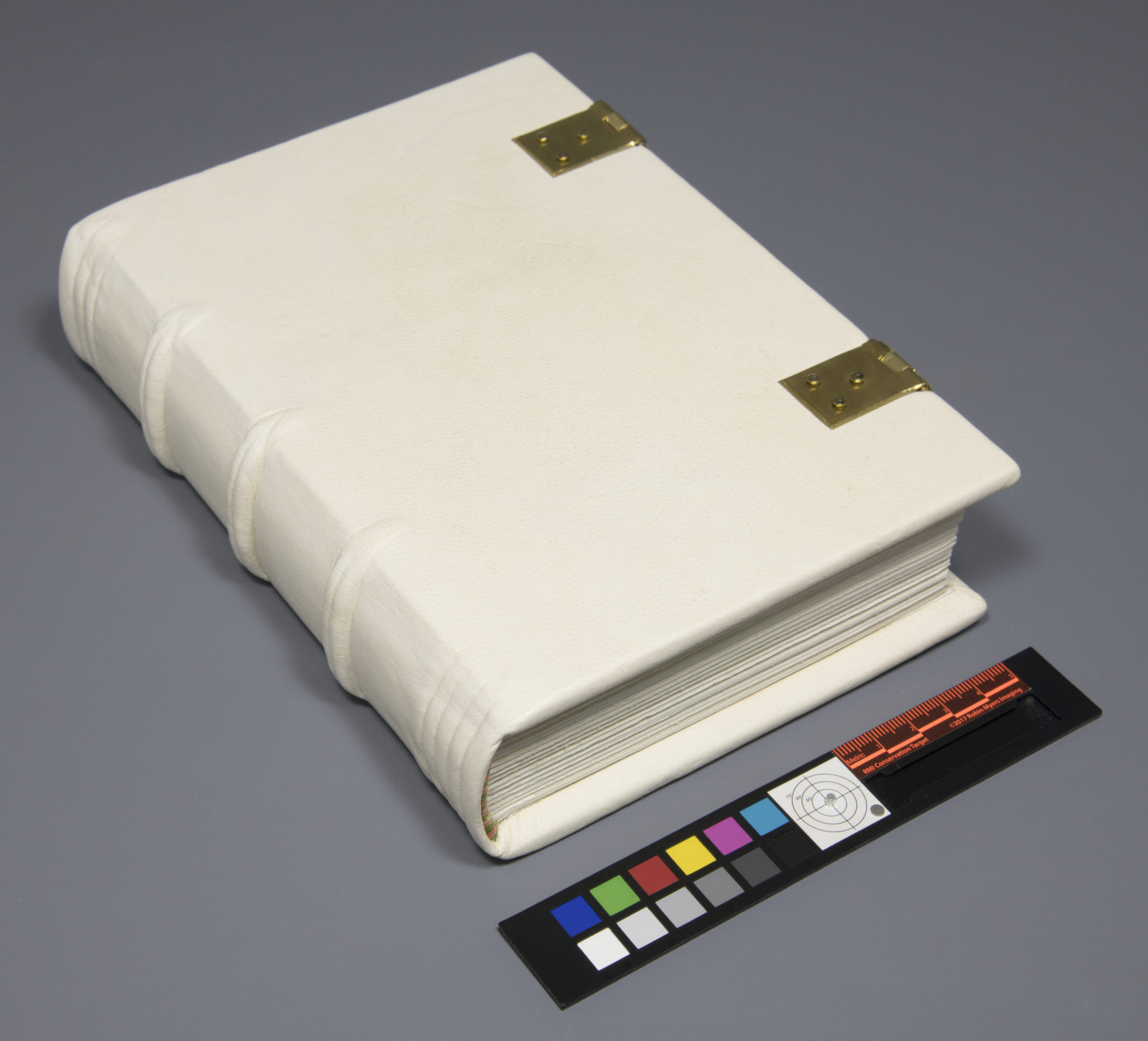
Image of the book of hours model closed. The chemise is attached to the lower board, but not the upper board.
The Book of Hours MODEL with a removable chemise.

Now here is where this story begins with the model of the Book of Hours. Often, here in the lab, we all create book models for various reasons: to learn about a new treatment, test different treatment options, to understand how some materials work together, and as teaching tools.

As a teaching tool in the ARB library collection, this model needed to resemble the original Book of Hours in its structure and materials used.

The primary goal for this model was to show how a Book of Hours was historically built, its sewing structure, the materials used, and also to provide the ARB library with a book that could be easily handled by students and scholars.

Once the treatment for the Book of Hours was fully established and confirmed with the ARB curator, I was able to start working on the book model. I will save you form reading about all the different steps of making the model, but here are the main features of model:

Text block

  • Primary support – Khadi paper white cotton rag
  • Endsheets with leather hinge – Two bifolios of calligraphy goat parchment skin wrapped along the spine edge with a hinge of Allum tawed leather (later would be used as pastedowns)
  • Sewing – Sewn on three double raised cords with a linen 18/3 thread. The dimensions of the text block and sewing holes, were guided from the original sewing holes of the Book of Hours.
  • Endbands – Primary conservation endband with the bead on the spine, and secondary endband with the bead on the text block.
  • Spine linings:
    • Reversible layer of Usu Gami thin and Zen Shofu wheat starch paste.
    • Slotted Airplane cotton cloth with flanges to be used as board attachments.

Cover

  • Boards – Oak wood
  • Board attachment – Boards were laced with the sewing supports through carved channels
  • Covering material – Full alum tawed leather binding with removable chemise
  • Clasps – Brass tension clasps (these were created in-house by Chris Voynovich, and he did an amazing job).

There was no evidence that the original Book of Hours had clasps, but the curator requested tension clasps for the book model. Clasps were common in the 15th century bookbinding, and this would provide the students with the experience of handling a book with clasps and allow them to understand their function.

The curator also requested that one of the pastedowns be kept unattached, so the students could see how the boards were attached to the text block and that they were wooden boards.

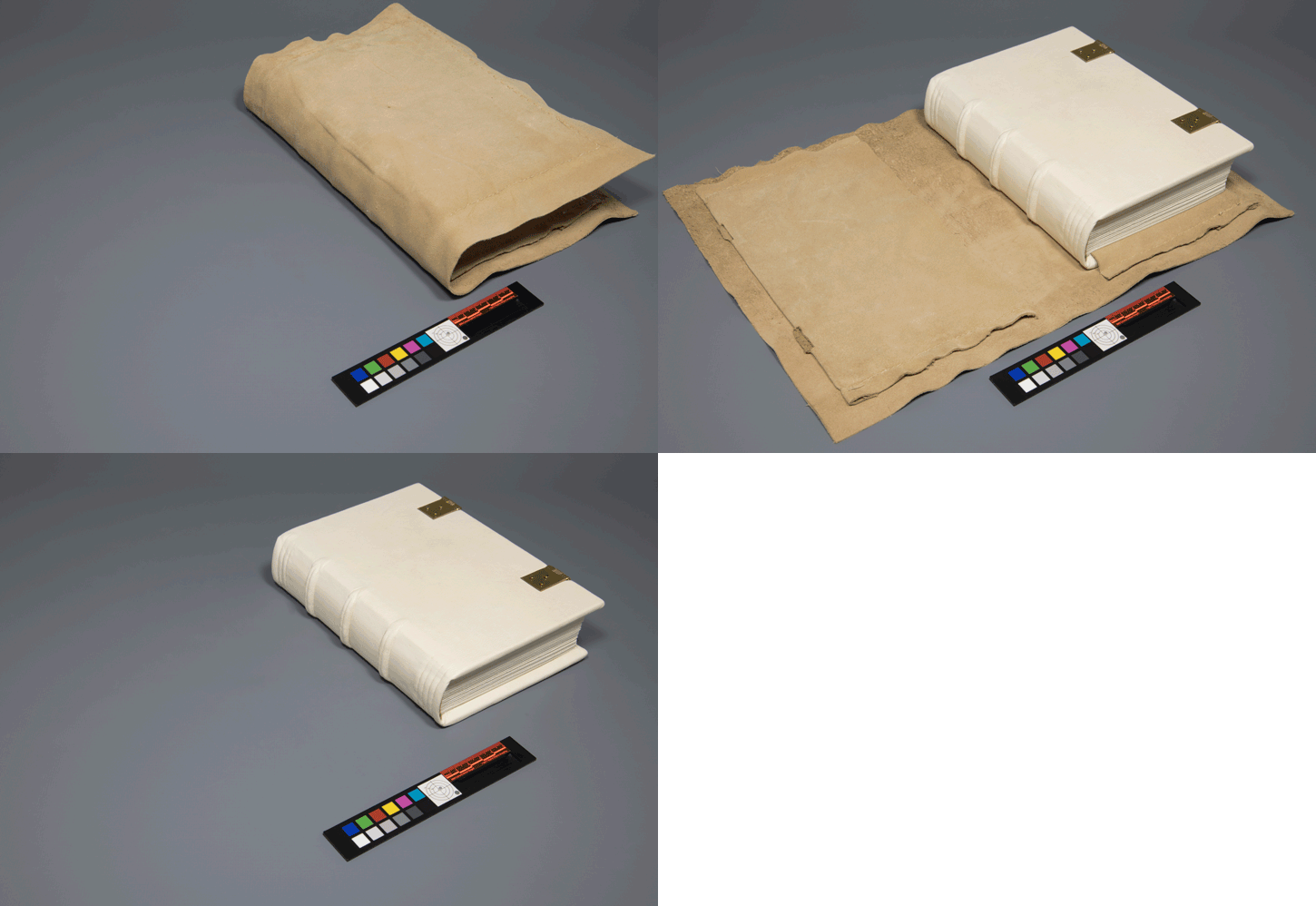
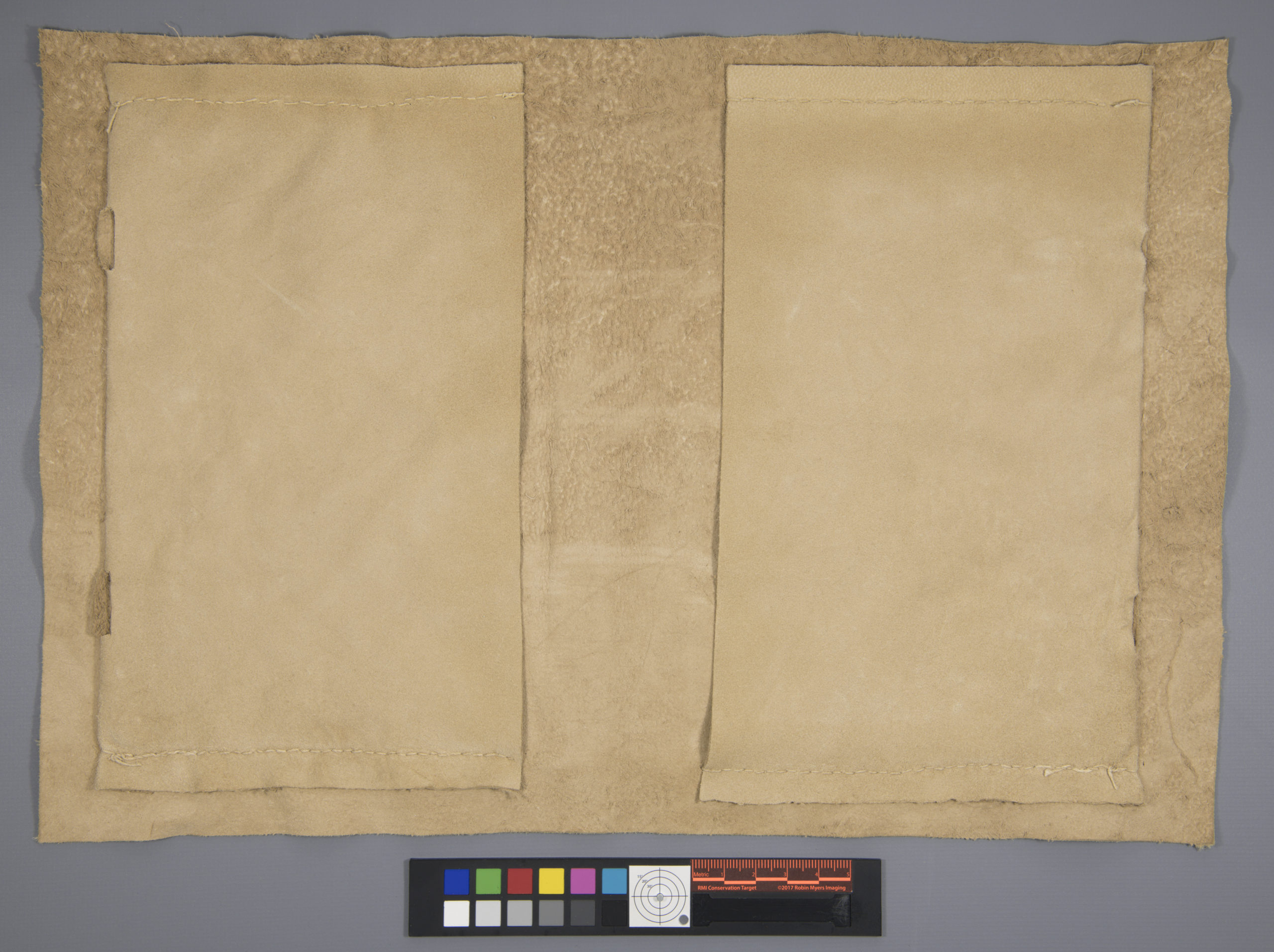
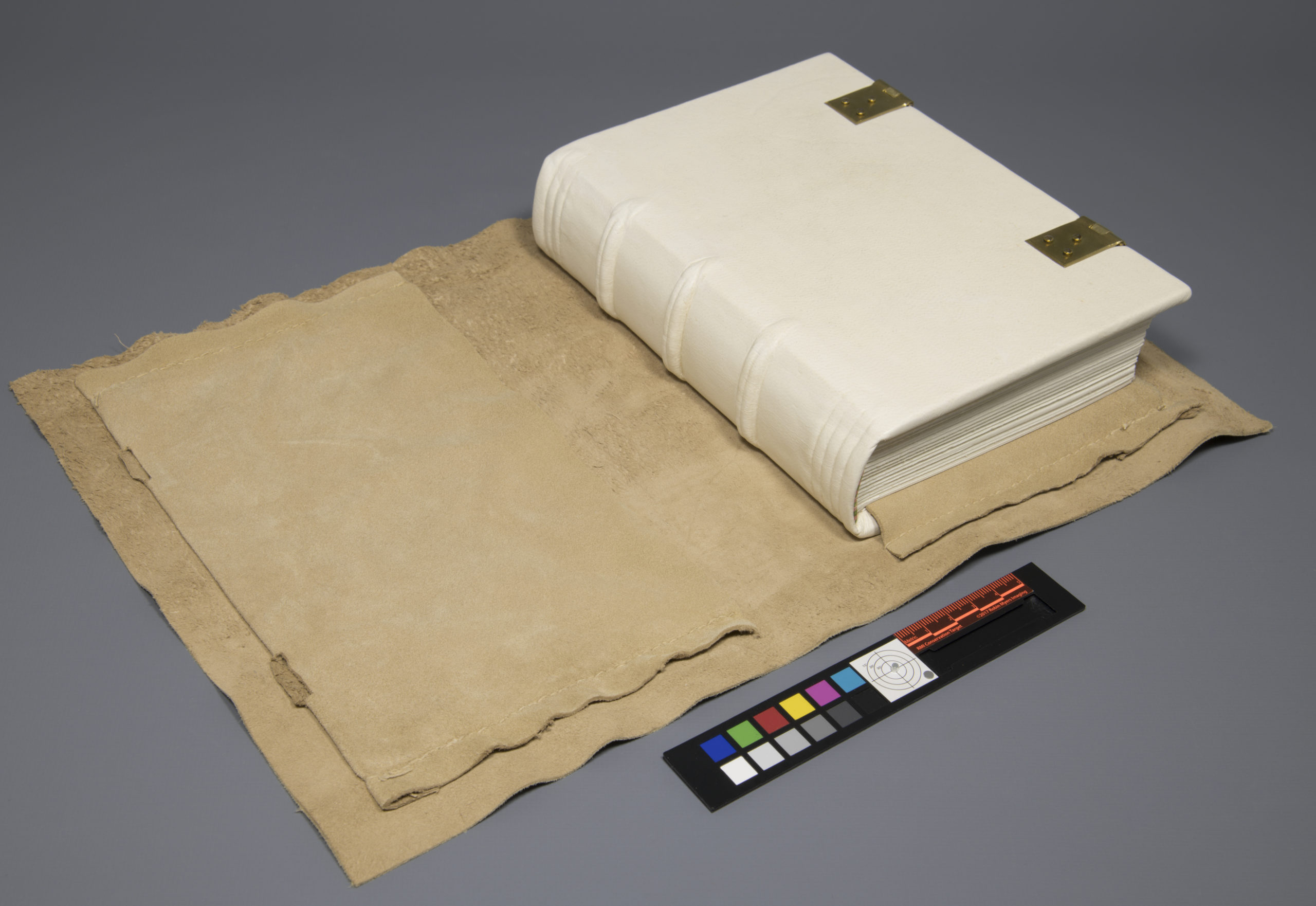
In addition, I created a removable chemise, also requested by the curator of the ARB library. In some Books of Hours, it was common to have a leather chemise, but most often they were not removable. The chemise was created from a vegetable tanned goat split skin.

Gif of the chemise on and off the model.
 The chemise in action.
Video tutorial of how to put on and remove the chemise from the model.

Stay tuned for a future blog post where we will dive into the conservation treatment and research we did on the Book of Hours (ms.37).

Catarina Figueirinhas (UCL) —- Assistant Conservator
Photographic Documentation by Catarina Figueirinhas and Jessica Ebert

Job Announcement (and an opportunity to work with The Preservation Lab!)

Image of a shelf of rare books from the Archives and Rare Books Library

University Archivist and Head, Archives & Rare Books Library

University of Cincinnati Libraries

Full-time, faculty tenure-track

Salary Range $85-110K, salary plus stipend

University of Cincinnati Libraries is inviting applications for the University Archivist and Head, Archives & Rare Books Library.  The successful candidate will be responsible for the development and management of services and collections of the Archives and Rare Books Library, which includes rare books, manuscripts, the University Archives, and other archival and special collections. Additionally, as University Archivist, the position is responsible for promoting use and engagement with collections documenting the history of the University of Cincinnati and provides leadership oversight of University Records Management Program.  
This position is covered by AAUP UC’s collective bargaining agreement. UC faculty librarians have access to annual funding to support conference attendance and professional development needs.

This position operates under the principles of the UC Libraries Strategic Framework: NEXT Directions, which aims to increase our impact by: creating paths to education innovation and student success; contributing to the university’s research, learning and teaching agendas; and by creating partnerships within UC, the wider Cincinnati urban community and at national and international levels.

This work requires a substantial investment in people, a renewed commitment to Diversity, Equity and Inclusion and a continued focus on and acceleration of digital transformations as the Libraries continue to fulfill its mission and achieve the vision to become the globally engaged, intellectual commons of the university—positioning itself as the hub of collaboration, digital innovation and scholarly endeavor on campus.

The full position description and application are available on the university’s website.  

Print Council of America Paper Sample Book

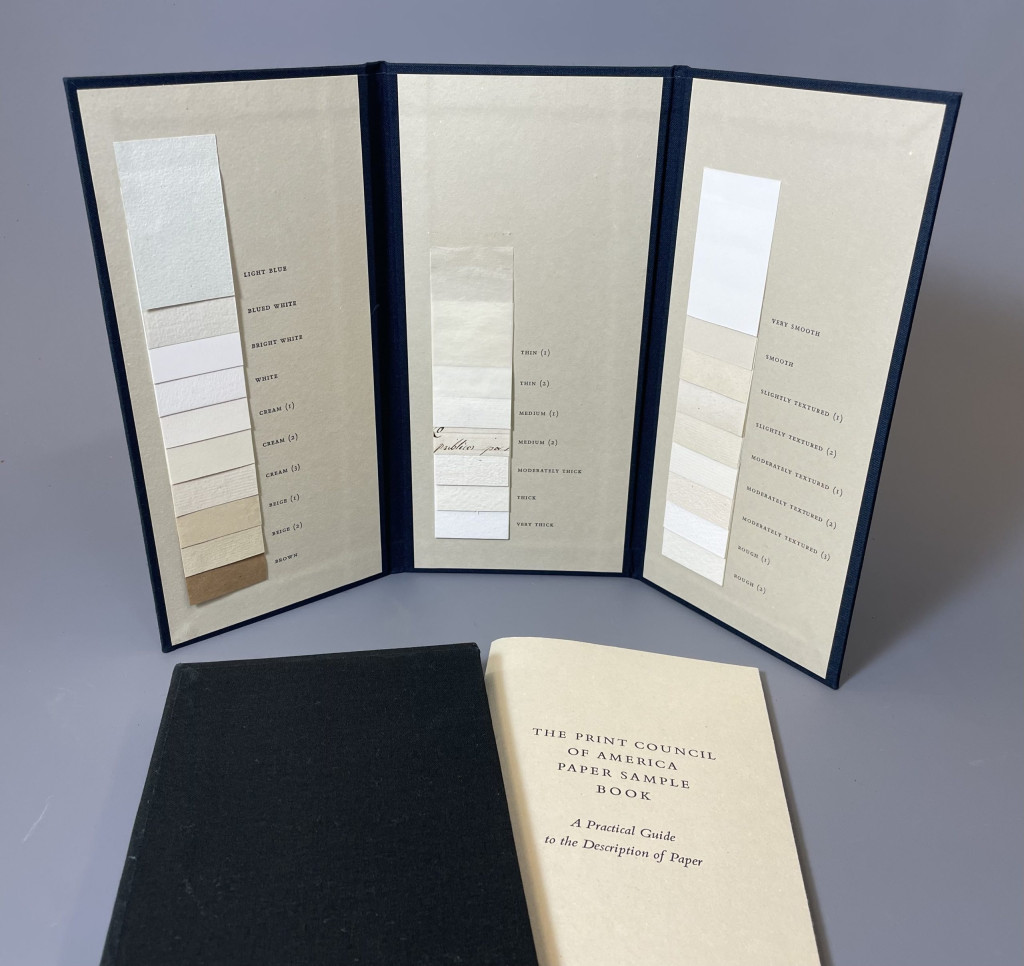
Cleaning out old historic papers from the lab closet inspired me to investigate finding a reference material that I enjoyed using at other institutions: the Print Council of America Paper Sample Book. A Practical Guide to the Description of Paper, by Roy Perkinson and Elizabeth Lunning, Boston 1996. 

Print Council of America’s Paper Sample Book

While there are many fine art applications, this book is used in the field of paper conservation when describing papers in an examination report.  The reason for this is to establish a visual standard since descriptors can be quite subjective. Cream, beige and light brown to one person could be perceived as opposites to another.  However, using this booklet, a large range of colors, textures and thicknesses are definitive and straightforward to select when comparing the samples to the object in person. 

I first gained experience using the reference in graduate school and thought it could be a valuable resource for the Preservation Lab, especially for staff and students learning to examine objects for the first time. However, I was under the impression it was out of print because the booklet was created by the Print Council of America a few decades ago and contains a limited number of hand cut paper samples.  With the lab’s newly found historic paper samples in mind, I emailed the Print Council Of America to seek permission to create a facsimile. Lo and behold, I was thrilled to learn the books were still for sale and no boot-legging necessary!

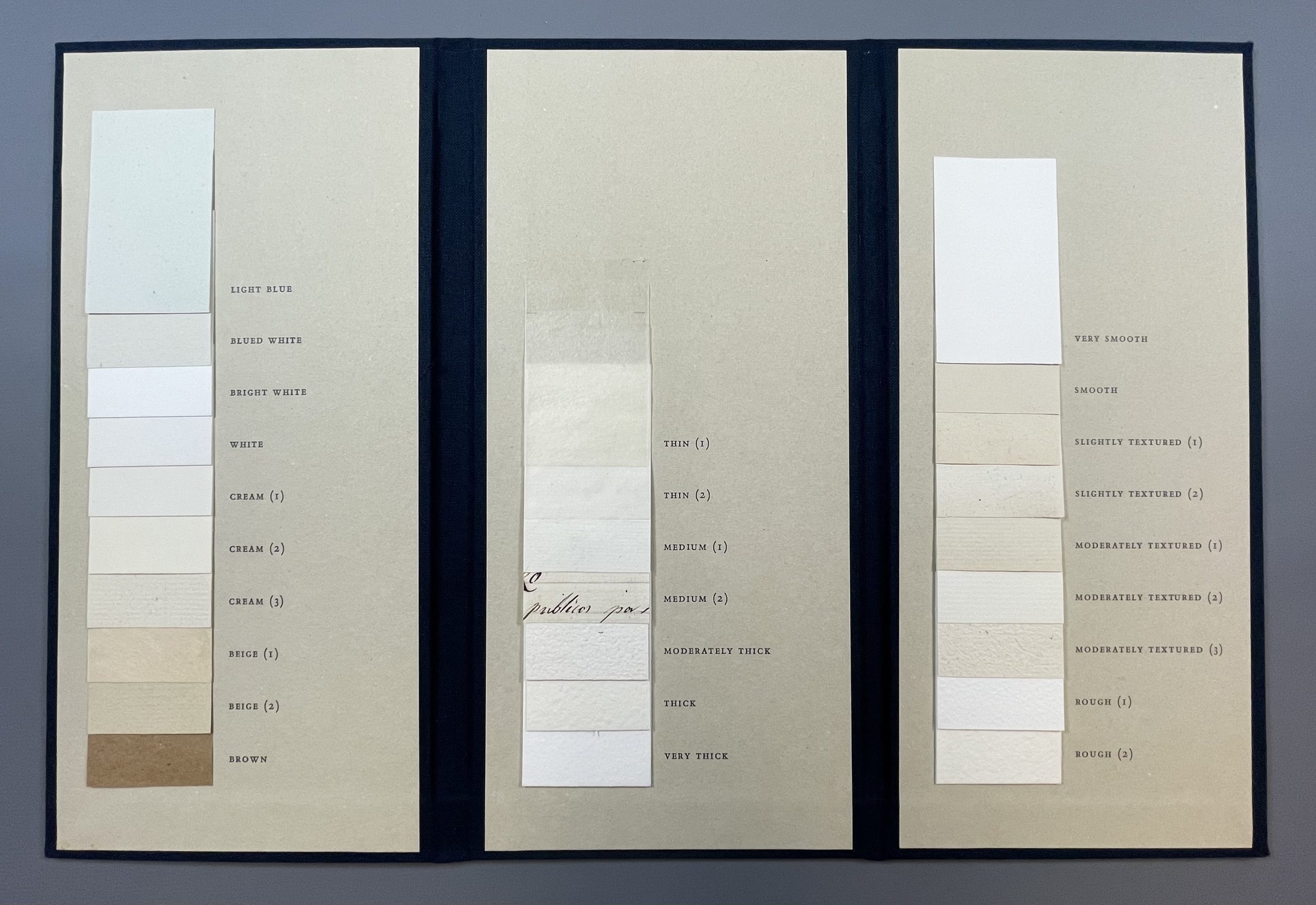
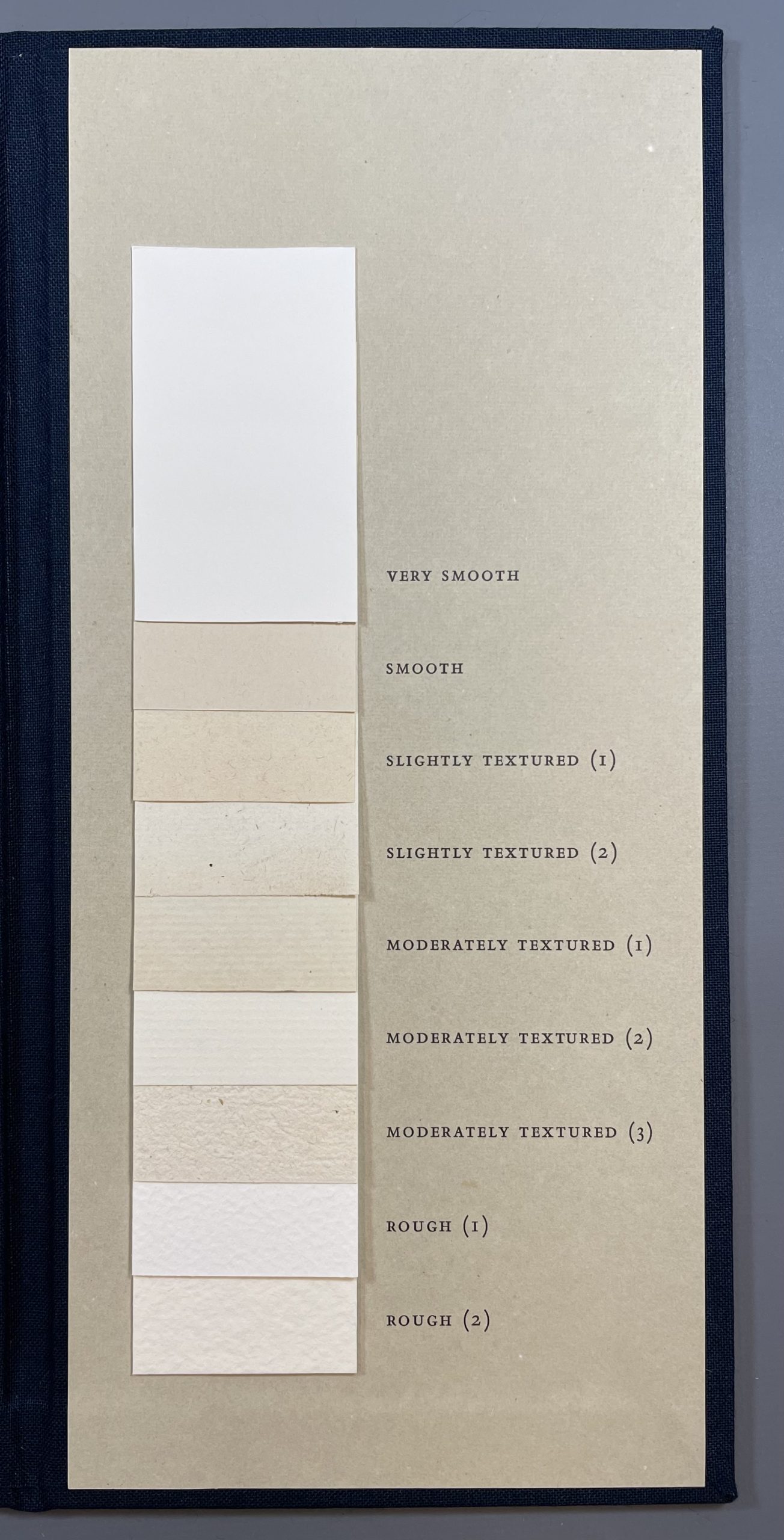
Ours arrived just this week and I’m excited to share the tri-fold booklet below! Paper colors are defined on the left, thicknesses outlined in the center, and textures displayed on the right.

How to use:

When describing a paper object (or text block) in the description section of the treatment report, I will now reference this booklet to describe the color, texture and thickness using this terminology.  Colors include: Light blue, blued white (which looks gray to me!), bright white, white, cream (1), cream (2), cream (3), beige (2), and brown.  There are seven types of thickness and nine types of textures to select for comparison ranging from very smooth to rough (3). The accompanying pamphlet has great information to further define the terms, including a measurement chart for the paper thickness (should you prefer using a micrometer), and provenance of all the sample papers.

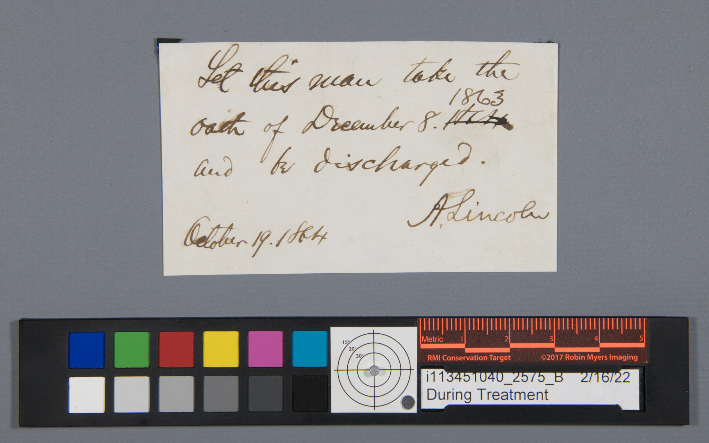
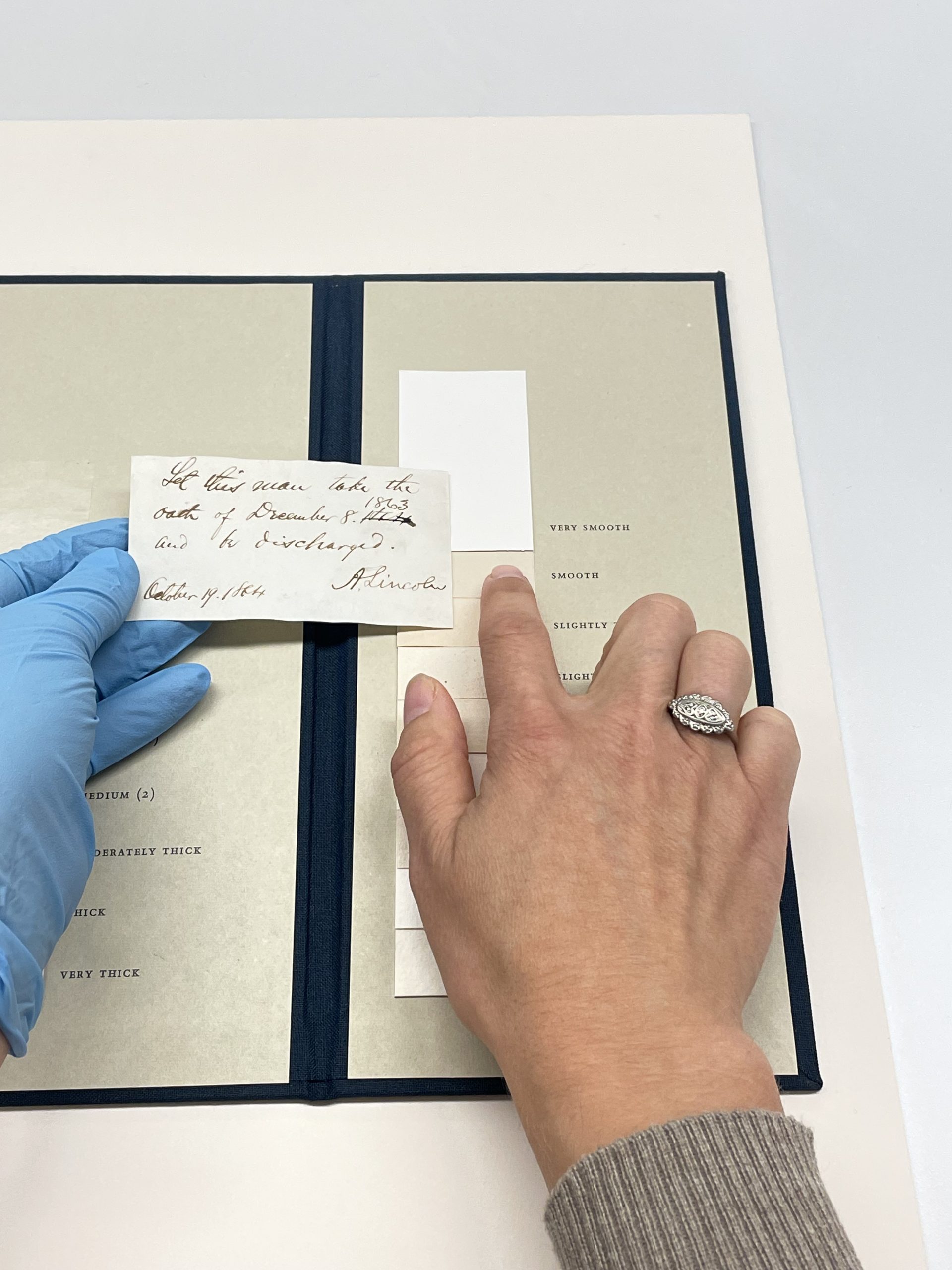
Let’s use the booklet to describe a handwritten note by Abraham Lincoln from 1864, owned by the Cincinnati and Hamilton County Public Library:

During treatment, the note is removed from the matting system

Before having my hands on the booklet, I would have described the object as follows: The manuscript is handwritten with brown iron gall ink on a light beige handmade laid paper. Comparing the object to the Print Council of America sample book, the manuscript could be better described as:

…a manuscript handwritten in brown iron gall ink on a cream (1)…

…a manuscript handwritten in brown iron gall ink on a cream (1), medium (2) thick…

… a manuscript handwritten in brown iron gall ink on a cream (1), medium (2) thick, smooth, handmade laid paper.

Much improved from my initial description that indicated the color was light beige!

When using this booklet as a reference for reports or surveys, at the bottom of the report, I’ll begin adding a footnote that says, “[1] All paper descriptions by comparison with Print Council of America’s Paper Sample Book (Roy Perkinson and Elizabeth Lunning, 1996).  This will allow other conservators and practitioners familiar with the book to have a point of reference when reading my report, even on the other side of the country!  In the future, this can also help in identifying shifts in paper tone caused by aging paper.  

Ashleigh Ferguson Schieszer – Lab Co-Manager, Rare Book and Paper Conservator