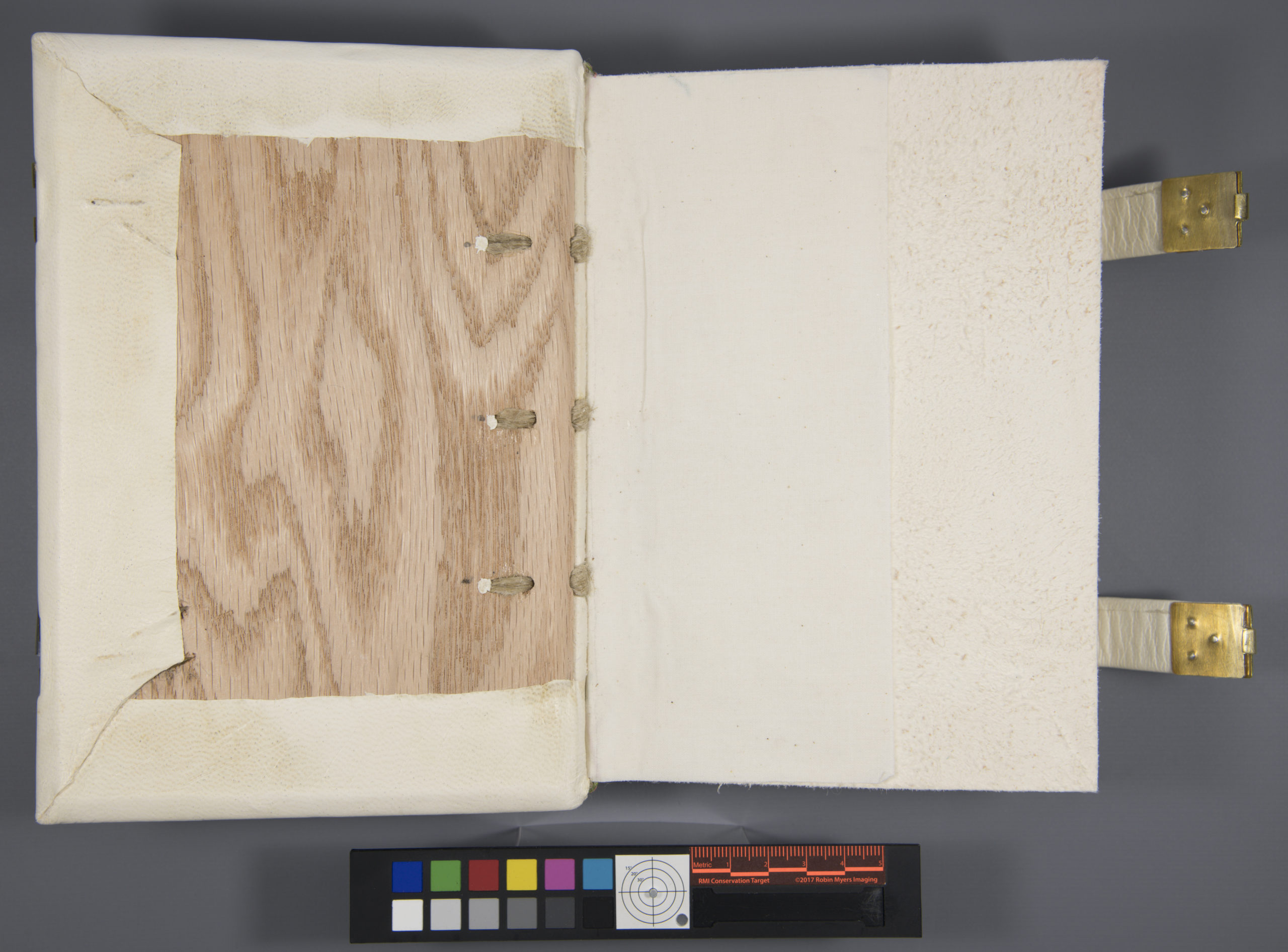
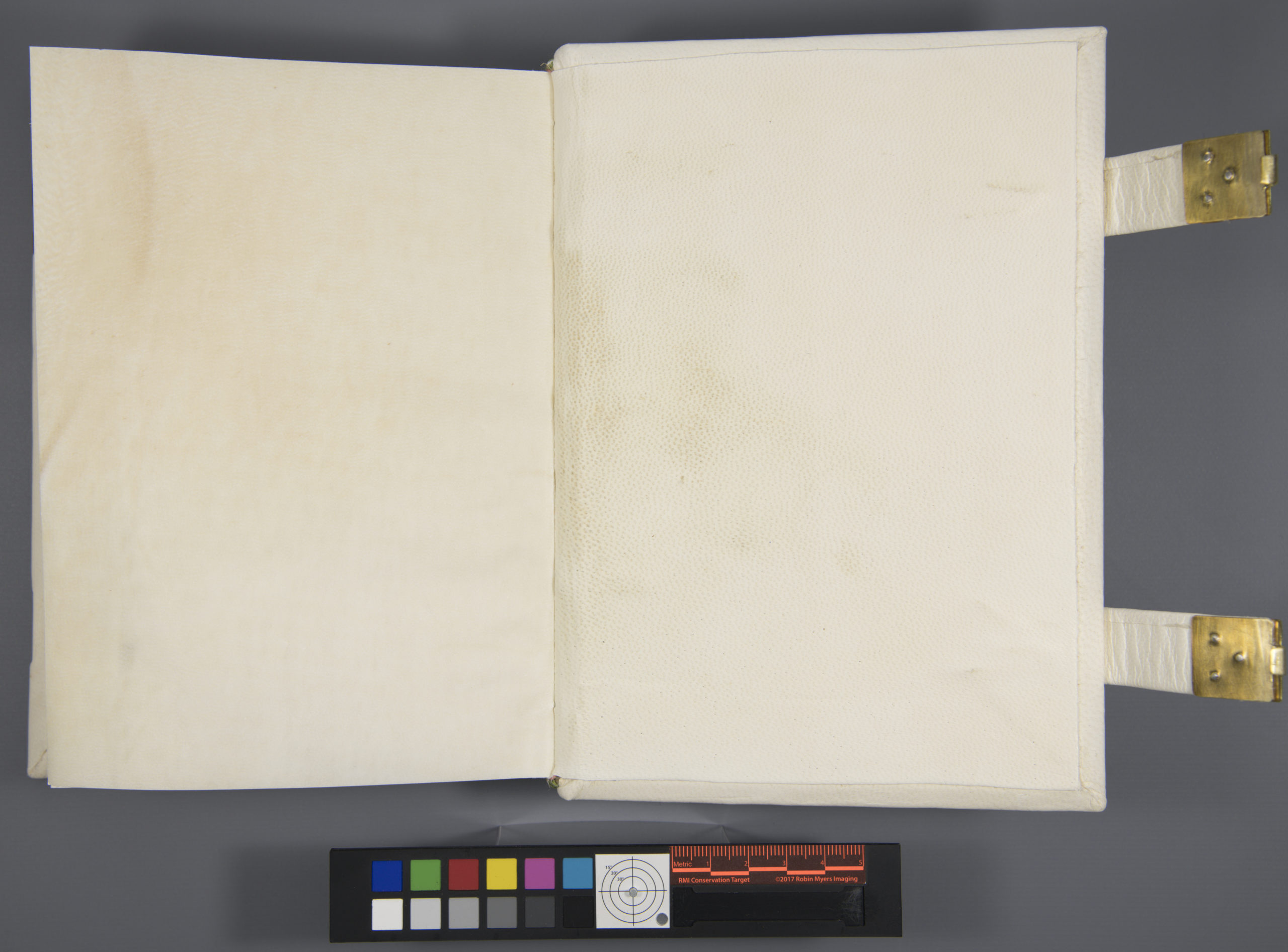
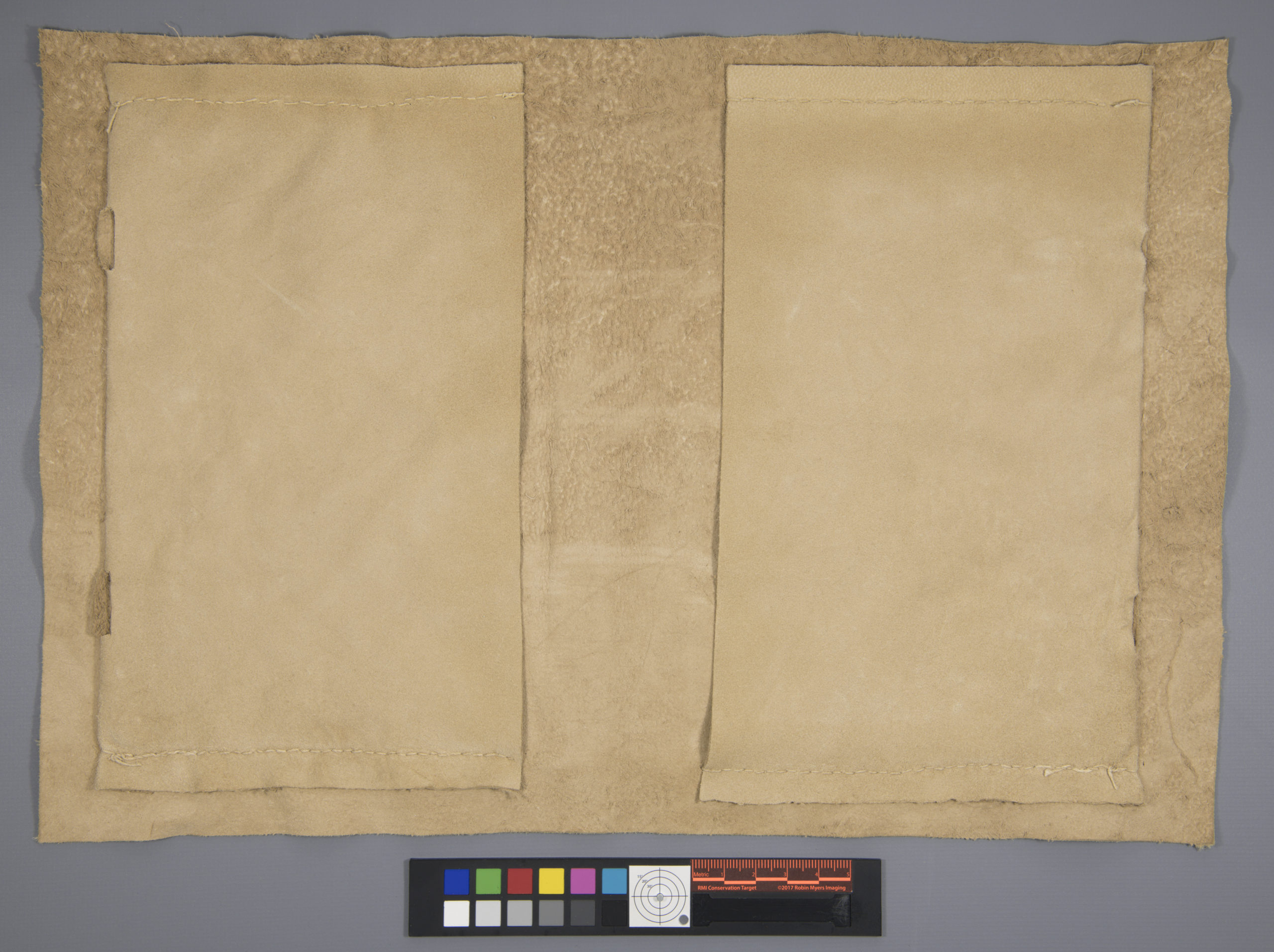
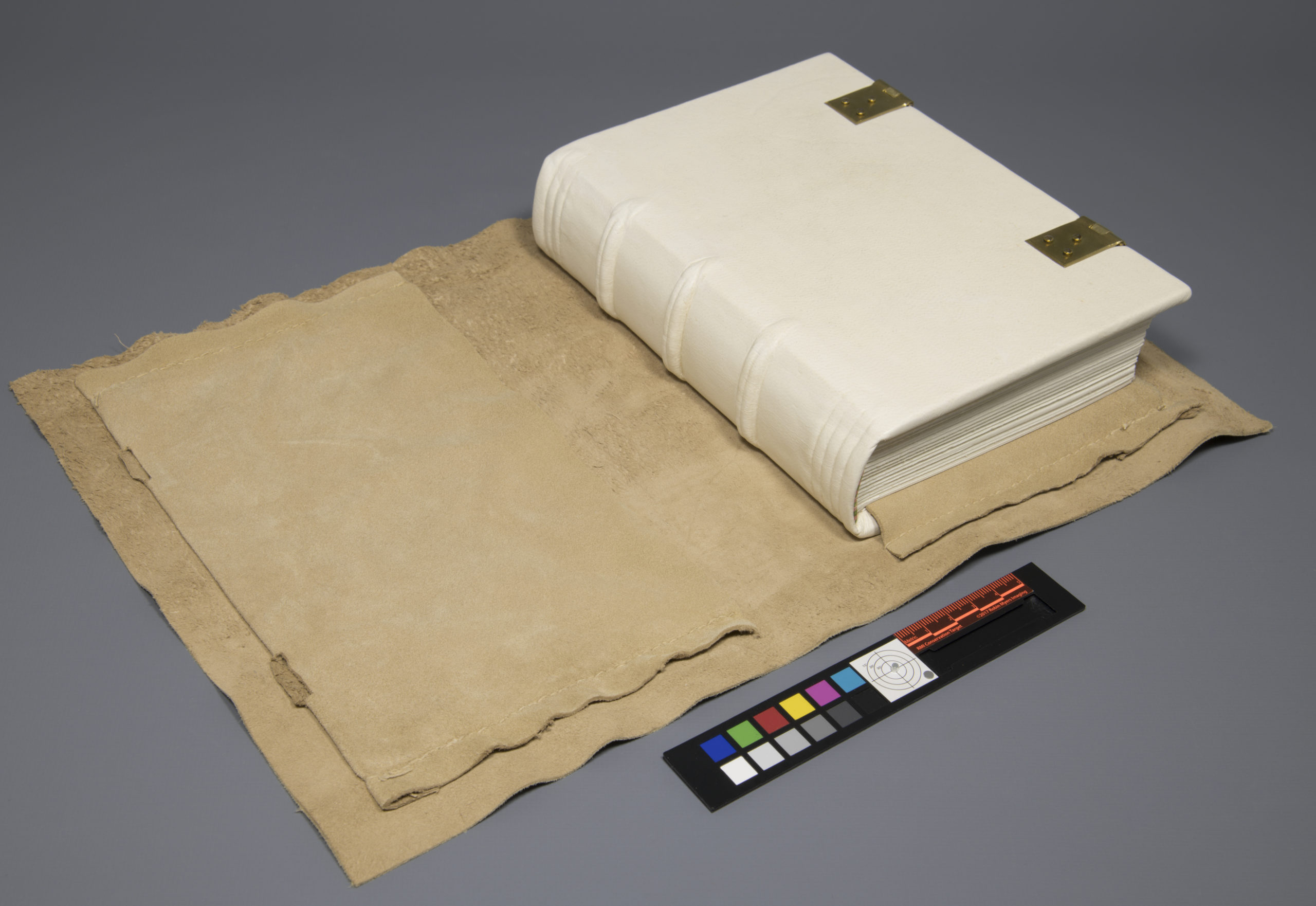
In February 2019, the Lab received a unique item at the special collections’ meetings for the UC Libraries, a Book of Hours (ms.37) from 1475 from the Archives and Rare Books Library. I was so excited when this book came into the Lab.
This 15th century Book of Hours was in poor condition and in need of conservation treatment. Not only was the binding structure failing and the text block broken in half, but this book was also heavily used as a teaching tool at the ARB library, and in its current condition it could not be safely handled. This was the perfect project for Ashleigh and I to collaborate.
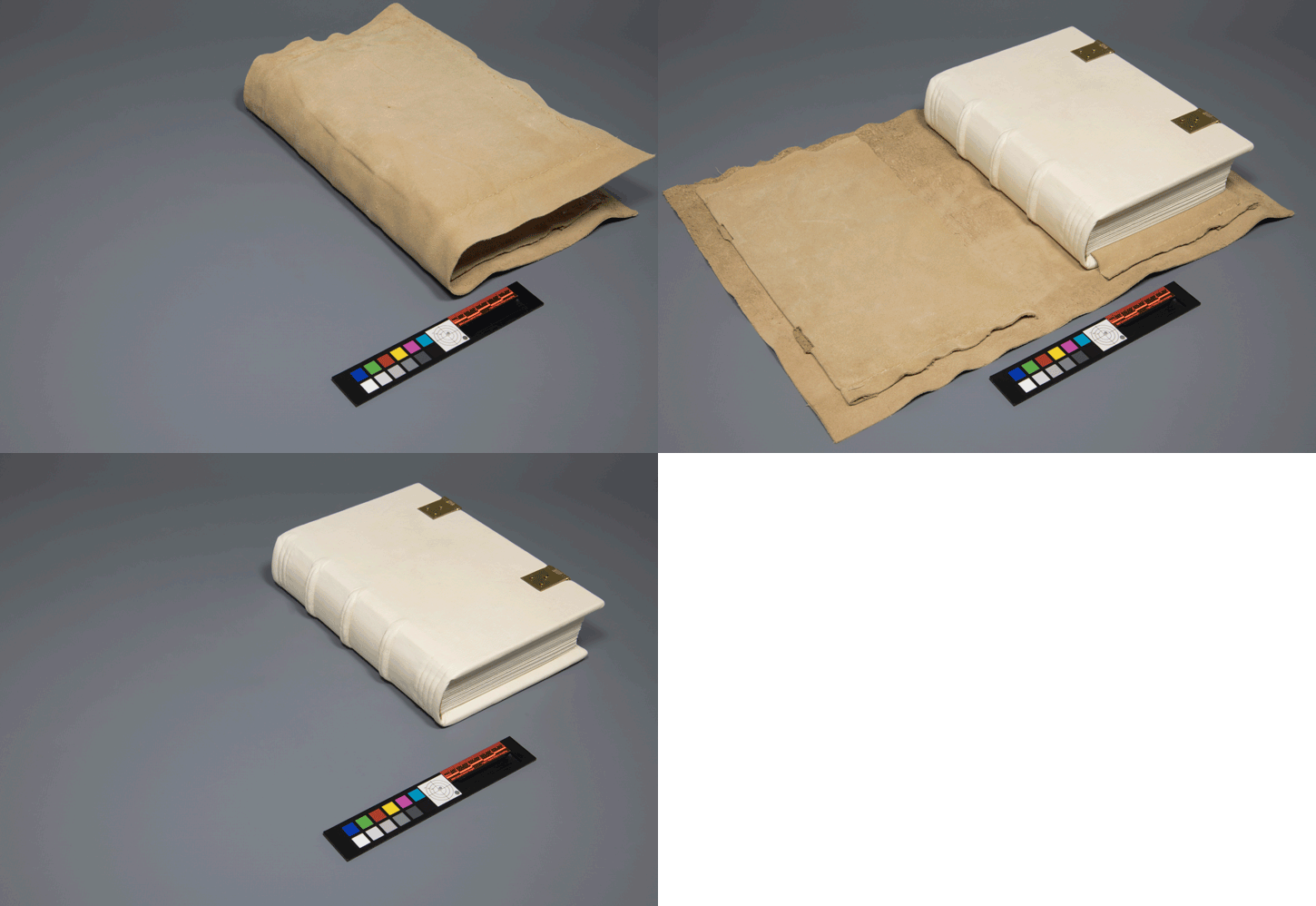
From the beginning, it was decided that in conjunction with the conservation treatment of the Book of Hours, I would create a book model like the original Book of Hours, to be used as a teaching tool in the ARB library collection. In addition, the model would have a leather chemise, a common feature in some Book of Hours of the time.
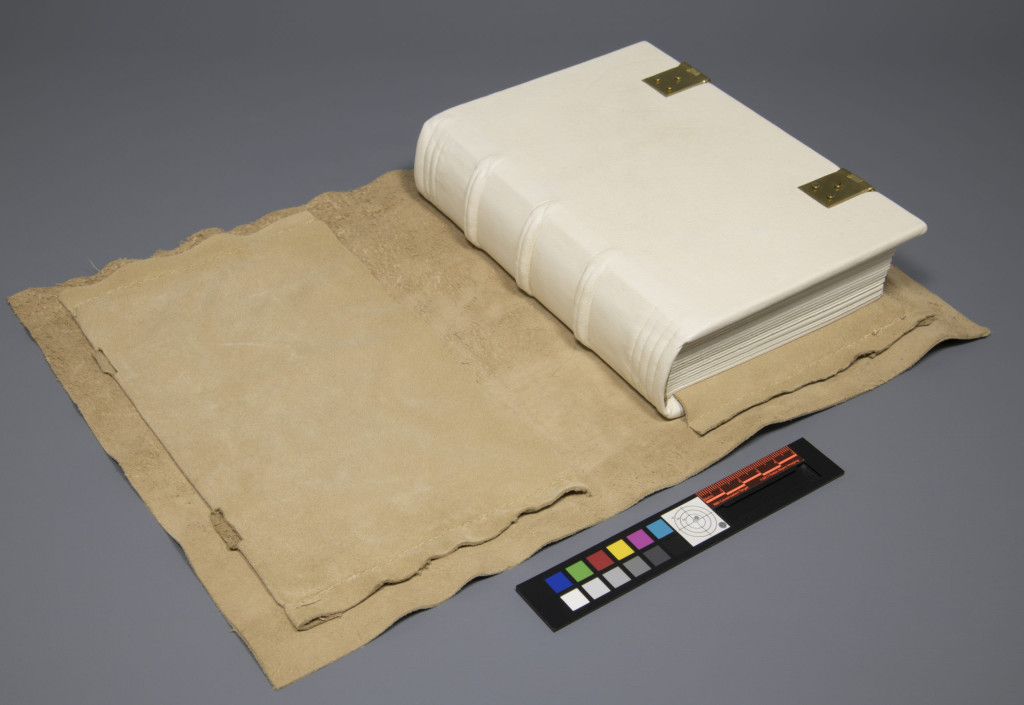
The Book of Hours MODEL with a removable chemise.
Now here is where this story begins with the model of the Book of Hours. Often, here in the lab, we all create book models for various reasons: to learn about a new treatment, test different treatment options, to understand how some materials work together, and as teaching tools.
As a teaching tool in the ARB library collection, this model needed to resemble the original Book of Hours in its structure and materials used.
The primary goal for this model was to show how a Book of Hours was historically built, its sewing structure, the materials used, and also to provide the ARB library with a book that could be easily handled by students and scholars.
Once the treatment for the Book of Hours was fully established and confirmed with the ARB curator, I was able to start working on the book model. I will save you form reading about all the different steps of making the model, but here are the main features of model:
Endsheets with leather hinge – Two bifolios of calligraphy goat parchment skin wrapped along the spine edge with a hinge of Allum tawed leather (later would be used as pastedowns)
Sewing – Sewn on three double raised cords with a linen 18/3 thread. The dimensions of the text block and sewing holes, were guided from the original sewing holes of the Book of Hours.
Endbands – Primary conservation endband with the bead on the spine, and secondary endband with the bead on the text block.
Spine linings:
Reversible layer of Usu Gami thin and Zen Shofu wheat starch paste.
Slotted Airplane cotton cloth with flanges to be used as board attachments.
Cover
Boards – Oak wood
Board attachment – Boards were laced with the sewing supports through carved channels
Covering material – Full alum tawed leather binding with removable chemise
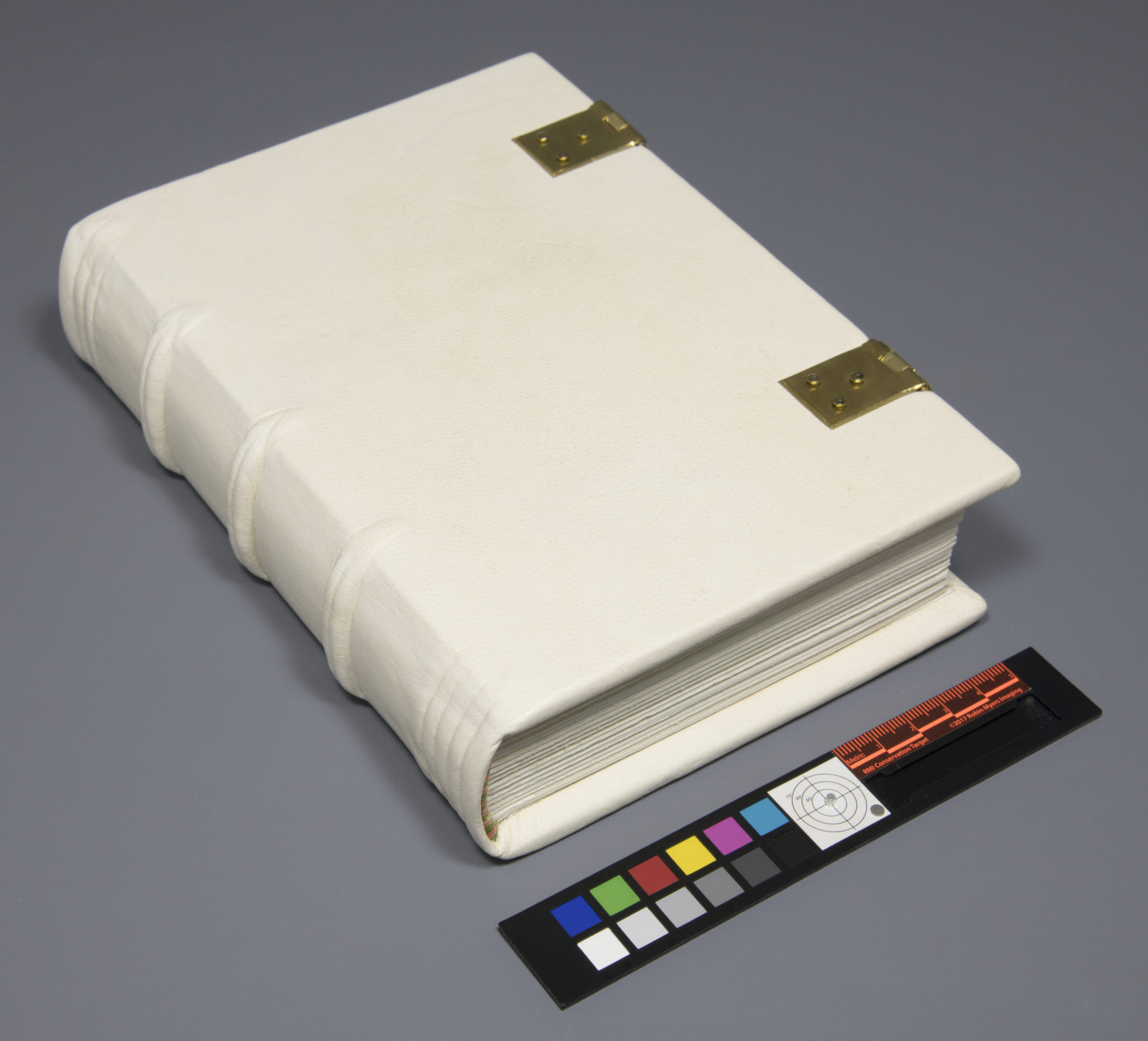
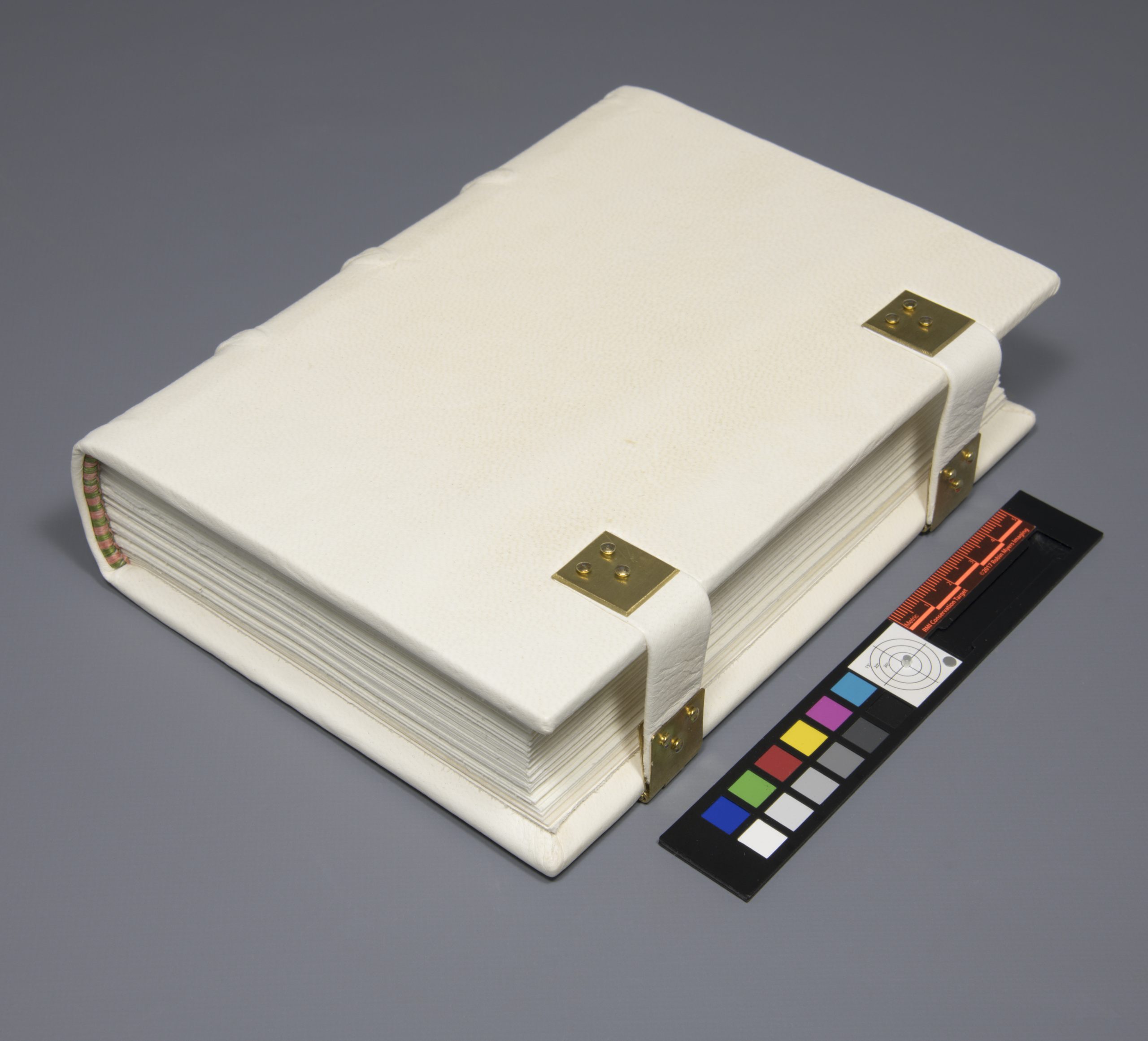
Clasps – Brass tension clasps (these were created in-house by Chris Voynovich, and he did an amazing job).
Upper cover.Lower cover with the tension clasps (created by Chris)
There was no evidence that the original Book of Hours had clasps, but the curator requested tension clasps for the book model. Clasps were common in the 15th century bookbinding, and this would provide the students with the experience of handling a book with clasps and allow them to understand their function.
pine with three raised bands, bottom weighted.Tension clasps were common in the 15th century. Chris created these using brass plates.As a teaching model, the interior of the upper cover was left exposed to show how the boards were laced and what material was used.On the lower cover, the pastedown was adhered. An alum tawed pastedown was not very common for the time of the Book of Hours.
The curator also requested that one of the pastedowns be kept unattached, so the students could see how the boards were attached to the text block and that they were wooden boards.
In addition, I created a removable chemise, also requested by the curator of the ARB library. In some Books of Hours, it was common to have a leather chemise, but most often they were not removable. The chemise was created from a vegetable tanned goat split skin.
Removable suede chemiseBook model with the chemise attached on the lower cover. The chemise in action.
Video tutorial of how to put on and remove the chemise from the model.
Stay tuned for a future blog post where we will dive into the conservation treatment and research we did on the Book of Hours (ms.37).
After a two year hiatus, the Preservation Lab once again was able to celebrate the American Library Association’s Preservation Week. And this year, the lab decided to take Preservation Week to the public.
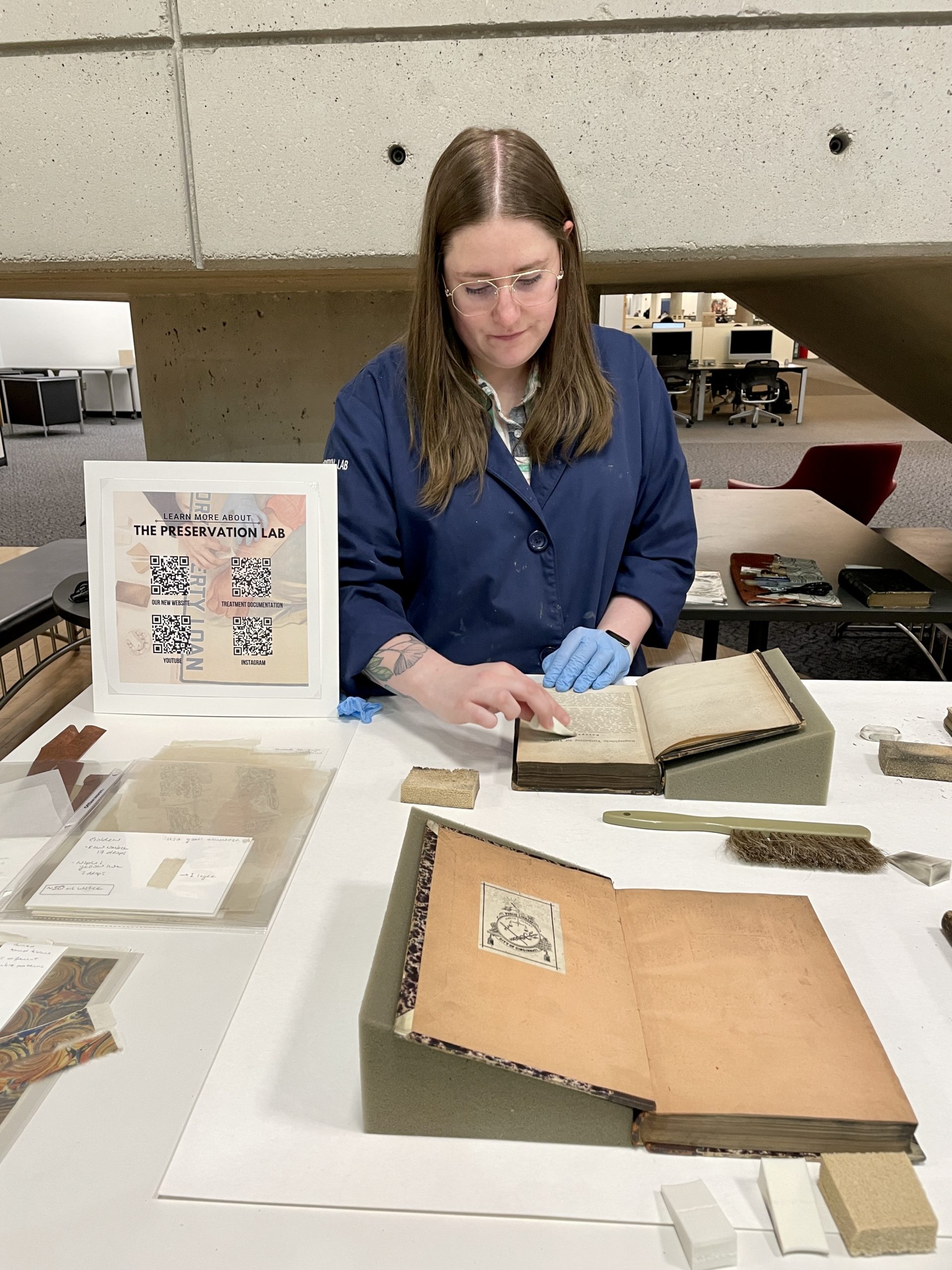
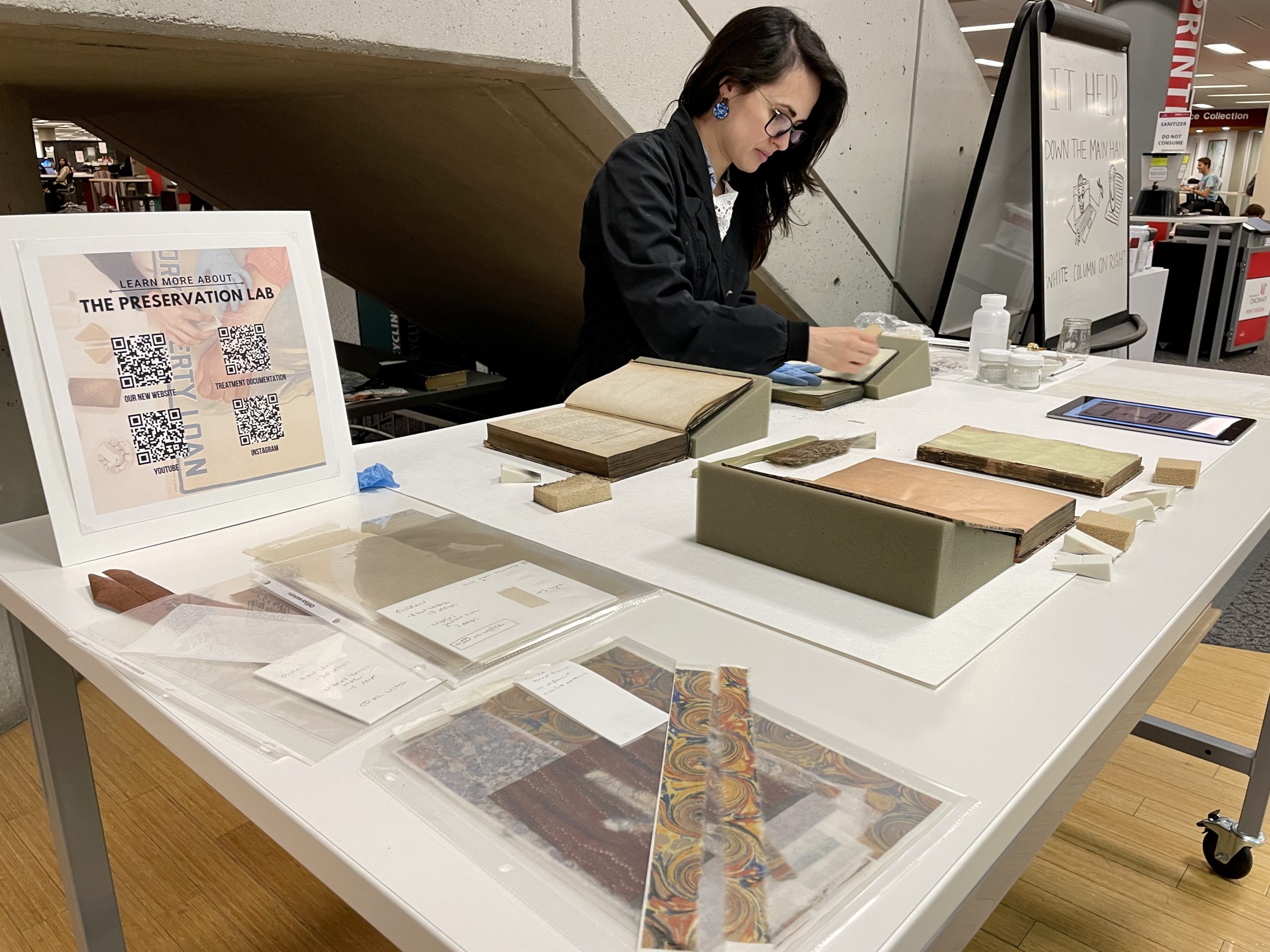
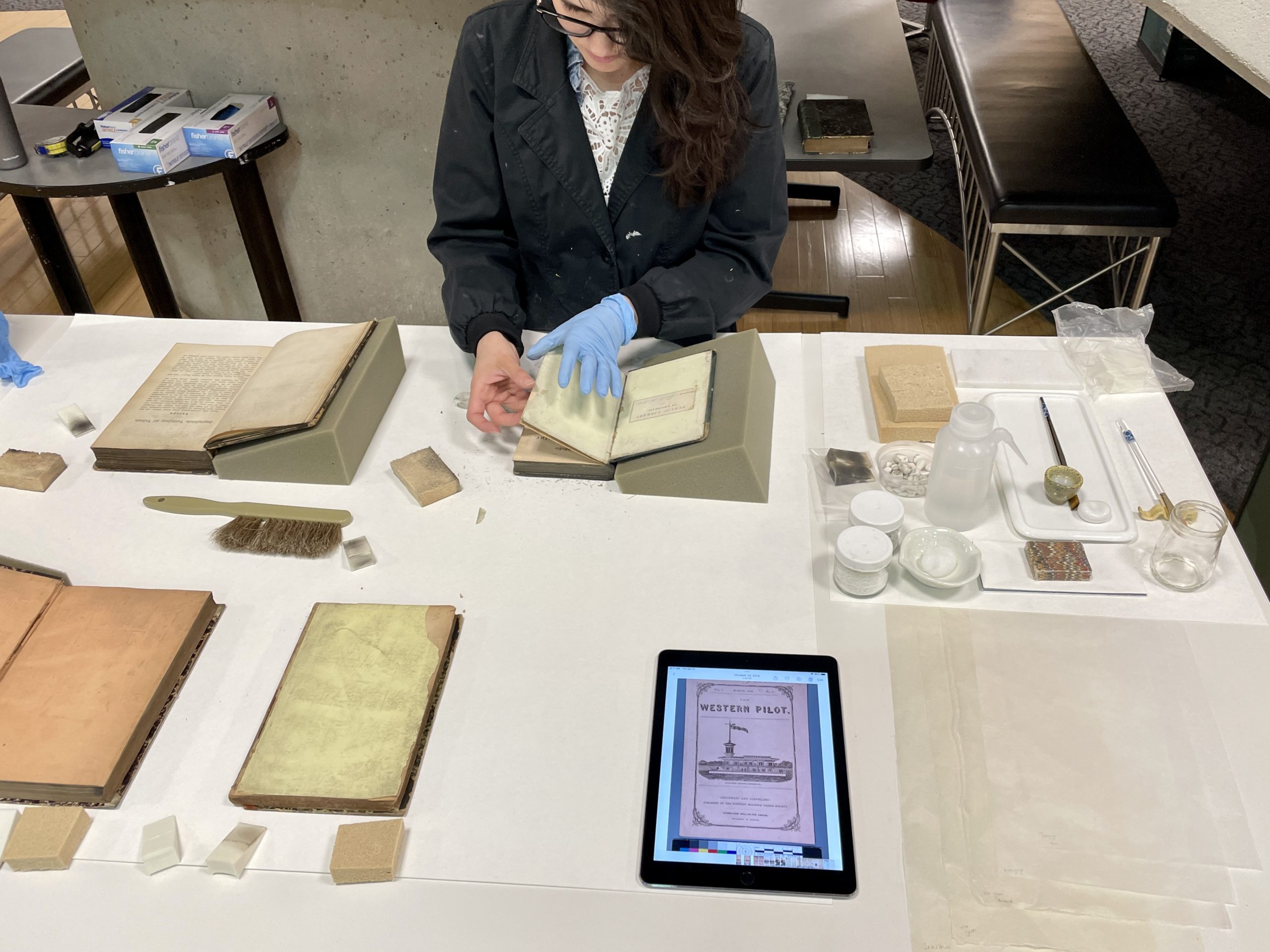
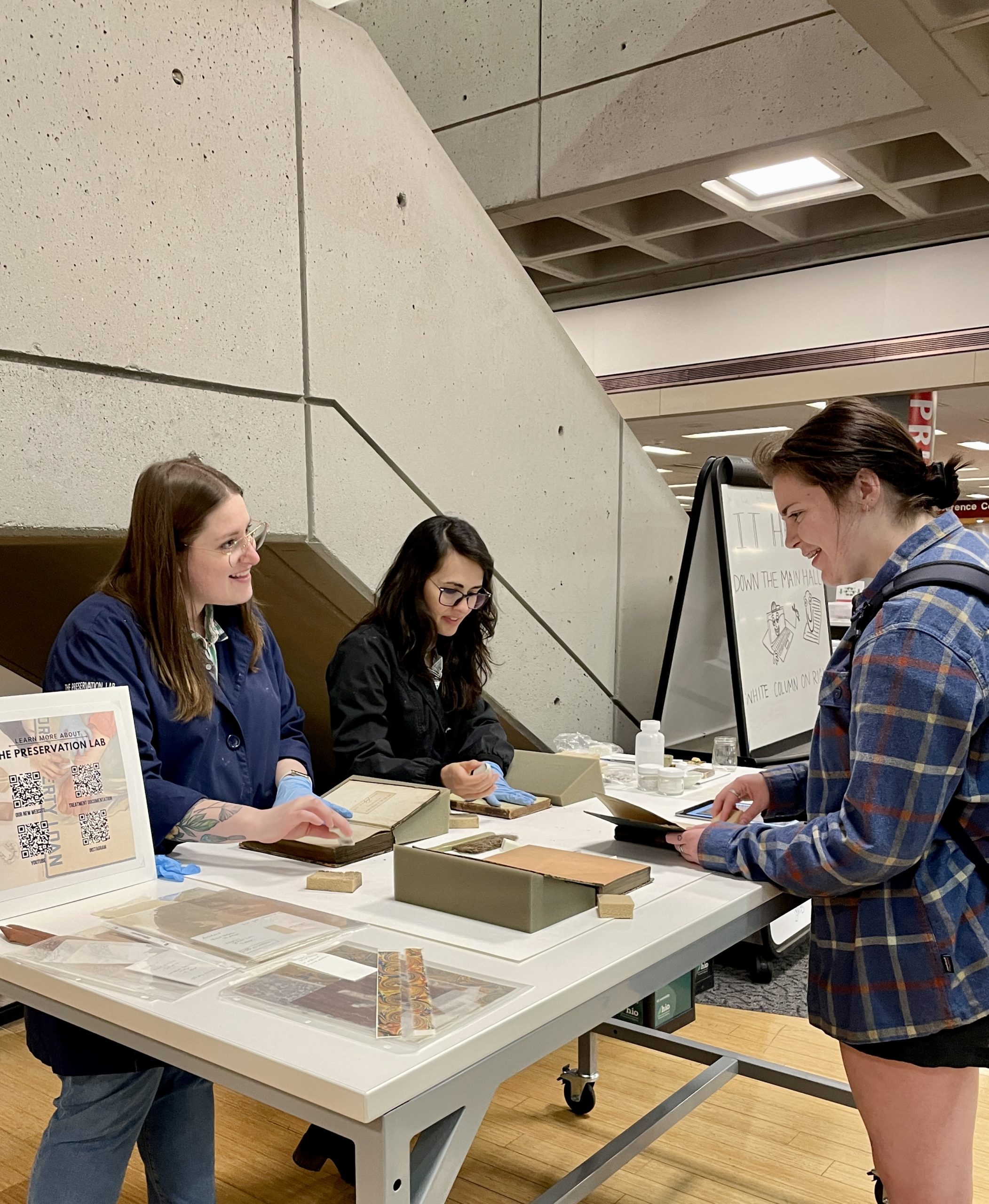
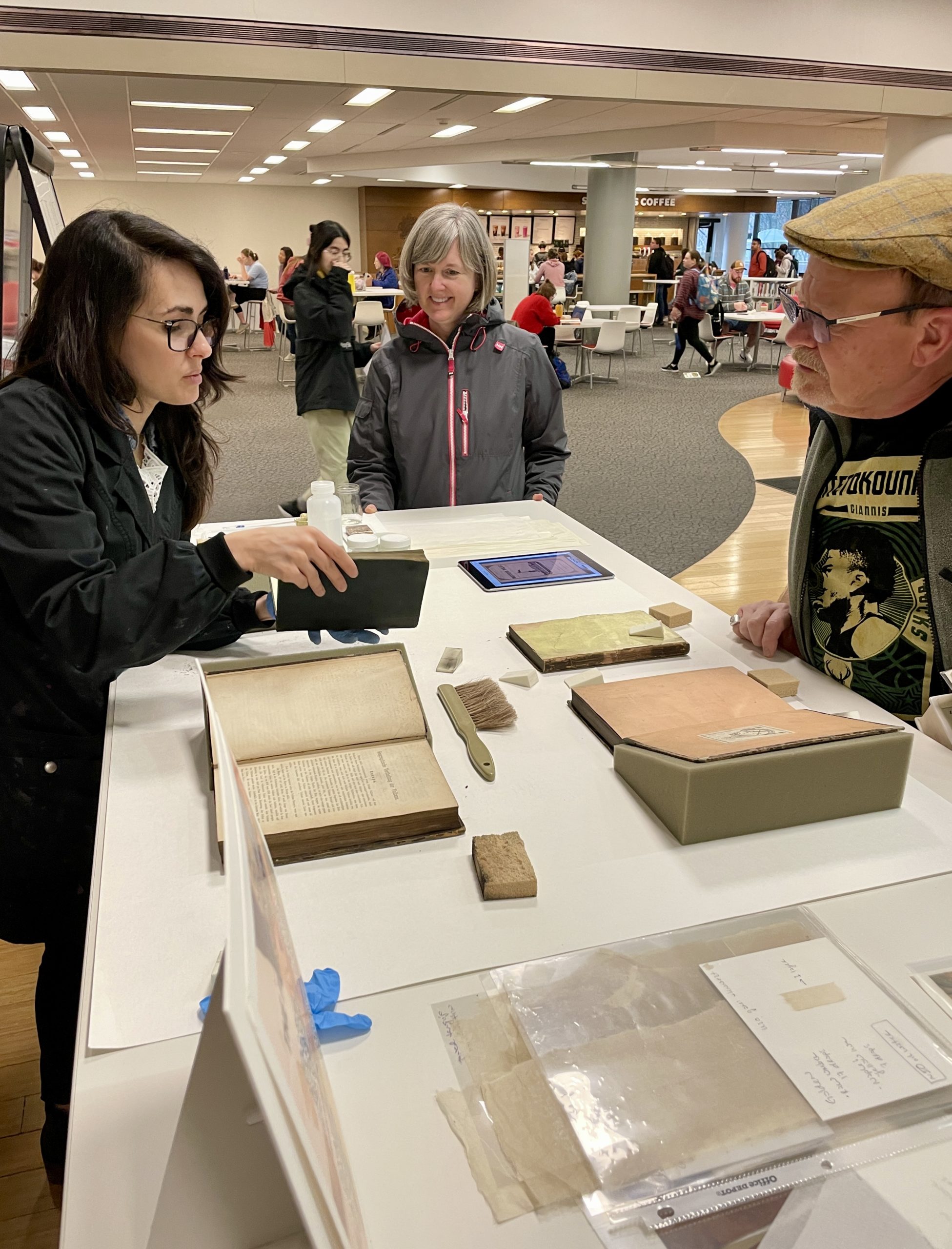
On the morning of April 21st, Catarina and Jessica took one of the lab’s rolling work tables to the entrance of the Langsam library. There they set up a demonstration area with some very dirty books, to show the public a little bit about surface cleaning. They brought out the different supplies used in surface cleaning (such as hydrophilic sponges, smoke sponges, eraser crumbles and vinyl erasers). In addition to surface cleaning materials, Jessica and Catarina also brought some Japanese tissue for the public to touch and learn about tear repair.
Jessica is actively surface cleaning a very grimy book.Catarina is surface cleaning a dirty book using a hydrophilic sponge.Another view of the entire set up with a tear repair station.
A few members of the public were too nervous to even try to surface clean a little bit of the dirty books (all filled with soot from coal burning stoves), but others were brave enough and felt that surface cleaning was a very satisfying and relaxing treatment.
Jessica encouraging a UC student to try to surface clean.Catarina explaining why surface cleaning was the first step to repair the broken inner joint.
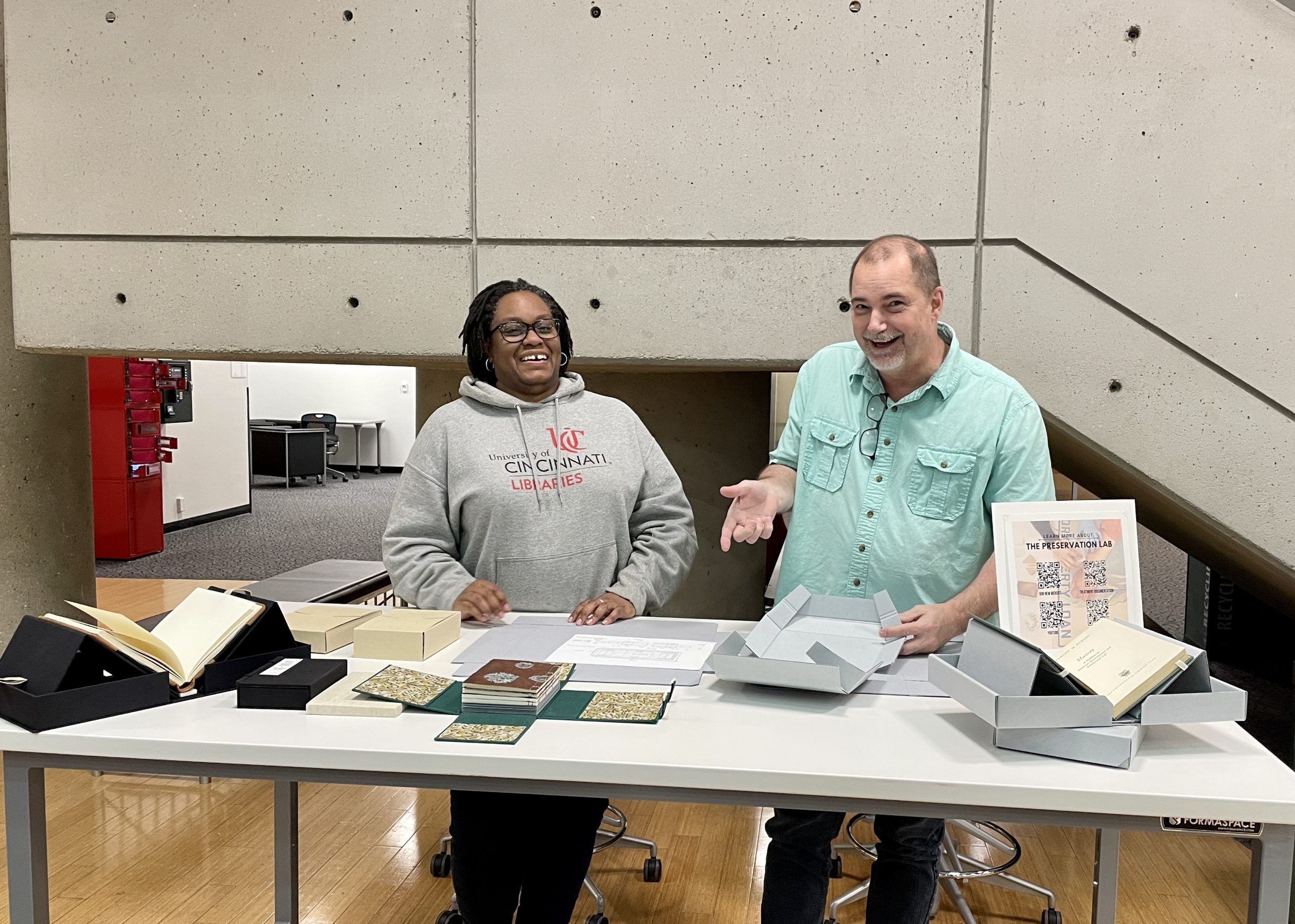
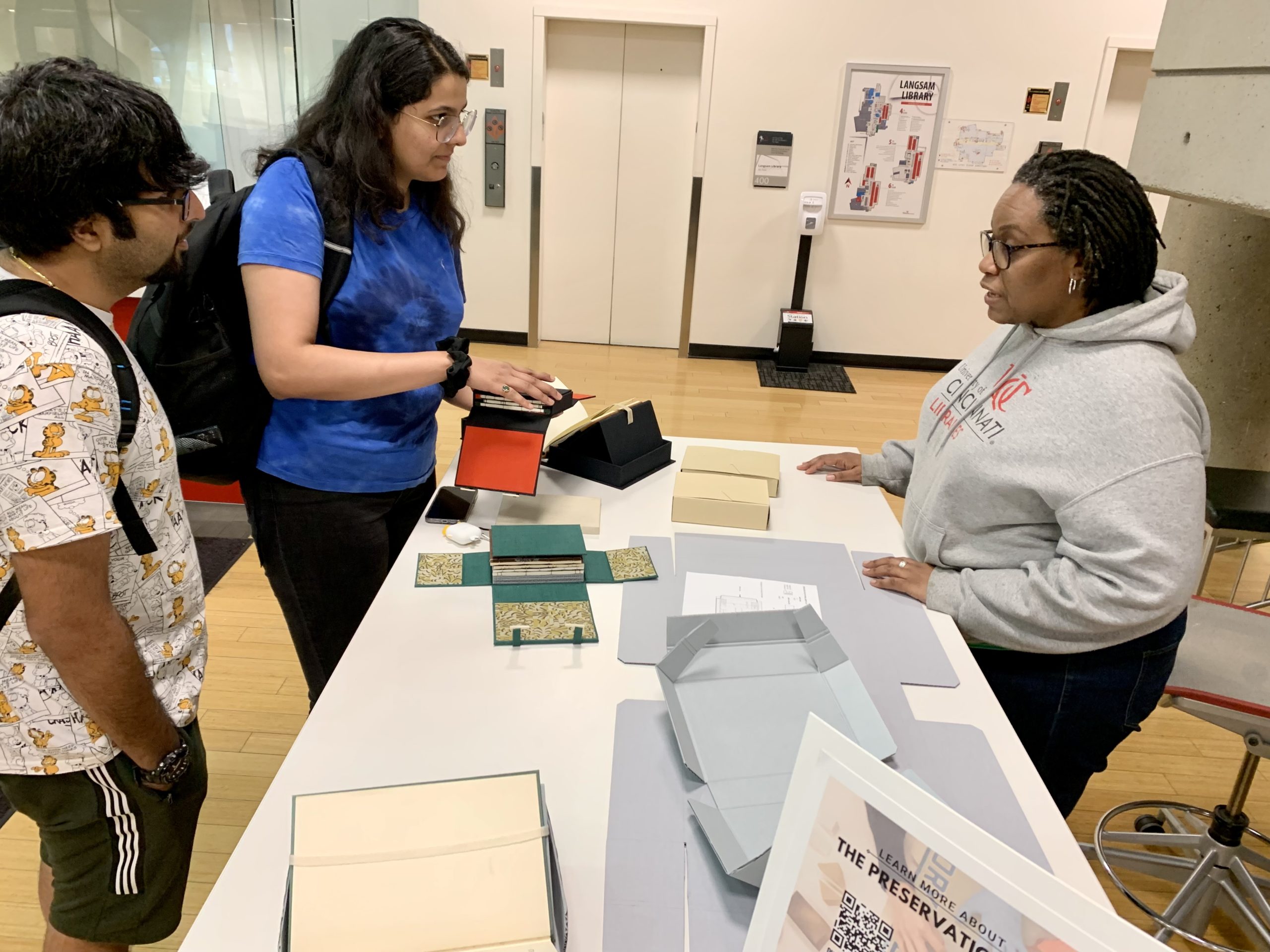
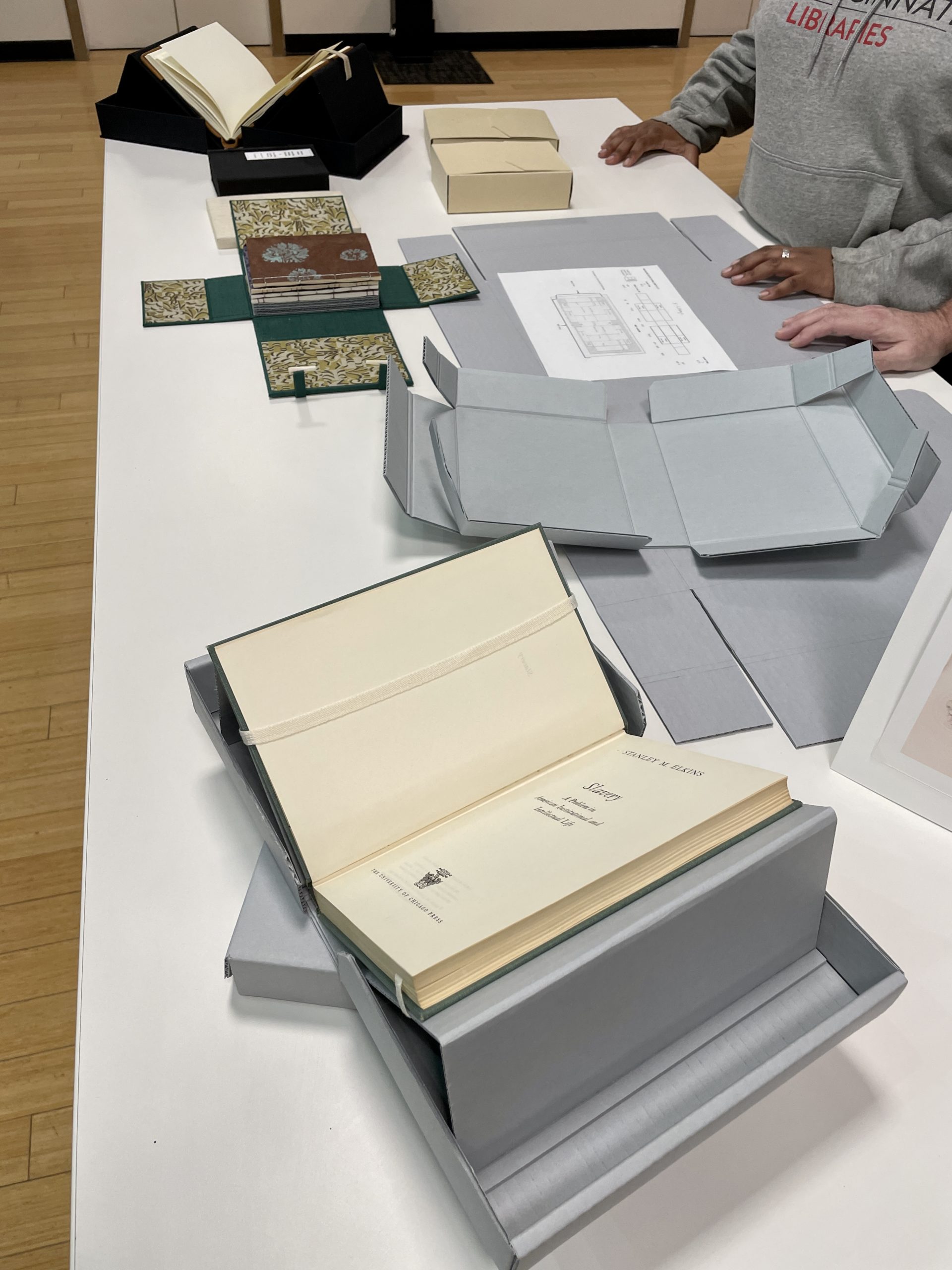
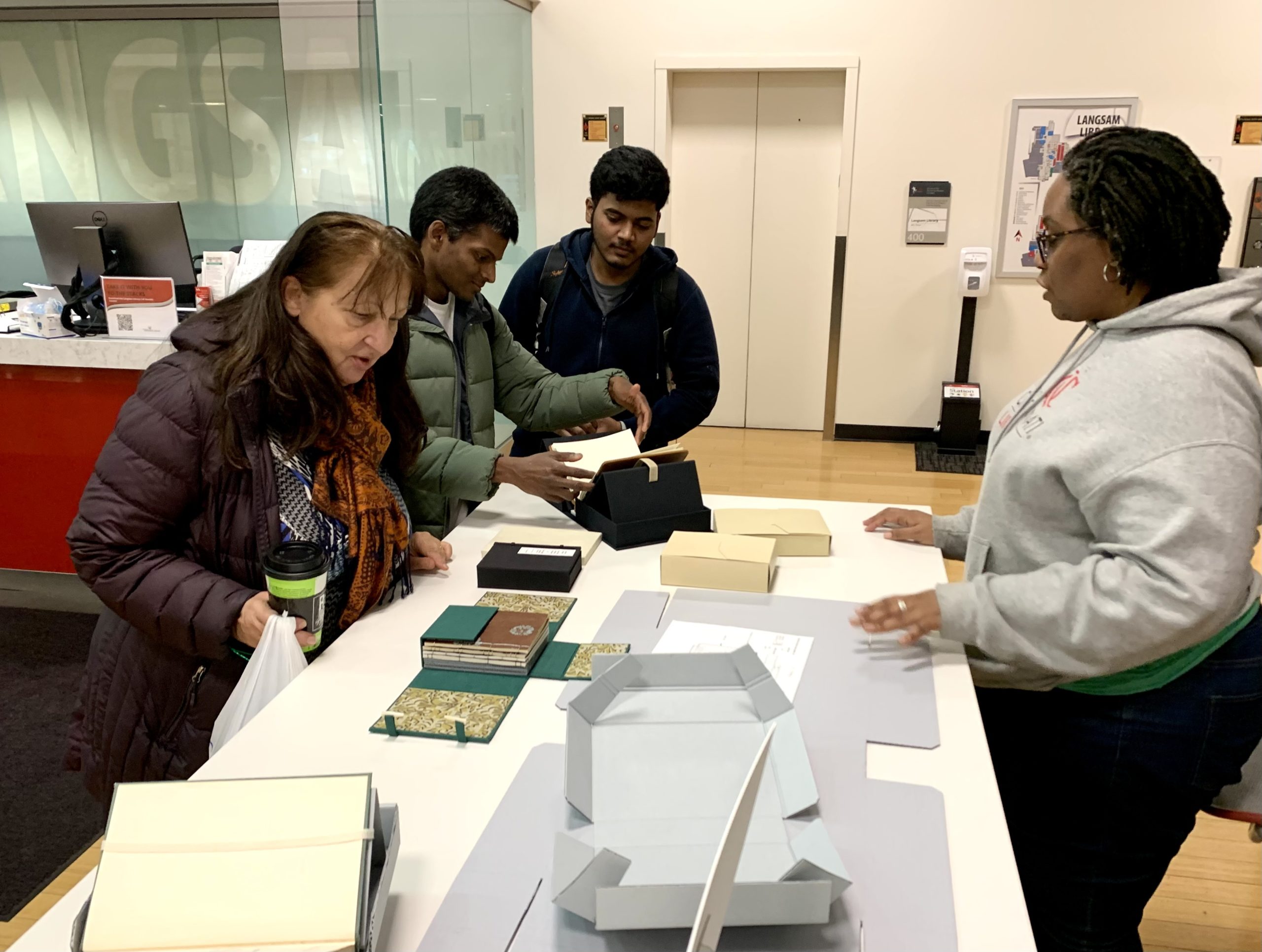
In the afternoon of the same day, Chris and Hyacinth showed the public a variety of enclosures and how they are made from beginning to end. There were corrugated clamshell boxes, one with an integrated cradle, cloth clamshell boxes, tuxedo boxes and a Japanese four-sided enclosure.
Chris also brought a corrugated clamshell in its early stages to show the public how the process of making a corrugated clamshell begins.
Chris and Hyacinth showing their display of models and enclosures.Hyacinth explaining to some UC students the different Japanese four-sided enclosure compared to other enclosures.The different enclosures that Chris and Hyacinth showed to the public. Hyacinth sharing with an interested public.
The crowd favorites were the elaborate cloth covered clamshell box made by Chris, and the beautiful Japanese four-sided enclosure made by Hyacinth.
Even though this was a smaller event compared to our open house tours of the past, the event was a success; allowing the Preservation Lab staff to share with the UC community a peek into our daily work and explain what goes on in the Preservation Lab. But Preservation week is not done yet…
This upcoming Friday, April 29th at 1 pm, join Holly and Ashleigh at the Clifton Branch of the Cincinnati and Hamilton Public Library, .They will be showing some books models, explaining how books are made and what materials are used. You can find more details in the following link: https://cincinnatilibrary.bibliocommons.com/events/625422b5cd8e792f000bcfc5
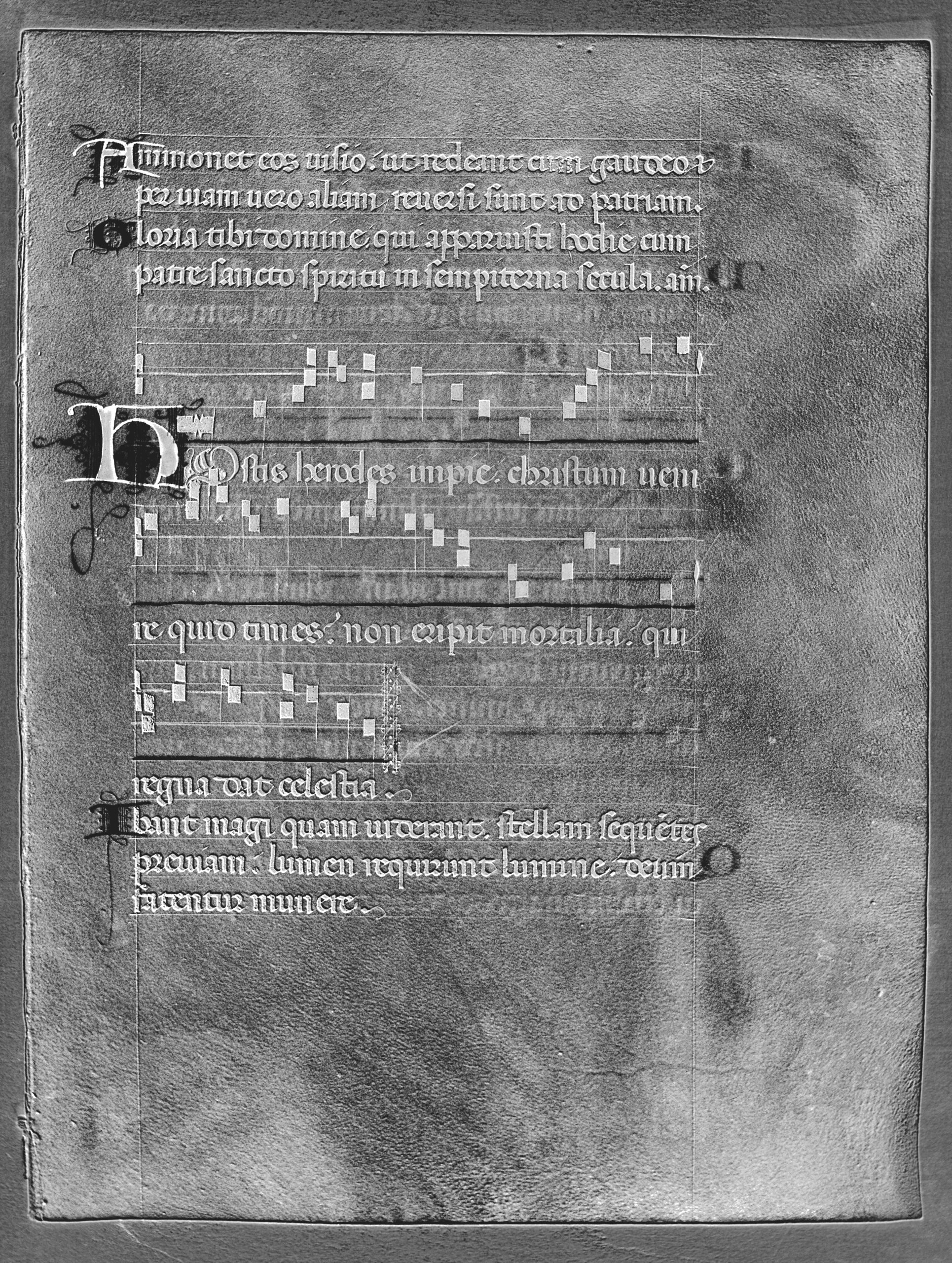
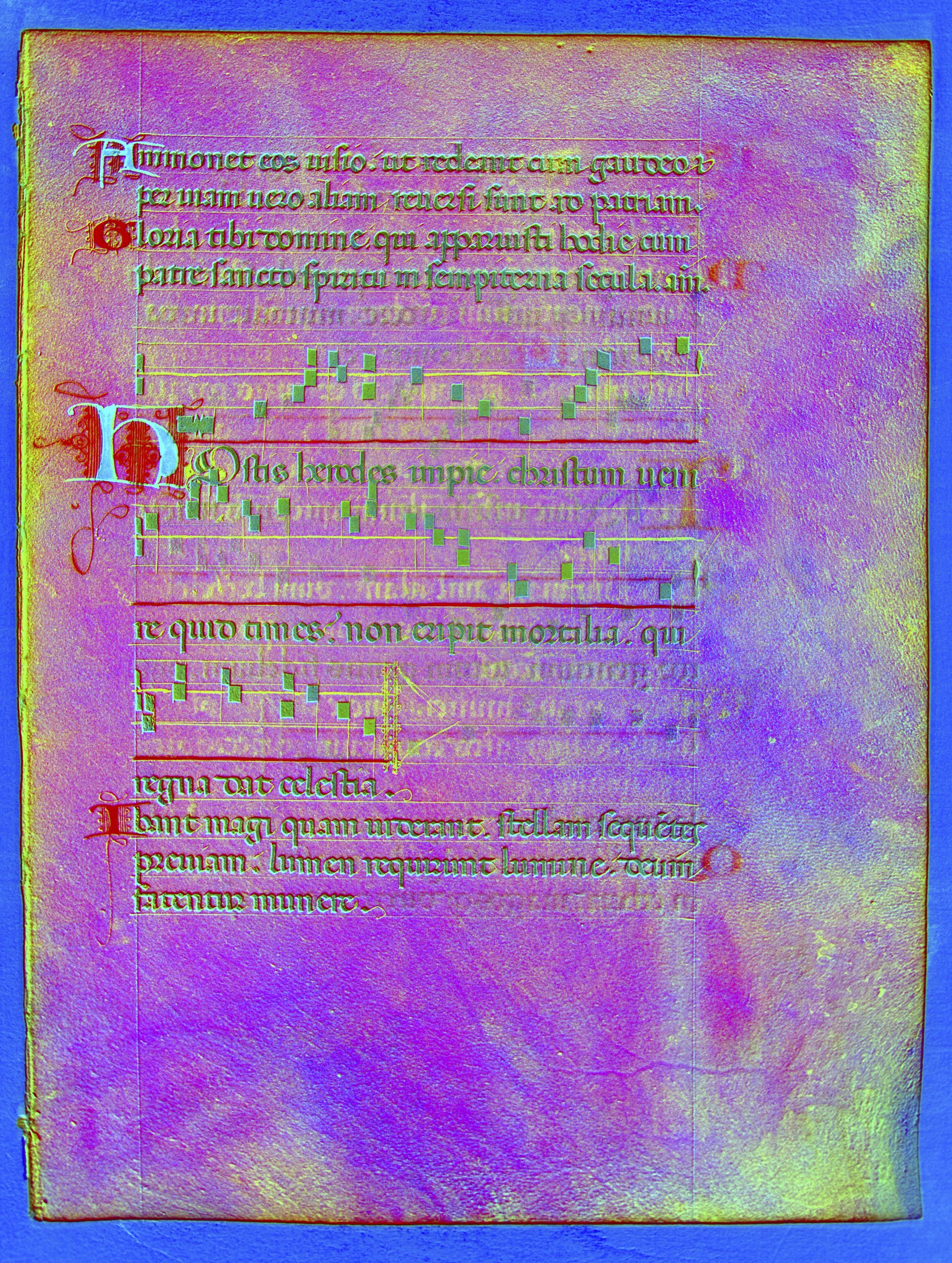
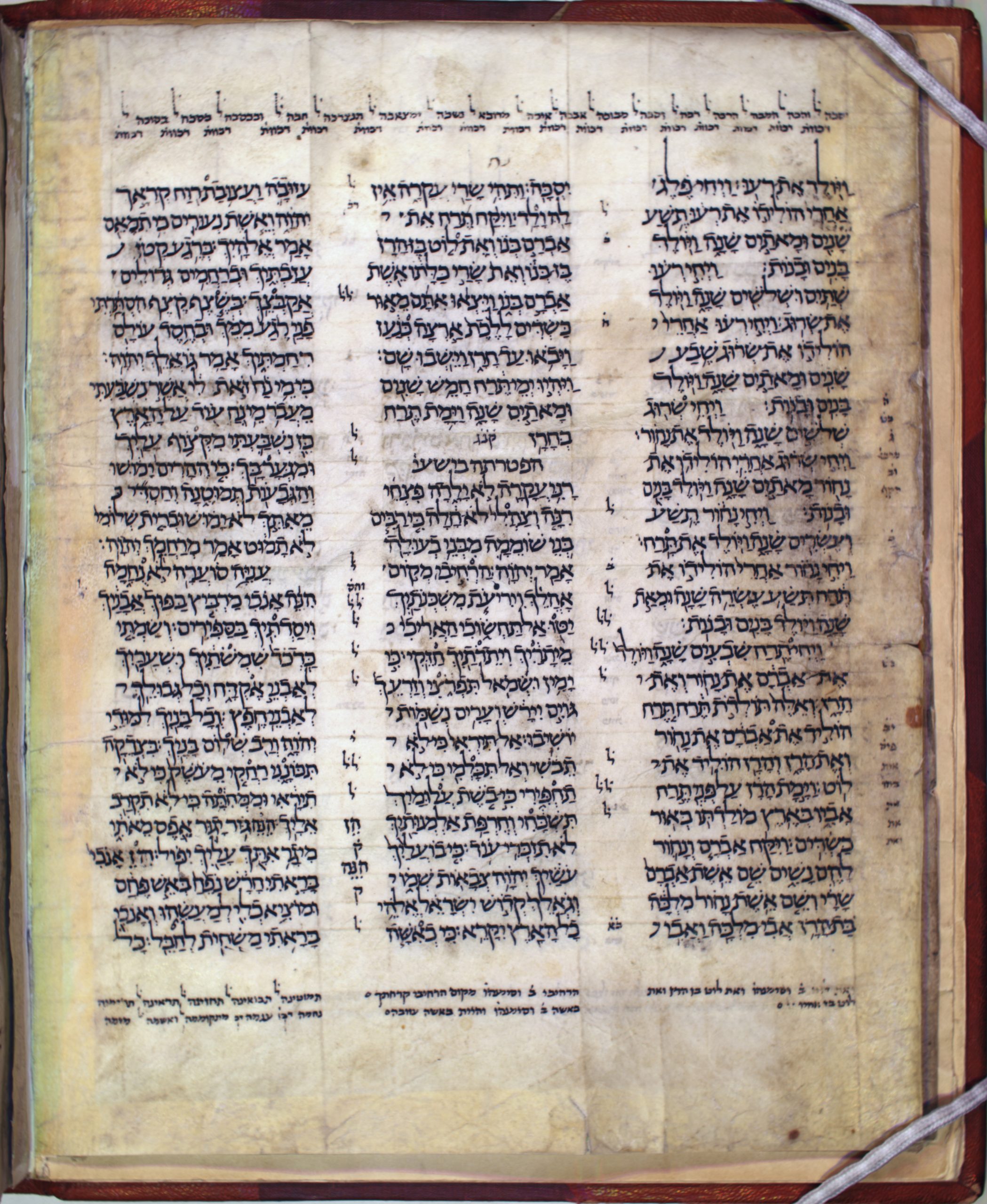
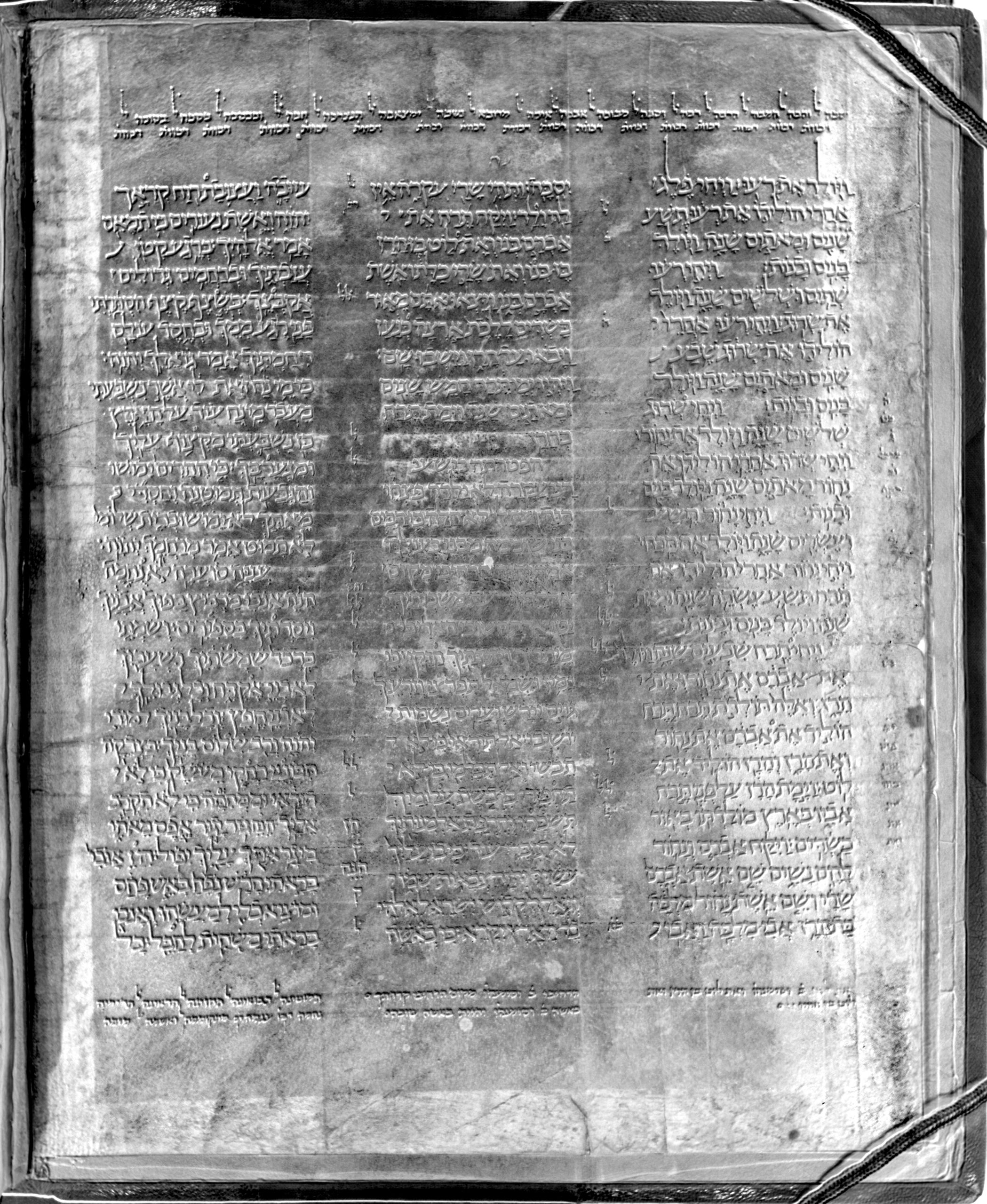
As mentioned in a previous blog post, Andrew and Naomi from Case Western Reserve came to the lab in late February to demo the MISHA portable multispectral imaging system, made possible by a National Endowment for the Humanities (NEH) Research Grant awarded to the Rochester Institute of Technology. In total, Naomi and Andrew imaged five objects from the Public Library, UC Libraries, and one of our third-party institutional clients. Imaged books included, one Otto Ege item, two Book of Hours, one undated Latin music manuscript, and a Pentateuch volume from Hebrew Union College. In all, thirteen separate capture sessions were carried out for the five objects. Afterwards, the raw data from the capture sessions was shared with the Lab via OSF (Open Science Framework) so that I could process the data in the NEH grant supported open access RCHIVE (Rochester Cultural Heritage Image processing and Visualization Environment) software.
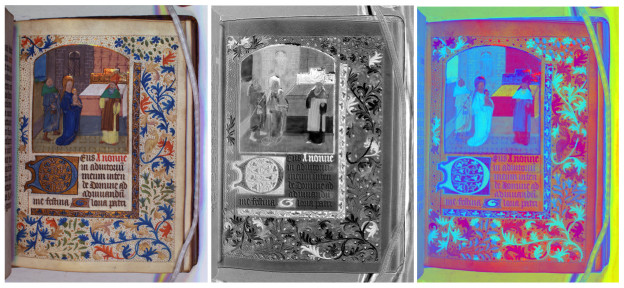
RGB representationBand 5 with the MNF (Maximum Noise Fraction) algorithm applied and the Gaussian enhancement appliedA false color representation
The image gallery above shows the recto of leaf 32 from the Public Library’s copy of Fifty Original Leaves from Medieval Manuscripts, Western Europe, XII-XVI century, by Otto Ege.
While each of the capture sessions took only two minutes to complete, I found that processing the raw data took me a bit longer to figure out. Processing the data felt very similar to using CHI’s RTI Builder and Viewer software. However, in this situation I did not have a week-long training opportunity to learn the ins and outs of the software and its functions. For the Spectral Analysis App, I had only a couple of brief documents to refer to, so the learning curve was a little steeper. I also experienced some issues with the software while processing the data with the flatfield files provided from the capture session. But in the end, the processed files seemed fine without the flatfield data, so it all worked out.
RGB representationBand 3 with the MNF (Maximum Noise Fraction) algorithm appliedA false color representation
The above image gallery depicts a leaf from Hebrew Union College’s Pentateuch Ms. 1 with adhesive staining, tape, and prior repairs.
What I discovered through processing all the MISHA data and then comparing it to the existing specialized imaging done in the Lab was that the suite of imaging we do in the Lab is very well rounded and, in general, suits our needs and our clientele quite well. In many cases, our results were at least comparable, if not better (specifically within the UV wavelengths) than the results accomplished using the MISHA. And, especially with our UV workflow, though our current capture time might be slightly longer than that of MISHA, the data processing time is significantly shorter and, in the case of UV especially, the side-by-side results of the accurate normal illumination next to the full color UV image(s) is ideal for our purposes.
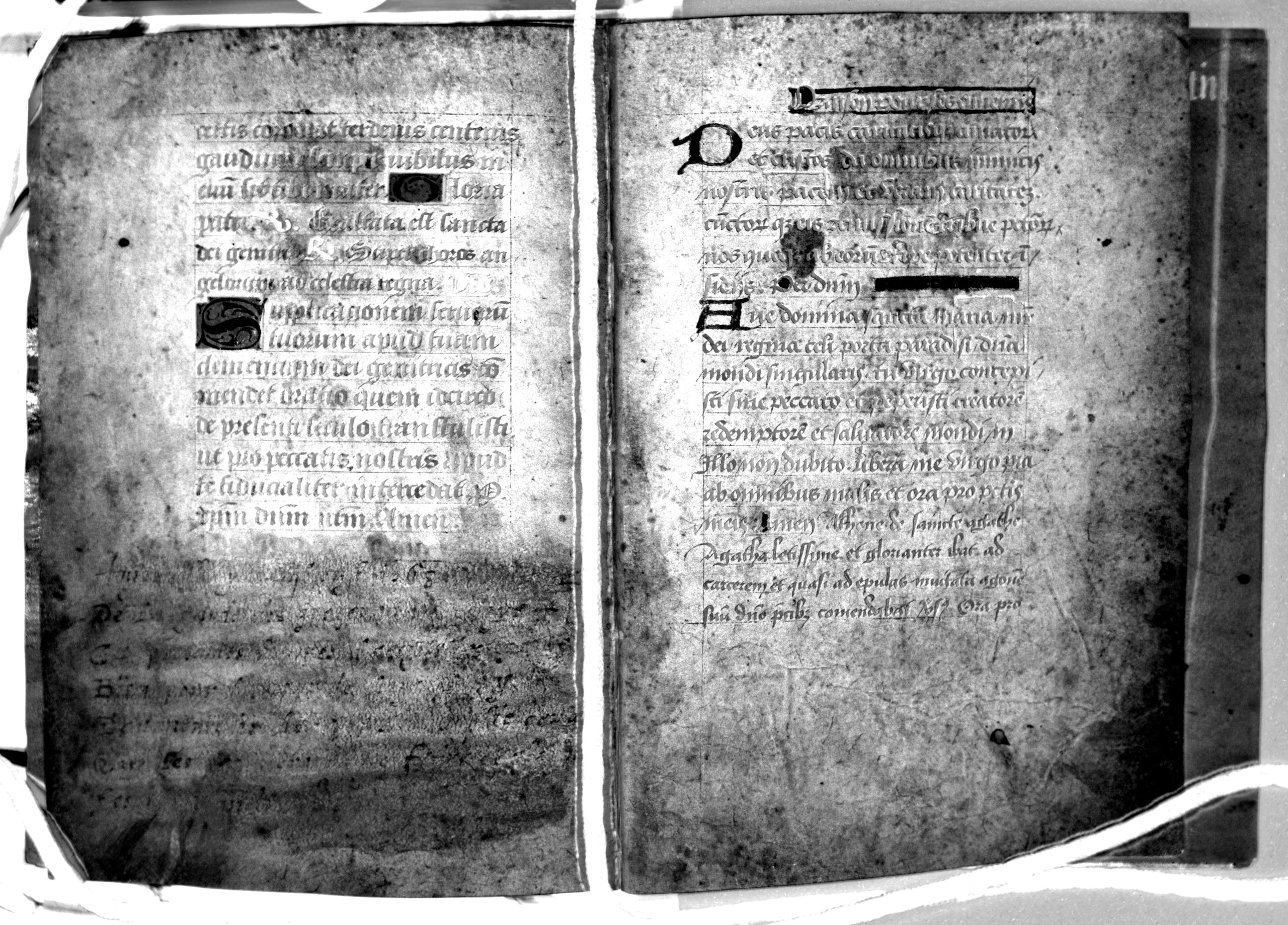
RGB representationand 2 using the Maximum Noise Fraction (MNF) algorithm with the brightness adjusted
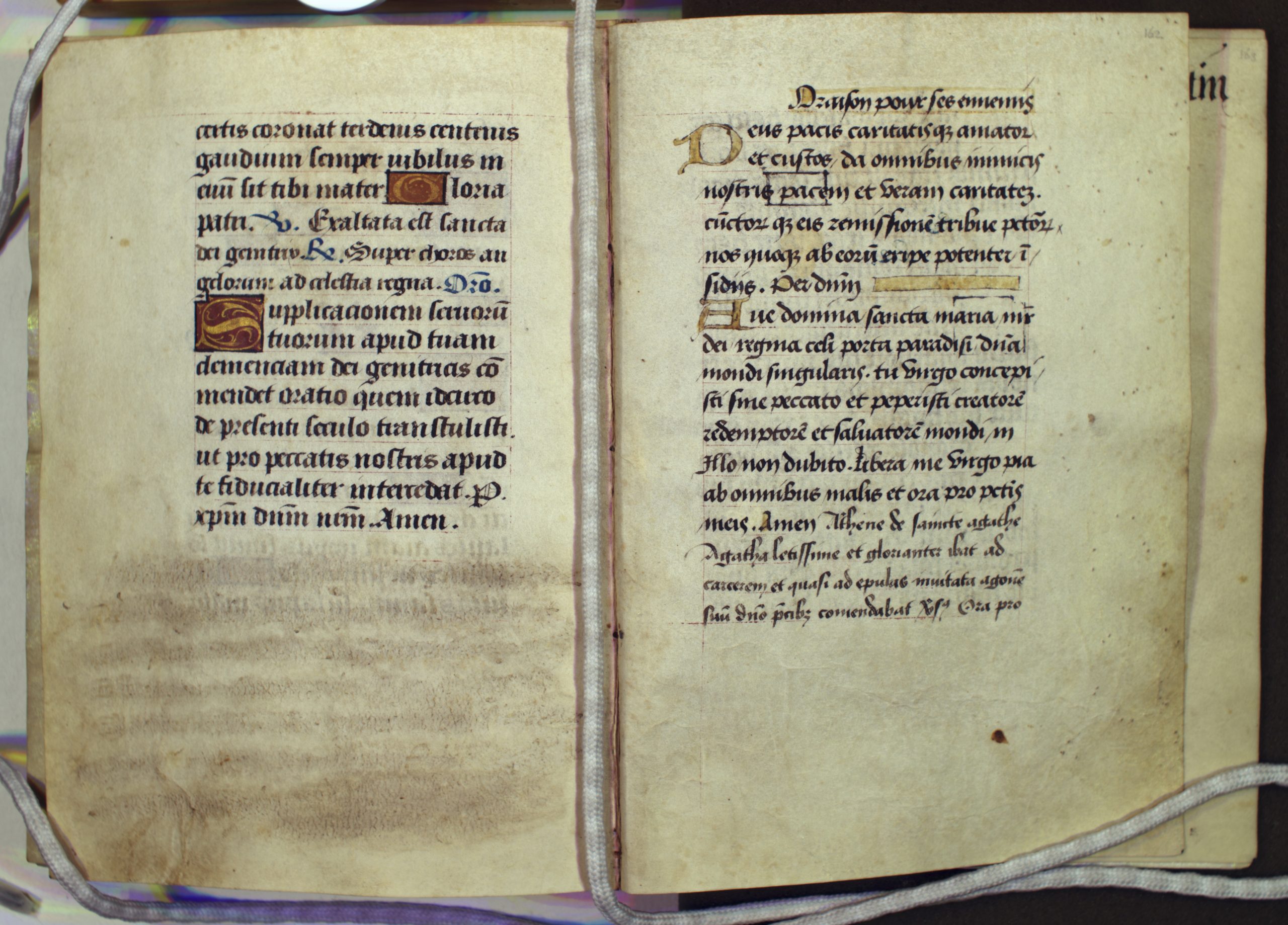
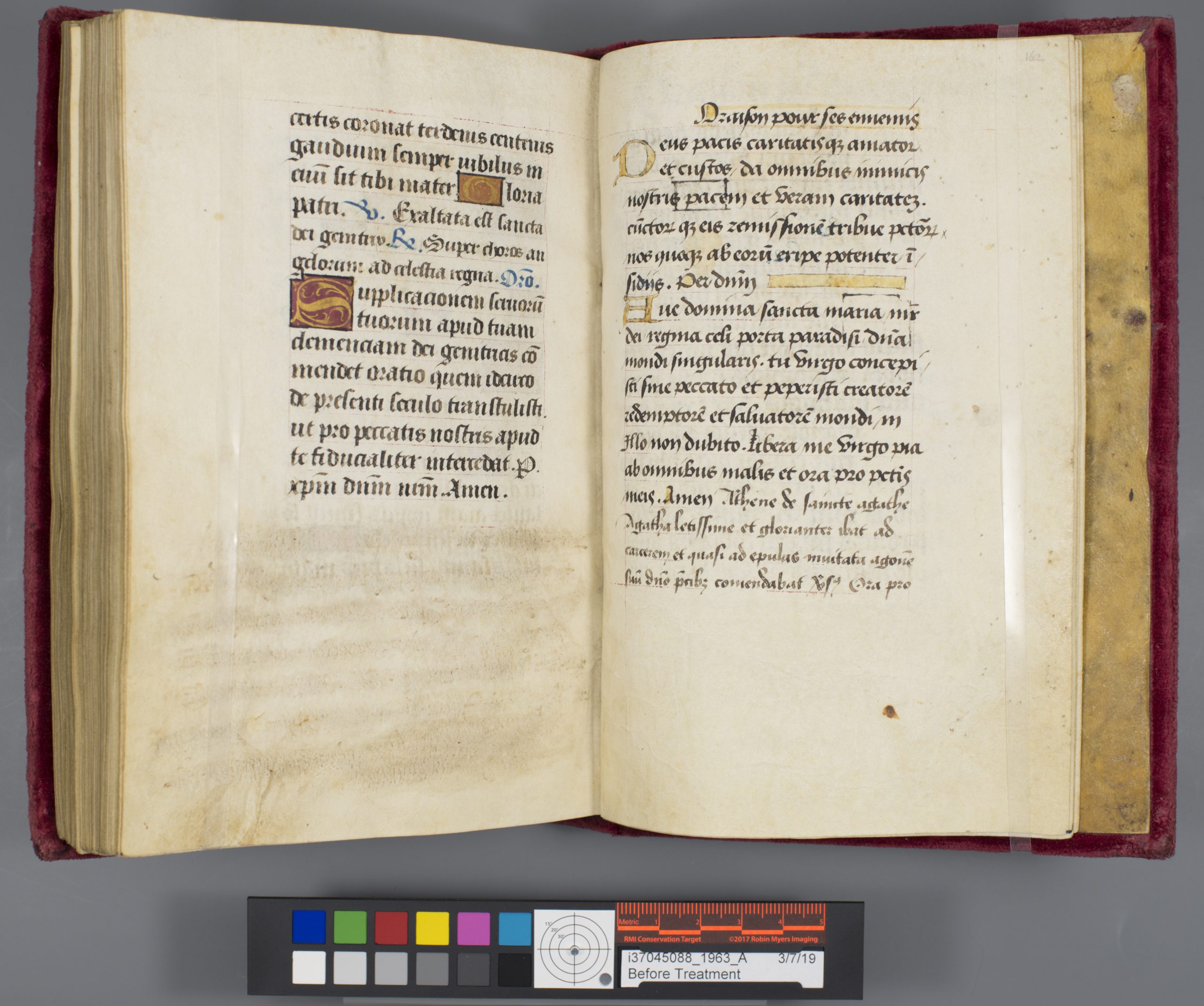
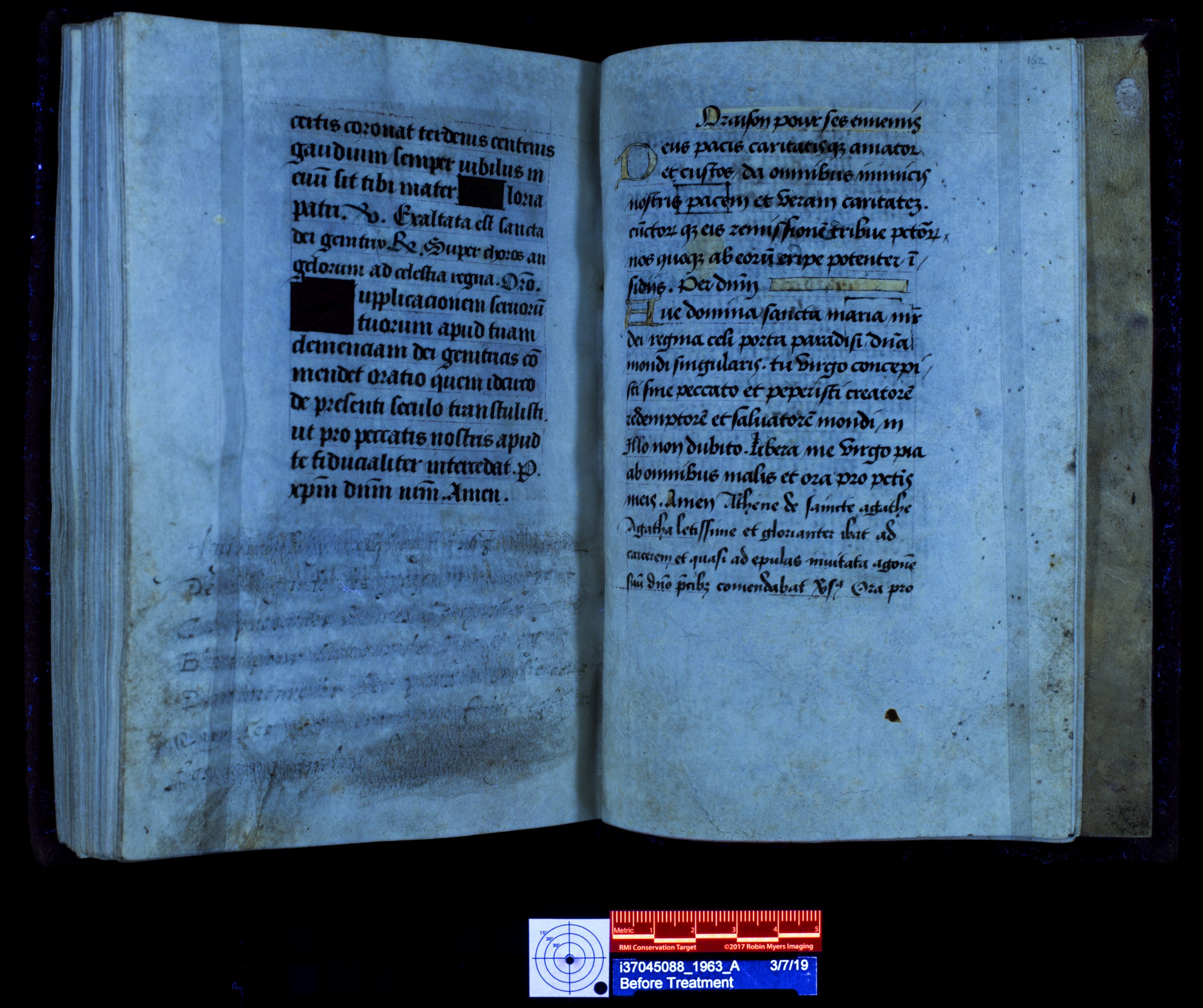
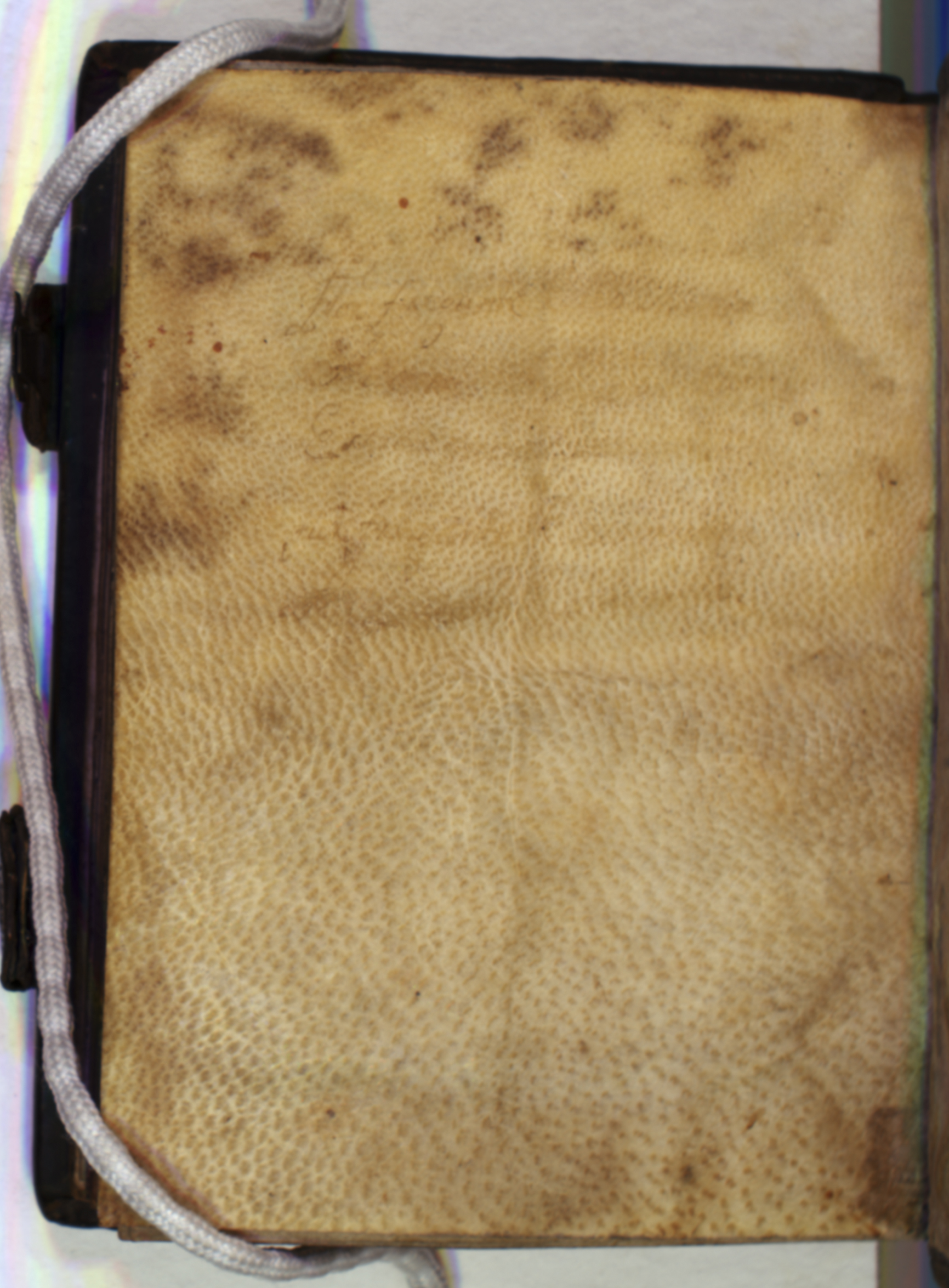
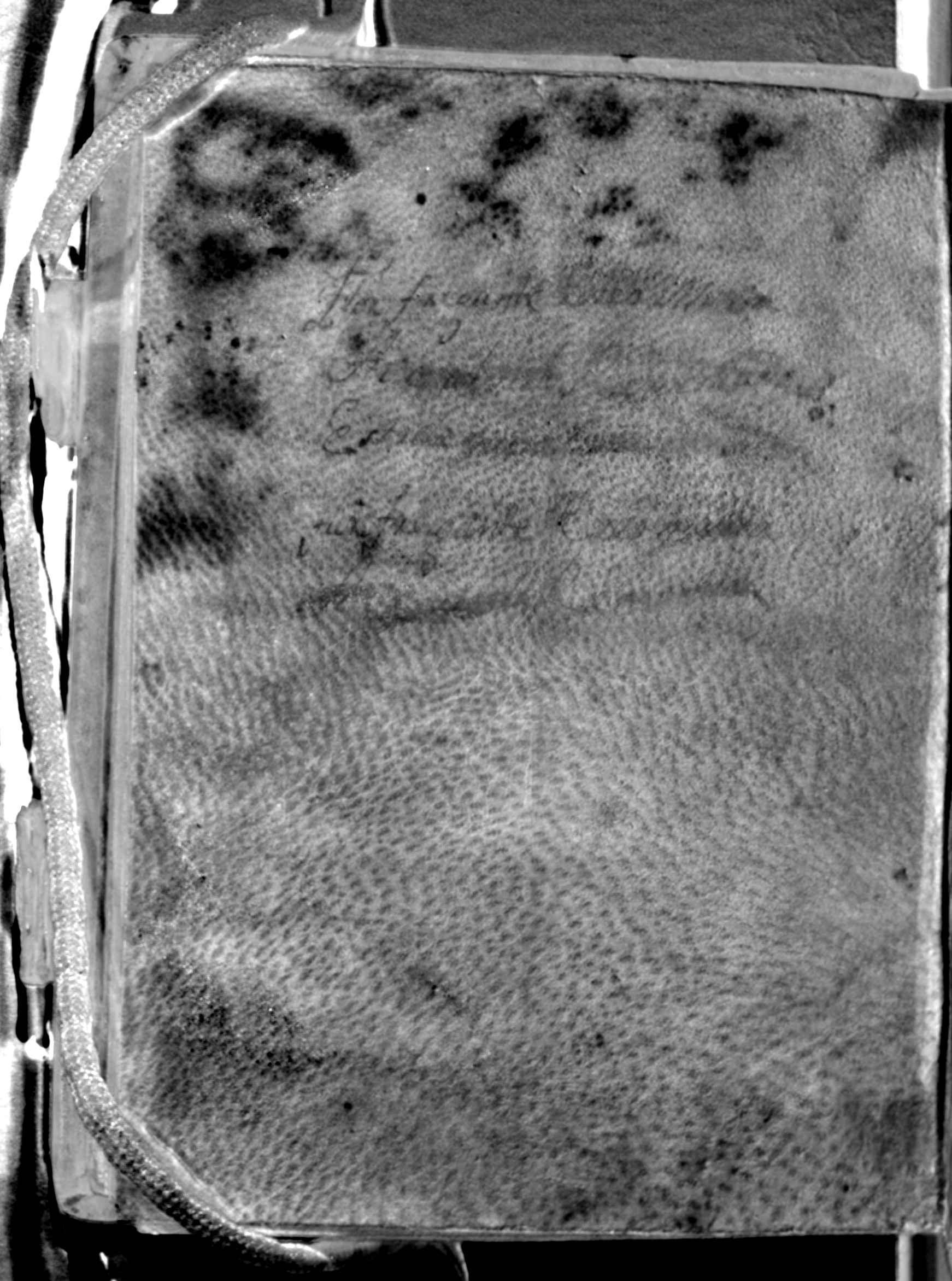
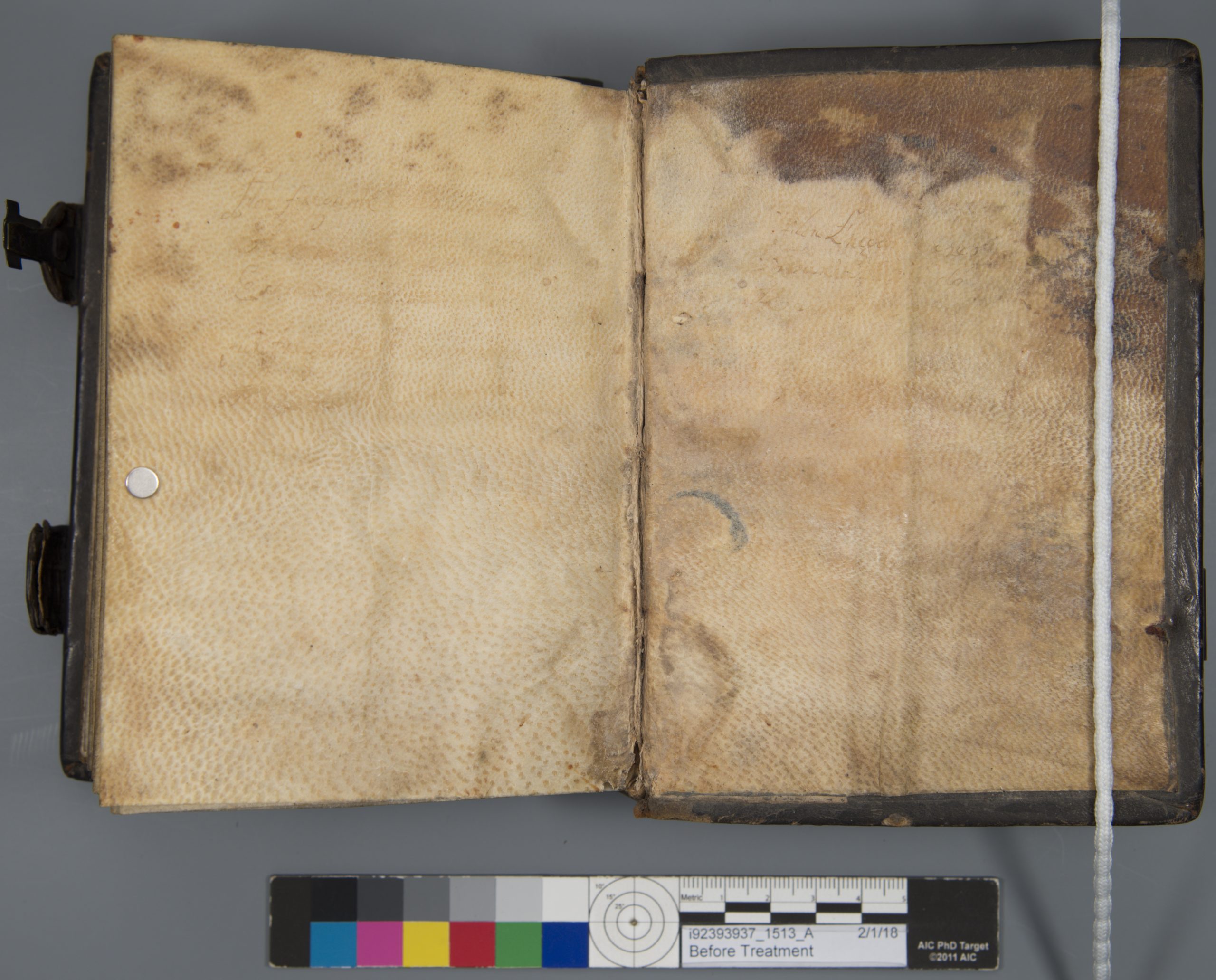
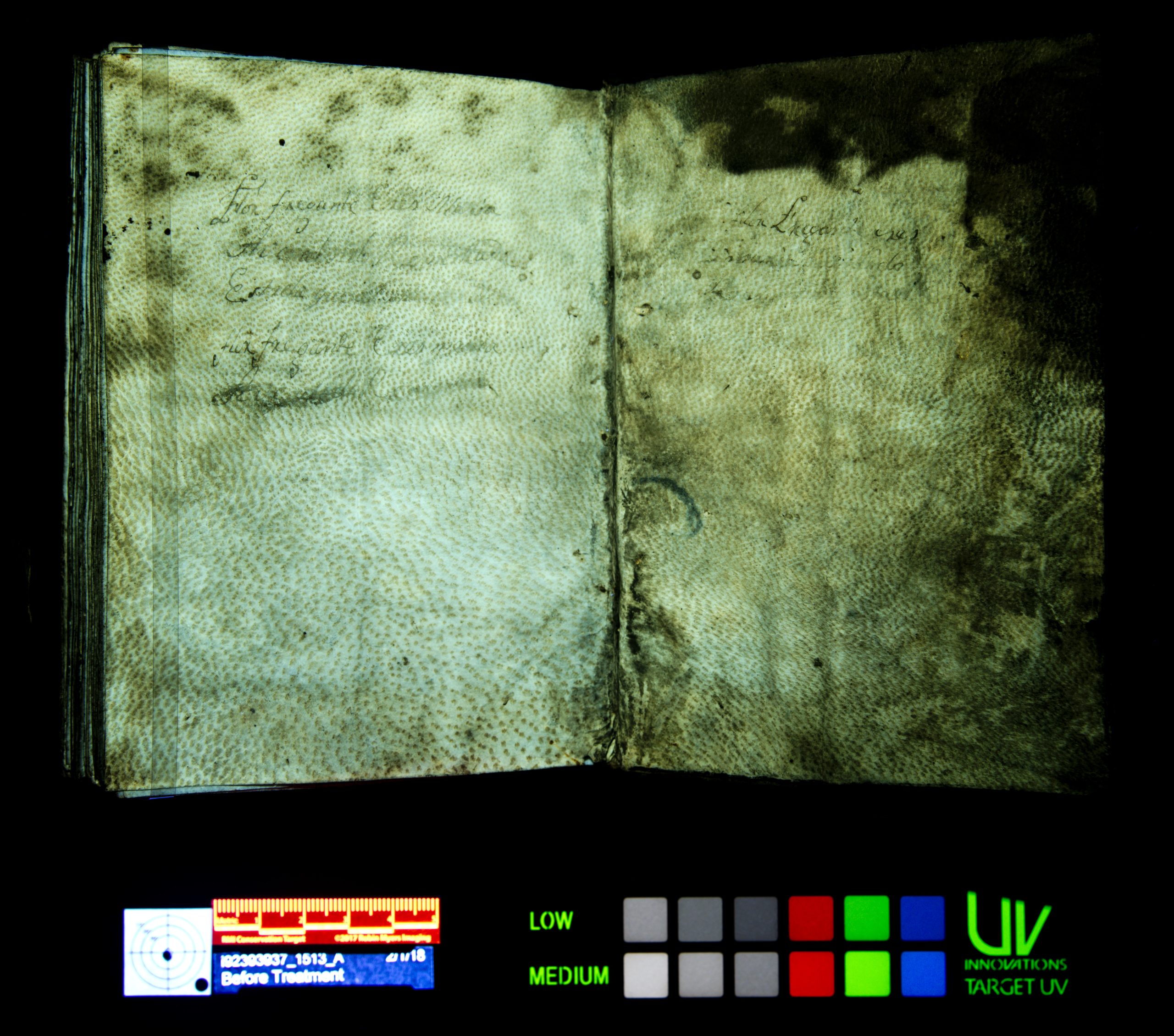
The images above show an example of scraped text on parchment from UC Libraries Hours of the Virgin from 1475, currently in the Lab for treatment. Compare these MISHA generated images to the documentation performed by Catarina Figueirinhas and myself using the Lab’s equipment and processes below.
Normal illuminationUV image (using our old setup without the UV Innovations target)
That said, I am fully aware that not everyone has access to the equipment/training that I have been fortunate to curate/experience over the last five plus years. Also, not everyone uses their finished data exactly how we do. For instance, the needs and expectations of a conservation lab and cultural heritage institutions can be very different. Even within the conservation field, how we use the data provided by specialized imaging in our hybrid book and paper lab is quite different from the kind of data needed by a fine arts conservation lab. Ultimately, I think the core audience for a system like the MISHA system is an organization looking to expand their suite of imaging services, or an institution with no multispectral imaging infrastructure interested in imaging collections in a quick and easy manner. Though for the latter, I would say that there is a big learning curve in manipulating and processing the data, but if greater focus is put into making the software and processing steps user-friendly, especially to novice users, it is completely manageable. And if this step is taken, I think the system could help a lot of institutions dive deeper into the materiality and history of their collections.
RGB representationBand 5 with the PCA (Principal Component Analysis) algorithm applied, inverted with brightness adjustedA false color representation
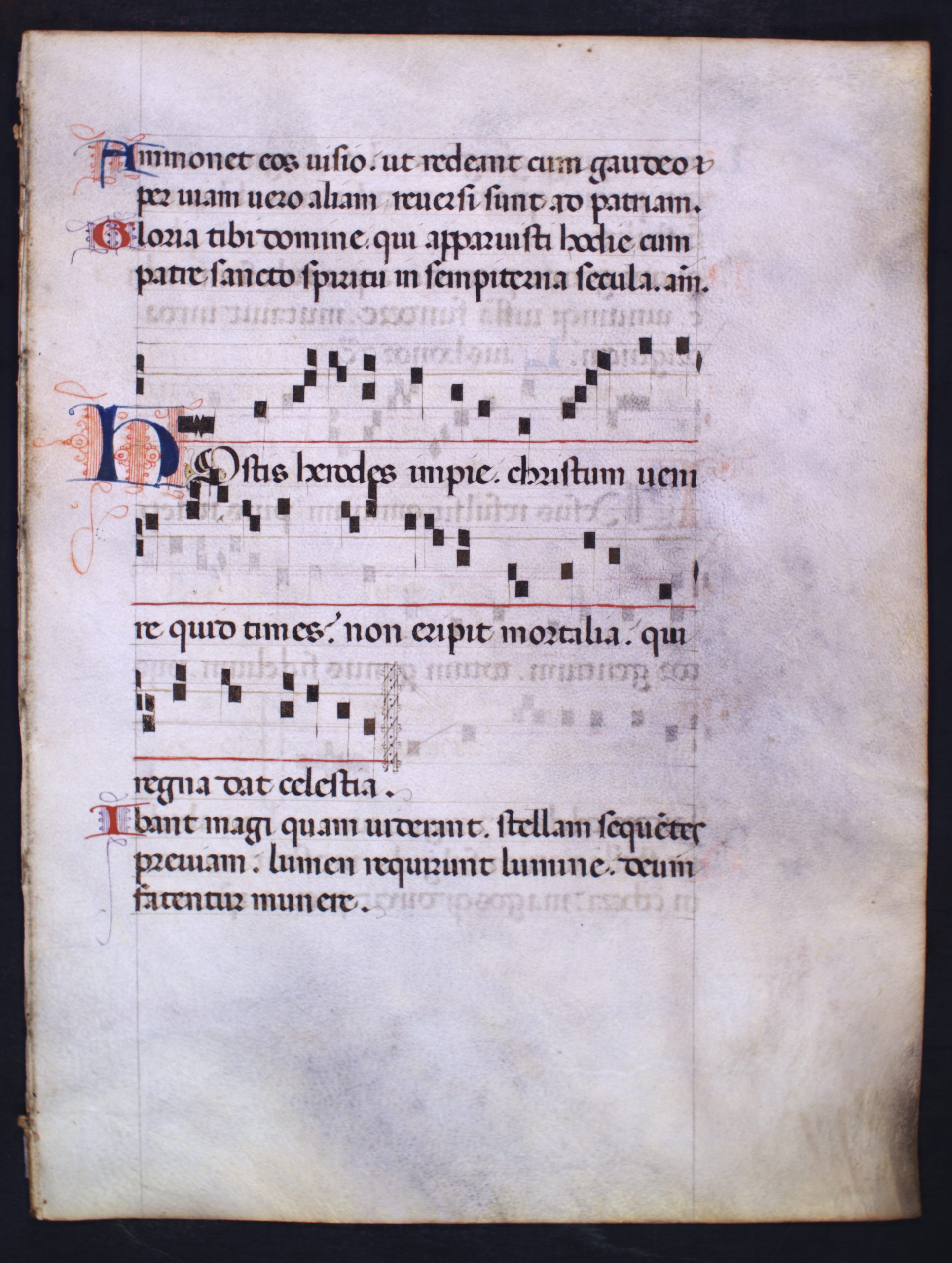
The images above depict another example of faded, scraped text. This flyleaf is from an undated Latin music manuscript that is part of the Public Library’s collection. The images below represent imaging done by the Lab, both normal illumination and UV radiation, with the goal to increase the legibility of the inscription.
Normal illuminationUV radiation image using our current, standardized workflow that has been further enhanced to bring out the text.
In the end, multispectral imaging is just plain FUN! So, the idea of making it more accessible to a wider audience is extremely exciting and I think the work that NEH, RIT, and colleagues like Andrew and Naomi are doing to share the power and wonder of multispectral imaging is amazing. The idea of a portable multispectral imaging system with free processing software that does not take a PhD to use is boundary-breaking, and it gives us a glimpse into a future of accessible and exciting imaging, which thus allows us to see and understand more of the past. I will always be an advocate for that kind of imaging!
One of the exciting things about the Preservation Lab is you never know what’s going to come into the Lab next! Sure, sometimes we know a little bit ahead of time about upcoming projects, but usually the special collections intake meetings are filled with “oohh’s”, “aahh’s” and sometimes “oh no’s”. But it’s not very often that you get to work on a project, here in Cincinnati, while the objects themselves are across the Atlantic. Combine that with RTI (Reflectance Transformation Imaging), a variety of Vesalius related texts, and an opportunity to collaborate with other photographers, and you’ve got a recipe for one exciting project!
Currently in the planning stages, the Winkler Center for the History of the Health Professions will host a series of Cecil Striker lectures and a physical exhibition that will celebrate the work of Andreas Vesalius. The series and exhibition is entitled The Illustrated Human: the Impact of Andreas Vesalius and is sponsored by Stephen and Sandra Joffe. Vesalius was a renowned 16th century author and physician, whose iconic work on human anatomy, De Humani Corporis Fabrica Libri Septem, is considered one of the most influential anatomy books ever written. Three rare first edition Vesalius volumes will be exhibited during this upcoming lecture series, gratuitously on loan from Stephen and Sandra Joffe. Dr. Joffe is a long-time UC supporter and an emeritus faculty member.
For the upcoming exhibit, the Lab will be creating custom supports, as needed, to display the volumes, and providing imaging of various pages and illustrations for promotion. I will also be doing any additional specialized imaging that might be helpful.
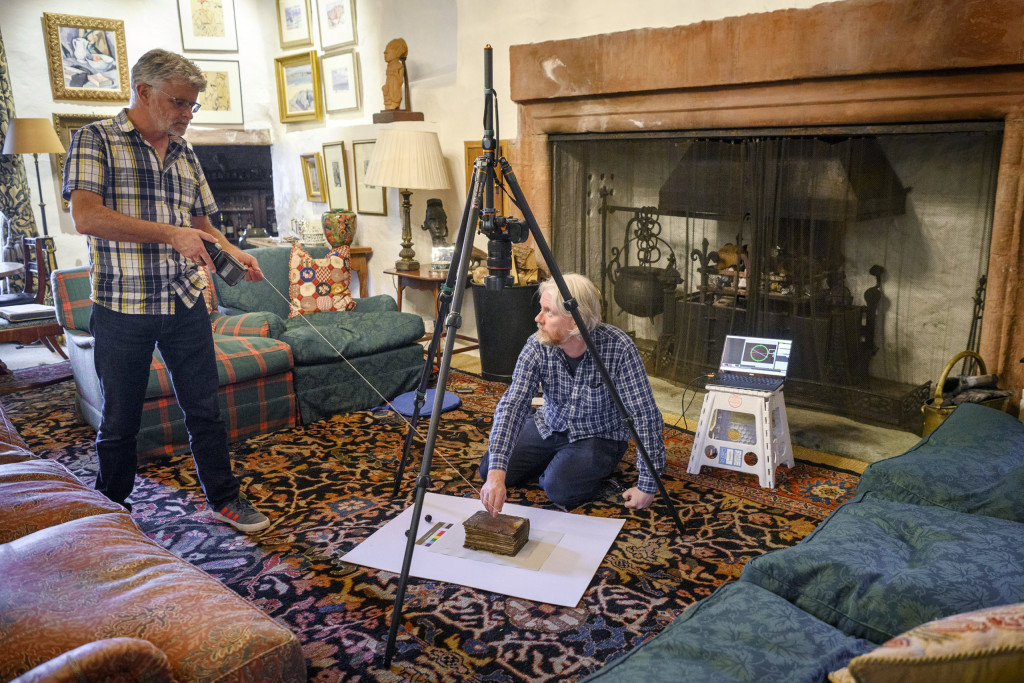
Since we believe that some, if not all three bindings coming to Cincinnati, might be original to the volumes, and we immediately thought of RTI and wondered if it could provide new insights to researchers. After seeing the wonders of RTI, via RTI examples from the Lab, the owners of the Vesalius editions were interested in having RTI done on a selection of Vesalius items in their collection, including some that wouldn’t be coming to the Lab. The only hitch? The volumes are at their home in Scotland. The solution: hire a local photographer, Iain McLean, to carry out the capture portion of the RTI in Scotland, and have the files shared with the Lab for processing and rendering. Though Iain is an established commercial photographer with a digital imaging background, RTI was a new adventure for him, so I shared some resources with him, including CHI’s Guide to Highlight Image Capture and some notes and resources created by the Lab during our various capture sessions. Iain and I then met via Zoom in mid- August to discuss the ins and outs of RTI highlight capture prior to his capture session on August 20th. Iain also brought his colleague and fellow photographer, John Linton, into the fold to assist him during the capture session, which I recommended highly because though it might be possible to do RTI solo, I can’t imagine a capture session without my normal collaborator and the Lab’s Assistant Conservator, Catarina Figueirinhas. The session would take double the time and I’d make five times the mistakes without Cat! (Check out a time lapse video of Cat and I doing RTI in the Lab on our YouTube channel).
Iain and John during the capture session, featuring one of my favorite volumes that they captured that day. (This image was taken by Iain and kindly shared with me.)
After a successful test capture session, Iain and John were ready for the main capture session on August 20th. They ended up capturing the front and back covers of seven volumes. Once the massive capture session was completed, Iain shared the jpegs with me so that I could begin processing the images in RTI Builder and then rendering the snapshots in RTI Viewer.
This is a time lapse video of the capture session. (This video was created by Iain and kindly shared with me.)
After processing the 679 images and rendering the snapshots, here are some of my favorite finds:
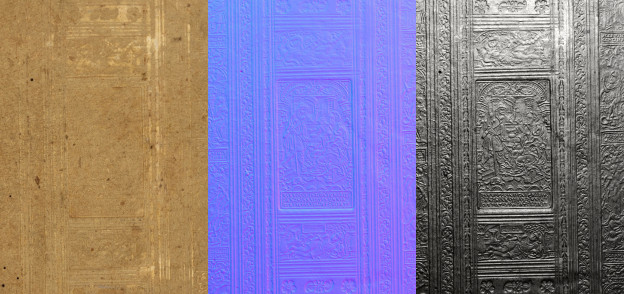
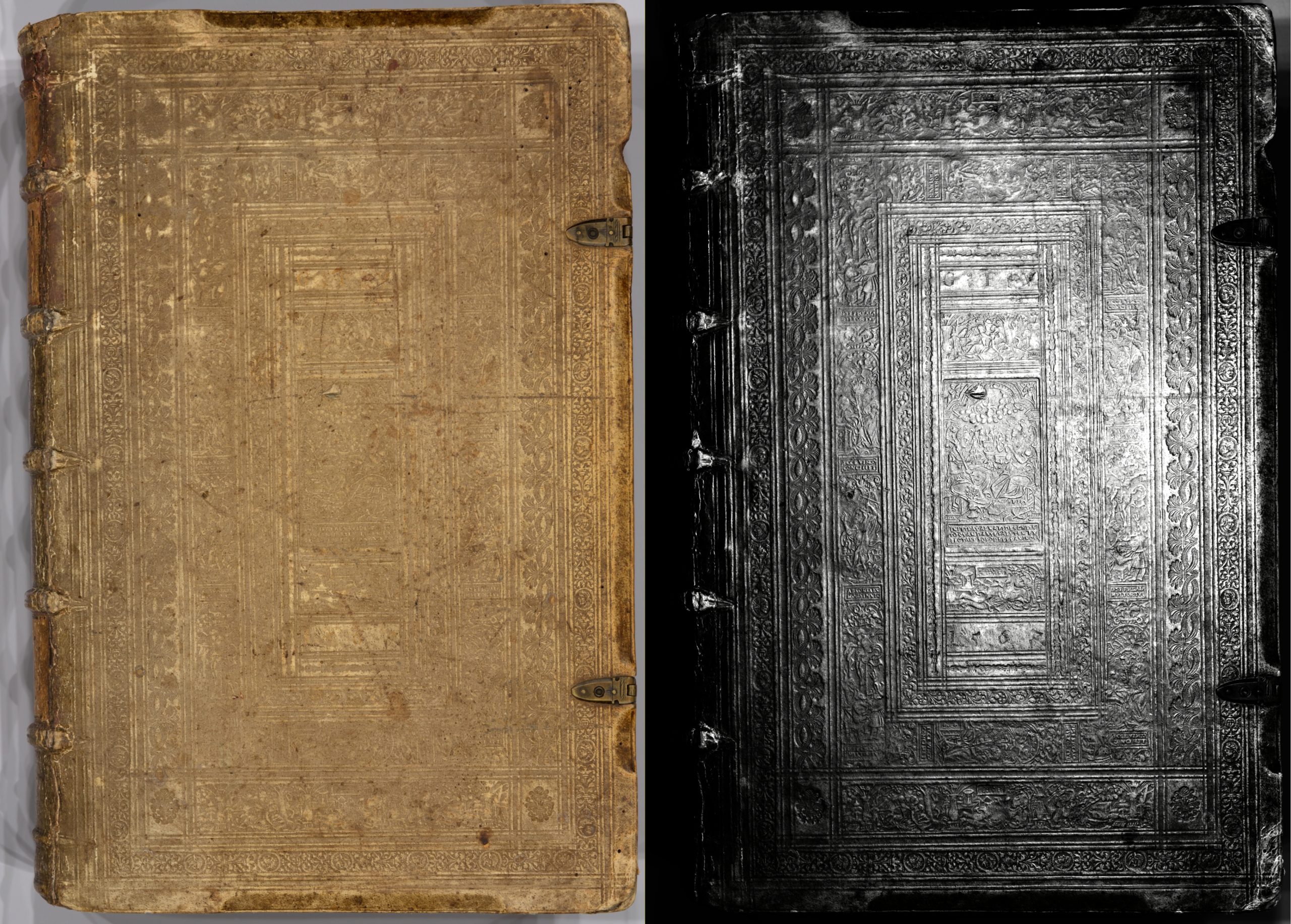
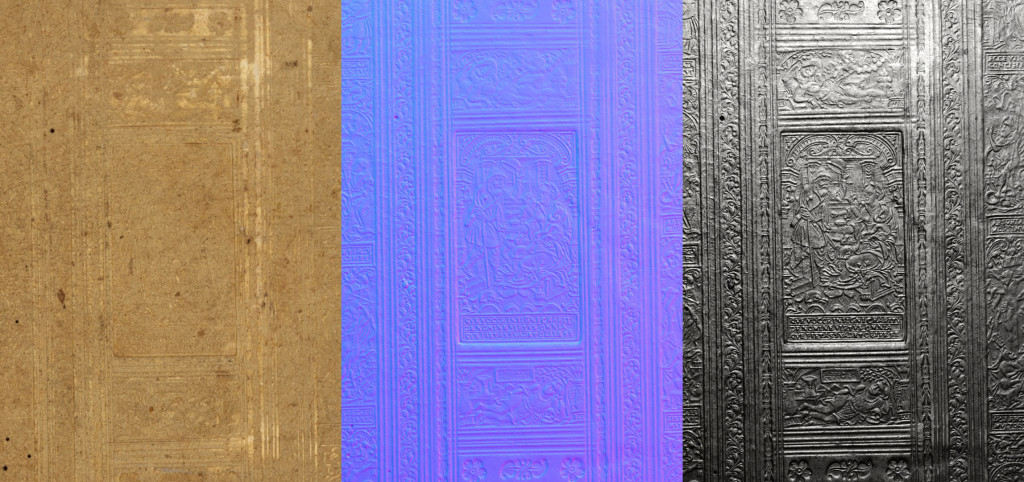
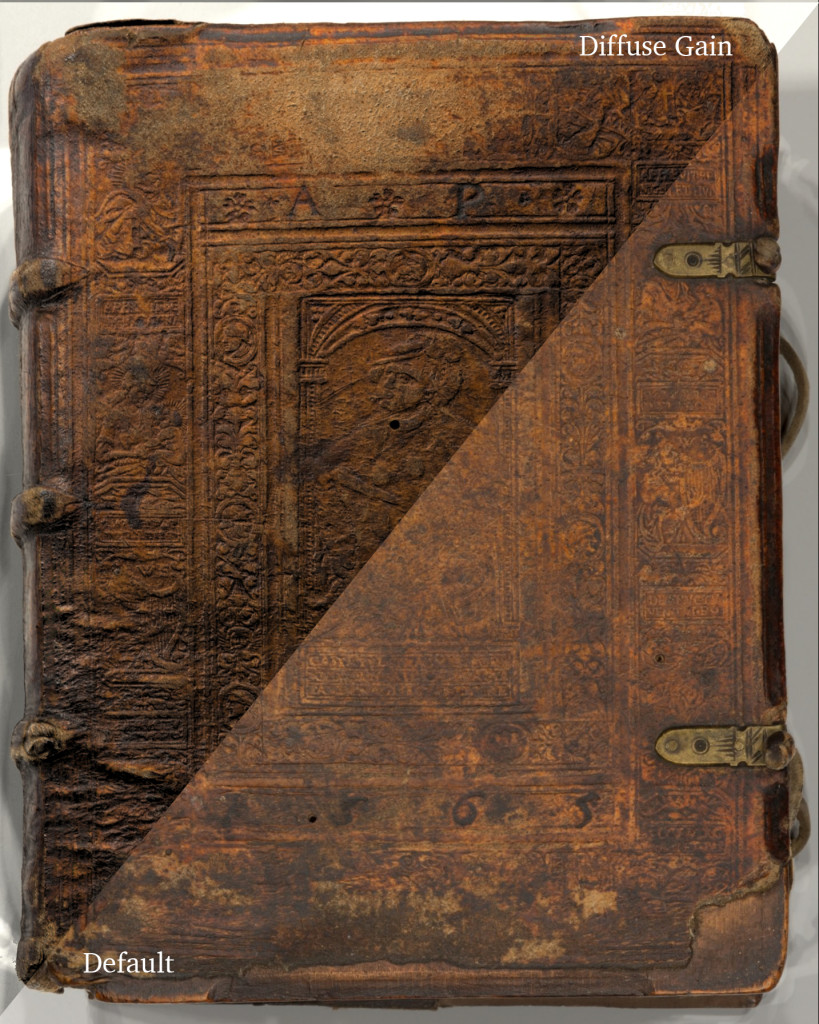
This a side-by-side of an upper cover. The left image shows the default lighting mode in RTI Viewer and the right show the specular enhancement mode. On the right, just above the center panel, you can see the letters GFV (above the panel) and 1567 (below the panel), which are much more visible with the specular enhancement mode than under normal illumination.Here you can see a detailed composite of another cover’s center panel. On the left is the default/normal illumination mode, the center shows the normals visualization mode, and the right is the specular enhancement mode. You can see by employing the two specialized RTI modes the ornate detail of the cover is far more readable.
This composite of the upper cover features the diffuse gain mode on the upper left half, and the default lighting mode on the lower left half. The diffuse gain mode really accentuates the features of the man in the center panel.
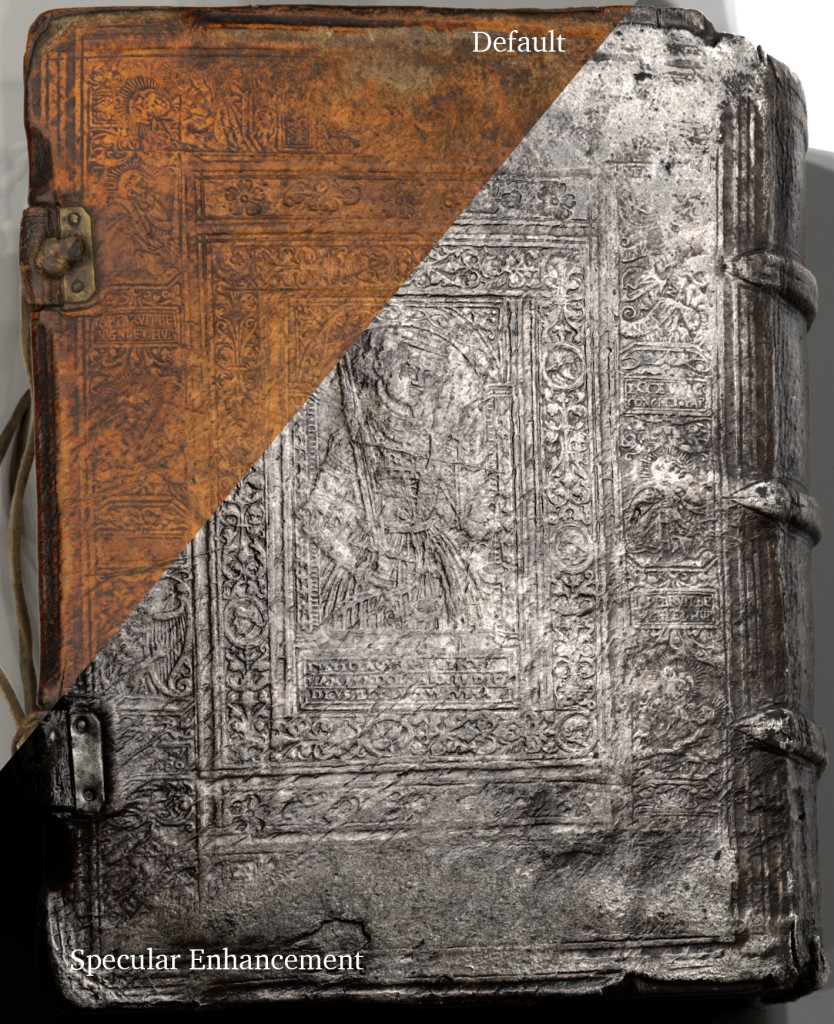
This is a composite of the lower cover of the same volume (my favorite binding of the group). This shows the default on the upper left and specular enhancement on the lower right.
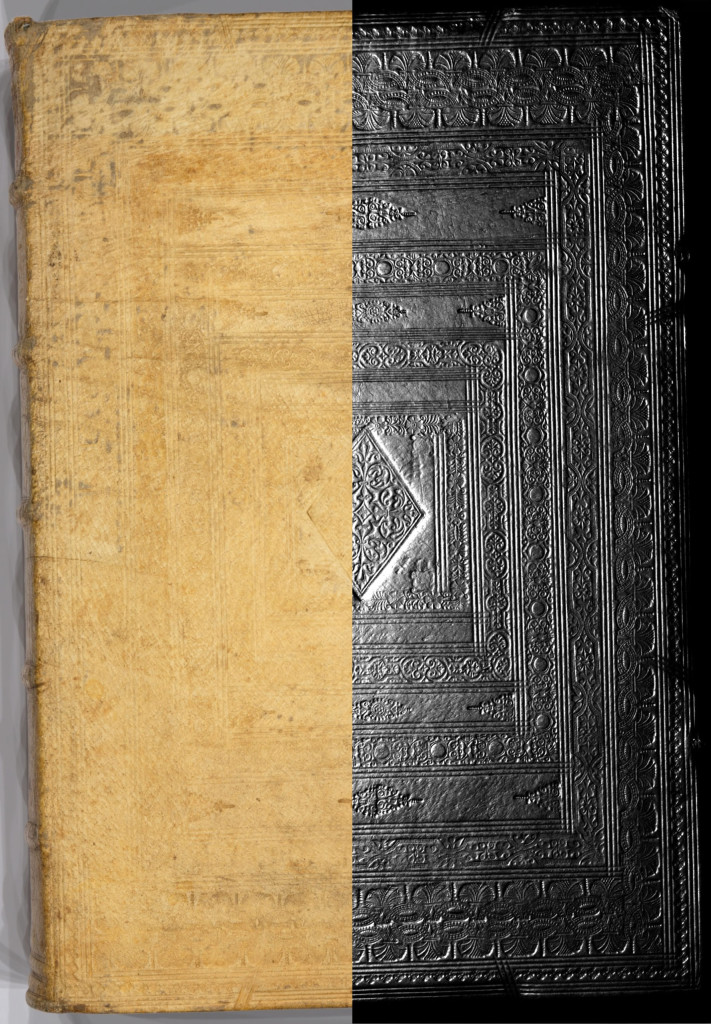
This composite of another upper cover shows the default mode on the left and the specular enhancement mode on the right. With this one, the discoloration of the cover distracts the eye and pulls it away from the detail of the decoration, but with the specular enhancement mode you can eliminate the color completely and modify the secularity so that your eye can focus solely on the elaborate detail.
This was such a fun experience for me, and I really enjoyed collaborating with colleagues outside the conservation field and across the pond! And I look forward to the condition photography of the three volumes and any additional specialized photography that might be helpful.
Special thank you to Stephen and Sandra Joffe for allowing their important collection items to be photographed, and for giving the Lab full permission to use the generated images. Also, a very special thanks to photographers Iain McLean and John Linton for capturing these covers and for collaborating with me on this exciting project.
We’ve reached the end of Preservation Week and what better way to celebrate than with a fun how-to video on our Lab’s YouTube channel?!
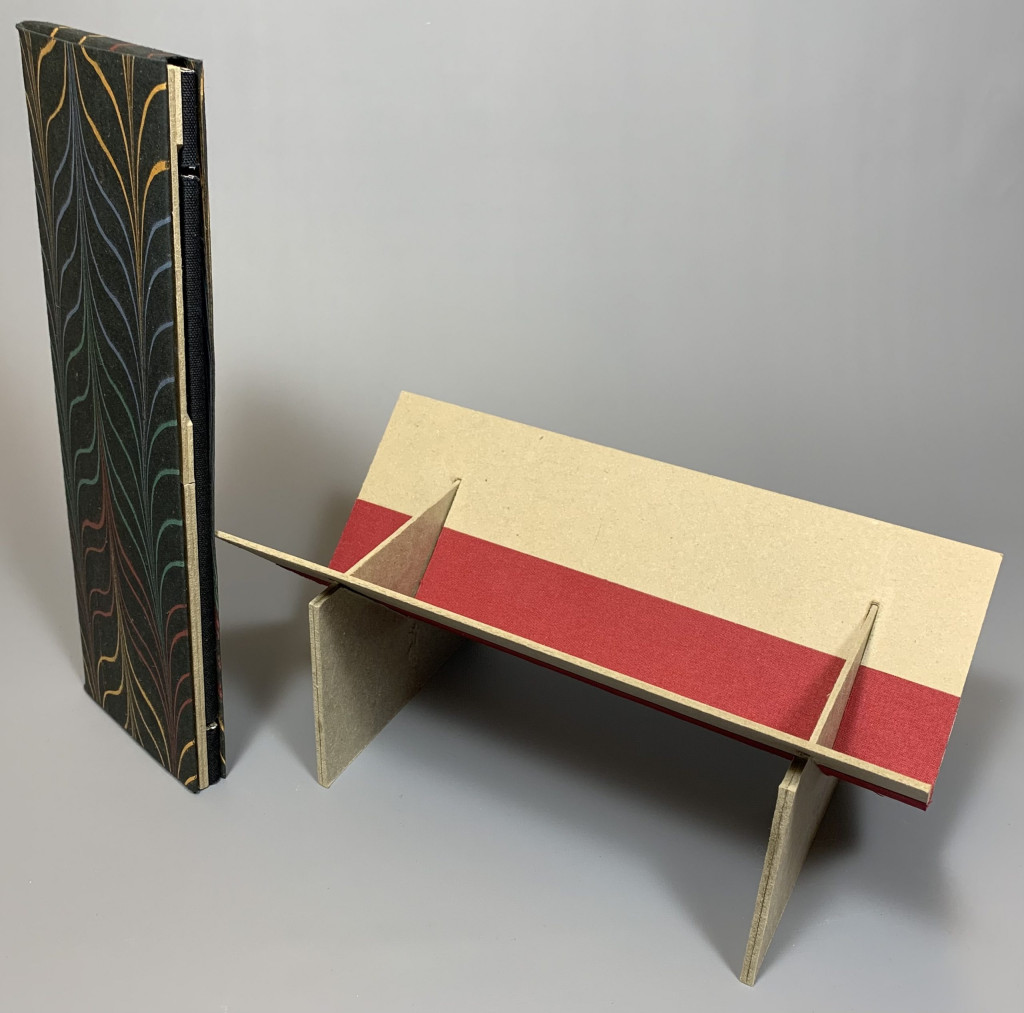
This video goes over how to make a collapsible punching cradle, step-by-step. Punching cradles are a useful bookbinding tool to have on hand in your toolbox. They allow you to create uniform sewing stations in your signatures or gatherings when you are preparing to sew a textblock. Best of all, this type of punching cradle is fully collapsible and easy to store while not in use; especially when you make one of these simple slipcases to hold all the pieces.
Here you can see a collapsed punching cradle stored in a paper slipcase made with marbled paper (left) and a punching cradle assembled and ready for use (right).
Don’t forget to “like” our video and subscribe to our YouTube channel to stay in the loop when we post new videos to the channel. If you decide to make your own punching cradle, we’d love to know what you thought of the video or, even better, tag us in a photo of it on Instagram (@thepreservationlab).
We hope you’ve enjoyed celebrating Preservation Week 2021 with us! We look forward to celebrating our 11th annual Preservation Week next year…maybe even in person this time?!
To celebrate nationalPreservation Week (April 25 – May1, 2021), staff at the Preservation Lab are sharing the following answers to the question below as they reflect upon the wealth of library resources located in the Cincinnati community:
What is your favorite treatment or project that you have worked on in the Lab?
Jessica Ebert:
Learning a new photographic imaging technique, RTI
In April of 2017 I had the amazing opportunity of attending a 4-day workshop at Yale University to learn Reflectance Transformation Imaging (RTI) from the experts at Cultural Heritage Imaging. It was one of the most exciting experiences of my career, and when I came back to the Lab to show the staff what I had learned, Aller Bucher Und Schrifften volume from Martin Luther was one of the first items we captured with RTI. I remember that moment when Catarina and I completed the capture and processed the images – we were just in awe of everything we could see with RTI that we couldn’t under normal illumination. Since then, we’ve made changes to our equipment and our workflow, so now the results are even better than they were back then…but this will always be my favorite.
Of all the projects I have worked on at the Preservation Lab, this item is by far one of my ultimate favorite treatments I was able to perform. This book was brought to the Preservation Lab in poor condition. The book had no binding, the text block was split in multiple areas, the sewing was broken, and several pages of the text block where either torn or had extensive loss. In addition, most of the text block showed signs of water damage. Since this book was in such poor condition and the curator of the collection wanted the book to be handled by scholars and the public, it was necessary to do a full conservation treatment.
I was thrilled when I got assigned to this book treatment. I love to work on any book, but the more complicated or involved treatments the better and this was definitely the case. In this treatment, I was able to repair the text block, reduce some of the tideline staining, fill losses and resew the entire text block, while also creating a new binding (called a split board binding) that is strong and flexible to allow such a heavy book to be read.
Before Treatment – Initial condition of the book when it was received by the Preservation Lab. The text block was split, the sewing was broken, and several pages were torn or had paper loss.
After Treatment – Conservation treatment complete. After the text block was repaired and resewn, the book received a new split board binding that allowed the heavy book to be read while mitigating further damage.
After Treatment – The new split board binding provided the book a more flexible opening.
This treatment took a long time to complete, and to this day it is still one of the projects that I have enjoyed the most. Click here to see the complete treatment report and all the photographic documentation. To learn more about conservation split board bindings, check out the Preservation Lab blog post by Kasie and Jessica.
Kasie Janssen:
Iron gall ink treatment of the CHPL Jones Account Book
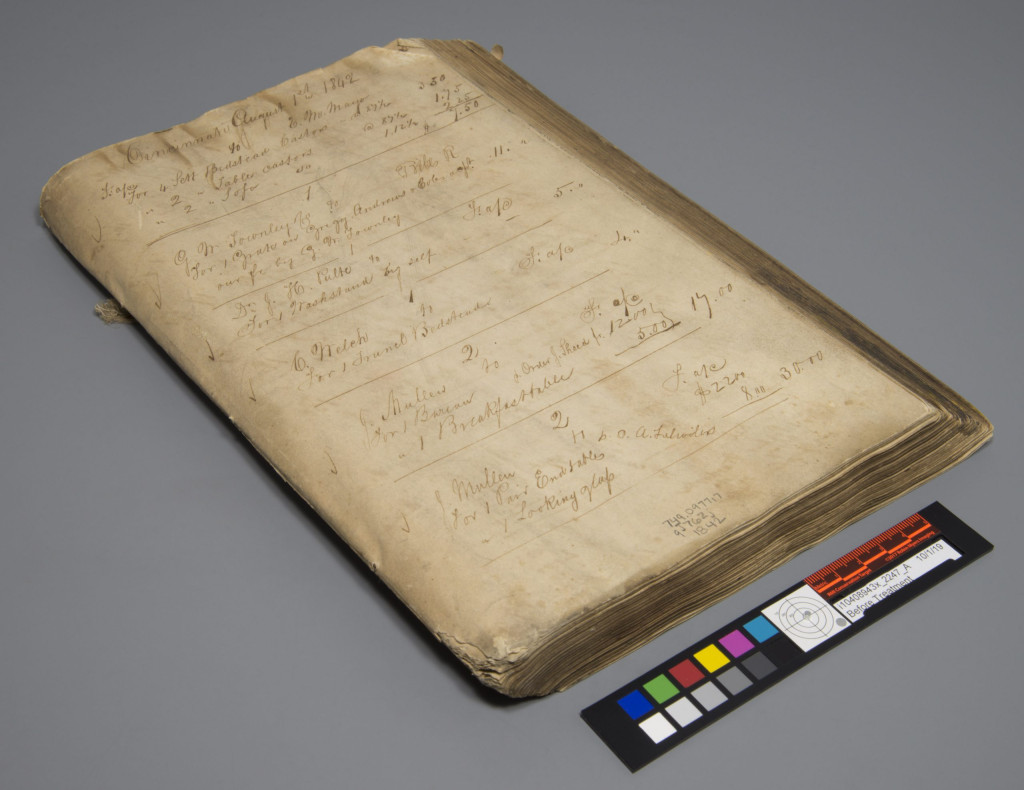
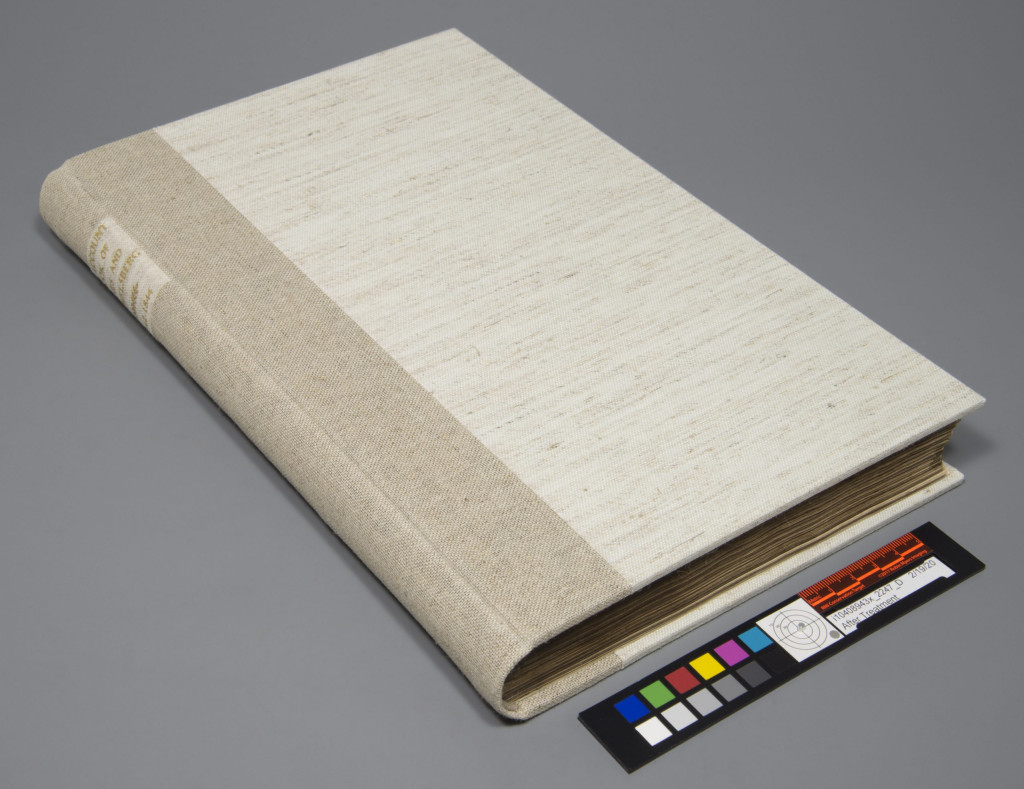
Washing and rebinding treatments are always a favorite when they come across my bench, as they allow a highly damaged item to become usable and accessible once again. An account book of Jones and Rammelsberg offered one such treatment as it came to the lab with a myriad of issues: a damaged book block without a binding, corroding iron gall ink, previous mold damage, and a shocking amount of pest evidence. The treatment is incredibly memorable because to tackle the issues of aging iron gall ink I was able wash the pages of the book block using a calcium phytate bath to stabilize the manuscript. Once the washing was complete, I was able to resew and rebind the book block, making it whole, functional, and protected once again. It is rare and special to have done such an involved treatment, but in this case the in-depth steps allowed previous damage to be treated and helped remedy the inherent vice of aging materials.
The book block before treatment was highly damaged, so much so, that it was difficult for library patrons and staff to access and use the item without a cover.
Handling the book, you’d never know the hours of labor that went into the treatment (including learning!), but its functional form makes it ready for use once again.
Creating the Italian ledger binding for our teaching model collection
The lab creates a lot of models. Many of these models are made in preparation for treatments. However, some models are created with instruction or engagement in mind. These models, such as the Italian stationery binding (laminated archival bind) I created, help illustrate the history of the book as its form and manufacturing process change over time. Check out the model at the blog entry where you can see a video of the binding being handled. Follow the instructions on the blog make you very own, and in the future, come see it for yourself when our in-person open houses resume in the future.
View of the cover fully opened that shows the overband lacing pattern, the front fore edge flap, and the buckle clasp.
Ashleigh Ferguson Schieszer:
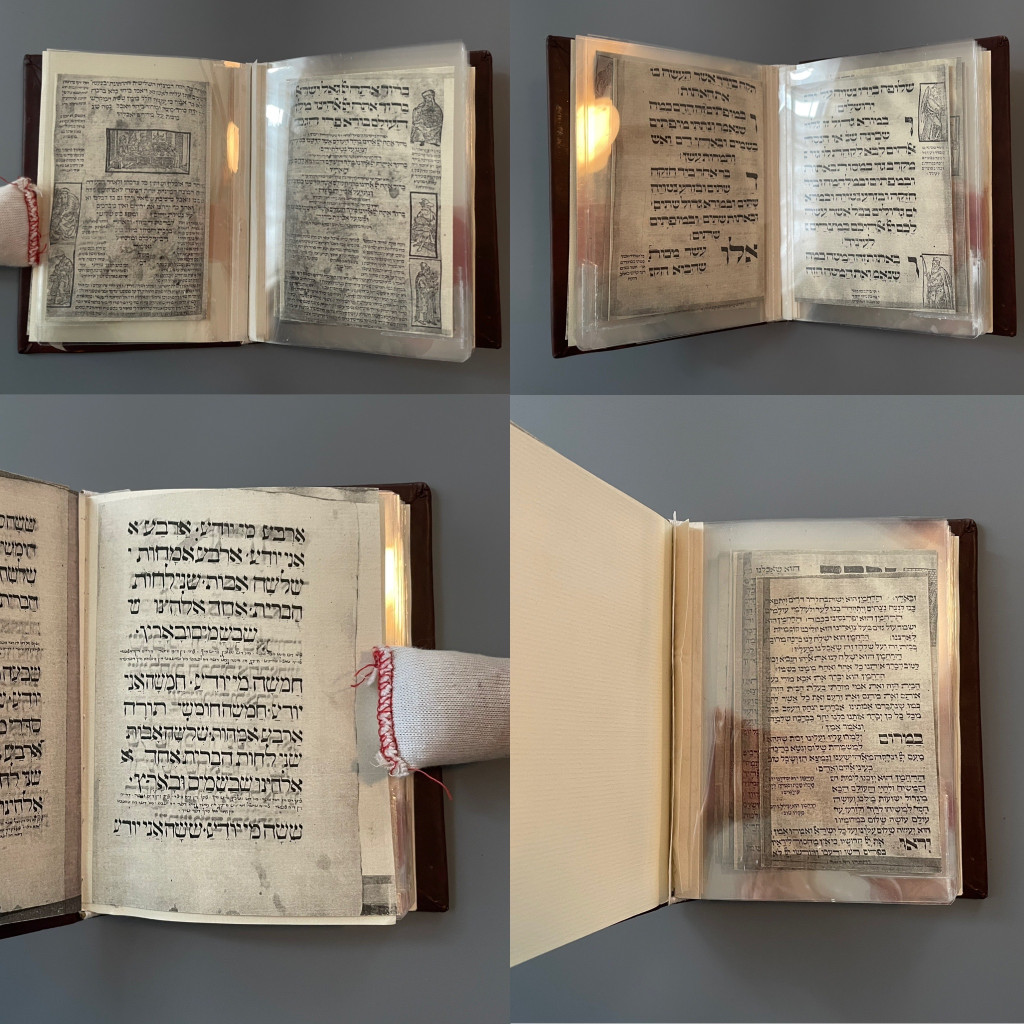
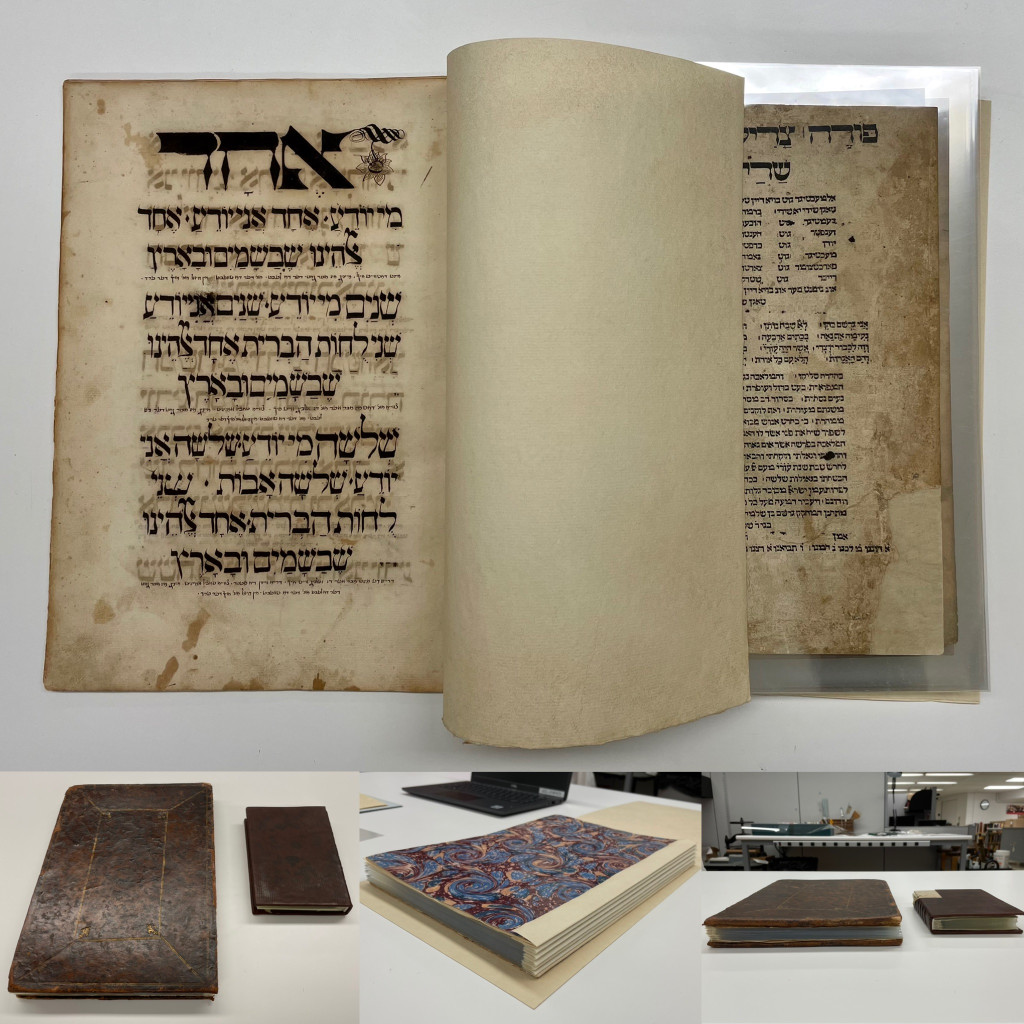
Treatment of a Haggadahowned by Hebrew Union College
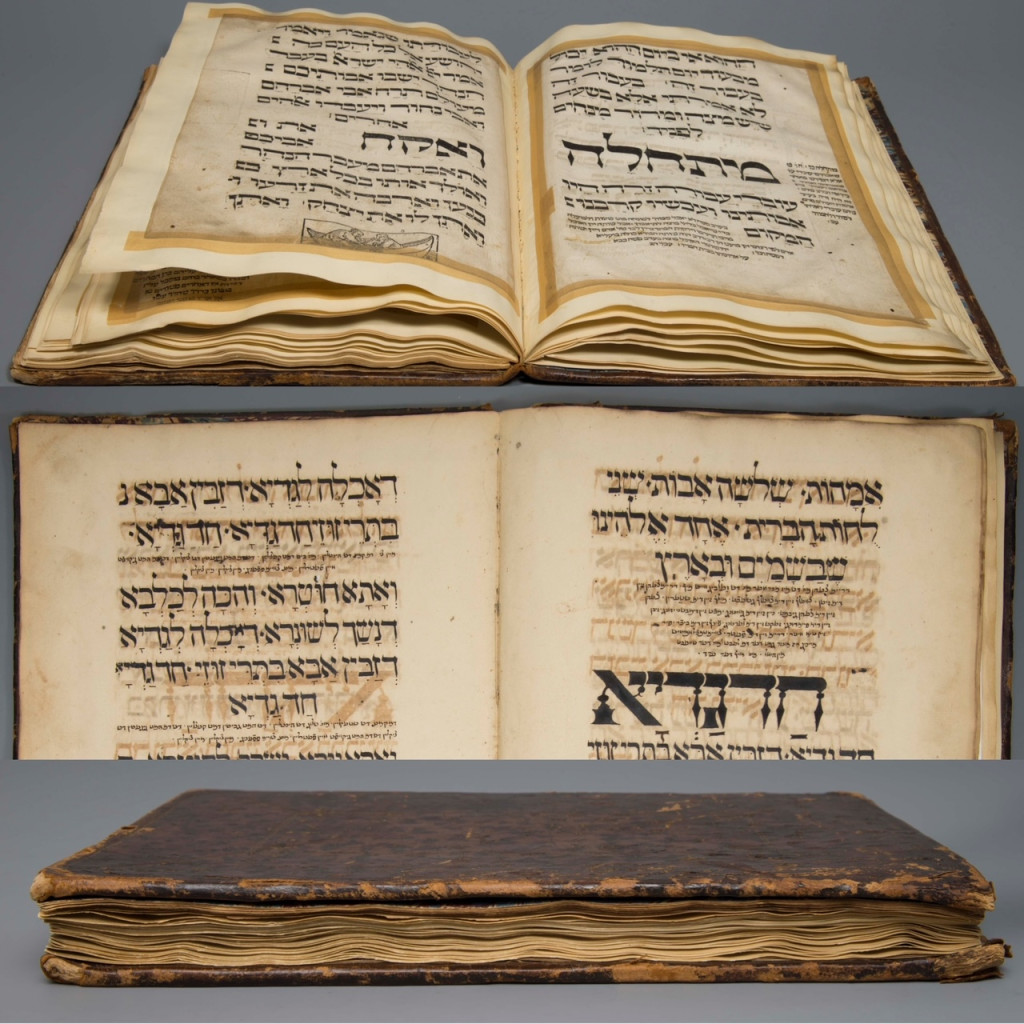
I particularly enjoy the problem solving nature of special collection treatments and thus, my “favorite” treatment is usually the one I’m working on. Currently, I’m treating a Haggadah owned by Hebrew Union College that dates to 1526 or 1527. While I’ve treated other haggadahs from HUC, including this one, this project involved iron gall ink treatment AND rebinding a textblock with two different sized leaves, or pages, into its original historic leather cover. Because the binding had been previously treated and reformatted with materials that did not age well, collaboration with the librarians at HUC required exploration into whether we wanted to re-create the past reformatting option with longer lasting materials, or perhaps, explore a new option altogether. Before we committed to a solution, I created a model to test out a new option since unanticipated questions or outcomes often arise during experimental pursuits. For that reason, it’s better to problem solve on a model, rather than on an actual special collection material. In the end, the librarians and I were happy with the results of the new option, and I’m currently at the stage where I’m ready to start rebinding the pages of the actual object.
The top image shows the book open to smaller sized printed leaves before treatment. Leaves are previously reformatted with yellowed tape along the edges, attached to larger paper frames. Paper frames are cockled and distorted. The middle image shows a detail of untrimmed, full-size manuscript leaves. The bottom image shows the fore edge of the binding before treatment.
These images show the model that explores a solution to encapsulate the smaller pages into polyester sleeves that could be sewn into the binding next to the larger pages. This required staff to weld polyester sleeves with paper hinges that could be sewn through like a gathering.
The image shows the binding ready for resewing with its new encapsulated leaves, or pages, next to the created model.
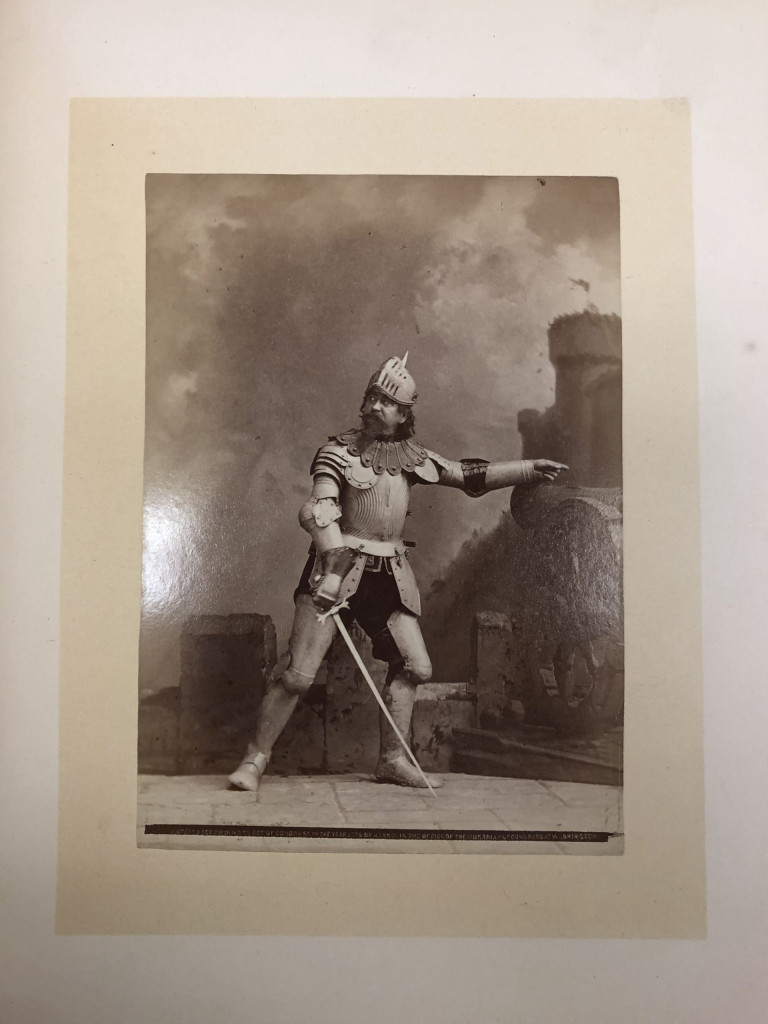
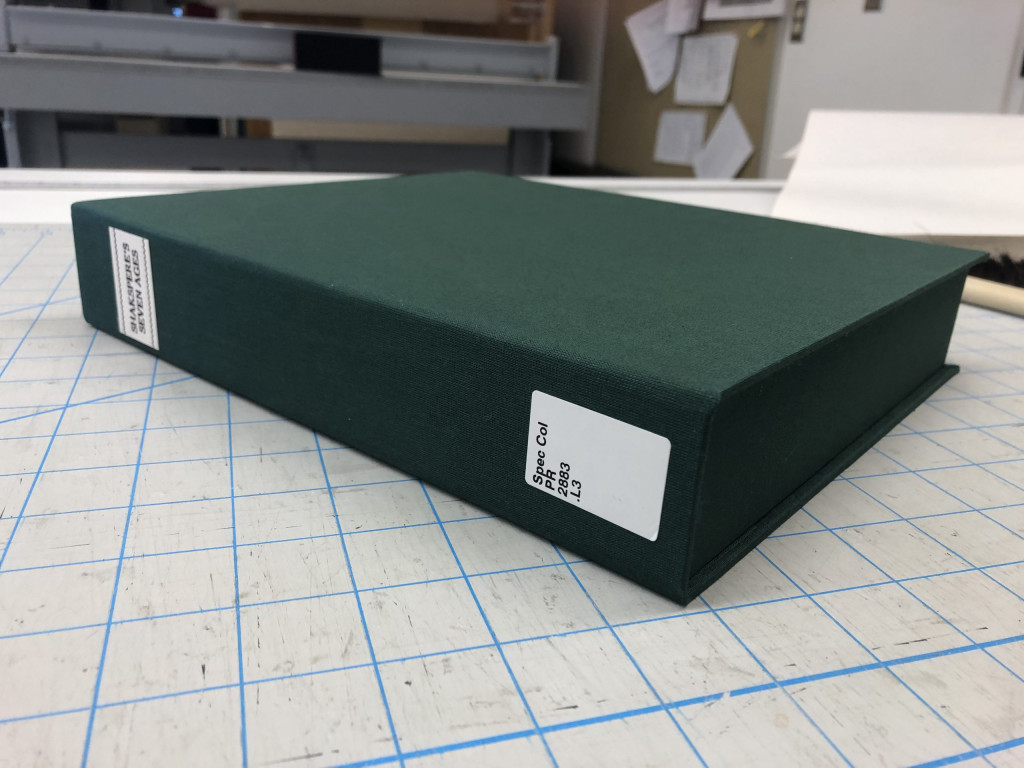
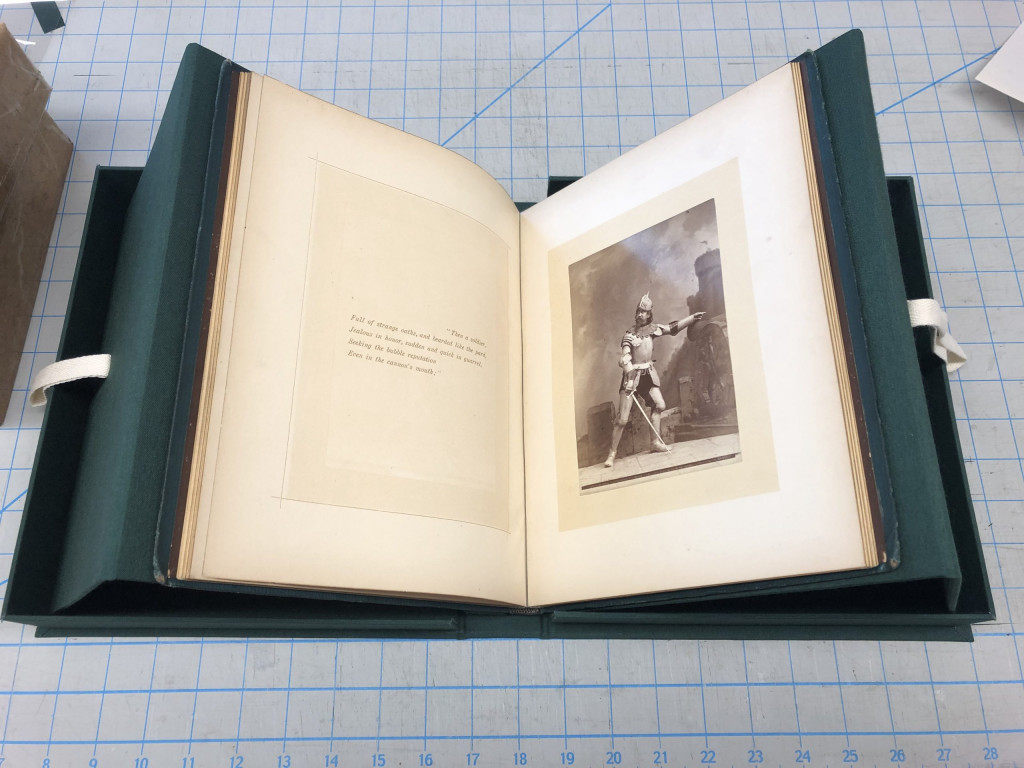
Not only was this piece based on a favorite subject of mine (I love Shakespeare!), this was a historic photograph treatment I was able to handle with just a little guidance. I was able to properly identify the photographic elements on the first try, performed a surface cleaning on the piece, and created my very first cloth-covered clamshell and cradle to house it. It was such a wealth of learning experiences within one project, which is the best part of my work!
Before cleaning; albumen card (note the finger prints in the upper right corner). The image depicts the photographer as a soldier.
Cloth-covered clamshell exterior.
Cloth-covered clamshell interior, with piece opened to surface cleaned soldier image in integrated cradle.
Chris Voynovich:
Constructing a custom cloth-covered enclosure to house the Public Library’s William S. Porter Collection of photographs
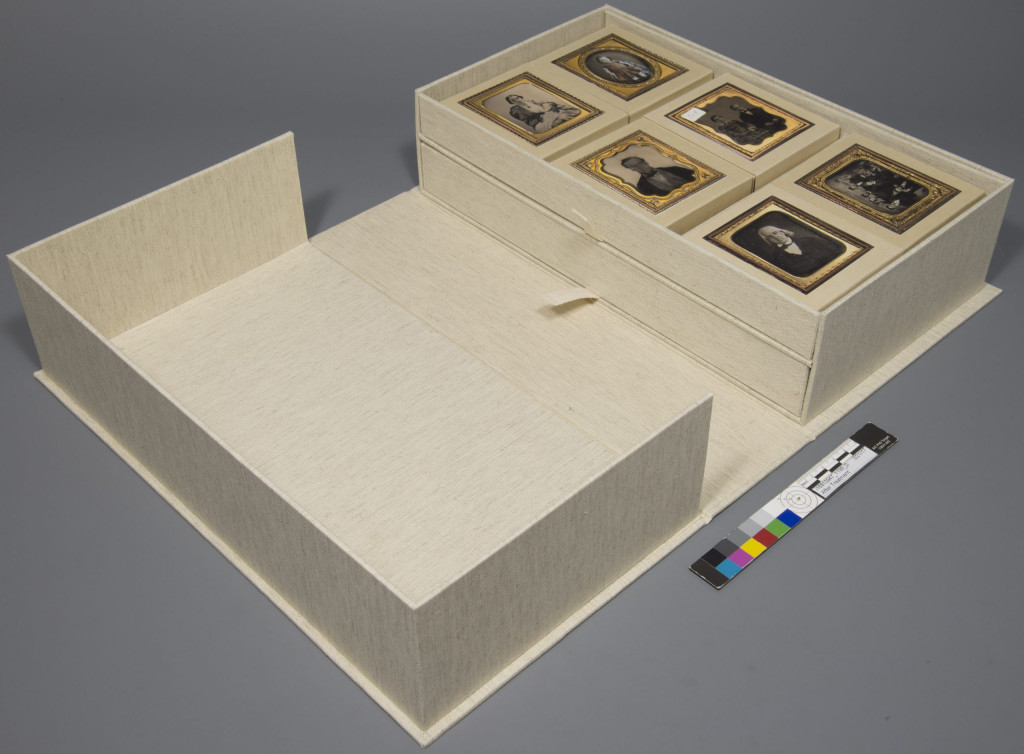
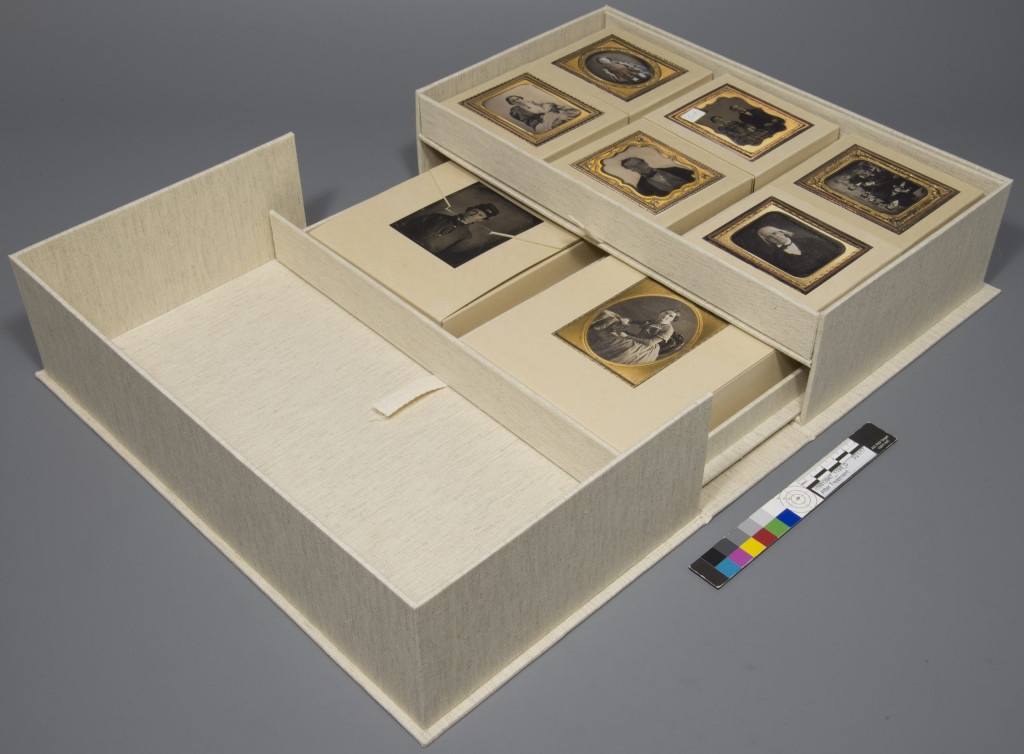
One of my favorite aspects of the job here, in the lab, is designing and creating custom enclosures. This collection of rare daguerreotypes, ambrotypes, and tintypes is an example of adapting a standard cloth covered clamshell to accommodate a collection. I created two trays with pull tabs that are removable for easy access and display. Each photograph has its own tuxedo box and is set in polyethylene foam (Volara) for protection. The tuxedo box enclosures are identical in size to reduce confusion while repacking. Check out this blog created by Jessica that shows a gif of the enclosure opening and closing, and this blog post showing a similar enclosure I created for a dairy collection.
View of the opened cloth-covered clamshell with the two removeable trays in place. The trays contain the collection of cased photographs in tuxedo boxes with labels for easy identification.
This image shows the bottom tray partially pulled out, displaying the two larger cased photographs.
Today at 3pm (EST) join Jessica and Catarina on the Preservation Lab’s Instagram (@thepreservationlab) for a quick, informal Instagram Live.
Then tomorrow, make sure to tune into the Public Library’s Instagram (@cincylibrary) at 12pm (EST) for an in-depth Instagram Live event where Catarina and Jessica will be sharing treatments they are currently working on; giving you a behind-the-scenes look and answering all your questions “Live in the Lab”.
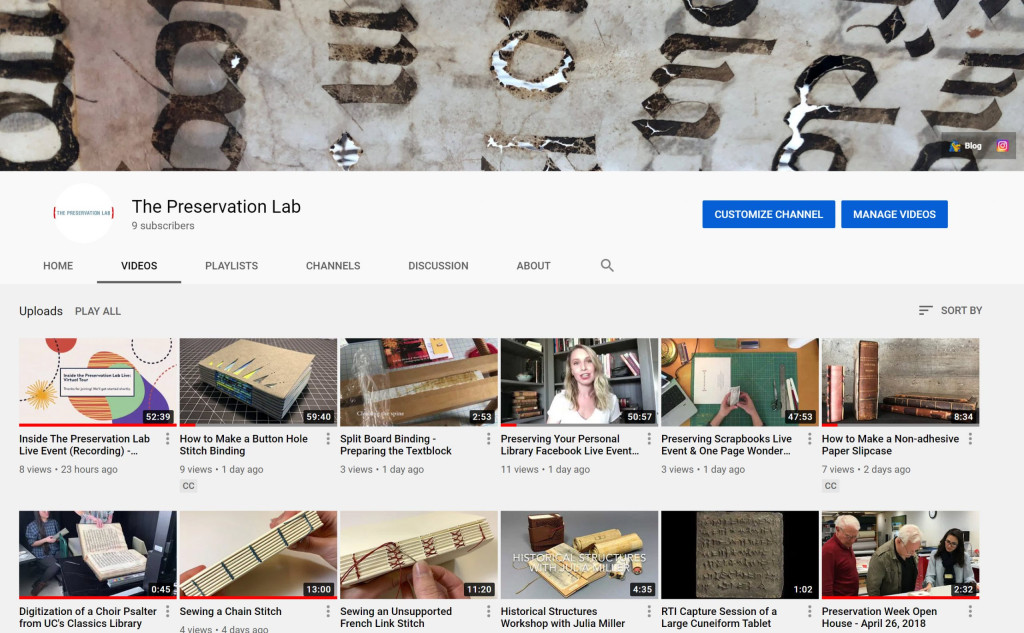
One of our most recent additions to our channel is the recording of our Virtual Lab Tour and Live Q&A, hosted by the Cincinnati & Hamilton County Public Library, which took place on Tuesday. If you weren’t able to join us live, please take a look; it was a very fun event and we had so many great questions from our live viewers.
Make sure to subscribe to our channel so that you can stay up to date on any new videos we add! And don’t forget to like videos, and we’d love to hear about what you’d like to see more of from us in the future.
The Lab will be offering a virtual lab tour on Tuesday, January 26th at noon (EST). The Facebook Live event will be hosted on the Cincinnati & Hamilton County Public Library’s Facebook page. Staff will give a tour of all of our most used and loved areas of the lab and will highlight how we use the spaces and the equipment, tools, and supplies stored in each space. Following the tour, we will be doing a live Q&A where you can ask us any questions you might have.
We hope you can join us for our first Virtual Tour, but don’t worry if you can’t, a recording of the tour will be available after the event so that you may view it at your leisure.