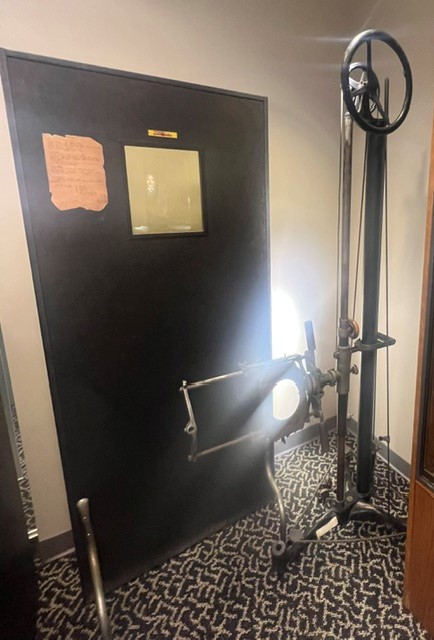
In the early 20th century the excellence of the Bar-Ray Products Company and the Kelley-Koett Manufacturing Company gave Covington, Kentucky the distinction as “X-Ray City”. While they were independent enterprises, these two Covington-based companies were instrumental in their influence on early radiology science, medical imaging, and the manufacture of radiation protective equipment.

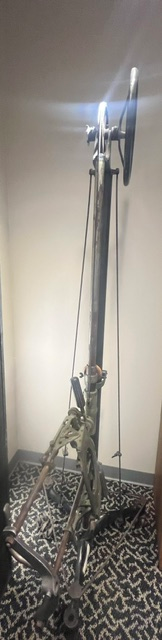
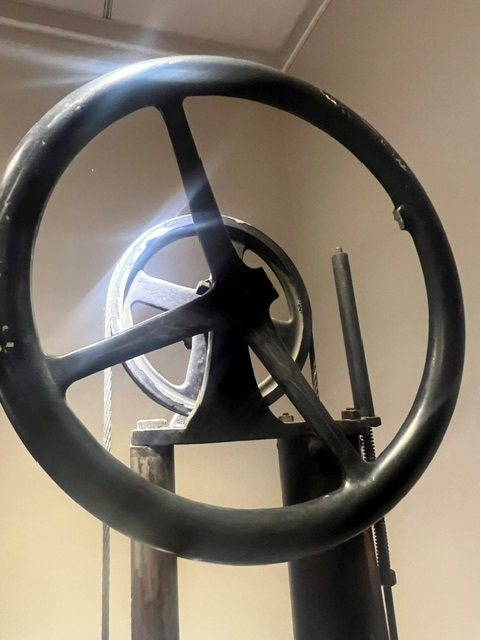
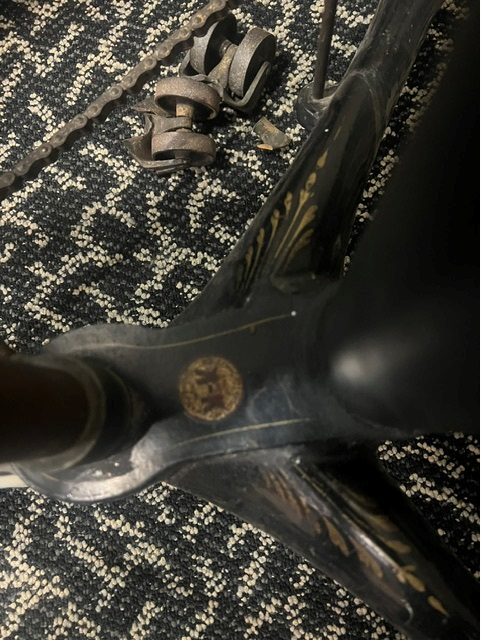
The Henry R. Winkler Center for the History of the Health Professions installed an exhibit of a Bar-Ray Products Company X-Ray Stitching Stand (circa 1940s) and a Kelley-Koett Manufacturing Company X-Ray Machine (circa 1920). The radiology equipment was utilized at the Cincinnati General Hospital. The X-Ray Stitching Stand was accessioned with an attached document of operator instructions.
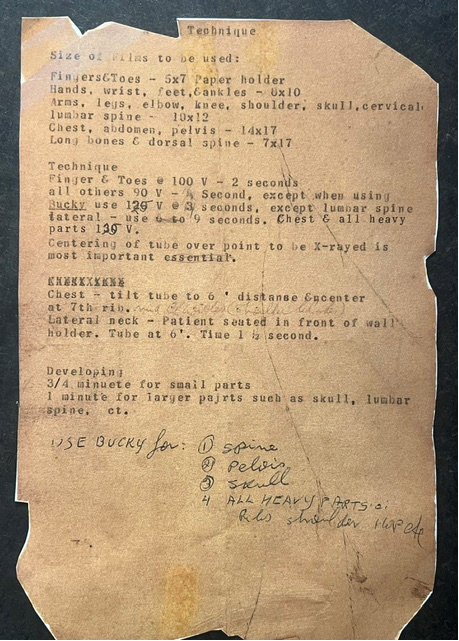
Technique
Size of Films to be used:
Fingers & Toes – 5×7 Paper holder
Hands, wrist, feet, ankles – 8×10
Arms, legs, elbow, knee, shoulder, skull, cervical, lumbar spine – 18×12
Chest, abdomen, pelvis – 14×17
Long bones & dorsal spine – 7×17
Technique
Finger & toes 100 v – 2 seconds
all others 900 v – 5 second, except when using
Bucky, use 120 v (illegible) seconds except lumbar spine
lateral use 9 seconds. Chest and all heavy
parts 130 v
Chest – tilt tube to 6” distance & center
at 7th rib.
Lateral neck – Patient seated in front of wall
holder. Tube at 6”. Time 1 second.
Developing
¾ minute for small parts
1 minute for larger parts such as skull, lumbar, spine, etc.
Use Bucky for
1. Spine
2. Pelvis
3. Skull
4. All heavy parts, rib, shoulder, hip, etc.
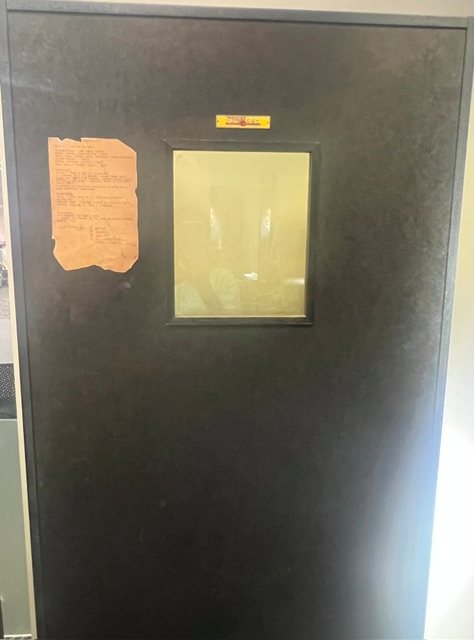
Founded in the early twentieth century, the Bar-Ray Products Company manufactured protective devices from the extreme hazards of radiation exposure. The company designed, developed, and manufactured radiation protective gear, specializing in lead x-ray aprons, collars to protect the neck and thyroid gland, and devices to shield radiologist’s eyes. These tools were crucial to guard patients, radiologists, and doctors as the robustness increased in x-ray machines. The x-ray stitching stand on display at the Winkler Center was utilized to take segmented images of patients standing or lying down due to the fact that the early twentieth century x-ray tubes could only reproduce small areas in a single image. The stand itself kept the patient still and aligned during the multiple x-ray imaging process. The individual x-rays were arranged together (stitched) by placing them on a light box or made into a film strip. Now located in Littlestown, Pennsylvania, Bar-Ray Products Company continues to produce radiation protective gear and supplies.
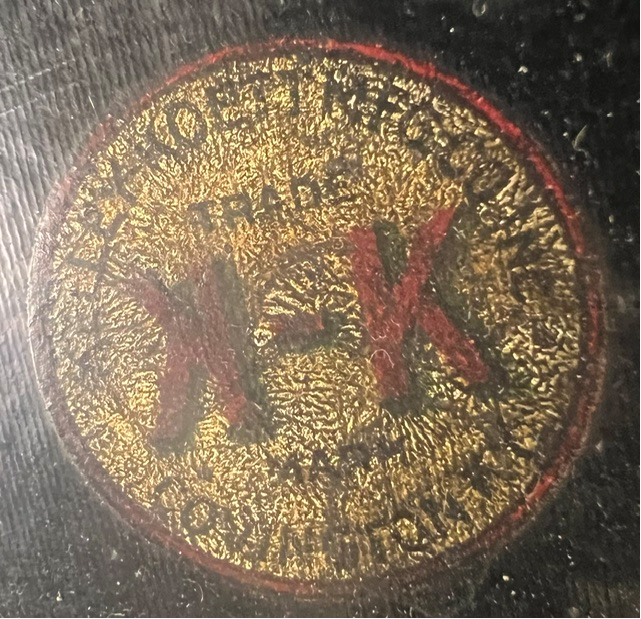
Located at 212 West Fourth Street, the Kelley-Koett Manufacturing Company was founded in Covington, Kentucky by John Kelley and Albert Koett in 1903. From there it moved to 125 East 6th Street in 1950, and then later to Cincinnati, Ohio. Their long-term and large-scale manufacture of x-ray stands, tubes, and radiology equipment led to Covington’s moniker X-Ray City. By 1952 the firm was sold to Tracerlab.
Both the Bar-Ray Products Company and the Kelley-Koett Manufacturing Company were early pioneers in the development of radiological science in X-Ray City. These artifacts are on display at the Henry R. Winkler Center for the History of the Health Professions in the Health Sciences Library at the University of Cincinnati.