University Archivist and Head, Archives & Rare Books Library
University of Cincinnati Libraries
Full-time, faculty tenure-track
Salary Range $85-110K, salary plus stipend
University of Cincinnati Libraries is inviting applications for the University Archivist and Head, Archives & Rare Books Library. The successful candidate will be responsible for the development and management of services and collections of the Archives and Rare Books Library, which includes rare books, manuscripts, the University Archives, and other archival and special collections. Additionally, as University Archivist, the position is responsible for promoting use and engagement with collections documenting the history of the University of Cincinnati and provides leadership oversight of University Records Management Program.
This position is covered by AAUP UC’s collective bargaining agreement. UC faculty librarians have access to annual funding to support conference attendance and professional development needs.
This position operates under the principles of the UC Libraries Strategic Framework: NEXT Directions, which aims to increase our impact by: creating paths to education innovation and student success; contributing to the university’s research, learning and teaching agendas; and by creating partnerships within UC, the wider Cincinnati urban community and at national and international levels.
This work requires a substantial investment in people, a renewed commitment to Diversity, Equity and Inclusion and a continued focus on and acceleration of digital transformations as the Libraries continue to fulfill its mission and achieve the vision to become the globally engaged, intellectual commons of the university—positioning itself as the hub of collaboration, digital innovation and scholarly endeavor on campus.
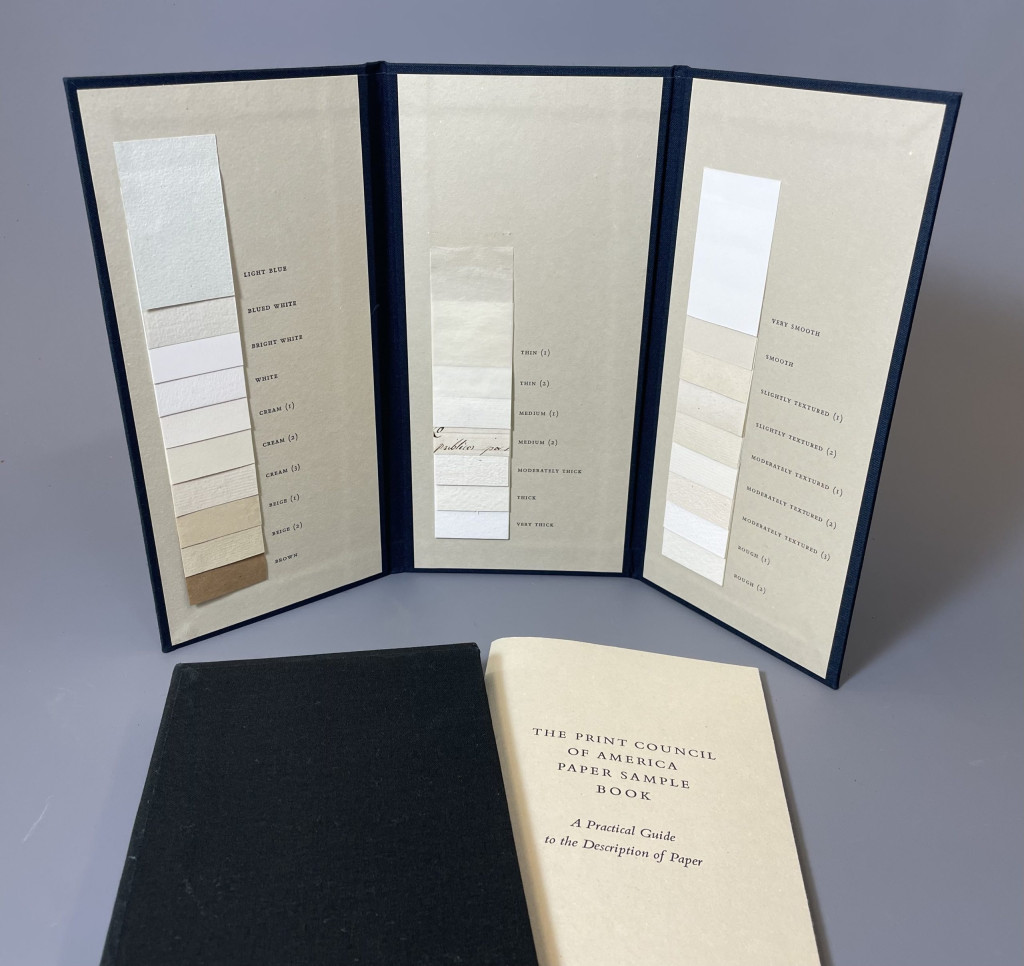
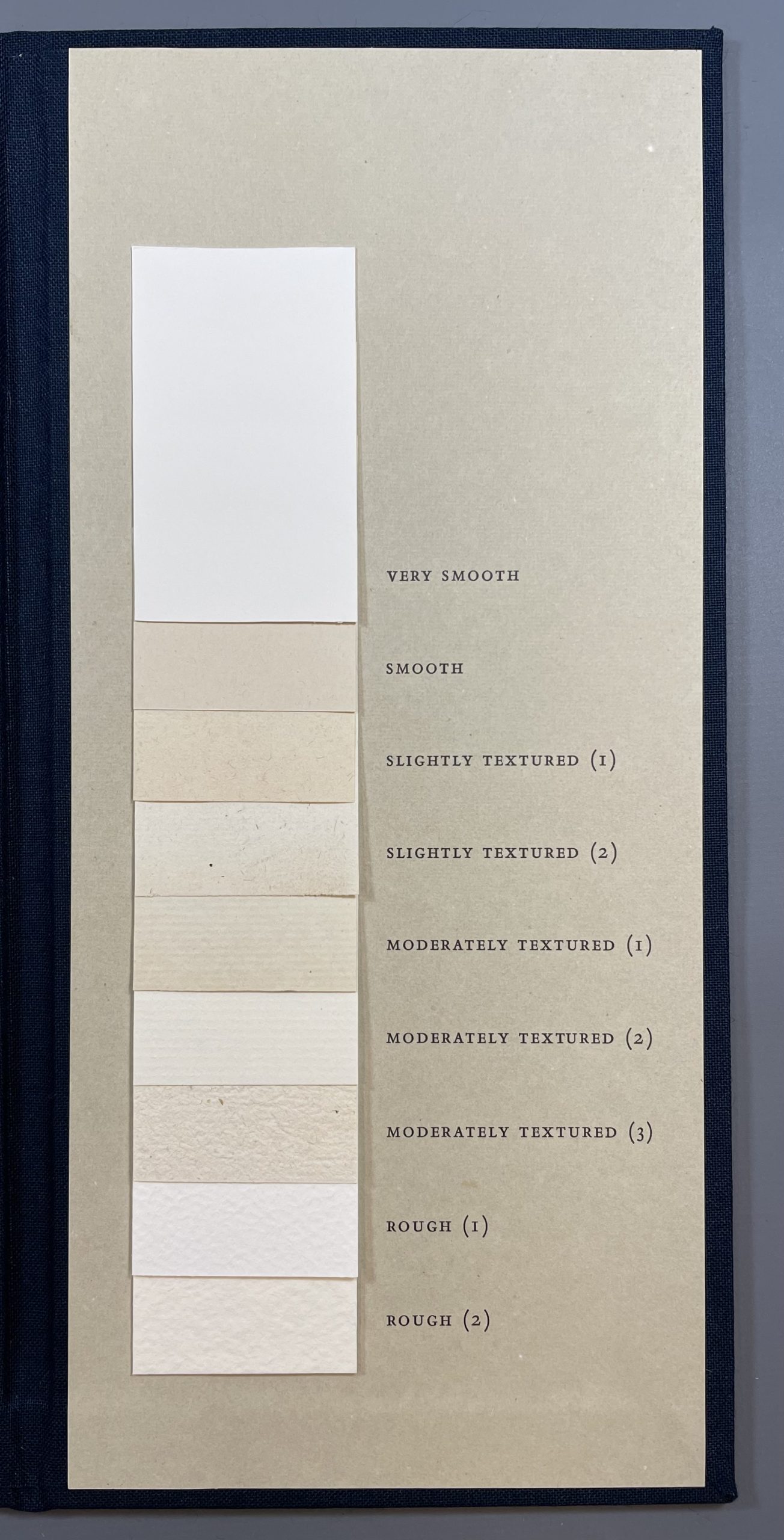
While there are many fine art applications, this book is used in the field of paper conservation when describing papers in an examination report. The reason for this is to establish a visual standard since descriptors can be quite subjective. Cream, beige and light brown to one person could be perceived as opposites to another. However, using this booklet, a large range of colors, textures and thicknesses are definitive and straightforward to select when comparing the samples to the object in person.
I first gained experience using the reference in graduate school and thought it could be a valuable resource for the Preservation Lab, especially for staff and students learning to examine objects for the first time. However, I was under the impression it was out of print because the booklet was created by the Print Council of America a few decades ago and contains a limited number of hand cut paper samples. With the lab’s newly found historic paper samples in mind, I emailed the Print Council Of America to seek permission to create a facsimile. Lo and behold, I was thrilled to learn the books were still for sale and no boot-legging necessary!
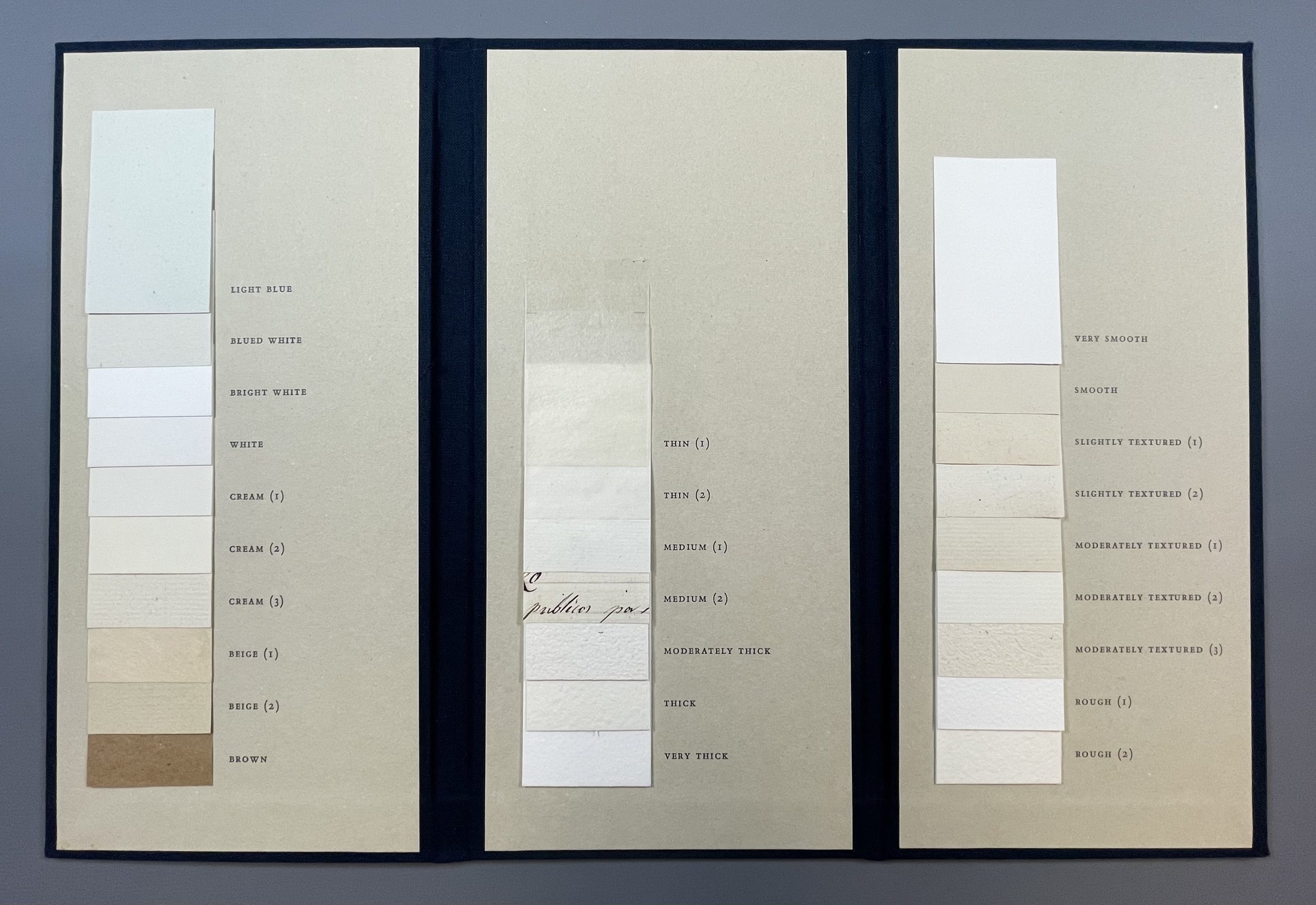
Ours arrived just this week and I’m excited to share the tri-fold booklet below! Paper colors are defined on the left, thicknesses outlined in the center, and textures displayed on the right.
How to use:
When describing a paper object (or text block) in the description section of the treatment report, I will now reference this booklet to describe the color, texture and thickness using this terminology. Colors include: Light blue, blued white (which looks gray to me!), bright white, white, cream (1), cream (2), cream (3), beige (2), and brown. There are seven types of thickness and nine types of textures to select for comparison ranging from very smooth to rough (3). The accompanying pamphlet has great information to further define the terms, including a measurement chart for the paper thickness (should you prefer using a micrometer), and provenance of all the sample papers.
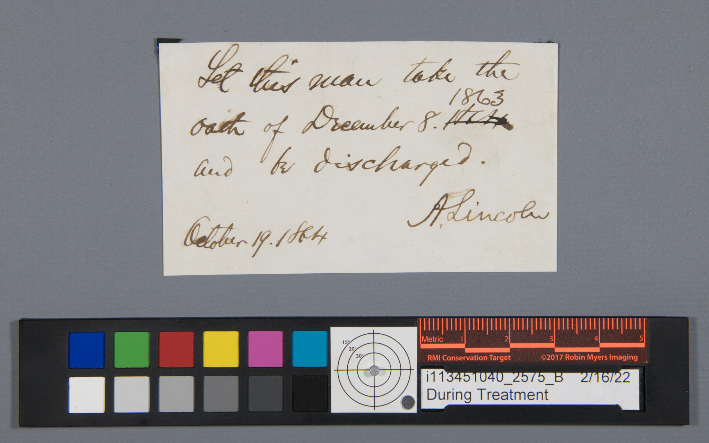
Let’s use the booklet to describe a handwritten note by Abraham Lincoln from 1864, owned by the Cincinnati and Hamilton County Public Library:
During treatment, the note is removed from the matting system
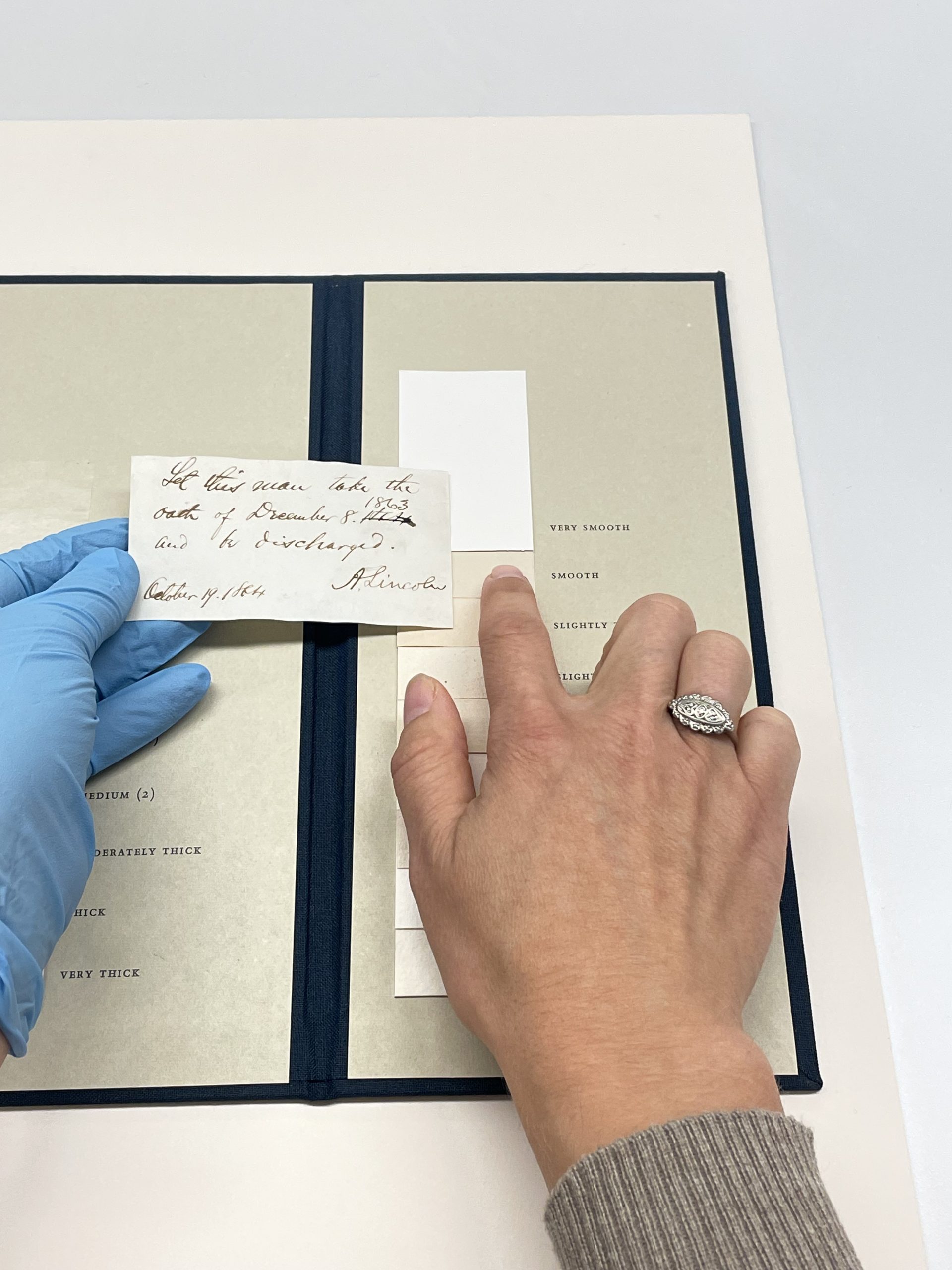
Before having my hands on the booklet, I would have described the object as follows: The manuscript is handwritten with brown iron gall ink on a light beige handmade laid paper. Comparing the object to the Print Council of America sample book, the manuscript could be better described as:
…a manuscript handwritten in brown iron gall ink on a cream (1)…
…a manuscript handwritten in brown iron gall ink on a cream (1), medium (2) thick…
… a manuscript handwritten in brown iron gall ink on a cream (1), medium (2) thick, smooth, handmade laid paper.
Much improved from my initial description that indicated the color was light beige!
When using this booklet as a reference for reports or surveys, at the bottom of the report, I’ll begin adding a footnote that says, “[1] All paper descriptions by comparison with Print Council of America’s Paper Sample Book (Roy Perkinson and Elizabeth Lunning, 1996). This will allow other conservators and practitioners familiar with the book to have a point of reference when reading my report, even on the other side of the country! In the future, this can also help in identifying shifts in paper tone caused by aging paper.
Ashleigh Ferguson Schieszer – Lab Co-Manager, Rare Book and Paper Conservator
The phrase “chain of custody” doesn’t illicit much excitement generally speaking, but it’s one part of the workflow in the Preservation Lab that leads to the exciting part — materials return days!
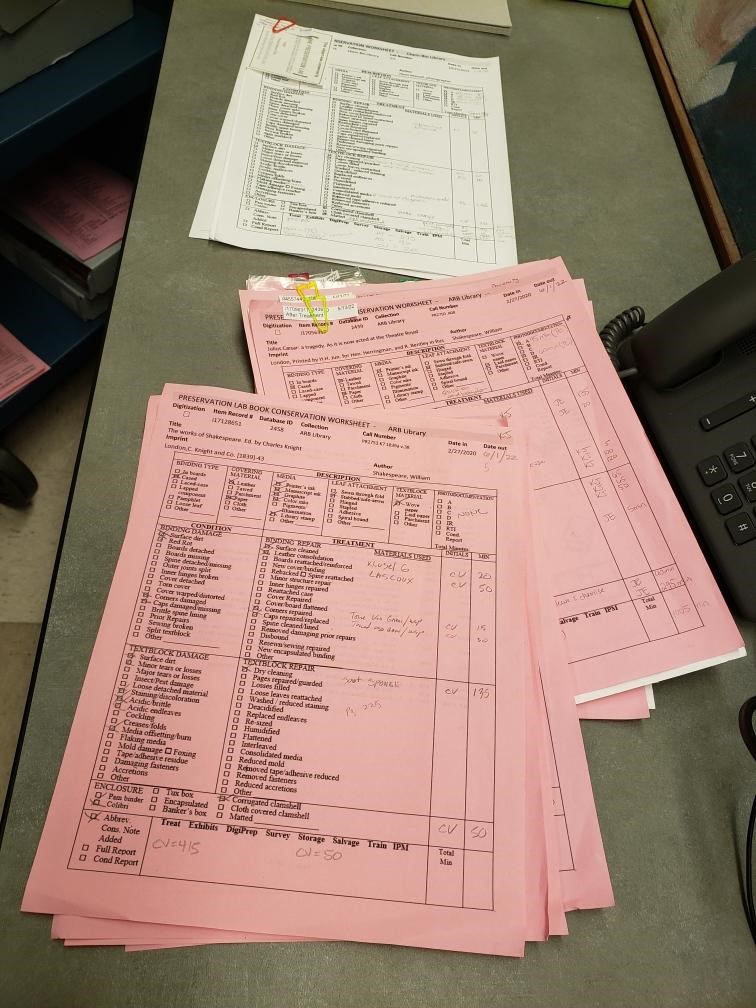
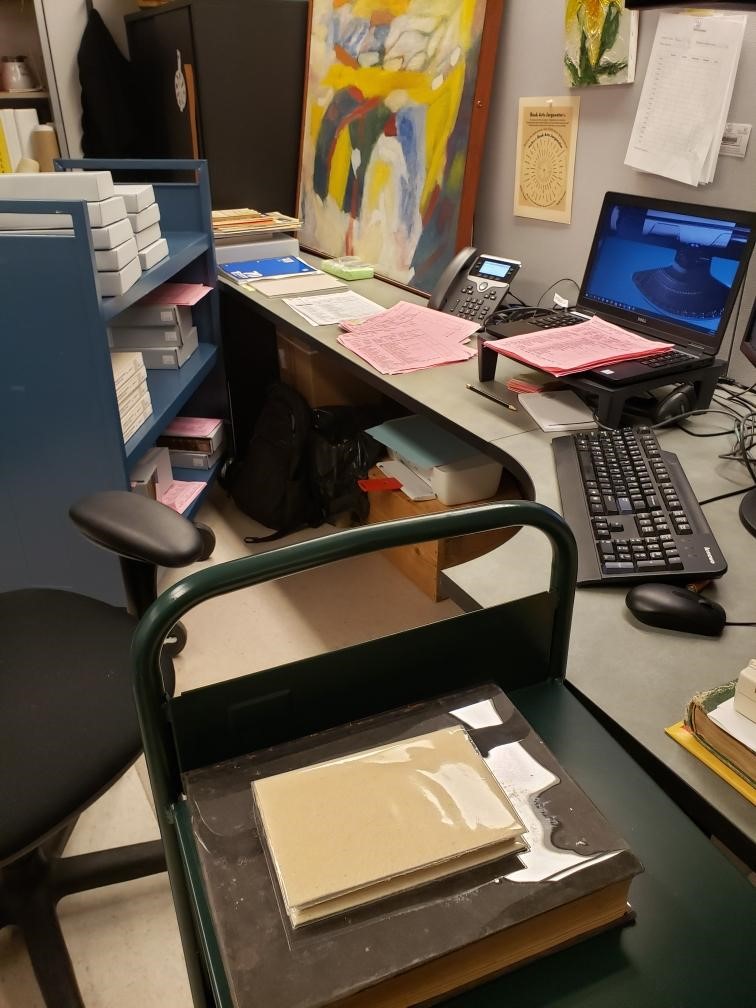
We count on paper forms (pictured below), our homegrown treatment database, and our partner’s catalogs to make sure that at all times our partners know where their treasures are in the conservation workflow.
(Left) Paper treatment forms where we record our conservation time. (Right) My office area with materials preparing to “go home” after chain of custody work completed.
The materials above are ready for return. This happens at regularly scheduled meetings where the materials are delivered back by the lab and the treatments are discussed with the subject selectors. At the return meetings we also do our new intake… and the process begins again!
After a two year hiatus, the Preservation Lab once again was able to celebrate the American Library Association’s Preservation Week. And this year, the lab decided to take Preservation Week to the public.
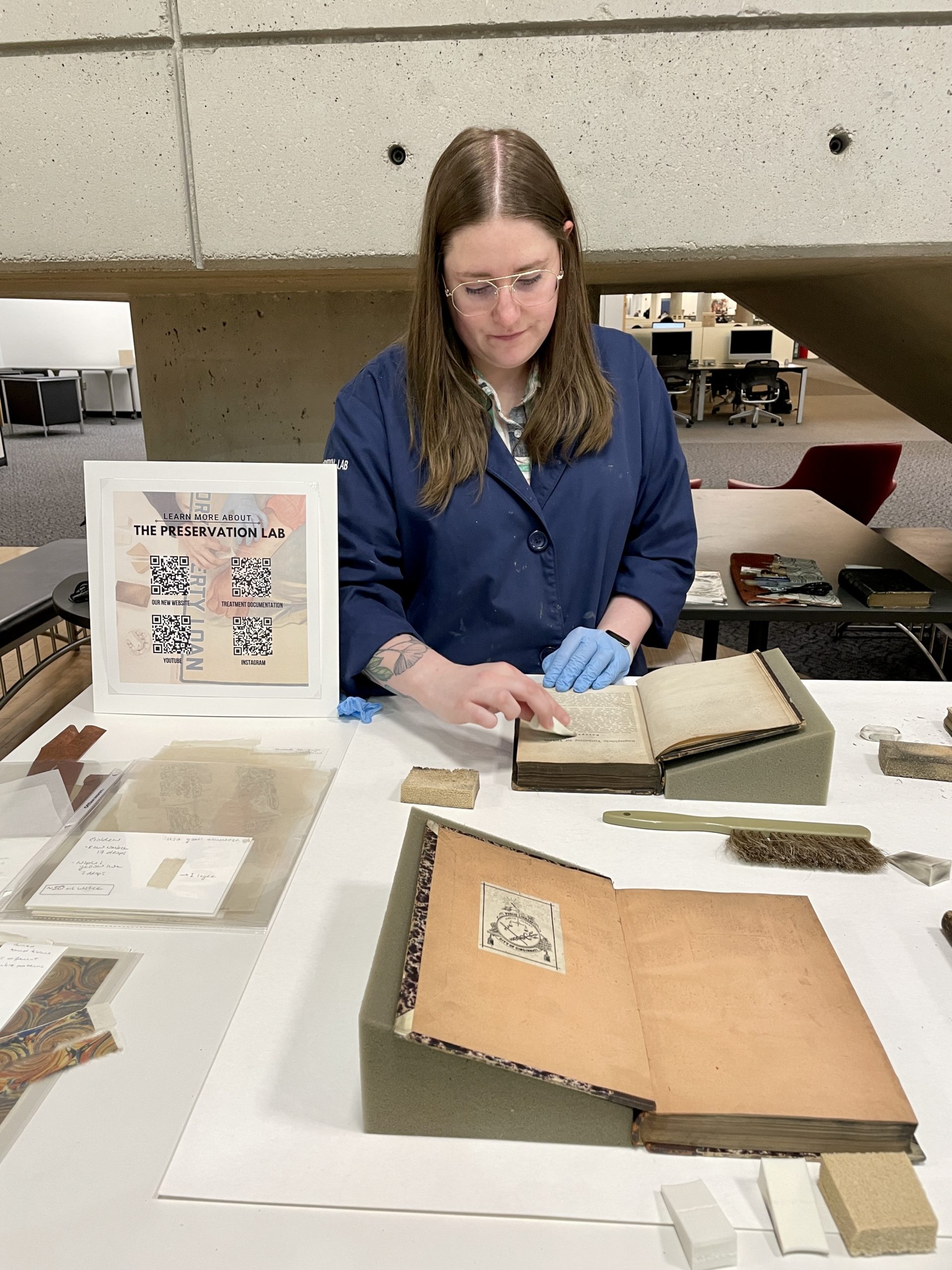
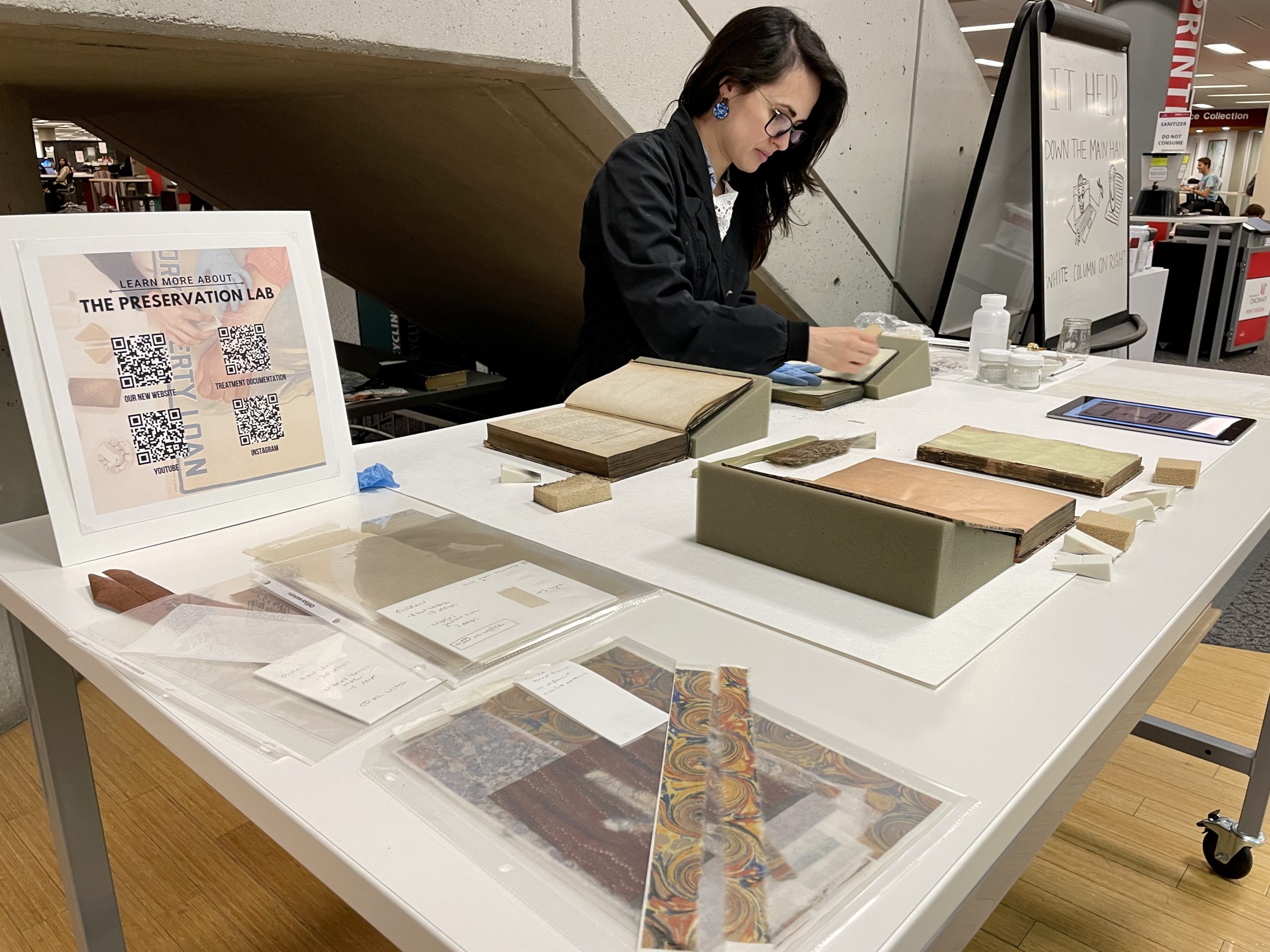
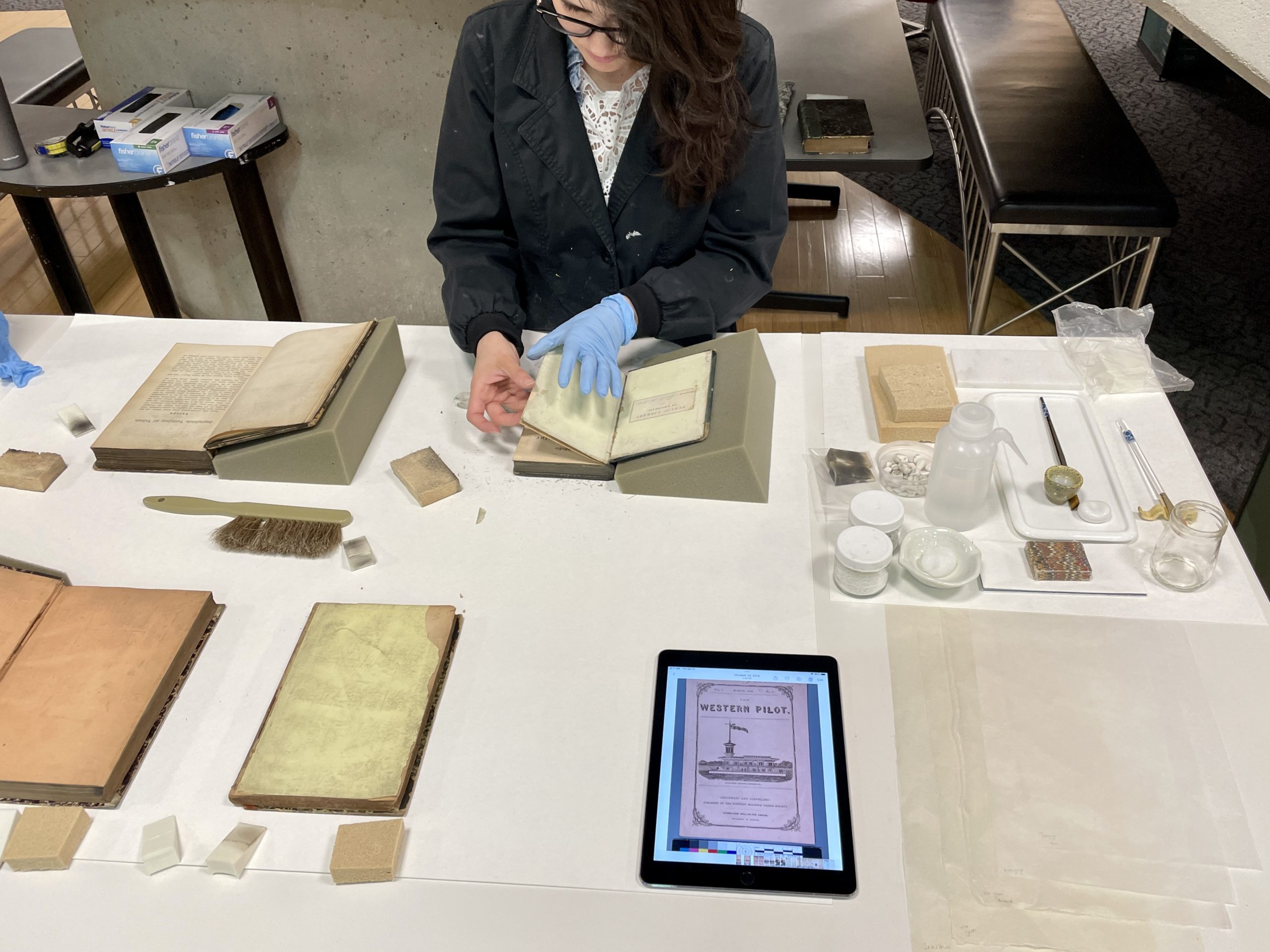
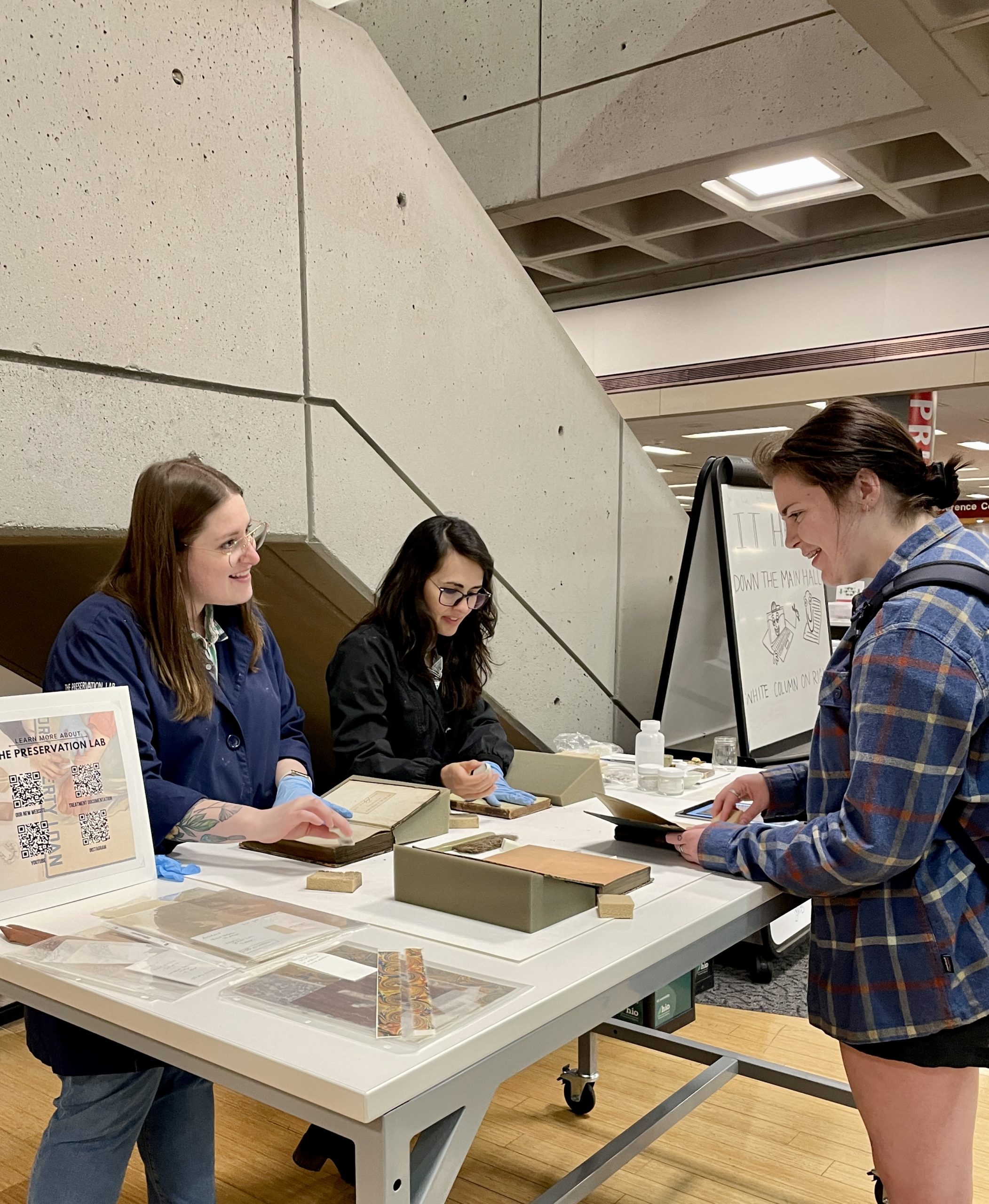
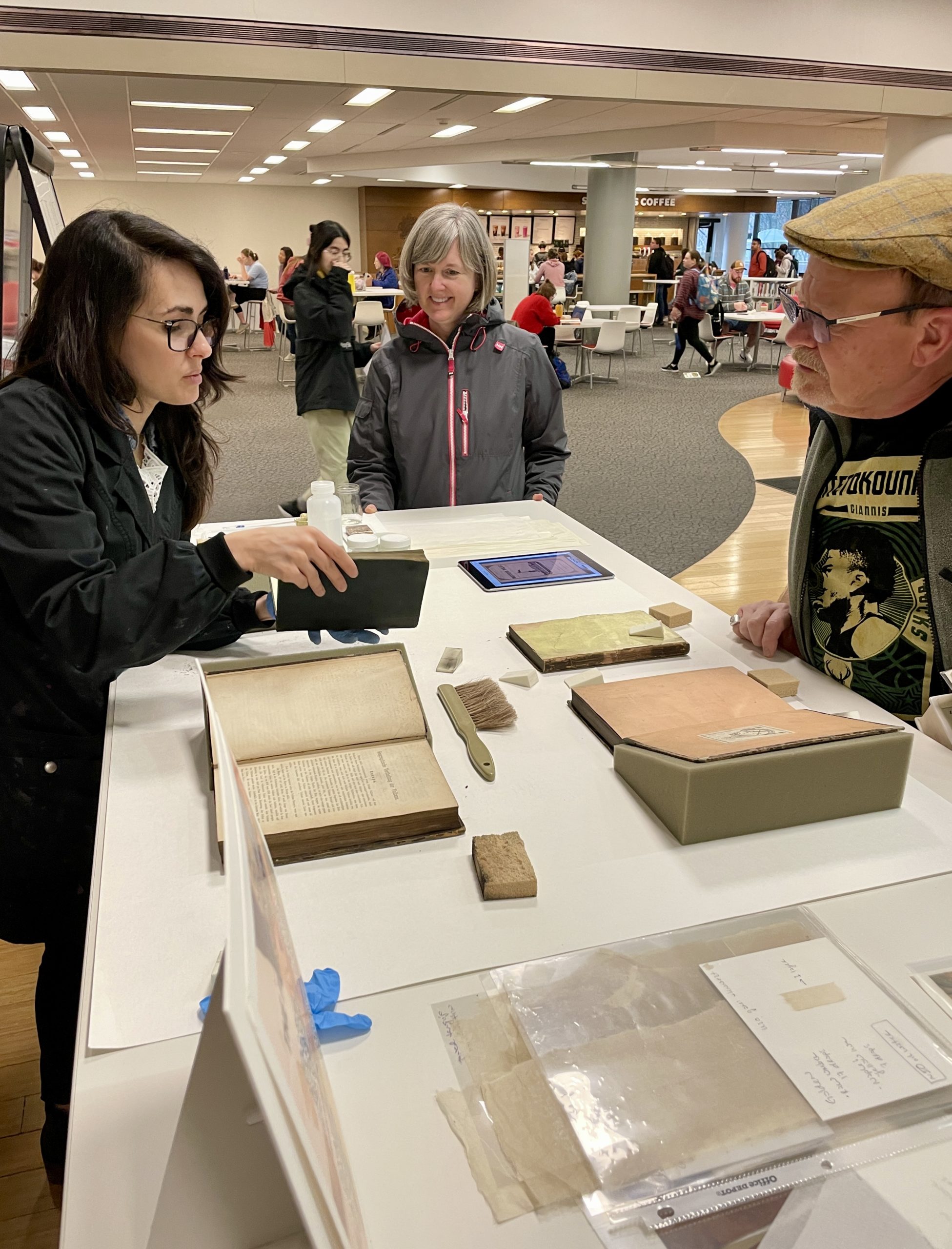
On the morning of April 21st, Catarina and Jessica took one of the lab’s rolling work tables to the entrance of the Langsam library. There they set up a demonstration area with some very dirty books, to show the public a little bit about surface cleaning. They brought out the different supplies used in surface cleaning (such as hydrophilic sponges, smoke sponges, eraser crumbles and vinyl erasers). In addition to surface cleaning materials, Jessica and Catarina also brought some Japanese tissue for the public to touch and learn about tear repair.
Jessica is actively surface cleaning a very grimy book.Catarina is surface cleaning a dirty book using a hydrophilic sponge.Another view of the entire set up with a tear repair station.
A few members of the public were too nervous to even try to surface clean a little bit of the dirty books (all filled with soot from coal burning stoves), but others were brave enough and felt that surface cleaning was a very satisfying and relaxing treatment.
Jessica encouraging a UC student to try to surface clean.Catarina explaining why surface cleaning was the first step to repair the broken inner joint.
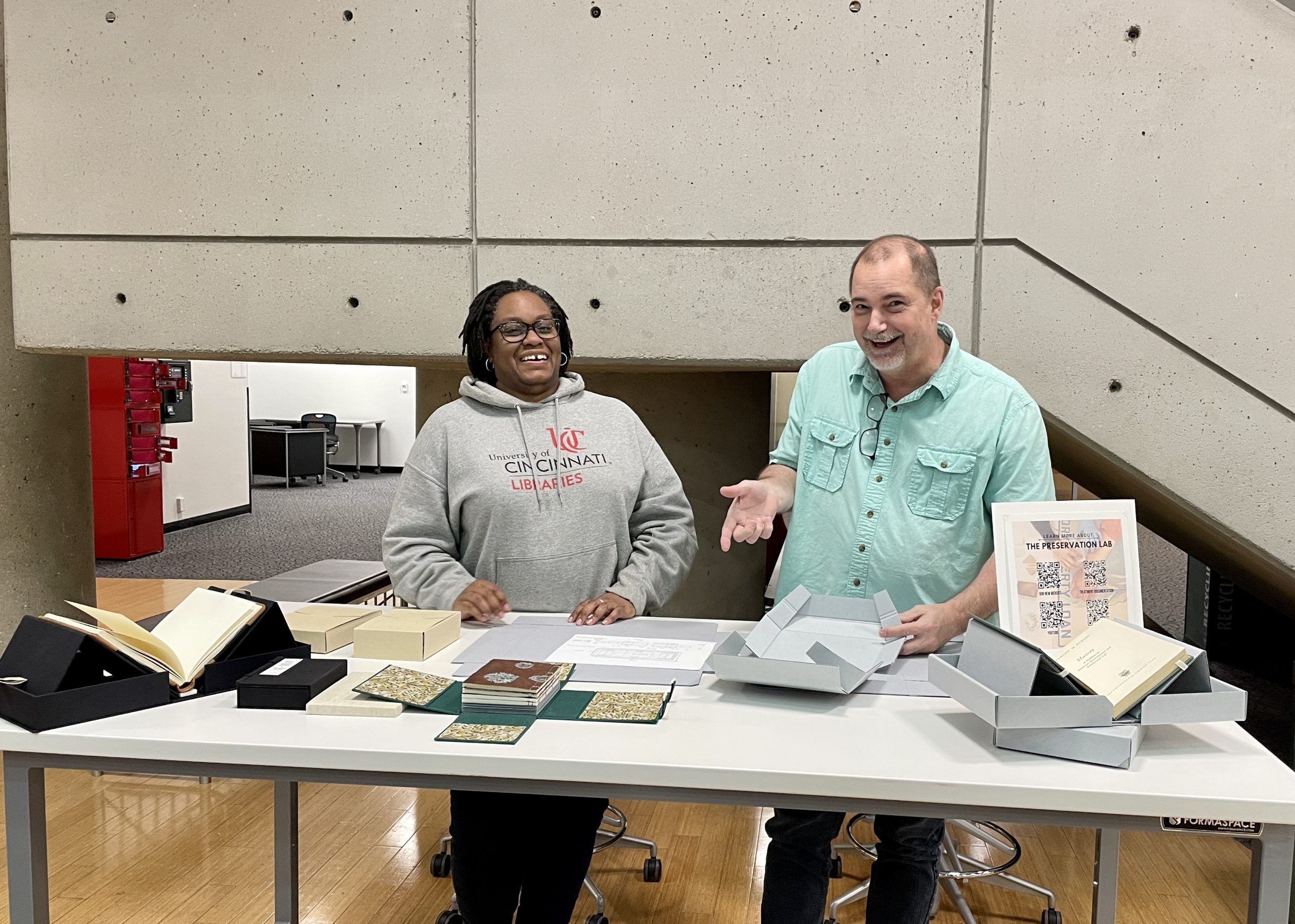
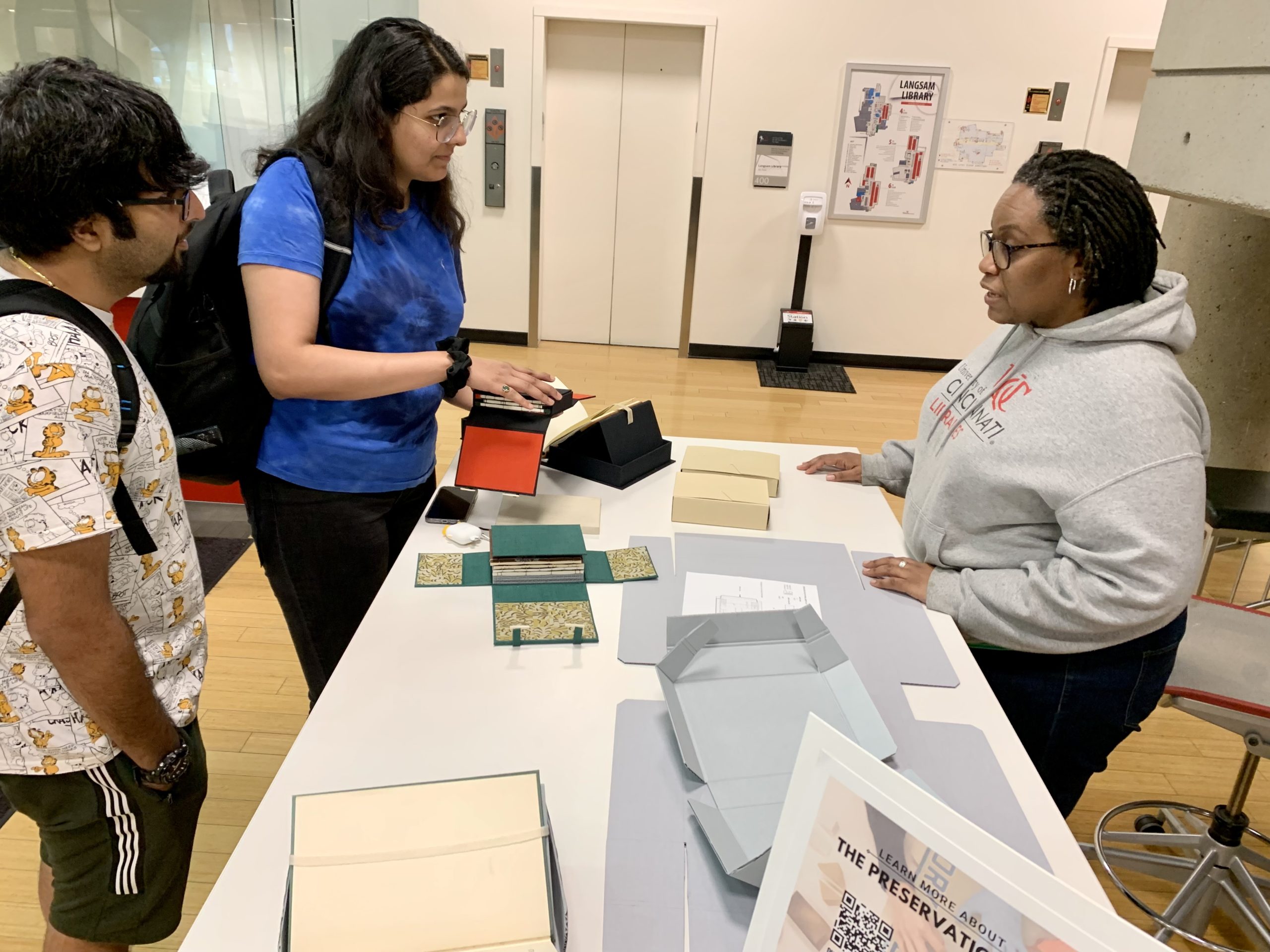
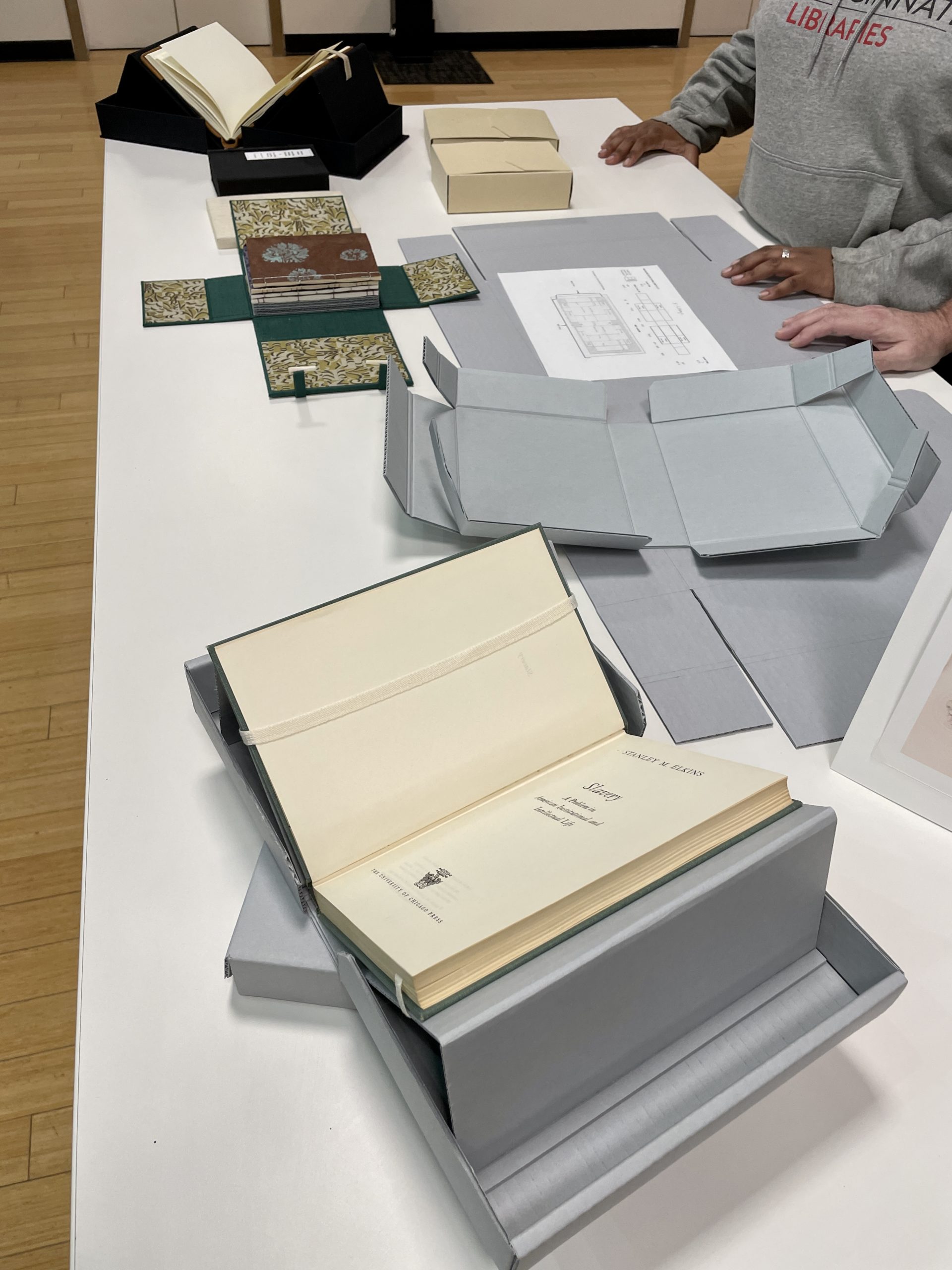
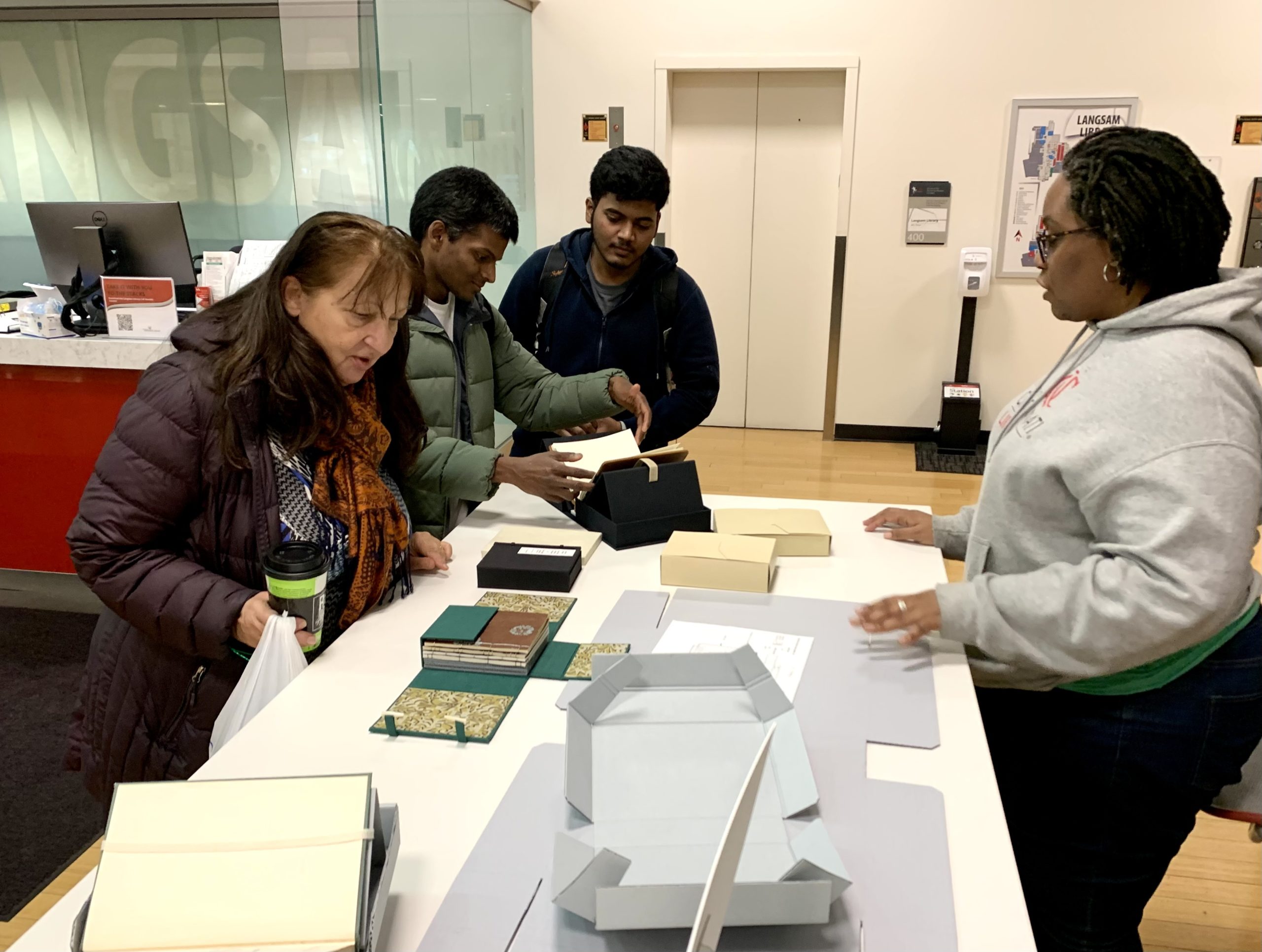
In the afternoon of the same day, Chris and Hyacinth showed the public a variety of enclosures and how they are made from beginning to end. There were corrugated clamshell boxes, one with an integrated cradle, cloth clamshell boxes, tuxedo boxes and a Japanese four-sided enclosure.
Chris also brought a corrugated clamshell in its early stages to show the public how the process of making a corrugated clamshell begins.
Chris and Hyacinth showing their display of models and enclosures.Hyacinth explaining to some UC students the different Japanese four-sided enclosure compared to other enclosures.The different enclosures that Chris and Hyacinth showed to the public. Hyacinth sharing with an interested public.
The crowd favorites were the elaborate cloth covered clamshell box made by Chris, and the beautiful Japanese four-sided enclosure made by Hyacinth.
Even though this was a smaller event compared to our open house tours of the past, the event was a success; allowing the Preservation Lab staff to share with the UC community a peek into our daily work and explain what goes on in the Preservation Lab. But Preservation week is not done yet…
This upcoming Friday, April 29th at 1 pm, join Holly and Ashleigh at the Clifton Branch of the Cincinnati and Hamilton Public Library, .They will be showing some books models, explaining how books are made and what materials are used. You can find more details in the following link: https://cincinnatilibrary.bibliocommons.com/events/625422b5cd8e792f000bcfc5
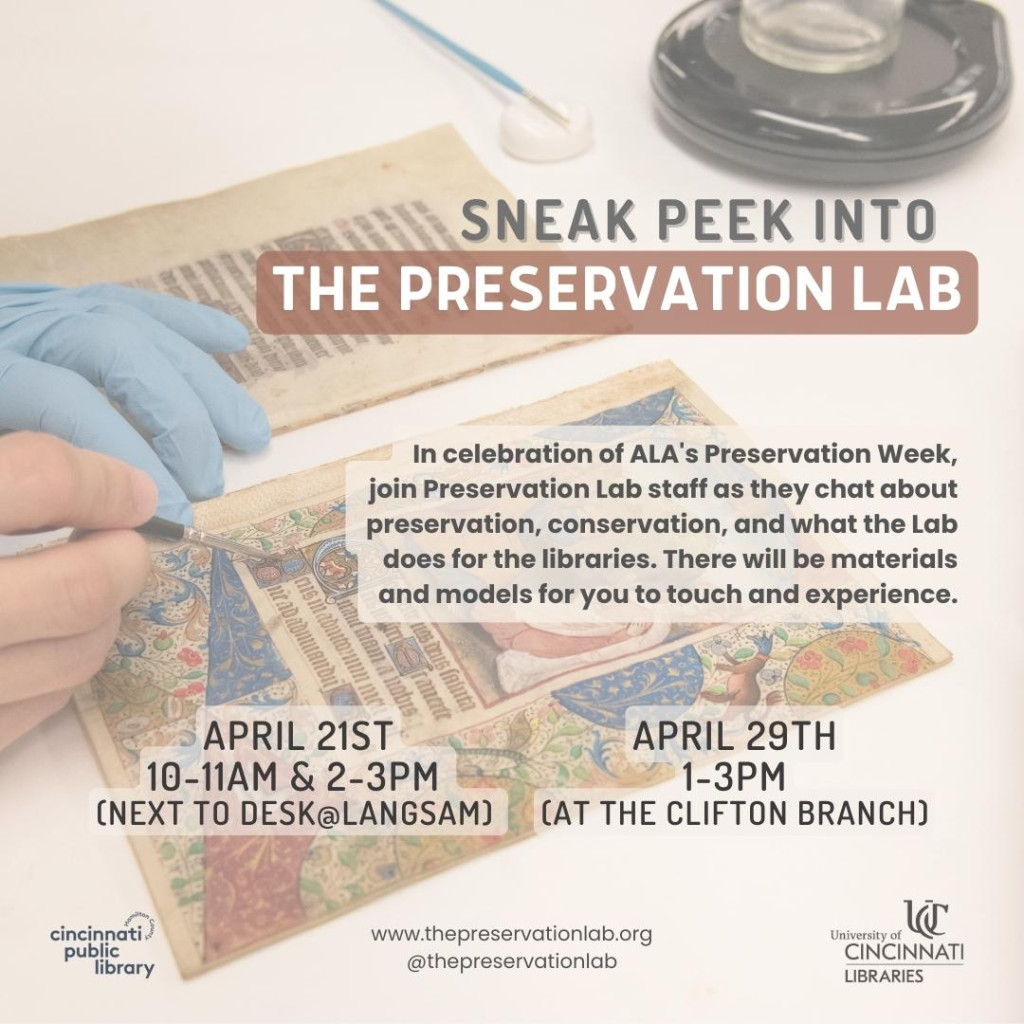
In celebration of ALA’s annual Preservation Week (April 24th-30th), Preservation Lab staff will be offering live demos and show & tells this week and next, both at UC Libraries and the Cincinnati and Hamilton County Public Library:
Each session will be unique, with different staff members showing off different aspects of preservation and conservation!
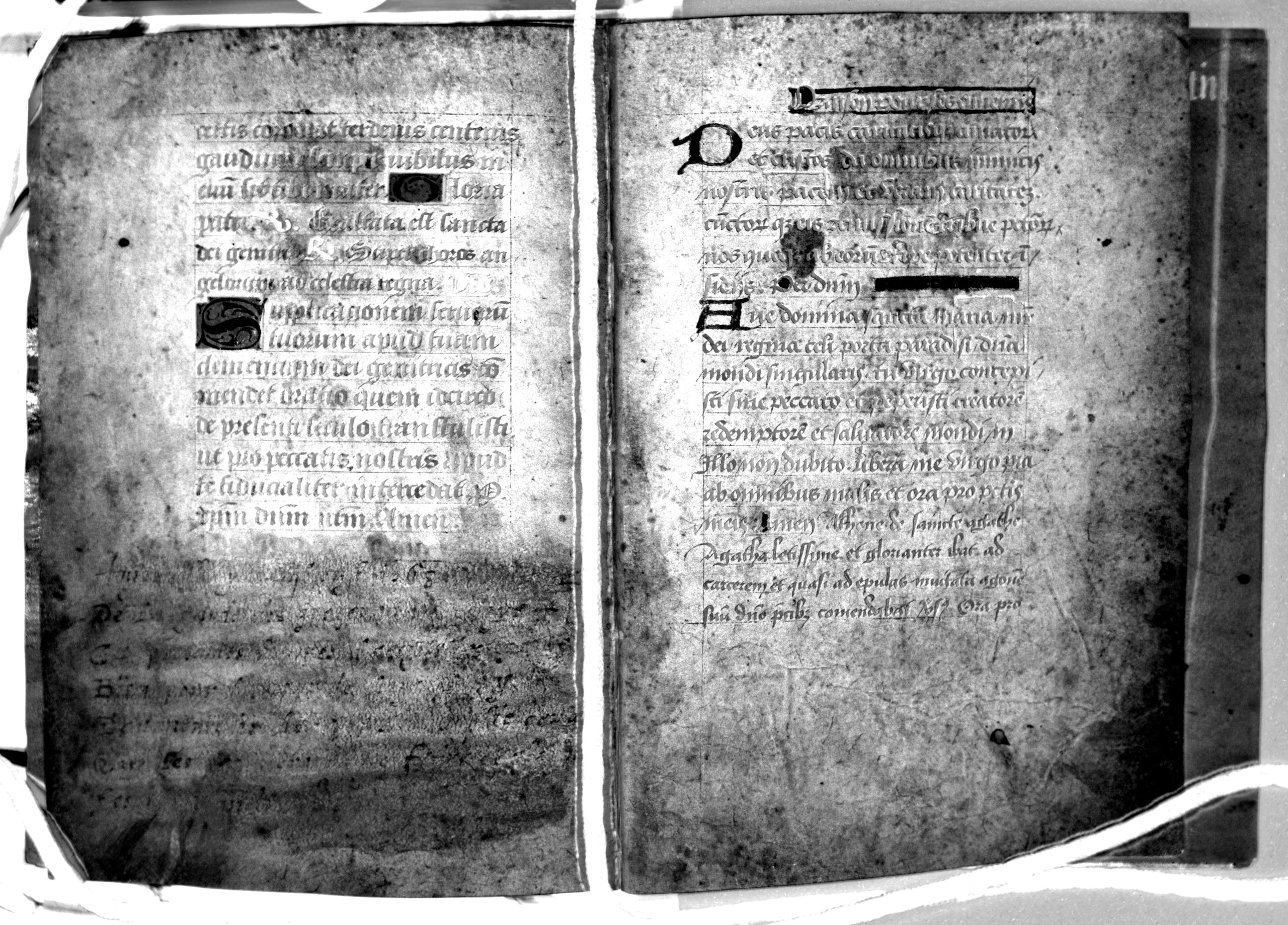
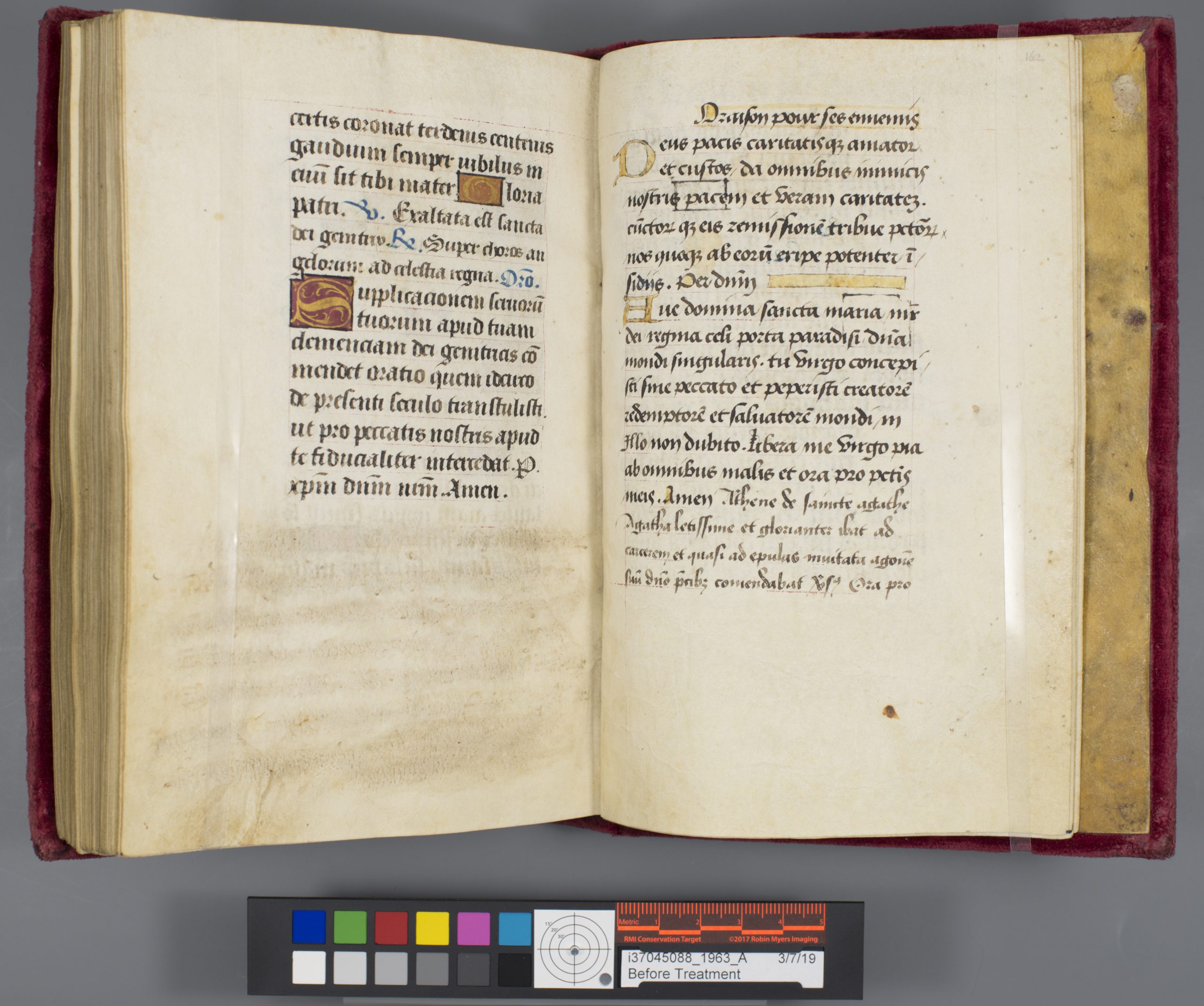
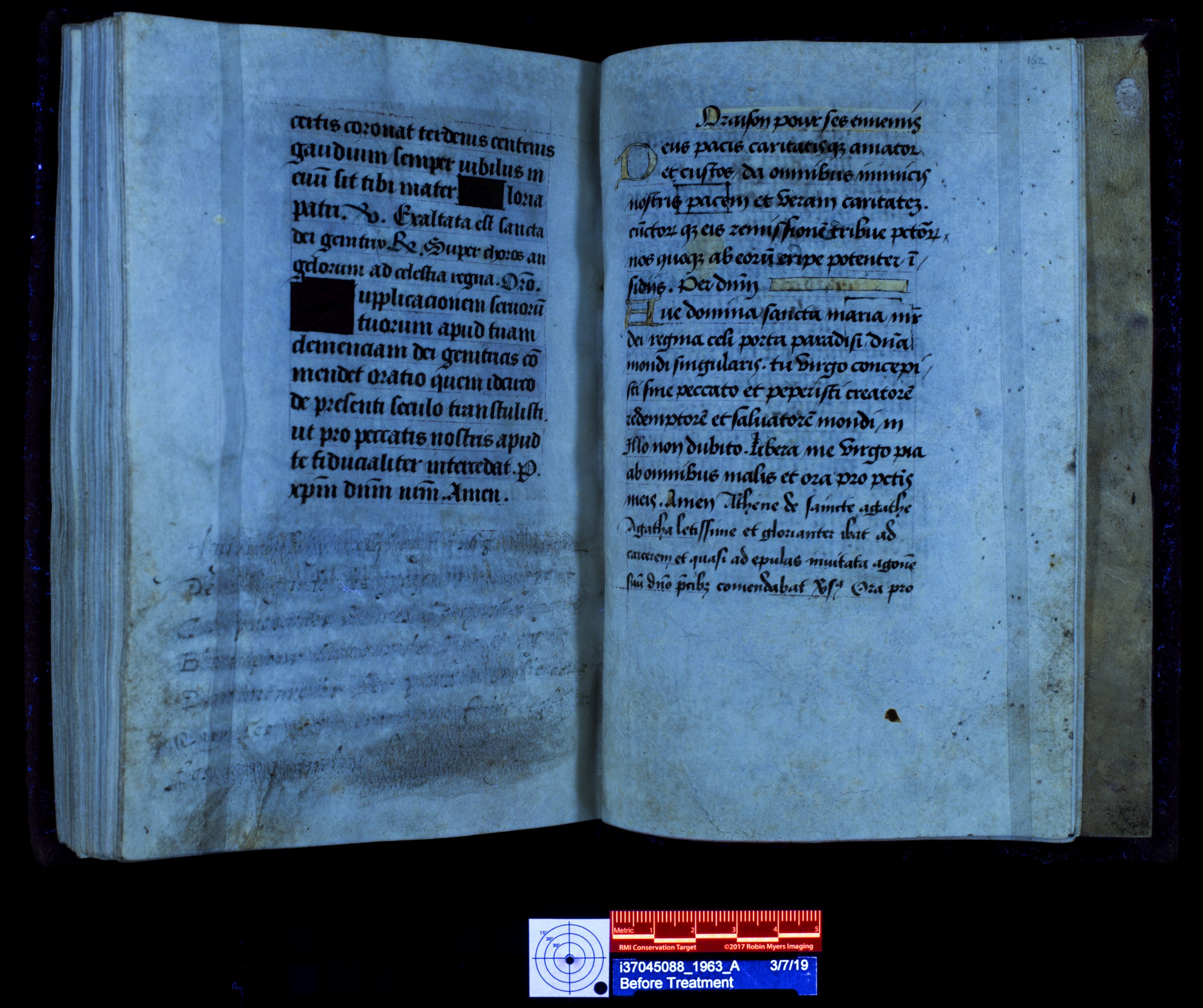
As mentioned in a previous blog post, Andrew and Naomi from Case Western Reserve came to the lab in late February to demo the MISHA portable multispectral imaging system, made possible by a National Endowment for the Humanities (NEH) Research Grant awarded to the Rochester Institute of Technology. In total, Naomi and Andrew imaged five objects from the Public Library, UC Libraries, and one of our third-party institutional clients. Imaged books included, one Otto Ege item, two Book of Hours, one undated Latin music manuscript, and a Pentateuch volume from Hebrew Union College. In all, thirteen separate capture sessions were carried out for the five objects. Afterwards, the raw data from the capture sessions was shared with the Lab via OSF (Open Science Framework) so that I could process the data in the NEH grant supported open access RCHIVE (Rochester Cultural Heritage Image processing and Visualization Environment) software.
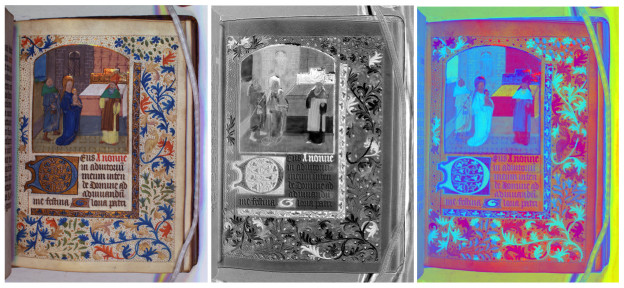
RGB representationBand 5 with the MNF (Maximum Noise Fraction) algorithm applied and the Gaussian enhancement appliedA false color representation
The image gallery above shows the recto of leaf 32 from the Public Library’s copy of Fifty Original Leaves from Medieval Manuscripts, Western Europe, XII-XVI century, by Otto Ege.
While each of the capture sessions took only two minutes to complete, I found that processing the raw data took me a bit longer to figure out. Processing the data felt very similar to using CHI’s RTI Builder and Viewer software. However, in this situation I did not have a week-long training opportunity to learn the ins and outs of the software and its functions. For the Spectral Analysis App, I had only a couple of brief documents to refer to, so the learning curve was a little steeper. I also experienced some issues with the software while processing the data with the flatfield files provided from the capture session. But in the end, the processed files seemed fine without the flatfield data, so it all worked out.
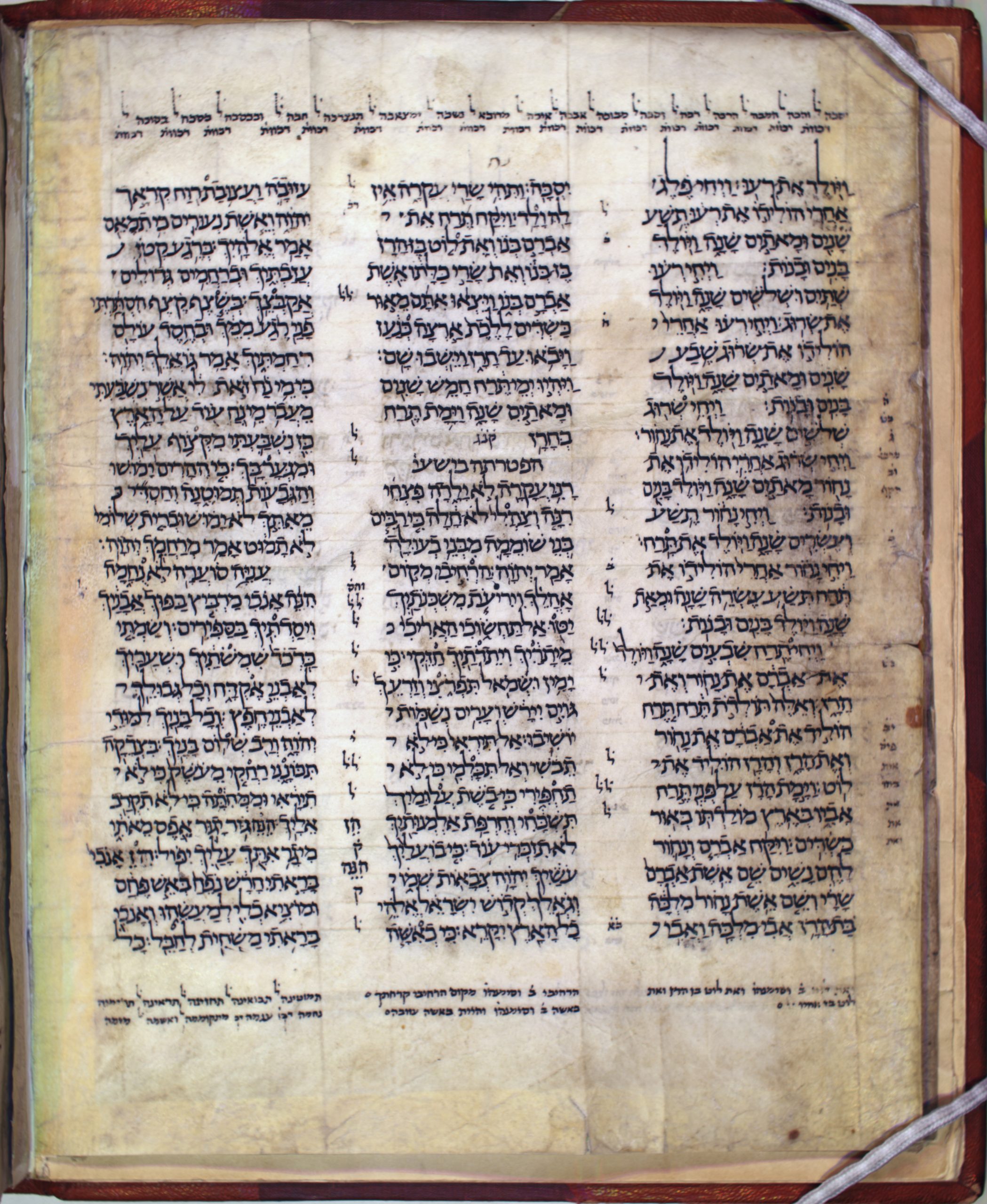
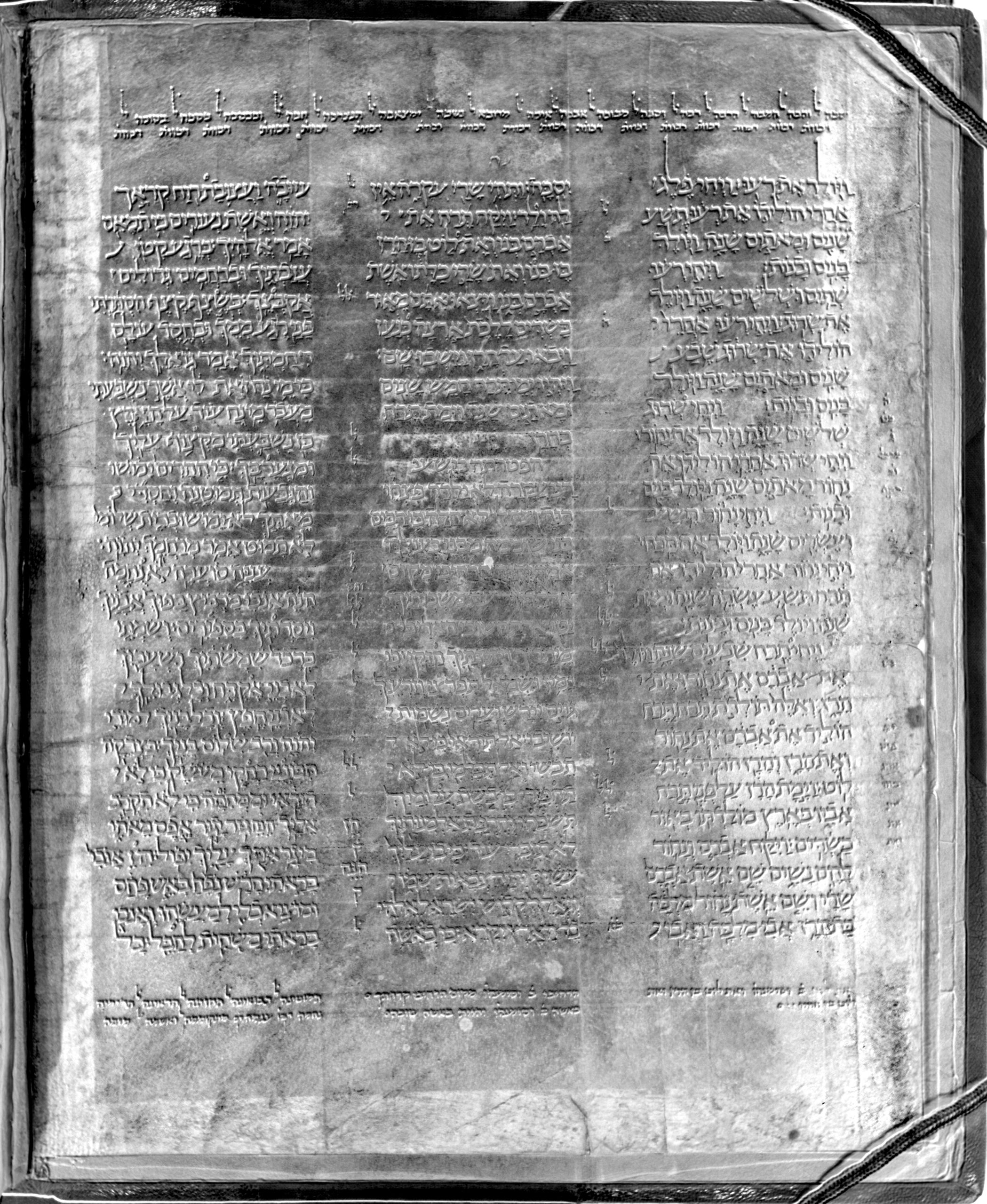
RGB representationBand 3 with the MNF (Maximum Noise Fraction) algorithm appliedA false color representation
The above image gallery depicts a leaf from Hebrew Union College’s Pentateuch Ms. 1 with adhesive staining, tape, and prior repairs.
What I discovered through processing all the MISHA data and then comparing it to the existing specialized imaging done in the Lab was that the suite of imaging we do in the Lab is very well rounded and, in general, suits our needs and our clientele quite well. In many cases, our results were at least comparable, if not better (specifically within the UV wavelengths) than the results accomplished using the MISHA. And, especially with our UV workflow, though our current capture time might be slightly longer than that of MISHA, the data processing time is significantly shorter and, in the case of UV especially, the side-by-side results of the accurate normal illumination next to the full color UV image(s) is ideal for our purposes.
RGB representationand 2 using the Maximum Noise Fraction (MNF) algorithm with the brightness adjusted
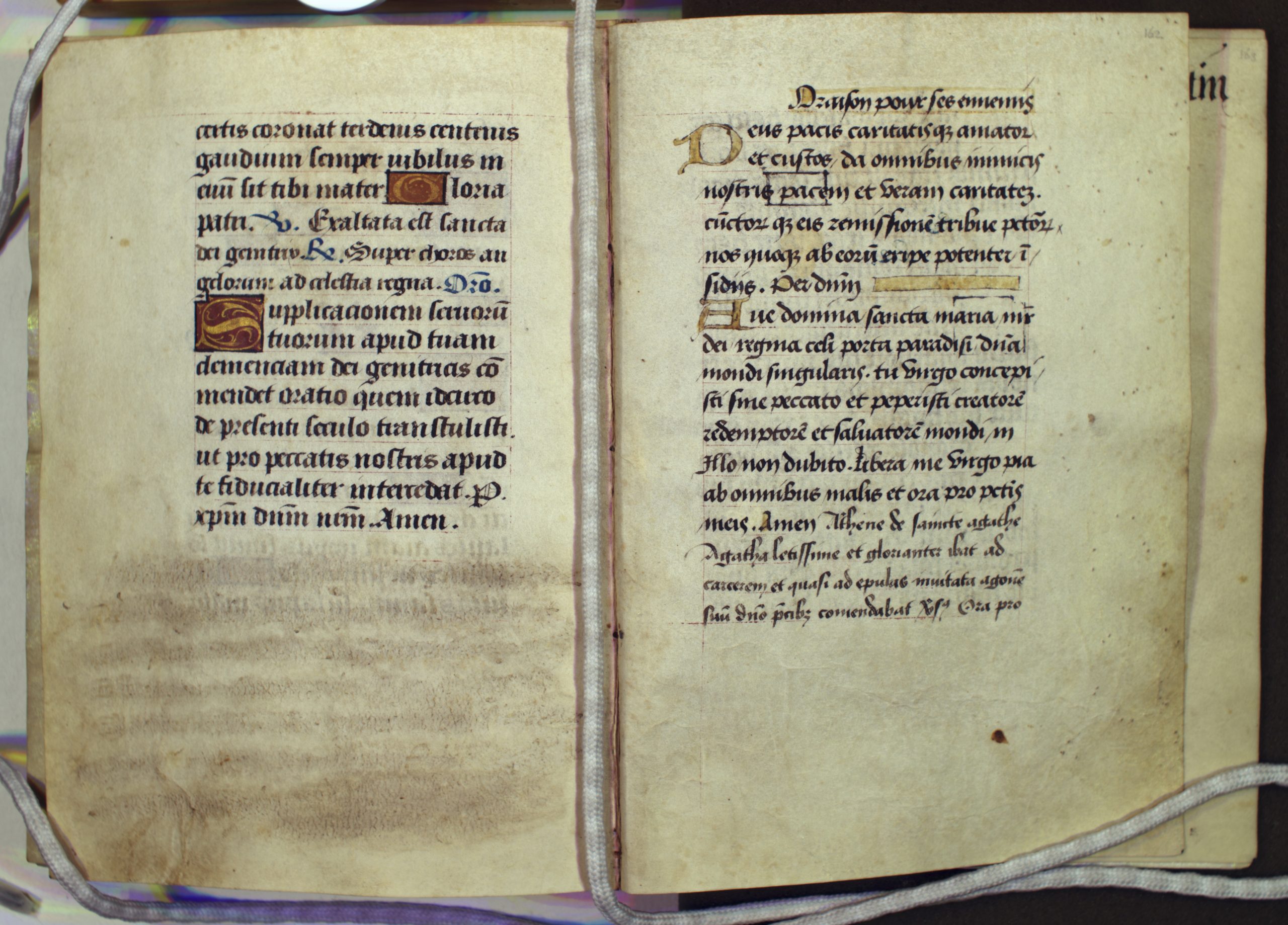
The images above show an example of scraped text on parchment from UC Libraries Hours of the Virgin from 1475, currently in the Lab for treatment. Compare these MISHA generated images to the documentation performed by Catarina Figueirinhas and myself using the Lab’s equipment and processes below.
Normal illuminationUV image (using our old setup without the UV Innovations target)
That said, I am fully aware that not everyone has access to the equipment/training that I have been fortunate to curate/experience over the last five plus years. Also, not everyone uses their finished data exactly how we do. For instance, the needs and expectations of a conservation lab and cultural heritage institutions can be very different. Even within the conservation field, how we use the data provided by specialized imaging in our hybrid book and paper lab is quite different from the kind of data needed by a fine arts conservation lab. Ultimately, I think the core audience for a system like the MISHA system is an organization looking to expand their suite of imaging services, or an institution with no multispectral imaging infrastructure interested in imaging collections in a quick and easy manner. Though for the latter, I would say that there is a big learning curve in manipulating and processing the data, but if greater focus is put into making the software and processing steps user-friendly, especially to novice users, it is completely manageable. And if this step is taken, I think the system could help a lot of institutions dive deeper into the materiality and history of their collections.
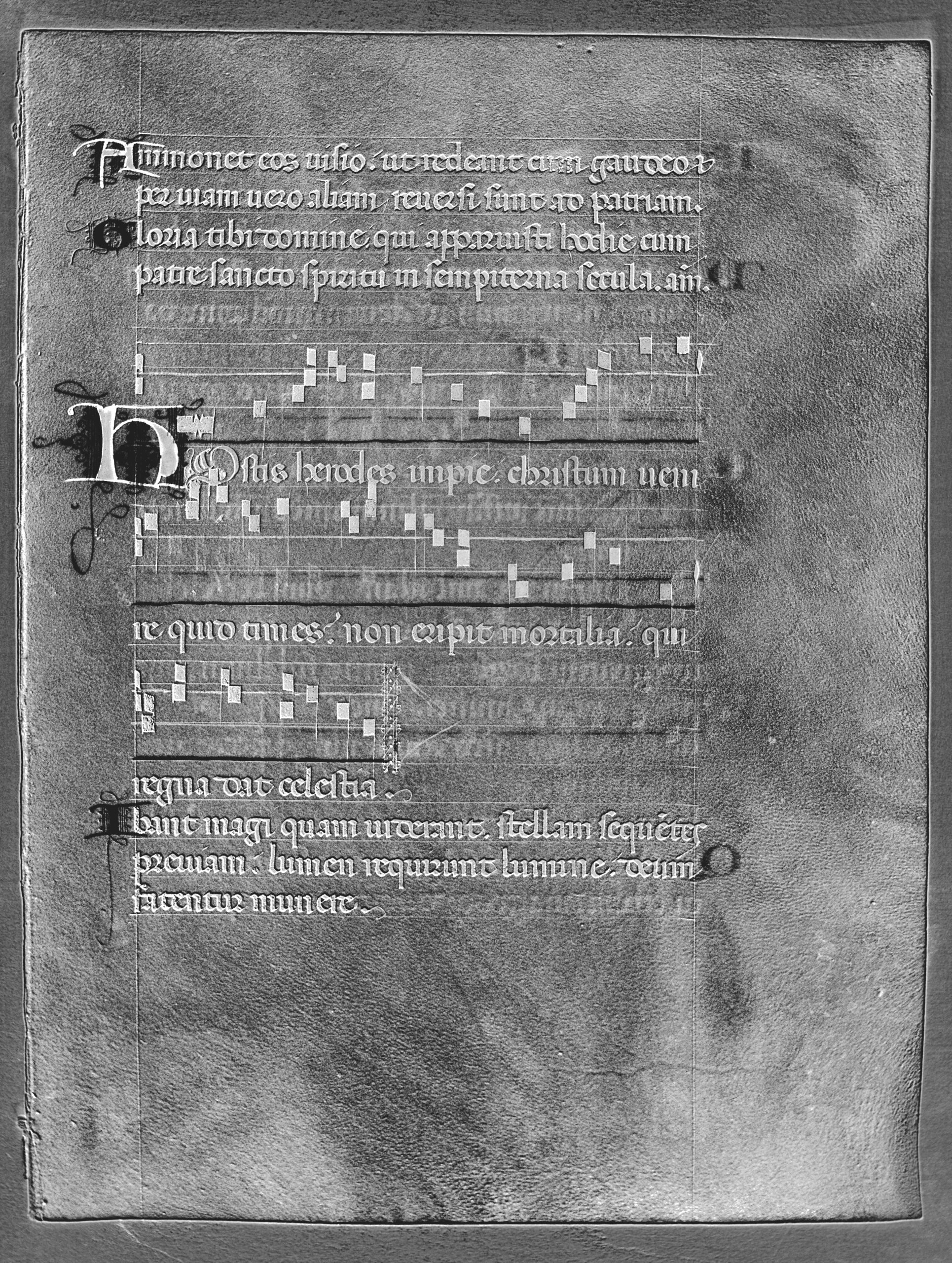
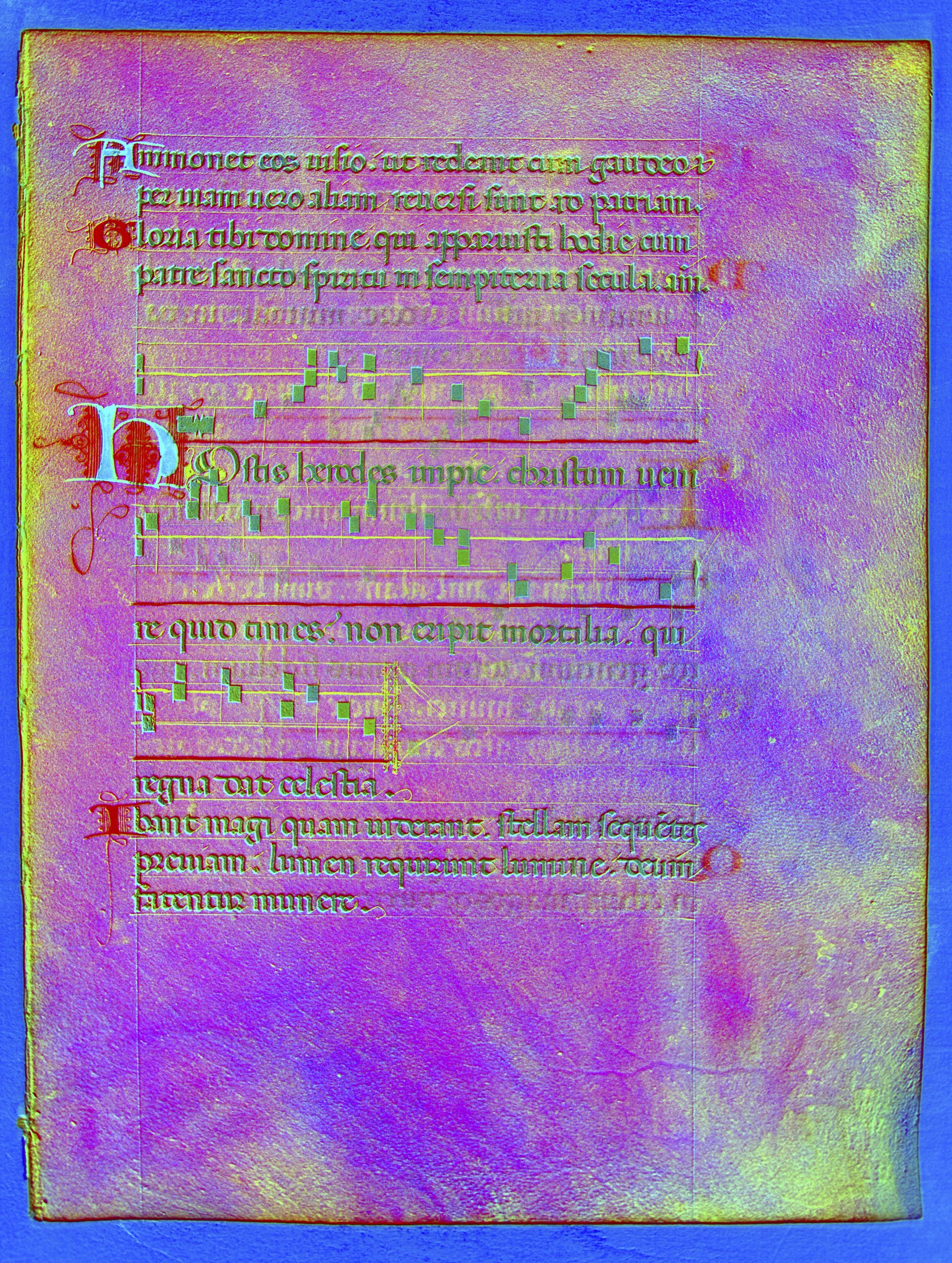
RGB representationBand 5 with the PCA (Principal Component Analysis) algorithm applied, inverted with brightness adjustedA false color representation
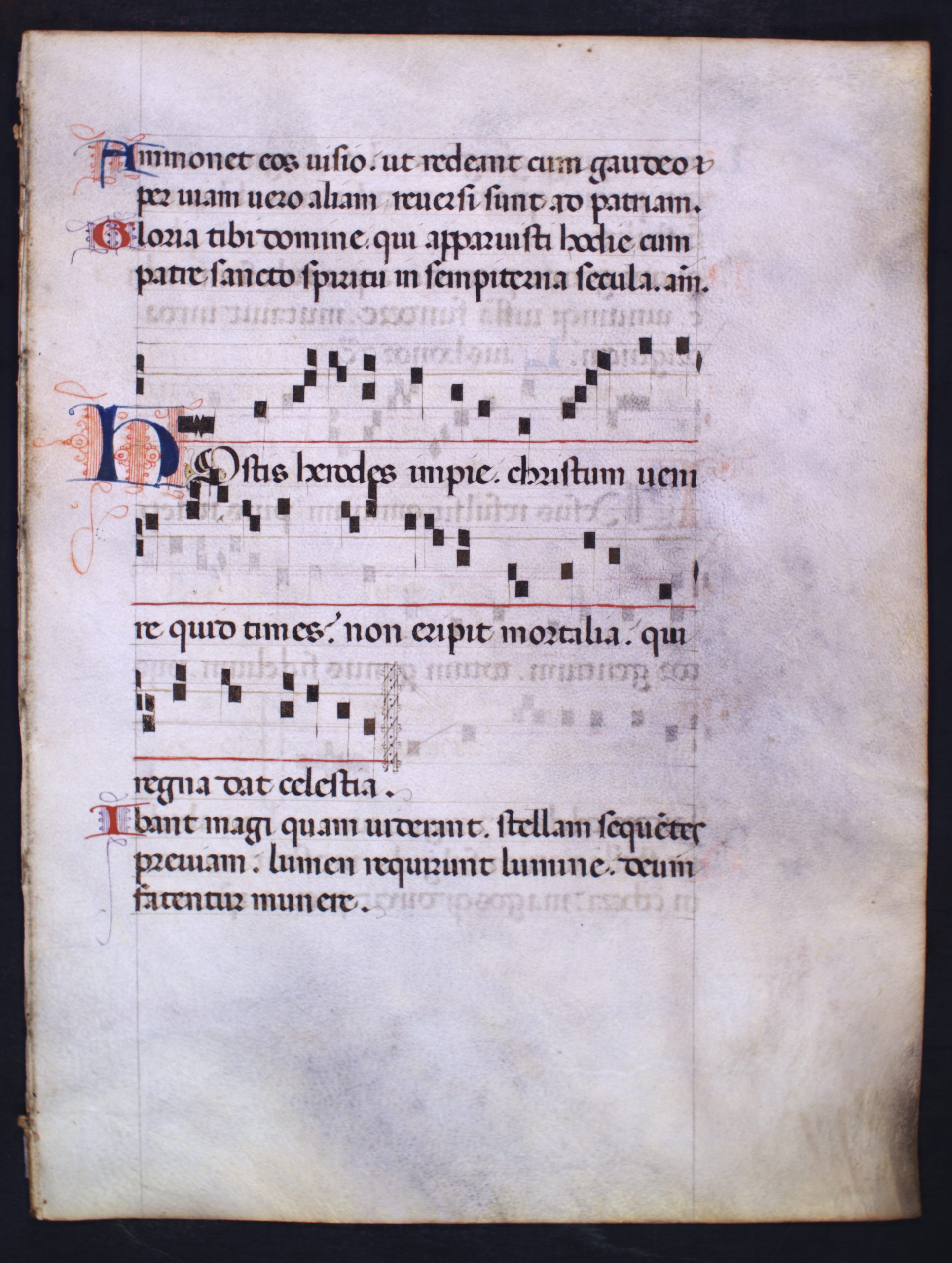
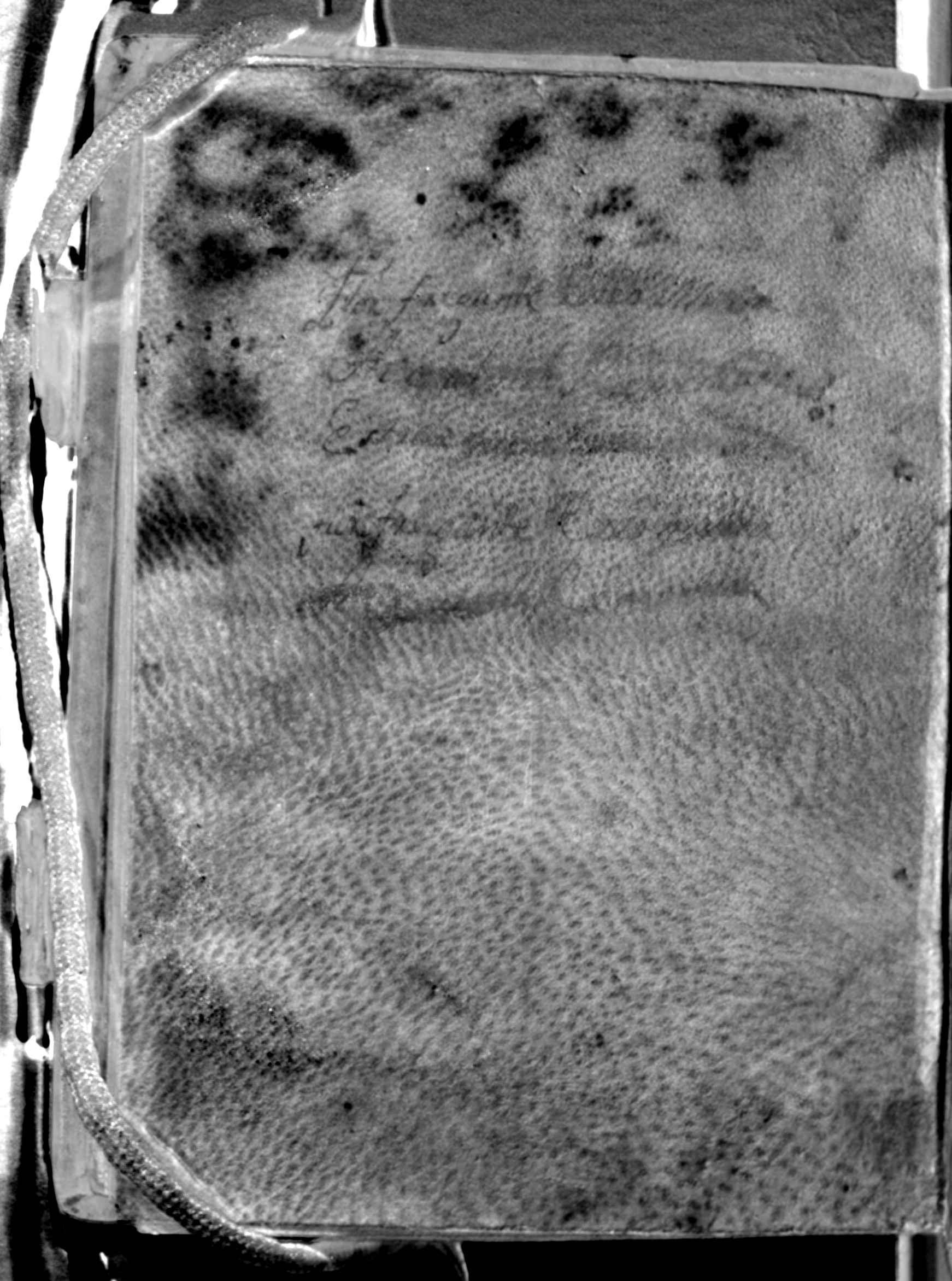
The images above depict another example of faded, scraped text. This flyleaf is from an undated Latin music manuscript that is part of the Public Library’s collection. The images below represent imaging done by the Lab, both normal illumination and UV radiation, with the goal to increase the legibility of the inscription.
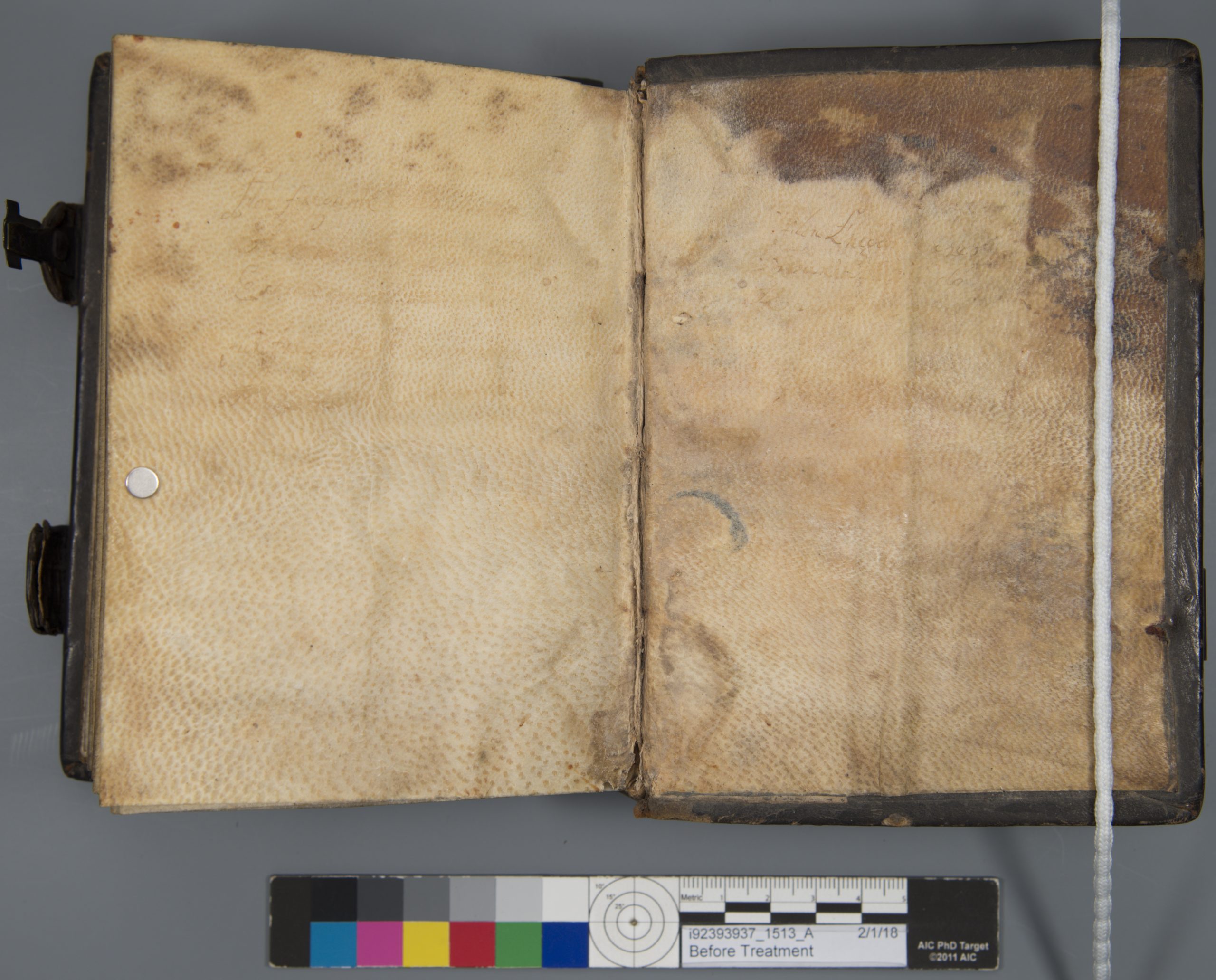
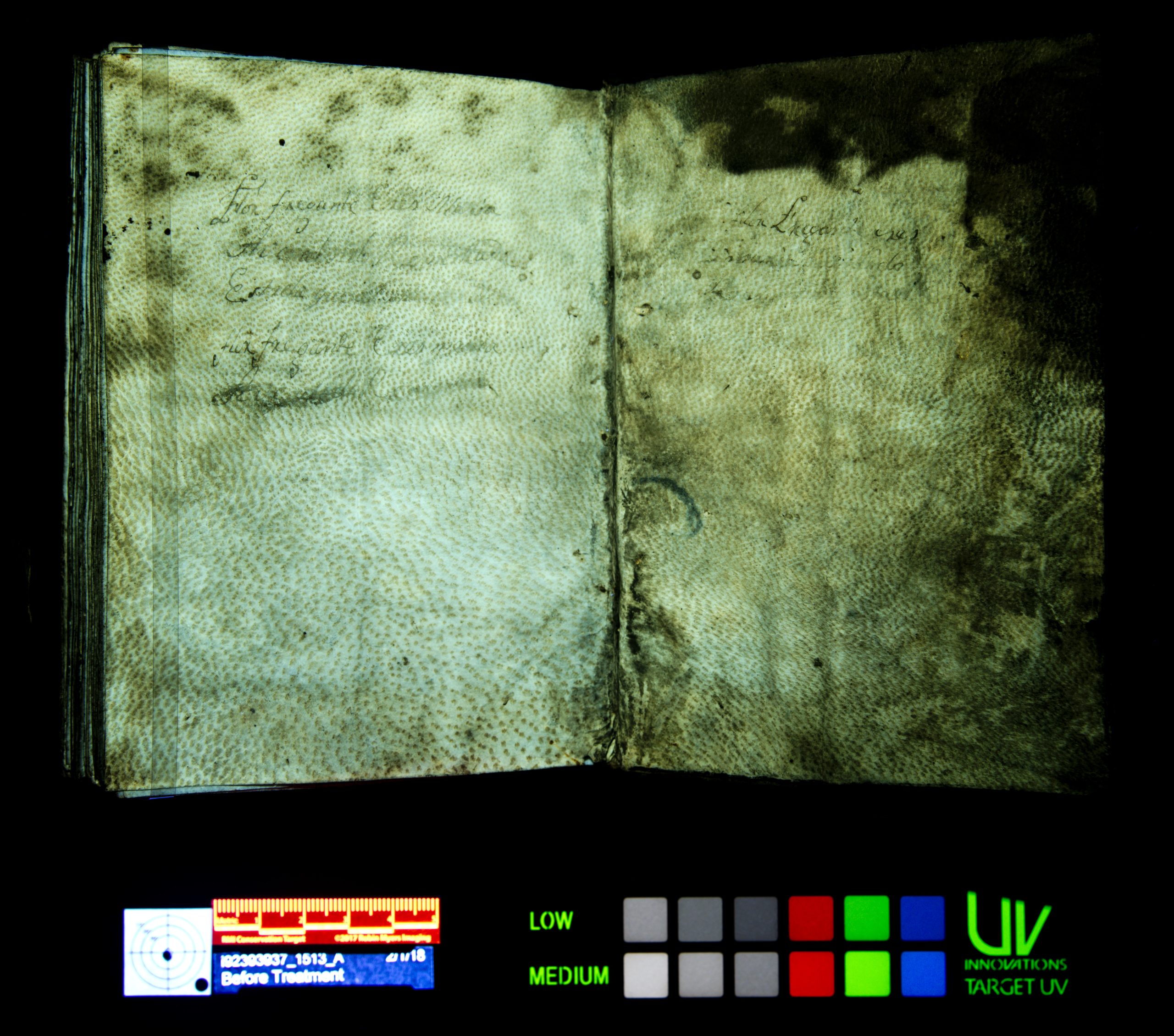
Normal illuminationUV radiation image using our current, standardized workflow that has been further enhanced to bring out the text.
In the end, multispectral imaging is just plain FUN! So, the idea of making it more accessible to a wider audience is extremely exciting and I think the work that NEH, RIT, and colleagues like Andrew and Naomi are doing to share the power and wonder of multispectral imaging is amazing. The idea of a portable multispectral imaging system with free processing software that does not take a PhD to use is boundary-breaking, and it gives us a glimpse into a future of accessible and exciting imaging, which thus allows us to see and understand more of the past. I will always be an advocate for that kind of imaging!
I love matting projects! Matting is an elegant way to present images and documentation for exhibition. We received a collection of letters and images from Abraham Lincoln in the lab from the Cincinnati and Hamilton County Public Library (CHPL) for preservation and conservation. After our conservator Ashleigh Schieszer completed the preliminary work of removing the artifacts from all the acidic and harmful elements they were previously in contact with, we collaborated on the matting choices. One cool thing I just love about this job is the opportunity to make tiny models of our intended work. Obviously, we can iron out some of the bugs and problem solve unforeseen obstacles with models, but making a tiny representation of my work is not only great to have as a future reference but is just really cool.
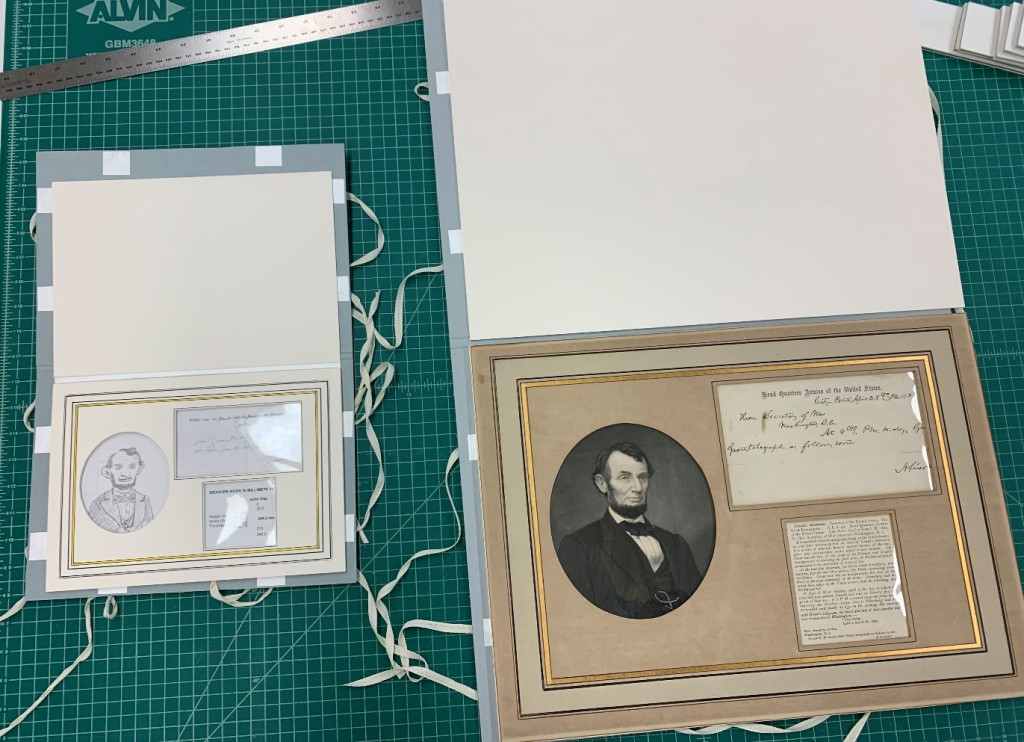
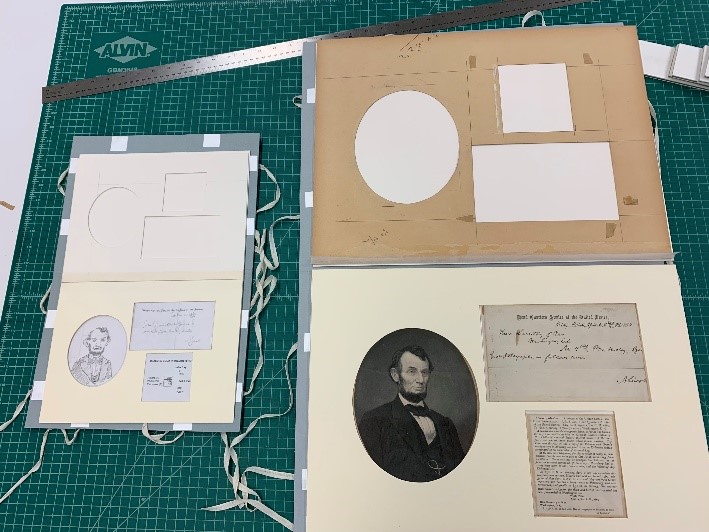
Matting model on left, original objects on right
So, for one of the previously matted compilations the curator suggested retaining the beautiful custom mat for the finished system. This presented a problem because of the acidity in the original mat. The solution we came up with was to create an archival buffer mat between the original mat and the artifacts. Easy-peezy.
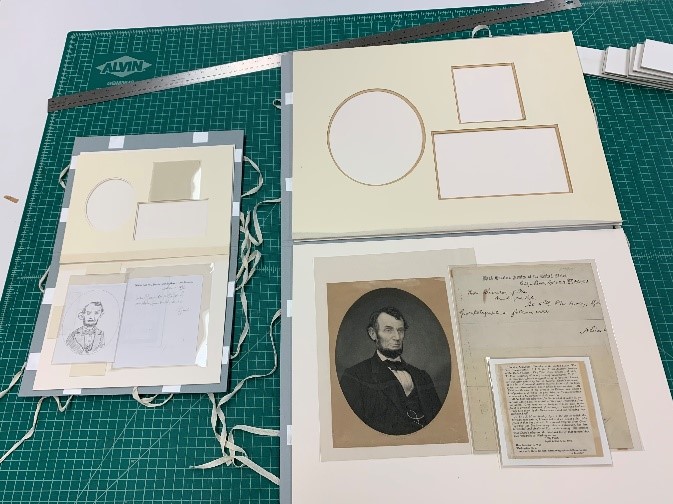
To mount overlapping objects, we decided to secure them to different mat board layers. For example, the document on top will be attached to the back of the archival buffer with a polyester sling while the letter and portrait will be mounted to the backing board with edge strips or photo corners.
The archival buffer mat is hinged below the opened original mat.
View of the artifacts below the archival buffer mat. Parts are mounted to different layers in the model.
We also added a custom portfolio for transportation and long term housing.
Yesterday we had the pleasure of a visit from Case Western Reserve University Library staff, Andrew Mancuso, Preservation Officer, and Naomi Langer, Digitization Technician.
They are currently winding up a whirl-wind month-long tour, traveling around the state to test a portable (and affordable!) multi-spectral imaging system as part of a grant from the National Endowment for the Humanities (NEH).
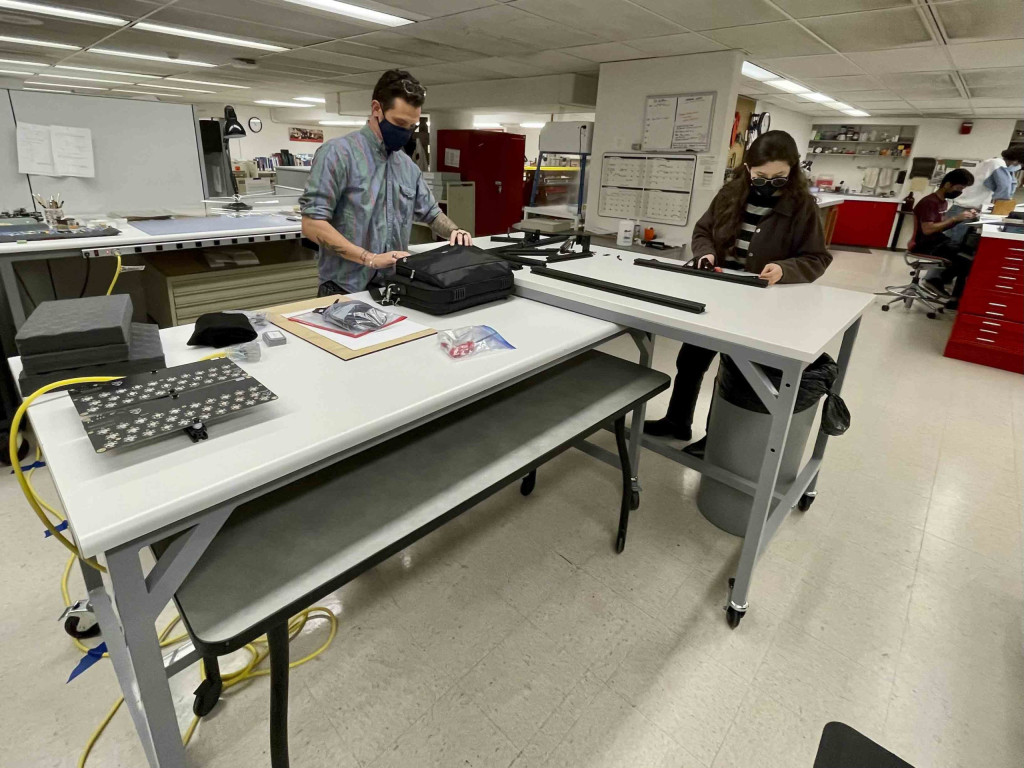
Andrew and Naomi unpack MISHA
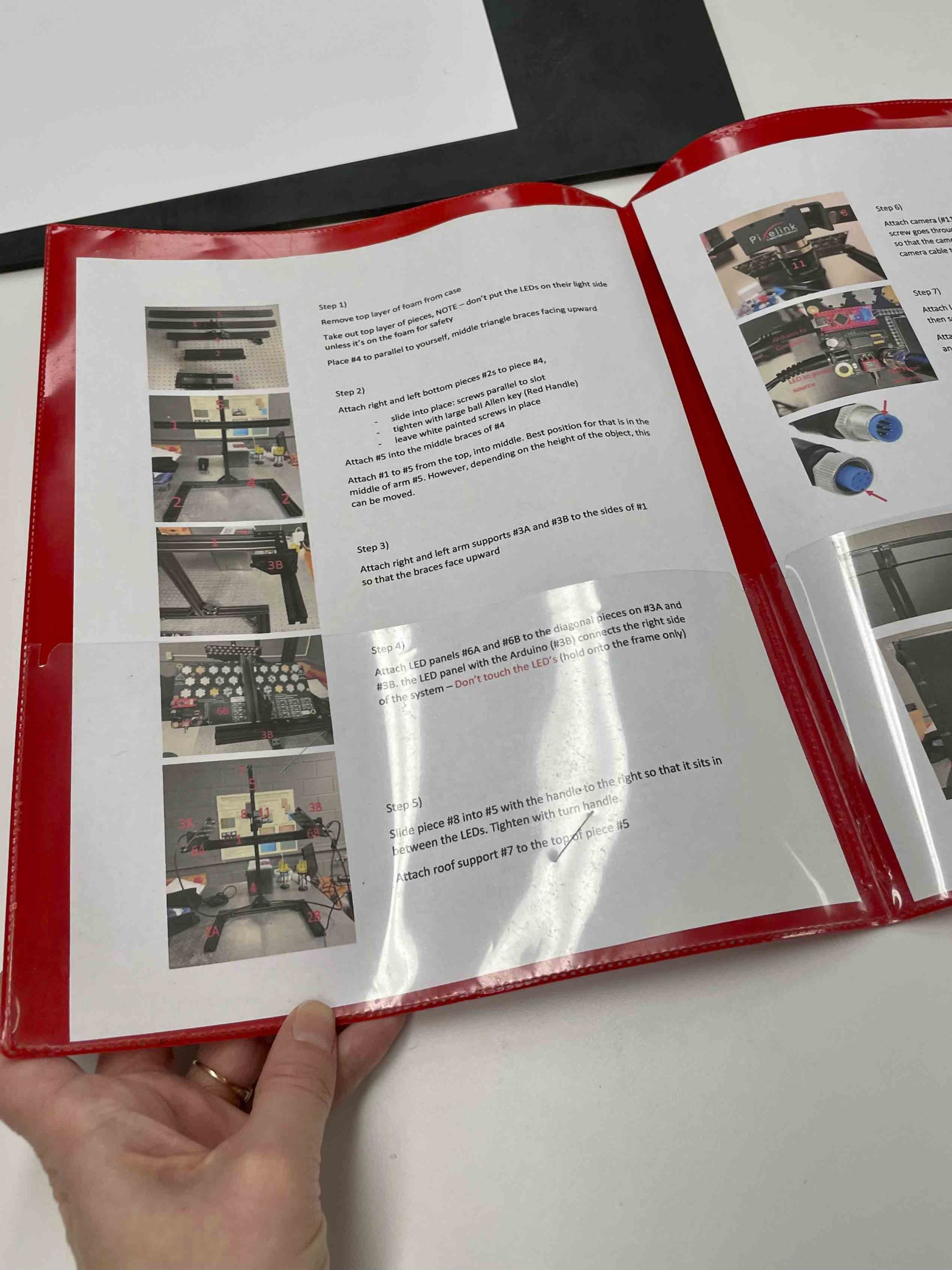
Detailed setup instructions
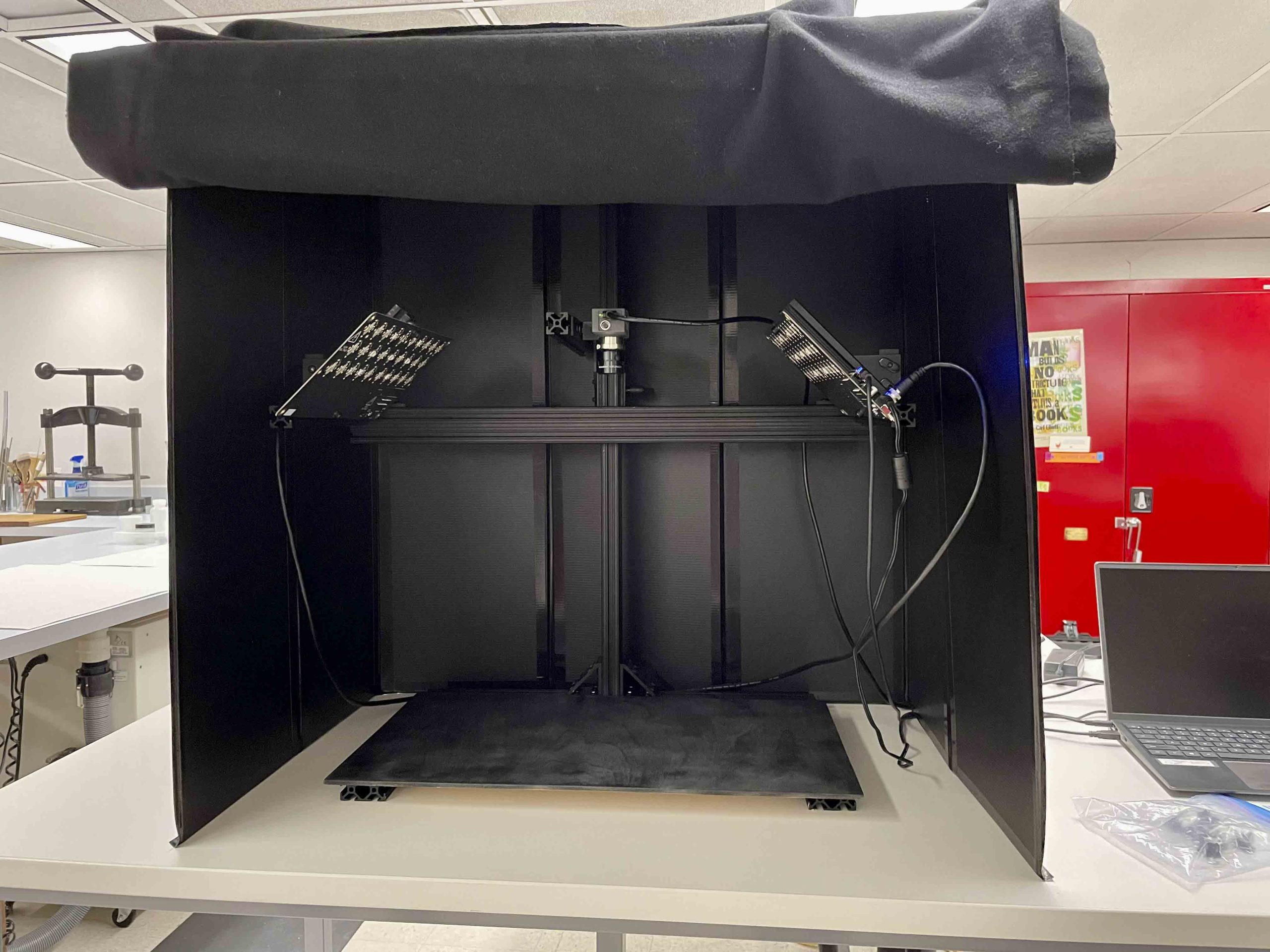
This unique system is called MISHA, which stands for Multi-spectral Imaging System for the Humanities and Archives. The imaging system and software can be used to recover obscured and illegible text on historical documents, such as scraped-away writing:
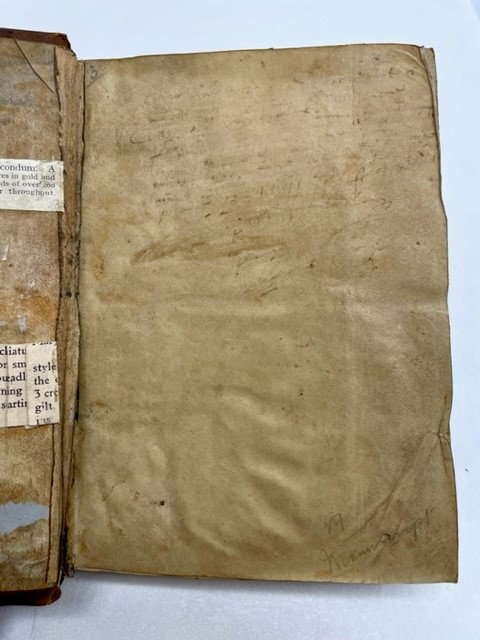
Lost manuscript writing on a CHPL Book of Hours is a good candidate for multi-spectral imaging
If you’re familiar with multi-spectral imaging systems, you might be wondering, “How much is ‘cheap’?” Roughly, the entire system cost under $5,000 to create – with the monochrome camera and light boards making up the bulk of the price tag.
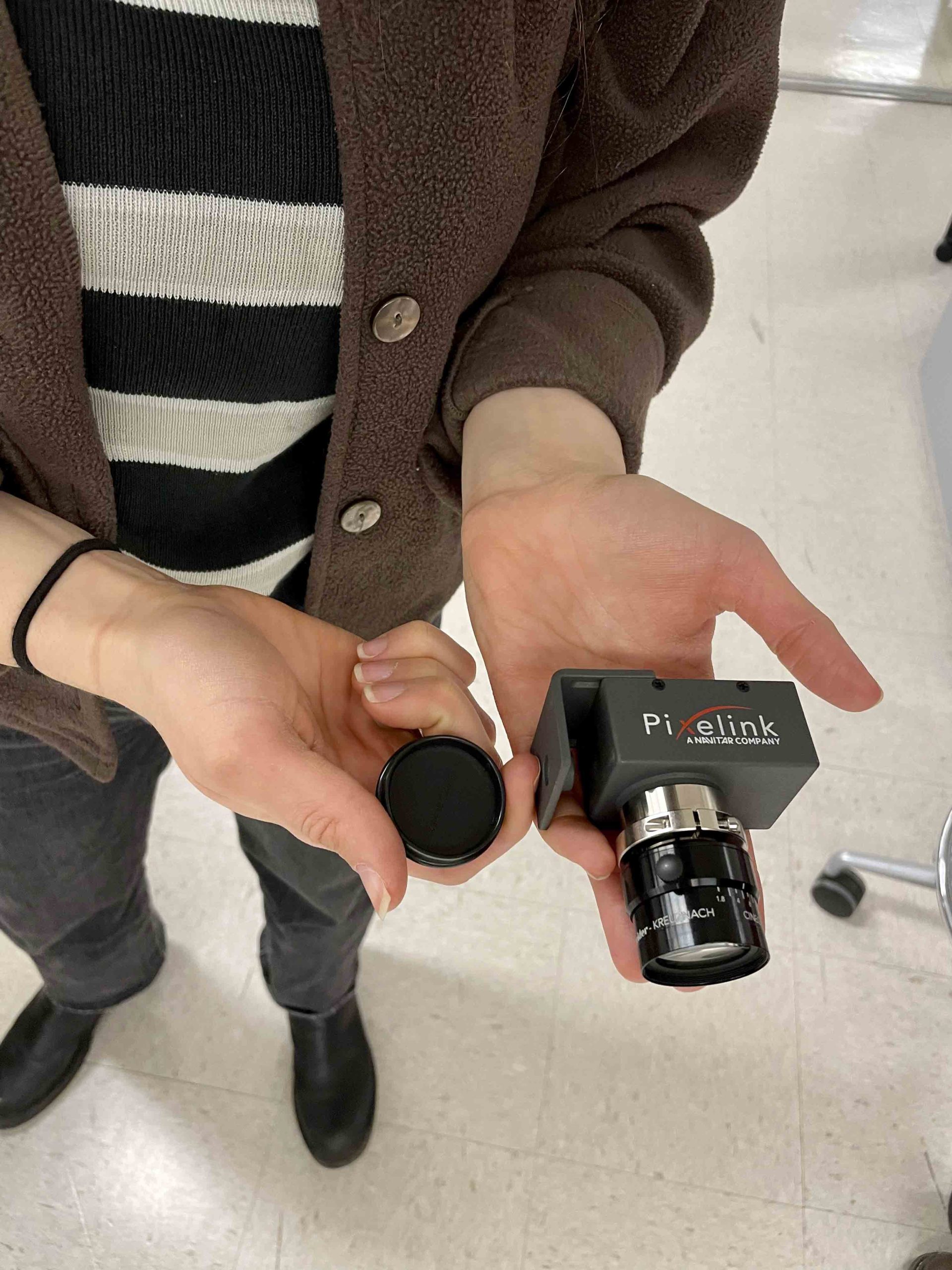
Monochrome camera fits in palm of hand
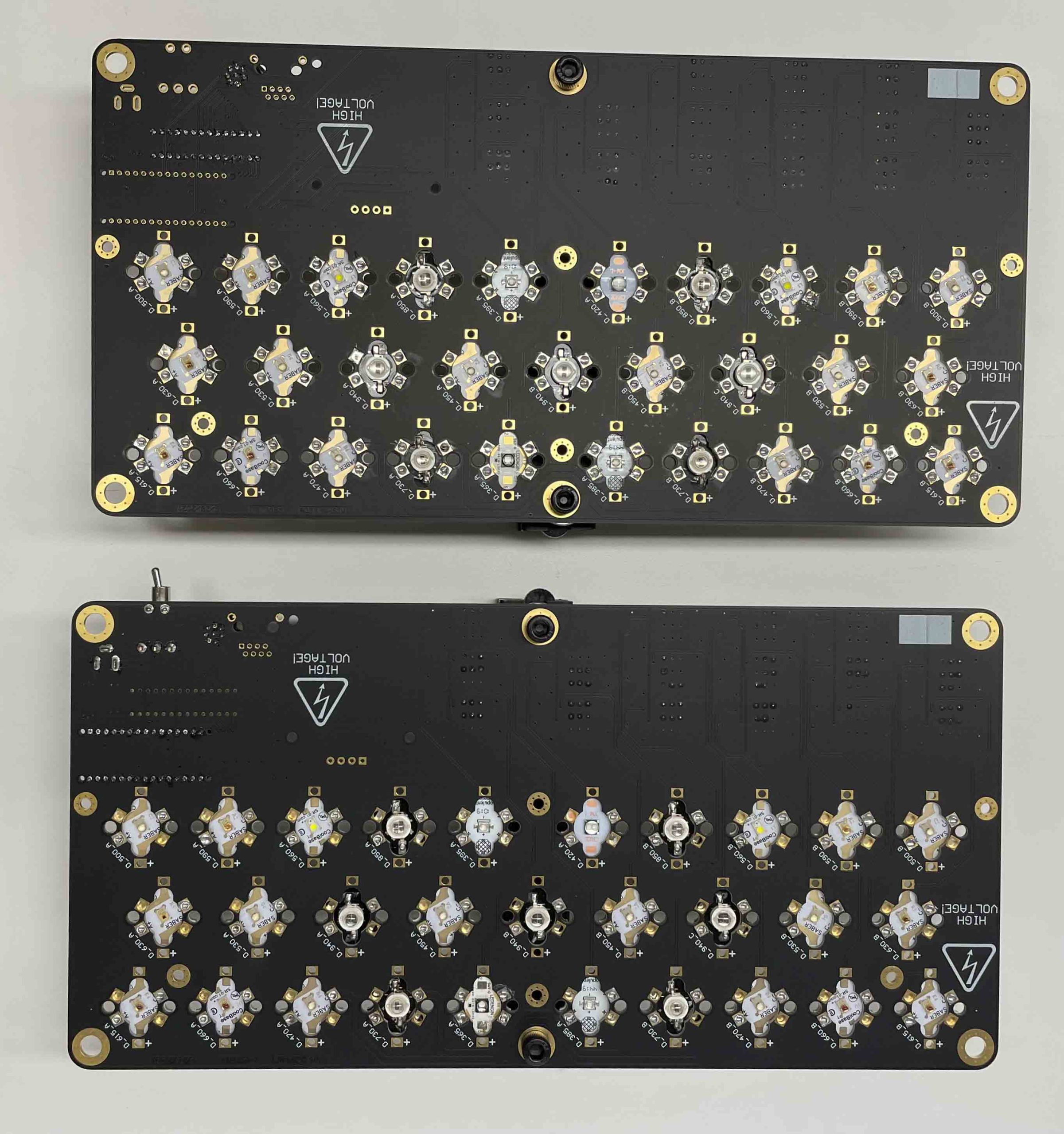
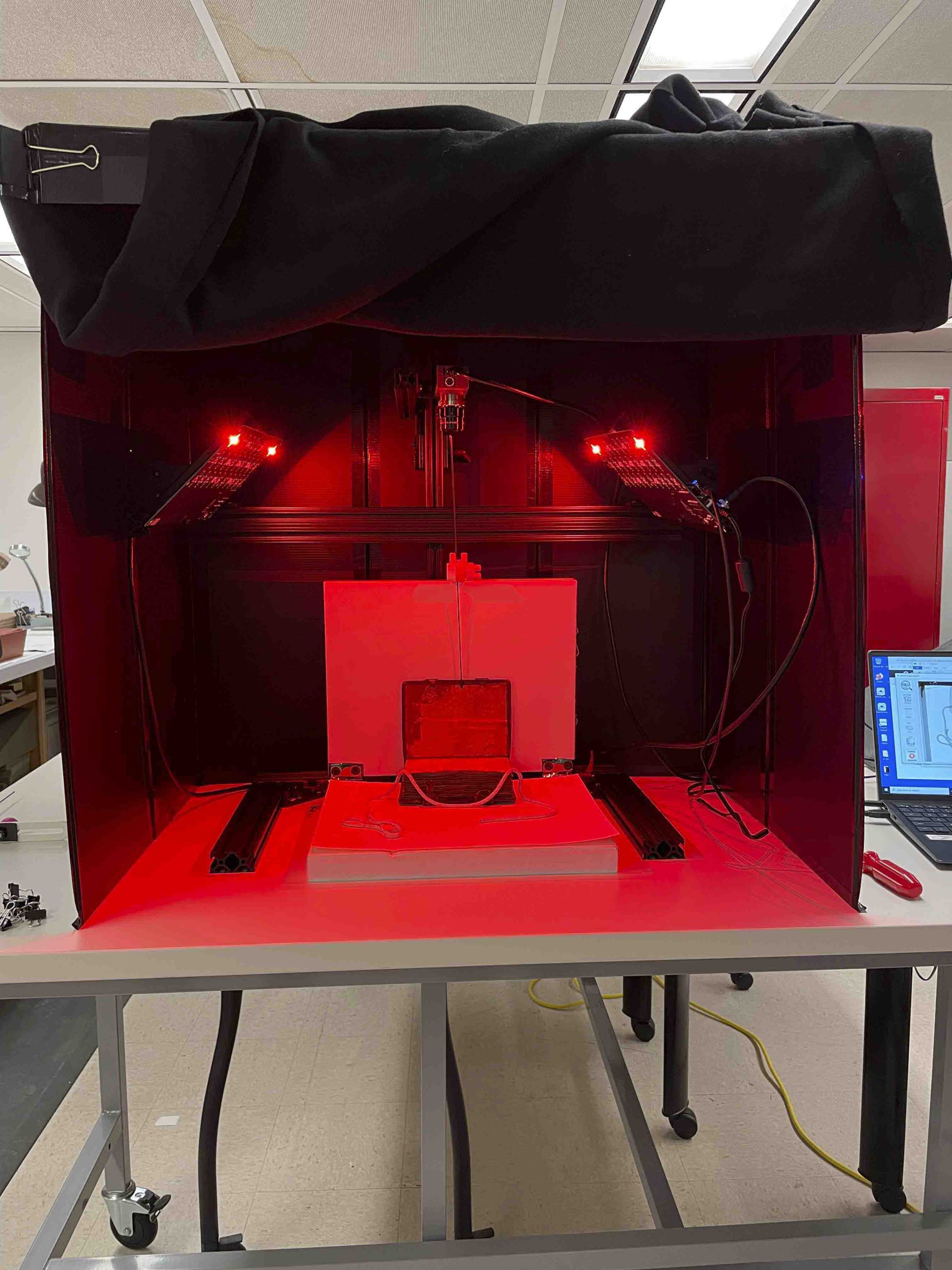
LED light boards built by RIT Chester F. Carlson Center for Imaging Science
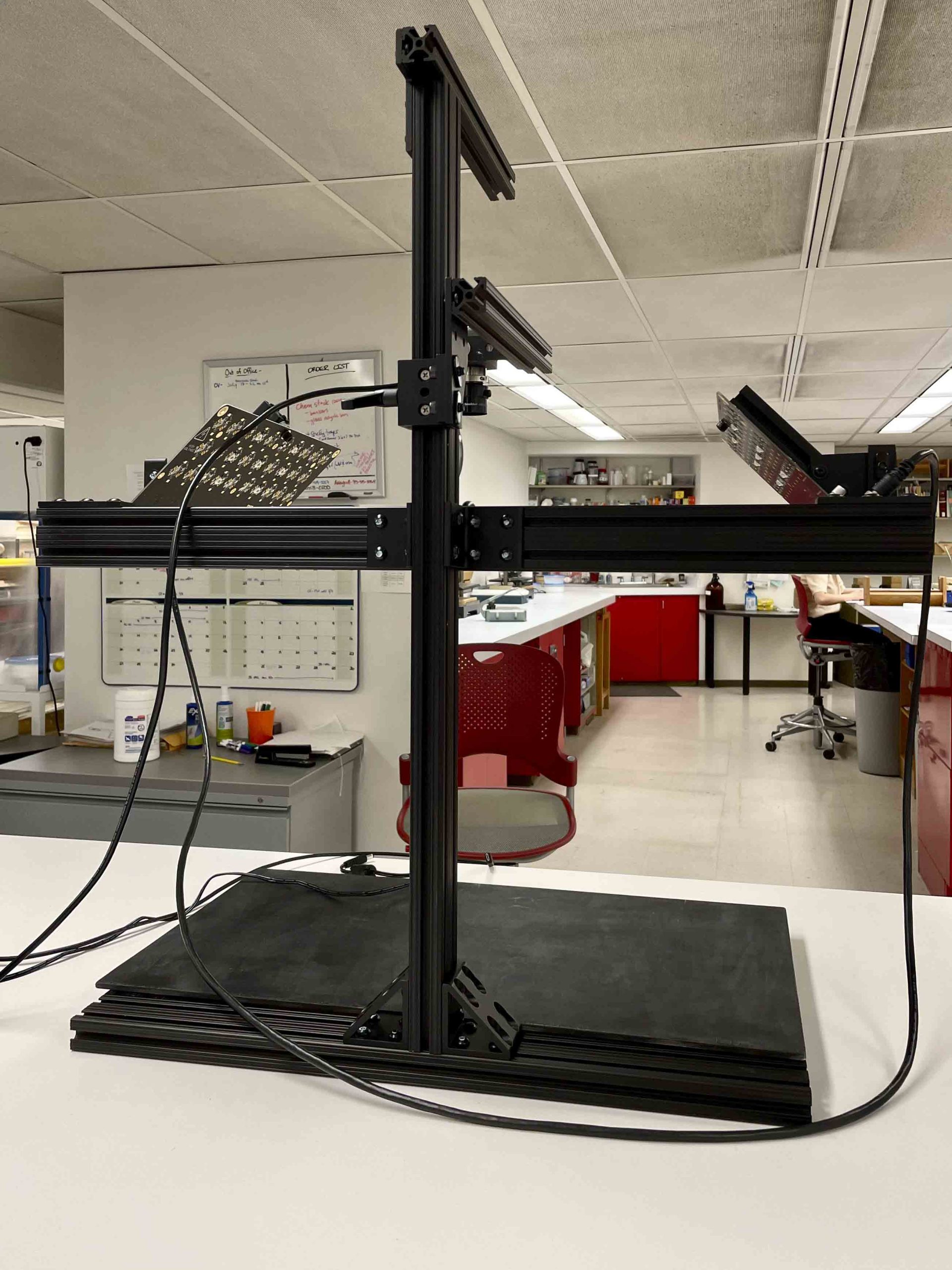
Copy stand consists of T-slot aluminum framing and black painted wood board base
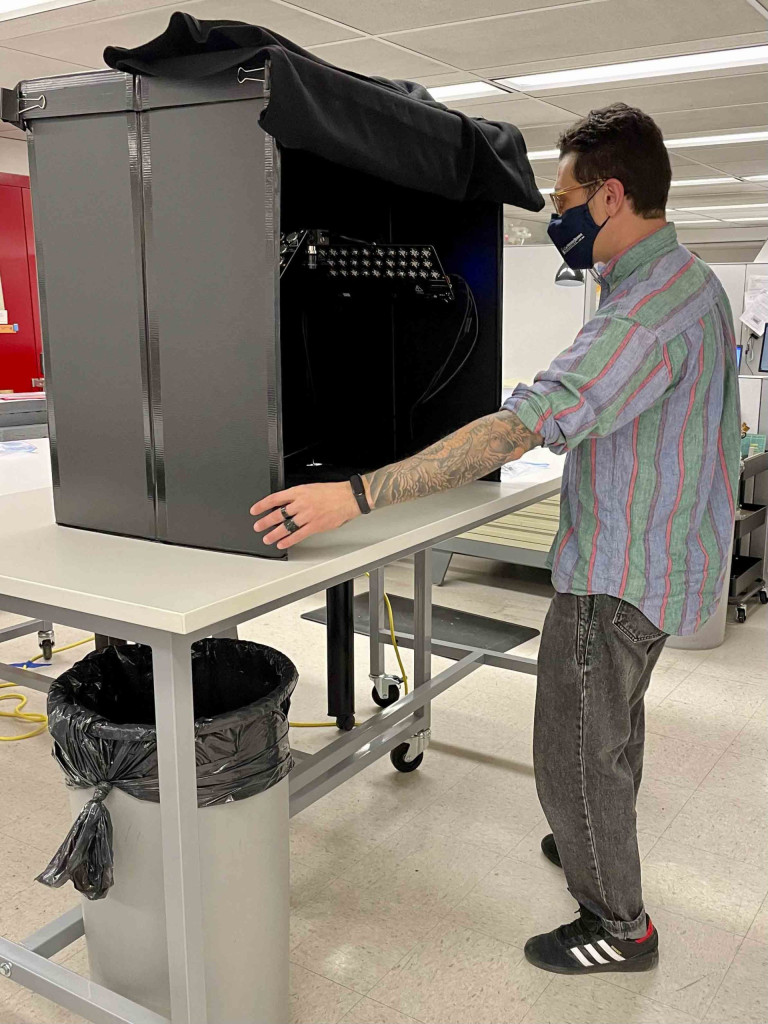
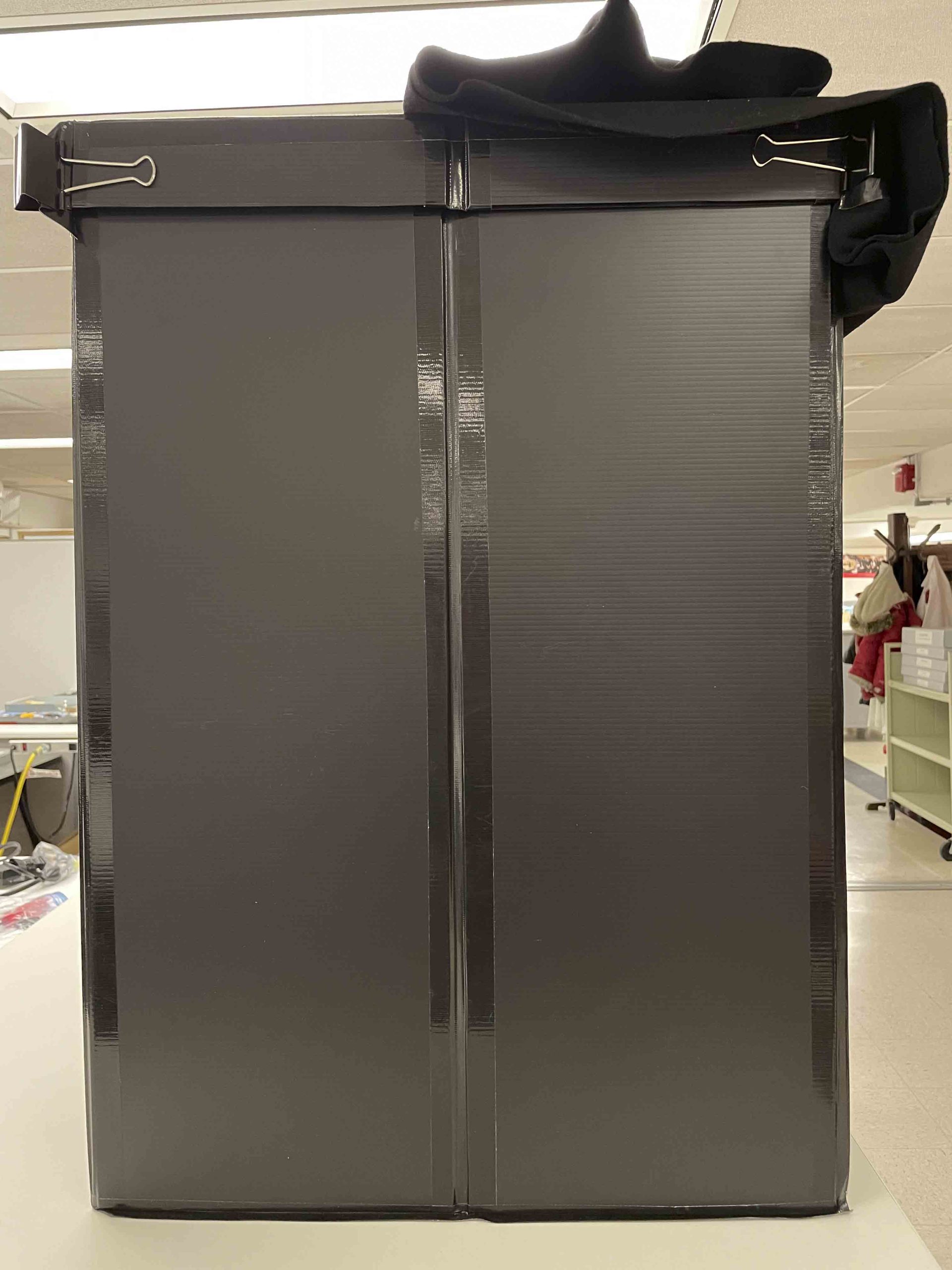
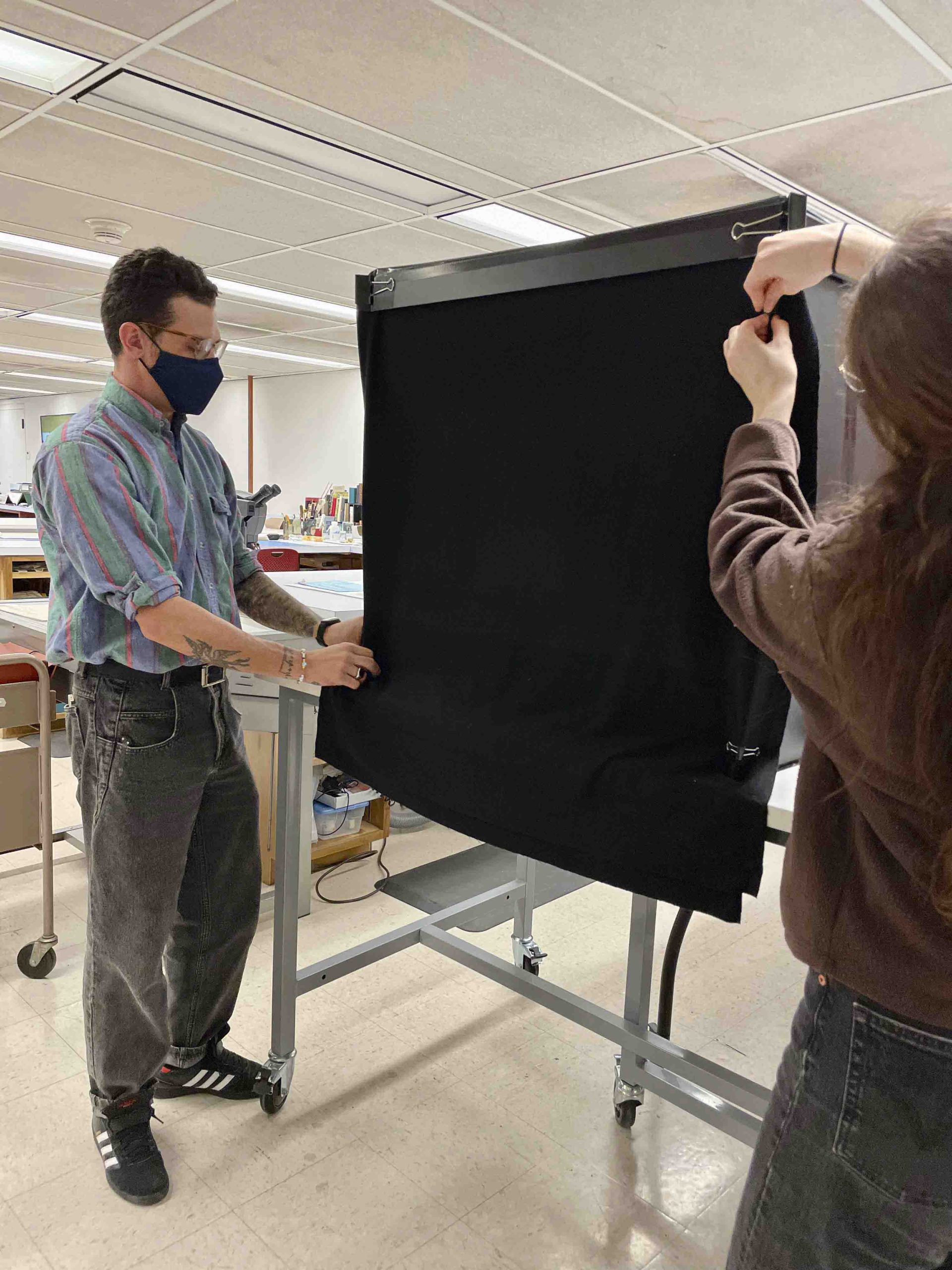
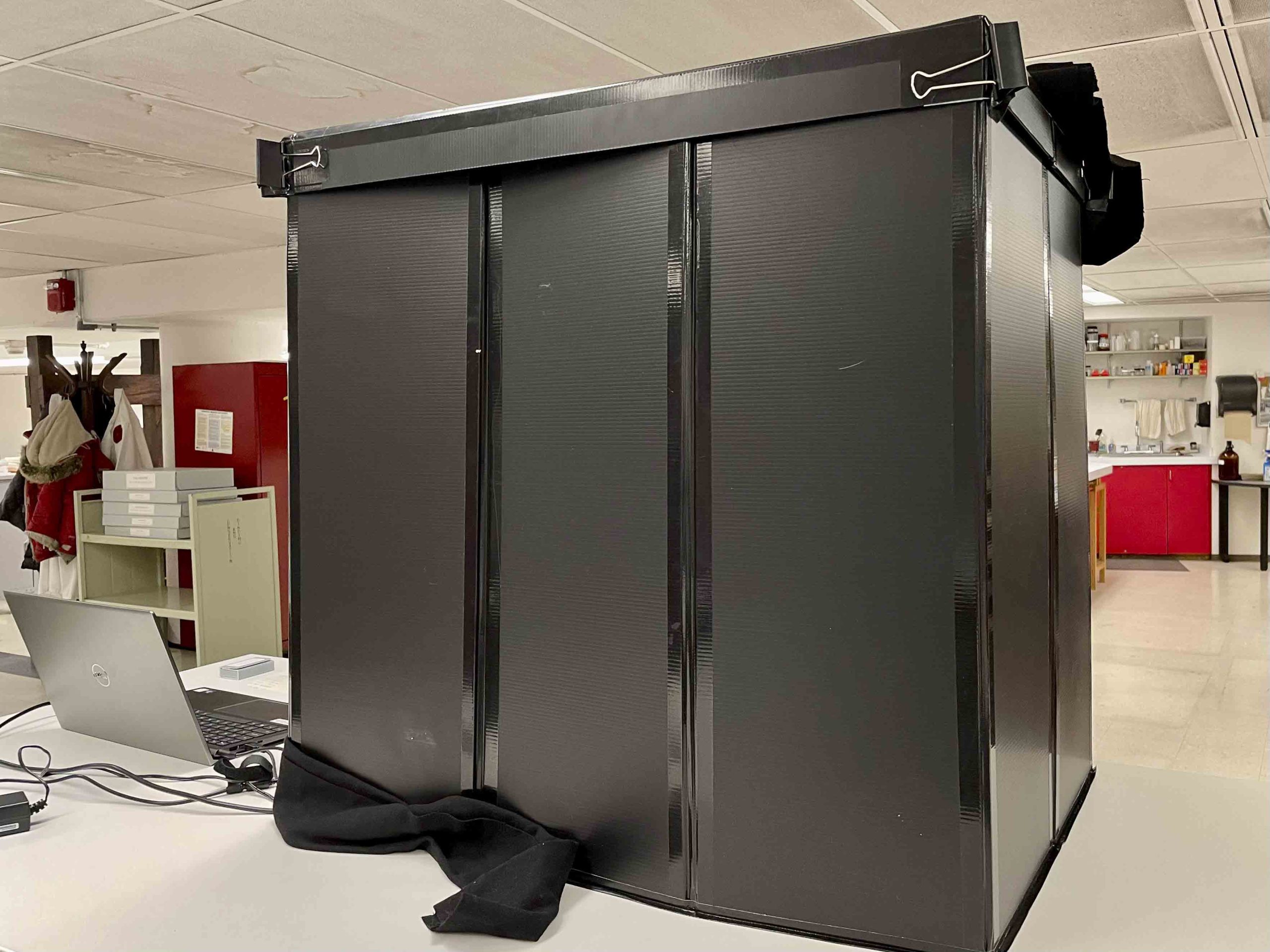
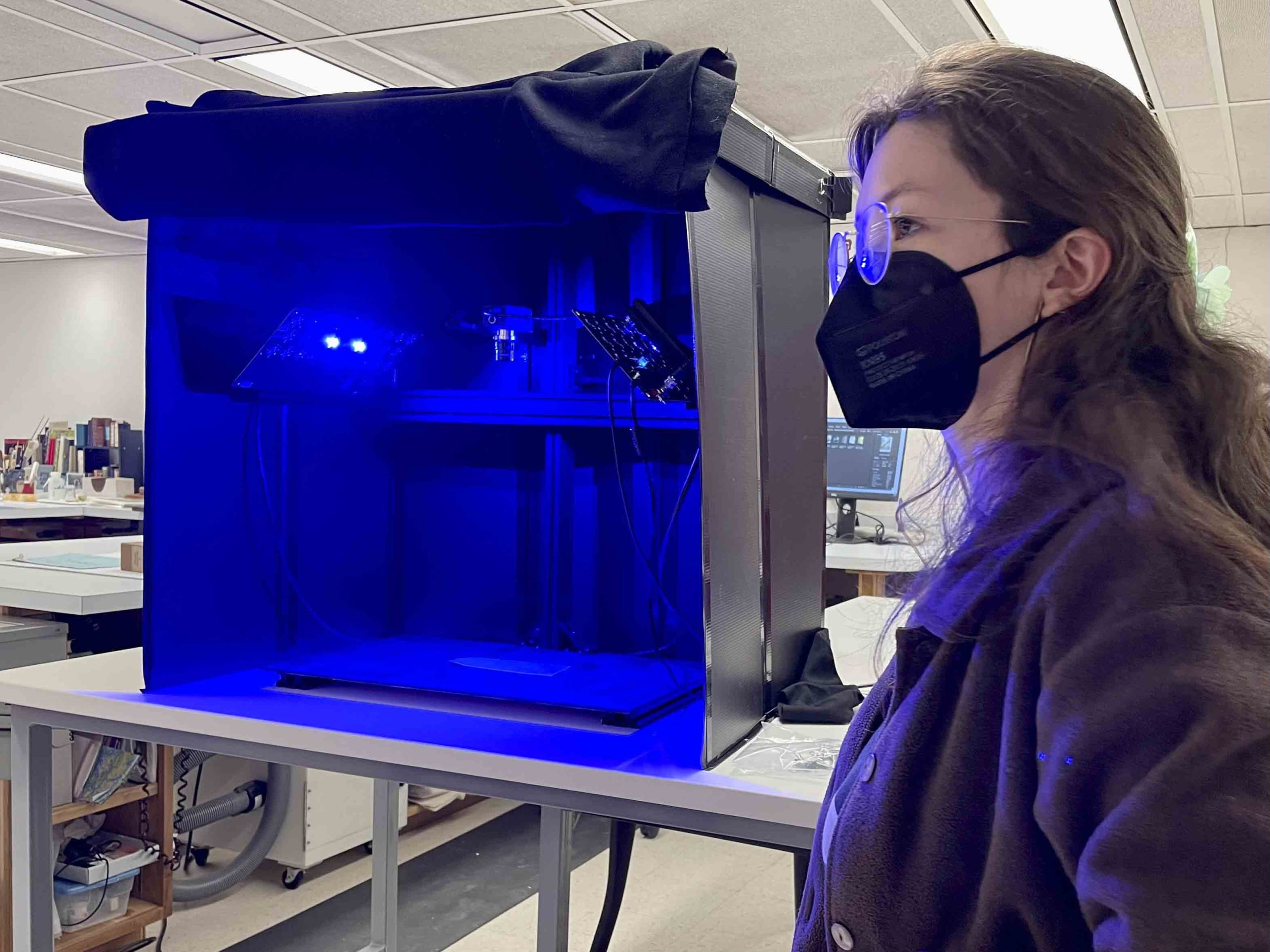
As you can see, the black Coroplast, duct tape, felt, and binder clips make up a very small portion of the budget, however, they are instrumental for using the system in a room that cannot be fully darkened. We also observed that the lights were extremely bright, and the light shield made it easier on our eyes.
Felt is clipped with binder’s clips to keep out light
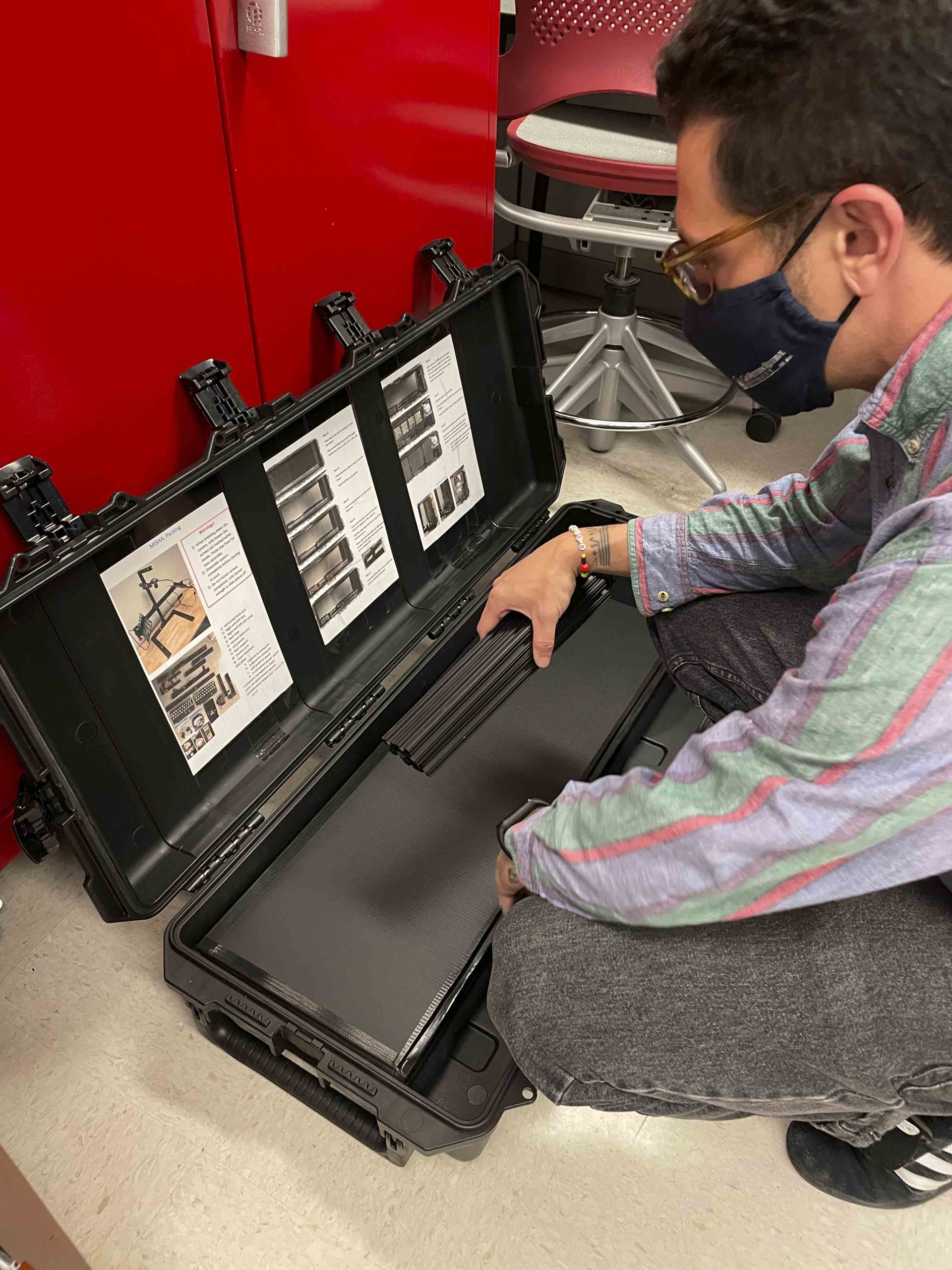
To test the portable system, Ohio institutions with medieval parchment documents from Otto Ege collections were asked if their manuscript leaves could be imaged on-site with this equipment. With the entire glamour shot studio fitting into a 40-pound rolling suitcase, Andrew and Naomi traveled to various cities from Cleveland to Cincinnati, making our photographic imaging dreams come true!
This tightly fitting suitcase has packing instructions to protect all the parts.
Since the Cincinnati and Hamilton County Public Library (CHPL) own multiple Ege collections and a variety of other worthy imaging candidates, the Preservation Lab was fortunate enough to participate. In the CHPL collection, manuscript 32 (of Fifty original leaves from medieval manuscripts, Western Europe, XII-XVI century) was thought to be the most promising to reveal hidden information.
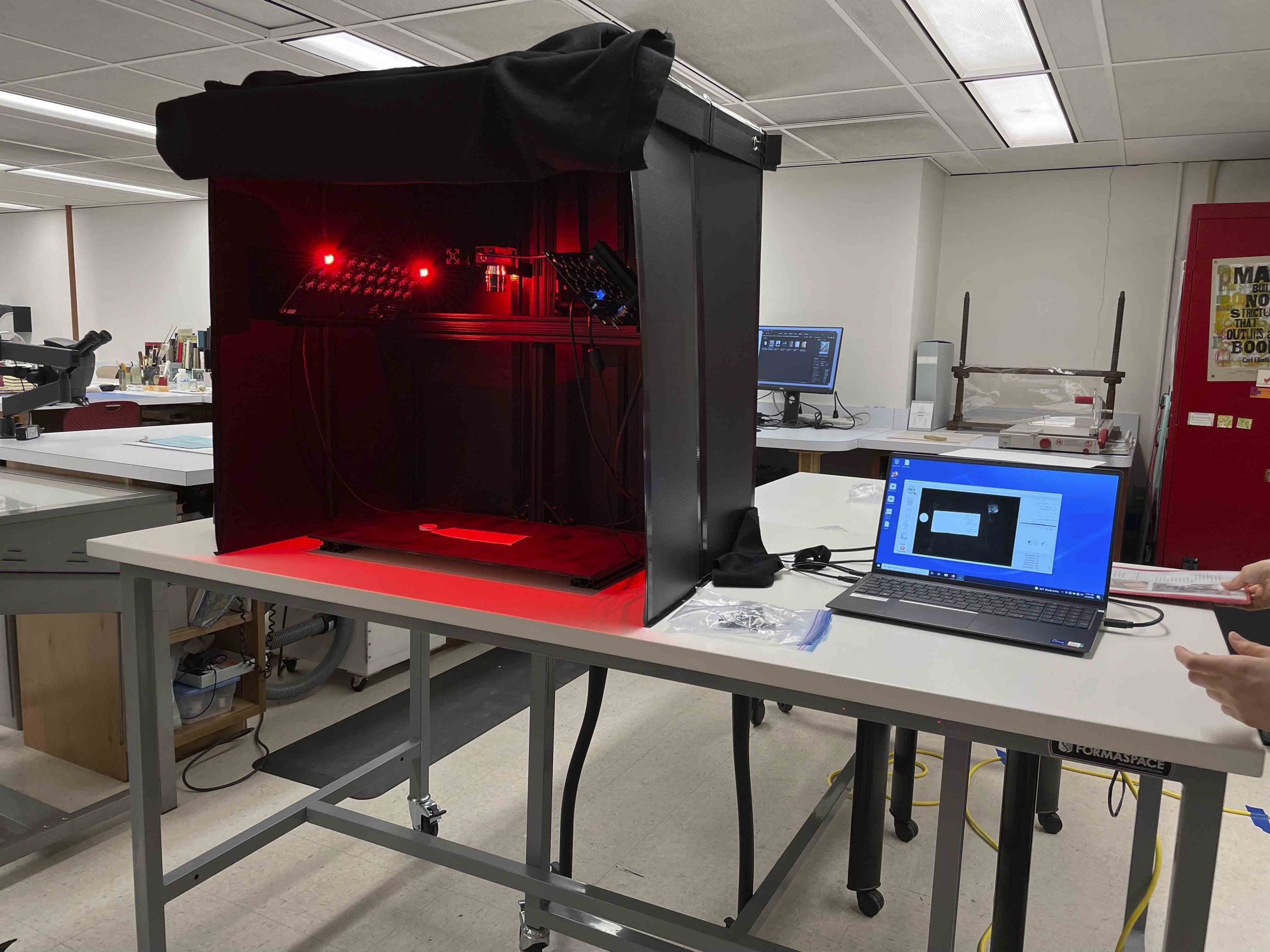
Naomi demos the imaging procedures to lab staff
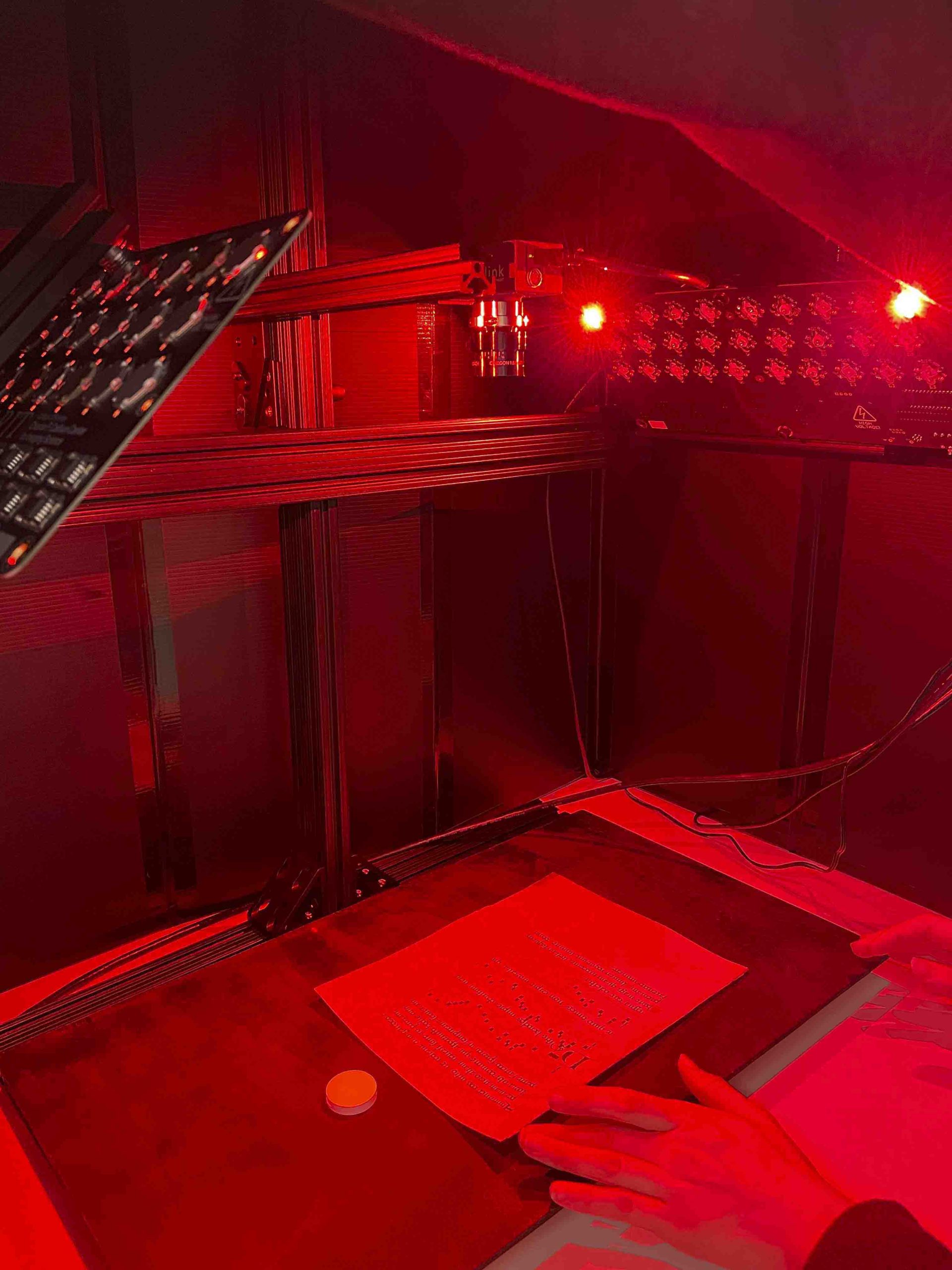
Images are captured at 16 different wavelength bands ranging between 365 nm – 940 nm
A white MA CLP2036 99% reflectance disk is placed in every image to aid in image processing later
CHPL music manuscript is cradled for imaging by an adaptable book conservation support (ABCS)
Now that the photographic capture is complete, we’re looking forward to processing the images next with the open access software called Hoku, provided by the Rochester Cultural Heritage Imaging, Visualization, and Education (R-Chive) community.
We were thrilled to see how easy this equipment was to set up in person. And special thanks to Andrew who brought his handy adaptable book conservation support (ABCS) to cradle our bound collections. Everyone should have one!