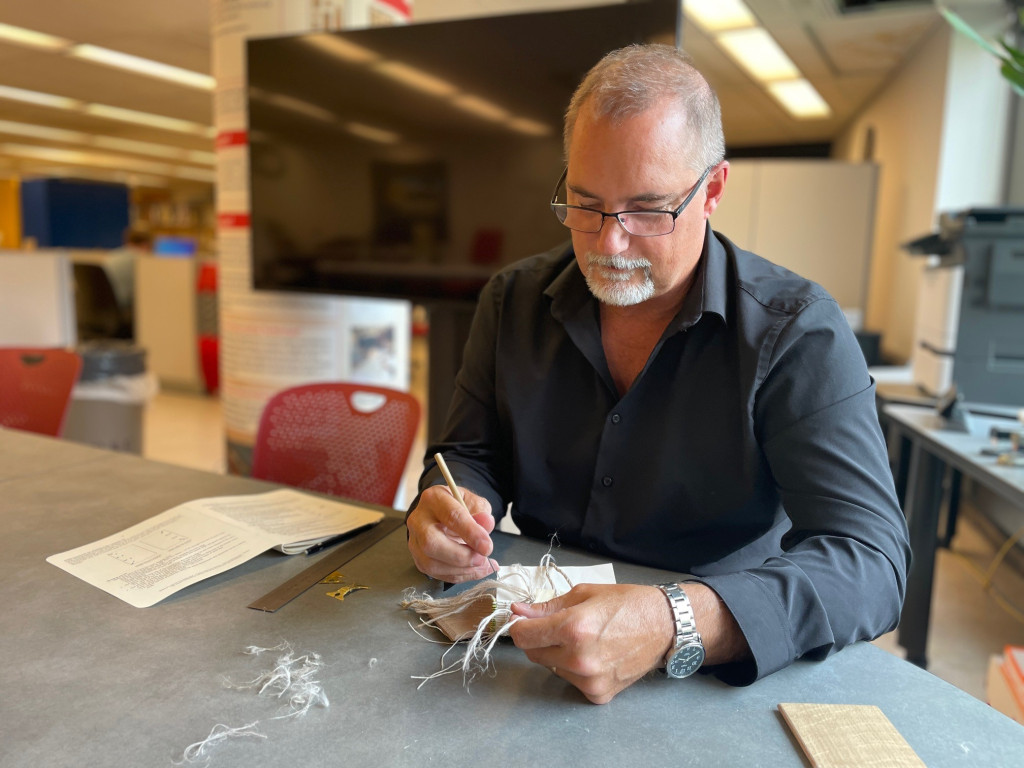
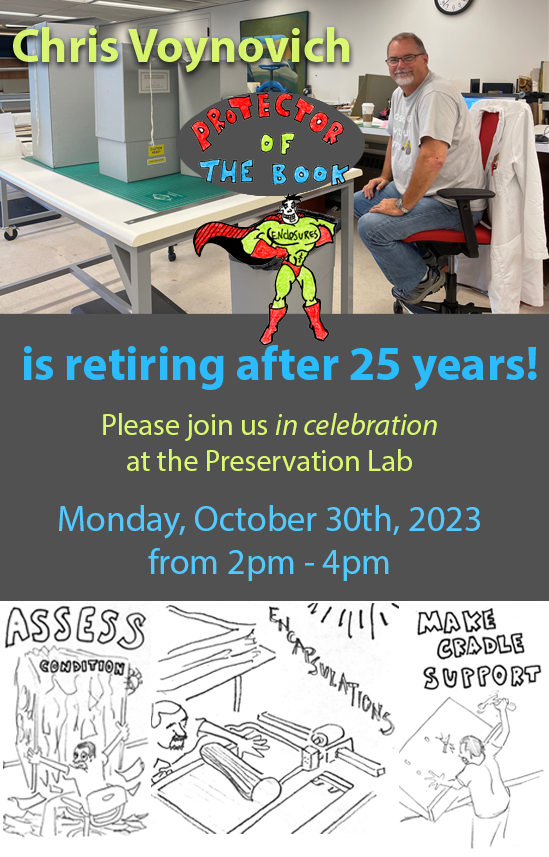
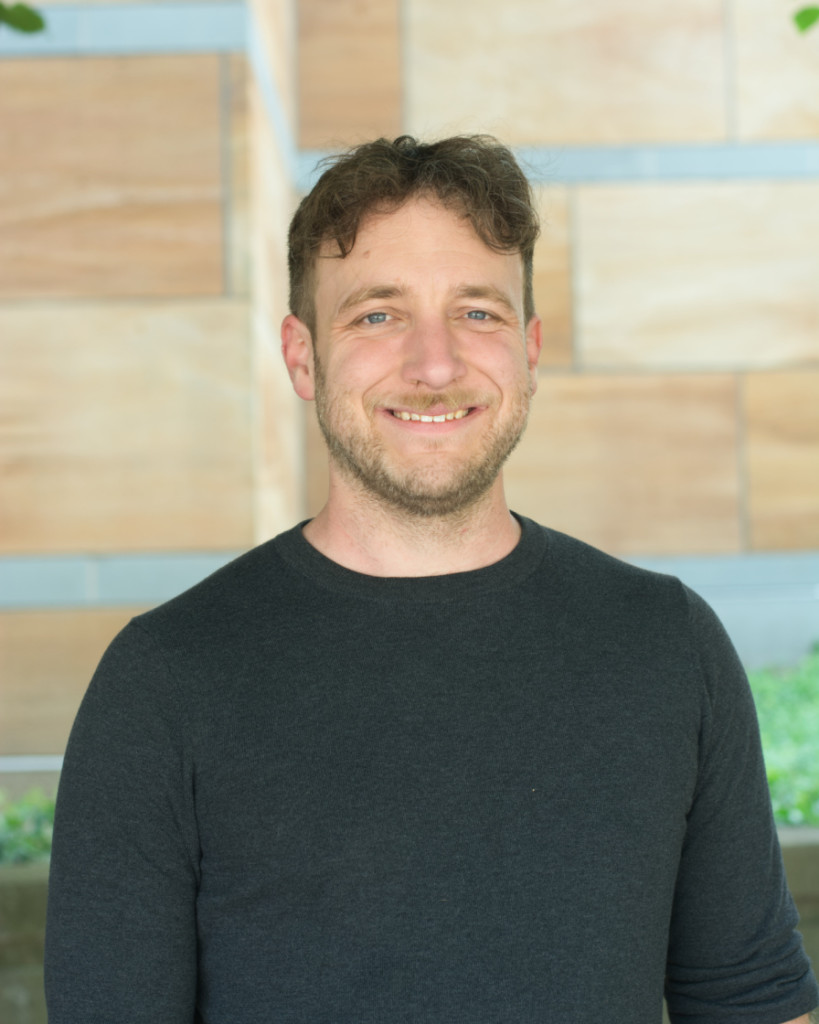
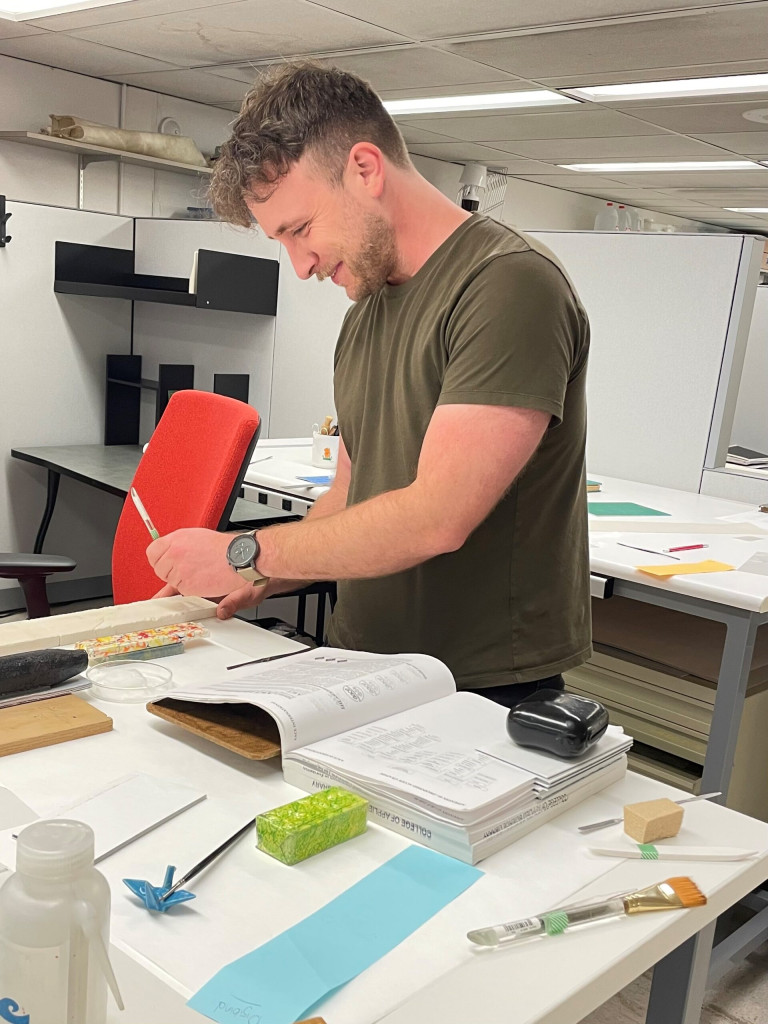
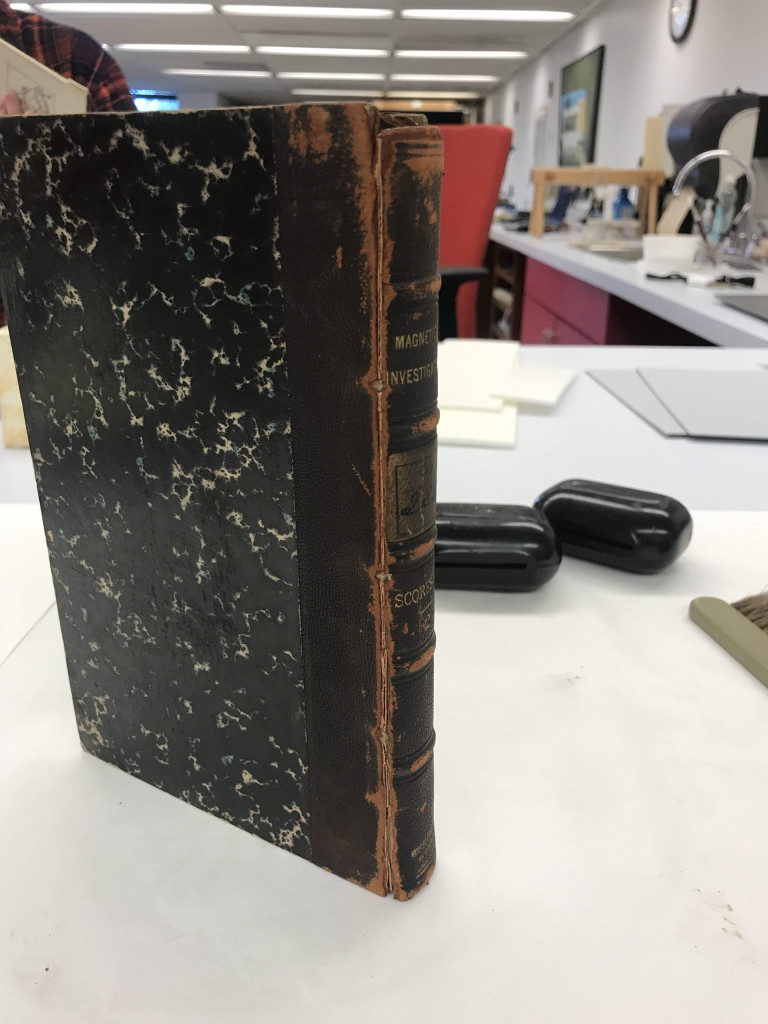
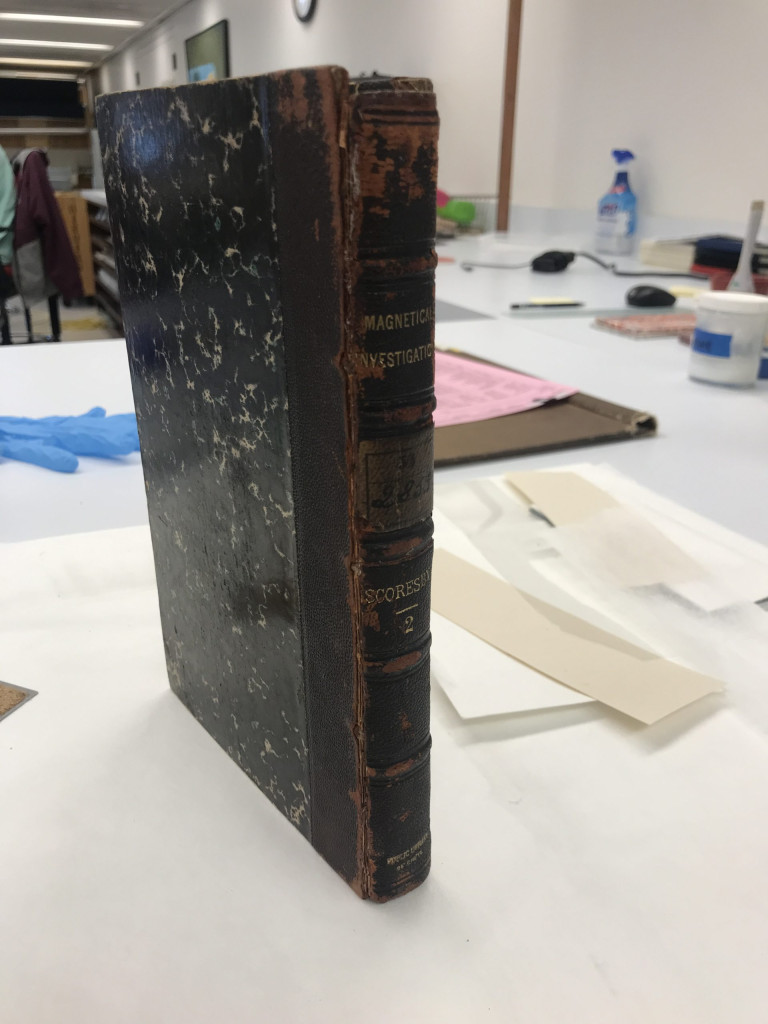
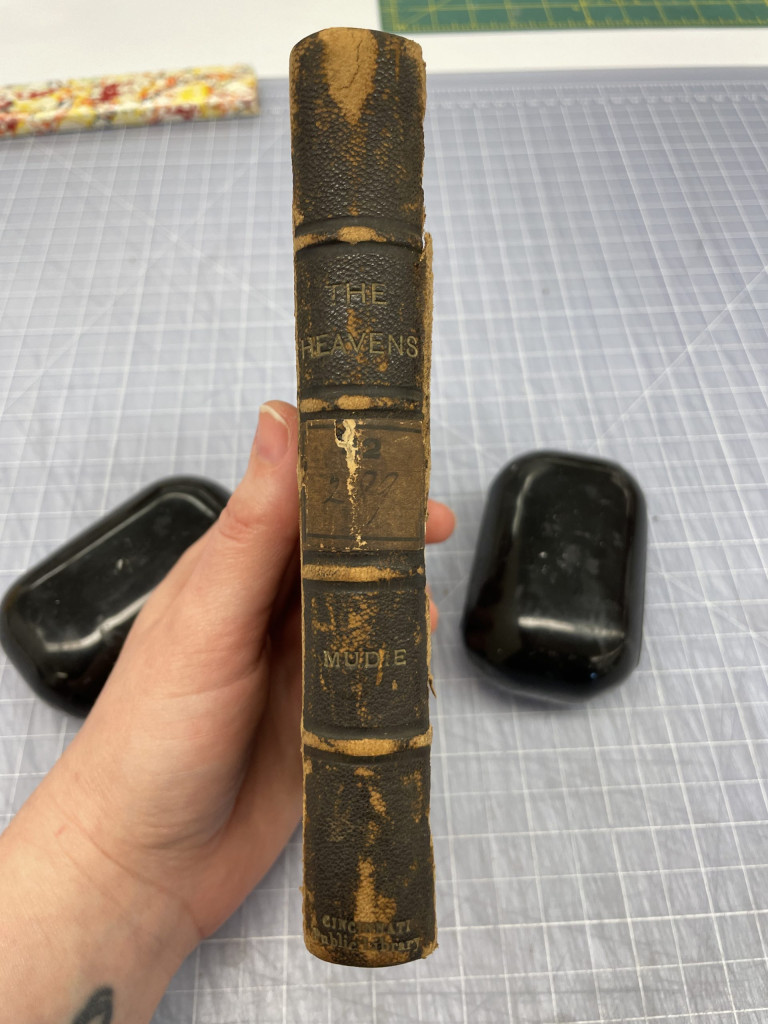
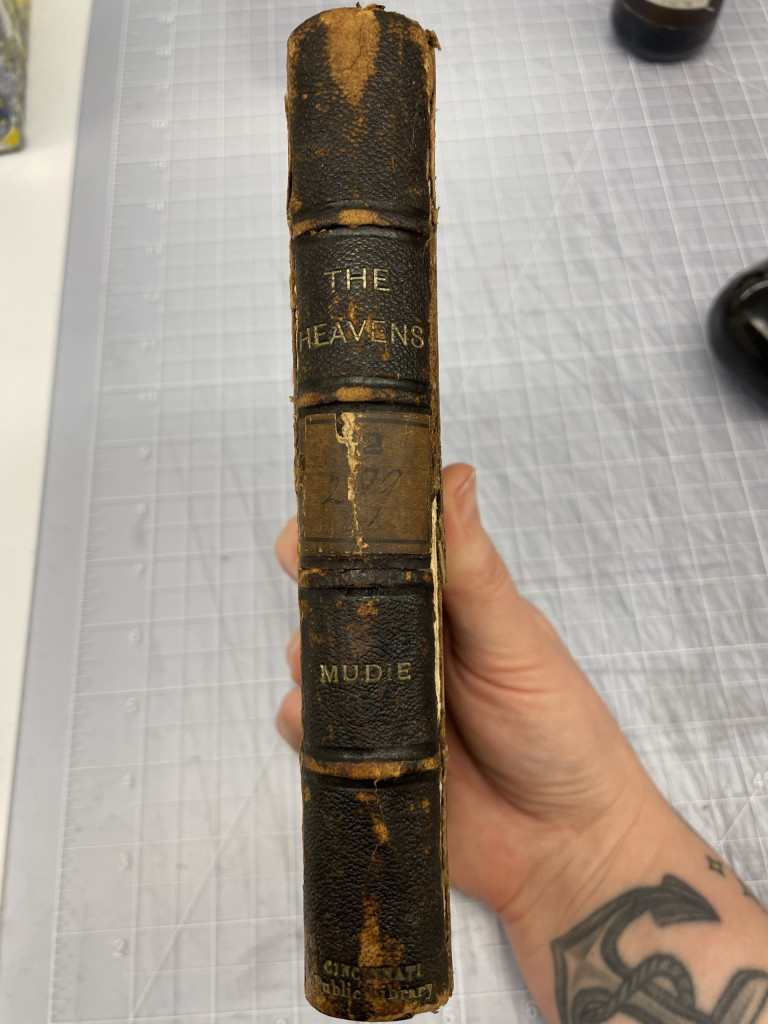
Congratulations are in order! We are happy to celebrate with our lab colleague, Chris Voynovich. After 25 years at the Public Library, Chris is retiring to a lovely beach house in Florida.
Chris first began his career at the library working in Shipping and Receiving. He then transitioned to Cataloging and Processing where he began his journey in material repair. He was a quick learner, able to utilize hand skills from his personal experience in metal work, graphic design, drumming, and matting at a frame shop.
Since 2011, Chris has grown his skills to preserve a WIDE variety of materials at the Preservation Lab. Chris has…
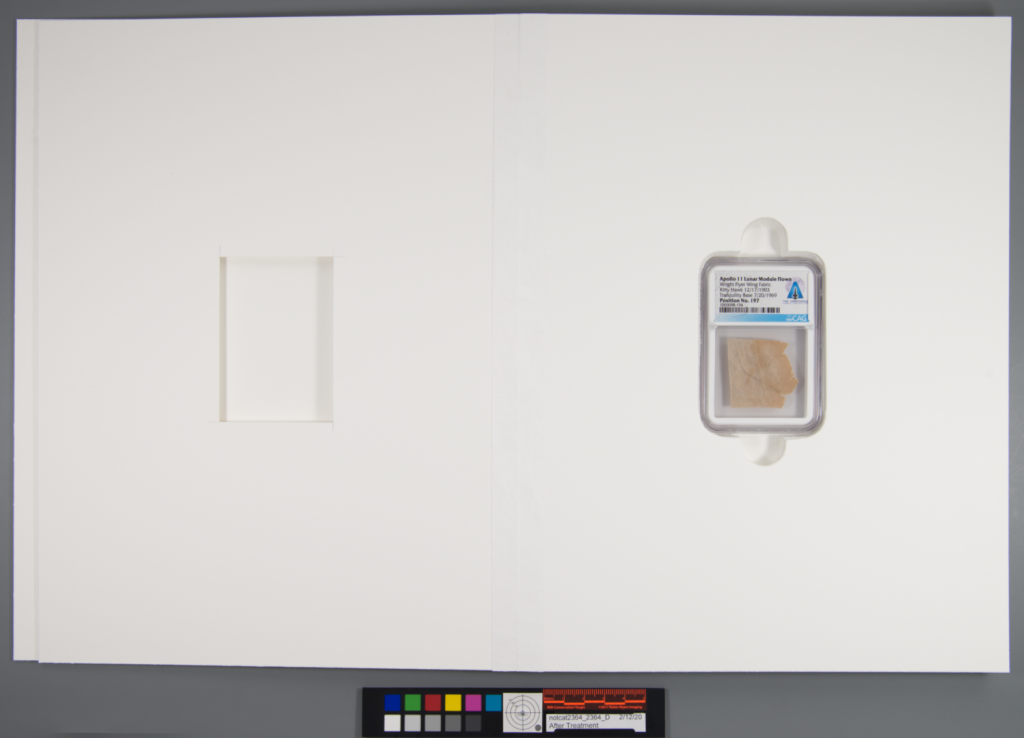
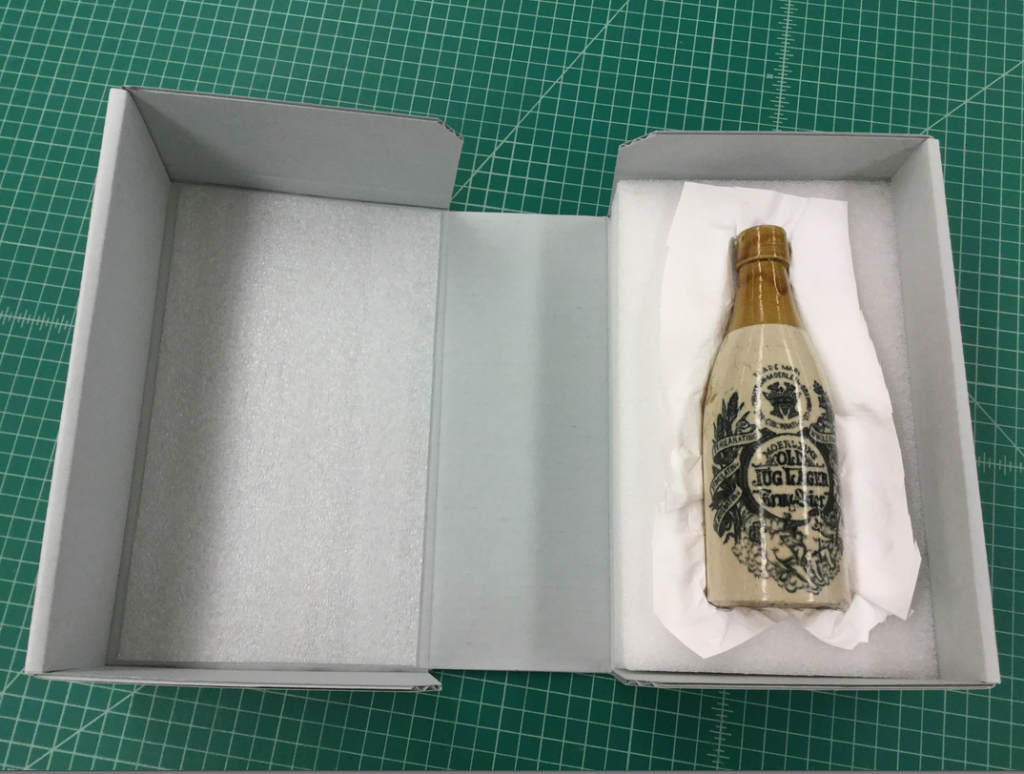
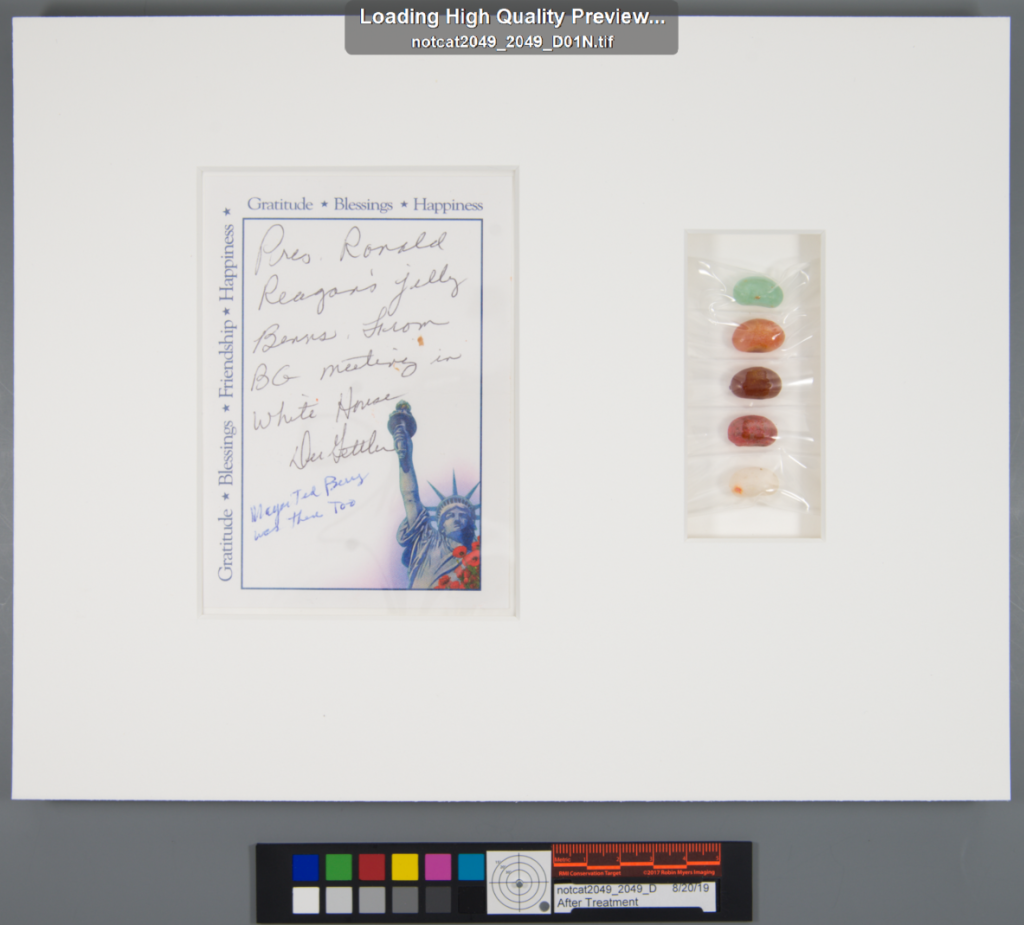
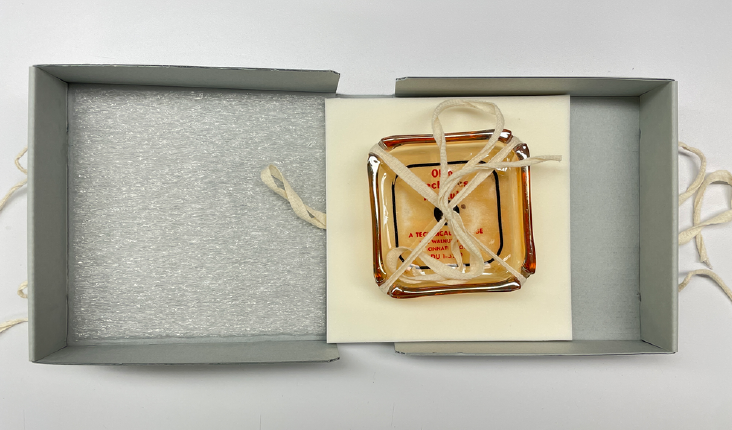
matted Ronald Regan’s jelly beans (see image below),
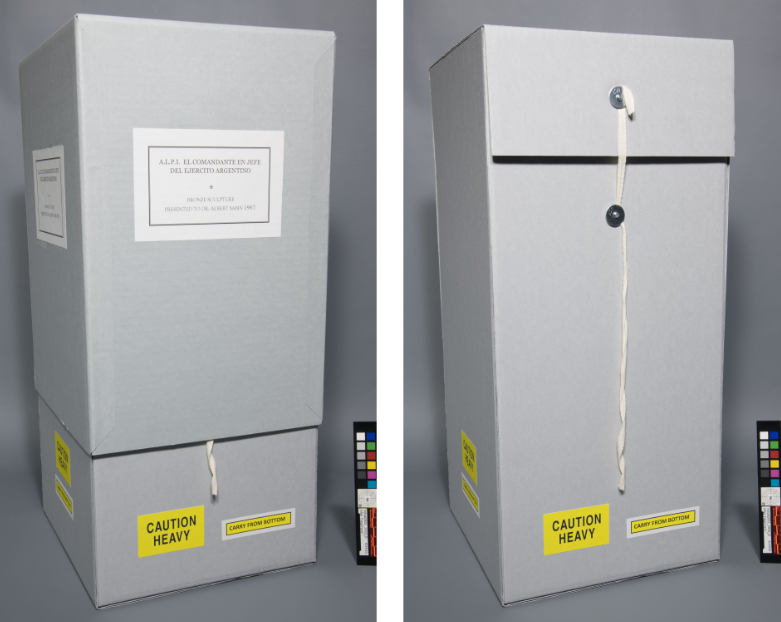
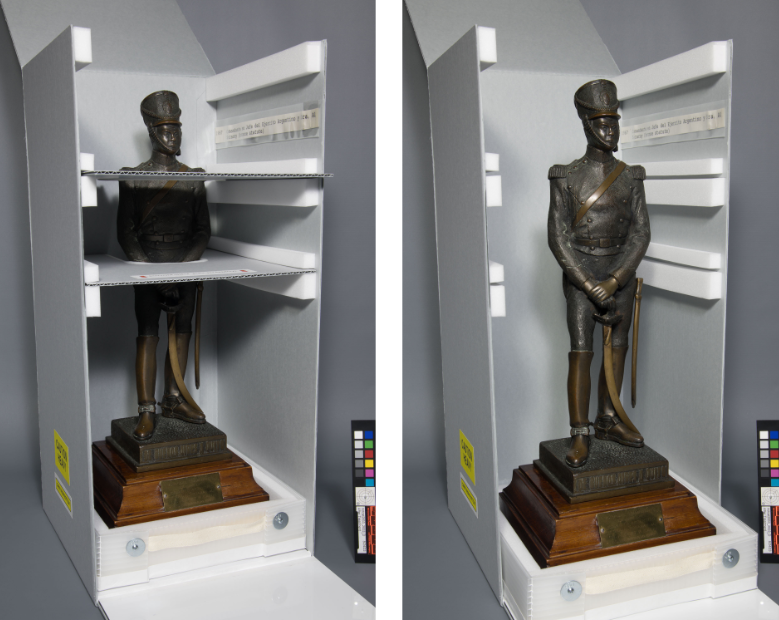
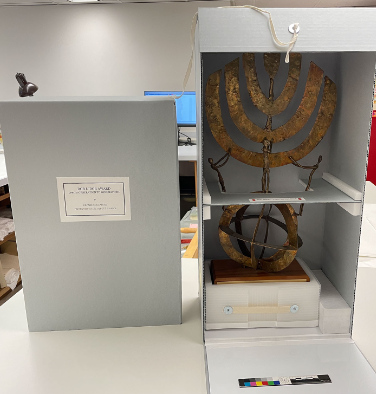
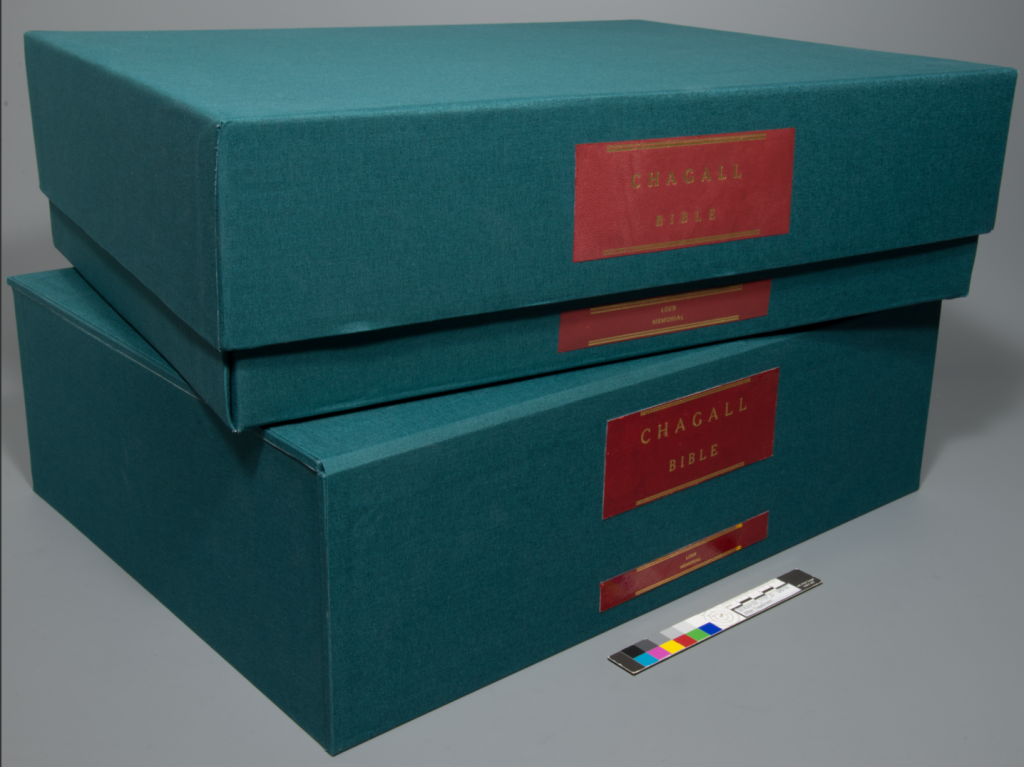
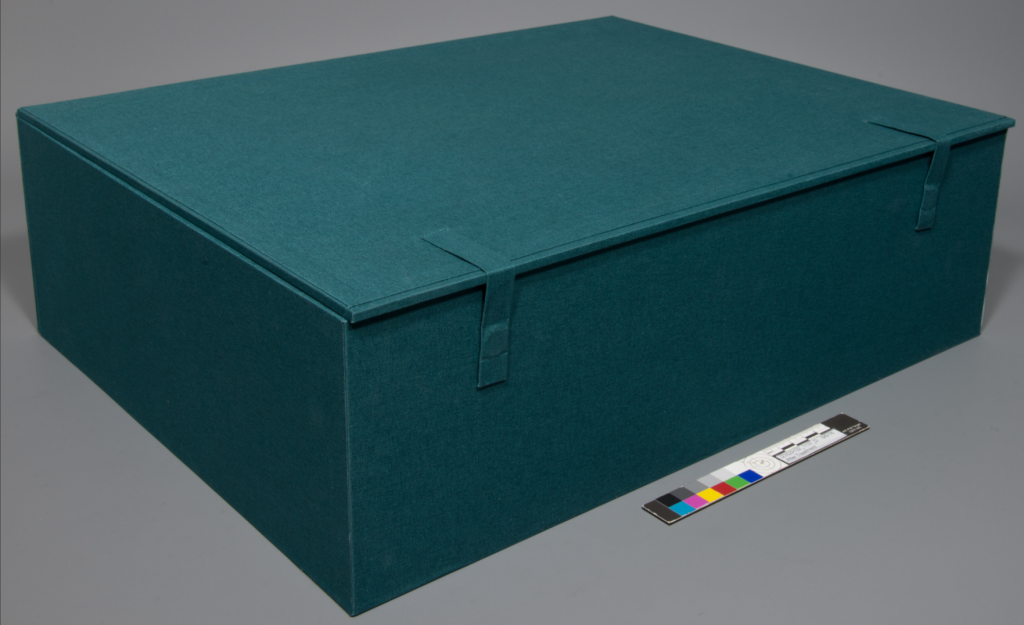
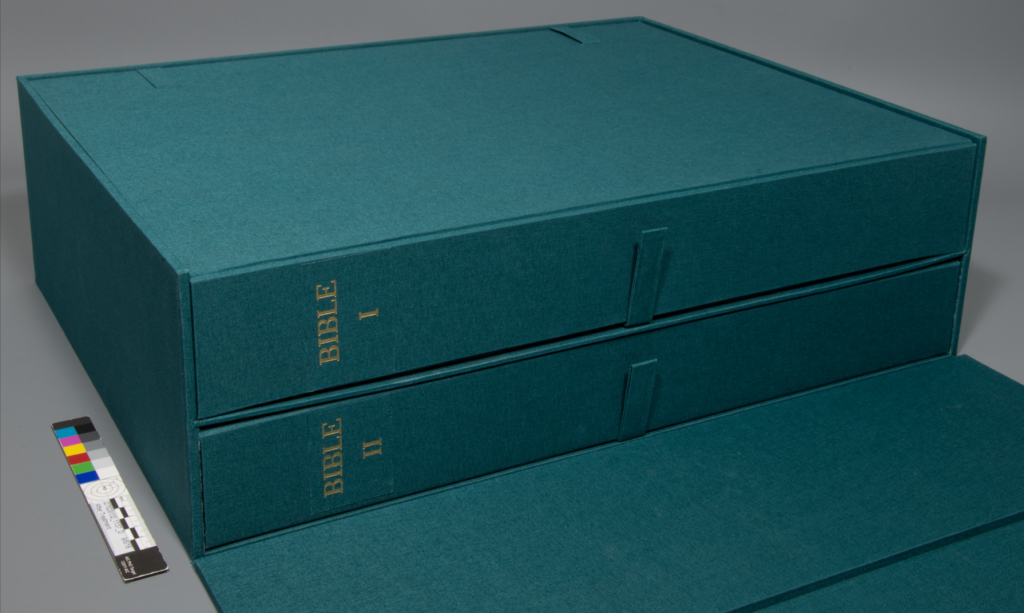
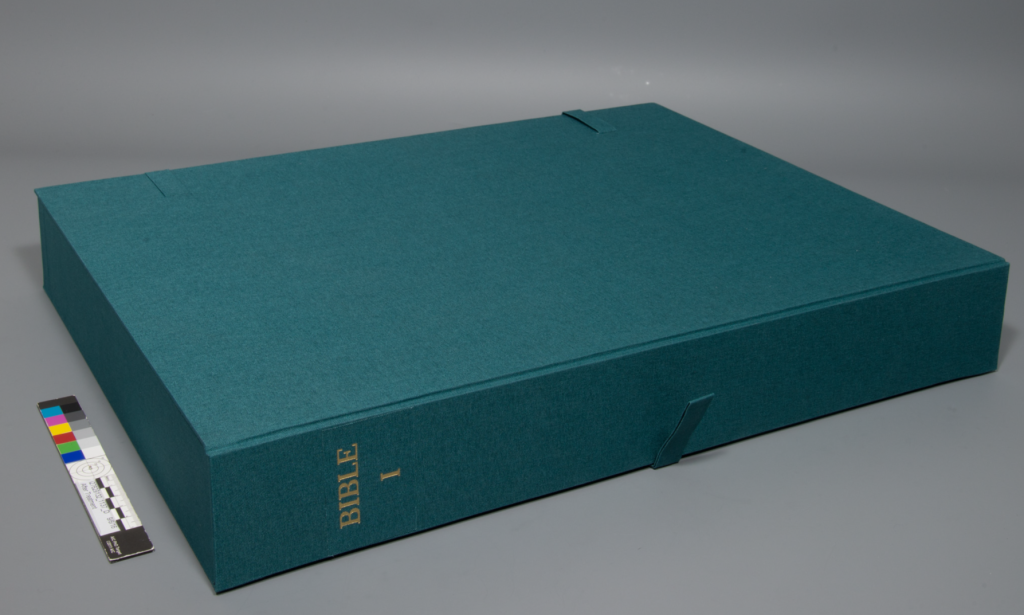
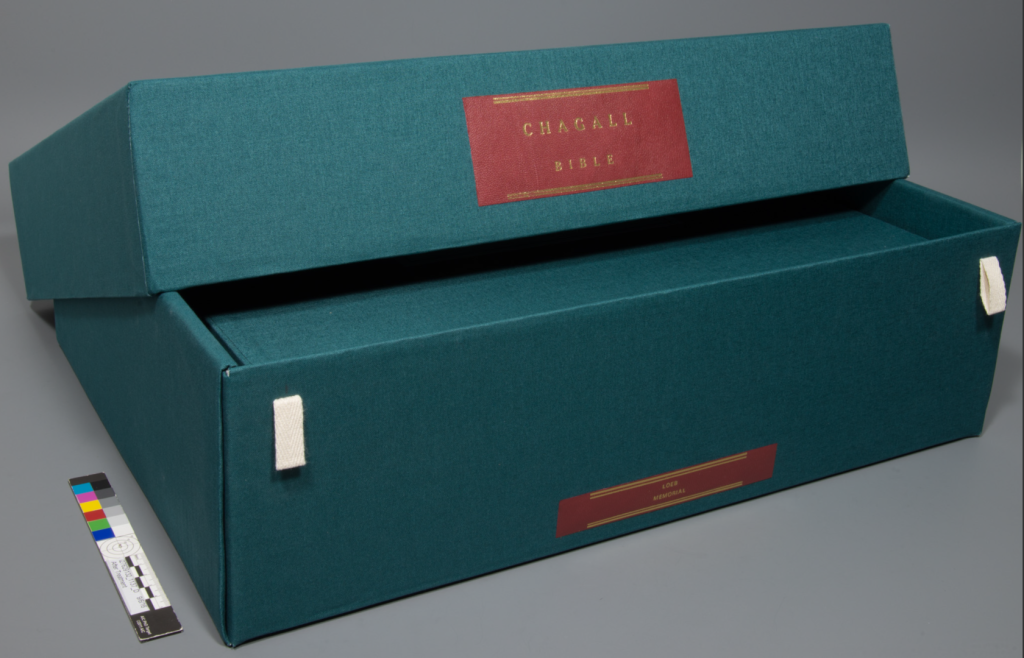
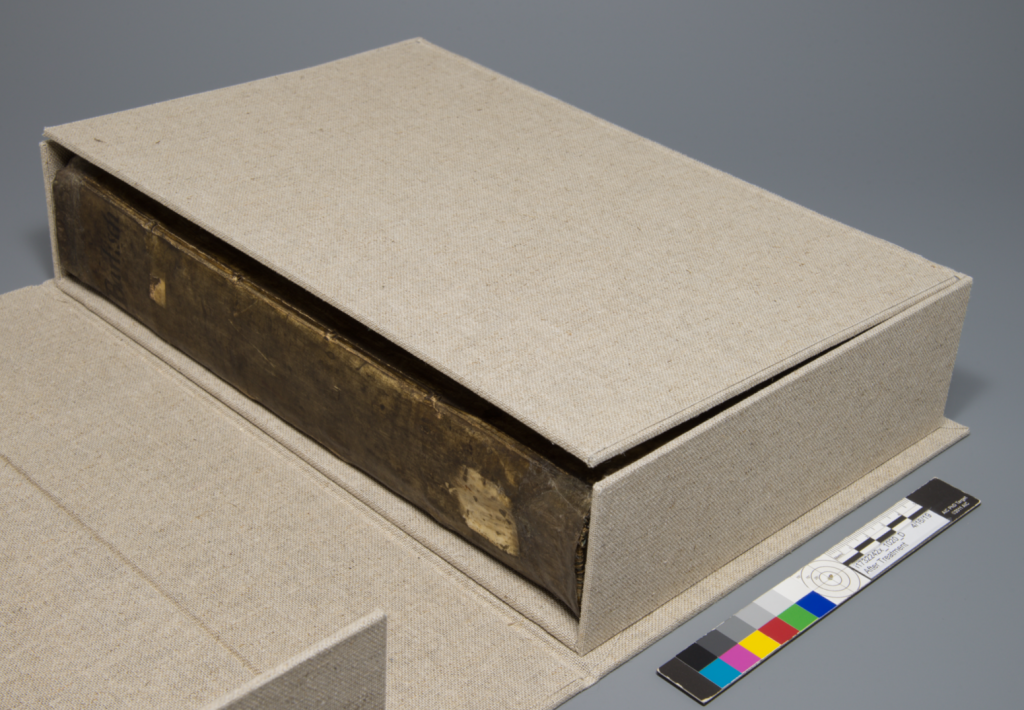
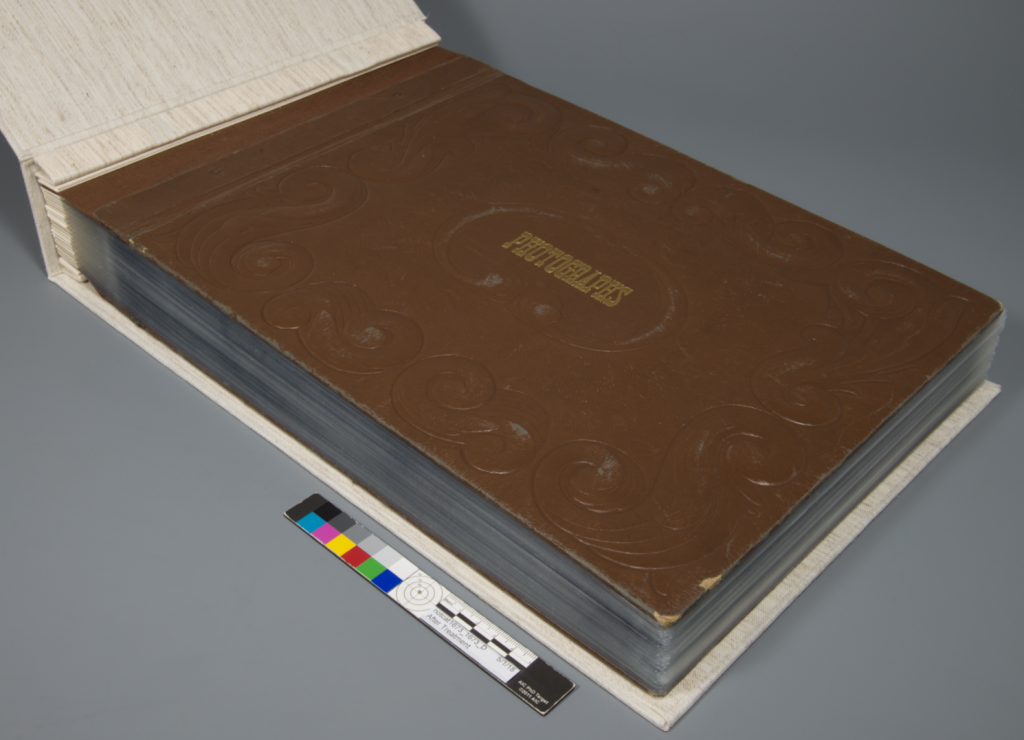
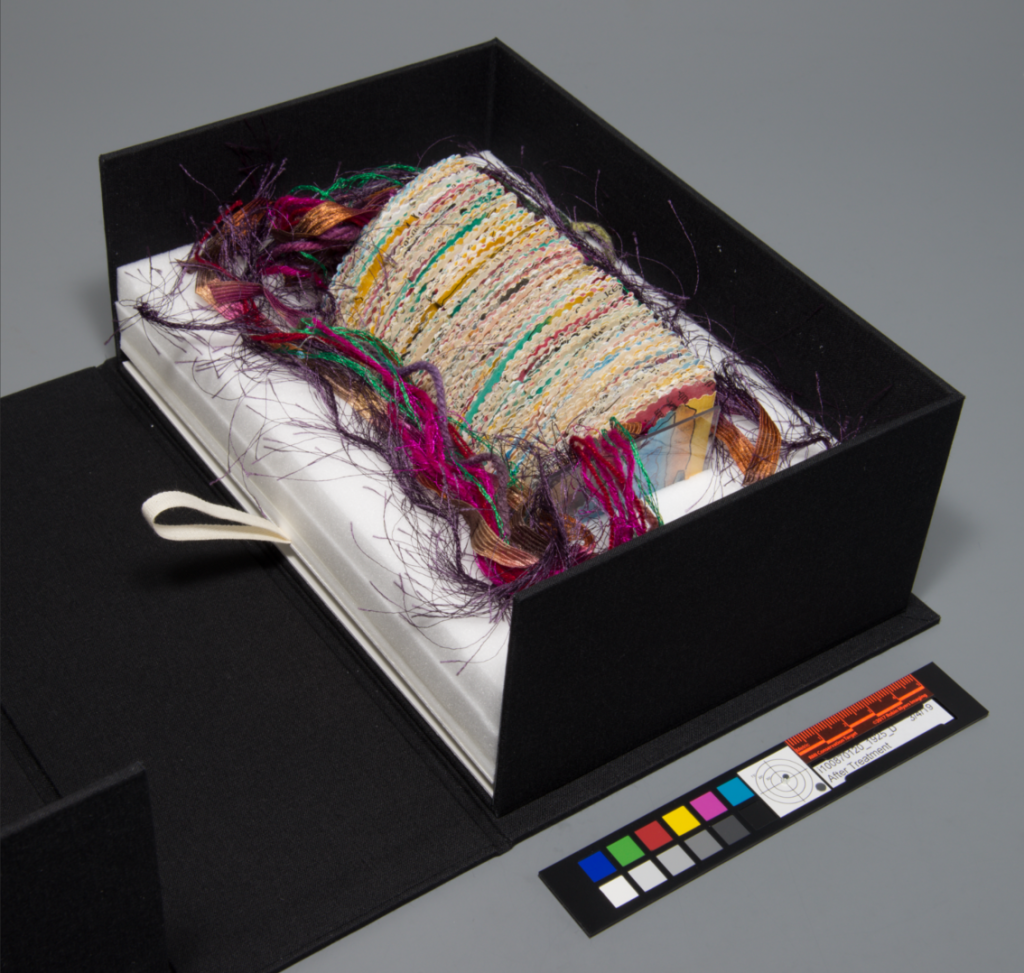
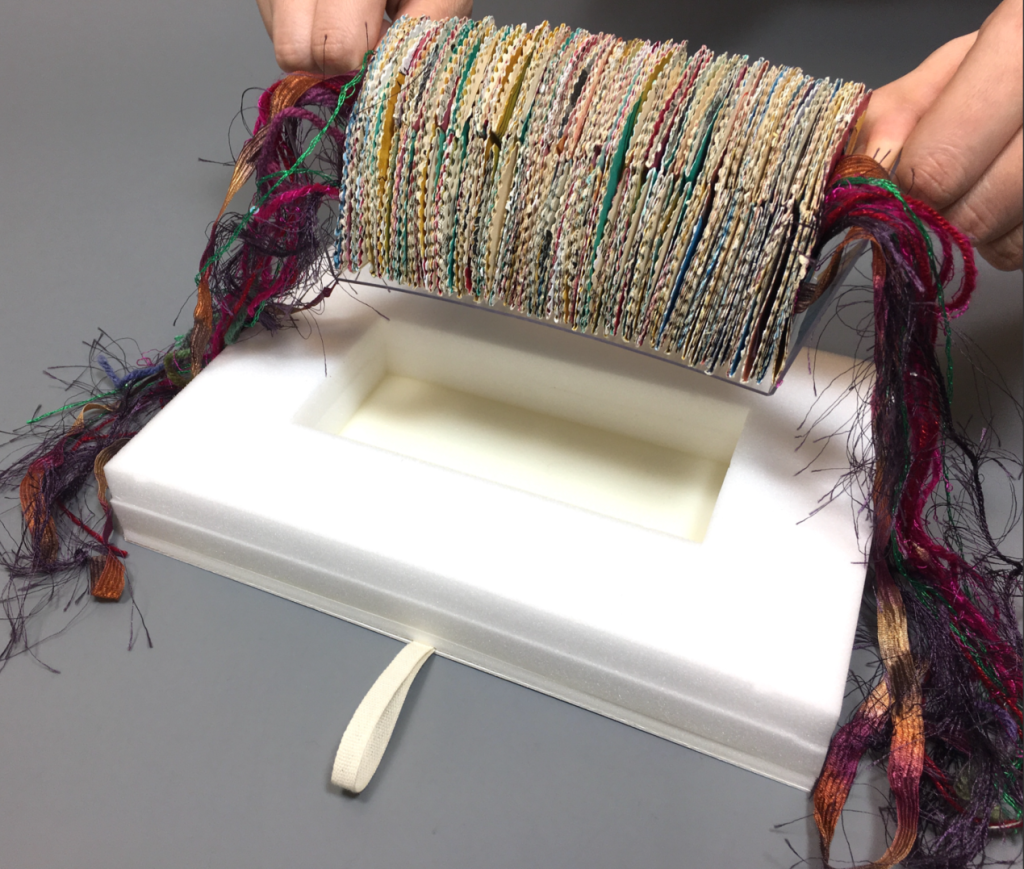
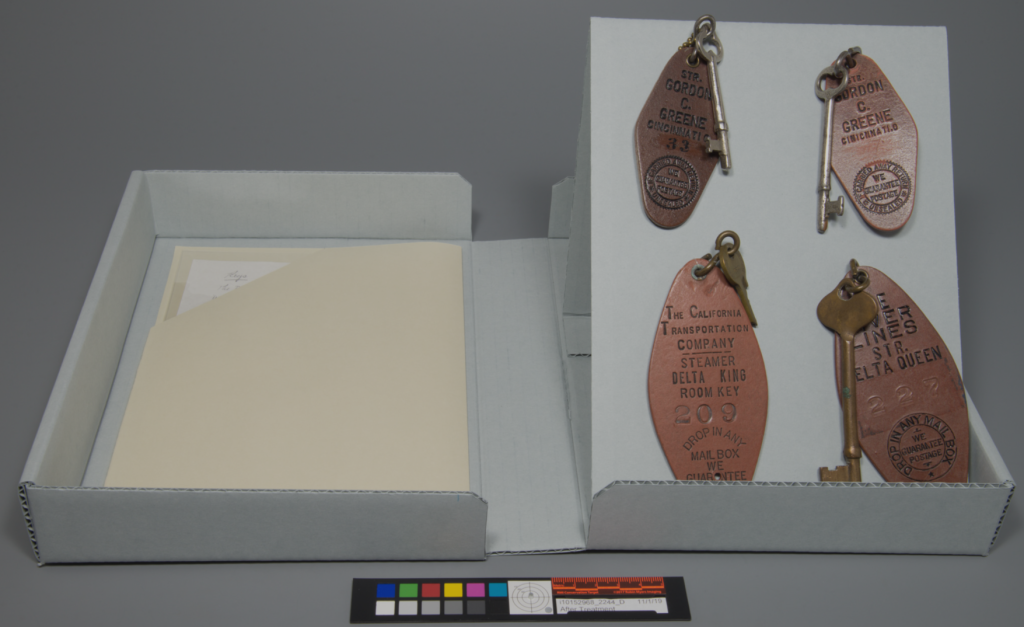
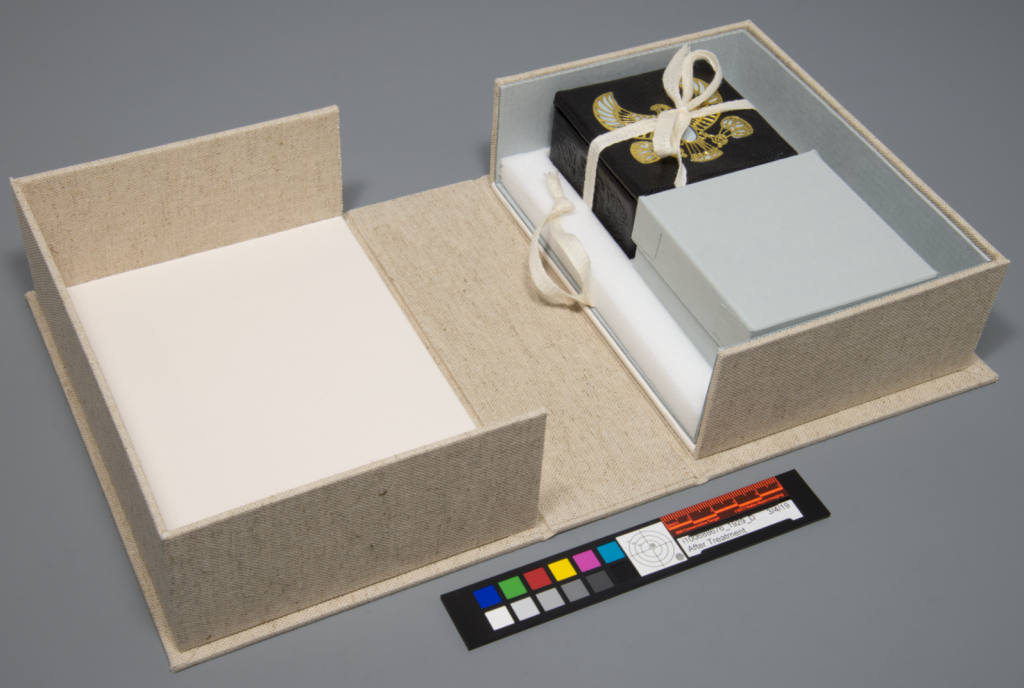
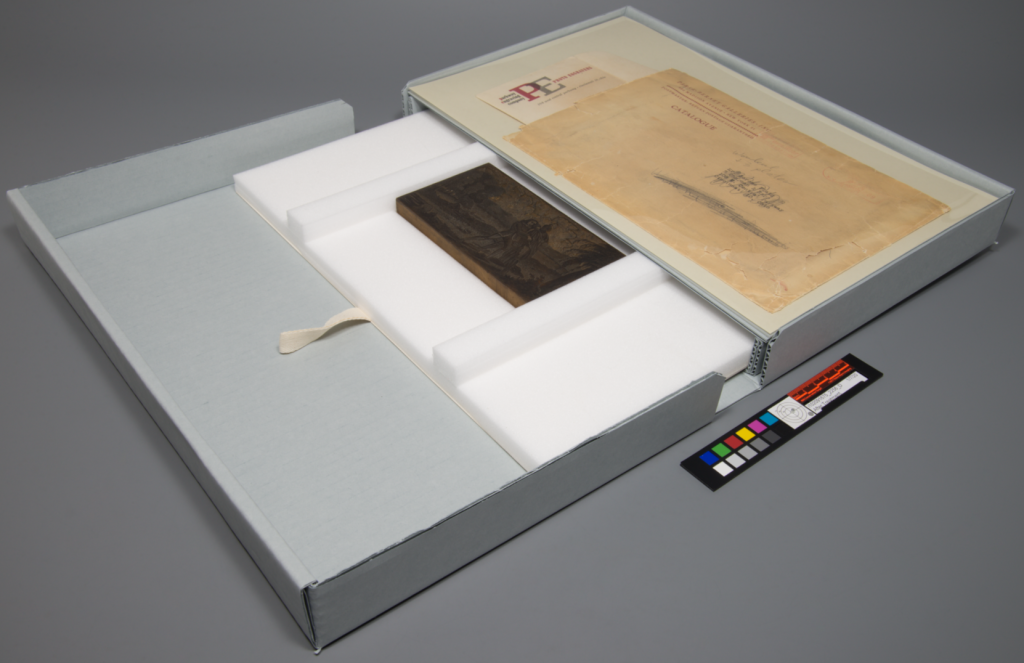
While he brought many skills with him, such as an ability to cut oversized mats, solder and work with metal files, his treatment skills have grown from general collections conservation to the treatment of special collections – with interests in leather, scrapbooks, and making clasps for medieval books. Treatment aside, Chris has held the esteemed title of Box-Maker Extraordinaire.
Known for his engineering feats, a few of Chris’ masterpieces can be viewed below:
As you can see, we will miss Chris’ can-do attitude when faced with any challenge. His positive outlook, efficiency (no one makes a box as fast as Chris!!), cartoons and dad jokes will especially be missed, but we are so happy for the new adventures that await him.
Please join us in celebration on Oct. 30th! RSVP to ashleigh.fergusonschieszer@chpl.org.
Ashleigh Ferguson Schieszer [CHPL] – Special Collections Conservator, Co-Lab Manager
Recently Jessica and I started working on a series of special collection items from UC Libraries’ DAAP Library. These were recent acquisitions specifically bought to be used as a teaching collection within the DAAP Library. Most items are small prints and single manuscript leaves that need to be matted for exhibition and prepared for handling during class. We have been working on these in small batches since it is a much larger collection that keeps growing.
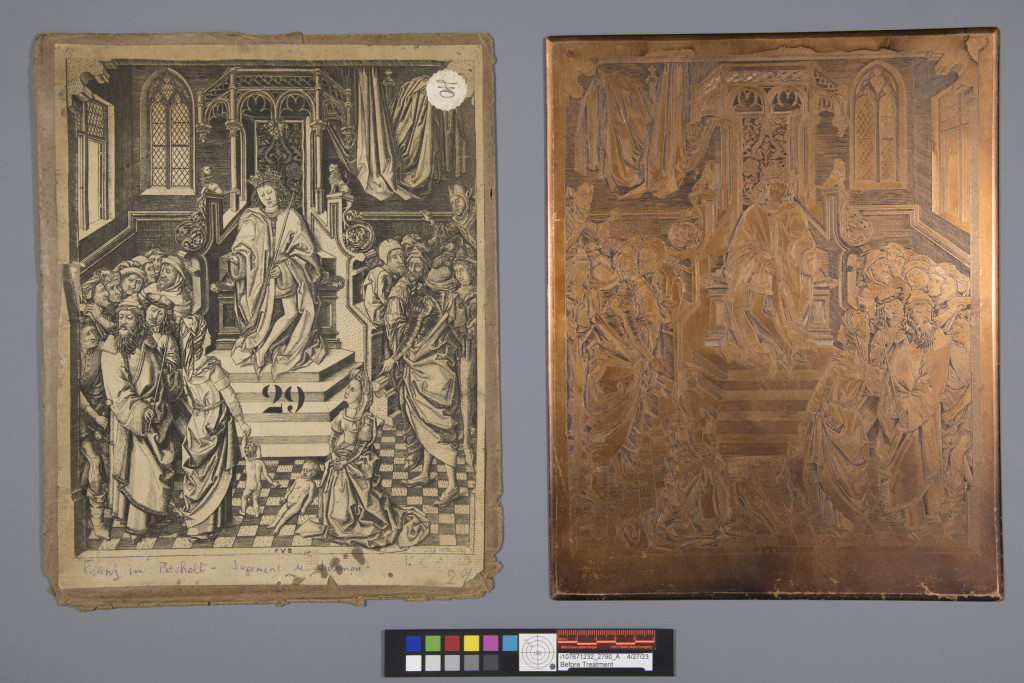
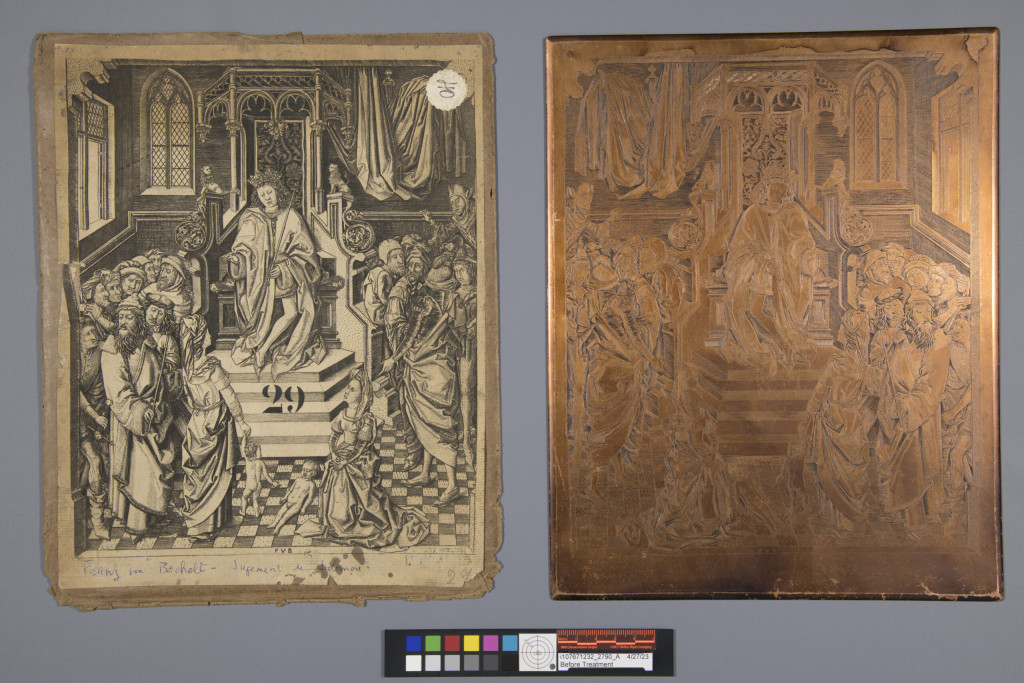
Most of the items we have received so far have been very straightforward matting projects, however we encountered one that was puzzling and fun to work on. We received this item: a proof print accompanied by its very heavy, copper engraving plate. The print was adhered to a paper brown envelope with no information and the copper plate was also unhoused.
Proof print (left) and engraving plate (right) before treatment and housing.
The curator of the collection wanted both items to be housed together and housed in a way that would allow students to touch the items, and also be able to use them for exhibits. We decided that both items would be matted individually, and then housed together in a thin corrugated clamshell box. The most challenging part would be to create a matting system that was strong enough to secure the very heavy copper plate and elegant enough to be used for exhibition.
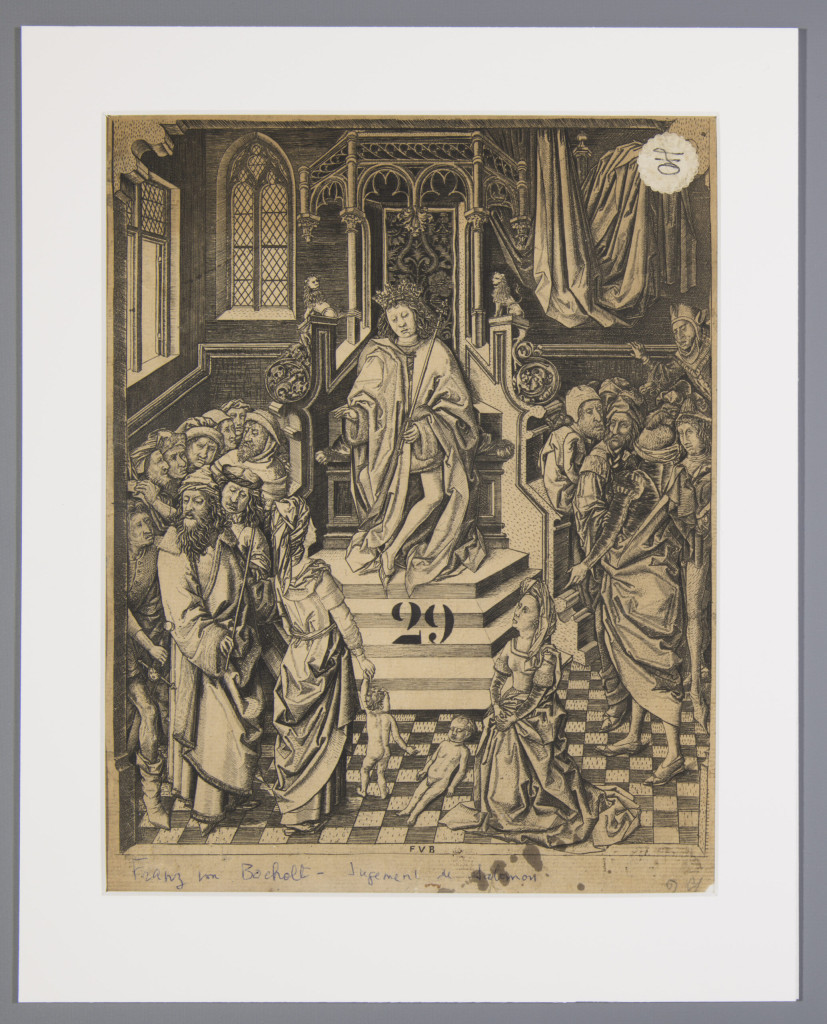
The print itself received minor treatment, with the backing envelope being removed and the print housed in a polyester L-sleeve mounted with photo corners.
Print housed in a polyester L-sleeve and matted with photo corners.
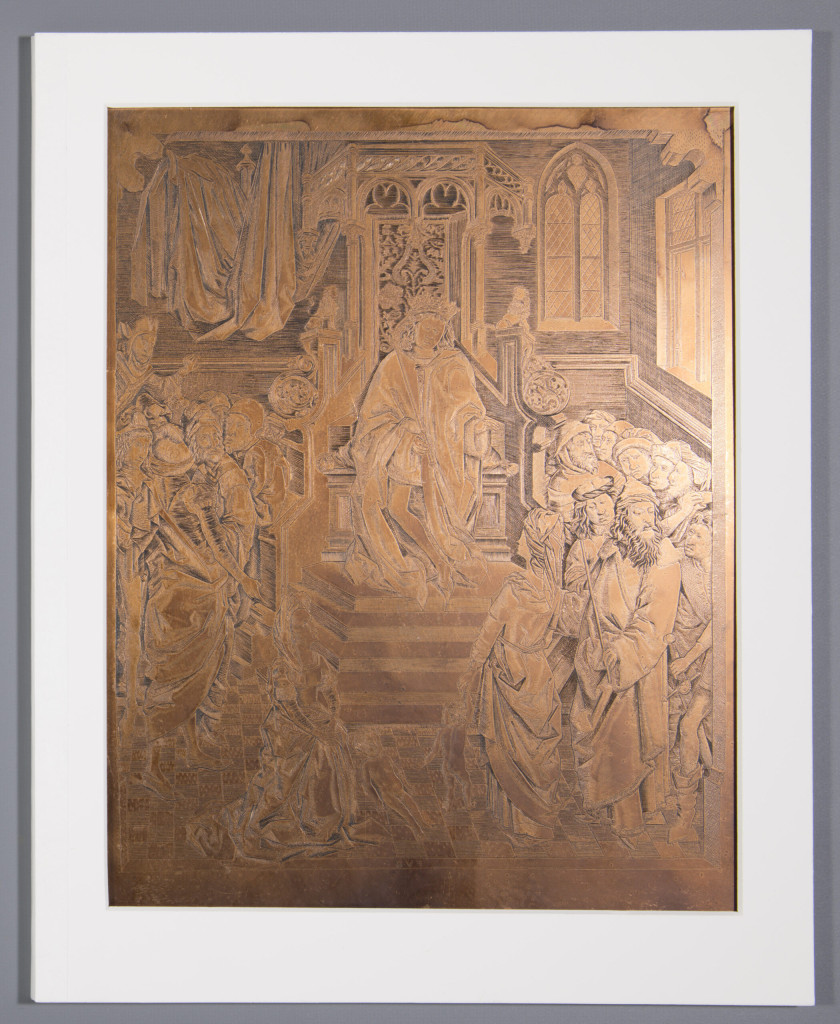
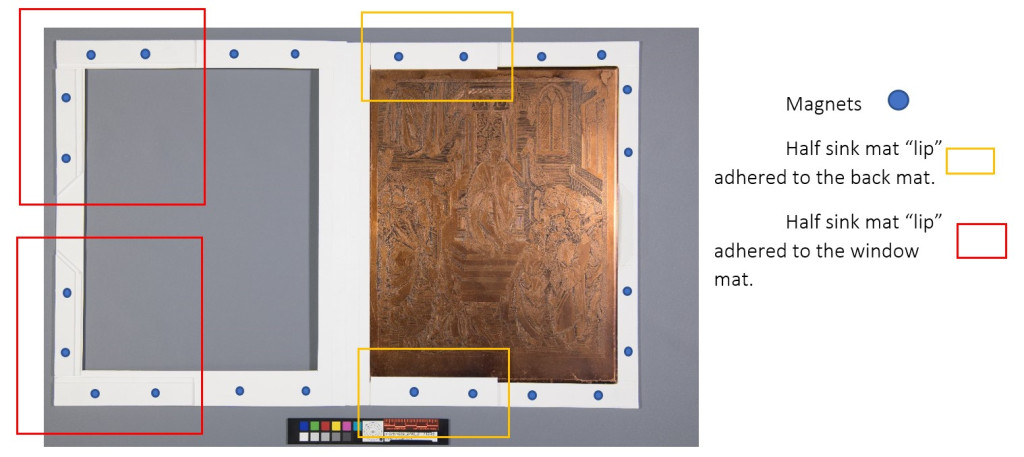
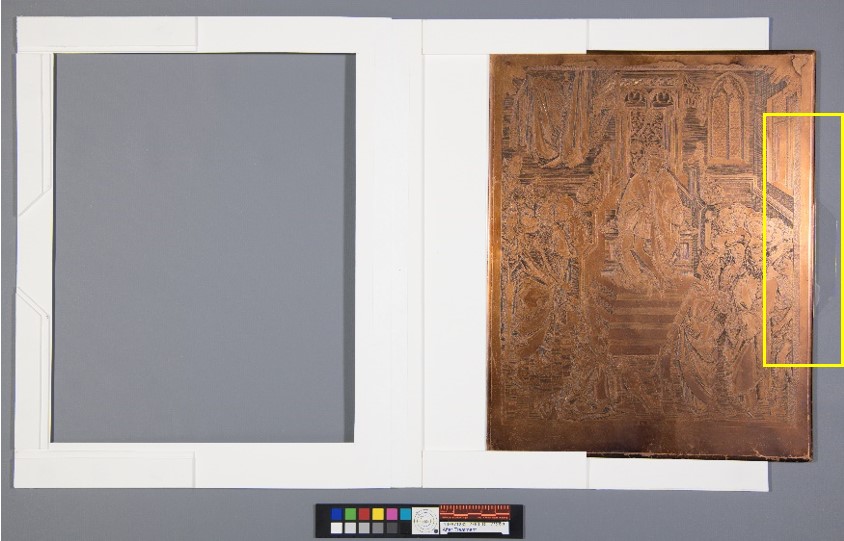
With the engraving plate, I needed to figure out how to create a matting system that was strong enough to hold the copper plate in place, especially if used for an exhibit where it may be propped at a slight angle. After considering some options, I created a sink mat that would secure the plate halfway, and then the rest of the sink mat would be adhered to the window mat so the copper plate, resting on a polyester tray, could be pulled out of the mat easily. How would I keep the matting system closed? ….with magnets, lots of magnets! For this project I used 24 rare earth magnets.
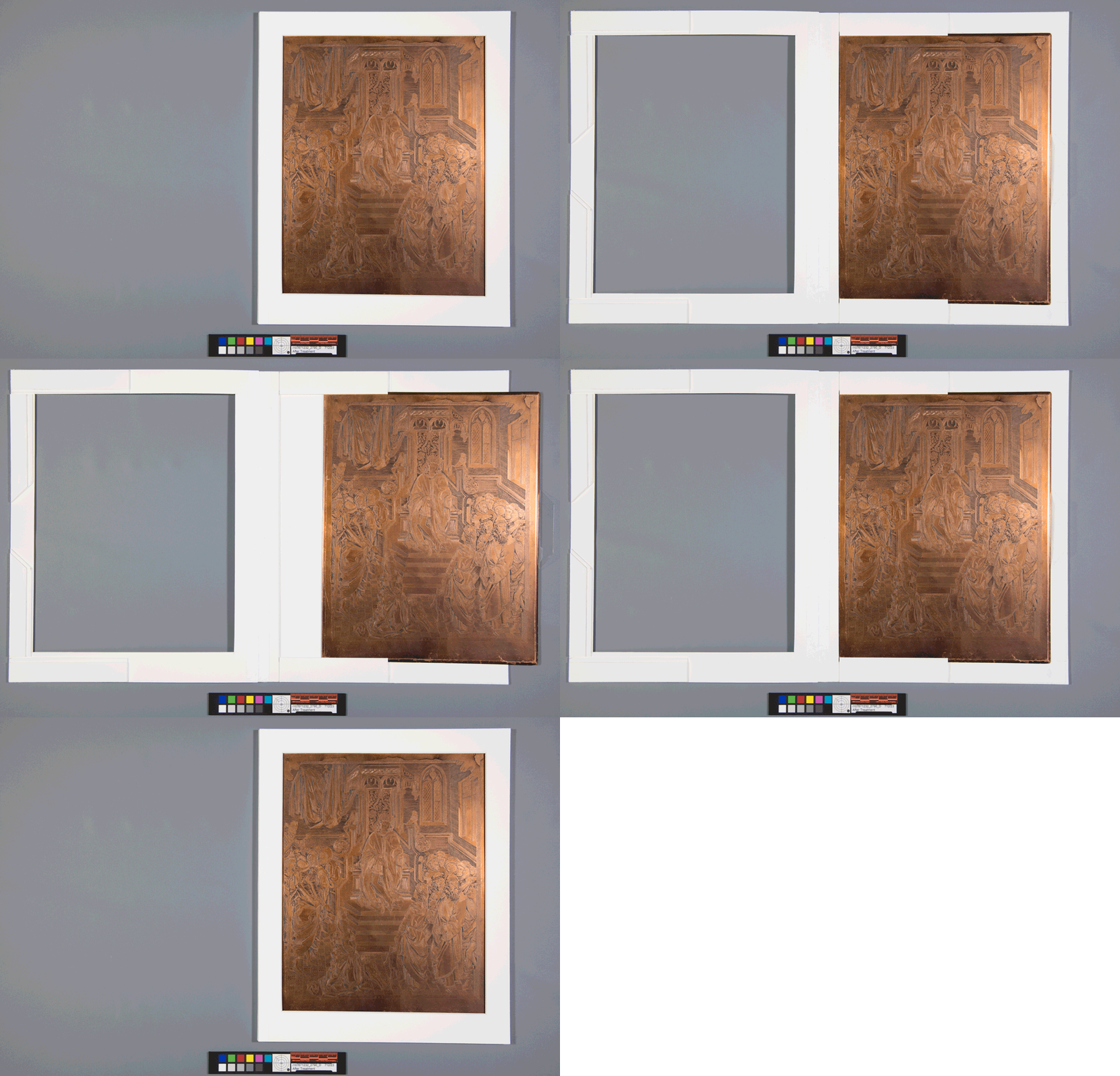
Copper engraving plate housed in a specialty sink mat with magnetic closures.Matting system for the copper plate – a sink mat, half attached to the back mat and half attached to the window mat, all secured closed with magnets.Copper plate slightly removed from the matting system by the polyester film tray.
This was a fun project to work on. After using 24 magnets and breaking a few in the process, the copper plate was securely housed in the sink mat, while also able to be propped up for exhibition and handled for teaching.
Before treatmentAfter treatmentThe matting system in action!
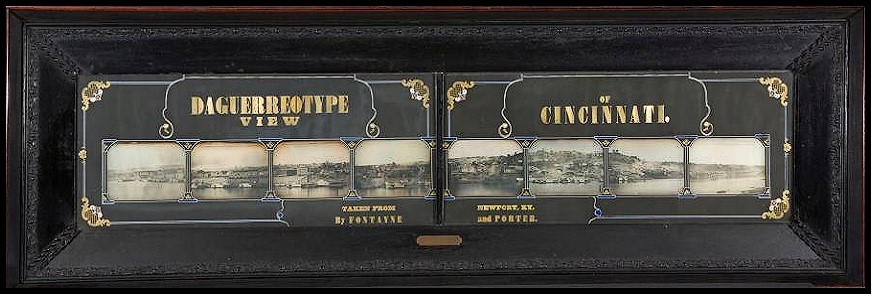
As conservation professionals at the Preservation Lab, we get to see and work with our fair share of historic, rare, and just plain interesting artifacts. I recently had the pleasure of becoming familiar with an item that is all 3 of these, and just so happens to be one of The Cincinnati & Hamilton County Public Library’s (CHPL) most prized possessions: the Fontayne and Porter 1848 Cincinnati Panorama Daguerreotype.
Cincinnati Daguerreotype Panorama by C. Fontayne and W. Porter, 1848
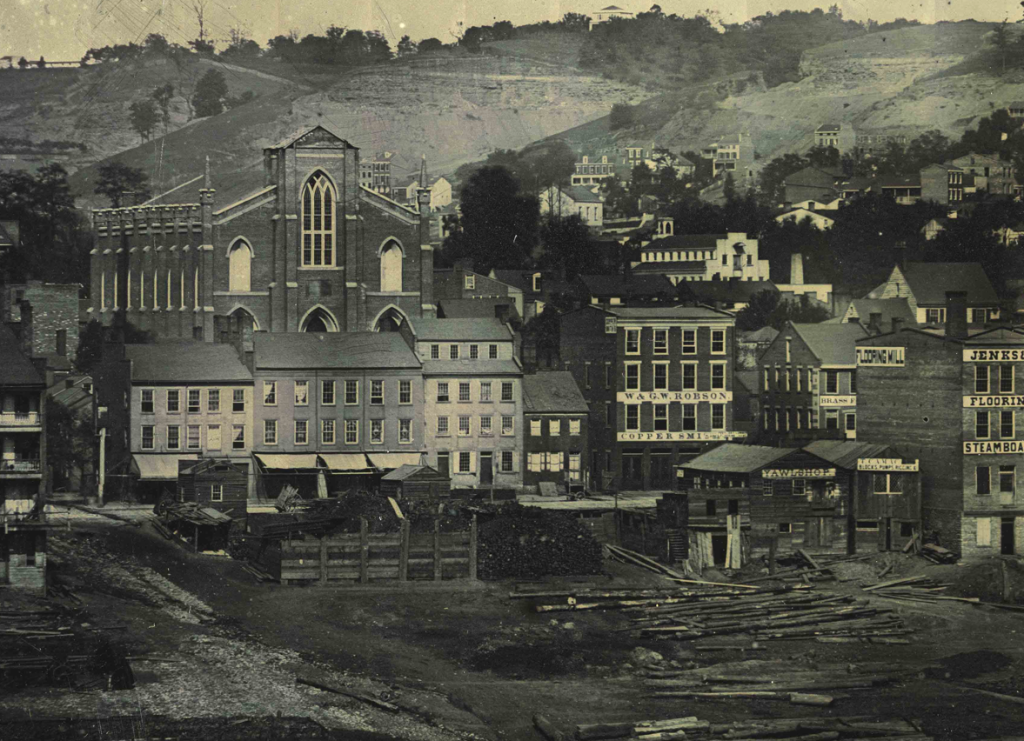
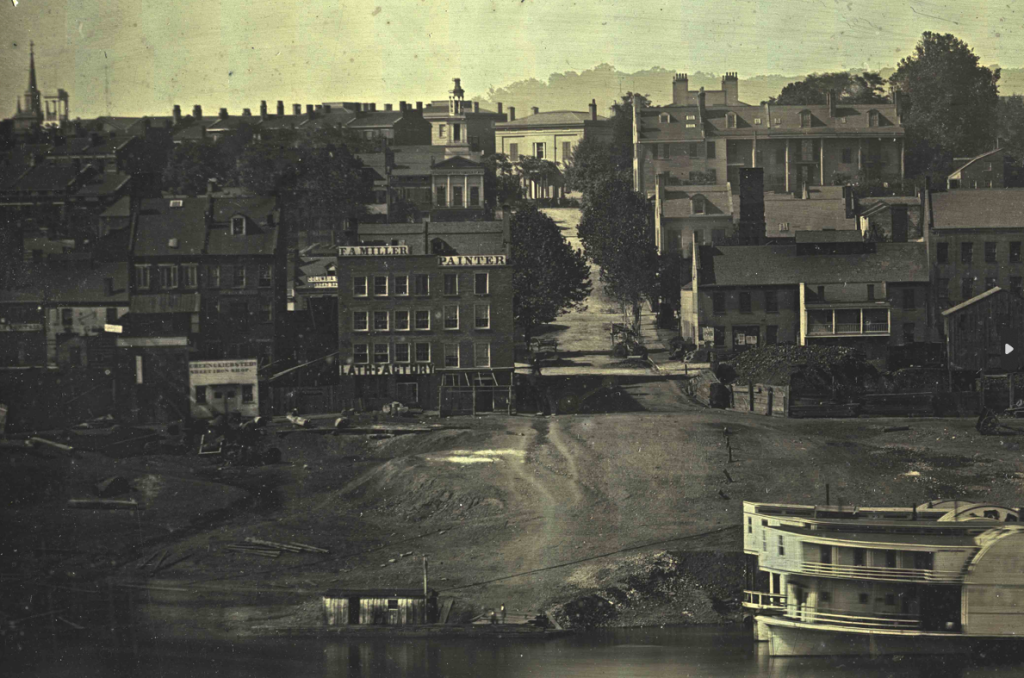
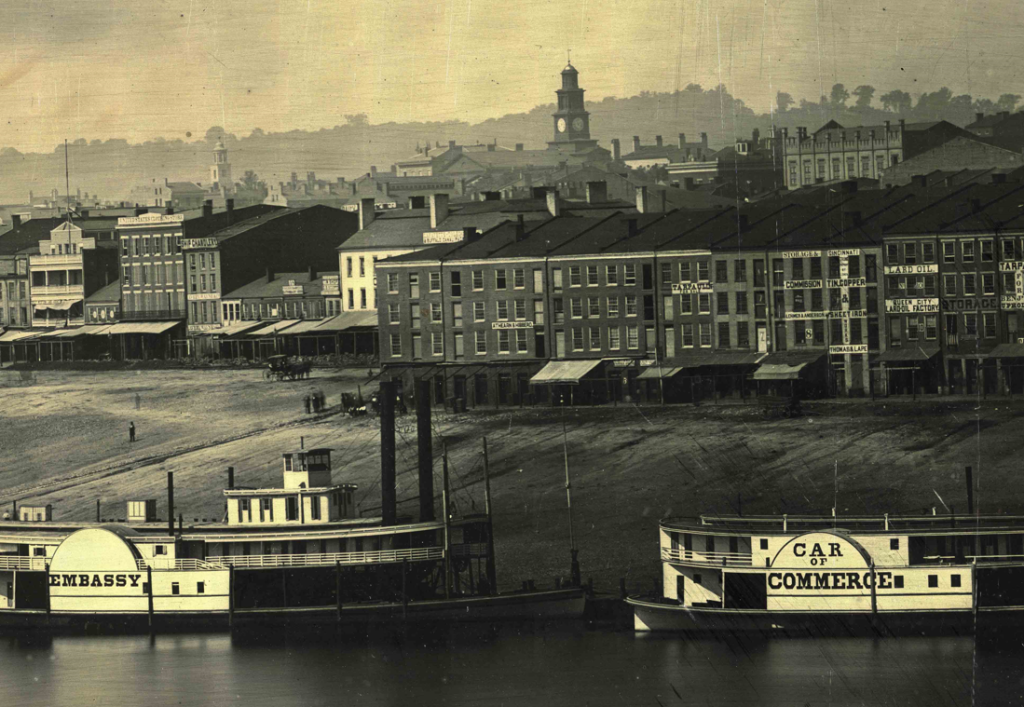
For those who are unfamiliar, a daguerreotype is the very first photographic process, utilizing iodine-sensitized silver plates and mercury vapors, often offering stunning detail and resolution. Currently on display in the downtown Main Library’s Cincinnati Room, the Cincinnati Panorama is no exception, and is considered one of the most detailed and vivid examples of daguerreotype photography currently in existence.
CHPL panorama plate 5 detail
CHPL panorama plate 4 detail
CHPL panorama plate 2 detail
Daguerreotype photography is not without its challenges, however. Most significant of these (at least which concerns us in the conservation field) is that daguerreotypes are extremely delicate. They scratch easily and can degrade with simple exposure to oxygen, atmospheric pollutants, and moisture. These attributes bring up a difficult question: how does one display an item like this, while also ensuring its preservation for generations to come?
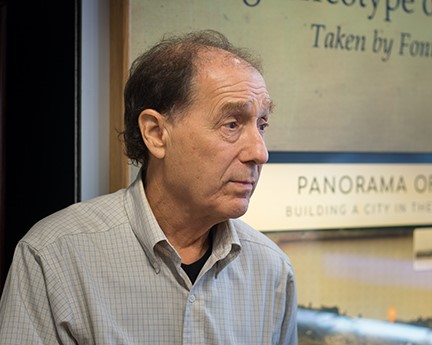
Enter Ralph Wiegandt. Wiegandt is a Photograph Research Conservator who designed and installed the 1848 Cincinnati Panorama’s enclosure and display case in 2008. He routinely has performed on-site follow-up consultations in 2012, ’14, ’16, and most recently this past June with Genealogy and Local History and Preservation Lab staff. My fellow lab mate, Hyacinth, and I had the good fortune to also meet with Wiegandt on this recent visit to attend a presentation on his uniquely designed enclosure. Although the primary purpose of the visit was to discuss the enclosure, Ralph shared no shortage of information about daguerreotype plates, the photographers (Fontayne and Porter), the conditions surrounding the panorama, and much more.
Ralph Wiegandt, photo by Hyacinth Tucker
It was clear from speaking with Wiegandt that this project was one he was deeply passionate about, referring to it as “a seminal object in my career.” He spoke with excitement about the unique attributes the Cincinnati Panorama showcases, chief among them: the stunning detail and clarity. According to Wiegandt, this image is so detailed that it can be magnified up to 30x before experiencing any resolution loss. This allowed for intense digital imaging to be performed during the initial conservation of the daguerreotype in 2008. In this process, digital photos were taken from different degrees of closeness to the original image and then stitched together, creating one large interactive digital display, viewable here.
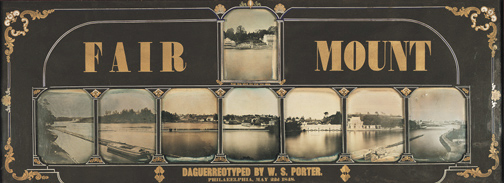
Wiegandt informed us that the 1848 Cincinnati Panorama was not the first attempt at such a picture. Just several months prior, W.S. Porter had taken another daguerreotype panorama of the Fairmount Water Works in Philadelphia.
Fairmount Water Works Daguerreotype Panorama by W.S. Porter, 1848
The detail of this image, however, is not as impressive as the Cincinnati Panorama. What can be gleaned from this fact, according to Wiegandt, is that the Philadelphia capture was a successful learning experience for Porter, and that his skills and techniques were able to improve dramatically by the time he attempted the Cincinnati Panorama with C. Fontayne.
At the time of the Cincinnati Panorama, daguerreotype photography had only existed for 9 years. Equally as remarkable as the detail these images were able to capture is the inception of this technology. Wiegandt explained how Louis-Jacques-Mande Daguerre experimented with plates of silver sensitized with iodine fumes. The idea was that the sensitized silver would be reduced as it was exposed to light (i.e., the shutters on a camera opening and allowing light from the image field to hit the plates), thus creating latent images in the silver. Although this proved to be successful, a viewable image was not detectable until a chance happening, which Wiegandt describes as “a miracle.” Legend has it that one of Daguerre’s exposed plates was stored in a cabinet, sharing this space with one other singular item: a broken instrument that utilizes mercury (such as a thermometer, barometer, etc.). Upon examining this plate, Daguerre realized the latent image was now detectable, correctly deducing that the mercury fumes had developed the film. The fumes had caused the light-exposed areas on the silver plate to form small bumps, roughly 1 micron in size, creating an instant high-resolution image. The microscopic size of these bumps means that, according to Wiegandt, daguerreotype images are an early example of what we would today call nanotechnology. (Ralph also notes the actual circumstances of its discovery are unclear since any notes from Daguerre’s studio would have been lost during a fire shortly afterwards.)
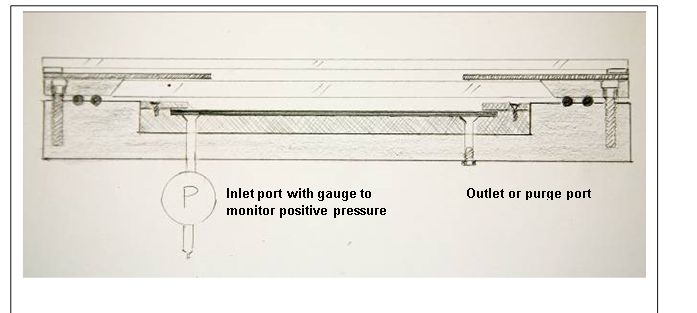
Much like the Fontayne and Porter Cincinnati Daguerreotype, the current display case is quite unique as well. As mentioned before, daguerreotypes are incredibly delicate. To successfully prevent further degradation and preserve this object for generations to come, its exposure to oxygen and other reactive gases must be severely limited. The solution that Wiegandt produced was a specialized inert gas case, similar in concept to how the Declaration of Independence is housed. The goal of this case is “to maintain a slightly elevated pressure of a non-reactive gas such that it will not put excessive strain on the seals yet will be above the potentially highest barometric pressure” (Wiegandt, 2006), thus preventing any atmospheric air from coming in contact with the sensitive daguerreotype plates.
Wiegandt’s sealed encasement design sketch provided in treatment documentation
Wiegandt chose argon to pressurize the case with as it has a better diffusion rate and is more inert than other gases such as nitrogen, all while being cost effective.
Wiegandt informed us on his most recent visit that the case is doing its job: the panorama has experienced no detectable degradation since its installation. However, this was likely his final visit to the Cincinnati Library, as he is retiring from the field. I should add that a further and perhaps more important purpose for this visit was to advise and inform CHPL (and Preservation Lab) staff to be successful in monitoring and caring for the object in his absence. Fortunately, Wiegandt was able to leave us with a wealth of information and resources that will aid in the continued preservation of this amazing artifact. With an updated preservation plan, knowledgeable staff in both the Genealogy & Local History and Preservation Lab departments, and a commitment to preserving cultural property, we can be confident the Cincinnati daguerreotype panorama will be enjoyed by library visitors for many generations to come.
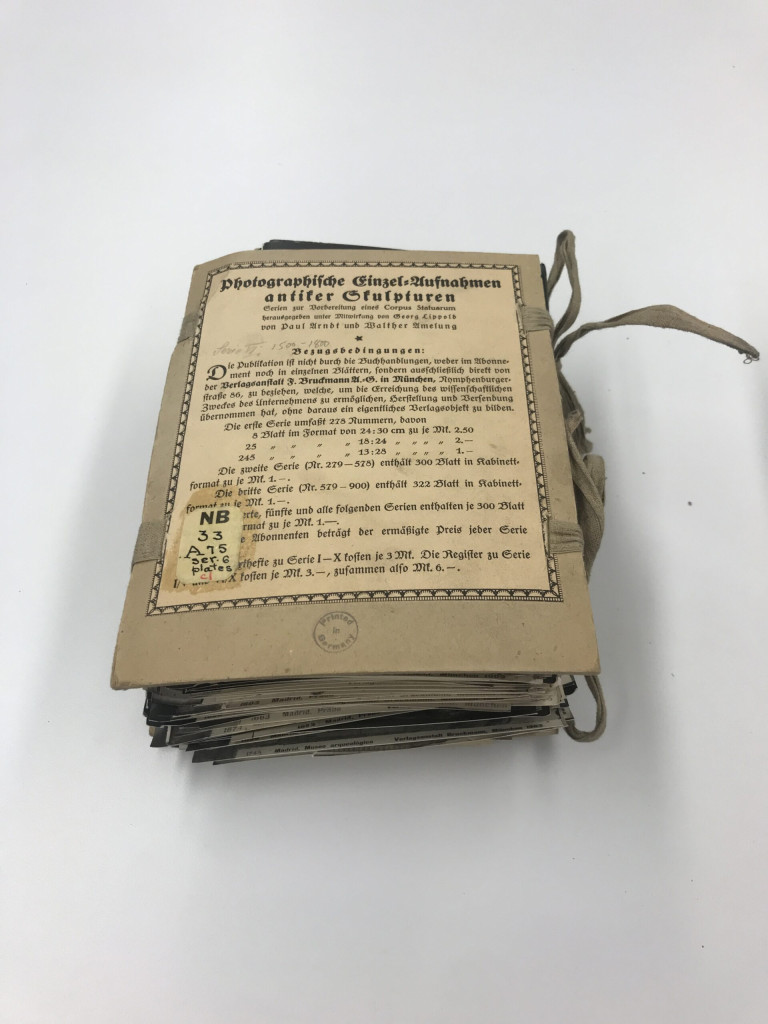
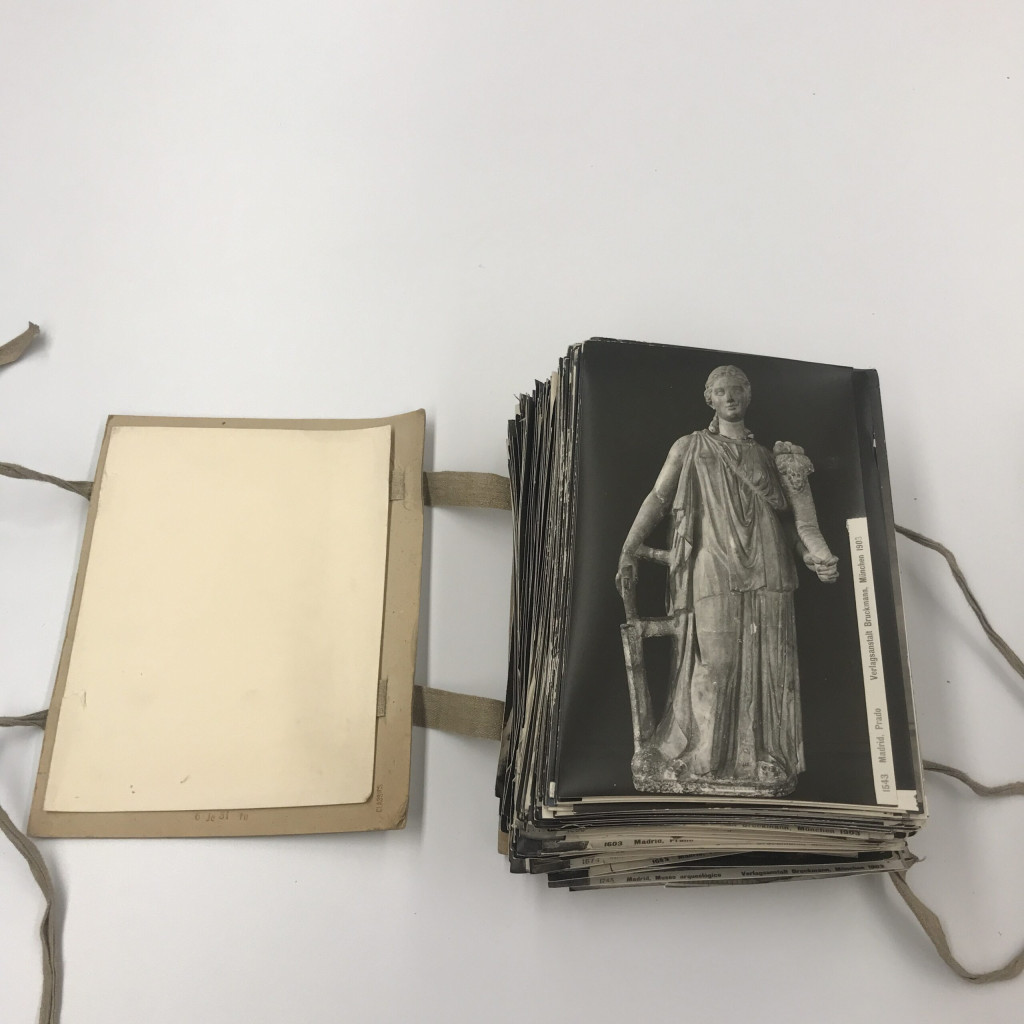
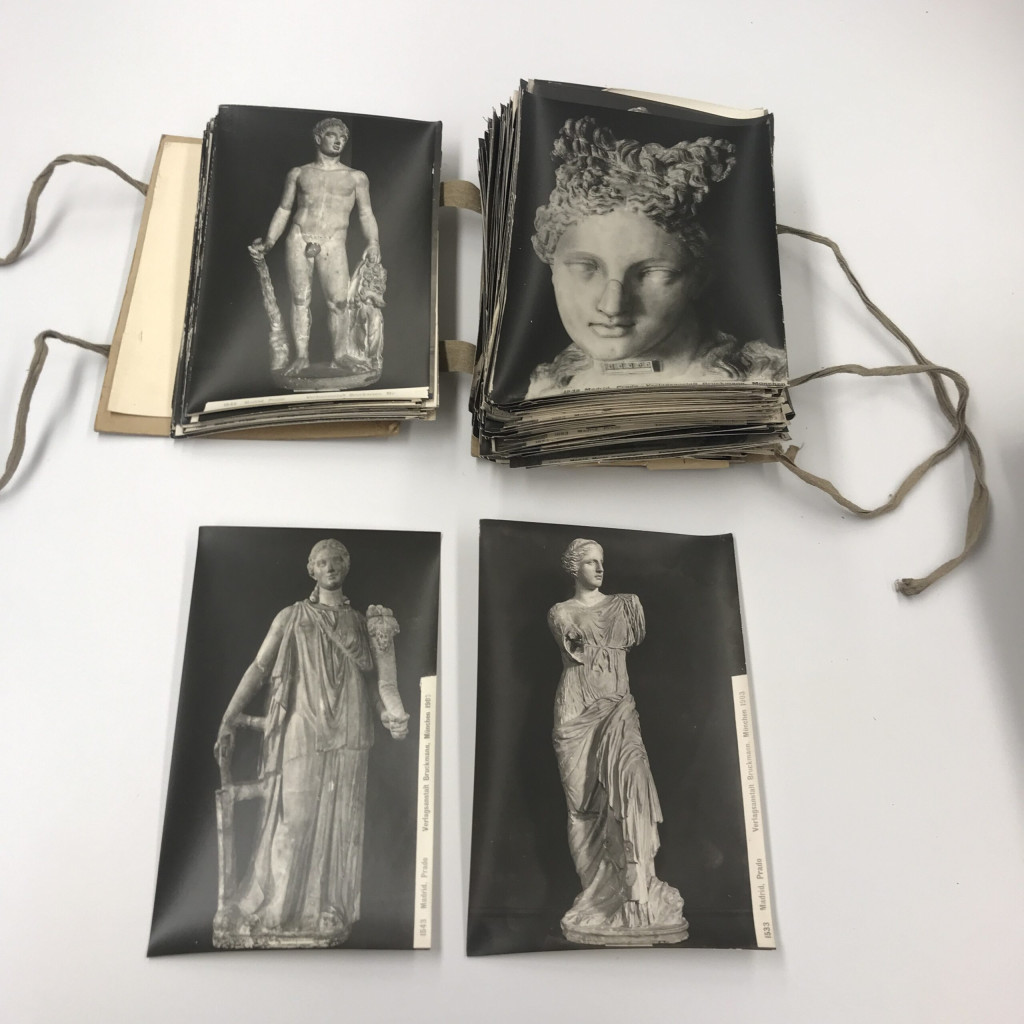
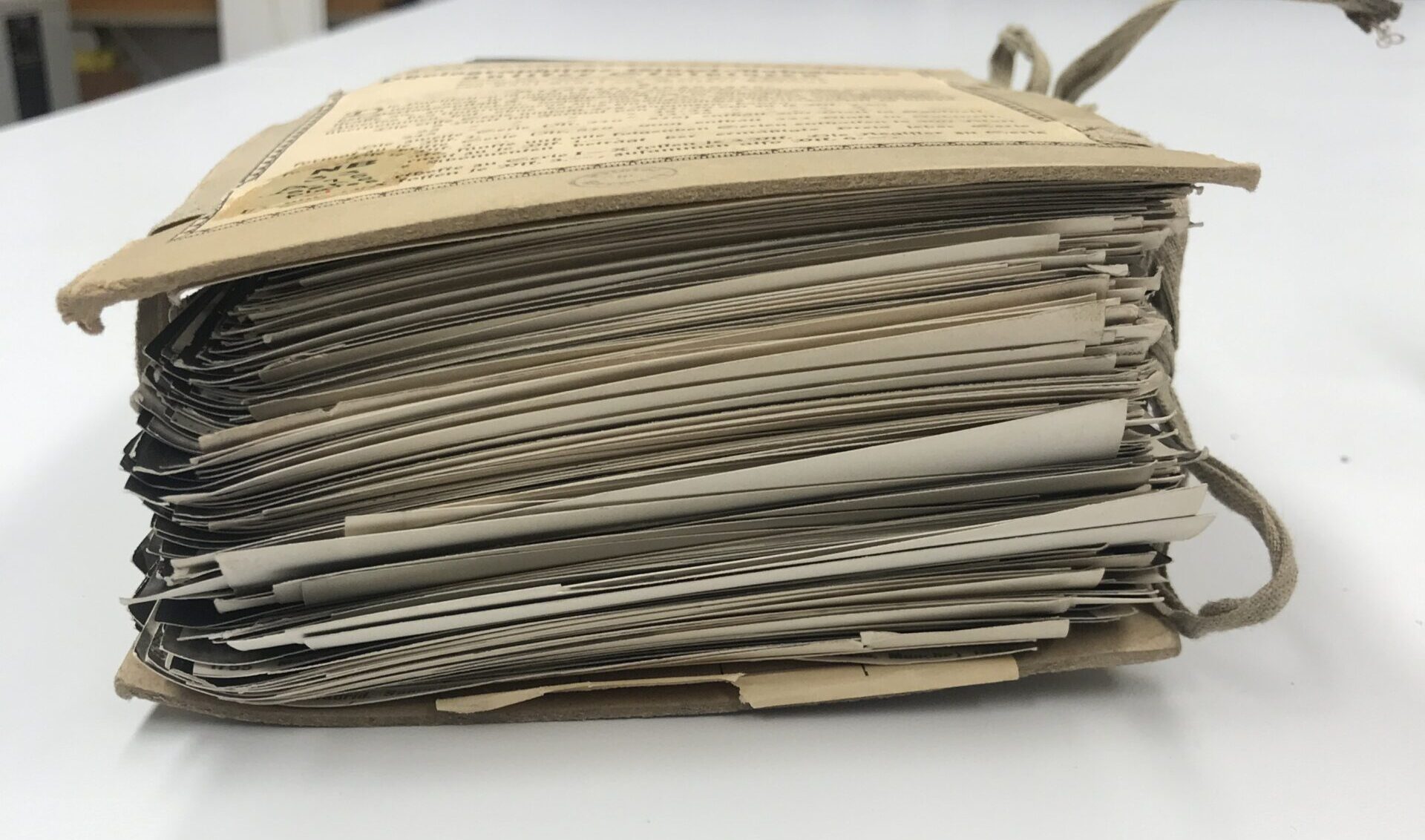
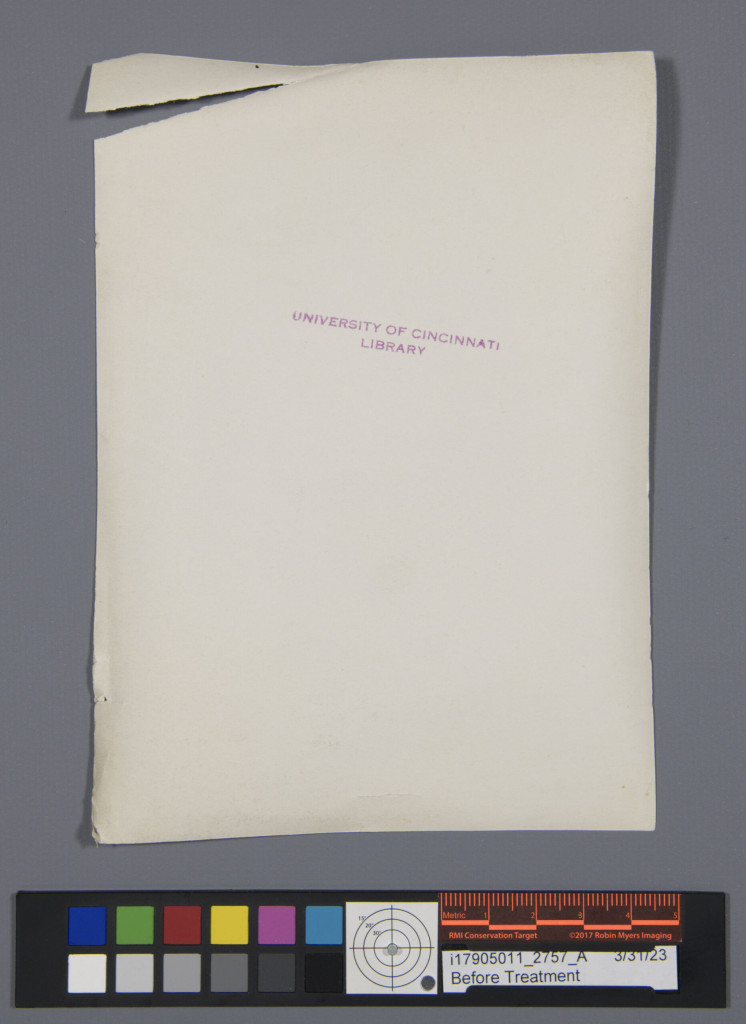
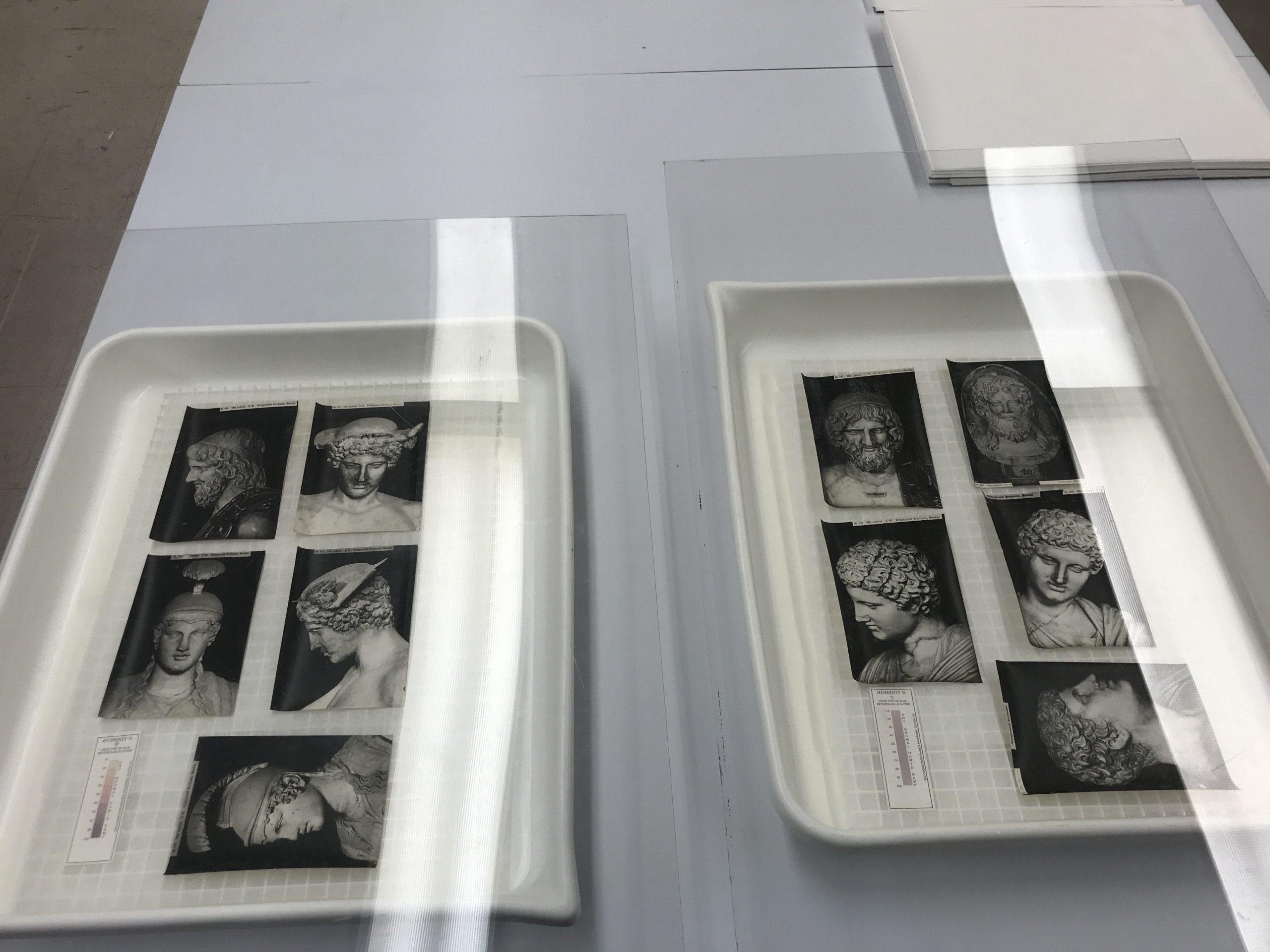
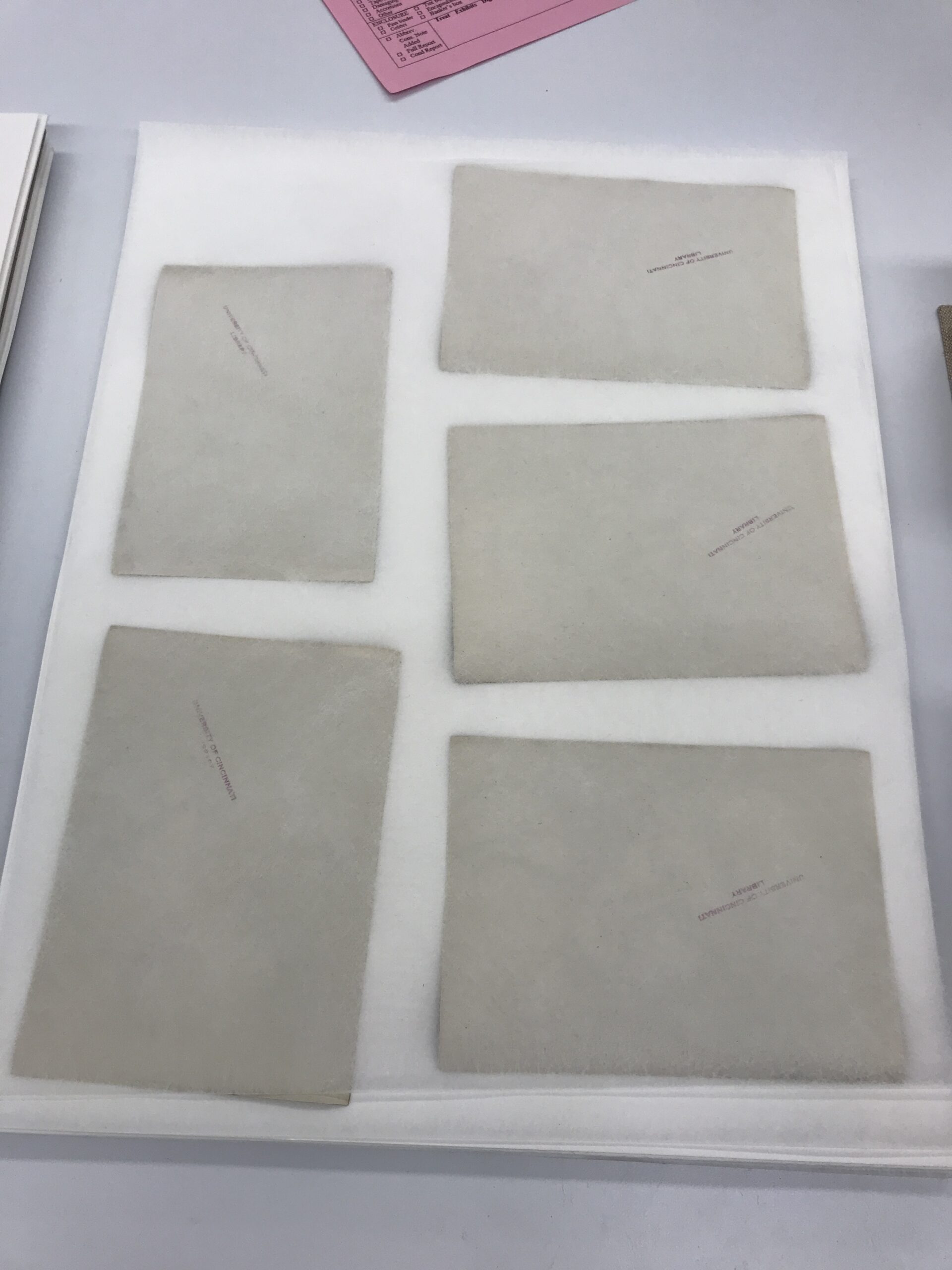
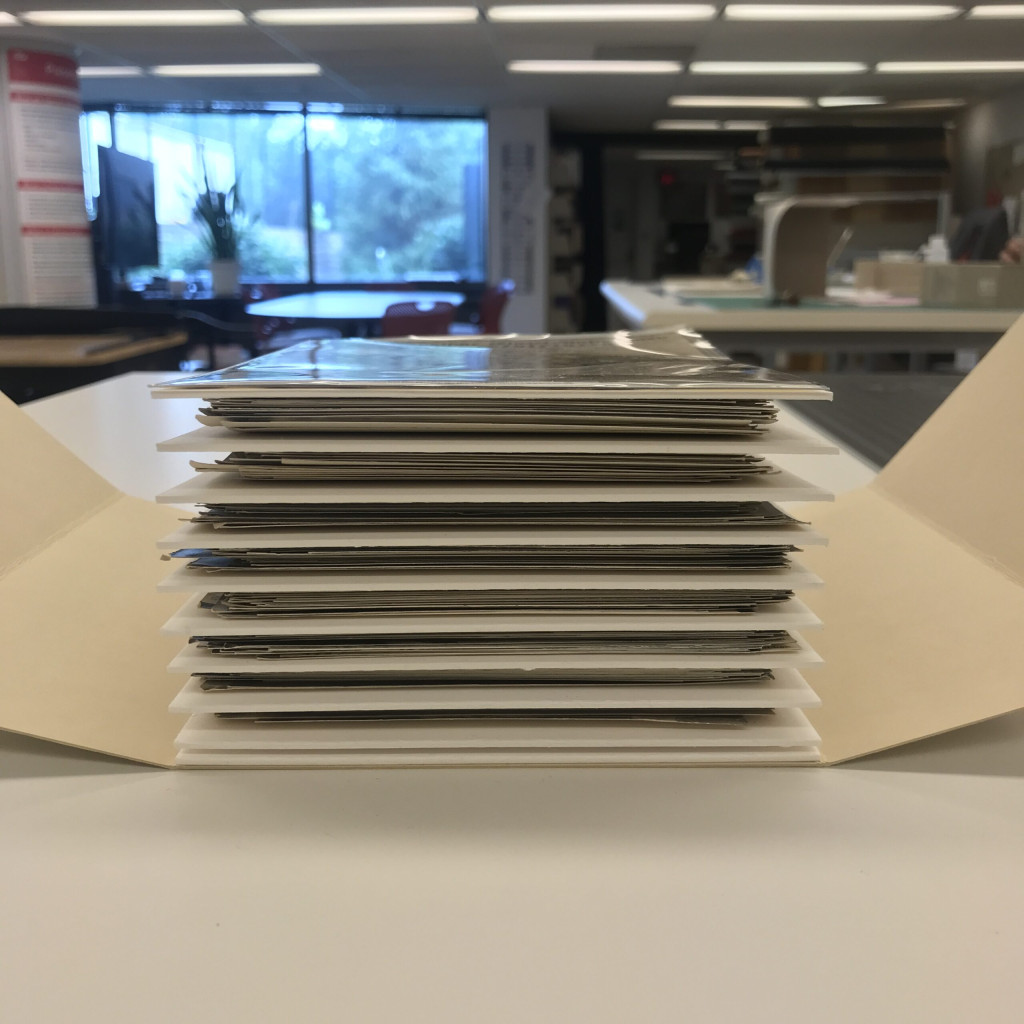
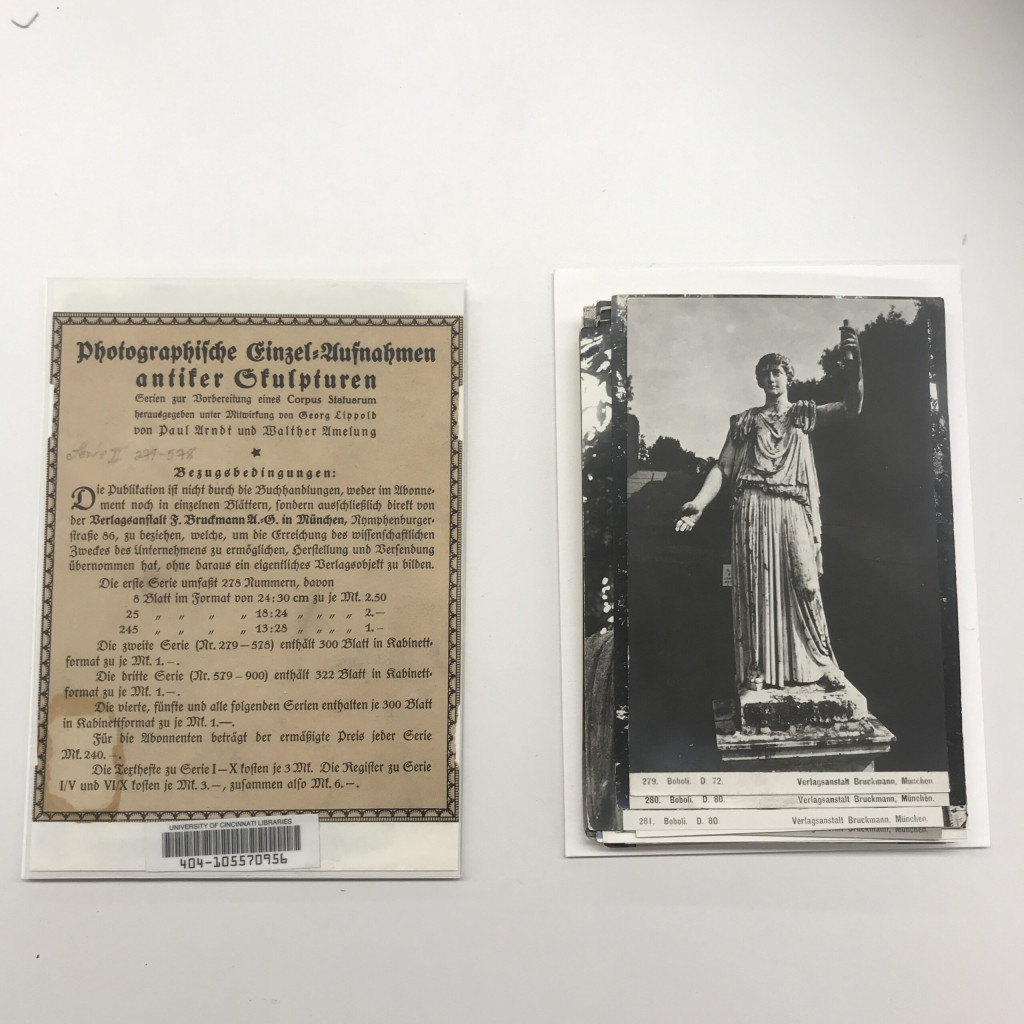
This past March, at one of our Special collections meetings, the Lab received a photographic project from UC’s Classics Library. This was a large German collection comprised of 16 series, each series with approximately 300 photographs, a total of about 4800 photographs!! These are silver gelatin photographs that depict ancient sculptures. The photographs are important since in some cases they show sculptures that may have been destroyed during the WWII.
Before Treatment – Series 5 of the 16 series of photographs
Before Treatment – Original enclosure – Book board with cloth ties
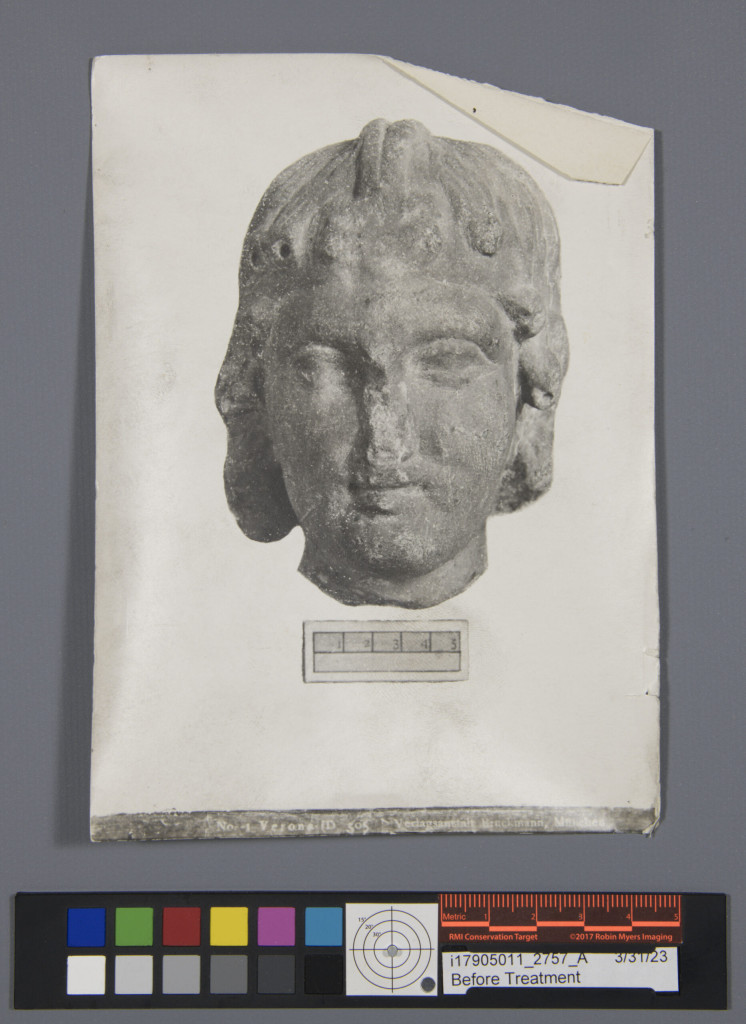
Before Treatment – Curled photographs
All the photographs were curled, some showed silver mirroring, and minor tears along the edges, or creases. Most of the conservation treatment focuses on humidification and flattening of each photograph. With such a large number of photographs, the project was divided between Chris (Senior Conservation Technician), Hyacinth (Conservation Technician), and myself (Assistant Conservator).
Before Treatment – Photographs as they were received in the Preservation Lab. Overall, curled with small tears along the edges.
We each took a series of photographs to work on. Ahead of starting the project, we conducted some tests, along with Ashleigh (Conservator), to understand how long we should humidify the photographs, we create the pressing stacks that would be used for the flattening, and some guidelines that we could all refer to throughout the projects.
Before Treatment – Curled photograph, tear, and creased corners (Recto) Before Treatment – Curled photograph, tear, and creased corners (Verso)
We concluded that we would obtain the best results by only humidifying the photographs for a maximum of 20-30 mins and then pressing them. First, we pressed the photographs between pressing stacks of thin Hollytex, blotter, Rising Museum Photomount mat board and binders board for two days. Then we pressed them in a book press or under weights between Photomount mat board until the compression enclosure is created. Before humidification, each photograph was surface cleaned with a hydrophilic sponges.
During Treatment – Small batch of Photographs being humidified in a cold humidity chamber.
During Treatment – Photographs being prepared for flattening by being pressed in a pressing stack.
After being humidified, small cracks on the emulsion and small tears were repaired.
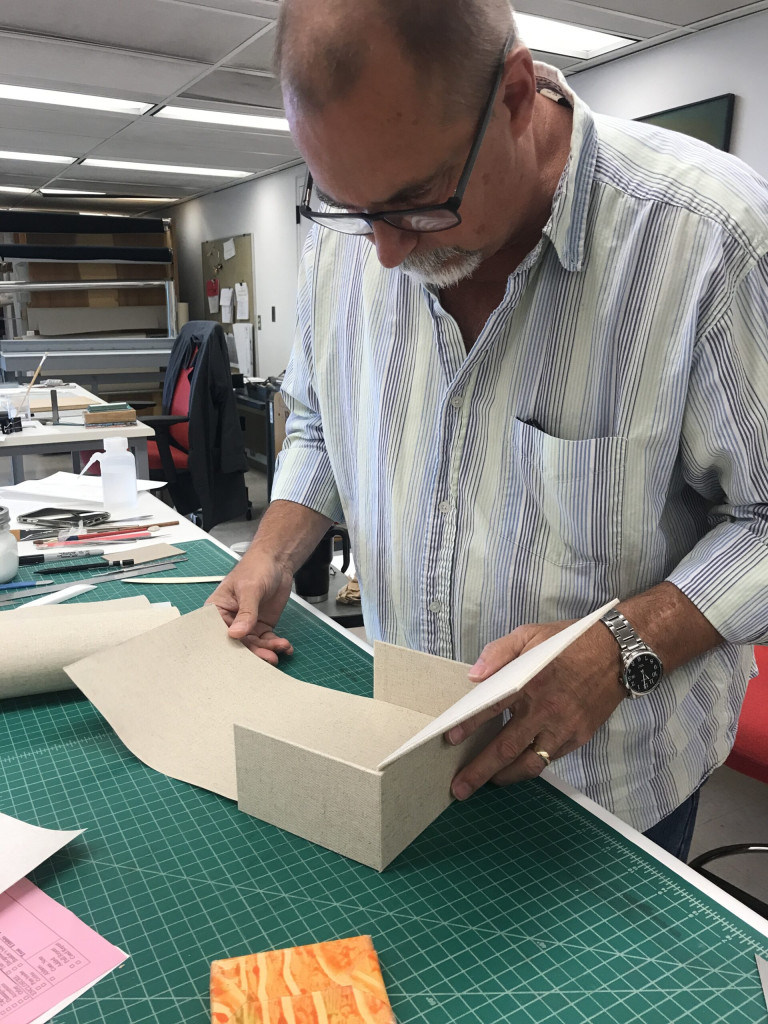
Chris is usually faster with any treatment, so his batch has been fully treated, and now he is in the process of making an enclosure, a cloth clamshell compression enclosure to ensure the photographs don’t start to curl again.
During Treatment – Chris working on the cloth clamshell compression enclosure.
I am still working on my batch. I currently have one-fifth of the photographs being pressed and the rest are awaiting humidification and flattening. This is a long project that requires constant monitoring and time for pressing, but it is so satisfying to see the photographs slowly relaxing and flattening. It will probably take us a few years or more to fully complete the entire 16 series, but once the project is complete each series will be safely housed and repair.
Before Treatment – Photographs as they were received in the Preservation Lab. Overall, curled with small tears along the edges.After treatment – Photographs have been humidified and flattened, each received minor stabilization treatment After treatment – Photographs flattened.
I recently had the privilege of sitting down for a talk with the newest member of the lab staff, Matt McCoy. Matt is a CPHL employee who comes to us from…well, I’ll just let him tell it.
[edited for clarity]
Hyacinth: Alright, so first off, how did you come to be here in the lab?
Matt: I became aware of the lab at an open house; I think it was 2017 or 2018. I was working in Materials Retrieval downtown. I did the tour here, and I knew Cat [Catarina Figueirinhas, Assistant Conservator in the lab] because she used to work in my department. My boss picked a couple of people to go to the open house, and I got to check it out.
It was really cool, and I thought, ‘this would be a cool place to work someday.’ At the time, libraries were sort of just a side job for me. They’ve become more of a focus, especially over the pandemic. I started an MLIS but decided not to continue with it after getting a taste for the public librarianship. I guess I wouldn’t say I’ll never pick it back up again, but who knows?
I’ve always kept an eye on job postings, and I saw this one, I think it was over winter break. At that pont I had been working as a customer service substitute for CHPL for about a year. Then I saw the job posting and it just it sort of was like they have an opening there; I feel like that was the first time I had ever seen an opening pop up when I was here.
H: Yeah, it doesn’t happen often.
M: So I was like, you know what, I’m just going to apply for that. I was a little worried I’d missed my shot because I think it had been posted for a month or so. I had a friend who was staying with me over the holidays, and I applied for it the first day he was out, just kind of on a whim. Things just sort of fell into place from there, and here I am.
H: Well, you’ve been with us for nearly three weeks [at the time of the interview.] How are you liking it?
M: I love it so far. Even just the general collection stuff I’m doing so far, it’s very interesting. There are hand skills, but since I’m starting on general collections, it hasn’t been super stressful. The days fly by really quickly. I really like improving skill sets, so just getting to go through the training and practice different things and assessing how’d it go, what can I do better or what do I need more work on, that’s been fun and satisfying to do. I’m really liking that.
You guys have all been great so far, real good staff to have around. Everybody’s been really helpful and friendly. I’ve felt very welcomed here from the start and it’s been cool just getting to see all the stuff you guys have been working on, both at the open house but also the…I guess the pre-return meeting? That’s what it was, right?
H: Yeah. [nods]
M: Yeah, that was really cool to see too, and just get a feel for how things work with the special collection stuff, and how the process goes from an item first arriving, to you guys doing treatment on it, and then sending it on its way.
H: It’s a whole thing. We have a flow chart.
M: [laughs] I’ve noticed that a couple of times, as I’ve been leaving for the day, and think that I need to read that and then forget, and then I’ll walk by it again.
H: It’s a lot of flow chart. I mean, you get the hang of it, but it’s a lot of flow chart.
M: And the flow of my life has been really nice since starting this job. It’s a short commute, and the fact that the days go by quick. I feel like I never have enough time to…I’ll get into something and then I’ll hear the [closing] announcements go on. I’m like, ‘shoot, I was just getting into this!’ I was also a little worried, I wondered how much energy I’d have at the end of the day, to work on music and whatnot, but it hasn’t really been an issue so far.
It’s cool being on a college campus too. It’s sort of lively. I know it’s going to get more lively as we go along, but it’s a lively place to work. And I like being around people, so that’s been cool. It’s also nice that it’s not the place where I went to college. I don’t feel like ‘oh, shoot, back here again.’
H: So what’s the most fun or interesting or fascinating thing you’ve done in your training so far. I know it’s going along really quick.
M: I really like the – and I feel like it’s probably the thing I’ve had to work at the most – I like the hinge-in, doing hinge repairs. They’re just very satisfying. It’s either, you know, pages have fallen out of a book, or it’s structurally compromised and then all of a sudden, oh look how nice! It’s all nice and sturdy now, putting it back together, so I really like those. I enjoy any sewing I’ve done so far too. Once it’s all nice and tight and looking prim and proper, that’s been pretty gratifying.
H: It is very gratifying. And Jessica [Ebert, Sr. Conservation Specialist] is a good person to learn it from.
M: Absolutely! She’s been a great teacher.
H: Her sewing is fantastic. You’ll never be as fast as her.
M: She really does just fly by!
H: Even I’m not as fast as she is.
M: Yeah! And then I also like the tear repairs too. Those are nice, once everything’s all dry and put together, it’s like there we go, that looks nice.
H: What are you looking forward to learning?
M: Definitely down the road, but I’m looking forward to getting into some of the special collection stuff. Getting to have a project. I mean, I have had a couple of projects that I’ll start and finish up the next day, but I haven’t had any long-term things. And I’m sure it’s different for every item, like I’m not sure how long each of you spends on a particular treatment, but I’m sure that there’s some where there’s a lot of different steps, seeing something throughout the whole process on a broad scale, that sort of thing. I think it’d be neat to work on something like pieces of artwork or maps. I’m also excited to get into any kind of bookbinding stuff, like the models you guys have made of different types of books. The more complex things like making a cover or something like…I forget what it was, the sermon that Jessica worked on.
H: The split-board binding.
M: I think that looks really cool, yeah. I always enjoy a well put-together book and that is a nice one.
H: Well, I have found that there are two kinds of library people. There’s the kind that’s born and raised in the stacks – that was me, my family was into libraries from the time I was really little – or people who kind of stumble in one day and realize that it’s great, and then they just never leave. Which kind are you?
M: I did go a little bit as a kid, sort of here and there. I remember would do summer reading. But then I got into my teenage years and early adulthood and didn’t really utilize them that much. I think it was later in college that I started going to the downtown library because they had – this was before I got into the streaming music services – they had such a good jazz CD collection. I think it had been donated by a radio station that used to play a lot of jazz stuff, the Oscar Treadwell jazz collection. That’s what got me into it. Then I thought this might be a cool place to work, and that’s what led me here.
H: What sort of things do you like to read, and what are you reading right now?
M: Mostly fiction. Although I’d like to read more nonfiction, I think sometimes reading is a nice sort of escape from reality. So I like reading fictional stories. I’m reading this Cormac McCarthy book right now. It’s the third part of a trilogy he has called the Border Trilogy.
H: Cormac McCarthy is so bleak!
M: Oh I know, that was the exact same reaction Holly [Prochaska, Preservation Librarian] had!
H: Oh he’s a wonderful writer. Just bleak.
M: Yeah, he’s great, one of my favorites. His prose is so beautiful, but the actual contents of the story is so dark and depressing sometimes.
H: You read it and you gotta take a break.
M: Yeah, so I’ve been chipping away at this one and afterward I’m going to take a break. I’ve also gone through phases where I’m really into science fiction and kind of fantasy stuff sometimes. I think maybe when I get done with [the Cormac McCarthy], I’ve been wanting to maybe start Dune.
H: I’ve tried Dune like three times. It’s so dense.
M: That’s what I hear.
H: It has a glossary.
M: I’m wondering if I can get into it or not because I was really into Tolkien. I did The Silmarillion a few years ago, and that was the only book where I’ve had a little sheet that just had notes on it.
H: Then you’ll probably be fine. I had an ex who read it. He loved it, but it was a lot.
M: Some other favorite authors…I like [Kazuo] Ishiguro a lot, probably one of my favorites, and Vonnegut.
H: Vonnegut’s great.
M: I really like his sense of humor, it’s very much up my alley. I also don’t think I mentioned the name of the book that I’m reading, the McCarthy one, it’s called Cities of the Plain. The most famous of the trilogy is the first one, All the Pretty Horses, and then The Crossing, and this is the third one.
H: Do you have a favorite book?
M: Let me think…I really love the Lord of the Rings trilogy. I could pick out a favorite of the movies, but not the books. I also liked Blood Meridian; I read Song of Solomon, a beautifully written book. I also enjoyed Never Let Me Go. That was Ishiguro, a really sad one, very beautiful.
H: That was adapted into a film.
M: I haven’t seen the movie yet, and I think I started it one night but then…I think I got worried. The story has such a high place in my head, it might live up to it. Sometimes for that reason if there’s a movie version I’ll watch it first and then read the book. But yes, those are a few of my favorites.
H: So you are a jazz musician. What led you to that?
M: That’s a good question and kind of similar to what you’re saying about how there’s like kind of two types of people who get led into libraries. I found there’s sort of like two kinds of a paths that lead people into jazz, and I was kind of in the middle of it. It’s usually either band kids in high school –
H: [raises hand] I was a band kid.
M: – they get into it, but then also it’s also people that like the hippie Grateful Dead sort of jam bands.
H: I like those too.
M: That’s how they get into it, more improvised music.
H: It’s very technical.
M: Yeah, so that kind of start it for me. I started playing electric bass when I was probably 14 or 15. I got really into it, I wanted to learn everything I could about it. And then I started learning about all these jazz musicians and hearing some good bass players. You check a record out and that led me down that path. I had a lesson teacher, and he pitched the idea of going to school for music. There’s a couple of programs where you can do what they call commercial music, if you want to study music in college, a jazz or classical degree. I thought, ‘Oh yeah, I wouldn’t mind going to school for a jazz degree’. Through that I got really immersed in the jazz world and fell in love with it and have been doing that ever since.
H: So not the Miles Davis route, starting with classical and hanging out in jazz clubs?
M: Yeah, there’s a lot of people who do that, it’s funny. I feel like a lot of the famous acts were classical musicians who kind of got into jazz, which is also cool.
H: What other musical genres do you listen to?
M: It’s kind of all over the place. I like a lot of hip-hop, the current modern stuff and some more classic stuff too. I like folk music and I play in a folk band, although we’re kind of losing momentum right now. Everybody in the band other than me keeps having kids, which make rehearsing a little difficult. But I grew up in the time where the pop punk emo thing was real big, so I will always have a soft spot for that in my catalog. Usually if I like something, I’ll just save it. I was listening to Bob Marley recently; I mean, everybody knows he’s great, but I couldn’t remember the last time I just sat down and listened to him. So, a pretty wide range of stuff, but there’s a few things I gravitate towards. I will end up listening to indie rock and folk more than other genres.
H: Is there a piece of music that you’re obsessed with at the moment?
M: That’s a good question. Let me look here and see if something stands out. [He flips through his phone briefly.] There is a Gregory Allen song called Dark Dark Dark that I really like. I’m going to go with that one.
H: Do you have any other hobbies?
M: I like going to the gym, although I can sometimes kind of slack on that. I feel like lately my life has just been a lot of music stuff and this job and I haven’t been doing too much else, but I really do like being outside, just hiking and stuff. I want to go camping more.
H: We’ve had good weather for it.
M: Absolutely! I also like traveling. I mean, everybody does, but you know, I like getting out to see stuff. Other than that, I’m somewhat into movies, TV shows, nothing super wild at the moment though. I have a bunch of hobbies that I’ve been meaning to get to, that I want to give a shot. I just never seem to find the time for it.
H: I know you’re a coffee guy, you come in with one every morning.
M: [laughs] Yeah.
H: So instead, Coke or Pepsi?
M: I would say Coke over Pepsi. Not that I have anything against Pepsi! In terms of cherry cola I used to like Wild Cherry Pepsi better, although I feel like I never see it around anymore. But yeah, I would say Coke.
H: Do you have a favorite movie or movie genre?
M: I really like science fiction movies. That’s maybe my favorite genre. And I’m going to Cormac McCarthy again, but I really like No Country For Old Men. The Life Aquatic with Steve Zissou, that Wes Anderson movie, that’s up there. As far as sci-fi goes, I liked Arrival; it really stood out to me.
H: What is your favorite time of year?
M: Fall, especially living around here. We have all the leaves changing, and the temperature is nice and not too humid. You can still go outside and do stuff.
H: Do you have any pets?
M: I have a dog named Baby Redbone. He’s a rescue. A significant other and I found him living on the street. We lived in Northside at the time and we used to take our other dogs out together. There was a school that has since been turned into apartment complex, it was abandoned at the time and we used to run with the dogs and wear them out real quick. One day he was just sort of back there. We initially weren’t going to keep him. She mentioned that he was just a baby, so we were calling him Baby. We thought maybe he was a Redbone coonhound because he’s got this real reddish coat, like he’s definitely part pitbull. So the name just kind of stuck. When we parted ways, she kept the other dogs, and I kept him. We weren’t having any luck finding anyone to take him from us. People don’t like having dogs sprung on them! He’s a decent-sized dog, 63 pounds or so.
H: Yeah, we have a pit/rot mix and he’s like 100 and he’s so much dog, but just the sweetest thing I’ve ever met.
M: Oh goodness, yeah. They’re so sweet. My theory is [pits] are very trainable and receptive to things, so if somebody has bad intentions with them, they can get them to be mean, and if someone has good intentions, they can get them to be sweet too.
H: I find that they often work best when they’re mixed with something.
M: Yeah, totally. You’ll have to show me pictures of your dog at some point.
H: And finally, can you leave us with a random fun fact about yourself?
M: I haven’t tried this in a while, but I feel like I could still do it, but when I was in elementary school we had an after school program, a unicycle club where our gym teacher trained us all up to ride unicycles, and we rode in parades and stuff. So I guess my fun fact would be that I can ride a unicycle!
H: That is a very fun fact.
M: It’s been a little bit since I’ve tried it. Somebody had one at a party awhile ago and I tried. It still worked. I feel like my body would remember how to balance like just sort of like a bike.
H: Very cool. Thank you!
I hope you enjoyed getting to know Matt as much as I did!
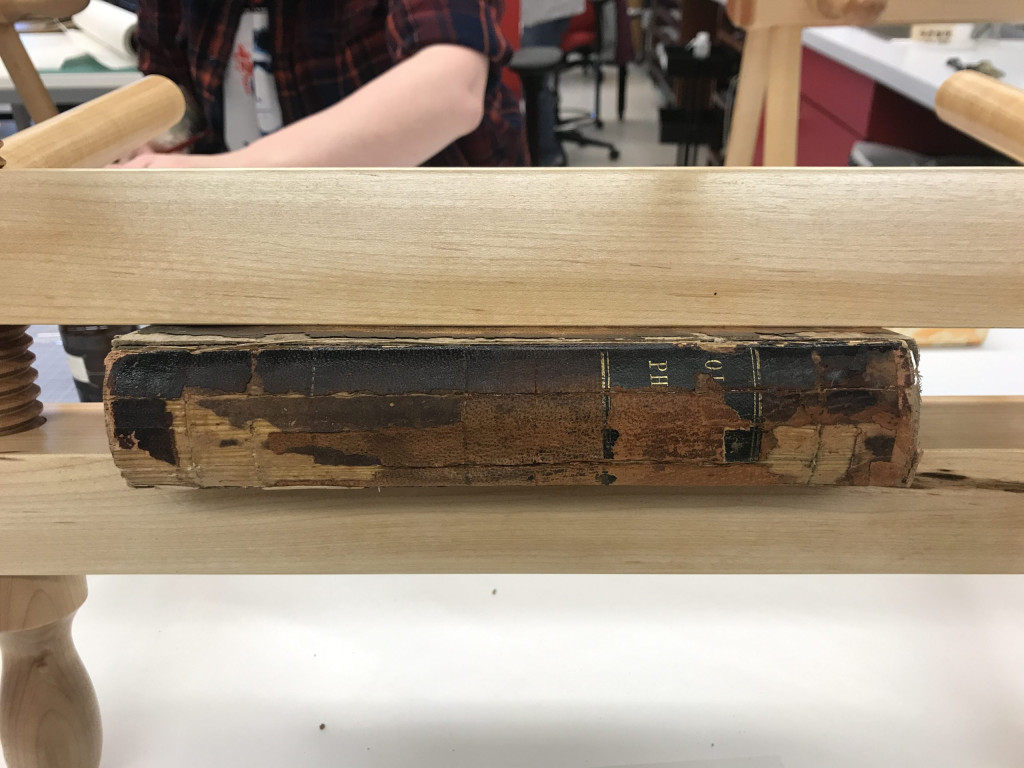
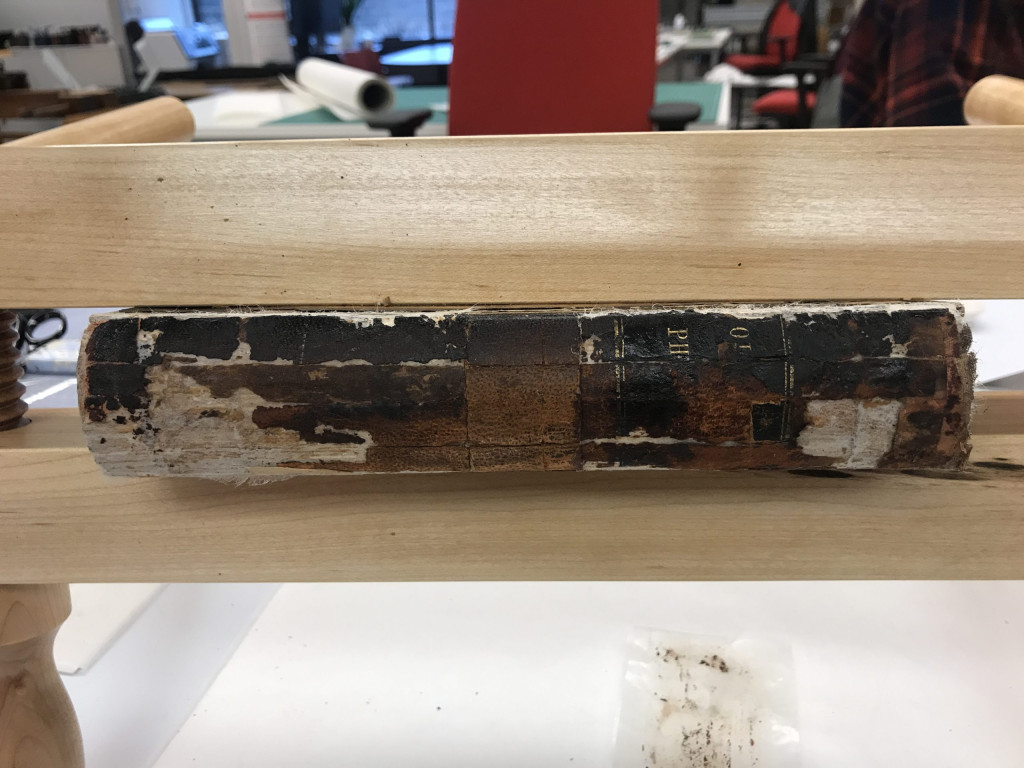
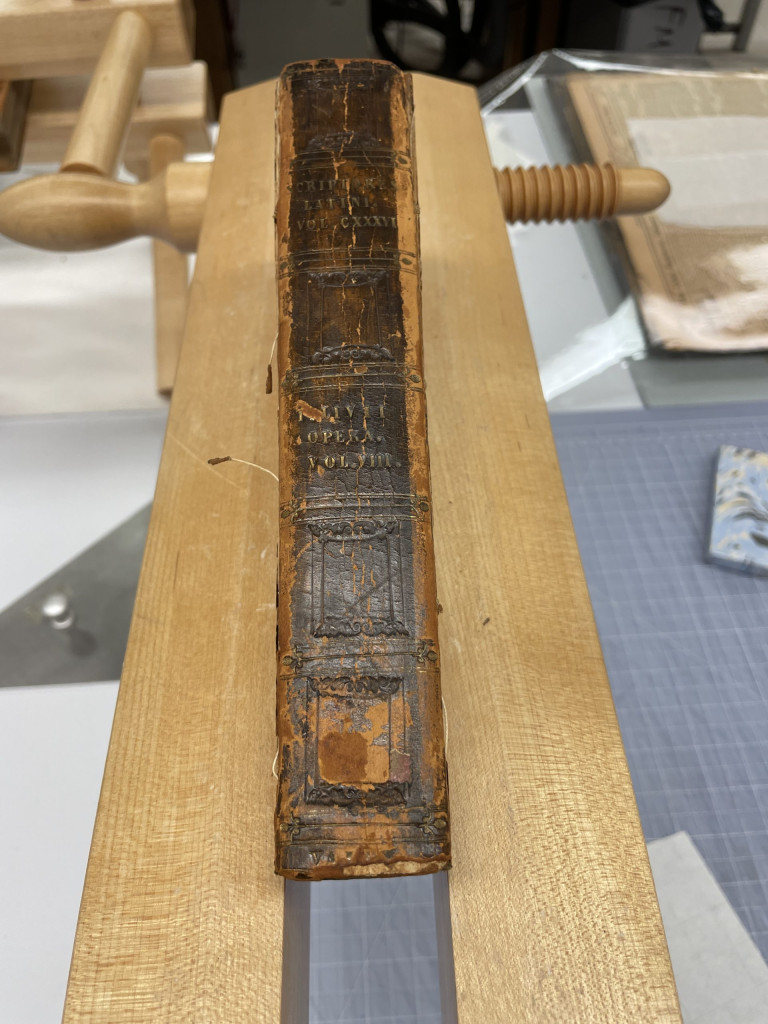
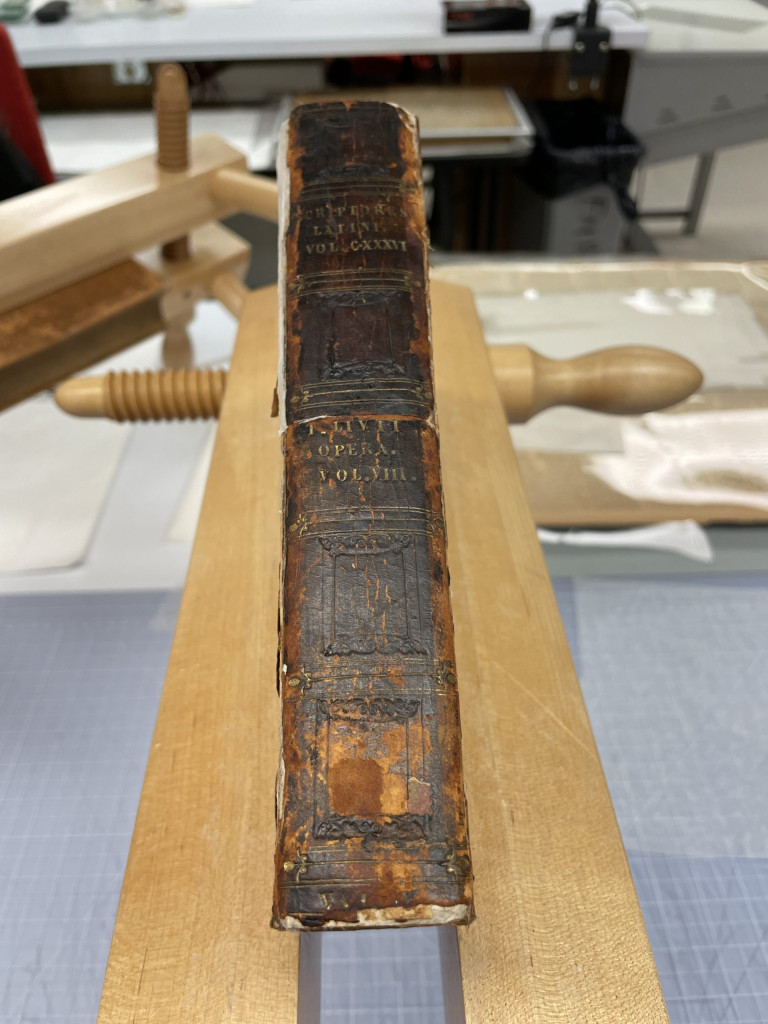
Back in October of 2022, The Preservation Lab had the pleasure of hosting Book Conservator, Jeff Peachey, for a week-long workshop on Conservation of Leather Bindings. One of the topics that was mentioned, but not discuss in depth, was leather facing.
No one in the lab had ever faced leather before, so Sr. Conservation Specialist, Jessica Ebert, and I decided to conduct some tests to understand the process, the best materials, and tools. With the research available, Jessica and I focused primarily on two sources, Conservation of Leather and Related Materials by Marion Kite and Roy Thomson and an article written by James Reid-Cunningham entitled Leather Rebacking, for the Seminar in Standards of Excellence in Hand Bookbinding, The Guild of Book Workers, 2013.
The primary reasons for testing out this technique was the fact that there were leather books from UC’s Archives and Rare Books Library here in the Lab for treatment and they could potentially be good candidates for leather facing.
Let the tests begin!!
Both Jessica and I chose two different withdrawn leather books to test on:
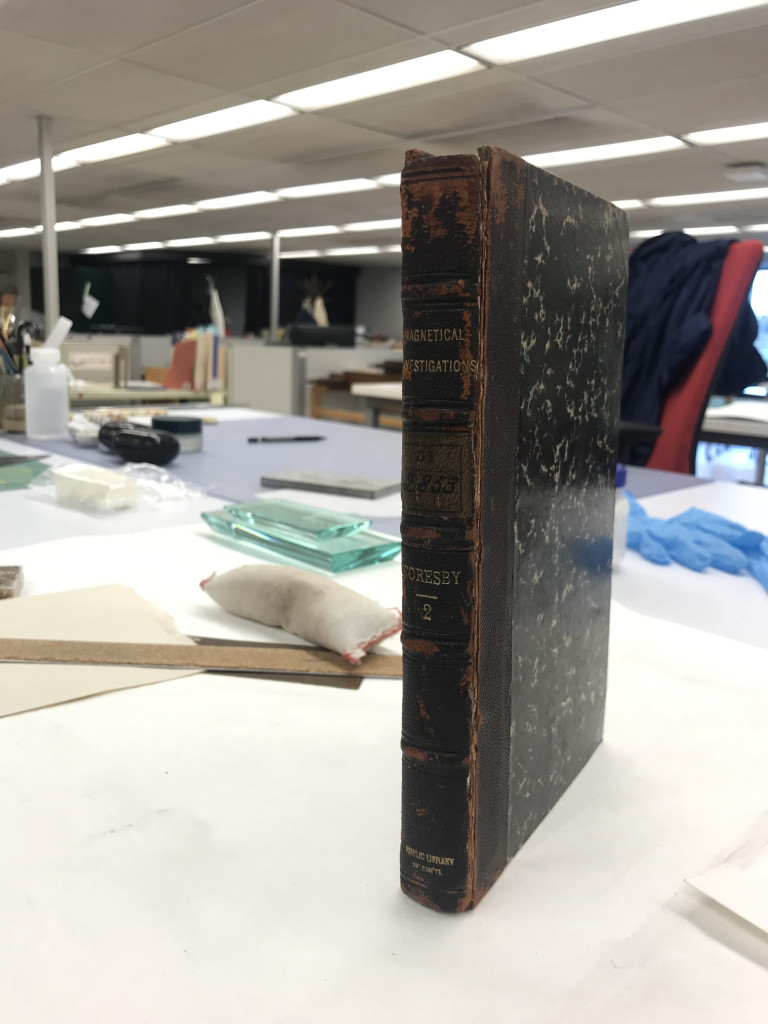
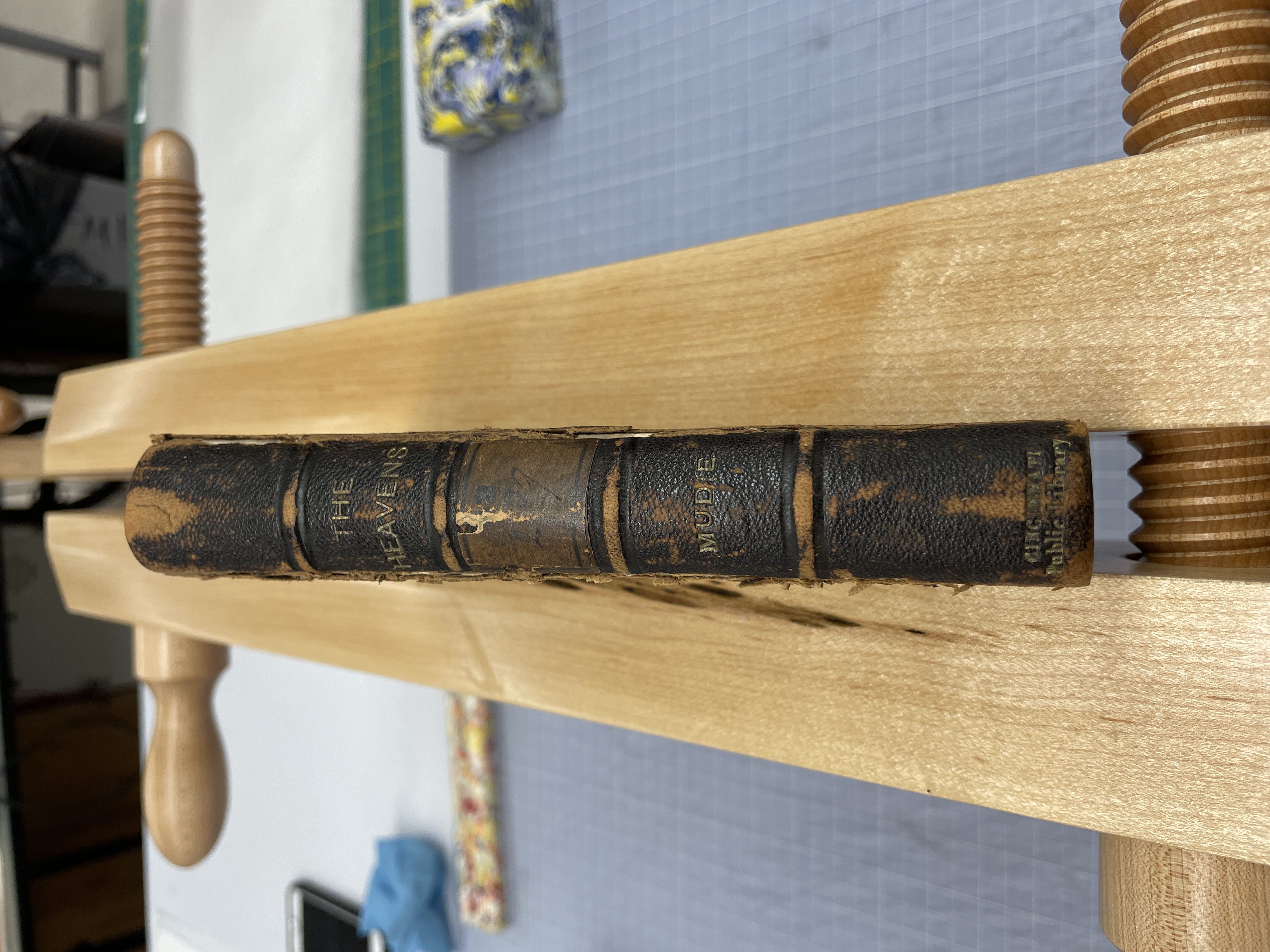
A tight back leather book
A leather book with false raised bands and a hollow tube
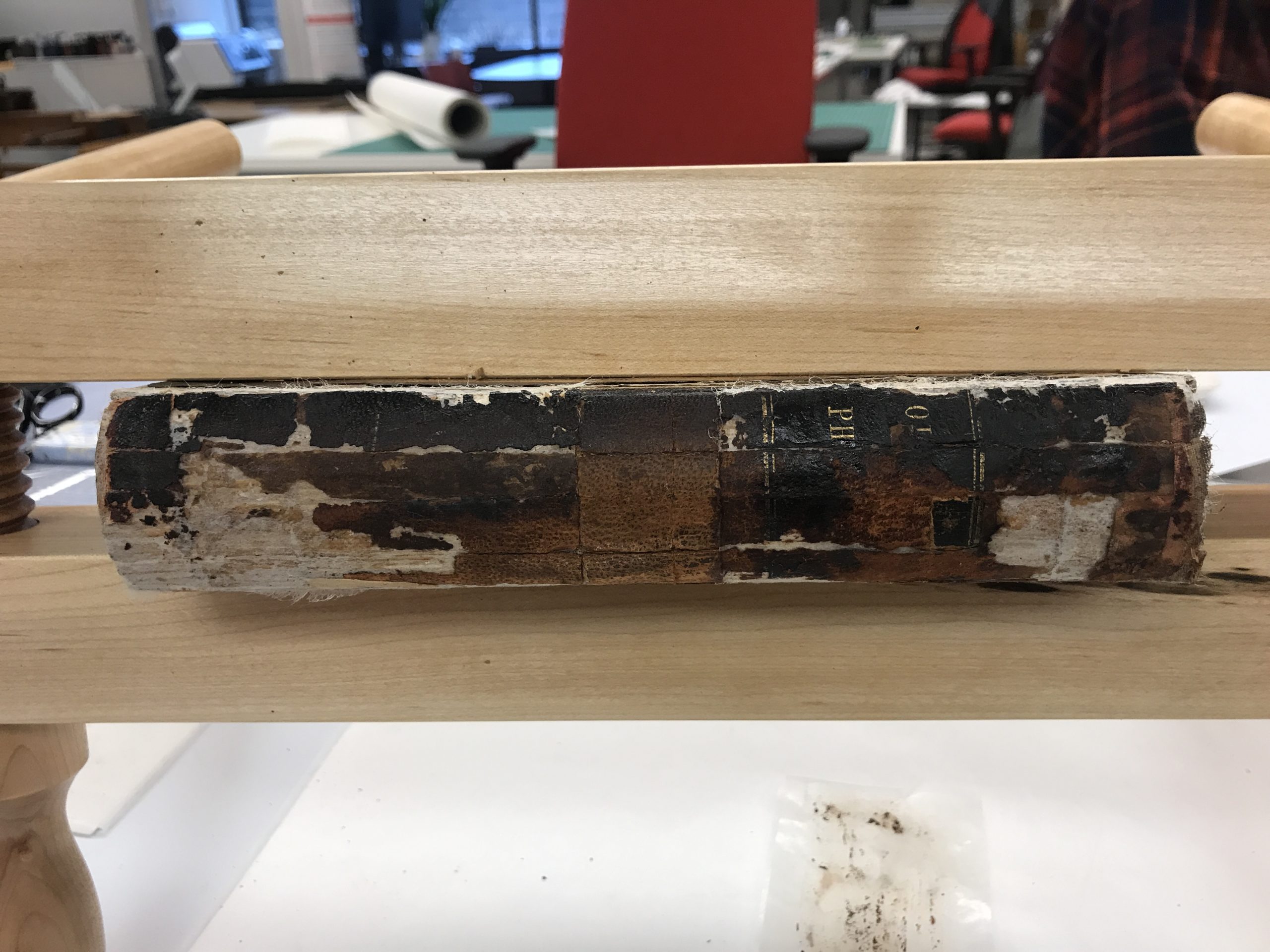
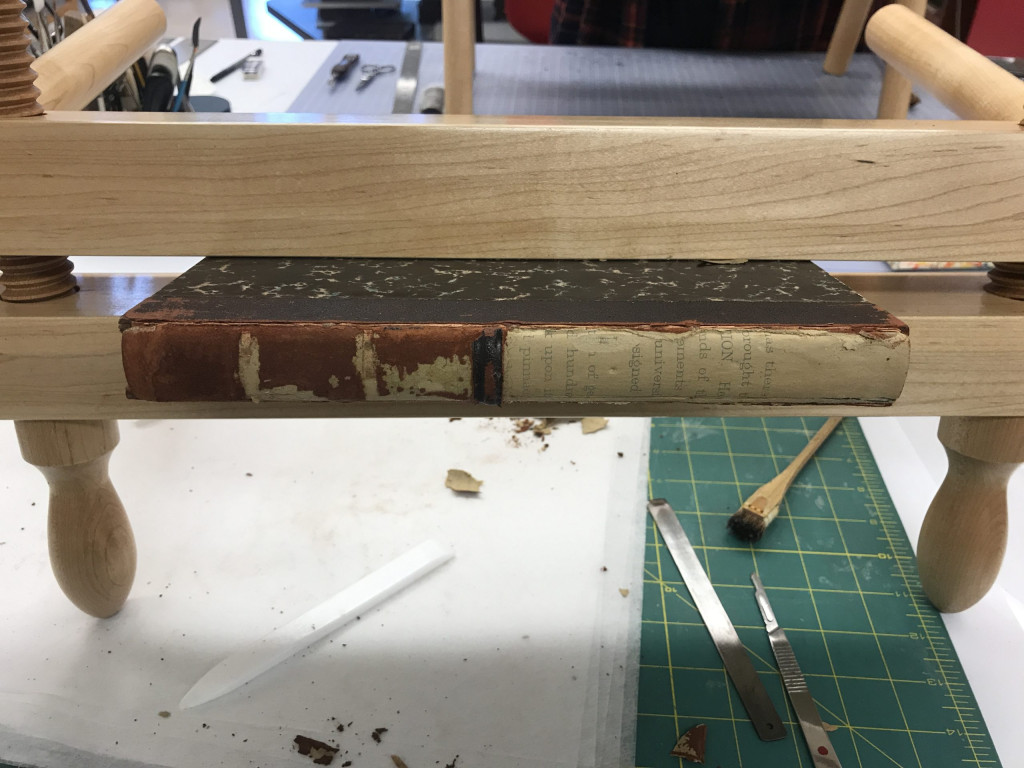
Catarina’s test model (tight back) before facing.Catarina’s test book model (tight back) after facing.Jessica’s test book model (tight back) before facing.Jessica’s test book model (tight back) after facing.Catarina’s test model (hollow tube with false raised bands) before facing.Catarina’s test model after the leather facing.Jessica’s test model (hollow tube with false raised bands) before facing.Jessica’s test model after the leather facing treatment.
The first step was to consolidate the leather on all the withdrawn books we were using as models. The leather was consolidated with 3% Klucel G in isopropanol. Since there were different methods shown in the available resources regarding leather facing, we decided to use two different methods for facing: facing with Japanese tissue adhered with Klucel G and facing with a Crompton heat-set tissue activated with ethanol. Trying out these two different methods would help us to understand which one of these materials would work best and cause less damage/staining to the leather.
Catarina’s Test Models
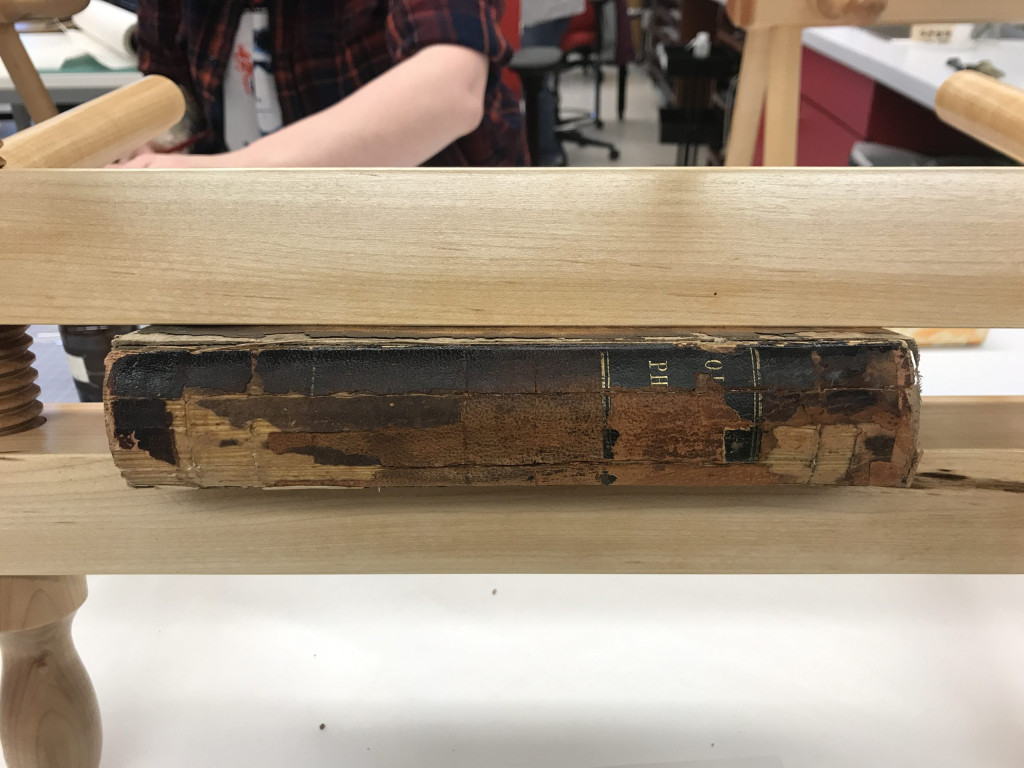
After having consolidated the leather, the spine was “divided” in two sections, top and bottom, with a small portion of the spine in between. The reason the spine wasn’t fully faced was because I wanted to see if there were any changes in the leather after being faced, removed, and reattached.
Leather consolidated with 3% Klucel G in isopropanol. For this model, since the leather was so degraded, it wasn’t possible to get the Japanese tissue to adhere with klucel G. Therefore, only the Crompton heat-set tissue was used.
For this book, the leather was very degraded, and I couldn’t get the Japanese tissue to adhere to the leather spine with Klucel G. As a result, for this model I only used the Crompton heat-set tissue method.
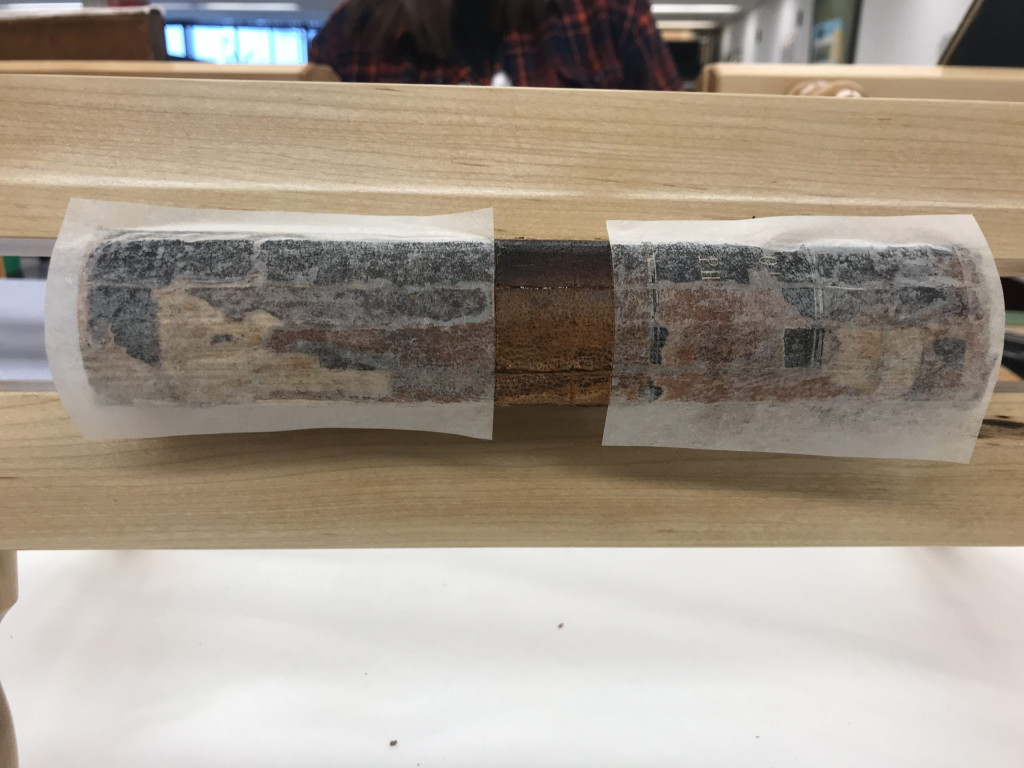
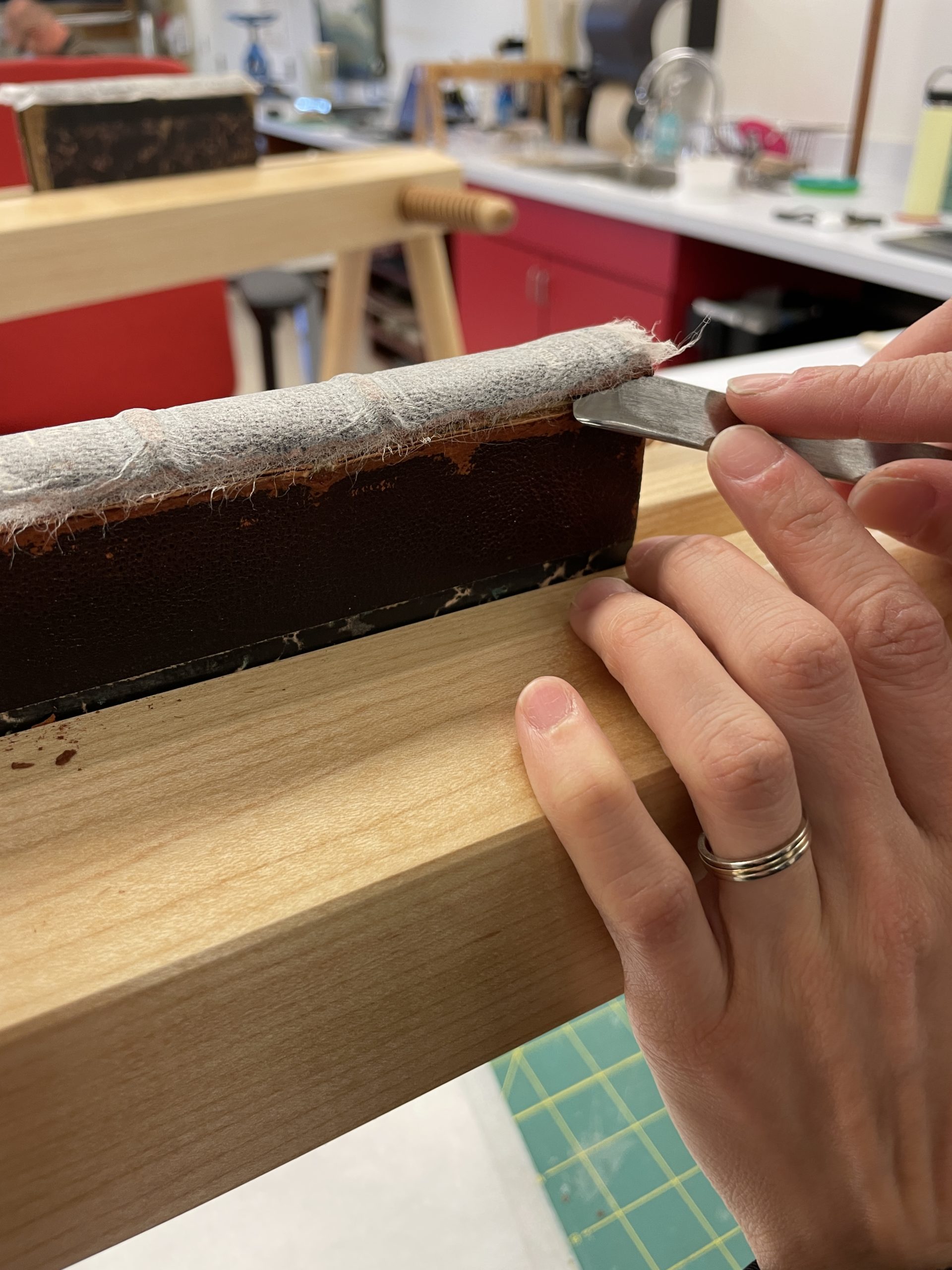
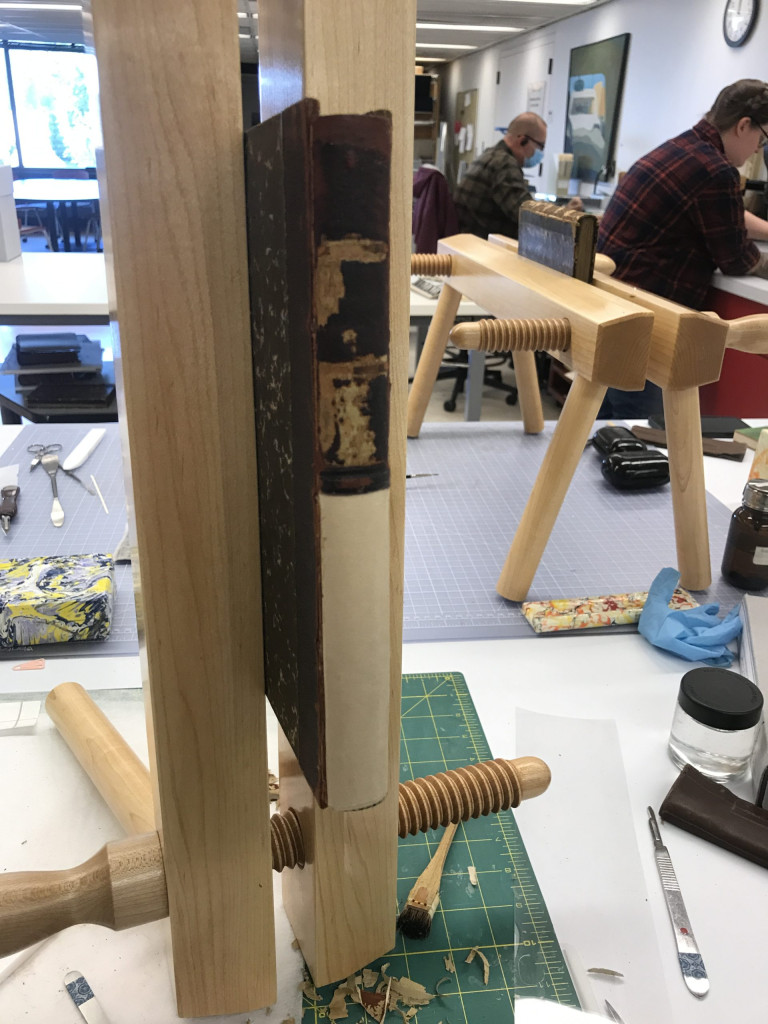
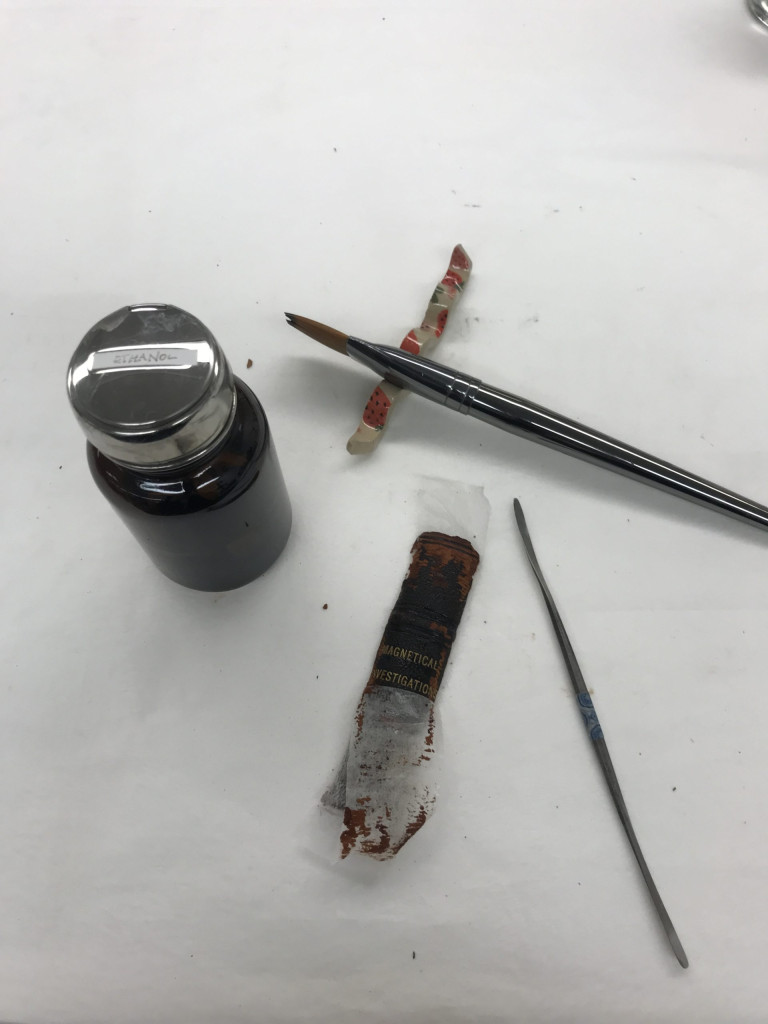
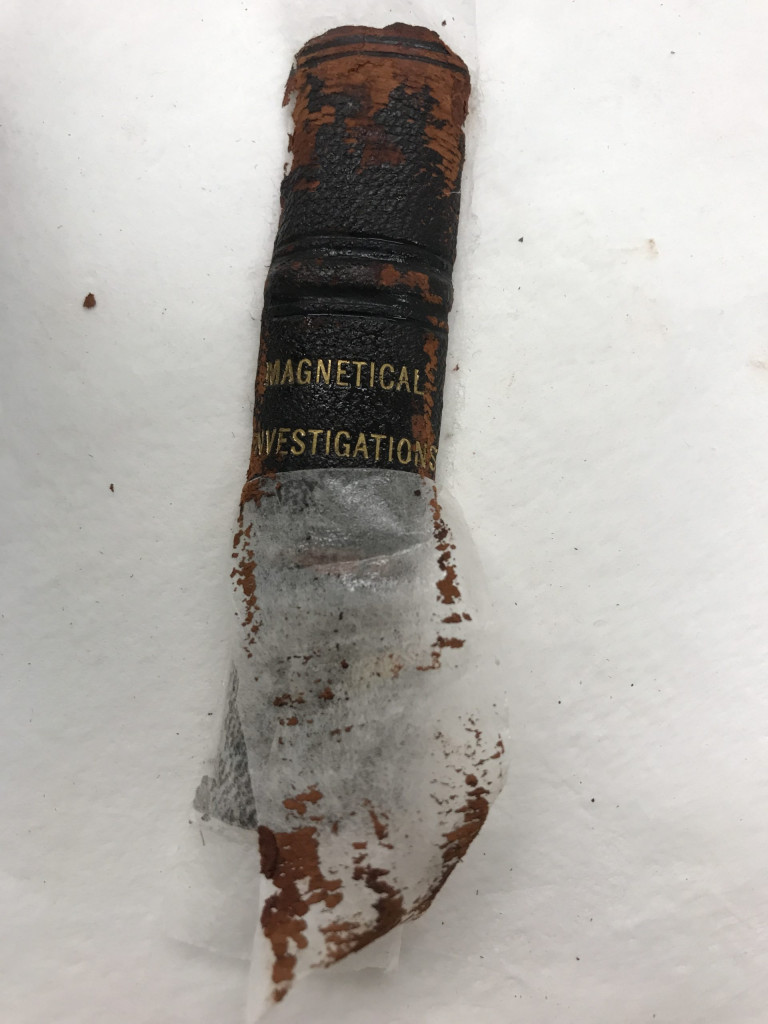
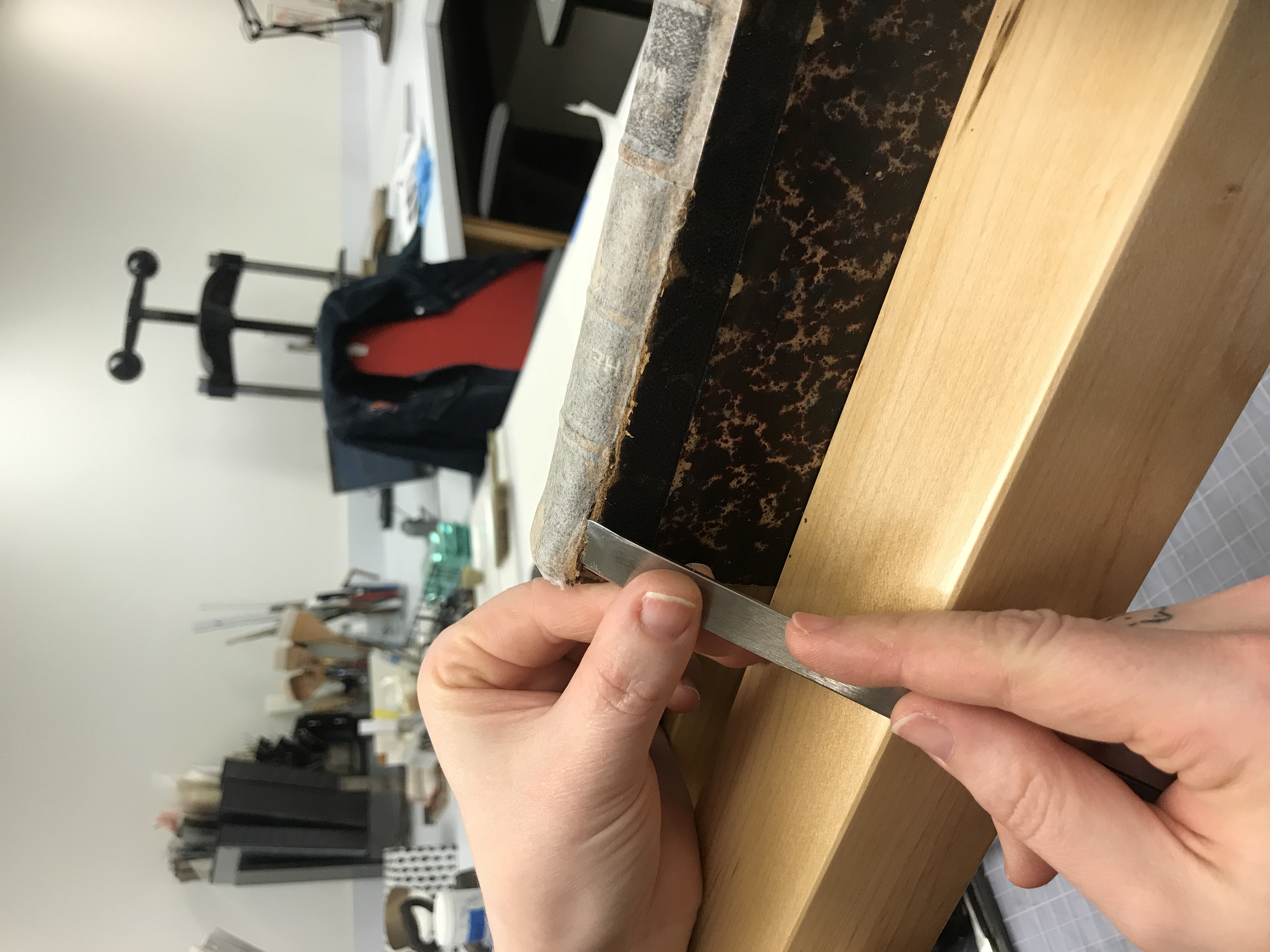
The adhesive on the heat-set tissue was activated by brushing on a thin layer of ethanol. Once it was activated, the heat-set tissue was placed on the spine, and with a tamping brush pressed on the leather. Using a lifting knife, I was able to remove the leather spine, leaving the middle portion still adhered to the text block for comparison.
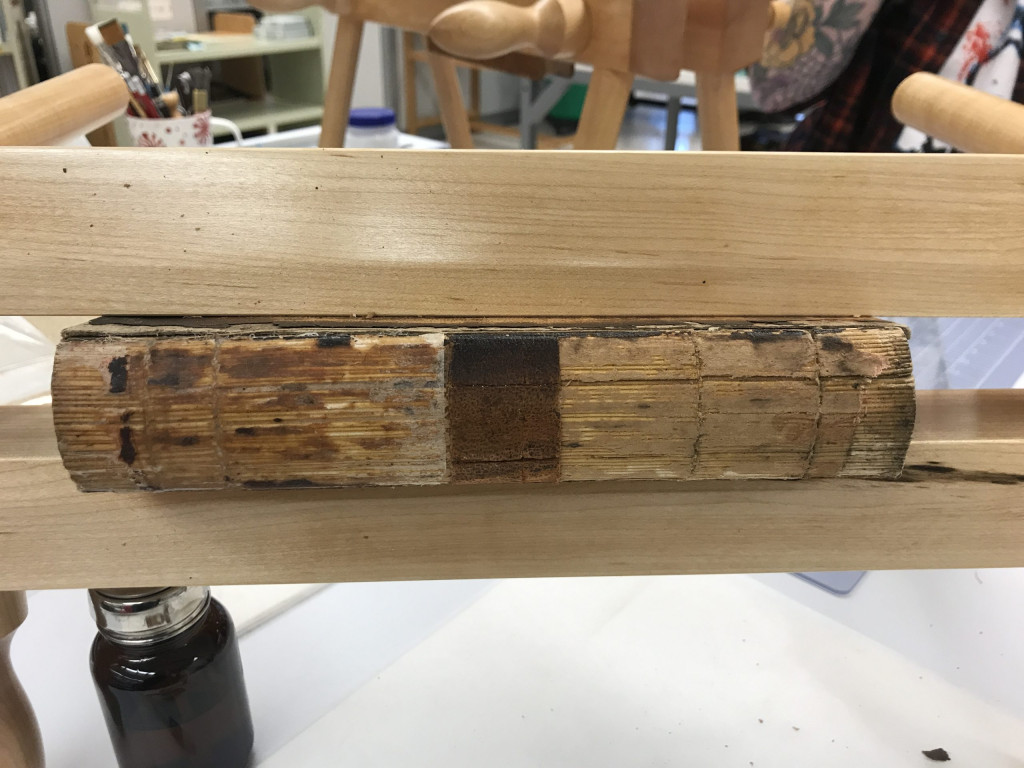
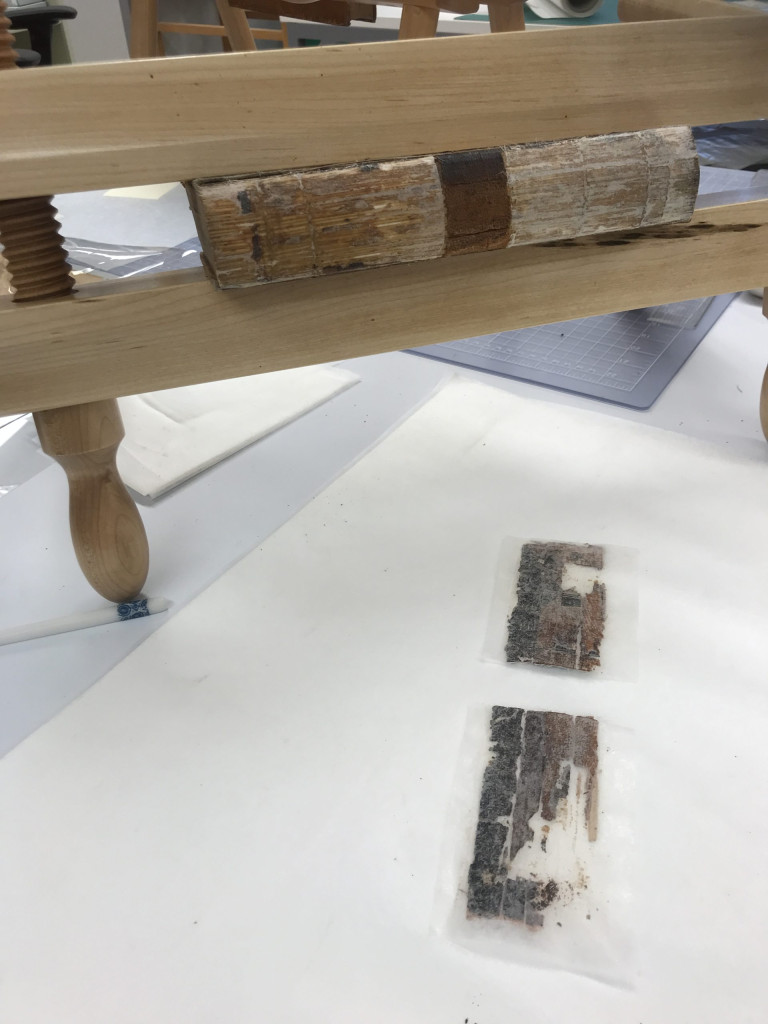
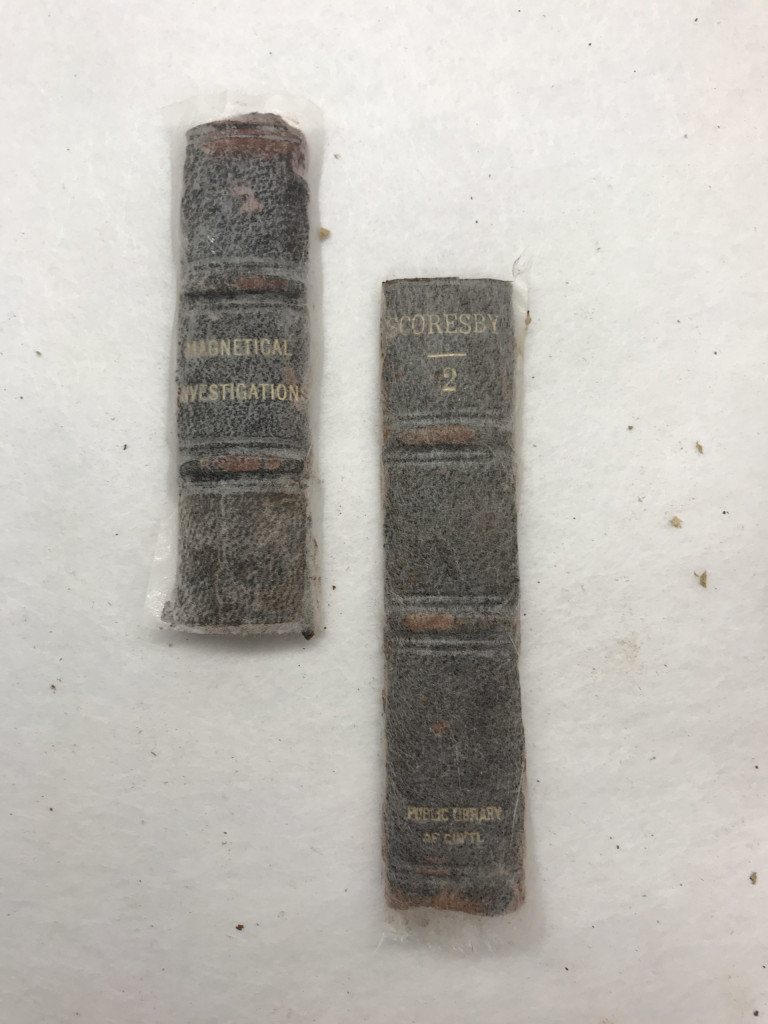
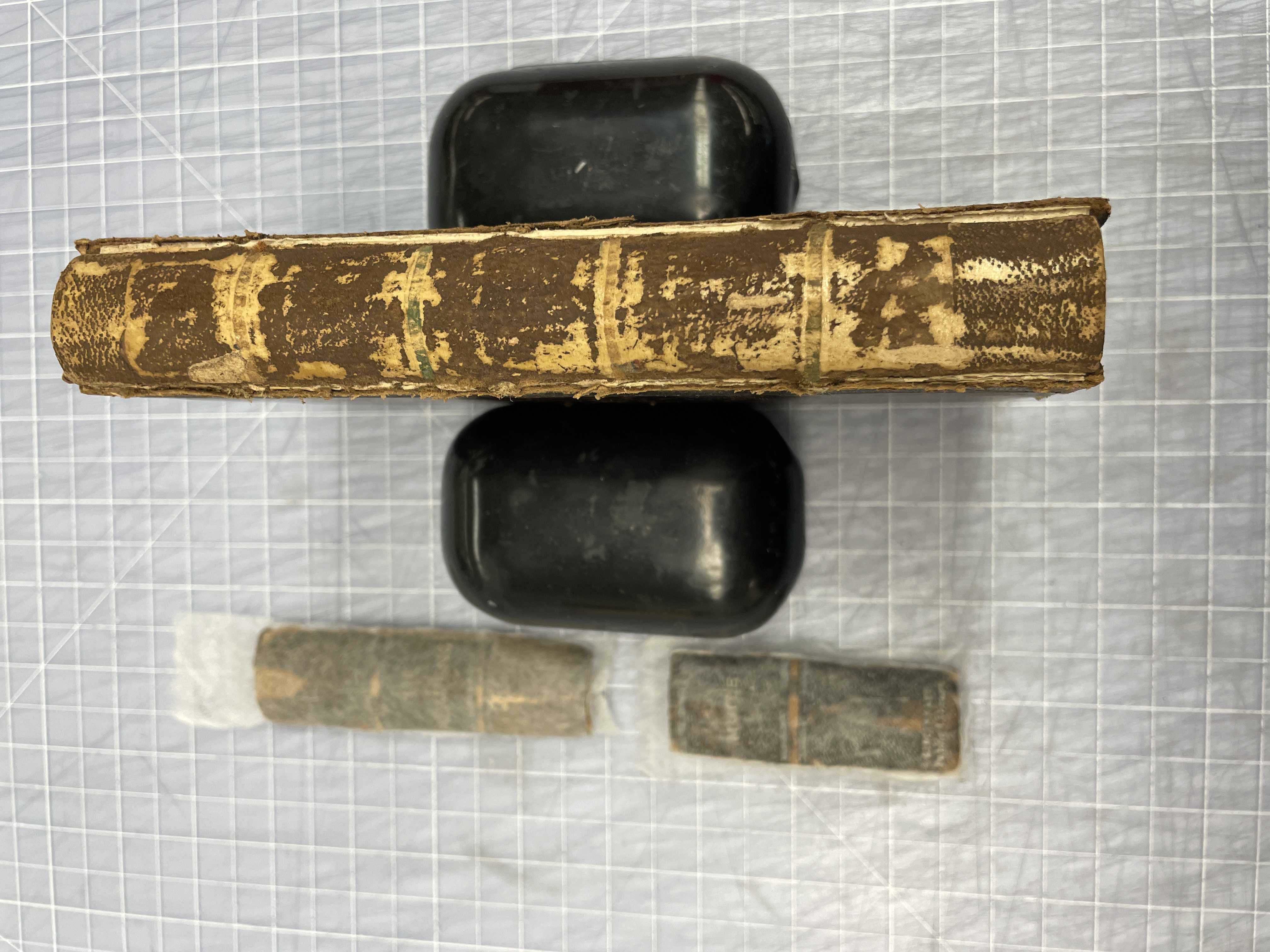
Two portions of the spine fully removed.Leather spine removed, and two portions of the spine faced.
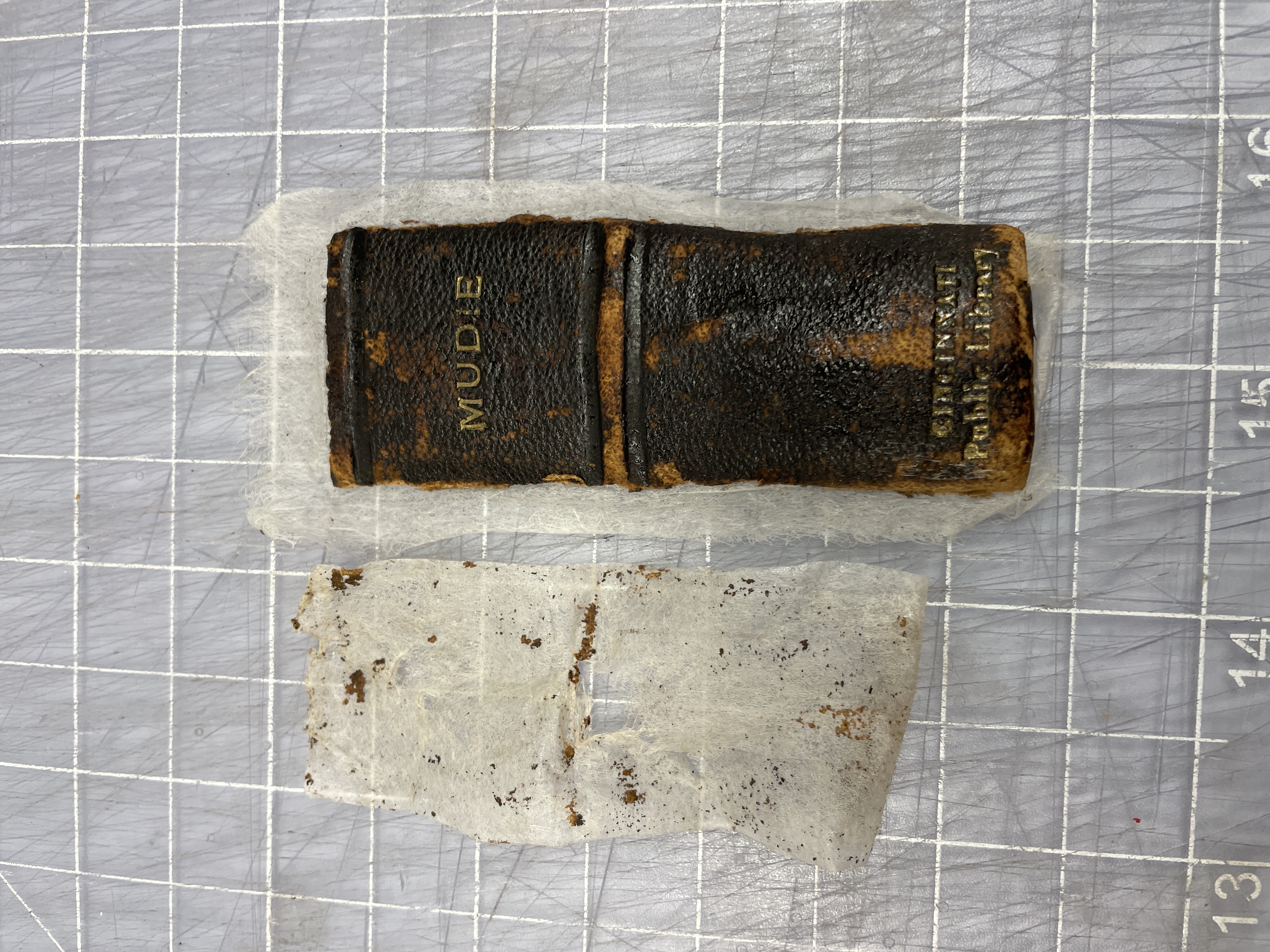
Once the leather spine was removed, I relined the text block spine with a reversible layer of Japanese tissue and wheat starch paste. The two portions of the leather spine were lined from the back with Japanese kozo fiber tissue and wheat starch paste.
At this point, there were two different ways to follow, I could adhere the faced spines to the text block and then remove the heat-set tissue, or I could remove to heat-set tissue first and then adhere the leather spine to the text block. I decided to first remove the heat-set tissue by activating the adhesive again with ethanol and gently removing it with a Caselli spatula. Once the heat-set tissue was fully removed and the leather was dry, I reattached each portion of the leather spine to the text block with wheat starch paste.
Two portions of the leather spine adhered to the text block spine.
For the leather book with false raised bands and hollow tube, the process was very similar. However, for this model I was able to try out both the Japanese tissue adhered with Klucel G as a facing method and the Crompton heat-set tissue.
Test book model with false raised bands and hollow tube.
The spine was “divided” in two sections: top portion was faced with Crompton heat-set tissue activated with ethanol and the bottom portion of the spine was faced with Japanese kozo fiber tissue adhered with Klucel G.
Using a Peachey lifting knife, I was able to remove both portions of the spine. On the top portion of the spine, I ended up not removing the previous hollow tube, but removed it completely on the bottom portion of the spine.
Leather spine was removed. The hollow tube was not removed on the top portion of the spine and removed completely on the bottom portion of the spine.Two sections of the leather spine faced with different methods.
Once the two portions of the spine were removed, a new hollow tube was created to adhered to the bottom portion of the text block spine. The hollow tube was mode of Griffin Mill Broadsheet 60 gm/115 gm paper. The new hollow tube was adhered with wheat starch paste.
Again, I decided to remove the facing tissue before adhering the leather spine back on. With ethanol, I was able to remove the facing tissue from both pieces of the spine. As seen in the pictures below, while removing the Crompton heat-set tissue there was some loss of the leather along the edges and where the leather was most degraded already.
New hollow tube adhere to the bottom section of the spine.
Removing the Crompton heat-set tissue with a Caselli spatula and ethanol.
Removing the Crompton heat-set tissue with a Caselli spatula and ethanol.
Each spine piece was lined on the verso with a Tengujo tissue and wheat starch paste. This provided some support to the fragile leather spines. The two pieces of the spine were then adhered back on with wheat starch paste.
Leather spine after being faced, removed, and reattached.
Leather spine after being faced, removed, and reattached.
Jessica’s Test Models
Here are a few of Jessica’s test models (she has a better eye for taking good photographs throughout the process).
Tight back leather binding before facing.
Spine faced with Japanese tissue adhered with Klucel G and with Crompton heat-set tissue.
Mid process, spine fully detached.
Two sections of the spine faced with different materials.
Tight back test model after facing.
Final Thoughts…
This was a great project that Jessica and I worked together. It was useful to test out different methods using different types of books with leathers in various stages of deterioration. We learned that Japanese tissue may not be able to be used as a facing material when coated with Klucel G, since in one of the tests I did, it did not adhere to the leather. This could lead to further testing, perhaps working with a Klucel G of a different concentration since we only used a 3% concentration for these tests. In addition, depending on how degraded the leather is, using a Crompton heat-set tissue may not be an ideal good solution for every item as it created some damage on the surface layer of the leather spine of our of the test books. Finally, at least in one of my models, the leather became darker than it was originally. There is still more testing and practice to do before we use this technique on a collection item, but this was a great place to start.
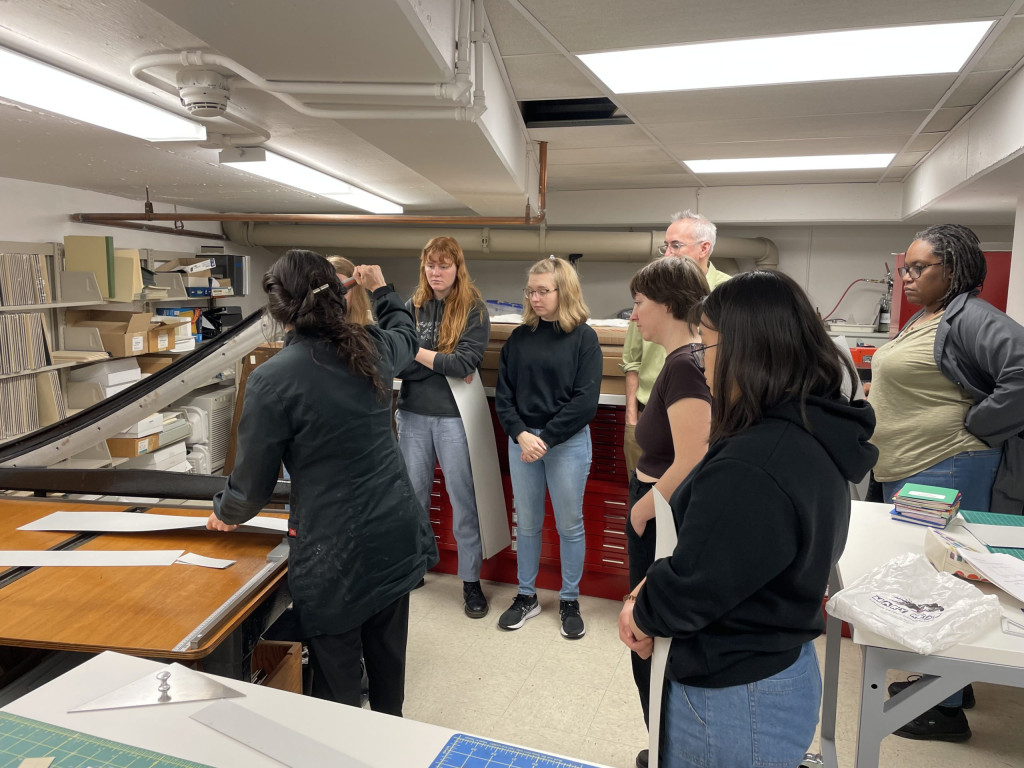
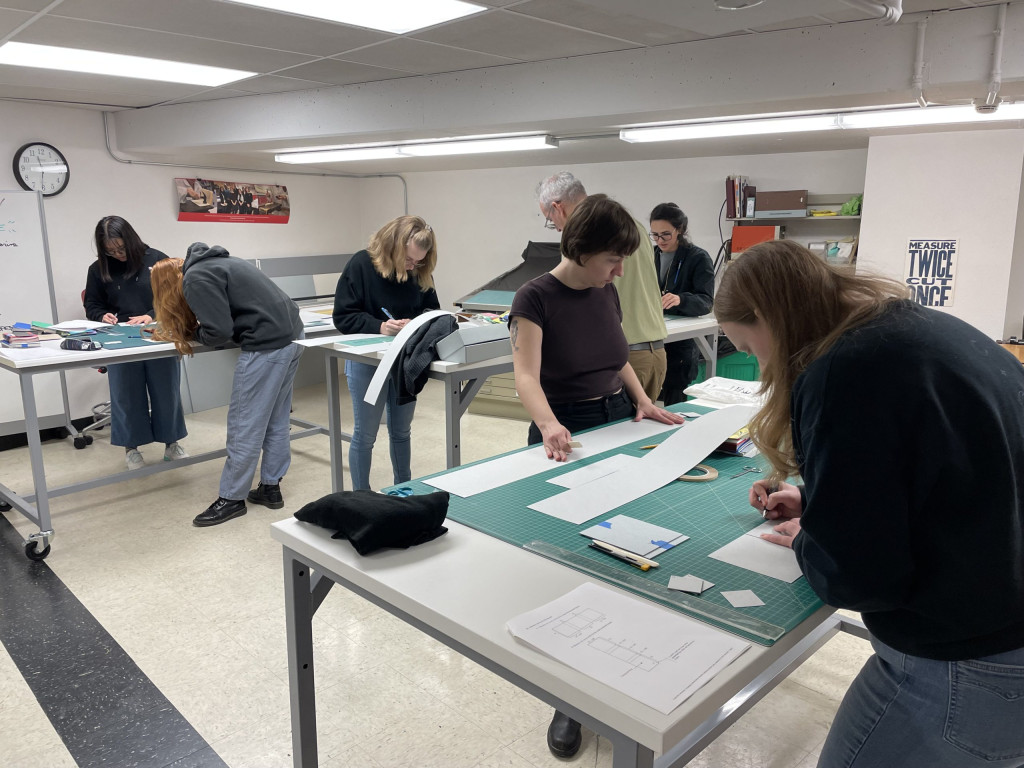
This semester the Preservation Lab is collaborating with the English department and Associate Professor Gary Weissman to teach ENGL 3097 – Book Arts. The experiential learning portion of the course is taught in the Preservation Lab by Holly Prochaska, with much assistance from Jessica Ebert, Catarina Figueirinhas, and Hyacinth Tucker. The course offers students a foundation in the history of the codex, artists’ books, and zines, as well as a hands-on introduction to paper making, bookbinding, and printing.
Last week the students finally got their hands on our beloved board-shears while making a tux box to house the many models they constructed during the course.
It has been a fun and rewarding spring thanks to the enthusiasm of our 12 students!
If you are interested in learning more about the experiential learning portion of the Book Arts curriculum, please reach out to holly.prochaska@uc.edu.
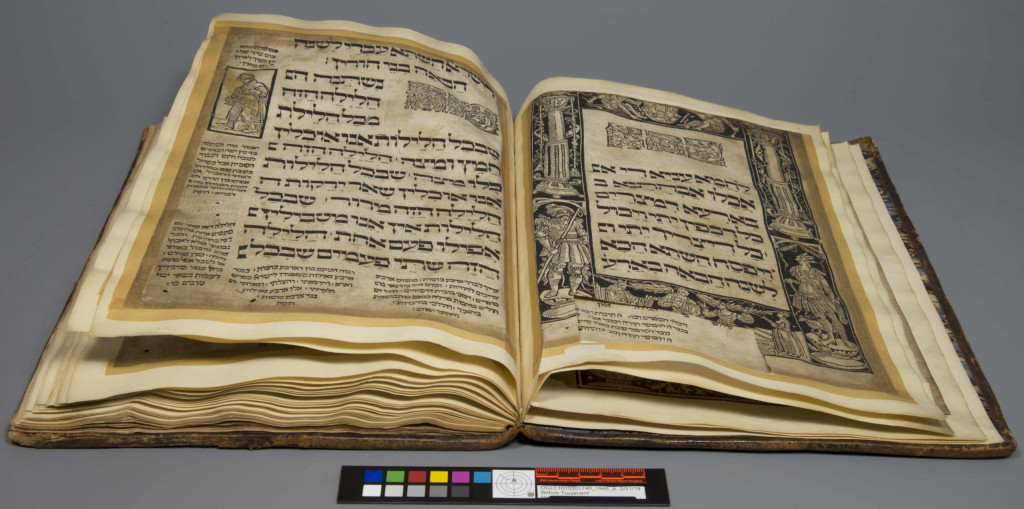
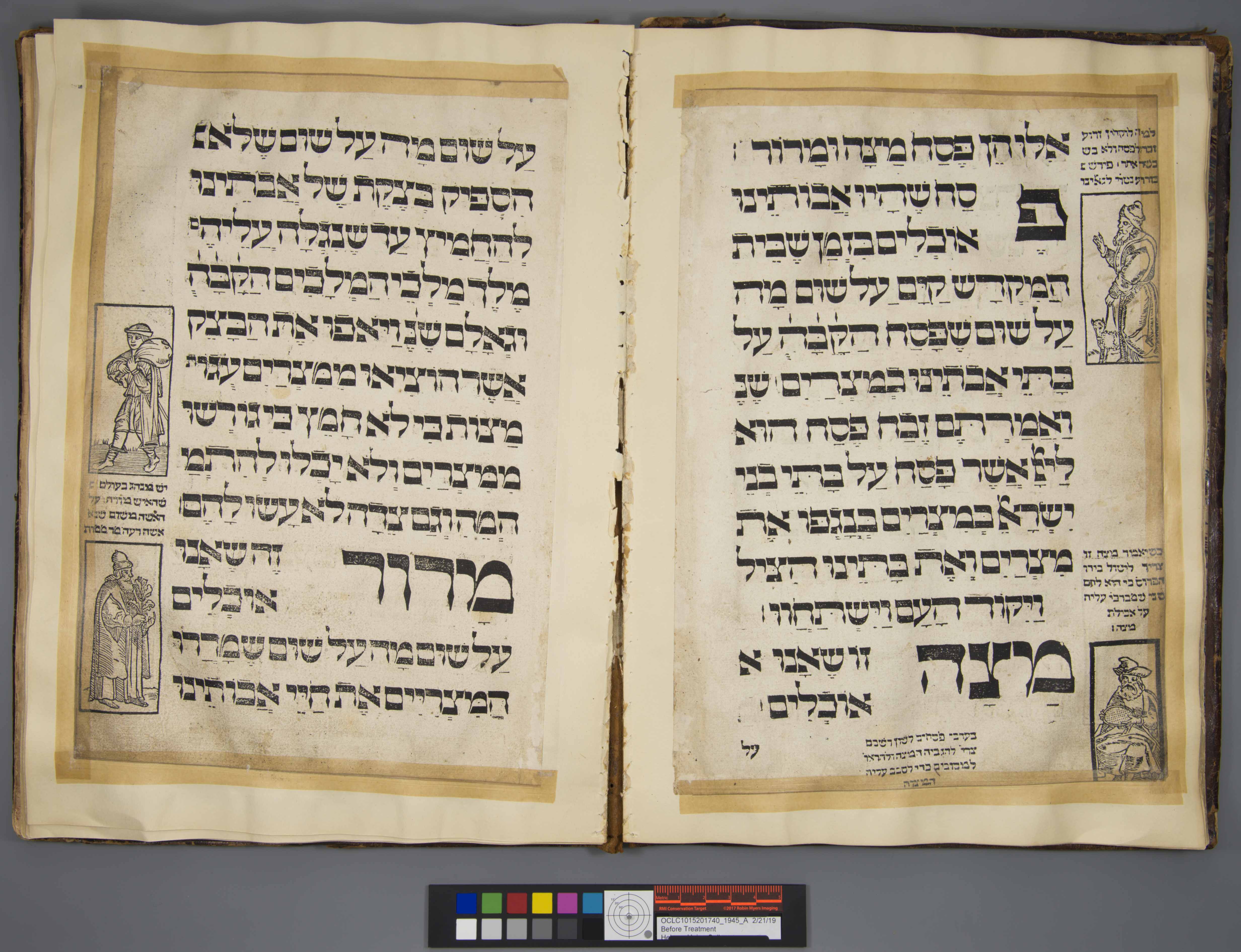
To celebrate the upcoming festival of Passover, please join Hebrew Union College and the Preservation Lab for a virtual presentation about the treatment of one of the earliest printed illustrated Haggadot in the rare book collection of the Klau Library.
View of broken sewing and poorly aging repairs before treatment
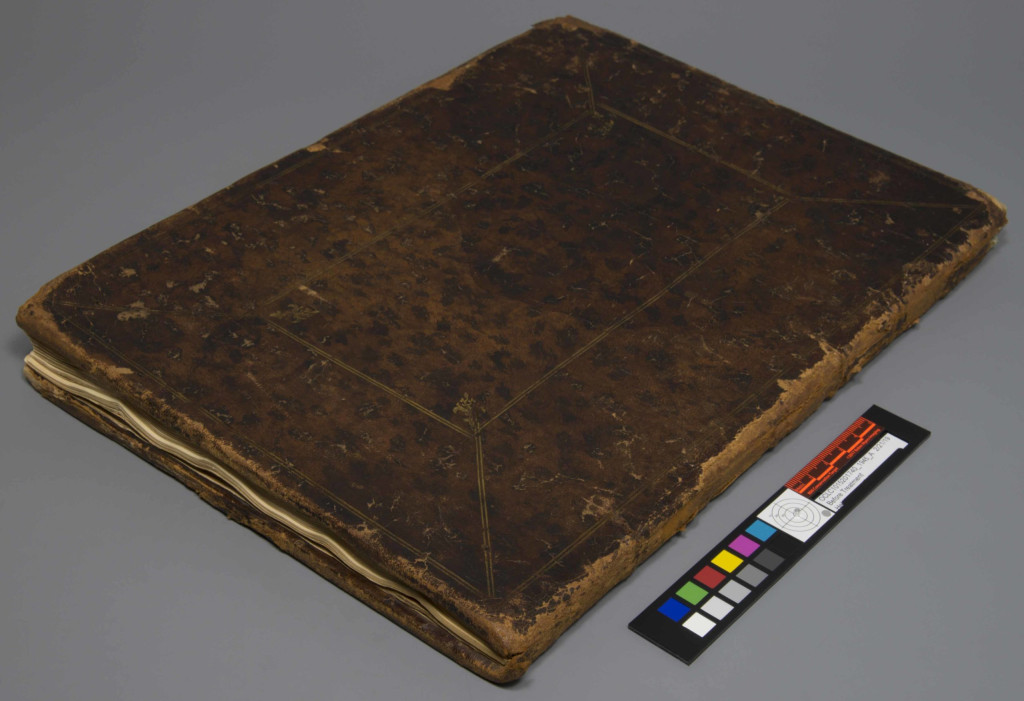
Overall view of leather binding before treatment
Dr. Jordan Finkin, Rare Book and Manuscript Librarian and Co-Director at Hebrew Union College Press will kick off the talk with a discussion about the significance and history of the Haggadah in the greater context of Haggadot Jewish book printing.
Ashleigh N. Ferguson Schieszer, Rare Book and Paper Conservator, will follow by describing the intricate process required to restore the binding and its contents. In this session, Ashleigh will discuss how she met the challenges facing her with this amazing historical work to reverse earlier poorly-done repairs. These treatments were conducted over several years, and included preservation of handwritten songs later added to the Klau’s copy.
Please join us at 11 am on April 10th, 2023 for the hour-long session by registering for the event here.
Check out the recorded session, now available on the HUC-JIR YouTube channel here.
This project was funded by the generous donations of Dr. Valerie Hotchkiss and Dr. David Price.
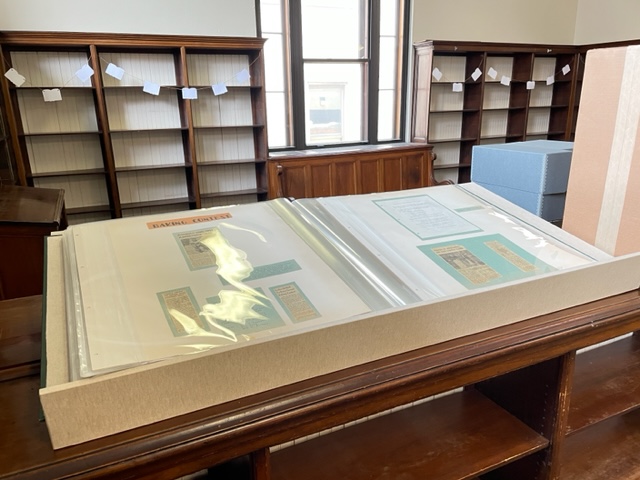
We’re excited to announce that the Madisonville branch is in its final stages to re-open their newly renovated space! Please join the library for the opening eventMarch 18th! At the event, the Genealogy and Local History Department staff member, Chris Smith will talk about Madisonville’s history from 3:30 pm – 4 pm.
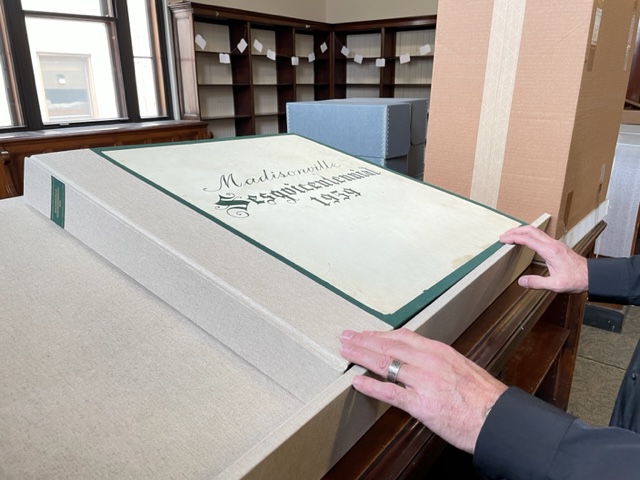
During the event, the Madisonville scrapbook will be on view for festivities March 18th.
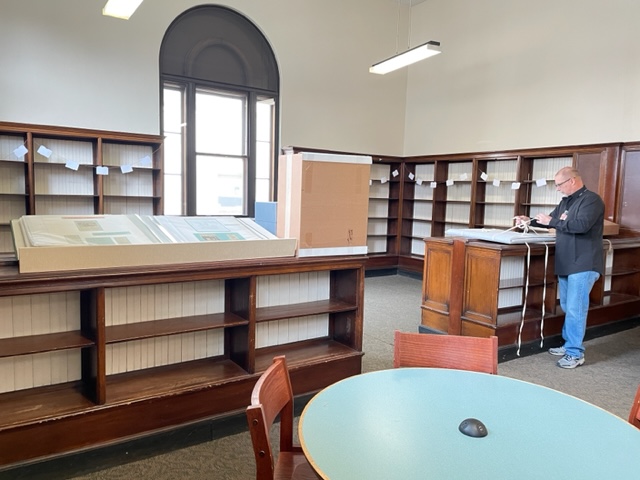
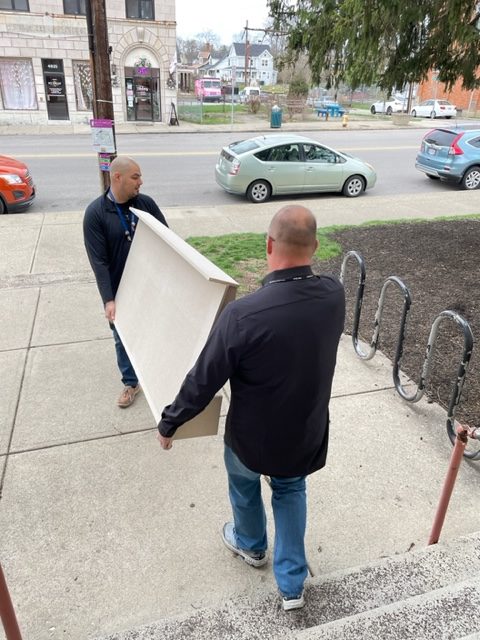
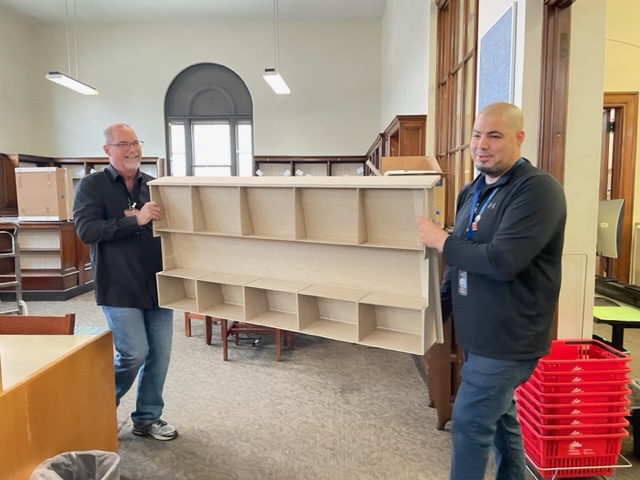
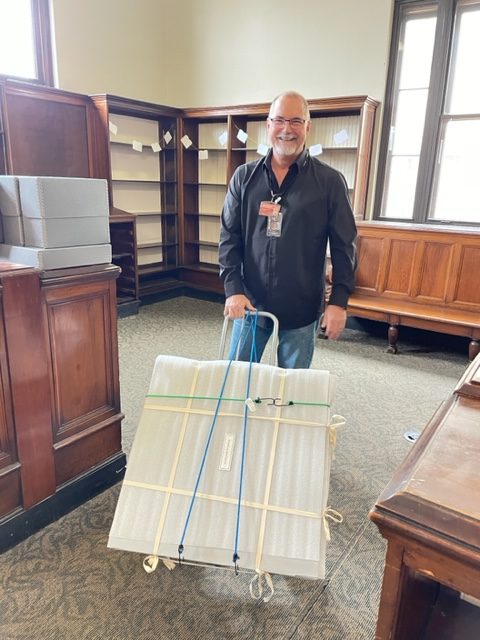
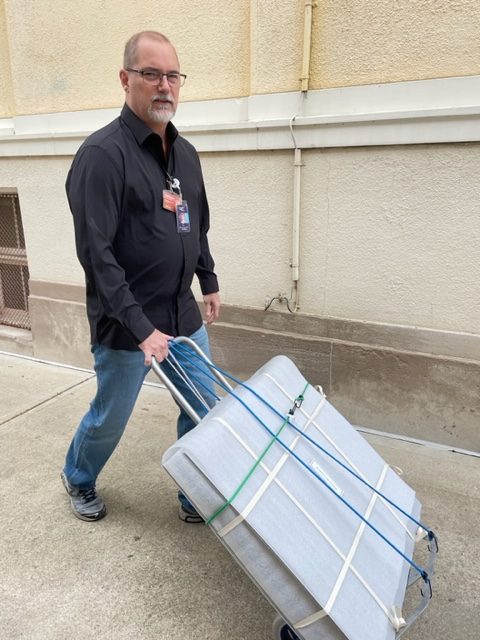
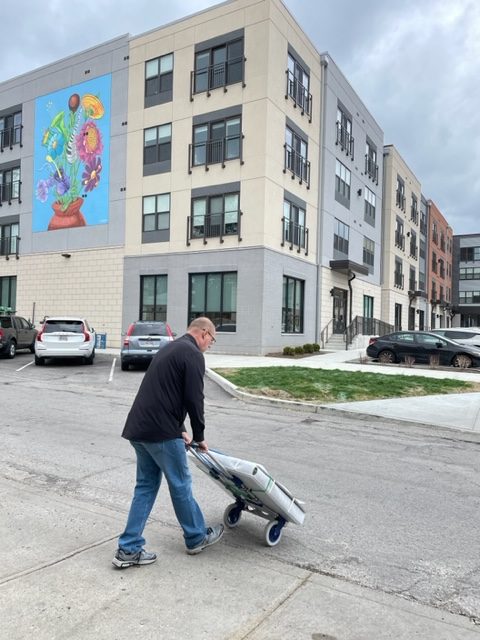
Because this material is HUGE and considered a rare irreplaceable item, both the book and cradle were hand delivered from one building to another by Preservation Lab and Madisonville staff. Below are “behind the scenes” images showing the delivery of these oversized materials.
View of book in its prior home location, recently cleared of books:
Scrapbook & cradle in room empty of booksCradle in prior locationScrapbook coverB
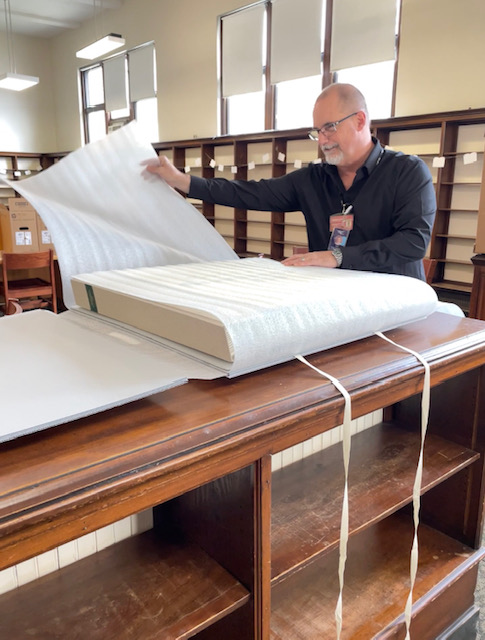
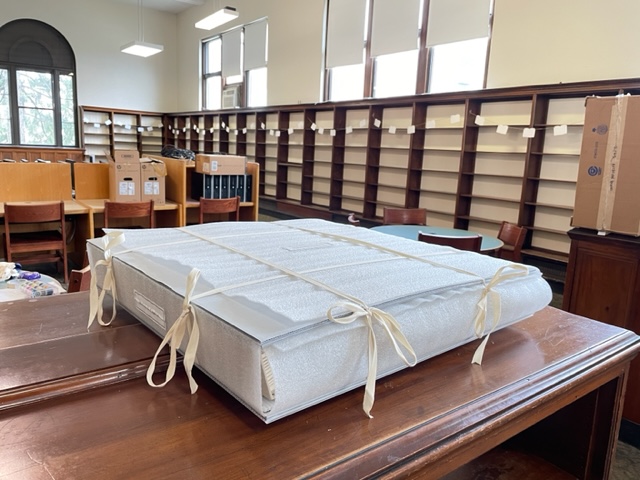
For transport, the oversized book was stored in a lightweight (but strong!) custom enclosure:
Two flaps of foam were first sandwiched under a flap of boardChris Voynovich closes all flapsFlaps were secured with integrated cloth ties
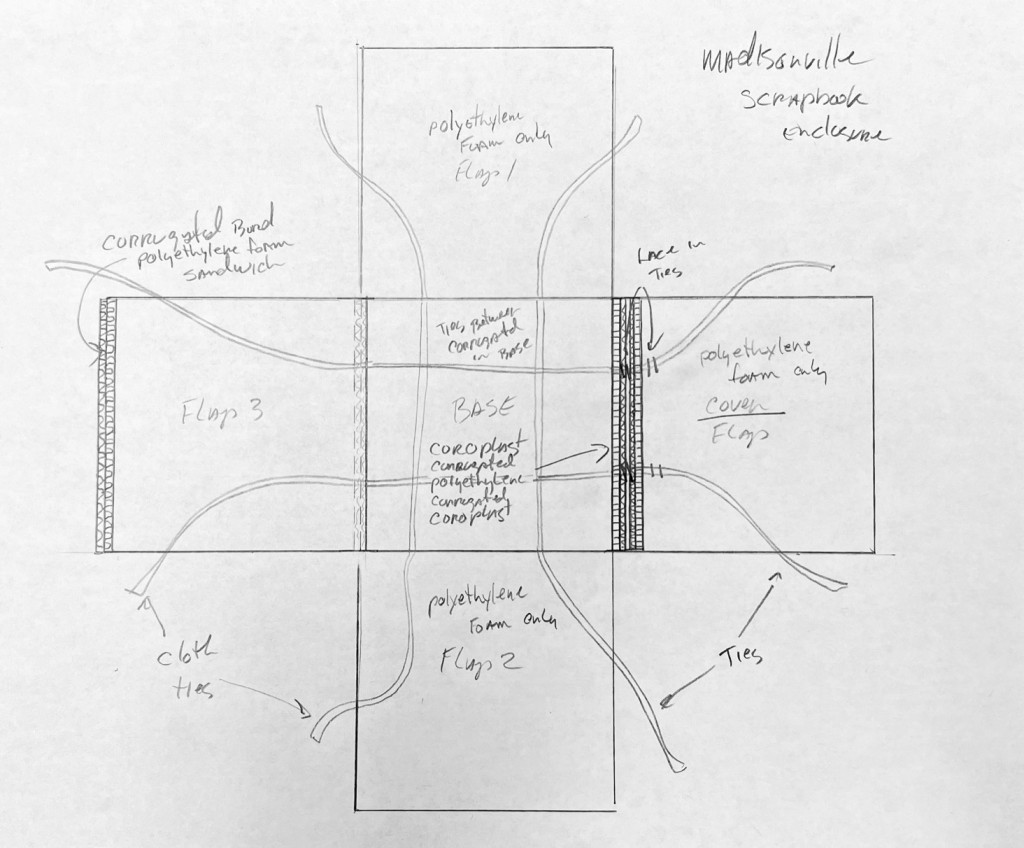
The custom enclosure consists of multiple light-weight layers and flaps of foam, all tied together with cotton ties, as shown in Chris’ schematic. This enclosure will be used both for transport and for long-term storage.
Once packaged, both the book and cradle were hand delivered to their new home next door:
Cradle hand delivered next door by Terry Barnum and Chris VoynovichBottom view of cradleBook strapped to dollyBook is oriented spine edge down for safe transport
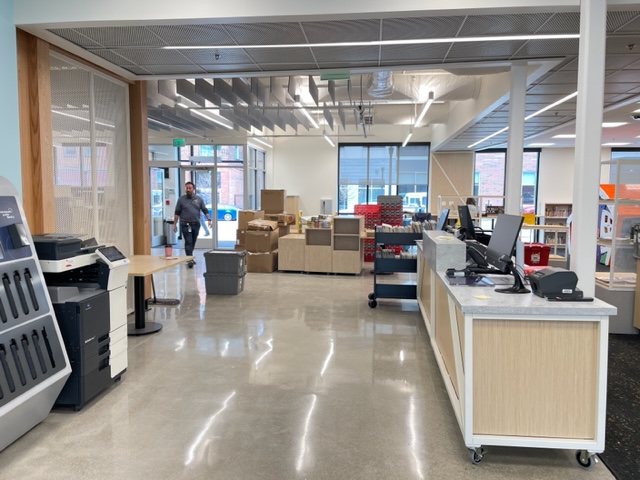
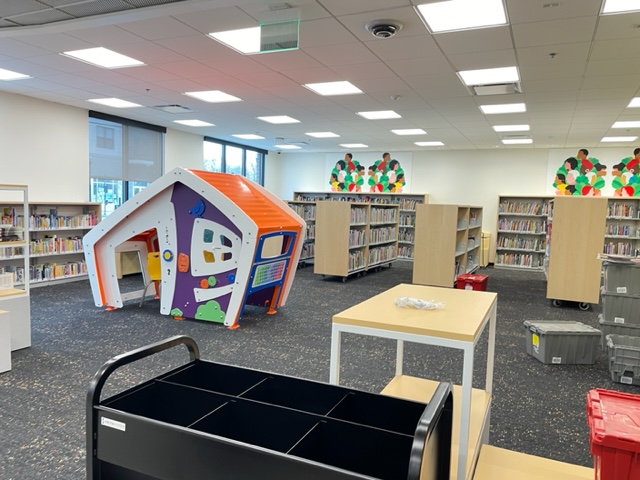
The book now awaits the re-opening event while staff continue unpacking the rest of collections!
Boxes being unpacked in new spaceChildren’s area is coming together!
We hope to see you there!
Ashleigh Ferguson Schieszer [CHPL] – Rare book and paper conservator
To read about the conservation of the scrapbook and construction of the book’s cradle, please see the treatment documentation and a prior blog article titled, Madisonville Scrapbook.
As a bonus, to celebrate the completion of the oversized treatment, Chris created a comic you can fold from an 8 1/2 x 11 sheet of paper. Check out the printable file below! Instructions on how to fold can be found on the Preservation Lab’s YouTube channel video titled Preserving Scrapbooks beginning at the 10:42 time stamp.