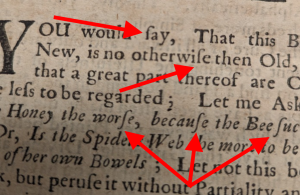
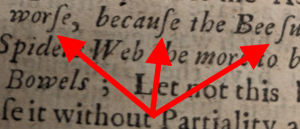
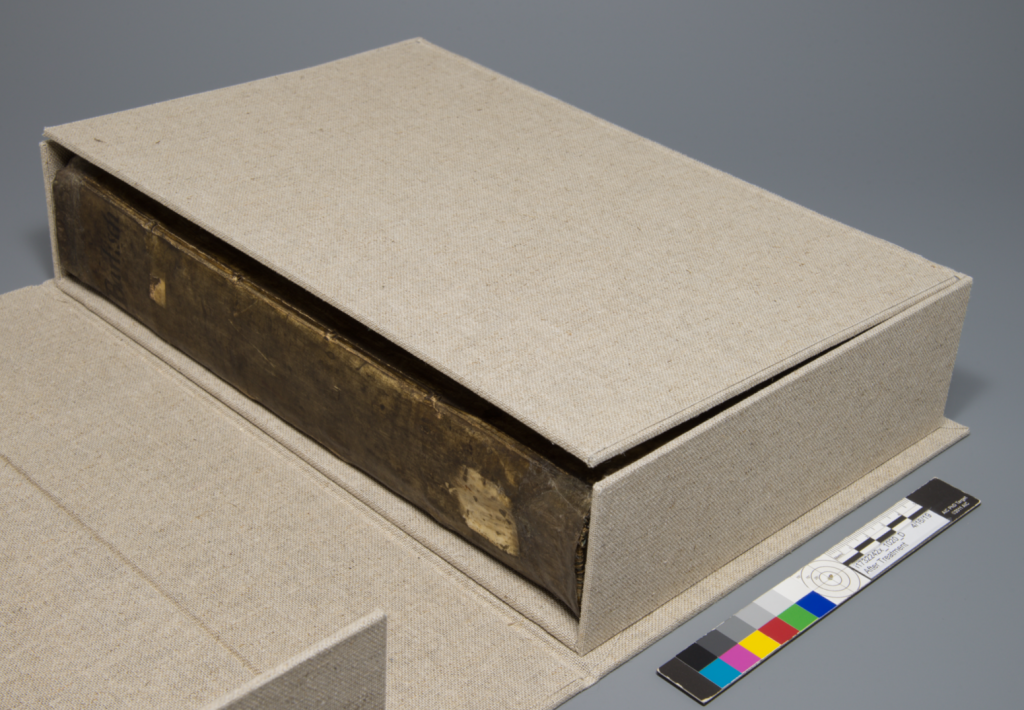
I was recently building an enclosure for a book dating back to 1681 entitled The Experienced Farrier. While examining this item I noticed something interesting about the spelling of certain words: often, rather than seeing what normally should be the letter “s” I would see what appeared to be the letter “f.”
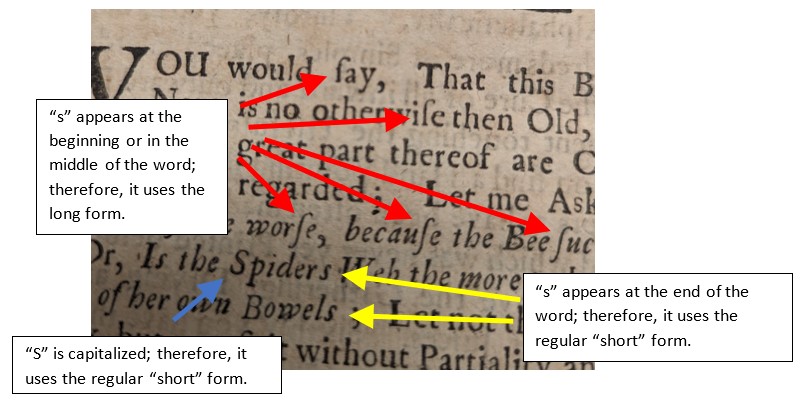
Figure 1: An image from The Experienced Farrier, containing what appears to be “strange” spellings.
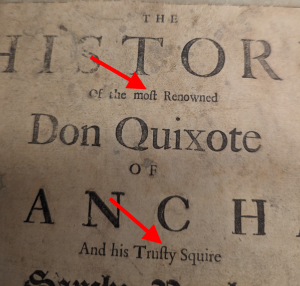
Since noticing this, I started seeing these seemingly bizarre spellings in other items dating to this period, as can be seen in the title page from a copy of Don Quixote from 1678.
Figure 2: An image of the text from Don Quixote, with further examples of these “strange” spellings.
Identifying The Long S
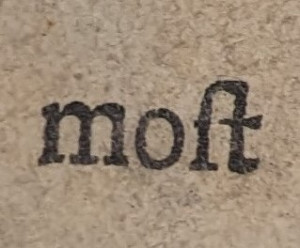
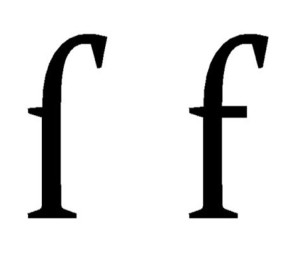
After some sleuthing, I discovered something interesting: these letters were not “f”s at all. They were a now defunct character known as the “long s.” Closer examination of these letters in the text showed that, although they closely resembled an “f,” the horizontal cross bar did not extend all the way across the letter; it starts on the left side and ends in the middle.
Figure 3: A close-up of the word “most” that uses the “long s.” Note that the horizontal cross bar stops at the center stem of the letter.
Figure 4: The “long s” (left) as compared to a lowercase “f” (right).
This solved some of the mystery, but what about the characters that looked like an “f” where the bottom of it curves to the left?
Figure 5: Another style of the “long s,” depicted as it would appear in cursive handwriting.
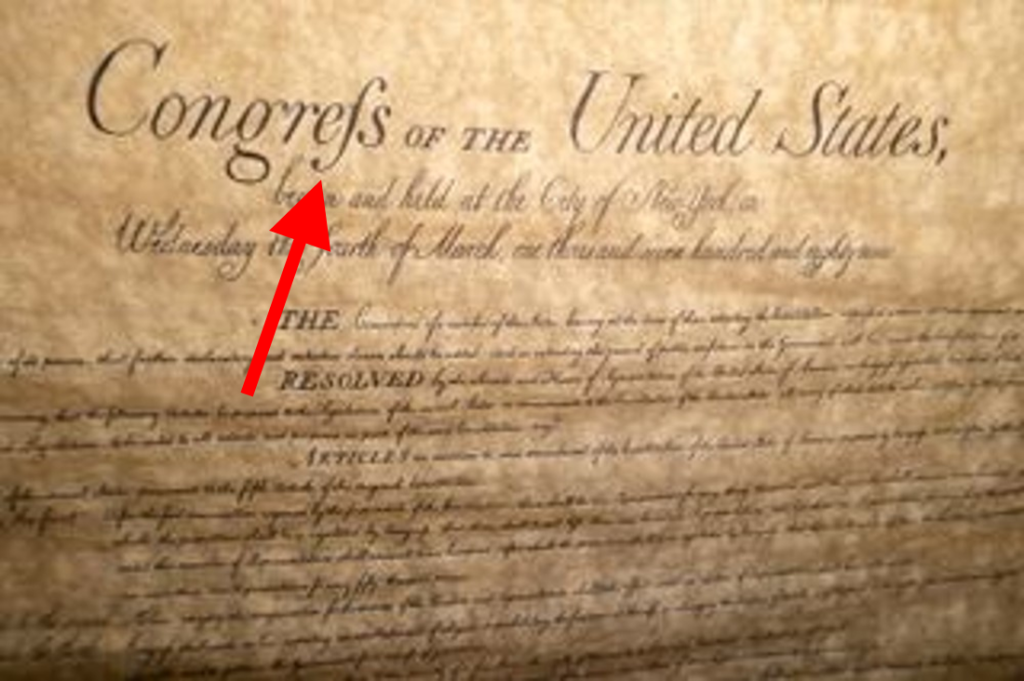
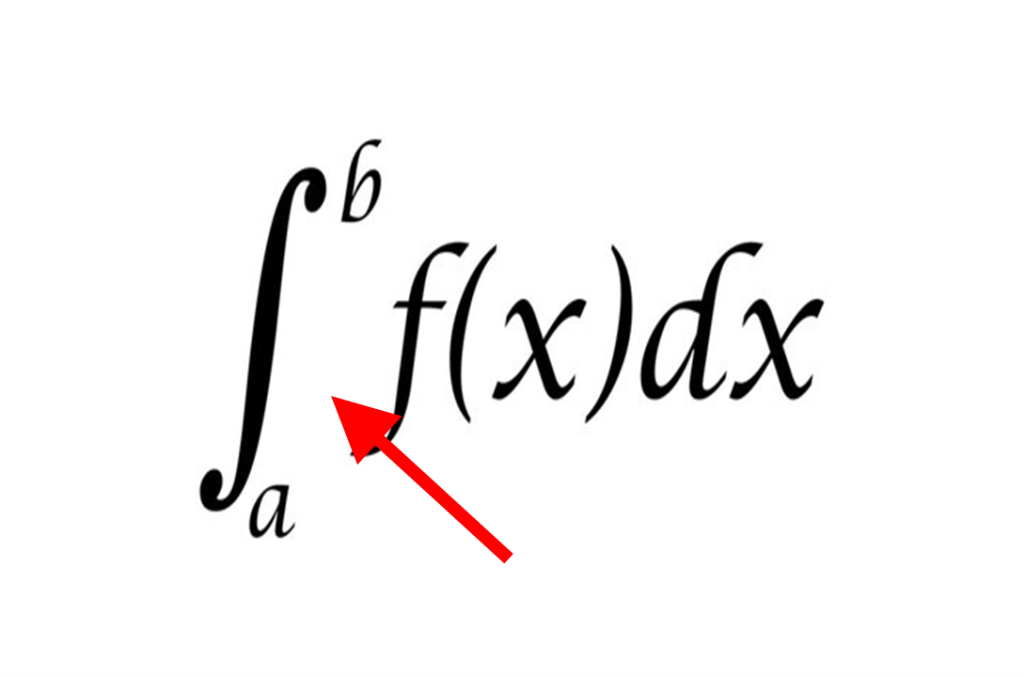
The answer is that this is also a “long s,” but depicted how it was written in cursive. If you feel like you’ve seen this character before, you’re probably correct: a notable example of this style of “long s” can be found in the first line of the Bill of Rights. Some may also recognize this character from calculus as the “integral” symbol.
Figure 6: The “long s” that occurs in the word “Congress” as it appears in the handwritten Bill of Rights.
Figure 7: The “integral” symbol used in calculus uses the same character used for the cursive-style “long s.”
When The Long S Was Used
You may have noticed in some of these examples that not every “s” is the long form. So, what exactly were the rules for when and where this character was used?
It’s difficult to say exactly, as the rules changed over time and writers/printers didn’t always adhere to the same rules. However, according to a blog from the National Archives, some simple guidelines for when and where the “long s” was used are as follows:
An “s” would use the long form if it appeared at the beginning or in the middle of a word, but only if it is a lowercase s. An uppercase S would not use the long form of the letter.
An “s” would not use the long form if it was the last letter in a word.
It was very common in the case of a “double s” or “ss”, as in the word “opossum”, for both “s”s to be the long form (opoſſum), unless the “ss” ended the word, as in the word “congress”, in which only the first “s” would be the long form (congreſs). *
*An observant reader may notice that this last rule is redundant given the first two rules; however, mentioning the “long s” in the case of an “ss” is significant in that as this character fell out of favor with writers/printers, one of the last remaining circumstances that utilized it was in the case of an “ss.”
Figure 8: Examples of when the “long s” was/was not used.
Final Observations
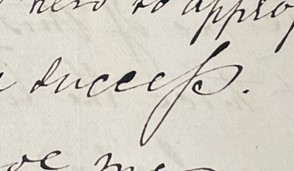
Gradually, the “long s” fell out of usage around the time of the late 1700’s-1820’s, although it persisted longer in handwriting. Serendipitously, while writing this blog post, the lab received a first edition copy of Goblin’s Market with a handwritten note inside from the author, Christina Rossetti dating to 1862 that features this use even in the late 19th century:
Figure 9: Although difficult to read, this is the word success (ſucceſs) from a handwritten note dating to 1862 that utilizes the “long s” several decades after it fell out of common usage in printed media.
If you still find words containing a “long s” difficult to read, you aren’t alone; it has been theorized that it was phased out in favor of exclusive “short s” usage as they weren’t as easily confused with other letters and were found to be more legible. The disappearance of the “long s” is a good reminder that language, both written and spoken is fluid with ever evolving rules and norms.
Resources
For further information about the long s and its history be sure to check out these excellent blog posts, that were very helpful in the gathering of information for this post:
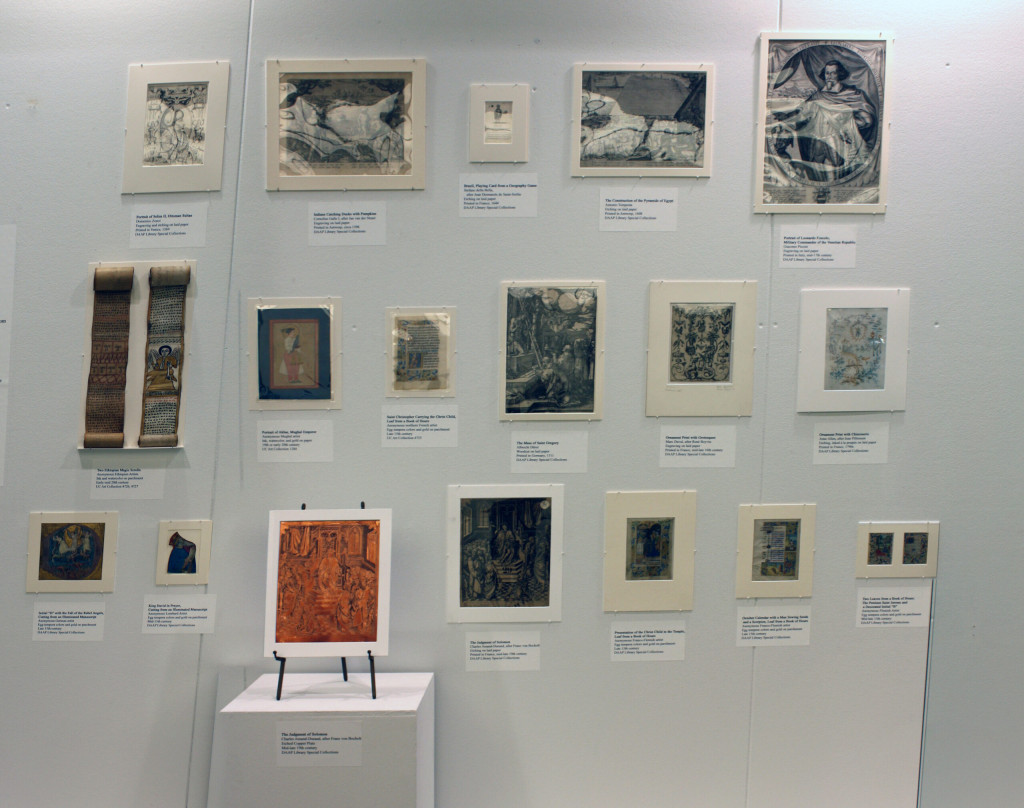
For the past six months, Jessica and Catarina have been working with the DAAP Library on housing their Teaching art collection, including prior acquisition and newly acquired items. This collection consists of different art prints on paper, print plates and manuscript parchment leaves in need of long-term housing. In addition to housing, this collection is used for teaching in a classroom setting and for exhibition.
Most of the collection only requires simple matting systems, but some require more intricate matting systems such as the copper plate along with its print, a project mentioned in a previous blog post entitled How many magnets is too many magnets!?.
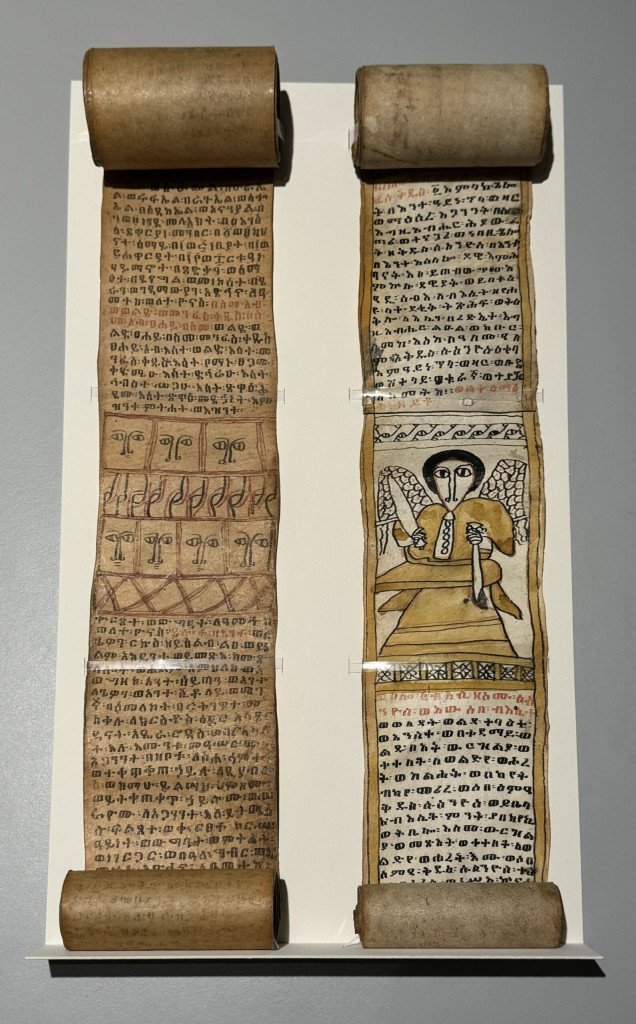
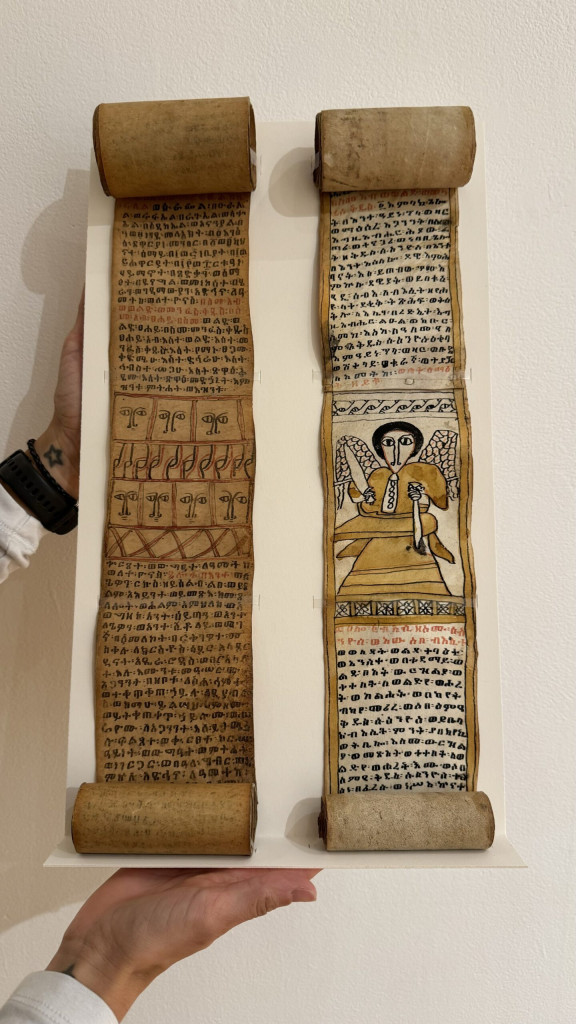
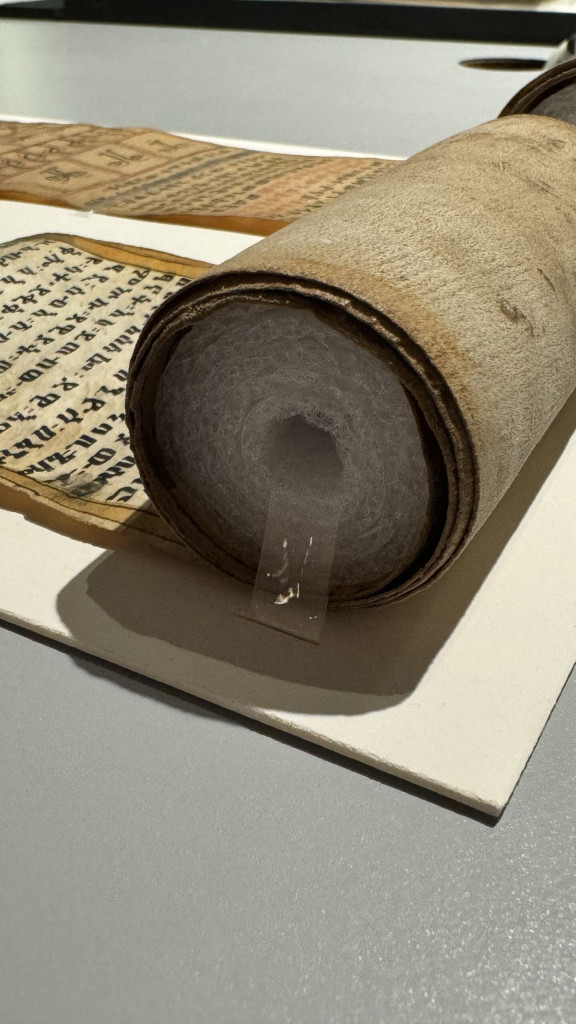
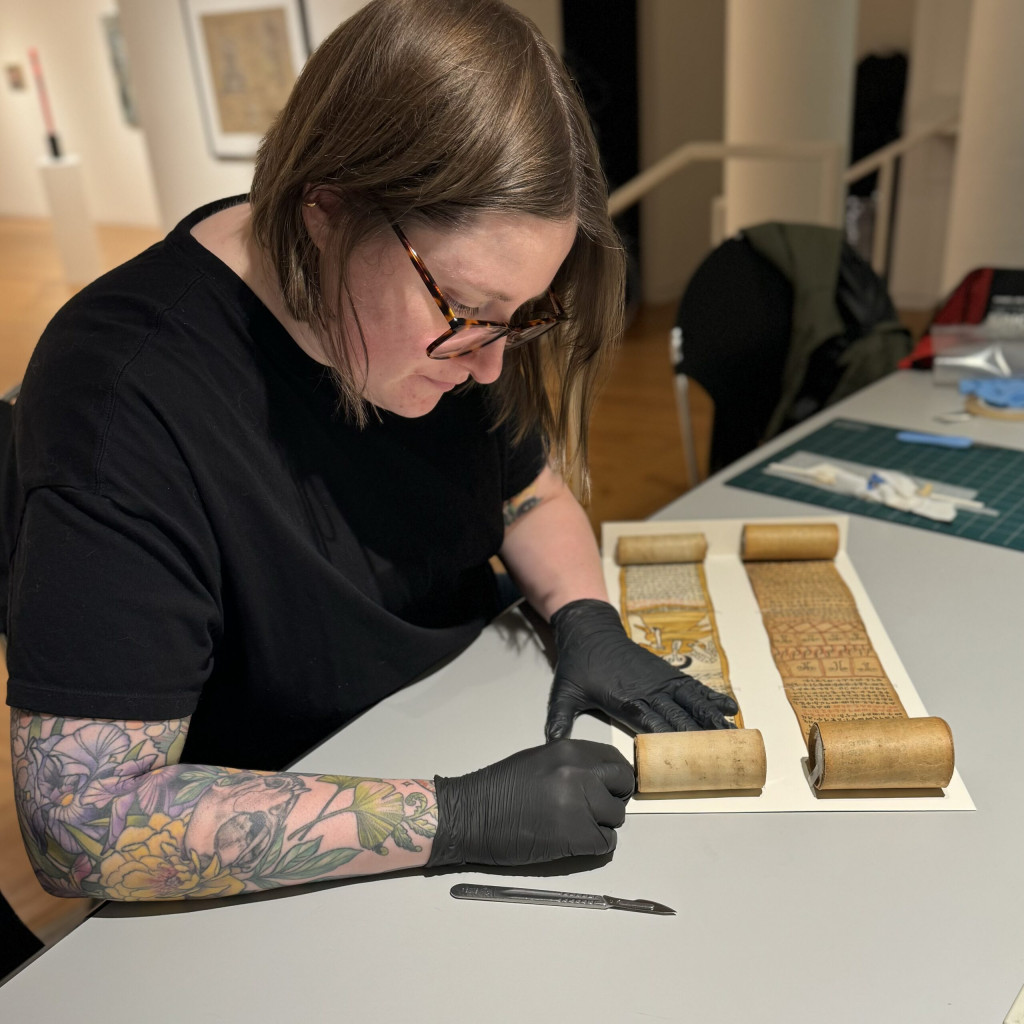
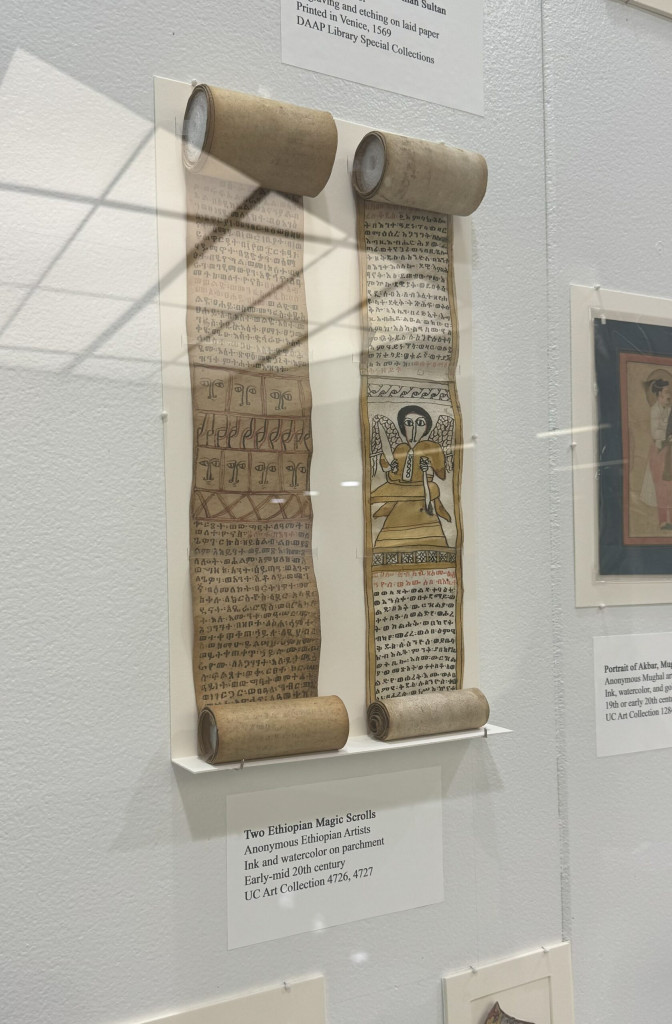
As some of the items of this collection were being prepared to go on exhibit, we had the opportunity to create mounts for other items, such as two parchment scrolls that were included in the exhibit. This was a fun project to work on, as it required us to create a support that would secure both scrolls, while providing an elegant solution for display.
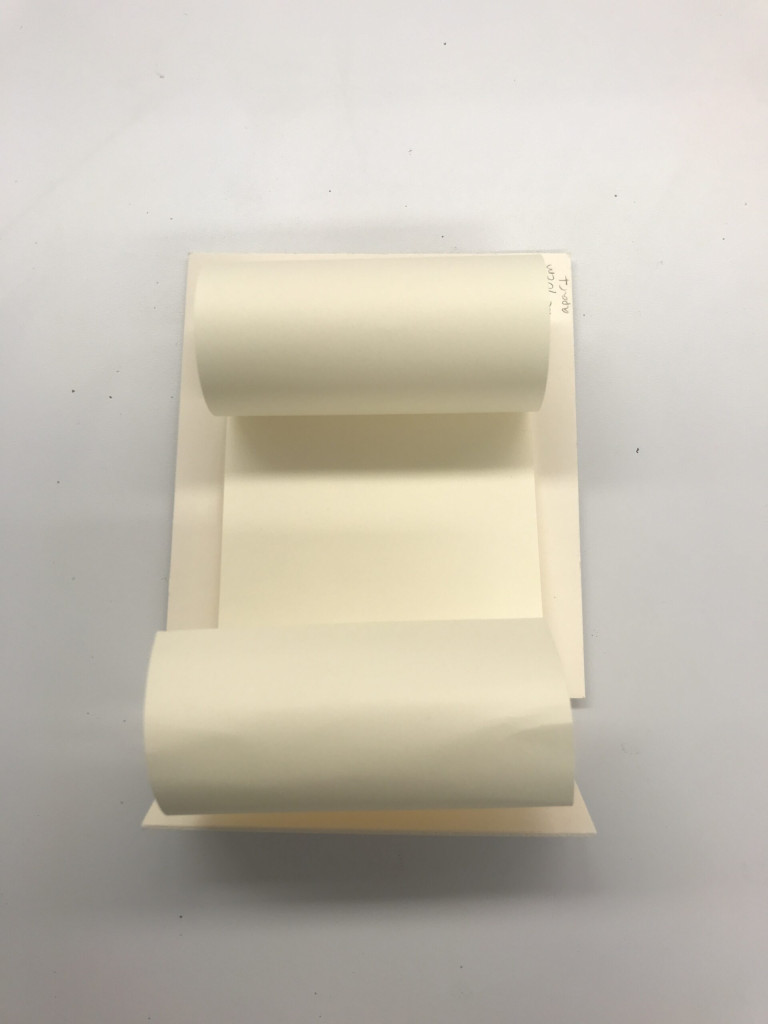
To start, Jessica created a very rough small model with mat board, polyethylene strapping, and paper (as we always do with anything new in the lab, we do love model making!!). The model provided us the visual example that we needed to create the mount for the two scrolls.
Small rough model created by JessicaSmall rough model created by Jessica
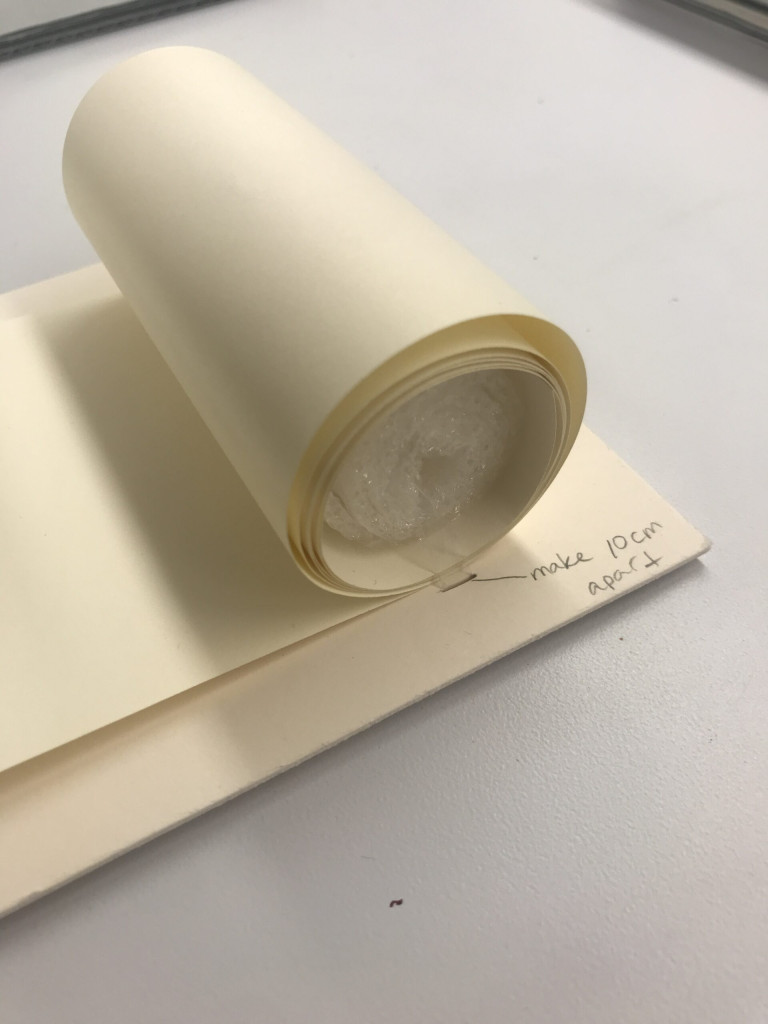
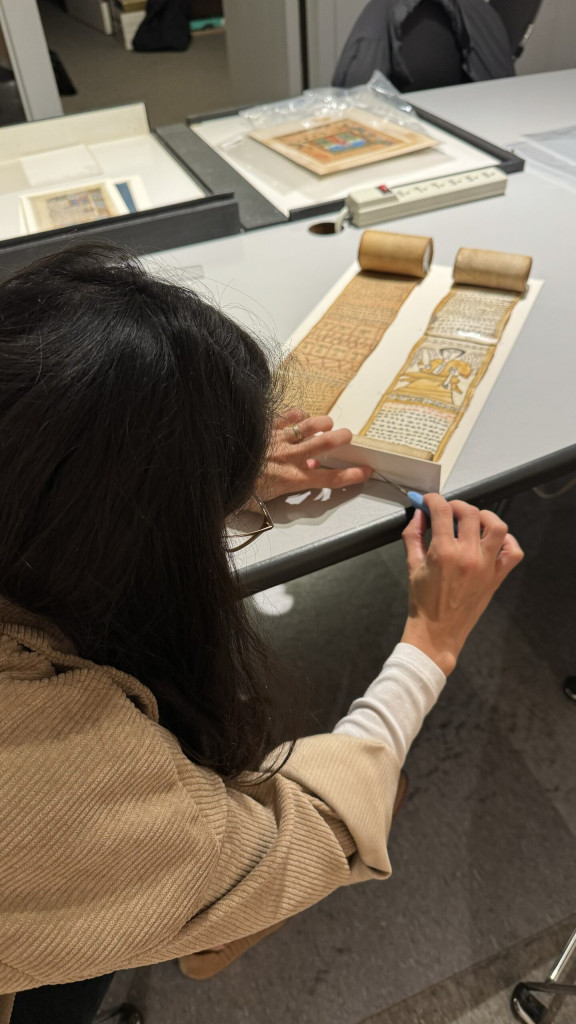
With the model in mind, we were able to engineer a good system that would provide support for the scrolls and could be used for display. The scrolls were supported with foam rolls on the inside for the rolled ends, and secured with polyethylene strapping that only touched the foam. The sections of the scrolls that were going to be displayed were also secured with polyethylene strapping that wrapped around the mat board support through slits in the board. At the bottom, the mat board extended outwards creating a small shelf to support the end of the scroll.
Scrolls mounted and ready for exhibition.Scrolls mounted and ready for exhibition.
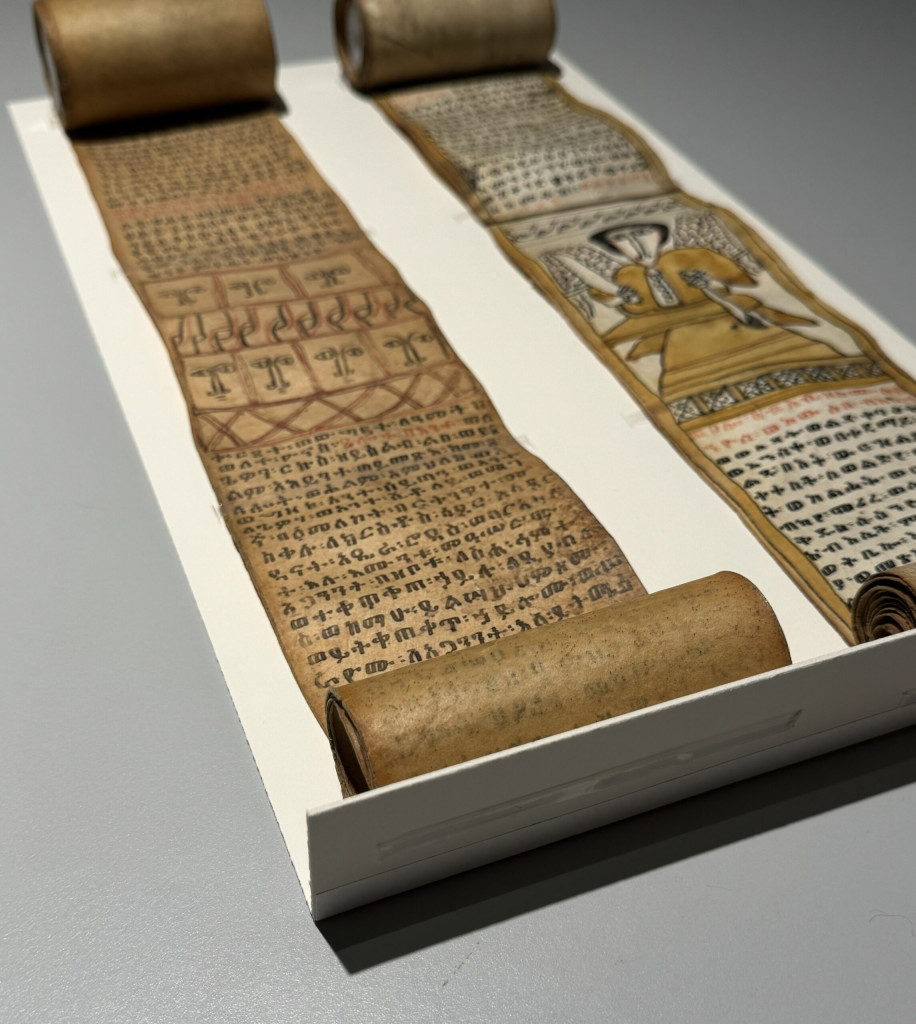
A small “shelf” of mat board supports the bottom of the scrolls.
Catarina adjusting the strapping on the mount.
A small “shelf” of mat board supports the bottom of the scrolls.
A small “shelf” of mat board supports the bottom of the scrolls.
The foam rolls support the inside of the scrolls and are secured with polyethylene strapping.
Jessica securing the foam roll that supports the scroll.
As a result of all the mounting and matting we did for the Teaching Art collection and for the scrolls, each item is currently on display at the DAAP Library entrance case:
Current display at the DAAP Library featuring the Teaching Art Collection.A close-up of the scroll mounted on exhibition.
If you are interested in learning more about our preservation considerations for exhibition of this collection, Catarina and Jessica will be giving a short gallery talk on Tuesday, December 5th at 1pm, at the DAAP Library entrance on the 5th floor.
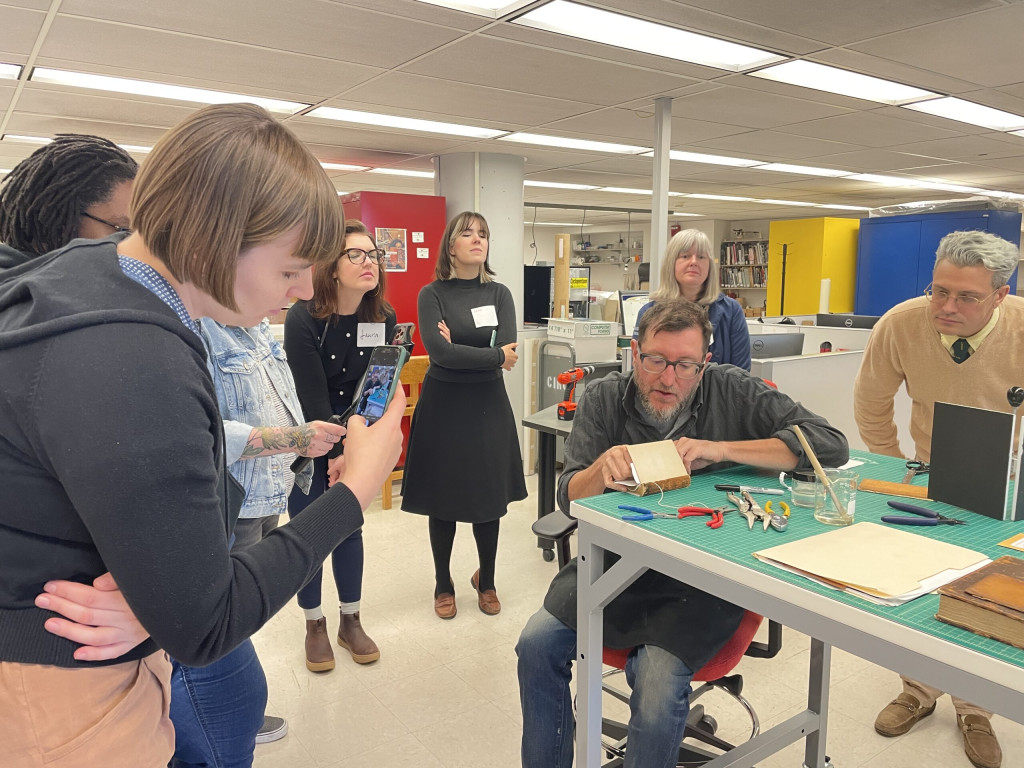
Last year around this time, the lab was fortunate to bring in book conservator and toolmaker, Jeff Peachey for a week-long intensive workshop to learn leather rebacking. While I always expect to walk away with new anticipated skills as advertised by the workshop, I’m ALSO always pleasantly surprised by the tangential tips and tricks shared along the way. In the case of Peachey’s workshop, there were many! One of my favorites was his use of a fish gelatin.
Introduction to Cold Fish Gelatin
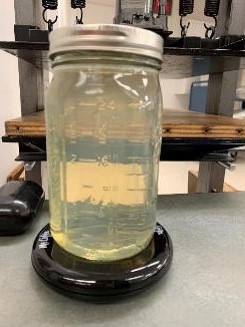
While adhering spine linings to our text blocks, Peachey pulled out a small baggie of fish gelatin he brought with him to the workshop. He poured the dry flaky powder into a small jar, added room temperature cold water, and mixed it until a liquid-y consistency. He then added strained wheat starch paste to the gelatin and mixed with water until he was happy with the consistency. He estimated it was a 40:60 ratio of gelatin to paste.
Jeff Peachey taught a workshop at the Preservation Lab in Oct. 2022 where he first introduced us to a low-bloom fish gelatin for book conservation that didn’t require heat for use
If you’ve ever used gelatin before, you might be wondering – how is it possible to mix the gelatin without heating? That’s the beauty of this product – it has a high molecular weight with low bloom strength and is produced from cold water fish which gives it this ability. It might not be the strongest of the films with a 0-bloom strength, but for a book conservator doing paper repairs that need to be reversible yet strong, this combo still had an amazing tack when dry!
Peachey explained he first heard about the gelatin on a lab tour at the Weissman Center. He recalled Alan Puglia might have been the one who originally investigated the adhesive for pigment consolidation of hundreds of manuscripts for a show. The mention of a high molecular weight Norland fish gelatin was shared during a talk given at the American Institute for Conservation’s 44th annual meeting. The talk was titled, The Challenge of Scale: Treatment of 160 Illuminated Manuscripts for Exhibition,” by Debora D. Mayer and Alan Puglia.
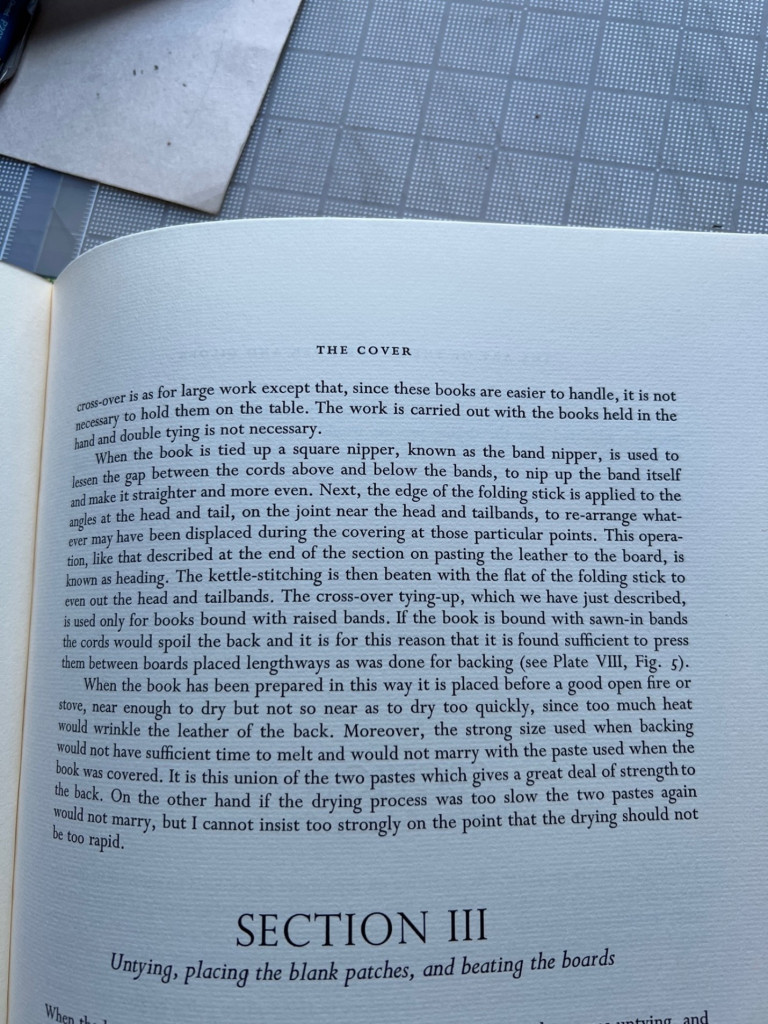
Peachey also doesn’t take credit for mixing the gelatin with wheat starch paste. He notes that even in Rene Matin Dudin’s 18th century manual, it discusses the “union” of paste and glue in the last paragraph below.
Peachey shares an excerpt by Rene Matin Dudin descripting his 18th century historic use of gelatin mixed with paste.
By the end of the week-long workshop, I had fallen in love with the properties of how well it adhered. By itself, the fish gelatin had a long working time and didn’t stick until it was nearly dry – but when mixed with wheat starch paste, it combined the best of both worlds. There was both the initial tack from the paste and a strong adhesion from the gelatin after dry. I wasted no time in ordering my own sample supply.
Treatments Testing the HMW Fish Gelatin
Over the past year, I’ve slowly incorporated the fish gelatin in treatments and testing more applications.
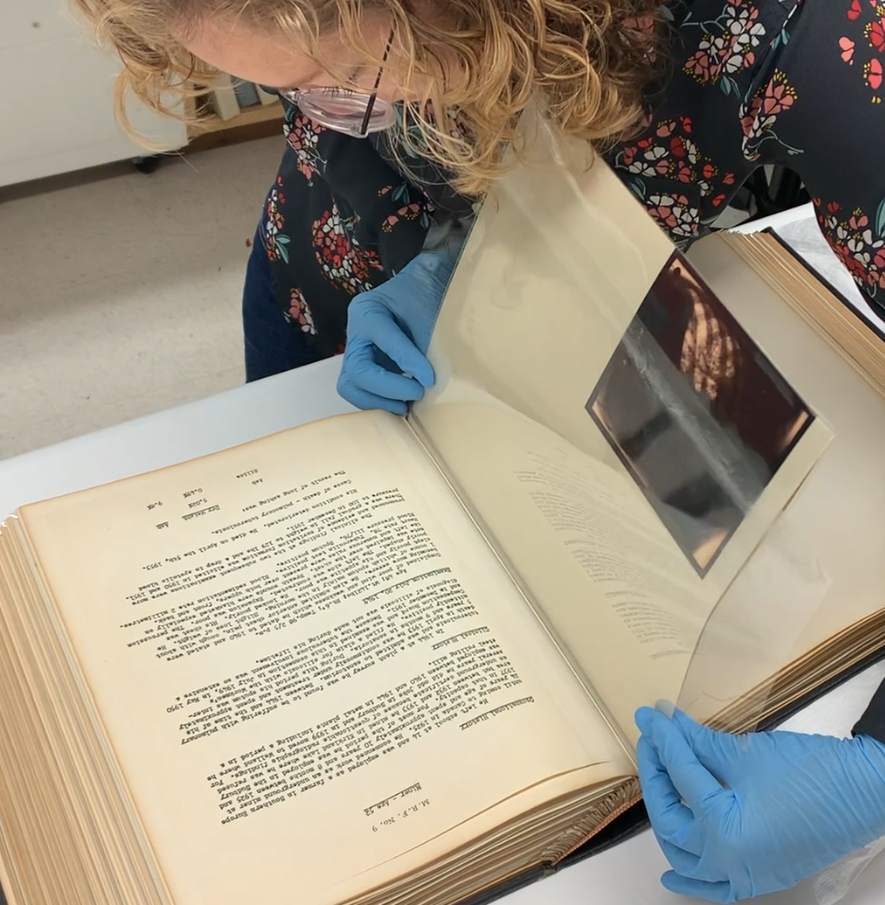
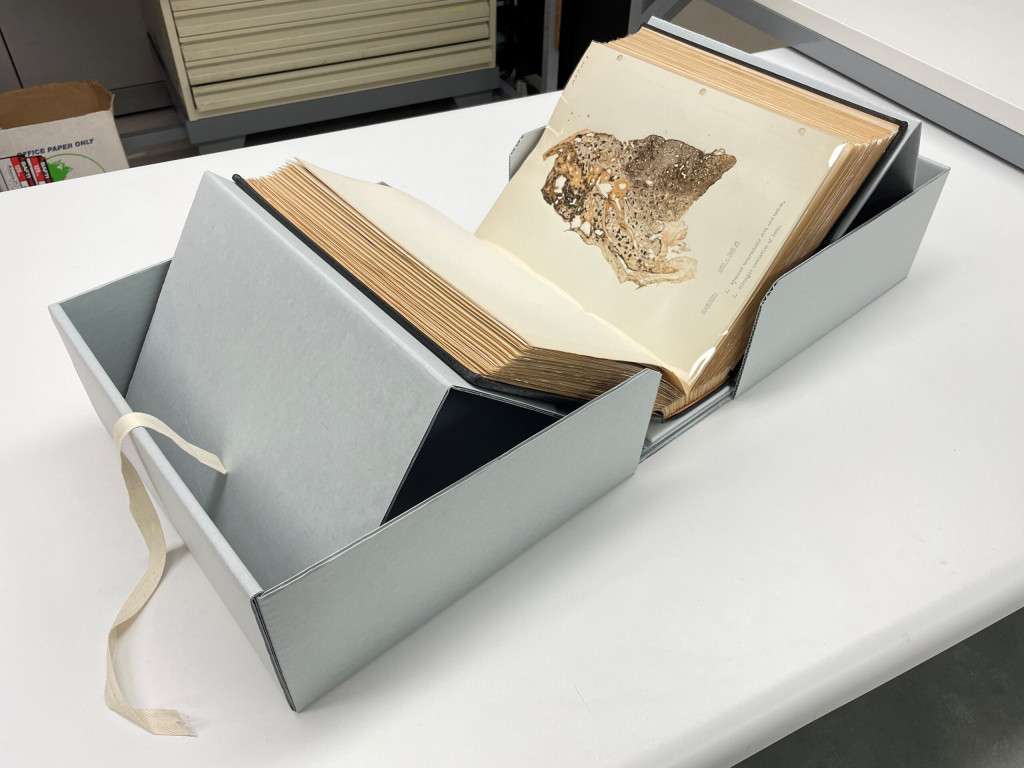
I first successfully used it to hinge-in heavy encapsulated sleeves into an album containing lung cross sections. After ultrasonically welding a paper hinge into an encapsulated sleeve, I applied the mix of wheat starch paste and fish gelatin to adhere the hinge to the scrapbook stubbing and had wonderful success. I was able to adhere with confidence that the encapsulation would stay in place and was able to avoid disbinding and resewing. At one point during treatment, I found I needed to reposition a hinge. I am happy to report the mixture was as easily reversible as wheat starch paste alone!
Ashleigh Ferguson Schieszer uses the 40:60 mixture of fish gelatin and wheat starch paste to hinge encapsulations into an album, ensuring the heavy encapsulations with paper hinges stay adhered.
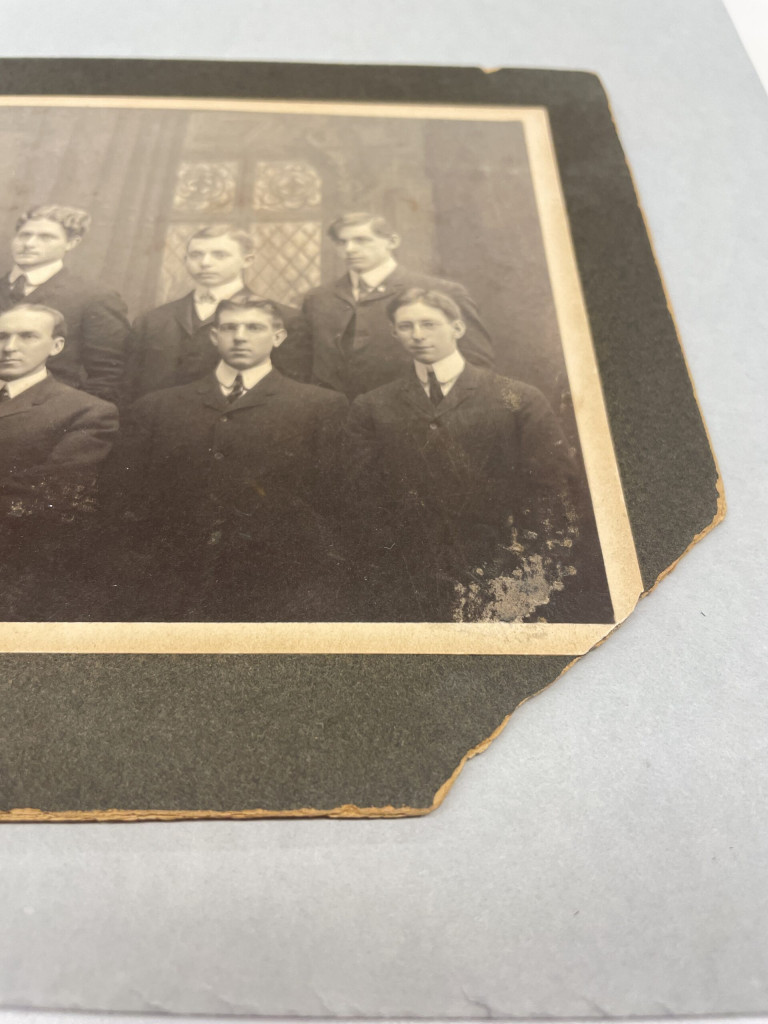
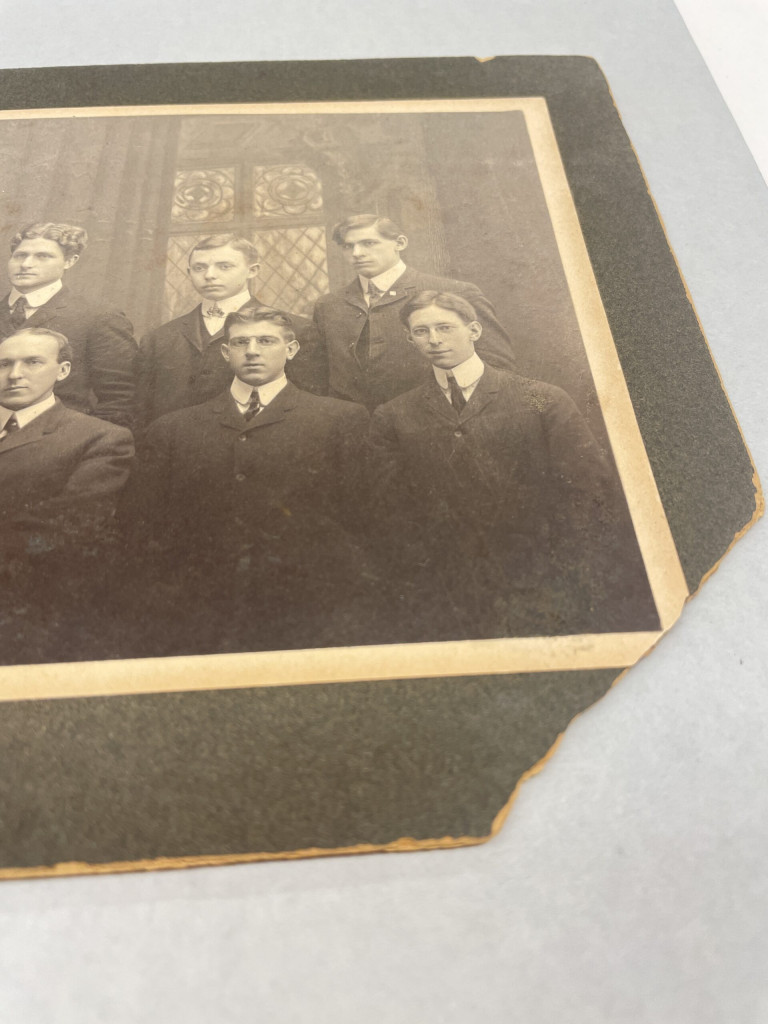
Most recently, I played around with using it for photographic emulsion consolidation. I used it first as a barrier layer before inpainting, and then to add sheen to in-painted photograph regions that were originally matte in comparison to the surrounding gelatin coating. It seemed extremely easy to apply and clean up was less messy than other photographic gelatins I’ve used in the past. The sheen was just the right amount of gloss I needed without being overly shiny. And, best of all, no heat required.
Before in-painting emulsion lossesAfter in-painting emulsion
Examples of photographic condition issues where the fish gelatin was tested: flaking emulsion was consolidated and a barrier layer was applied before inpainting
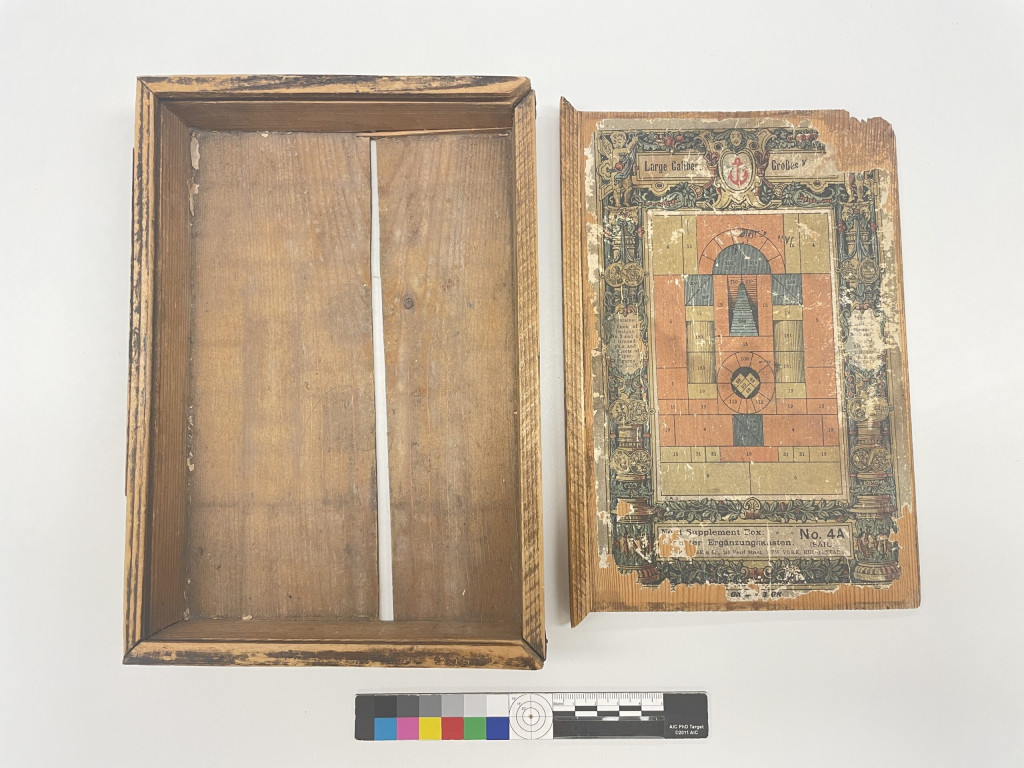
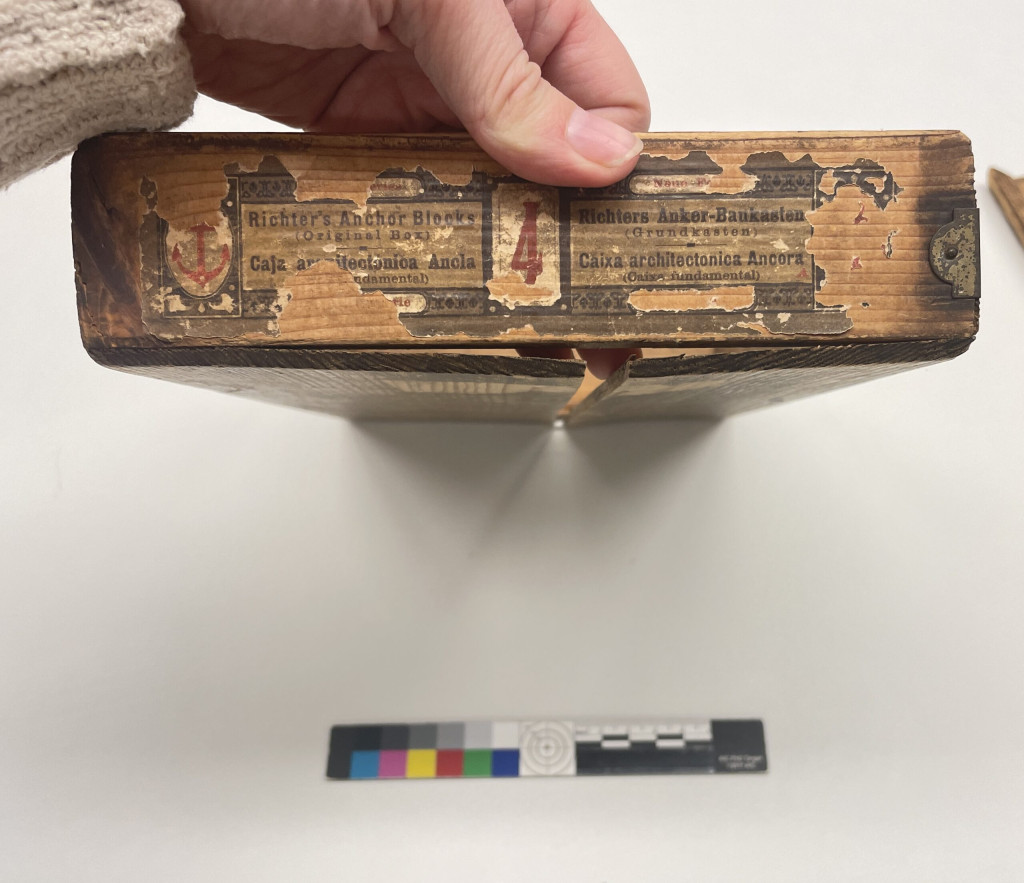
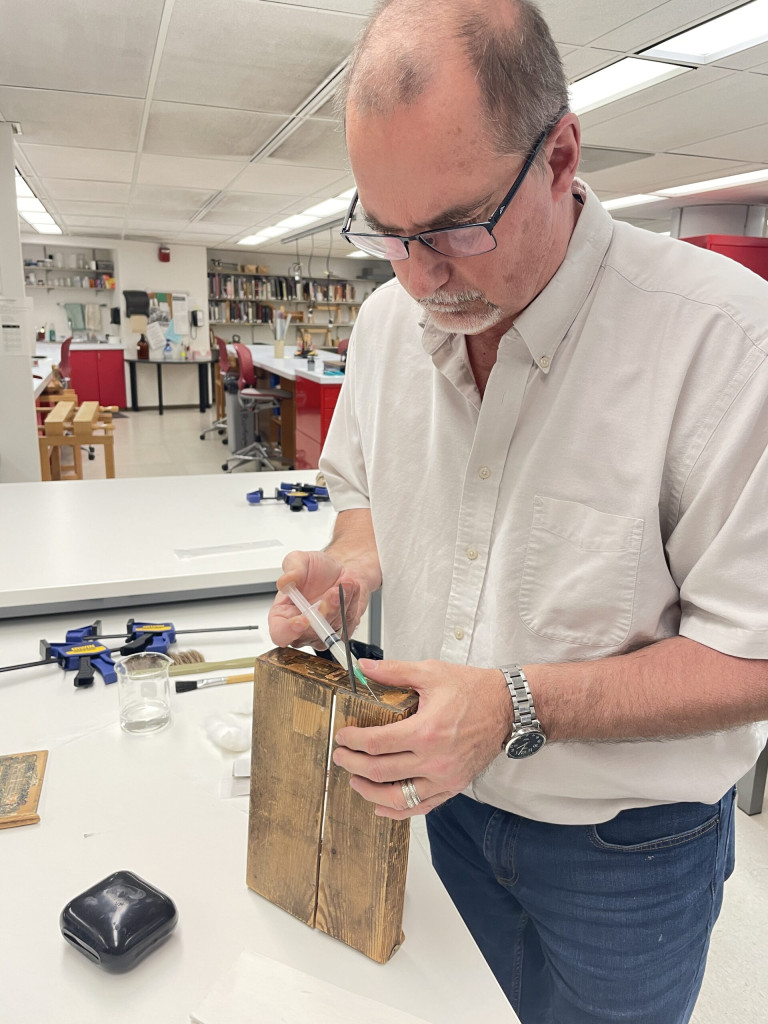
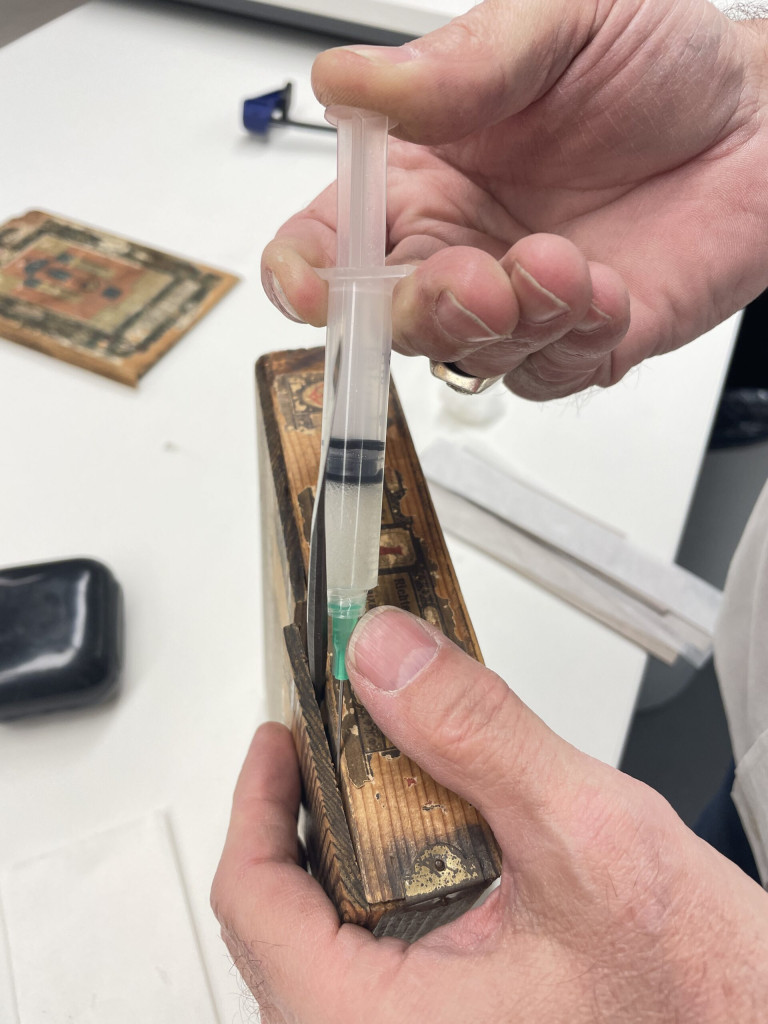
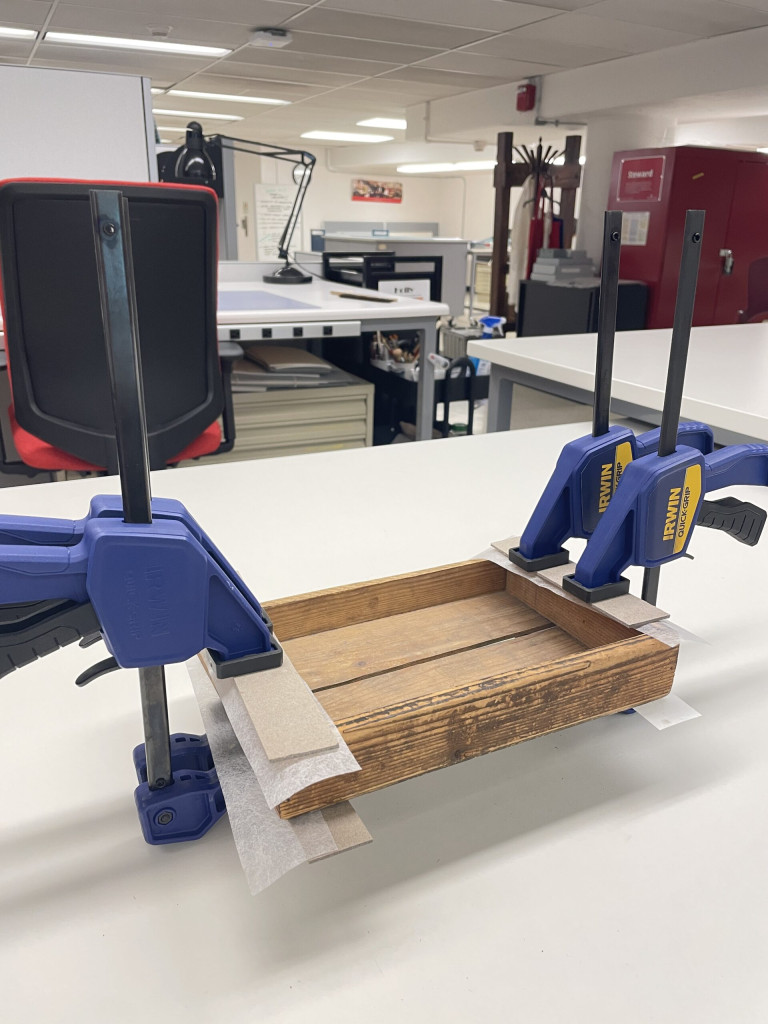
We’ve also used the gelatin to stabilze breaks in a wooden box originally used to house a Richter’s architecture game from the early 20th century.
Before TreatmentInserting fish gelatin with syringeClamping box during the curing process
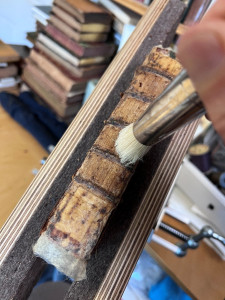
Jeff Peachey’ main use is to line spines. He’s found it not only has better adhesion than straight paste, but makes the spine feel slightly more solid and resistant to torsional forces
Applying fish gelatin to adhere spine linings
In the future, I imagine this gelatin would have excellent potential in media consolidation.
In all these uses, I couldn’t be more thrilled to not have to pull out my baby bottle warmer to set a beaker of gelatin on. As a result, there was no fuss in worrying about how long the gelatin was heated and if it was losing its properties due to heat.
Example of using a baby bottle or coffee warmer to re-heat pre-made gelatin during typical use
In terms of shelf life, the dried granules can be kept indefinitely like unmixed wheat starch paste. Once mixed, Jeff suggests that he’s found the adhesive properties hold up for about a week in the fridge; however, it does begin to smell fishy after just a day. So unlike wheat starch paste, if you’re adverse to the fishy odor, you’ll only want to make up as much as you’re planning to use for one day.
Supplier Info
Interested in getting your hands on some?
I found the product used at Weisman is no longer supplied by Norland – but I was able to track down what appears to be the same product through AJINOMOTO NORTH AMERICA, INC. If you’re interested in trying a sample, message Henry Havey, the Business Development Manager of Collagen & Gelatin at haveyh@ajiusa.com to request a sample of High Molecular Weight (HMW) dried fish gelatin.
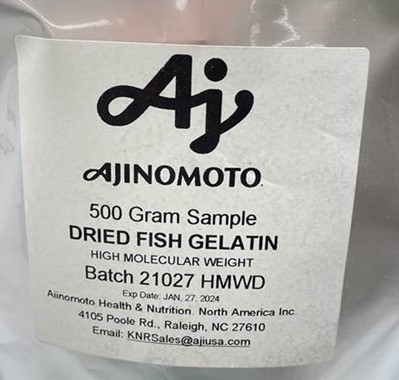
Fish gelatin sample acquired by the lab in a 500 gram sample bag
They provided me with a 500- gram sample at no cost and confirmed it was a Type A fish gelatin with a 0-bloom strength. Henry Harvey can also provide a pricing quote should you be interested in ordering a full supply which comes in 25 kg packs. They also provided the following product data info sheets:
While I still covet my isinglass cast films I created from boiling dried fish bladders, as well as our mammalian photographic grade type B gelatin, this HMW fish gelatin is a welcome addition I’ve added to my tool kit.
Ashleigh Ferguson Schieszer [CHPL] – Special Collections Conservator, Co-Lab Manager
Bibliography:
Dudin, M. The Art of the Bookbinder and Gilder. Trans. by Richard Macintyre Atkinson. Leeds: The Elmete Press, 1977, p. 51. (Originally 1772)
Foskett; An investigation into the properties of isinglass, SSCR Journal; The Quarterly News Magazine of the Scottish Society for Conservation and Restoration, Volume 5, Issue 4, November 1994, pages 11-14
Nanke C. Schellmann, Animal glues: a review of their key properties relevant to conservation, Reviews in Conservation, No. 8, 2007, pages 55-66
The Preservation Lab, a partnership to preserve and conserve the collections of the Cincinnati & Hamilton County Public Library and the University of Cincinnati Libraries, seeks applicants for a Conservation Assistant position.
The Conservation Assistant is a technician level position with on-the-job training that may appeal to emerging conservation professionals. This position will join a collaborative team of 7 full-time staff members, including conservators, a preservation librarian, technicians, student workers and volunteers to preserve collections from both institutions. The Preservation Lab staff consists of both Cincinnati Public Library and the University Library members. This position is a Cincinnati and Hamilton County Public Library position but is stationed at the University of Cincinnati West campus.
The successful candidate will demonstrate the ability to execute hands-on work with skill.
Founded in 1853, the Cincinnati and Hamilton County Public Library today is one of the busiest and most highly acclaimed library systems in the United States, providing service to over 800,000 residents through a network of 40 branch libraries, a major downtown Main Library, and a Distribution Center. CHPL holds one of the largest genealogical collections in the United States and many other specialized collections, most of which are housed in the Main library.
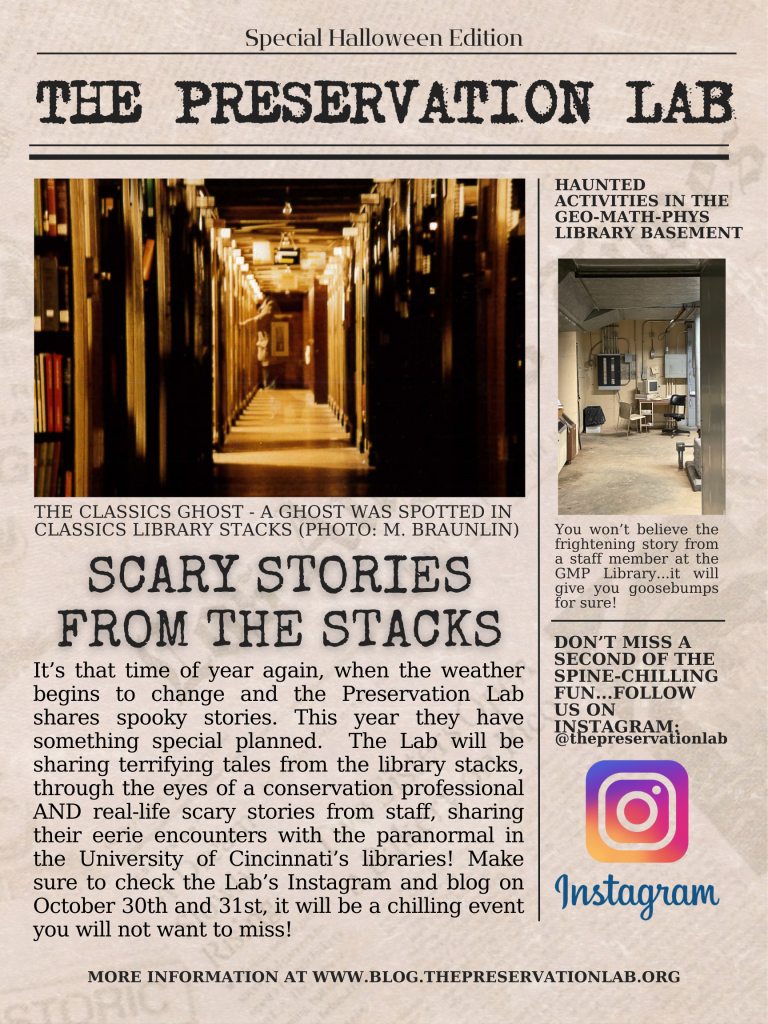
Every year the Preservation Lab celebrates Halloween with some fun, spooky and scary content, and this year is no different. However, this year we decided to reach out to our UC Libraries colleagues to hear about their encounters with the unknown, with the paranormal, and share with us any of those stories.
We received a few submissions that were downright spooky, creepy, and just unexplainable. So prepare yourself! Go ahead and settle in, grab yourself a hot chocolate, and cozy blanket and enjoy!! Hopefully you can sleep after this..
General spooky remarks from Mike Braunlin (Classics Library)
“Ghosts – Local lore is that the Blegen building [which is presently home to the Classics, CCM and ARB libraries] has some of them. In the Archives and Rare Books Department on the 8th floor, an apparition has been seen over the years. I read once that the Classics Department had its offices in that space years ago, and that the entity might be one of the professors of that time. I can add nothing to this story, but for years I became very uneasy whenever I had to visit our rare books in ARB and I am not usually bothered by such things. In later years, what used to invariably scare me when I retrieved a rare book was the life size photographic image of former UC president Nancy Zimpher that was placed in ARB’s stacks. They never moved it (something I would have done regularly), so I knew exactly where I would walk past it; but every time I did, it terrified me anew. But the image is now gone, and as I am also entering an age where I may soon number ghosts as my companions, I no longer fear those stacks. ”
The Ghost of Blegen Library by Kevin Miller
Published in Folkstream – volume 3, issue 3, December 1980 [courtesy of Mike Braunlin]
Cincinnati is a city steeped in tradition and folklore. Drawing upon a population of Eastern settlers, European immigrants, and Appalachian migrants, the Queen City has a varied heritage of tales and legends. Some of these, murder legends and ghost stories, have been around for the life of the city. But folklore is always being created and at least one ghost story is recent in origin: the ghost of Blegen Library.
Located at the south end of the University of Cincinnati campus, the Blegen Library is a large, rectangular structure built in 1930. Formerly known as the Main Library and then as the Old Library, the building was rededicated last year in honor of Carl Blegen, an early Classics professor at UC In the cavernous foyer, sculptures and bronze panels depict the heritage of learning while the chandeliers exhibit proverbs in bronze silhouettes, proverbs in Egyptian hieroglyphics, Hebrew, Chinese, Latin, and Japanese which extol the virtues of education. Printers marks, the trademarks of famous publishers in the history of the printed word, decorate the high walls and stairwells. Blegen Library has a scholarly demeanor, but is at the same time a stuffy, forbidding place.
I remember my years as a graduate student at UC, trying to negotiate the confusing stairwells, the maze of book stacks and small rooms. Some of the book stacks were located ‘underground and in the summertime, the dankness and humidity would assault me like a warm sponge. I often expected to come upon one of those career graduate students which infest every library, hiding in his carrell, his hair turned white and eyes pink from years of little sunlight, turning to me with a small, tubercular cough.
Image provided by Mike Braunlin
Atop the library is the Rare Book Room, a secluded area set off from offices, classrooms, and reading rooms. It is a dark room kept at a constant cool temperature and even humidity to preserve the volumes. Little drafts of air waft around theological tomes and travel accounts, in between shelves of poetry and stacks of folios. In 1976, while l was a students at UC, a student worker was shelving books in the Rare Book Room, alone in the quiet gloom, Suddenly she felt a chilling presence and turned to see a man in the stacks beside her, a rather innocuous and shadowy man who had instantly appeared.
Terrified and breathless, she rushed downstairs leaving her work unfinished. Soon her tale of a ghost quickly spread across campus and I heard about it for the first time. Since then, the story of what the student saw has circulated around Cincinnati.
An informal ghost investigation was conducted for her by a UC professor but the spectre did not reappear. Some versions have it that the man was wearing a gray suit and glasses, others that he was short and smoked a pipe, Some folks believe it was the ghost of a former Classics professor who suffered an untimely and tragic death. His office had once been in the room where the rare books are now housed, and it happened to be near the spot where the ghost was encountered. Be that as it may, the student forever refused to return alone to the Rare Book Room for as long as she was in the library’s employ.
Since I’ve come back to UC as an archivist in the Special Collections Department, which houses the Rare Book Room, I’m often asked by friends and acquaintances about the ghost and in turn I listen to what they have heard. Folklore is a dynamic process, always being generated and always changing. Legends are created all the time and spread by word of mouth. Whether there truly was a ghost of Blegen Library or not, its story is becoming a part of Cincinnati folklore, an example of the creative process in folklore.
Today, there are no offices or reading rooms in Blegen Library. The building is being renovated and the sounds of welding torches and drills have for a time replaced the echoes of students’ footsteps on marble stairs. The bronze panels and chandeliers and printers marks will survive the renovation. Perhaps the ghost will too, patiently awaiting another visitor.
The Haunted Basement under the Geo-Math-Phys Library by Anonymous
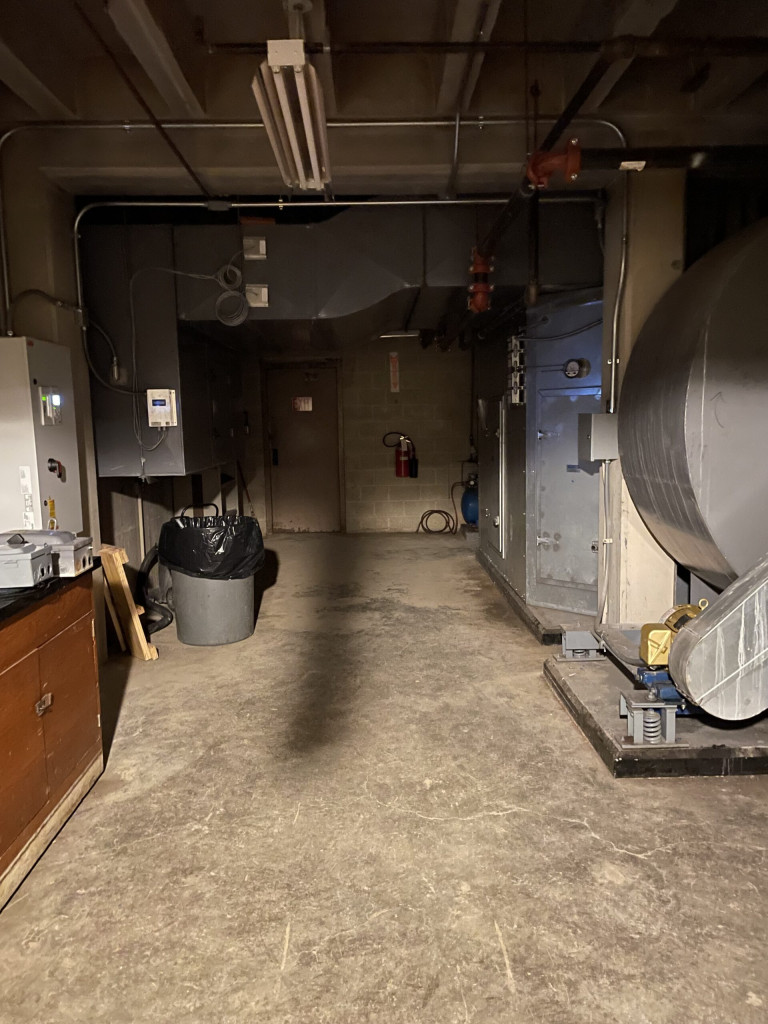
View from the elevator
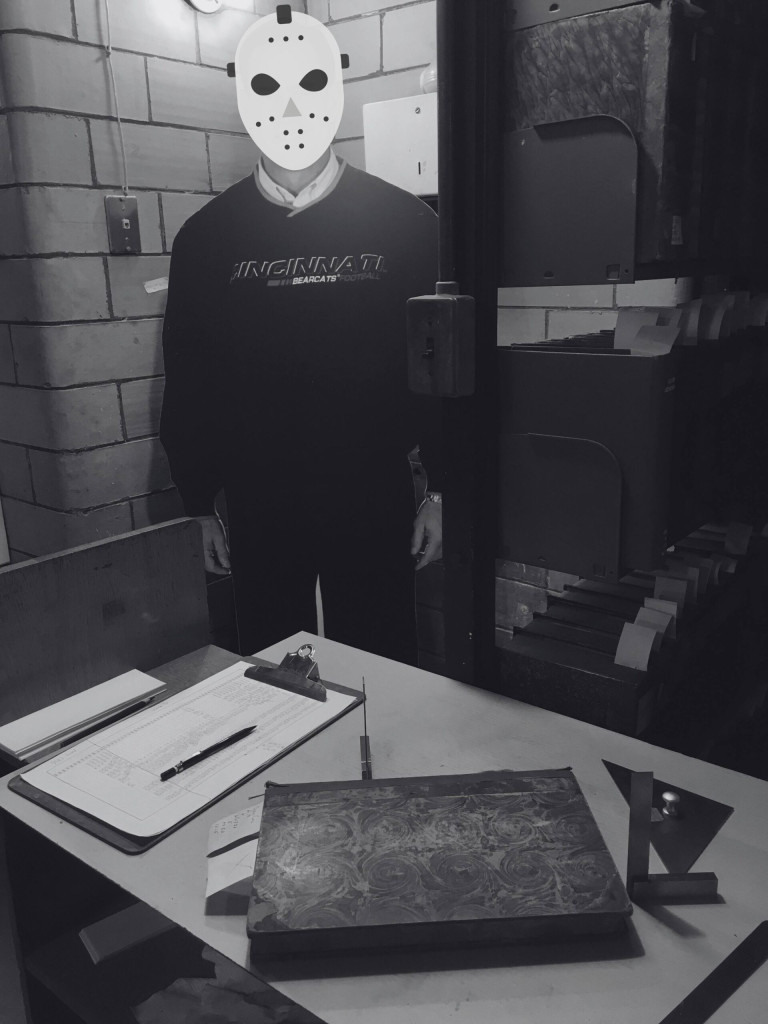
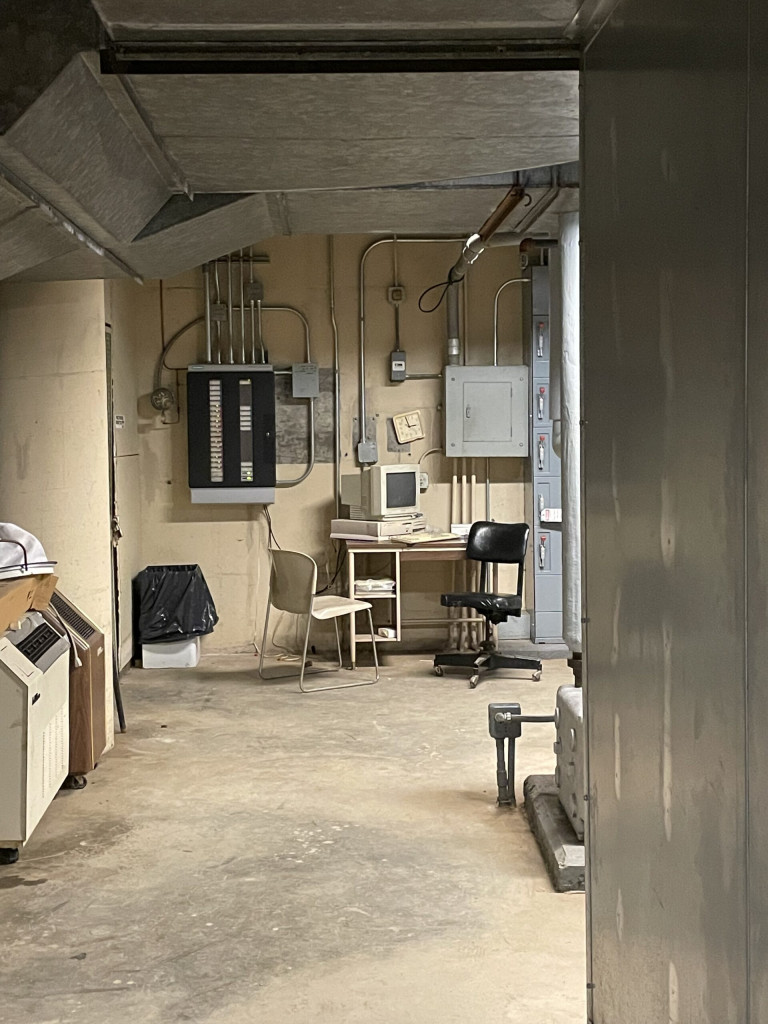
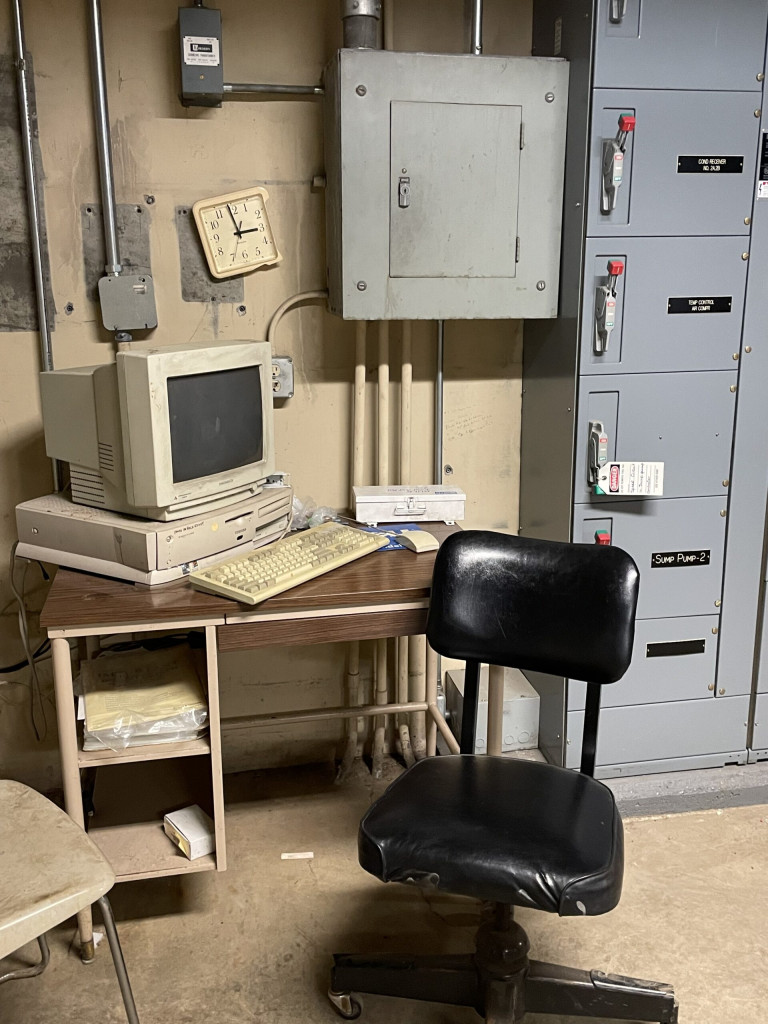
“There’s an urban legend here at GMP that long ago, a maintenance man accidentally died while trying to fix the service elevator. Now he haunts the GMP library and particularly can be spotted in the basement underneath GMP. One day I was teaching one of my coworkers how to use the service elevator and we decided to explore the basement since neither of us had been down there before. When we reached that floor, it was completely pitch black before we turned the lights on, meaning no one else was likely down there. As we walked in, we turned the corner and saw a very old work-station. At that station was an office swivel chair that was slightly turning all on its own. When it stopped, the seat pointed directly at us (almost as if someone wanted us to sit in it). We were both freaked out and decided to leave before exploring more. I have been down there a few times since then and luckily haven’t seen any more activity.”
View of the work-station around the cornerTHE desk!
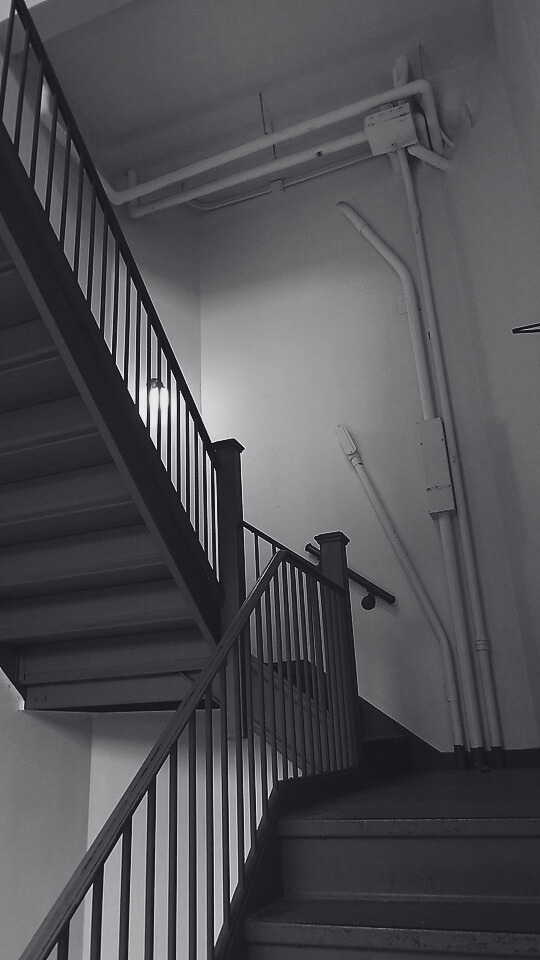
The Haunted Stairwell by Mike Braunlin
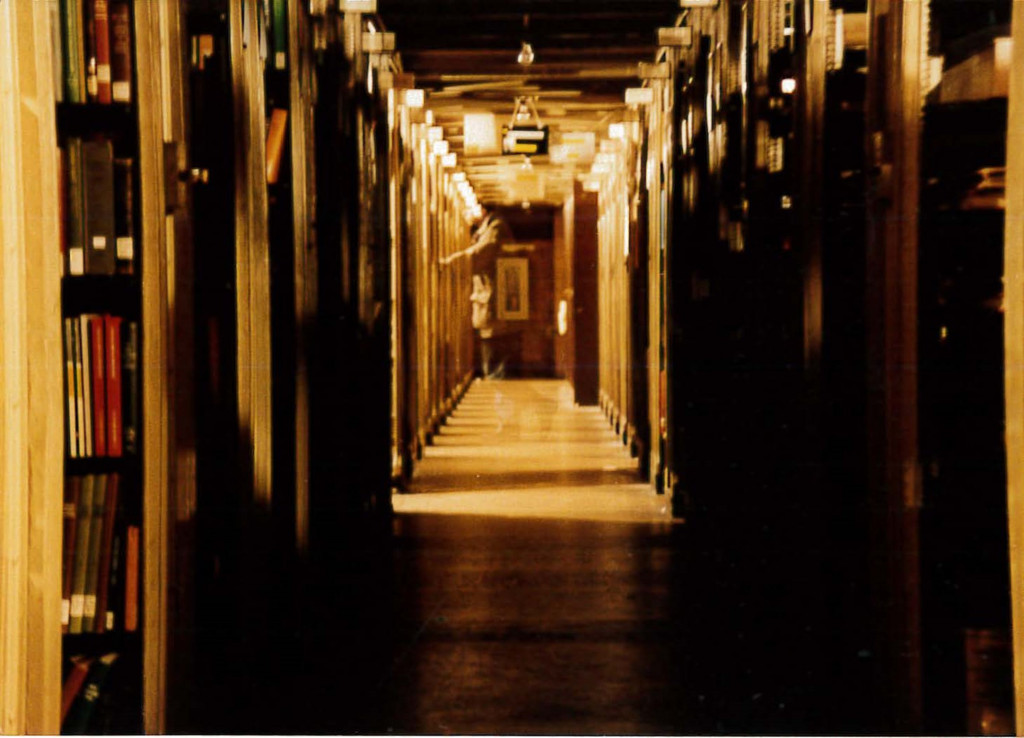
“Over the years, however, student assistants have told me they are uncomfortable working on the fourth floor of our Classics stacks. No one has ever reported to me anything extraordinary, but some have told me that something there made them fearful. Some students would go to great lengths to avoid working in stacks 4 and several downright refused to go there. It is most curious that the stacks photo with the shadowy figure was taken on the fourth stack level in the area where students have reported eerie sensations.
I only experienced one unusual incident and I offer the bare telling of it; I put forth no conclusions…
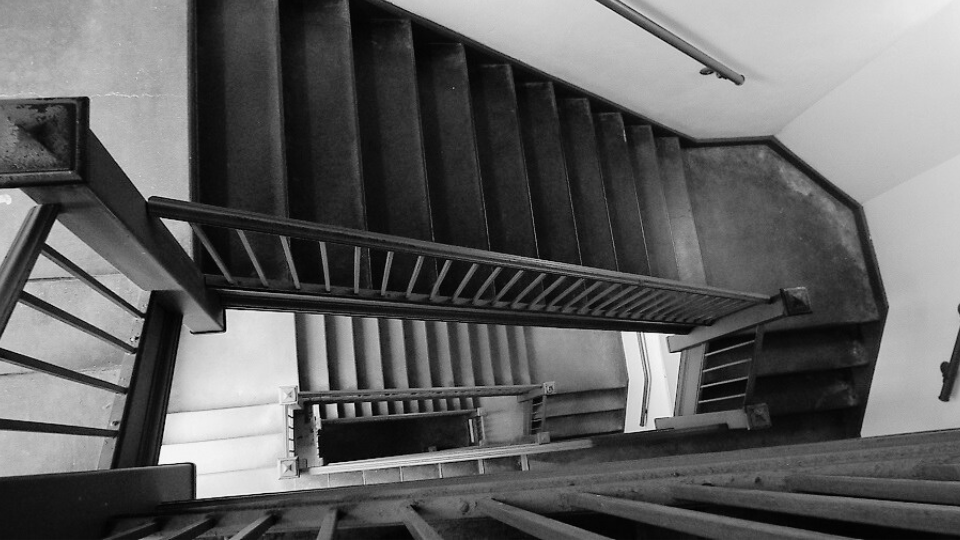
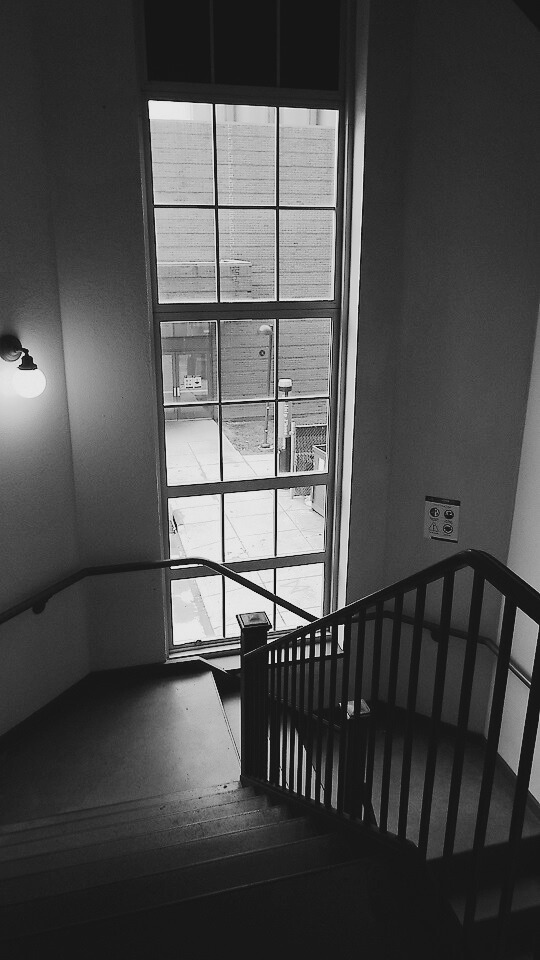
Ca. 45 years ago, when I was younger, energetic, and dedicated, an inability to stay asleep often led me to go to the office early – I often came to work in Classics around 5 AM mornings. I also didn’t have to sign in and out, as now on Flex, so I could get away with that kind of thing. One winter morning (some would call it late-middle of the night) I had entered the north stairwell of Blegen from the 4th floor to walk down to level 2, where the Classics Library was in those days. I was about halfway down the stairwell, which was in darkness, but for the moonlight shining in the windows, when the entire stairwell (all levels) erupted with the noise of dozens of people talking and laughing all together.
Image from Mike BraunlinImage from Mike Braunlin
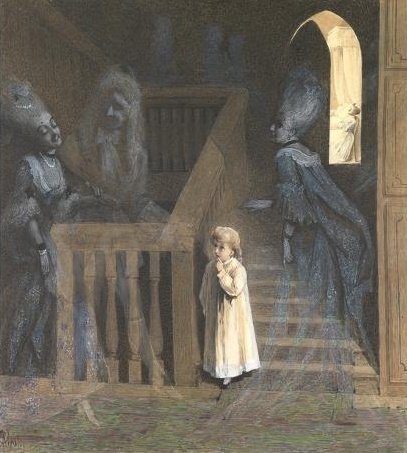
Illustration entitled “The Party on the Stairs” by British painter Adelaide Claxton from 1875
Imagine, if you will, a cocktail party going on in the stairwell, full of people, all talking and laughing at once – all around me. Except there was no one there. I stood there in the darkness, desperately tightening my sphincter muscles and taking in the unreality of this, until I bolted up the stairs, out the front door, and ran to the Majestic Apartments on McMillan, where 2 of our student assistants lived, Claire Sponsler and Susan Stites. I banged on the door and when they, full of sleep and surprise, let me in, I explained what happened, and lay on their couch until 8 AM, then I went back to work. Nearly scared the crap out of me, hence my sphincter reference several lines up, but I am glad for the experience. Also glad, because, 45 years on, Susan and I have been married for 33 years…”
Per our annual Halloween tradition, we have some spooky happenings planned next week. This year we have ventured into the stacks to bring you some spooky stories, so make sure to check the Lab’s blog and Instagram on October 30th and 31st, if you dare!
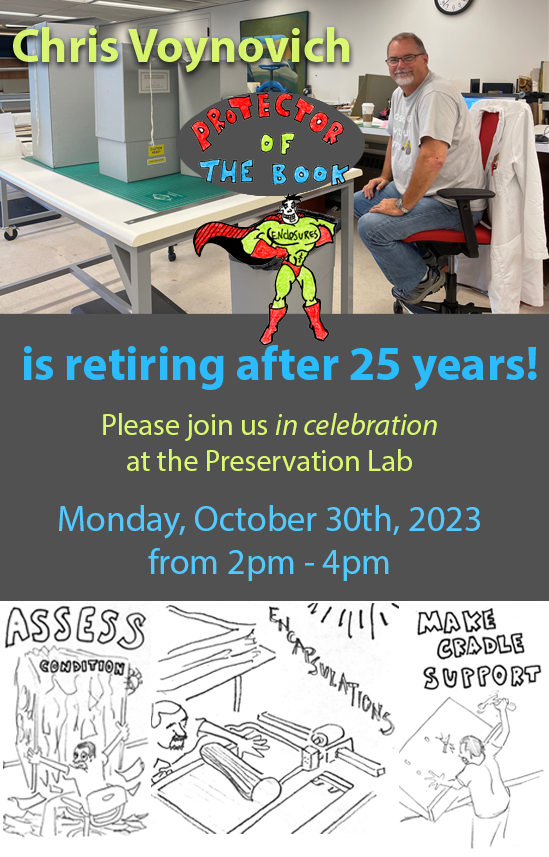
Congratulations are in order! We are happy to celebrate with our lab colleague, Chris Voynovich. After 25 years at the Public Library, Chris is retiring to a lovely beach house in Florida.
Chris first began his career at the library working in Shipping and Receiving. He then transitioned to Cataloging and Processing where he began his journey in material repair. He was a quick learner, able to utilize hand skills from his personal experience in metal work, graphic design, drumming, and matting at a frame shop.
Since 2011, Chris has grown his skills to preserve a WIDE variety of materials at the Preservation Lab. Chris has…
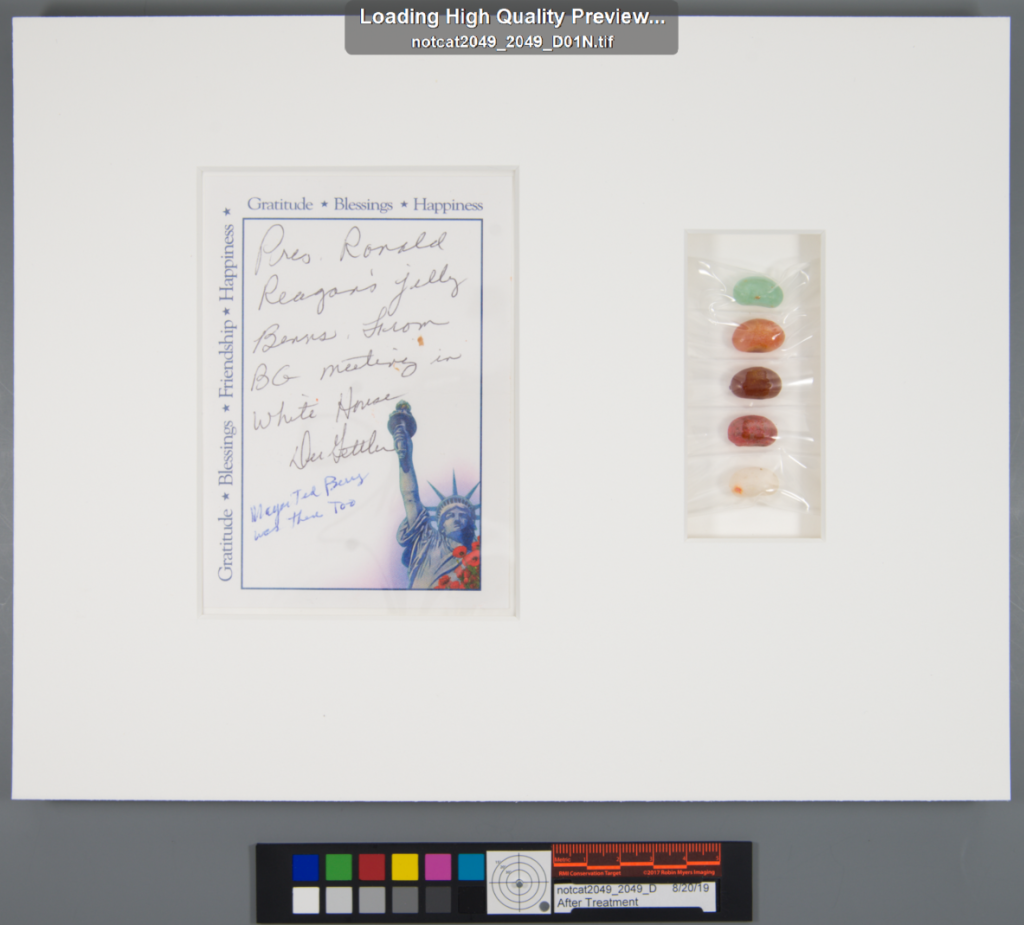
matted Ronald Regan’s jelly beans (see image below),
While he brought many skills with him, such as an ability to cut oversized mats, solder and work with metal files, his treatment skills have grown from general collections conservation to the treatment of special collections – with interests in leather, scrapbooks, and making clasps for medieval books. Treatment aside, Chris has held the esteemed title of Box-Maker Extraordinaire.
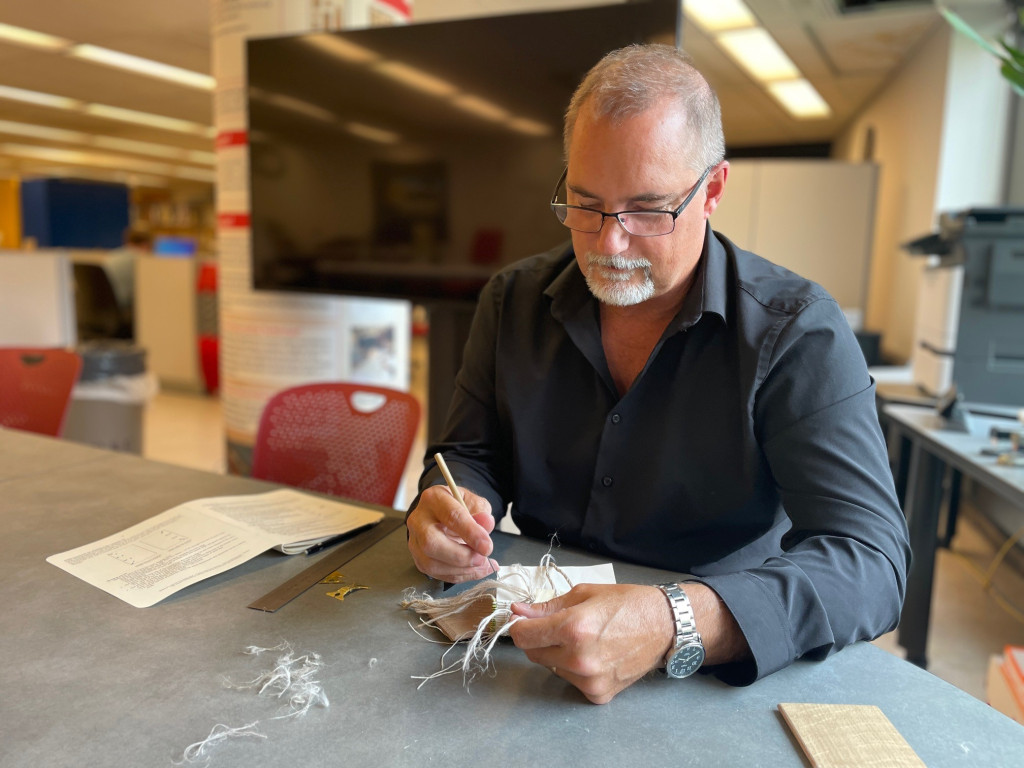
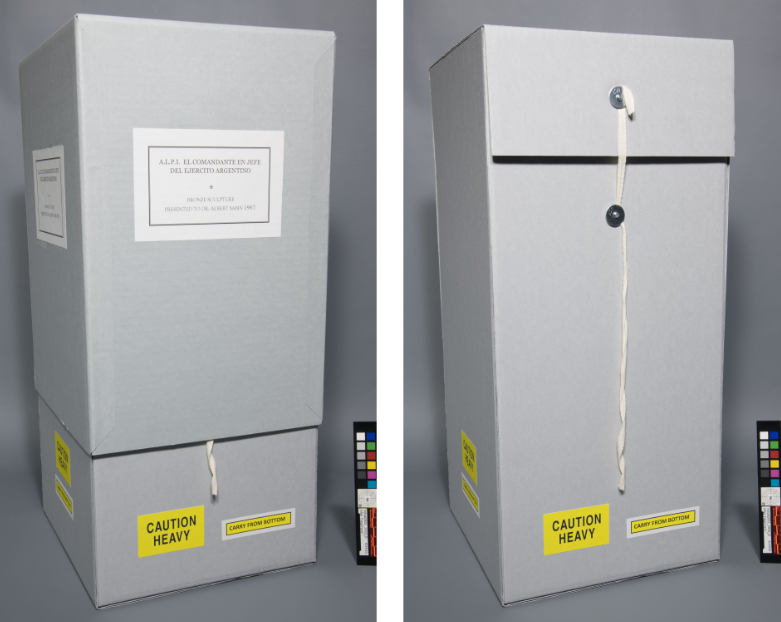
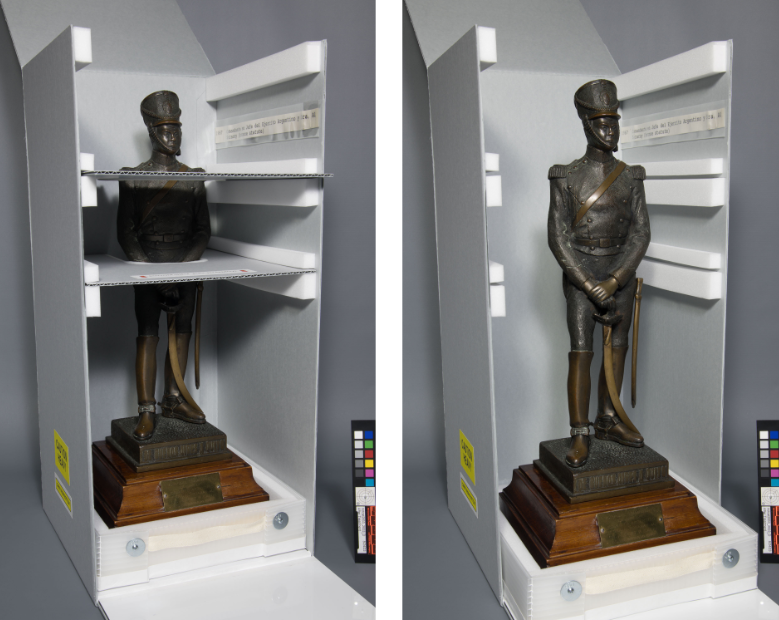
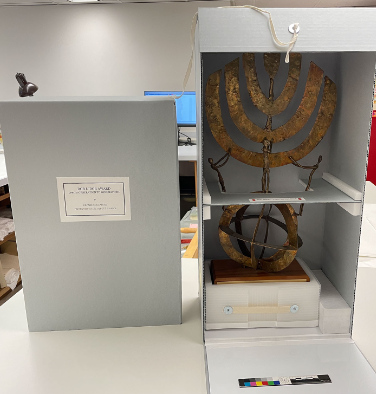
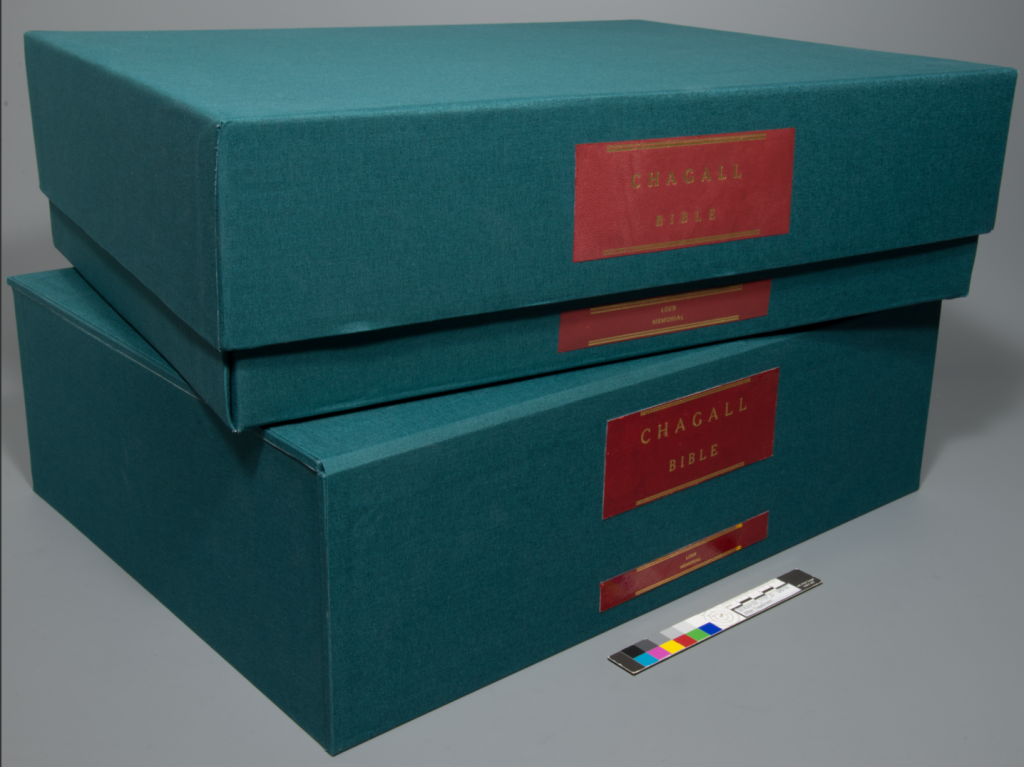
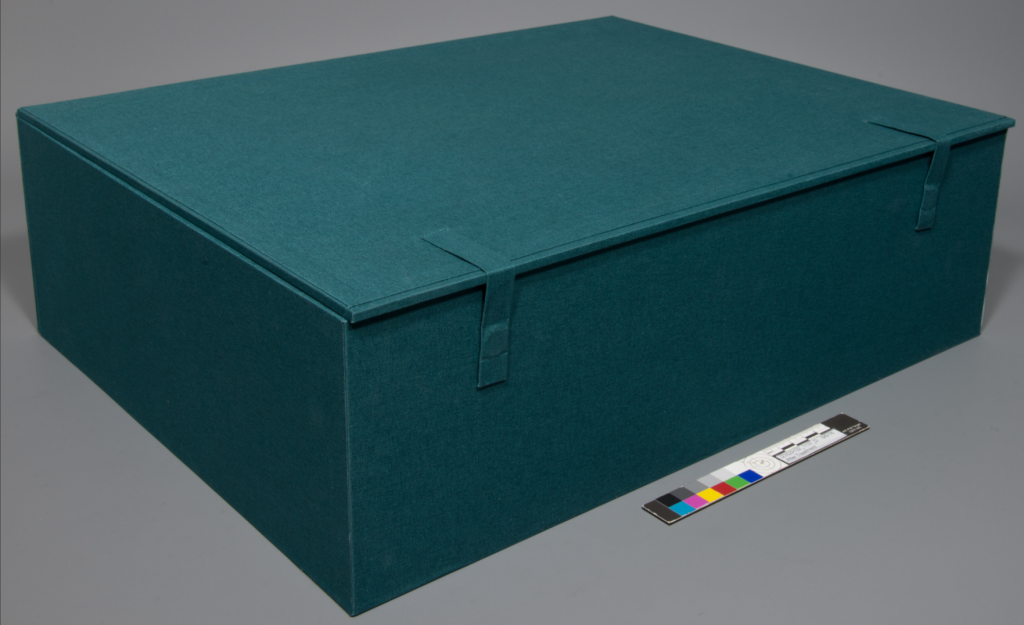
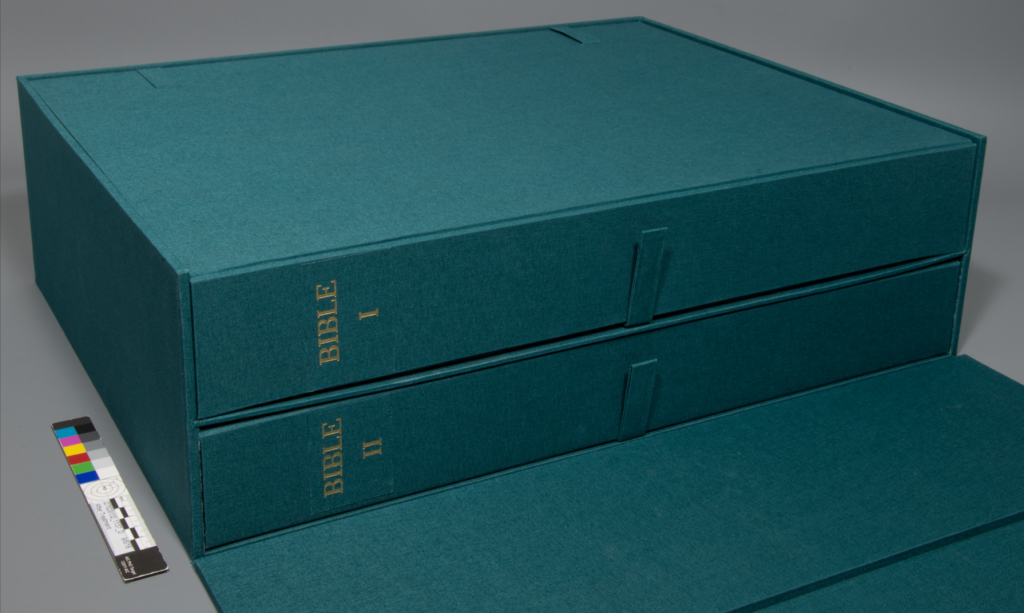
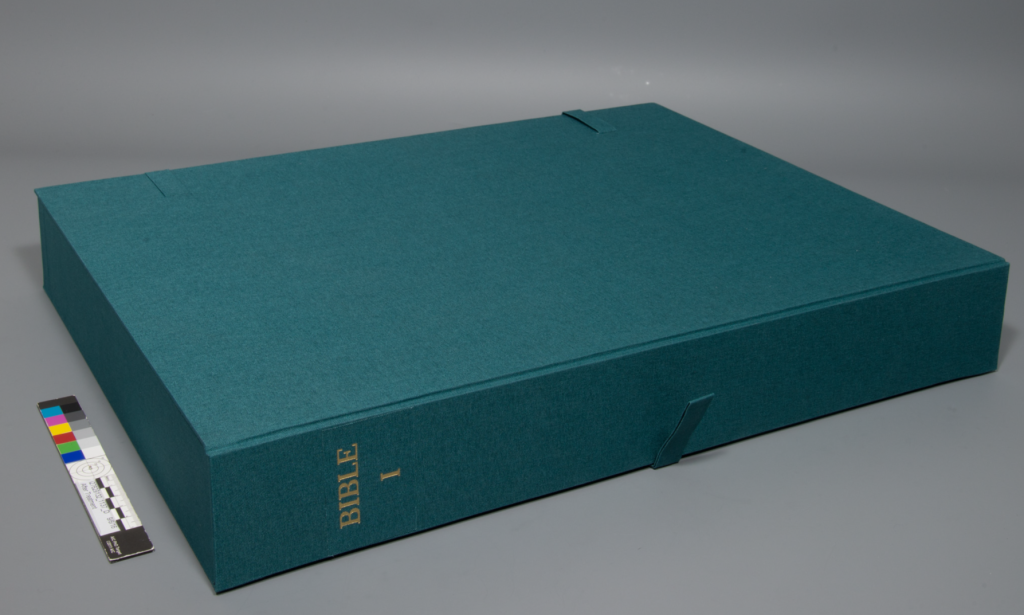
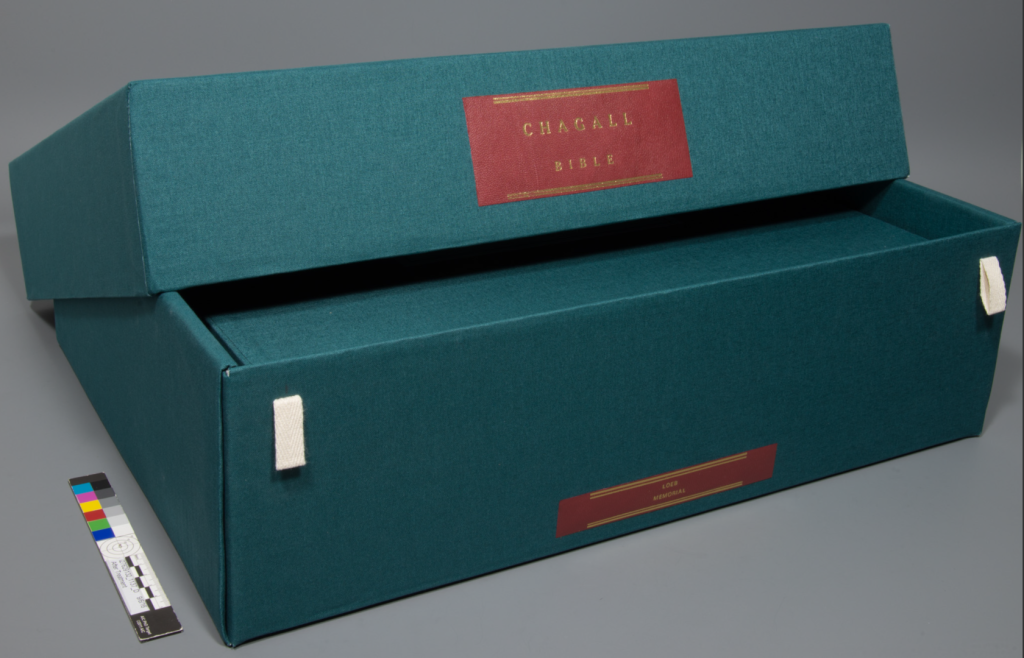
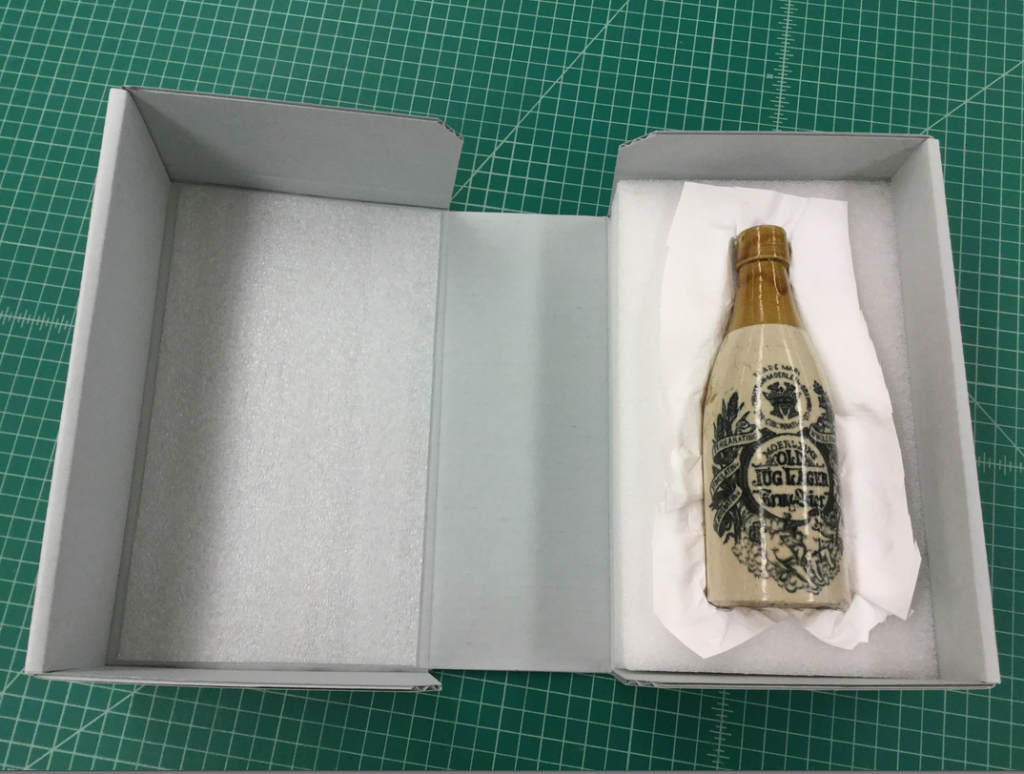
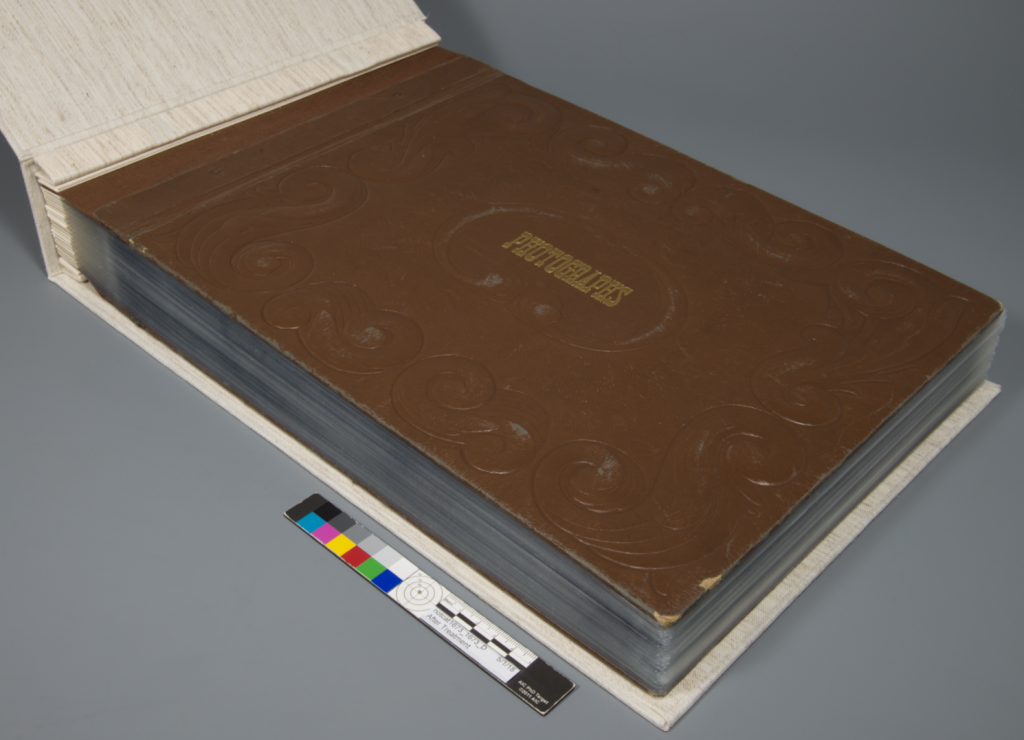
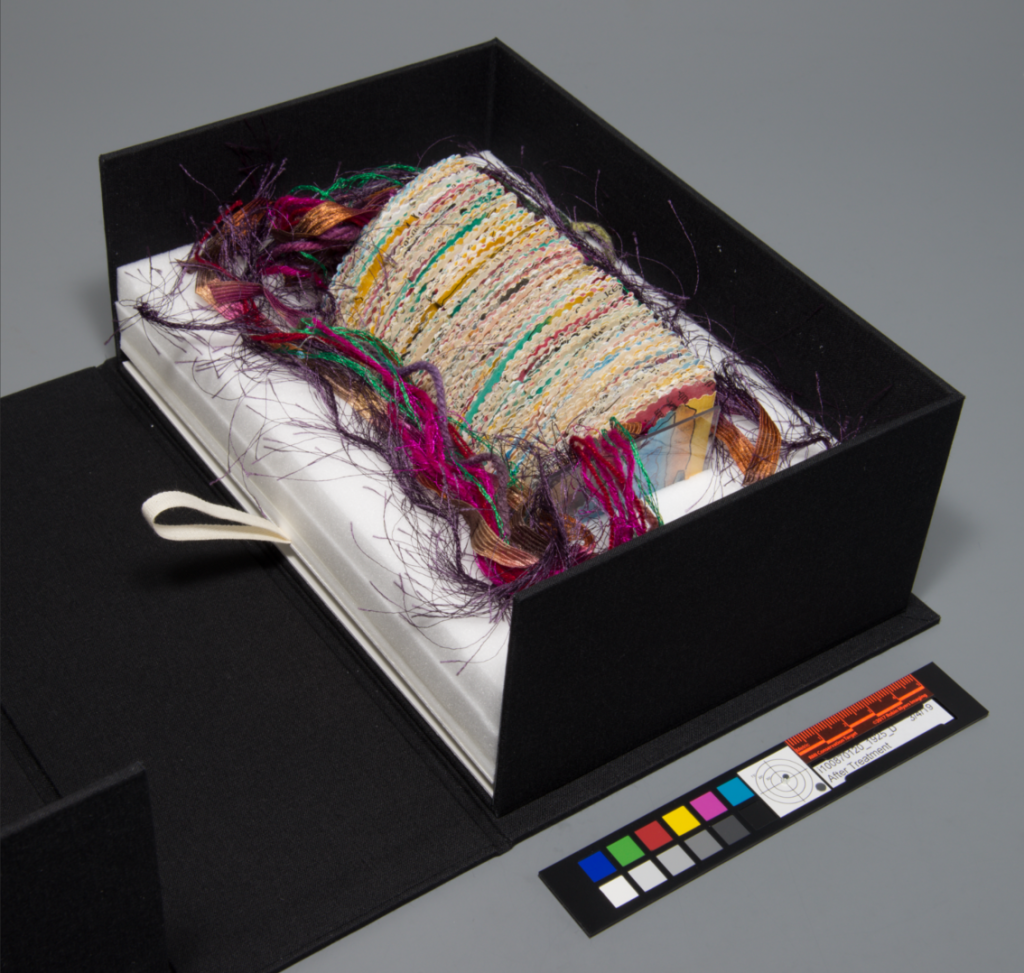
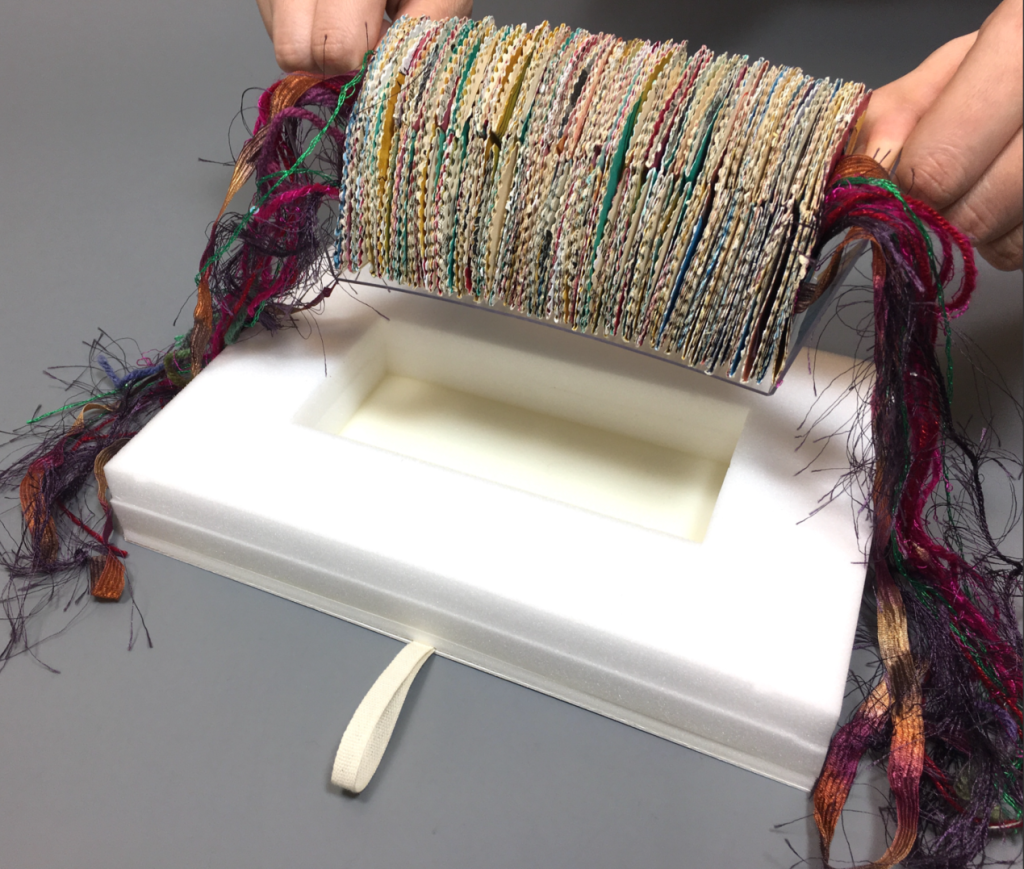
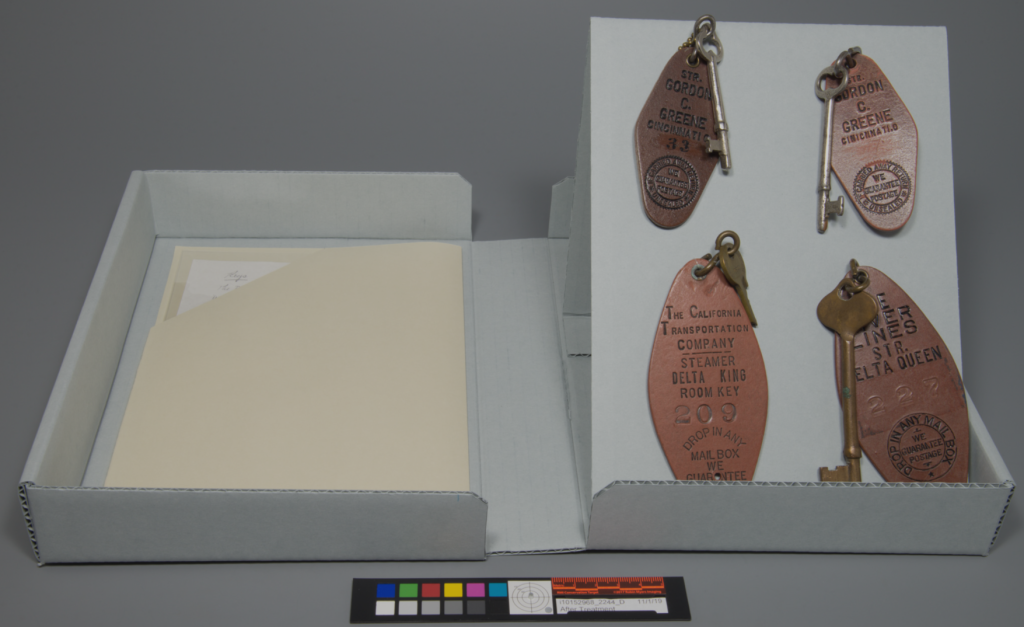
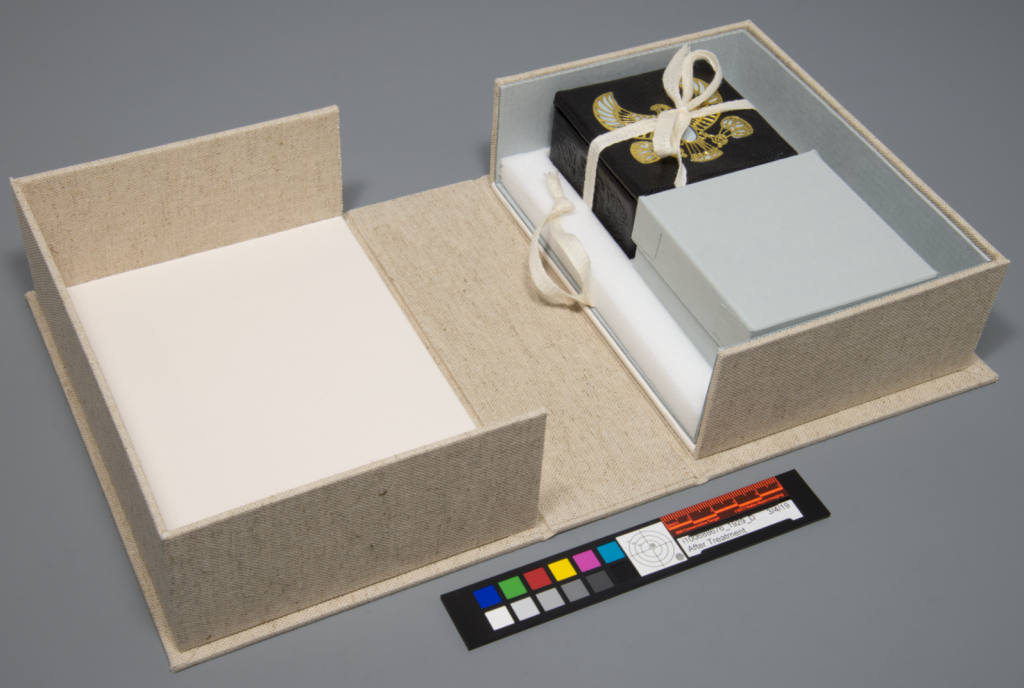
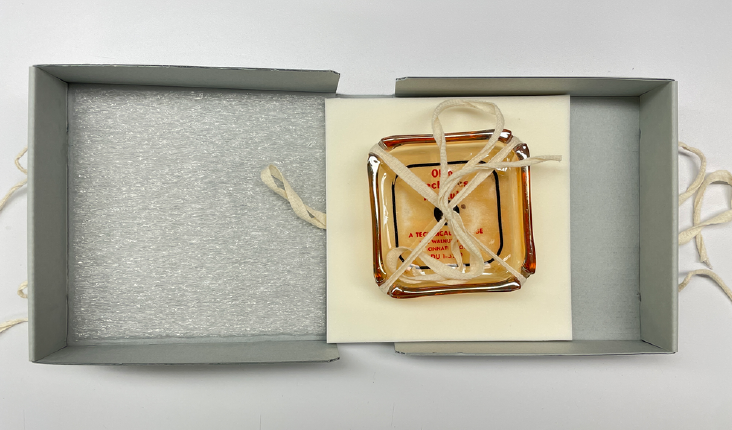
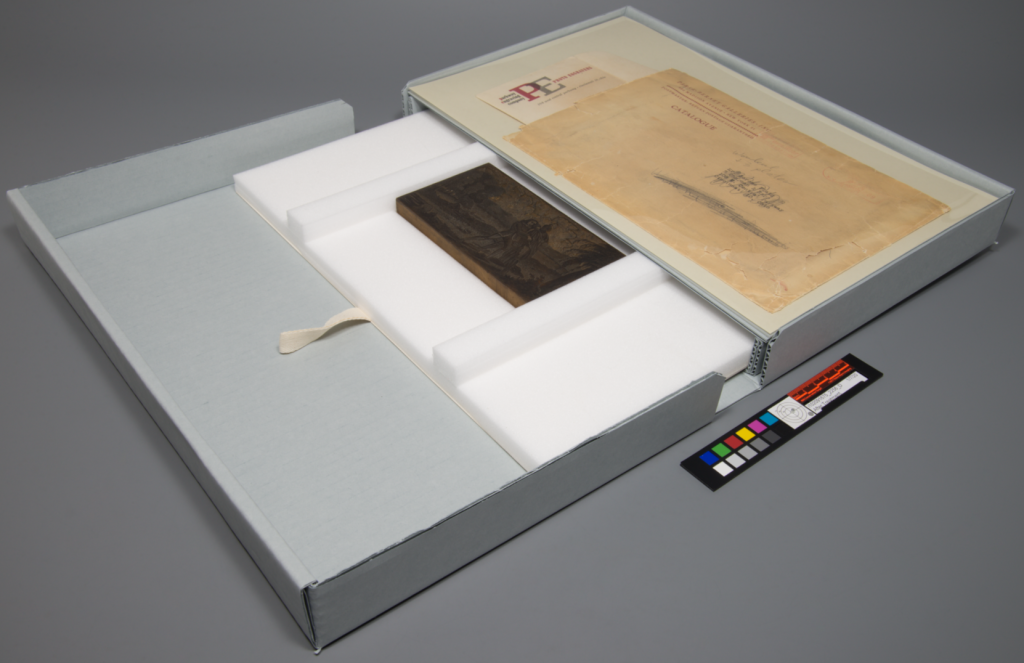
Known for his engineering feats, a few of Chris’ masterpieces can be viewed below:
As you can see, we will miss Chris’ can-do attitude when faced with any challenge. His positive outlook, efficiency (no one makes a box as fast as Chris!!), cartoons and dad jokes will especially be missed, but we are so happy for the new adventures that await him.
Please join us in celebration on Oct. 30th! RSVP to ashleigh.fergusonschieszer@chpl.org.
Ashleigh Ferguson Schieszer [CHPL] – Special Collections Conservator, Co-Lab Manager
Recently Jessica and I started working on a series of special collection items from UC Libraries’ DAAP Library. These were recent acquisitions specifically bought to be used as a teaching collection within the DAAP Library. Most items are small prints and single manuscript leaves that need to be matted for exhibition and prepared for handling during class. We have been working on these in small batches since it is a much larger collection that keeps growing.
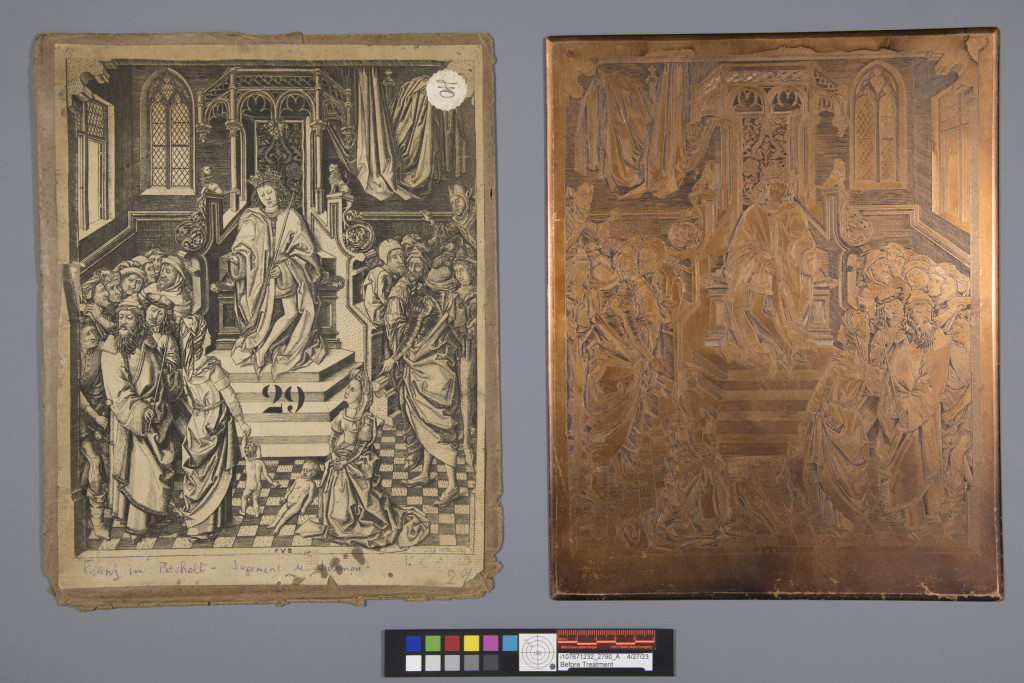
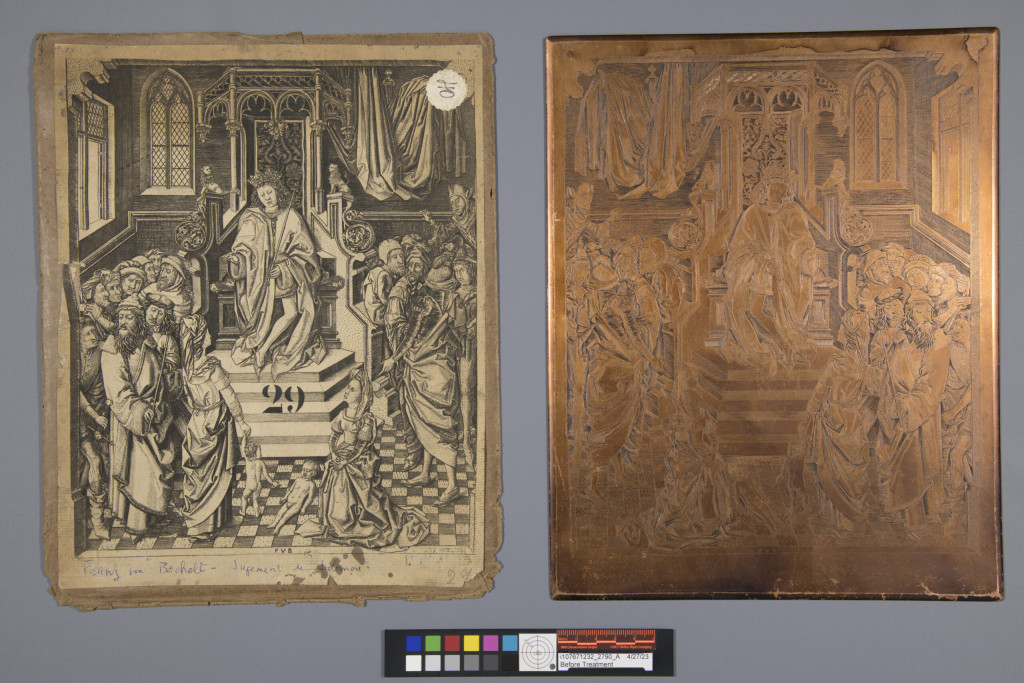
Most of the items we have received so far have been very straightforward matting projects, however we encountered one that was puzzling and fun to work on. We received this item: a proof print accompanied by its very heavy, copper engraving plate. The print was adhered to a paper brown envelope with no information and the copper plate was also unhoused.
Proof print (left) and engraving plate (right) before treatment and housing.
The curator of the collection wanted both items to be housed together and housed in a way that would allow students to touch the items, and also be able to use them for exhibits. We decided that both items would be matted individually, and then housed together in a thin corrugated clamshell box. The most challenging part would be to create a matting system that was strong enough to secure the very heavy copper plate and elegant enough to be used for exhibition.
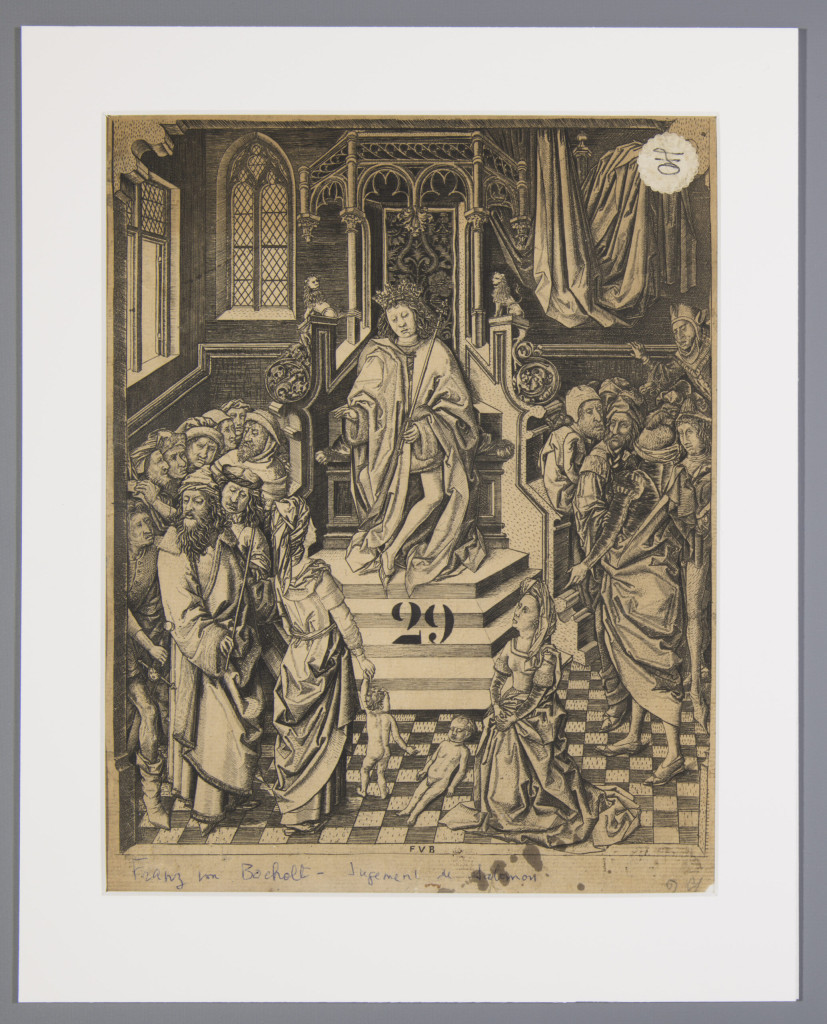
The print itself received minor treatment, with the backing envelope being removed and the print housed in a polyester L-sleeve mounted with photo corners.
Print housed in a polyester L-sleeve and matted with photo corners.
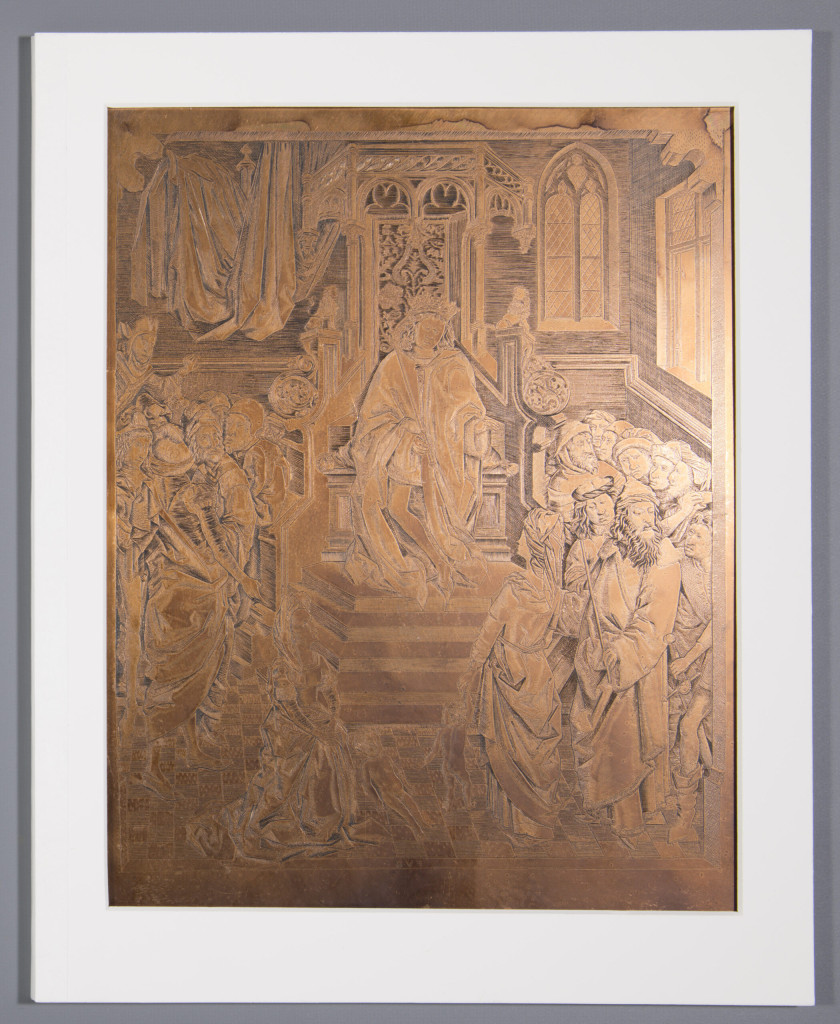
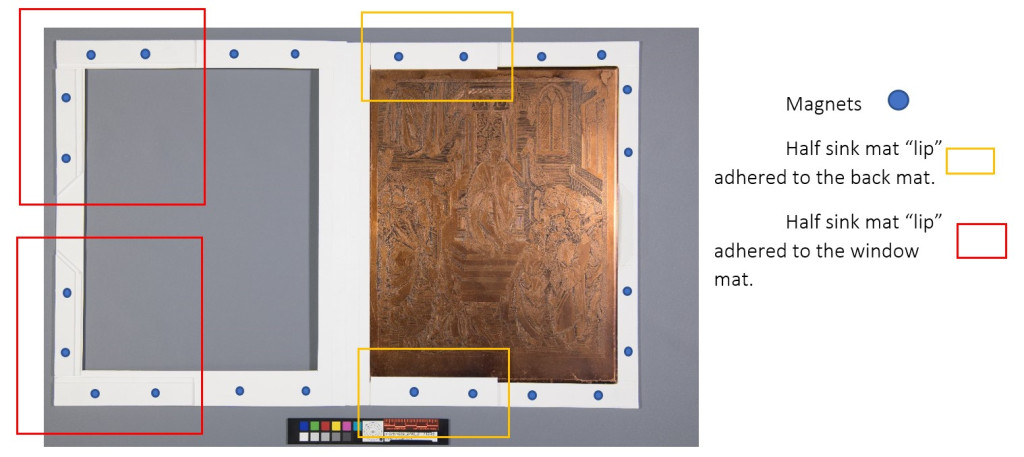
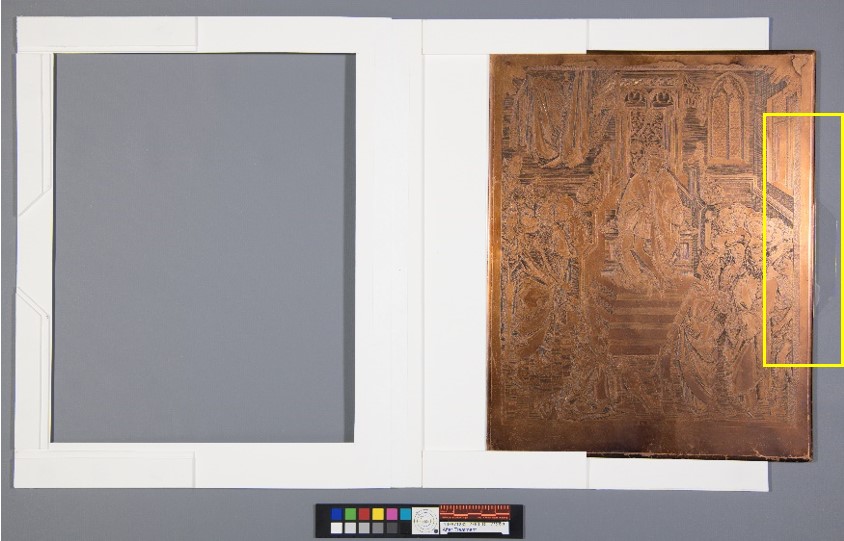
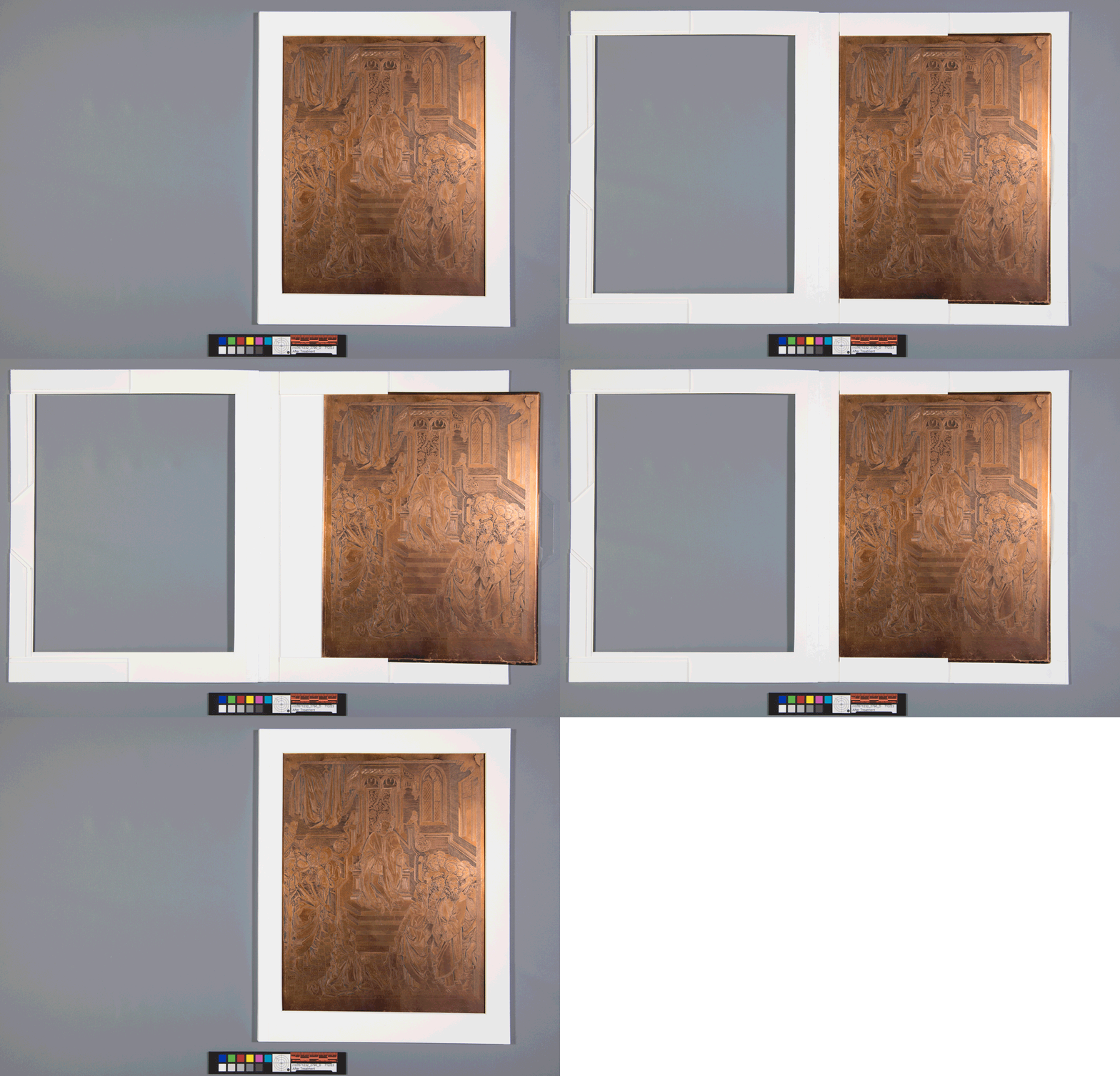
With the engraving plate, I needed to figure out how to create a matting system that was strong enough to hold the copper plate in place, especially if used for an exhibit where it may be propped at a slight angle. After considering some options, I created a sink mat that would secure the plate halfway, and then the rest of the sink mat would be adhered to the window mat so the copper plate, resting on a polyester tray, could be pulled out of the mat easily. How would I keep the matting system closed? ….with magnets, lots of magnets! For this project I used 24 rare earth magnets.
Copper engraving plate housed in a specialty sink mat with magnetic closures.Matting system for the copper plate – a sink mat, half attached to the back mat and half attached to the window mat, all secured closed with magnets.Copper plate slightly removed from the matting system by the polyester film tray.
This was a fun project to work on. After using 24 magnets and breaking a few in the process, the copper plate was securely housed in the sink mat, while also able to be propped up for exhibition and handled for teaching.
Before treatmentAfter treatmentThe matting system in action!
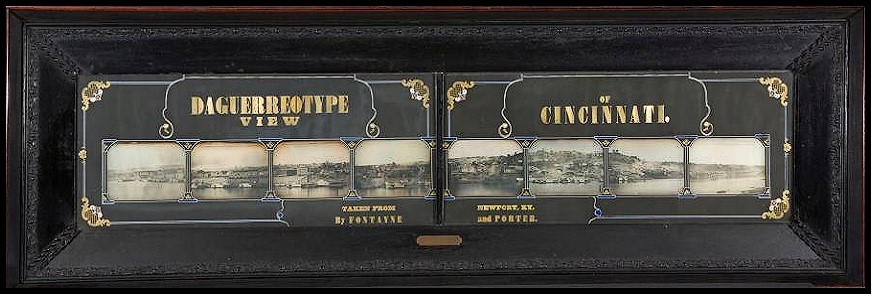
As conservation professionals at the Preservation Lab, we get to see and work with our fair share of historic, rare, and just plain interesting artifacts. I recently had the pleasure of becoming familiar with an item that is all 3 of these, and just so happens to be one of The Cincinnati & Hamilton County Public Library’s (CHPL) most prized possessions: the Fontayne and Porter 1848 Cincinnati Panorama Daguerreotype.
Cincinnati Daguerreotype Panorama by C. Fontayne and W. Porter, 1848
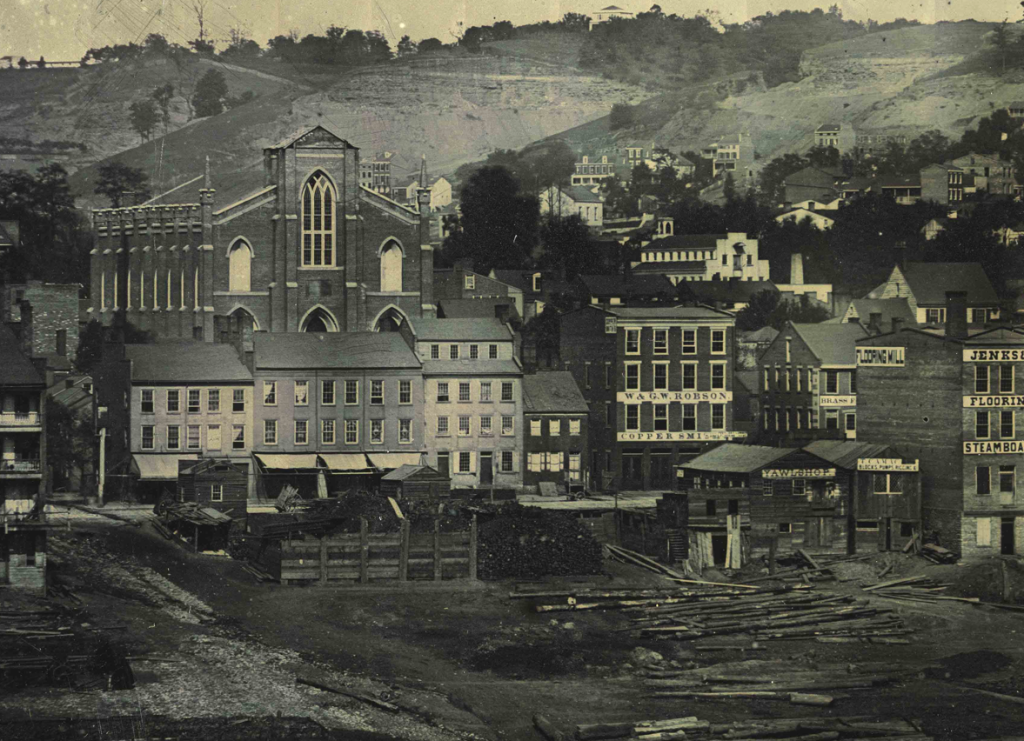
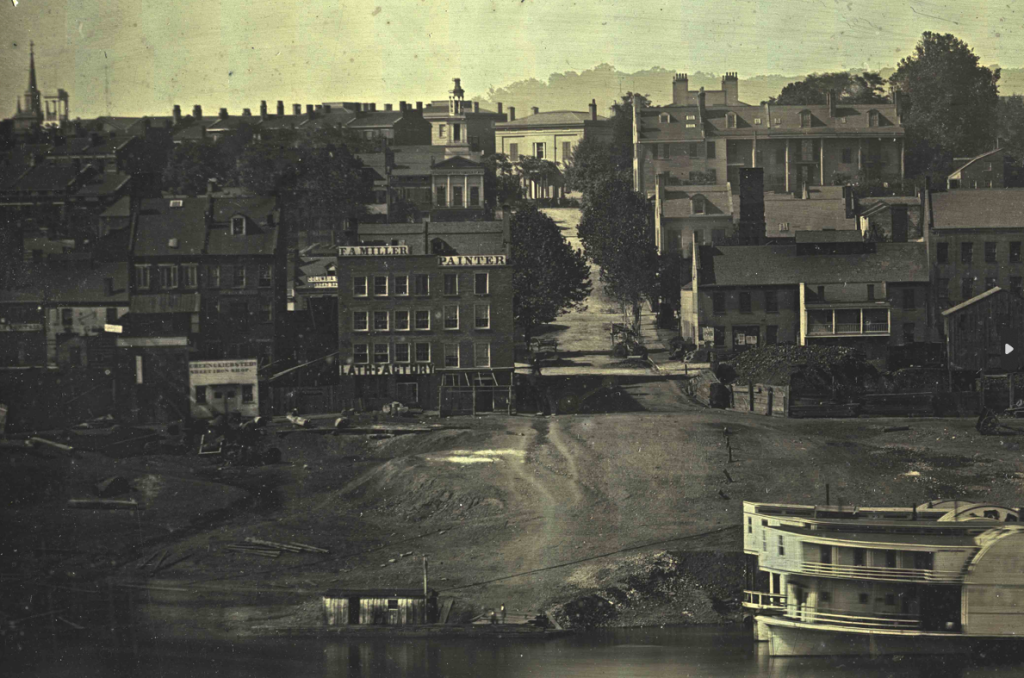
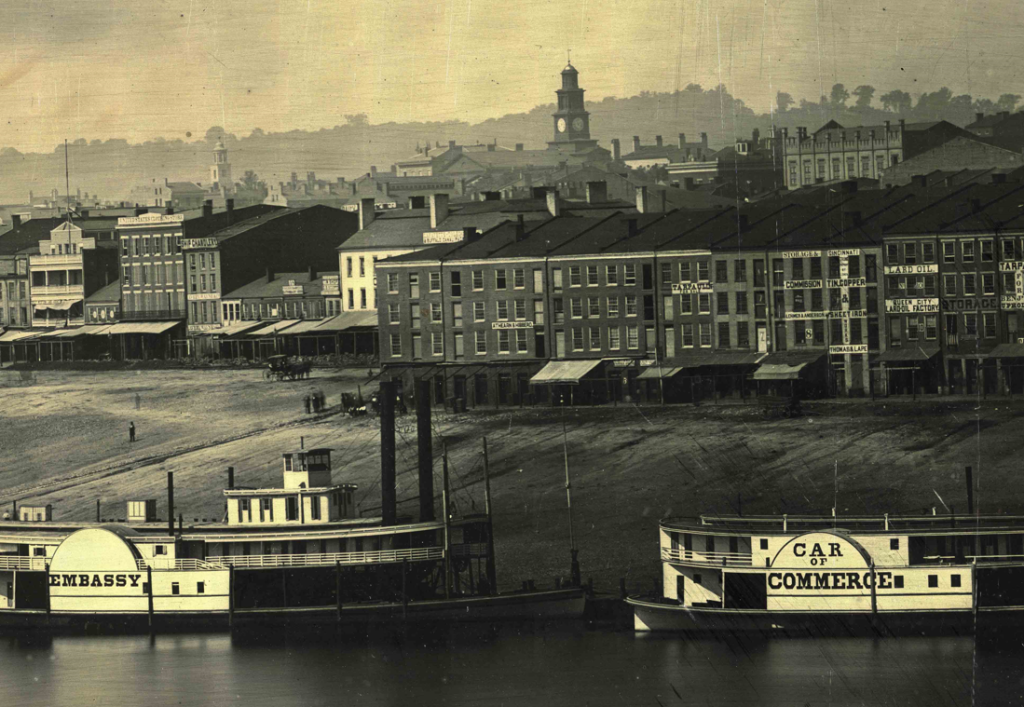
For those who are unfamiliar, a daguerreotype is the very first photographic process, utilizing iodine-sensitized silver plates and mercury vapors, often offering stunning detail and resolution. Currently on display in the downtown Main Library’s Cincinnati Room, the Cincinnati Panorama is no exception, and is considered one of the most detailed and vivid examples of daguerreotype photography currently in existence.
CHPL panorama plate 5 detail
CHPL panorama plate 4 detail
CHPL panorama plate 2 detail
Daguerreotype photography is not without its challenges, however. Most significant of these (at least which concerns us in the conservation field) is that daguerreotypes are extremely delicate. They scratch easily and can degrade with simple exposure to oxygen, atmospheric pollutants, and moisture. These attributes bring up a difficult question: how does one display an item like this, while also ensuring its preservation for generations to come?
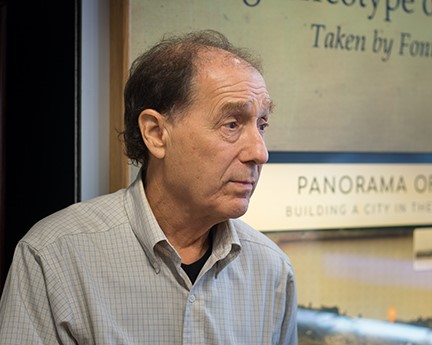
Enter Ralph Wiegandt. Wiegandt is a Photograph Research Conservator who designed and installed the 1848 Cincinnati Panorama’s enclosure and display case in 2008. He routinely has performed on-site follow-up consultations in 2012, ’14, ’16, and most recently this past June with Genealogy and Local History and Preservation Lab staff. My fellow lab mate, Hyacinth, and I had the good fortune to also meet with Wiegandt on this recent visit to attend a presentation on his uniquely designed enclosure. Although the primary purpose of the visit was to discuss the enclosure, Ralph shared no shortage of information about daguerreotype plates, the photographers (Fontayne and Porter), the conditions surrounding the panorama, and much more.
Ralph Wiegandt, photo by Hyacinth Tucker
It was clear from speaking with Wiegandt that this project was one he was deeply passionate about, referring to it as “a seminal object in my career.” He spoke with excitement about the unique attributes the Cincinnati Panorama showcases, chief among them: the stunning detail and clarity. According to Wiegandt, this image is so detailed that it can be magnified up to 30x before experiencing any resolution loss. This allowed for intense digital imaging to be performed during the initial conservation of the daguerreotype in 2008. In this process, digital photos were taken from different degrees of closeness to the original image and then stitched together, creating one large interactive digital display, viewable here.
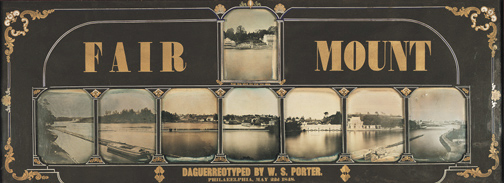
Wiegandt informed us that the 1848 Cincinnati Panorama was not the first attempt at such a picture. Just several months prior, W.S. Porter had taken another daguerreotype panorama of the Fairmount Water Works in Philadelphia.
Fairmount Water Works Daguerreotype Panorama by W.S. Porter, 1848
The detail of this image, however, is not as impressive as the Cincinnati Panorama. What can be gleaned from this fact, according to Wiegandt, is that the Philadelphia capture was a successful learning experience for Porter, and that his skills and techniques were able to improve dramatically by the time he attempted the Cincinnati Panorama with C. Fontayne.
At the time of the Cincinnati Panorama, daguerreotype photography had only existed for 9 years. Equally as remarkable as the detail these images were able to capture is the inception of this technology. Wiegandt explained how Louis-Jacques-Mande Daguerre experimented with plates of silver sensitized with iodine fumes. The idea was that the sensitized silver would be reduced as it was exposed to light (i.e., the shutters on a camera opening and allowing light from the image field to hit the plates), thus creating latent images in the silver. Although this proved to be successful, a viewable image was not detectable until a chance happening, which Wiegandt describes as “a miracle.” Legend has it that one of Daguerre’s exposed plates was stored in a cabinet, sharing this space with one other singular item: a broken instrument that utilizes mercury (such as a thermometer, barometer, etc.). Upon examining this plate, Daguerre realized the latent image was now detectable, correctly deducing that the mercury fumes had developed the film. The fumes had caused the light-exposed areas on the silver plate to form small bumps, roughly 1 micron in size, creating an instant high-resolution image. The microscopic size of these bumps means that, according to Wiegandt, daguerreotype images are an early example of what we would today call nanotechnology. (Ralph also notes the actual circumstances of its discovery are unclear since any notes from Daguerre’s studio would have been lost during a fire shortly afterwards.)
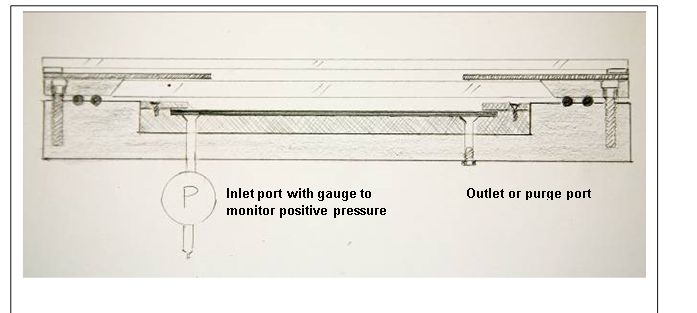
Much like the Fontayne and Porter Cincinnati Daguerreotype, the current display case is quite unique as well. As mentioned before, daguerreotypes are incredibly delicate. To successfully prevent further degradation and preserve this object for generations to come, its exposure to oxygen and other reactive gases must be severely limited. The solution that Wiegandt produced was a specialized inert gas case, similar in concept to how the Declaration of Independence is housed. The goal of this case is “to maintain a slightly elevated pressure of a non-reactive gas such that it will not put excessive strain on the seals yet will be above the potentially highest barometric pressure” (Wiegandt, 2006), thus preventing any atmospheric air from coming in contact with the sensitive daguerreotype plates.
Wiegandt’s sealed encasement design sketch provided in treatment documentation
Wiegandt chose argon to pressurize the case with as it has a better diffusion rate and is more inert than other gases such as nitrogen, all while being cost effective.
Wiegandt informed us on his most recent visit that the case is doing its job: the panorama has experienced no detectable degradation since its installation. However, this was likely his final visit to the Cincinnati Library, as he is retiring from the field. I should add that a further and perhaps more important purpose for this visit was to advise and inform CHPL (and Preservation Lab) staff to be successful in monitoring and caring for the object in his absence. Fortunately, Wiegandt was able to leave us with a wealth of information and resources that will aid in the continued preservation of this amazing artifact. With an updated preservation plan, knowledgeable staff in both the Genealogy & Local History and Preservation Lab departments, and a commitment to preserving cultural property, we can be confident the Cincinnati daguerreotype panorama will be enjoyed by library visitors for many generations to come.