
In May of 2013, we received a UC Faculty Development Council Grant to run a series of five workshops in order to help us determine the best ways to use The Elliston Digital Audio Archive for instruction and research. The first of these lectures will take place on September 21, 2013 and will be led by Jerome McGann. This workshop will map the conceptual significance and possibilities of The Elliston Project and of digital audio archives more generally.
Elliston Project Digital Archive Workshops
The audio archive of the Elliston Poetry Room is an astonishing set of recordings going back to the mid-1950s, housing recordings of visiting poets, especially those brought to UC as Elliston Poets in Residence. As all of these recordings were in the now relatively inaccessible format of audio cassettes, the English Department, partnering with the UC Libraries, began a digitization effort, ultimately creating an online archive of poetry readings and lectures.
In May of 2013, we received a UC Faculty Development Council Grant to run a series of five workshops in order to help us determine the best ways to use this digital audio archive for instruction and research.
Continue reading
Travel the World with UC Libraries: Destination for Today: Bahrain

Bahrain is nestled on the western side of the Arabian Gulf, between Saudi Arabia and Qatar. It is connected to Saudi Arabia by a causeway.
Interesting facts about Bahrain:
- Bahrain consists of 33 islands, only 3 of which are inhabited.
- Bahrain’s al-Khamis Mosque is the oldest Islamic structure in the Gulf region.
Source: CultureGrams
Featured library resource: Background Notes/Country Fact Sheets. See a report on Bahrain at http://www.state.gov/r/pa/ei/bgn/26414.htm.
Posted by Olga Hart
Woodie Garber Blueprints Now Available
By: Tyler Morrison, ARB Student Assistant
 Woodward (“Woodie”) Garber’s designs for Christ Church Episcopal Church in Glendale, Ohio are now available for viewing at Archives and Rare Books Library of the University of Cincinnati. There is a specification notebook of the addition to the church, as well as numerous blueprints that cover every aspect of the building from the temperature control wiring to chapel windows and even the layout of trees on the grounds.
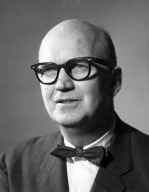
Garber (1913-1994) assisted in the design of Christ Church Epsicopal Chapel in 1959. He added the All Saints Chapel which produced space for 100 people along with classrooms and offices. This new addition connected the main church and the parish house by a glass corridor with an entrance colloquially known as the “Whale’s Mouth.” Continue reading
50 Minutes-1 Book Series Returns to ARB
By: Kevin Grace
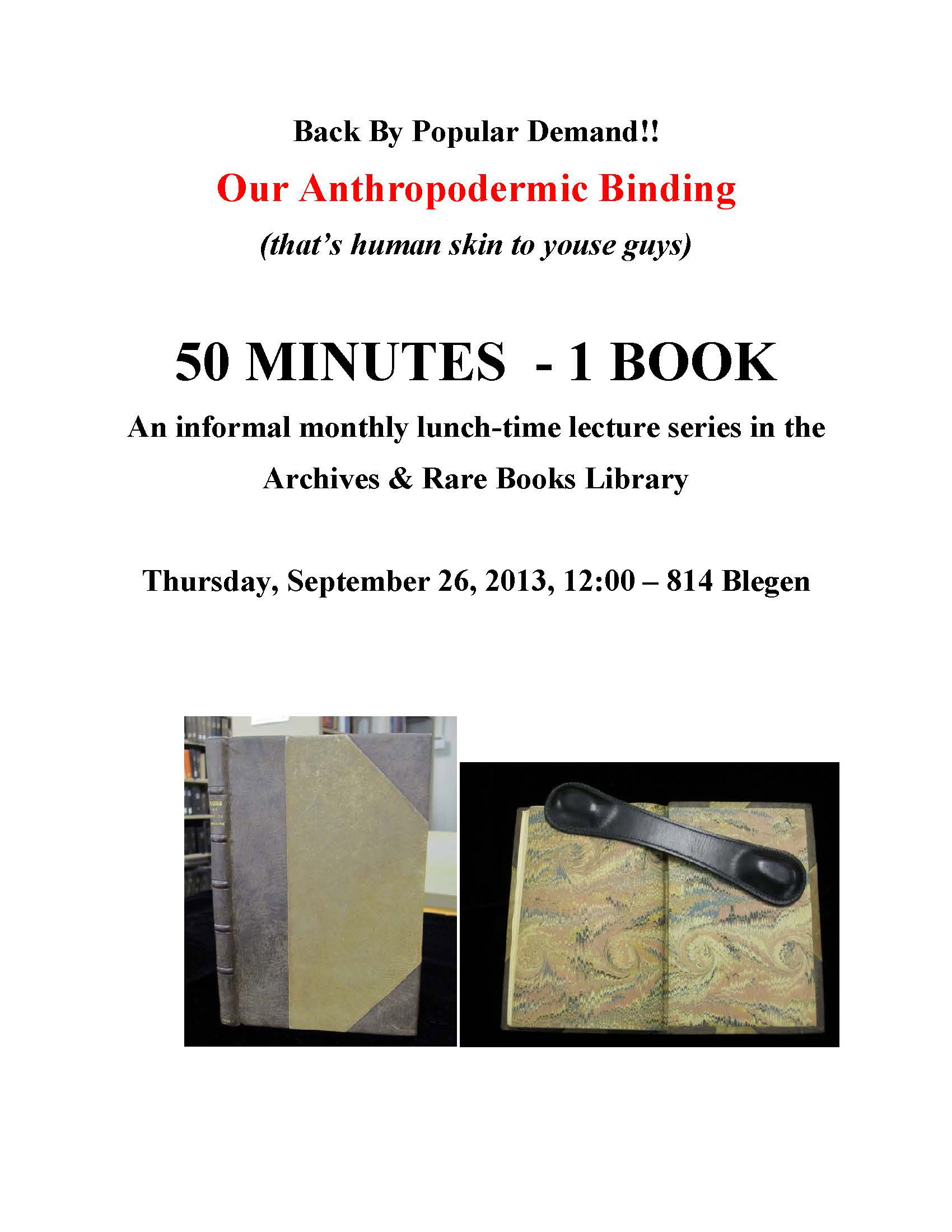
The lunch-time discussion series of wonderful items in the Archives & Rare Books Library is ready to go for the 2013-2014 academic year. Our first presentation is a repeat of a popular talk on our anthropodermic binding. The book is one for which we always receive numerous questions because of its curious nature. So please bring your lunch and conversation on Thursday, September 26, at 12 noon.
Future 50 Minutes-1 Book presentations over the next several months include Frankenstein in October; miniature books, including some of the smallest books you’ll ever barely see; the Arabian Nights; George Moerlein’s A Trip Around the World; William Nicholson’s London Types; and Ireland’s Celtic Revival in the early 20th century.
Off Campus Access to UC HSL Resources
Off campus access to UC Health Sciences Library resources is available through the SSL VPN (Secure Sockets Layer Virtual Private Network) or the proxy server.
SSL VPN Access: (VPN tutorial ; set up instructions) Call the UCIT Help Desk at 556-4357 with installation or general questions about the SSL VPN. VPN FAQs
Travel the World with UC Libraries! The Destination for Today: Azerbaijan
This post continues the series featuring library resources about the countries represented by the UC international community.
 Featured country: Azerbaijan.
Azerbaijan is located in southwestern Asia between Iran and Russia, it has a 713-kilometer (443-mi) coastline on the Caspian Sea.
Interesting fact about Azerbaijan: Azerbaijan features 9 of the Earth’s 11 climatic zones in various locations throughout the country, making it unique from a climatological perspective. Azerbaijan’s climatic zones range from a semi-desert to a moderate area by the Caspian Sea.
Source: Global Road Warrior
Feature resource: Climate (in the Country Information CampusGuide).
Posted by Olga Hart
Elliston Poetry Reading, September 6, 2013, Yona Harvey and Jamie Quatro
The next reading in the Elliston Poetry Room will be by poet Yona Harvey and author Jamie Quatro.
September 6, 2013, 4:00 PM, Elliston Poetry Room, 646 Langsam Library
Yona Harvey is the author of the poetry collection, Hemming the Water (Four Way Books, 2013).
Jamie Quatro’s debut story collection, I Want To Show You More (Grove), is a New York Times Editors’ Choice, NAIBA Bestseller, and Indie Next pick.
Look for recordings of this presentation soon in the digital collection, The Elliston Project: Poetry Readings and Lectures at the University of Cincinnati.
Learn More about Events sponsored by the Elliston Poetry Fund.
"Thirsty and Ye Gave Me Drink"-The Henry Probasco Fountains = Adventures in the Subway and Street Improvements Digitization Project
By: Angela Vanderbilt
A prominent figure in early Cincinnati history, Henry Probasco was both businessman and philanthropist, committing his time to numerous Cincinnati organizations and societies, accumulating a large personal library of rare books and manuscripts, as well as an extensive collection of prints and paintings, both rivaling the finest in the country, and dedicating two elaborate fountains to the citizens of Cincinnati in the late 1800s.
Henry Probasco, along with his business partner and brother-in-law, Tyler Davidson, managed one of the most successful hardware companies in Cincinnati in the 1800’s – Tyler Davidson & Company. Probasco joined the business in 1835 as a clerk, and in 1840 was made a partner. The same year, he married Davidson’s half-sister, Julia. Together with Davidson, Probasco succeeded in expanding the business quickly, and by 1846, Tyler Davidson & Company was the largest hardware store in Cincinnati. In 1851, at Probasco’s suggestion, the partners built a new, multi-level structure on the site of the original store at 140-142 Main Street, between Second and Third Streets, and within three years, their sales quadrupled. Pearl Street, Water Street and Front Street were also located in this area, and ran parallel with Second Street to the north and the river to the south. The hardware store, Second, Front, Water, and Pearl Streets no longer exist; all have been replaced with I-71, Fort Washington Way, the Great American Ball Park and Paul Brown Stadium, among other attractions along the riverfront.
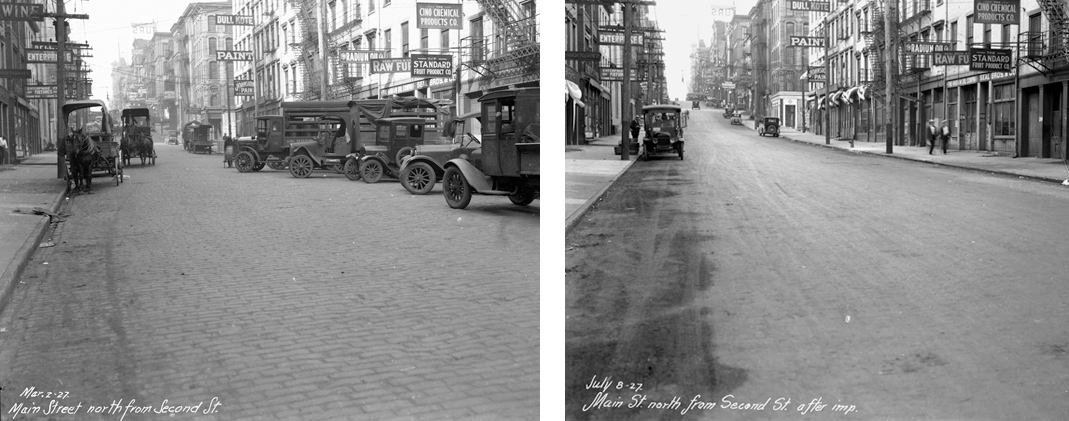
After Tyler Davidson passed away in 1865, Henry Probasco sold the hardware business to former partner, William Lowry, in 1866. The building would have been located on the east (right) side of Main Street between Second and Third Streets, in the vicinity of the images above (Left: March 2, 1927; Right: July 8, 1927.
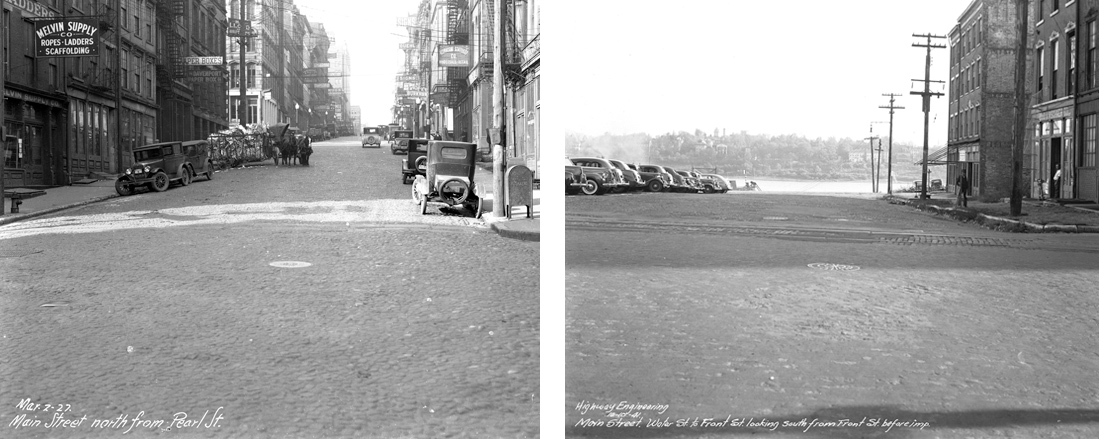
In the early history of Cincinnati, several streets were platted running parallel with the Ohio River, but which no longer exist. These were Pearl Street, Water Street, Front Street and Second Street. These have been replaced with Fort Washington Way, I-71, as well as museums, major league sports arenas and other businesses and attractions along the riverfront. (Left: March 2, 1927; Right: October 10, 1941)
Cead Slan, or, A Farewell to Archives Month
One of the great poets of the ages has died. Nobel Prize-winning Irishman Seamus Heaney passed way on Friday in Dublin at the age of 74: http://www.irishtimes.com/news/ireland/irish-news/kenny-leads-tributes-to-keeper-of-language-seamus-heaney-1.1510607. It was less than a year ago that Heaney came to Cincinnati to speak at the Mercantile Library for the 2012 Niehoff Lecture Series, and we ran this blog at that time:
October 30, 2012
By Kevin Grace
-Not your colloquial Irish farewell, mind you, because that would have us skipping out when it is our turn to buy a round of drinks, and you just know we would never do that! Rather, a farewell to Archives Month in Ohio and its 2012 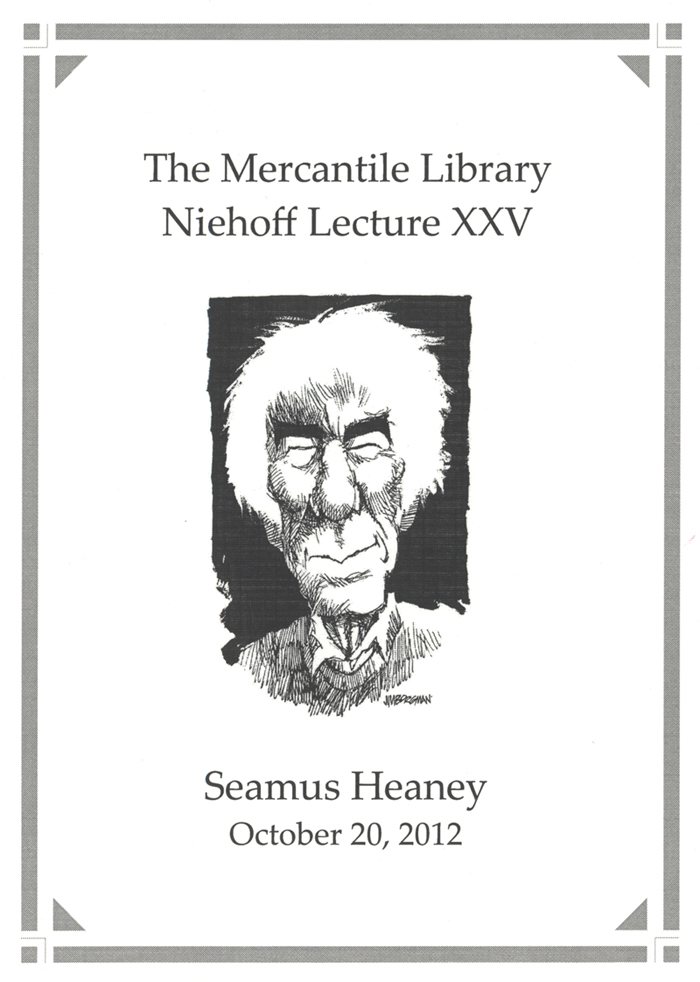 theme of “Ethnic Peoples of Ohio.” In southwest Ohio, the focus has been on Irish heritage and the Celtic contribution to our culture. From businessmen and women and Civil War soldiers to civic leaders and politicians, to writers and artists, Cincinnati and this corner of the state have been greatly enriched by the Irish.
In addressing this theme in October, we were very fortunate that it coincidentally embraced the annual Niehoff Lecture at the Mercantile Library, presented by Irish poet and Nobel laureate Seamus Heaney. It could have been happenstance, of course, but more likely cinnuint, or destiny to youse guys. On Saturday evening, October 20, Heaney spoke before an enthralled audience at the Westin Hotel as part of a lecture series that has helped mark the Mercantile as the center for literary life in Cincinnati. Continue reading