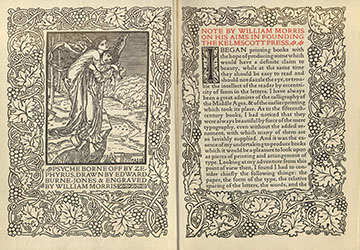
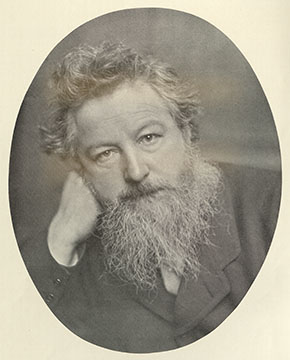
When English designer William Morris died at the age of 62 in October 1896, his physician stated that the cause of his death was “simply being William Morris, and having done more work than most ten men.” The University of Cincinnati Libraries and the Archives and Rare Books Library are currently celebrating the life of Morris and his many roles — designer of stained glass, tapestries, wallpaper, chintzes, furniture, books, and typefaces, as well as preservationist, socialist, poet, novelist, lecturer, calligrapher, translator of Icelandic and English sagas, and founder of the Kelmscott Press – with an exhibition in Blegen Library now through February 2027.
Associated with the Pre-Raphaelite Brotherhood of artists and critics of the mid-19th century, Morris went on to become a leading figure in the later Arts and Crafts movement. His great passions in life were design, aesthetics, and the production and preservation of cultural heritage. Morris was an incredibly detailed and thorough designer and craftsman, but he was motivated not by the end product itself, but rather by the values represented in their making.
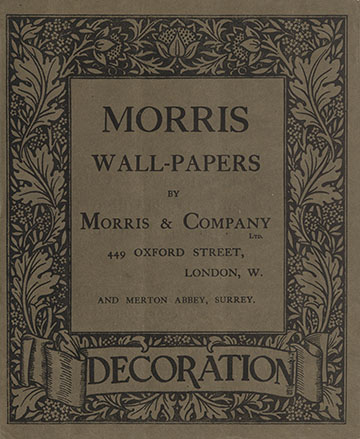
The exhibition touches upon Morris’ life; the founding of his design firm, Morris & Co.; and his interest in socialism, while focusing on the founding of the Kelmscott Press, Morris’ most enduring legacy, which produced 52 hand-printed books from 1891 to 1898. The Kelmscott Press was founded after Morris attended a lecture by printer Emery Walker in November 1888, and Morris’ goal was nothing less than to produce the “ideal book.” With a dislike for the mechanization of printing during that time, Morris and his associates found inspiration in 15th century book traditions.
The Archives and Rare Books Library preserves a small, but growing set of Kelmscott titles as well as pamphlets and books by Morris and manuscript materials about Morris. Stop by the fourth floor lobby of Blegen Library to view the exhibition and contact us at archives@ucmail.uc.edu to learn more about our Morris and Kelmscott holdings. We also wish to thank our colleagues at the DAAP Library for lending some of their holdings for display in the exhibition.
“I began printing books with the hope of producing some which would have a definite claim to beauty….
–W. Morris, “The Ideal Book”