Are you teaching English as a Second Language?


In 1912 the Department of Charities and Correction launched a crusade against loan sharks who were targeting the poor of Cincinnati
By Janice Schulz
The Archives & Rare Books Library holds City of Cincinnati Annual Reports from 1853-1870, 1875-1876, 1905-1914, and 1926-1958. These reports contain valuable information for anyone researching the history of Cincinnati, its departments, its people, and its issues.
While reports included in each volume vary, the Mayor’s report is always available. Also available may be various city financial reports and reports from City Council, schools, the Health Department and health care facilities, the House of Refuge, the Fire Department, the Police Department, Public Works, the City Engineer, jails, Civil Service Commission, City Solicitor, Parks Department, the University of Cincinnati, and other city commissions. Until 1914, each individual annual report is published in full, but after that time the reports take on more of a summarized format under the title Municipal Activities. Continue reading
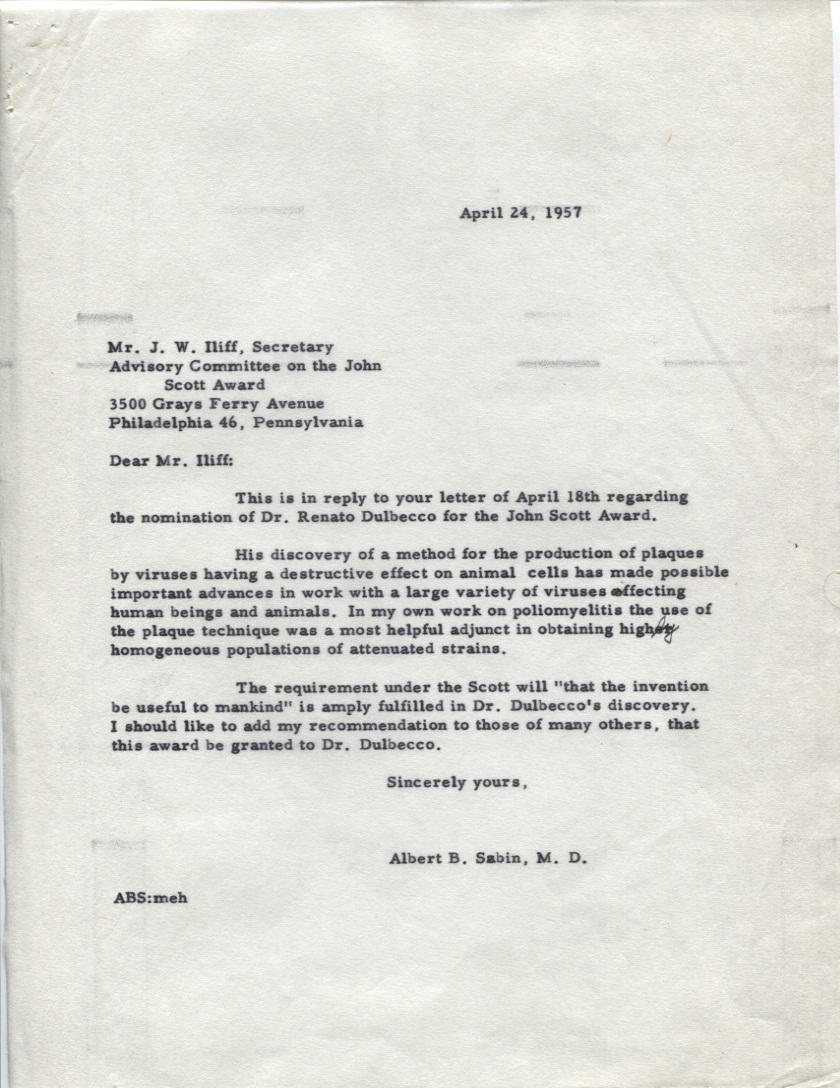
April 24, 1957 - This letter from Dr. Sabin endorsed Dr. Dulbecco for the John Scott Award.
I read a recent New York Times obituary of Dr. Renato Dulbecco, a Nobel Prize winning virologist. In 1975, he and his colleagues received the award “for their discoveries concerning the interaction between tumour viruses and the genetic material of the cell.”[1] Although most knew him from his cancer research, Dr. Dulbecco’s earlier research was an important piece of Dr. Sabin’s oral polio vaccine puzzle. The work that they completed together was mentioned in a previous blog post called “A Polio Research Collaboration.” Continue reading
 Want to Know the Latest in Library News? Read Source, the UC Libraries newsletter for faculty, students, staff, and friends.
This volume announces the availability of the papers of Theodore M. Berry in the Archives and Rare Books Library. Berry (1905-2000) was the first African American mayor in Cincinnati, served the Lyndon B. Johnson presidential administration in civil rights programs, and was an active attorney for the NAACP. The Berry papers, acquired by the UC Libraries many years ago, were able to be fully processed through a grant from the National Historical Publications and Records Commission of the National Archives. The materials are now available for research and teaching. Continue reading
By Janice Schulz
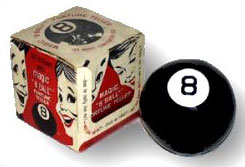 At the Archives & Rare Books Library we frequently get requests asking us to verify that a certain individual attended UC or one of its predecessor schools. Recently a call came in asking us to substantiate a claim found on the internet that Abe Bookman, creator of the Magic 8 Ball, was a graduate of the Ohio Mechanics Institute (OMI). Generally this is an easy task – we simply look in alumni directories, yearbooks or commencement brochures for the person – but Abe proved to be a bit more elusive than most. With no attendance dates to go by, we started pouring through all of the resources we have for OMI using his birth date and the Magic 8 Ball’s introduction as guides, but to no avail. After further research, the reason for his elusiveness began to become clearer – at some point around 1936, we believe he Anglicized his surname from Buchmann to Bookman. He seemed to use both names until around 1955, eventually dropping Buchmann and exclusively using Bookman. That research also uncovered some interesting details about his life. Continue reading
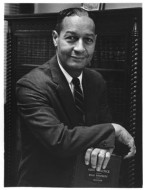 By Kevin Grace, UC Archivist and Head of the Archives and Rare Books Library
Theodore M. Berry (1905-2000) was a key figure in American civil rights in the 20th century, a man who marked his life with a formidable sense of justice. From the 1930s, when he graduated from the University of Cincinnati with bachelor’s and law degrees, until his death just before a new century, Berry worked tirelessly to promote racial harmony and served with distinction in President Lyndon Johnson’s programs for civil rights during the 1960s.
Three decades ago, Berry donated his papers to the University of Cincinnati where they are housed in the Archives and Rare Books Library.
By Janice Schulz
Every city in every era seems to have its “Crime of the Century” and during the 1950s in Cincinnati, that was the 1958 murder of Louise Bergen, a Cincinnati housewife. The trial of her accused killer, Edythe Klumpp, was held during the summer of 1959. The case was sensational for many reasons – a “love triangle” between Edythe, Louise, and Louise’s husband, Bill Bergen; Edythe’s history of two divorces and other affairs; the participation of Foss Hopkins, Edythe’s defense attorney; the specter of the death penalty for a woman; and the controversial role of Ohio Governor Michael DiSalle in Edythe’s ultimate fate.
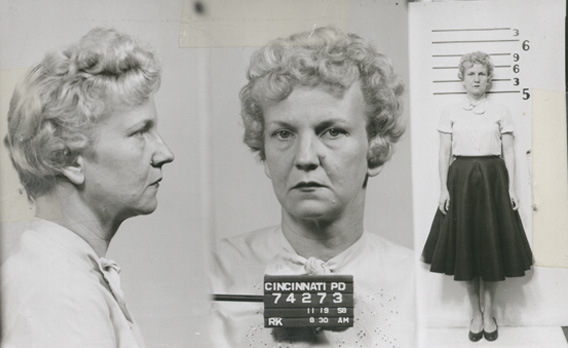
Edythe Klumpp’s booking photographs. From the collection of the UC Archives & Rare Books Library
Louise Bergen’s body was found burned near the public beach at Cowen Lake on the evening of November 1, 1958. The subsequent investigation zeroed in on Bill Bergen’s live-in lover, Edythe Klumpp, who confessed after failing a lie detector test. Edythe claimed that the killing was accidental, that a gun went off during a struggle and hit Louise in the throat. But Hamilton County Prosecutor C. Watson Hover disagreed, charging her with first degree murder and seeking the death penalty.
By Kevin Grace
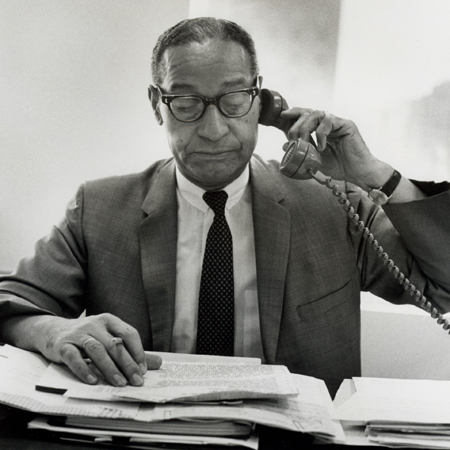 Yesterday evening a special event celebrated the processing of the Theodore M. Berry Papers. Hosted by the Office of the President, UC Libraries, UC College of Law, UC Alumni Association, and the UC Foundation, the gathering attracted over a hundred people to recognize the outstanding contributions of civil rights leader Berry to his alma mater, his community and his nation. Theodore “Ted” Berry (1905-2000) was the first African American mayor in Cincinnati, served the Lyndon Baines Johnson presidential administration in civil rights programs, and was an active attorney for the NAACP. The Berry papers, acquired by the UC Libraries many years ago, were able to be fully processed through a grant from the National Historical Publications and Records Commission of the National Archives. The materials are now available for research and teaching. Continue reading
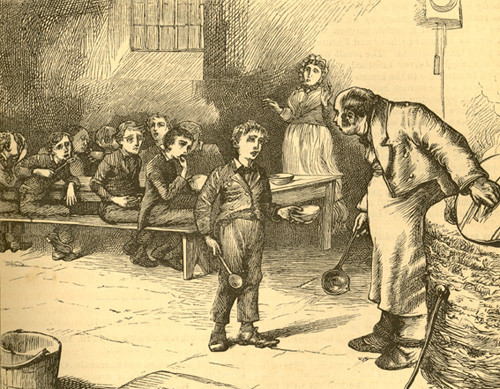
By Kevin Grace
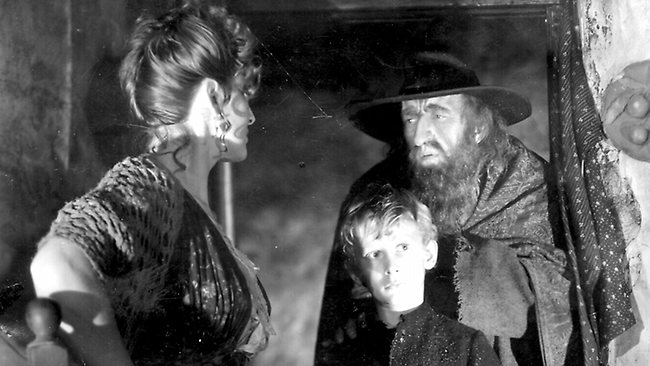
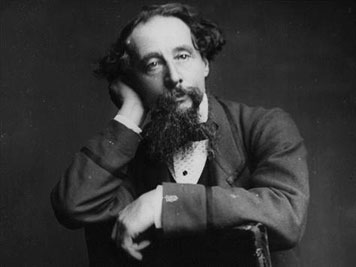
-Just a reminder: this Thursday, February 23, our monthly “50 Minutes – 1 Book” lunchtime talk from 12-12:50 in 814 Blegen Library will feature Oliver Twist, a look at the poor orphan and the nefarious Fagin as well as a short, but illuminating, discourse on the Dickens holdings.
For more information about the Archives & Rare Books Library and its collections, call (513) 556-1959, email archives@ucmail.uc.edu, or visit the website, www.libraries.uc.edu/libraries/arb/archives
OhioLINK will be switching to a new book delivery vendor in early March. This change may lead to minor delays in service as a new system is put in place. If you anticipate needing library materials at that time, we recommend allowing extra time to receive your requests. Questions? Please contact a librarian.