Due to inclement weather, University of Cincinnati campuses are closed from 6 a.m. to 10 a.m. Friday, Dec. 12, 2025. Visit Commencement and Registrar’s pages for additional details. This closure applies to all UC Libraries locations except for the Donald C. Harrison Health Sciences Library, which will be open at 7:45 a.m.
The Archives and Rare Books Library is excited to announce a new ARB digital exhibition that has been completed and is now accessible online. This digital exhibition was a part of the National Association for the Advancement of Colored People project to process and create a finding aid for the NAACP Bronson v. Board of Education of the City of Cincinnati records through the National Historical Publications & Records Commission grant we received in November 2024.
Due to inclement weather, the University of Cincinnati campus will close from 7 a.m. Dec. 2, 2025, until 7 a.m. on Dec. 3, 2025. This closure applies to all UC Libraries locations except for the Donald C. Harrison Health Sciences Library, which will be open Tuesday, Dec. 2 from 7:45 a.m. to 4 p.m.
Two new exhibits have been installed in the Walter C. Langsam Library.
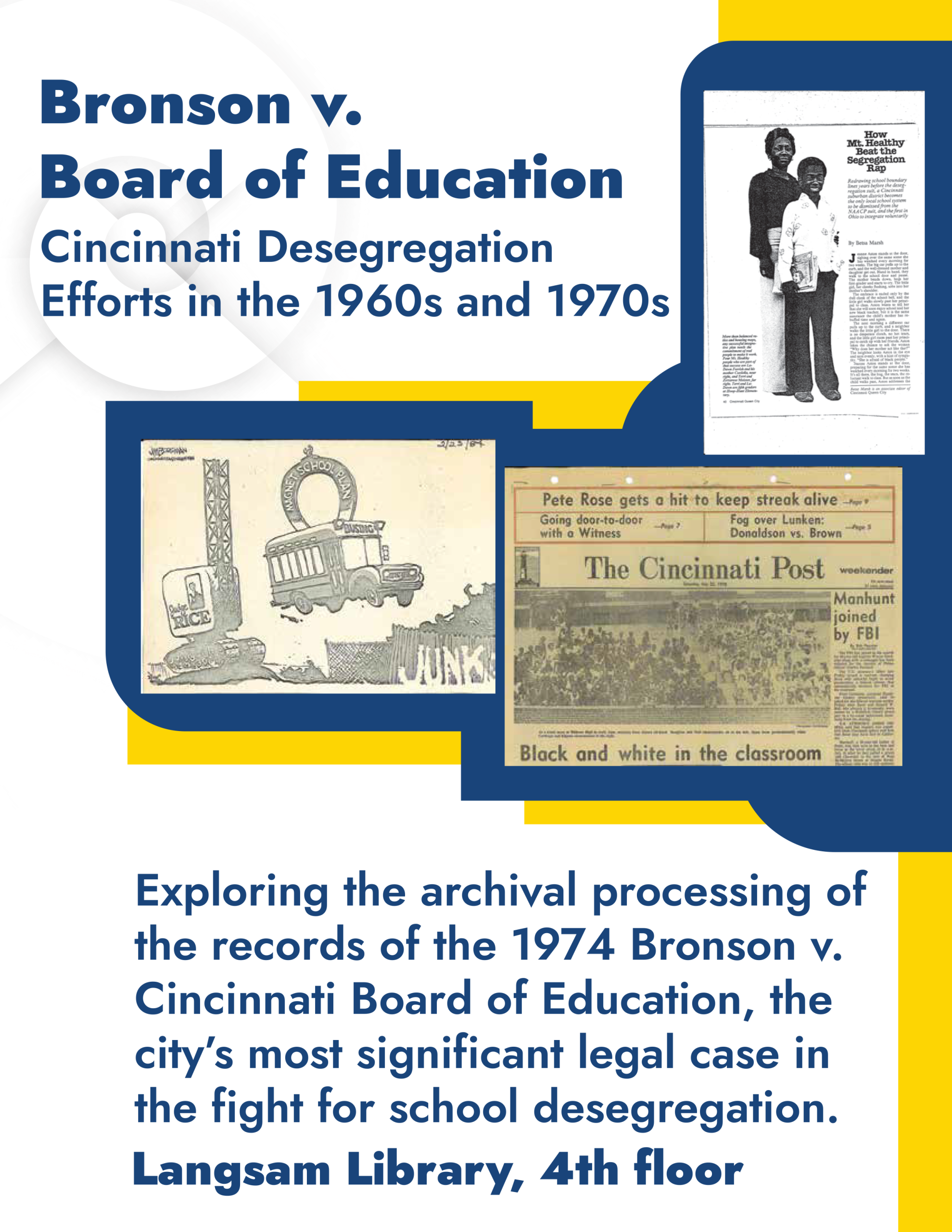
On display on the 4th floor lobby, Bronson v. Board of Education: Cincinnati Desegregation Efforts in the 1960s and 1970s chronicles the work of project archivist Julianna Witt as she completed the archival processing of the National Association for the Advancement of Colored People’s, Bronson v. Board of Education of the City of Cincinnati records. This collection contains material related to the class-action lawsuit Bronson v. Board from 1974-1984 and consists of legal documents created for court submission and records that originated from the Cincinnati Board of Education. The collection itself, housed in the Archives and Rare Books (ARB) Library, provides a detailed history of race relations in Cincinnati. A finding aid is available for more information.
Last November, the University of Cincinnati Libraries announced the award of an Archives Grant from the National Historical Publications and Records Commission to ARB.
On display on the 5th floor lobby is an exhibit promoting The Libraries of UC. The exhibit includes images and descriptions of each of the nine University of Cincinnati Libraries, along with the fan-favorite Triceracopter. A map of the libraries is available for take away at the exhibit.
Both exhibits were designed by UC Libraries design co-op student Ashleigh Stout.
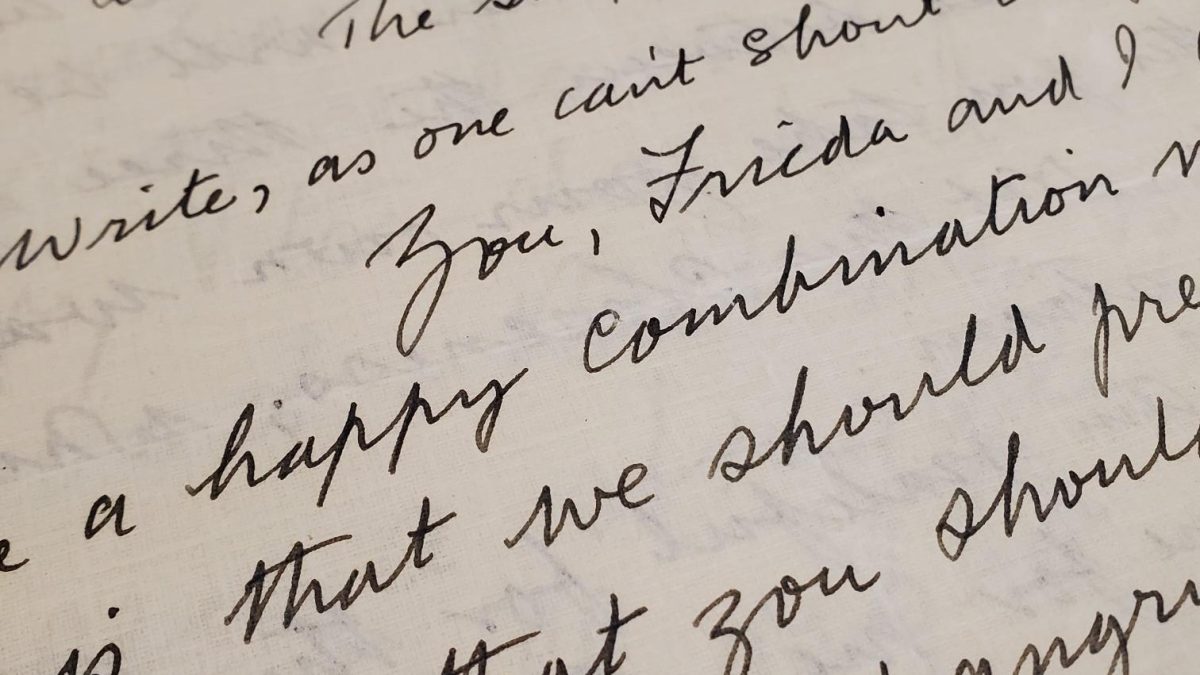
“You, Freida and I don’t make a happy combination now. The best is that we should prepare to separate: that you should go your own way. I am not angry; except that I hate ‘situations’ and feel humiliated by them…I am grateful for the things you have done for me. But we must stand apart.”
In a letter dated January 1925 and sent from English novelist and short story writer D.H. Lawrence while in Oaxaca, Mexico, to Dorothy Brett, who was living on his ranch in Taos, New Mexico, Lawrence let his feelings be known about the sometimes tense relationship he and his wife, Frieda, shared with Brett. The multiple letters that comprise the Dorothy Brett papers, housed at the Archives and Rare Books Library (ARB), provide an insight not only into Brett’s relationship with the Lawrences, but with other literary and art figures during the early twentieth century. Newly organized with an online finding aid, the Brett papers provide a wealth of information about Brett and her social circles.
Detail of a January 1925 letter from D.H. Lawrence to Dorothy Brett
British by birth and raised near Windsor, Dorothy Brett’s father was influential in the affairs of England and the royal family. After attending the Slade School of Art, Brett began her career as an artist. In 1924, she accepted an invitation by D.H. Lawrence to move to the United States to join the artistic and bohemian community that had formed there. She remained in the United States for the remainder of her life and eventually became a U.S. citizen.
Her papers consist of approximately 200 letters, dating from 1916-1948, from several major early twentieth century literary figures including D.H. Lawrence, Frieda Lawrence, John Middleton Murray, J.M. Barrie, Muriel Draper, A.R. Orage, Sigried Sassoon, and Virginia Woolf. Additional correspondents include artist Augustus John and economist John Maynard Keynes.
The bulk of the letters are written by D.H. and Frieda Lawrence between 1924 and 1930. The Lawrence letters provide insight into the sometimes inviting and sometime contentious relationship between Brett and the Lawrences. Topics include the Lawrences’ travels to Europe and Mexico and in the United States; D.H. Lawrence’s illnesses; his writing and publishing activities; an exhibition of D.H. Lawrence’s photographs; the Lawrences’ ranch in New Mexico; and the disposition of his manuscripts.
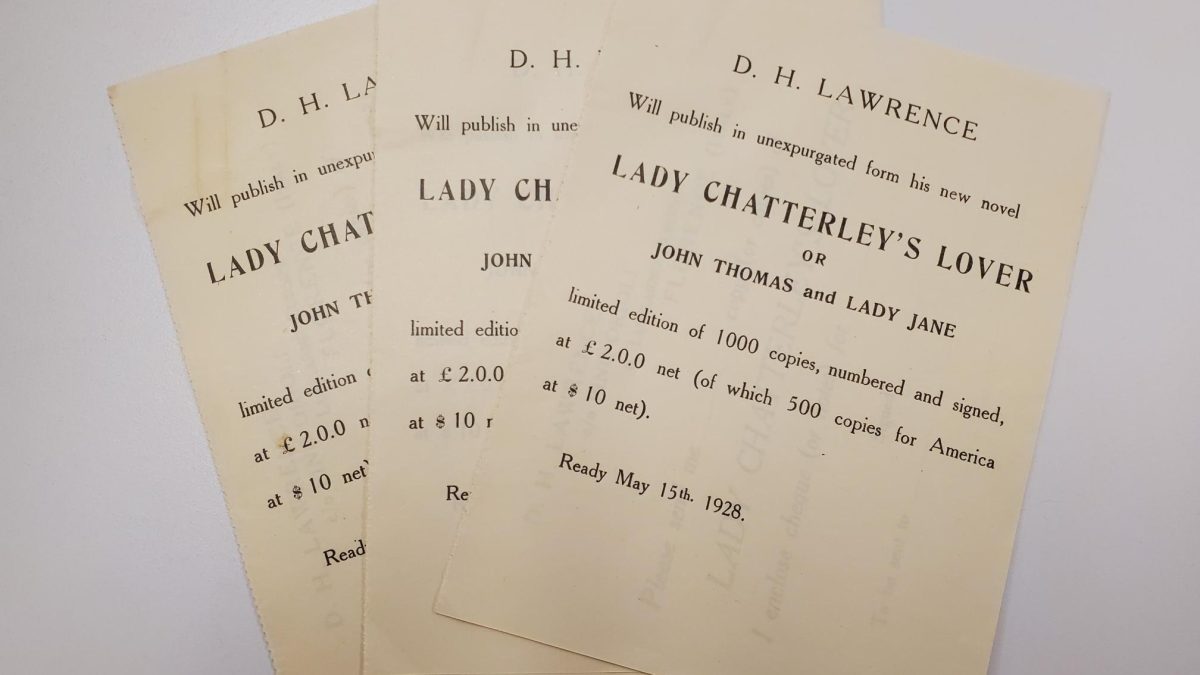
Printed advertisements for D.H. Lawrence’s book, Lady Chatterley’s Lover.
The letters from John Middleton Murray, a friend of Brett and husband of writer Katherine Mansfield, form the second largest group of letters. They concern Murray’s relationship with Brett prior to and after his marriage, his support of her work as an artist, Katherine Mansfield’s writing and health, and Murray’s own writing and editing of Mansfield’s letters, as well as his thoughts on D.H. and Frieda Lawrence.
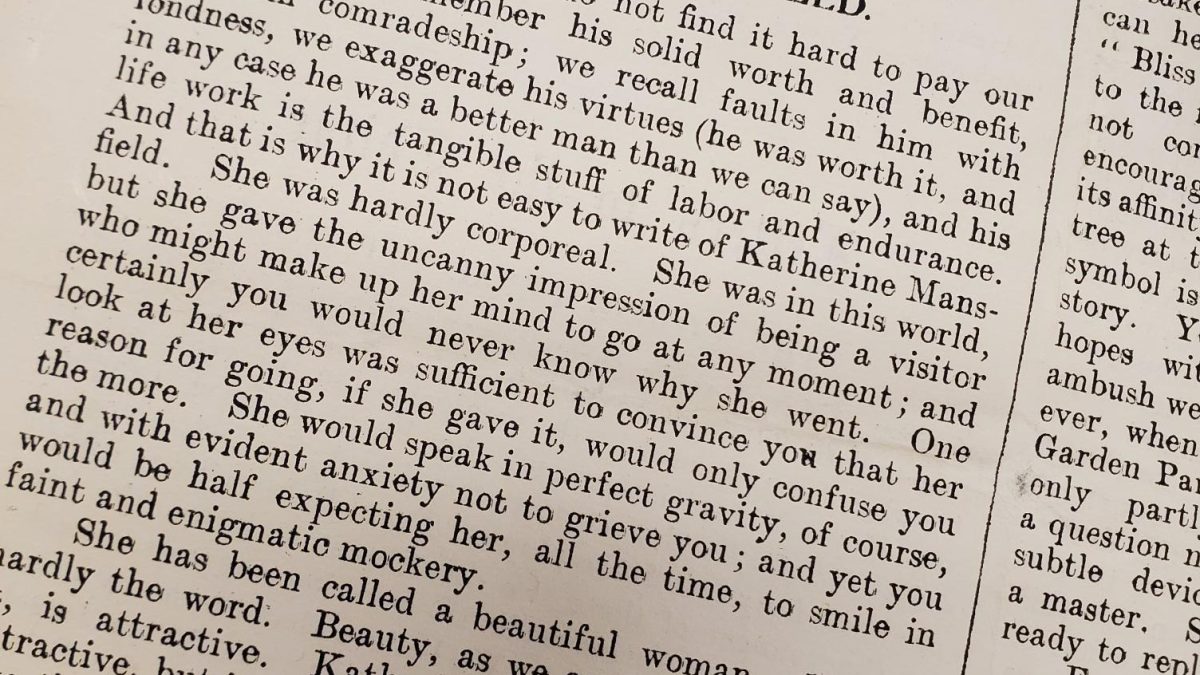
Printed obituary from a newspaper for the author Katherine Mansfield. The obituary was included in a letter from Mansfield’s husband, John Middleton Murray, to Dorothy Brett.
The letters from other correspondents, while not as extensive or expressive, provide a view toward Brett’s social and artistic relations. Others mentioned in passing throughout the letters in this collection include Nancy Cunard, Aldous Huxley, S.S. Koteliansky, Lady Ottoline Morrell, Vita Sackville-West, and Carl Van Vechten, making the Dorothy Brett Papers a valuable collection for any student or researcher interested in British literature during the early decades of the twentieth century. The collection complements a small number of D.H. Lawrence manuscripts and additional sets of correspondence he exchanged with others, which are also housed at ARB. Those interested in consulting the collection can schedule a research appointment at ARB by emailing archives@ucmail.uc.edu.
Last November, the University of Cincinnati Libraries announced the award of an Archives Grant from the National Historical Publications and Records Commission to the Libraries’ Archives and Rare Books Library (ARB). This grant supports the archival processing of records related to the lawsuit Bronson v. Board of Education of the City School District of the City of Cincinnati maintained by the local branch of the National Association for the Advancement of Colored People (NAACP) and donated to the University of Cincinnati in the 1980s.
As ARB wraps up the project to process the records of the Cincinnati Branch of the NAACP regarding the 1974 lawsuit Bronson v. Board of Education of the City School District of the City of Cincinnati, we look at the 1984 settlement agreement that brought to an end the decade-long legal struggle to end racial isolation in Cincinnati’s public schools.
Image from Cincinnati Enquirer, February 17, 1984
On April 6, 1984, the ten-year lawsuit ended when a final settlement was approved by all parties and fairness hearings were conducted. Although the case did not go to trial, it is clear through the thousands of exhibits, dozens of deposed individuals and numerous lawyers that the case had a lasting impact on the city of Cincinnati. The settlement called for Cincinnati Public Schools to lessen racial isolation in the school system by 1991. The four major sections of the settlement stated:
Are you the family historian? Do you like to look at old photographs? Like solving puzzles and bringing a little order to unorganized things? Then a career in archives may be just what you are looking for!
The Archives and Rare Books Library would like to cordially invite all UC students to attend our Archives Career Panel in celebration of American Archives Month this October.
This moderated, hour-long talk will feature conversation between archivists from UC Libraries, as well as local Cincinnati archivists, as they discuss their career paths, reflect on the current and future state of the profession, and answer audience questions in a Q&A.
The event will be held on Monday, October 6th from 1:30-2:30pm in Room 471 of Langsam Library.
Read these articles, as well as past issues, on the website. To receive Source via e-mail, contact melissa.norris@uc.edu to be added to the mailing list.
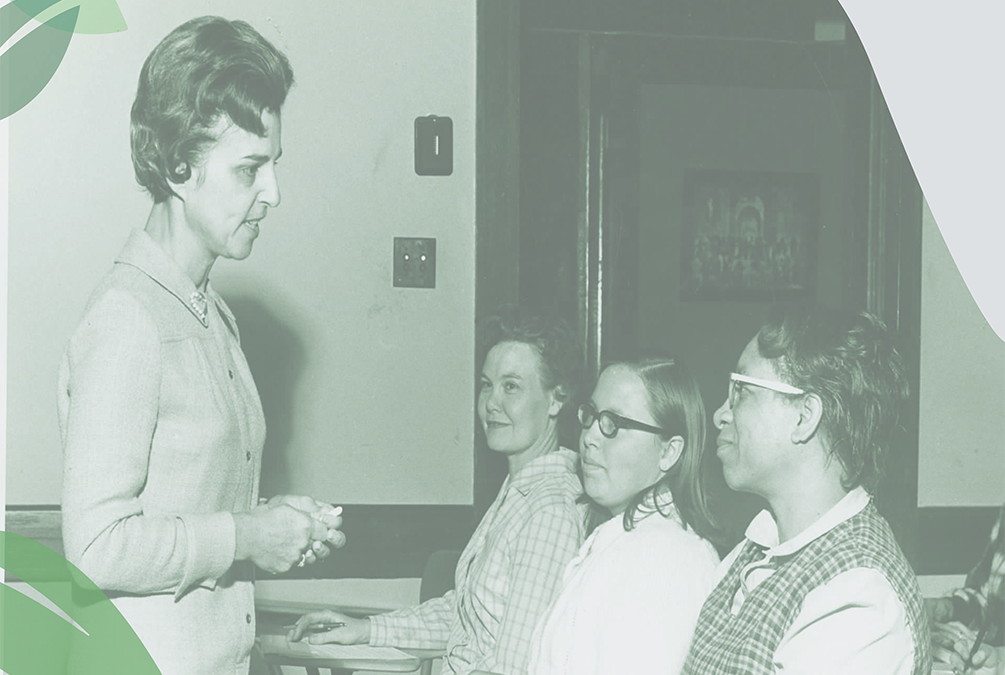
For 100 years, the Arlitt Center has been a cornerstone of early childhood education, founded as one of the nation’s first laboratory preschools and continuously championing the rights and potential of young children. The center was founded by Ada Hart Arlitt, PhD, University of Cincinnati faculty member and a prominent figure in early childhood psychology and the child study movement.
An exhibit on display on the fourth floor of the Walter C. Langsam Library celebrates the past, present and future of the Arlitt Center. Included in the exhibit are images from the Archives and Rare Books Library and a bibliography of published works by Ada Hart Arlitt.
The Archives and Rare Books Library holds the Ada Hart Arlitt Papers, containing correspondence related to her professional activities as a faculty member in the Department of Child Care and Training at UC, as well as her involvement with the National Congress of Parents and Teachers. A finding aid about the collection is available.
The exhibit was a collaboration between with Arlitt Center and UC Libraries. Reece Guthier, communication design co-op student, designed the exhibit.
Last November, the University of Cincinnati Libraries announced the award of an Archives Grant from the National Historical Publications and Records Commission to the Libraries’ Archives and Rare Books Library (ARB). This grant supports the archival processing of records related to the lawsuit Bronson v. Board of Education of the City School District of the City of Cincinnati maintained by the local branch of the National Association for the Advancement of Colored People (NAACP) and donated to the University of Cincinnati in the 1980s.
History of alternative programs and schools
Alternative programs and schools in Cincinnati Public Schools existed prior to the Bronson v. Board of Education lawsuit and continued to grow in numbers as the case proceeded. These programs were designed to give students more opportunities in the classroom compared to the standard taught subjects. These were voluntary programs and open to students of all ages.