UC Libraries will be closed Wednesday, November 11, in observance of Veterans Day. Regular hours will resume on Thursday, November 12.


A single part of a symphony can open the door to a world of story-telling. As the CCM Philharmonia presents the music of Mahler’s Symphony No. 4 on October 16, 2026, the CCM Library shares the story of the violin I part held in the Theodore Spiering Collection.
The Albino Gorno Memorial / CCM Library Special Collections holds a collection of annotated sheet music that belonged to Theodore Spiering (1871-1925), an American violinist, conductor, and teacher. Spiering studied violin with Henry Schradieck at the College of Music of Cincinnati in the 1880s before moving to Berlin to study with Joseph Joachim. Spiering later performed as concertmaster for the New York Philharmonic under Gustav Mahler from 1909 to 1911 and conducted the final seventeen concerts of 1911 during Mahler’s illness. On January 17 and 20, 1911, the New York Philharmonic performed Mahler’s Symphony No. 4 with Spiering as concertmaster and conducted by Mahler. A highlight of the Theodore Spiering Collection is the violin I part of the symphony, bearing edits and paste-overs of performance markings and notation. While the violin part in the Spiering Collection was evidently not used in the 1911 performances, the background of the marked-up sheet music illuminates a rich snapshot of the symphony’s editorial and performance history.
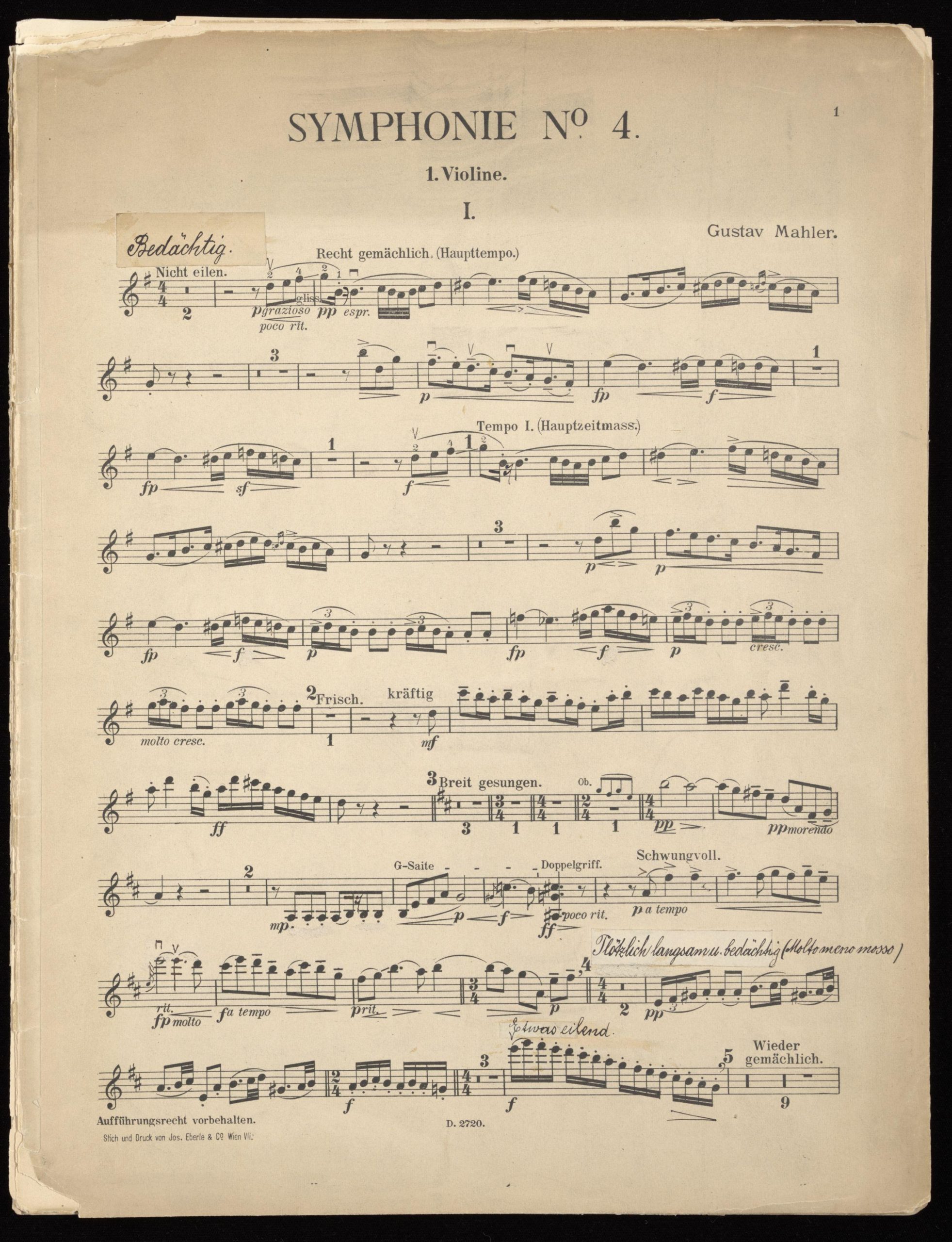
Gustav Mahler (1860-1911) began composing his fourth symphony in 1899 and completed it during the winter of 1900/1901, though he continued to refine the orchestration of the piece over the next several years. Mahler sent his score of the symphony to the publisher and requested a proof to use during a reading rehearsal with the Vienna Philharmonic in October, as he wanted to hear what it sounded like before it was published. It is not clear if the publishing house also provided proofs of the parts—it is possible the musicians performed from manuscript parts when the symphony was premiered in Munich by the Kaim Orchestra on November 25, 1901. The first edition was engraved and printed by Josef Eberle and published by Ludwig Doblinger in Vienna in December 1901.
Mahler made further edits over the next few years, adding corrections to conducting scores for performances given by Willem Mengelberg in Amsterdam in 1904 and by Richard Wickenhauser in Graz in 1905. In 1910, Mahler transferred publication rights to Universal Edition and sent to the publisher a galley proof with numerous revisions. After Mahler conducted the piece with the New York Philharmonic in January 1911, he sent his final corrections to Universal Edition.
Mahler’s Symphony No. 4 premiered in New York on November 6, 1904, performed by the New York Symphony conducted by Walter Damrosch. Beginning in 1907, Mahler traveled between the U.S. and Europe, spending time in New York each season conducting with the Metropolitan Opera, New York Symphony Orchestra, and New York Philharmonic. Mahler conducted his Symphony No. 4 with the New York Philharmonic in January of 1911, a significant occasion of the composer interpreting his own work with the ensemble.
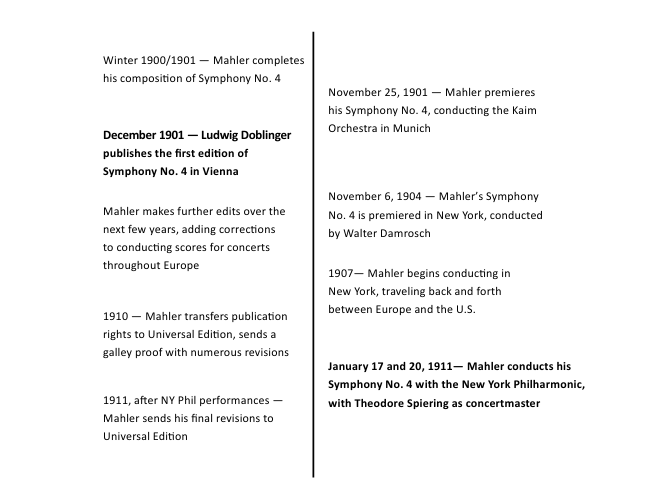
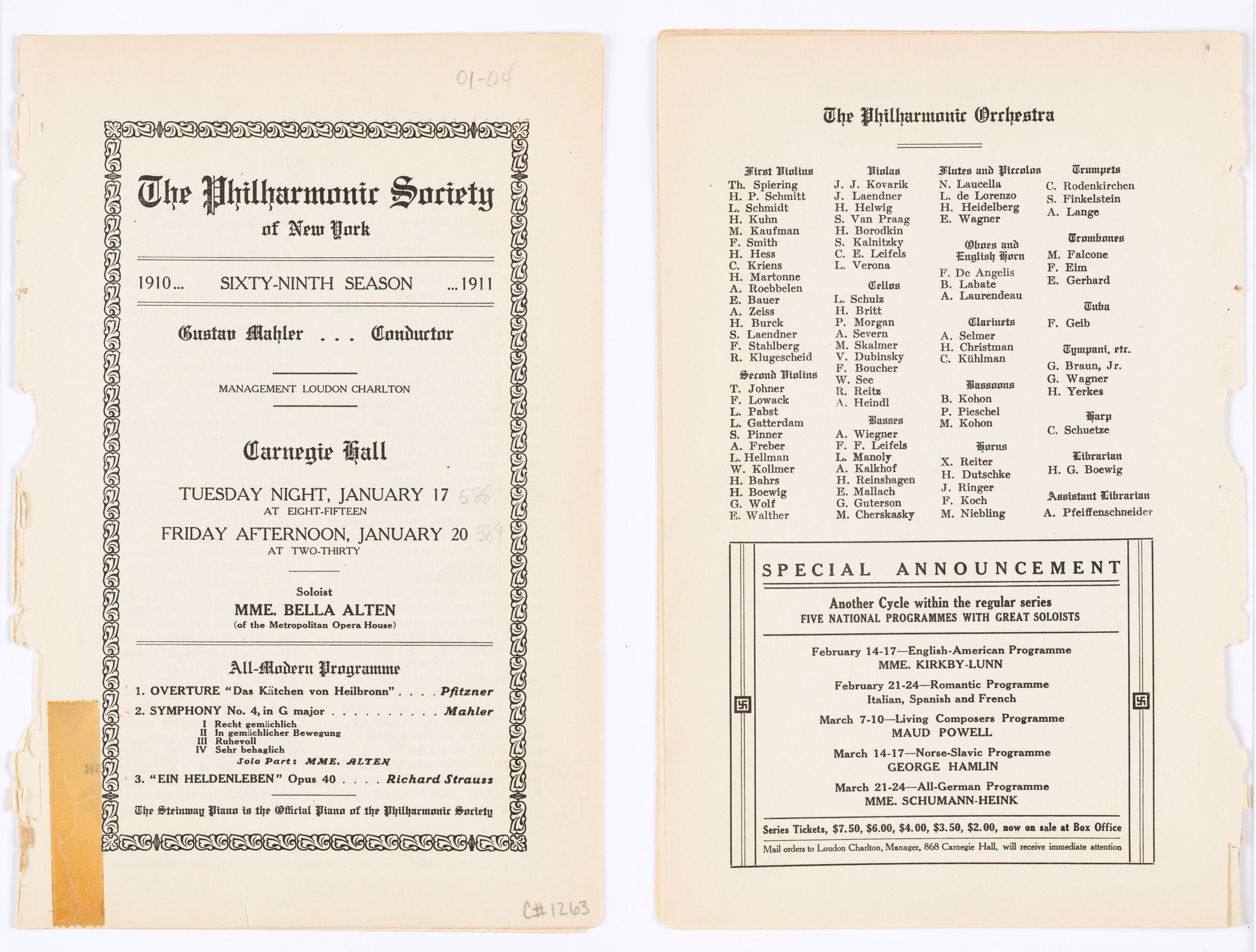
For the January 1911 performances, the New York Philharmonic used the 1901 Doblinger first edition orchestral parts, which had been marked up with Mahler’s revisions by Viennese copyist Johann Forstik. Theodore Spiering performed as concertmaster during these January 1911 performances—the violin I part held in the CCM Library Special Collections is also the Doblinger first edition and was also marked up by Forstik, though it evidently does not belong to the New York Philharmonic set of parts. The violin part of the New York Philharmonic set bears annotations not present in the CCM Library Spiering part, including bowings, dynamics, notation edits, and rehearsal letters in blue, red, and graphite pencil. Shortly after the January 1911 New York performances, Mahler fell ill. Spiering took over as conductor of the New York Philharmonic while Mahler traveled back to Vienna, where he died on May 18, 1911.
The Mahler Symphony No. 4 violin I part from the Theodore Spiering Collection has been digitized by the UC Libraries Digital Initiatives Team. It is accessible on JSTOR, along with many other pieces from the Theodore Spiering Collection. Materials in the Theodore Spiering Collection were donated by Lenore Spiering, Theodore Spiering’s daughter.
Check out the digitized Theodore Spiering Collection on JSTOR, and access the Mahler Symphony No. 4 violin I part!
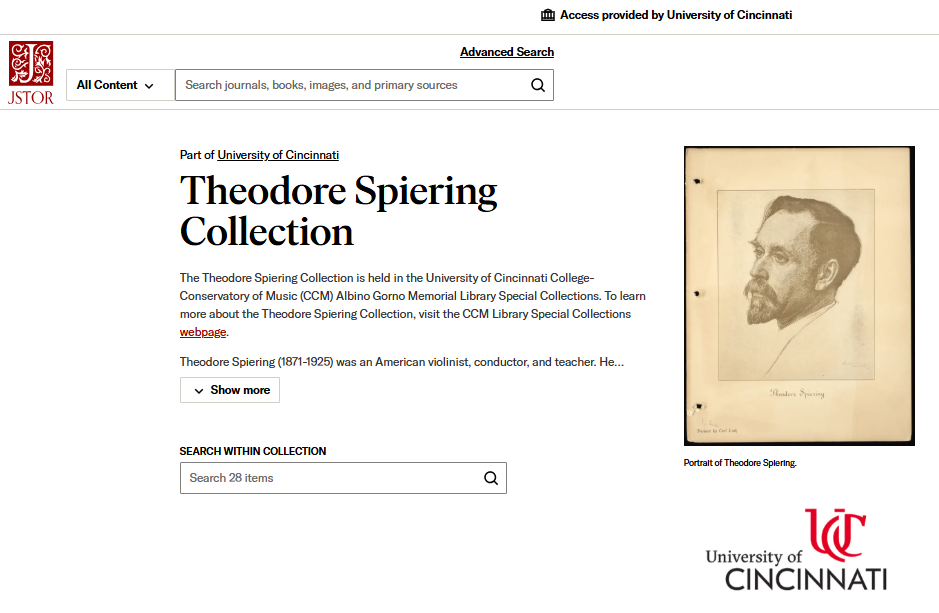
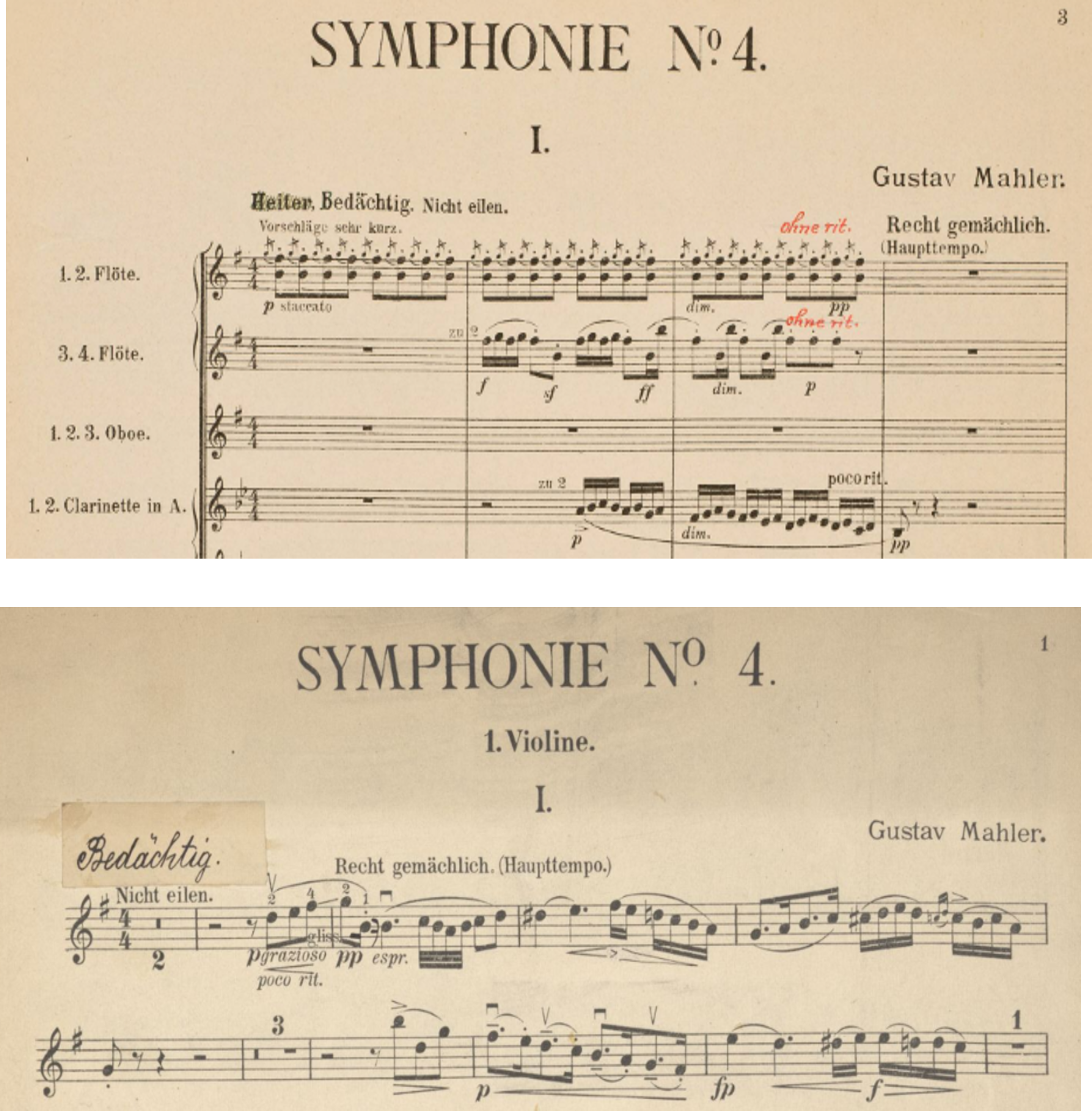
As you explore the revisions and paste-overs, you can compare to a digitized score of Mahler’s Symphony No. 4 from the NY Philharmonic Archives, which shows more clearly what was in the score prior to the changes. Image 7 is the cover page of the Doblinger first edition with a note indicating red corrections after Mahler and green corrections after later Universal Edition revisions. You will see significant changes right from the beginning: the Spiering part has a paste-over of “Bedächtig” (deliberately) at m. 1, which is covering the original marking of “Heiter, Bedächtig” (cheerful, deliberately). Imagine the different interpretive ways the music would feel and sound as you explore the revisions!
References:
Written by Rebecca Schreiber
Read Source, to learn about the news, events, people and happenings in UC Libraries. This year marks the 25th anniversary of the newsletter! To mark the occasion, Source underwent a design refresh to both the graphics and website to herald the publication into the next quarter century.
In this issue of Source, Liz Kiscaden, dean and university librarian, welcomes everyone back to the start of the academic year, while a photo slide show features early outreach activities welcoming Bearcats to campus. And don’t miss a list of Fall Events taking place throughout UC Libraries. The Source @ 25! article talks about some of the changes at UC Libraries documented by Source, and an interview with the Preservation Lab’s Jessica Ebert marks her upcoming 20th anniversary at UC Libraries. A new exhibit on display in the Archives and Rare Books Library explores Cincinnati’s growth and transit transformation from its founding in 1788 to the present day, and the CEAS Library launches a wellness collection. And for those who can’t travel to campus, UC Libraries digital collections are now available via Preservica for viewing online.
Read these articles, as well as past issues, on the website. To receive Source via e-mail, contact melissa.norris@uc.edu to be added to the mailing list. Happy reading.

Read Source, the online newsletter, to learn about the news, events, people and happenings in UC Libraries.
In this issue of Source, Liz Kiscaden, dean and university librarian, looks back at the accomplishments of the most recent academic year while also looking head to the fall semester. We celebrate the many accomplishments of the UC Libraries faculty and staff, the 2026 UC Open Research Day and announce the 2026 Zero Textbook Cost Grant cohort. Two collections are highlighted in this issue: The Werner H. Von Rosentiel papers and the Oesper History of Chemistry collection while the Winkler Center display illuminates Covington, Kentucky as the “X-Ray City.” This issue of Source concludes with a year in photos.
Read these articles, as well as past issues, on the website. To receive Source via e-mail, contact melissa.norris@uc.edu to be added to the mailing list.
UC Libraries has reduced operating hours in most locations beginning summer semester and continuing throughout the upcoming academic year. To minimize the impact on library users, reductions are primarily during evening and weekend hours when in-person usage is at its lowest. Digital library services, including Chat Reference, online resources and access to the library catalog will remain available 24/7.
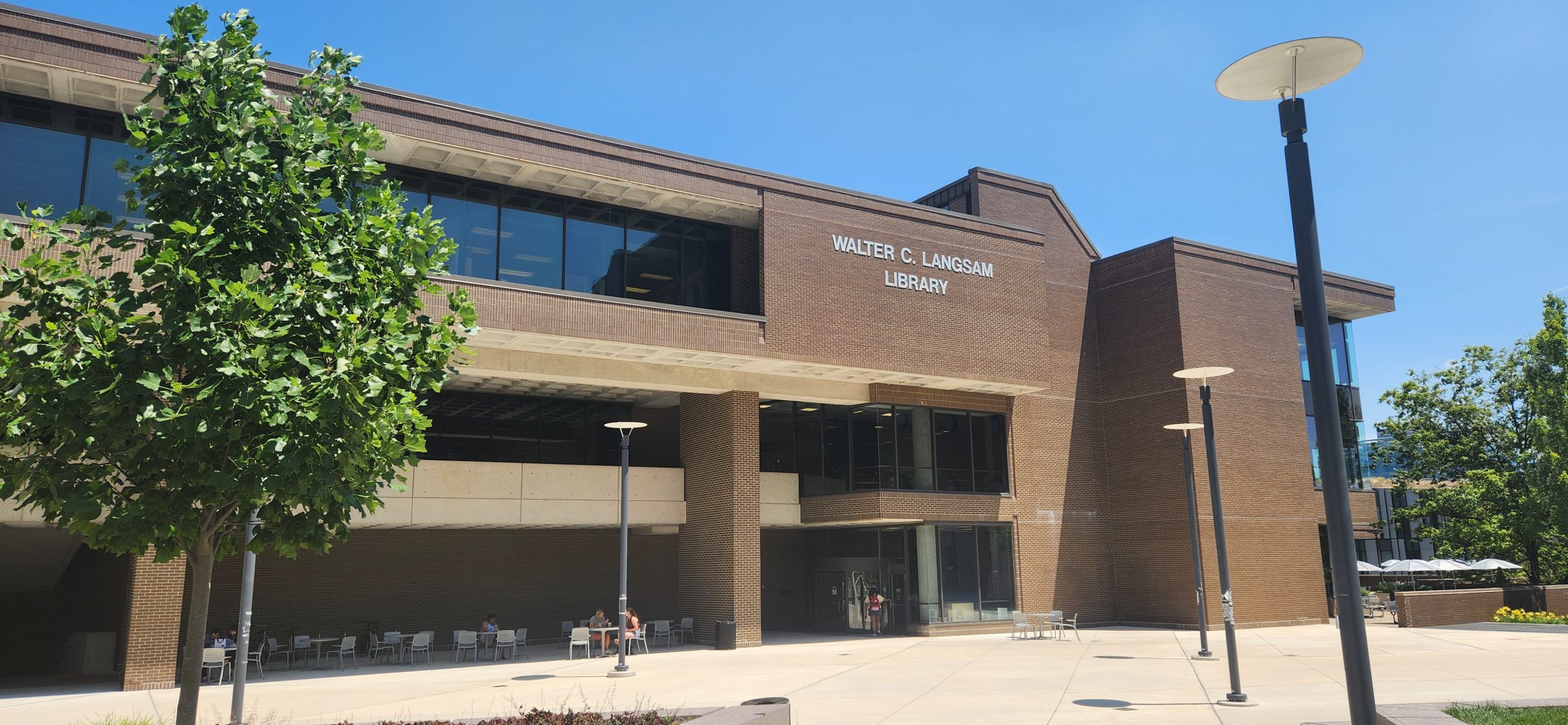
These changes are the result of a reduction to the UC Libraries operating budget and are informed by foot traffic and usage patterns. The budget reduction required eliminating contracted security services and student employee positions, which are necessary to keep the libraries open extended hours. When determining how to adjust operating hours, the Libraries reviewed usage statistics and prioritized retaining currently employed student employees.
We recognize that reduced hours will impact users and are committed to maintaining access to services and support in a digital environment. Library staff and faculty roles remain unchanged.
Each UC library location will continue to monitor usage and may adjust hours when possible, such as during high-demand periods. A list of library hours by location is posted on the Libraries web site.
The University of Cincinnati Libraries and the Elliston Poetry Room announce the poets and composers for the next Poetry Stacked, a semi-regular poetry reading series. This session is a musical collaboration, and will be held in the Albino Gorno Memorial (CCM) Library, 600 Blegen Library.
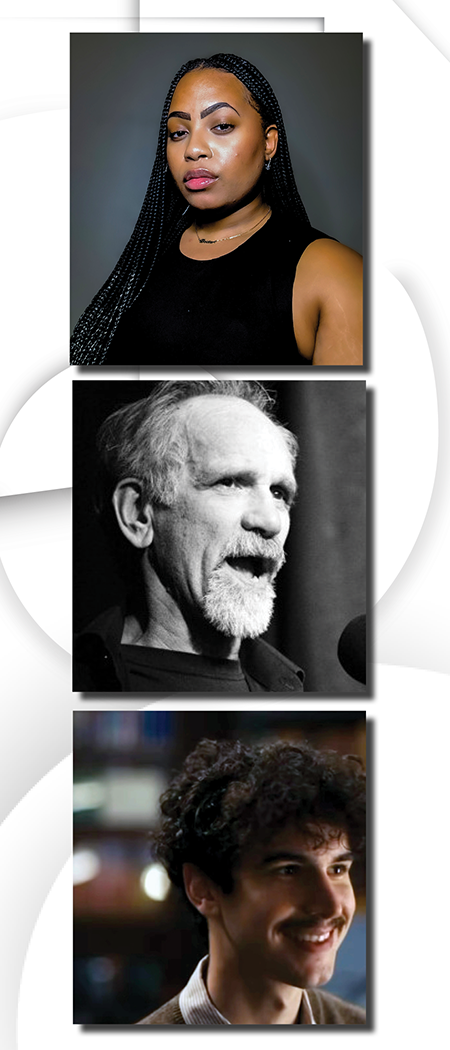
At the next event, scheduled for Wednesday, March 11 at 4pm, three poets will read their original work:
All UC Libraries locations, including Blue Ash, Clermont, Law and Health Sciences, are closed Tuesday, January 27 due to inclement weather.
See the UC alerts page for more information.
Stay safe and warm, Bearcats!