
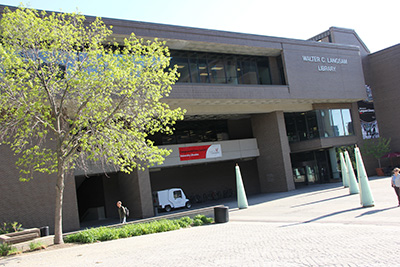
 While studying for exams in Langsam Library, take a moment to breath and recharge with “Stress Less Fest” brought to you by the Student Wellness Center, Counseling & Psychological Services (CAPS), Learning Assistance Center (LAC), Campus Rec Center, Residence Hall Association (RHA), and Disability Services.
Category Archives: UC Libraries
Oesper News: Museum Booklets on the History of Chemical Apparatus
Dr. William B. Jensen introduces his new series:
Like most museums, only about 25% of the holdings of the Oesper Collections
in the History of Chemistry are on public display at a given time. In order to make the remaining 75% available in some form, it was decided to initiate a series of short museum booklets, each dedicated to a particular instrument or laboratory technique of historical importance to the science of chemistry.
Each booklet would include not only photographs of both displayed and stored museum artifacts related to the subject at hand, but also a short discussion of the history of the instrument or technique and of its impact on the development of chemistry as a whole. Several of these booklets are expansions of short articles which have previously appeared in either the bimonthly series Museum Notes, which is posted on the Oesper website, or the series Ask the Historian, which appeared in the Journal of Chemical Education between 2003 and 2012.
You can access the booklets by clicking here.
Check Out the Latest Issue of Source, UC Libraries Newsletter
 Read the online newsletter to learn more about the development of UC’s digital repository, why UC’s colors are red and black, and more news from UC Libraries.
This latest issue of Source includes updates on the Libraries’ Strategic Plan, with an overview of digital humanities and news on the development of UC’s digital repository, which makes accessible, enables re-use, stores, organizes and preserves the full range of the institution’s intellectual output, including scholarly, historical and research materials. Also featured are stories about providing access to the Libraries special collections, a new exhibit highlighting the top illustrated children’s books, and the librarians, staff and students of UC Libraries giving thanks.
Source online is available on the web at http://libapps.libraries.uc.edu/source/ and via e-mail. To receive Source online via e-mail, contact melissa.norris@uc.edu to be added to the mailing list.
An Early View of the Stands
By: Janice Schulz, Former ARB Library staff member
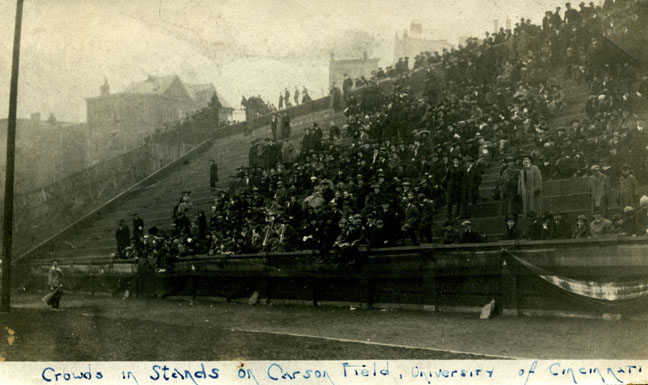
The University of Cincinnati is in the midst of a major renovation of Nippert Stadium that will turn it into a state-of-the-art athletic complex, but at one time our gridiron heroes played on what were simply a field and a chain of stands. According to the 1904 Cincinnatian the “much-needed and long-looked for” athletic field was completed in that academic year. The field was later named after UC alum, medical school faculty member, and UC director Archibald I. Carson. As a medical school student (Class of ’89) Carson organized the first UC football team. The stands were first erected in 1912 at a cost of $50,000 and then added to in 1920 and again in 1924, when the stadium was dedicated in memory of Jimmy Nippert. In 1935 the Works Progress Administration sponsored a $135,000 project to add the press box. Shank Pavilion was added in 1954 and a major renovation came in 1991 at a cost of $13,500,000.
Coming Together to Give Thanks
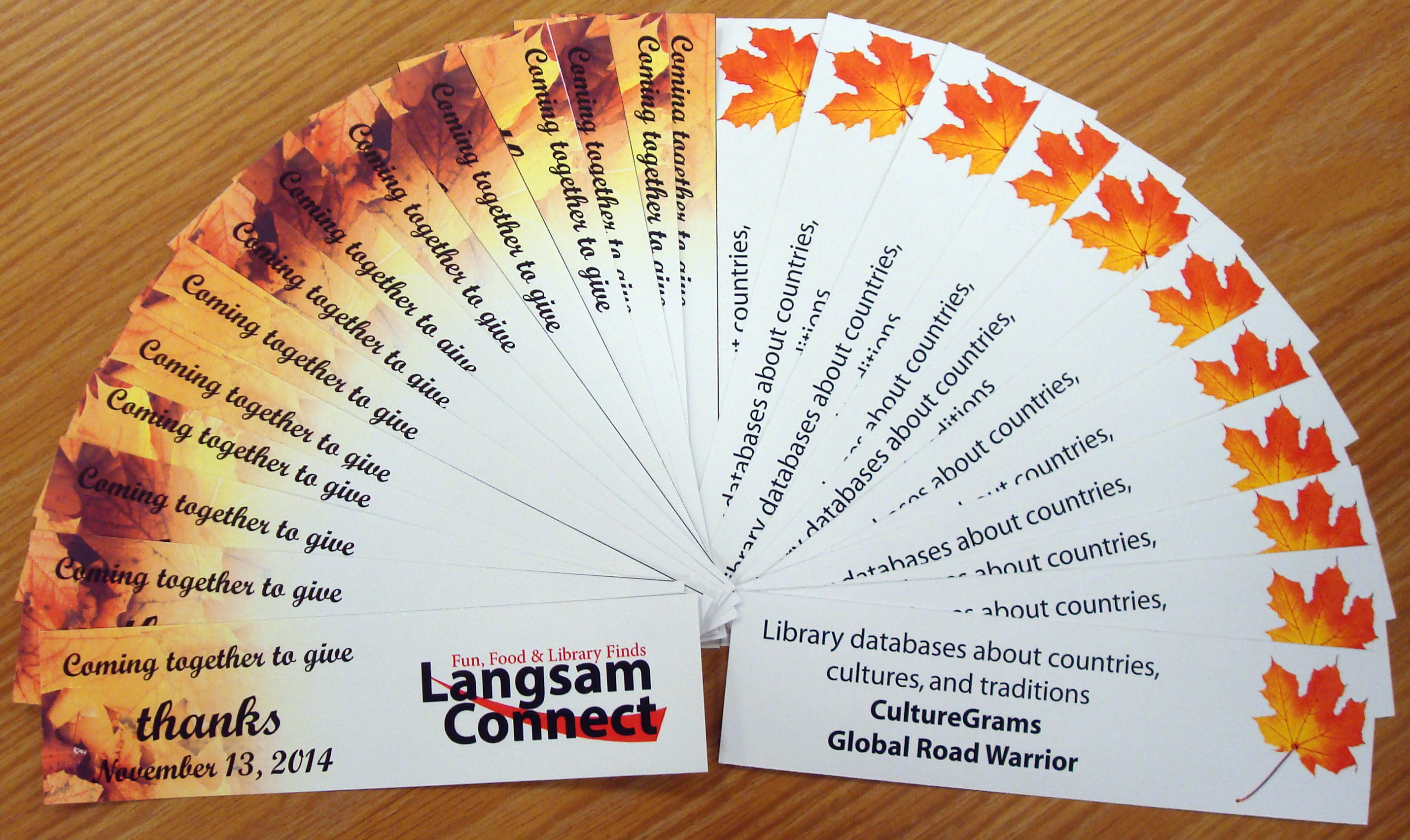
Over 50 students and UCL staff got together on the afternoon on November 13th to learn about holidays, traditions, and feasts around the world celebrating fall, harvest, family, or giving thanks. Alongside Thanksgiving favorites, including turkey, corn bread, greens and pies, the dishes on our holiday table featured Caribbean jerk chicken with rice, beans, and vegetables, Chinese mooncakes, Russian apple cakes, Indian rice and carrot puddings, and other delicacies. After filling (and refilling) our plates and learning to say “thank you” in several languages, we embarked on a tour of the world spotlighting holidays and festivals in China, Germany, India, Japan, Korea, Kurdistan, Russia, South Africa, Turkey, and United States. We learned a lot about various holidays and food associated with them. Continue reading
Study 24/7 in Langsam Library During Exams
 Cramming for an exam? Need a safe, quiet place to study?
Langsam Library space will be opened 24/7 beginning noon on Sunday, November 30 through December 10. Regular hours will resume 8am on December 11.
November 19th is GIS Day
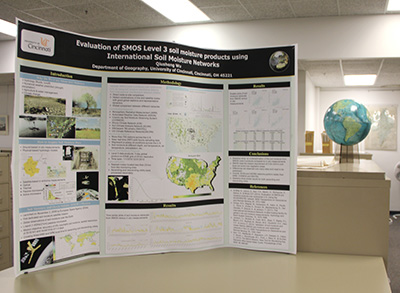 Join UC Geography (and UC Libraries) in celebrating GIS Day – a worldwide salute to geospatial technology and its impact on our lives.
Tim Balzer, product manager of the Cincinnati-based start-up company Roadtrippers, will discuss the history, development and future direction of their successful web-based and multi-platform app Roadtrippers.
Wednesday, November 19
11:45-12:30pm
TUC 417A
Stop by TUC to meet and greet UC Libraries’ Amy Koshoffer and Holly Prochaska as they man the GIS Day booth during the speaker and talk to visitors about GIS. And visit the Geology-Mathematics-Physics Library during the day to see GIS posters from the Geography Department.
Growth of Student Government
By: Iman Said, ARB Intern, 2014-2015
Just about every college campus, and now almost every high school, has some form of a student government. It’s a coalition of students who put on events, work on projects, and speak to administrators and members of the community on issues related to the students.
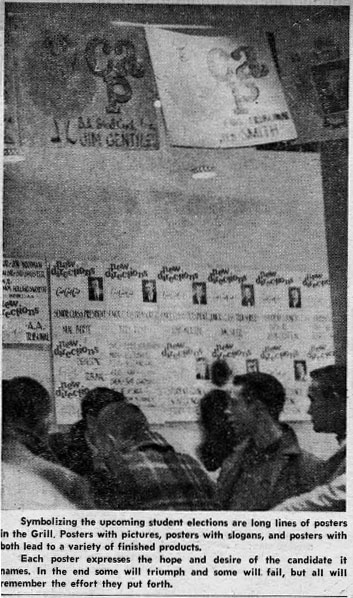
Today, the UC Undergraduate Student Government is made up of a Senate, a Cabinet, Boards, and College Tribunals. This makes for an organization that is involved in just about every aspect of student life. Elections are held every year, usually in February, and candidates select a President and Vice President, as well as eight At-Large Senators. After those positions have been chosen, Cabinet positions are filled using an application process. Any student can apply to a cabinet position, no matter their age or year in school. Each of the Tribunals then holds their own internal elections to select their executive board and their representative to Senate. Continue reading
The Universality of Sherlock Holmes
By: Iman Said, ARB Intern 2014-2015
This week, we’ll take a quick break from historical photos and talk about the impact that literature can have on society.
Last March, I had the opportunity to travel to Edinburgh, Scotland as part of a seminar here at UC. Edinburgh is the very first city to be established as an UNESCO City of Literature. Incredible authors began their careers in Edinburgh, from Sir Walter Scott to J.K. Rowling. Simply walking the streets of Newtown was enough to see the impact that literature has had on the culture of the city.
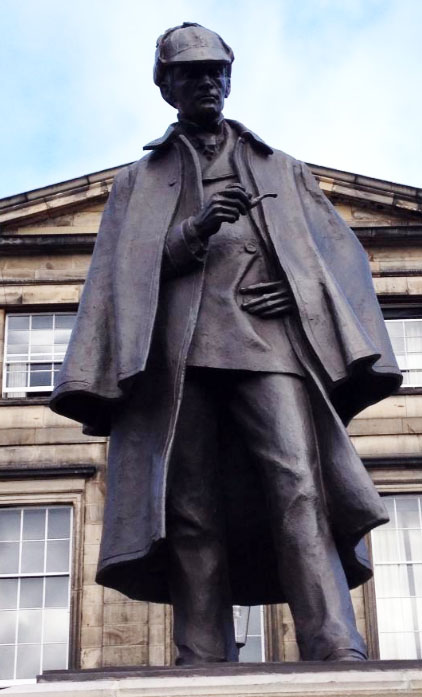
For me, the most significant author to start in Edinburgh is the incredible Sir Arthur Conan Doyle, whose legendary consulting detective is a household name all over the world. Sherlock Holmes and his faithful compatriot, Dr. John Watson, got their start in two novels, A Study in Scarlet and Sign of the Four. Neither of the novels had very much success, so Doyle decided to change tactics and began to write a series of short stories that ran every month in The Strand Magazine. The first story, “A Scandal in Bohemia” was published in July 1891 and was an instant success, guaranteeing the success of Doyle and the success of the magazine. Today, the stories have been translated into numerous languages and adapted into tens of television programs, radio shows, and movies. Statues of the great detective can be found in Edinburgh, the birthplace of Sir Arthur Conan Doyle, as well as in Japan and Switzerland. Continue reading
Who Invented the Fleaker? : Notes from the Oesper Collections, No. 29, November/December 2014
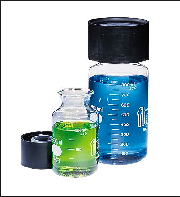
Typical modern-day fleakers with their patented caps.
The 29th issue of Museum Notes highlights a recent innovation in laboratory glassware known as the “fleaker” and traces its historical antecedents to a late 19th-century innovation known as the “beaker flask.”
Click here for all other issues of Notes from The Oesper Collections and to explore the Jensen-Thomas Apparatus Collection.