David Blackburn: A Performer and Teacher is Remembered at UC

By:  Suzanne Maggard

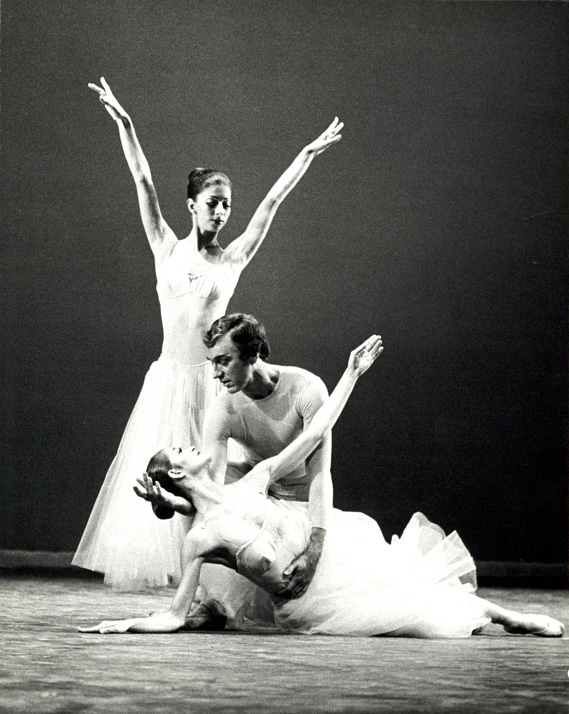
Blackburn in Serenade

Blackburn in Serenade with Alyce Taylor (standing), and Colleen Giesting

On June 15, 2013, David Blackburn passed away and the Cincinnati dance community lost a beloved teacher and friend.  Blackburn served as a professor of dance at the University of Cincinnati’s College-Conservatory of Music for over 30 years and played a vital role in the history of the Cincinnati Ballet as a dancer and then as Assistant Artistic Director.

Continue reading

Oesper Collections Attract International Scholars

(Contributed by Dr. William Jensen, Curator of the Oesper Collections in the History of Chemistry)

As the global reputation of the Oesper Collections in the History of Chemistry continues to grow, these special collections are attracting the attention of more and more international scholars.

Starting in January 2013, Professor José Chamizo of the University of Mexico spent three months of his sabbatical  working in the collections and  returned once more in  June for another two weeks. While at Cincinnati his research focused on the role of instrumentation in initiating chemical revolutions and on the life and work of the 19th-century Mexican chemist, José Ortigiosa.
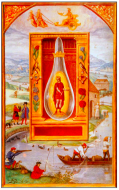
Detailed image from the Splendor Solis manuscript
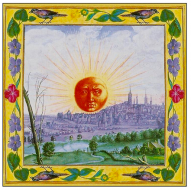
Detailed image from the Splendor Solis manuscript

Detailed image from the Splendor Solis manuscript

Detailed image from the Splendor Solis manuscript

In late June, the Oesper collections were also visited by Dr. Eberhard Slenczka, former Director of Libraries for the Germanisches Nationalmuseum in Nuremburg, who came to examine our facsimile of the 16th century alchemical manuscript known as the Splendor Solis in order to make comparisons with the copies found in Nuremburg, Paris, London and Spain.

Please direct questions regarding access and use of the Oesper collections to  Professor William B. Jensen or Ted Baldwin, Director of Science and Engineering Libraries.

Cincinnati Street Names-A Who's Who of Cincinnati History = Adventures in the Subway and Street Improvements Digitization Project

By:  Angela Vanderbilt

The subway and street improvements photograph collection is truly a wealth of historic information about the city of Cincinnati in the first half of the 20th century. As with most cities, many of the streets and avenues are named for the founders and prominent families who helped establish the city, as well as important statesmen such as presidents, governors and military heroes. Cincinnati has her fair share of these, with the city directories reading like a “Who’s Who” of Cincinnati’s political, cultural and economic development, with street names such as Ludlow, Symmes, and Patterson, St. Clair, Gamble and Ault, Anderson, Findlay and Wade, among others.

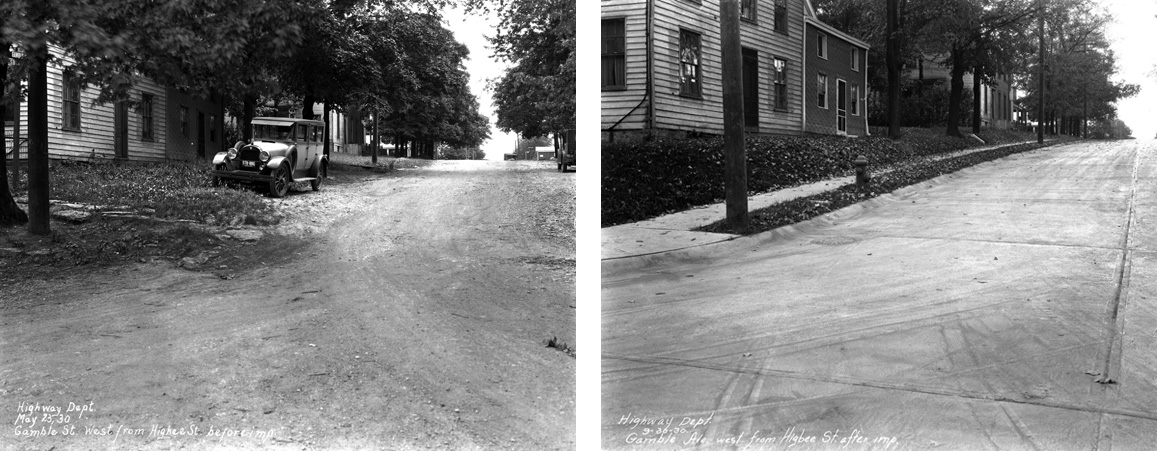
Gamble Street

Gamble Street, named for industrialist James Gamble, of Proctor & Gamble.

Continue reading

Welcome Newest Bearcats

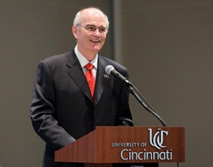
signThis summer, Langsam Library was a busy place as over 4,000 incoming students participating in UC New Student Orientation visited and learned about all that UC Libraries has to offer. While here, they engaged in activities designed to be entertaining while at the same time informative about the various research resources, assistance, and library services they can take advantage of when they return in the fall.
Continue reading

President Williams Speeches Are Now Available in the University Archives

By Tyler Morrison, ARB Student Worker

Greg WilliamsGregory H. Williams became the University of Cincinnati’s 27th president when he took office in September 2009.  Among more than 100 applicants for the position, he was selected in part because of his outstanding work in transforming the City College of New York, where he served as president before joining the UC.  Williams received national acclaim for his book, Life on the Color Line: The True Story of a White Boy Who Discovered He Was Black (New York, NY: Dutton, 1995).   Over a decade later, he still received feedback from his readers while serving as the president here at UC. The memoir was his way of telling the world about struggling with poverty and acceptance during his youth and dealing with his biracial identity in Muncie, Indiana at a time when segregation was still highly overt in the United States.   The book also brought to life other family issues such as alcoholism and abandonment.  Throughout his account, he told the story of a normal childhood that spiraled into one of torment, welfare, and segregation, and then how he made the best of it.  Williams became the star quarterback of his high school’s football team, excelled in college to earn four degrees, and worked his way up in higher education system until he became president of College City of New York from 2001-2009 and then president of the University of Cincinnati from 2009 to 2012. Continue reading
How Much Did You Pay For That Education?!?!

By Tyler Morrison, ARB Student Worker

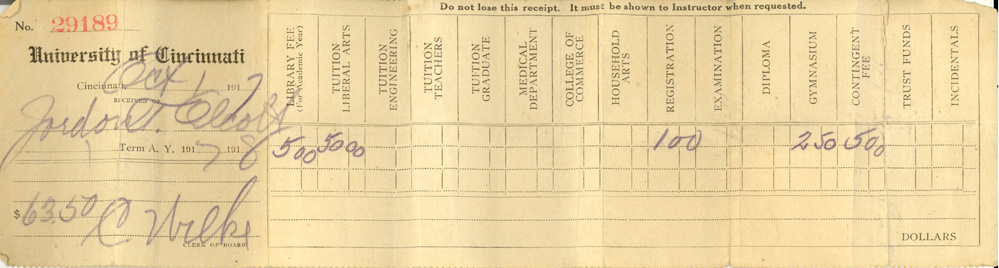
Oh, the things you can find when you go to an auction.  Even the typical items that you find for sale, such as books, sometimes contain a surprise for the unsuspecting buyer.  That’s exactly what happened to Linda Sheets of Jonesboro, Indiana when she bought a box lot of books and discovered a University of Cincinnati tuition receipt dated October 1, 1917.  The strip of paper has yellowed with age, and fortunately Ms. Sheets realized it might have historical value for UC, and was kind enough to share her discovery with the Archives and Rare Books Library.

Jordon Alcott, the student from the 1917-1918 academic year, probably thought that $63.50 in tuition for one semester here at the university was expensive.  That total comes from a $5 library fee, $50 for tuition to the College of Liberal Arts, a $ 1 registration fee, $2.50 fine to use the gymnasium, and a $5 contingency fee.

Receipt for Tuition

Continue reading

Home Interiors of the 1920s = Adventures in the Subway and Street Improvements Digitization Project

By:  Angela Vanderbilt

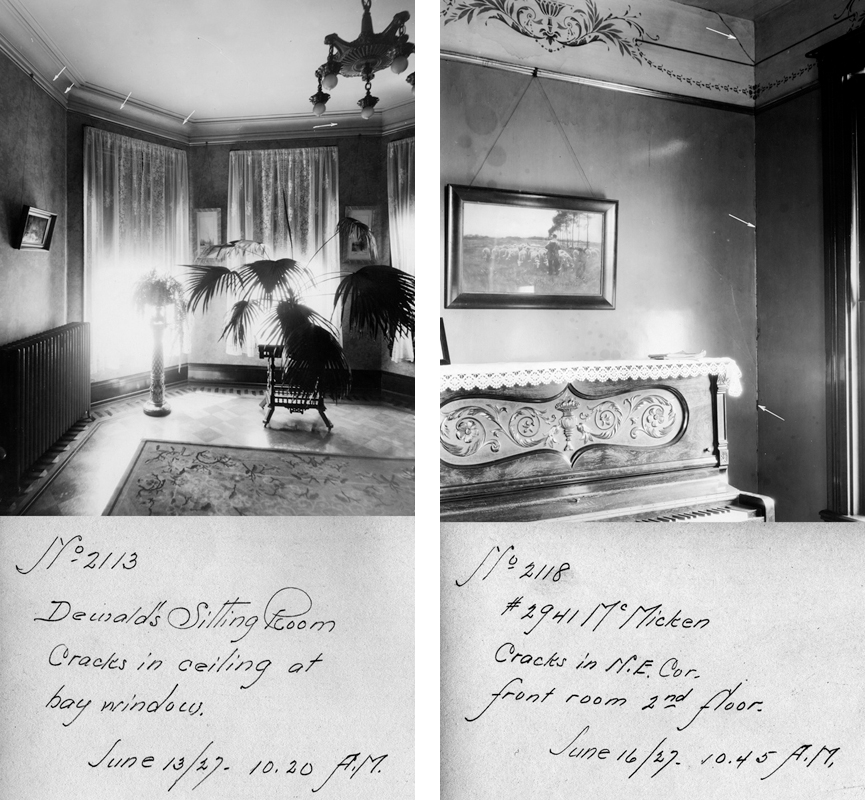
Contained within the subway portion of the photograph collection are images of the interiors of homes along McMicken Avenue taken during the construction of the subway. Originally intended to serve as evidence for claims by homeowners of structural damage to the houses caused by blasting for the subway tunnels, the pictures now serve as a historic reference of domestic life during the 1920s.

Interiors of Homes with damaged walls

Continue reading

Ezzard Charles Drive, the Making of a Parkway

By Angela Vanderbilt

Road construction. It seems like it’s never ending. Some have joked that Ohio has only two seasons – winter and road construction. And the images in the Street Improvement collection would certainly seem to validate that. What is interesting about the images in the collection of street improvements is that many of the streets recorded in the photographs no longer exist. Or, where they do still exist, they are named differently or the surroundings have been altered to the point that the location in the photograph is no longer recognizable.

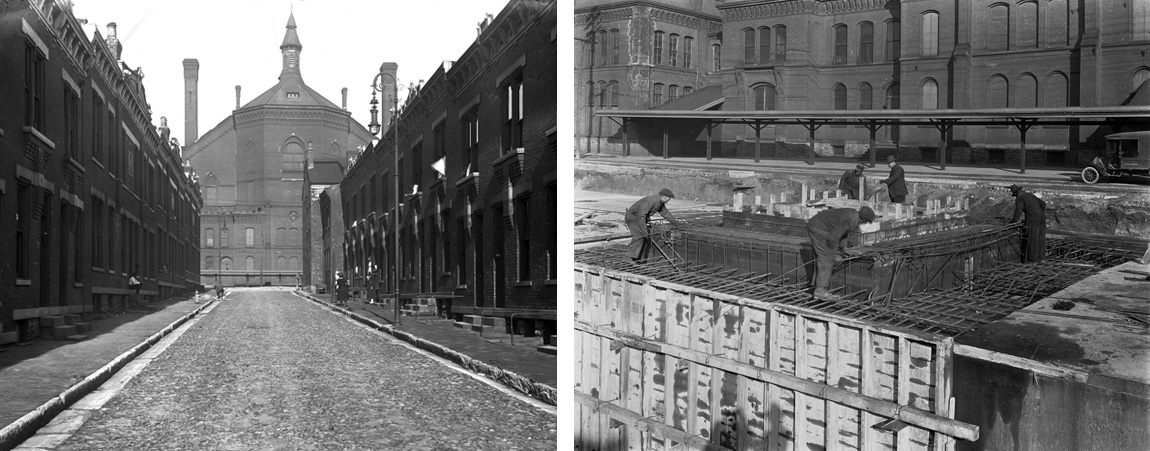
One major example of a street changing in both name and appearance is Laurel Street – or as we know it today, Ezzard Charles Drive. Originally a narrow street lined with brick row houses and businesses, Laurel Street extended from 1247 Plum Street west to Freeman Avenue, with the Cincinnati Symphony Orchestra Hall towering over the eastern end of the street, as if keeping watch over all who passed. In the winter of 1921, subway construction made its way north along the canal bed to the Laurel Street intersection, where a tunnel ventilator was constructed.

Music Hall and Ventilator Construction

(Left) Construction of subway ventilator opposite Laurel Street, January 12, 1921, 2:02 p.m.
(Right) Laurel Street, west of Canal, with Cincinnati Symphony Orchestra Hall in center background, April 21, 1920, 3:47 p.m.

Continue reading

Paving the Way through Cincinnati = Adventures in the Subway and Street Improvements Digitization Project

By:  Angela Vanderbilt

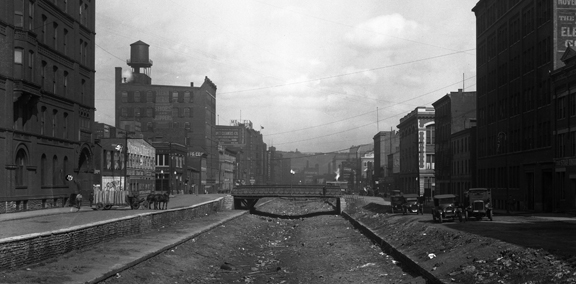
Downtown Cincinnati at the turn of the 20th century was a bustling business and commercial center, but with a dangerous mixture of pedestrians, horse-pulled wagons and carriages, street cars, and unseasoned automobile drivers. Add to this a mess of unpaved or cobblestoned streets, a lack of traffic laws, speed limits, and stop signs at intersections, with streetcar tracks criss-crossing lanes. It was a recipe for disaster.

Miami & Erie Canal

On the left, deliveries to the Raschig School are unloaded from a horse-drawn wagon while, on the right, automobiles park along a drained Miami & Erie Canal, looking east down Canal Street as subway construction begins, April 20, 1920

Continue reading

Eugene Ruehlmann, former Cincinnati Mayor, will be missed

By:  Suzanne Maggard

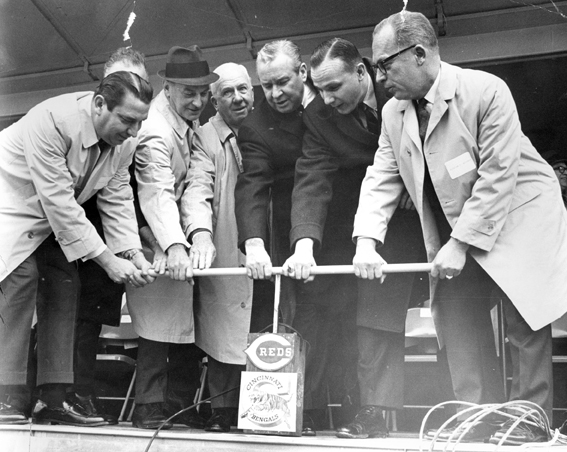
Construction of Riverfront Stadium

Construction of Riverfront Stadium begins, Eugene Ruehlmann is second from the right

We began our Monday in the Archives and Rare Books Library with the sad news that a dear friend of our library passed away over the weekend.  Former Cincinnati mayor and city councilman, Eugene Ruehlmann died on Saturday June 8 at the age of 88.  Since the Archives and Rare Books Library holds his papers, I had the pleasure of assisting Mr. Ruehlmann on several occasions.  For someone so accomplished, I always found Mr. Ruehlmann incredibly approachable, easy to talk to, and humble.  Our student workers especially enjoyed meeting and talking with him.  He will be greatly missed.

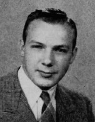
Ruehlmann, 1947

Eugene Ruehlmann, 1947, from The Cincinnatian Yearbook

Eugene Ruehlmann, the second youngest of John and Hattie Ruehlmann’s ten children, was born in 1925.  He grew up on Cincinnati’s West Side and attended Western Hills High School and graduated in 1943.  After high school, he joined the U.S. Marines and served in World War II.  He then entered the University of Cincinnati, where he was a successful and active student.  Ruehlmann was a member of Beta Theta Phi, ODK, and Sophos and was on the board of The Cincinnatian (yearbook) and was a member of the varsity football team.  He graduated with honors in 1948 with a degree in Political Science and received the McKibbin Medal from the College of Arts and Sciences.  Ruehlmann earned his law degree in 1950 from Harvard. Continue reading