Smoking Permitted and No Tipping Allowed!?! Hospital Information for Overnight Patients, 1958

The following post was written by Winkler Center assistant archivist, Nina Herzog.   All images courtesy of the Henry R. Winkler Center for the History of the Health Professions

Smoking Permitted and No Tipping Allowed!?! Hospital Information for Overnight Patients, 1958

CGH  Informational Booklet, 1958.


Without a doubt, checking into and staying at hospitals is a lot different today than it was over a half century ago.  Computerized check-ins, televisions in rooms and bans on smoking, etc. have all improved the patient experience. The images below were taken from an informational booklet given to patients at the Cincinnati General Hospital (CGH) in 1958.

The instructive pamphlet titled, “Well Here I Am,” provides the incoming patient with information on subjects ranging from check in, dining hours, and visitor information to hospital maps, directions, and much more.

Smoking Permitted and No Tipping Allowed!?! Hospital Information for Overnight Patients, 1958 Smoking Permitted and No Tipping Allowed!?! Hospital Information for Overnight Patients, 1958


Continue reading

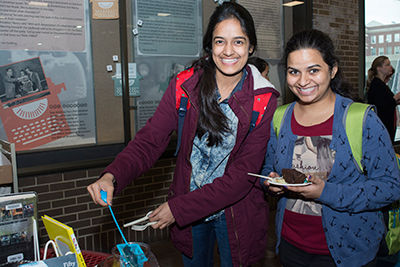
Welcome Back, Clermont Students!

Dear Students,

I’m so happy to welcome you all back to campus!

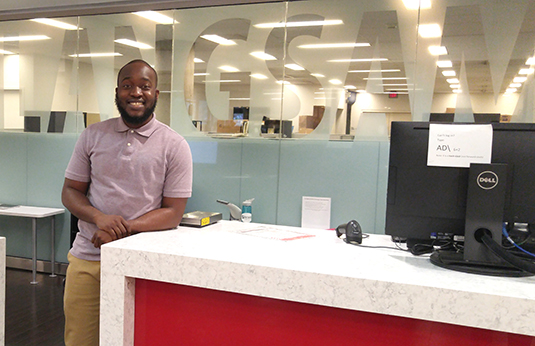
With help from generous donors, we’ve worked hard during the winter break to make the library a better place for you to study, hang out, and get assistance with research. The big changes  include an upgraded service point and new front doors. We’ve also relocated some furniture and the printer-scanner combo in order to serve you better. Stay tuned for more improvements coming soon this term, including electric access for more first floor study tables and for the circular couches in the library atrium.

Let me know what you think of all of the changes!

Best wishes for a productive and happy spring semester,

Katie Foran-Mulcahy
Clermont College Library Director

Dean’s Corner: Welcome Back!

This fall, UC Libraries continued the pursuit of our mission to become the “globally engaged intellectual commons of the university.”

We began the semester with the announcement of Langsam Library’s transformation to a 24×7 space, and the opening of its new Starbucks cafe. We celebrated a number of new hires, including the director of the University of Cincinnati Press, Liz Scarpelli and the head of the CCM Library, Jenny Doctor. We featured new displays, such as Big Bone Lick: A Place of Discovery at the Geography-Mathematics-Physics Library, physical and online exhibits  celebrating Native American Heritage found at Langsam Library and on our library website, and a Halloween exhibit of creepy medical artifacts at the Winkler Center. We also celebrated at the Winkler Center the 100th birthday of Dr. Henry R. Winkler.

At the 10th Annual Books by the Banks Festival. From left to right, my wife Wendy, Director of Communications Melissa Cox Norris, and Interim Associate Dean for Public Services Dan Gottlieb

UC Libraries sponsored numerous events, including ones for Hispanic Heritage Month and the bi-annual Life of the Mind.* I held my third bi-annual Dean’s Advisory Council meeting.

All of these visible and publicized changes and events don’t account for the hard work done behind the scenes by UC Libraries’ excellent faculty and staff.

This spring will be a time of re-calibration. We will continue to serve the students, faculty, researchers and scholars of the University of Cincinnati community while examining the best way forward. On this blog, I plan to dig deeper into the initiatives, departments and personnel that make up UC Libraries.

Thank you for reading and welcome back!

Dean’s Corner: Welcome Back!

Xuemao Wang
Dean and University Librarian


*For more highlights, check out the recently released 2015/2016 Progress Report: Transforming Our Spaces and UC Libraries’ Newsletter Source.

Welcome, Craig Person, New Operations Manager & Student Supervisor for the Science & Engineering Libraries

UC Libraries is pleased to welcome Craig Person as the operations manager and student supervisor for the Science and Engineering Libraries.

craig person

Craig comes to the university from Northern Kentucky University (NKU) Libraries where he was the head of access services since 2008, and was previously the circulation and reserves supervisor and the evening circulation supervisor.  Craig may be a familiar face to some as he was a temporary staff member at Langsam Library from September 1996 – June 1997.  He is also active as a continuing education instructor for programs at NKU and with the American Library Association (ALA).

As operations manager and student supervisor, Craig will manage daily operations and service points at both the College of Engineering and Applied Science (CEAS) Library and the Chemistry-Biology Library.  His major duties include supervising the student workforce, overseeing interlibrary services and collections maintenance, assisting with facilities and technology initiatives, providing reference and training support and assisting with unit-wide planning.

Welcome to UC Libraries, Craig!

The Passing of Henry Heimlich (1920-2016)

Gallery

This gallery contains 7 photos.

The Winkler Center was saddened over the weekend to learn of the passing of Dr. Henry J. Heimlich. In lieu of writing another obituary or quick biography like the ones that can be read here at the Cincinnati Enquirer or … Continue reading

But what about Robert Kehoe?

Recently, Smithsonian.com published a brief article on the history of leaded

But what about Robert Kehoe?

Dr. Robert Kehoe, Kettering Laboratory, UC, date unknown

gas.  The article, seen here, http://www.smithsonianmag.com/smart-news/leaded-gas-poison-invented-180961368/, is informative though by no means exhaustive.  The story begins in 1920, 55 miles up I-75, in Dayton, Ohio, at the General Motors Research Corporation.  An engineer there, Thomas Midgely, and his boss, Charles F. Kettering, had developed an anti-engine knock additive called TEL or tetraethyllead.

At the time, “engine knock,” which was due to a malfunction between the fuel, air, and ignition explosion in a car’s cylinder, was at best a mild annoyance causing a light knocking sound and at worst a problem capable of destroying an automobile engine. Midgely’s solution was to add TEL to gasoline which would raise the combustability, or octane, of an engine lessening its chances of malfunctioning.

It worked.  Which was all well and good, but TEL contained lead, and as people have known for ages, lead isn’t particularly good for us.  In fact it’s rather deadly.  The author goes on to discuss the outcry that erupted after several workers died after being exposed to TEL on a regular basis.  A federal study was authorized in 1925 and it was decided that the amount of risk associated to every day exposure for most people was minimal and the production of leaded gasoline continued.  It was not until the 1970s that growing evidence over leaded gas’s danger became evident.  In January, 1996, the U.S. Clean Air act, officially banned the sale of leaded fuel for use in vehicles. Continue reading

Read UC Libraries Progress Report: Transforming Our Spaces

progress report coverRead the 2015/16 Progress Report: Transforming Our Spaces. In addition to providing an update on the news, events and stats from the previous academic year, the report focuses on the transformation of library spaces – both current and future. Renovations and changes to library spaces that will enable us to be recognized as the intellectual hub for students, faculty, researchers and scholars by providing engaging digital and physical environments, as well as powerful new tools and services that spark inquiry, support analysis and ignite discovery and scholarship as well as prepare emerging generations for lives of ongoing discovery.

The Progress Report is available online at https://issuu.com/uclibraries/docs/uclannualreport15_16.

Questions? Request a print copy? Email melissa.norris@uc.edu

Dean Wang Invited to Participate on International Dunhuang Consultative Committee

Xuemao Wang

Xuemao Wang, Dean and University Librarian, attending the International Dunhuang Consultative Committee meeting.

This past October, Xuemao Wang, dean and university librarian, was invited by the Dunhuang Research Academy of China to participate in a two-day International Dunhuang Consultative Committee meeting sponsored by the Andrew W. Mellon Foundation to consult on the Digital Dunhuang project. The consultative committee included individuals from such institutions as UC San Diego, UC Berkeley, Microsoft Research Asia, The University of Hong Kong Libraries, the British Library, the Victoria and Albert Museum, Jawaharlal Nehru University Library, the National Museum in New Delhi, the Korea Institute of Dunhuang, National Taiwan University, Zhejiang University, Wuhan University, and the University of Science and Technology of China, among other institutions. Members of the Consultative Committee received a three-year appointment from the director of the academy, Mr. Wang Yuanlong.

The objective of the two-day meeting was to review Digital Dunhuang’s current infrastructures, policies, and challenges, particularly in the three key areas of: digital asset management, digital resource integration, and digital preservation. The committee was charged by the director to prepare a set of recommendations for future activities in each of the three areas. At the end of the two-day, intensive meeting, the international consultative committee presented a draft set of recommendations to the academy.

Dunhuang Cave

Dunhuang Cave

The Dunhuang Caves, the best-known of which are the Mogao Caves, comprise some 492 temples and contain some of the finest examples of Buddhist art spanning a period of 1,000 years. Named a UNESCO World Heritage Site in 1987, the caves are one of the most comprehensive cultural heritage museums in existence. The Dunhuang Research Academy  has been devoted to the protection of the Dunhuang Mogao Caves since its founding in 1944. Currently, the Academy is undertaking a massive endeavor known as Digital Dunhuang whose ambitious goals include, eventually, digitizing all 492 caves’ resources—including 3-D imaging of murals, sculptures and the caves themselves—as well as managing the resulting digital resources with long-term digital preservation strategies.

Another Dunhuang project, the International Dunhuang Project is a consortium of libraries and museums that are linking their collections of digitized Dunhuang manuscripts and making them available on the Internet.

This was Dean Wang’s first visit Dunhuang, although he remembers learning about it in his Chinese high school history class. “I was tremendously impressed by its historical and artistic richness and the beauty of the mural paintings, Buddhism manuscripts and massive cave structures,” said Dean Wang. “Dunhuang Research Academy’s vision and work on digitizing the cave’s entire historical and cultural objects for both access and preservation using cutting edge digital technologies is an important and impressive endeavor.”

Emily Kean New Research and Education Librarian in the Health Sciences Library

Emily KeanUC Libraries is pleased to welcome Emily Kean as the research and education librarian in the Donald C. Harrison Health Sciences Library. In this position, Emily will provide research, consultation, instruction, collection development and outreach services to the University of Cincinnati Academic Health Center. She will serve as liaison to Academic Health Center colleges with a focus on Nursing and Allied Health.

Emily has over 10 years of experience working in libraries, most recently serving as the digital services librarian at the Boone County Public Library.  Prior to that she was the electronic resources librarian at the Christ Hospital.  Emily brings with her great technical skills and a passion for teaching and developing new and innovative ways to provide instruction and library services.

Welcome to UC Libraries, Emily!