All nine University of Cincinnati Libraries locations will be closed Sunday, January 25 because of the impending winter storm.

All nine University of Cincinnati Libraries locations will be closed Sunday, January 25 because of the impending winter storm.

I recently had the unique opportunity to visit my child’s classroom on Career Day to talk about academic librarianship. The audience was a pod of nearly 100 third and fourth graders, and I had 15 minutes to make an impression.
To start, I shared a short time-lapse video of our library building, highlighting collaborative spaces, art installations, and our massive stacks. The kids seemed genuinely engaged. I talked about student employment opportunities in university libraries, which caught the attention of a few of the fourth-grade girls. From there, I moved into an age-appropriate lesson on information literacy—how to recognize fake information in (my son’s favorite) YouTube videos and across the internet more broadly.
I introduced Special Collections and explained just how old some of our materials are, hundreds of years old, in fact, which managed to impress even the hardest-to-impress third and fourth graders. My one misstep was mentioning the artist of our very cool Tricercopter: The Hope for the Obsolescence of War sculpture, requested that their ashes be placed inside the piece after their death. I immediately knew I’d gone too far when a student raised their hand to ask, “What are ashes?”
In all honesty, this was a challenging presentation. Academic librarianship is incredibly broad; how do you choose what to share when your goal is to inspire future librarians? With the rapid introduction of new technologies like artificial intelligence, our work is becoming even more critical. We’re facing yet another overwhelming flood of information and are tasked with understanding how it’s created, building ethical and moral guardrails for its use, and, of course, identifying what’s fake. If current trends are any indication, we are going to be drowning in AI-generated content very soon, if we aren’t already.
This is core librarian work. We have been organizing, evaluating, and understanding information since the dawn of recorded knowledge. To keep up, we must continually adapt our foundational frameworks to meet challenges we haven’t yet experienced or even imagined.
This is an exciting, and some might say transformational, time for librarianship and higher education. I hope I was able to convey that excitement to those bright third and fourth graders, because we’re going to need their help.


The University of Cincinnati Libraries and the Elliston Poetry Room announce the next roster of poets for Poetry Stacked, a semi-regular poetry reading series held in the 6th floor east stacks of the Walter C. Langsam Library.
At the next event, scheduled for Wednesday, Feb. 18 at 4:30pm, three poets will read their original work:

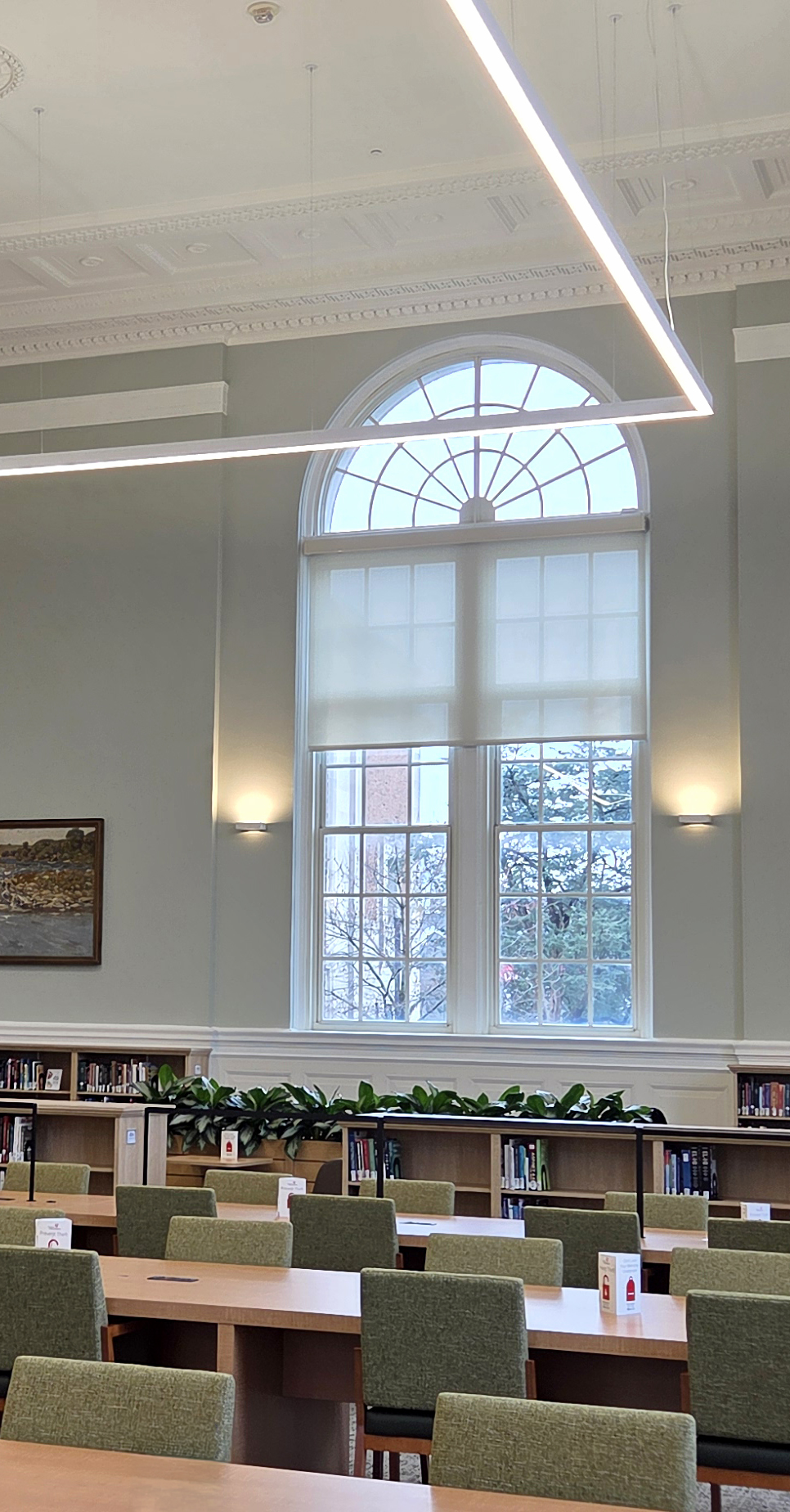
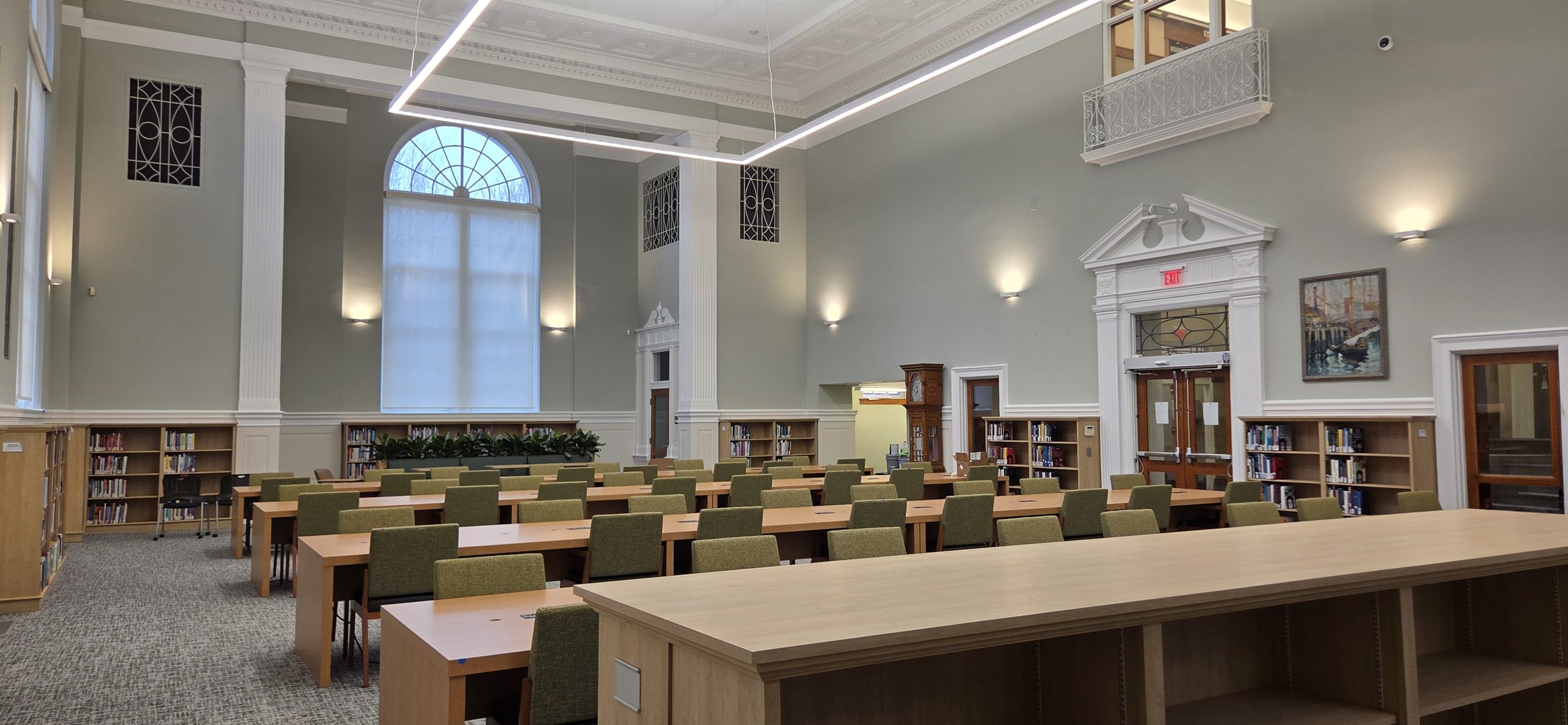
Tuesday, January 20, the renovated College of Education, Criminal Justice and Human Services (CECH) Library Reading Room reopened. Located on the 4th floor of the Teachers-Dyer Complex, and totaling more than 3,000 square feet, the reading room is accessible via the staircase in the CECH Library or directly with a Bearcat ID.

Bathed in natural light, the renovated reading room features flexible, soft seating arrangements in the room’s south and north ends, and in the center of the room four large study tables with integrated lighting (coming soon) and power access. An inclusive, reservable study room (400B) features adaptive lighting and study and focus tools.
Artwork and print collections line the perimeter of the room and include materials that support the entirety of CECH, including the School of Education, School of Criminal Justice, School of Human Services and School of Information Technology. Quick access to additional print collections is available across UC Libraries and the high-density storage facility at Fishwick.

The renovation of the CECH Library 4th floor Reading Room was a joint effort between UC Libraries and CECH. Prior to his retirement in 2023, CECH dean and professor emeritus Larry Johnson teamed up with dean and university librarian Liz Kiscaden to plan for the revitalization of the space. The college expanded its support of the revitalization when CECH dean Lisa Huffman came aboard. The re-imagined reading room prioritizes student access and space, while preserving the room’s historical architecture. The redesigned space also offers improved access, re-opening direct entry from level 4 and adding an additional “front door” to the CECH Library.
Visit the CECH Library and check it out.

The John Miller Burnam Classics Library will be closed Friday, January 2. All other library locations will open as scheduled.
We apologize for any inconvenience.

By Lynn Warner
Our newest Nursing Resource is Dynamic Health – CDS + Skills. This resource not only replaces Nursing Reference Center Plus subscription; it includes many of the same great features and more. Dynamic Health combines everything you need–skills checklists, clinical answers, and evidence-based guidance–all in one simple tool designed for nurses and allied health professionals. All of the content is reviewed and edited by experts in the field and thoroughly cited using credible references. Users can even claim continuing education credits by using the resource. There is also an option to download the Dynamic Health app, so you can always have the resource handy.

Dynamic Health can be accessed through the Nursing Resource Guide, as well as through the UC Libraries A-Z Database list.
Resources contained in Dynamic Health include:
To learn more about using Dynamic Health, you can sign up for live trainings offered through Ebsco.
Questions? Reach out to the Health Sciences Library!
The State Library of Ohio is pleased to announce the 2026 cohort selected to complete coursework to earn a Digital Curation Certificate from Library Juice Academy. Through a competitive application process, a State Library review committee selected the following 15 participants, and will manage their enrollment in the six-course series:
“I’m delighted to see such a varied cohort, representative of all types of institutions, selected for this year’s Library Juice Academy Digital Curation Certificate program,” expressed Evan T. Struble, associate state librarian. “The State Library strives to ensure that library staff around the state have the tools and training necessary to digitally preserve their collections, and that takes on even greater importance in 2026 as we head into the U.S. Semiquincentennial and the history-focused celebrations that are sure to take place.”
This program uses federal Library Services and Technology Act (LSTA) funds from the Institute of Museum and Library Services (IMLS) awarded to the State Library of Ohio to cover the cost of enrollment. This award-winning Digital Curation Certificate is designed to build skills for work in digitization, digital preservation, metadata creation and more, and is suitable for those interested in the work whether they have prior experience or not.
Questions regarding the Library Juice Academy Digital Curation Certificate cohort may be addressed to library consultant, Penelope Shumaker, at pshumaker@library.ohio.gov.
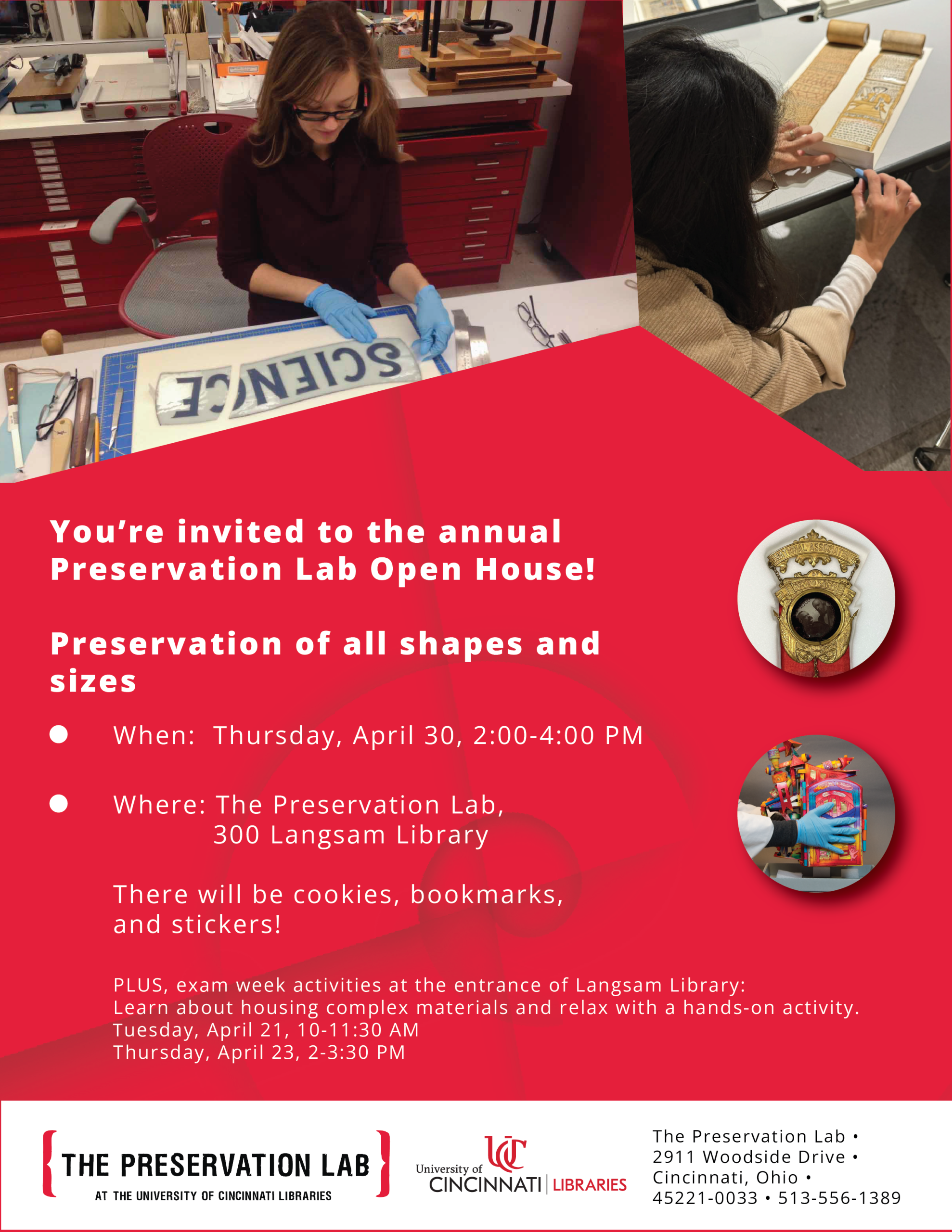
On a cold, snowy Friday at the end of the semester,The Preservation Lab hosted a 3D imaging workshop where two professors from UC’s College of Design, Architecture, Art & Planning (DAAP) taught 3D imaging techniques to a small group of imaging colleagues from Ohio and Michigan labs.

The instructors, Jordan Tate and John-David Richardson, both teach photography in DAAP. Previously, Jordan cross-collaborated with Jessica Ebert from the Preservation Lab on imaging the Assyrian Cornerstone, found in the collection of the Archives and Rare Books Library. Jordan demonstrated 3D imaging techniques and Jessica demonstrated how to do Reflectance Transformation Imaging (RTI).
Participants in the Friday, Dec.12th workshop were:

The object photographed came from the Henry R. Winkler Center for the History of the Health Professions.
The Yoruba, Luba or Luluwa/Lulua Statue (circa 1800—1900) was presented by “the Interns & Residents Wives Club, 1974” to the University of Cincinnati Hospital. The statue’s distinct shapes and facial features match most closely to the sculpture style of the Yoruba, Luba or Luluwa/Lulua. The figure appears to be working with a mortar and pestle, and was made for sale, rather than ceremonial or cultural use.
The Preservation Lab provides the full suite of preservation services to the University of Cincinnati Libraries. The Lab’s expertise is in book and paper conservation, with services available in general circulating materials repair, single-item conservation treatment, housing, exhibition prep and preservation consulting.
The use of 3D imaging in preservation is crucial as it creates an accurate visual record of an object before and after treatment. It allows conservators to examine often fragile objects in close detail without touching, and possibly damaging, the structure. In addition, 3D imaging provides a visual record for students and researchers to view and study.
Imagine for a moment: you are working diligently at your desk and someone pops through your doorway with a request in hand. That request is for records maintained by your department.
You have heard of a Freedom of Information Act request (a.k.a. a public records request), but you have never dealt with FOIA before. What do you do?

If your first act is to immediately hand over the records – STOP! You never simply hand over requested records to anyone requesting them. This post will show what a public records request is and how to handle such a request.
As a public institution, the University of Cincinnati falls under the oversight of the state of Ohio’s Public Records Act. This law allows any person the right to request to access and see the public records of UC.
But any record? Not exactly. A public record is defined in three ways. Any document, device, or item – physical or digital – that falls under the authority of UC. Any of these can be created by or received by UC. Lastly, a public record serves to document decisions, actions, policies, procedures, and other activities conducted at UC.
A record that is considered a non-record is one that does not meet all three parts of what constitutes a public record. These are not subject to the Public Records Act.

UC employees may at some point be requested to make records in their offices available. The request may come from anyone. It may be by a letter in the mail, email, a phone call, an in-person visit, or other mode of communication. The identity of the requester or intended use of the records may not be required as a condition of disclosure. All UC employees have the responsibility to recognize that no request for university records, however it is done, will be ignored or refused.

Which begs the question: what if the requested records have confidential or personally identifiable information on them? Regardless of however confidential or not the requested records are, UC employees will always, and promptly, contact the Office of General Counsel. The same will be done if employees are made aware of a subpoena or legal hold on the requested records. OGC will evaluate whether the records can be made available for access or copying. All requests for public records will be answered within three business days and clearly state when the records will be available along with their location and medium, need for legal review, and need to redact non-public information.
The inspection of public records is permitted during normal operating hours only. Requestors will be charged for the actual cost of copying and transmitting requests. The charge for paper copies is five cents per page. UC may retain a private contractor for copying services and forward the cost onto the requester. For large requests, it is possible that UC could require payment in advance.
With this information, you can confidently know how the handle a FOIA or public records request. Below are links to useful information to help you learn more.
Public records requests may be submitted to:
Public Records Manager
Office of General Counsel
University of Cincinnati
PO Box 210661
Cincinnati, Ohio 45221-0661
Due to inclement weather, University of Cincinnati campuses are closed from 6 a.m. to 10 a.m. Friday, Dec. 12, 2025. Visit Commencement and Registrar’s pages for additional details. This closure applies to all UC Libraries locations except for the Donald C. Harrison Health Sciences Library, which will be open at 7:45 a.m.

LiBlog uses Accessibility Checker to monitor our website's accessibility. Read our Accessibility Policy.