On the fifth floor lobby of the Walter C. Langsam Library is the exhibit “Animals in Antiquity: An exhibition from the collections of the John Miller Burnam Classics Library.”
Curated by Rebecka Lindau, head of the John Miller Burnam Classics Library, and Michael Braunlin, assistant head of the Classics Library, and designed by Michelle Matevia, library communication design co-op student, the exhibit highlights the role and importance of animals in Antiquity.

Cats were sacred in ancient Egypt. There was even a cat goddess, Bastet.
Animals were divinities, especially in Egypt. In Ancient Greece and Rome they were the companions or theomorphic stand-ins for gods and goddesses. Many animals were considered sacred to the ancient Greeks and Romans. However, as humans went from a nomadic existence to one of settlers and farmers, they began taming and using animals for their own purposes and so the status of animals began to decline.
After their domestication, bulls, cows, horses, donkeys, pigs, sheep and goats were used to plow fields, to provide milk and meat, transportation, and clothing. Wild boars were hunted for food and for “displays of manhood” by well-to-do young men as were various birds, deer, hares and even lizards. Some animals were made companions or pets such as sparrows, pigeons, doves, dogs, cats, monkeys and even wild animals, gazelles and cheetahs. Animals in Greece, rabbits, dogs, roosters and doves, were given as presents, also in courtship as “love gifts.”

Foxes were wild and often considered a nuisance for wine growers because they liked eating the vines.
Various kinds of fish were eaten in antiquity, but they, too, could be pets and were sacred to the gods. Animals such as horses and elephants were used in war and as entertainment, for example, among the Romans at the Colosseum where lions, tigers, elephants, giraffes, bears, rhinoceroses, hippopotamuses, wild donkeys, hyenas and ostriches were forced to fight to their deaths. Greek and Roman authors such as Plutarch, Aelian and Pliny the Elder wrote about animals in works on ethics, morals and natural history and prose, poetry and history writers such as Homer, Aesop’s Fables, Lucretius, Ovid, Seneca, Dio Cassius, Diodorus Siculus frequently used animals to tell stories and to illustrate the human experience.
Sections of the exhibit inform how animals were used as entertainment, as companions, for ritual sacrifice, even in war. In addition, the exhibit features animals in art, displayed on coins, vases and statues. A bibliography of resources used in the creation of the exhibit is available on site and online as a PDF.
To learn more about Animals in Antiquity, read about or visit the Classics Library located on the fourth floor of Blegen Library where the books and artifacts featuring the texts and images in this exhibition are housed and where the librarian is happy to answer questions and offer research advice on this or any other topic concerning classical antiquity.

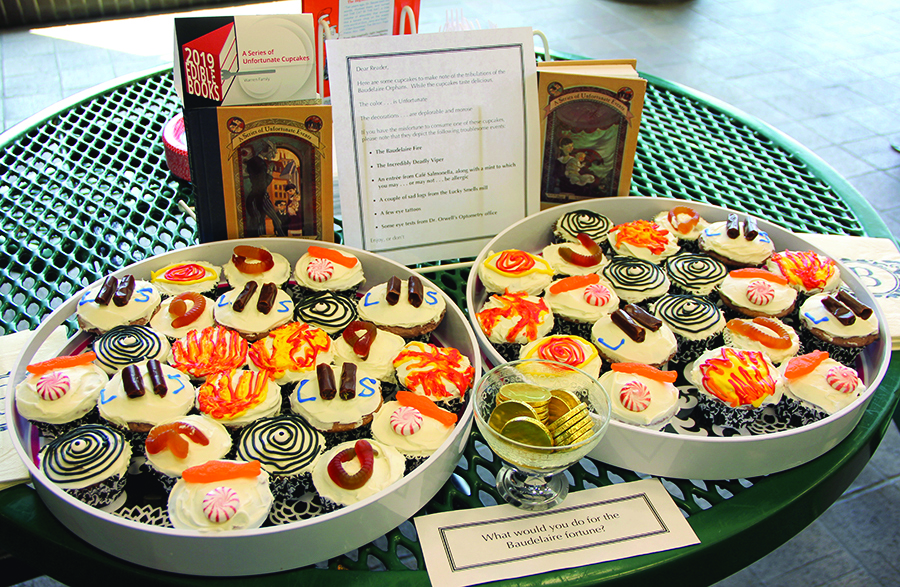
As in previous years, entries will be judged according to such categories as “Most Delicious,” “Most Creative,” “Most Checked Out” and “Most Literary.” Those awarded “Best Student Entry” and “Best Overall” will win a limited-edition UC Libraries t-shirt.
Read Source, the online newsletter, to learn more about the news, events, people and happenings in UC Libraries.

In celebration of Black History Month, UC Libraries is holding an event featuring author Carol Tongue Mack who will discuss her book Being Bernadette: From Polite Silence to Finding the Black Girl Magic Within. In her memoir, Carol Tonge Mack takes us on a journey from a small town in Antigua to the streets of the South Bronx to private college life in New England to a career in academia.


Do you like poetry? Interested in hearing poets talk about and read their work?
The University of Cincinnati Libraries has partnered with UC Student Government to create a Prayer and Meditation Space in the Walter C. Langsam Library.
Read the