Gustav Mahler’s Symphony No. 4 and Theodore Spiering in the CCM Library Special Collections

A single part of a symphony can open the door to a world of story-telling. As the CCM Philharmonia presents the music of Mahler’s Symphony No. 4 on October 16, 2026, the CCM Library shares the story of the violin I part held in the Theodore Spiering Collection.

The Albino Gorno Memorial / CCM Library Special Collections holds a collection of annotated sheet music that belonged to Theodore Spiering (1871-1925), an American violinist, conductor, and teacher. Spiering studied violin with Henry Schradieck at the College of Music of Cincinnati in the 1880s before moving to Berlin to study with Joseph Joachim. Spiering later performed as concertmaster for the New York Philharmonic under Gustav Mahler from 1909 to 1911 and conducted the final seventeen concerts of 1911 during Mahler’s illness. On January 17 and 20, 1911, the New York Philharmonic performed Mahler’s Symphony No. 4 with Spiering as concertmaster and conducted by Mahler. A highlight of the Theodore Spiering Collection is the violin I part of the symphony, bearing edits and paste-overs of performance markings and notation. While the violin part in the Spiering Collection was evidently not used in the 1911 performances, the background of the marked-up sheet music illuminates a rich snapshot of the symphony’s editorial and performance history.
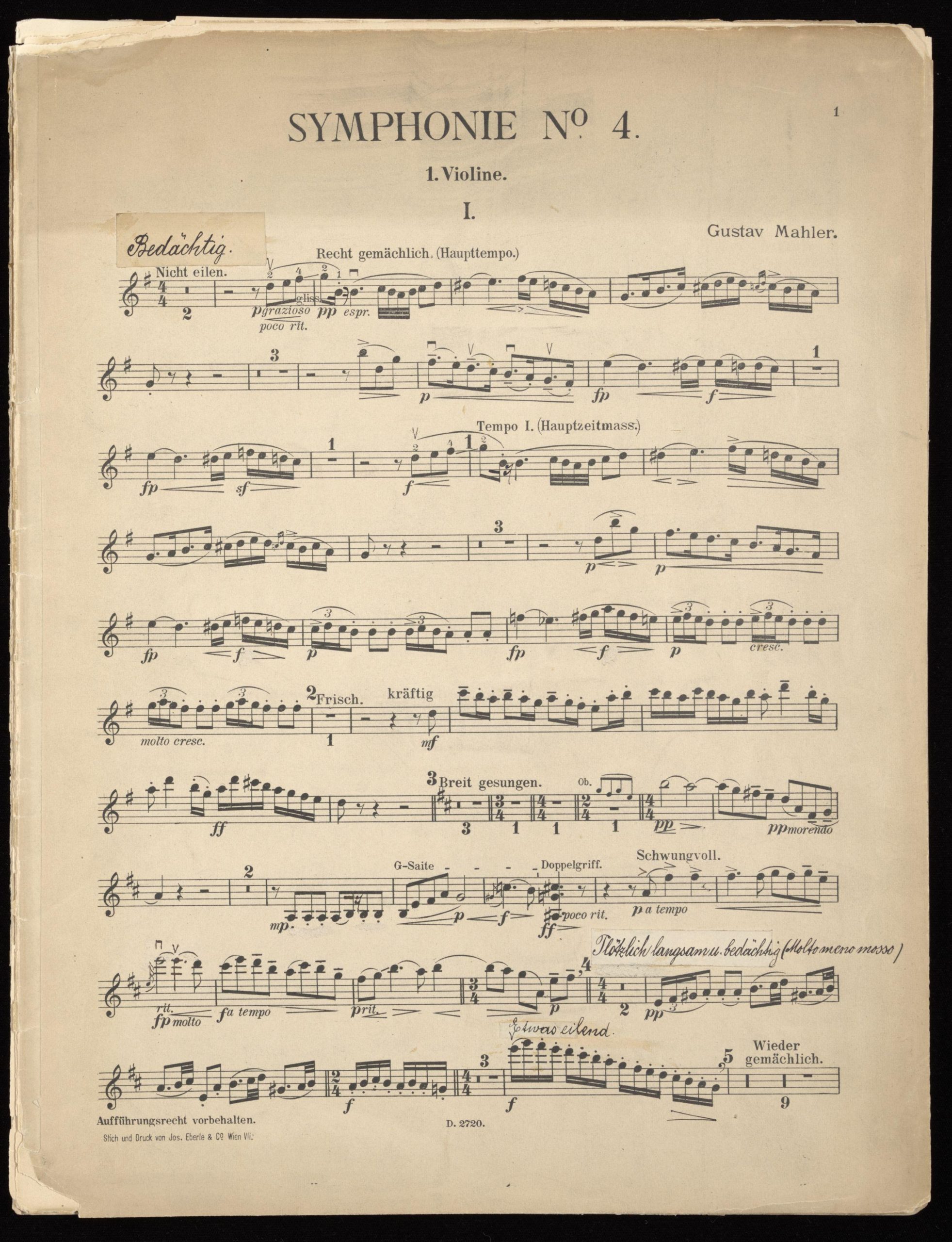
violin sheet music for Mahler Symphony Number 4
Page 1 of the Spiering violin I part of Mahler’s Symphony No. 4, digitized on JSTOR. Theodore Spiering Collection, Albino Gorno Memorial College-Conservatory of Music Library Special Collections, University of Cincinnati. https://www.jstor.org/stable/community.42074264

Gustav Mahler (1860-1911) began composing his fourth symphony in 1899 and completed it during the winter of 1900/1901, though he continued to refine the orchestration of the piece over the next several years. Mahler sent his score of the symphony to the publisher and requested a proof to use during a reading rehearsal with the Vienna Philharmonic in October, as he wanted to hear what it sounded like before it was published. It is not clear if the publishing house also provided proofs of the parts—it is possible the musicians performed from manuscript parts when the symphony was premiered in Munich by the Kaim Orchestra on November 25, 1901. The first edition was engraved and printed by Josef Eberle and published by Ludwig Doblinger in Vienna in December 1901.

Mahler made further edits over the next few years, adding corrections to conducting scores for performances given by Willem Mengelberg in Amsterdam in 1904 and by Richard Wickenhauser in Graz in 1905. In 1910, Mahler transferred publication rights to Universal Edition and sent to the publisher a galley proof with numerous revisions. After Mahler conducted the piece with the New York Philharmonic in January 1911, he sent his final corrections to Universal Edition.

Mahler’s Symphony No. 4 premiered in New York on November 6, 1904, performed by the New York Symphony conducted by Walter Damrosch. Beginning in 1907, Mahler traveled between the U.S. and Europe, spending time in New York each season conducting with the Metropolitan Opera, New York Symphony Orchestra, and New York Philharmonic. Mahler conducted his Symphony No. 4 with the New York Philharmonic in January of 1911, a significant occasion of the composer interpreting his own work with the ensemble.
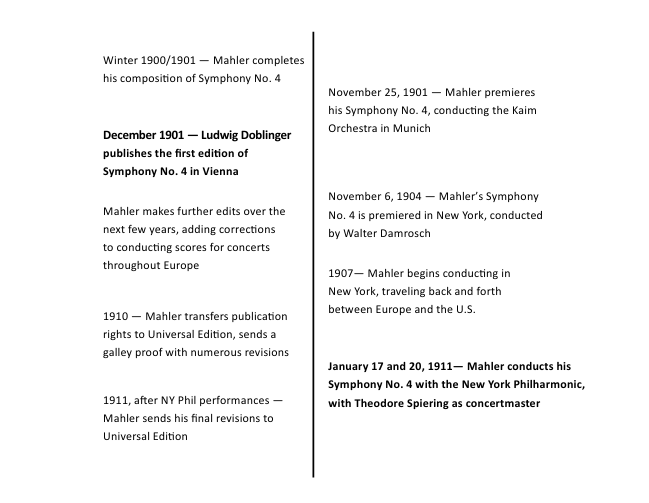
Text arranged in a timeline indicating chronology of Mahler's performance and publishing activities
Timeline of Mahler’s publishing and performance activities surrounding Symphony No. 4, 1900-1911
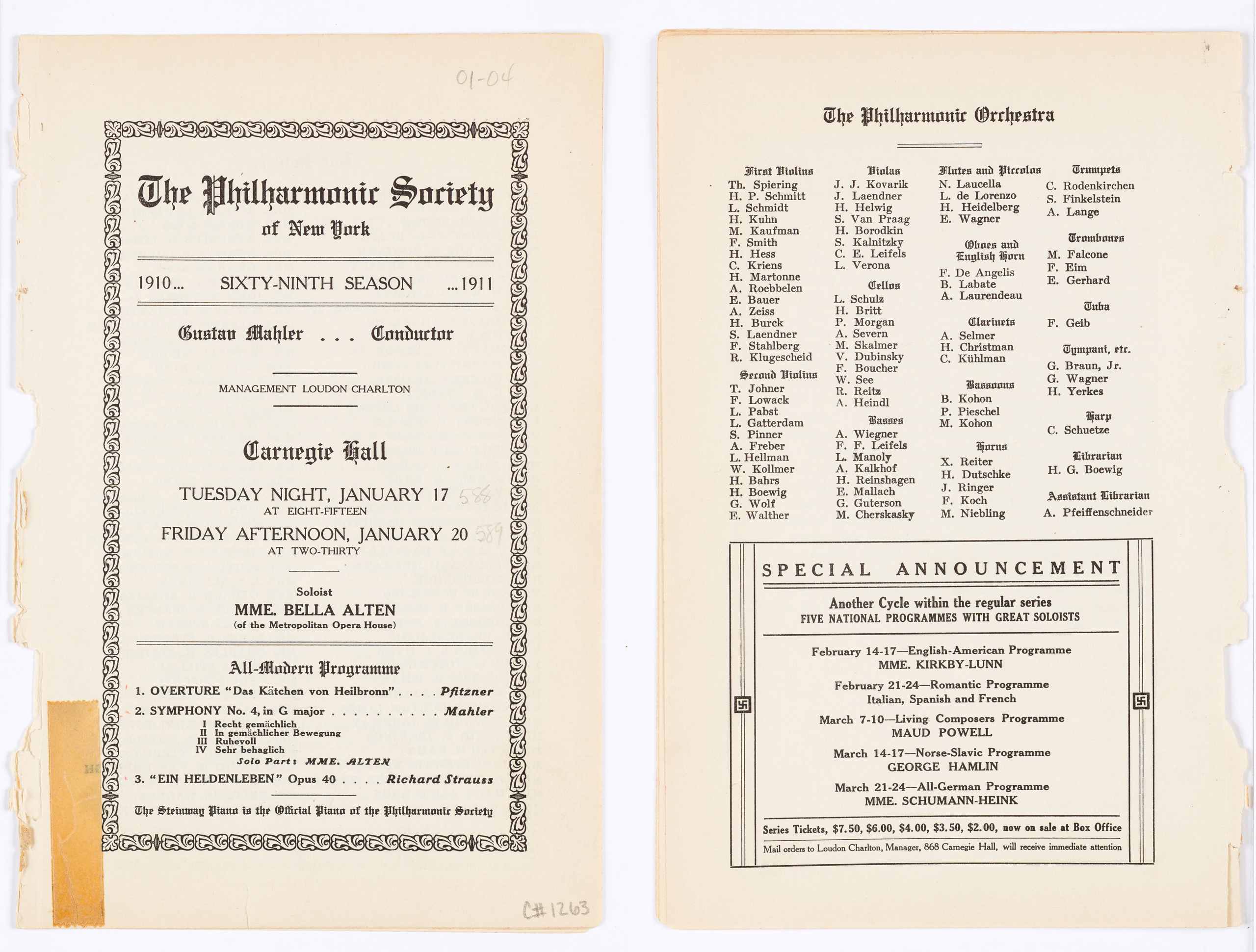
Concert program cover page and list of ensemble members
Program of the January 1911 New York Philharmonic performances of Mahler’s Symphony No. 4, conducted by Mahler, with Theodore Spiering as concertmaster. Program ID: 1263. New York Philharmonic Shelby White and Leon Levy Digital Archives.  https://archives.nyphil.org/asset-management/2TTUGPT6VOQA?WS=2TTURYF6K50F

For the January 1911 performances, the New York Philharmonic used the 1901 Doblinger first edition orchestral parts, which had been marked up with Mahler’s revisions by Viennese copyist Johann Forstik. Theodore Spiering performed as concertmaster during these January 1911 performances—the violin I part held in the CCM Library Special Collections is also the Doblinger first edition and was also marked up by Forstik, though it evidently does not belong to the New York Philharmonic set of parts. The violin part of the New York Philharmonic set bears annotations not present in the CCM Library Spiering part, including bowings, dynamics, notation edits, and rehearsal letters in blue, red, and graphite pencil. Shortly after the January 1911 New York performances, Mahler fell ill. Spiering took over as conductor of the New York Philharmonic while Mahler traveled back to Vienna, where he died on May 18, 1911.

The Mahler Symphony No. 4 violin I part from the Theodore Spiering Collection has been digitized by the UC Libraries Digital Initiatives Team. It is accessible on JSTOR, along with many other pieces from the Theodore Spiering Collection. Materials in the Theodore Spiering Collection were donated by Lenore Spiering, Theodore Spiering’s daughter.

Check out the digitized Theodore Spiering Collection on JSTOR, and access the Mahler Symphony No. 4 violin I part!
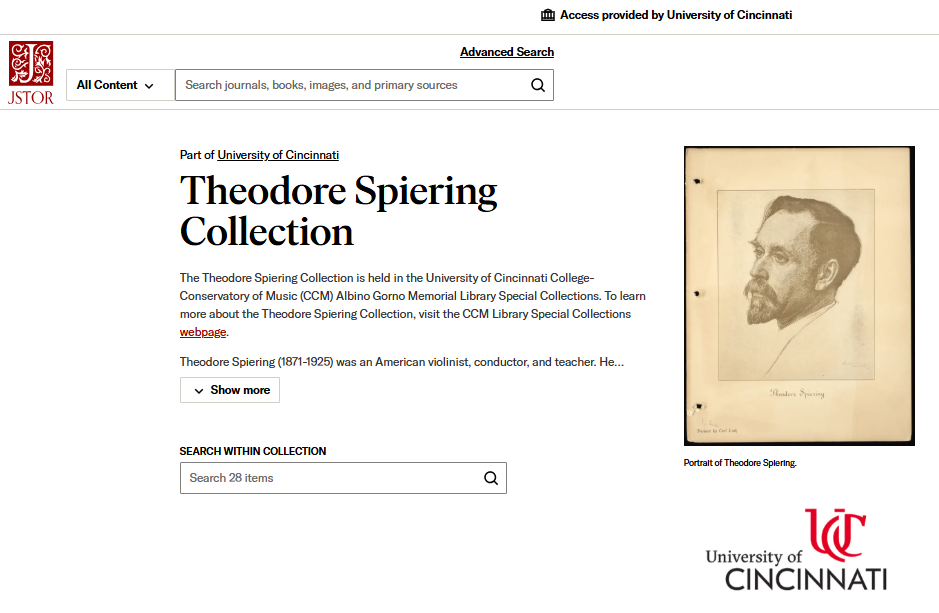
Screenshot of JSTOR landing page for the Theodore Spiering Collection
Landing page of the Theodore Spiering Collection on JSTOR, digitized by the University of Cincinnati Libraries Digital Initiatives Team. https://www.jstor.org/site/uc/spiering

As you explore the revisions and paste-overs, you can compare to a digitized score of Mahler’s Symphony No. 4 from the NY Philharmonic Archives, which shows more clearly what was in the score prior to the changes. Image 7 is the cover page of the Doblinger first edition with a note indicating red corrections after Mahler and green corrections after later Universal Edition revisions. You will see significant changes right from the beginning: the Spiering part has a paste-over of “Bedächtig” (deliberately) at m. 1, which is covering the original marking of “Heiter, Bedächtig” (cheerful, deliberately). Imagine the different interpretive ways the music would feel and sound as you explore the revisions!
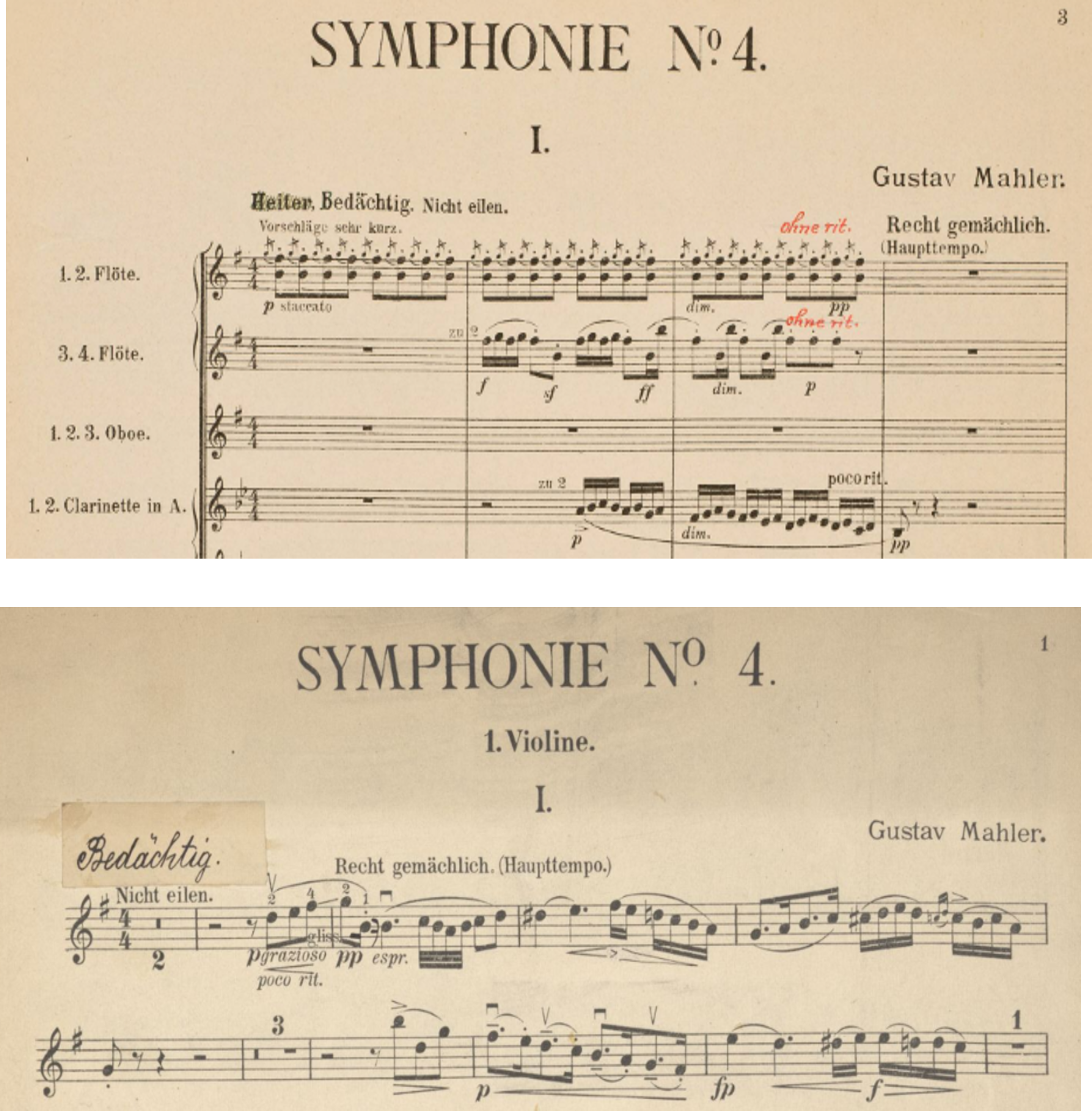
Excerpts of the score and violin part sheet music of Mahler Symphony Number 4
Top: Score of 1901 Doblinger edition with inked revisions. Mahler, Gustav – SYMPHONY NO. 4 IN G MAJOR – Score. Library ID: 2175. New York Philharmonic Shelby White and Leon Levy Digital Archives. https://archives.nyphil.org/asset-management/2TTUGPYF7IT6?WS=2TTURYFJ1D6S
Bottom: Spiering violin I part of Doblinger edition with pasted-over revision. Theodore Spiering Collection, Albino Gorno Memorial College-Conservatory of Music Library Special Collections, University of Cincinnati. https://www.jstor.org/stable/community.42074264

References:

  • Peter Franklin, “Mahler, Gustav,” Grove Music Online. 24 June 2024. https://doi-org.uc.idm.oclc.org/10.1093/gmo/9781561592630.article.40696.
  • Gustav Mahler, Symphonie Nr. 4 für Sopran-Solo und Orchester, ed. Christian Rudolf Riedel (Wiesbaden: Breitkopf & Härtel, 2019).
  • “Theodore Spiering,” promotional booklet, Theodore Spiering Collection, Albino Gorno Memorial College-Conservatory of Music Library Special Collections, University of Cincinnati.
  • “Theodore Spiering, Composer, Is Dead,” New York Times, 14 August 1925, p. 13. ProQuest Historical Newspapers: The New York Times.
  • James L. Zychowicz, Mahler’s Fourth Symphony (New York: Oxford University Press, 2000).

Written by Rebecca Schreiber
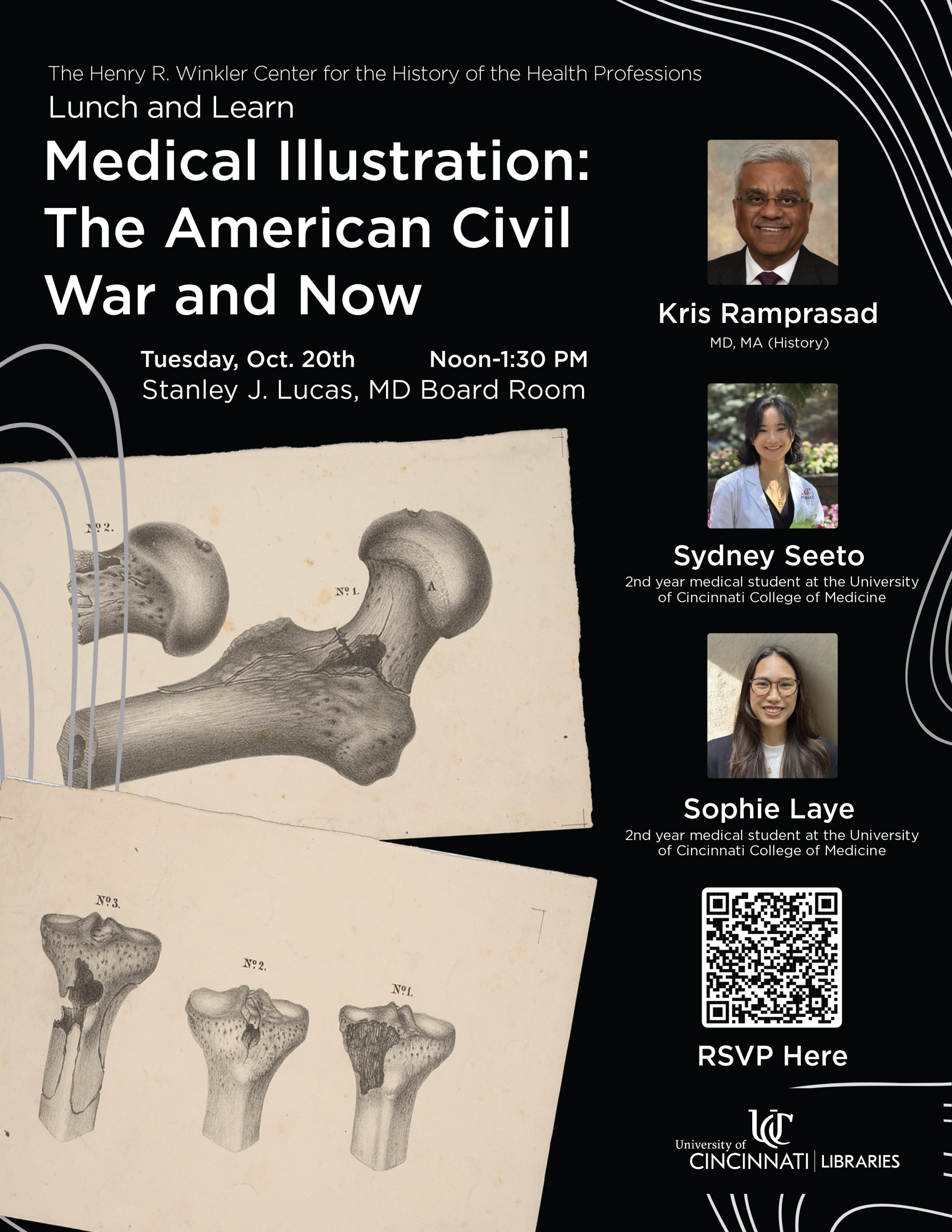
October 20th Lunch & Learn to focus on Medical Illustration: The American Civil War and Now

Join the Henry R. Winkler Center for the History of the the Health Professions Tuesday, Oct. 20, NOON-1:30PM, in the Stanley J. Lucas, MD, Board Room, Health Sciences Library, for a lunch & learn to explore Medical Illustration: The American Civil War and Now. Speakers: Kris Ramprasad, MD, MA (history) and retired UC associate professor, Sydney Seeto and Sophie Laye, both second-year medical students at UC’s College of Medicine, will discuss the Daniel S. Young archives.

Dr. Ramprasad will discuss the varying injuries of the Civil War through his eyes and how these illustrations should be viewed, understood and appreciated now – updating our understanding of the care provided at that time. As co-presidents of the Medical Art and Illustration, Sydney and Sophie will discuss the modern process for creating a medical illustration, showcasing their own work and explaining plans for the Medical Art club for the upcoming year.

The lunch & learn is free and open to all to attend, but RSVP is requested.

Following the lunch & learn, attendees can view the exhibit on display in the library featuring the medial illustrations by Daniel S. Young.

October 20th Lunch & Learn to focus on Medical Illustration: The American Civil War and Now

Daniel S. Young: American Civil War Medical Illustrations, available online via JSTOR, contains the artistic and medical contributions of an American Civil War era medical illustrator in a military context. The Daniel S. Young Archives were donated by the University of Cincinnati’s College of Medicine to the Medical Heritage Center, now the Henry R. Winkler Center for the History of the Health Professions. Young was a surgeon, artist and inventor. During the American Civil War, Young was the surgeon of the 21st Regiment Ohio Volunteer Infantry (O.V.I.).

Continue reading →

DAAP Library exhibit features medieval illuminated manuscripts and early modern prints from UC collections

An exhibit on display at the entrance to the Robert A. Deshon and Karl J. Schlachter Library for Design, Architecture, Art and Planning (DAAP) features 20 items of woodcuts, engravings, etchings and illuminated manuscript leaves and scrolls from the UC Art Collection and DAAP Library Special Collections. Featuring intricately designed prints and lavishly illuminated manuscripts, the exhibit explores late medieval and early modern European art in a global perspective. It focuses on the visual and material traces of social and political connections between Europe and Africa, Asia and the Americas from the 15th to 17th centuries.

DAAP Library exhibit features medieval illuminated manuscripts and early modern prints from UC collections

The installation was curated by Aaron Cowan, director of the UC Art Collections, Galleries and Museum Studies Program, Elizabeth Meyer, head of the DAAP Library, and Christopher Platts, assistant professor of art history in the School of Art at DAAP.

scrolls

The Preservation Lab’s Jessica Ebert and Catarina Figueirinhas assisted with preparing the exhibit for display by creating housing, matting and mounts for the items, including for this parchment scroll.

The exhibition will be up through December 13, 2023.

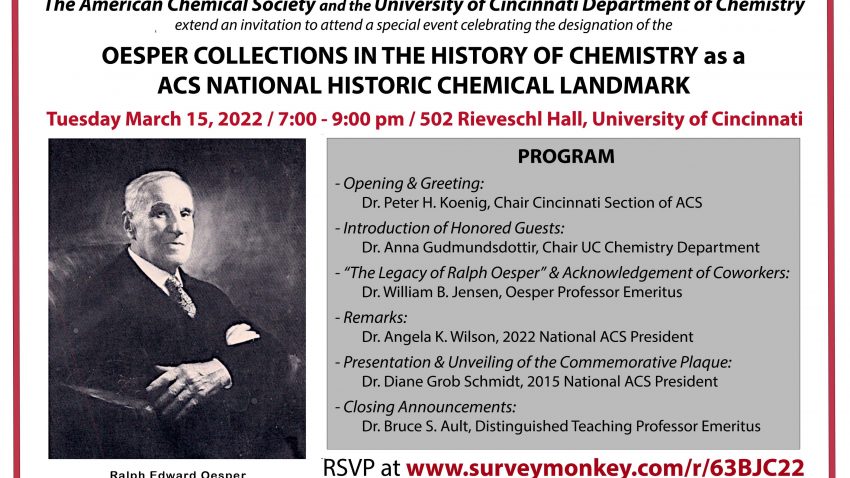
3/15/22 Celebration for Oesper Museum – ACS National Historic Chemical Landmark

The Oesper Museum & Collections in the History of Chemistry (502 Rieveschl Hall, University of Cincinnati’s main campus) invites you to a celebration and open house starting at 7:00pm on Tuesday, March 15.  The Museum & Collections will be designated as a National Historical Chemical Landmark by the American Chemical Society (ACS).  More event details in the invitation graphic below.  Please RSVP at https://www.surveymonkey.com/r/63BJC22 and share with others.  The public is welcome.

Oesper Museum Celebration Graphic

Program details for March 15 Oesper Museum celebration

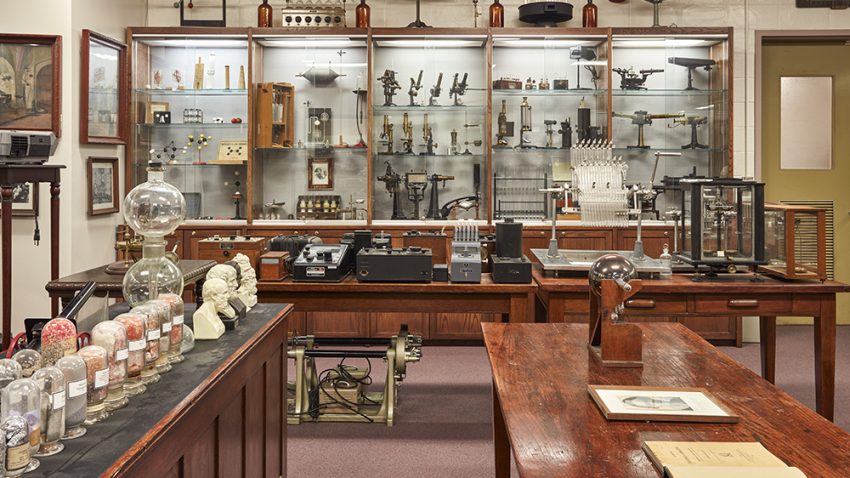
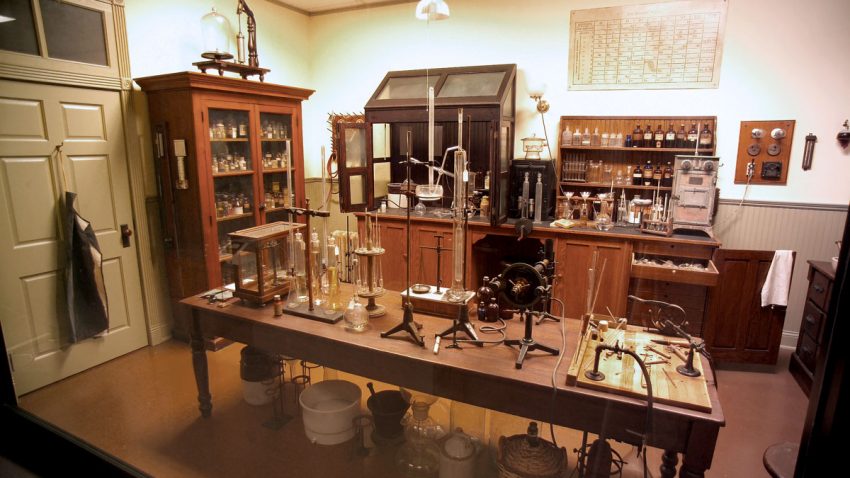
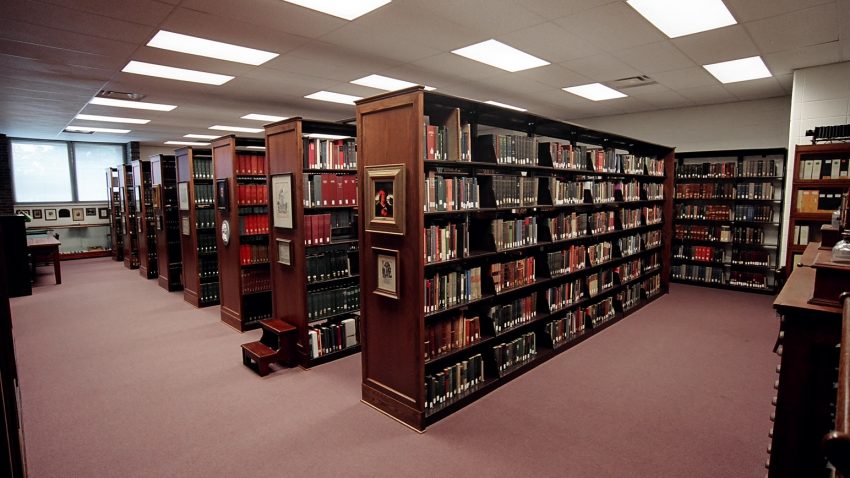
The Oesper Museum & Collections are a unique and hidden treasure.  They showcase and document the history of chemistry in many ways: historic chemical apparatus museum, replica 1900 chemical laboratory, prints and portraits collection, and a library/rare books collection.  The Museum & Collections are a partnership of the UC Chemistry Department and UC Libraries.  Read more and view virtual displays from the chemical apparatus museum: https://digital.libraries.uc.edu/oesper/museum/displays.html and https://www.cincinnatimagazine.com/citywiseblog/cincy-obscura-the-oesper-collection/ .

3/15/22 Celebration for Oesper Museum – ACS National Historic Chemical Landmark

We are thrilled to welcome you to the Oesper Museum & Collections.  Contact Ted Baldwin (Director, UC Science & Engineering Libraries) with questions,  Ted.Baldwin@uc.edu .


3/15/22 Celebration for Oesper Museum – ACS National Historic Chemical Landmark

Ca. 1900 replica laboratory

Oesper Library Collections (history of chemistry)

Oesper Library Collections (history of chemistry)

Read Source for the news, events, people and happenings in UC Libraries

source graphic

Read Source, the online newsletter, to learn about the news, events, people and happenings in UC Libraries.

In this issue of Source, as we mark the 20th year of publishing our newsletter, Dean Xuemao Wang welcomes students back to campus. We spotlight a library staff member, Ben Kline, and special collections in the DAAP Library and the newly digitized OMI posters, as well as a team bringing research and data services to the university community. In addition, we announce upcoming events – Life of the Mind and The Illustrated Human: The Impact of Andreas Vesalius.

Read these articles, as well as past issues, on the website. To receive Source via e-mail, contact melissa.norris@uc.edu to be added to the mailing list.

First Wave Feminism-Is it Still Relevant?

By Erica Bock, Archives and Rare Books Library Intern

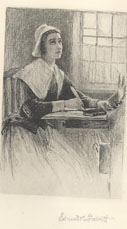
Anne Bradstreet from The Poems of Mrs. Anne BradstreetMany of us remember being forced to read the poetry of Anne Bradstreet in high school or even college. And most of us read summaries online or in SparkNotes so we could still get an “A” without having to spend the time to decipher certain poetry. In high school, I was that person too.

However, when a college professor assigned us the week’s reading, I actually took the time to read Bradstreet’s works. Maybe it was because of lack of anything else to do. Or maybe I just really liked the professor’s approach to teaching. Regardless, I delved into the world of Bradstreet and I was both inspired and pleasantly surprised.

This free thinking first wave feminist started to inspire my life. And in particular, I took to her poem, “The Four Elements”. Bradstreet observed the world around her. And I began to realize what could happen if I too decided to become more aware of the world around me. Bradstreet reminded me that there is beauty in the natural chaos of life. And though everyone is different, we can use our differences to our advantage. Continue reading →

New Acquisitions-DAAP Library Special Collections

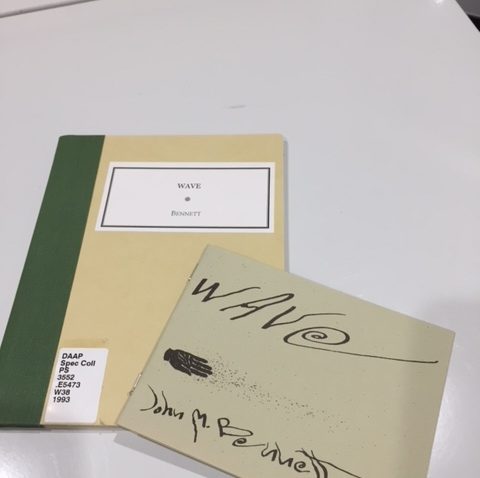
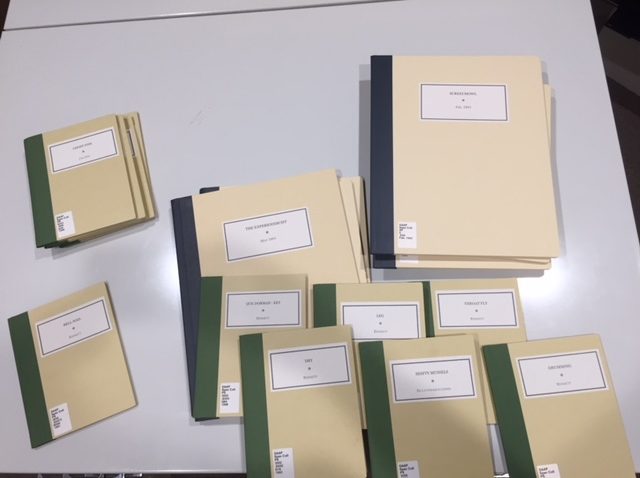
A new shipment of concrete poetry books has arrived in the Robert A. Deshon and Karl J. Schlachter Library for Design, Architecture, Art and Planning (DAAP). Titles by John M. Bennett, Jim Leftwich, Robin Crozier, César Figueiredo, Serge Segay and others.

Make an appointment with Interim DAAP Library Head Elizabeth Meyer or librarian Andrea Chemero to view them.

Photo of concrete poetry book cover Wave by John M. Bennett

Wave, by John M. Bennett

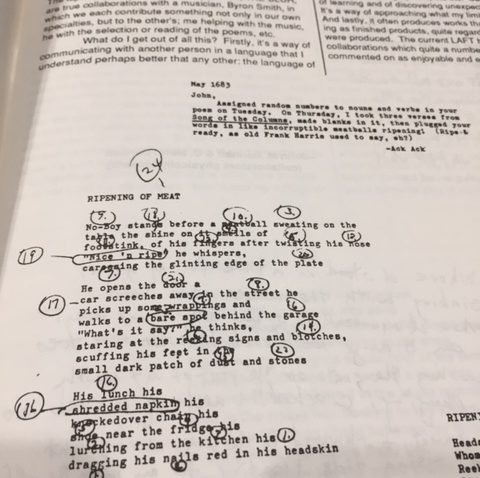
"Ripening of Meat," a poem from Co-Labor-ative Writing

“Ripening of Meat,” a poem from Co-Labor-ative Writing

New Acquisitions-DAAP Library Special Collections

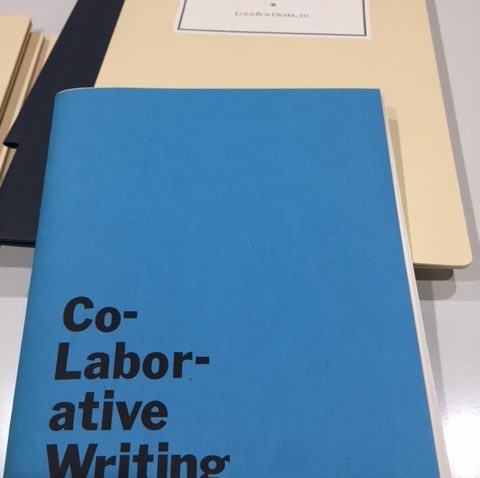
Co-Labor-ative Writing by Editor Luigi-Bob Drake, cover photo

Various titles from new acquisitions.

New acquisitions.


Welcome Back DAAP Students!

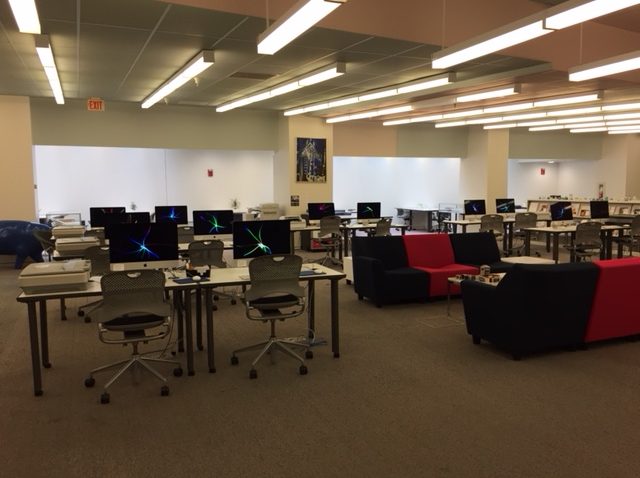
The DAAP Library would like to welcome back the students. We are in the process of moving Special Collections in the room down near the circulation desk where the old computer lab used to be. The room and collection will be available by appointment once the move is complete. The computers complete with scanners and WEPA printer have moved out to the reading room. Please let us know your information needs. We hope you have a great Spring semester.


Welcome Back DAAP Students!

Position Opening: Digital Imaging Coordinator (3-year appointment renewable), University of Cincinnati Libraries

The University of Cincinnati Libraries is seeking a digital imaging coordinator (a 3-year, renewable position).  Within the University of Cincinnati’s Preservation Services and Lab, the person in this position coordinates the UC Libraries’ digital imaging projects and workflows, ensuring successful project completion; operates and maintains digitization equipment and software; creates imaging workflows, including image quality controls, digital conversion and production reports. The digital imaging coordinator will work in a learning environment within a highly collaborative library atmosphere to increase and enrich online access to the UC Libraries’ collection of rare and unique materials.

For more information and to apply, please visit http://bit.ly/2KMmipn.

Oesper Collections Attract International Scholars

(Contributed by Dr. William Jensen, Curator of the Oesper Collections in the History of Chemistry)

As the global reputation of the Oesper Collections in the History of Chemistry continues to grow, these special collections are attracting the attention of more and more international scholars.

Starting in January 2013, Professor José Chamizo of the University of Mexico spent three months of his sabbatical  working in the collections and  returned once more in  June for another two weeks. While at Cincinnati his research focused on the role of instrumentation in initiating chemical revolutions and on the life and work of the 19th-century Mexican chemist, José Ortigiosa.

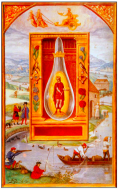
Detailed image from the Splendor Solis manuscript

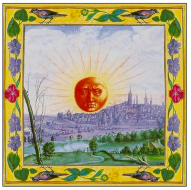
Detailed image from the Splendor Solis manuscript

Detailed image from the Splendor Solis manuscript

Detailed image from the Splendor Solis manuscript

In late June, the Oesper collections were also visited by Dr. Eberhard Slenczka, former Director of Libraries for the Germanisches Nationalmuseum in Nuremburg, who came to examine our facsimile of the 16th century alchemical manuscript known as the Splendor Solis in order to make comparisons with the copies found in Nuremburg, Paris, London and Spain.

Please direct questions regarding access and use of the Oesper collections to  Professor William B. Jensen or Ted Baldwin, Director of Science and Engineering Libraries.