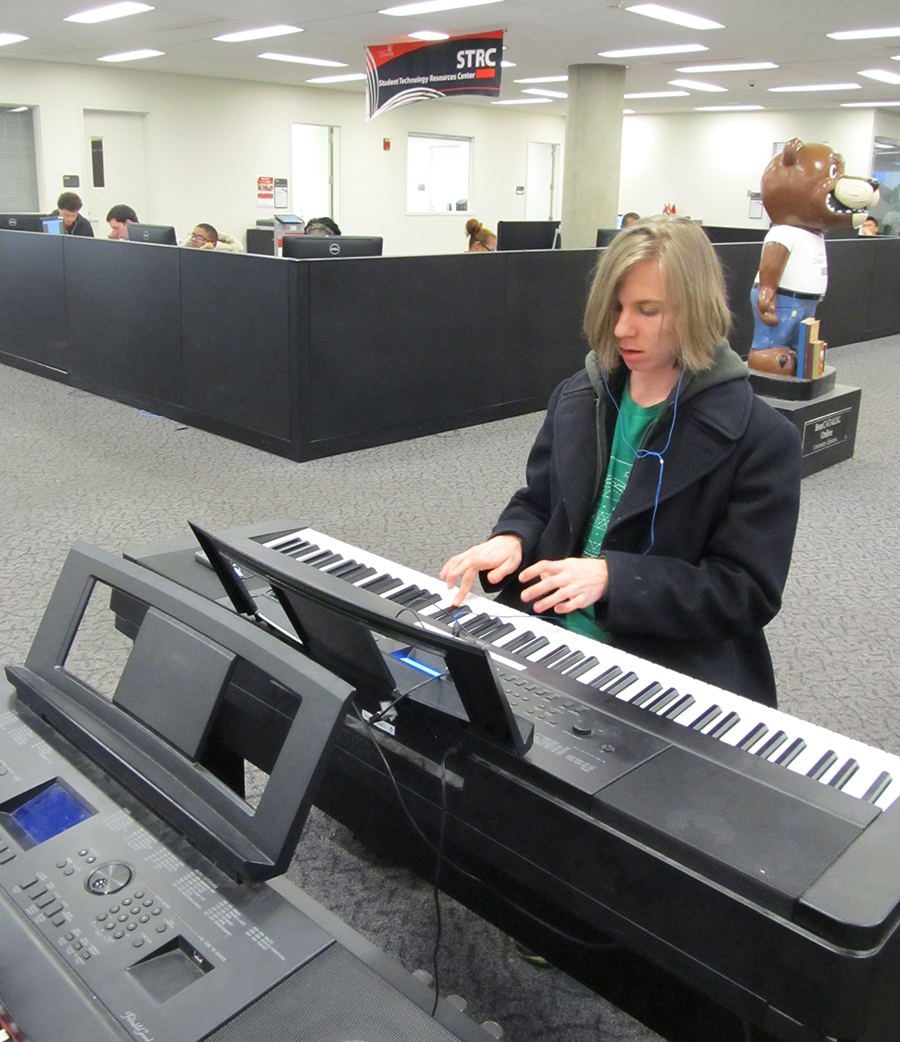
Starting Dec. 8 Langsam Library’s 4th Floor will Close when the Desk@Langsam Closes during Winter Break

winter break

Langsam Library’s Winter Break Hours:

December 8-10

Fri, Dec 8 – 7:45am-6pm
Sat, Dec 9 – 10am-6pm
Sun, Dec 10 – CLOSED

December 11-22

Mon-Fri – 8am-5pm
Sat & Sun – CLOSED

December 23-January 7 –

Dec 23-Jan 1 – CLOSED (Winter Seasonal Days)
Tues-Fri, Jan 2-5 – 8am-5pm
Sat, Jan 6 – CLOSED
Sun, Jan 7 – 12pm-11pm

Langsam’s 4th floor will resume 24/7 hours on Sunday, January 7.

The recordkeeping of energy infrastructure

Natural gas pipeline capacity out of Ohio

When people think of the energy industry, they often picture heavy industrial equipment – pipelines criss-crossing prairies, oil rigs along coastlines, or earthmovers pushing mountaintop overburden into valleys below. But what about the invisible equipment? How do we visualize the caverns that store nuclear energy production waste? How do we know where the underground  piping is that connects us to the grid? How can we tell when there are wells nearby?

We cannot see invisible infrastructure, and even visible infrastructure blends into the background of our daily lives. But we can see the outlines of all infrastructure by inspecting the records associated with it. Some recordkeeping associated with the energy industry’s infrastructure is available to the public – permits that must be filed with state and federal agencies, for example. Other recordkeeping conducted for internal corporate administration is considered private business information. Some business information may be shared with the public if an energy company is a public company, but other forms of information may be proprietary.

One of the fastest growing sectors of domestic energy production is hydraulic fracturing of shale formations, better known as fracking. Ohio is located in a major shale formation and is the 7th largest producer of natural gas. According to the Energy Information Agency, “[t]he Utica Shale has contributed to the rapid increase in natural gas production in Ohio, which was almost 19 times greater in 2016 than 2011.” Ohio’s neighbors of West Virginia and Pennsylvania are part of the Utica and Marcellus Shale formations, and also rank highly for natural gas production (Pennsylvania is the #2 domestic producer, West Virginia is #8).

Most oil and gas activities are regulated at the state-level, and therefore different states have varying regulations around fracking. As a result, the impacts from fracking are experienced differently depending on where you live. Since there is a different regulatory landscape from state to state, this means that the information and records concerning fracking vary across state lines. To put it another way, this means that the public has different levels of information about fracking depending on where it’s carried out.

An illuminating example can be found with disclosure of chemicals used for hydraulic fracturing. Many states use the registry FracFocus for chemical disclosure. However, a recent study of FracFocus showed that 92% of submitted chemical disclosures for wells “withheld at least one ingredient record” by classifying it as a trade secret, confidential or proprietary business information (Konschnik and Dayalu, 2016, p. 508).

This issue will almost certainly continue to be of regional importance for both industry and concerned citizens. Ohio and Pennsylvania increased their production of natural gas more than any other states between 2015-2016, and the Energy Information Agency “projects that natural gas production will increase in both 2017 and 2018 as natural gas prices rise.” As the federal government and many states continue to embrace domestic fossil-fuel production over renewable energy, this is a topic that deserves our attention.

UC Libraries Closed for Thanksgiving Holiday

  • thanks imageUC Libraries will be closed Thursday, November 23 and Friday, November 24 for Thanksgiving, with the exception of the Donald C. Harrison Health Sciences Library, which will be open Friday, November 24 from noon – 5:00pm. Regular library hours will resume Saturday, November 25.

This closing includes the Langsam Library 4th floor space, which will close Wednesday, November 22 at 6pm and re-open Saturday, November 25 at 10am.

Happy Thanksgiving!

“Snapshots” of the Classics Library’s Collections


The Classics Collection


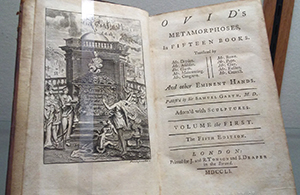
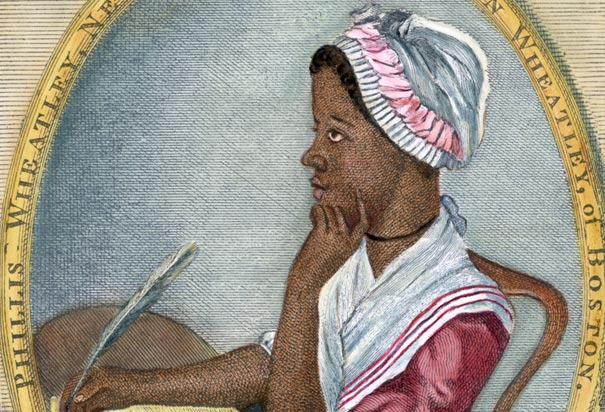
The Classics collections include more than 270,000 volumes and c. 2,000 journal titles spanning all areas of classical civilization, including language and literature, archaeology, art, history, epigraphy, papyrology, numismatics, palaeography, religion, philosophy, politics, science and technology, and medicine. The collections in all areas of classical studies are outstanding, although especially exhaustive in Greek and Latin philology and Minoan-Mycenaean archaeology.  The comprehensive level of current acquisitions continues. A few highlights include some 18,000 German dissertations and Programmschriften in classics, especially philology, from the 18th to the early 20th c., a separate room of more than 2,000 books on Palaeography, the collecting of which began with the namesake of the library, Latin palaeographer John Miller Burnam, some 3,500 early imprints from the 16th-18th c. as well as various incunabula such as Statius’ Thebaid, Silvae, Achilleid from 1483, Diodorus Siculus’ Bibliotheca Historica from 1496, Tacitus’ Historiae from 1497, Justin’s epitome of Trogus’ Philippic Histories from 1497, and Josephus’ De bello judaico from 1499 as well as some exquisite facsimiles of illuminated manuscripts such as Ptolemy’s Cosmographia (Codex Urb. Lat. 277), the Joshua Roll (Codex Vat. Pal. Graec. 431), and the Vergilius Romanus (Codex Vat. Lat. 3867), and a facsimile of the oldest preserved Sophocles manuscript (Florence, Ms. Codex Laurentianus 32.9). The collections also include representations of Medieval Latin in the superb facsimiles of the Book of Kells with 24 mounted color plates (Turin), and the Lindisfarne Gospels (Cottonian Ms. Nero D.IV) from the British Museum. Continue reading

UC Libraries Closed Veterans’ Day. HSL to Remain Open 9am-5pm.

Veterans DayUC Libraries will be closed Friday, November 10 in observance of Veterans’ Day, except for the Health Sciences Library, which will be open 9am to 5pm. Normal hours will resume Saturday, November 11. This closing includes the Langsam Library 4th floor space, which will close Thursday, November 9 at 11pm and re-open Saturday, November 11 at 10am.

What’s in the water?

Ohio River headwaters in Pittsburgh

Formation of the Ohio River in Pittsburgh by the Allegheny and Monongahela rivers. Photograph taken by Eira Tansey, October 2017.

What’s in the water?

Ohio’s status as a “water-rich state” has meant that it has long been a flashpoint for concerns over how to ensure protection of our water resources, particularly as Ohio’s waterways have played a significant part in regional industry. One of the most famous images of the environmental movement was Cleveland’s Cuyahoga River catching on fire in 1969 – it was not the first time, as it had caught on fire several times before, going back to the mid-1800s. If you want to learn more about the political atmosphere of Cleveland during this event, UC history professor (and friend of the Archives and Rare Books Library) David Stradling has written a book about it.

One of the landmark federal laws that was placed under authority of the newly established EPA was the 1972 Clean Water Act. The Clean Water Act actually traced its origins to the Federal Water Pollution Control Act of 1948, and was the result of many amendments to the 1948 law. The Clean Water Act requires significant recordkeeping and information systems in order to support implementation of the law. Much of the Clean Water Act’s powers are delegated to state environmental protection agencies (for example, Ohio’s Environmental Protection Agency, or Pennsylvania’s Department of Environmental Protection). One of the major parts of the Clean Water Act is a permitting system known as the National Pollutant Discharge Elimination System (NPDES). The NPDES system “regulates discharges of pollutants from municipal and industrial wastewater treatment plants, sewer collection systems, and stormwater discharges from industrial facilities and municipalities.”

As a system of bureaucratic recordkeeping, the NPDES system reveals much about how we have attempted to take hard-to-quantify aspects of our environment, and pack it down into standardized documentation about human impact.

For example, reviewing a recent draft permit for a wastewater facility in the greater Cincinnati area, this permit will last for five years. It requires the wastewater facility to self-report sampling levels of their discharges to one of the tributaries of the Ohio River. Sampling must take place Monday through Friday but the time of day doesn’t have to be reported, and the permit holder must retain records for three years. One can imagine arguing for modifying any of these recordkeeping requirements upwards or downwards, based on your orientation towards deregulation or to environmental protection.

Recordkeeping is not a neutral act. What is reported and recorded reflects information necessary for regulatory fulfillment. Choices about recordkeeping – what to record, when to record it, who should record it, how often to record it, where to store it, and public vs proprietary access, reflect competing values attached to environmental information.

A Photographic Look at 125 Years of UC Libraries

125 years banner      How do you determine the starting date of the University of Cincinnati Libraries when from the university’s founding in 1819, books played an important part in the education of students?
      As early as 1875, a collection of books could be found in the various classrooms of University Building (now McMicken). These materials were selected for daily reference use and were acquired through various departmental funds. In 1883, a small working library was established in the Academic Department (College of Liberal Arts). However, it is in 1892 that the Libraries were officially recognized as a distinct administrative unit of the university by the Board of Directors (as the Trustees were called at the time) with the naming of a dean and the establishment of a separate general library apart from small departmental libraries maintained by faculty members. William Everett Waters, professor of Greek and comparative philology, was appointed the first Dean and University Librarian and would serve until 1894. Thus, 2017 marks the 125th anniversary of the University of Cincinnati Libraries.
       To mark the occasion of our 125th anniversary, we have compiled an exhibit of photographs of the libraries past and present – from the first library in Van Wormer to the stately Blegen Library to Langsam Library, UC Libraries have changed considerably in 125 years.
       The photographs are also on display in the 5th floor lobby of the Walter C. Langsam Library. They are from the collections of the Archives and Rare Books Library and UC Libraries Communications Department.

For more about the history of UC Libraries, read http://digital.libraries.uc.edu/exhibits/arb/lawrenceBook/ulhistory.pdf. In the coming year, we will find more opportunities to celebrate the future of UC Libraries as we look to 125+ years.

Research Strategies for Classics Majors: A Tutorial

http://guides.libraries.uc.edu/classics-research

This tutorial is chiefly aimed at undergraduate majors in Classics and beginning graduate students who are about to write a research paper, a junior or senior thesis. To illustrate this step-by-step approach to research, a topic, “Aristotle on the Function of Music in Tragedy,” has been chosen. It seems a particularly useful one for this purpose since it incorporates several disciplines — ancient Greek language and literature, philosophy, music, history, education, and politics — and, therefore, offers good practice in conducting research at the UC Libraries. To illustrate these principles of research, as well as to highlight a multitude of library resources at the University of Cincinnati, especially in the John Miller Burnam Classics Library, concrete and live searches are performed in video and audio.