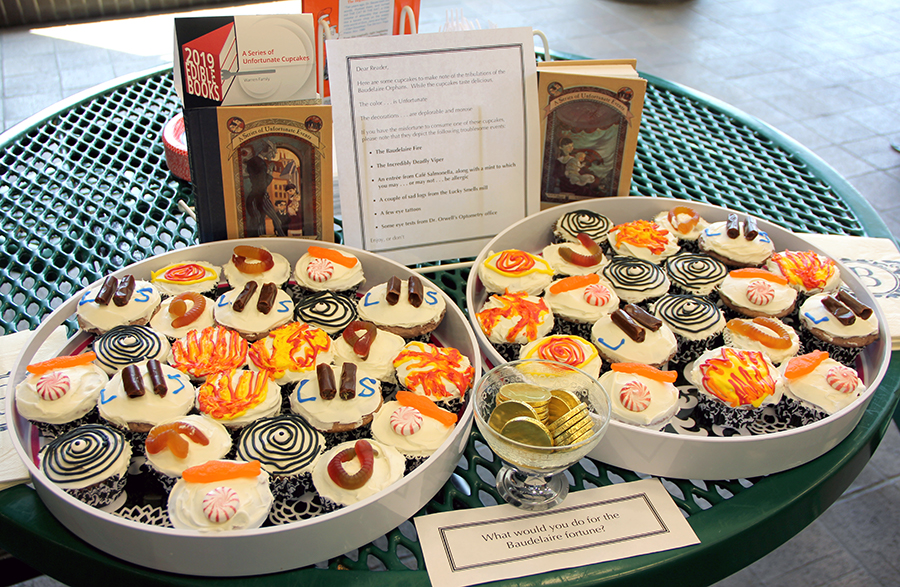
Best Overall – A Series of Unfortunate Cupcakes by the Warren Family
The University of Cincinnati Libraries celebrated the International Edible Books Festival on April 1, 2019.
Twenty edible books were created by students, faculty, staff, librarians, friends and family. The entries ranged from children’s books to literary classics to popular fiction and self-help books. The edible books were made of cakes, cookies, candy, deviled eggs and even carrots. Each entry was judged by our esteemed judges Debbie Tenofsky and Mary Anne McMillan and awarded a bookmark.
Created by librarian Judith A. Hoffberg and artist Béatrice Coron, the International Edible Books Festival is held worldwide annually on or around April 1st to mark the birthday of Jean Brillat-Savarin, author of The Physiology of Taste. The global event has been celebrated since 2000 in various parts of the world, including in Australia, Brazil, India, Italy, Japan, Luxembourg, Mexico, Morocco, The Netherlands, Russia and Hong Kong.
UC Libraries has participated in the International Edible Books Festival since 2001. The 2019 winners ares:
- Most Humorous – After the Party by Olya Hart
- Most Whimsical – The Monster at the End of This Book by Melissa Cox Norris
- Most Literary – The Adventures of Huckleberry Finn by Ben Kline and Aaron Libby
- Most Creative – The Giving Tree by Jessica Ebert
- Most Magical – Good Night Moon by Michelle Matevia
- Most Adorable – Owl Moon by Debbie Weinstein
- Most Clever – The Amazing Spider-Man by Sam Norris
- Most Delicious – All New Square Foot Gardening by Luahna Winningham Carter
- Most Deadly – Where the Red Fern Grows by Jack Norris
- Most Checked Out – Green Eggs and Ham by Sami Scheidler
- Most Fun – Middlemarch by Steve Norris
- Most Taboo – Human Resources or was it Human Remains by Aja Hickman
- Scariest – Ring by Holly Prochaska
- Most Imaginative – The Life-Changing Magic of Tidying Up by Jenny Mackiewicz
- Silliest – Too Many Carrots by Melissa Cox Norris
- Most Outrageous – A Dance with Dragons by Sam Kane
- Best Overall – A Series of Unfortunate Cupcakes by the Warren Family
- Best Student Entry – The Little Prince by Emma Duhamel and Eli Seidman-Deutsch
Congratulations to all the edible books creators! View the entries and the winners on the UC Libraries Facebook page. See you next year for Edible Books 2020!

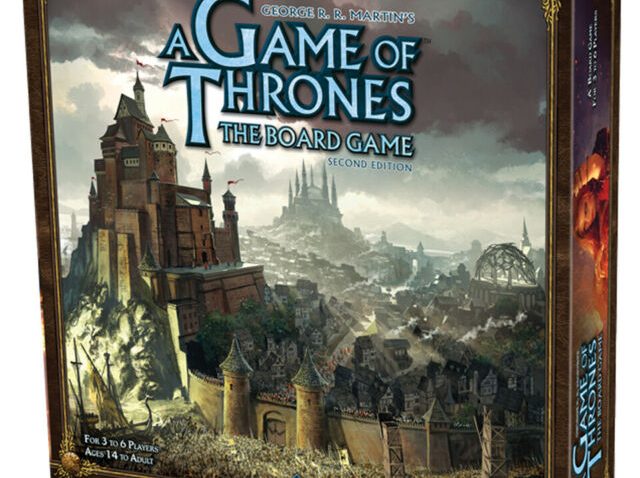 The Student Technology Resources Center (STRC), located on the fourth floor of the Walter C. Langsam Library, has collaborated with the UC Gaming Club to be named an official Game Lab. As such, the STRC currently lends out approximately 20 board and card games with more added weekly. The newest board game, Game of Thrones, promises to be popular.
 Why do you come to the library? What kind of furniture do you want? What inspires you? These are some of the questions UC Libraries is asking users to consider as they provide input on possible changes to a large area within the library.