Read Source, the online newsletter, to learn about the news, events, people and happenings in UC Libraries

source graphic

Read Source, the online newsletter, to learn about the news, events, people and happenings in UC Libraries.

In this issue of Source, Liz Kiscaden, dean and university librarian, writes about a new global library collaboration with the library at the University of Cape Coast in Ghana. We announce the opening of two renovated library spaces: the Science Library and the CECH Library Reading Room as we bid a fond farewell to Crosley Tower. We highlight library services in the CECH Library to improve accessibility and our expanding Evidence Synthesis group. Library collections are on display in the Chem Bio building renovation featuring the Oesper Collection and online in a new exhibit by the Archives and Rare Books Library about the Bronson v. the Cincinnati Board of Education. Spring is events season in UC Libraries, and we feature those currently on the calendar.

Read these articles, as well as past issues, on the website. To receive Source via e-mail, contact melissa.norris@uc.edu to be added to the mailing list.

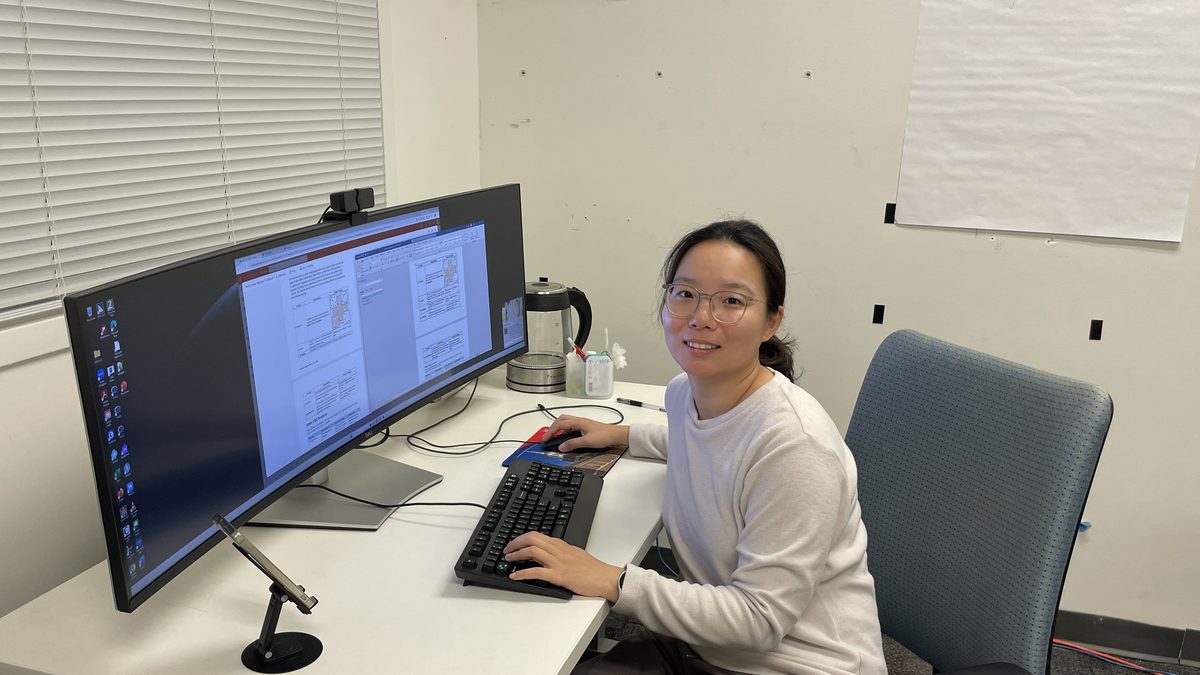
Welcome Weiye Li, GIS Research Consultant for Research and Data Services

Weiye is a PhD candidate in Geography at the University of Cincinnati. Originally from Shenzhen, China, he earned both his bachelor’s and master’s degrees in Land Resource Management at China University of Geosciences.

His research focuses on geospatial data science, socio-environmental sustainability, and health geography, with a particular interest in applying advanced modeling and algorithms to understand human–environment interactions. He has contributed to several projects including land management, nature-based climate solutions, and urban perception analysis using street-view imagery, and has presented his work at academic conferences such as the American Association of Geographers (AAG) annual meeting.

As a GIS Collab consultant, Weiye looks forward to supporting others while continuing to expand his analytical toolkit in GIS-related analysis. He can share information, offer advice, and even partner on certain projects (on a case by case basis).

The Data & GIS collab is located in 412 Langsam with the hours of

Monday 9:00 am – 5:00 pm

Tuesday: 9:00 am – 1:00 pm

Wednesday: 9:00 am – 2:00 pm

Thursday: 9:00 am – 1:00 pm

Friday: 9:00 am – 2:00 pm

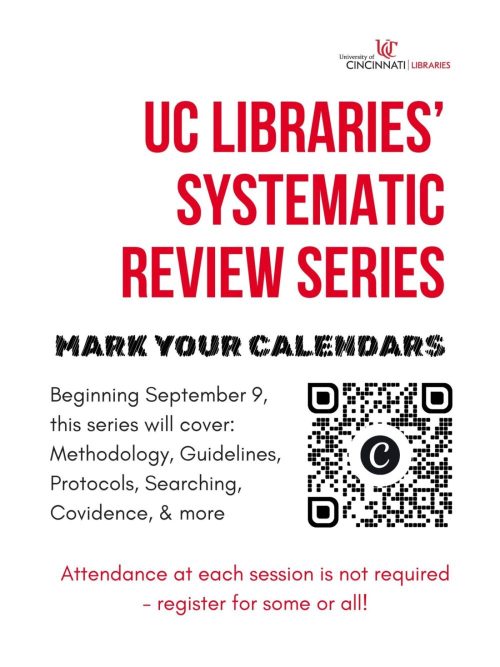
2026 Systematic Review Workshop Series

The University of Cincinnati Libraries is again offering the popular series of workshops on systematic reviews. Through these students, staff, and faculty can learn about and work through various components of the review process – from protocol to data extraction – with the support of experienced librarians. Attendance at each session is not required, so pick those that best fit your need! More information and registration can be found at OneStop.

Recordings and PowerPoints will be shared with all those that register. Please let us know if you have any questions!

Health Sciences Library Resources

The Health Sciences Library provides access to hundreds of resources – from journals and books to flashcards and test banks.

It can be difficult to find and access these resources (we know our website is a bit clunky) so our librarians have created libguides to provide easy access to popular and subject specific resources. Be sure to bookmark the links that are relevant to your areas!

A group of images showing various resources.

If you are interested in exploring all databases, check out the A-Z database list.

Contact the HSL if you encounter any issues finding, accessing or using the library’s resources!

New Nursing Resource Spotlight – Dynamic Health – CDS + Skills 

By Lynn Warner

Our newest Nursing Resource is Dynamic Health – CDS + Skills. This resource not only replaces Nursing Reference Center Plus subscription; it includes many of the same great features and more. Dynamic Health combines everything you need–skills checklists, clinical answers, and evidence-based guidance–all in one simple tool designed for nurses and allied health professionals. All of the content is reviewed and edited by experts in the field and thoroughly cited using credible references. Users can even claim continuing education credits by using the resource. There is also an option to download the Dynamic Health app, so you can always have the resource handy. 

Dynamic Health can be accessed through the Nursing Resource Guide, as well as through the UC Libraries A-Z Database list.  

Resources contained in Dynamic Health include: 

  • Cultural Overviews – focuses on caring for patients from various faiths and heritages
  • Diseases/Conditions – detailed overviews of diseases and conditions
  • Signs/Symptoms – guidance on possible medical conditions
  • Tests/Labs – information on imaging tests, lab tests, assessments, and diagnostic procedures
  • Interventions – guides to treatments and actions
  • Skills – contains nursing, health profession, clinical assistant, cultural care, and patient instruction skills
  • Drug Monographs – with information from Davis’s Drug Guide for Nurses
  • Patient Handouts – patient-friendly information on diseases & conditions, procedures & tests, health & wellness, and discharge instructions. All can be printed in PDF format, many in a variety of languages.
  • Leadership – topics related to leader development, human resources, professional development, case management, and more

To learn more about using Dynamic Health, you can sign up for live trainings offered through Ebsco.  

Questions? Reach out to the Health Sciences Library

Updates for Data Sharing at UC

The UC Office of Research supported repository  UCFigshare is now available for data deposits resulting from any Federal Funder.  If you are funded by any of the 15 federal agencies such as NIH or NSF which have a data sharing requirement as part of the grant, you can contact the UCFigshare team and request access to deposit.  The UCFigshare website provides instructions on how to request storage, upload datasets, and use the system. It also provides important budget considerations.

Research data sharing has been encouraged as a part of grant funding since the publication of the 2013 Holdren memorandum entitled “Expanding Public Access to the Results of Federally Funded Research”.  The 2022 Nelson OSTP memorandum accelerated the timeline and included required sharing the article and the data supporting without embargo as soon as the grant period ends.  Under the recent May 2025 executive order entitled Restoring Gold Standard Science, this is still the case that federally funded research data needs to be shared per the agency policy (1). It is now required to indicate the repository where you will share the data as part of the data management and sharing plan (DMSP). 

Agencies with Updated Policies in Effect

AHRQ | CDC | Ed | DOE | EPA | FDA | IMLS | NASA SMD | NEH | NIH | Smithsonian

Agencies with Updated Policies Published but not yet in Effect

ACF | ACL | Census | CMS | CPSC

Even if your research is not funded by a federal agency, sharing research data can benefit a researcher greatly.  Research data sharing accelerates research discovery, facilitates research reproducibility, helps identify issues with the data, and increases research impact.  Sharing the data and other research outputs such as registrations, protocols, code, and preprints helps the next generation of researchers better understand and reuse the outputs. Data sharing comes with the cost of extra time invested to create good documentation and uploading the data and other project associated research outputs to the designated repository.  Planning from the start of any project can help ease this additional labor.  These planning steps are also part of writing the DMSP accompanying a grant application.  Some recommended steps (2) are:

  • Identify a data repository as early as possible for the informed consent forms and to specify in the DMSP
  • Establish a file naming convention and organization
  • Include file-level Information
  • Keep track of sensitive information
  • Keep memos about analytic decisions
  • Create a “data narrative” and a readme file
  • Prepare your data for sharing
  • Make a human readable form and a raw / machine readable form
  • Promote your data  

UC researchers have several platforms for data sharing including the Office of Research managed UCFigshare, and UC Libraries managed repositories such as the Qualitative Data Repository (QDR), Inter-university Consortium for Political and Social Research (ICPSR), the Open Science Framework (OSF), and Scholar@UC. UC Libraries Research and Data Services unit can advise researchers on data management and sharing plans, metadata, and workflows. Email askdata@uc.edu if you have questions, need assistance, or want to learn more about university resources. 

References

(1) Badger, K., Biszaha, A. Sadvari, S., and Walsh, M., 2025 Federal Sponsor Updates to Article and Data Sharing [Webinar]. Ohio State University Library. 12-11-2025. Personal communication.

(2) Karcher, Sebastian; Kirilova, Dessi; and Page, Christiane, “Sharing and Managing Qualitative Data” (2019). Moynihan Institute of Global Affairs. 2. https://surface.syr.edu/miga/2

UC Libraries will open at 10 a.m. Friday, Dec. 12, except for HSL which will open at 7:45 a.m.

Due to inclement weather, University of Cincinnati campuses are closed from 6 a.m. to 10 a.m. Friday, Dec. 12, 2025. Visit Commencement and Registrar’s pages for additional details. This closure applies to all UC Libraries locations except for the Donald C. Harrison Health Sciences Library, which will be open at 7:45 a.m.

snowy campus