Open Scholarship includes all open practices such as open data, open educational resources, and all other forms of open tools used in scholarly and research environments. This practice doesn’t solely focus on the end product of journal articles or textbooks, but the sharing and collaboration of its practitioners.
Learn more about open scholarship from authors George Veletsianos and Royce Kimmons from the University of Text at Austin in the article “Assumptions and challenges of open scholarship.”
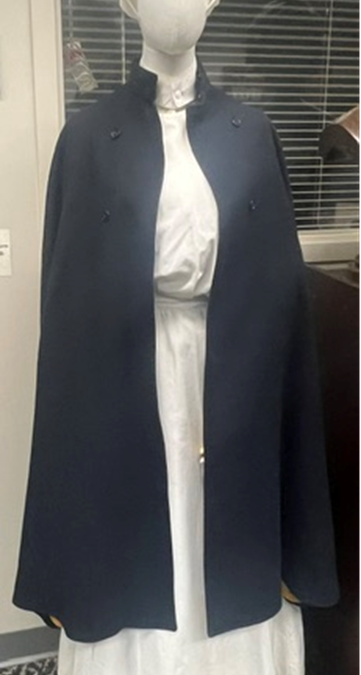
Inspired by the cholera epidemic of 1849, the Jews of Cincinnati, Ohio established the Jewish Hospital at the corners of Bauer and Central Avenue. Their hospital was one among three Jewish hospitals launched in the 19th century in the United States, which included Mt. Sinai Hospital in New York, New York and Touro Infirmary in New Orleans, Louisiana. These hospitals were established to assist the indigent poor, protect Jewish patients against discrimination and to insure the observance of Jewish traditions at the time of a patient’s death.
Traditionally, research findings were published in journal articles, but much of the data gathered in the process was seldom made available. Now funders, publishers, and institutions demand that both publications and supporting data be openly available. Open research does not stop at publications; it also includes all research outputs, such as data, code, and even open peer review. Open access can help increase the impact of research and potentially speed up new discoveries.
Federal policies require researchers to deposit federally funded research in open data repositories. While open-access publishing makes research findings freely available to readers, open data repositories enhance transparency by providing access to the datasets underlying those findings. Open access publishing and open data repositories advance the principles of open science by promoting greater openness, reusability, and reproducibility in research. While open access publishing gives readers access to the story, open data repositories give readers access to the evidence behind the story, allowing others to examine and reuse it.
Open data repositories are places where researchers can share data to make it easier to find. Many open data repositories provide DOIs (digital object identifiers), or digital tags, to help researchers cite their data, support long-term storage, and meet funder and publisher requirements to share data. Sharing research data in a trustworthy open data repository can make your data more accessible, reusable, and compliant with FAIR (Findable, Accessible, Interoperable, and Reusable) principles.
Considerations for Selecting a Data Repository
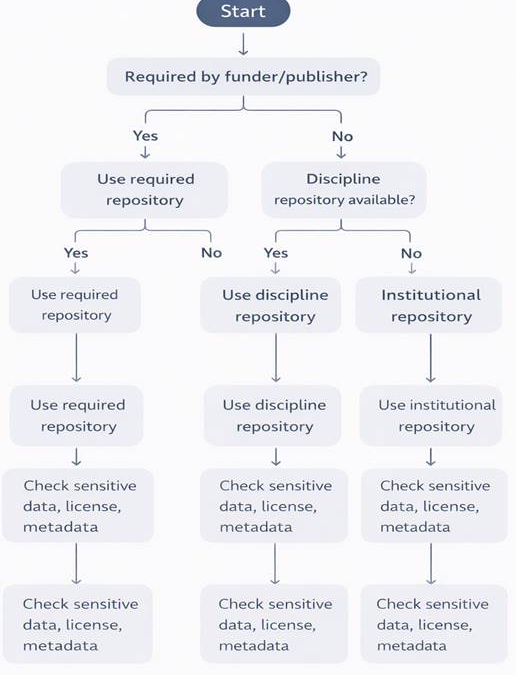
Simplified flowchart for choosing a research data repository. Created with BearChatGPT based on author specifications, October 14, 2026.
Selected Repository Options
Generalist Repositories
General repositories accept research data, code, and scholarly outputs regardless of subject matter, data format, or academic discipline. These are good options when no disciplinary repository exists.
Figshare: Supports datasets, code, figures, posters, presentations, and other research outputs. Provides DOIs, versioning, and sharing controls, making it popular among universities and research institutions. UCFigshare is the data repository available for federally funded University of Cincinnati researchers to promote the sharing of scientific data in compliance with. UCFigshare provides a data sharing platform consistent with the FAIR (Findability, Accessibility, Interoperability, and Reusability) data principles and is provided via a partnership between the Office of Research, UC Libraries, and DTS.
Zenodo: A free multidisciplinary repository that allows researchers to share datasets, software, publications, and other research products while receiving a DOI.
Dryad: A curated repository commonly used for datasets associated with scholarly publications, particularly in the life and environmental sciences.
Domain Specific Repositories
Domain-specific repositories are specialized repositories that collect, preserve, and share data, code, or research outputs tailored to a particular academic field, scientific discipline, or data type.
UK Data Service: Provides access to social, economic, and population data for research and teaching. The principal repository for economic, population, and social research data in the UK
Join UC Libraries in celebrating International Open Access Week 2026.
Research is a conversation. We build upon the insights and findings of those who’ve preceded us, and those we work in parallel with, to move our areas of study forward. Ideally, those conversations also push beyond the boundaries of the academy, informing work done by practitioners, industry, activists and government. But, not everyone is having the same conversation.
Paywalls and the considerable cost of journal subscriptions make research inaccessible to most people outside of research institutions, and access even within those institutions can be variable, particularly for our colleagues in the Global South. The goal of open access is to remove the barriers between research and those who can build upon it and employ it.
It’s hard to argue with that goal, but reaching it can be complicated and confusing for authors. UC Libraries can help. If you’re new to open access, or if you’ve struggled with navigating the open world in the past, this post unpacks a few open access basics and the supports open to UC scholars.
November brings National GIS Day. UC’s celebration is a collaboration of the Department of Geography & GIS and UC Libraries, and sponsored by the Office of the Provost. GIS or Geographic Information Systems is a powerful tool for analyzing spatial data to identify patterns, solve problems and better understand the world we live in. Please join us on November 18, 2026 in the Faculty Enrichment Center from 10 am to 2 pm for lightning talks featuring UC researchers across disciplines, lunch, and a careers panel.
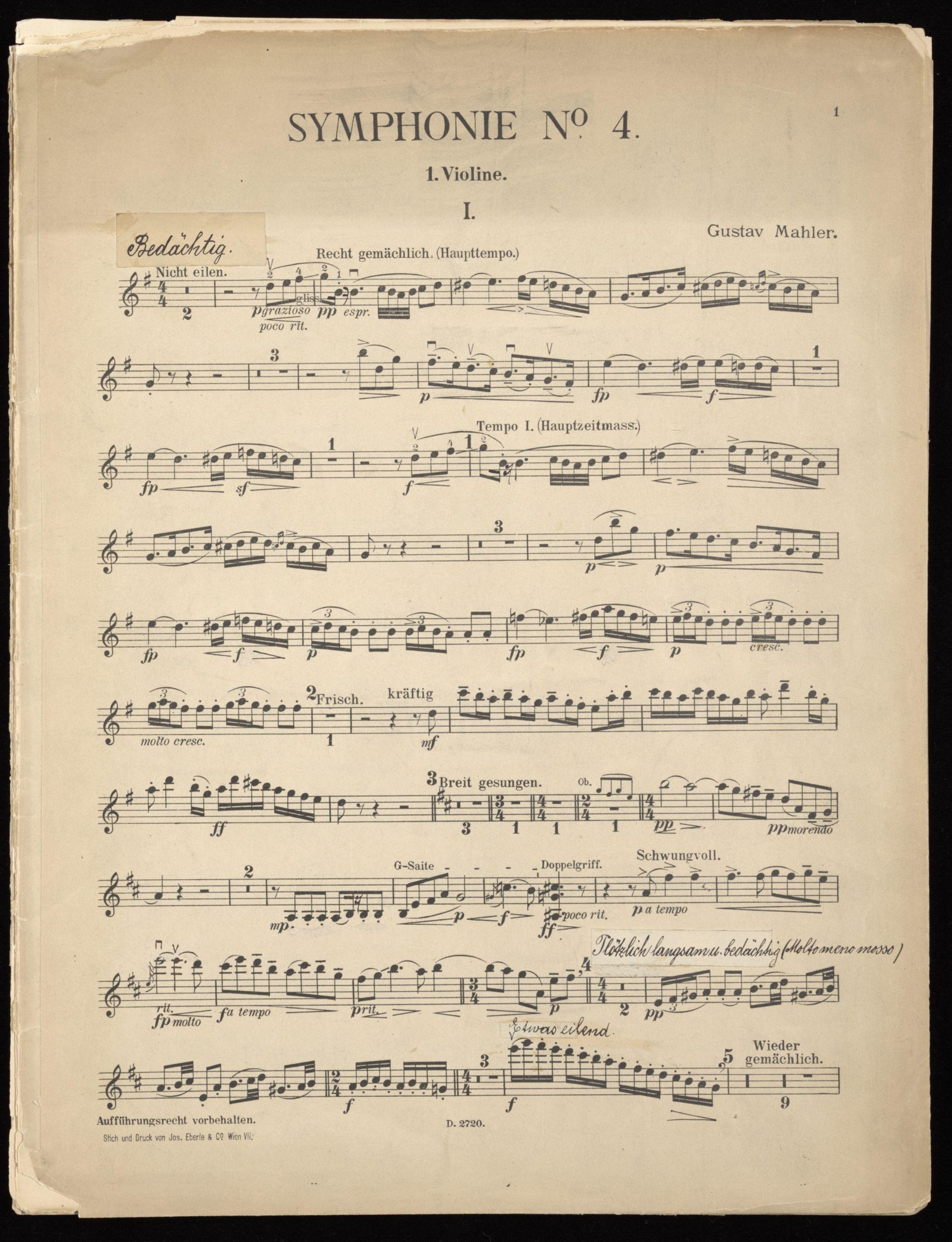
A single part of a symphony can open the door to a world of story-telling. As the CCM Philharmonia presents the music of Mahler’s Symphony No. 4 on October 16, 2026, the CCM Library shares the story of the violin I part held in the Theodore Spiering Collection.
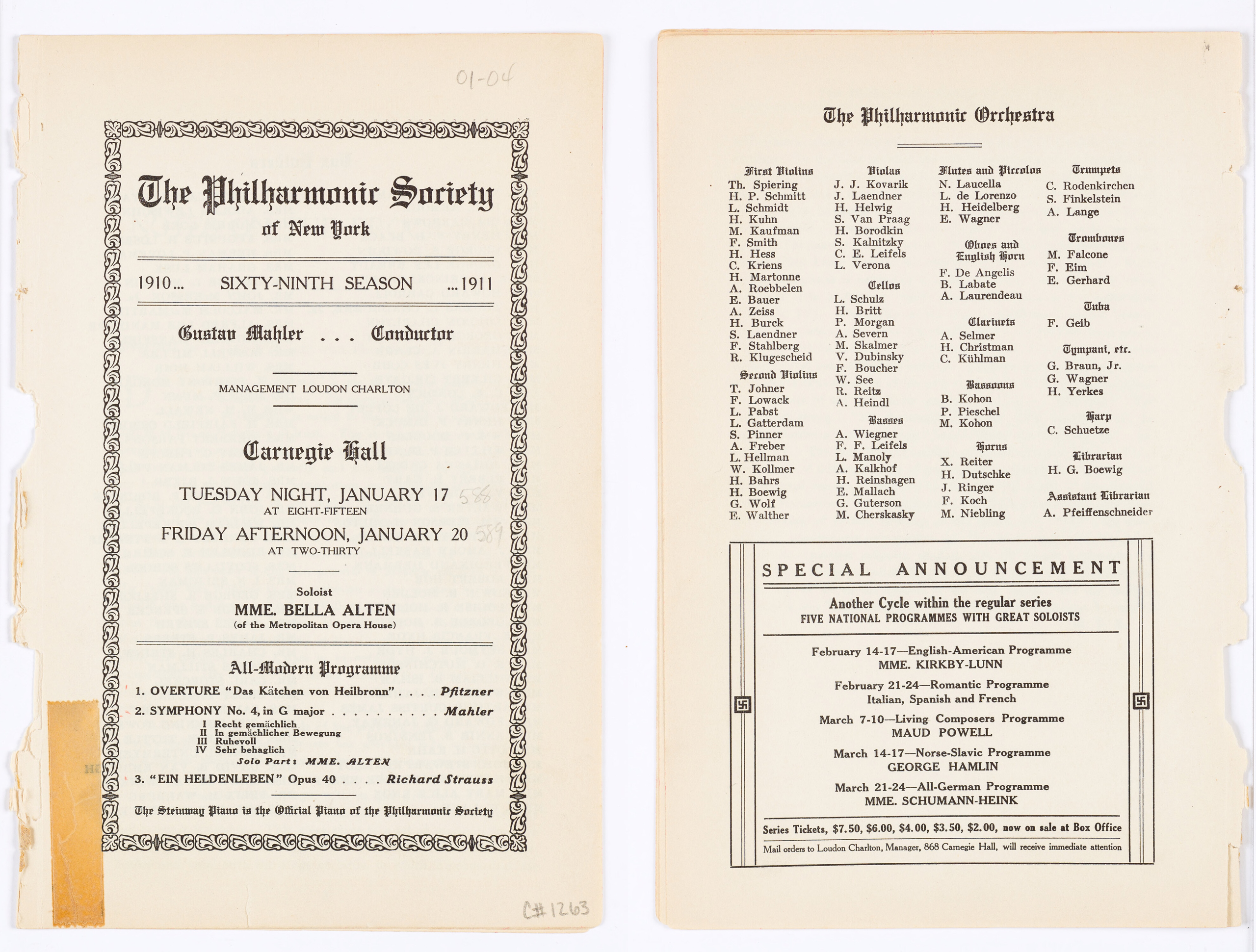
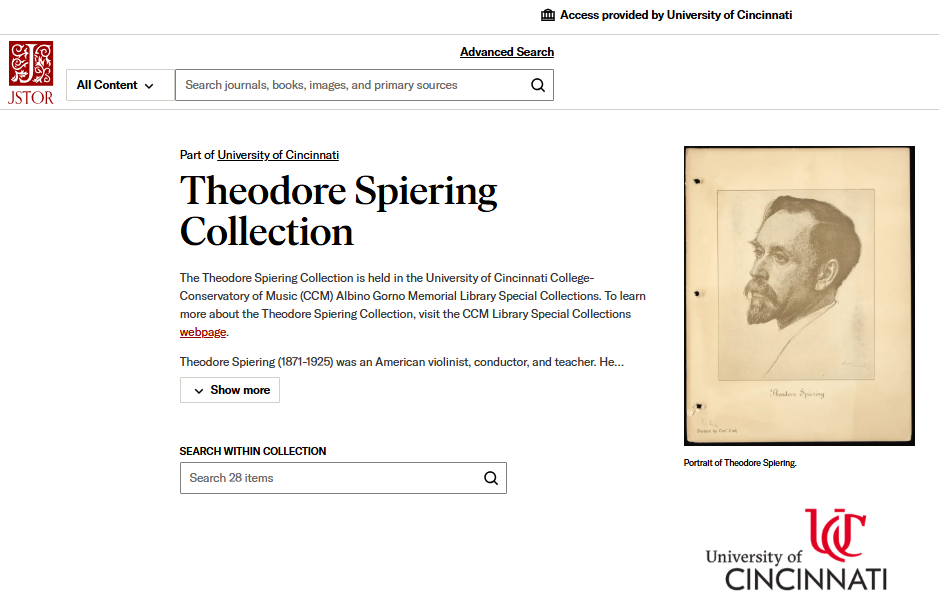
The Albino Gorno Memorial / CCM Library Special Collections holds a collection of annotated sheet music that belonged to Theodore Spiering (1871-1925), an American violinist, conductor, and teacher. Spiering studied violin with Henry Schradieck at the College of Music of Cincinnati in the 1880s before moving to Berlin to study with Joseph Joachim. Spiering later performed as concertmaster for the New York Philharmonic under Gustav Mahler from 1909 to 1911 and conducted the final seventeen concerts of 1911 during Mahler’s illness. On January 17 and 20, 1911, the New York Philharmonic performed Mahler’s Symphony No. 4 with Spiering as concertmaster and conducted by Mahler. A highlight of the Theodore Spiering Collection is the violin I part of the symphony, bearing edits and paste-overs of performance markings and notation. While the violin part in the Spiering Collection was evidently not used in the 1911 performances, the background of the marked-up sheet music illuminates a rich snapshot of the symphony’s editorial and performance history.
Page 1 of the Spiering violin I part of Mahler’s Symphony No. 4, digitized on JSTOR. Theodore Spiering Collection, Albino Gorno Memorial College-Conservatory of Music Library Special Collections, University of Cincinnati. https://www.jstor.org/stable/community.42074264
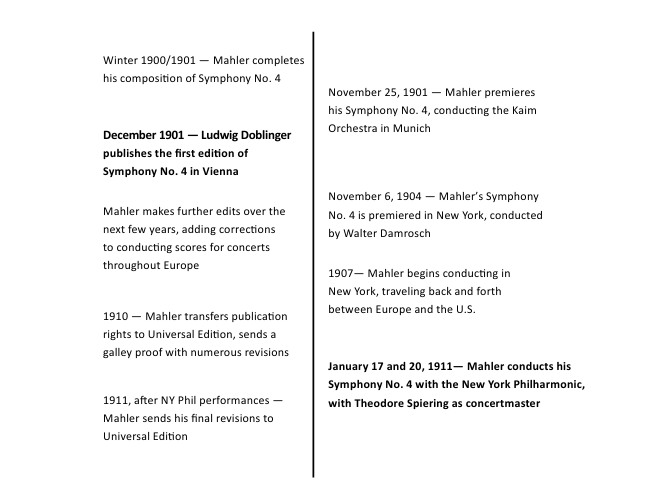
Gustav Mahler (1860-1911) began composing his fourth symphony in 1899 and completed it during the winter of 1900/1901, though he continued to refine the orchestration of the piece over the next several years. Mahler sent his score of the symphony to the publisher and requested a proof to use during a reading rehearsal with the Vienna Philharmonic in October, as he wanted to hear what it sounded like before it was published. It is not clear if the publishing house also provided proofs of the parts—it is possible the musicians performed from manuscript parts when the symphony was premiered in Munich by the Kaim Orchestra on November 25, 1901. The first edition was engraved and printed by Josef Eberle and published by Ludwig Doblinger in Vienna in December 1901.
Mahler made further edits over the next few years, adding corrections to conducting scores for performances given by Willem Mengelberg in Amsterdam in 1904 and by Richard Wickenhauser in Graz in 1905. In 1910, Mahler transferred publication rights to Universal Edition and sent to the publisher a galley proof with numerous revisions. After Mahler conducted the piece with the New York Philharmonic in January 1911, he sent his final corrections to Universal Edition.
Mahler’s Symphony No. 4 premiered in New York on November 6, 1904, performed by the New York Symphony conducted by Walter Damrosch. Beginning in 1907, Mahler traveled between the U.S. and Europe, spending time in New York each season conducting with the Metropolitan Opera, New York Symphony Orchestra, and New York Philharmonic. Mahler conducted his Symphony No. 4 with the New York Philharmonic in January of 1911, a significant occasion of the composer interpreting his own work with the ensemble.
Timeline of Mahler’s publishing and performance activities surrounding Symphony No. 4, 1900-1911Program of the January 1911 New York Philharmonic performances of Mahler’s Symphony No. 4, conducted by Mahler, with Theodore Spiering as concertmaster. Program ID: 1263. New York Philharmonic Shelby White and Leon Levy Digital Archives. https://archives.nyphil.org/asset-management/2TTUGPT6VOQA?WS=2TTURYF6K50F
For the January 1911 performances, the New York Philharmonic used the 1901 Doblinger first edition orchestral parts, which had been marked up with Mahler’s revisions by Viennese copyist Johann Forstik. Theodore Spiering performed as concertmaster during these January 1911 performances—the violin I part held in the CCM Library Special Collections is also the Doblinger first edition and was also marked up by Forstik, though it evidently does not belong to the New York Philharmonic set of parts. The violin part of the New York Philharmonic set bears annotations not present in the CCM Library Spiering part, including bowings, dynamics, notation edits, and rehearsal letters in blue, red, and graphite pencil. Shortly after the January 1911 New York performances, Mahler fell ill. Spiering took over as conductor of the New York Philharmonic while Mahler traveled back to Vienna, where he died on May 18, 1911.
The Mahler Symphony No. 4 violin I part from the Theodore Spiering Collection has been digitized by the UC Libraries Digital Initiatives Team. It is accessible on JSTOR, along with many other pieces from the Theodore Spiering Collection. Materials in the Theodore Spiering Collection were donated by Lenore Spiering, Theodore Spiering’s daughter.
Landing page of the Theodore Spiering Collection on JSTOR, digitized by the University of Cincinnati Libraries Digital Initiatives Team. https://www.jstor.org/site/uc/spiering
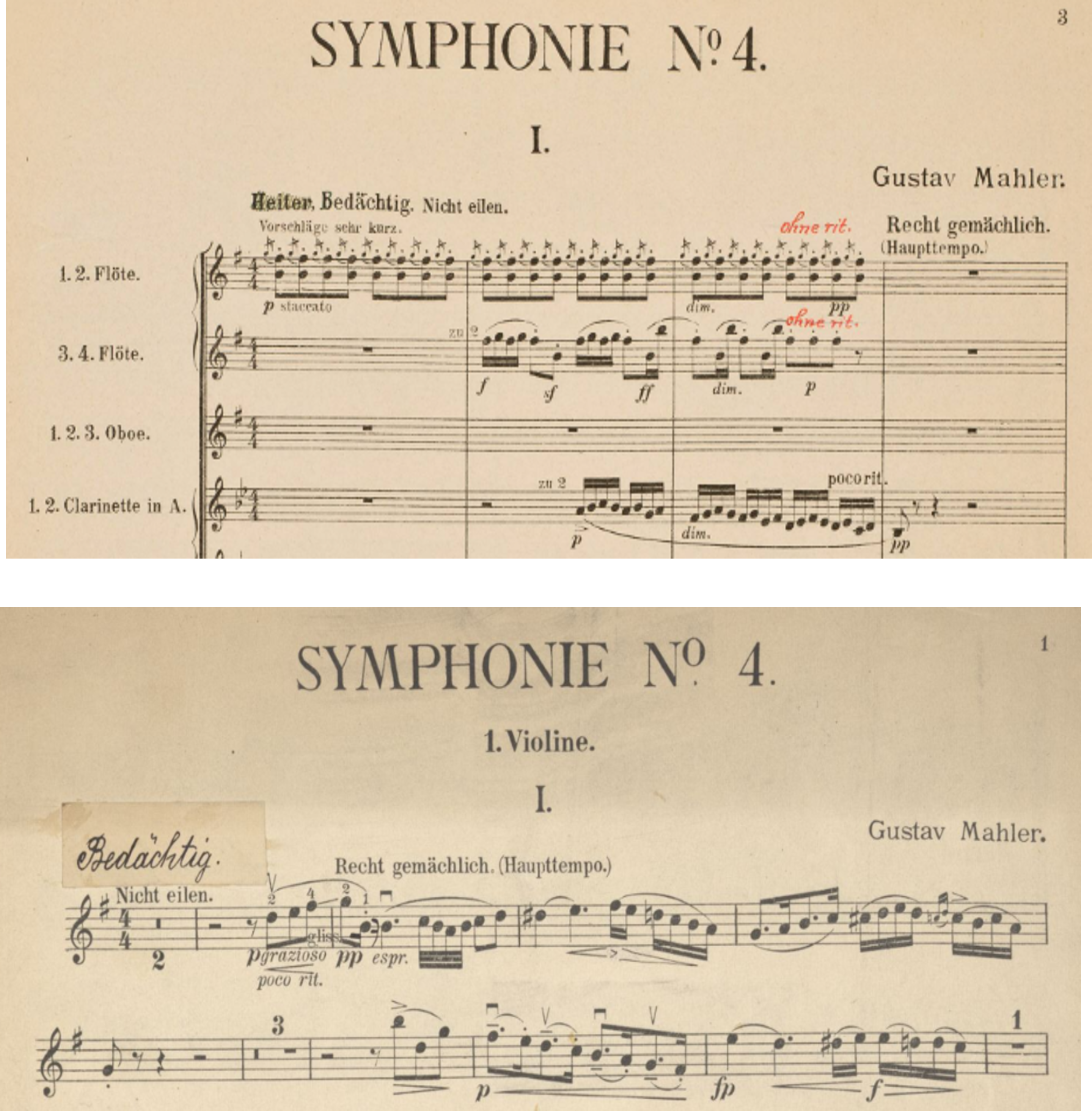
As you explore the revisions and paste-overs, you can compare to a digitized score of Mahler’s Symphony No. 4 from the NY Philharmonic Archives, which shows more clearly what was in the score prior to the changes. Image 7 is the cover page of the Doblinger first edition with a note indicating red corrections after Mahler and green corrections after later Universal Edition revisions. You will see significant changes right from the beginning: the Spiering part has a paste-over of “Bedächtig” (deliberately) at m. 1, which is covering the original marking of “Heiter, Bedächtig” (cheerful, deliberately). Imagine the different interpretive ways the music would feel and sound as you explore the revisions!
Top: Score of 1901 Doblinger edition with inked revisions. Mahler, Gustav – SYMPHONY NO. 4 IN G MAJOR – Score. Library ID: 2175. New York Philharmonic Shelby White and Leon Levy Digital Archives. https://archives.nyphil.org/asset-management/2TTUGPYF7IT6?WS=2TTURYFJ1D6S Bottom: Spiering violin I part of Doblinger edition with pasted-over revision. Theodore Spiering Collection, Albino Gorno Memorial College-Conservatory of Music Library Special Collections, University of Cincinnati. https://www.jstor.org/stable/community.42074264
Gustav Mahler, Symphonie Nr. 4 für Sopran-Solo und Orchester, ed. Christian Rudolf Riedel (Wiesbaden: Breitkopf & Härtel, 2019).
“Theodore Spiering,” promotional booklet, Theodore Spiering Collection, Albino Gorno Memorial College-Conservatory of Music Library Special Collections, University of Cincinnati.
“Theodore Spiering, Composer, Is Dead,” New York Times, 14 August 1925, p. 13. ProQuest Historical Newspapers: The New York Times.
James L. Zychowicz, Mahler’s Fourth Symphony (New York: Oxford University Press, 2000).
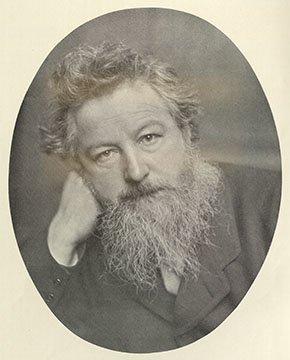
When English designer William Morris died at the age of 62 in October 1896, his physician stated that the cause of his death was “simply being William Morris, and having done more work than most ten men.” The University of Cincinnati Libraries and the Archives and Rare Books Library are currently celebrating the life of Morris and his many roles — designer of stained glass, tapestries, wallpaper, chintzes, furniture, books, and typefaces, as well as preservationist, socialist, poet, novelist, lecturer, calligrapher, translator of Icelandic and English sagas, and founder of the Kelmscott Press – with an exhibition entitled “The Ideal Book: William Morris and the Kelmscott Press” in Blegen Library now through February 2027.
Associated with the Pre-Raphaelite Brotherhood of artists and critics of the mid-19th century, Morris went on to become a leading figure in the later Arts and Crafts movement. His great passions in life were design, aesthetics, and the production and preservation of cultural heritage. Morris was an incredibly detailed and thorough designer and craftsman, but he was motivated not by the end product itself, but rather by the values represented in their making.
The exhibition touches upon Morris’ life; the founding of his design firm, Morris & Co.; and his interest in socialism, while focusing on the founding of the Kelmscott Press, Morris’ most enduring legacy, which produced 52 hand-printed books from 1891 to 1898. The Kelmscott Press was founded after Morris attended a lecture by printer Emery Walker in November 1888, and Morris’ goal was nothing less than to produce the “ideal book.” With a dislike for the mechanization of printing during that time, Morris and his associates found inspiration in 15th century book traditions.
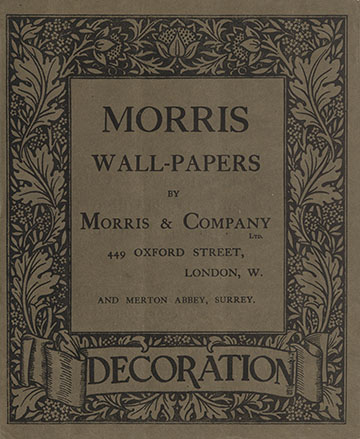
Morris and Company Catalog
The Archives and Rare Books Library preserves a small, but growing set of Kelmscott titles as well as pamphlets and books by Morris and manuscript materials about Morris. Stop by the fourth floor lobby of Blegen Library to view the exhibition and contact us at archives@ucmail.uc.edu to learn more about our Morris and Kelmscott holdings. We also wish to thank our colleagues at the DAAP Library for lending some of their holdings for display in the exhibition.
“I began printing books with the hope of producing some which would have a definite claim to beauty…. –W. Morris, “The Ideal Book”
The last book printed at the Kelmscott Press, which was sold by the trustees of William Morris. Note by William Morris on His Aims in Founding the Kelmscott Press [Z232.M87 M7]
Read Source, to learn about the news, events, people and happenings in UC Libraries. This year marks the 25th anniversary of the newsletter! To mark the occasion, Source underwent a design refresh to both the graphics and website to herald the publication into the next quarter century.
In this issue of Source, Liz Kiscaden, dean and university librarian, welcomes everyone back to the start of the academic year, while a photo slide show features early outreach activities welcoming Bearcats to campus. And don’t miss a list of Fall Events taking place throughout UC Libraries. The Source @ 25! article talks about some of the changes at UC Libraries documented by Source, and an interview with the Preservation Lab’s Jessica Ebert marks her upcoming 20th anniversary at UC Libraries. A new exhibit on display in the Archives and Rare Books Library explores Cincinnati’s growth and transit transformation from its founding in 1788 to the present day, and the CEAS Library launches a wellness collection. And for those who can’t travel to campus, UC Libraries digital collections are now available via Preservica for viewing online.
Read these articles, as well as past issues, on the website. To receive Source via e-mail, contact melissa.norris@uc.edu to be added to the mailing list. Happy reading.
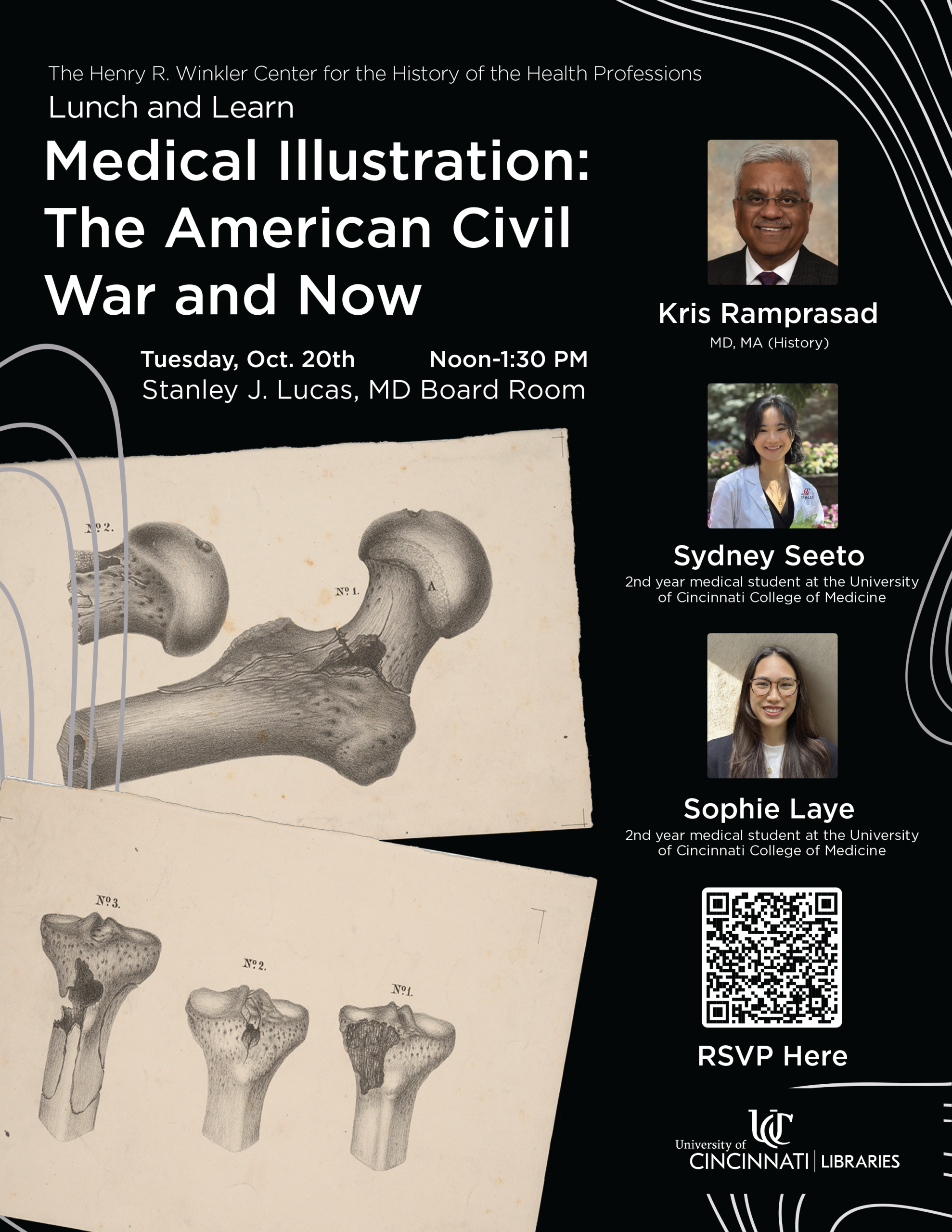
Join the Henry R. Winkler Center for the History of the the Health Professions Tuesday, Oct. 20, NOON-1:30PM, in the Stanley J. Lucas, MD, Board Room, Health Sciences Library, for a lunch & learn to explore Medical Illustration: The American Civil War and Now. Speakers: Kris Ramprasad, MD, MA (history) and retired UC associate professor, Sydney Seeto and Sophie Laye, both second-year medical students at UC’s College of Medicine, will discuss the Daniel S. Young archives.
Dr. Ramprasad will discuss the varying injuries of the Civil War through his eyes and how these illustrations should be viewed, understood and appreciated now – updating our understanding of the care provided at that time. As co-presidents of the Medical Art and Illustration, Sydney and Sophie will discuss the modern process for creating a medical illustration, showcasing their own work and explaining plans for the Medical Art club for the upcoming year.
The lunch & learn is free and open to all to attend, but RSVP is requested.
Following the lunch & learn, attendees can view the exhibit on display in the library featuring the medial illustrations by Daniel S. Young.
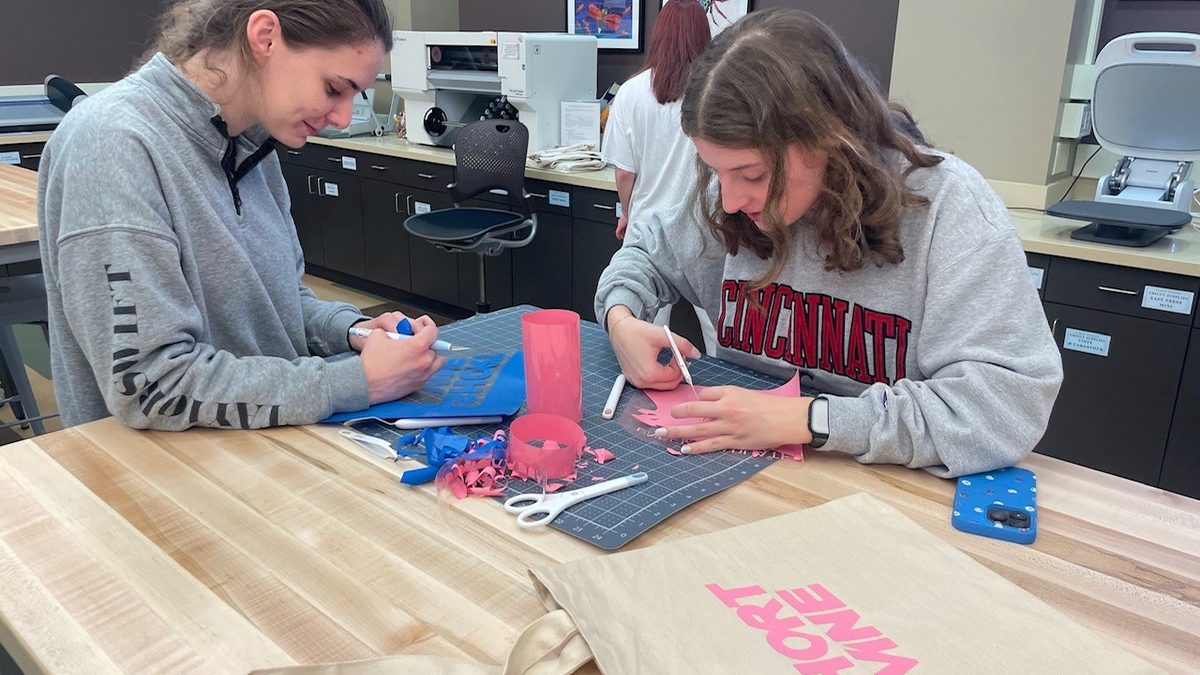
Curious about the MakerLab equipment and creative opportunities available in the CECH Library? Join us for a fall MakerLab workshop!
These hands-on sessions are designed to help you explore MakerLab tools and technologies while creating something of your own. Participants will leave with a small takeaway item and new skills to build on.


![The last book printed at the Kelmscott Press, which was sold by the trustees of William Morris. Note by William Morris on His Aims in Founding the Kelmscott Press [Z232.M87 M7]](https://libapps.libraries.uc.edu/liblog/wp-content/uploads/2026/10/Morris_Aims.jpg)